Want more images or videos?
Request additional images or videos from the seller
1 of 6

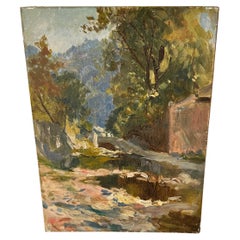
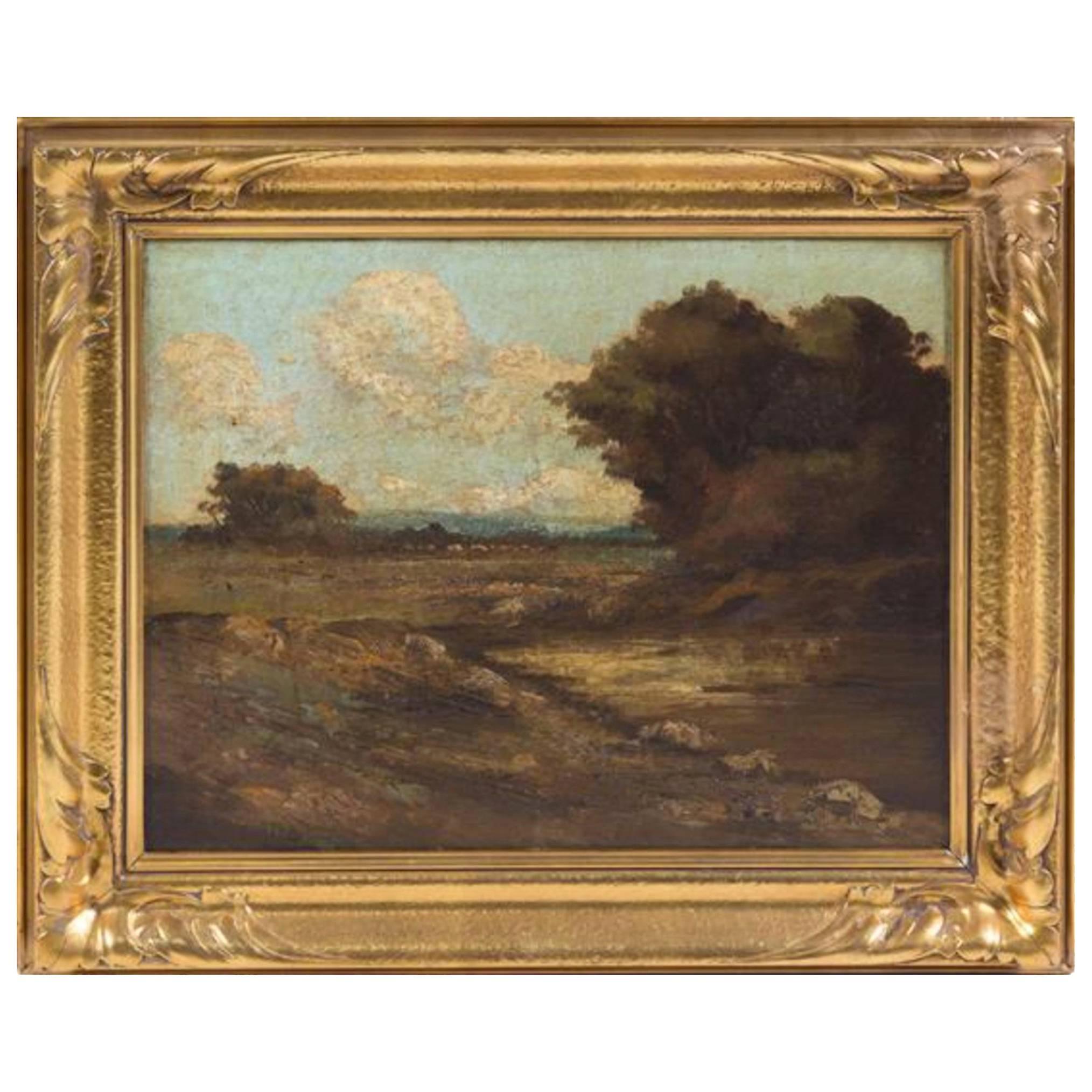
A Very Good 19th Century Italian Plein Air Macchiaioli School Landscape

$2,600
£1,983.25
€2,259.52
CA$3,654.32
A$3,986.77
CHF 2,110.97
MX$47,772.86
NOK 26,884.38
SEK 24,583.77
DKK 16,871.49

About the Item

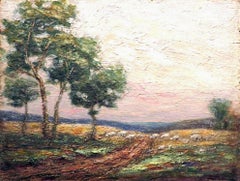
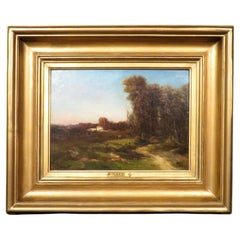
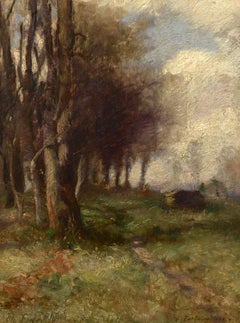
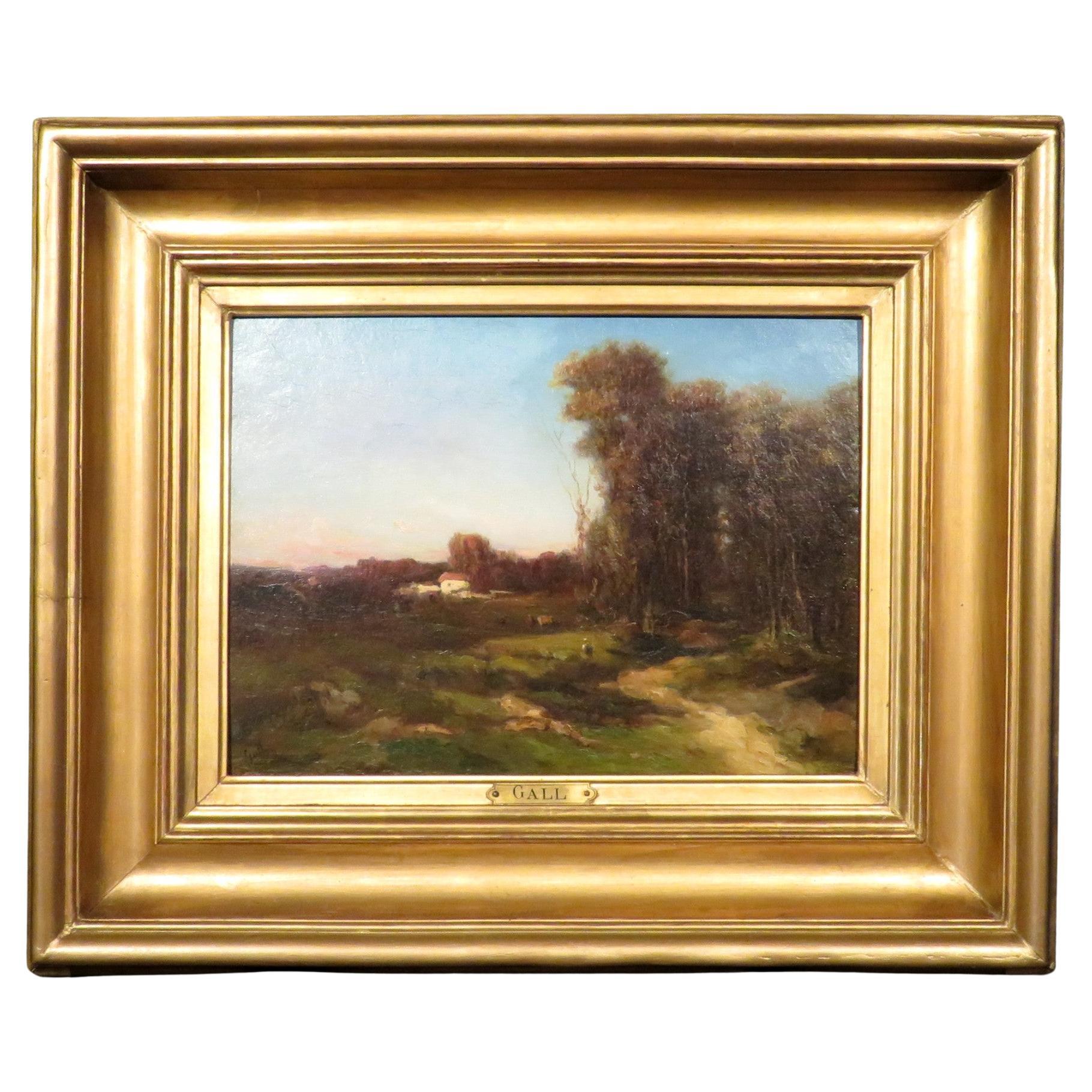
A finely executed 19th century Italian ‘plein air’ forested landscape, demonstrating a highly developed balanced application of natural light, texture shading. Oil on wood panel, signed P. Manzoni bottom right. Dimensions, (sight) 8.75" high x 12.25" wide, (framed) 14.75" high x 18.5". There is very little known about the Italian artist P. Manzoni, other than he was primarily a landscape painter working between 1850-1900. 'The Macchiaioli School' During the mid 19th century several French Barbizon School artists, including Poussin Tissot travelled to Italy to experience firsthand the unique Mediterranean sunlight, painting sketching throughout the Roman countryside. Then In 1859, inspired by these French artists, a group of Italian artists formed a group known as ‘The Macchiaioli’ (spot painters). This group strongly rejected the traditional Italian academy style of painting, choosing instead to leave the static confines of the artist’s studio in lieu of the more freeing experience of the ‘plein air’ or Barbizon School style method. They applied the natural elements of sunlight shade found within the forested landscapes, into contrasting ‘spots’, (macchie). This charming Italian forested landscape is one such fine example of the Macchiaioli School.
  • Creator:
    Piero Manzoni (Artist)
  • Dimensions:
    Height: 14.75 in (37.47 cm)Width: 18.5 in (46.99 cm)Depth: 2 in (5.08 cm)
  • Style:
    Barbizon School (Of the Period)
  • Materials and Techniques:
  • Place of Origin:
  • Period:
  • Date of Manufacture:
    Circa 1875
  • Condition:
    Wear consistent with age and use. No apparent restorations, other than perhaps having been previously cleaned.
  • Seller Location:
    Ottawa, CA
  • Reference Number:
    1stDibs: LU2728339125152

More From This Seller

View All
19th Century Barbizon School Pastoral Landscape, France, Circa 1890
By Leon Richet
Located in Ottawa, Ontario
A bucolic & sensitively rendered Barbizon School pastoral landscape depicting a lone figure shepherding a flock of sheep down a dusk lit country road. Although signed illegibly, thi...
Category

Antique Late 19th Century French Barbizon School Paintings

Materials

Wood, Canvas, Paint

A Finely Executed Plein Air Barbizon Style Landscape by Francois Gall
By François Gall
Located in Ottawa, Ontario
A fine & sensitively executed Barbizon 'plein-air' style landscape depicting rural figures in a treed setting. Oil on wood panel, measuring 9" high x 12.25" wide, signed bottom left...
Category

Vintage 1930s French Barbizon School Paintings

Materials

Paint, Wood

A Fine 19th C. Barbizon Inspired Landscape by W.E. Atkinson, Canadian OSA. ARCA
By William Edwin Atkinson
Located in Ottawa, Ontario
A finely executed 19th century ‘plein air’, Barbizon School inspired landscape by noted Canadian artist W.E. Atkinson. OSA. ARCA. Oil on canvas, signed & dated 1894 bottom left. ...
Category

Antique Late 19th Century Canadian Barbizon School Paintings

Materials

Canvas, Wood, Paint

20th Century Landscape Watercolour by John Atkinson, British (1863-19240)
By John Atkinson
Located in Ottawa, Ontario
A very good 19th century watercolor depicting a pastoral landscape with haycarts, mounted with archival acid free materials and signed bottom left. Measures: 6.75” x 9.75” (sight). Framed dimensions, 10.75" high x 13.75" wide x .75" deep. John Atkinson (1863-1924) was a highly regarded British landscape artist working in watercolours, oil & tempera. He was born in Newcastle, he attended classes at the Newcastle School of Art where he is said to have briefly studied under Wilson Hepple...
Category

Early 20th Century English Paintings

Materials

Paper

A Fine 20th C. British Watercolor Plein Air Landscape by Henry John Kinnaird
By Henry John Kinnaird
Located in Ottawa, Ontario
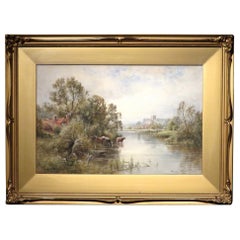
A finely executed early 20th century 'plein air' landscape by noted British landscape artist Henry John Kinnaird, titled ‘View of Winchester Cathed...
Category

Early 20th Century British Edwardian Paintings

Materials

Other

A Fine Early 20th Century French Harbour Scene by Henri Alphonse Barnoin
By Henri Alphonse Barnoin
Located in Ottawa, Ontario
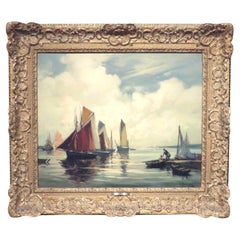
Henri Alphonse Barnoin (1882-1940) studied with Emile Charles Dameron at the Ecole des Beaux Arts in Paris. In 1912 he moved to the small commun...
Category

Early 20th Century French Beaux Arts Paintings

Materials

Canvas, Paint, Gesso

You May Also Like

Oil on Canvas Landscape by Henry Charles Payne IL, MA
Located in Dallas, TX
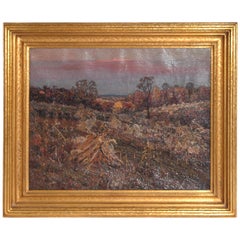
An American oil on canvas beautifully painted in a realistic manner of a hayfield. In the foreground and trees in the distance. Heavy impasto technique adds impressionist feeling. ci...
Category

Antique Late 19th Century American Barbizon School Paintings

Materials

Canvas, Wood

"a Fontainebleu, " Charles Francis DeKlyn, Barbizon, Oil, French Countryside
Located in Wiscasset, ME
Charles Francis De Klyn was born in Westchester County, New York, in 1865. A landscape, marine, portrait and figure painter, De Klyn studied in New York and Paris from 1886 to 1891, then taught at the Cleveland Art Club and the Cleveland School of Art. In 1893, he was one of the founders of the Cleveland Brush and Palette Club, and he exhibited at the National Academy of Design in 1894 and 1895. He was also a member of the Society of Western Artists. "A Fontainebleu" by Charles Francis De Klyn is a beautifully rendered Barbizon oil...
Category

Late 19th Century Barbizon School Landscape Paintings

Materials

Oil, Panel

Impressionist Italian Landscape Oil Painting, circa 1900
Located in Hamburg, DE
This atmospheric oil painting on canvas, created around 1900, captures the charm of the Italian countryside with an impressionist touch. The canvas has been mounted on artist’s board...
Category

Antique Early 1900s Italian Belle Époque Paintings

Materials

Canvas

Barbizon School, 19th Century Forest Landscapes Oil on Canvas
Located in Buchanan, MI
Barbizon School (19th century) Forest Landscapes oil on canvas; oil on board 13 3/8 x 21 3/8 inches.
Category

Antique 19th Century Barbizon School Paintings
Barbizon School Landscape, The Poplar Trees, Late 19th Century Oil on Wood Panel
Located in Cotignac, FR
Late 19th Century French Barbizon School oil on wood panel of poplar trees in a landscape by Richard. The painting is signed bottom left. The painting is on a quality chamfered panel. A very charming, almost impressionist, rendition of a line of iconic French trees in a landscape. Before them an earth drive has been ploughed up by the wheels of passing carts and horses. Richard has created a wonderful perspective that draws us in to the painting and he has created a contrast between the strong greens of the trees and fields against the whites and blues of the sky. The painting is reminiscent of the works of Monet from the 1890s. to whom the poplar trees were a continuing inspiration. The Barbizon school of painters was part of an art movement towards Realism in art, which arose in the context of the dominant Romantic Movement of the time. The Barbizon school was active roughly from 1830 through 1870. It takes its name from the village of Barbizon, France, on the edge of the Forest of Fontainebleau, where many of the artists gathered. Most of their works were landscape paintings, but several of them also painted landscapes with farmworkers, and genre scenes of village life. Some of the most prominent features of this school are its tonal qualities, colour, loose brushwork, and softness of form. The leaders of the Barbizon school were: Théodore Rousseau, Charles-François Daubigny, Jules Dupré, Constant Troyon, Charles Jacque, and Narcisse Virgilio Díaz. Jean-François Millet lived in Barbizon from 1849, but his interest in figures with a landscape backdrop sets him rather apart from the others. Jean-Baptiste-Camille Corot was the earliest on the scene, first painting in the forest in 1829, but his work has a poetic and literary quality which sets him somewhat apart. Other artists associated with the school, often pupils of the main group, include: Henri Harpignies, Albert Charpin, François-Louis Français and Émile van Marcke. In 1824 the Salon de Paris exhibited works of John Constable, an English painter. His rural scenes influenced some of the younger artists of the time, moving them to abandon formalism and to draw inspiration directly from nature. Natural scenes became the subjects of their paintings rather than mere backdrops to dramatic events. During the Revolutions of 1848 artists gathered at Barbizon to follow Constable's ideas, making nature the subject of their paintings. The French landscape became a major theme of the Barbizon painters. Millet extended the idea from landscape to figures — peasant figures, scenes of peasant life, and work in the fields. In The Gleaners (1857), for example, Millet portrays three peasant women working at the harvest. Gleaners are poor people who are permitted to gather the remains after the owners of the field complete the main harvest. The owners (portrayed as wealthy) and their laborers are seen in the back of the painting. Millet shifted the focus and the subject matter from the rich and prominent to those at the bottom of the social ladders. To emphasize their anonymity and marginalized position, he hid their faces. The women's bowed bodies represent their everyday hard work. In the spring of 1829, Jean-Baptiste-Camille Corot came to Barbizon to paint in the Forest of Fontainebleau, he had first painted in the forest at Chailly in 1822. He returned to Barbizon in the autumn of 1830 and in the summer of 1831, where he made drawings and oil studies, from which he made a painting intended for the Salon of 1830; "View of the Forest of Fontainebleau'" (now in the National Gallery in Washington) and, for the salon of 1831, another "View of the Forest of Fontainebleau"'. While there he met the members of the Barbizon school: Théodore Rousseau, Paul Huet, Constant Troyon, Jean-François Millet, and the young Charles-François Daubigny. During the late 1860s, the Barbizon painters attracted the attention of a younger generation of French artists studying in Paris. Several of those artists visited Fontainebleau Forest to paint the landscape, including Claude Monet, Pierre-Auguste Renoir, Alfred Sisley and Frédéric Bazille. In the 1870s those artists, among others, developed the art movement called Impressionism and practiced 'plein air' painting. In contrast, the main members of the school made drawings and sketches on the spot, but painted back in their studios. The Post-Impressionist painter Vincent Van Gogh studied and copied several of the Barbizon painters as well, including 21 copies of paintings by Millet. He copied Millet more than any other artist. He also did three paintings in Daubigny's Garden. The Barbizon painters also had a profound impact on landscape painting in the United States. This included the development of the American Barbizon school by William Morris Hunt. Several artists who were also in, or contemporary to, the Hudson River School studied Barbizon paintings for their loose brushwork and emotional impact. A notable example is George Inness, who sought to emulate the works of Rousseau. Paintings from the Barbizon school also influenced landscape painting in California. The artist Percy Gray...
Category

Late 19th Century Barbizon School Landscape Paintings

Materials

Oil, Wood Panel

19th Century Landscape Oil Painting by W. Merritt Post
By William Merritt Post
Located in Water Mill, NY
Landscape oil on wood painting by W. Merritt Post in a giltwood frame. Measures: 6 x 7.5, unframed.
Category

Antique 19th Century American Paintings