1 of 1
Virgen de Pomata
$24,750List Price
About the Item
- Dimensions:Height: 64.5 in (163.83 cm)Width: 42.5 in (107.95 cm)
- Style:Spanish Colonial (Of the Period)
- Materials and Techniques:
- Place of Origin:
- Period:
- Date of Manufacture:ca. 1800s
- Condition:
- Seller Location:Santa Fe, NM
- Reference Number:Seller: PWRORLKK00121stDibs: LU9739808847
Authenticity Guarantee
In the unlikely event there’s an issue with an item’s authenticity, contact us within 1 year for a full refund. DetailsMoney-Back Guarantee
If your item is not as described, is damaged in transit, or does not arrive, contact us within 7 days for a full refund. Details24-Hour Cancellation
You have a 24-hour grace period in which to reconsider your purchase, with no questions asked.Vetted Professional Sellers
Our world-class sellers must adhere to strict standards for service and quality, maintaining the integrity of our listings.Price-Match Guarantee
If you find that a seller listed the same item for a lower price elsewhere, we’ll match it.Trusted Global Delivery
Our best-in-class carrier network provides specialized shipping options worldwide, including custom delivery.You May Also Like
Cuzco School Painting of Our Lady of Pomata, Framed
Located in Bradenton, FL
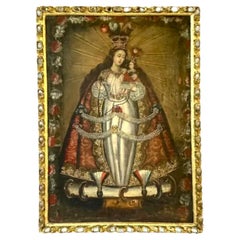
Our Lady of Pomata Oil on Canvas Painting from the Cuzco School in Colonial Peru. The virgin is shown crowned and richly attired in a gem-studded robe, holding the Christ Child amid ...
Category
Antique 18th Century Peruvian Spanish Colonial Paintings
Materials
Giltwood, Paint, Canvas
18th-Century Miniature Oil Painting – Virgen Dolorosa
Located in Madrid, ES
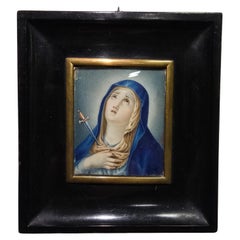
An exquisite 18th-century Sevillian miniature oil painting depicting the Virgen Dolorosa, a masterfully detailed religious artwork.
Artist: Signed by L. Ruiz
Medium: Oil on panel
Fr...
Category
Antique 1730s Paintings
Materials
Fruitwood
Capriccio View of Rio de Janeiro, Oil on Sailcloth, Circa 1810
Located in Seaford, GB
Rare Early 19th century Capriccio view of Rio de Janeiro Painting
Probably painted circa 1810 by one of Jean-Baptiste Debret, Italian Students.
Painted on Sailcloth.
Historical Context of Early 19th Century Portuguese Colonial Brazil
1.1 Transition from Colony to Empire
During the early 19th century, Brazil underwent a seismic shift in its political status. Originally a colony under the Portuguese Empire, the arrival of the Portuguese Royal Court in Rio de Janeiro in 1808 rapidly elevated the city’s cultural and political importance. By 1815, Brazil was declared a kingdom united with Portugal, setting the stage for the emergence of the Empire of Brazil in 1822. This period of transformation—often termed the transitional period from colony to empire—fueled a wave of artistic production in cities like Rio de Janeiro.
1.2 European Artistic Influence in Brazil
With the French Artistic Mission in Rio (initiated in 1816) and the presence of various Portuguese and European artists, Brazilian art of the early 1800s began to reflect diverse influences, from neoclassical painting to the early rumblings of romanticism. Painters such as Jean-Baptiste Debret, and Nicolas-Antoine Taunay, and local luminaries like Manuel de Araújo Porto-Alegre contributed to the fine arts tradition in Brazil. Their works featured scenes of local life, portraits of Brazilian society, and imaginative vistas—sometimes referred to as “capriccios,” in which real elements were combined with artistic liberties to create an idealized panorama.
1.3 Rio de Janeiro as Cultural and Political Hub
Rio de Janeiro, often called the Imperial capital after Brazil’s independence, was home to foundational institutions like the Imperial Academy of Fine Arts (Academia Imperial de Belas Artes). Later evolving into the Escola de Belas Artes (School of Fine Arts in Rio), these academies nurtured the talents of emerging painters, who found patronage under the Royal Court and, subsequently, the Imperial Court. The city’s significance was further enhanced by the construction of significant buildings, the modernization of infrastructure, and the mingling of European courtly customs with the traditions of local inhabitants.
. Description of the Octagonal Oil on Canvas: A Capriccio View of Rio de Janeiro
2.1 Composition and Layout
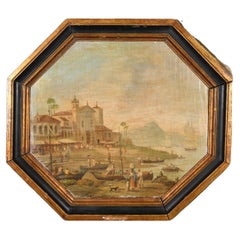
The most striking characteristic of this 19th-century Brazilian art piece is its octagonal shape, a relatively unusual format that draws the viewer’s gaze toward its centre. The composition showcases Rio de Janeiro’s shoreline in the early 1800s, brimming with merchant ships and smaller boats anchored near the shore. On the sand, there is a bustling crowd of local people—men and women carrying food and goods on their heads, loading and unloading boats, and engaging in everyday commerce. The backdrop of soaring mountains suggests Rio’s iconic topography, embodying the landscape that famously defines the city.
2.2 Architectural and Religious Landmarks
On the left side, one can discern the silhouette of a church believed to be Santa Lucia, a significant religious structure in the heart of early 19th-century Rio. This element provides viewers with a tangible reference point, linking the scene to an actual location. However, because this painting is labelled as a “capriccio,” the artist might have taken creative liberties by rearranging or amplifying certain features of the city. The melding of real and idealized elements is characteristic of these imaginative vistas.
2.3 Evoking Daily Life in Colonial Rio
One of the painting’s greatest appeals lies in its portrayal of daily life during the colonial era. Men and women from various backgrounds populate the scene. Some appear to be carrying goods on their heads, a common practice in Brazil that has persisted through different centuries. Others appear to be haggling or trading near small vessels, revealing the commercial pulse of an active port city. This focus on local people, combined with the grandeur of merchant ships, captures the tension and synergy between the every day and the extraordinary—a hallmark of Brazilian colonial painting that balances the grand narratives of empire with the rhythms of ordinary life.
2.4 An Amalgamation of Neoclassical and Romantic Influences
Although academic art in early 19th century Brazil was highly influenced by neoclassicism, the onset of romanticism can be spotted in the emotional portrayal of the sky, the lively palette, and the dramatic emphasis on nature’s beauty (the mountains, in particular). This duality reflects the fine arts tradition in Brazil during the transitional phase when artists were embracing multiple styles. As part of the School of Rio or the Rio de Janeiro school, painters often integrated academic techniques learned from European masters with emerging local subjects and influences.
3. Institutions and Artistic Movements
3.1 Imperial Academy of Fine Arts
Originally known as the Royal School of Sciences, Arts, and Crafts, the Imperial Academy of Fine Arts in Rio de Janeiro was instrumental in shaping 19th-century Brazilian art. Influential artists and teachers from Portugal, France, and other European nations congregated at the Academy, imparting their expertise to native students. As the monarchy consolidated power, the Academy enjoyed royal patronage, leading to the creation of Imperial Academy-style works that combined European academic rigour with Brazilian-themed subject matter.
3.2 Impact of the French Artistic Mission
The French Artistic Mission, which arrived in 1816, played a pivotal role in introducing advanced European artistic techniques, thereby elevating the overall quality of painting in Brazil. Artists like Jean-Baptiste Debret not only documented Brazilian society but also spearheaded the development of a local visual identity that aligned with both academicism and the national context of a blossoming empire. Debret, alongside others such as Nicolas-Antoine Taunay, mentored Brazilian artists, sowing the seeds of what would become the Brazilian academic art movement.
3.3 Religious, Historical, and Landscape Paintings
In addition to everyday scenes and historical compositions, religious iconography remained crucial throughout Portuguese colonial and imperial Brazil. Churches were omnipresent in cityscapes like Rio de Janeiro. Many colonial-era Brazilian portraits...
Category
Antique Early 19th Century Brazilian Spanish Colonial Paintings
Materials
Canvas
$2,949 Sale Price
20% Off
H 24.41 in W 26.78 in D 1.97 in
Jacques de Feline de la Roche abstract painting 1983
Located in Grenoble, FR
abstract painting by the Grenoblois painter Jacques de Feline in his last period. Abstract and lyrical work, Jacques' wife was a French poet who had a lot of influence on his way of ...
Category
Vintage 1980s French Mid-Century Modern Paintings
Materials
Canvas, Paint

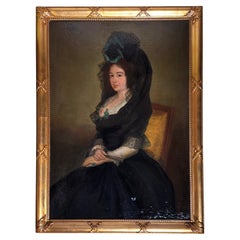
Portrait of Doña Narcisa Barañana de Goicoechea, MET Authorized Copy, oil, 1937
Located in Madrid, ES
Portrait of Doña Narcisa Barañana de Goicoechea, MET Authorized Copy, oil, 1937
Magnificent copy authorized by the Metropolitan Museum of Art (New York) of Francisco de Goya's origi...
Category
Early 20th Century Spanish Spanish Colonial Paintings
Materials
Paint
$9,474
H 39.77 in W 31.11 in D 3.94 in
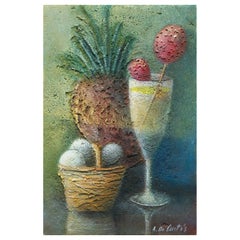
a. De Cortés - Latin American Painting on Panel - Unframed - Late 20th Century
Located in Chatham, ON
A. DE CORTÉS - Vintage Latin American school airbrush still life painting on panel - signed lower right - untitled - unframed - late 20th century.
Excellent vintage condition - st...
Category
Late 20th Century South American Spanish Colonial Paintings
Materials
Paint
$525
H 7 in W 4.75 in D 0.13 in
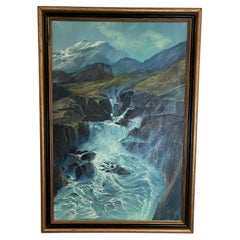
Mid Century Landscape Painting De Jong
Located in W Allenhurst, NJ
Beautiful mid century painting of river running through the mountains. Fabulous colors capturing natures beauty in a period composition. Nicely framed in contrasting black and gold. ...
Category
Mid-20th Century Unknown Mid-Century Modern Paintings
Materials
Paint
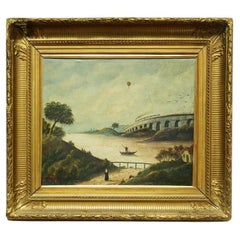
"Le pont de chemin de fer"painting, M. L. Daguerry 1888.
Located in Lisboa, PT
Oil on canvas painting signed M. L. Daguerry, located Paris and dated 1888 on lower left corner. Wooden frame and gilded stucco. France, 1888.
Category
Antique 1880s French Space Age Paintings
Materials
Canvas
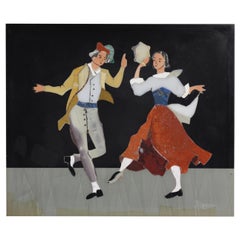
Italian Pietra Dura Panel Arte de Mosaico
Located in West Palm Beach, FL
An Italian Pietra Dura Panel
Early 20th century
Arte del Mosaico
Via San Giuseppe 36-38
Florence, Italy
By Nenci
Measures: Height 7.93 in. (20.16 cm...
Category
Early 20th Century Paintings
Materials
Porcelain
Oil painting "Chemin" Paul de Pignol, 2018
Located in PARIS, FR
Born in Toulouse in 1965, Paul de Pignol studied at the Ecole Nationale Supérieure des Beaux-Arts in Paris in the painting studio of Pierre Carron. He l...
Category
2010s French Paintings
Materials
Paint, Paper