Want more images or videos?
Request additional images or videos from the seller
1 of 6
WWII RAF Lancaster Bomber Painting
$4,701.22List Price
About the Item
- Dimensions:Height: 20.08 in (51 cm)Width: 25.2 in (64 cm)Depth: 1.19 in (3 cm)
- Materials and Techniques:
- Place of Origin:
- Period:1990-1999
- Date of Manufacture:20th Century
- Condition:
- Seller Location:Ongar, GB
- Reference Number:1stDibs: LU6600230936342
About the Seller
5.0
Vetted Professional Seller
Every seller passes strict standards for authenticity and reliability
Established in 2015
1stDibs seller since 2022
31 sales on 1stDibs
Authenticity Guarantee
In the unlikely event there’s an issue with an item’s authenticity, contact us within 1 year for a full refund. DetailsMoney-Back Guarantee
If your item is not as described, is damaged in transit, or does not arrive, contact us within 7 days for a full refund. Details24-Hour Cancellation
You have a 24-hour grace period in which to reconsider your purchase, with no questions asked.Vetted Professional Sellers
Our world-class sellers must adhere to strict standards for service and quality, maintaining the integrity of our listings.Price-Match Guarantee
If you find that a seller listed the same item for a lower price elsewhere, we’ll match it.Trusted Global Delivery
Our best-in-class carrier network provides specialized shipping options worldwide, including custom delivery.You May Also Like
Lancaster Bridge Original Oil Painting
Located in Annville, PA
A very interesting and unusual Lancaster Bridge Original Oil Painting by artist J. Earle Pfoutz. The painting is produced on artist board and comes complete with what appears to be an original artist decorated/painted frame. The painting is signed on the front by the artist.
Overall frame Size approximately 42″ wide x 2″ deep x 30″ high
J. Earle Pfoutz had a long and distinguished career as a self trained artist. More can be learned about him from reading this article produced by Gary Hawbaker at askART
Earle Pfoutz Born: 1891 – Lancaster, Pennsylvania
Died: 1957
Known for: Landscape, figure, still life painting
An image of J Earle Pfoutz
Biography from the Archives of askART
J. Earle Pfoutz (John Earle Pfoutz) – (Oct 23, 1891-Nov 9, 1957)
“A seventh generation descendant of a Swiss family which arrived in America early in the 17th Century, J. Earle Pfoutz was born in Lancaster, PA, son of John Bachman and Susan Allison Pfoutz. He painted houses for a living and pictures for a life.
A self-taught artist, described as a primitive, he was distinctive for his vivid imagination and bold color application. He painted hundreds of Lancaster County scenes. Pfoutz traveled through the hills near his home and along the Susquehanna River in search of scenes. He began painting with a brush when he was fourteen, but added a palette knife after suffering an eye injury. He completed eighth grade in the Lancaster Public Schools and there his formal education ended. However, the Department of Public Instruction of the State of Pennsylvania thought so highly of his work as an artist that officials certified him as an art instructor and he taught for a year in the York (PA) public schools. He also was an art instructor under the program for disabled veterans, sponsored by the Veterans Administration, when he gave private instruction to veterans in their homes.
In 1947, J. Earle Pfoutz finally earned national recognition as an artist. His painting, Opalescent October, was chosen by the Museum of Art of Dayton Ohio, to travel all over the country for a year with its Group Exhibition. Described as a “very colorful, calm scene, iridescent in color, sweeping in design,” the painting started on its journey around the country early in 1948. In an interview with the Sunday News (Lancaster, PA – Nov 2, 1947), Pfoutz stated that he didn’t know whether he was a “primitive” or an “impressionist.” No master taught him, no school channeled his style. “Sometimes I didn’t eat, but I always managed to paint,” he recalled. Many of his hundreds of canvases -most of them not sold, but given away to friends – found their way to other parts of the country. “I never remember the day when I did not love color,” Pfoutz said. “I was about 12 years old when I saw my first palette – a string of different colored paint paddles that graced the stores of that day. As a boy I had two great desires. One was to be able to eat all the strawberry jam I could, and the other to possess a string of those beautiful paint paddles. Well, I’ve got my fill of jelly, but I’ve never yet got my fill of beautiful colors.”
In 1950, Pfoutz’s one man show of paintings made front page headlines in the Lancaster Intelligencer Journal: “Most of the twenty oil paintings on exhibition are landscapes, although there are several interesting figure studies. Colors again, as in all Pfoutziana are rich and full-bodied, but for the most part not as startlingly as in some of the earlier work. Most of the paintings were done during the past year, and also reveal the painter’s characteristic heavy impasto technique, in which the rich swirls of paint carry their own message. Among the figures, The Banjo Picker, and The Magician, are the most provocative. Both are character studies; the first being of a tramp musician whose drab clothing is set-off by a luminous aqua blue background. Modern in feeling and treatment is The Magician, a clown-faced wizard whose spinning ball in the air suggests the fourth dimension – space. The use of the primary colors in this picture serves to emphasize the theme effectively.
A large colorful landscape, Opalescent October, depicting rolling hills against a late afternoon sky is new to Lancastrians, as it has just returned from Dayton, Ohio, where it hung in the Dayton Art Institute. Another landscape with soft dreamy colors is Fantasie D’Autumne, and one of the loveliest pictures in the show. Pennsylvania Dutch Country is another with eye appeal, and was one of the works which was hung in the Old Customs House in Philadelphia during Pennsylvania Week, and before that in a collection of Pfoutz work in the same place. In deep contrast to the sunny skies and brilliant foliage of many of the pictures, is the somewhat morbid Worry, in which the center of interest is a tremendous rat. This, the painter explains, was symbolic of 1948 in China, which was ‘The Year of The Rat’ in the Chinese calendar. Background material for the picture was furnished to Pfoutz by author Pearl Buck.
Other pictures include Autumn Prelude, Miners Village, painted at Cornwall, PA; Humid Day, Saint Peters Kierch, at Middletown, PA; Lady Pfoutz, inspired by the painter’s wife; Sun Flowers, Sentimental Journey, Gyne, Luzon Woman, Old Bridge, The Cow Path. Lemures, based on Roman mythology, and Ethiopian, painted from an ebony wood carving...
Category
Mid-20th Century Expressionist Paintings
Materials
Paint
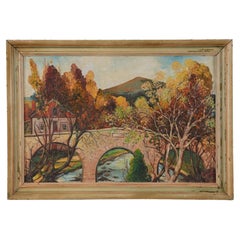
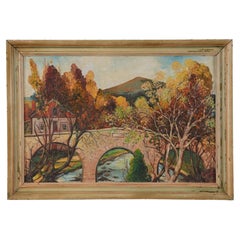
Lancaster Bridge Original Oil Painting
Located in Annville, PA
A very interesting and unusual Lancaster Bridge Original Oil Painting by artist J. Earle Pfoutz. The painting is produced on artist board and comes complete with what appears to be an original artist decorated/painted frame. The painting is signed on the front by the artist.
Overall frame Size approximately 42″ wide x 2″ deep x 30″ high
J. Earle Pfoutz had a long and distinguished career as a self trained artist. More can be learned about him from reading this article produced by Gary Hawbaker at askART
Earle Pfoutz Born: 1891 – Lancaster, Pennsylvania
Died: 1957
Known for: Landscape, figure, still life painting
An image of J Earle Pfoutz
Biography from the Archives of askART
J. Earle Pfoutz (John Earle Pfoutz) – (Oct 23, 1891-Nov 9, 1957)
“A seventh generation descendant of a Swiss family which arrived in America early in the 17th Century, J. Earle Pfoutz was born in Lancaster, PA, son of John Bachman and Susan Allison Pfoutz. He painted houses for a living and pictures for a life.
A self-taught artist, described as a primitive, he was distinctive for his vivid imagination and bold color application. He painted hundreds of Lancaster County scenes. Pfoutz traveled through the hills near his home and along the Susquehanna River in search of scenes. He began painting with a brush when he was fourteen, but added a palette knife after suffering an eye injury. He completed eighth grade in the Lancaster Public Schools and there his formal education ended. However, the Department of Public Instruction of the State of Pennsylvania thought so highly of his work as an artist that officials certified him as an art instructor and he taught for a year in the York (PA) public schools. He also was an art instructor under the program for disabled veterans, sponsored by the Veterans Administration, when he gave private instruction to veterans in their homes.
In 1947, J. Earle Pfoutz finally earned national recognition as an artist. His painting, Opalescent October, was chosen by the Museum of Art of Dayton Ohio, to travel all over the country for a year with its Group Exhibition. Described as a “very colorful, calm scene, iridescent in color, sweeping in design,” the painting started on its journey around the country early in 1948. In an interview with the Sunday News (Lancaster, PA – Nov 2, 1947), Pfoutz stated that he didn’t know whether he was a “primitive” or an “impressionist.” No master taught him, no school channeled his style. “Sometimes I didn’t eat, but I always managed to paint,” he recalled. Many of his hundreds of canvases -most of them not sold, but given away to friends – found their way to other parts of the country. “I never remember the day when I did not love color,” Pfoutz said. “I was about 12 years old when I saw my first palette – a string of different colored paint paddles that graced the stores of that day. As a boy I had two great desires. One was to be able to eat all the strawberry jam I could, and the other to possess a string of those beautiful paint paddles. Well, I’ve got my fill of jelly, but I’ve never yet got my fill of beautiful colors.”
In 1950, Pfoutz’s one man show of paintings made front page headlines in the Lancaster Intelligencer Journal: “Most of the twenty oil paintings on exhibition are landscapes, although there are several interesting figure studies. Colors again, as in all Pfoutziana are rich and full-bodied, but for the most part not as startlingly as in some of the earlier work. Most of the paintings were done during the past year, and also reveal the painter’s characteristic heavy impasto technique, in which the rich swirls of paint carry their own message. Among the figures, The Banjo Picker, and The Magician, are the most provocative. Both are character studies; the first being of a tramp musician whose drab clothing is set-off by a luminous aqua blue background. Modern in feeling and treatment is The Magician, a clown-faced wizard whose spinning ball in the air suggests the fourth dimension – space. The use of the primary colors in this picture serves to emphasize the theme effectively.
A large colorful landscape, Opalescent October, depicting rolling hills against a late afternoon sky is new to Lancastrians, as it has just returned from Dayton, Ohio, where it hung in the Dayton Art Institute. Another landscape with soft dreamy colors is Fantasie D’Autumne, and one of the loveliest pictures in the show. Pennsylvania Dutch Country is another with eye appeal, and was one of the works which was hung in the Old Customs House in Philadelphia during Pennsylvania Week, and before that in a collection of Pfoutz work in the same place. In deep contrast to the sunny skies and brilliant foliage of many of the pictures, is the somewhat morbid Worry, in which the center of interest is a tremendous rat. This, the painter explains, was symbolic of 1948 in China, which was ‘The Year of The Rat’ in the Chinese calendar. Background material for the picture was furnished to Pfoutz by author Pearl Buck.
Other pictures include Autumn Prelude, Miners Village, painted at Cornwall, PA; Humid Day, Saint Peters Kierch, at Middletown, PA; Lady Pfoutz, inspired by the painter’s wife; Sun Flowers, Sentimental Journey, Gyne, Luzon Woman, Old Bridge, The Cow Path. Lemures, based on Roman mythology, and Ethiopian, painted from an ebony wood carving from Kenya Province, S. Africa.”
In 1953, Pfoutz was installed as President of the Lancaster County Art Association. A. Z. Kruse, New York City artist, writer and member of the faculty of the Brooklyn College and the Cartoonists and Illustrators School, Manhattan, was the guest speaker. In January of 1953, thirty-five Pfoutz oils were exhibited at the Old Custom House in Philadelphia, PA under the sponsorship of the Carl Schurz Memorial Foundation. Several Lancaster County landscapes and covered bridges were included as well as Katy, a Pennsylvania Dutch scene. Symbolic paintings included End of the Second Day, the artist’s visualization of the second coming of Christ, and Twilight, typifying the grief of mothers of all lands for sons lost in battle.
In June of 1953, a Pfoutz oil made history in Lancaster. From the Lancaster New Era: “For the first in local art history, a painting has been withdrawn from an exhibition because of objections from viewers and hostesses serving at the show. The painting, Jeune Fille, a standing nude done by Pfoutz, was one of the paintings in the annual spring exhibition of the Art Association and had become the center of the controversy. Pfoutz said he took the painting down… ‘graciously but reluctantly.’ ‘From an artistic standpoint, there is nothing offensive about the painting,’ Pfoutz said. ‘This community just wants its nudes with clothes on.’ “It is most brilliant in color, and because it is so brilliant I thought it would make a nice lively spot for the show. This is the first time I’ve had to take a picture off the walls. I substituted a seascape for it.’ Pfoutz said he felt the painting brought a lot of viewers to the show because it was so controversial. It had never been exhibited before. ‘If this had been shown in a metropolitan city,’ he commented, ‘people wouldn’t have given it a second glance. But the viewpoint here is more conservative, even though I don’t think moderns would have minded.’ He said he felt the painting was neither ‘objectionable nor pornographic,’ but had complied with the wishes of fellow members of the Art Association who telephoned him to relay the protests they had received. The art controversy was the first to arise here publicly since the showing of Amish Grandmother, an oil by William Gropper which was part of the Gimbel Pennsylvania exhibit at the Griest Building several years ago. — Numerous viewers of Amish Grandmother, [a painting showing an Amish woman holding a white goose], expressed themselves quite vocally, calling it an affront to the Plain Folk. But it stayed on exhibit throughout the length of the Gimbel show. Pfoutz expressed no rancor, implying that if Gropper could take it so could he.”
After his death, there were several shows of Pfoutz’ work organized by his son J. Earle, Jr. J. Earle, Jr. also saw to it that President Eisenhower would receive an oil called The Cow’s Path. The president first saw the painting in 1950 when, as president of Columbia University, he visited Lancaster to address a student assembly at Franklin and Marshall College. After his address was over, the then Gen. Eisenhower stopped at the Fackenthal Library on the campus to view an exhibition of Pfoutz’s paintings. The Cow’s Path intrigued him. For some time, as his aides fumed to get him back on his time schedule, Eisenhower and Pfoutz talked, as artist to artist. Prior to his death, Pfoutz requested that The Cow’s Path be given to the President if he wanted it. The painting was presented to Ike at the White House in November of 1959. Mrs. Eisenhower owned a Pfoutz painting titled, In the Manor.
Though house painting was his livelihood, he worked for Millersville State Teachers College (now a university) for a time during World War II, and called himself “the Chimney Sweep of MSTC.” During that period he knocked out a dizzying canvas in the surrealist style (he thought it was terrible) and got into the campus newspaper when one of the students spotted it.
Earle Pfoutz was not the humble, downtrodden artist, not the Douanier Rousseau type at all. As he developed his skill and style through the years, he also fashioned a resilient confidence in himself as an artist. Whether he was building his own home (he built two) or painting one for somebody else, he never lost faith in his ultimate recognition—though he was never sure he would live to see it.
Whether he was working as a rigger for a hoisting company, in the Stehli Silk Mill of Lancaster, carving Cloister-style chairs, decorating old chests, cementing bricks from the old Safe...
Category
Vintage 1940s American Paintings
Materials
Paint
Lancaster Covered Bridge Original Oil Painting
Located in Annville, PA
A very interesting and unusual Lancaster Covered Bridge Original Oil Painting by artist J. Earle Pfoutz. The painting is produced on artist board and comes complete with what appears to be an original artist decorated/painted frame. The painting is signed on the front by the artist and is dated 1936 on the rear.
Overall frame Size approximately 28″ wide x 2″ deep x 22″ high
J. Earle Pfoutz had a long and distinguished career as a self trained artist. More can be learned about him from reading this article produced by Gary Hawbaker at askART
Earle Pfoutz Born: 1891 – Lancaster, Pennsylvania
Died: 1957
Known for: Landscape, figure, still life painting
An image of J Earle Pfoutz
Biography from the Archives of askART
J. Earle Pfoutz (John Earle Pfoutz) – (Oct 23, 1891-Nov 9, 1957)
“A seventh generation descendant of a Swiss family which arrived in America early in the 17th Century, J. Earle Pfoutz was born in Lancaster, PA, son of John Bachman and Susan Allison Pfoutz. He painted houses for a living and pictures for a life.
A self-taught artist, described as a primitive, he was distinctive for his vivid imagination and bold color application. He painted hundreds of Lancaster County scenes. Pfoutz traveled through the hills near his home and along the Susquehanna River in search of scenes. He began painting with a brush when he was fourteen, but added a palette knife after suffering an eye injury. He completed eighth grade in the Lancaster Public Schools and there his formal education ended. However, the Department of Public Instruction of the State of Pennsylvania thought so highly of his work as an artist that officials certified him as an art instructor and he taught for a year in the York (PA) public schools. He also was an art instructor under the program for disabled veterans, sponsored by the Veterans Administration, when he gave private instruction to veterans in their homes.
In 1947, J. Earle Pfoutz finally earned national recognition as an artist. His painting, Opalescent October, was chosen by the Museum of Art of Dayton Ohio, to travel all over the country for a year with its Group Exhibition. Described as a “very colorful, calm scene, iridescent in color, sweeping in design,” the painting started on its journey around the country early in 1948. In an interview with the Sunday News (Lancaster, PA – Nov 2, 1947), Pfoutz stated that he didn’t know whether he was a “primitive” or an “impressionist.” No master taught him, no school channeled his style. “Sometimes I didn’t eat, but I always managed to paint,” he recalled. Many of his hundreds of canvases -most of them not sold, but given away to friends – found their way to other parts of the country. “I never remember the day when I did not love color,” Pfoutz said. “I was about 12 years old when I saw my first palette – a string of different colored paint paddles that graced the stores of that day. As a boy I had two great desires. One was to be able to eat all the strawberry jam I could, and the other to possess a string of those beautiful paint paddles. Well, I’ve got my fill of jelly, but I’ve never yet got my fill of beautiful colors.”
In 1950, Pfoutz’s one man show of paintings made front page headlines in the Lancaster Intelligencer Journal: “Most of the twenty oil paintings on exhibition are landscapes, although there are several interesting figure studies. Colors again, as in all Pfoutziana are rich and full-bodied, but for the most part not as startlingly as in some of the earlier work. Most of the paintings were done during the past year, and also reveal the painter’s characteristic heavy impasto technique, in which the rich swirls of paint carry their own message. Among the figures, The Banjo Picker, and The Magician, are the most provocative. Both are character studies; the first being of a tramp musician whose drab clothing is set-off by a luminous aqua blue background. Modern in feeling and treatment is The Magician, a clown-faced wizard whose spinning ball in the air suggests the fourth dimension – space. The use of the primary colors in this picture serves to emphasize the theme effectively.
A large colorful landscape, Opalescent October, depicting rolling hills against a late afternoon sky is new to Lancastrians, as it has just returned from Dayton, Ohio, where it hung in the Dayton Art Institute. Another landscape with soft dreamy colors is Fantasie D’Autumne, and one of the loveliest pictures in the show. Pennsylvania Dutch Country is another with eye appeal, and was one of the works which was hung in the Old Customs House in Philadelphia during Pennsylvania Week, and before that in a collection of Pfoutz work in the same place. In deep contrast to the sunny skies and brilliant foliage of many of the pictures, is the somewhat morbid Worry, in which the center of interest is a tremendous rat. This, the painter explains, was symbolic of 1948 in China, which was ‘The Year of The Rat’ in the Chinese calendar. Background material for the picture was furnished to Pfoutz by author Pearl Buck.
Other pictures include Autumn Prelude, Miners Village, painted at Cornwall, PA; Humid Day, Saint Peters Kierch, at Middletown, PA; Lady Pfoutz, inspired by the painter’s wife; Sun Flowers, Sentimental Journey, Gyne, Luzon Woman, Old Bridge, The Cow Path. Lemures, based on Roman mythology, and Ethiopian, painted from an ebony wood carving...
Category
Early 20th Century North American Paintings
Materials
Canvas, Paint
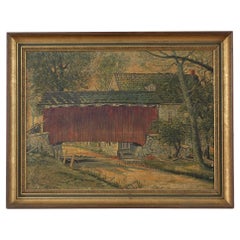
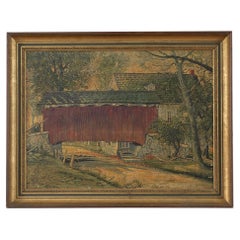
Lancaster Covered Bridge Original Oil Painting
Located in Annville, PA
A very interesting and unusual Lancaster Covered Bridge Original Oil Painting by artist J. Earle Pfoutz. The painting is produced on artist board and comes complete with what appears to be an original artist decorated/painted frame. The painting is signed on the front by the artist and is dated 1936 on the rear.
Overall frame Size approximately 28″ wide x 2″ deep x 22″ high
J. Earle Pfoutz had a long and distinguished career as a self trained artist. More can be learned about him from reading this article produced by Gary Hawbaker at askART
Earle Pfoutz Born: 1891 – Lancaster, Pennsylvania
Died: 1957
Known for: Landscape, figure, still life painting
An image of J Earle Pfoutz
Biography from the Archives of askART
J. Earle Pfoutz (John Earle Pfoutz) – (Oct 23, 1891-Nov 9, 1957)
“A seventh generation descendant of a Swiss family which arrived in America early in the 17th Century, J. Earle Pfoutz was born in Lancaster, PA, son of John Bachman and Susan Allison Pfoutz. He painted houses for a living and pictures for a life.
A self-taught artist, described as a primitive, he was distinctive for his vivid imagination and bold color application. He painted hundreds of Lancaster County scenes. Pfoutz traveled through the hills near his home and along the Susquehanna River in search of scenes. He began painting with a brush when he was fourteen, but added a palette knife after suffering an eye injury. He completed eighth grade in the Lancaster Public Schools and there his formal education ended. However, the Department of Public Instruction of the State of Pennsylvania thought so highly of his work as an artist that officials certified him as an art instructor and he taught for a year in the York (PA) public schools. He also was an art instructor under the program for disabled veterans, sponsored by the Veterans Administration, when he gave private instruction to veterans in their homes.
In 1947, J. Earle Pfoutz finally earned national recognition as an artist. His painting, Opalescent October, was chosen by the Museum of Art of Dayton Ohio, to travel all over the country for a year with its Group Exhibition. Described as a “very colorful, calm scene, iridescent in color, sweeping in design,” the painting started on its journey around the country early in 1948. In an interview with the Sunday News (Lancaster, PA – Nov 2, 1947), Pfoutz stated that he didn’t know whether he was a “primitive” or an “impressionist.” No master taught him, no school channeled his style. “Sometimes I didn’t eat, but I always managed to paint,” he recalled. Many of his hundreds of canvases -most of them not sold, but given away to friends – found their way to other parts of the country. “I never remember the day when I did not love color,” Pfoutz said. “I was about 12 years old when I saw my first palette – a string of different colored paint paddles that graced the stores of that day. As a boy I had two great desires. One was to be able to eat all the strawberry jam I could, and the other to possess a string of those beautiful paint paddles. Well, I’ve got my fill of jelly, but I’ve never yet got my fill of beautiful colors.”
In 1950, Pfoutz’s one man show of paintings made front page headlines in the Lancaster Intelligencer Journal: “Most of the twenty oil paintings on exhibition are landscapes, although there are several interesting figure studies. Colors again, as in all Pfoutziana are rich and full-bodied, but for the most part not as startlingly as in some of the earlier work. Most of the paintings were done during the past year, and also reveal the painter’s characteristic heavy impasto technique, in which the rich swirls of paint carry their own message. Among the figures, The Banjo Picker, and The Magician, are the most provocative. Both are character studies; the first being of a tramp musician whose drab clothing is set-off by a luminous aqua blue background. Modern in feeling and treatment is The Magician, a clown-faced wizard whose spinning ball in the air suggests the fourth dimension – space. The use of the primary colors in this picture serves to emphasize the theme effectively.
A large colorful landscape, Opalescent October, depicting rolling hills against a late afternoon sky is new to Lancastrians, as it has just returned from Dayton, Ohio, where it hung in the Dayton Art Institute. Another landscape with soft dreamy colors is Fantasie D’Autumne, and one of the loveliest pictures in the show. Pennsylvania Dutch Country is another with eye appeal, and was one of the works which was hung in the Old Customs House in Philadelphia during Pennsylvania Week, and before that in a collection of Pfoutz work in the same place. In deep contrast to the sunny skies and brilliant foliage of many of the pictures, is the somewhat morbid Worry, in which the center of interest is a tremendous rat. This, the painter explains, was symbolic of 1948 in China, which was ‘The Year of The Rat’ in the Chinese calendar. Background material for the picture was furnished to Pfoutz by author Pearl Buck.
Other pictures include Autumn Prelude, Miners Village, painted at Cornwall, PA; Humid Day, Saint Peters Kierch, at Middletown, PA; Lady Pfoutz, inspired by the painter’s wife; Sun Flowers, Sentimental Journey, Gyne, Luzon Woman, Old Bridge, The Cow Path. Lemures, based on Roman mythology, and Ethiopian, painted from an ebony wood carving from Kenya Province, S. Africa.”
In 1953, Pfoutz was installed as President of the Lancaster County Art Association. A. Z. Kruse, New York City artist, writer and member of the faculty of the Brooklyn College and the Cartoonists and Illustrators School, Manhattan, was the guest speaker. In January of 1953, thirty-five Pfoutz oils were exhibited at the Old Custom House in Philadelphia, PA under the sponsorship of the Carl Schurz Memorial Foundation. Several Lancaster County landscapes and covered bridges were included as well as Katy, a Pennsylvania Dutch scene. Symbolic paintings included End of the Second Day, the artist’s visualization of the second coming of Christ, and Twilight, typifying the grief of mothers of all lands for sons lost in battle.
In June of 1953, a Pfoutz oil made history in Lancaster. From the Lancaster New Era: “For the first in local art history, a painting has been withdrawn from an exhibition because of objections from viewers and hostesses serving at the show. The painting, Jeune Fille, a standing nude done by Pfoutz, was one of the paintings in the annual spring exhibition of the Art Association and had become the center of the controversy. Pfoutz said he took the painting down… ‘graciously but reluctantly.’ ‘From an artistic standpoint, there is nothing offensive about the painting,’ Pfoutz said. ‘This community just wants its nudes with clothes on.’ “It is most brilliant in color, and because it is so brilliant I thought it would make a nice lively spot for the show. This is the first time I’ve had to take a picture off the walls. I substituted a seascape for it.’ Pfoutz said he felt the painting brought a lot of viewers to the show because it was so controversial. It had never been exhibited before. ‘If this had been shown in a metropolitan city,’ he commented, ‘people wouldn’t have given it a second glance. But the viewpoint here is more conservative, even though I don’t think moderns would have minded.’ He said he felt the painting was neither ‘objectionable nor pornographic,’ but had complied with the wishes of fellow members of the Art Association who telephoned him to relay the protests they had received. The art controversy was the first to arise here publicly since the showing of Amish Grandmother, an oil by William Gropper which was part of the Gimbel Pennsylvania exhibit at the Griest Building several years ago. — Numerous viewers of Amish Grandmother, [a painting showing an Amish woman holding a white goose], expressed themselves quite vocally, calling it an affront to the Plain Folk. But it stayed on exhibit throughout the length of the Gimbel show. Pfoutz expressed no rancor, implying that if Gropper could take it so could he.”
After his death, there were several shows of Pfoutz’ work organized by his son J. Earle, Jr. J. Earle, Jr. also saw to it that President Eisenhower would receive an oil called The Cow’s Path. The president first saw the painting in 1950 when, as president of Columbia University, he visited Lancaster to address a student assembly at Franklin and Marshall College. After his address was over, the then Gen. Eisenhower stopped at the Fackenthal Library on the campus to view an exhibition of Pfoutz’s paintings. The Cow’s Path intrigued him. For some time, as his aides fumed to get him back on his time schedule, Eisenhower and Pfoutz talked, as artist to artist. Prior to his death, Pfoutz requested that The Cow’s Path be given to the President if he wanted it. The painting was presented to Ike at the White House in November of 1959. Mrs. Eisenhower owned a Pfoutz painting titled, In the Manor.
Though house painting was his livelihood, he worked for Millersville State Teachers College (now a university) for a time during World War II, and called himself “the Chimney Sweep of MSTC.” During that period he knocked out a dizzying canvas in the surrealist style (he thought it was terrible) and got into the campus newspaper when one of the students spotted it.
Earle Pfoutz was not the humble, downtrodden artist, not the Douanier Rousseau type at all. As he developed his skill and style through the years, he also fashioned a resilient confidence in himself as an artist. Whether he was building his own home (he built two) or painting one for somebody else, he never lost faith in his ultimate recognition—though he was never sure he would live to see it.
Whether he was working as a rigger for a hoisting company, in the Stehli Silk Mill of Lancaster, carving Cloister-style chairs, decorating old chests, cementing bricks from the old Safe...
Category
Vintage 1940s American Paintings
Materials
Paint
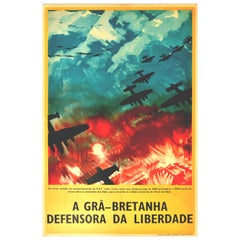
Original Vintage Poster WWII Defender Of Freedom RAF Bombers Italian Alps Planes
Located in London, GB
Original vintage World War Two propaganda poster in Portuguese - A Gra Bretanha Defensora de Liberdade Os avioes pesados de bombardeamento da R.A.F. voam muitas vezes uma distancia t...
Category
Vintage 1940s British Posters
Materials
Paper
$2,004
H 29.93 in W 19.69 in D 0.04 in
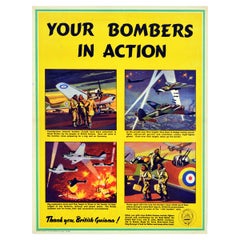
Original Vintage WWII Poster Your Bombers In Action Thank You British Guiana RAF
Located in London, GB
Original vintage World War Two poster - Your Hurricanes In Action Thank You British Guiana! - featuring four colourful captioned illustrations against a...
Category
Vintage 1940s British Posters
Materials
Paper
$1,313
H 20.08 in W 14.97 in D 0.04 in
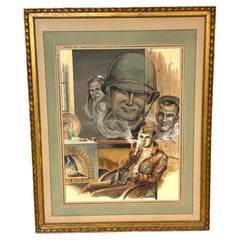
WWII Private Theater: Gay American Soldier in Reflection
Located in West Palm Beach, FL
WWII, how are you? Private Theater: Gay American Soldier in Reflection, Original WWII-Era Gouache, Signed CSG
A highly nuanced, emotionally layered, and visually accomplished original painting in gouache and watercolor on Whatman drawing board, signed CSG lower right. This rare mid-20th-century work portrays a seated U.S. Army Air Forces officer—smiling faintly, cigarette in hand, and with a small black-bound diary resting on his lap—lost in reverie as smoke from his cigarette rises and transforms into the visages of three idealized male figures. Rendered in an illustrative realist style with tonal sensitivity and surreal suggestion, the composition invites interpretation as an interior portrait of desire, intimacy, and memory—quietly coded, emotionally sincere, and possibly autobiographical.
The figure wears a regulation-issue A-2 leather flight jacket, iconic of U.S. Army Air Forces personnel during WWII. The jacket is detailed with a personalized, hand-painted circular patch depicting a lion rampant in a blue roundel—a heraldic symbol of power, pride, and possibly self-invention. An American flag patch is affixed to the left shoulder. The jacket, traditionally worn by bomber crews, officers, and pilots, functions here not only as a marker of military identity but as a gendered and cultural signifier—suggesting the complex intersection of duty, masculinity, and private identity. The slightly open collar, relaxed posture, and cigarette suggest the officer is off-duty—physically grounded but mentally elsewhere.
The seated figure’s companions—summoned in smoke—appear above and behind him in a dreamlike procession: a helmeted infantryman, a pilot in goggles, and a hat-wearing civilian (?) man posed in pin-up style. Each face is rendered with tenderness and idealization, not as ghosts or casualties, but as romantic or erotic conquests: remembered lovers, fleeting encounters, or imagined partners. Their expressions, softly lit and emotionally present, reflect a form of desire neither tormented nor tragic. This is not a meditation on loss but on intimacy remembered, perhaps treasured.
On the table beside him rests a small bronze Buddha...
Category
Mid-20th Century American Modern Paintings
Materials
Glass, Giltwood, Paper
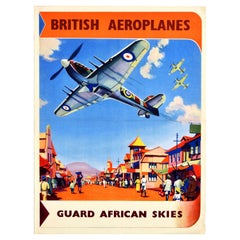
Original Vintage WWII Poster British Aeroplanes Guard African Skies RAF Spitfire
Located in London, GB
Original vintage World War Two propaganda poster - British Aeroplanes Guard African Skies - featuring a colourful design depicting a Royal Air Force RAF Spitfire plane flying low ove...
Category
Vintage 1940s British Posters
Materials
Paper
$1,659
H 20.08 in W 14.97 in D 0.04 in
Original Vintage WWII Poster RAF Coastal Command Lockheed Hudson Submarine Uboat
Located in London, GB
Original vintage World War Two propaganda poster in Portuguese - A Gra-Bretanha Defensora Da Liberdade Captura do submarino alemao U 570 por um aviao britanico Lockheed 'Hudson' do C...
Category
Vintage 1940s British Posters
Materials
Paper

$1,313
H 29.93 in W 19.69 in D 0.04 in
Original Vintage WWII Poster Sunderland Flying Boat RAF Coastal Command Aircraft
Located in London, GB
Original vintage World War Two poster for the 20-Ton Giant Of The Coastal Command - A Short Sunderland Flying Boat featuring an annotated technical cut-out...
Category
Vintage 1940s British Posters
Materials
Paper
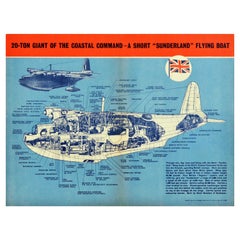
$1,935
H 14.57 in W 19.3 in D 0.04 in
More From This Seller
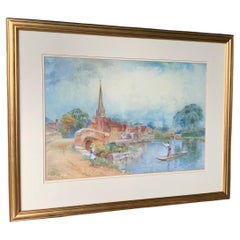
View AllEnglish Victorian Watercolour Painting
Located in Ongar, GB
A lovely Victorian watercolour of an English country scene. Mounted in a later frame behind glass. Circa 1860.
Please contact us directly for a worldwide shipping quote.
Category
Antique Late 19th Century European Paintings
Materials
Paint
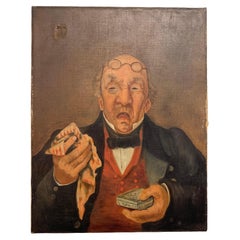
The Sneezing Gentleman Portrait Painting
Located in Ongar, GB
Antique oil on canvas painting of a French gentleman sneezing after probably taking snuff from the snuff box he is holding. A naive portrait painting with plenty of charm and charact...
Category
Early 20th Century French Paintings
Materials
Canvas
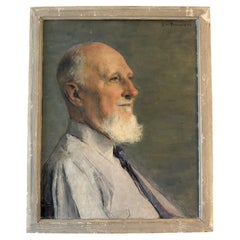
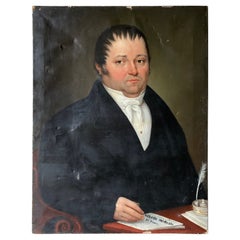
20th Century French Portrait Painting Of A Gentleman
Located in Ongar, GB
A very nice quality oil on board portrait painting of a French gentleman. Mounted in a plain wooden frame. Signed top right. Circa 1950.
Please contact us for a worldwide shipping ...
Category
Mid-20th Century French Paintings
Materials
Paint
Naive 19th Century French Oil Painting Of A Gentleman
Located in Ongar, GB
A lovely naive 19th century French oil painting of a gentleman. Wear to canvas in places. A lovely subject with plenty of character.
Category
Antique Mid-19th Century French Paintings
Materials
Canvas
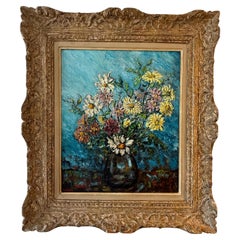
20th Century French Still Life Painting Of Flowers
Located in Ongar, GB
A very beautiful French still life oil on canvas painting of flowers . Signed bottom right. In a beautiful carved wood Montparnasse frame.
Please contact us for a worldwide shipping...
Category
Vintage 1970s French Paintings
Materials
Canvas
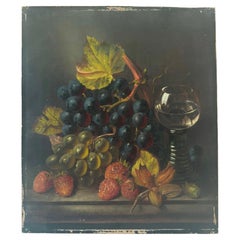
19th Century Still Life Oil On Canvas
Located in Ongar, GB
A lovely little 19th century still life oil on canvas painting. Very well painted with a nice capture of light. Signed and dated bottom left W H Smith 1880.
Please contact us for a ...
Category
Antique 19th Century English Paintings
Materials
Canvas
Still Thinking About These?
All Recently ViewedMore Ways To Browse
Vintage Bomber
Leon Brunin
Leonora Sisto
Lester Goldman
Lolo Painting
Louis Icart Oil Paintings
Ludovico Della Rocca
M Q Rothwell
Malcah Zeldis
Marc R Rubin
Marco Fine Furniture
Marek Halter
Mexican Religious Paintings
Michael J Whitehand
Miniature Portrait Josephine
Naked Women Oil Painting
Navajo Sand Painting
New England Street Scene