Items Similar to The Apparel of Hottentot Men and Women: Old Engraving, Cape of Good Hope, 1745
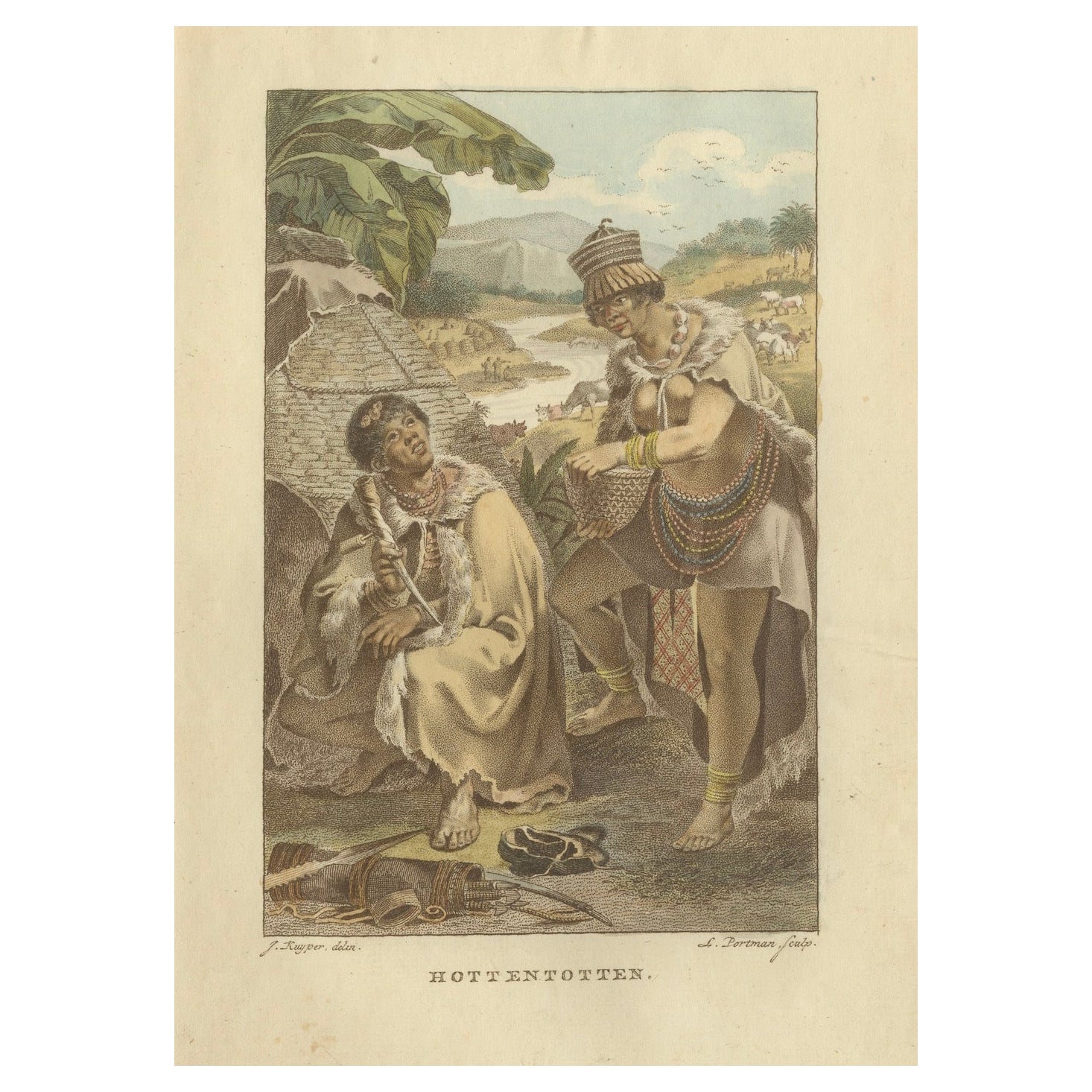
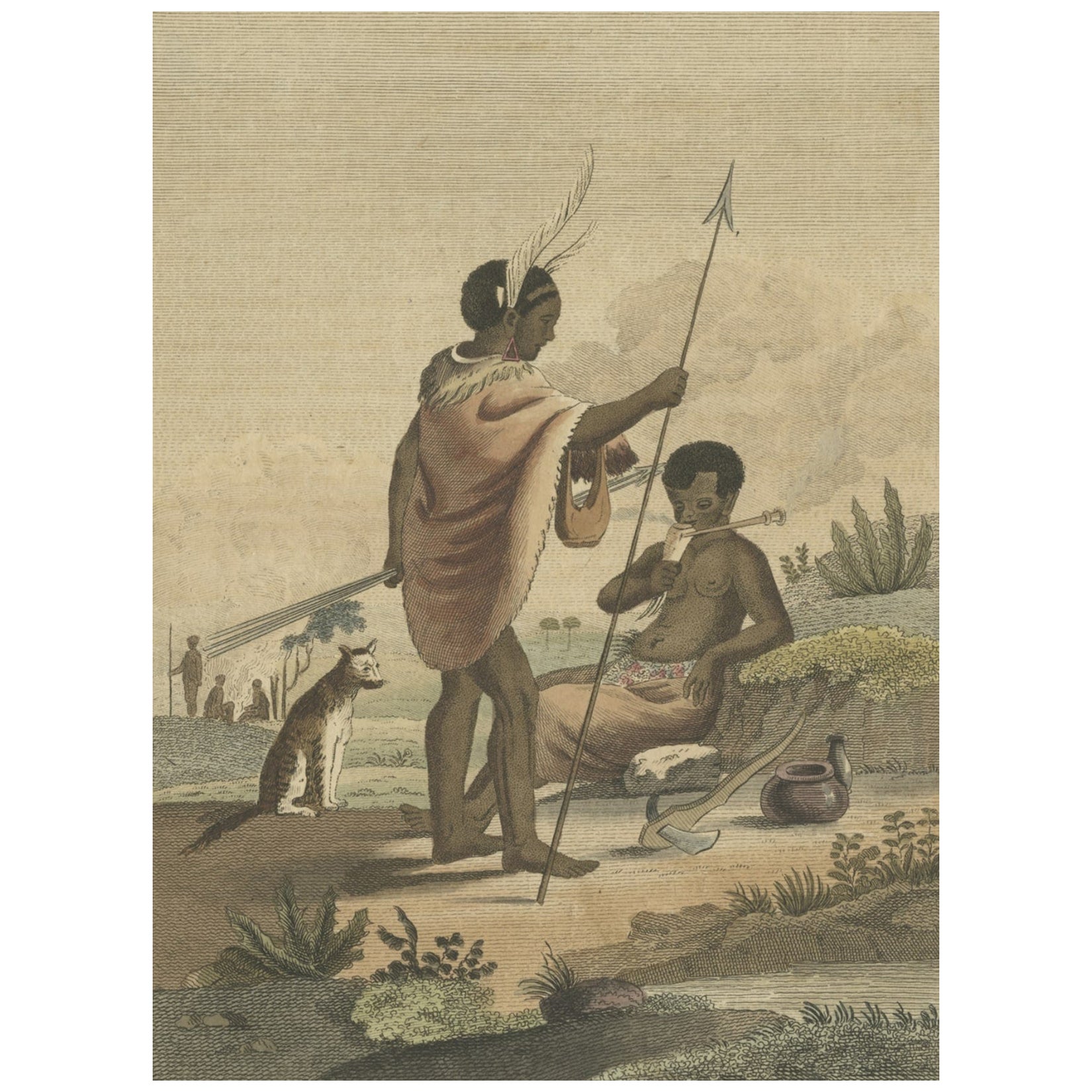
Want more images or videos?
Request additional images or videos from the seller
1 of 7
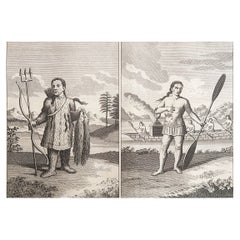
The Apparel of Hottentot Men and Women: Old Engraving, Cape of Good Hope, 1745
$325.51
$406.8920% Off
£243.68
£304.6020% Off
€272
€34020% Off
CA$448.11
CA$560.1420% Off
A$489.87
A$612.3420% Off
CHF 259.16
CHF 323.9520% Off
MX$5,862.09
MX$7,327.6120% Off
NOK 3,297.48
NOK 4,121.8520% Off
SEK 3,018.51
SEK 3,773.1420% Off
DKK 2,072.31
DKK 2,590.3820% Off
About the Item
This double-engraved page featuring the titles "The Apparel of the Hottentot Men" and "The Apparel of the Hottentot Women" are from the 18th-century book "The Present State of the Cape of Good Hope" published in 1731 by W. Innys in London. The style of the engravings, along with the subject matter, aligns well with the content of the book, which aimed to provide European audiences with detailed descriptions and illustrations of the indigenous peoples of the Cape of Good Hope, particularly the Khoikhoi (historically referred to as Hottentots by Europeans).
The year 1745 marked on the engraving could suggest a later edition or reprinting of the book, as it was common during that period for books to undergo multiple editions or updates. The engraver J. Mijnde is noted as having created several works around this time, making it possible that this particular plate was used in a later printing of the book or another similar publication.
In summary, this engraved page could either be from the 1731 edition or a subsequent edition issued in 1745, given the alignment of the content, style, and subject matter with the descriptions from the book "The Present State of the Cape of Good Hope."
The term Hottentot was historically used by European settlers and explorers to describe the Khoikhoi, an indigenous people of southwestern Africa, primarily in the region now known as Namibia and South Africa. The name "Hottentot" is considered offensive today, as it was a derogatory term given by the Dutch colonists, mocking the sound of the Khoikhoi's language, which uses distinct click sounds.
Origins and Culture:
The Khoikhoi were traditionally pastoralists, herding cattle, sheep, and goats. They had a deeply interconnected social structure based on clans and were known for their mobility, moving to different grazing lands with their livestock. Prior to European colonization, the Khoikhoi lived a relatively peaceful life, thriving in the Cape region.
The Khoikhoi's clothing, as depicted in engravings like the one you shared, was typically made from animal hides, and they often adorned themselves with beads and ornaments made from natural materials. Men carried spears for hunting and defense, while women dressed in skins and often carried water or provisions in hide bags.
European Encounters:
The Khoikhoi were among the first African groups to come into contact with European settlers in the 17th century, particularly the Dutch. Initially, interactions were peaceful and based on trade, particularly cattle. However, as European colonization expanded, tensions rose due to competition for land and resources, leading to violent confrontations.
Dutch colonization and subsequent European settlement led to a decline in the Khoikhoi population, due to disease, land dispossession, and integration into European-controlled societies as laborers. By the 18th century, the Khoikhoi had been greatly diminished as a distinct people, and many were absorbed into settler communities or displaced.
Representation in European Works:
European travel literature, such as "The Present State of the Cape of Good Hope", often described the Khoikhoi through a Eurocentric lens. These descriptions tended to portray the Khoikhoi as exotic and "primitive," reflecting European attitudes of superiority and colonial justification. Engravings like the one you shared were part of this broader trend of "ethnographic" documentation, which was often less about accurate representation and more about reinforcing colonial perspectives.
Modern Perspective:
Today, the Khoikhoi identity has seen a resurgence among descendants, and efforts are being made to reclaim their history and culture. The term "Hottentot" has been discarded in favor of Khoikhoi or Khoisan (the latter being an umbrella term that includes both the Khoikhoi and the San peoples, who were hunter-gatherers).
The history of the Khoikhoi is a testament to their resilience in the face of colonization and cultural erasure, and their contributions to the region's history remain significant in South African heritage.
- Dimensions:Height: 14.3 in (36.3 cm)Width: 8.67 in (22 cm)Depth: 0 in (0.02 mm)
- Materials and Techniques:Paper,Engraved
- Period:1740-1749
- Date of Manufacture:1745
- Condition:Very good condition, considering age. Minor wear due to handling. Study the images carefully.
- Seller Location:Langweer, NL
- Reference Number:Seller: BG-13599-361stDibs: LU3054341700632
About the Seller
5.0
Recognized Seller
These prestigious sellers are industry leaders and represent the highest echelon for item quality and design.
Platinum Seller
Premium sellers with a 4.7+ rating and 24-hour response times
Established in 2009
1stDibs seller since 2017
2,792 sales on 1stDibs
Typical response time: <1 hour
- ShippingRetrieving quote...Shipping from: Langweer, Netherlands
- Return Policy
More From This Seller
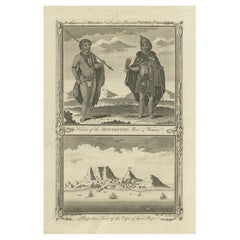
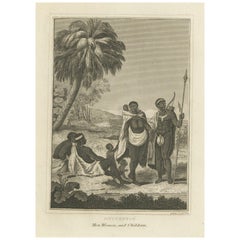
View All18th-Century Engraving of Hottentots and Cape of Good Hope in South-Africa
Located in Langweer, NL
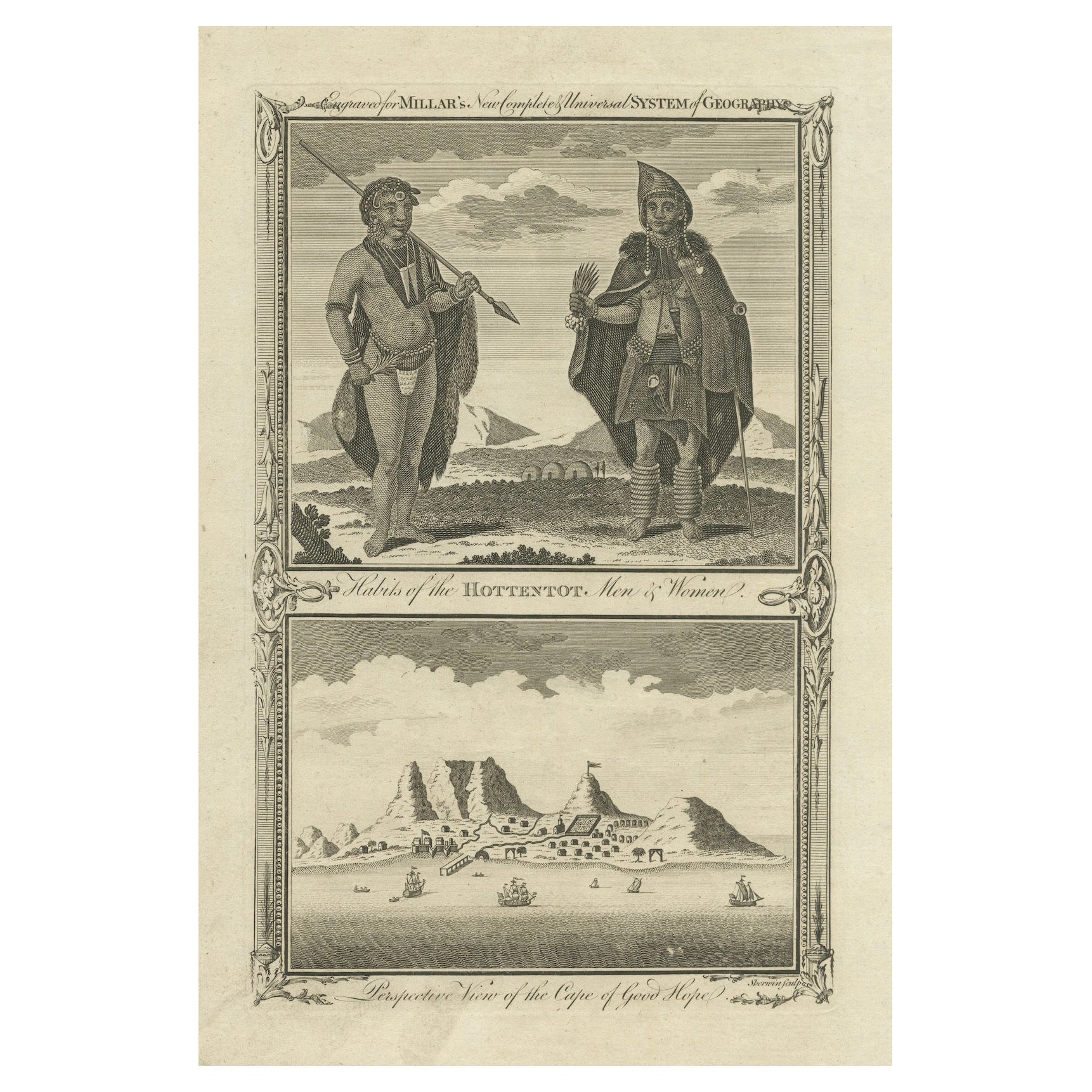
This engraving, titled "Habits of the Hottentot Men & Women" and "Perspective View of the Cape of Good Hope," is a fine example of 18th-century European visual representations of dis...
Category
Antique 1780s Prints
Materials
Paper
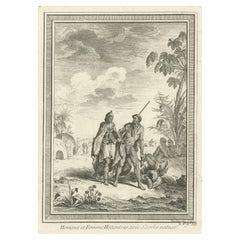
Antique Print of Hottentots in South Africa, C.1750
Located in Langweer, NL
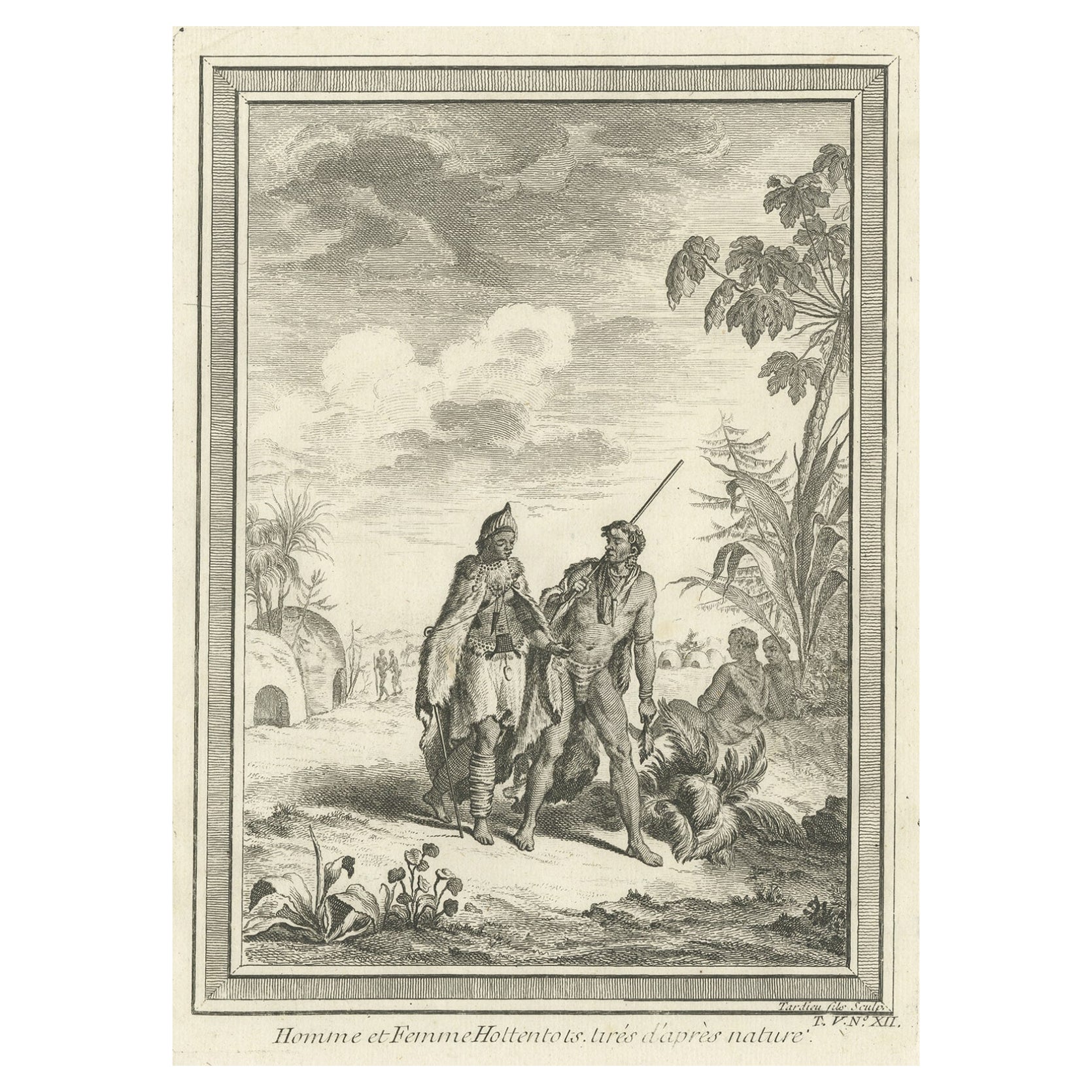
Antique print titled 'Homme et Femme Hottentots'. Old print showing Hottentots, nowadays called Khoikhoi. This print originates from Prevost's 'Histoire Generale des Voyages'.
Ar...
Category
Antique 18th Century Prints
Materials
Paper
Antique Print of the Khoikhoi of Cape of Good Hope by Valentijn, 1726
By F. Valentijn
Located in Langweer, NL
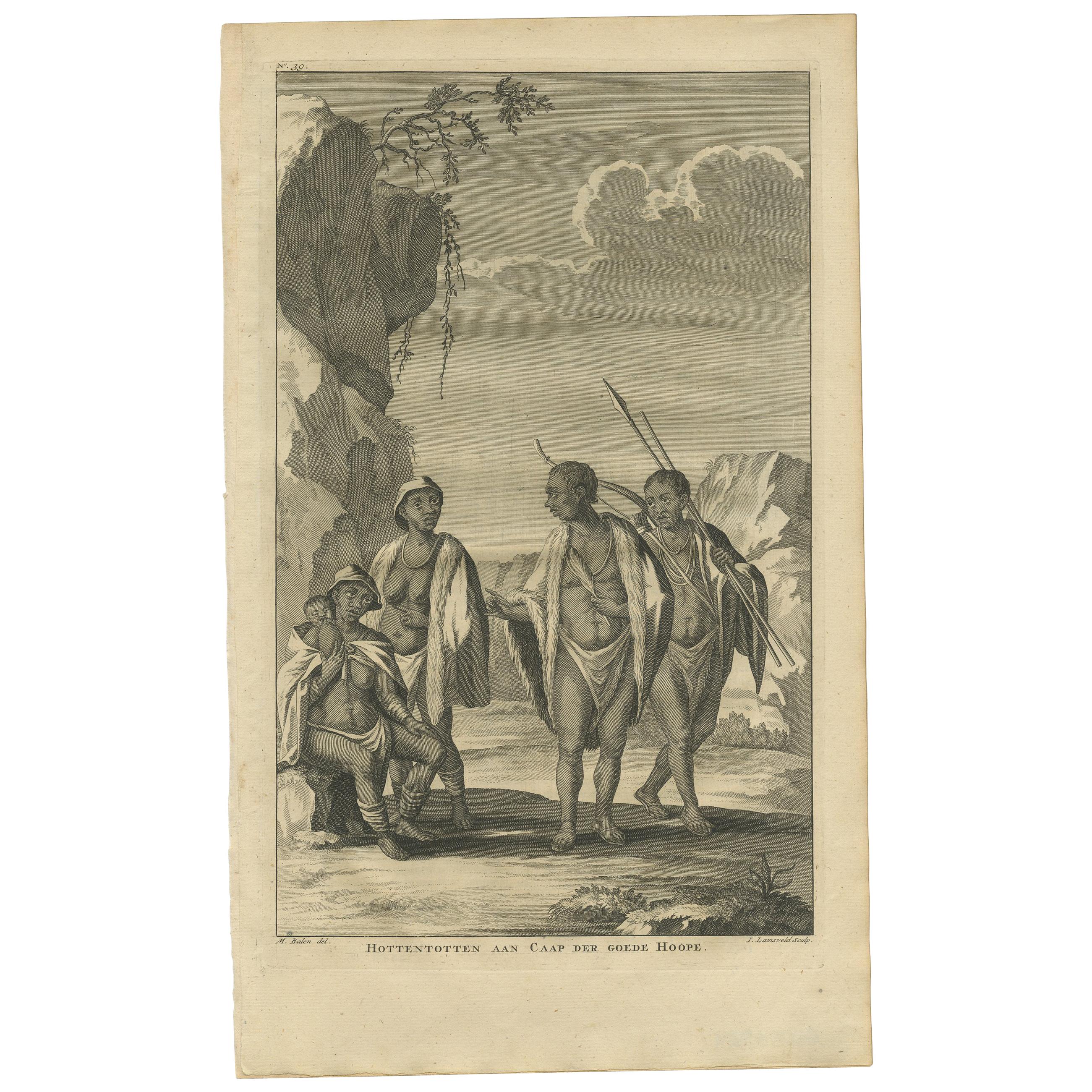
Antique print titled 'Hottentotten aan Caap der Goede Hoope'. Print depicting the Khoikhoi of Cape of Good Hope, Africa. Including two text pages. This print originates from 'Oud en ...
Category
Antique Early 18th Century Dutch Prints
Materials
Paper

The Khoikhoi of Southwestern Africa, Original Engraving of circa 1801
Located in Langweer, NL
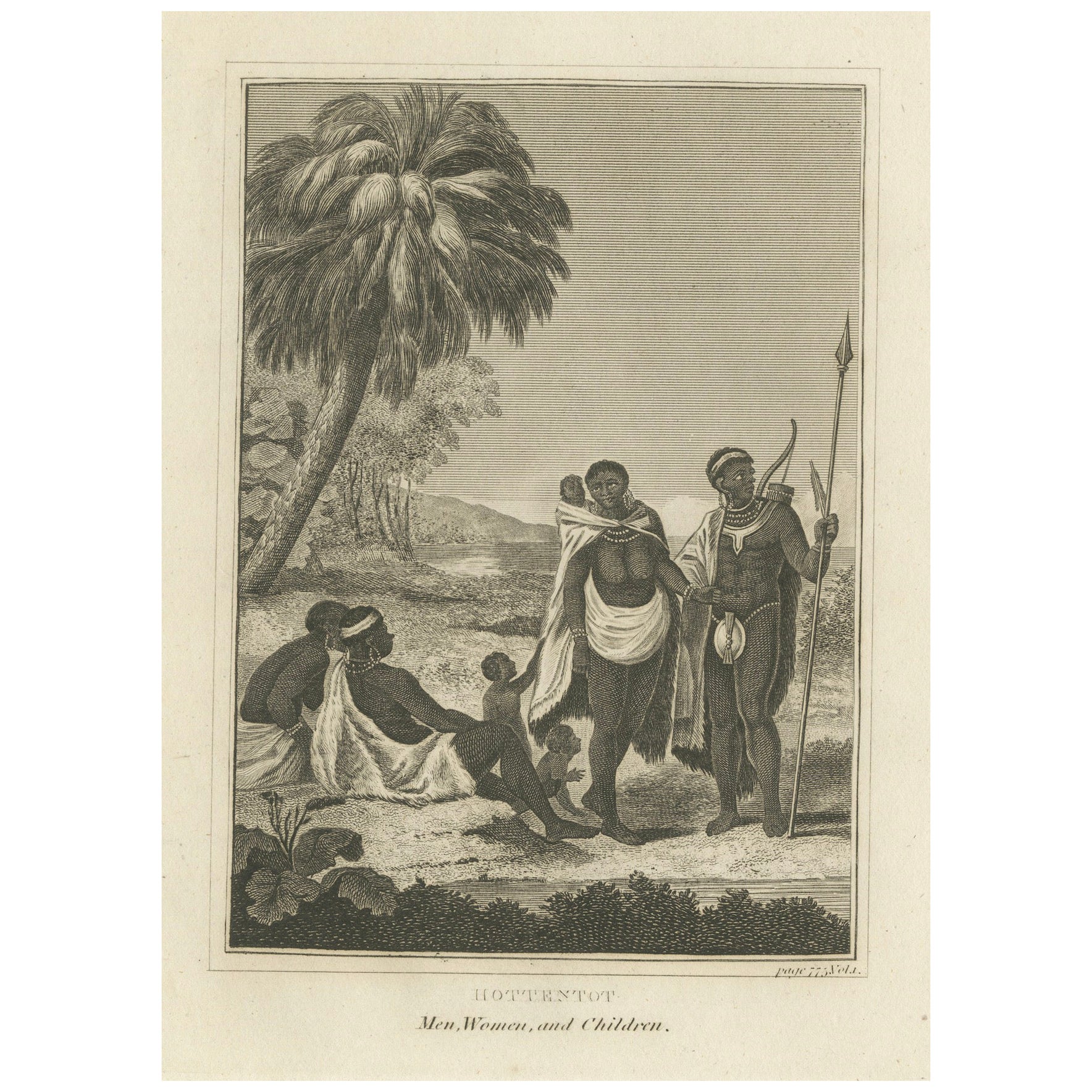
The print is an early 19th-century engraving depicting the Khoikhoi people, historically referred to as the Hottentots, which is an outdated term. The Khoikhoi are indigenous inhabit...
Category
Antique Early 1800s Prints
Materials
Paper
$325 Sale Price
20% Off
Free Shipping
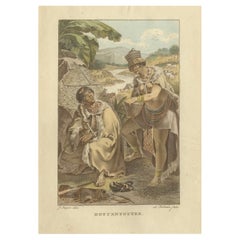
Khoikhoi Figures of Southern Africa – Antique Ethnographic Engraving. c.1803
Located in Langweer, NL
Khoikhoi Figures of Southern Africa – Antique Hand-Colored Ethnographic Engraving (c.1800)
Description:
An early 19th-century hand-colored ethnographic engraving depicting two Indig...
Category
Antique Early 19th Century Dutch Prints
Materials
Paper
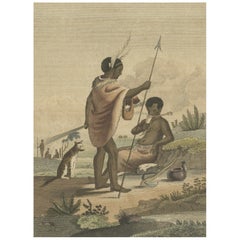
Antique Print of Natives from Africa, 1807
Located in Langweer, NL
Original antique print of natives from Africa ('The Beethshuans'). This print originates from 'Bilderbuch für Kinder'. Published 1807.
Artists and Engravers: Friedrich Johann Just...
Category
Antique 19th Century Prints
Materials
Paper
You May Also Like
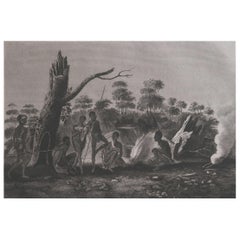
Original Antique Ethnographical Print, Figures, New South Wales, Australia, 1809
Located in St Annes, Lancashire
Wonderful ethnographical print.
A copper-plate engraving after Lesieur
Published by Sherwood, Neely & Jones. Dated 1809
Unframed.
Category
Antique Early 1800s English Folk Art Prints
Materials
Paper
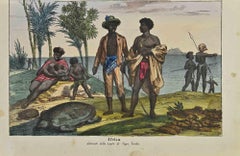
Ancient African Customs - Lithograph by Auguste Wahlen - 1844
Located in Roma, IT
Africa is a lithograph realized by Auguste Wahlen in 1844.
Hand colored.
Good condition.
At the center of the artwork is the original title "Africa" and subtitle "Abitanti delle i...
Category
1840s Modern Figurative Prints
Materials
Lithograph
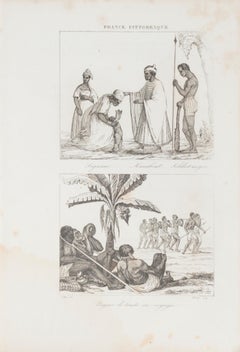
Indigenous Costumes - Original Lithograph - 19th Century
Located in Roma, IT
Indigenous Costumes is an original lithograph realized by an anonymous engraver of the 19th Century.
Printed as part of the series "France Pittoresque", as indicated at the top cent...
Category
19th Century Figurative Prints
Materials
Lithograph
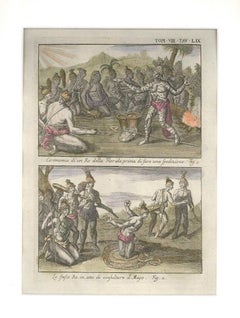
Ceremonies of a Floridian King - Etching by G. Pivati - 1746-1751
By Gianfrancesco Pivati
Located in Roma, IT
Image dimensions: 25.5 x 18 cm.
Ceremonies of a Floridian King is a fine etching, hand-watercolored, realized by the engraver Gianfrancesco Pivati.
This original print, representi...
Category
1740s Old Masters Figurative Prints
Materials
Etching
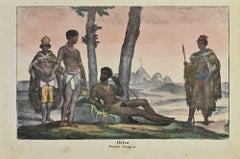
Ancient African Customs - Lithograph by Auguste Wahlen - 1844
Located in Roma, IT
Ancient African Customs is a lithograph realized by Auguste Wahlen in 1844.
Hand colored.
Good condition.
At the center of the artwork is the original title "Africa" and subtitle ...
Category
1840s Modern Figurative Prints
Materials
Lithograph
Original Antique Ethnographical Print of Indigenous Siberians. C.1780
Located in St Annes, Lancashire
Wonderful print of indigenous Siberians
Copper-plate engraving
Published C.1780
Unframed.
Category
Antique 1780s English Georgian Prints
Materials
Paper
More Ways To Browse
Womens Dress
Vintage Rooster Plates
Vintage Stetson
Vintage Sunroom Furniture
Vintage Wall Thermometer
Vintage Woodworking Tools
Wall Secretary
Wheat Pattern
Whimsical Pottery
White Ceramic Elephant
White Lion Sculpture
White Swedish Commode
Wood Hand Carved Painted Chinese Statues
Wood Hindu
Zebra Cushion
15th Century Chinese Porcelain
1933 Worlds Fair
1950s Vintage Television