1 of 1
The Blue Passion Flower
$7,500List Price
About the Item
The Temple of Flora.
London, 1798-1810.
Painted by Reinagle, Henderson, Pether, et. al.
Engraved by Ward, Caldwall, Earlom, et. al.
Aquatint, mezzotint, and/or stipple engraving finished by hand.
Approximately 17.75” x 22.5” paper size.
5 frontice pieces, 32 plates; generally 29-30 per volume with 1 or more frontice pieces.
As a boy, Robert John Thornton (d.1837) demonstrated his love of natural history with his own botanical garden and an aviary, which contained every species of English hawk, most of them captured by himself. He took his Cambridge M.B. and, following in his father's footsteps, set up practice as a London doctor. Upon inheriting the family fortune in 1797, Thornton desired to leave his mark on the world in the form of a massive work dedicated to Carolus Von Linnaeus, the great Swedish naturalist. For his own aggrandizement and that of his beloved England, Thornton wished it to surpass in scope, illustration, paper, and topography any publication produced in any other European country. He felt he was engaged upon "a national undertaking", and dedicated this homage of philosophic and literary distinction to Queen Charlotte. It was to be titled The Temple of Flora; or Garden of Nature Picturesque Botanical Plates of the New Illustration of the Sexual System of Linnaeus. Desiring the national glorification of botany and its alliance with the arts of painting and engraving, Thornton was the first person to juxtapose landscape backgrounds with his floral subjects. He opened an art gallery of the paintings from which the prints were made and subscriptions for the forthcoming books were sold. Copies of the work were sent to the Queen and Prince Regent, and to the Emperor of Russia, who sent Thornton a ring in acknowledgment of the "splendid and elaborate Botanical works."
The Thornton prints, originally to number seventy in all, were barely published in an edition of thirty at the author's expense between the years 1799 and 1807. Despite his efforts, Thornton was unable to succeed financially. Technically The Temple of Flora, as it came to be known, was not a success due to botanical inaccuracies and rather insipid text all based on Thornton's aesthetic sense. However, it is the forceful stylization of flowers, together with their historical, allegorical and fanciful backgrounds that place The Temple of Flora among the greatest botanical books of all time.
Though Thornton actually painted only one picture used for the engravings in his Temple, "The Roses", he literally directed his flower pictures. He chose the plants, arranged the symbolism and the backgrounds. For example, in the "Night-Blowing Cereus" the moon illuminates the turret clock, which has just struck midnight, the hour when this flower is fully open. Henderson, Reingal, Edwards and Pether are among the artists hired by Thornton to work on the flower designs and their backgrounds. Many times they would collaborate, as in the aforementioned "Cereus" where it states "The Flower by Reinagel, Moonlight by Pether". These plates were executed by the likes of Bartolozzi and other English master engravers and are a varied combination of mezzotint, aquatint, stipple engraving and finished in watercolor by hand. The text, primarily composed by Thornton, was lengthy, somewhat fanciful and included rather exaggerated poetry. Thornton was a man of his era, a time of romanticism, when artistic tastes ran to the sentimental, symbolic, and dramatic. The flowers from the Temple of Flora are delightful examples of that style.
In spite of tremendous public exposure and a dedication to Queen Charlotte, Thornton's venture was a financial disaster. While he attributed this to the continental war, no doubt his over-zealous attention to details, none too scientific, largely contributed to his failure. By 1811, Thornton was forced to petition Parliament for permission to set up a lottery. "An Act to enable Dr. Robert John Thornton to dispose of his collection of paintings, drawings and engravings, together with several copies of certain books therein mentioned, by way of chance" was passed in May of that year. Thus, the Quarto or Lottery edition of The Temple of Flora was published. This work, smaller in scale but not in romantic spirit, was to salvage Thornton's expenses for the original folio edition. Hoping to sell twenty thousand tickets at two guineas each, Thornton estimated the worth of his ten thousand prizes to be 77,000 pounds. This was a generous estimate as the complete sale of tickets would be worth no more than 42,000 pounds. Once again, Thornton's venture resulted in disaster. For the remaining years of his life, Thornton continued his medical practice with varying success, and attempted a brief, unhappy collaboration with the poet William Blake. Sadly when he died in 1837 his family was almost destitute. But despite these early failures, The Temple of Flora has now a permanent place as one of the greatest prizes of all time.
Reference:
Flower Fruit Prints. Dunthorne. Da Capo Press. Washington, D. C., 1938.
The Temple of Flora: Robert Thornton. King. Little, Brown and Company, NY, 1981.
- Dimensions:Height: 35.5 in (90.17 cm)Width: 30 in (76.2 cm)
- Period:
- Date of Manufacture:Jan 7, 1800
- Condition:Excellent. Full Margins. Original Color.
- Seller Location:Florham Park, NJ
- Reference Number:1stDibs: U090329857153
Authenticity Guarantee
In the unlikely event there’s an issue with an item’s authenticity, contact us within 1 year for a full refund. DetailsMoney-Back Guarantee
If your item is not as described, is damaged in transit, or does not arrive, contact us within 7 days for a full refund. Details24-Hour Cancellation
You have a 24-hour grace period in which to reconsider your purchase, with no questions asked.Vetted Professional Sellers
Our world-class sellers must adhere to strict standards for service and quality, maintaining the integrity of our listings.Price-Match Guarantee
If you find that a seller listed the same item for a lower price elsewhere, we’ll match it.Trusted Global Delivery
Our best-in-class carrier network provides specialized shipping options worldwide, including custom delivery.You May Also Like
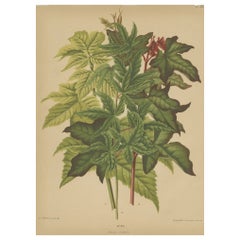
Antique Flower Print of the Acer Palmatum, 1879
Located in Langweer, NL
Antique print titled 'Acer'. Lithograph of the Acer Palmatum, also known as red emperor maple, palmate maple, Japanese maple or smooth Japanese-maple. This print originates from 'Ned...
Category
Antique 19th Century Prints
Materials
Paper
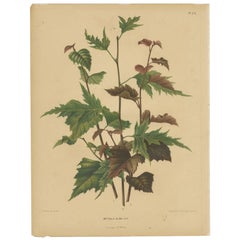
Antique Flower Print of the Betula Pubescens, 1879
Located in Langweer, NL
Antique print titled 'Betula Alba'. Lithograph of the Betula Pubescens, also known as downy birch and or moor birch. This print originates from 'Nederlandsche flora en pomona'.
Ar...
Category
Antique 19th Century Prints
Materials
Paper
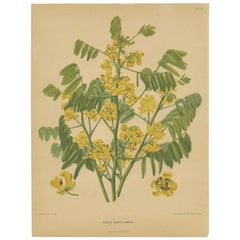
Antique Flower Print of the Senna Marilandica, 1879
Located in Langweer, NL
Antique print titled 'Cassia Marylandica'. Lithograph of the Senna Marilandica, also known as Maryland senna or Maryland wild senna. This print originates from 'Nederlandsche flora e...
Category
Antique 19th Century Prints
Materials
Paper
$104 Sale Price
20% Off
H 12.21 in W 9.26 in D 0 in
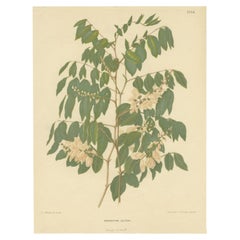
Original Antique Flower Print of the Indigofera Decora, 1879
Located in Langweer, NL
Antique print titled 'Indigofera Decora'. Lithograph of the Indigofera Decora, commonly known as summer wisteria. This print originates from 'Nederlandsche flora en pomona'.
Artist...
Category
Antique 19th Century Prints
Materials
Paper
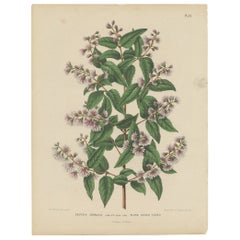
Antique Handcolored Flower Print of the Deutzia Crenata, 1868
Located in Langweer, NL
Antique print titled 'Deutzia Crenata'. Lithograph of the Deutzia Crenata, a species of flowering shrub. This print originates from 'Flora : afbeeldingen en beschrijvingen van boomen...
Category
Antique 19th Century Prints
Materials
Paper
$123 Sale Price
20% Off
H 12.41 in W 9.45 in D 0 in
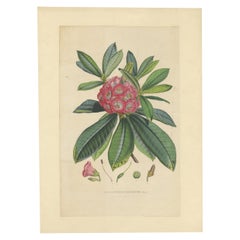
Large Original Antique Flower Lithograph of the Rhododendron Barbatum, 1849
Located in Langweer, NL
Antique botany print titled 'Rhododendrum Barbatum'. Large lithograph of the rhododendron barbatum. This print originates from volume 5 of 'Flore des serres et des jardins...
Category
Antique 1840s Prints
Materials
Paper
$274 Sale Price
20% Off
H 23.23 in W 16.93 in D 0 in
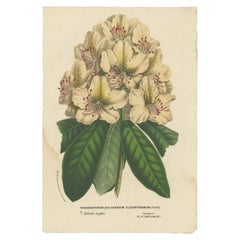
Decorative Original Antique Flower Print of the Rhododendron Carneum, c.1880
Located in Langweer, NL
Antique print titled 'Rhododendron Carneum Elegantissimum'. Lithograph of the rhododendron carneum, a creamy white flowered shrub native to China, Myanmar, and Vietnam. This print or...
Category
Antique 19th Century Prints
Materials
Paper
$118
H 9.65 in W 6.7 in D 0 in
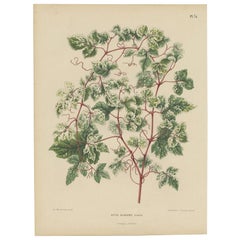
Antique Flower Print of the Ampelopsis Glandulosa var. Heterophylla, 1868
Located in Langweer, NL
Antique print titled 'Vitis Elegans'. Lithograph of the Ampelopsis Glandulosa var. Heterophylla, also known as porcelain vine or cutleaf grape. This print originates from 'Flora : af...
Category
Antique 19th Century Prints
Materials
Paper
$165
H 12.41 in W 9.26 in D 0 in
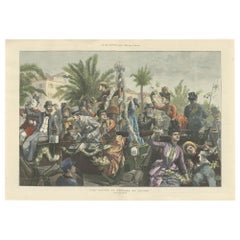
Antique Print of
The Battle of Flowers
at Cannes by Hopkins,
1889
Located in Langweer, NL
Antique print titled 'The Battle of Flowers at Cannes'. Original antique print of a flower parade in Cannes, France. This print originates from 'The Illustrated London News'. Drawn b...
Category
Antique Late 19th Century Prints
Materials
Paper
$378 Sale Price
20% Off
H 15.95 in W 22.64 in D 0.02 in
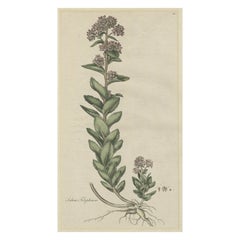
Old Flower Print of the Frog
s-Stomach or Harping Johnny, ca.1800
Located in Langweer, NL
Antique print titled ‘Sedum Telephium’. Sedum telephium, often called Hylotelephium telephium, orpine, livelong, frog's-stomach, harping Johnny, life-everlasting, live-forever, midsu...
Category
Antique Early 1800s Prints
Materials
Paper
$265 Sale Price
20% Off
H 18.12 in W 11.03 in D 0 in