Items Similar to A frame with an old Japanese Buddhist woodblock print / amulet / 1800-1912
Want more images or videos?
Request additional images or videos from the seller
1 of 19
A frame with an old Japanese Buddhist woodblock print / amulet / 1800-1912
$600
£453.16
€523.47
CA$845.31
A$905.33
CHF 486.70
MX$10,995.79
NOK 6,149.70
SEK 5,630.50
DKK 3,911.28
About the Item
This is a woodblock print made between the late Edo and Meiji periods (1800-1912).
It was originally a talisman given to visitors to temples as a good luck charm.
It is unclear which temple gave it out, but the Buddha depicted here is a statue called "Bishamonten."
"Bishamonten" is a Buddhist deity belonging to the heavenly realm. He is one of the guardian deities of Buddhism, one of the Four Heavenly Kings and the Twelve Heavenly Kings, and protects the north direction.
Bishamonten is also the god of war and is said to bring victory. He is also one of the Seven Lucky Gods and is a god of fortune who bestows various good fortunes.
As a reference image of Bishamonten, I have attached an image of Bishamonten, which is designated as an Important Cultural Property of Japan. Please take a look.
This was probably displayed in a private home for a long time, but it was recently framed because it had become corroded.
If you are displaying it in your home, I think it would fit in a modern space better if it was framed like this.
How about displaying it in your entrance or living room?
Weight: 1.4kg
[We mainly sell old Japanese items.
We've seen tens of thousands of items so far.
Taking advantage of that experience, we are posting attractive items here.
We are able to do this because we have a long experience.
We introduce simple objects, tools used by common people, and objects used in temples that are different from the image of Japan that we have known up until now.
We are rediscovering Japanese beauty that is unknown to the world, evaluating it, and disseminating it.]
- Dimensions:Height: 17.33 in (44 cm)Width: 14.3 in (36.3 cm)Depth: 0.99 in (2.5 cm)
- Style:Edo (Of the Period)
- Materials and Techniques:
- Place of Origin:
- Period:
- Date of Manufacture:1800-1912
- Condition:
- Seller Location:Sammu-shi, JP
- Reference Number:1stDibs: LU5487240832152
About the Seller
5.0
Platinum Seller
Premium sellers with a 4.7+ rating and 24-hour response times
Established in 2015
1stDibs seller since 2020
1,707 sales on 1stDibs
Typical response time: 6 hours
- ShippingRetrieving quote...Shipping from: senzoku, Japan
- Return Policy
More From This Seller
View AllJapanese antique wooden blocks/1800-1920/paper charms/Buddhist art
Located in Sammu-shi, Chiba
This is a wooden woodblock produced in Japan from the late Edo period to the Taisho period (about 1800s to 1920s). The material used is something like beech wood, and the wood is dec...
Category
Antique Late 19th Century Japanese Edo Wall-mounted Sculptures
Materials
Beech
Old Japanese wall-mounted wooden frame / 20th century / large picture frame
Located in Sammu-shi, Chiba
This wooden frame is crafted from ancient Japanese zelkova wood. It appears to have originally been made as a hearth edge, but was rarely used and stored for a long time. As a result...
Category
20th Century Japanese Taisho Decorative Art
Materials
Wood
Japanese antique wall-hanging wooden Buddha statue/Edo period/1603-1868/Wabisabi
Located in Sammu-shi, Chiba
This is a wooden Buddha statue made around the Edo period in Japan.
Although it is a small Buddha statue, it has a strong presence and is beautiful.
Originally, there was a wooden pe...
Category
Antique 18th Century Japanese Edo Sculptures and Carvings
Materials
Cypress
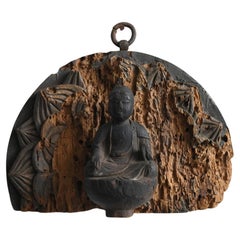
Antique Japanese Buddhist pagoda hanging scroll /Buddhist painting/Edo
Located in Sammu-shi, Chiba
This is a slightly different Buddhist painting believed to have been created by a Japanese temple monk during the Edo period (late 17th to 19th century). Rendered in ink on paper, th...
Category
Antique 18th Century Japanese Edo Paintings
Materials
Paper

Antique Japanese Ink Painting Curtain/Wabi-Sabi Tapestry/1868-1920
Located in Sammu-shi, Chiba
This is an old Japanese noren curtain. It is believed to be made from a traditional Japanese fabric called asa or basho, made from banana leaf fibers. Noren curtains were originally hung at the entrances of shops and homes, gently blocking outside views and breezes while also conveying a sense of the presence of people and the changing seasons, a presence born from Japan's unique lifestyle and culture. More than simply a room divider, noren curtains also quietly convey the aesthetic sense of the people and businesses that inhabit them.
The greatest appeal of this work lies in the ink paintings executed on the fabric. The moon, bamboo grass, rocks, and flowing river are depicted, making ample use of the white space, creating a tranquil worldview reminiscent of Chinese and Japanese landscape paintings. However, the depiction is by no means verbose; the bamboo grass is depicted with minimal, omitted lines, and the river is not depicted in full, leaving it to the viewer's imagination. In the center, a full moon is depicted only as an outline, and its understated depiction evokes a sense of transience and lingering beauty.
A two-character signature can be seen in the corner of the painting, but details about the artist are unknown. However, noren curtains painted directly onto them in ink like this are extremely rare, and I have only seen them a few times before. I think it is particularly noteworthy that such poetic, highly refined pictorial expression has been applied to a noren curtain, which is supposed to be a practical item.
Over the years, the entire fabric has taken on a slight brownish tinge, taking on the depth and tranquility that only comes with aging. This color blends with the pale ink colors of the ink, quietly blending into the space without making a strong statement. It pairs particularly well with white walls, and I highly recommend using it not only as a noren curtain, but also hanging it on the wall like a tapestry for viewing. I believe that just hanging one in a space will bring a sense of dignified space and the depth of time.
Size & Specifications
Cloth Width: Approx. 87.5 cm
Height: Approx. 150.5 cm
Cloth Thickness: Very thin (approx. 0.05 mm; exact measurements not taken)
Top Bamboo Rod Length: Approx. 98.5 cm
Item Number
OB314
It's impossible to say when we'll ever be able to find another antique noren...
Category
Antique Late 19th Century Japanese Meiji Tapestries
Materials
Hemp

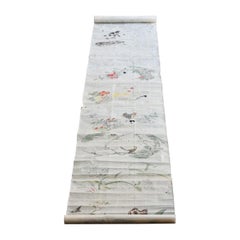
Japanese antique sketch scroll / 1800-1900 / Flower, bird and animal paintings
Located in Sammu-shi, Chiba
This is a rough sketch of a Japanese painting drawn around the late Edo period to the early Meiji period (1800-1900) in Japan.
A picture is drawn by sticking and connecting short pi...
Category
Antique 19th Century Japanese Edo Paintings and Screens
Materials
Paper
You May Also Like
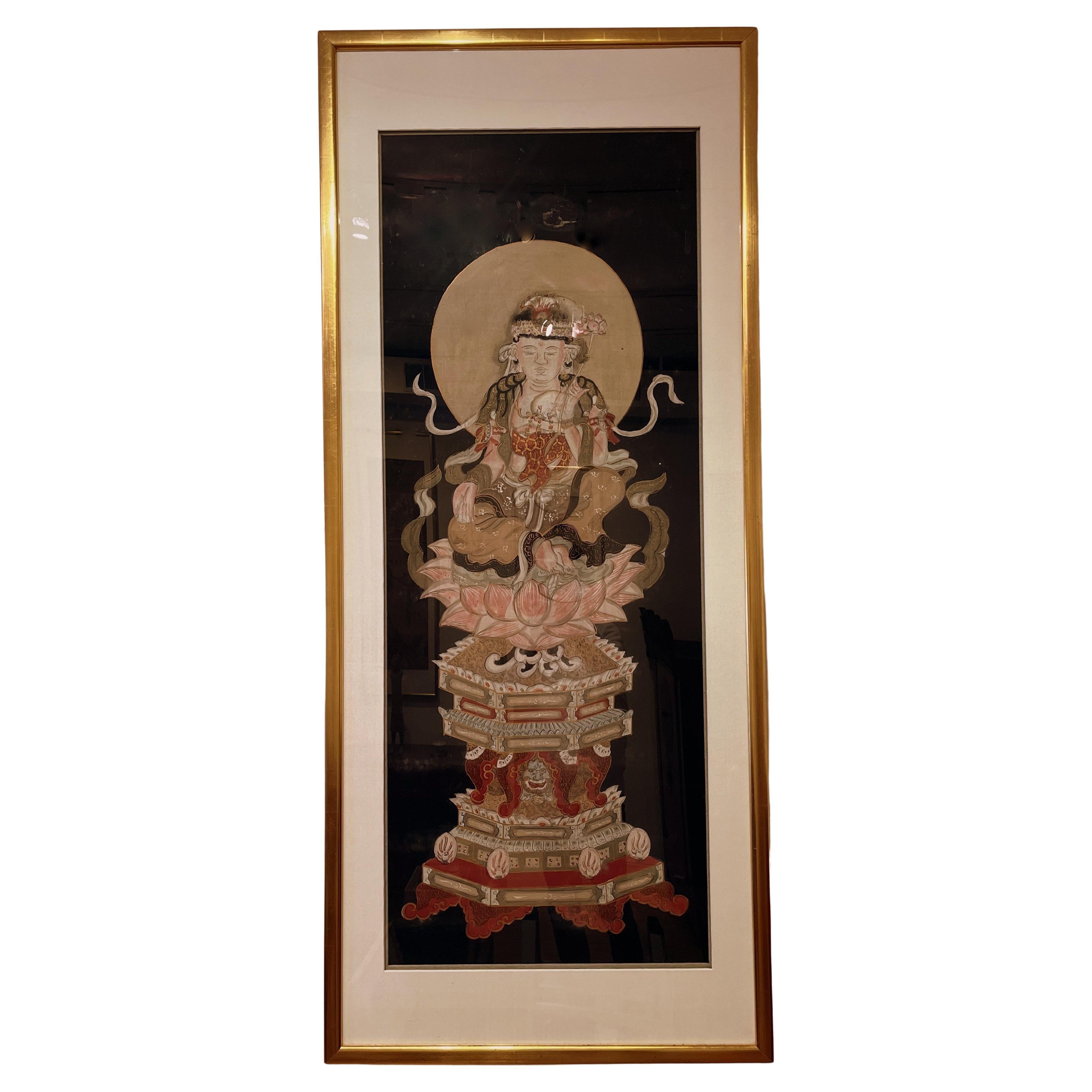
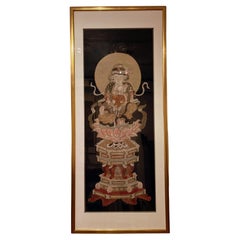
Framed Japanese or Chinese Brush Painting of Buddhistattva, Conservation Framed
Located in Greenwich, CT
Chinese or Japanese brush painting of Bodhisattva of Mercy sitting on lotus throne, Painting itself is in very good condition. Conservation framed is the quality of using by museum ...
Category
Antique Early 1900s Chinese Paintings and Screens
Materials
Silk
$2,500 Sale Price
34% Off
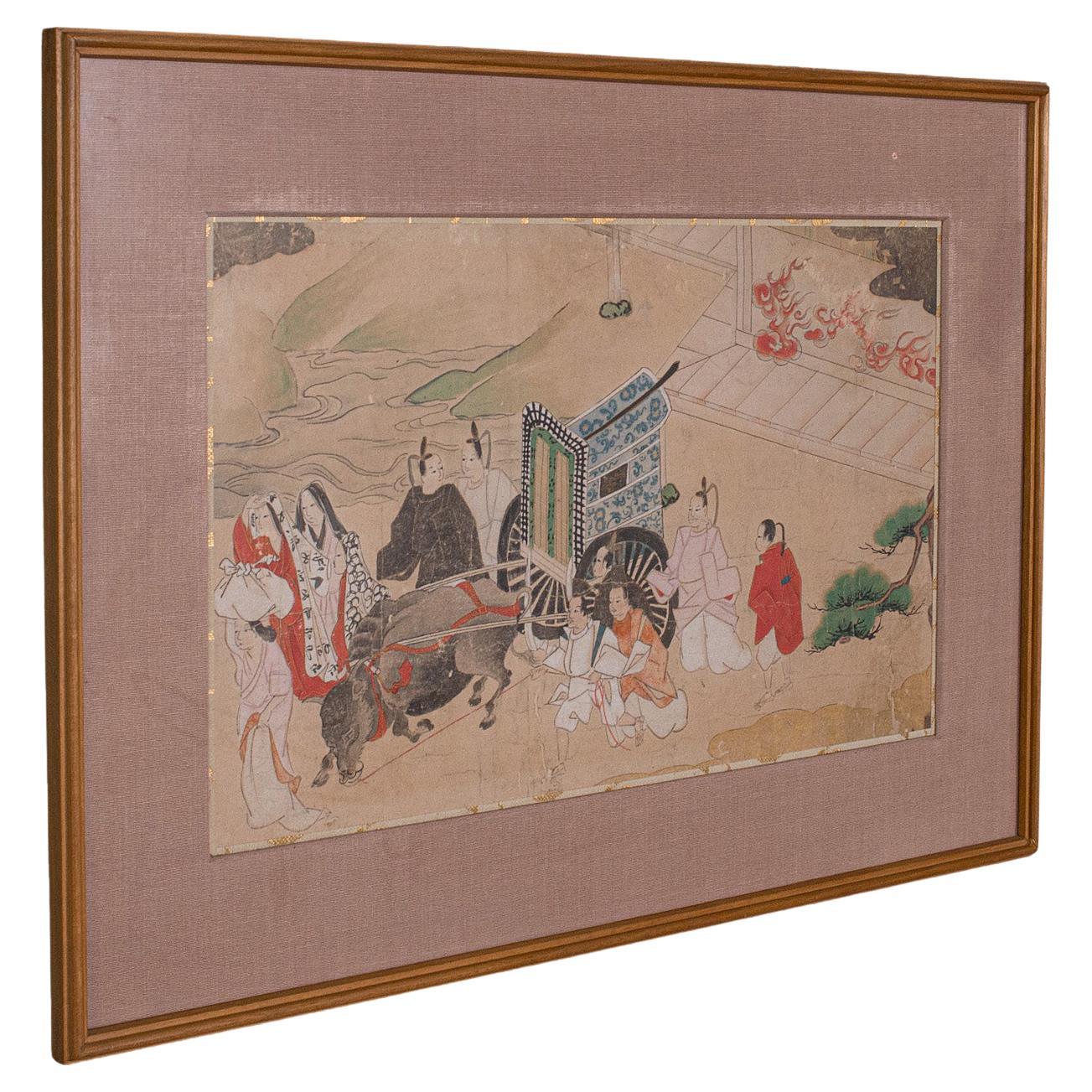
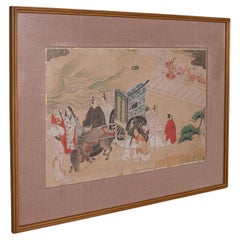
Antique Framed Woodblock Print, Japanese, After Heian, Art, Victorian, C.1900
Located in Hele, Devon, GB
This is an antique framed woodblock print. A Japanese, after Heian era art scene, dating to the late Victorian period, circa 1900.
The Heian period of ...
Category
Antique Late 19th Century Japanese Decorative Art
Materials
Pine
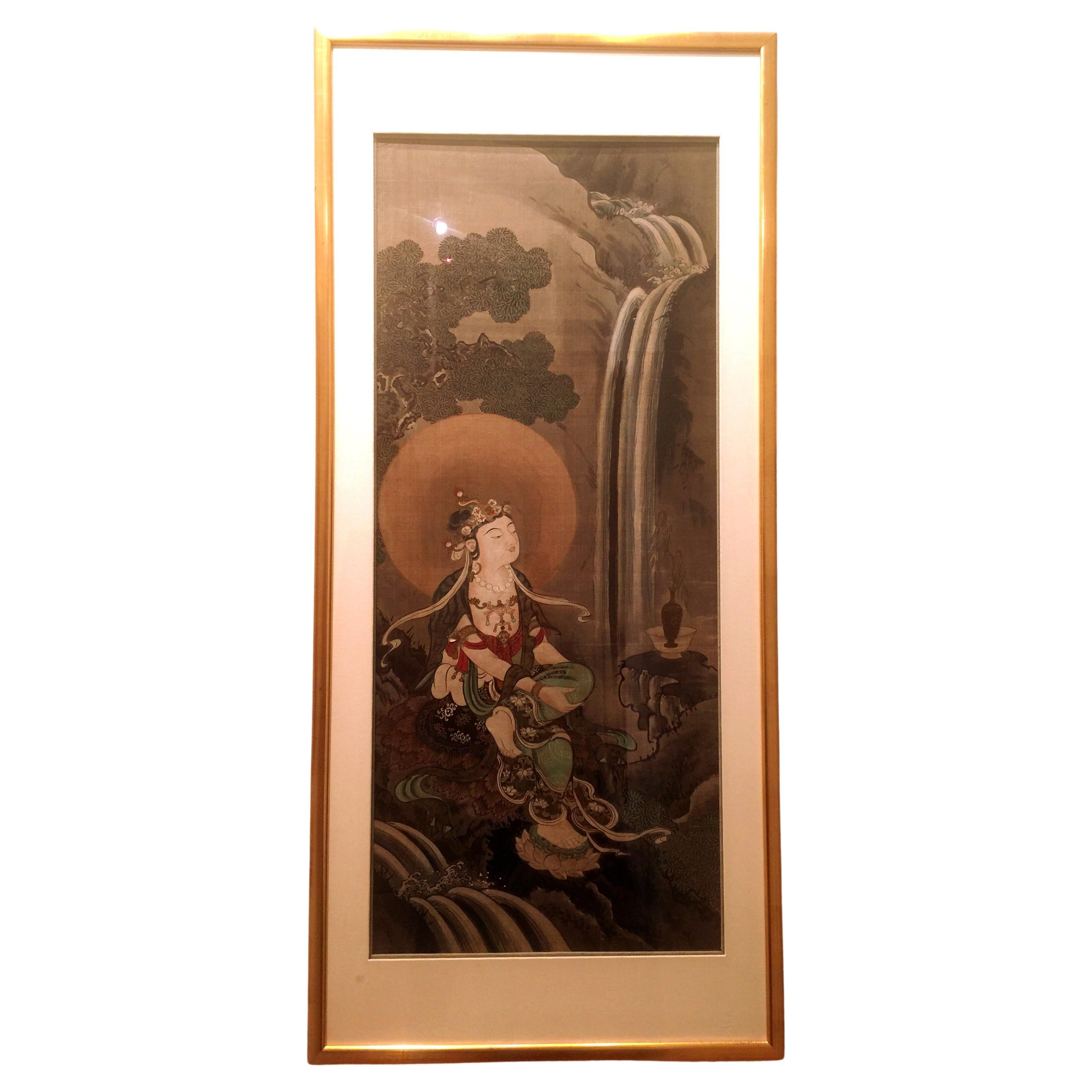
Fine Framed Japanese Brush Painting of Bodhisattva, Conservation Framed
Located in Greenwich, CT
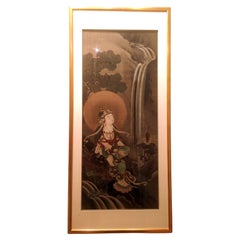
refined Japanese brush painting of Bodhisattva sitting by stream, waterfall and pine tree, ink and color on silk, 19th century, conservation fr...
Category
Antique 19th Century Japanese Meiji Paintings and Screens
Materials
Silk
$3,500 Sale Price
36% Off
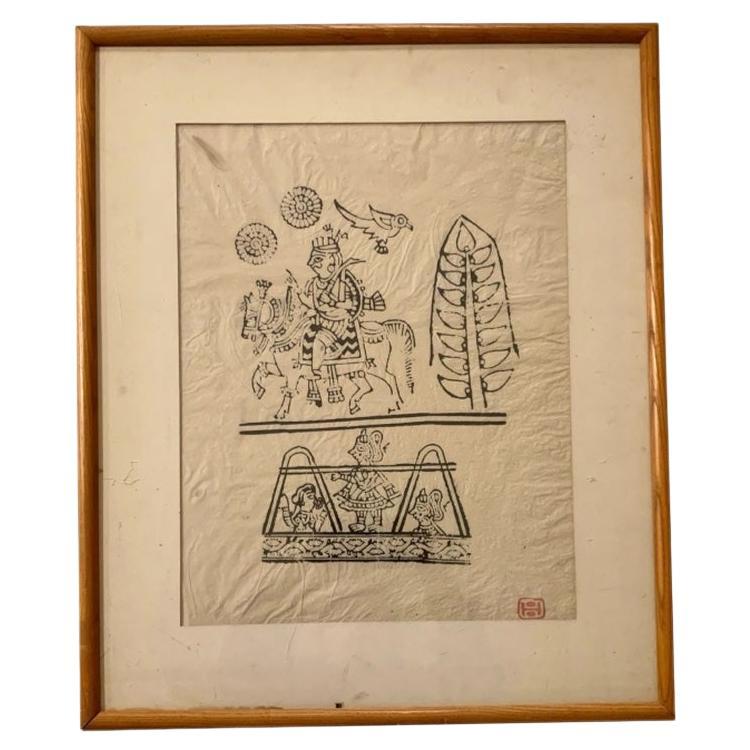
Japanese Framed Wood Block Print Of A King With Chop Mark
Located in Bridgeport, CT
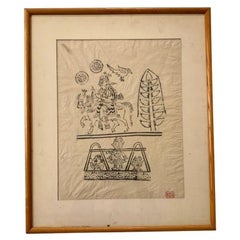
Vintage Asian woodblock print on rice paper of a Horse mounted King with a Tree, Bird and Sun Mandalas floating above and surmounting three figures in an open pavilion. Cinnabar chop...
Category
20th Century Edo Prints
Materials
Hardwood, Paper
Tosa Mitsusada Woodcut Printed 1806-1808
Located in Alpha, NJ
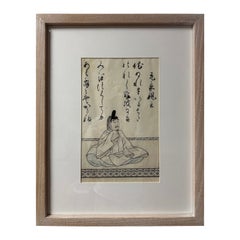
Dated between 1738-1806 Mitsusada Tosa
Printed 1806-1808
Engraver Jihei Inoue
Printer Kisaburo Hori
Category
Antique Early 1800s Japanese Prints
Materials
Paper
Shiko Munakata SignedJapanese Woodblock Print of Three Buddhas Shaka No Saku
By Shiko Munakata
Located in Studio City, CA
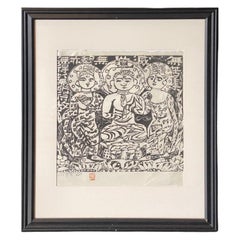
A wonderful Mingei woodblock print titled "Shaka No Saku (Sakyamuni)" is by famed Japanese master Showa era printmaker/ artist Shiko (Shikou) Munakata (棟方志功 ) who was widely consider...
Category
Vintage 1950s Japanese Showa Prints
Materials
Paper
More Ways To Browse
Good Luck Charms
Seven Lucky Gods
Marti Bronze Mantel Clock
Metal Glider
Mid Century Liquor Bottle
Mid Century Parrot Bird
Ming Dynasty Dish
Mirrored Table Plateau
Moretti Nason
Morrocan Chest
Murano Glass Cat
Nambe Vintage
Nautilus Seashell
New England Chest
New Hope Furniture
Oak Tallboy
Olympic Torch
Opium Smoker