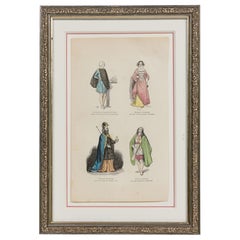
Items Similar to Lord Beaumont in Courtly Attire, Costume Di Moyen Age, 1847
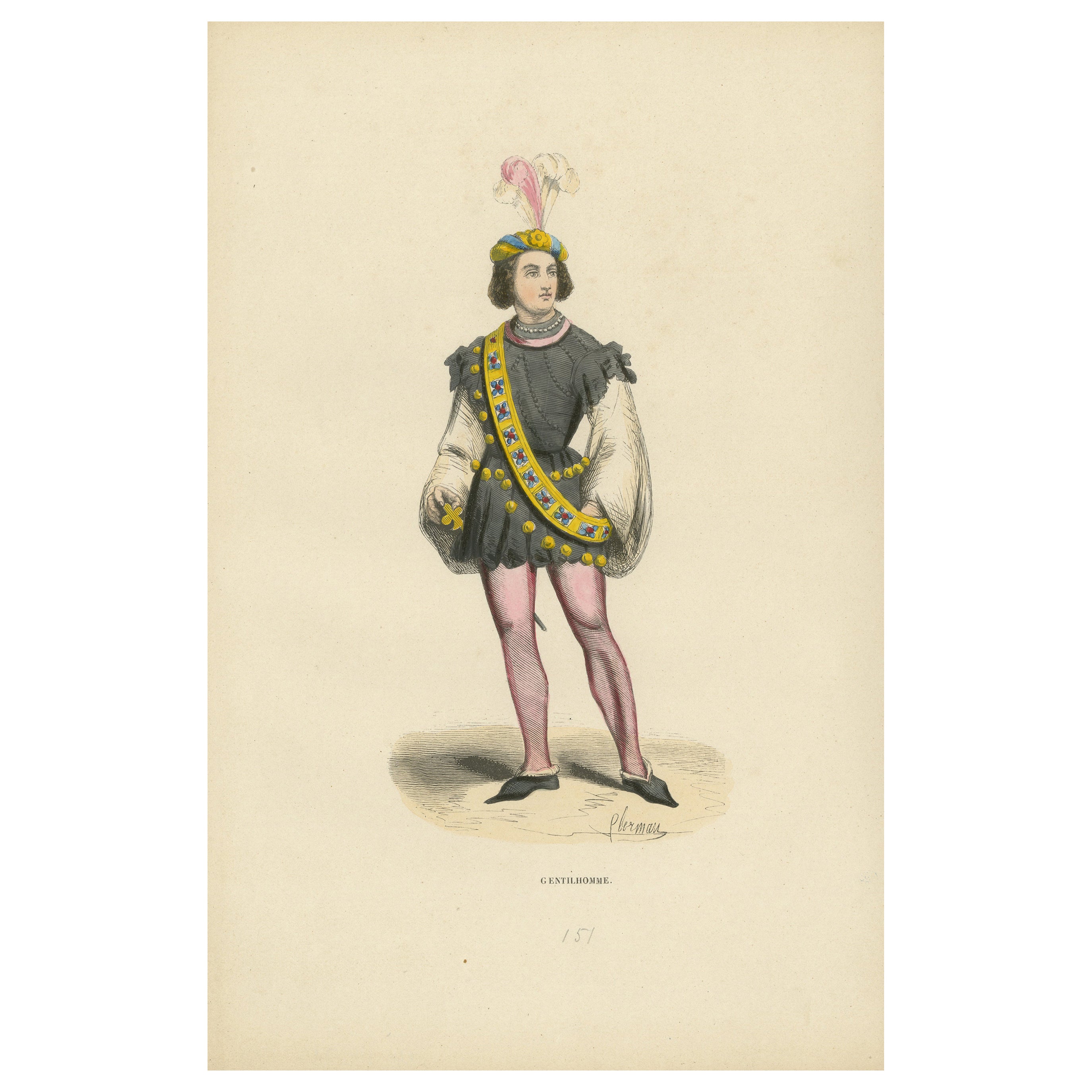
Want more images or videos?
Request additional images or videos from the seller
1 of 6
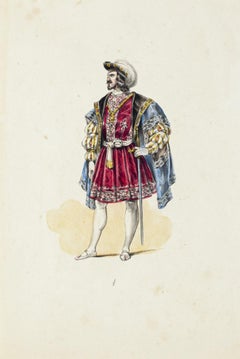
Lord Beaumont in Courtly Attire, Costume Di Moyen Age, 1847
$124.89
$156.1220% Off
£92.50
£115.6320% Off
€104
€13020% Off
CA$170.85
CA$213.5620% Off
A$185.93
A$232.4220% Off
CHF 98.56
CHF 123.2020% Off
MX$2,236.94
MX$2,796.1720% Off
NOK 1,250.11
NOK 1,562.6320% Off
SEK 1,143.76
SEK 1,429.7020% Off
DKK 792.50
DKK 990.6220% Off
About the Item
The image shows a figure labeled as "Lord Beaumont," depicted in medieval attire. He is wearing a blue overcoat with a fur trim and a gold-patterned undergarment that extends to his knees. His head is adorned with a red cap, a common headpiece for noblemen of the time. The style and cut of the clothing, along with the fur and fabric patterns, suggest wealth and status. Lord Beaumont is portrayed with a gesture that seems to indicate speaking or presenting, which might suggest his role in court or in council.
The source for this print is Costume Di Moyen Age, published 1847.
More about the vivid colors of this original hand-colored antique print:
The colors have a nice glow over them. Historically, egg whites, known as glair, and sometimes egg yolk were indeed used in illumination and painting, particularly in manuscripts, to give colors a brighter appearance and to add a sheen or gloss to the work. This technique was quite common during the Middle Ages and into the Renaissance.
Egg whites can be applied as a varnish over pigments to enhance their brightness and to protect the colors. This application could make the colors appear more vivid and also add a slight glossy sheen to the surface of the image.
Egg yolk, on the other hand, was commonly used as a binding agent in paint. It forms the basis of tempera paint, a medium that was widely used before the advent of oil painting. Egg yolk helps to create a durable and long-lasting color that adheres well to various surfaces.
In the context of the print from 1847, it's less likely that egg whites or yolks were used directly on the print, as by that time, commercial printing processes would have been more advanced and less reliant on such manual methods. However, if this print is a representation of an earlier style or is meant to mimic the appearance of hand-painted manuscripts, the original artists might have employed techniques or materials that gave a similar effect to those achieved with egg-based binders and varnishes.
- Dimensions:Height: 10.63 in (27 cm)Width: 7.09 in (18 cm)Depth: 0 in (0.02 mm)
- Materials and Techniques:
- Period:
- Date of Manufacture:1847
- Condition:Good. Overal very light toning and light soiling but the image itself clean and hand-colored almost 200 years ago and still in expliciet colors. Aged paper with typically warm, yellowish-brown hue, mostly around the edges.
- Seller Location:Langweer, NL
- Reference Number:Seller: BG-13635-361stDibs: LU3054337888922
About the Seller
5.0
Recognized Seller
These prestigious sellers are industry leaders and represent the highest echelon for item quality and design.
Platinum Seller
Premium sellers with a 4.7+ rating and 24-hour response times
Established in 2009
1stDibs seller since 2017
2,816 sales on 1stDibs
Typical response time: 1 hour
- ShippingRetrieving quote...Shipping from: Langweer, Netherlands
- Return Policy
More From This Seller
View AllThe Gallant Courtier: A Nobleman
s Fashion in
Costume du Moyen Âge, 1847
Located in Langweer, NL
Title: "The Gallant Courtier: A Nobleman's Fashion in 'Costume du Moyen Âge'"
Description: This 1847 lithograph from the "Costume du Moyen Âge" collection depicts a nobleman dressed...
Category
Antique 1840s Prints
Materials
Paper
$134 Sale Price
20% Off
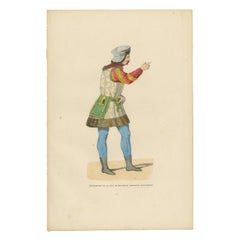
Courtly Splendor: A Nobleman at Emperor Sigismund
s Court, 1847
Located in Langweer, NL
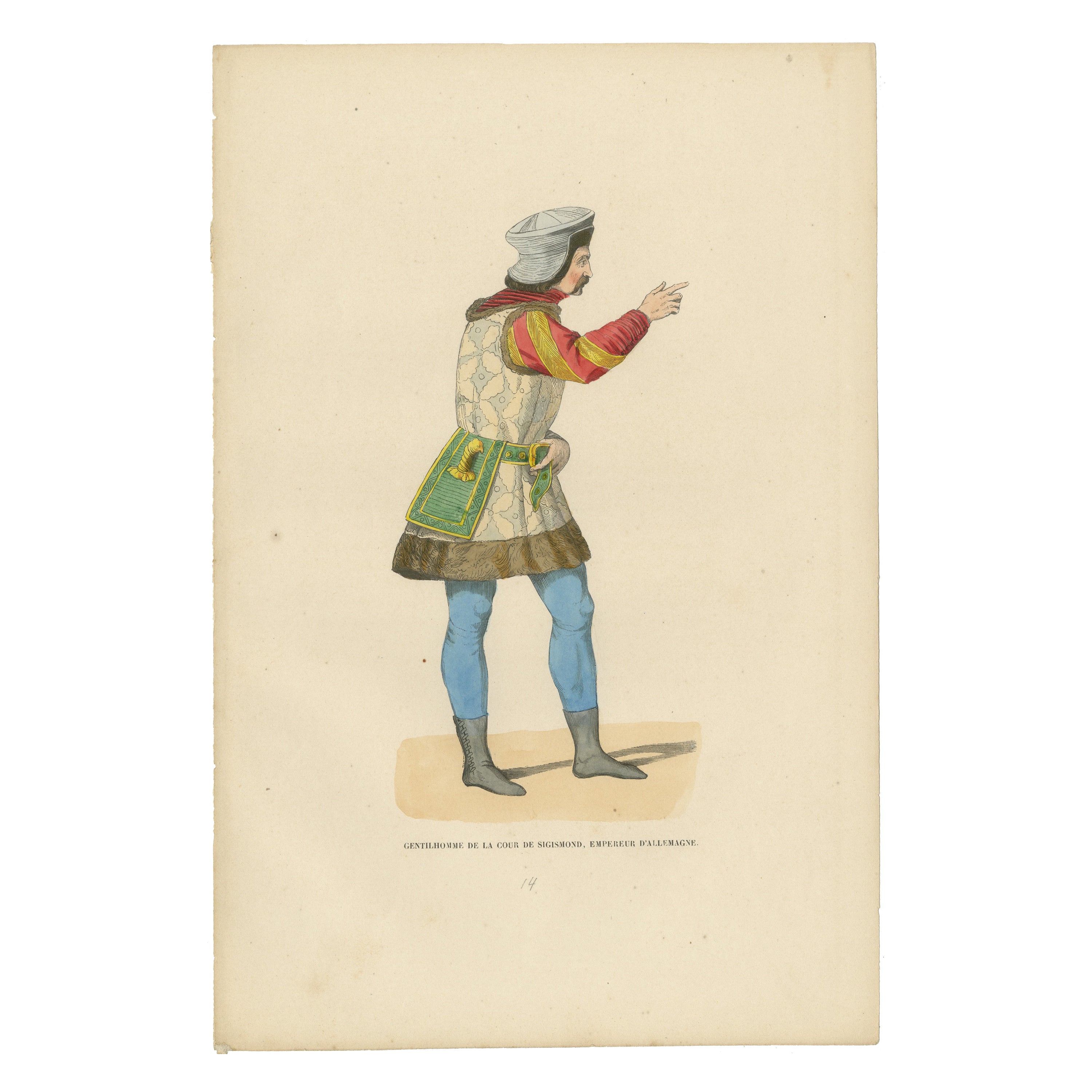
The image depicts a man identified as a "Gentilhomme de la cour de Sigismond, empereur d'Allemagne," which translates to "Gentleman of the court of Sigismund, Emperor of Germany."
This individual is portrayed in a profile stance, dressed in attire that is indicative of the high-status courtiers during the time of Emperor Sigismund, who reigned in the early 15th century. He is wearing a turban-like headgear, which reflects the influence of Eastern fashion on European court attire, possibly due to the Ottoman influence or the general exchange of culture during the Crusades and subsequent interactions.
His doublet is richly patterned and he has puffed sleeves in red, which were fashionable among the nobility during the period. The garment is accented with a decorative belt that holds what appears to be a purse or a pouch. He also sports tight blue hose and pointed shoes, which complete the ensemble typical of a nobleman or a high-ranking court official in the Holy Roman Empire.
Egg whites can be applied as a varnish over pigments to enhance their brightness and to protect the colors. This application could make the colors appear more vivid and also add a slight glossy sheen to the surface of the image.
Egg yolk, on the other hand, was commonly used as a binding agent in paint. It forms the basis of tempera paint, a medium that was widely used before the advent of oil painting. Egg yolk helps to create a durable and long-lasting color that adheres well to various surfaces.
In the context of the print from 1847, it's less likely that egg whites or yolks were used directly on the print, as by that time, commercial printing processes would have been more advanced and less reliant on such manual methods. However, if this print is a representation of an earlier style or is meant to mimic the appearance of hand-painted manuscripts...
Category
Antique 1840s Prints
Materials
Paper
$153 Sale Price
20% Off
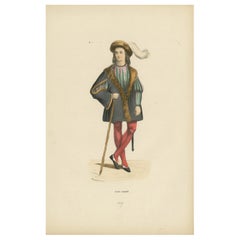
Youthful Elegance: A Young Gentleman
s Attire in
Costume du Moyen Âge
, 1847
Located in Langweer, NL
Title: "Youthful Elegance: A Young Gentleman's Attire in 'Costume du Moyen Âge'"
Description: This lithograph, part of the 1847 "Costume du Moyen Âge" series, depicts a young gentle...
Category
Antique 1840s Prints
Materials
Paper
$163 Sale Price
20% Off
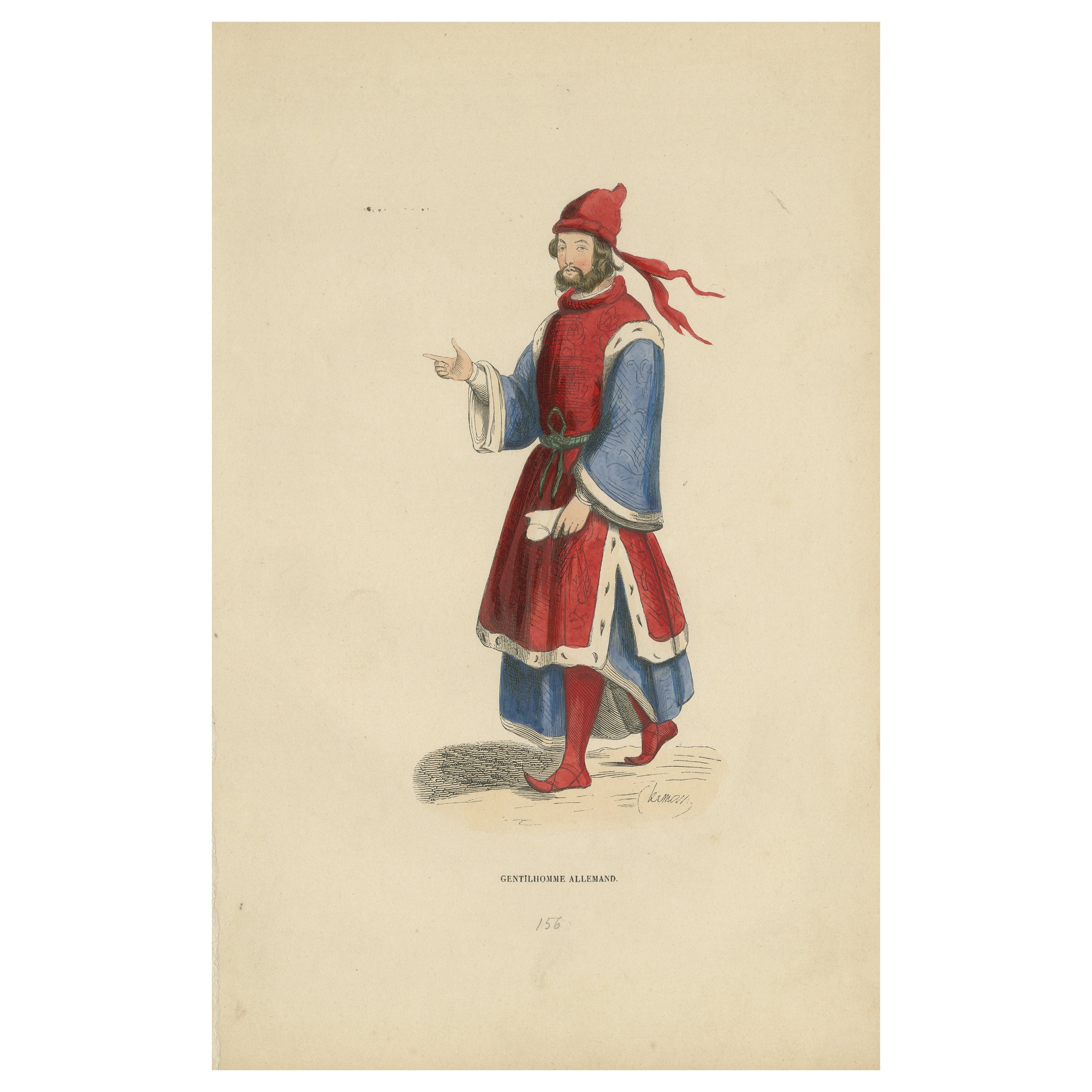
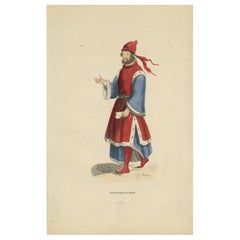
Noble Bearing: A German Gentleman in Medieval Attire, 1847
Located in Langweer, NL
Title: "Noble Bearing: A German Gentleman in Medieval Attire from 'Costume du Moyen Âge'"
Description: This 1847 lithograph from the esteemed collection "Costume du Moyen Âge" showc...
Category
Antique 1840s Prints
Materials
Paper
$172 Sale Price
20% Off
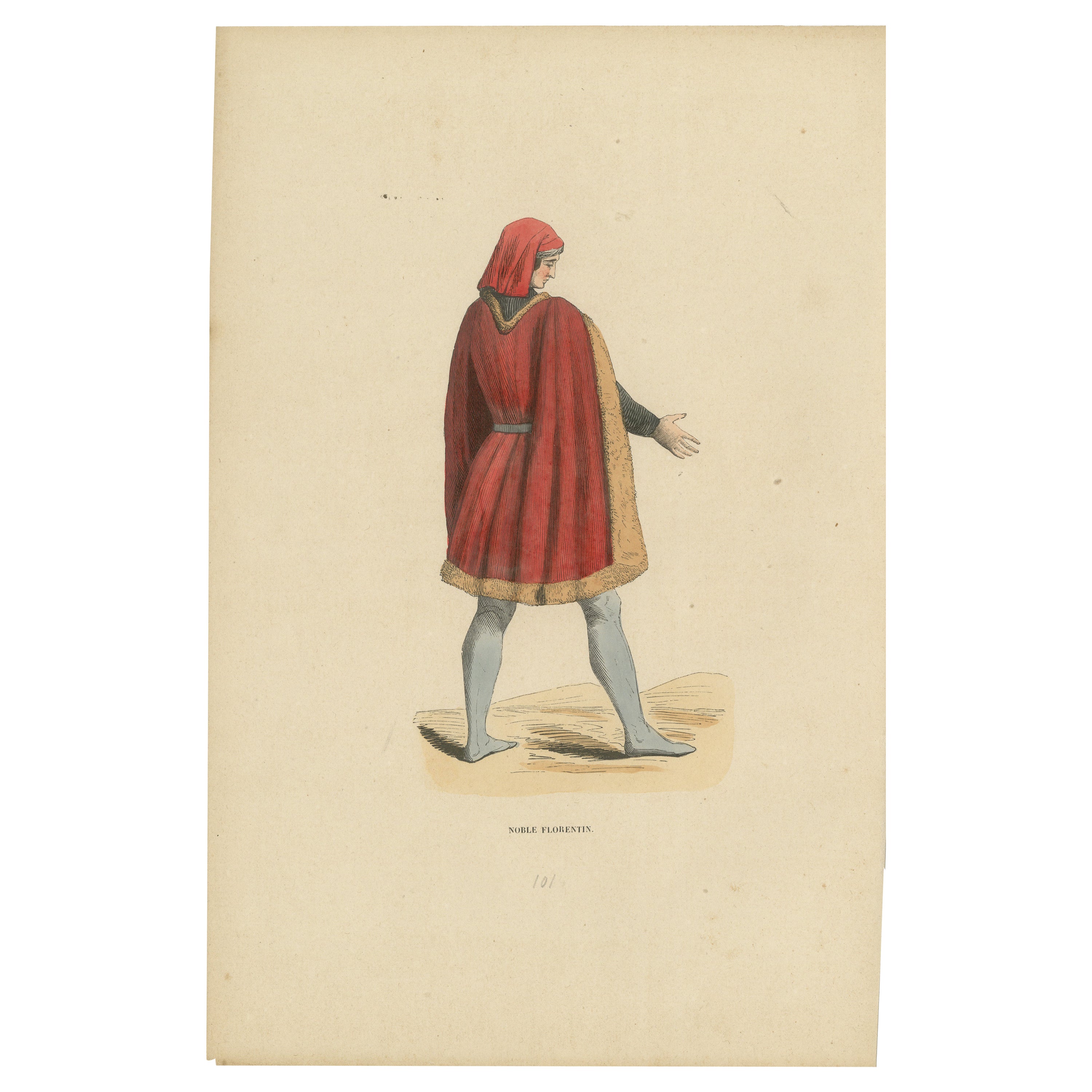
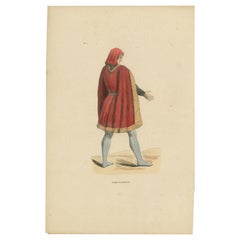
Florentine Nobleman of the Middle Ages, 1847
Located in Langweer, NL
Title: "Civilian Costume at the End of the 15th Century"
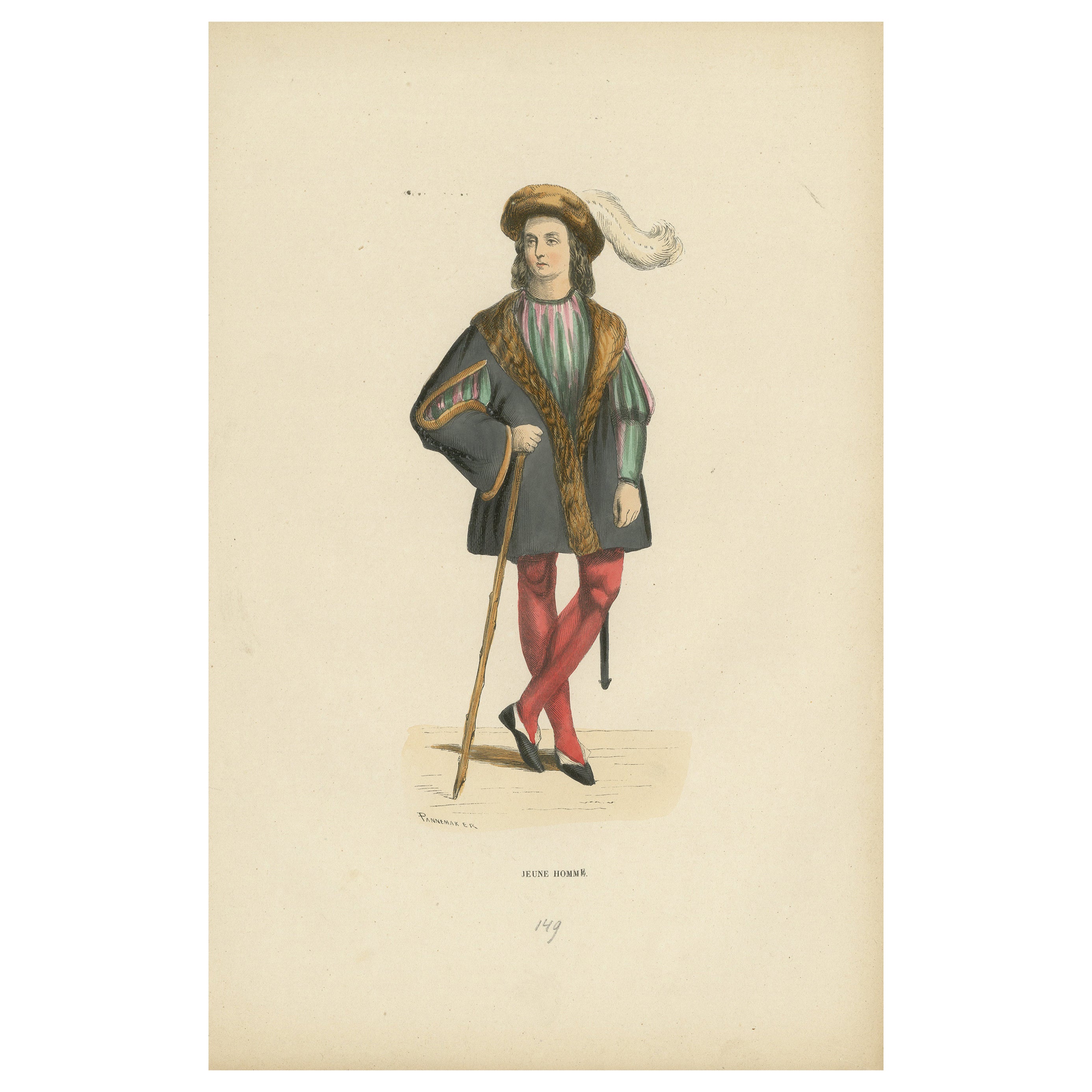
Description: The image is a print from a series the "Costume du Moyen Age" dated 1847, and titled "Costume Civil de la Fin du XVe Siècle," which translates to "Civilian Costume at the End of the 15th Century." It showcases a man of status, possibly a noble or a wealthy burgher, standing in a poised and confident manner.
He is attired in an ornate cloak covered in a complex pattern of fleur-de-lis and cross motifs, indicative of wealth and possibly a connection to royalty or high social rank. The cloak is open at the front to reveal a blue doublet with a belt, and he wears red hose—a fashion staple of the late medieval period. His footwear is also red, which stands out against the more subdued tones of his outfit.
On his head, he sports a fur-trimmed hat, adding to the luxuriousness of his attire. In one hand, he holds a long staff, which serves as both a walking aid and a symbol of authority. His other hand rests on the hilt of a dagger, further indicating his readiness to defend his status or engage in the political or civic matters of his time.
The artist has skillfully rendered the textiles and accessories with great care, emphasizing the fashion and social cues of the late 15th-century European society.
The colors have a nice glow over them. Historically, egg whites, known as glair, and sometimes egg yolk were indeed used in illumination and painting, particularly in manuscripts, to give colors a brighter appearance and to add a sheen or gloss to the work. This technique was quite common during the Middle Ages...
Category
Antique 1840s Prints
Materials
Paper
$124 Sale Price
20% Off
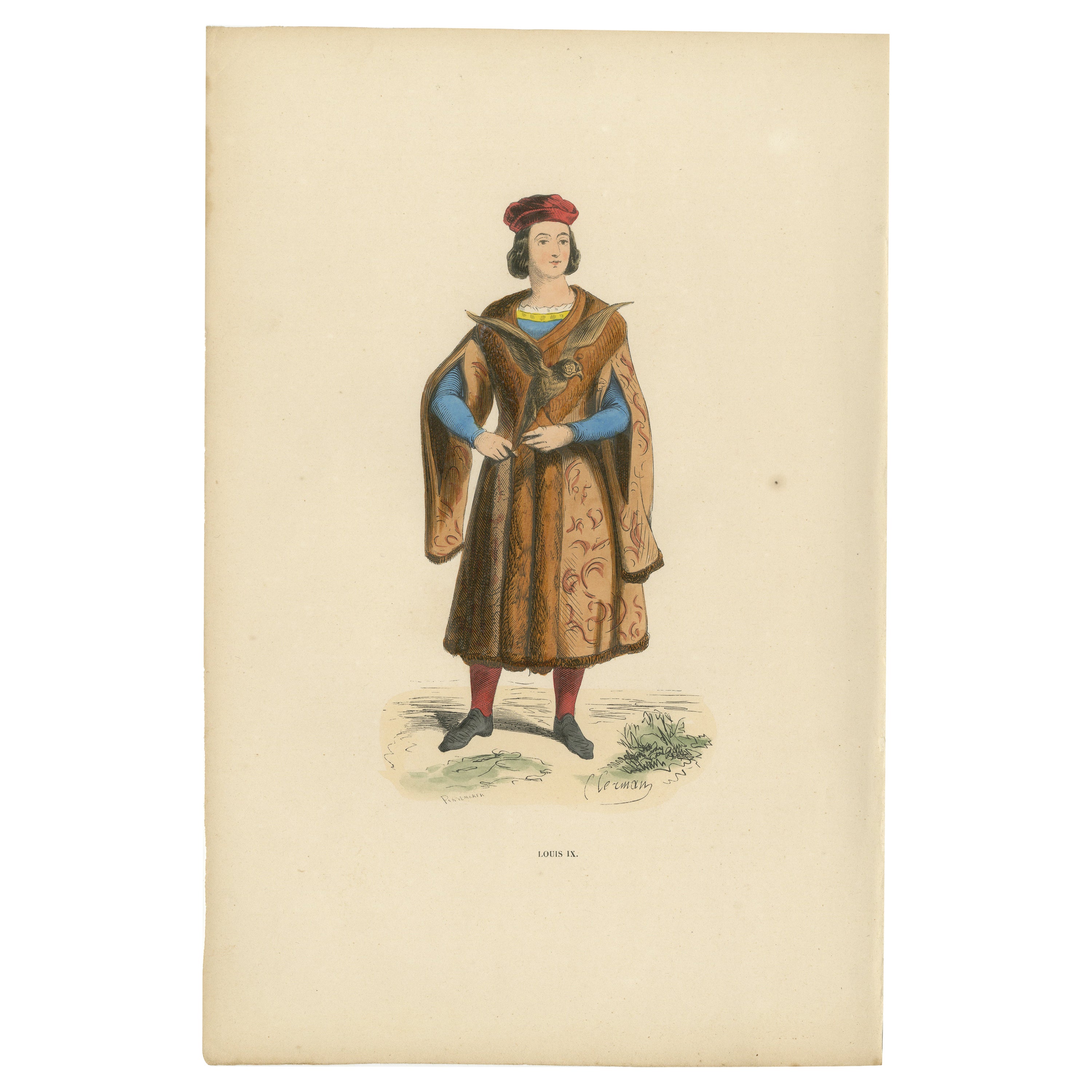
Louis IX: A Portrayal of French Royalty in Medieval Attire, Published in 1847
Located in Langweer, NL
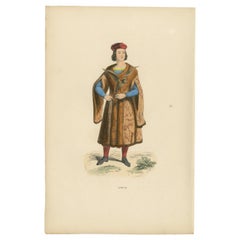
The image is a hand-colored engraving titled "Louis IX," representing the 13th-century King of France, also known as Saint Louis, renowned for his Christian zeal and justice. It is p...
Category
Antique 1840s Prints
Materials
Paper
$163 Sale Price
20% Off
You May Also Like
French Louis XIV Style Framed Lithograph of a Lord in Baroque Attire
Located in Queens, NY
French Louis XIV style framed lithograph of a lord in Baroque attire towards the end of Louis XIV\'s reign in a wooden black and silver frame (Similar group of prints NWL6152A-J)
Go...
Category
Antique 18th Century French Louis XIV Prints
French 19th-Century Framed Lithograph of Charles d
Amboise, Lord of Chaumont in
Located in Queens, NY
French 19th-century framed lithograph of Charles d\'Amboise, Lord of Chaumont in military-civilian Renaissance attire in a wooden black and silver frame (Similar group of prints NWL6...
Category
Antique 19th Century French Renaissance Prints
French 19th-Century Framed Lithograph of a Parisian Man in Renaissance Attire
Located in Queens, NY
French 19th-century framed lithograph of a young elegant Parisian man in Renaissance attire holding a gestural pose in a wooden black and silver frame (Similar group of prints NWL615...
Category
Antique 19th Century French Victorian Prints
Theatrical Costume - Original Lithograph - Early 20th Century
Located in Roma, IT
Theatrical Costume is a splendid hand lithograph engraved by Anonymous Artist in the Early 20th Century.
The state of preservation of the artwork is e...
Category
Early 20th Century Modern Figurative Prints
Materials
Lithograph
Antique French Hand-Colored Lithograph “Chevalier de Notre-Dame du Chardon
Located in Oklahoma City, OK
Antique French lithograph depicting a Chevalier de l’Ordre de Notre-Dame du Chardon (Knight of the Order of Our Lady of the Thistle) from th...
Category
Antique 19th Century American Charles II Prints
Materials
Glass, Wood, Paint, Paper
$187 Sale Price
25% Off
English Victorian Prints of 4 English Noble Attires
Located in Queens, NY
English Victorian print featuring four styles of English noble attires from historical periods in a carved silver/gilt frame with a mat (Similar items: NWL6149A-F)
Good condition co...
Category