Items Similar to Louis XII: The Prudent King in Regal Attire, 1847
Want more images or videos?
Request additional images or videos from the seller
1 of 6
Louis XII: The Prudent King in Regal Attire, 1847
$143.62
$179.5320% Off
£105.95
£132.4320% Off
€120
€15020% Off
CA$197.69
CA$247.1120% Off
A$213.57
A$266.9620% Off
CHF 113.62
CHF 142.0220% Off
MX$2,569.78
MX$3,212.2220% Off
NOK 1,438.66
NOK 1,798.3220% Off
SEK 1,315.69
SEK 1,644.6120% Off
DKK 914.39
DKK 1,142.9920% Off
About the Item
This print presents a dignified portrait of Louis XII, King of France, known for his prudent and just reign. Standing in profile, the king is depicted in royal attire that is both lavish and emblematic of his status.
He is wearing a long, richly patterned yellow robe that falls straight to his feet, adorned with an intricate design that may represent fleurs-de-lis, symbolic of French royalty. The robe is edged with a dark fur trim, adding a layer of luxury and warmth, fitting for a king. Underneath, a black garment can be seen, with a sleeve that matches the fur trim of the outer robe.
On his legs, he wears blue hose, a common element of male fashion during the Renaissance, which contrasts with the bold yellow of his robe. His black shoes are simple and functional, with a squared toe.
Louis XII’s head is adorned with a dark, brimless hat, which sits atop his neatly cut hair. His facial expression is calm and reflective, with a hint of sternness, perhaps indicative of the serious responsibilities of kingship. In his right hand, he holds a slender scepter, reaffirming his authority and rule.
The background is minimalistic, ensuring that the focus remains on the figure of the king and his regal bearing. This print captures the essence of the monarch in a period of transition from the medieval to the Renaissance era, reflecting the cultural and stylistic changes of the time.
The colors have a nice glow over them. Historically, egg whites, known as glair, and sometimes egg yolk were indeed used in illumination and painting, particularly in manuscripts, to give colors a brighter appearance and to add a sheen or gloss to the work. This technique was quite common during the Middle Ages and into the Renaissance.
Egg whites can be applied as a varnish over pigments to enhance their brightness and to protect the colors. This application could make the colors appear more vivid and also add a slight glossy sheen to the surface of the image.
Egg yolk, on the other hand, was commonly used as a binding agent in paint. It forms the basis of tempera paint, a medium that was widely used before the advent of oil painting. Egg yolk helps to create a durable and long-lasting color that adheres well to various surfaces.
In the context of the print from 1847, it's less likely that egg whites or yolks were used directly on the print, as by that time, commercial printing processes would have been more advanced and less reliant on such manual methods. However, if this print is a representation of an earlier style or is meant to mimic the appearance of hand-painted manuscripts, the original artists might have employed techniques or materials that gave a similar effect to those achieved with egg-based binders and varnishes.
- Dimensions:Height: 10.63 in (27 cm)Width: 7.09 in (18 cm)Depth: 0 in (0.02 mm)
- Materials and Techniques:
- Period:
- Date of Manufacture:1847
- Condition:Good. Overal very light toning and light soiling but the image itself clean and hand-colored almost 200 years ago and still in expliciet colors. Aged paper with typically warm, yellowish-brown hue, mostly around the edges. Study the image carefully.
- Seller Location:Langweer, NL
- Reference Number:Seller: BG-13635-451stDibs: LU3054337893902
About the Seller
5.0
Recognized Seller
These prestigious sellers are industry leaders and represent the highest echelon for item quality and design.
Platinum Seller
Premium sellers with a 4.7+ rating and 24-hour response times
Established in 2009
1stDibs seller since 2017
2,826 sales on 1stDibs
Typical response time: 1 hour
- ShippingRetrieving quote...Shipping from: Langweer, Netherlands
- Return Policy
More From This Seller
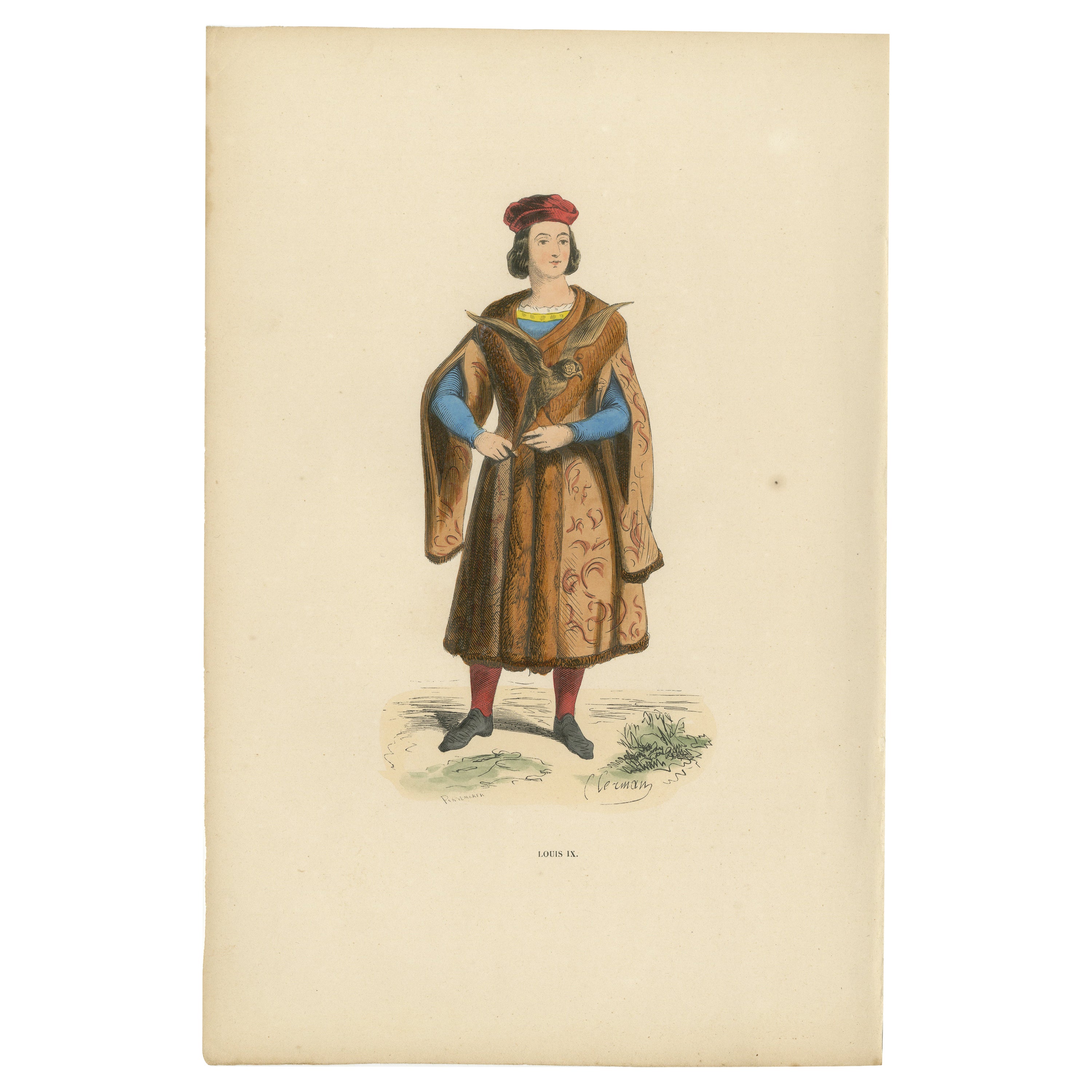
View AllLouis IX: A Portrayal of French Royalty in Medieval Attire, Published in 1847
Located in Langweer, NL
The image is a hand-colored engraving titled "Louis IX," representing the 13th-century King of France, also known as Saint Louis, renowned for his Christian zeal and justice. It is p...
Category
Antique 1840s Prints
Materials
Paper
$162 Sale Price
20% Off
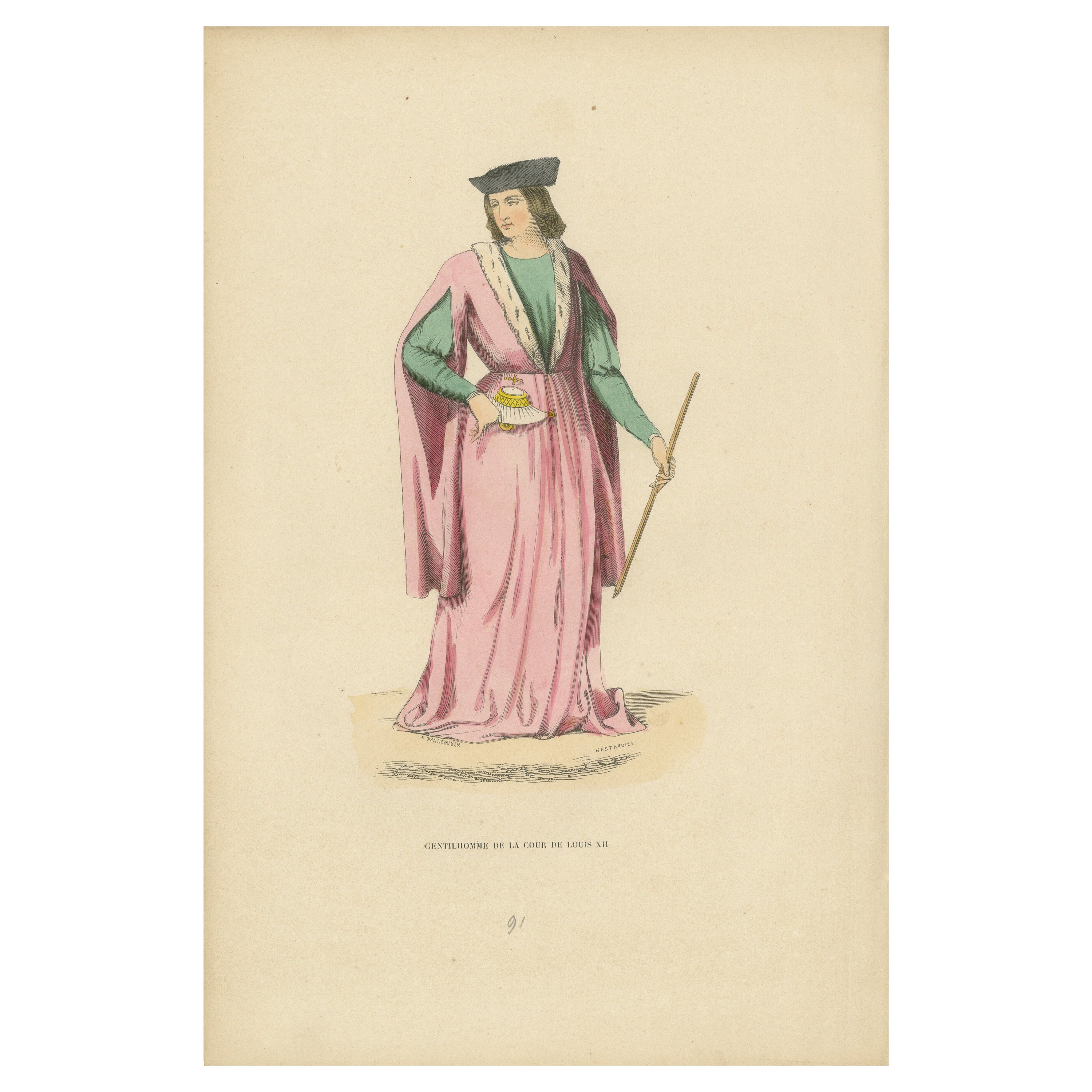
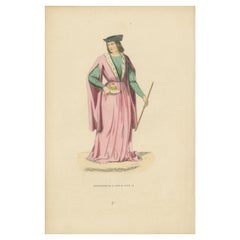
Elegance at the Court of Louis XII: A French Noble
s Poise, 1847
Located in Langweer, NL
Title: "Elegance at the Court of Louis XII: A French Noble's Poise"
Description: This delicate historical illustration depicts a French nobleman from the court of King Louis XII, elegantly attired in the fashion of the early 16th century. He stands with a composed and dignified stance, a walking stick in one hand, exuding the grace and refinement expected of someone from his esteemed position.
His attire is a rich blend of colors and textures, indicative of his status. The nobleman wears a soft pink tunic, a color that during the time was often associated with nobility due to the expense of the dye required to produce it. The tunic is complemented by a deep green overcoat...
Category
Antique 1840s Prints
Materials
Paper
$134 Sale Price
20% Off
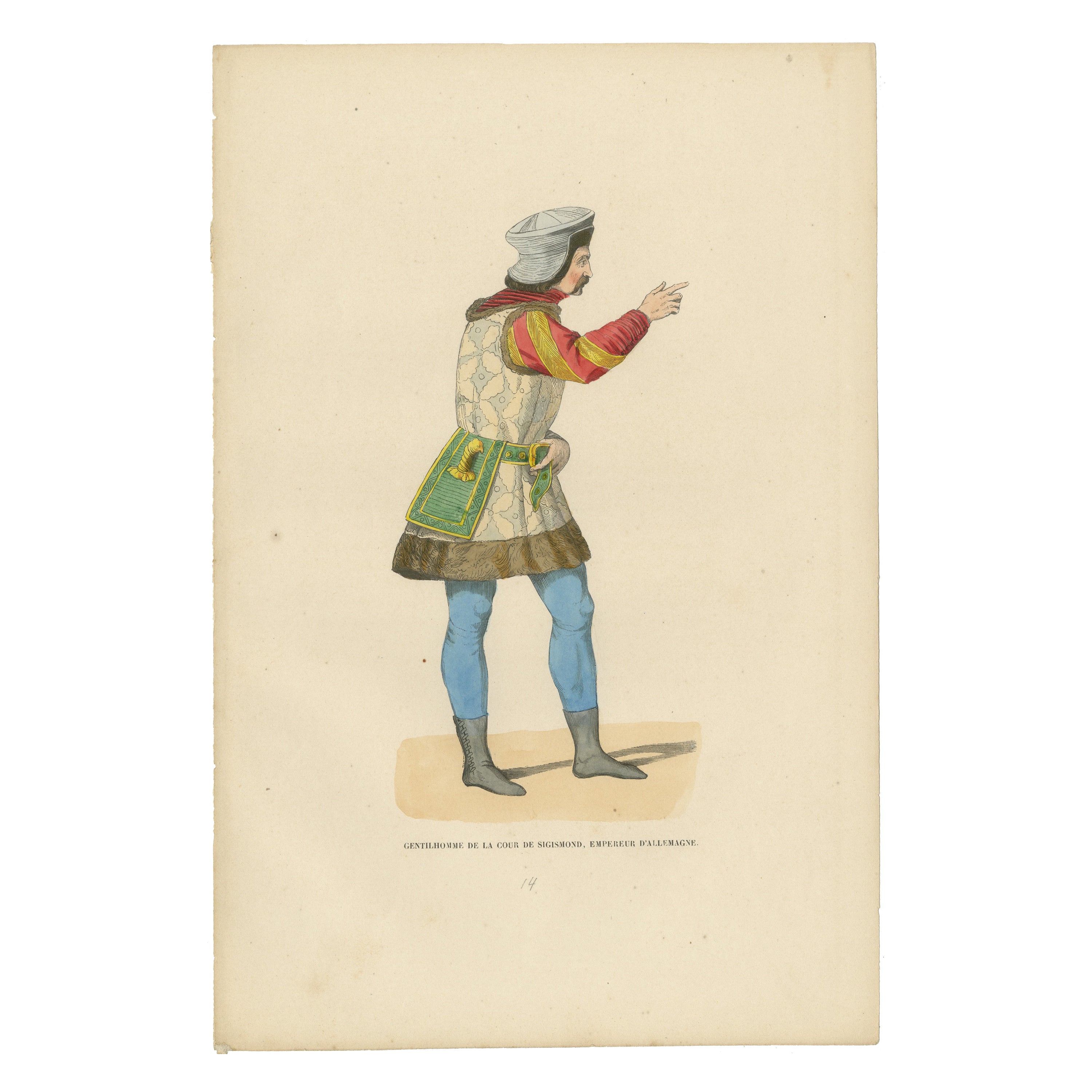
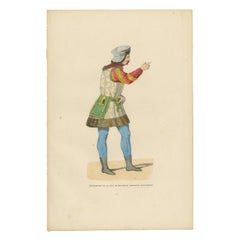
Courtly Splendor: A Nobleman at Emperor Sigismund
s Court, 1847
Located in Langweer, NL
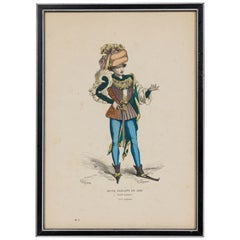
The image depicts a man identified as a "Gentilhomme de la cour de Sigismond, empereur d'Allemagne," which translates to "Gentleman of the court of Sigismund, Emperor of Germany."
This individual is portrayed in a profile stance, dressed in attire that is indicative of the high-status courtiers during the time of Emperor Sigismund, who reigned in the early 15th century. He is wearing a turban-like headgear, which reflects the influence of Eastern fashion on European court attire, possibly due to the Ottoman influence or the general exchange of culture during the Crusades and subsequent interactions.
His doublet is richly patterned and he has puffed sleeves in red, which were fashionable among the nobility during the period. The garment is accented with a decorative belt that holds what appears to be a purse or a pouch. He also sports tight blue hose and pointed shoes, which complete the ensemble typical of a nobleman or a high-ranking court official in the Holy Roman Empire.
Egg whites can be applied as a varnish over pigments to enhance their brightness and to protect the colors. This application could make the colors appear more vivid and also add a slight glossy sheen to the surface of the image.
Egg yolk, on the other hand, was commonly used as a binding agent in paint. It forms the basis of tempera paint, a medium that was widely used before the advent of oil painting. Egg yolk helps to create a durable and long-lasting color that adheres well to various surfaces.
In the context of the print from 1847, it's less likely that egg whites or yolks were used directly on the print, as by that time, commercial printing processes would have been more advanced and less reliant on such manual methods. However, if this print is a representation of an earlier style or is meant to mimic the appearance of hand-painted manuscripts...
Category
Antique 1840s Prints
Materials
Paper
$153 Sale Price
20% Off
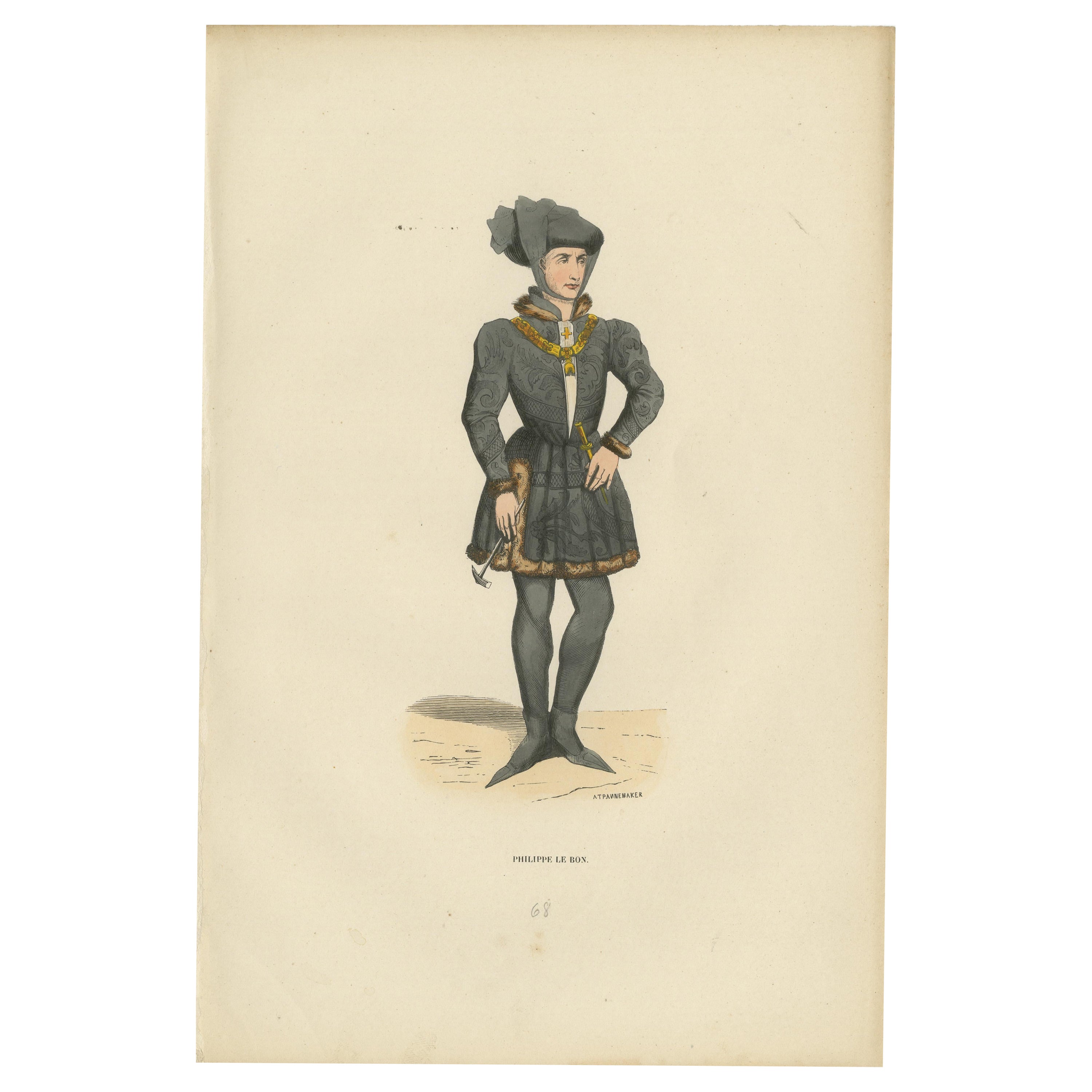
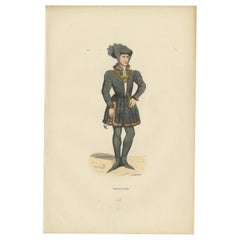
Philippe le Bon or The Good, Duke of Burgundy: The Duke
s Prestige, 1847
Located in Langweer, NL
Title: "Philippe le Bon: The Duke's Prestige"
Description: The print showcases Philippe le Bon, also known as Philip the Good, Duke of Burgundy, standing in a dignified pose that conveys authority and nobility. He was known for his patronage of the arts and the opulence of his court, and this is reflected in the intricate detail of his attire.
Philippe is dressed in a doublet with a patterned design, possibly embroidered with gold thread, which would have been a symbol of wealth and status during his time. The garment fits snugly to his form, a style that was fashionable among the nobility in the 15th century. The lower part of the doublet extends into a skirt, which is edged with fur, adding to the luxuriousness of his ensemble.
He wears hose that fit tightly to his legs, a common fashion of the time, which are practical for riding and daily activities of a nobleman. His shoes are pointed, following the style of the Burgundian court.
On his head, Philippe sports a chaperon, a type of headgear that was popular among men of rank. The chaperon features a rolled brim and an extended tail, known as a 'liripipe', which adds a distinctive flair to his profile.
Around his neck, he has a chain, from which hangs a badge or medallion, denoting his high rank and perhaps an order of chivalry. His right hand rests on the hilt of a dagger, hinting at the martial aspect of his role as a duke and the necessity for self...
Category
Antique 1840s Prints
Materials
Paper
$162 Sale Price
20% Off
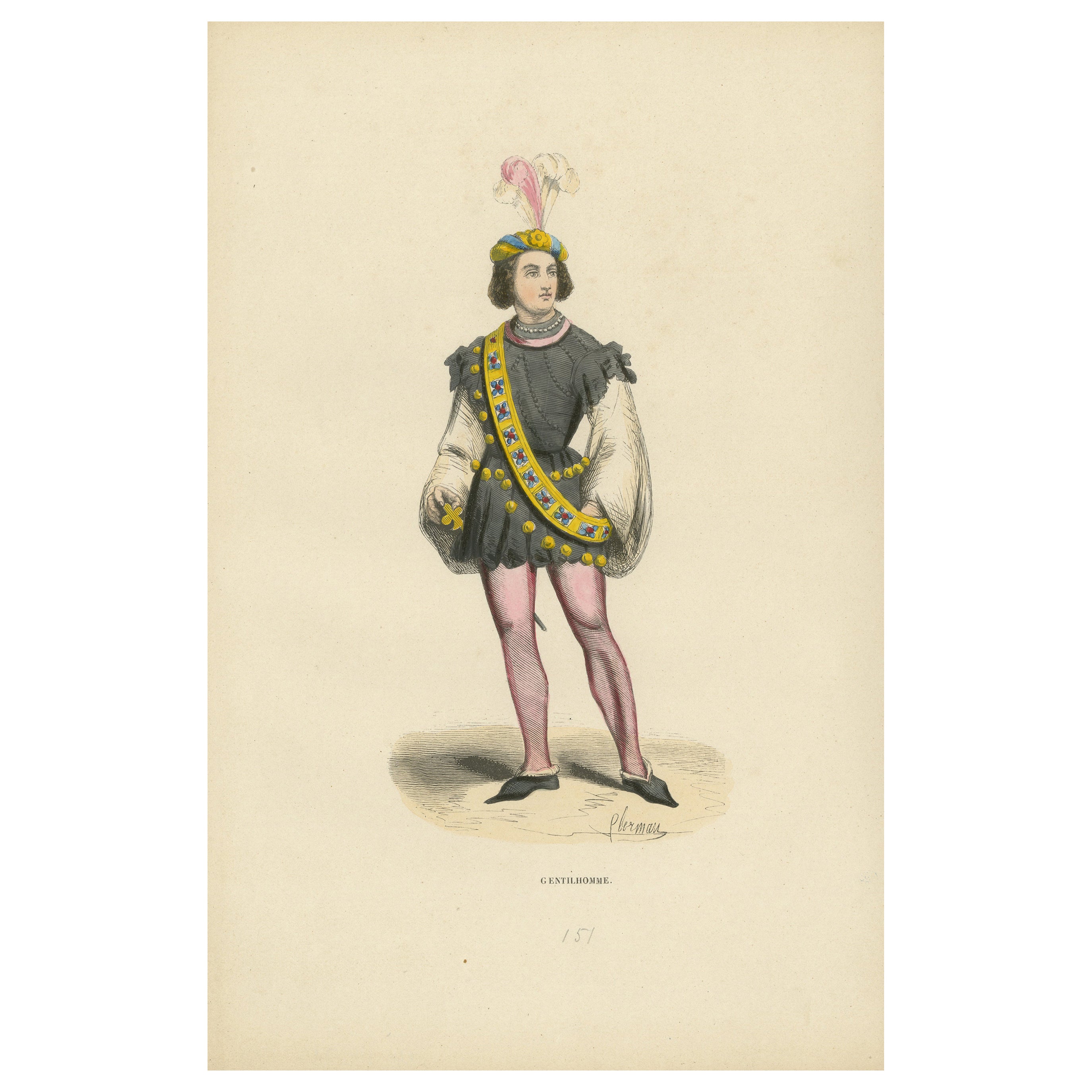
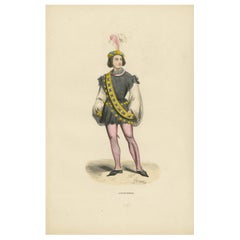
The Gallant Courtier: A Nobleman
s Fashion in
Costume du Moyen Âge, 1847
Located in Langweer, NL
Title: "The Gallant Courtier: A Nobleman's Fashion in 'Costume du Moyen Âge'"
Description: This 1847 lithograph from the "Costume du Moyen Âge" collection depicts a nobleman dressed...
Category
Antique 1840s Prints
Materials
Paper
$134 Sale Price
20% Off
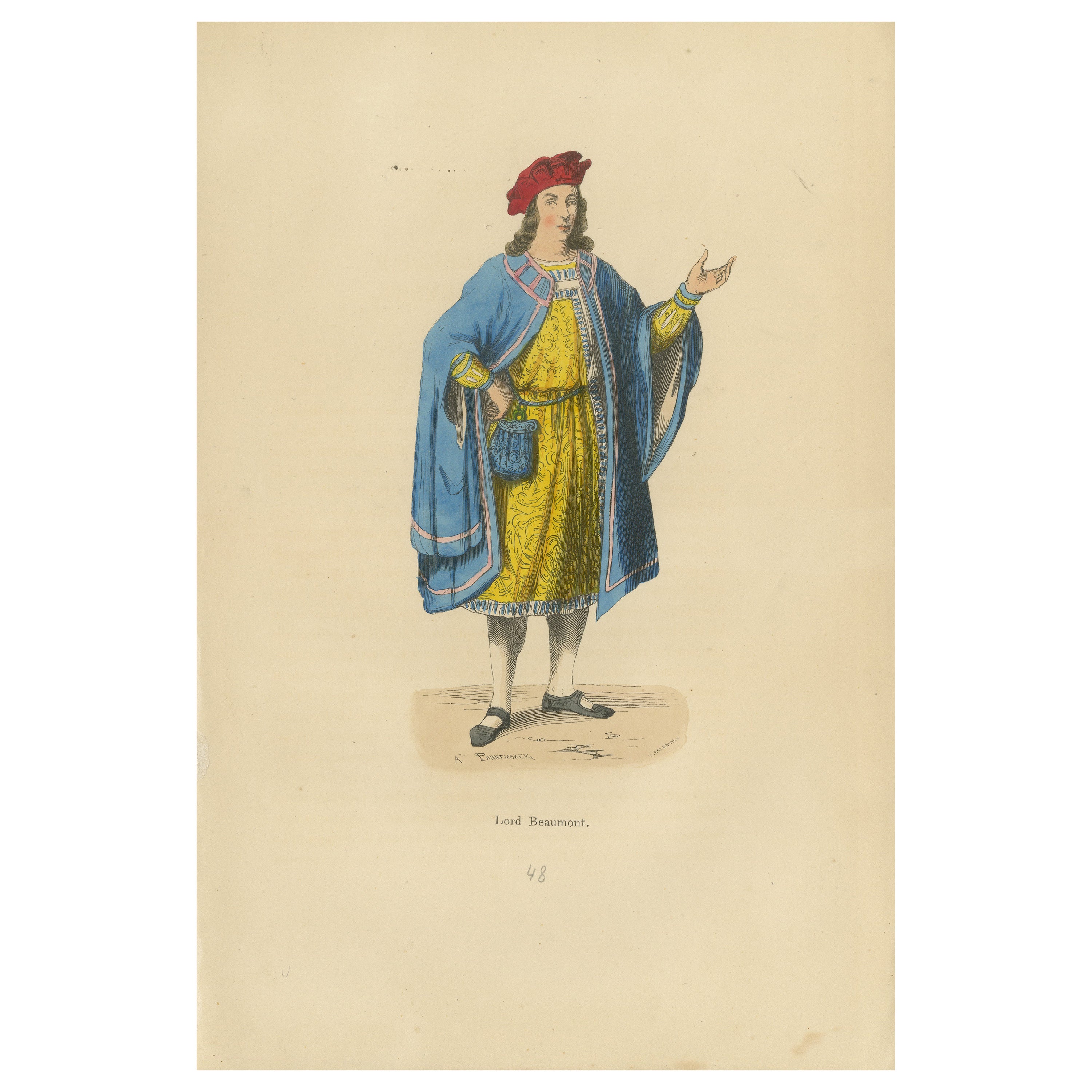
Lord Beaumont in Courtly Attire, Costume Di Moyen Age, 1847
Located in Langweer, NL
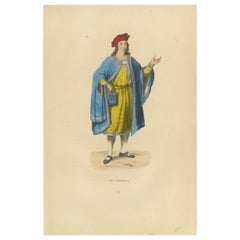
The image shows a figure labeled as "Lord Beaumont," depicted in medieval attire. He is wearing a blue overcoat with a fur trim and a gold-patterned undergarment that extends to his ...
Category
Antique 1840s Prints
Materials
Paper
$124 Sale Price
20% Off
You May Also Like
French Louis XIV Style Framed Lithograph of a Lord in Baroque Attire
Located in Queens, NY
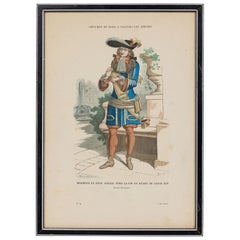
French Louis XIV style framed lithograph of a lord in Baroque attire towards the end of Louis XIV\'s reign in a wooden black and silver frame (Similar group of prints NWL6152A-J)
Go...
Category
Antique 18th Century French Louis XIV Prints
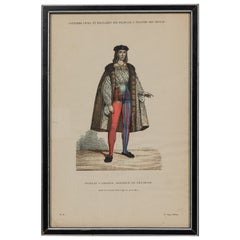
French 19th-Century Framed Lithograph of Charles d
Amboise, Lord of Chaumont
Located in Queens, NY
French 19th-century framed lithograph of Charles d\'Amboise, Lord of Chaumont in military-civilian Renaissance attire in a wooden black and silver frame (Similar group of prints NWL6...
Category
Antique 19th Century French Renaissance Prints
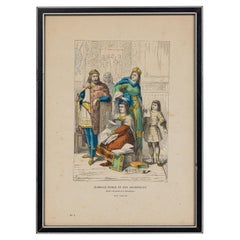
French Framed Lithograph of a Parisian Noble Family and Architect
Located in Queens, NY
French 19th-century framed lithograph of a Parisian noble family and their architect in Byzantine attire discussing architectural ground plans in a wooden black and silver frame (Sim...
Category
Antique 19th Century French Renaissance Prints
French 19th-Century Framed Lithograph of a Parisian Man in Renaissance Attire
Located in Queens, NY
French 19th-century framed lithograph of a young elegant Parisian man in Renaissance attire holding a gestural pose in a wooden black and silver frame (Similar group of prints NWL615...
Category
Antique 19th Century French Victorian Prints
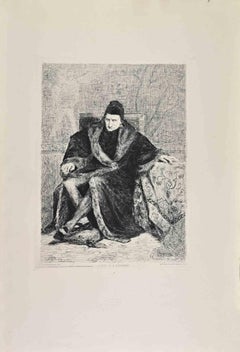
Louis XI A Peronne - Etching by Allard Cambray - Late 19th Century
Located in Roma, IT
Louis XI A Peronne is a black and White etching realized by Allard Cambray in the Late 19th Century.
Titled in the lower
Image Size:31x23
Very good impression.
Realized by Cadar...
Category
Late 19th Century Modern Figurative Prints
Materials
Etching
French 19th-Century Framed Lithograph of a Parisian Noble Lady
Located in Queens, NY
French 19th-century framed lithograph of a Parisian noble lady in Renaissance attire going to Mass in a wooden black and silver frame (Similar group of prints NWL6152A-J)
Good condi...
Category