Items Similar to Memorial to Jacob van Heemskerck, Dutch Naval Hero at Gibraltar, Engraving, 1611
Want more images or videos?
Request additional images or videos from the seller
1 of 9
Memorial to Jacob van Heemskerck, Dutch Naval Hero at Gibraltar, Engraving, 1611
$277.51
£203.38
€230
CA$380.89
A$402.48
CHF 216.45
MX$4,818.41
NOK 2,711.92
SEK 2,483.73
DKK 1,752.19
About the Item
This striking 1611 engraving is a memorial tribute to Jacob van Heemskerck, the famed Dutch navigator, explorer, and naval commander, published in Johannes Isacius Pontanus’ Rerum et urbis Amstelodamensium historia (History of Amsterdam). The elaborate architectural frame, inscribed “Honori et Aeternitati” (To Honor and Eternity), celebrates Heemskerck’s achievements and heroic death in battle.
The central Latin text honors his life and service:
"Iacobo ab Heemskerck Amsteldamensi, viro fortissime et optime de patria merito. Qui post varias in notas ignotatas navigationes in novam Zemblam sub Polo Arctico duas, in Indiam Orientalem versus Antarcticum totidem indeque, optimis spoliis anno 1604 reversus victor. Tandem expeditionis maritimae adversus Hispanos praefectus eorumdem validam classem Herculeo ausu aggressus in Fretum Herculeum, sub ipsa arce et urbe Gibraltari, VIII Cal. Maii, anno 1607, fusit ac profligavit. Ipse ibidem pro patria strenue dimicans gloriose occubuit. Anima caelo gaudet, corpus hoc loco jacet. Ave lector, famam viri ama et virtutem. Cuius ergo ab Illustrissimis et Potentissimis Foederatarum Provinciarum Belgii Ordinibus P.P.A.M.P. Vixit annos XL, menses II, dies XII."
English translation:
To Jacob van Heemskerck of Amsterdam, a man of great courage and merit toward his homeland. After various voyages to unknown regions—two to Nova Zembla under the Arctic Pole, and two toward the East Indies beneath the Antarctic—he returned in 1604 as a victorious conqueror laden with spoils. At last, commanding a maritime expedition against the Spanish, he attacked their mighty fleet with Herculean courage in the Strait of Hercules (Gibraltar), near the fortress and city itself, on the 24th of April 1607, routing and destroying them. There he fell gloriously in battle for his country. His soul rejoices in heaven; his body rests here. Farewell, reader—honor the fame and valor of this man. By decree of the Most Illustrious and Mighty Lords of the Federated Provinces of the Netherlands. He lived 40 years, 2 months, and 12 days.
Below the epitaph, an additional Dutch verse reads:
“Heemskerck die dwers door ’t ijs in t’ijser dorst te streven,
Liet d’eer aen ’t land, hier t’lyf voor Gibraltar het leven.”
Translation:
Heemskerck, who once dared the ice of the North to pierce through iron itself,
Left his honor to his homeland, and here, before Gibraltar, gave his life.
Beneath the inscription is a vivid engraving of the Battle of Gibraltar (1607), showing Dutch ships engaging and defeating the Spanish fleet under Heemskerck’s command. Smoke from cannon fire fills the harbor, with the Rock of Gibraltar and the coastal fortifications visible in the background. A skull motif below the scene symbolizes both mortality and heroism.
This print unites portraiture, naval history, and allegory in a single powerful image, memorializing one of the early naval heroes of the Dutch Republic. It exemplifies the national pride and maritime identity of the early 17th century.
Condition: Good, with slight toning, faint text show-through, and minor edge wear typical of early 17th-century paper. Strong impression with crisp detail.
Framing tips: Present in a dark wood or ebonized frame with a thin ivory mat to accentuate the architectural composition and classical symmetry of the print.
Technique: Engraving
Maker: Anonymous engraver after designs for Johannes Isacius Pontanus, Amsterdam, 1611
- Dimensions:Height: 9.45 in (24 cm)Width: 7.17 in (18.2 cm)Depth: 0.01 in (0.2 mm)
- Materials and Techniques:Paper,Engraved
- Place of Origin:
- Period:Early 17th Century
- Date of Manufacture:circa 1611
- Condition:Condition: Good, with slight toning, faint text show-through, and minor edge wear typical of early 17th-century paper. Strong impression with crisp detail.
- Seller Location:Langweer, NL
- Reference Number:Seller: BG-13098-41stDibs: LU3054346950932
About the Seller
5.0
Recognized Seller
These prestigious sellers are industry leaders and represent the highest echelon for item quality and design.
Platinum Seller
Premium sellers with a 4.7+ rating and 24-hour response times
Established in 2009
1stDibs seller since 2017
2,852 sales on 1stDibs
Typical response time: 1 hour
- ShippingRetrieving quote...Shipping from: Langweer, Netherlands
- Return Policy
More From This Seller
View AllEnglish Galleons
Dutch Vessels, Naval Ship Engravings, Coronelli 1690
Located in Langweer, NL
English Galleons & Dutch Vessels, Naval Ship Engravings, Coronelli 1690
This copper-engraved plate presents two detailed ship studies, published in 1690 in Vincenzo Coronelli’s Atla...
Category
Antique Late 17th Century Italian Prints
Materials
Paper

Copper Engraving by Merian of The Battle Fleet off Constantinople, 1646
Located in Langweer, NL
An engraving by Matthäus Merian senior depicting the "Sea battle of the Venetians against the Turks in the Dardanelles" from 1646 . It presents a dramatic and detailed scene capturi...
Category
Antique 1640s German Prints
Materials
Paper
$444 Sale Price
20% Off
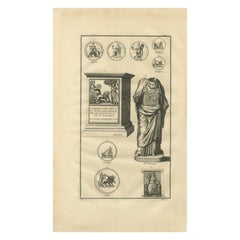
Roman Funerary Monument and Relief Sculpture – Montfaucon Engraving, 1721
Located in Langweer, NL
Roman Funerary Monument and Relief Sculpture – Montfaucon Engraving, 1721
DESCRIPTION
Large classical engraving depicting Roman funerary and commemorative monuments, recorded after ...
Category
Antique 1720s British Prints
Materials
Paper
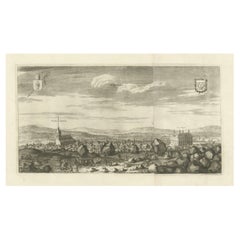
Westras: A Jan van Aveelen Engraving from
Suecia Antiqua et Hodierna
, 1701
Located in Langweer, NL
Original antique engraving of 'Westras' or Västerås in Sweden
The location referred to in the print is likely "Westras," which seems to be a historic name or variant spelling relate...
Category
Antique Early 1700s Prints
Materials
Paper
$434 Sale Price
20% Off
Free Shipping
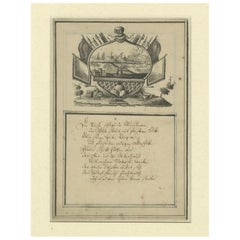
18th-Century German Engraving – Allegory of War, Poem
Naval View
Located in Langweer, NL
A rare and intriguing 18th-century German engraving combining a finely detailed allegorical scene of naval warfare with a poetic handwritten reflection on military life, ambition, an...
Category
Antique Early 18th Century German Prints
Materials
Paper
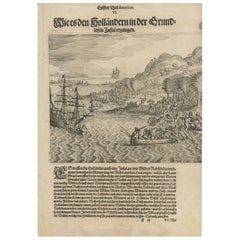
Early Exploration Engraving – Dutch Encounter with Islanders, De Bry 1599
Located in Langweer, NL
De Bry Engraving “Wie es den Holländern in der Grundlosen Insul ergangen” – Encounter of the Dutch with Islanders, c.1599
A remarkable original copper engraving from Theodor de Bry’...
Category
Antique 16th Century German Prints
Materials
Paper
You May Also Like
Mare Atlanticum - Etching by Johannes Janssonius - 1650s
By Johannes Janssonius
Located in Roma, IT
Mare Atlanticum is an ancient map realized in 1650 by Johannes Janssonius (1588-1664).
Good conditions.
From Atlantis majoris quinta pars, Orbem maritimum [Novus Atlas, volume V: c...
Category
1650s Modern Figurative Prints
Materials
Etching
Old Original Engraving with soldiers characters Dutch 17th Century Set of 12
Located in Auribeau sur Siagne, FR
This is an engravings set of 12, with black color. Representing Soldiers. It has been made in Holland in the 17th Century.
Category
Antique 17th Century Dutch Napoleon III Prints
Materials
Paper
Oceanus - Etching by Johannes Janssonius - 1650s
By Johannes Janssonius
Located in Roma, IT
Antique Map - Oceanus is an antique map realized in 1650 by Johannes Janssonius (1588-1664).
The Map is Hand-colored etching, with coeval watercoloring.
Good conditions with slight...
Category
1650s Modern Figurative Prints
Materials
Etching
Seascape with Monument and Figures- Etching by Luigi Aloja - 18th Century
Located in Roma, IT
Seascape With Monument and Figures is an Etching realized by Luigi Aloja (1783-1837).
The etching belongs to the print suite “Antiquities of Herculaneum Exposed” (original title: “...
Category
18th Century Old Masters Figurative Prints
Materials
Etching
Antique Map - Gallia - Etching by Johannes Janssonius - 1650s
By Johannes Janssonius
Located in Roma, IT
Antique Map - Gallia is an antique map realized in 1650 by Johannes Janssonius (1588-1664).
The Map is Hand-colored etching, with coeval watercoloring.
Good conditions with slight ...
Category
1650s Modern Figurative Prints
Materials
Etching
Seascape with Monument and Figures - Etching by F. Cepparuli - 18th Century
By Francesco Cepparuli
Located in Roma, IT
Seascape With Monument and Figures is an Etching realized by Francesco Cepparuli (1750-1767).
The etching belongs to the print suite “Antiquities of Herculaneum Exposed” (original...
Category
Late 18th Century Old Masters Figurative Prints
Materials
Etching