Items Similar to Nagai Tartars – Traditional Dress of Women of Distinction, c.1810 Engraving
Want more images or videos?
Request additional images or videos from the seller
1 of 10
Nagai Tartars – Traditional Dress of Women of Distinction, c.1810 Engraving
$213.10
£159.20
€180
CA$296.72
A$318.81
CHF 171.04
MX$3,756
About the Item
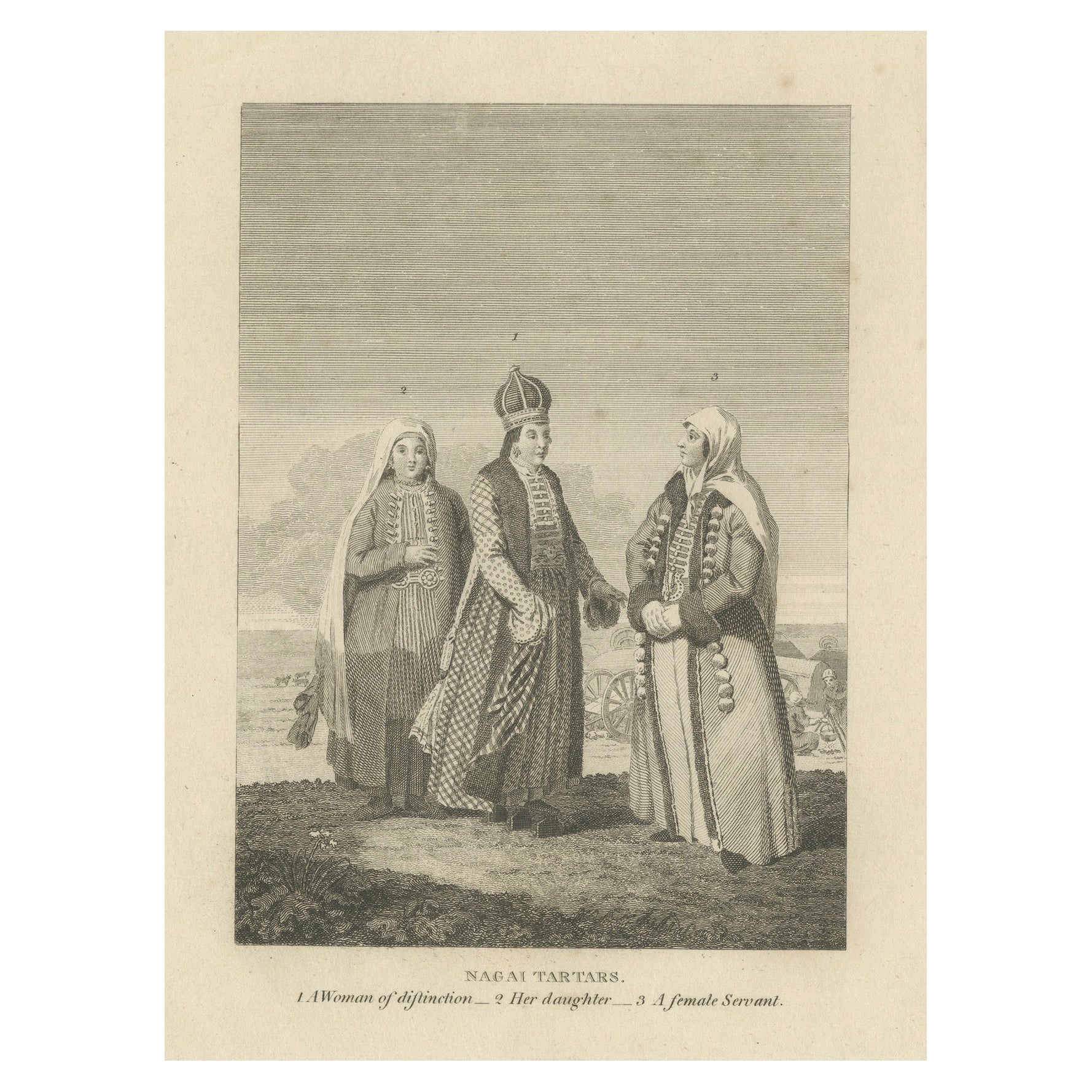
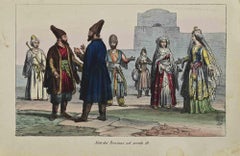
Nagai Tartars – Traditional Dress of Women of Distinction, c.1810
This delicately hand-colored copper engraving titled Nagai Tartars portrays three women of the Nogai Tatar ethnic group in traditional costume, reflecting early 19th-century European interest in the diversity of peoples within the Russian Empire and Central Asia. The print is captioned below:
1. A Woman of distinction — 2. Her daughter — 3. A female Servant.
The composition features the three figures standing in a grassy open landscape. Each wears richly ornamented garments in bold colors: long robes with golden trim and decorative tassels, white veils covering their hair, and embroidered sashes. The central figure, marked by a taller, elaborate headdress, represents the woman of distinction, while her daughter and servant wear similar but less ornate clothing. In the background, one can discern elements of nomadic life, such as wooden carts, possibly alluding to the group's semi-nomadic traditions.
This print likely appeared in an ethnographic publication such as Costume of the Russian Empire or A Collection of the Dresses of Different Nations, produced in England in the early 1800s for an audience fascinated by exotic customs and imperial diversity. It reflects the era’s growing scholarly and artistic effort to document and categorize the world’s peoples through costume studies, especially those under Russian, Ottoman, and Qing dominion.
The Nogai Tartars (also spelled Nagai or Noghay) are a Turkic-speaking people historically inhabiting the steppe regions north of the Black Sea and the Caucasus. Descendants of the Mongol Golden Horde, they were known for their equestrian culture, Islamized traditions, and later integration into the Russian Empire.
Condition: Good condition overall. Plate impression strong, with original hand coloring still vivid. Light foxing and scattered spotting visible, particularly in the margins. Slight age-toning consistent with early 19th-century paper.
Framing tips: A classic walnut or mahogany frame with a soft cream mat will enhance the period character of the print. Ideal for historical costume or ethnographic collections.
Technique: Copper engraving with original hand coloring
Maker: Anonymous, published in England, c.1810
- Dimensions:Height: 10.67 in (27.1 cm)Width: 8.27 in (21 cm)Depth: 0.01 in (0.2 mm)
- Materials and Techniques:Paper,Engraved
- Place of Origin:
- Period:
- Date of Manufacture:circa 1780
- Condition:Condition: Good condition overall. Plate impression strong, with original hand coloring still vivid. Light foxing and scattered spotting visible, particularly in the margins. Slight age-toning consistent with early 19th-century paper.
- Seller Location:Langweer, NL
- Reference Number:Seller: BG-13600-30A1stDibs: LU3054346173102
About the Seller
5.0
Recognized Seller
These prestigious sellers are industry leaders and represent the highest echelon for item quality and design.
Platinum Seller
Premium sellers with a 4.7+ rating and 24-hour response times
Established in 2009
1stDibs seller since 2017
2,836 sales on 1stDibs
Typical response time: 1 hour
- ShippingRetrieving quote...Shipping from: Langweer, Netherlands
- Return Policy
More From This Seller
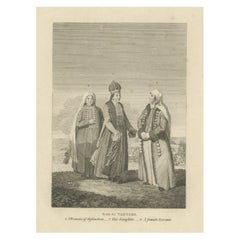
View AllSocial Hierarchy of the Nagai Tartars - An Etching by Geissler, ca. 1800
Located in Langweer, NL
Title: "Social Hierarchy of the Nagai Tartars - An Etching by Geissler, ca. 1800"
Description: This etching by Christian Gottfried Heinrich Geissler, titled "Nagai Tartars," is a fine representation of the German School from around the year 1800.
It portrays three figures, labeled to indicate their social standing: a woman of distinction, her daughter, and a female servant, numerically annotated as 1, 2, and 3 respectively. The detailed depiction captures the intricate attire and cultural fashion of the period, reflecting the societal structure and familial roles within the Nagai Tartar community.
The women are adorned in traditional garments that signify their status and identity, while the setting suggests a backdrop typical of their environment, providing a glimpse into the life of the Tartar people at the turn of the 19th century.
The Nagai or Nogai Tartars were part of the Nogai Horde, a confederation that occupied the Pontic–Caspian steppe from about 1500 until they were displaced in the 17th century by the Kalmyks and Russians. They were named after Nogai Khan, a Mongol ruler, and were divided into groups such as the Budjak and Yedisan in the area north of the Black Sea. The Nogais were known to be pastoral nomads who grazed sheep, horses, and camels and were also involved in trade, raiding, and tribute. They spoke a form of Kypchak Turkic and were Muslim, although their religious institutions were not strongly developed. The societal structure of the Nogais was quite fluid, with personal prestige playing a significant role in their political organization. They were historically known for their slave raids across Eastern Europe, which were an important part of their economy.
The term "Tatar" broadly refers to Turkic-speaking peoples, mainly found in west-central Russia and other former Soviet Republics. It was originally used to refer to various nomadic groups from the vast Central and Northern Asian region then known as Tartary. The largest Tatar group is the Volga Tatar from the Volga region in Russia. There are several Tatar groups, including the Volga Tatars and the Crimean Tatars, with the latter being subdivided into groups such as the Tats and the Nogai.
The Tatars have a rich history that dates back to the 5th century when nomadic tribes in northeastern Mongolia around Lake Baikal were first recognized. They became part of Genghis Khan's army in the 13th century and were known to Europeans as Tatars. Following the disintegration of the Mongol Empire, the Tatars were particularly associated with the western part of the empire, the Golden Horde...
Category
Antique Early 1800s Prints
Materials
Paper
$445 Sale Price
20% Off
Free Shipping
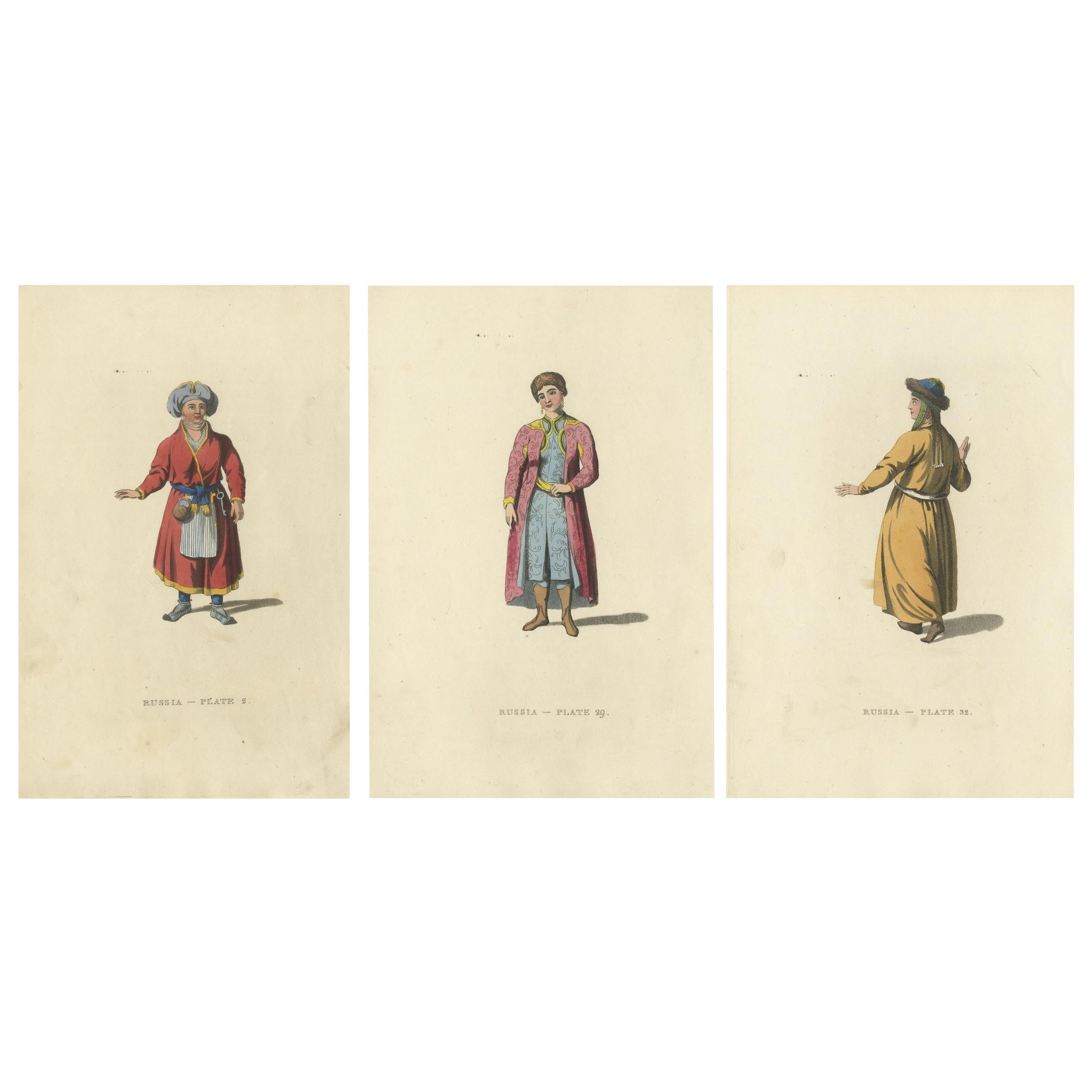
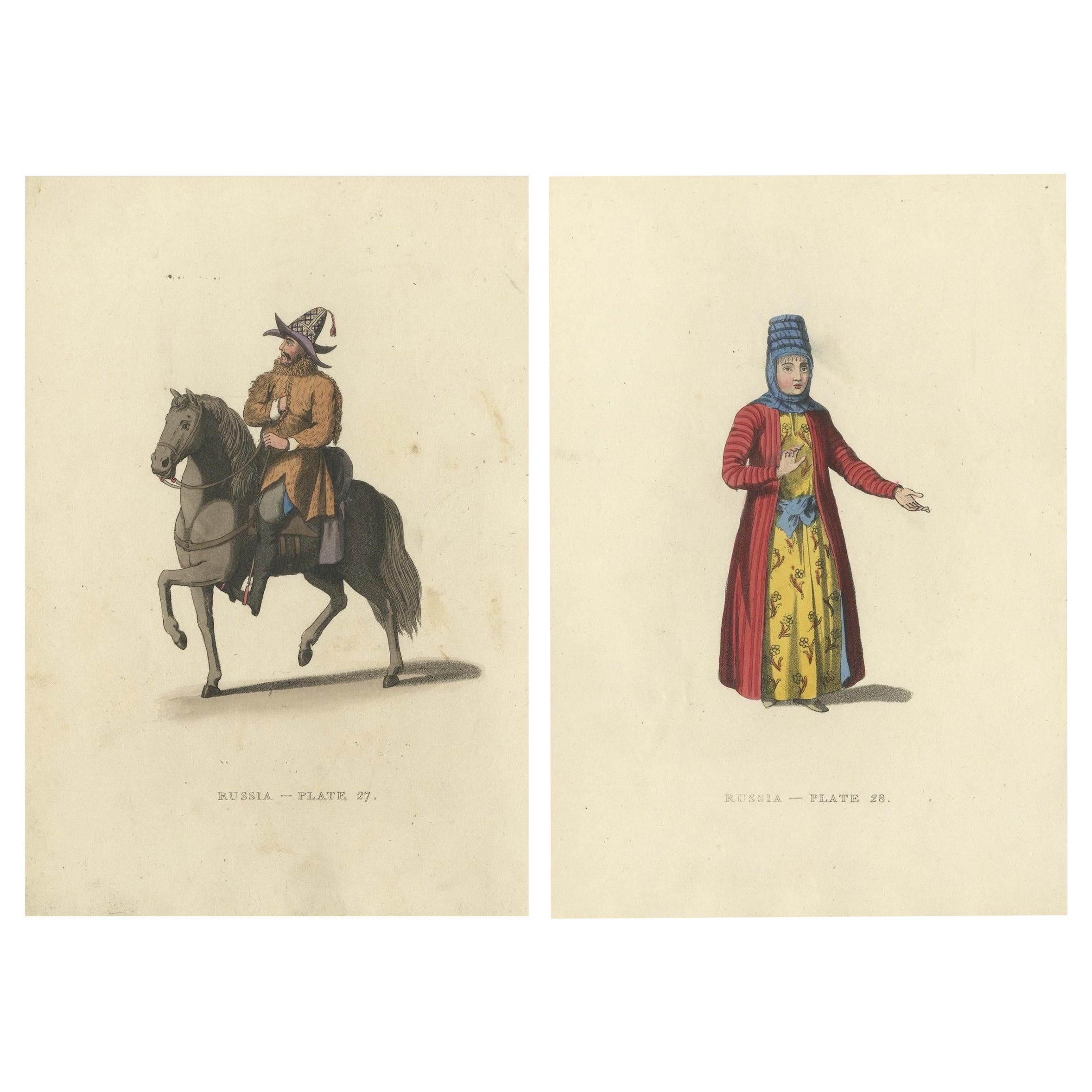
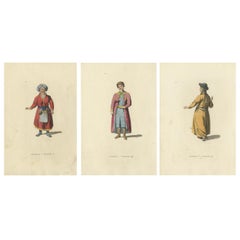
Cultural Tapestry: Traditional Female Attire of 19th Century Russia, 1814
Located in Langweer, NL
These original antique images are colored engravings that represent the traditional attire of three female inhabitants from different ethnic groups within the Russian Empire as of th...
Category
Antique 1810s Prints
Materials
Paper
$312 Sale Price / set
20% Off
Free Shipping
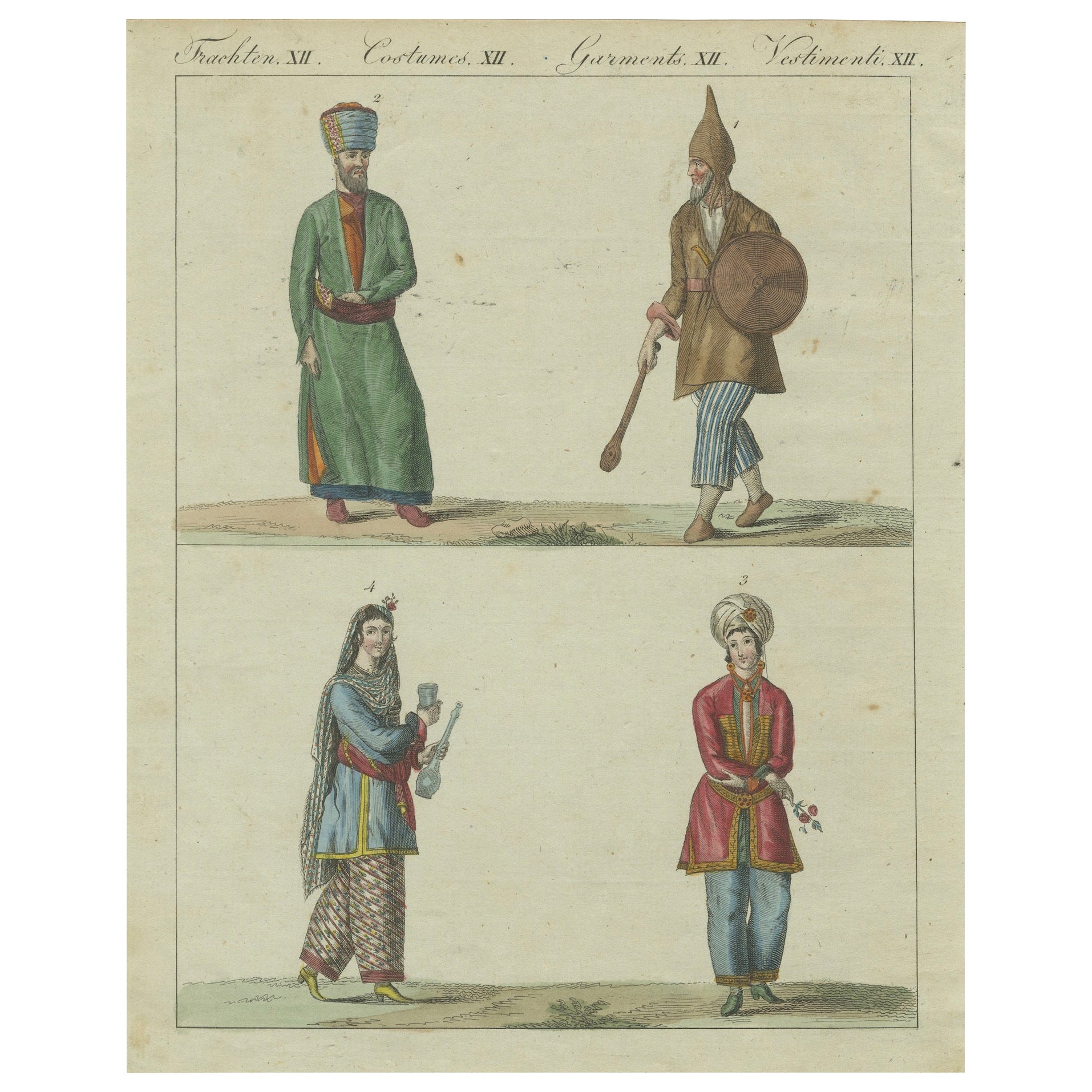
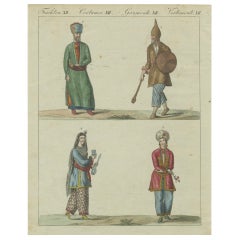
Antique Hand-Colored Print of Turkish or Ottoman Costumes Plate XII, circa 1800
Located in Langweer, NL
Antique Hand-Colored Print of Turkish Costumes Plate XII, circa 1800
This elegant antique print, titled Trachten XII, Costumes XII, Garments XII, Vestimenti XII, presents four finel...
Category
Antique Early 1800s German Prints
Materials
Paper
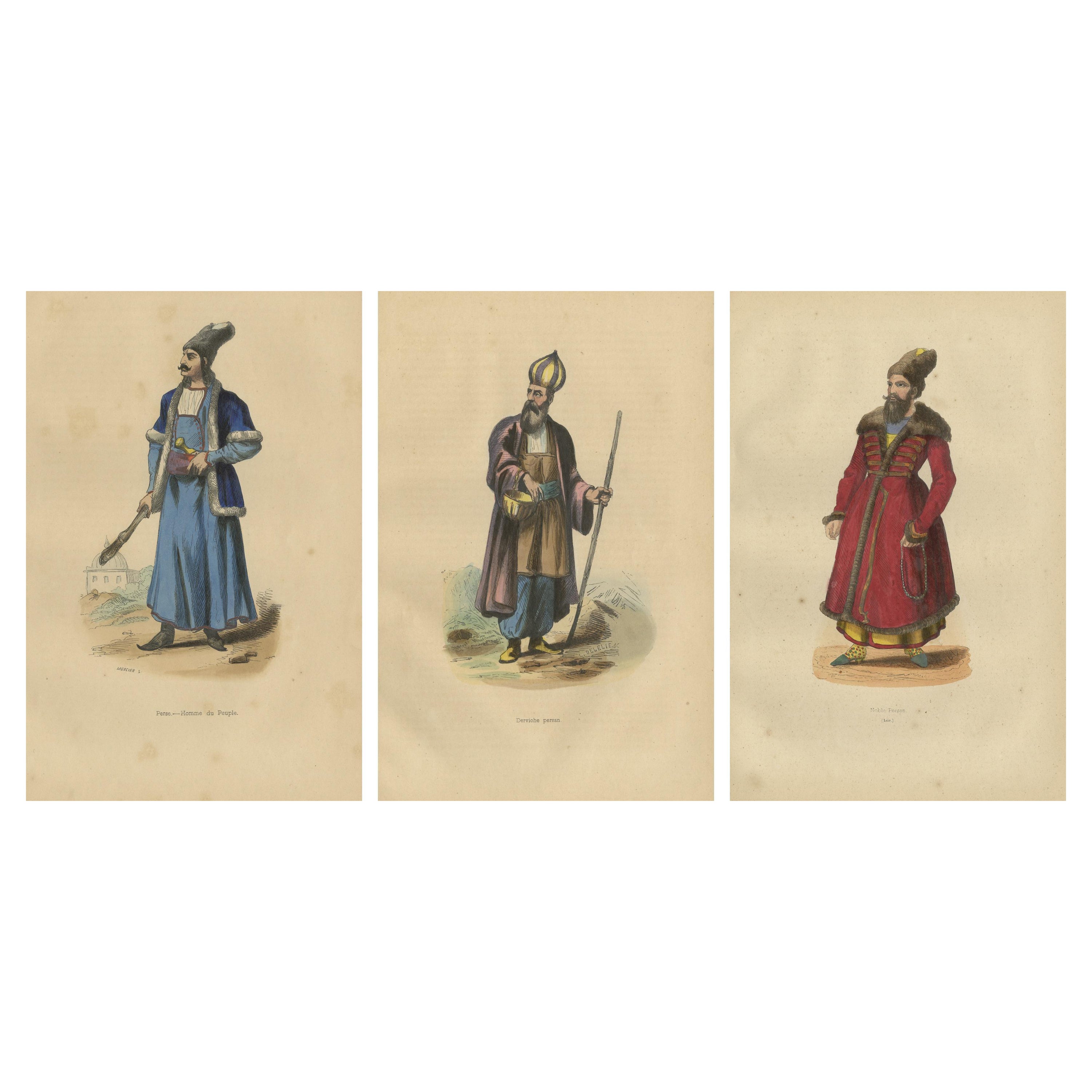
1844 Persian Cultural Figures: Engraved Prints of Traditional Attires
Located in Langweer, NL
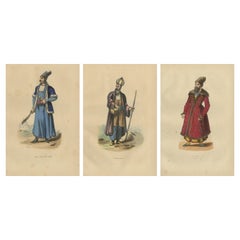
Title: "1844 Persian Cultural Figures: Engraved Prints of Traditional Attires"
Description: This compilation features three handcoloured lithographs representing traditional Persian figures: a common man, a dervish, and a noble, from the esteemed 1844 collection "Moeurs, Usages et Costumes de tous les Peuples de Monde" by Auguste Wahlen.
Published in Paris, these prints are crafted through lithography, a popular 19th-century technique, and are enhanced with Arabic gum on wove (vellin) paper. The vivid depiction of their cultural attire and the distinct portrayal of each social stratum make these prints particularly captivating. They offer a glimpse into the historical socio-cultural fabric of Persia, making them highly sought after by collectors and enthusiasts of Middle Eastern art and history.
In the three prints you provided of Persian figures, each character holds something distinct that signifies their role or status within their culture:
1. Persé - Homme du Peuple (Common Man):
- Holding: This figure holds a walking stick or cane, which is a common accessory that could be used for practical purposes like walking support or herding animals.
- Outfit: He wears traditional attire with a long coat and a large hat, indicative of a common man's clothing in historical Persian society. His outfit and the stick both emphasize his everyday, practical life.
2. Derviche Persan (Dervish):
- Holding: The Dervish holds a stick and a begging bowl. Dervishes are known for their ascetic piety, often connected with Sufism in Islam. The stick (or staff) symbolizes their travels and spiritual journey, while the bowl is used to receive alms, reflecting their vow of poverty.
- Interesting Fact: Dervishes are part of a mystical spiritual ascetic practice within Islam, focusing on the universal values of love and service. Their clothing and accessories reflect simplicity and spiritual richness.
3. Noble Persan (Nobleman):
- Holding: The nobleman carries a sword, which is a symbol of power, authority, and martial prowess. It is commonly featured in depictions of nobility as a sign of their status and ability to command.
- Outfit: His clothing is significantly more elaborate and colorful compared to the others, with fur trim and decorative patterns, signifying wealth and high social status.
These accessories and their attire provide a deep insight into the roles and societal positions of each figure within Persian culture, reflecting a wide range of personal and social identities from the common man to spiritual seekers and the ruling elite. Each element, from the practical walking stick to the symbolically rich begging bowl and the authoritative sword, offers a narrative about their life, status, and societal roles during that historical period.
Keywords:
- Antique Persian prints...
Category
Antique 1840s Prints
Materials
Paper
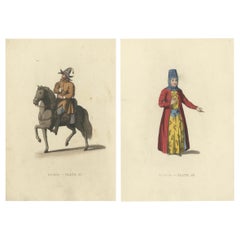
Kirghiz Elegance Engraved: A Study of 19th Century Central Asian Attire, 1814
Located in Langweer, NL
The two engravings vividly capture the traditional attire of the Kirghiz, a group native to the steppes of Central Asia.
1. The first engraving portrays a Kirghiz man mounted on hor...
Category
Antique 1810s Prints
Materials
Paper
$227 Sale Price / set
20% Off
Free Shipping
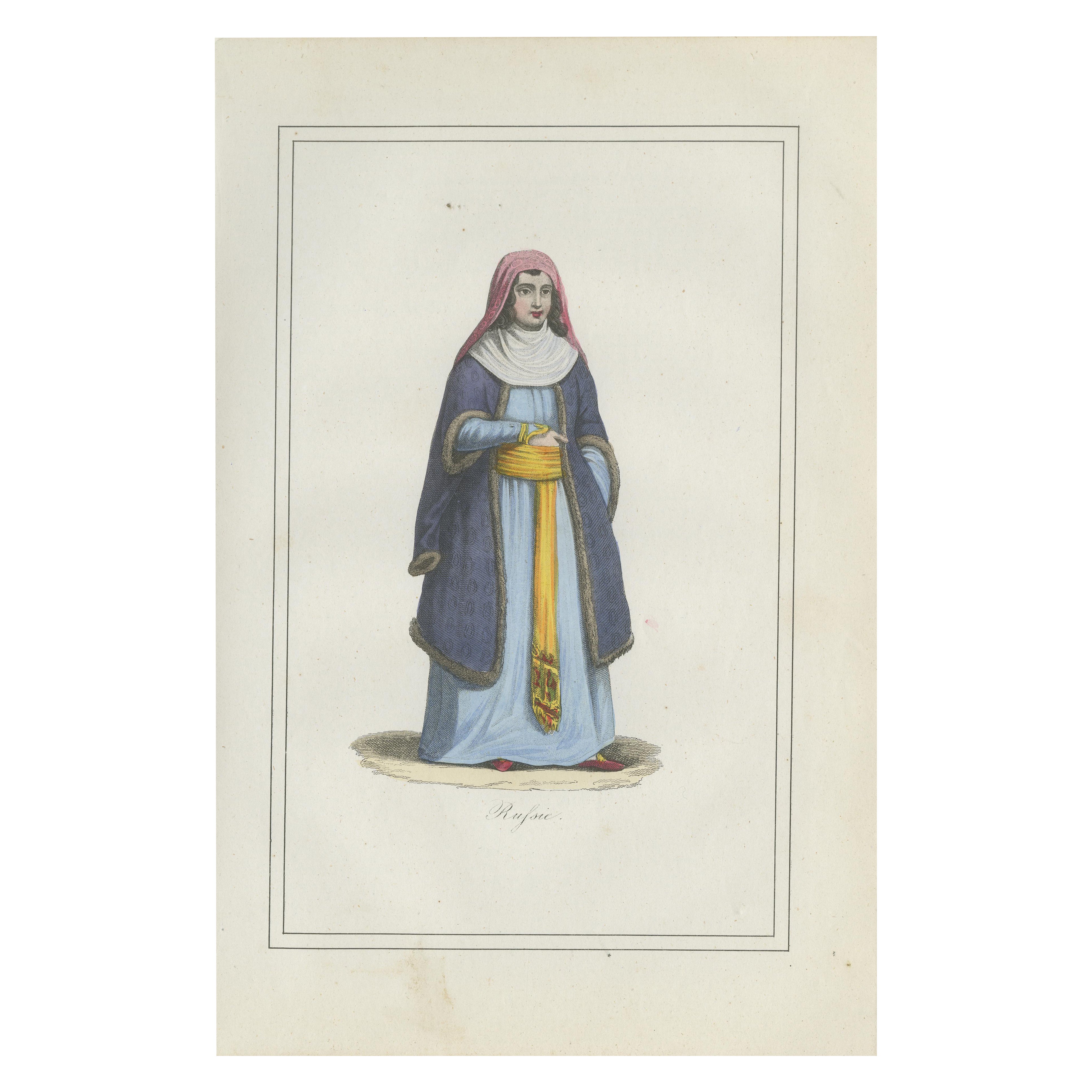
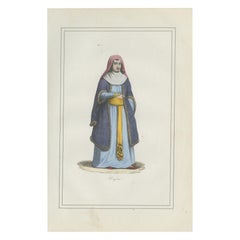
Russian Woman Costume Print – Antique Hand-Colored Lithograph, 1854
Located in Langweer, NL
Russian Woman Costume Print – Antique Hand-Colored Lithograph, 1854
This antique hand-colored lithograph, published in 1854 in Album des Voyages Anciens et Modernes by Martial Ardan...
Category
Antique Mid-19th Century French Prints
Materials
Paper
You May Also Like
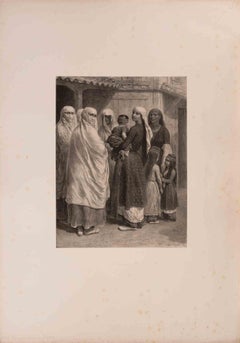
Femmes Tatars en Bessarabie - Lithograph by Auguste Raffet - 1842
Located in Roma, IT
Lithograph on paper realized by Auguste Raffet in 1842.
It is part of the suite "Crimée".
The scene depicts a group of Tatar women, standing together in a courtyard-like space.
Th...
Category
1840s Modern Figurative Prints
Materials
Lithograph
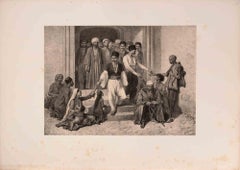
Tatars Faisant des Aumônes - Lithograph by Auguste Raffet - 1840
Located in Roma, IT
Lithograph on paper realized by Auguste Raffet in 1840.
It is part of the suite "Crimée".
The lithograph shows a group of Tatar men exiting a mosque or religious building, surround...
Category
1840s Modern Figurative Prints
Materials
Lithograph
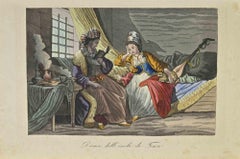
Ladies of the Islands of Tina - Lithograph - 1862
Located in Roma, IT
Ladies of the Islands of Tina is a lithograph on paper realized in 1862.
The artwork belongs to the Suite Uses and customs of all the peoples of the universe: " History of the gover...
Category
1860s Modern Figurative Prints
Materials
Lithograph
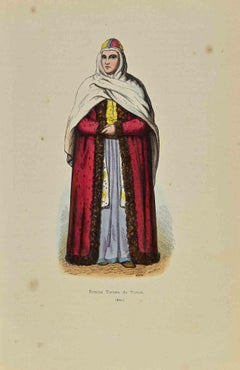
Tomsk Tartar Woman - Lithograph by Auguste Wahlen - 1844
Located in Roma, IT
Tomsk Tartar Woman is a lithograph made by Auguste Wahlen in 1844.
Hand colored.
Good condition.
At the center of the artwork is the original title "Femme Tartare de Tomsk".
The ...
Category
1840s Modern Figurative Prints
Materials
Lithograph
Jewish People from Karasubazar- Lithograph by Auguste Raffet - 1840
Located in Roma, IT
Lithograph on paper realized by Auguste Raffet in 1840.
It is part of the suite "Crimée".
Image dimension cm. 26x20.
Signed and dated in the plate.
Very good condition.
Auguste ...
Category
1840s Modern Figurative Prints
Materials
Lithograph

Persian Cloth in 19th Century- Lithograph - 1862
Located in Roma, IT
Persian Cloth in 19th Century is a Hand-colored lithograph on paper realized in 1862.
The artwork belongs to the Suite Uses and customs of all the peoples of the universe: " History...
Category
1860s Modern Figurative Prints
Materials
Lithograph
More Ways To Browse
Womens Dress
Japanese Root Wood
Japanese Scroll Flower
Japanese Shell Art
Japanese Sword Furniture
Jean Roger Paris
Jiaqing Porcelain
Karl Muller
Kodak Vintage
Lane Cedar Chest
Large Block Prints
Large Ceramic Cat
Large Chinese Foo Dogs
Large Giraffe Sculpture
Large Menorah
Lattice Dining Table
Le Nid
Leaping Gazelle