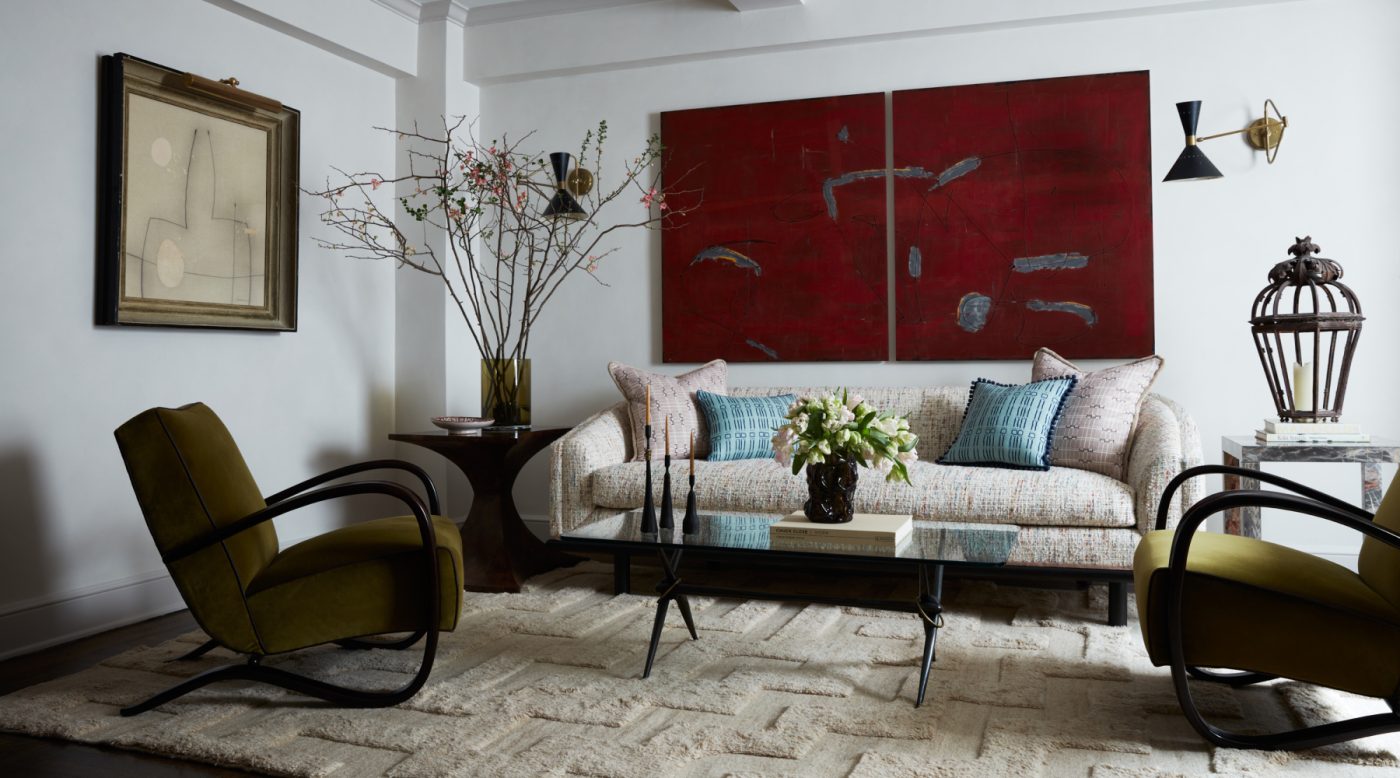
November 30, 2025Long before Erik Gensler founded EZG Design, his Manhattan interiors studio, he worked in advertising sales at NBC. There, a veteran salesperson, Shelley Freiman, took him under her wing. “She was sharp, sassy and incredibly generous,” says Gensler. “She became a mentor and friend.”
At one point, NBC sent Gensler to work in San Francisco. When he returned to New York a year and a half later without a place to live, Freiman insisted he stay in the spare bedroom of her Upper East Side pad. “It was a gracious offer,” Gensler recalls, “but the apartment itself was half-finished. No countertops, no window treatments, just a few pieces of furniture floating in a space full of potential.”
Gensler, a psychiatrist’s son, diagnosed the problem: “Shelley has fantastic taste but dreads making design decisions — always afraid there’s a better choice waiting.”

More than two decades later, Freiman asked her former protégé, now an interior designer, for help choosing a sofa — for the very room he’d slept in. They considered countless possibilities before Gensler quoted something she sometimes said to clients: “You just need to pick the [expletive] thing.
“That broke the spell,” he says. “She laughed, and we finally ordered a sofa.”
Then, they ordered a rug. Eventually, Freiman gave him a budget and asked him to do the whole apartment. A compact two bedroom, it had been stripped of most of its prewar detailing. So, one of Gensler’s first moves was to put back missing moldings and trim, a decision he sold to Freiman by telling her, “You’ve got to respect the architecture.”
For the same reason, he kept the original black-and-white-tiled floors in the bathrooms pretty much as he found them. “An old New York City bathroom ought to look like an old New York City bathroom,” he says.
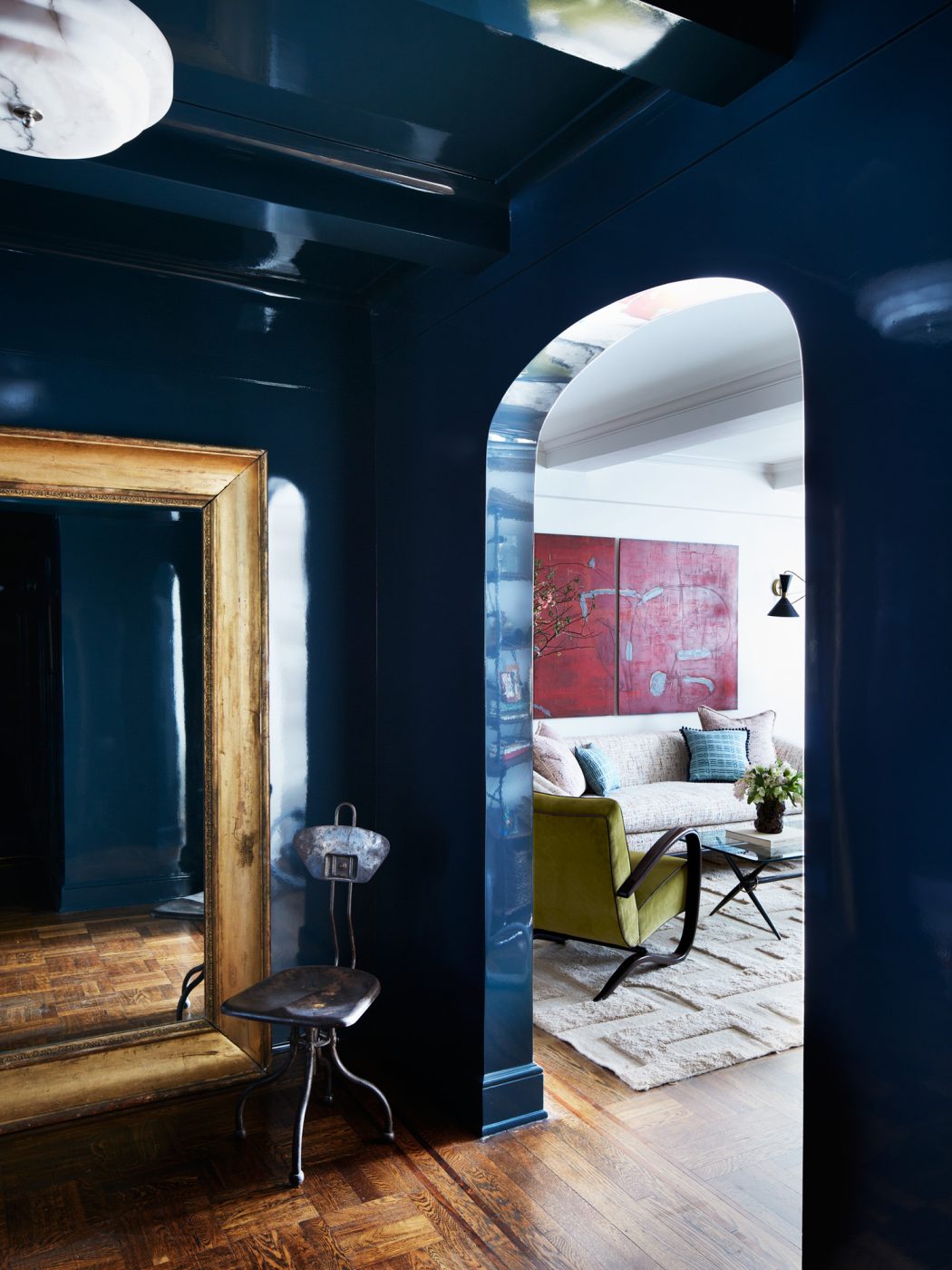
But his restraint with the bathrooms didn’t preclude big changes in the rest of the apartment. For one thing, he chose some very bold colors. The foyer walls, for example, are a deep, deep blue. Thanks to five layers of lacquer, they have what Gensler calls an “auto-body finish” — so shiny that they bounce light everywhere. More rays reflect from the large mirror across from the front door. The light dancing around makes the small space seem unbounded.
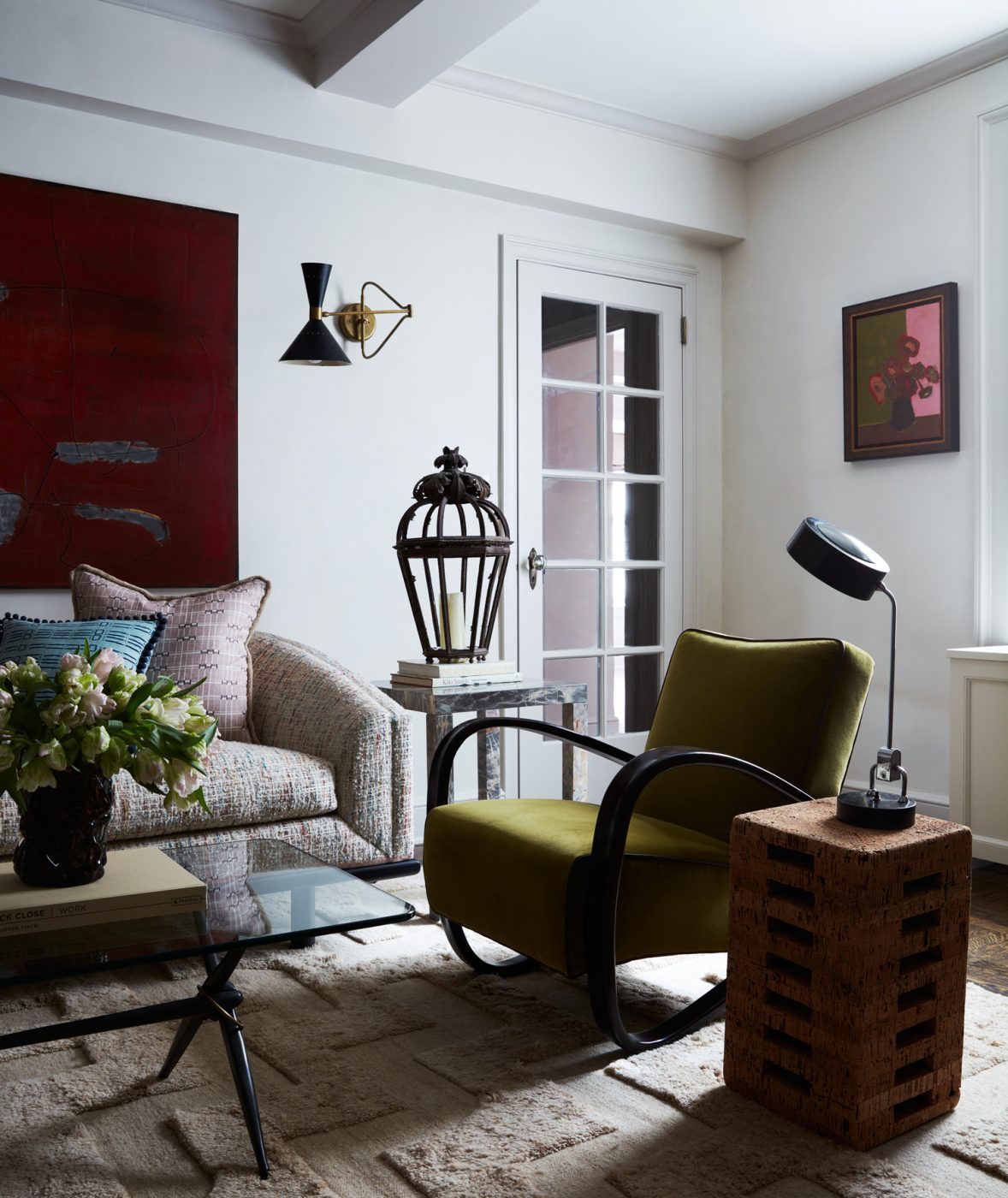
Another way Gensler created an expansive feel was to sharpen the transitions from room to room. The dark foyer leads to a mostly white living area. As part of a careful paint job that took more than a month, Gensler had the walls limewashed, to give them character, and the trim coated in glossy oil-based paint.
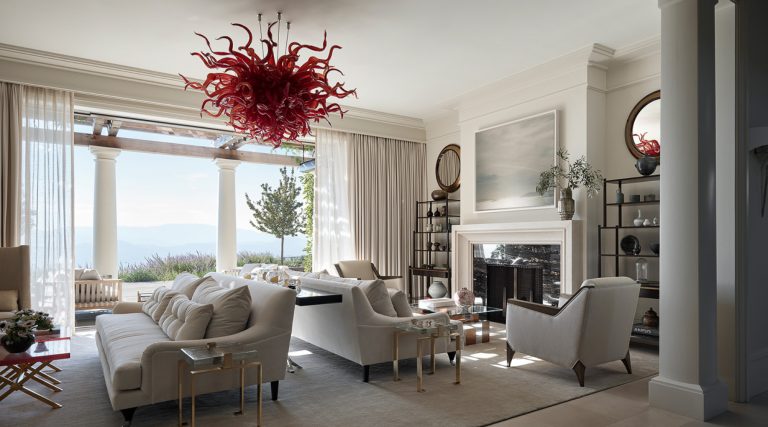
On an unusually sculptural rug, a mix of flat-weave and shag from Nordic Knots, Gensler placed a custom curved sofa from NickEy Kehoe and a pair of 1930s Jindřich Halabala armchairs. In a corner is a geometrically compelling 1980s Coconut side table attributed to Karl Springer. Also compelling are a pair of articulated Austrian swing-arm sconces. Above the sofa is a large painting by Denis De Mot. Its deep garnet color is jolting; Gensler made it less so by working bits of red into the sofa’s throw pillows and bouclé fabric.
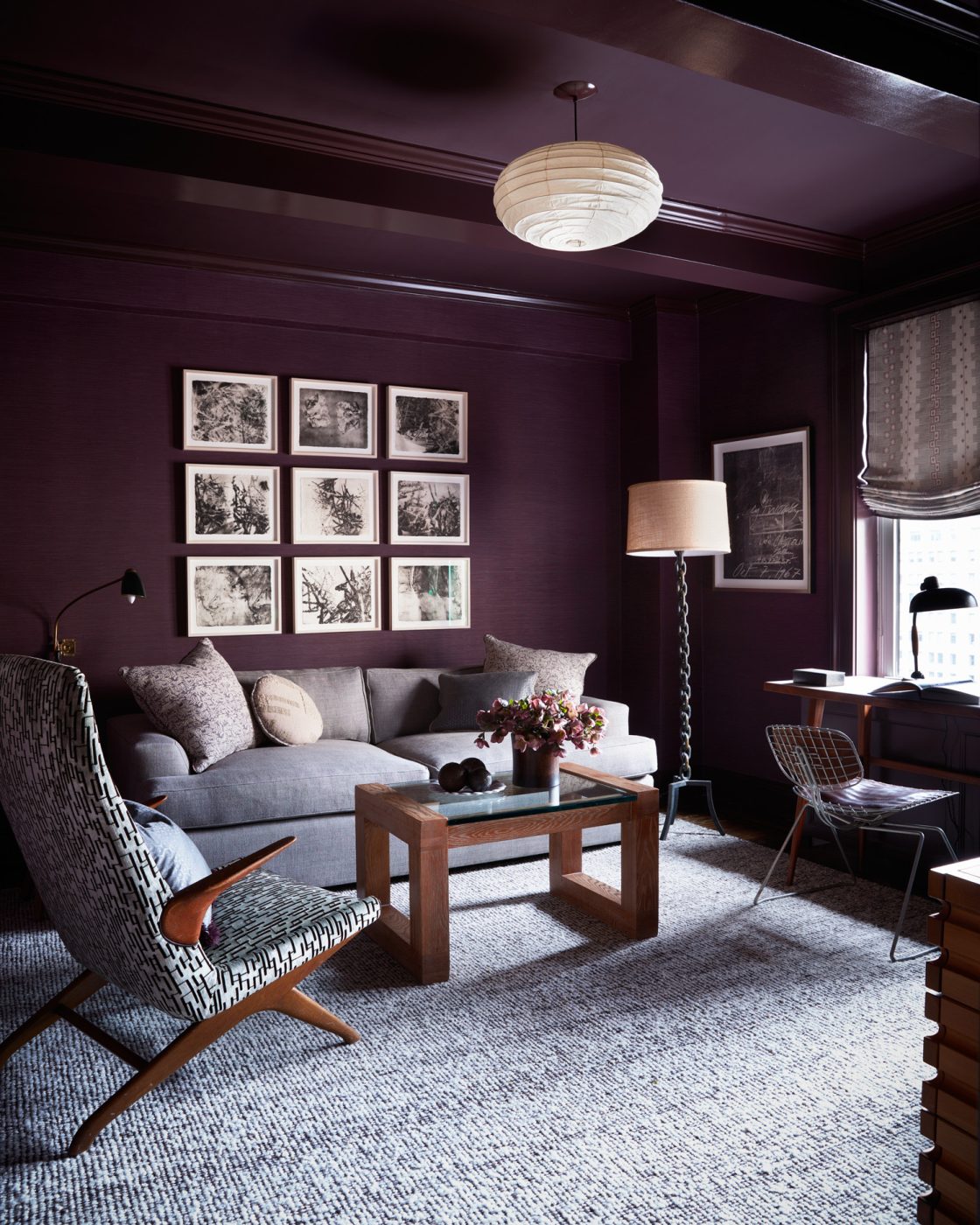
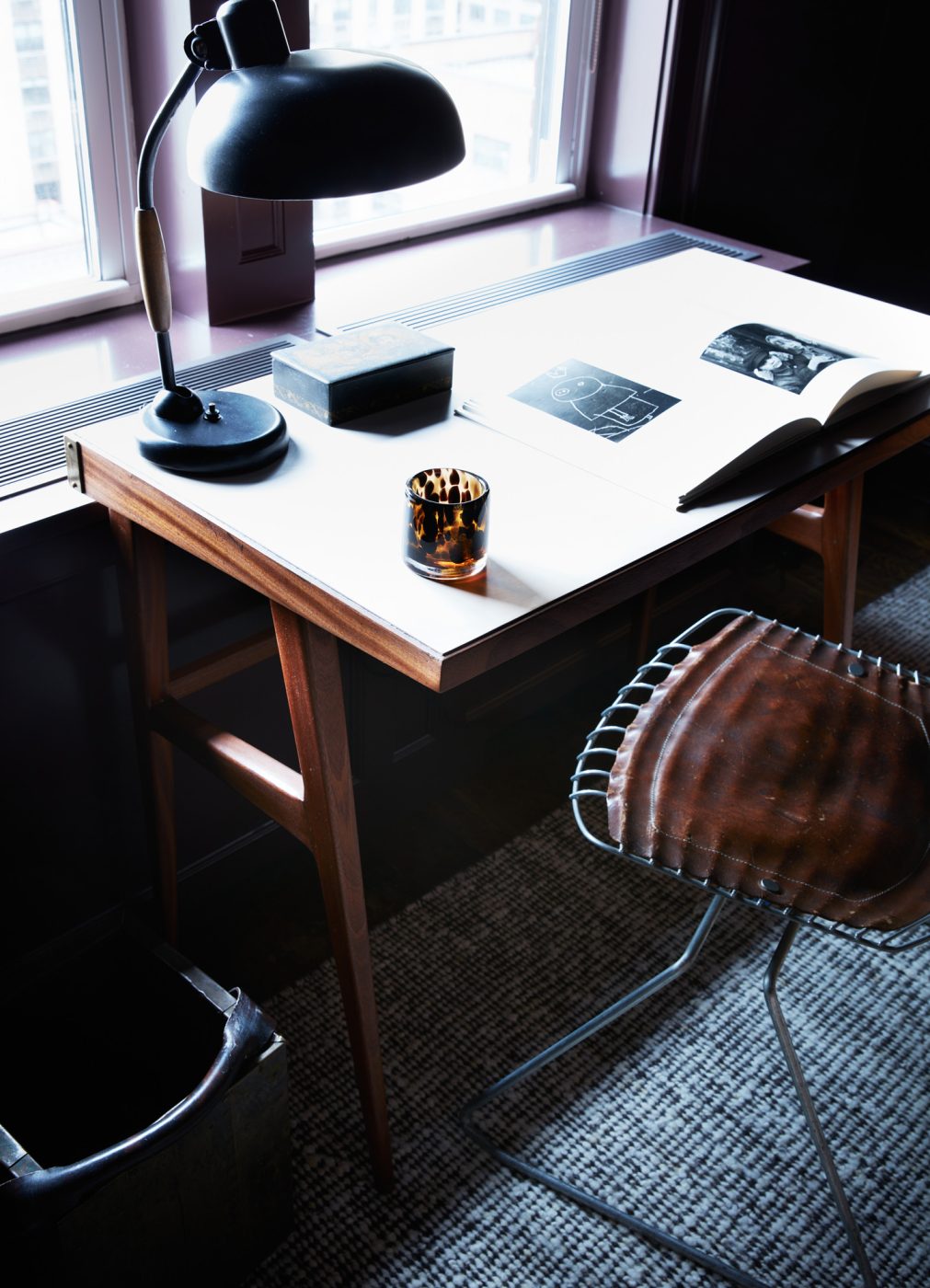
Continuing the dark-light-dark sequence, the pale living room leads to a study with walls covered in a matte-finished grasscloth from Phillip Jeffries. Freiman calls the color “eggplant”; Gensler calls it purple, “just to mess with her.” Whatever it’s called, it makes the room feel like a kind of hideout, which is just what Gensler intended.
Thanks to a custom sleeper sofa, the study serves as an extra bedroom — just as the same space did years ago, when Gensler stayed there. The other furniture constitutes a Grand Tour of Europe. It includes, from France, a circa 1970 chest of drawers by Maison Regain and a gridded-metal Beaubourg chair by Michel Cadestin and Georges Laurent; from Italy, a mid-century desk in an exotic wood by Fratelli Strada; and from Denmark, a Schillers Møbel Model 6 armchair.
The study also contains a wonderful range of light sources, from a Isamu Noguchi Akari pendant to a French mid-century bronze chain-link floor lamp from Nickey Kehoe to a desk lamp by Christian Dell for Koranda Austria.
“This is Shelley’s favorite room to spend time in,” Gensler says, noting that the mix of furnishings makes “it feel like a room that evolved around her life, her taste and her personality. Though she responded most to mid-century European pieces, I made a point of varying decades, materials and geographic origins to create contrast and subtle tension.” And indeed, the international medley subtly conveys a worldly, cosmopolitan approach — the opposite of buying everything at the same store, even a really good store.
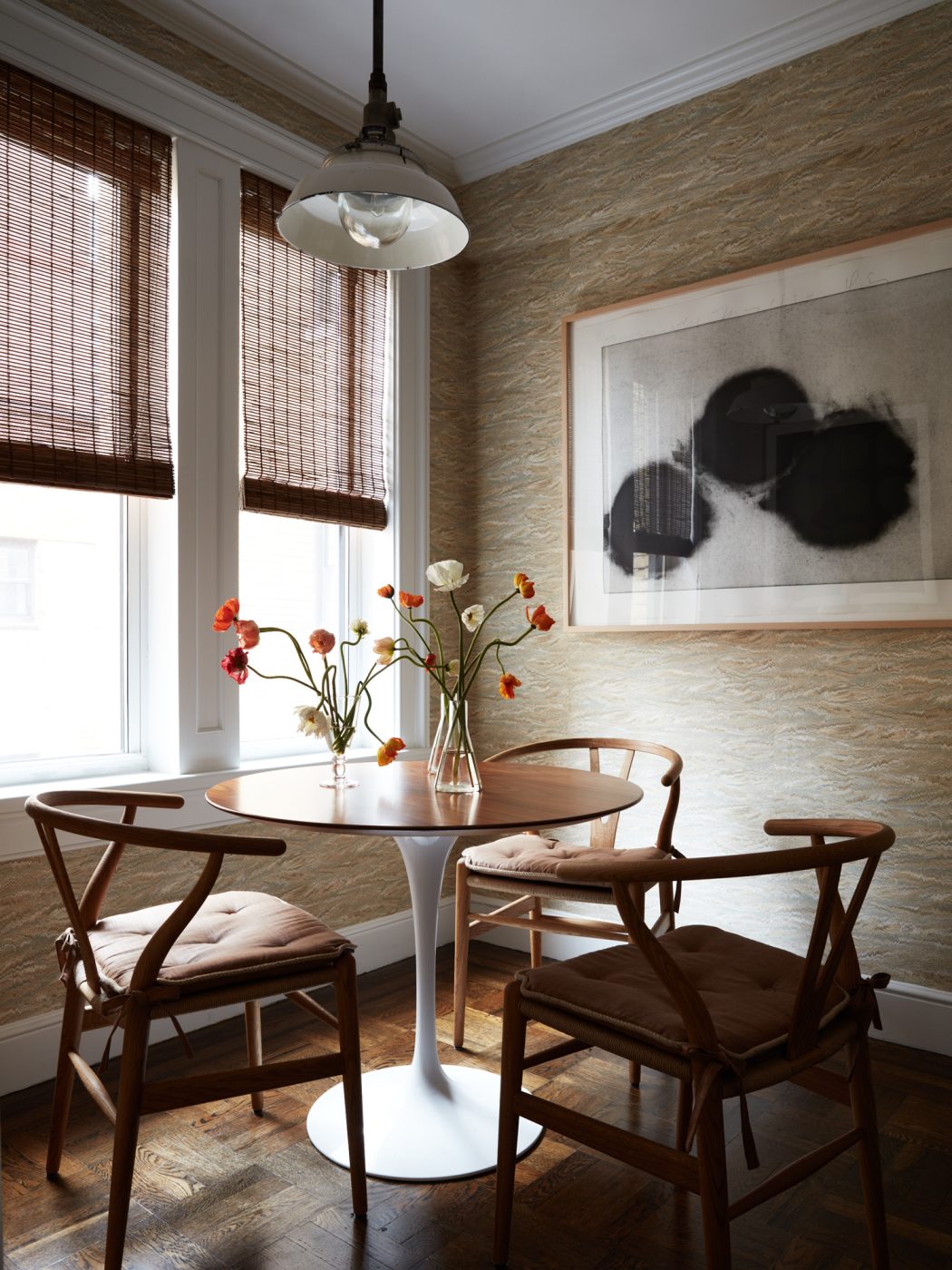
For the kitchen, Gensler chose modern classics: a rosewood-topped Tulip table by Eero Saarinen and a set of Wishbone chairs by Hans Wegner. He had button-tufted cushions made for the chairs, he says, “so ours would be distinctive.” The wallpaper has a marbleized pattern he compares to the cover of an old Venetian book.
Practically everything in the primary bedroom is custom, including the rug, edged by a poofy olive-green border, and the burl-wood bedside tables from Lemon. The lamps, from a Hudson Valley ceramist, are fitted with bespoke jute lampshades.A klismos bench at the foot of the bed, from Jamb, adds a bit of classicism. Much of the art, which already belonged to Freiman, was reframed.
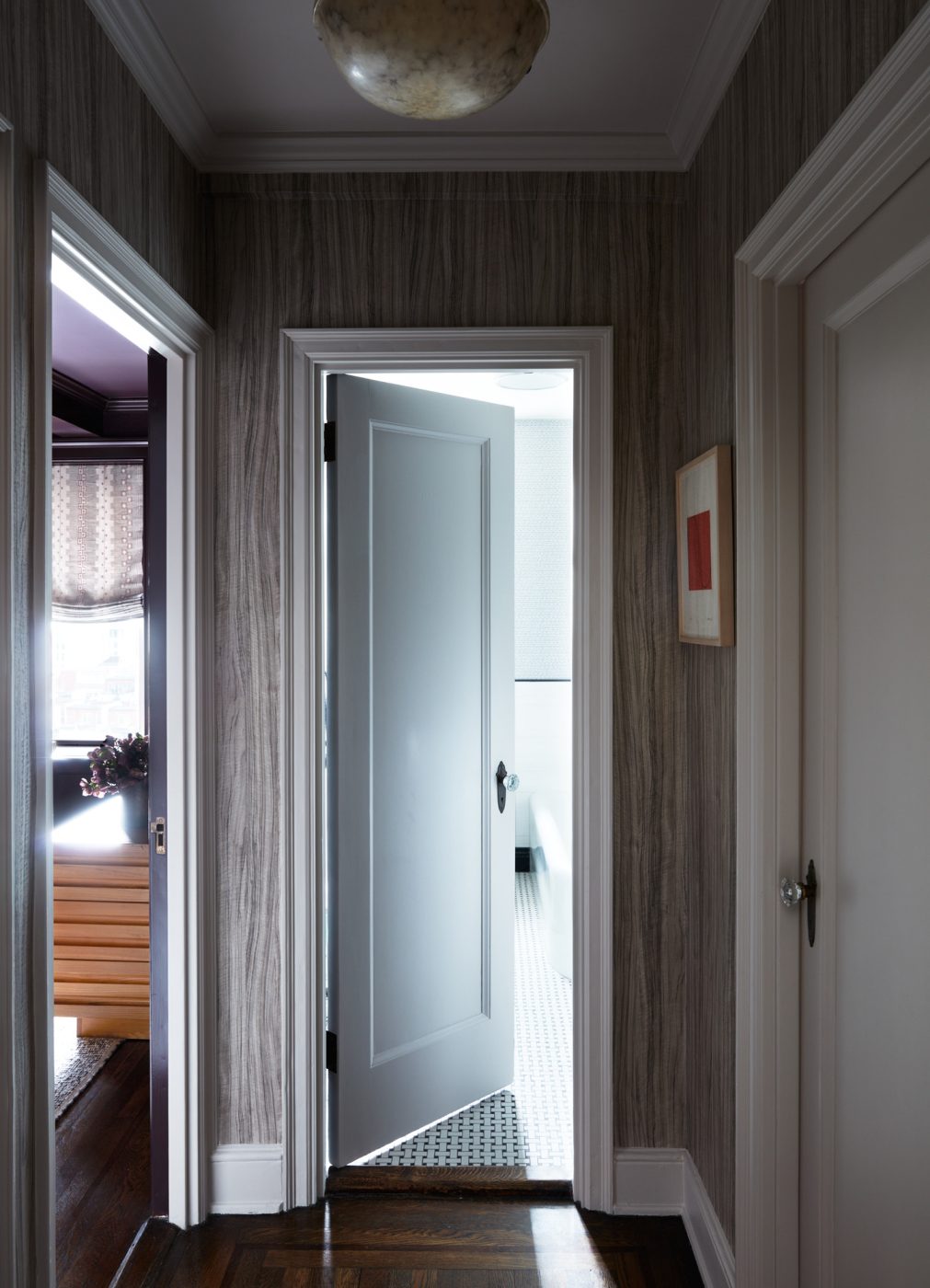
Connecting all the rooms is a small hallway clad in Nobilis’s Olivier Africain wallpaper, which looks like wood. “Shelley asked, ‘Why do we need wallpaper in such a tiny space?’ ” recalls Gensler, who responds that one trick for making a small space punch above its weight is to give it a special feature usually reserved for prominent locations. “And for a small space,” he adds, “you can afford to buy a really nice wallpaper, because you don’t need a ton of it. I think it ties everything together, and now she loves having it there.”

Gensler, a Cincinnati native, didn’t plan to become a designer. As a boy, he knew he wanted to do something entrepreneurial. So, at Northwestern University he studied economics and communications.
After his stint at NBC, he handled marketing for a dance troupe and an opera company before opening his own agency, Capacity Interactive, which over the years handled digital marketing for some 200 nonprofit cultural organizations. After a decade and a half, he sold the business to his employees, while remaining chairman of the board, and began to indulge his interest in design.
The first significant project he completed was his own apartment in the West Village, which was published in Architectural Digest in 2024. Gensler generally works at home, alone. Several assistants contribute remotely. That lets him focus on design, but even so, he plans to take on only two or three jobs a year. “More than that,” he says, “and you move away from the creative work.”

Right now, he is renovating a 1980s townhouse in Maryland overlooking Chesapeake Bay. “We’re going for a seaside look — lots of blue and white — but nothing cheesy.” And he’s working on a home in Greenwich, Connecticut, too.
As for Freiman — who used to have what she calls decor-a-phobia — she says she is a happier person now than before the apartment was redone. “For weeks after the work was done,” Gensler recounts, “she called me every day just to say, ‘I can’t believe how much I love this apartment, how much better it has made my life.’ ’’