October 19, 2025Jacques Jarrige may not be world famous, but many of his fans — including interior designers Robert Couturier, Victoria Hagan, Matthew Patrick Smyth, Sandra Nunnerley, Alyssa Kapito and Michael S. Smith — certainly are.
They admire the Paris-based artist and designer’s sensuous bronze lamps, massive oak tables, see-through room screens and aluminum-ribbon chandeliers. “Jarrige’s sculptural works are organic and full of movement yet remain highly functional, blurring the line between sculpture and furniture,” says Nunnerley. “His loose, hand-shaped forms and beautiful finishes make the pieces not only timeless but highly adaptable. His work doesn’t just sit in a room. It brings a quiet energy to it, almost ethereal.”

Adds Smyth, “Jarrige’s creations are different enough without being weird, and work with eighteenth-century furniture, Directoire antiques and contemporary interiors. Part of the appeal is that each piece is unique and also reveals the thought process behind it, like watching scissors taken to paper.”
Couturier concurs. “I love the organic quality and the elegance of the line,” he says. “It’s like updated Art Nouveau. The finish is quite refined, and the forms are never merely derivative but sensual and modern.”
A large selection of Jarrige’s furniture, lighting, sculpture and jewelry is on view now through December 15 at longtime 1stDibs seller Valerie Goodman’s eponymous gallery on Manhattan’s Upper East Side, in celebration of the 15-year relationship between gallerist and artist.


Jarrige never planned to be an artist, although his mother was a Paris art dealer and he grew up with Rodin sculptures and paintings by André Derain, Maurice de Vlaminck and Léonard Tsugouharu Foujita. He initially studied architecture at the École des Beaux-Arts, in Paris, where he says he happily pored over blueprints by Frank Lloyd Wright, Carlo Scarpa and Tadao Ando. He dropped out to attend the ESAM (École Supérieure des Arts Modernes), an interior architecture, applied arts and design school in Paris. And he began studying sculptures by Jean Arp, Max Ernst, Henry Moore and Diego Giacometti.

In the late 1980s he started making things by hand: chairs built with wood salvaged from junk yards and lengths of discarded rebar that he soldered together. He moved on to plywood chandeliers, driftwood mobiles and tables crafted of inexpensive MDF, medium-density fiberboard engineered by pressing together wood fibers, resin and wax under high heat. Blocks made by gluing together MDF layers are easily sculpted into furniture.
Jarrige used basic hand tools and found materials because “they left nothing for the artist to hide behind,” he says. “It makes my work seem more honest.”


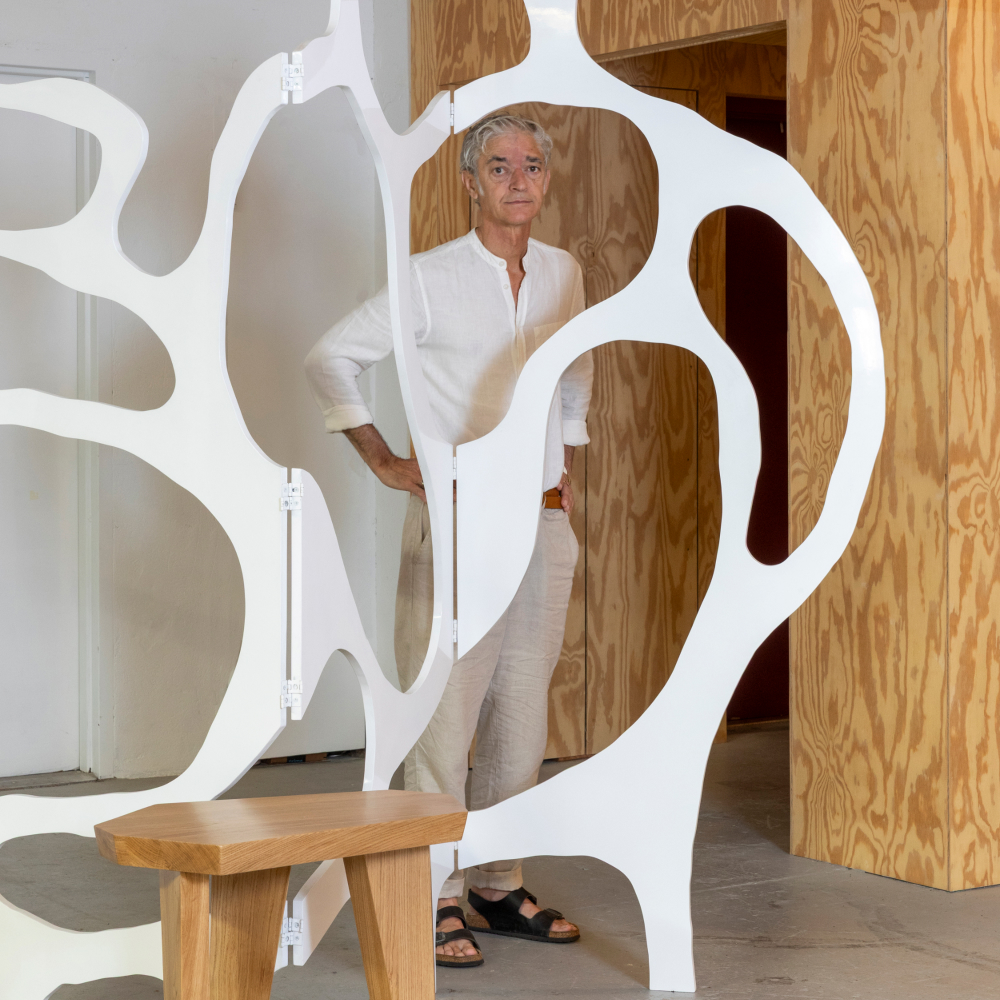
Jarrige’s working process is highly intuitive. He described it as “an unplanned path of an unhurried walk” to Glenn Adamson, an American curator who contributed to a 2022 Jarrige monograph produced by Goodman. The volume also includes an essay by academic and theorist Isi Litke that speaks of Jarrige’s “artistic vocabulary,” the language of “paring down, removing, stripping away, liberating” his chosen materials. His room screens, for example, are riddled with carved-out amoeba-shaped punctures, making them fully porous to light.

Jarrige has long been attracted to aluminum. A floating mobile or chandelier might start with a rough sketch. But when he picks up a ribbon of aluminum and begins to hammer it, he says, “I don’t follow the drawing but realize the piece as I make it. It takes on a life of its own. The design evolves. The material is the inspiration. It’s a singular experience. At the moment of realization, I have a dialogue with the material; it’s like a pas de deux.”
“The specificity of material is the prime driver for his creativity,” Adamson writes. “Jarrige thinks of himself not so much as a designer as a hyphenate ‘artist-artisan’ who thinks best through the act of making.”


The show includes works in multiple scales, from intricate pieces of jewelry to massive tables, and many mediums: wood (MDF, oak and ash), silver, bronze, brass and aluminum.
Goodman calls Jarrige “a humanist, a dreamer and idealist,” adding, “The work is about him, of course — for him, it’s all the same gesture — but it is just as much about the dialogue with the viewer through the made object.”
That may explain his appeal to designers. As Nunnerley puts it, “Jarrige brings an art de vivre to his creations that we love to bring into our interiors.”