December 14, 2025When Ray Booth arrived in New York City in the summer of 1989, fresh from the architecture program at Auburn University, in his native Alabama, he quickly found a place to rent on East 60th Street. “I had a one-bedroom apartment,” he says, pausing for effect, “that four of us were living in. I slept in a bedroom where you could touch either wall,” he adds, stretching out his arms to demonstrate.

The accommodations may have been less than auspicious, but Booth’s first job more than made up for it: He joined the practice of the celebrated interior designer John Saladino, which, he says, “changed the course of my life.”
With his eyes opened to interiors’ creative potential, Booth went on to build his own prominent career in the field. Today, he not only is a partner in the well-regarded architecture firm McAlpine but also designs a furniture collection for Hickory Chair, creates lighting for Visual Comfort and recently published his second book, Ray Booth: The Expressive Home, with Rizzoli.

The houses that volume presents — including the home in Pacific Palisades, California, featured here — all show off his sophisticated, carefully considered interiors. But most exciting for him is the fact that about half also highlight his ground-up architecture. Flexing that muscle again has been a source of great satisfaction.
“For so many years, I held myself back,” he says via video call from his Manhattan apartment in NoMad (a significant upgrade from his original uptown digs). “I want to continue to practice architecture. I want my career to evolve into more of these projects.”

Growing up in a family of engineers in Huntsville, Alabama —aka Rocket City — Booth says his fascination with architecture always made him feel like “an odd bird.” His mother was the only one who shared his love of luxurious homes. Together, they would visit the city’s Twickenham historic district of antebellum houses and even venture into construction sites. “So, for me, the smell of wet concrete and cut lumber hearkens back to a lot of excitement in my youth,” he says.
At Auburn, Bobby McAlpine was Booth’s second-year architecture professor. McAlpine gave him an internship at his nascent firm but wasn’t ready to hire by the time Booth graduated. “So, they sent me to work in New York,” he says, adding that McAlpine introduced him to Saladino, one of the era’s preeminent designers. “That was this whole new revelation about interiors and furniture and fabrics and telling stories with all of those tools,” Booth recalls. “It was like my master’s degree.”


Booth continued to build his portfolio working for two other interior designers: the mononymous Clodagh and David Howell. McAlpine’s firm was growing at the same time, and he’d occasionally ask Booth, “You ready to come back yet?”
“And after ten years, I was ready,” Booth says. “McAlpine has always been where I felt the most at home.”
In 1999, he joined as a partner at the firm’s headquarters — in Montgomery, Alabama. Returning to the state of his birth gave him culture shock, remedied only when the first project he worked on landed the cover of Veranda magazine.

“I was like, ‘Wow, people are paying attention,’ ” he says. “I remember coming back to New York and people commenting on it. Most of those people had told me how crazy I was to be leaving New York and moving to Alabama — and I believed them every weekend when I was crying in my soup. But sometimes, you find what you’re most looking for by looking in the opposite direction of where you think it lies.”
Booth helped start McAlpine’s Nashville office, and projects soon began flowing. Now, he and his husband divide their time among the house he designed there, the NoMad apartment and a summer home he built in Provincetown, Massachusetts, which is also featured in the new book.


Booth begins every project, he says, by learning the clients’ “loves and their hates,” including such details as where they like to vacation and where they feel inspired — “any little seed that we can grow or hatch into a design that ultimately feels personal and meaningful.”
He is also a great advocate for context. “An interior should be influenced by what you see just outside the window beyond. Tethering those things together gives you a sense of timelessness,” he explains. “I find reasons for the selections we make, to achieve something that’s beyond trendy and gives people a real sense of place.”

In the case of the Pacific Palisades house — for which he helmed the interiors while Bobby McAlpine served as the architect, and which made it through January’s fires unscathed — “there were all these color references that you had looking outside,” Booth says, “to the sage and the purples of the mountains in the distance, and even the ocean. We assembled the palettes based off that.” Knowing that landscape architect Christine London was planting a grove of old olive trees outside the kitchen, Booth incorporated in that space the silvery-green hue of their leaves.

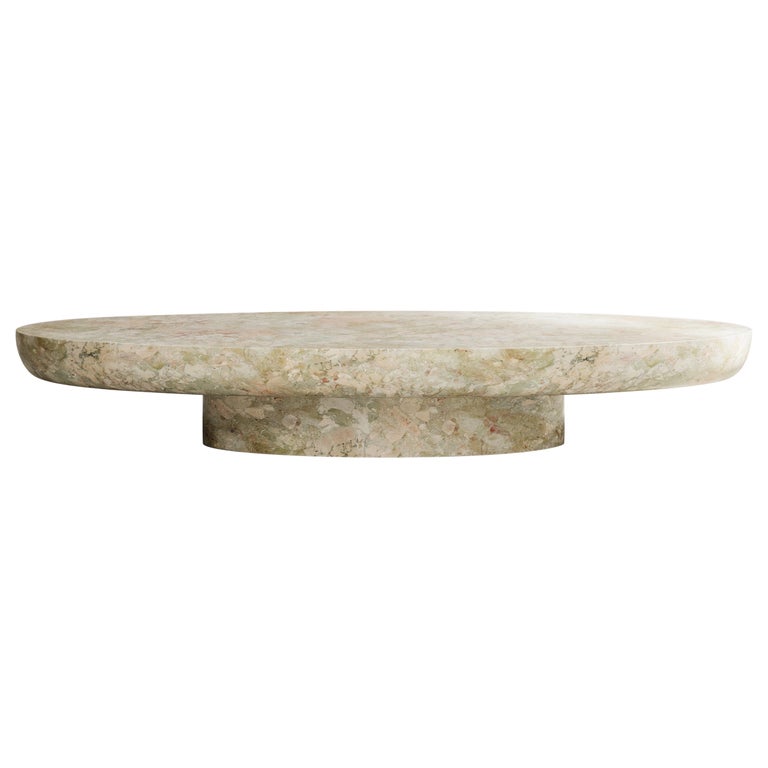
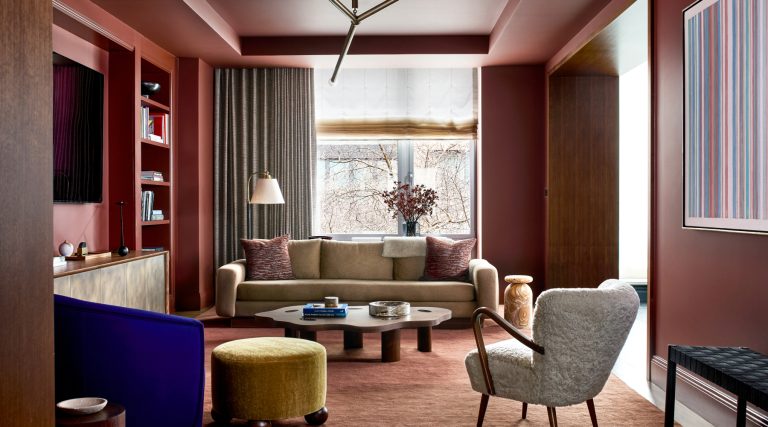
Another jumping-off point was the family’s connection to the United Kingdom, where they have their primary home. But Booth says most of his creative direction came from “trying to set up harmonies and a little bit of visual vibration” — pairing antiques with modern pieces, for example. One of his favorite compositions is in the light-filled living room, where a large planar coffee table by Axel Vervoordt and mid-century floor lamps share space with an antique vessel atop a stand. “It is assembled bit by bit,” he explains. “And you let one thing speak to who else is welcome at the party.”
Booth orchestrated a similarly eclectic vignette in the dining room, which boasts a view of Will Rogers State Historic Park. There, he teamed a bleached-wood contemporary dining table from Christophe Delcourt and new B&B Italia chairs slipcovered in ecru fabric with a pair of deep-russet vintage chairs from Rose Uniacke.

“Our palettes modulate between dark and light, and all shades in between,” Booth says of the scheme here. “There is white, and there is black, and there are pops of color. Once you establish a neutral palette, you’ve got to come in and break the rules a little bit. There’s got to be some color thrown into it, or it doesn’t live.”
Decades after he and his mother wandered through strangers’ houses in Huntsville, Booth gets the same charge from his work as a designer. “Our homes are reflections of ourselves,” he says. “I love being a fly on the wall.”