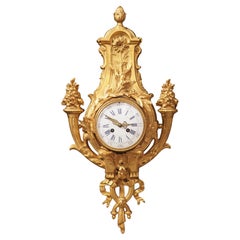
Articoli simili a Un orologio a cartello in stile Luigi XVI e un barometro di accompagnamento
Vuoi altre immagini o video?
Richiedi altre immagini o video al venditore
1 di 13
Un orologio a cartello in stile Luigi XVI e un barometro di accompagnamento
67.956,01 €
Informazioni sull’articolo
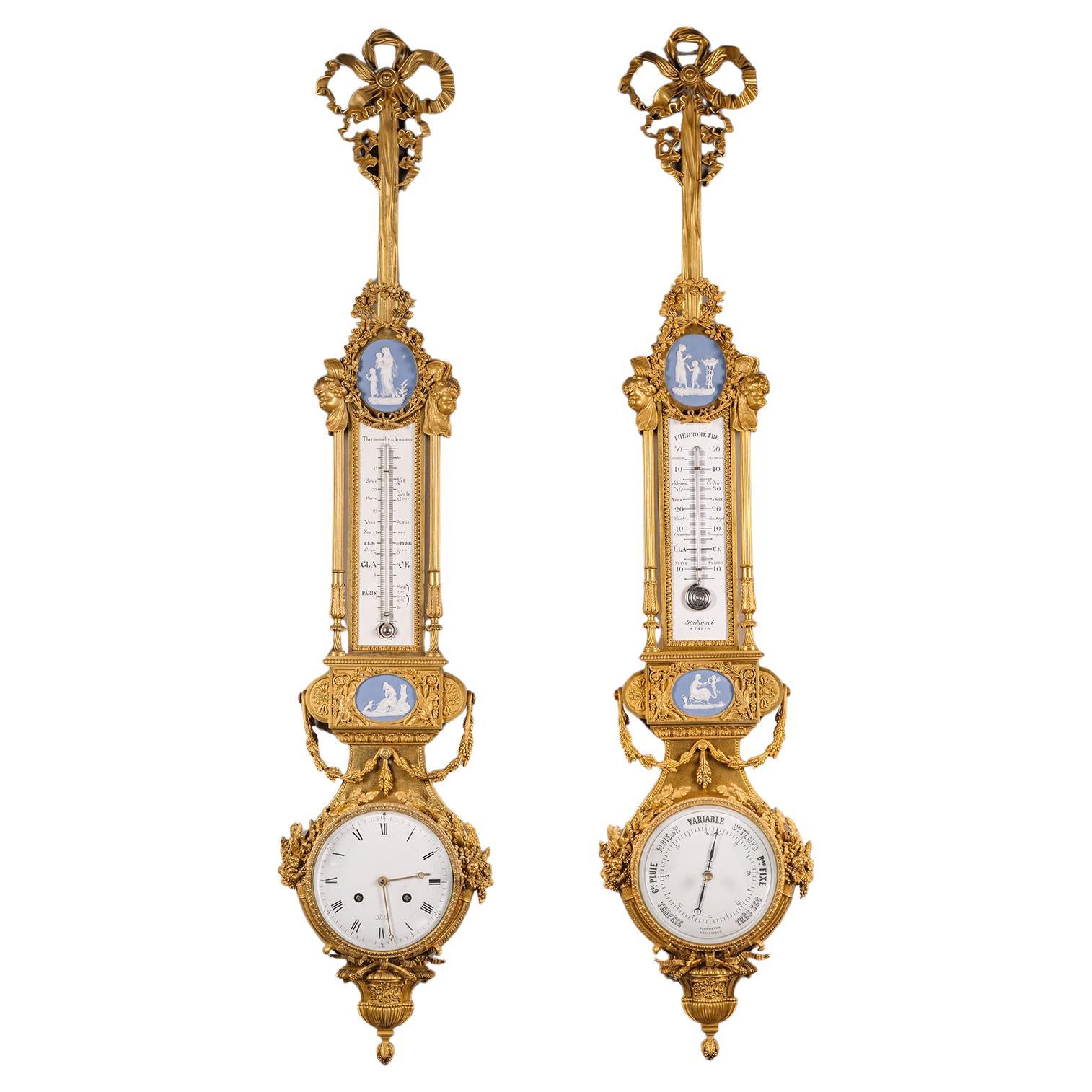
Orologio a cartello montato in bronzo dorato e ceramica diaspro in stile Luigi XVI, con barometro annesso, secondo il modello attribuito a Pierre Gouthière.
L'orologio e il barometro sono sormontati da termometri, placche in diaspro e terminali con nastri. Le custodie in bronzo dorato sono impreziosite da ghirlande di rose, cornucopie, viti fruttifere e foglie di Oak in riferimento alle quattro stagioni. Accanto alla targa superiore in Jasperware, due teste con ali delicate che personificano il vento.
L'orologio ha il quadrante smaltato di bianco, le ore sono segnate in numeri romani e i secondi in divisioni di cinque in numeri arabi. Il movimento a doppio treno di otto giorni con scappamento ad ancora che batte le mezze ore e le ore intere su una campana, con il numero "80". Il barometro aneroide da compagnia con quadrante in smalto bianco conforme che indica la gamma barometrica TEMPETE, Gx Pluie, Pluie Ou VARIABLE, Beau Temps, Beau Fixe, TRES SEC, (Tempestoso, Piovoso Variabile, Bel Tempo, Tempo Discreto e Molto Secco). I termometri sono contrassegnati dalla scala Réaumur. Il termometro posto sopra il barometro è costituito da un tubo capillare di vetro riempito di alcol con una scala che va da 25 gradi sotto lo zero a 35 gradi sopra, seguendo la scala Réaumur.
Le temperature insolitamente fredde raggiunte a Parigi durante l'inverno del 1785 sono indicate sui due termometri e spiegano gli estremi della scala utilizzata.
L'attuale orologio a cartello e il barometro corrispondente si basano su un modello attribuito al bronzista Pierre-Joseph-Désiré Gouthière (morto nel 1813), proveniente dal Castello di Saint Cloud e ora parte della collezione permanente del Musée du Louvre (OA 5493 e OA 5494).
Timbro 'P G' sul retro del bronzo nel calco.
Francese, circa 1880.
Nella seconda metà del XIX secolo, i mobili e le opere d'arte, un tempo appannaggio dell'aristocrazia e spesso letteralmente realizzati per i reali, vennero trasferiti, spesso a causa di guerre e rivoluzioni, alle collezioni dei musei statali, molti dei quali attraverso pionieristici collezionisti privati. Prima di allora c'erano pochissimi musei.
Gli esemplari del Louvre (mostrati in una vecchia fotografia in bianco e nero), attribuiti al bronzista Pierre Gouthière e all'orologiaio Carcany, furono realizzati intorno al 1785 per un membro della corte di Luigi XVI, molto probabilmente per la stessa regina Marie Antoinette. Verso la metà del XIX secolo si trovavano al Castello di Saint Cloud, forse nel salone dell'imperatrice Eugenia. Con la caduta del Secondo Impero, furono trasferiti al Musée du Louvre, dove vennero adeguatamente documentati, fotografati, pubblicati ed esposti.
La moda dell'Ancien Régime e di "tous les Louis" spinse una nuova categoria di collezionisti, come Sir Richard Wallace e Henry Clay Frick. Le mostre pubbliche di mobili e opere d'arte reali hanno dato ai creatori contemporanei l'opportunità di esaminare questi capolavori da vicino per la prima volta. I costruttori facevano a gara per produrre le repliche più belle e alla fine del XIX secolo le versioni di questi orologi e barometri erano realizzate in modo accurato.
Letteratura:
C. Dreyfus, Musée du Louvre, pl. LV, no. 392 e 393, per l'illustrazione degli esempi del XVIII secolo attribuiti a Gouthière (gli esempi del XVIII secolo attribuiti a Gouthière).
C. Dreyfus, Mobilier et Objets d'Art du XVIIe du XVIIIe Siècle, Musée du Louvre, Département des objets d'art, Paris, 1913, No. 358 "Cartel et thermomère" e no. 359 "Barometère", pag. 65 (gli esempi del XVIII secolo attribuiti a Gouthière).
D. Alcouffe, Bronzi dorati al Louvre, Parigi, 2014, p. 213. (gli esempi del XVIII secolo attribuiti a Gouthière).
C. Mestdagh, L'ameublement d'art français: 1850-1900, Paris, 2010, fig. 258., p. 221(per una coppia di Emmanuel-Alfred (dit Alfred II) Beurdeley (1847-1919)).
- Simile a:Pierre Gouthiere (Designer)
- Dimensioni:Altezza: 117 cm (46,07 in)Larghezza: 23 cm (9,06 in)Profondità: 12 cm (4,73 in)
- Stile:Luigi XVI (Nello stile di)
- Materiali e tecniche:
- Luogo di origine:
- Periodo:
- Data di produzione:Circa 1880
- Condizioni:Usura compatibile con l’età e l’utilizzo.
- Località del venditore:Brighton, GB
- Numero di riferimento:Venditore: B781201stDibs: LU1028045340822
Informazioni sul venditore
5,0
Venditore riconosciuto
Questi venditori prestigiosi sono leader del settore e rappresentano il massimo in termini di qualità e design.
Fondazione nel 1964
Venditore 1stDibs dal 2014
61 vendite su 1stDibs
Tempo di risposta standard: 2 ore
Associazioni
The British Antique Dealers
AssociationLAPADA - The Association of Arts
Antiques Dealers
- SpedizioneRecupero del preventivo…Spedizione da: Brighton, Regno Unito
- Politica di reso
Alcune parti di questa pagina sono state tradotte automaticamente. 1stDibs non può garantire che le traduzioni siano corrette. L’inglese è la lingua predefinita del sito.
Altro da questo venditore
Mostra tuttoOrologio a cartello e barometro in stile Luigi XVI di Pierre Gouthière
Di Maison Millet
Orologio a cartello in bronzo dorato e porcellana di Wedgwood in stile Luigi XVI e barometro di accompagnamento, di Maison Millet, Parigi, secondo il modello attribuito a Pierre Gout...
Categoria
Di antiquariato/d’epoca, XIX secolo, Francese, Luigi XVI, Orologi a parete
Materiali
Smalto, Similoro
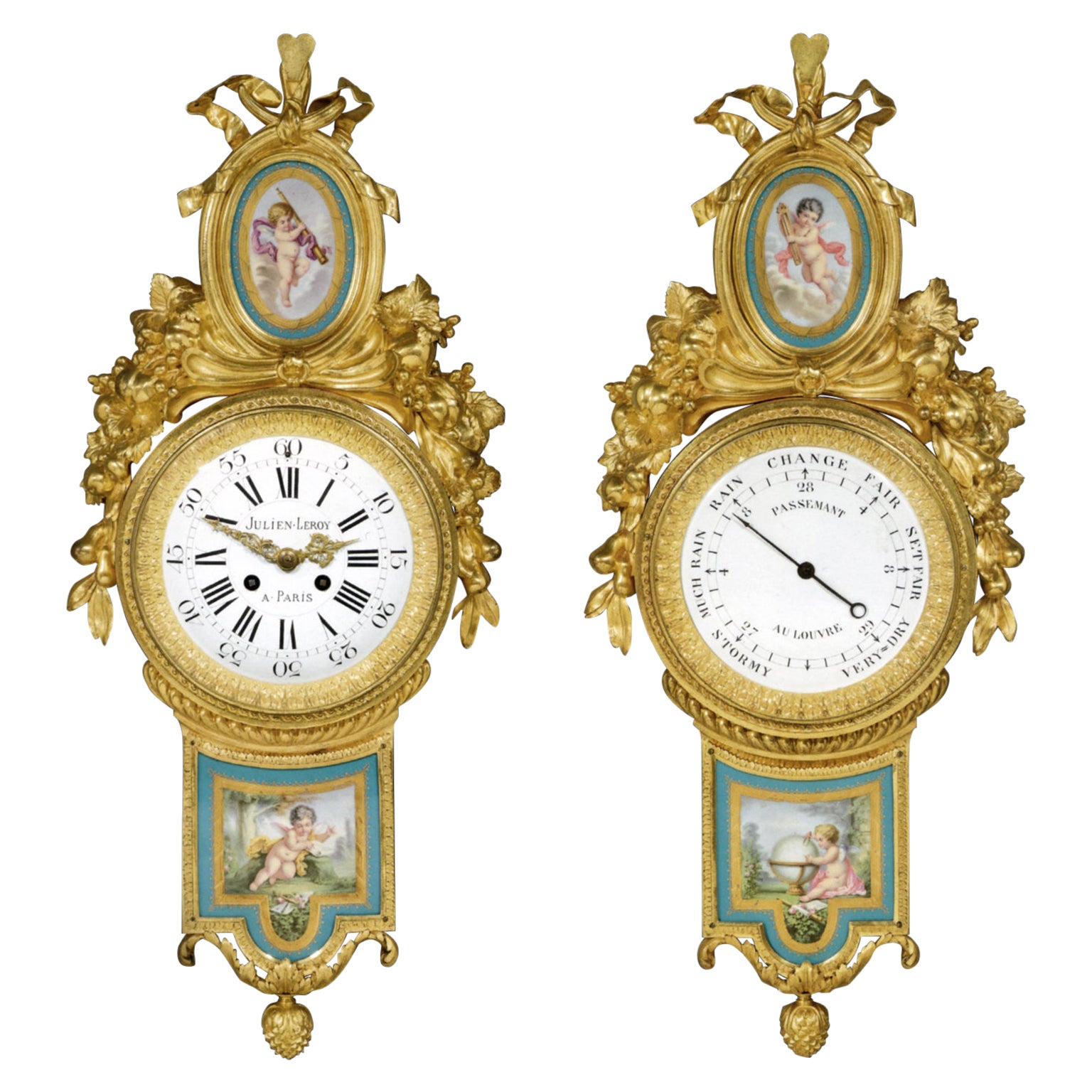
Orologio da parete e barometro abbinato con placche di Sèvres
Orologio da parete in bronzo dorato e barometro abbinato con placche di Sèvres.
Il quadrante dell'orologio è firmato "JULIEN LEROY A PARIS", il quadrante del barometro è firmato "...
Categoria
Di antiquariato/d’epoca, XIX secolo, Francese, Luigi XVI, Orologi a parete
Materiali
Bronzo
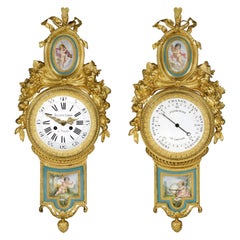
Orologio e barometro in legno dorato intagliato di grandi dimensioni e in stile Luigi XVI
Un grande e importante orologio e barometro in legno dorato intagliato in stile Luigi XVI.
Ciascuno con quadranti circolari in smalto, l'orologio con numeri romani e arabi e lance...
Categoria
Di antiquariato/d’epoca, XIX secolo, Francese, Luigi XVI, Orologi a parete
Materiali
Legno dorato
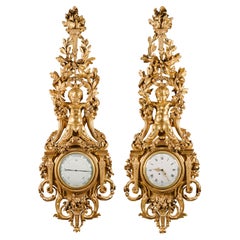
Orologio a cartello e barometro in stile Luigi XVI in bronzo dorato e smalto blu
Di Maison Mottheau et Fils
Orologio a cartello e barometro in bronzo dorato e smalto blu in stile Luigi XVI, Maison Mottheau & Fils, Parigi.
Questo eccezionale orologio a cartello e barometro aneroide mostra ...
Categoria
Di antiquariato/d’epoca, XIX secolo, Francese, Luigi XVI, Orologi a parete
Materiali
Bronzo, Smalto
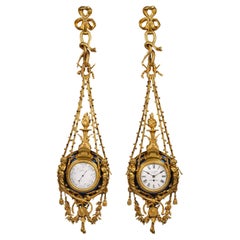
Orologio a cartello e barometro in mogano in stile Luigi XVI, dopo Carlin, circa 1870
Di Martin Carlin
Pregevole orologio a cartello e barometro in mogano montato in stile Louis XVI in bronzo dorato, secondo il modello di Martin Carlin.
Francese, circa 1870.
Il quadrante è firm...
Categoria
Di antiquariato/d’epoca, Fine XIX secolo, Francese, Luigi XVI, Orologi a...
Materiali
Bronzo
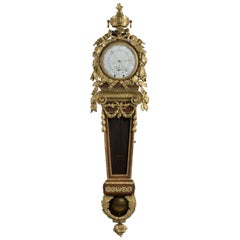
Orologio a cartello e barometro in porcellana di Sèvres in stile Luigi XVI
Pregevole orologio a cartello montato in bronzo dorato e porcellana di Sèvres e barometro aneroide en suite, secondo i modelli di Martinout e Passemant.
L'orologio ha un movimento ...
Categoria
Di antiquariato/d’epoca, XIX secolo, Francese, Luigi XVI, Orologi a parete
Materiali
Bronzo, Smalto
Ti potrebbe interessare anche
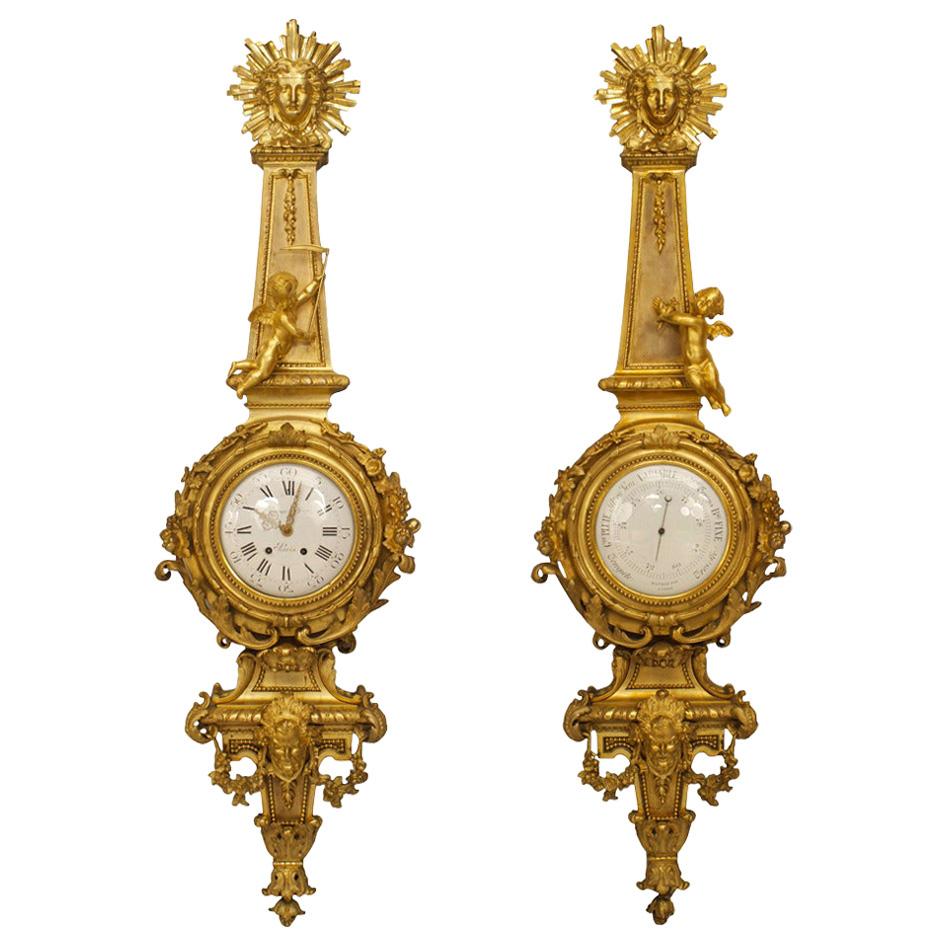
Coppia di orologi da parete e barometri Luigi XVI Ormulu
Di Raingo Frères
Coppia di orologi da parete e barometri in ormolu in stile Luigi XVI (metà del XIX secolo), ciascuno con forma a banjo con maschera di Apollo sopra putti e quadrante circolare sopra ...
Categoria
Di antiquariato/d’epoca, XIX secolo, Francese, Luigi XVI, Orologi
Materiali
Metallo, Similoro
99.829 € / set
Orologio e termometro in stile Louis XV Vernis Martin, circa 1740
Orologio e termometro a cartello Vernis Martin in stile Luigi XV, 1740 circa.
Un orologio di cartello in stile Vernis Martin e bronzo dorato del 18° secolo, molto bello e sontuoso. ...
Categoria
Di antiquariato/d’epoca, XVIII secolo, Francese, Luigi XV, Orologi a parete
Materiali
Bronzo
Barometro francese Luigi XVI del 1700
Un barometro francese Luigi XVI ornato da intricati intagli e dorature originali, risalente alla fine del 1700. Questo squisito pezzo è una testi...
Categoria
Di antiquariato/d’epoca, Inizio Settecento, Francese, Stile provenzale, ...
Materiali
Legno
2796 € Prezzo promozionale
20% in meno
Orologio a cartelli e barometro in bronzo dorato in stile rococò
Per l'uso elaborato di volute a C, figure di putti, foglie d'acanto e fiori stilizzati, questo orologio e questo barometro sono chiaramente in stile rococò. Il rococò divenne di moda...
Categoria
Di antiquariato/d’epoca, XIX secolo, Francese, Rococò, Orologi da camino
Materiali
Smalto, Similoro, Bronzo
Orologio e barometro francese in bronzo dorato e vasellame di diaspro bianco e blu
Di Carcany
Robin
Orologio e barometro di alta qualità di Carcany & Robin, su modelli esposti al Museo del Louvre di Parigi.
In stile Luigi XVI, a forma di banjo, le casse sono in bronzo fuso, con...
Categoria
Di antiquariato/d’epoca, XIX secolo, Francese, Luigi XVI, Orologi a parete
Materiali
Bronzo
Antique French Louis XVI Style Gilt Bronze Wall Clock, XIX secolo
Realizzato in Francia nel 1800, questo orologio da parete in bronzo dorato di alta qualità presenta elementi in stile Luigi XVI. Il quadrante dell'orologio bianco con numeri blu pogg...
Categoria
Di antiquariato/d’epoca, XIX secolo, Francese, Luigi XVI, Orologi a parete
Materiali
Metallo, Bronzo