Articoli simili a Pair of candelabrum with 9 lights in gilded, silvered and burnished bronze
Vuoi altre immagini o video?
Richiedi altre immagini o video al venditore
1 di 21
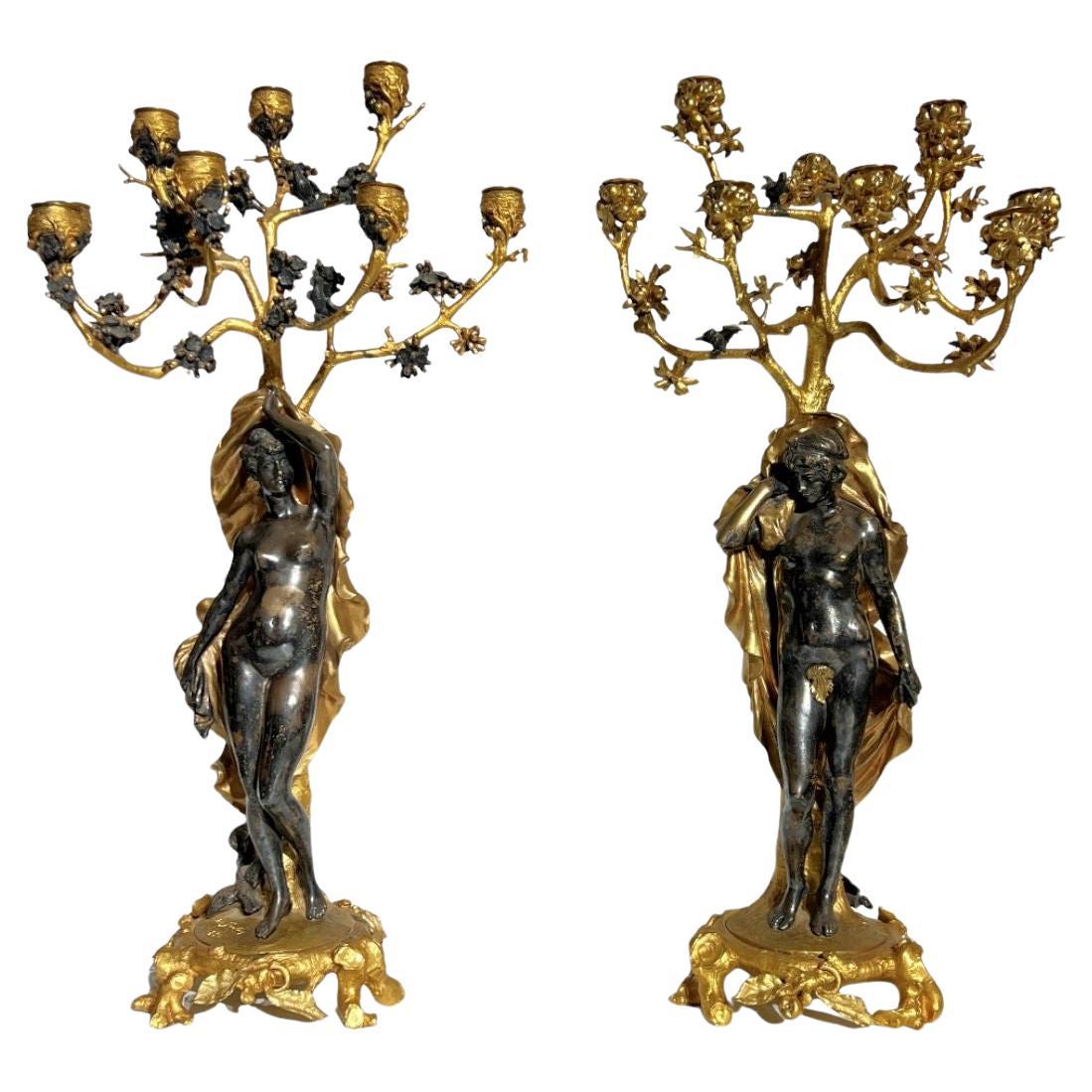
Pair of candelabrum with 9 lights in gilded, silvered and burnished bronze
281.250 €IVA inclusa
Informazioni sull’articolo
This splendid pair of candelabrum was made by Auguste-Louis Marquis (bronze maker) for the Maison Giroux circa 1855 in gilded, silvered and burnished bronze, the set on a cylindrical stand made of blackened wood resting on a square base.
Reflection of the eclecticism from the second half of the 19th century, our pair of candelarbum illustrates the exuberance of the Napoleon III style and the classicism of the Louis XVI style. The bronze maker has represented here the theme of the silent children, through winged putti with one finger put on their mouth, in burnished bronze. From their free hands, they hold a gilt bronze quiver where is resting a roses bouquet below large lily flowers being shaped to be light arms and of which the flowers are lightened up with a beautiful silver work. The putti are lightly dressed with a drapery hold by a strap roses garland and are bearing a crown of this same flower in their hair. About the cylindrical stand made of blackened wood, it is very typical of the Louis XVI style with its gilded bronze decoration of flowers garlands and laurel leaves flowers on which they stand.
We find on a sketching book indexing the works made by the maison Giroux, conserved in the Musée des Arts Décoratifs of Paris, a drawing depicting one of our candelabra, allowing us to confirm that they were sold by the maison created by Alphonse Giroux in the late 1790’s.
This store which was originally selling all kind of supplies and small objects such as paints, varnishes, albums, writing-papers, fans, toys, boxes and souvenirs, but also lithographs, drawings and watercolors, considerably developed in the first decades of the 19th century. First, because they count among the clients, important persons such as the Duchesse de Berry, Louis XVIII or even Charles X, then by the drive given by Alphonse Giroux’s sons who joined the firm in 1833. Thus, Alphonse-Gustave Giroux, the eldest son, had the idea to sell small furniture. Even though he was an artist himself, he worked like furniture dealers of the 18th century, with artists who did not have the right to put their signature and exerted a hold over the design of the creation that he chose. He also decided to move the store in the new Opera district on the corner of the 43 boulevard des Capucines and the 24 rue Neuve des Capucines in 1855.
On this same year, the company which had already won medals for the quality of its production during previous events, sells during the World Fair, to the Impress Eugénie, a bonheur du jour, conserved today in the château de Compiègne. In 1867, the store direction is given to Ferdinand Duvinage, Harinkouck and Brune. Little things are known about Harinkouck and Brune who seem to have been associated for a short period of time as Duvinage remains the only one in 1874.
A similar pair, a little bit smaller, with only 7 light arms, and made entirely of gilded bronze is illustrated on Marie-France Dupuy-Bellet’s book: Les bronzes du mobilier national 1800-1870, on the page 303.
The handwritten documentation of the Mobilier national allows to name their author: Auguste-Louis Marquis, who delivered them to the Garde-Meuble in April 1855 for the Palais Royal. They are next send, 22 years later to the Palais de l’Élysée where their presence is mentioned in the Ladies Salon in 1894.
The maison Chaumont and Marquis, founded in 1731, made and sold bronze, chandeliers, clocks, candelabrum, etc. They participated during the World Fairs of 1862 and 1867.
Thus, as written above, it seems that Alphonse Giroux asked Auguste Marquis to make a model of candelabrum from his original one, while imposing his modifications that we can notice by comparing the formal differences between the two pair of candelabrum. This manner to ask other artists to create models is really usual for the important companies selling art in the late 19th century. We can also mentionned l'Escalier de Cristal which worked with Gabriel Viardot, Emile Gallé and others, or Edouard Lièvre who worked for the maison Barbedienne.
Bibliography :
Marie-France Dupuy-Bellet, L’heure, le feu, la lumière, Les bronzes du mobilier National 1800-1870, Editions Faton, 2005
- Dimensioni:Altezza: 232 cm (91,34 in)Larghezza: 58 cm (22,84 in)Profondità: 72 cm (28,35 in)
- Stile:Napoleone III (Nello stile di)
- Materiali e tecniche:
- Luogo di origine:
- Periodo:
- Data di produzione:Circa 1855
- Condizioni:
- Località del venditore:SAINT-OUEN-SUR-SEINE, FR
- Numero di riferimento:Venditore: 132001stDibs: LU7662232252852
Informazioni sul venditore
Ancora nessuna recensione
Venditore riconosciuto
Questi venditori prestigiosi sono leader del settore e rappresentano il massimo in termini di qualità e design.
Venditore 1stDibs dal 2022
6 vendite su 1stDibs
Tempo di risposta standard: 4 ore
- SpedizioneRecupero del preventivo…Spedizione da: SAINT-OUEN-SUR-SEINE, Francia
- Politica di reso
Alcune parti di questa pagina sono state tradotte automaticamente. 1stDibs non può garantire che le traduzioni siano corrette. L’inglese è la lingua predefinita del sito.
Altro da questo venditore
Mostra tuttoCoppia di lampade di cristallo antiche
Questa bellissima coppia di lampade è stata realizzata in cristallo tra la fine del XIX secolo e l'inizio del XX.
Le lampade sono composte da pendenti di cristallo di diverse forme ...
Categoria
Inizio XX secolo, Francese, Belle Époque, Lampade da tavolo
Materiali
Cristallo, Marmo
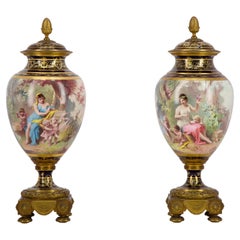
Coppia di vasi in porcellana montati in bronzo dorato, 1890 circa
Di Charles Labarre, Manufacture Nationale de Sèvres
Questa bellissima coppia di vasi ovoidali e coperti è stata realizzata in porcellana di Sèvres e montata in bronzo dorato. I due vasi raffigurano un decoro dipinto da Charles Labarre...
Categoria
Di antiquariato/d’epoca, XIX secolo, Francese, Napoleone III, Vasi
Materiali
Bronzo
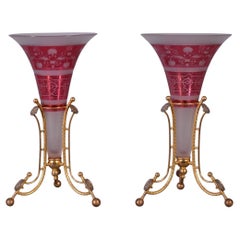
BACCARAT, Coppia di vasi montati, 1878 circa
Di Baccarat
Fondata sotto Luigi XV, la fabbrica di cristalli francese Baccarat dimostrò la sua eccellenza alle Esposizioni Universali del XIX secolo.
Questa coppia di vasi, dal tocco elegante,...
Categoria
Di antiquariato/d’epoca, Fine XIX secolo, Francese, Napoleone III, Vasi
Materiali
Cristallo, Bronzo
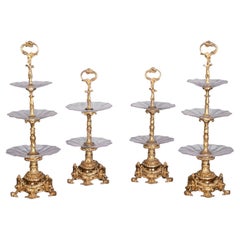
Centro tavola in stile Napoléon III in bronzo dorato e cristalli taillé, vers. 185
L'antica collezione del castello di Dampierre
Importante centro tavola composto da quattro pezzi in bronzo dorato finemente cisellato e cristal taillé, in stile Napoléon III. Due pe...
Categoria
Di antiquariato/d’epoca, Anni 1850, Napoleone III, Alzate, vassoi e piat...
Materiali
Cristallo, Bronzo
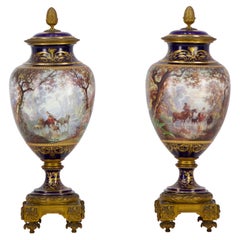
Coppia di vasi in porcellana di Sèvres montati in bronzo dorato dipinti da J. Machereau
Di Charles Labarre, Manufacture Nationale de Sèvres
Questa bellissima coppia di vasi coperti in porcellana proviene originariamente dalla Manifattura di Sèvres, dove i pezzi bianchi furono acquistati nel 1869, decorati e poi montati i...
Categoria
Di antiquariato/d’epoca, XIX secolo, Francese, Napoleone III, Vasi
Materiali
Bronzo
Sospensione in bronzo dorato con gemme in vetro, periodo Napoleone III
Questo lampadario in bronzo dorato ha otto rami che assumono la forma di bicchieri e candele e circondano una semisfera decorata con gemme di vetro. Frutto di un lavoro molto accurat...
Categoria
Di antiquariato/d’epoca, XIX secolo, Francese, Napoleone III, Lampadari ...
Materiali
Gemme varie, Bronzo
Ti potrebbe interessare anche
Coppia di grandi candelabri francesi in bronzo e bronzo dorato
Di François Rémond
Questa impressionante coppia di candelabri presenta due fanciulle in stile classico, che tengono sopra la loro testa una stravagante serie di frutta dorata, da cui esce un trio di ca...
Categoria
Di antiquariato/d’epoca, Fine XIX secolo, Francese, Neoclassico, Candelabri
Materiali
Bronzo, Similoro
Coppia di eccezionali candelabri francesi del XIX secolo in bronzo dorato e argentato
Coppia di candelabri figurali neoclassici in bronzo argentato e dorato disegnati dallo scrittore, saggista e artista francese,
Judith Gautier (1845-1917), firmata e datata 1886, raf...
Categoria
Di antiquariato/d’epoca, Fine XIX secolo, Francese, Neoclassico, Candelabri
Materiali
Bronzo
Coppia di candelabri francesi in bronzo dorato del XIX secolo con base in marmo
Coppia di candelabri figurati in bronzo patinato e dorato Napoleone III. Ciascuna in piedi su basi di marmo reale rosso, le figure sembrano tenere con grazia una cornocupia piena di ...
Categoria
Di antiquariato/d’epoca, Fine XIX secolo, Francese, Candelabri
Materiali
Marmo, Bronzo
Coppia (2) di magnifici candelabri francesi in ottone dorato e bronzo
Coppia (2) di magnifici candelabri francesi in ottone dorato e bronzo patinato.
Coppia di candelabri francesi in bronzo dorato e patinato
Francese, XX secolo
Una magnifica coppia d...
Categoria
XX secolo, Francese, Candelieri
Materiali
Ottone
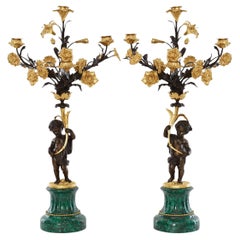
Coppia di candelabri del XIX secolo Napoleone III
Questa elegante coppia di candelabri esemplifica la grandezza e l'estetica raffinata del periodo di Napoleone III in Francia. I candelabri mostrano un'armoniosa miscela di influenze ...
Categoria
Di antiquariato/d’epoca, XIX secolo, Francese, Napoleone III, Candelieri
Materiali
Malachite, Bronzo
7035 € Prezzo promozionale / set
23% in meno
Coppia monumentale di candelabri in bronzo Napoleone III
Una monumentale coppia di antichi candelabri francesi Napoleone III in bronzo e onice bianco, risalenti alla fine del XIX secolo. A forma di balaustro con manici in bronzo dorato for...
Categoria
Di antiquariato/d’epoca, XIX secolo, Francese, Napoleone III, Candelabri
Materiali
Onice, Bronzo