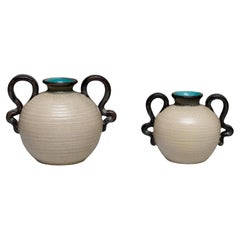
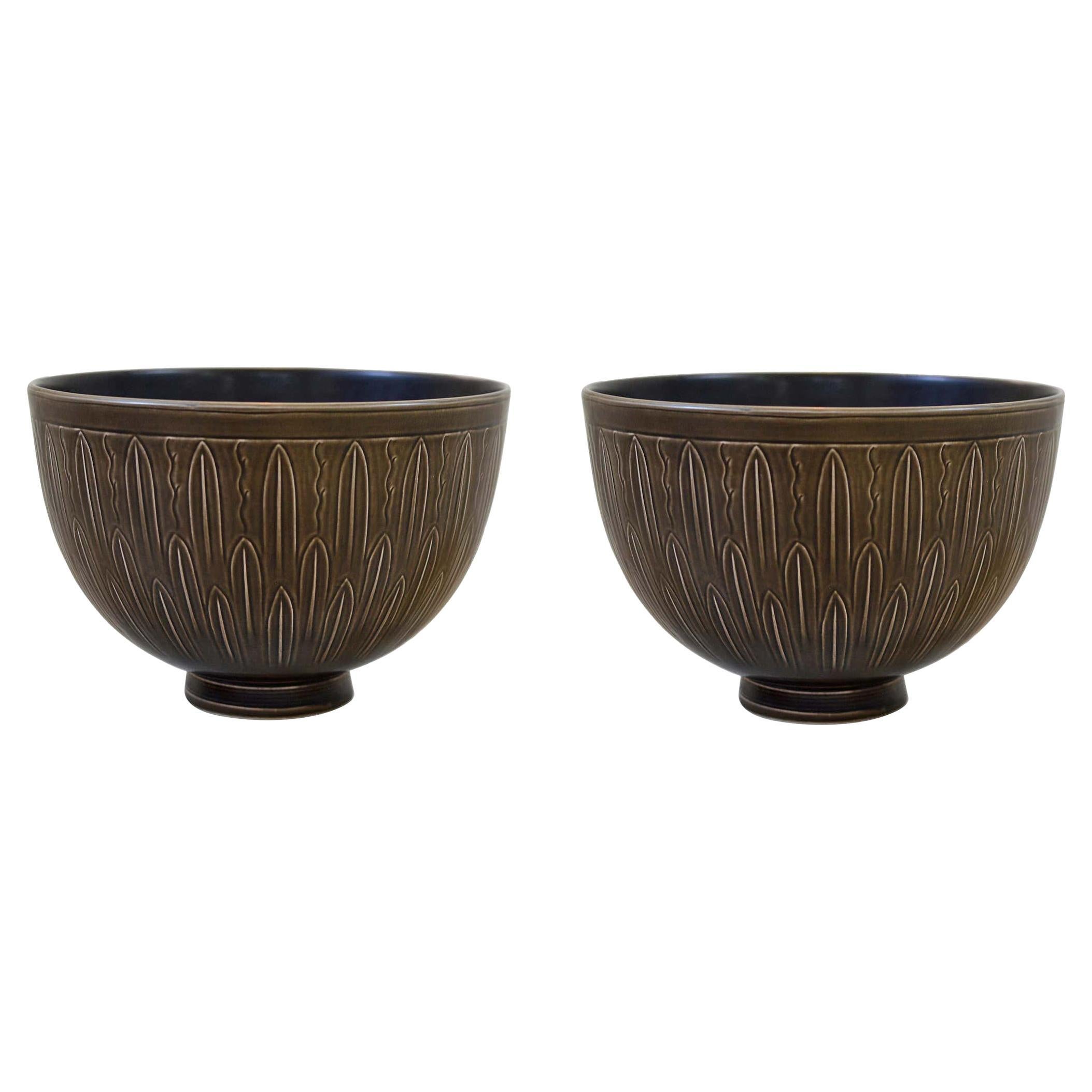
Articoli simili a Pair of Ceramic Bowls by Allan Ebeling for Bo Fajans, Sweden, 1920s.
Vuoi altre immagini o video?
Richiedi altre immagini o video al venditore
1 di 10
Pair of Ceramic Bowls by Allan Ebeling for Bo Fajans, Sweden, 1920s.
951,73 €per set|IVA inclusa
Informazioni sull’articolo
A pair of beautiful Swedish Grace / Scandinavian Modern ceramic bowls with amazing decor.
Designed by Allan Ebeling for Bo Fajans, Sweden, 1920s.
Great condition. No chips or cracks.
Makers marks on base of vase.
Allan Svante Ebeling (1897–1975) was a Swedish ceramist, sculptor, painter, and visual artist whose imaginative and often playful work made him a distinctive figure in 20th-century Swedish art. He was born on 30 July 1897 in Bethlehem on Long Island, New York, to Swedish parents, and spent his early years in the United States. As a young man he worked as a commercial artist and advertising illustrator, gaining practical experience in visual communication and design. After his father’s death in 1908, the family returned to Sweden and settled in Strängnäs, where Ebeling continued his artistic development and soon decided to pursue a formal education in art.
He studied at Tekniska Skolan in Stockholm, now Konstfack, and later at Althins målarskola, where he received thorough training in drawing, painting, and craftsmanship. During the early 1920s his interest increasingly turned toward ceramics, a medium that allowed him to combine sculptural form with painterly surface treatment. In 1921 he was employed by Bo Fajans in Gävle, one of Sweden’s leading ceramics factories at the time. Over the following six years, Ebeling became one of the company’s most important designers, creating expressive ceramic works characterized by flowing lines, stylized figures, and a modern decorative language influenced by both Art Deco and emerging functionalist ideas.
Ebeling’s work at Bo Fajans brought him national and international recognition. He participated in important exhibitions in Sweden and abroad, including exhibitions in Paris and New York, where Swedish decorative arts were presented to an international audience. His ceramics were praised for their originality and vitality, standing out for their sculptural qualities and bold artistic confidence. After leaving Bo Fajans in 1927, he continued his career at Upsala-Ekeby, where he worked from 1928 to 1930 and contributed designs that were shown at the Stockholm Exhibition of 1930, a landmark event in the history of Scandinavian modernism.
Despite his success within major ceramics factories, Ebeling increasingly sought artistic independence. In the early 1930s he settled in the small town of Torshälla, near Eskilstuna, where he established his own studio under the name Svensk Lerkonst. There he worked as a free artist for the rest of his life, expanding his practice beyond ceramics to include sculpture in iron and steel, painting, and public art commissions. His works from this period reveal a strong sense of imagination and humour, often drawing on mythological themes, human figures, and animals rendered with expressive simplicity and warmth.
Ebeling became deeply connected to the cultural life of Torshälla, and several of his sculptures were installed in public spaces in the town and surrounding area. These works, which include fountains and figurative sculptures, remain important local landmarks and reflect his belief that art should be accessible and integrated into everyday life. At the same time, his ceramic works continued to gain recognition and were acquired by major museum collections, including the Nationalmuseum and Prins Eugens Waldemarsudde in Stockholm, as well as international institutions such as the Metropolitan Museum of Art in New York.
Known for his lively personality and generosity, Allan Ebeling often described himself simply as a potter, despite the wide range of media he mastered. He lived and worked in Torshälla until his death on 3 May 1975. In 1997, the Ebeling Museum was opened in Torshälla in his honour, dedicated to preserving and presenting his artistic legacy. Today, Allan Ebeling is remembered as a highly original and versatile artist whose work combines craftsmanship, imagination, and a strong human presence, securing his place in Swedish art and ceramic history.
- Creatore:Bobergs Fajansfabrik AB (Produttore),Bo Fajans (Produttore)
- Attribuito a:Allan Ebeling (Artista)
- Simile a:Ewald Dahlskog (Designer)Eva Jancke-Björk (Designer)
- Dimensioni:Altezza: 12 cm (4,73 in)Diametro: 17 cm (6,7 in)
- Venduto come:Set di 2
- Stile:Scandinavo moderno (Del periodo)
- Materiali e tecniche:
- Luogo di origine:
- Periodo:
- Data di produzione:1921-1929
- Condizioni:Usura compatibile con l’età e l’utilizzo.
- Località del venditore:Malmö, SE
- Numero di riferimento:Venditore: 9941stDibs: LU8317248175772
Informazioni sul venditore
5,0
Venditore Platino
Venditori Premium con valutazione 4.7+ e tempi di risposta entro 24 ore
Venditore 1stDibs dal 2023
171 vendite su 1stDibs
Tempo di risposta standard: <1 ora
- SpedizioneRecupero del preventivo…Spedizione da: Malmö, Svezia
- Politica di reso
Alcune parti di questa pagina sono state tradotte automaticamente. 1stDibs non può garantire che le traduzioni siano corrette. L’inglese è la lingua predefinita del sito.
Altro da questo venditore
Mostra tuttoSet di 2 ciotole in porcellana Crown Window di Gunnar Nylund. Rorstrand, Svezia, 1933.
Di rorstrand studio, Rörstrand, Gunnar Nylund
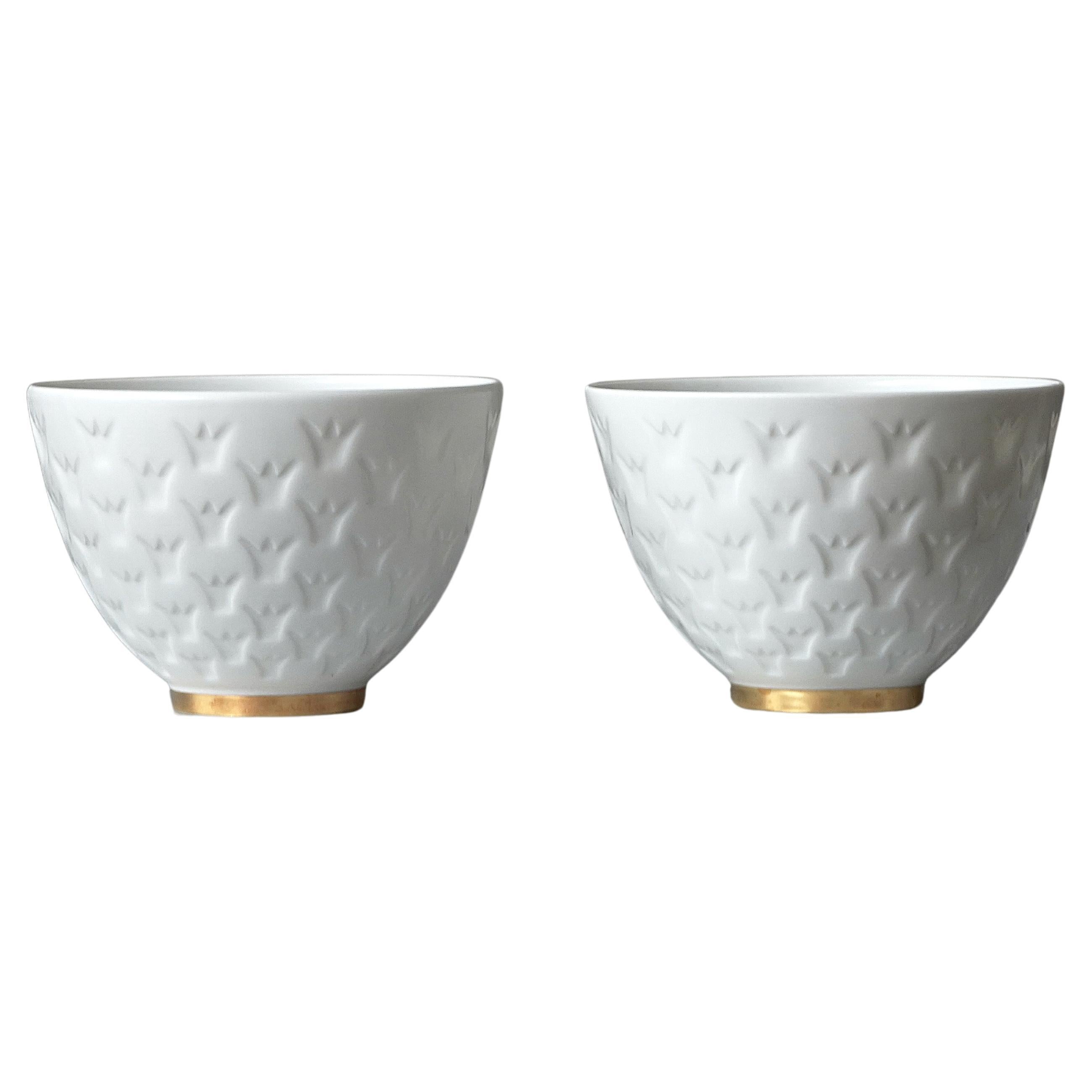
Un set di due bellissime ciotole da finestra a corona in porcellana con una fascia dorata dipinta a mano sul piede.
Disegnata da Gunnar Nylund per Rorstrand, Svezia, 1933.
Condizi...
Categoria
Metà XX secolo, Svedese, Scandinavo moderno, Ciotole decorative
Materiali
Ceramica, Porcellana
Set di 2 ciotole Art Deco di Josef Ekberg per Gustavsberg, Svezia, anni
20
Di Gustavsberg, Josef Ekberg
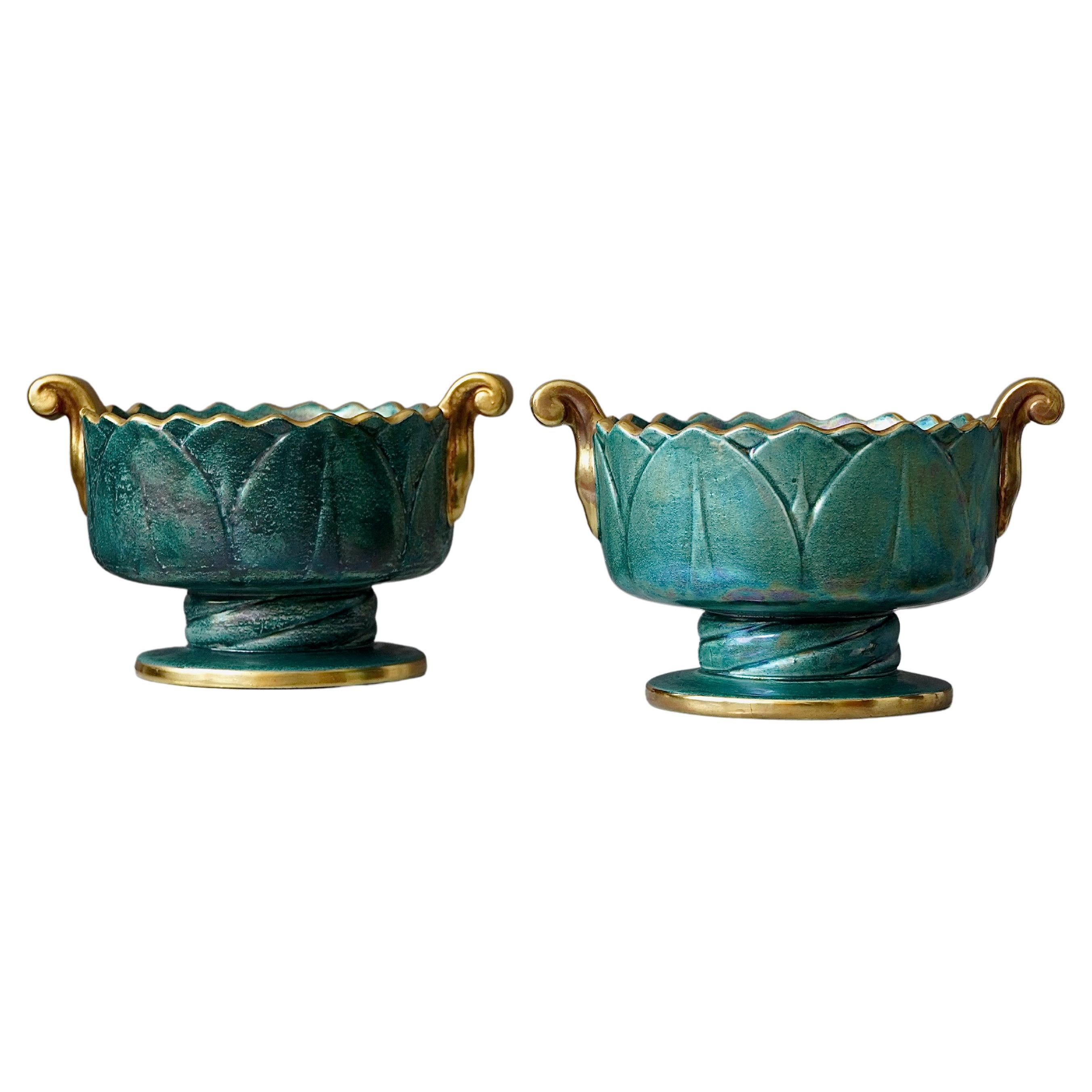
Un set di 2 bellissime ciotole con piede con un'incredibile smaltatura a lustro e dettagli dorati dipinti a mano. Grazia scandinava / Art Deco.
Realizzata da Josef Ekberg a Gustavsbe...
Categoria
Vintage, Anni 1920, Svedese, Art Déco, Ciotole decorative
Materiali
Ceramica
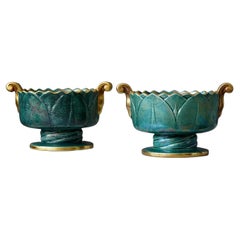
Set di 2 ciotole bianche
Vaga
di Wilhelm Kage per Gustavsberg, Svezia, anni
40
Di Gustavsberg, Wilhelm Kage
Set di 2 bellissime ciotole "Våga". Gres con smalto "Carrara".
Realizzato da Wilhelm Kåge presso lo Studio A di Gustavsberg in Svezia, negli anni '40.
'Swedish Modern'.
Condizioni ...
Categoria
Metà XX secolo, Svedese, Scandinavo moderno, Ciotole decorative
Materiali
Ceramica, Grès porcellanato
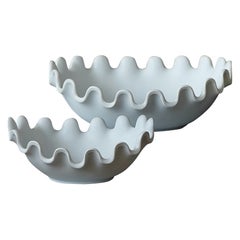
Set di 2 vasi bianchi
Surrea
di Wilhelm Kage per Gustavsberg, Svezia, anni
40
Di Gustavsberg, Wilhelm Kage
Un set di 2 bellissimi vasi in gres "Surrea" con smalto "Carrara".
Realizzato da Wilhelm Kåge presso lo Studio A di Gustavsberg in Svezia, negli anni '40.
Ottime condizioni.
Wilh...
Categoria
Metà XX secolo, Svedese, Scandinavo moderno, Vasi
Materiali
Ceramica, Grès porcellanato
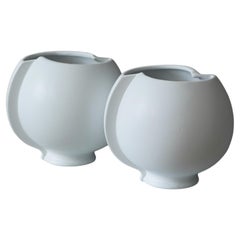
Set di 2 ciotole bianche "Vaga" di Wilhelm Kage per Gustavsberg, Svezia, 1940.
Di Gustavsberg, Wilhelm Kage
Un set di due bellissime ciotole "Våga". Gres con smalto bianco "Carrara".
Realizzato da Wilhelm Kåge presso lo Studio A di Gustavsberg in Svezia, negli anni '1940.
Swedish Grace.
...
Categoria
Metà XX secolo, Svedese, Scandinavo moderno, Ciotole decorative
Materiali
Ceramica, Grès porcellanato
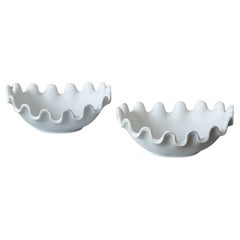
Set di 2 vasi in gres di Gertrud Lönegren, Rörstrand, Svezia, 1930
Di Gertrud Lönegren, Rörstrand
Bellissimi e rari vasi in gres disegnati da Gertrud Lönegren.
Questi pezzi da studio sono stati creati a Rorstrand in Svezia tra il 1936 e il 1941.
Condizioni eccellenti.
Impre...
Categoria
Metà XX secolo, Svedese, Scandinavo moderno, Vasi
Materiali
Ceramica, Grès porcellanato
Ti potrebbe interessare anche
Laholm, Svezia. Due piccole ciotole in ceramica. Ca. 1970.
Laholm, Svezia. Due piccole ciotole in ceramica. Decorato a mano.
Ca. 1970.
Contrassegnato.
In ottime condizioni con minimi segni di utilizzo.
Grande: L 12,0 cm x P 10,0 cm x H 7,5 cm.
Categoria
Vintage, Anni 1970, Svedese, Ciotole decorative
Materiali
Ceramica
Nils Johan Thorvald Thorsson Ciotole in ceramica per Aluminia 1930 Svezia
Di Aluminia, Nils Thorsson
Due grandi e rare ciotole della serie "Solbjerg", provenienti dai precedenti lavori di Nils Johan Thorvald Thorsson (1898-1975) per Aluminia e contrassegnate. Misure: Ø 28,5 x H. 19,...
Categoria
Vintage, Anni 1930, Svedese, Scandinavo moderno, Ceramiche
Materiali
Ceramica
Per Linnemann-Schmidt per Palshus. Due ciotole in gres, 1960
Per Linnemann-Schmidt per Palshus.
Due ciotole in gres con uno smalto blu intenso e vibrante con vivaci variazioni superficiali. La forma semplice e raffinata permette allo smalto di...
Categoria
Vintage, Anni 1960, Danese, Scandinavo moderno, Ciotole decorative
Materiali
Grès porcellanato
Coppia di ciotole in gres di Gunnar Nylund, Rörstrand, anni
50
Di Rörstrand, Gunnar Nylund
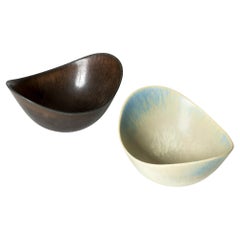
Coppia di ciotole in gres di Gunnar Nylund, dell'accattivante modello "ARO". Forma ovale e affusolata con lati sporgenti. Uno con una ricca glassa marrone e l'altro con una glassa bl...
Categoria
Vintage, Anni 1950, Scandinavo moderno, Ciotole decorative
Materiali
Grès porcellanato
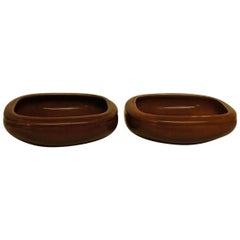
Coppia di ciotole in ceramica artistica di Royal Copenhagen di Bode Willumsen, metà del XX secolo
Coppia di ciotole in ceramica artistica di Royal Copenhagen di Bode Willumsen.
Smalto fine color sangue di bue della metà del XX secolo.
Dimensioni: 6 cm di altezza e 15 ...
Categoria
Metà XX secolo, Danese, Scandinavo moderno, Ciotole decorative
Coppia di vasi in ceramica Eva Jancke-Björk in due dimensioni, Bo Fajans, Svezia, anni
30
Di Bo Fajans, Eva Jancke-Björk
Questa straordinaria coppia di vasi è stata disegnata da Eva Jancke-Björk e prodotta da Bo Fajans in Svezia alla fine degli anni Trenta. Entrambi sono contrassegnati da numeri di pro...
Categoria
Vintage, Anni 1930, Svedese, Scandinavo moderno, Vasi
Materiali
Ceramica