Articoli simili a Impressionistic Portrait of the Equestrian Artist Baptista Schreiber - Drawing
Vuoi altre immagini o video?
Richiedi altre immagini o video al venditore
1 di 11
Gosta von HennigsImpressionistic Portrait of the Equestrian Artist Baptista Schreiber - Drawing1910-1920
1910-1920
650 €IVA inclusa
Informazioni sull’articolo
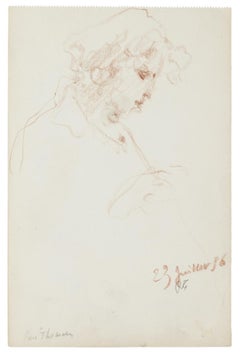
This expressive and atmospheric graphite drawing by Gösta von Hennigs (1866–1941) portrays the celebrated equestrian artist Baptista Schreiber within the charged setting of a circus manège. In the foreground, Schreiber is captured in an impressionistic moment of motion, her head turned toward her horse Menelik, which is only faintly suggested in the background. Behind her, her partner stands ready to lift her onto the horse, reinforcing the sense of immediacy and preparation before performance. On the reverse (a tergo), Schreiber is depicted riding her horse Menelik in the arena, wearing a striking feathered headdress. The audience appears schematically in the background, while to the right stands a male figure, possibly the circus director or presenter. The drawing is possibly a study for a painting, probably executed around 1905- 1915, and demonstrates von Hennigs’s assured command of line and movement, as well as his keen interest in performers and modern spectacle. The back panel has an old note describing the present drawing and attesting the artist, signed by Sven Petersohn, artexpert and one of the authors of the Swedish National Encyclopedia of Swedish artists. It is not signed.
Carl Gustaf Albert von Hennigs (1866-1941) was a Swedish painter whose career spans the transition from late 19th-century Impressionism to a highly personal engagement with modern urban and performative life.
Von Hennigs received his artistic training at the Artists’ Association School (Konstnärsförbundets skola) between 1891 and 1893, where he studied under Richard Bergh, Per Hasselberg, and Anders Zorn. During his early career, he painted street scenes, and focused on Stockholm motifs rendered in an impressionistic manner. He was an active member of the Artists’ Association (Konstnärsförbundet) and participated in many of its exhibitions until the organisation was dissolved in 1920.
From the early 1900s, von Hennigs gradually moved away from purely urban landscapes and developed a distinctive new subject matter. From around 1903 onwards, he increasingly drew inspiration from the world of the circus, the arena, and the manège, a thematic focus that earned him the epithet “the circus painter.” His works from this period depict acrobats, riders, jugglers, and clowns, executed in oil and watercolour. These compositions are marked by strong, vibrant colours and an impressionistic handling that emphasises movement, rhythm, and spectacle.
Stylistically, von Hennigs evolved from Impressionism toward a more decorative expression, influenced in part by Japanese colour woodcuts. His choice of viewpoints and compositional cropping often recalls Edgar Degas, particularly in the way figures are captured mid-motion and seen from unconventional angles. This approach allowed him to convey the fleeting, dynamic nature of performance with immediacy and visual intensity.
The Artists’ Association exhibition in Stockholm in 1912 marked a major breakthrough in his career. Prince Eugen purchased nine of his works at the exhibition, which were subsequently incorporated into the collection at Prins Eugens Waldemarsudde.
Von Hennigs’s reputation as an artist of movement and light was summarised in Svenska Dagbladets Yearbook in 1941, which noted his particular strength in capturing motion and the interplay of light and colour, while also observing a certain coolness in his work, arising from a strong focus on visual sensation despite the temperament of his motifs.
In addition to his artistic practice, von Hennigs played an important role in Swedish art education. He served as acting professor at the Royal University College of Fine Arts (Konsthögskolan) in Stockholm from 1928 to 1933. Today, Gösta von Hennigs is regarded as a key figure in Swedish early modern painting, especially celebrated for his vivid and innovative depictions of circus and performance life.
His works can be found in the Swedish National Museum, Modern museum of art, Prince Eugen Waldemarsudde and others.
Baptista Schreiber’s fame as an equestrian artist cannot be fully understood without placing her celebrated horse Menelik at the centre of her life and career. Schreiber, also known as Mijares-Schreiber, was the owner and trainer of Menelik, a white Arabian stallion who came to be regarded as the most famous circus horse in Sweden. Their partnership symbolized the height of artistic horsemanship in the early 20th century, when the bond between rider and horse was central to the show.
Menelik arrived in Schreiber’s life under extraordinary circumstances. In 1914, he was presented to her as a gift from Queen Alexandra of Great Britain and the British royal court, an exceptional gesture that reflects both Schreiber’s international reputation and the prestige surrounding her performances. The stallion was named after Emperor Menelik II of Ethiopia, a name that further enhanced the horse’s aura of strength, nobility, and exotic distinction.
Menelik’s death in 1931 caused widespread public attention and marked the end of an era. Together, their story has become part of Swedish cultural memory, illustrating how artistic performance, personal attachment, and public recognition could intersect in a way that elevated a circus horse to the level of a national icon.
- Creatore:Gosta von Hennigs (1866 - 1941, Svedese)
- Anno di creazione:1910-1920
- Dimensioni:Altezza: 39 cm (15,36 in)Larghezza: 33 cm (13 in)Profondità: 2 cm (0,79 in)
- Tecnica:
- Movimento e stile:
- Periodo:
- Condizioni:The drawing is in good condition. The paper has turned slightly brown. It has presently an acid free mounting.
- Località della galleria:Stockholm, SE
- Numero di riferimento:1stDibs: LU2608217370262
Informazioni sul venditore
5,0
Venditore Oro
Venditori Premium con valutazione 4,3+ e tempi di risposta entro 24 ore
Venditore 1stDibs dal 2023
33 vendite su 1stDibs
Tempo di risposta standard: <1 ora
- SpedizioneRecupero del preventivo…Spedizione da: Stockholm, Svezia
- Politica di reso
Alcune parti di questa pagina sono state tradotte automaticamente. 1stDibs non può garantire che le traduzioni siano corrette. L’inglese è la lingua predefinita del sito.
Altro da questo venditore
Mostra tuttoRitratto di donna gitana - Disegno del XIX secolo
Ritratto di profilo di donna in grafite su carta di Johannes Collin (1873-1951), firmato "Johannes Collin 98" e intitolato "Zigenerska". Questo primo e insolito lavoro di Collin pres...
Categoria
Anni 1890, Altro stile artistico, Disegni e acquarelli (ritratto)
Materiali
Carta, Grafite
Ufficiale di cavalleria a cavallo
Un acquerello su carta finemente lavorato raffigura un ufficiale di cavalleria a cavallo - formale nel portamento e nel costume - dipinto con la delicata chiarezza per cui Egron Lund...
Categoria
Metà XIX secolo, Altro stile artistico, Disegni e acquarelli (animali)
Materiali
Carta, Acquarello
Ritratto di profilo di una donna seduta su una sedia
Un disegno ovale finemente elaborato dall'artista finlandese Ester Helenius che raffigura una giovane donna di profilo seduta su una sedia. La stanza è suggerita solo da uno sfondo d...
Categoria
Anni 1910, Jugendstil, Disegni e acquarelli (ritratto)
Materiali
Carta, Carboncino, Gouache
Ritratto Gustav Wilhelm Palm - XIX secolo Matita e pastello su carta
Ritratto di Gustaf Wilhelm Palm (1810-1890) di Lorenz Frølich (1820-1908)
Firmato con monogramma e datato maggio 1849. Matita e pastello su carta. 29,5 × 21 cm.
Questo ritratto del p...
Categoria
Anni 1840, Naturalismo, Disegni e acquarelli (ritratto)
Materiali
Carta, Pastelli, Matita carboncino
Psiche - Olio su tela del XIX secolo
Di Otto Bache
In questo olio su tela neoclassico firmato e datato "Otto Bache 1864", l'artista raffigura Psiche in piedi di spalle accanto a un tavolo drappeggiato di rosso. I suoi capelli sono di...
Categoria
Anni 1860, Altro stile artistico, Dipinti figurativi
Materiali
Olio
Principessa russa Olga Gortschakoff - Ritratto del XIX secolo, olio su tela
Ritratto della principessa Olga Gortschakoff realizzato dall'artista del XIX secolo Elise Hügel.
Ritratto ovale della principessa Olga Gortschakoff (1838-1926), poi baronessa von Me...
Categoria
Anni 1850, Altro stile artistico, Dipinti (ritratto)
Materiali
Tela, Olio
Ti potrebbe interessare anche
Ritratto - Disegno a matita su carta - Metà del XX secolo
Il ritratto è un disegno originale a matita su carta, realizzato da un artista anonimo nella metà del XX secolo. Con un altro disegno sul retro.
Buone condizioni.
Categoria
Metà XX secolo, Moderno, Disegni e acquarelli figurativi
Materiali
Matita
Ritratto - Disegno a carboncino di Pierre Georges Jeanniot - Inizio XX secolo
Di Pierre Georges Jeanniot
Il ritratto è un disegno originale su carta realizzato dal pittore Pierre Georges Jeanniot (1848-1934).
Disegnare a matita.
Firmato a mano sulla parte inferiore.
Buone condizioni,...
Categoria
Inizio XX secolo, Moderno, Disegni e acquarelli (ritratto)
Materiali
Matita
Ritratto di signora - Disegno di A. Hermann Paul - Anni
90 del XIX secolo
Ritratto di signora è un disegno a matita realizzato da A. Hermann Paul.
Firmato a mano nell'angolo inferiore sinistro. Passpartout incluso cm 51x35
Buone condizioni.
René George...
Categoria
Anni 1890, Moderno, Disegni e acquarelli figurativi
Materiali
Carta, Matita
Ritratto di donna - Disegno originale a carboncino - Inizio del XX secolo
Ritratto di donna è un'opera d'arte originale realizzata da un artista sconosciuto.
Disegno in punta di grigio e acquerello non firmato, scritta dietro CH.L. Carta incollata su cart...
Categoria
Inizio XX secolo, Moderno, Disegni e acquarelli figurativi
Materiali
Carta, Matita
Studio per un ritratto - Disegno originale a matita - 20° secolo
"Studio per un ritratto" è un disegno originale a tempera su carta, realizzato da un artista francese anonimo del XX secolo.
Lo stato di conservazione delle opere d'arte è molto buo...
Categoria
XX secolo, Moderno, Disegni e acquarelli figurativi
Materiali
Matita
Equestrienne
, Salon d
Automne, Musée du Luxembourg, Post-Impressionismo francese
Di Henri Ottmann
Firmato in basso a destra "Henri Ottmann" (francese, 1877-1927) e creato nel 1915 circa.
Un elegante disegno a matita e inchiostro che mostra due donne che conversano, una seduta a ...
Categoria
Anni 1910, Dipinti figurativi
Materiali
Carta, Inchiostro di china, Matita
