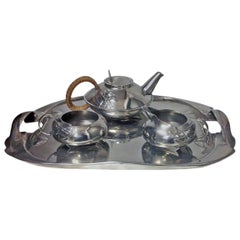
Liberty
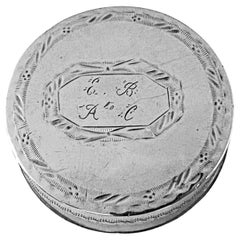
Co. Pewter Box, C.1920
About the Item
- Creator:
- Dimensions:Width: 3.5 in (88.9 mm)Depth: 3 in (76.2 mm)Length: 6.75 in (171.45 mm)
- Period:
- Date of Manufacture:C. 1920
- Condition:
- Seller Location:Toronto, CA
- Reference Number:Seller: AL35961stDibs: LU38014504192
Liberty & Co.
Long before Liberty became one of London’s most iconic luxury department stores, shoppers of the late 19th century knew it as Liberty Co. — purveyors of fine silverware designed in the Art Nouveau style, Arts and Crafts-style furniture and an eclectic assortment of ornaments, fabrics, fashion and other goods from around the world.
British merchant Arthur Lasenby Liberty founded Liberty Co. in 1875. Liberty dreamed of selling an assortment of fine wares he obtained in the Far East from a ship docked in the middle of one of London’s busiest shopping thoroughfares. However, he could only manage to borrow £2,000 from his father-in-law, so he settled for a small shop on Regent Street.
What began as a modest business grew exponentially over the next few years, and, by 1890, Liberty Co. occupied most of Regent Street. Meanwhile, Liberty forged relationships with many British Art Nouveau artists and designers who were keen to work with one of the most prestigious retailers in London.
In 1899, Liberty Co. hosted an exhibition showcasing a collection of silver pieces designed by notable silversmiths like Oliver Barker, Albert Edward Jones and Bernard Cuzner. A line of silverware called Cymric also debuted and was produced in partnership with silversmith W. H. Haseler of Birmingham and Liberty Co.’s chief designer, Manx artist Archibald Knox. The innovative Cymric collection featured a blend of Art Nouveau with traditional Celtic style, including such pieces as candlesticks, spoons, bowls, tableware and jewelry.
Liberty Co. also had a furniture workshop in Archway, London, run by Lawrence Turner and which employed carpenters to produce handcrafted, Arts and Crafts-style armchairs, stools, bookcases, cabinets, side tables and other furniture. Most of these high-quality and durable pieces were made of solid wood such as oak, mahogany and walnut. In addition to their own in-house creations, Liberty Co. also sold furniture by other designers, including chairs by German architect Richard Riemerschmid.
Liberty died in 1917, and Liberty Co. became Liberty of London after relocating to their iconic location on Great Marlborough Street in 1924. Ironically, the imposing Tudor Revival building is constructed from the timbers of two decommissioned British Navy ships — realizing Liberty’s original “ship-store” dream.
On 1stDibs, discover a range of antique and vintage Liberty Co. serveware, seating and decorative objects.
You May Also Like
Antique 1850s Boxes and Cases
Gold, 18k Gold, Yellow Gold, Enamel
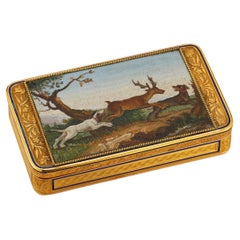
Vintage 1940s French Retro Boxes and Cases
Blue Sapphire, 18k Gold
2010s Mexican Boxes and Cases
Crystal, Sterling Silver
Antique 1810s French Empire Boxes and Cases
Gold
Antique 1780s Swiss Boxes and Cases
Gold, Enamel
Early 20th Century German Art Nouveau Boxes and Cases
Silver, Enamel
21st Century and Contemporary Italian Boxes and Cases
Sterling Silver
Vintage 1970s British Modern Boxes and Cases
Moonstone, Sterling Silver
Antique 1830s French Boxes and Cases
Silver
21st Century and Contemporary Italian Boxes and Cases
Sterling Silver
More From This Seller
View AllVintage 1910s British Art Deco Boxes and Cases
Silver
Early 20th Century British Boxes and Cases
Vintage 1920s Austrian Art Deco Boxes and Cases
Silver
Antique Early 1900s Arts and Crafts Boxes and Cases
Brass, Copper
Antique 18th Century English George III Boxes and Cases
Silver
Early 20th Century British Arts and Crafts Coffee and Tea Sets