Items Similar to Bookbinding Stamp with the Arms of King Charles X. France, Paris, c. 1824–1830.

Want more images or videos?
Request additional images or videos from the seller
1 of 10
Bookbinding Stamp with the Arms of King Charles X. France, Paris, c. 1824–1830.
$2,556.77
£1,875
€2,177.23
CA$3,523.10
A$3,872.75
CHF 2,033.17
MX$46,049.75
NOK 26,110.58
SEK 23,783.91
DKK 16,267.40
About the Item
Bronze Bookbinding Stamp with the Arms of King Charles X (Imprimerie Royale).
France, Paris, circa. 1824–1830.
Materials and technique:
Engraved bronze matrix mounted on an original turned wooden handle, used for impressing the royal arms on leather bindings.
Measurements: 8.6 x 5 x 3.8cm.
Description
A bronze bookbinding stamp mounted on a well-preserved, dark-stained, turned wooden handle with ring mouldings. The tool was produced for the Imprimerie Royale (Royal Printing House) during the reign of King Charles X of France (1824–1830). The engraved face bears the crowned arms of France as used by the Bourbon monarch, designed to be impressed in blind or gilt tooling on the covers of official state publications. The handle shows natural age cracks consistent with prolonged use in the bindery, but remains structurally intact, offering a rare survival of a functional matrix as once employed in the royal workshops of the Imprimerie Royale.
Context and use
Since its foundation in 1640, the Imprimerie Royale maintained a tradition of binding presentation copies of royal publications in fine morocco, tooled with the reigning monarch’s arms. Under Charles X, this practice continued with bindings recorded in 1828 bearing his distinctive supralibros (see OHR 2498, no. 4). The present tool is representative of those used by the court’s professional finishers, applying the monarch’s arms centrally on large-format morocco bindings destined for royal libraries, diplomatic gifts, and prestigious state commissions.
- Period:
- Date of Manufacture:1824–1830
- Condition:Wear consistent with age and use.
- Seller Location:London, GB
- Reference Number:1stDibs: LU4435227917152
About the Seller
New to 1stDibs
Joined in the past six months.
No Reviews Yet
Vetted Professional Seller
Every seller passes strict standards for authenticity and reliability
Established in 2011
1stDibs seller since 2025
- ShippingRetrieving quote...Shipping from: London, United Kingdom
- Return Policy
More From This Seller
View AllBoxwood Roller Print with Royal Arms. France, 18th century.
Located in London, GB
French Boxwood Roller Print with Royal Arms, Hunting Scenes, and Military Emblems.
France, 18th century.
Measurements: 7.3cm (2 3/4 in.) in length.
This intricately carved roller ...
Category
Antique 18th Century Models and Miniatures
Engine-Turned Silver Combination Pomander Whistle. Augsburg, early 18th century.
Located in London, GB
Engine-Turned Silver Combination Pomander Whistle.
Germany, Augsburg, early 18th century.
Height: 5.6 cm.
Description
A small silver combination device formed in three detachable,...
Category
Antique 18th Century Desk Accessories
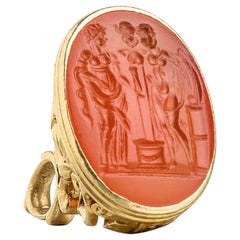
Gold fob seal with Renaissance intaglio of herm, figures, and altar with lyre.
Located in London, GB
Gold-Mounted Carnelian Fob Seal with Intaglio of a Herm, Female Figures, and Sacrificial Altar
Renaissance, 16th century (intaglio); French, 18th century (mount, with duty marks)
...
Category
Antique 16th Century Pendant Necklaces
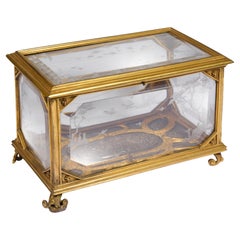
Engraved Rock Crystal and Gilt Bronze Casket with Silver Relief Base.
Located in London, GB
Engraved Rock Crystal and Gilt Bronze Casket with Silver Relief Base.
Attributed to the workshop of Giovanni Battista Metellino (active Milan, d. circa 1724).
Milan, late 17th cent...
Category
Antique Early 18th Century Desk Accessories
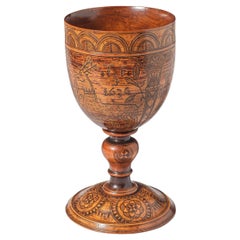
An Engraved Turned Wooden Cup. English, dated 1636.
Located in London, GB
An Engraved Turned Wooden Cup.
English, dated 1636.
Material
Turned pearwood, engraved with foliate and geometric decoration.
Measurements
Height: 20.5 cm.
Diameter (rim): 10.2...
Category
Antique 17th Century Desk Accessories
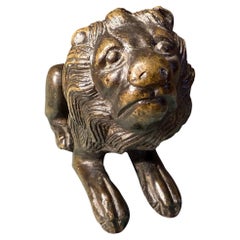
Renaissance Bronze Lion. Germany or Italy, 16th century.
Located in London, GB
Renaissance Bronze Lion.
Germany or Italy, 16th century.
Measurements
8.5 × 7.2 × 3.5 cm
Description
A small bronze lion cast as a solid figure, t...
Category
Antique 16th Century Figurines and Sculptures
You May Also Like
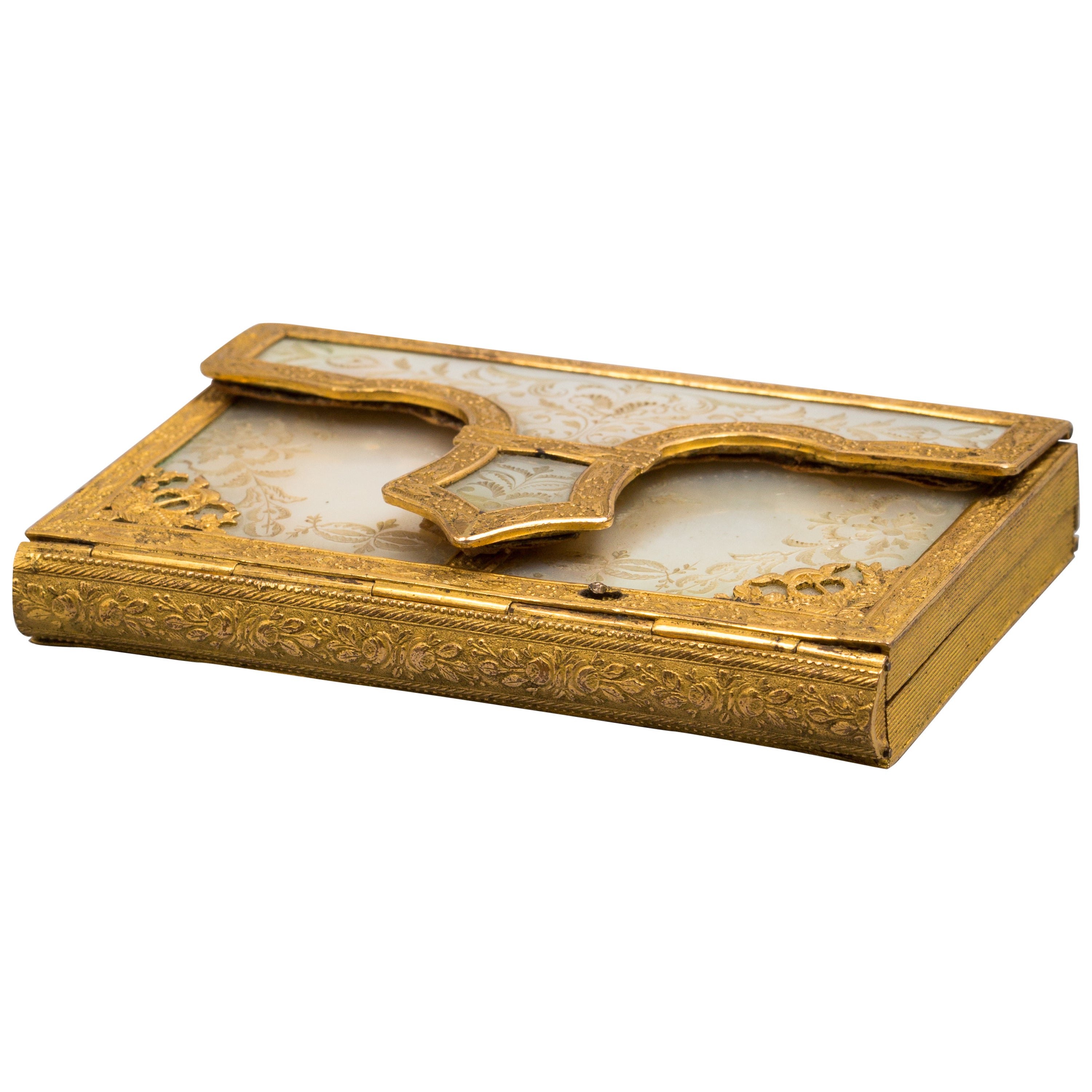
Palais Royal Aide-de-Memoire, French, circa 1830
Located in New York, NY
Purse revealing diary and pen in the interior.
Category
Antique 1830s French Collectible Jewelry
Materials
Mother-of-Pearl
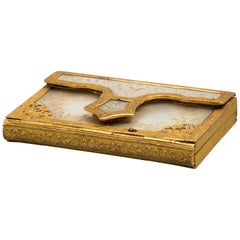
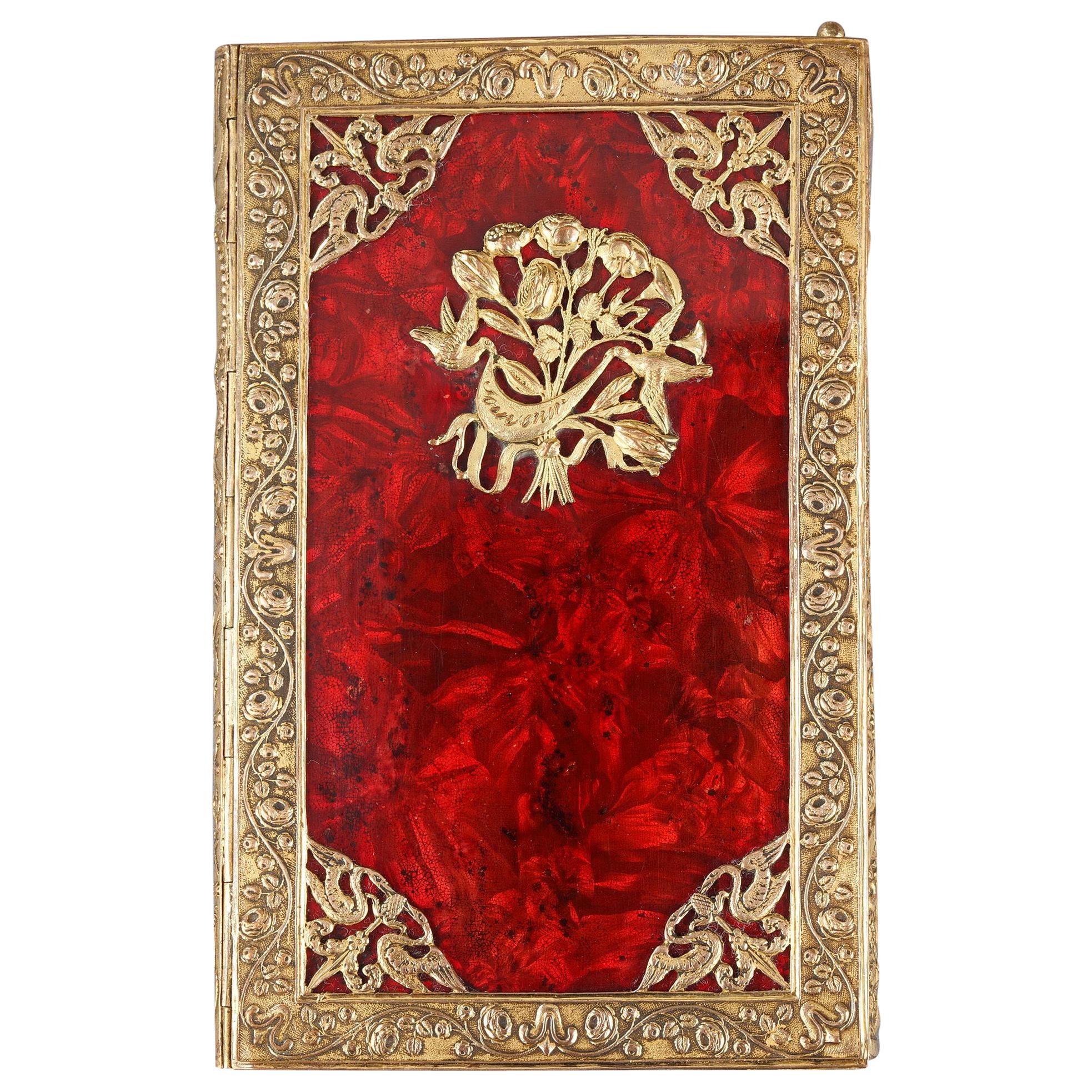
Dance Case, Charles X, circa 1820-1830
Located in Paris, FR
Rectangular dance case in gilded bronze and red colored metal with moire reflections. The gilded bronze mount is finely chiseled with floral friezes, doves ...
Category
Antique 1820s French Empire Desk Accessories
Materials
Bronze
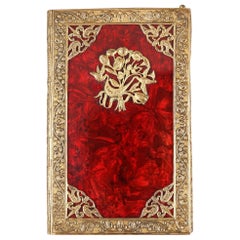
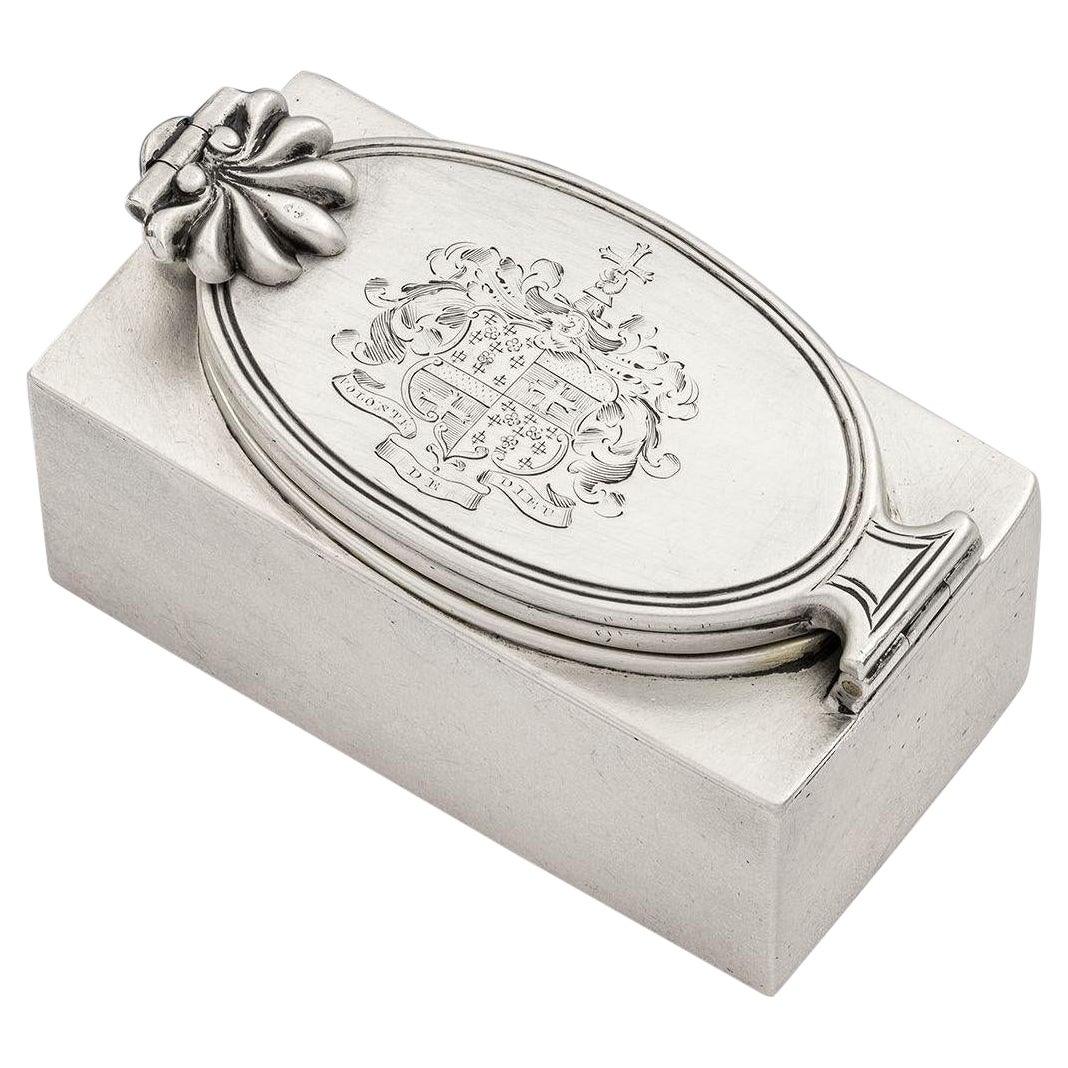
George III Armorial Travelling Inkwell Made in London by William Price, 1819
Located in London, GB
A Very Rare & Unusual George III Armorial Travelling Inkwell Made in London in 1819 by William Price.
The Inkwell is of a large size and broad rectangul...
Category
Antique 19th Century English George III Inkwells
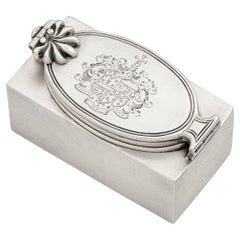
Antique Middle Eastern Islamic Brass Inkwell Qalamdan, circa 1850
Located in Moreno Valley, CA
Antique Middle Eastern Brass Inkwell Qalamdan.
A 19th century brass decorated Middle Eastern Islamic Qalamdan. The Qalamdan is in solid brass, etched on all sides with engraved geom...
Category
Antique Late 19th Century Asian Islamic Scholar s Objects
Materials
Bronze
Travel Inkwell in leather with a Count`s Crown, probably early 18th Century
Located in Knivsta, SE
Very charming Travel Inkwell in leather with a Count`s Crown, probably early 18th Century. Nice patina with some wear. See pictures.
Wear consistent with age and use.
Category
Antique Early 18th Century European Baroque Inkwells
Materials
Sheet Metal
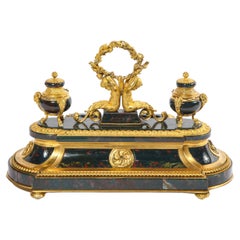
An Exquisite and Rare French Louis XVI Style Ormolu-Mounted Bloodstone Inkwell
Located in Queens, NY
An Exquisite and Rare French Louis XVI Style Ormolu-Mounted Bloodstone Inkwell, circa 1875.
A truly exceptional and jewel like quality inkwell encrier, made with the finest ormolu, mounted on bloodstone. A true collectors and one of a kind piece.
Revival of the ancient régime in the late 19th century was paramount to the French furniture and bronze casting firms of the Belle Epoque. Imitation in the highest regard and replication of those tastes and styles was prevalent throughout the Paris Faubourg, where the most talented bronziers and ébénistes established their workshops. The present inkwell encrier recalls the late 18th century's obsession with hardstones - a taste expounded above all by the duc d'Aumont and, subsequently Marie-Antoinette. Such hardstone-mounted pieces, reminiscent of Renaissance schatzkammer objects, enjoyed a revived popularity at the end of the 18th century through the impetus of both the marchands-mercier and, more importantly, the hôtel des Menus-Plaisirs, where the duc d'Aumont himself established a workshop in 1770 specializing in the cutting and polishing of precious hardstones.
This exceptional inkwell encrier, sumptuously-mounted with finely chased gilt-bronzes, incorporates a highly-prized material such as bloodstone.
Sometimes called the Sunstone, the meaning of Bloodstone comes entangled in fascinating history. The Ancient Greeks held the Bloodstone as a gem with glorious powers. They referred to it as Heliotrope, which directly translates to Sunstone. It was believed to have heavenly healing powers gifted by the gods and most certainly when it came to healing all things related to the blood. Even as we move forward into the Middle Ages, the Bloodstone takes another mystical story under its wing. It was believed to be formed from Christ's blood. It was said that during the Crucifixion, a few red spots of his blood dripped...
Category
Antique 19th Century French Napoleon III Inkwells
Materials
Bronze, Ormolu