French Figurines and Sculptures
to
3
15
11
9
9
3
6
5
5
2
2
3
8
16
4
1
1
1
2
1
1
1
3
31
4
2
2
2
1
3
2
2
2
1
3
3
2
2
29
2
18
13
Place of Origin: French
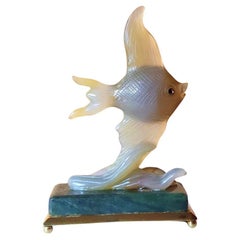
Fabergé Agate Angel Fish Figurine
By Fabergé
Located in Chesterland, OH
Fabergé Angel Fish Figurine – A Symbol of Fortune and Elegance
Like a shimmering dream captured in stone, this exquisite Fabergé sculpture depicts a...
Category
Mid-20th Century French Figurines and Sculptures
Materials
Agate, Gold Plate, Sterling Silver
Exclusive And Iconic Scarab Brooch in 18K Gold With Ebony Wood, Horn
Diamonds
By Eva Soussana
Located in Paris, FR
Eva Soussana and her partner the "Atelier Franck Mico", are proud to introduce to you the "Goliath" Scarab, an exclusive and iconic piece created by Eva Soussana and Franck Mico, man...
Category
21st Century and Contemporary Artist French Figurines and Sculptures
Materials
Diamond, 18k Gold
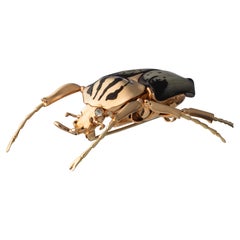
Exclusive And Iconic Scarab Brooch in 18 Karat Rose Gold, Enamel and Ebony Wood
By Eva Soussana
Located in Paris, FR
Eva Soussana and her partner the "Atelier Franck Mico", are proud to introduce to you the "Hercules" Scarab, an exclusive and iconic piece created by Eva Soussana and Franck Mico, ma...
Category
21st Century and Contemporary Artist French Figurines and Sculptures
Materials
18k Gold, Rose Gold, Enamel

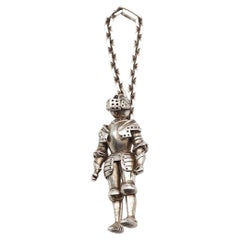
Gaetan de Percin knight key ring in silver, silver key ring, articlated key ring
Located in PARIS, FR
Gaetan de Percin knight key ring in silver. This chivalric-themed keychain depicts a knight in armor with a helmet. The legs are articulated at the hips. The chain fastens by passing...
Category
1960s Modernist Vintage French Figurines and Sculptures
Materials
Silver
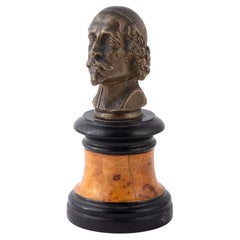
Antique Cardinal Richelieu Bronze Bust Sculpture
Located in Firenze, IT
This patinated bronze bust depicting the Cardinal Richeleau (Armand Jean du Plessis de Richelieu, Cardinal-Duc de Richelieu, 1585-1642), the noted French clergyman, noble and statesm...
Category
1820s Baroque Antique French Figurines and Sculptures
Materials
Bronze
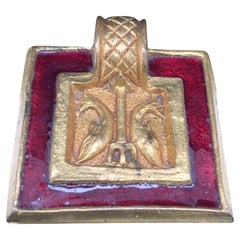
Gilt-bronze and red resin Pisces pendant by Line Vautrin
By Line Vautrin
Located in Idar-Oberstein, DE
Beautiful, bronze-doré and red 'Talesol' Pisces pendant by Line Vautrin, 1970s, marked Line Vautrin.
Line Vautrin (1913-1997) was a highly independent, self-taught, experimental art...
Category
1970s Modernist Vintage French Figurines and Sculptures
Materials
Bronze, Gilt Metal
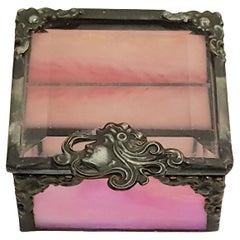
Antique French NancySigned ArtNouveau MuchaMajorelleGruberStyle SilveredGlassBox
By Daum
Located in Chicago, IL
Influenced by the Art Nouveau illustrations of Alphonse Mucha, this Nancy-signed antique French enameled glass jewelry box display case is decora...
Category
1890s Art Nouveau Antique French Figurines and Sculptures
Materials
Gilt Metal, Mixed Metal, Silver Plate, Brass, Bronze
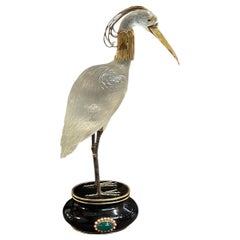
Boucheron Rock Crystal Heron
By Boucheron
Located in New York, NY
Boucheron Rock Crystal Heron
A heron sculpture crafted from carved rock crystal set in yellow gold. The base is adorned with a cabochon chalce...
Category
20th Century French Figurines and Sculptures
Materials
Chalcedony, Coral, Rock Crystal, 18k Gold

$30,000
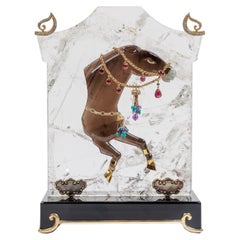
Mellerio Paris, a French Gold, Diamonds, Silver, and Smoky Quartz Carved Horse
By Mellerio dits Meller
Located in Long Island City, NY
Mellerio Paris, A French Gold, Diamonds, Silver-Gilt, Rock-Crystal, Jade, Mother-Of-Pearl and Smoky Quartz, Carved Horse Sculpture, Jeweled Mounted Object.
An extremely rare and unique, one of a kind French gold, diamonds, Silver-gilt, rock-crystal, jade, obsidian, mother-of-pearl, and smoky quartz carved jeweled sculpture "CHEVAUX DE LEGENDE", "A Legendary Horse" by Mellerio, Paris, circa 1991.
Sitting on black obsidian base, the solid rock-crystal slab is finely applied with a carved smoky -quartz and jade horse with a harness mounted in 18k gold, brilliant -cut diamonds, rubies, turquoise, and amethyst chains and pendants. The top columns adorned with 18k gold and brilliant cut diamond pendants, the bottom with gold and mother of pearl plaques. The obsidian base with a plaque engraved: CHEVAUX DE LEGENDE" / N° 05 / MELLERIO DITS MELLER / PARIS / 5003 D
The piece is in excellent condition and comes with a custom made wood case made for transport. It's very elegant and has French hallmarks throughout. A truly magnificent piece.
Measures 10.5" high x 8.5" wide x 4" deep
Founded in France in 1613 by the descendants of Italian immigrants from the Vigezzo Valley in the north of Italy, Mellerio is one of the oldest jewellery houses in Europe. The family business soon attracted the attention of the Royal Court and Marie Antoinette herself reportedly purchased a precious bracelet featuring 7 cameos surrounded by rubies in 1780. Later on, in the 19th century, Mellerio became the official supplier of the French Royal family and the Court of Netherland.
Mellerio creates many jewellery items, all set with rare gems such as peridots, amethysts, aquamarines, citrines and topaz, applying for a patent, the flexible stem, a very supple and light jewellery mechanism. Mellerio remains also well known for their spectacular series of Art Nouveau jewels, created at the beginning of the 20th century, as well as for the creation of trophies rewarding some of the greatest footfall and tennis players of history. In 1993, the jewellery house launched their first watch collection.
Today, Mellerio has stores in Paris, Japan and Hong Kong.
July 14, 1789: this date is known throughout the world as the beginning of the French Revolution. According to a ledger belonging to House of Mellerio, this was also the day that the jeweler sold a golden key to the Comte de Coutance for 10 livres. This ledger, as well as inventories dating as far back as 1768, are the jeweler’s oldest archives. These archives have continued to grow over the years, as the House, established on rue de la Paix in Paris, still lives on today, still in the hands of the same family from Craveggia, in the North of Italy.
The tumultuous history of the Mellerio family in France probably goes as far back as the Italian wars of the Renaissance, but the first official document proving their commercial activity in Paris dates back to 1613. This document is the famous royal warrant awarded by Marie de Medici to a number of Italian families established along the rue des Lombards, including the Mellerios, allowing them to sell “small jewelery items”, therefore granting them a small exception to the traditional monopoly enjoyed by Parisian jewelers. At that time, powerful corporations regulated the operations and customs of Parisian business, but thanks to this exceptional warrant, the Mellerios managed to escape the confines of this framework. Today, this wax-sealed document is kept at the city hall of Craveggia.
From 1613 to the Revolution, the Mellerios lived between France and Italy. The corporations tried many times to put an end to their trade privileges, but all in vain, as a dynasty of sovereigns renewed the warrant. Always marrying and often retiring in Craveggia, the Mellerios continued to maintain their jewelry business in Paris. At first, they did this without a shop. Wearing backpacks (wooden boxes divided into small compartments where jewels were kept), they would tour town fairs around Paris and royal castles.
This is how Jean-Baptiste Mellerio (1765-1850) is said to have sold a bracelet set with rubies and Antique cameos to Marie-Antoinette, which still exists today. Many elements seem to prove the veracity of this anecdote. The queen was particularly fond of cameos, which cover the entire background of her famous jewelry cabinet, and ruby was her favorite stone after diamond. The famous bracelet, reacquired a few years ago by the House of Mellerio, is indeed an 18th century jewel, set with antique cameos representing the profiles of Roman emperors. Two branches of the family were operating in Paris during this time, under the reign of Louis XVI: that of Jean-François (1746-1828), the paternal ancestor of the current Mellerios, and that of Jean-Baptiste (1765-1850).
The French Revolution forced them to return to Italy. However, both Jean-Baptiste and François Mellerio (1772-1843), who was the son of Jean-François, were eventually able to return to Paris after the founding of the Consulate. Jean-Baptiste opened a shop at the Iron Crown of rue Vivienne, and François opened his at the Palais des Tuileries, rue du Coq Saint-Honoré. His well-organized order books give an idea of his high-ranking clientele during the “Old Regime”, among which were the Comte and Comtesse Octave de Segur, the Marquise (later Duchess) de Tourzel, former governess of the royal children, and her daughter, the Comtesse de Bearn, the Craufurds -who organized the flight to Varennes, the Duc and Duchess de Gramont, the Comtesse de Boigne, and Madame de Souza, Talleyrand’s mistress.
We also see the names of the imperial family: Empress Josephine, the Queen of Holland, Princess Elisa, Caroline and Pauline. At that time, the House of Mellerio specialized, among other things, in the trade of antique cameos, a newly fashionable genre of jewel that captured the imagination of all the princesses and noble women of the time.
The years of the Restauration and July Monarchy were among the most glorious. The Bourbons were back on the throne, and the clientele of the House of Mellerio had regained its former wealth. Mellerio supplied Louis-Philippe, Duke of Orléans, as well as his mother, wife and sister, with sumptuous jewels, including a set of emeralds made piece by piece, while the Duke of Bourbon, last prince of the House of Condé, offered diamonds to his mistress, the scheming Baronne de Feucheres, and Monsieur de LaFayette also bought cameos for one of his granddaughters. For the first time, Mellerio ventured into the world of arts in 1815, when Carlotta Grisi, a famous dancer who created Giselle, as well as an actress named Rachel, bought jewels at the Mellerio store on rue de la Paix.
1848 marked a new turning point. France once again became a Republic. François Mellerio handed the company over to his son, Jean, and the latter decided to travel to Spain to build a new clientele. He later became one of the jewelers of the royal family, and met Eugénie de Montijo, who remained a faithful client when she became empress of the French people. The Imperial years were lavish. During the Second Empire, Paris was a pageant of crinoline dresses designed by Worth, while jewels by Mellerio, Worth’s neighbour on the rue de la Paix, adorned the noble women of the Tuileries court.
The Empress bought pearls. Mathilde Bonaparte...
Category
20th Century French Figurines and Sculptures
Materials
Amethyst, Diamond, Jade, Quartz, Rock Crystal, Ruby, Turquoise, Gold, Si...
Mellerio Paris, a French Gold, Diamond, Silver-Gilt, Rock-Crystal,
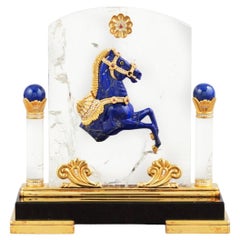
Lapis Horse
By Mellerio Paris
Located in Long Island City, NY
Mellerio Paris, A French Gold, Diamond, Silver-Gilt, Rock-Crystal, Obsidian & Lapis Horse
An extremely rare and unique, one of a kind French gold, diamonds, Silver-gilt rock-crystal, obsidian and lapis lazuli jeweled sculpture "Bucéphale, Chevaux de légende", "Bucephalus, A Legendary Horse" by Mellerio, Paris, circa 1998.
Sitting on black obsidian base, the solid rock crystal slab is finely applied with a lapis lazuli half-horse with harness mounted in 18k gold and brilliant cut diamonds, between two crystal and lapis lazuli columns adorned with gold and diamonds, insert with 7 ruby cabochons and 1 emerald cabochon, the obsidian base with a plaque engraved: CHEVAUX DE LEGENDE / MELLERIO DITS MELLER / PARIS / 5029 DIV
Bucephalus (c355-326 BC) is among the most famous horses in history, and it was said that this he could not be tamed. The young Alexander the Great, of course, tamed him – and went on to ride his beloved equine companion for many years and into many battles.
The piece is in excellent condition and comes with a custom made wood case made for transport. It's very elegant and has French hallmarks throughout. A truly magnificent piece.
Measures 10" high x 9" wide x 4" deep
Founded in France in 1613 by the descendants of Italian immigrants from the Vigezzo Valley in the north of Italy, Mellerio is one of the oldest jewellery houses in Europe. The family business soon attracted the attention of the Royal Court and Marie Antoinette herself reportedly purchased a precious bracelet featuring 7 cameos surrounded by rubies in 1780. Later on, in the 19th century, Mellerio became the official supplier of the French Royal family and the Court of Netherland.
Mellerio creates many jewellery items, all set with rare gems such as peridots, amethysts, aquamarines, citrines and topaz, applying for a patent, the flexible stem, a very supple and light jewellery mechanism. Mellerio remains also well known for their spectacular series of Art Nouveau jewels, created at the beginning of the 20th century, as well as for the creation of trophies rewarding some of the greatest footfall and tennis players of history. In 1993, the jewellery house launched their first watch collection.
Today, Mellerio has stores in Paris, Japan and Hong Kong.
July 14, 1789: this date is known throughout the world as the beginning of the French Revolution. According to a ledger belonging to House of Mellerio, this was also the day that the jeweler sold a golden key to the Comte de Coutance for 10 livres. This ledger, as well as inventories dating as far back as 1768, are the jeweler’s oldest archives. These archives have continued to grow over the years, as the House, established on rue de la Paix in Paris, still lives on today, still in the hands of the same family from Craveggia, in the North of Italy.
The tumultuous history of the Mellerio family in France probably goes as far back as the Italian wars of the Renaissance, but the first official document proving their commercial activity in Paris dates back to 1613. This document is the famous royal warrant awarded by Marie de Medici to a number of Italian families established along the rue des Lombards, including the Mellerios, allowing them to sell “small jewelery items”, therefore granting them a small exception to the traditional monopoly enjoyed by Parisian jewelers. At that time, powerful corporations regulated the operations and customs of Parisian business, but thanks to this exceptional warrant, the Mellerios managed to escape the confines of this framework. Today, this wax-sealed document is kept at the city hall of Craveggia.
From 1613 to the Revolution, the Mellerios lived between France and Italy. The corporations tried many times to put an end to their trade privileges, but all in vain, as a dynasty of sovereigns renewed the warrant. Always marrying and often retiring in Craveggia, the Mellerios continued to maintain their jewelry business in Paris. At first, they did this without a shop. Wearing backpacks (wooden boxes divided into small compartments where jewels were kept), they would tour town fairs around Paris and royal castles.
This is how Jean-Baptiste Mellerio (1765-1850) is said to have sold a bracelet set with rubies and Antique cameos to Marie-Antoinette, which still exists today. Many elements seem to prove the veracity of this anecdote. The queen was particularly fond of cameos, which cover the entire background of her famous jewelry cabinet, and ruby was her favorite stone after diamond. The famous bracelet, reacquired a few years ago by the House of Mellerio, is indeed an 18th century jewel, set with antique cameos representing the profiles of Roman emperors. Two branches of the family were operating in Paris during this time, under the reign of Louis XVI: that of Jean-François (1746-1828), the paternal ancestor of the current Mellerios, and that of Jean-Baptiste (1765-1850).
The French Revolution forced them to return to Italy. However, both Jean-Baptiste and François Mellerio (1772-1843), who was the son of Jean-François, were eventually able to return to Paris after the founding of the Consulate. Jean-Baptiste opened a shop at the Iron Crown of rue Vivienne, and François opened his at the Palais des Tuileries, rue du Coq Saint-Honoré. His well-organized order books give an idea of his high-ranking clientele during the “Old Regime”, among which were the Comte and Comtesse Octave de Segur, the Marquise (later Duchess) de Tourzel, former governess of the royal children, and her daughter, the Comtesse de Bearn, the Craufurds -who organized the flight to Varennes, the Duc and Duchess de Gramont, the Comtesse de Boigne, and Madame de Souza, Talleyrand’s mistress.
We also see the names of the imperial family: Empress Josephine, the Queen of Holland, Princess Elisa, Caroline and Pauline. At that time, the House of Mellerio specialized, among other things, in the trade of antique cameos, a newly fashionable genre of jewel that captured the imagination of all the princesses and noble women of the time.
The years of the Restauration and July Monarchy were among the most glorious. The Bourbons were back on the throne, and the clientele of the House of Mellerio had regained its former wealth. Mellerio supplied Louis-Philippe, Duke of Orléans, as well as his mother, wife and sister, with sumptuous jewels, including a set of emeralds made piece by piece, while the Duke of Bourbon, last prince of the House of Condé, offered diamonds to his mistress, the scheming Baronne de Feucheres, and Monsieur de LaFayette also bought cameos for one of his granddaughters. For the first time, Mellerio ventured into the world of arts in 1815, when Carlotta Grisi, a famous dancer who created Giselle, as well as an actress named Rachel, bought jewels at the Mellerio store on rue de la Paix.
1848 marked a new turning point. France once again became a Republic. François Mellerio handed the company over to his son, Jean, and the latter decided to travel to Spain to build a new clientele. He later became one of the jewelers of the royal family, and met Eugénie de Montijo, who remained a faithful client when she became empress of the French people. The Imperial years were lavish. During the Second Empire, Paris was a pageant of crinoline dresses designed by Worth, while jewels by Mellerio, Worth’s neighbour on the rue de la Paix, adorned the noble women of the Tuileries court.
The Empress bought pearls. Mathilde Bonaparte...
Category
21st Century and Contemporary French Figurines and Sculptures
Materials
Diamond, Lapis Lazuli, Rock Crystal, Gold, Silver
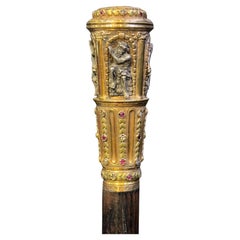
Froment Meurice Antique Diamond And Ruby Four Rivers Cane
Located in New York, NY
Froment Meurice Antique Diamond And Ruby Four Rivers Cane
Made Circa 1870.
A cane featuring architectural decorations of classical figures representing the four major rivers of the...
Category
1870s Antique French Figurines and Sculptures
Materials
Diamond, Ruby, 14k Gold, 18k Gold, Silver
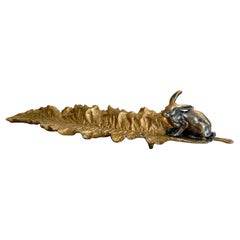
Antique Bronze Bunny Rabbit on Leaf Tray Sculpture, French, 19th Century
Located in New York, NY
This is a superb antique Bronze Tray in the form of a Leaf with a Bunny Rabbit. The fabulous bronze has exquisite details throughout the leaf and ...
Category
19th Century Gilded Age Antique French Figurines and Sculptures
Materials
Bronze
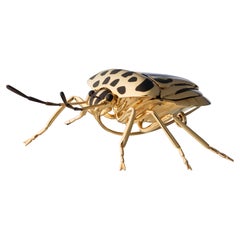
Exclusive And Iconic Beetle Brooch in 18 Karat Yellow Gold And Ebony Wood
By Eva Soussana
Located in Paris, FR
Eva Soussana and her partner the "Atelier Franck Mico", are proud to introduce to you the "Helmet" Beetle, an exclusive and iconic piece created by Eva Soussana and Franck Mico, manu...
Category
21st Century and Contemporary Artist French Figurines and Sculptures
Materials
18k Gold, Yellow Gold
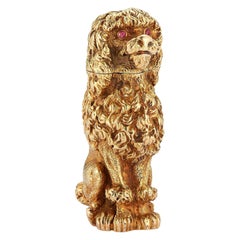
Schlumberger Gold Poodle Lighter
By Jean Schlumberger for Tiffany
Co.
Located in New York, NY
Schlumberger Gold Poodle Lighter , 18k carved gold with ruby eyes .Circa 1950
Measurements: 5.5 x 3.3 x 2.1 cm
Gram Weight: 47.3 grams
Gold Type: 1...
Category
1950s Vintage French Figurines and Sculptures
Materials
Ruby, Gold, 14k Gold
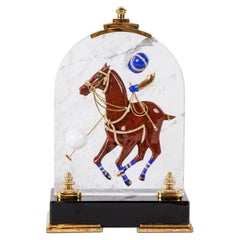
Mellerio Paris, French Gold, Diamonds, Silver, Lapis, and Obsidian Polo Player
By Mellerio dits Meller
Located in Long Island City, NY
Mellerio Paris, A French Gold, Diamonds, Silver-Gilt, Rock Crystal, Enamel, Emerald, Lapis Lazuli, Agate, Emerald, and Obsidian Polo Player, Carved Horse Sculpture, Jeweled Mounted Object.
An extremely rare and unique, one of a kind French Carved Horse Sculpture, Jeweled Mounted Object sculpture "CHEVAUX DE LEGENDE", "A Legendary Horse" by Mellerio, Paris, circa 1999.
Sitting on black obsidian base, the solid rock-crystal slab is finely applied with a carved obdisian hardstone horse and polo player, mounted in 18k gold, brilliant -cut diamonds, emaralds, enamel, lapis lazuli, and agate, .The obsidian base with a plaque engraved: CHEVAUX DE LEGENDE" / MELLERIO DITS MELLER PARIS / 5003 DIV
The piece is in excellent condition and comes with a custom made wood case made for transport. It's very elegant and has French hallmarks throughout. A truly magnificent piece.
Measures 12" high x 8" wide x 4" deep
Founded in France in 1613 by the descendants of Italian immigrants from the Vigezzo Valley in the north of Italy, Mellerio is one of the oldest jewellery houses in Europe. The family business soon attracted the attention of the Royal Court and Marie Antoinette herself reportedly purchased a precious bracelet featuring 7 cameos surrounded by rubies in 1780. Later on, in the 19th century, Mellerio became the official supplier of the French Royal family and the Court of Netherland.
Mellerio creates many jewellery items, all set with rare gems such as peridots, amethysts, aquamarines, citrines and topaz, applying for a patent, the flexible stem, a very supple and light jewellery mechanism. Mellerio remains also well known for their spectacular series of Art Nouveau jewels, created at the beginning of the 20th century, as well as for the creation of trophies rewarding some of the greatest footfall and tennis players of history. In 1993, the jewellery house launched their first watch collection.
Today, Mellerio has stores in Paris, Japan and Hong Kong.
July 14, 1789: this date is known throughout the world as the beginning of the French Revolution. According to a ledger belonging to House of Mellerio, this was also the day that the jeweler sold a golden key to the Comte de Coutance for 10 livres. This ledger, as well as inventories dating as far back as 1768, are the jeweler’s oldest archives. These archives have continued to grow over the years, as the House, established on rue de la Paix in Paris, still lives on today, still in the hands of the same family from Craveggia, in the North of Italy.
The tumultuous history of the Mellerio family in France probably goes as far back as the Italian wars of the Renaissance, but the first official document proving their commercial activity in Paris dates back to 1613. This document is the famous royal warrant awarded by Marie de Medici to a number of Italian families established along the rue des Lombards, including the Mellerios, allowing them to sell “small jewelery items”, therefore granting them a small exception to the traditional monopoly enjoyed by Parisian jewelers. At that time, powerful corporations regulated the operations and customs of Parisian business, but thanks to this exceptional warrant, the Mellerios managed to escape the confines of this framework. Today, this wax-sealed document is kept at the city hall of Craveggia.
From 1613 to the Revolution, the Mellerios lived between France and Italy. The corporations tried many times to put an end to their trade privileges, but all in vain, as a dynasty of sovereigns renewed the warrant. Always marrying and often retiring in Craveggia, the Mellerios continued to maintain their jewelry business in Paris. At first, they did this without a shop. Wearing backpacks (wooden boxes divided into small compartments where jewels were kept), they would tour town fairs around Paris and royal castles.
This is how Jean-Baptiste Mellerio (1765-1850) is said to have sold a bracelet set with rubies and Antique cameos to Marie-Antoinette, which still exists today. Many elements seem to prove the veracity of this anecdote. The queen was particularly fond of cameos, which cover the entire background of her famous jewelry cabinet, and ruby was her favorite stone after diamond. The famous bracelet, reacquired a few years ago by the House of Mellerio, is indeed an 18th century jewel, set with antique cameos representing the profiles of Roman emperors. Two branches of the family were operating in Paris during this time, under the reign of Louis XVI: that of Jean-François (1746-1828), the paternal ancestor of the current Mellerios, and that of Jean-Baptiste (1765-1850).
The French Revolution forced them to return to Italy. However, both Jean-Baptiste and François Mellerio (1772-1843), who was the son of Jean-François, were eventually able to return to Paris after the founding of the Consulate. Jean-Baptiste opened a shop at the Iron Crown of rue Vivienne, and François opened his at the Palais des Tuileries, rue du Coq Saint-Honoré. His well-organized order books give an idea of his high-ranking clientele during the “Old Regime”, among which were the Comte and Comtesse Octave de Segur, the Marquise (later Duchess) de Tourzel, former governess of the royal children, and her daughter, the Comtesse de Bearn, the Craufurds -who organized the flight to Varennes, the Duc and Duchess de Gramont, the Comtesse de Boigne, and Madame de Souza, Talleyrand’s mistress.
We also see the names of the imperial family: Empress Josephine, the Queen of Holland, Princess Elisa, Caroline and Pauline. At that time, the House of Mellerio specialized, among other things, in the trade of antique cameos, a newly fashionable genre of jewel that captured the imagination of all the princesses and noble women of the time.
The years of the Restauration and July Monarchy were among the most glorious. The Bourbons were back on the throne, and the clientele of the House of Mellerio had regained its former wealth. Mellerio supplied Louis-Philippe, Duke of Orléans, as well as his mother, wife and sister, with sumptuous jewels, including a set of emeralds made piece by piece, while the Duke of Bourbon, last prince of the House of Condé, offered diamonds to his mistress, the scheming Baronne de Feucheres, and Monsieur de LaFayette also bought cameos for one of his granddaughters. For the first time, Mellerio ventured into the world of arts in 1815, when Carlotta Grisi, a famous dancer who created Giselle, as well as an actress named Rachel, bought jewels at the Mellerio store on rue de la Paix.
1848 marked a new turning point. France once again became a Republic. François Mellerio handed the company over to his son, Jean, and the latter decided to travel to Spain to build a new clientele. He later became one of the jewelers of the royal family, and met Eugénie de Montijo, who remained a faithful client when she became empress of the French people. The Imperial years were lavish. During the Second Empire, Paris was a pageant of crinoline dresses designed by Worth, while jewels by Mellerio, Worth’s neighbour on the rue de la Paix, adorned the noble women of the Tuileries court.
The Empress bought pearls. Mathilde Bonaparte...
Category
20th Century Art Deco French Figurines and Sculptures
Materials
Agate, Diamond, Emerald, Rock Crystal, Gold, Silver
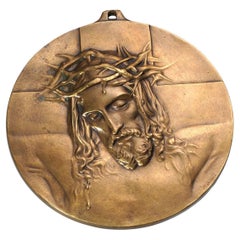
Antique Jesus Christ Portrait Medallion Plaque Henri Miault French Catholic 1900
Located in Berlin, DE
Antique Bronze Jesus Portrait Medallion Plaque by Henri Miault, French Catholic and Christian Gifts
An antique bronze medallion with a portrait of Jes...
Category
Early 1900s Art Nouveau Antique French Figurines and Sculptures
Materials
Bronze
$5,428 Sale Price
25% Off
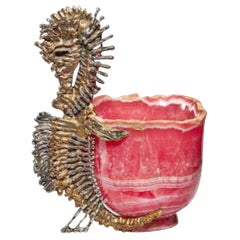
Chaumet Paris, a French Silver-Gilt Seahorse Mounted Rhodochrosite Cup
By Chaumet
Located in Long Island City, NY
Chaumet Paris, A French Silver-Gilt Seahorse Mounted Rhodochrosite cup
Circa 1980.
An exceptional object
A quadrangular cut cup in rhodochrosite and the handle made of a seahorse ...
Category
20th Century French Figurines and Sculptures
Materials
Rhodocrosite, Silver
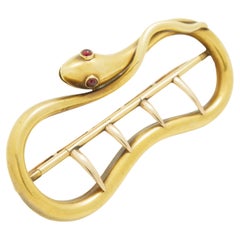
Antique French 18 Karat Yellow Gold Serpent Snake Belt Buckle Cabochon Rubies
Located in New York, NY
Antique French 18 Karat Yellow Gold Serpent Snake Belt Buckle Cabochon Rubies
31 grams
W 81.06mm
H 41mm
Made in France
19th Century
Category
Late 19th Century Belle Époque Antique French Figurines and Sculptures
Materials
Ruby, 18k Gold, Yellow Gold
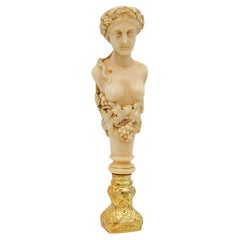
French 1798 Neo Classic Stamp Seal in 18kt Gilded Silver with Carved Bust Flora
Located in Miami, FL
French neo classic desk seal.
Wonderful desk seal, created in France during the late 18th century, back in the 1798-1808. This magnificent piece of art was conceived as a miniature sculpture mounted in a Louis XVI neoclassical style base. This base is crafted in 18 karats gold over silver with chiseled and incised decorations, supporting a magnificent extremely detailed carving of a women. The carved piece, depicts, the naked portrait bust of the classical Greek-Roman goddess of the flowers and nature Flora (Heba), facing forward and exhibiting her breasts, undressed and crowned with flowers, wheat and ivy.
Flora or Heba
She was the deity of the flowering plants, fertility, spring, and blossoming. Although she was a minor figure compared to other goddesses of the Roman empire, she was important as a fertility goddess. Flora was responsible for the abundance of the crops in spring, so her worship strengthened as this season approached. Her name derives from the Latin floris, which means flower, and her Greek counterpart was the nymph, Chloris. The Sabine King Titus Tatius introduced Flora into the Roman pantheon...
Category
1790s Neoclassical Antique French Figurines and Sculptures
Materials
Gold, 18k Gold, Silver
$2,838 Sale Price
25% Off
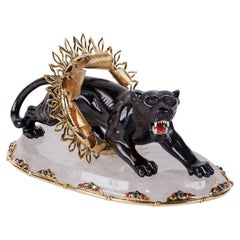
Alexandre Reza, Rare Obsidian, Silver-Gilt, and Rock Crystal Circus Panther
Located in Long Island City, NY
Alexandre Reza, A Rare Obsidian, Silver-Gilt, and Rock Crystal Circus Panther, mounted with Cabochon Sapphires and Rubies.
"Panthère au cirque"" / Panther at the circus" - an exquisite jeweled mounted objet.
5.5" high x8" wide x 4.5" deep.
In very good condition, no damages noted. Ready to place.
In its original presentation box from Maison Alexandre Reza.
Alexandre Reza (November 1, 1922 – January 15, 2016) was a Paris-based jeweler known for his diverse and rare collection of precious gemstones.He is lauded as the greatest gem collector of modern times. Alexandre Reza was born in 1922 in Moscow, of ancient Samarkand heritage. The son of a jeweler, he moved to France with his family when he was a child. He set out on his own at the age of eighteen, the same time as the onset of World War II.
After the war, he began his career as a diamond expert, traveling extensively to source each stone, which served as the key design inspiration for his work.Early on, he supplied gems to jewelry brands such as Boucheron, Bulgari, Cartier, Chaumet, Harry Winston, Louis Gérard...
Category
20th Century Art Deco French Figurines and Sculptures
Materials
Rock Crystal, Ruby, Blue Sapphire, Silver
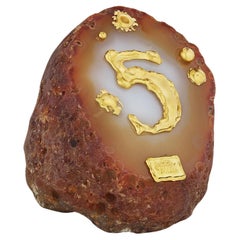
Jean Mahie France Gold Agate Vintage Sculpture
By Jean Mahie
Located in Greenwich, CT
Rock it! If your lucky number is five, this Jean Mahie France agate stone and 22 yellow gold vintage small sculpture will make you always feel the beat. Signed Jean Mahie. Circa 1...
Category
1990s Modernist French Figurines and Sculptures
Materials
Gold, 18k Gold
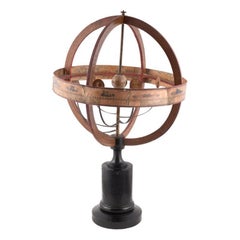
Copernican Delamarche Planetary With Hand Mechanism
Located in Firenze, IT
Copernican-type planetary globe in cardboard and engraved paper mounted on a blackened wooden stand. France, circa 1810. H. 54 cm Diam. 36 cm Antique armillary spheres...
Category
1810s Empire Antique French Figurines and Sculptures
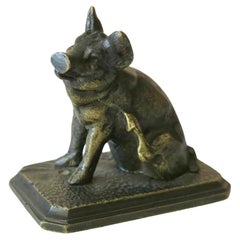
French Antique Seated Pig Bronze Figurine by Christophe Fratin, 1830-1840
Located in Chesterland, OH
Presenting a unique antique bronze figurine by the renowned French Animalier sculptor Christophe Fratin. This is a very charming, miniature br...
Category
Mid-19th Century Empire Antique French Figurines and Sculptures
Materials
Bronze
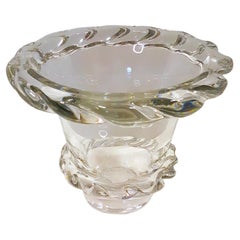
DaumNancyFrance ArtDeco Signed Glass Applications LeadCrystal Sculptural Vase
By Daum
Located in Chicago, IL
Art glass vase sign: Daum Nancy France. Evidenced by this Daum sculptural colorless blown and hot-shaped lead-crystal heavy vessel vase, the finest irreproducible artistic works in the history of the iconic French decorative-glass maker feature ornamental thick glass applications. Its most in-demand pieces today were made between 1925 and 1935, with very few major ArtDeco-period pieces remaining in private hands and even less without damage. As a significant gift acquired from Don Jacques Daum in 1950, a similarly shaped, constructed and sized circa-1925 vase with "stylized foliage" motif is in the collection of the French Museum of Decorative Arts in Paris as Inventory #36309. A later-produced vase with a similar application-motif at just the rim, but in a "Champagne" bubbled style, is among the photos in the published book about the Leo and Irina Esterkin acquisitions from 1910-1940 titled Daum Art Deco Glass--A Private Collection.
On our prime-condition antique vase, applied transparent glass is styled in high relief into a flowing undulating motif that evolved from Daum's Art Nouveau foliage designs. The angular and curvilinear shapes of this vessel epitomize the bold vases, bowls and sculptures for which Daum is best known. Its tiny pencil-etched signature on the side near the bottom reads "Daum (plus the Lorraine-cross symbol) Nancy France", which resembles some published signatures since 1925.
Revealing how ahead of its time this particular design was--after WWII in 1945 coinciding with the revitalization of the French glass industry--Daum used...
Category
1920s Art Deco Vintage French Figurines and Sculptures
Materials
Crystal
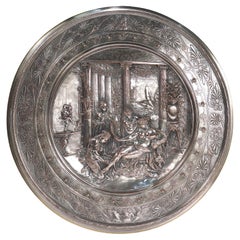
Antique Elkington Electrotype Silver Plate Figural Charger by Morel-Ladeuil
Located in Philadelphia, PA
A fine antique English electroplate charger.
By Elkington & Co.
Designed by Léonard Morel-Ladeuil for the 1876 Philadelphia Exhibition.
In the Neo-Grec manner with a stylized Pom...
Category
1870s Neoclassical Antique French Figurines and Sculptures
Materials
Silver Plate
Crystal Seagull Statue on Stainless Frame, Midcentury Daume France "La Mouette"
Located in Northampton, MA
This pristine Daume France "La Mouette" Crystal Seagull Statue is both pristine and rare. The signed "Daume France" crystal bird is suspended from a ch...
Category
Mid-20th Century Modernist French Figurines and Sculptures

$5,200 Sale Price
20% Off
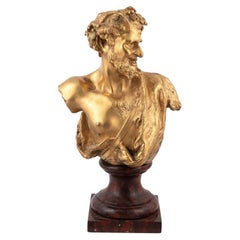
A French Gilt Bronze Satyr Claude Michel Clodion (French, 1738-1814)
Located in Firenze, IT
Modeled as a satyr, incised CLODION, raised on variegated red and green marble plinth.
height 13in (33cm) 33cm high, 13in high)
Category
Late 18th Century Neoclassical Antique French Figurines and Sculptures
Materials
Bronze
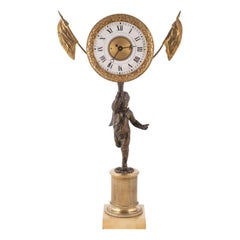
An Empire Gilt Bronze Mantel Clock First Quarter 19th Century
Located in Firenze, IT
Very nice high quality French Empire clock, showing a Cupid holding two flag. The opaline dial with Roman and Arabic numbers. The watch is signed by Eugene Bornand Height 19in (48cm)
Category
Mid-18th Century Baroque Antique French Figurines and Sculptures
Materials
Brass, Bronze
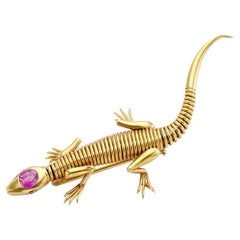
1950s Lizard Diamond Yellow Gold 18 Karat Brooch Clip
Located in Geneva, CH
The Animal Lizard brooch clip in yellow gold 18k is a captivating piece of jewelry.
This brooch features a lizard design, crafted with meticulous attention to detail.
The lizard’s eyes are adorned with rose cut diamonds, adding a touch of sparkle and elegance. The head of the lizard is crowned by a beautiful pink sapphire, enhancing its regal appearance. This brooch is estimated to be from the 1950s and bears French assay marks, indicating its authenticity and quality. With its unique design and exquisite gemstone accents, this lizard brooch is a timeless and sophisticated accessory.
Total length: 2.56 inches (6.50 centimeters).
We are reknown for curating unfindable jewels.
Most of the pieces of our collection are antique, one-of-a-kind and formerly owned by...
Category
1950s Artist Vintage French Figurines and Sculptures
Materials
Pink Sapphire, Diamond, Gold, Yellow Gold
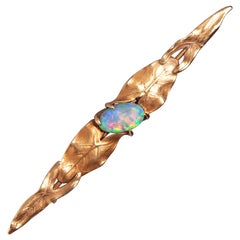
Art Nouveau Opal Gold Brooch Australian Precious Opal Unisex Arnould 1910 Brooch
By Edouard Aimé Arnould
Located in Berlin, DE
An exceptional piece - Art nouveau Opal Brooch from original catalogue of french jeweller Edouard Aimé Arnould, circa 1910
brooch measurement...
Category
1910s Art Nouveau Vintage French Figurines and Sculptures
Materials
Crystal, Opal, Gold, 18k Gold
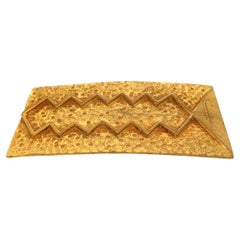
Rare bronze-doré belt buckle by Line Vautrin
By Line Vautrin
Located in Idar-Oberstein, DE
Elegant and rare 1950s bronze-doré belt buckle by Line Vautrin,
with a raised geometric pattern and textured background,
marked Line Vautrin, with additional, original loop for th...
Category
Mid-20th Century Modernist French Figurines and Sculptures
Materials
Bronze, Gilt Metal
More Ways To Browse
Cameo Stick Pin
Cento Diamond
Chanel Brooch Diamond
Chanel Gripoix 1969
Chanel Vintage Turn Lock
Chaumet Ruby
Chinese Enamel Brooch
Chopard Blue Sapphire
Christian Dior Perfume
Christian Dior Swarovski
Ciro Jewelry Vintage
Ciro Jewelry
Coral Cameo And 14k
Coral Monkey
Coro Bird
Crane Brooch
Cross Scotland
Crystal Opal And Diamond Brooches