Asia - Paintings
to
7
12,819
6,424
93
8
5
Height
to
Width
to
12
10
2
1
18
33
42
13
17
8
8
3
1
3
7
2
1
65
33
30
24
24
63
46
35
33
15
106
101
106
5
4
3
2
1
Item Ships From: Asia
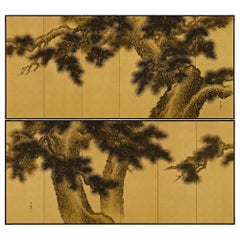
Early 20th Century Japanese Screen Pair - Ink Pine Trees on Gold
Located in Kyoto, JP
Imao Keisho (1902-1993)
Pine Trees
Early 20th Century, Circa 1930
Pair of six-panel Japanese screens. Ink on silk and gold leaf.
Dimensions: Each screen H. 67.5” x 148” (172 cm x 376 cm)
A pair of monumental six-panel Japanese pine screens by the renowned Nihonga artist Imao Keisho. Here Keisho entirely removed the background and brought the pine trees to the surface of the painting. This simplification of the elements makes the scene exceptionally direct and compelling and injects a very modern...
Category
Early 20th Century Japanese Showa Asia - Paintings
Materials
Gold Leaf
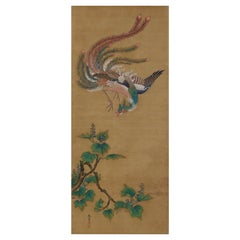
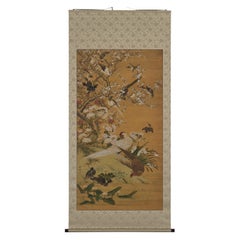
19th Century Japanese Silk Painting by Kano Chikanobu, Phoenix
Paulownia
Located in Kyoto, JP
Birds & Flowers of the seasons
Pheasants & Plum in Snow
Unframed painting. Ink, pigment and gofun on silk
Kano Chikanobu 1819-1888
Signature...
Category
Mid-19th Century Asian Edo Antique Asia - Paintings
Materials
Silk
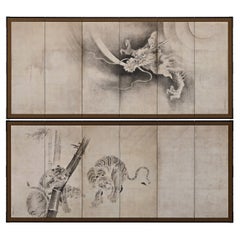
17th Century Japanese Screen Pair. Tiger
Dragon by Kaiho Yusetsu
Located in Kyoto, JP
Kaiho Yusetsu (1598-1677)
Tiger and Dragon
Early Edo Period, Circa 1650
A Pair of Six-fold Japanese Screens. Ink and slight color on paper.
Dimensions:
Each screen: H. 171 cm x W. 380 cm (67.5’’ x 149.5’’)
In this pair of early Edo period Japanese screens a group of tigers prowl in a bamboo grove whipped with fierce wind, while a dragon claws through clouds and mist. The dragon embodies elemental qualities - looming out of the mist, the coils of its body disappearing in the clouds. The dragon is calling for rain, symbolizing spring which is considered the fountain of life. On the other side, the tigers calls for the wind, symbolizing autumn which is considered the end of life. Tigers were familiar motifs within Japanese art from ancient times though the animals were imaginary to the people in the 17th century. While dragons and tigers are usually associated as sacred and ferocious, in this painting, both animals have rather amusing expressions. The tigers appear to glare at the dragon with cat-like eyes, and the look on the swirling dragon’s face appears almost affectionate - lending a playful flair to an otherwise magnificent theme.
The tiger and dragon are cosmological symbols of the balancing forces in the world. Screens such as this were originally meant to express the fluctuating nature of the world. For Japanese in the early Edo period, they likely suggested the powers of the cosmos. In Japan the tiger and dragon motif was originally absorbed into the circles of Zen monasteries before spreading into the secular world. The theme especially appealed to the military classes with the Kano school, the official painters to the Shogun and the samurai, being the leading contributors. The painter of this pair of screens, Kaiho Yusetsu (1598-1677), was closely patronized by the third Shogun Tokugawa Iemitsu. In his later years he worked with Kano school artists...
Category
Mid-17th Century Japanese Edo Antique Asia - Paintings
Materials
Silk, Wood, Paper
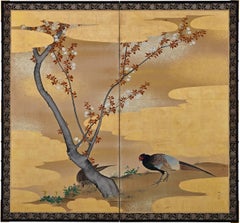
Early 19th Century Japanese Screen. Cherry Blossom
Pheasants by Mori Tetsuzan
Located in Kyoto, JP
Mori Tetsuzan (1775-1841)
Pheasants and Cherry Blossoms
Two-fold Japanese screen. Ink, color, gofun, gold and silver on paper.
A two-fold Japanese bir...
Category
Early 19th Century Japanese Edo Antique Asia - Paintings
Materials
Gold Leaf
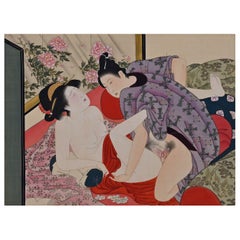
19th Century Japanese Shunga Hand-Scroll, Katsukawa School
Located in Kyoto, JP
Shunga
Unknown artist
Meiji era, circa 1880
Hand-scroll mounted with 12 paintings
Ink, pigment and gofun on silk
Dimensions:
Each image measures H. 23.2 cm x W. 34.4 cm (9.15” x 13.5”)
The hand-scroll measures H. 28 cm x W. 540 cm (11” x 212”)
A set of 12 late 19th century Japanese Shunga paintings mounted as a hand-scroll. Two of the leaves bear the signature and seal ‘Setsuzan’, although we are unable to confirm the identity of the artist using this art name. 6 of the 12 images are taken almost directly from Katsukawa Shuncho’s late 18th century woodblock series, ‘Erotic Pictures...
Category
Late 19th Century Japanese Meiji Antique Asia - Paintings
Materials
Silk
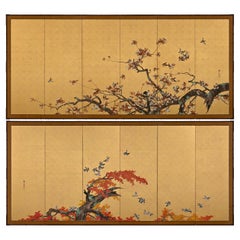
Meiji Era, Circa 1900 Japanese Screen Pair, Flowers
Birds of Spring
Autumn
Located in Kyoto, JP
Flowers & Birds of Spring and Autumn
Unknown artist.
Japan. Meiji period, circa 1900.
A pair of six-fold screens. Ink, color, gofun and gold leaf on paper.
Signed: Gaga S...
Category
1890s Japanese Meiji Antique Asia - Paintings
Materials
Gold Leaf
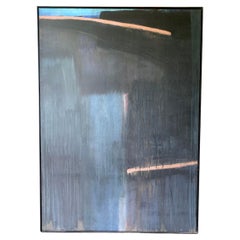
Abstract Painting "AZ-TEP" by Venezuelan Artist Susana Amundarain
Located in Jimbaran, Bali
This abstract painting titled "AZ-TEP" was created by contemporary Venezuelan artist Susana Amundarain. Her work has been included in many group and ...
Category
Late 20th Century Venezuelan Modern Asia - Paintings
Materials
Canvas, Paint

$3,200 Sale Price
20% Off
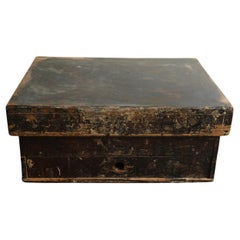
Wooden workbench of a Japanese lacquerware craftsman/20th century/wall-hanging
Located in Sammu-shi, Chiba
This is a lacquerware craftsman's workbench believed to have been actually used in Fukushima Prefecture and other areas in the Tohoku region between 1945 and 1960. This box-shaped st...
Category
20th Century Japanese Showa Asia - Paintings
Materials
Cedar, Lacquer
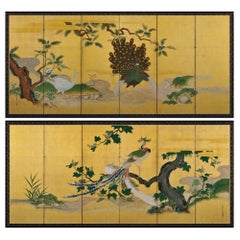
Japanese Screen Pair, circa 1730, Peacocks and Phoenix, Kano School
Located in Kyoto, JP
Phoenix and Peacocks.
A pair of six-panel Japanese folding screens by Tsunetake Yotei (n.d.)
First half of the 18th century.
The signature reads 67 year old Tsunetake.
The seals read:
-Tsunetake no in,
-Yotei,
-Seishin
Dimensions:
Each screen – H. 69” x W. 149” (176 cm x 378 cm)
A pair of Kano Grand Picture (Waga) screens depicting phoenix and peacocks rich with symbolic meaning. Dating to the first half of the 18th century, from the Kobikicho Kano school in Edo, this pair of folding...
Category
Early 18th Century Asian Edo Antique Asia - Paintings
Materials
Gold Leaf
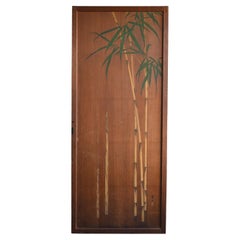
Wooden door with old Japanese bamboo painting/Wall hanging painting/Wooden door
Located in Sammu-shi, Chiba
This is a one-panel wooden door made in Japan around the 20th century. The material used is presumed to be Japanese cypress or Japanese cedar, and the delicately straight grain of th...
Category
20th Century Japanese Taisho Asia - Paintings
Materials
Cedar
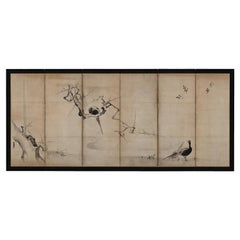
17th Century Japanese Screen. Ink Plum Tree
Birds by Kano Naonobu.
Located in Kyoto, JP
Kano Naonobu (1607-1650)
Plum Tree and Birds
Six-fold Japanese Screen. Ink and slight color on paper.
In this evocative ink work spread over a six-panel folding screen, we see the consummation of the elegance and refinement of the Edo Kano school. This 17th century screen is a rare surviving example of a large-scale bird and flower painting by Kano Naonobu, the younger brother of Kano Tanyu...
Category
17th Century Japanese Edo Antique Asia - Paintings
Materials
Wood, Paper
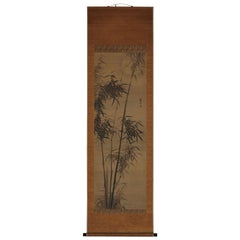
Japanese Painting, Hanging Scroll, 19th Century Bamboo in Moonlight
Located in Kyoto, JP
Bamboo in moonlight
Gamo Rakan (1784-1866)
Hanging scroll, ink on silk.
Dimensions:
Scroll: 201 cm x 58 cm
Image: 137 cm x 45 cm
In this early 19th century work by Gamo Rakan a light ink wash applied to the silk background silhouettes the moon and suggests the atmosphere of early evening. Even though it is a literati subject, Rakan’s bamboo is quite realistic with a strong decorative style. The painting finds its inspiration from Chinese Ming dynasty painters who often used a single-tone, jet black stroke to emphasize the calligraphic nature of bamboo.
In a different era, decorative would have been seen as somewhat unrefined. But increasingly in the Edo period, it was the hallmark of high style. The Japanese people, in particular the rising merchant class, had gradually become apathetic toward the traditional Sesshu and Kano schools of painting. Chinese professional and amateur painters living in the port of Nagasaki during the 18th century had a profound effect on Japanese painting and the freshness of their style and its decorative appeal contributed greatly to its popularity. Gamo Rakan’s teacher, Tani Buncho...
Category
Early 19th Century Japanese Edo Antique Asia - Paintings
Materials
Silk
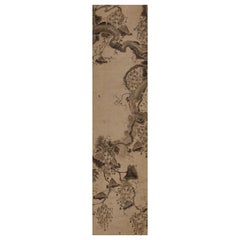
17th Century Korean Grapevine and Squirrel Scroll Painting, Mid Joseon Period
Located in Kyoto, JP
Anonymous. Korean, 17th century. Joseon period.
Hanging scroll. Ink on paper.
Seal: Shinso
Dimensions:
Scroll: H. 200 cm x W. 31 cm (79” x 12”)
Image: H. 122 cm x W. 29.5 cm (48” x 11.5”)
The grapevine came to China and then Korea from western Asia via the silk road trade routes. By the mid-Joseon period, it was one of the most popular subjects for Korean literati painters. Grapevines were painted as a singular subject or, less commonly, in combination with squirrels, which are associated with children due to their playful nature. Together, grapevines and squirrels embody wishes for abundant offspring and wealth.
For the Korean literati artist the twisting vines, curling tendrils and round, plump grapes provided ample opportunity for expressive "brush play”. In this painting the artist has abstracted the scene and is seemingly unconcerned with discontinuities and proportion. Vines spring up from nowhere, grapes hang in random clusters and the squirrel’s head appears as if twisted backwards. For the vines and leaves we can feel a sense of speed in the brushstrokes, imparting a dynamic feel which is at once intense and animated. This contrasts dramatically with the countless tiny strokes of ink which realistically capture the texture of the squirrel’s fur...
Category
17th Century Korean Other Antique Asia - Paintings
Materials
Paper
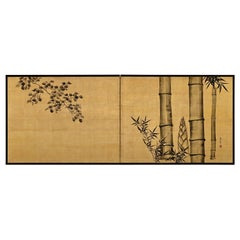
19th Century Japanese Screen for Tea-Ceremony, Ink Bamboo and Plum on Gold Leaf
Located in Kyoto, JP
Three Friends of Winter
Nakajima Raisho (1796-1871)
Late Edo period, circa 1850
Ink and gold leaf on paper.
This is a double-sided Japanese Furosaki or tea-ceremony screen from the mid 19th century; bamboo and plum on the front, young pines the back. It by Nakajima Raisho, a master painter of the Maruyama school in the late Edo and early Meiji periods. In this work Raisho combines exquisite ink brushwork with large open spaces of brilliant gold-leaf to inspire the viewers imagination. Rather than naturalism, he is searching for the phycological impression of the motifs, resulting in abstraction and stylization. His simplification of the motifs the result of looking to capture the inner nature of the objects. This art motif is known as Sho Chiku Bai, or the Three Friends of Winter. Evergreen pine connotes steadfastness, bamboo suggests both strength and flexibility, while plum blossoms unfurling on snow-laden branches imply hardiness. Combined, this trio is emblematic of Japanese new year. Chinese literati were the first to group the three plants together due to their noble characteristics. Like these resilient plants flowering so beautifully in winter, it was expected of the scholar-gentleman to cultivate a strong character with which he would be able to show the same degree of perseverance and steadfastness even during times of adverse conditions.
The screen would have been placed near the hearth of a room used for the Japanese tea ceremony, shielding the fire from draughts and also forming a stimulating and decorative backdrop behind the tea utensils. It would have been used in the Hatsugama, or first tea-ceremony of the new year.
Nakajima Raisho (1796-1871) originally studied under Watanabe Nangaku before entering the school of Maruyama Ozui. He was the highest ranking Maruyama school painter at the end of the Edo period and was known as one of the ‘Four Heian Families’ along with Kishi...
Category
Mid-19th Century Japanese Edo Antique Asia - Paintings
Materials
Gold Leaf
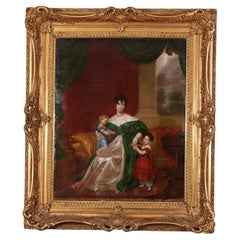
Early 19th Century Oil Painting French Family Portrait
Located in 263-0031, JP
The term “Biedermeier” was first wielded as mildly disparaging designation for the bourgeois domesticity, so idealized by German society in the post-Napoleonic era prior to the 1848 ...
Category
Early 19th Century French Biedermeier Antique Asia - Paintings
Materials
Canvas
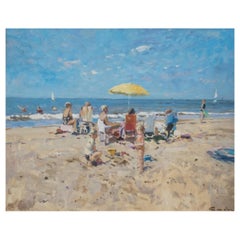
Niek van der Plas, Beach Scene
Located in Lantau, HK
Niek van der Plas grew up in Katwijk Ann Zee in the Netherlands. Taking inspiration from his hometown, his work features the famous sea and dunes of the fisherman village. Van der Pl...
Category
20th Century Dutch Asia - Paintings
Materials
Canvas
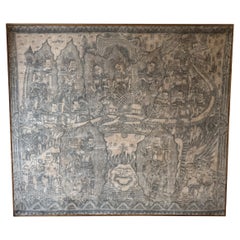
Bali Hindu Textile Framed
Kamasan
Painting, Indonesia C. 1900
Located in Jimbaran, Bali
This Antique Balinese Kamasan painting, rendered on handwoven cotton, beautifully captures the timeless elegance of classical Wayang-style storytellin...
Category
Early 1900s Balinese Folk Art Antique Asia - Paintings
Materials
Cotton, Paint
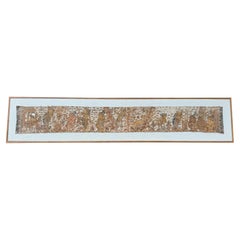
$1,360 Sale Price
20% Off
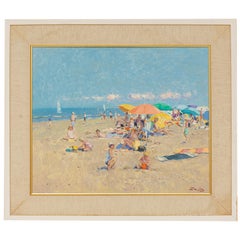
02**Impressionistic Beach Scene by Niek van der Plas
By Niek van der Plas
Located in Lantau, HK
Niek van der Plas is a Dutch painter born in 1954, he paints impressionist scenes of Holland's beaches and dunes, bulb fields, city scenes in Amsterdam and Maastricht and other typic...
Category
21st Century and Contemporary Dutch Modern Asia - Paintings
Materials
Canvas
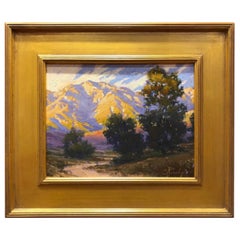
American Landscape by Craig Pursley
Located in Lantau, HK
Craig Pursley. Autry's Home, American, born 1954.
Oil on canvas. Dimensions 28.5 x 36 cm
Original art work(s).
Category
20th Century Asia - Paintings
Materials
Paint
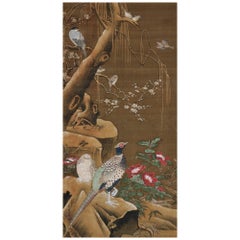
Japanese Painting. Bird and Flower. 19th century copy of Lu Ji by Ogata Tomin.
Located in Kyoto, JP
Ogata Tomin (1839 -1895)
Birds in a spring landscape
Ink and colour on silk.
Inscription reads:
“Copy of Lu Ji, painted with heartfelt appreciation”
“Painted by Tomin Ogat...
Category
Late 19th Century Japanese Ming Antique Asia - Paintings
Materials
Silk
Bali Hindu Textile Framed
Kamasan
Painting, Indonesia C. 1920
Located in Jimbaran, Bali
A mid-20th century 'Kamasan' cotton textile painting from Bali, Indonesia. The hand-painted image has great detail and depicts Balinese Hindu mythology. Key features of this image ar...
Category
1950s Balinese Folk Art Vintage Asia - Paintings
Materials
Cotton, Paint
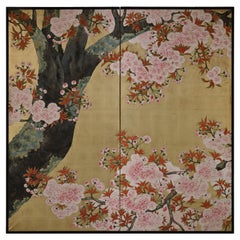
Early 20th Century Japanese Cherry Blossom Screen by Kano Sanrakuki
Located in Kyoto, JP
Cherry Blossoms
Kano Sanrakuki (1898-1981)
Showa period, circa 1930
2-panel Japanese Screen
Color, gofun and gold leaf on paper
Against a backdrop of gold-leafed ground, the lichen covered trunk and branches of the life-sized cherry blossom tree reach out and beyond the confines of the pictorial surface. The overall composition has a feeling of flatness which draws emphasis to the surface and the three-dimensionality of the cherry blossoms. Painstakingly built-up layers of thickly applied shell-white gofun detail the voluminous blossoms and cover large areas of this tour-de-force of Japanese Nihonga painting. By simplifying the background, minimizing the number of colors and depicting the blossoms with such heavy relief, the artist has emphasized the stunning presence of the cherry tree. The type of tree depicted is the Yae-Zakura; a double-layered type of cherry blossom famed for its beauty and strength. When we think of Japanese cherry blossoms, the first thing that comes to mind is Somei Yoshino variety, which has a single flower with five almost white petals. This type is fragile and easily blown away by strong wind or rain. Most of the double-flowered cherry blossoms begin to bloom when the Somei-Yoshino falls, and the flowering period lasts longer than that of the Somei-Yoshino.
Kano Sanrakuki originally studied painting at the Kyoto City Arts and Crafts School under the tutelage of Yamamoto Shunkyo...
Category
Early 20th Century Japanese Showa Asia - Paintings
Materials
Gold Leaf
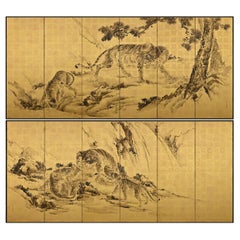
Japanese Screen Pair, Tigers by Kishi Renzan, Late Edo Period
Located in Kyoto, JP
Kishi Renzan (1804-1859)
Tigers
Pair of six-panel Japanese screens.
Ink and gold-leaf on paper.
In this monochromatic pair of six-fold Japanese screens painted on gold-leaf, Kishi Renzan has created a breathtaking composition of a family of tigers. The screens are filled with a sense of drama which is conveyed by both the subject matter and the wet, expressive brushwork. The running mountain stream and the towering waterfall allude to refreshment during the summer months and we feel the tiger families familiarity and security within their environment. Renzan’s master, Kishi Ganku...
Category
Mid-19th Century Asian Edo Antique Asia - Paintings
Materials
Gold Leaf
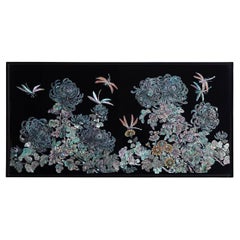
Handcrafted Floral Painting on Wood Panel by Arijian Chrysanthemum 02
By Arijian, Jian Yoo
Located in Namyangju-si, KR
Handcrafted mother-of-pearl painting with Chrysanthemum design.
Category
2010s South Korean Asia - Paintings
Materials
Wood
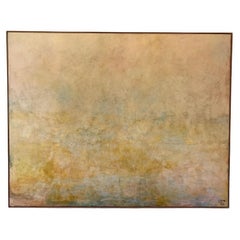
Abstract Painting by Venezuelan Artist Alejandro Rios
Located in Jimbaran, Bali
An abstract painting by Venezuelan artist Alejandro Rios. Rios is known for creating largely abstract landscapes that disappear through the texture a...
Category
Late 20th Century Venezuelan Modern Asia - Paintings
Materials
Canvas, Paint
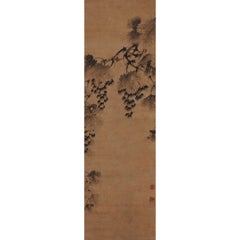
Korean Painting, Wall Panel, 17th Century Ink Grapevine
Located in Kyoto, JP
Grapevine
Anonymous. Korean, 17th century.
Wall panel, ink on paper.
Upper seal:
Kou Kinun in
Lower seal:
Kaigen
Dimensions:
Measures: 98.5 cm x 29.5 cm (39” ...
Category
17th Century Korean Other Antique Asia - Paintings
Materials
Wood, Paper
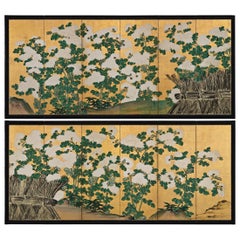
Mid-18th Century Japanese Screen Pair, One Hundred Flowers, Chrysanthemums
Located in Kyoto, JP
Omori Soun (b. 1704)
Chrysanthemums - One Hundred Flowers
A Pair of Six-fold Japanese Screens. Ink, color, gofun and gold leaf on paper.
Dating ...
Category
Mid-18th Century Japanese Edo Antique Asia - Paintings
Materials
Gold Leaf
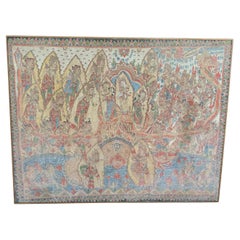
Bali Hindu Textile Framed
Kamasan
Painting, Indonesia C. 1940
Located in Jimbaran, Bali
This captivating Balinese Kamasan textile painting showcases the distinctive style rooted in the classical Wayang tradition, unfolding a mythic tableau rich with symbolism and storyt...
Category
1950s Balinese Folk Art Vintage Asia - Paintings
Materials
Cotton, Paint
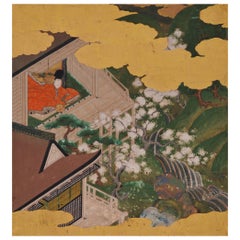
Japanese Painting, 17th Century, Tale of Genji, Tosa School
Located in Kyoto, JP
Illustration to an unidentified chapter of the Tale of Genji (Genji Monogatari)
Tosa School (second half of the 17th Century)
Ink, pigment, gofun and...
Category
Late 17th Century Japanese Edo Antique Asia - Paintings
Materials
Gold Leaf
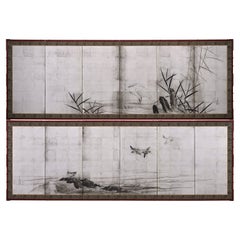
Japanese Silver Screen Pair, Meiji Period, Herons
Plovers, Shijo School
Located in Kyoto, JP
Heron & Plovers
Ink and silver leaf on paper
Maekawa Bunrei (1837-1917)
A pair of low six-panel Japanese screens by Maekawa Bunrei, a later master of the Kyoto based Shijo school of painting. On the right screen a solitary white heron stands motionless in a stream. On the left screen plovers play along a shoreline. The elegant forms are executed employing fluid, minimalistic ink brushstrokes. The soft brushstrokes and the sharp light of the silver leaf lend the scenes a sense of translucence. The sophisticated composition superbly exploits the long, horizontal pictorial surface of the pair of folding screens...
Category
Early 1900s Japanese Meiji Antique Asia - Paintings
Materials
Silver Leaf
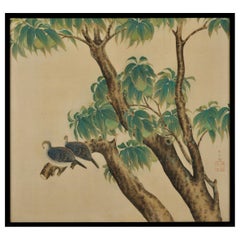
Japanese Framed Silk Painting, Turtledoves and Peaches, Taisho Era, circa 1920
Located in Kyoto, JP
Nakamura Daizaburo
Turtledoves in a Peach Tree
Taisho period, circa 1920
Framed painting. Mineral pigments, ink and gofun on silk
Signed: Daizaburo
Dimensions (framed)...
Category
1910s Japanese Taisho Vintage Asia - Paintings
Materials
Wood, Silk
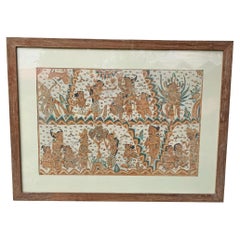
Bali Hindu Textile Framed
Kamasan
Painting, Indonesia, Early 20th Century
Located in Jimbaran, Bali
An early 20th century 'Kamasan' cotton textile painting from Bali, Indonesia. The hand-painted image has great detail and depicts Balinese Hindu mythology. It has been framed with a ...
Category
Early 20th Century Balinese Folk Art Asia - Paintings
Materials
Cotton, Paint
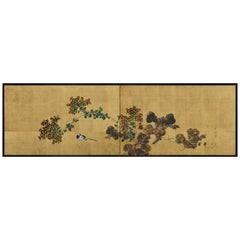
Japanese Screen, Early 20th Century Wagtail
Chrysanthemum by Ishizaki Koyo
Located in Kyoto, JP
Ishizaki Koyo (1884-1947)
Wagtail & Chrysanthemum
Early 20th century
Folding screen in two-panels. Ink, pigments and gofun on gold leaf.
Sign: Koyo
Seal: Koyo
This ...
Category
Early 20th Century Japanese Taisho Asia - Paintings
Materials
Gold Leaf
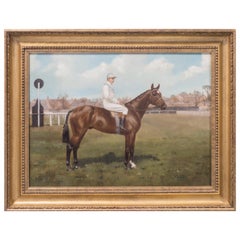
Portraits of a Jockeys and Racehorse
Located in Lantau, HK
Clarence Hailey Newmarket (British born 1867-1949) famous for his painting of stallions and jockeys
Portraits of a jockey and racehorse
Newmarket, Su...
Category
Early 20th Century English Asia - Paintings
Materials
Canvas
$6,000 Sale Price
20% Off
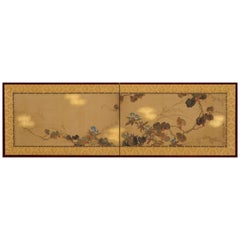
Japanese Screen Painting, Early 19th Century, Autumn Flowers by Sakai Hoitsu
Located in Kyoto, JP
A two-fold Japanese screen by the Rimpa school artist Sakai Hoitsu (1761-1828), Japan, 19th century, Edo period.
This small Japanese folding screen pai...
Category
Early 19th Century Japanese Edo Antique Asia - Paintings
Materials
Wood, Silk
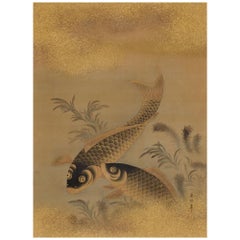
Japanese Painting, Hanging Scroll, Mid 19th Century, Koi and Water Plants
By Iwase Hirotaka
Located in Kyoto, JP
Iwase Hirotaka (1808-1877)
Koi and Water Plants
Hanging scroll, ink, color, gold wash and gold flecks on silk
Inscription: Hirotaka
Seal: Ille...
Category
1860s Japanese Edo Antique Asia - Paintings
Materials
Silk
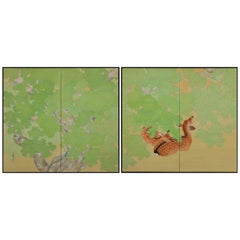
Early 20th Century Pair of Japanese Folding Screens, Deer Under Maple Trees
Located in Kyoto, JP
Deer under maples
Late Taisho period, circa 1925-1930
Pair of two-panel screens. Ink and pigment on silk.
Signature: Goho
Seal: Goho
A pair of two-fold Japanese silk screens...
Category
1920s Japanese Taisho Vintage Asia - Paintings
Materials
Wood, Paper, Silk
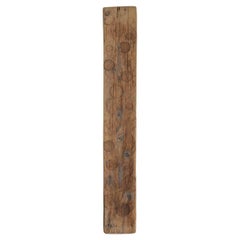
Antique Work Board Used by Japanese Craftsmen/1868-1920/Wabi-Sabi Wall Painting
Located in Sammu-shi, Chiba
If you want something special, we recommend purchasing items selected by Brood.
We sell carefully selected old Japanese items.
I've seen tens of thousands of items so far.
Based o...
Category
Late 19th Century Japanese Meiji Antique Asia - Paintings
Materials
Cedar
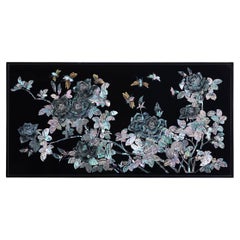
Handcrafted Unique Painting on Wood Panel by Arijian Rose 02
By Jian Yoo, Arijian
Located in Namyangju-si, KR
Wall decor handcrafted mother of pearl rose painting on wood panel by Arijian.
Category
2010s South Korean Asia - Paintings
Materials
Wood
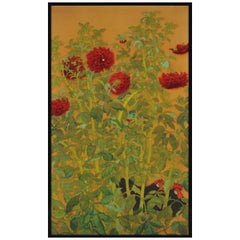
Japanese Painting, Framed Panel, Dahlias and Roosters, circa 1920
Located in Kyoto, JP
Tanaka Tessen (b.1890)
Dahlias and Roosters
Taisho period, circa 1920
Framed painting. Mineral pigments and ink on silk.
Dimensions (framed):
H. 159 cm x W. 97 cm x D. 2.5 cm (62.5” x 38” x 1”)
An ornate and complex composition in which the artist explores almost the entire painting surface. The coloration is bold and evocative and the tinted silk ground recreates the warm golden glow of sunset. Soft, luminous brushwork details the black feathers of the roosters, which seem to cloud and blur in counterpoint to the sharper points of the eyes and beaks. Their brilliant red combs balance the composition, echoing the rich burgundy hues of the dahlias; the flowers exquisite and lifelike. Dahlias were an exotic subject favored by painters of the Taisho era.
The painting belongs to the school of Kyoto Nihonga, exemplifying the principles of decorative elegance and consumate brush technique with which it was intimately associated. Painters of the time relied on the Shijo school method, basing the forms of the composition from life sketches. Sometimes they were then integrated with elements derived from Chinese bird and flower...
Category
1920s Japanese Taisho Vintage Asia - Paintings
Materials
Wood, Silk
Late 18th Century Japanese Framed Painting, God of Thunder by Yamaguchi Soken
Located in Kyoto, JP
Raijin - God of Thunder
Yamaguchi Soken (1759-1818)
Mid to Late Edo period, circa 1800.
Framed painting. Ink and light color on paper.
This humorous painting depicts the Thunder God, Raijin, tumbling from the sky, presumably being struck down by one of his own lighting bolts. He clings to one drumstick as the other is in free-fall along with his Taiko drums...
Category
Late 18th Century Asian Edo Antique Asia - Paintings
Materials
Paper

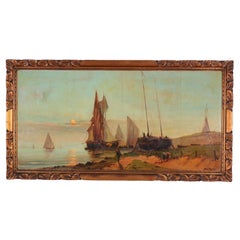
Lepoittevin Early 19th Century Marine Oil Painting
By Eugene Le Poittevin
Located in 263-0031, JP
A marine tableau, oil on wood board, by the French Romantic painter Eugène Lepoittevin (1806-1870). The signature “Poitevin” appears in the lower right: our painter seems to have gon...
Category
Mid-19th Century French Antique Asia - Paintings
Materials
Canvas
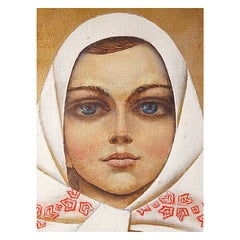
"Awaiting" Painting by Leonid Steele, Famous Ukrainian Artist
Located in Fukuoka, JP
A stunning painting by Ukrainian artist Leonid Steele titled "Awaiting", created in 1972 during the Soviet era. The painting is in the human realist st...
Category
20th Century Ukrainian Asia - Paintings
Materials
Cotton
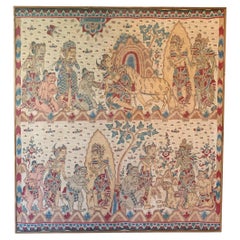
Bali Hindu Textile Framed
Kamasan
Painting, Indonesia C. 1950
Located in Jimbaran, Bali
A mid-20th century 'Kamasan' cotton textile painting from Bali, Indonesia. The hand-painted image has great detail and depicts Balinese Hindu mythology. Key features of this image ar...
Category
1950s Balinese Folk Art Vintage Asia - Paintings
Materials
Cotton, Paint
$1,760 Sale Price
20% Off
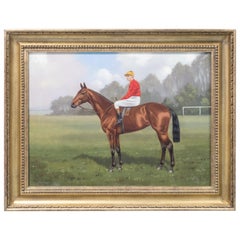
Portraits of a Jockey and Racehorse
Located in Lantau, HK
Clarence Hailey Newmarket (British born 1867-1949) famous for his painting of stallions and jockeys
Portraits of a jockey and racehorse
Newmarket, S...
Category
Early 20th Century English Asia - Paintings
Materials
Canvas
$6,000 Sale Price
20% Off
19th Century Japanese Scroll Painting, Birds
Flowers of the Four Seasons
Located in Kyoto, JP
Birds and flowers of the four seasons
Early to mid-19th century
Ink, pigment and gofun on silk
Unidentified artist
Signature: S...
Category
1830s Japanese Edo Antique Asia - Paintings
Materials
Silk
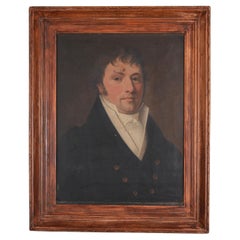
Portrait of Gilles Armand Vaquier de la Baume c. 1825
Located in 263-0031, JP
Bourbon Restoration portrait of French man. Dating from c. 1825, this handsome oil on canvas painting depicts a *homme bourgeois* displaying all the earmarks of the of the less-milit...
Category
1820s French Antique Asia - Paintings
Materials
Canvas
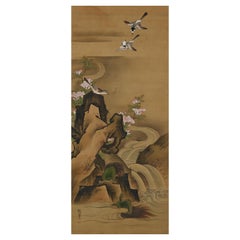
19th Century Japanese Silk Painting by Kano Chikanobu, Turtles
Azalea
Located in Kyoto, JP
Birds & flowers of the seasons
Pheasants & plum in snow
Unframed painting. Ink, pigment and gofun on silk
Kano Chikanobu 1819-1888
Signature...
Category
Mid-19th Century Asian Edo Antique Asia - Paintings
Materials
Silk
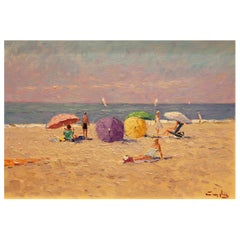
Impressionistic Beach Scene by Niek Van Der Plas
By Niek van der Plas
Located in Lantau, HK
Niek van der Plas paints impressionist scenes of Holland's beaches and dunes, bulb fields, city scenes in Amsterdam and Maastricht, and other typically Dutch vistas such as the harbo...
Category
21st Century and Contemporary Dutch Modern Asia - Paintings
Materials
Canvas
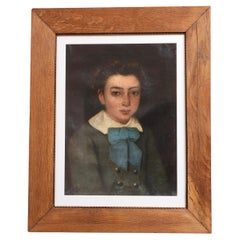
Early 19th Century French Oil-On-Canvas Portrait of Boy
Located in 263-0031, JP
French oil-on-canvas portrait of boy. Dating from the Louis Philippe Era of 1830-45, this charming portrait is done in a naive manner that evokes American portraiture from the same p...
Category
1840s French Louis Philippe Antique Asia - Paintings
Materials
Canvas
Antique Japanese Buddhist pagoda hanging scroll /Buddhist painting/Edo
Located in Sammu-shi, Chiba
This is a slightly different Buddhist painting believed to have been created by a Japanese temple monk during the Edo period (late 17th to 19th century). Rendered in ink on paper, th...
Category
18th Century Japanese Edo Antique Asia - Paintings
Materials
Paper

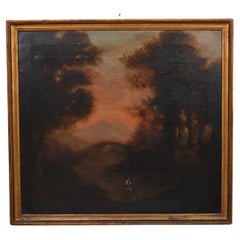
17th Century Oil Painting School of Claude Lorrain
By (after) Claude Lorrain (Claude Gellée)
Located in 263-0031, JP
A copy of the 1636 painting “River Ford” by the French proto-plein-air painter Claude Lorrain (1600-1682). This suivier, or follower, has faithfully reproduced the original but revis...
Category
17th Century European Antique Asia - Paintings
Materials
Canvas
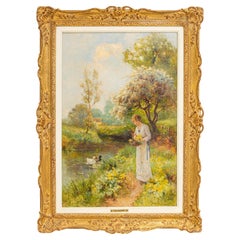
Ernest Charles Walbourn Dalston, a Young Woman Picking Flowers
Located in Lantau, HK
Ernest Charles Walbourn Dalston, 1872, Middlesex, 1927?
Walbourn dedicated his career to creating Victorian landscapes and countryside scenes.
Our painting reflects one of these char...
Category
Late 19th Century English Antique Asia - Paintings
Materials
Canvas
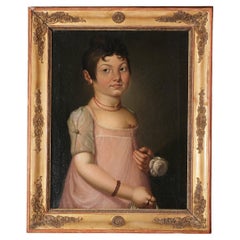
Young French Girl Portrait c. 1800 Oil On Canvas
Located in 263-0031, JP
Neoclassicism saturates this droll portrait of a French girl c. 1800: the high-waisted dress, the antique hairstyle "a la Titus” complemented with m...
Category
Early 18th Century French Neoclassical Antique Asia - Paintings
Materials
Canvas
French Oil on Panel Painting of a Woman c. 1815
Located in 263-0031, JP
French oil on panel painting of a woman. Composed on a wooden panel, this c. 1815 oil depicts a woman displaying the exaggerated, theatrical mannerisms of the Neoclassical style that...
Category
Early 19th Century French Neoclassical Antique Asia - Paintings
Materials
Wood
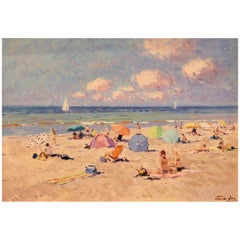
Perfect Beach Day by Niek van der Plas
By Niek van der Plas
Located in Lantau, HK
Niek van der Plas paints impressionist scenes of Holland's beaches and dunes, bulb fields, city scenes in Amsterdam and Maastricht, and other typically Du...
Category
21st Century and Contemporary Dutch Modern Asia - Paintings
Materials
Canvas
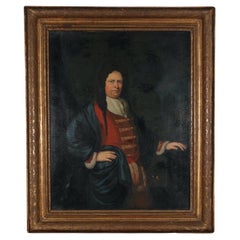
Early 18th-Century Baroque Portrait of a Nobleman
Located in 263-0031, JP
An oil-on-canvas full-scale portrait of a standing man in costume typical of the Baroque era of c. 1720, France. Purchased from a dealer in Geneva, Switzerland. The canvas is in good...
Category
Early 18th Century French Antique Asia - Paintings
Materials
Canvas
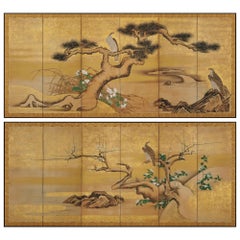
17th Century Japanese Screen Pair by Soga Nichokuan, Hawks on Pine
Plum Trees
Located in Kyoto, JP
Hawks on plum and pine
Soga Nichokuan (active circa 1625-1660)
Pair of six-fold screens.
Ink, mineral pigments, gofun, gold and speckled gold l...
Category
1640s Japanese Edo Antique Asia - Paintings
Materials
Wood, Paper
Japanese Screen Painting, Circa 1700
Tales of Ise
by Tosa Mitsusuke
By Tosa Mitsusuke 1
Located in Kyoto, JP
A six-fold Japanese screen by Tosa Mitsusuke (1675-1710), Japan 17th-18th century, Edo period.
The signature reads Shoroku-i ge Tosa sa Konoe Shogen Mit...
Category
Late 17th Century Japanese Edo Antique Asia - Paintings
Materials
Gold Leaf
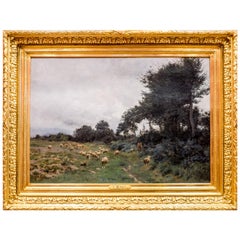
Landscape with Sheep by Victor Binet
Located in Lantau, HK
A late 19th century Barbizon School oil on canvas by Victor Jean Baptiste Barthélemy Binet (1849-1924), featuring a rural scene of sheep with a shepherd on a cloudy day.
He exhibite...
Category
Late 19th Century French Antique Asia - Paintings
Materials
Canvas
Still Thinking About These?
All Recently ViewedMore Ways To Browse
Vintage Fenwick
Vintage Figgjo Flint Norway
Vintage File Drawers
Vintage Fishing Line
Vintage Fishing Spear
Vintage Frog Figurines
Vintage Frog Pottery
Vintage Frosted Tom Collins Glasses
Vintage Gavels
Vintage Geisha Kimono
Vintage Glass Bottle Stoppers Pourers Stoppers
Vintage Glass Cookie Jar With Lid
Vintage Glasses In Caddy
Vintage Grooming Set
Vintage Hand Jewelry Holder
Vintage Hanuman
Vintage Hawaiian Tiki
Vintage Ice Maker