Berlin - Animal Drawings and Watercolors
to
2
1
Overall Width
to
Overall Height
to
2
1
2
1
2
1
1
1
1
1
1
1
2
1
1
1
1
1,598
803
Item Ships From: Berlin
Vigilant Fox - The psyche of the fox -
Located in Berlin, DE
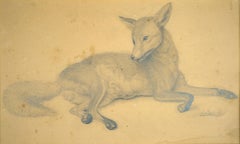
Carl Friedrich Deiker (1838 Wetzlar - 1892 Düsseldorf). Vigilant fox. Pencil drawing on brown paper, 18 × 29.5 cm (inside measurement), 31.5 x 43.5 cm (mount), signed and dated "Deiker [18]54" at lower right.
- a little bit stained, with a light water stain at lower right
About the artwork
Carl Friedrich Deiker's consummate ability to depict animals is already evident in this early work. He brought a whole new psychological dimension to animal painting, so that one could literally speak of animal portraits.
The naturalistic appearance of the fox alone makes it seem alive. Every strand of muscle, even every hair, is captured, which requires an intensive artistic study of animal anatomy and physiology. But the fox's real liveliness comes not from its natural appearance, but from its internal movement: Stretched out, it has been brought out of rest. It turns around and, with its ears pricked up, looks intently in the direction from which it has seen something. His mouth is slightly open and his pointed teeth are bared, as if he were growling. Tension gradually takes hold of his whole body. While the hind legs were still in a relaxed position, closely observed by Deiker, one front leg was already raised, ready to begin a rising movement. The fox seems so alarmed with all its senses that one gets the impression that, at any moment, its tail will move jerkily and the animal will jump up.
While wild animals have traditionally been portrayed as beasts or anthropomorphised, often for caricatural purposes, Deiker explores their inherent nature by attempting to capture their psychic impulses. The wild animal is neither bestial nor human, but a creature in its own right, valued by Deiker for its own sake. In this way, he brought the dignity of the animal into representation and raised animal painting to a whole new artistic level.
About the artist
Carl Friedrich Deiker was the son of the drawing teacher Christian Friedrich Deiker and the younger brother of the animal painter Johannes Deiker. In addition to the family art lessons, Christian Friedrich shared a studio with his brother Johannes at Braunfels Castle, Deiker attended the drawing academy in Hanau, and from 1858 he was a student at the Karlsruhe Art Academy, where he studied under the landscape painter Johann Wilhelm Schirmer. Carl Friedrich Deiker was already in demand as an artist during his first year: Grand Duke Frederick I of Baden, Margrave Max of Baden and Grand Duke Michael of Russia bought hunting scenes by him.
In 1859 he went on a study trip to the Reinhardswald. Just as the Barbizon School had rediscovered the landscape, Deiker opened up the forest for animal painting.
From 1861-64 Deiker had his own studio in Karlsruhe, then moved to Düsseldorf, where his brother Johannes followed four years later. Deiker married a daughter of the landscape painter Karl Hilger and remained in Düsseldorf until his death.
In 1868 he finally achieved international fame with his painting 'Pursued Noble Deer' and was regarded as a virtuoso new founder of animal painting.
"Deiker brought for the first time a truly great artistic quality to animal painting [...]".
- Hans Vollmer
From 1870 he participated in the academic art exhibitions in Berlin, Dresden, Munich and Hanover. He was also very busy as an illustrator. He drew for the Gartenlaube, the Salon, the Universum, and produced many of the finely illustrated hunting and animal books of the period. He also worked as a printmaker, while his oil paintings circulated as reprints by Franz Dinger.
From 1865 to 1892 Deiker was a member of the artists' association Malkasten.
Carl Friedrich Deiker's life's work was honoured with a large posthumous memorial exhibition at the Düsseldorf Kunsthalle in 1892.
His son Carl Deiker, born in 1879, also became a painter.
Selection of art museums that own works by Carl Friedrich Deiker:
Hamburger Kunsthalle / Kunsthalle Karlsruhe / Kunstmuseum Düsseldorf / Wallraff Richartz Cologne.
Selected Bibliography
H. Schmidt: Johannes and...
Category
1850s Naturalistic Berlin - Animal Drawings and Watercolors
Materials
Pencil
Feeding the Kittens - Little cat mother -
Located in Berlin, DE
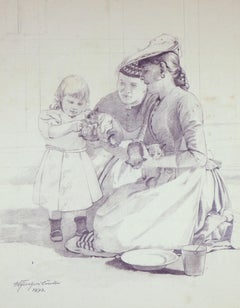
Ernst Albert Fischer-Cörlin (1853 Körlin - 1932 Persante). Feeding the Kittens, 1893. Pencil on painting cardboard, 38 x 29 cm. Signed and dated by the artist at lower left "E[rnst] A[lbert] Fischer=Cörlin 1893".
- Lightly stained, somewhat dusty and minimally foxed.
- Little cat mother -
About the artwork
Daughter, mother and grandmother gather in the sunlight to feed a litter of kittens. The mother and grandmother hold the lively, playful animals in their arms, while the young girl feeds two of the four kittens with cookies. There is also a small bucket of milk and a bowl of milk. The women and the girl watch as the cute, still blind animals eat.
It is a scene taken from everyday life, but it also has an allegorical dimension, bringing maternal care into the representation. Three generations are represented, with the grandmother and the mother already mothers. They not only offer the kittens to the youngest, but also proudly observe the maternal care that the youngest gives to the kittens. Like the kittens, she will grow up and become a mother herself, so the image is also an allegory of life's ever-new beginnings. In keeping with this, the morning sun shines into the picture from the right. Fischer-Cörlin has masterfully worked out the quality of the light, with its light and dark areas, with the pencil used...
Category
1890s Academic Berlin - Animal Drawings and Watercolors
Materials
Cardboard, Carbon Pencil
Schrödingers Bird 14
Located in Berlin, DE
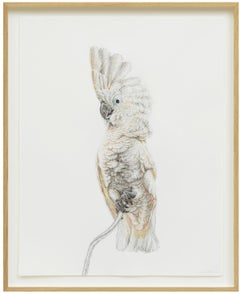
Signed and dated 'S. Schüffler 2021' lower right. From the series 'An Experiment on a Bird'. On white Mi-Teintes paper, Canson.
Category
21st Century and Contemporary Berlin - Animal Drawings and Watercolors
Materials
Chalk, Pastel
Related Items
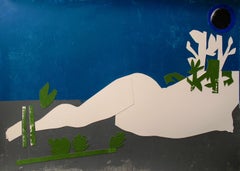
Siren - Contemporary Art, Nude, Female, Nature, White, Blue, Gray, Flowers
By Alexandru Rădvan
Located in Baden-Baden, DE
Siren, 2015
Collage on cardboard
27 9/16 H x 39 3/8 W in.
70 H x 100 W cm
The artist's reference on fundamental myths of humanity and their analysis from the perspective of contempo...
Category
2010s Contemporary Berlin - Animal Drawings and Watercolors
Materials
Paper, Acrylic, Cardboard

$1,442
H 31.5 in W 43.31 in D 3.15 in
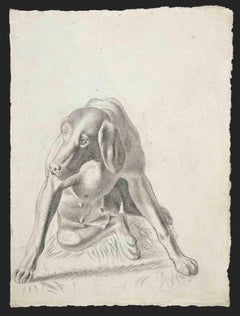
Portrait of Dog - Original Pencil Drawing - 1950
Located in Roma, IT
Portrait of Dog is an original pencil drawing realized by an artist of the mid 20th Century.
Good condition, no signature.
On a white cardboard.
Category
1950s Modern Berlin - Animal Drawings and Watercolors
Materials
Pencil
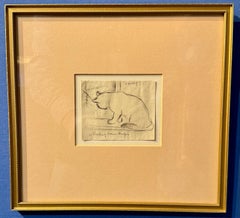
English mod British Pencil study of a cat by a window Watching Raindrops
By Lucy Dawson
Located in Woodbury, CT
Lucy Dawson (British, 1870–1954)
Watching Raindrops (“Whisky”), circa 1950
Pencil on paper, inscribed and titled
This delicate pencil study by Lucy Dawson, also known by her artist’...
Category
1930s Modern Berlin - Animal Drawings and Watercolors
Materials
Paper, Carbon Pencil
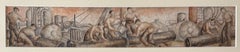
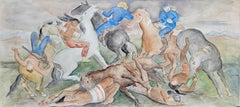
WPA Post Office Mural Study American Scene Regionalism Social Realism Modern Art
By Louise Ronnebeck
Located in New York, NY
WPA Post Office Mural Study American Scene Regionalism Social Realism Modern Art
Louise Emerson Ronnebeck (1901 - 1980)
Oil Riggers, Mural Study
Image: 6 1/2 x 37 inches
Watercolor ...
Category
1930s American Modern Berlin - Animal Drawings and Watercolors
Materials
Paper, Watercolor, Cardboard
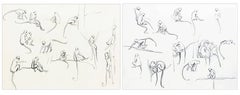
A Pair of Framed Monkey Studies
By Alexander Oscar Levy
Located in Buffalo, NY
A pair of exquisite drawings by American Ashcan School artist Alexander Oscar Levy.
Category
1920s Ashcan School Berlin - Animal Drawings and Watercolors
Materials
Archival Paper, Graphite
WPA Post Office Mural Study Native American Scene Regionalism Social Realism
By Louise Ronnebeck
Located in New York, NY
WPA Post Office Mural Study Native American Scene Regionalism Social Realism
Louise Emerson Ronnebeck (1901 - 1980)
Proposal Sketch for Worland Wyoming Post Office WPA Mural Project
Image: 7 x 15 inches
Board 14 x 22 inches
Watercolor on paper, attached to black/gray cardboard/thick paper
c. 1937
Signed lower right
Written in Louise's hand on mounting paper in white chalk/pencil: "Sketch for Mural...
Category
1930s American Realist Berlin - Animal Drawings and Watercolors
Materials
Paper, Watercolor, Cardboard
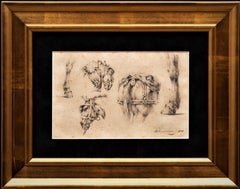
Antique Horse "Heads, Hooves, Rump 1838" Wouterus Verschuur (Dutch, 1812-1874)
Located in SANTA FE, NM
Antique Horse Study
"Heads, Hooves and Rump, 1838"
Wouterus Verschuur (Dutch, 1812-1874)
Pencil on paper
Signed and Dated "W Verschuuur 1838"
10 x 6 1/2 (17 1/2 x 14 frame) inches
In his time Wouterus Verschuur was an acclaimed and celebrated painter of horses. Through careful observation he learned to capture their physique and movement to perfection. As a true-born romanticist he was also interested in their character, thereby painting powerful carthorses in their stable, thoroughbred saddled horses during an afternoon ride or harnessed horses in action.
He was born to an Amsterdam jeweler and received his training from the landscape and cattle painters Pieter Gerardus van Os and Cornelis Steffelaar. As part of this education Verschuur had to copy works by the 17th century painter Philips Wouwerman. Like Wouwerman, Verschuur's subjects consist mostly of stable scenes, landscapes with horses and coastal landscape. These works reflect the enduring influence of the northern Baroque masters on nineteenth century art, revealing the artist's close study of his Dutch and Flemish predecessors harking back to Peter Paul Rubens.
Showing talent from a very early age, at 15 Verschuur had a painting exhibited at the "Exhibition of Living Masters" at Amsterdam in 1828. In 1832 and 1833 he won the gold medal at the annual exhibition at Felix Meritis. In 1833 he was appointed a member of the Royal Academy in Amsterdam. In 1839 he joined the artists' society, Arti et Amicitiae.
His reputation was also considerable abroad. He was often featured in the annual exhibitions which travelled the large European cities at that time. In 1855 Napoleon III purchased one of his paintings at the Exposition Universelle* in Paris.
The Verschuur horse revels in its physicality, like a quintessential Baroque horse...
Category
1830s Romantic Berlin - Animal Drawings and Watercolors
Materials
Paper, Pencil
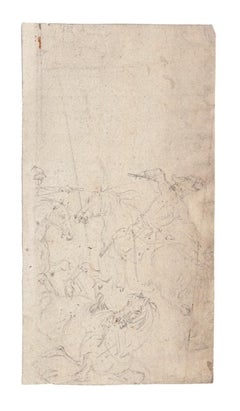
Horses - Pencil Drawing - Mid-20th Century
Located in Roma, IT
Horses is a pencil drawing on ivory-colorated paper, realized by unknown Artist of Mid-20th Century.
In very good conditions.
Not signed.
Illegible signature on the back of the dr...
Category
Mid-20th Century Modern Berlin - Animal Drawings and Watercolors
Materials
Pencil
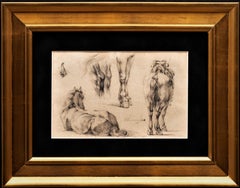
Antique Horse Study; Legs and Rumps, 1838" Wouterus Verschuur (Dutch, 1812-1874)
Located in SANTA FE, NM
Antique Horse Study
"Legs and Rumps, 1838"
Wouterus Verschuur l (Dutch, 1812-1874)
Pencil on paper
Signed and Dated "W Verschuur 1838"
10 x 6 1/2 (17 1/2 x 14 frame) inches
In his time Wouterus Verschuur was an acclaimed and celebrated painter of horses. Through careful observation he learned to capture their physique and movement to perfection. As a true-born romanticist he was also interested in their character, thereby painting powerful carthorses in their stable, thoroughbred saddled horses during an afternoon ride or harnessed horses in action.
He was born to an Amsterdam jeweler and received his training from the landscape and cattle painters Pieter Gerardus van Os and Cornelis Steffelaar. As part of this education Verschuur had to copy works by the 17th century painter Philips Wouwerman. Like Wouwerman, Verschuur's subjects consist mostly of stable scenes, landscapes with horses and coastal landscape. These works reflect the enduring influence of the northern Baroque masters on nineteenth century art, revealing the artist's close study of his Dutch and Flemish predecessors harking back to Peter Paul Rubens.
Showing talent from a very early age, at 15 Verschuur had a painting exhibited at the "Exhibition of Living Masters" at Amsterdam in 1828. In 1832 and 1833 he won the gold medal at the annual exhibition at Felix Meritis. In 1833 he was appointed a member of the Royal Academy in Amsterdam. In 1839 he joined the artists' society, Arti et Amicitiae.
His reputation was also considerable abroad. He was often featured in the annual exhibitions which travelled the large European cities at that time. In 1855 Napoleon III purchased one of his paintings at the Exposition Universelle in Paris.
The Verschuur horse revels in its physicality, like a quintessential Baroque horse...
Category
1830s Romantic Berlin - Animal Drawings and Watercolors
Materials
Paper, Pencil
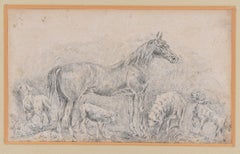
Horse with Herds - China Ink Drawing by Filippo Palizzi - 1895
By Filippo Palizzi
Located in Roma, IT
Image dimensions: 14x22 cm.
Horse with Herds is a really beautiful china ink original drawing on paper, signed and dated in black ink on lower margin by the Italian artist, Filippo Palizzi...
Category
1890s Naturalistic Berlin - Animal Drawings and Watercolors
Materials
Ink
$1,442
H 12.21 in W 15.28 in D 0.67 in
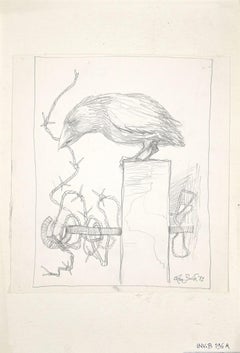
The Crow - Pencil Drawing by Leo Guida - 1972
By Leo Guida
Located in Roma, IT
The Crow is an original Contemporary artwork realized in 1972 by the italian artist Leo Guida.
Original Drawing.
Dated and Hand-signed in pencil on the lower right margin: Leo Guid...
Category
1970s Contemporary Berlin - Animal Drawings and Watercolors
Materials
Paper, Pencil
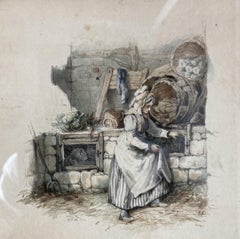
Attributed to Eugène Lami (1800-1890) A Maid feeding rabbits, Watercolor
By Eugène Louis Lami
Located in Paris, FR
Attributed to Eugène Lami (1800-1890)
A maid feeding rabbits
Watercolor on paper
Bears a monogramm E L on the lower right
12.5 x 12.5 cm
In good condition, some foxings in the uppe...
Category
1860s Academic Berlin - Animal Drawings and Watercolors
Materials
Watercolor
$655
H 4.93 in W 4.93 in
Previously Available Items
Still life with dead goldfinch - The mystic blue transcends death -
Located in Berlin, DE
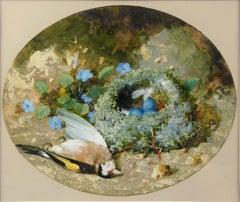
William Cruickshank (1848-1922). Still Life with a Dead Goldfinch and Nest. Watercolour and gouache on buff paper, 21 x 24.5 cm (visible size), 40 x 42 cm (frame), signed W Cruickshank on the left. Framed behind glass in a passpartout.
About the artwork
The painting has an atmosphere of melancholy beauty. The clutch of eggs, recalling the wonderfully mysterious blue of Romanticism, the matching blue flowers and the goldfinch with its black, yellow and red plumage show nature in all its beauty, and yet the goldfinch is dead. It lies on its back, its head bent backwards in an unnatural way, its claws lifeless and one wing outstretched in a last effort. This makes the scene a natura morta, a still life that spreads the melancholy silence of an eternal moment. Yet there is also an inherent movement in the picture, enhanced by the streaky application of paint.
A movement that here signifies the intertwining of life and death: death, which the goldfinch has met in mid-life, before it has been able to hatch its offspring, while at the same time the mysterious blue eggs that have not hatched point to a higher life after death. Finally, the goldfinch feeding on the thorny thistles traditionally represents Christ and his redemptive sacrificial death. The goldfinch is depicted in a similar way in Carel Fabritius' famous painting The Thistle Finch (1654), in the Mauritshuis in The Hague. The bird is alive, but chained and thus prevented from flying.
In this tradition, Cruickshanks' painting is a memento mori that is immediately appealing to today's viewer - a meditative image of life and death that also contains an affirmation of life in all the beauty of creation. In order to enhance the readability of this pictorial sense, the objects depicted are tilted into the plane so that the individual elements of the picture can be more easily related to one another, but without destroying the sense of space.
Cruickshank, who specialised in this type of painting, combined the emblematics of the Baroque with the imagery of Romanticism and a style borrowed from landscape painting. Cruickshank's mastery of materials is evident in his fusion of watercolour and gouache, in which the more intense colours of gouache concretise the motif from an indeterminate, moving colour space. The painted objects have the aesthetic quality of fine painting, although, as in the case of the nest, they are formed by a virtuoso structure of blotches.
Selected bibliography
Algernon Graves: The Royal Academy of Arts. A complete dictionary of contributors and their work from its foundation in 1769 to 1904, vol. 2: Carroll to Dyer, London 1905.
Leo R. Schidlof: The miniature in Europe. In the 16th, 17th, 18th, and 19th centuries, vol. 1: A - L, Graz 1964.
Jeremy Maas: Victorian painters, London 1996.
Daphne Foskett: A Dictionary of British miniature...
Category
1890s English School Berlin - Animal Drawings and Watercolors
Materials
Watercolor, Gouache
Still Thinking About These?
All Recently ViewedMore Ways To Browse
Zoe Mozert
15th Century Religious Paintings
16x20 Gilt Frame
17th Century Female Portraits
1800s Paintings Children
1920s Farm Painting
1963 Vintage Port
1993 Wedding Dress
4x6 Small Painting
70s Vintage Psychedelic Art
A J Robertson
Aaron Garber Maikovska
Abraham Herbe
African Village Oil Painting
Al Freno
Albert Swayhoover
Albert Tucker
Alberto Magnani Art