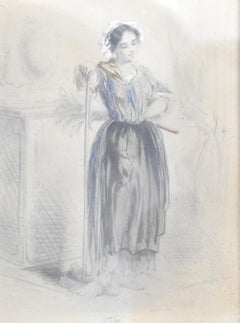
Continental Europe - Figurative Drawings and Watercolors

to
500
4,773
879
609
246
119
Overall Width
to
Overall Height
to
128
668
4,435
1,395
110
126
180
204
201
335
423
643
240
92
85
2,936
1,627
165
109
74
72
62
49
31
11
7
3
1
4,033
2,431
152
4,995
3,101
2,774
1,885
1,603
1,349
1,030
963
692
255
206
198
178
177
176
144
142
124
122
113
2,522
2,325
2,100
1,972
1,861
893
319
240
105
50
1,040
4,492
6,626
8,213
6,222
Item Ships From: Continental Europe
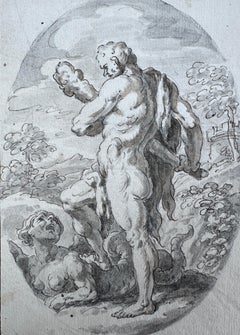
Hercules vanquishing a drakaina (half‑woman, half‑serpent)
By Giovanni Domenico Tiepolo
Located in Paris, Île-de-France
Circle of Giovanni Domenico Tiepolo (Venice 1727 – Madrid 1804) Hercules vanquishing a drakaina (half‑woman, half‑serpent) – interpreted either as Echidna or a personified Hydra c. ...
Category

18th Century Old Masters Continental Europe - Figurative Drawings and Watercolors

Materials

Ink

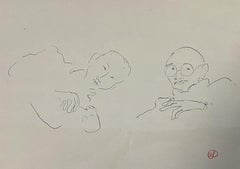
Jean Launois (1898-1942) Opium smokers, Indochina, original drawing
Located in Paris, FR
Jean Launois (1898-1942) Opium smokers, Indochina Stamp of the artit's estate on the lower right Black ink on paper 22.5 x 30.5 cm Framed : 38 x 46 cm This beautiful drawing, a fine example of Jean Launois' particular art, dates from the artist's stay in Indochina, from which he brought a group of works. An exhibition devoted to this Indochinese period of the artist's production was held at the Musée de l'Abbaye Sainte-Croix, Sables d'Olonne in 1998. About the artist : Of Vendée origin, Jean Launois very quickly showed a sure talent for drawing and was encouraged in this by his parents. He trained with his fellow Vendeans Charles Milcendeau and Auguste Lepère and then entered the Académie Jullian in Paris. Enrolled in the First World War in 1916, he continued to draw at the front, and produced numerous portraits of soldiers...
Category

1920s Post-Impressionist Continental Europe - Figurative Drawings and Watercolors

Materials

Ink

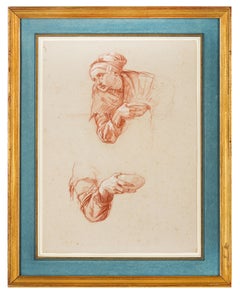
Study Of A Woman Holding A Bowl
By Isidore Alexandre Augustin Pils
Located in Paris, Île-de-France
Isidore Pils (Paris, 1813 – Douarnenez, 1875) Study of a Woman Holding a Bowl Red chalk, heightened with white chalk, on buff paper 36.3 × 26.5 cm (14 ¼ × 10 ⅜ in.) Unsigned Prove...
Category

1850s Academic Continental Europe - Figurative Drawings and Watercolors

Materials

Chalk

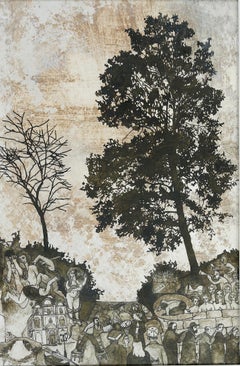
"The Small Collar", Trees Inhabited by Human, Paper Drawing with Pigment Colors
By Frank Girard
Located in Clermont-Ferrand, Auvergne-Rhône-Alpes
This drawing by Frank Girard is created with ink and pigments Colors, on 300g/m2 neutral white paper. It is not framed. Through drawings, the masterful French artist Frank Girard is...
Category

2010s Realist Continental Europe - Figurative Drawings and Watercolors

Materials

Paper, Ink, Watercolor, Pigment

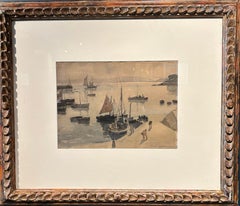
"ritorno dalla pesca" Acquarello cm. 22 x 29 1930 ca
By Henry Maurice CAHOURS
Located in Torino, IT
Signed ,Grey,blue,Britany,Harbor,Nord France,Sea Life in Brittany Harbor Douarnenez Blue and gray colors of the sea of northern France Henry Maurice CAHOURS (Paris, 1889 – Vence, ...
Category

1930s Impressionist Continental Europe - Figurative Drawings and Watercolors

Materials

Watercolor, Paper

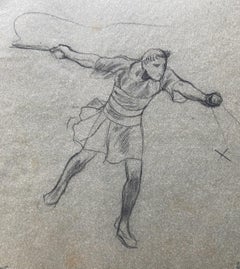
G. A. Rochegrosse (1859-1938) , Study for "Le Cocher" original drawing
By Georges Antoine Rochegrosse
Located in Paris, FR
Georges Antoine Rochegrosse (1859-1938) Study for "Le Cocher" carbon pencil on thin paper 14.5 x 13 cm In good condition Framed : 36.7 x 31 cm Provenance: Estate of the artist and...
Category

1910s Symbolist Continental Europe - Figurative Drawings and Watercolors

Materials

Carbon Pencil

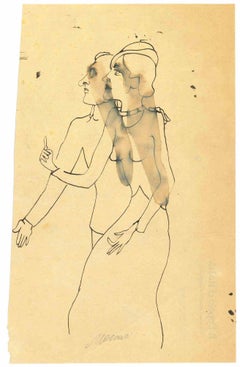
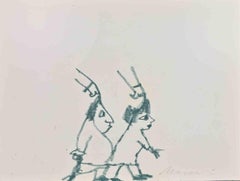
The Couple - Drawing by Mino Maccari - 1950s
By Mino Maccari
Located in Roma, IT
The Couple is an original Drawing in pen on creamy-colored paper realized by Mino Maccari in mid 20th century. Hand-signed on the lower in pencil. Good conditions. Mino Maccari (1...
Category

1950s Modern Continental Europe - Figurative Drawings and Watercolors

Materials

Ballpoint Pen, Watercolor

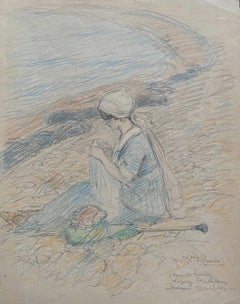
Lubin de Beauvais (1873-1917) L Anse de Launay 1911, signed color drawing
Located in Paris, FR
Lubin de Beauvais (1873-1917) L'anse de Launay, a woman at the beach, 1911 signed, dated and titled "Anse de Launay, Loguivy Ploubazlanec, Bretagne,...
Category

1910s Impressionist Continental Europe - Figurative Drawings and Watercolors

Materials

Pencil, Color Pencil

France 18th Century, Pastorale (Arcadian Landscape), original drawing
Located in Paris, FR
France 18th Century, Pastorale (Arcadian Landscape) Black chalk and heightenings of white gouache on blue-grey paper 19 x 31 cm Framed : 34.5 x 46.5 cm The atmosphere and the subje...
Category

1760s Old Masters Continental Europe - Figurative Drawings and Watercolors

Materials

Chalk

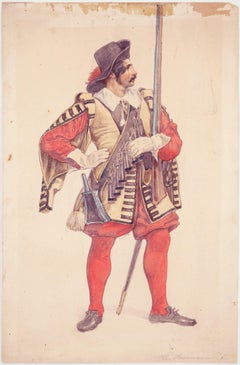
The actor Karl Seydelmann as soldier / - The expressiveness of a simple pose -
Located in Berlin, DE
Theodor Hosemann (1807 Brandenburg - 1875 Berlin), The actor Karl Seydelmann as soldier, around 1840. Watercolor in pencil, 22 cm (height) x 14.7 cm (width), signed “Th.[eodor] Hosem...
Category

1840s Realist Continental Europe - Figurative Drawings and Watercolors

Materials

Paper

Watercolor Belgian Orientalist Painting Marocco Horsemen Horse 19th
Located in PARIS, FR
Maurice Romberg de Vaucorbeil Schaerbeek, 1862 – Neuilly-sur-Seine, 1943 The Rest of the Riders Watercolor 12.5 x 19 cm (21 x 26 cm with frame) Signed lower right "MR" Very good cond...
Category

Late 19th Century Impressionist Continental Europe - Figurative Drawings and Watercolors

Materials

Watercolor

German Contemporary Art by Juliane Hundertmark - Pool
Located in Paris, IDF
Oil on canvas, Juliane Hundertmark is a German artist born in 1971 who lives and works in Berlin, Germany. She is considered one of Berlin's most original and inventive emerging pai...
Category

2010s Continental Europe - Figurative Drawings and Watercolors

Materials

Oil, Canvas

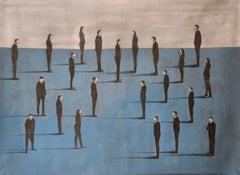
Figurative Drawing on Paper - Blue - Figurines Grupo 22 - Graphite
Located in Vilnius, Vilniaus apskr.
Work is framed with Plexiglass Signed on the right bottom corner of the drawing. Amilcar's drawings from the series of "Utopia by Tolina" inspired by the imagination of the artist’...
Category

2010s Contemporary Continental Europe - Figurative Drawings and Watercolors

Materials

Paper, Pencil, Color Pencil, Graphite
French school 18th Century, A mytholological scene with a couple, drawing
Located in Paris, FR
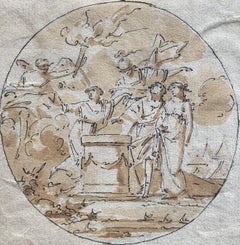
French school 18th Century, A mytholological scene with a couple, Pen and brown ink, brown ink wash on paper 11.5 x 11.5 cm, diameter of the main scene : 10,5 cm in a modern frame under glass : 33.5 x 33.5 cm This drawing by a particularly talented 18th-century artist - as yet unidentified - is notable for its mastery of pen and wash...
Category

1760s Old Masters Continental Europe - Figurative Drawings and Watercolors

Materials

Ink

Siebe Johannes Ten Cate (1858-1908) A garden in Zurich, 1898, pastel signed
By Siebe Johannes Ten Cate
Located in Paris, FR
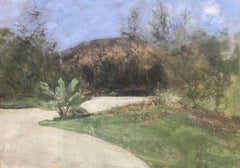
Siebe Johannes Ten Cate (1858-1908) A Garden in Zurich, 1898 Signed, located and dated "Zurich 98" lower right Pastel on paper 28.5 x 41.5 cm in good condition, trace of a small t...
Category

1890s Impressionist Continental Europe - Figurative Drawings and Watercolors

Materials

Pastel

Vigilant Fox - The psyche of the fox -
Located in Berlin, DE
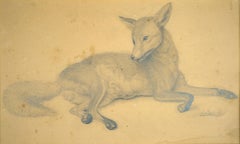
Carl Friedrich Deiker (1838 Wetzlar - 1892 Düsseldorf). Vigilant fox. Pencil drawing on brown paper, 18 × 29.5 cm (inside measurement), 31.5 x 43.5 cm (mount), signed and dated "Deiker [18]54" at lower right. - a little bit stained, with a light water stain at lower right About the artwork Carl Friedrich Deiker's consummate ability to depict animals is already evident in this early work. He brought a whole new psychological dimension to animal painting, so that one could literally speak of animal portraits. The naturalistic appearance of the fox alone makes it seem alive. Every strand of muscle, even every hair, is captured, which requires an intensive artistic study of animal anatomy and physiology. But the fox's real liveliness comes not from its natural appearance, but from its internal movement: Stretched out, it has been brought out of rest. It turns around and, with its ears pricked up, looks intently in the direction from which it has seen something. His mouth is slightly open and his pointed teeth are bared, as if he were growling. Tension gradually takes hold of his whole body. While the hind legs were still in a relaxed position, closely observed by Deiker, one front leg was already raised, ready to begin a rising movement. The fox seems so alarmed with all its senses that one gets the impression that, at any moment, its tail will move jerkily and the animal will jump up. While wild animals have traditionally been portrayed as beasts or anthropomorphised, often for caricatural purposes, Deiker explores their inherent nature by attempting to capture their psychic impulses. The wild animal is neither bestial nor human, but a creature in its own right, valued by Deiker for its own sake. In this way, he brought the dignity of the animal into representation and raised animal painting to a whole new artistic level. About the artist Carl Friedrich Deiker was the son of the drawing teacher Christian Friedrich Deiker and the younger brother of the animal painter Johannes Deiker. In addition to the family art lessons, Christian Friedrich shared a studio with his brother Johannes at Braunfels Castle, Deiker attended the drawing academy in Hanau, and from 1858 he was a student at the Karlsruhe Art Academy, where he studied under the landscape painter Johann Wilhelm Schirmer. Carl Friedrich Deiker was already in demand as an artist during his first year: Grand Duke Frederick I of Baden, Margrave Max of Baden and Grand Duke Michael of Russia bought hunting scenes by him. In 1859 he went on a study trip to the Reinhardswald. Just as the Barbizon School had rediscovered the landscape, Deiker opened up the forest for animal painting. From 1861-64 Deiker had his own studio in Karlsruhe, then moved to Düsseldorf, where his brother Johannes followed four years later. Deiker married a daughter of the landscape painter Karl Hilger and remained in Düsseldorf until his death. In 1868 he finally achieved international fame with his painting 'Pursued Noble Deer' and was regarded as a virtuoso new founder of animal painting. "Deiker brought for the first time a truly great artistic quality to animal painting [...]". - Hans Vollmer From 1870 he participated in the academic art exhibitions in Berlin, Dresden, Munich and Hanover. He was also very busy as an illustrator. He drew for the Gartenlaube, the Salon, the Universum, and produced many of the finely illustrated hunting and animal books of the period. He also worked as a printmaker, while his oil paintings circulated as reprints by Franz Dinger. From 1865 to 1892 Deiker was a member of the artists' association Malkasten. Carl Friedrich Deiker's life's work was honoured with a large posthumous memorial exhibition at the Düsseldorf Kunsthalle in 1892. His son Carl Deiker, born in 1879, also became a painter. Selection of art museums that own works by Carl Friedrich Deiker: Hamburger Kunsthalle / Kunsthalle Karlsruhe / Kunstmuseum Düsseldorf / Wallraff Richartz Cologne. Selected Bibliography H. Schmidt: Johannes and...
Category

1850s Naturalistic Continental Europe - Figurative Drawings and Watercolors

Materials

Pencil

The Ruins of St. Clement s Church in Visby, Sweden / - Real romanticism -
Located in Berlin, DE
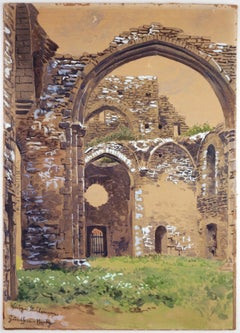
Otto Günther-Naumburg (1856-1941), The Ruins of St. Clement's Church in Visby, Sweden. Watercolor and ink, heightened with white, on sand-colored paper, mounted on cardboard, 33 x 24...
Category

Early 20th Century Realist Continental Europe - Figurative Drawings and Watercolors

Materials

Paper

Paul Emile Lecomte (1877-1950) A landscape, signed watercolor
By Paul Emile Lecomte
Located in Paris, FR
Paul Emile Lecomte (1877-1950) A Landscape Signed lower left Watercolor on paper 22.5 x 30.5cm In good condition Framed: 37.5 x 46 cm Paul Emile Lecomte (1877– 1950). Painter of wat...
Category

1930s Post-Impressionist Continental Europe - Figurative Drawings and Watercolors

Materials

Watercolor

The Puzzling Show - Drawing by Mino Maccari - 1960s
By Mino Maccari
Located in Roma, IT
The Puzzling Show is a Pen Drawing realized by Mino Maccari (1924-1989) in the 1960s. Hand-signed in the lower margin. Good condition. Mino Maccari (Siena, 1924-Rome, June 16, 19...
Category

1960s Modern Continental Europe - Figurative Drawings and Watercolors

Materials

Ballpoint Pen

Sketch of a head - Carved in stone -
Located in Berlin, DE
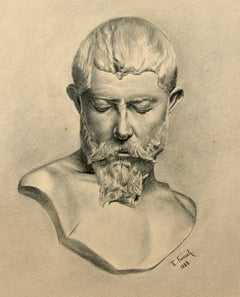
Emil Faesch (1865 Basel - 1915 Basel). Sketch of a head. Charcoal on painting cardboard, 60 x 47.5 cm (folio size), signed and dated at lower right "E. Faesch. 1888.". Minor browning. - Carved in stone - About the artwork The life-size head has an immensely present presence. This effect is due to the fact that Faesch took his cue from academic classical...
Category

1880s Realist Continental Europe - Figurative Drawings and Watercolors

Materials

Chalk

French Romantic school, Portrait of a young man, drawing
Located in Paris, FR
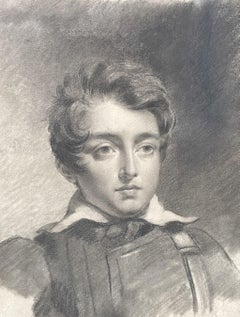
French Romantic school, circa 1840 Portrait of a young man, charcoal on paper 22.5 x 17 cm In good condition, however, there is a restoration of the paper in the upper right-hand qu...
Category

1840s Romantic Continental Europe - Figurative Drawings and Watercolors

Materials

Charcoal

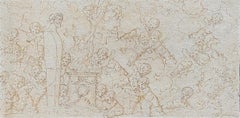
Louis-Félix de La Rue (1730-1777)  Putti playing around a sculpture, drawing
By Louis-Félix Delarue
Located in Paris, FR
Louis-Félix de La Rue (1730-1777)  Putti playing around a sculpture, a mythological scene Pen and brown ink on paper 15.4 x 31 cm In good condition The ancient mount has has a smal...
Category

1770s Old Masters Continental Europe - Figurative Drawings and Watercolors

Materials

Ink

Study of woman figure
By Louis A. F. (Jean-Louis) Janmot
Located in PARIS, FR
Jean Louis Janmot (Lyon 1814 - 1892) Study of woman figure Black pencil 10,6 x 14,4 cm (26,6 x 30,2 x 6 cm with the frame) Provenance : from the artist's series of drawings. Wi...
Category

19th Century Continental Europe - Figurative Drawings and Watercolors

Materials

Pencil

Swiss Contemporary Art by Olivier Furter - Île-de-France III
Located in Paris, IDF
Oil on linen canvas - Framed 63.8 x 84 x 3.4 cm
Category

2010s Contemporary Continental Europe - Figurative Drawings and Watercolors

Materials

Canvas, Oil

Fenzoni, Painting AND preparatorial Drawing, John the Baptist, Italy Renaissance
By Ferrau Fenzoni
Located in Greven, DE
The painting and the preparatory drawing are offered together. Provenance Private collection, Germany, Trier, c. 1980- 2013 Saint John the Baptist Brown ink and wash over red chalk on oatmeal paper 31 x 20.5 cm Inscribed: „Ferrau Fenzonio da Faenza invt. esque … imp. da Fran. Villamena …“. bears the collector's mark of Henry Scipio Reitlinger (1882-1950; Lugt 2274a) on a tiny label glued to the verso On the reverse is a partial drawing of a Pieta, pricked for transfer. Provenance New York, Doyle, 14. October 2015, No. 6 The painting and the preparatory drawing resemble the composition of an engraving after Ferraù Fenzoni by Francesco Villamena. Drawing, engraving and painting are almost identical, except for minor differences. Even the measurements nearly correspond: painting (32 x 25,5 cm), drawing (30 x 20,5 cm), engraving (31,1 x 23,5 cm). Dr. Guiseppe Scavizzi confirmed the attribution of the present panting to Fenzoni and he dates it to c. 1590. The inscription on the drawing reads “Ferrau Fenzonio da Faenza invt. esque. . . imp. da Fran: Villamena . . .”. The engraving’s inscription also lists place and date “Ferra Fensionius inventor/F. Villamoena sculpsit Rome/Aspectu fruitur… antra puer/cum Privilegio… 1613”. Interestingly, the engraving is not mirrored as it is in most printing processes. Painting, drawing and engraving are not reversed but the same. It is remarkable to note that there are further paintings by Fenzoni which were engraved in the same order and not reverted. They also show strong parallels regarding the compositions and the measurements (see for example “Deposition of Christ” ). Ferraù Fenzoni was an Italian painter mainly active in Todi. He is also called Il Faenzone after his birthplace (Faenza). He apprenticed in Rome during the papacy of Gregory XIII and contributed to numerous fresco cycles under pope Sixtus V, such as the Loggia della Benedizioni in the Lateran Palace, the frescoes on the walls and vaults of the Scala Santa of the adjacent Basilica of San Giovanni in Laterano, and the decoration in the Sistine library. His expressive canvases straddle the styles of Mannerism and Baroque. In 1594, he moved to Todi. A “Last Judgement” by him is housed in the cathedral of Todi. He returned to Faenza in 1599, where he decorated chapels in the cathedral from 1612 to 1616. In 1622, he completed a “Deposition”, now in the local Pinacoteca. In 1640, Fenzoni was named “cavaliere dello speron d’oro” by Cardinal Colonna and, on 25th April 1634, he was nominated vicar and “castellano of Granarolo”. Fenzoni‘s style is characterized by a mixture of the Mannerism of the Northern Netherlands and the Italian Baroque. Saint John the Baptist, Old Master, 17th Century, By Fenzoni, Religious Scene, Rome Art...
Category

16th Century Mannerist Continental Europe - Figurative Drawings and Watercolors

Materials

Canvas, Oil, Handmade Paper

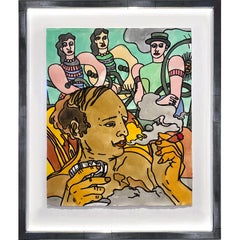
Hommage á Léger
By Erró
Located in Malmo, SE
Artwork size: 47×38 cm Frame size: 62,5 x 51,5 cm Free shipment worldwide. Acquired directly from the artist. Signed and dated on the verso. “I paint because painting is a private ...
Category

Early 2000s Pop Art Continental Europe - Figurative Drawings and Watercolors

Materials

Paper, Watercolor

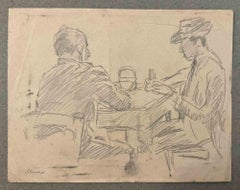
G. A. Rochegrosse (1859-1938) Studies of men, original drawing
By Georges Antoine Rochegrosse
Located in Paris, FR
Georges Antoine Rochegrosse (1859-1938) Studies of men, Pencil on paper 23 x 41.5 cm Signed lower right In good condition In a modern mount 41 x 52.5 cm Provenance: Estate of the...
Category

1910s Symbolist Continental Europe - Figurative Drawings and Watercolors

Materials

Carbon Pencil

French Contemporary Art by Francine Ledieu - Rue des Fossés, Saint Valery
Located in Paris, IDF
Oil on paper Francine Ledieu is a French artist born in 1931 who lives and works in Paris, France. In the 50s, she was a student of Maurice Rocher who specialized in Sacred art. In the ’80s, Francine was a student of Jean Bertholle from the Saint Roch Academy. The artist had personal exhibitions at Maison Mansart from 1989 to 1993 and at Étienne de Causans Gallery in 1997. In 1998 & 2009 she exhibited at La Petite Galerie. Francien Ledieu had three exhibitions at La Capitale Gallery in 2001, 2004, and 2007. She also showed her paintings at L’Oeil du Huit in 2011, 2013, 2016 & 2019. She participated in many group exhibitions as at Strasbourg Contemporary Art Fair in 2005. She exhibited also at Réalités Nouvelles in 2006, 2007, 2010 & 2011. She also worked in stained glass and mosaics in France. She achieved artworks in 1963 at Saint-Henri Pontoise chapel, Saint-Pierre des Louvrais church in Pontoise in 1969 & Mosaic in the same year at Jean Moulin...
Category

1960s Abstract Continental Europe - Figurative Drawings and Watercolors

Materials

Paper, Oil

France circa 1820, Portrait of a gentleman, black chalk and pastel drawing
Located in Paris, FR
France circa 1820 Portrait of a gentleman Black chalk and pastel on paper 12 x 10 cm In its original mount, modern oak frame : 25 x 22.5 cm
Category

1820s Romantic Continental Europe - Figurative Drawings and Watercolors

Materials

Chalk, Pastel

Ex Libris 1982, paper, ink, gouache, 17.5х13 cm
Located in Riga, LV
Ex Libris 1982, paper, ink, gouache, 17,5х13 cm Information about artist: Gunārs Vīndedzis (1918 - 1991) - cartoonist, illustrator. Born in a fami...
Category

1980s Realist Continental Europe - Figurative Drawings and Watercolors

Materials

Paper, Ink, Gouache

Jean-Henri Cless (1774-1812) Portrait of a young woman, signed drawing
Located in Paris, FR
Jean-Henri Cless (1774-1812) Portrait of a young woman in a landscape signed "Cless fec" for fecit on the lower left Brown ink and brown ink wash on paper Size of the sheet : 31.5 x 22 cm Size of the motive : 24.5 x 17 cm very simply framed under glass without actual frame 32 x 22.5 cm This pre...
Category

Early 1800s Old Masters Continental Europe - Figurative Drawings and Watercolors

Materials

Ink, Pencil

German Contemporary Art by Fabia Kleinpeter - Dragon Bird
Located in Paris, IDF
Acrylic on Cartridge paper Fabia Kleinpeter, a German self-taught multidisciplinary artist born in 2000 who lives and works in Tbilisi, Georgia. She began her artistic journey in 20...
Category

2010s Continental Europe - Figurative Drawings and Watercolors

Materials

Paper, Acrylic

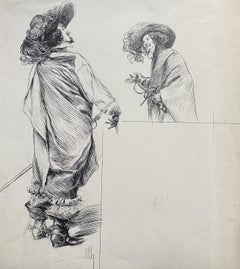
Felician Myrbach (1853-1940) The Musketeers, original drawing
By Felician Myrbach
Located in Paris, FR
Felician Myrbach (1853-1940) The Musketeers bears the monogram "M" on the lower left Ink and pencil on paper 26,7 x 23,7 cm in good condition, In a mod...
Category

1890s Art Nouveau Continental Europe - Figurative Drawings and Watercolors

Materials

Ink

Decorative - Drawing by Gabriele Galantara - Early 20th Century
By Gabriele Galantara
Located in Roma, IT
Decorative is a modern artwork by Gabriele Galantara (1865-1937) in the early 20th century. The artwork has been realized in ink and white lead and pencil on paper. Good conditions...
Category

Early 20th Century Modern Continental Europe - Figurative Drawings and Watercolors

Materials

Paper, Pencil

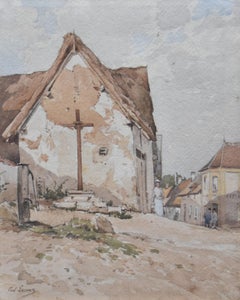
Paul Lecomte (1842-1920) A village street with a calvary, watercolor
By Paul Lecomte
Located in Paris, FR
Paul Lecomte (1842-1920) A village street with a calvary Signed lower left Watercolor on paper 29 x 23.5cm Framed : 46.5 x 420cm In quite good condition, light traces of a former fr...
Category

Early 1900s Impressionist Continental Europe - Figurative Drawings and Watercolors

Materials

Watercolor

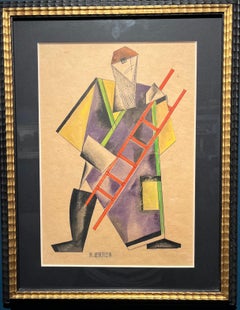
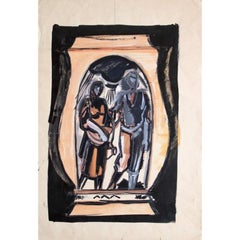
"Costume teatrale costruttivista" acquerello e china cm. 26 x 38 1920 ca
Located in Torino, IT
Bellissimo studio costruttivista per costume teatrale Kostantin Vialov Pittore, grafico, scenografo, artista di arti decorative e applicate. Uno dei principali artisti sovietici deg...
Category

1920s Constructivist Continental Europe - Figurative Drawings and Watercolors

Materials

India Ink, Watercolor

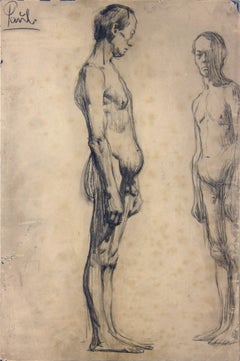
Self-portrait - Homo nudus -
Located in Berlin, DE
Bruno Paul (1874 Seifhennersdorf - 1968 Berlin). Self-portrait, c. 1895. Pencil on paper, mounted on cardboard, 53.5 x 35 cm, signed 'Paul' at upper left. - Homo nudus - About the artwork In a mirrored situation, Bruno Paul looks at himself in the picture. While his body, which is the size of the format, is shown in profile parallel to the picture, he turns his head into the picture in order to become aware of himself there, whereby the lighter use...
Category

1890s Realist Continental Europe - Figurative Drawings and Watercolors

Materials

Pencil

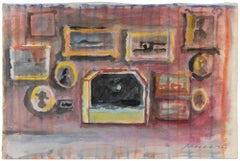
The Decorated Wall - Drawing by Mino Maccari - 1960s
By Mino Maccari
Located in Roma, IT
Watercolor on paper realized by Mino Maccari in the 1960s. Hand signed in pencil lower right. Very good condition.
Category

1960s Modern Continental Europe - Figurative Drawings and Watercolors

Materials

Paper, Watercolor

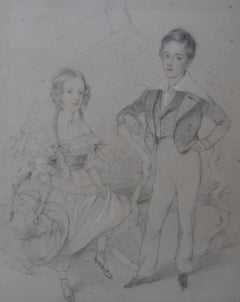
English School early 19th century, Portrait of two children, drawing
Located in Paris, FR
English School early 19th century, Portrait of two children, Pencil and light heightenings of white and red gouache 29.5 x 23 cm In quite good condition : the pape is yellowed by t...
Category

Early 1800s Old Masters Continental Europe - Figurative Drawings and Watercolors

Materials

Pencil

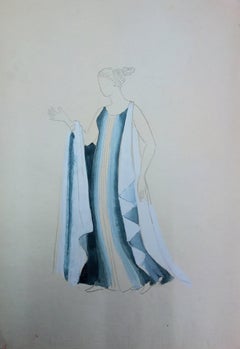
Long Blue Dress : Antique Greek costume (Antigone) - Original watercolor drawing
By Suzanne Lalique
Located in Paris, IDF
Suzanne LALIQUE Long Blue Dress : Antique Greek Costume (Antigone) Original carbon pencil and watercolor drawing Signed with the stamp of atelier on the back On vellum 37.5 x 26 (c...
Category

Mid-20th Century Modern Continental Europe - Figurative Drawings and Watercolors

Materials

Watercolor, Carbon Pencil

Sketch. 1930 s, watercolour, pencil on paper, 42x27 cm
Located in Riga, LV
Romans Suta Born on April 28, 1896 in the vicinity of Cesis (Latvia), died on July 14, 1944 in Tbilisi (Georgia), rehabilitated posthumously. Painter, graphic artist, decorative and stage designer, art critic and theoretician. Studied at the J. Madernieks' Art Studio (1913), Riga City Art School (1913-1915), and Penza Art School (1915 -1917). A prominent figure and active protagonist of modernist trends in Latvian art. Travels to Berlin and Paris, where he made the acquaintance of A. Ozanfant, Le Corbusier, and others. The influences of Cubism and Constructivism. A member of the Riga Artists' Group (1920-1924) and the Riga Graphic Artists' Society. Painter of still lifes and figural compositions. After the first experiments in Modernism, he turned to a more realistic manner of representation. The initiator and developer of a national constructive style, especially in interior design; the founder of Baltars creative workshop for porcelain painting (1924-1928); a designer and painter at Kuznetsov...
Category

1930s Modern Continental Europe - Figurative Drawings and Watercolors

Materials

Paper, Watercolor, Pencil

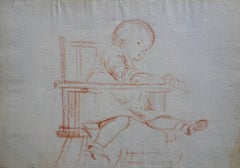
Baby on a Chair - Original Charcoals Drawing
By Gustave Poetzsch
Located in Paris, IDF
Gustave Poetzsch (1870-1950) Baby on a Chair Original red chalk drawing on linen watermarked paper 19 x 13 cm (c. 7,5 x 5 in) Stamp of the Estate auction sale on the back Very goo...
Category

Early 20th Century Realist Continental Europe - Figurative Drawings and Watercolors

Materials

Charcoal

Figure - Drawing by Joseph Alexander Colin - Mid-20th Century
Located in Roma, IT
Portrait is a drawing realized by Joseph Alexandre Colin in the Mid-20th Century. Charcoal ivory-colored paper Good conditions with slight foxing. The artwork is realized through ...
Category

Mid-20th Century Modern Continental Europe - Figurative Drawings and Watercolors

Materials

Paper, Pencil

Education - Drawing by Mino Maccari - 1960s
By Mino Maccari
Located in Roma, IT
Green oil pastel on paper realized by Mino Maccari in 1960s. Hand signed lower right. Very good condition.
Category

1960s Modern Continental Europe - Figurative Drawings and Watercolors

Materials

Paper, Pastel

Playing - Drawing by Mino Maccari - Mid-20th Century
By Mino Maccari
Located in Roma, IT
Playing is a watercolor drawing realized by Mino Maccari  (1924-1989) in the Mid-20th Century. Hand-signed. Good conditions with slight foxing. Mino Maccari (Siena, 1924-Rome, Jun...
Category

Mid-20th Century Modern Continental Europe - Figurative Drawings and Watercolors

Materials

Paper, Ink

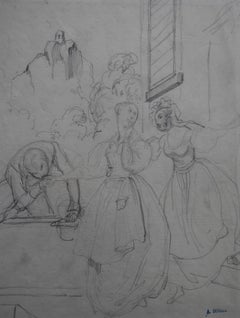
Achille Devéria (1800-1857) A galant scene Original Drawing
Located in Paris, FR
Achille Devéria (1800-1857) A galant scene pencil on paper Some stains (see photographs please) Bears the stamp of the Achille Deveria Estate Sale o...
Category

1850s Romantic Continental Europe - Figurative Drawings and Watercolors

Materials

Carbon Pencil

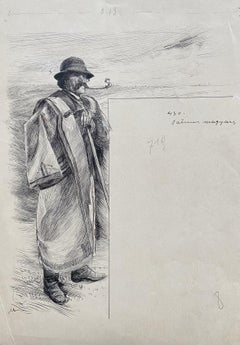
Felician Myrbach (1853-1940) Poèmes magyars original drawing
By Felician Myrbach
Located in Paris, FR
Felician Myrbach (1853-1940) Poèmes magyars, Magyar poems bears the monogram "M" on the lower left, titled in the upper right Ink on paper 29,8 x 19,8 cm in good condition, the sheet is slightly yellowed In a modern frame : 33 x 23 cm This is an illustration project by Felician Myrbach for François Coppée's work, "Poèmes magyars". He leaves the space to be occupied by the text blank on the sheet and arranges his composition accordingly. It is interesting to see the artist imagine his drawing with this constraint. Felician Myrbach (also Felicien de Myrbach, Felician von Myrbach, from 1919 Freiherr von Rheinfeld) was born on 9 February 1853 in Zalishchyky, he died 14 January 1940 in Klagenfurt He was an Austrian painter, graphic designer and illustrator. He was a founding member of the Vienna Secession and the director of the Applied Arts School in Vienna (now the University of Applied Arts Vienna), and was instrumental in the creation of the Wiener Werkstätte. Myrbach's father was Franz Myrbach (1818–1882), the Administrator of Bukovina in 1865–70. His older brother Franz Xaver (1850–1919) was an economist and professor at the University of Innsbruck. He attended the Theresian Military Academy in 1868–71, graduating as a Leutnant, then at the Academy of Fine Arts, Vienna under August Eisenmenger. In 1875, he joined the 19th Feldjäger Battalion, and in 1877 became an Oberleutnant in the Military Geographic Institute, then, after campaigning in Bosnia in 1878, he taught drawing at the Infantry Cadet School in Vienna. He continued his artistic studies under C R Huber. In 1881, he went on military leave and moved to Paris, retiring totally from the military in 1884 as a Hauptmann, 2nd Class. He stayed in Paris until 1897, working as an illustrator, including illustrating the works of Alphonse Daudet, Victor Hugo and Jules Verne. Myrbach was a founding member of the Vienna Secession in 1897. In the same year, he became the a professor of the Applied Arts School at the Museum of Art and Industry; Arthur von Scala, another reformer Modernist, was made head of the Museum. In 1889, Myrbach became the director of the school. He brought an enthusiastic Modernist attitude and encouraged an integration between art, design and production. He added Koloman Moser and Josef Hoffmann to the staff, amongst other Secession artists. This would lead to the foundation of the Wiener Werkstätte in 1903. Myrbach leant more towards an aesthetic approach than von Scala, but both worked together to bring about their combined vision of successful, popular Austrian applied art. Myrbach was a voice for reform towards Modernist ideals in the School, which was started 1899 with the support of Alfred Roller, and completed by 1901.The reform of the school has been described as his "lasting merit". Ludwig Hevesi called Myrbach "probably the best [illustrator] in Vienna", partially for his work (with Moser) in the Secession magazine Ver Sacrum. Myrbach visited America on a state-funded study trip in 1904, part of which was to represent the Applied Arts School at the 1904 World...
Category

Early 1900s Art Nouveau Continental Europe - Figurative Drawings and Watercolors

Materials

Ink

Three drawings by François Boucher in a mounting by Jean-Baptiste Glomy
By François Boucher
Located in PARIS, FR
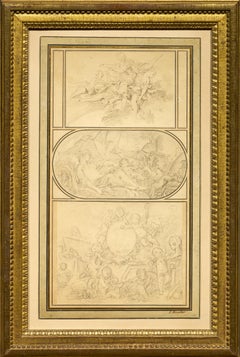
We would like to thank Juliette Parmentier-Courreau of the Custodia Foundation for her welcome and support during the consultation of Glomy’s Journal des Ouvrages. This spectacularly large "feuille de desseins ajustés" commissioned by François Boucher from Jean-Baptiste Glomy is emblematic of the painter's art and mastery of rocaille. It is also fully representative of the taste of this period in the field of decorative arts. The largest of these three drawings, placed at the bottom of the composition, is particularly interesting: dating from around 1756, it constitutes a modello (apparently unpublished) for the frontispiece of the "Catalogue des tableaux de Monsieur de Julienne"), preserved in the Morgan Library in New York. 1. François Boucher, the master of French rocaille The extraordinary career of Francois Boucher was unmatched by his contemporaries in versatility, consistency and output. For many, particularly the writers and collectors who led the revival of interest in the French rococo during the last century, his sensuous beauties and plump cupids represent the French eighteenth century at its most typical. His facility with the brush, even when betraying the occasional superficiality of his art, enabled him to master every aspect of painting – history and mythology, portraiture, landscape, ordinary life and, as part of larger compositions, even still life. He had been trained as an engraver, and the skills of a draftsman, which he imbued in the studio of Jean-Francois Cars (1661 – 1738), stood him in good stead throughout his career; his delightful drawings are one of the most sought-after aspects of his oeuvre. As a student of Francois Lemoyne (1688 - 1737), he mastered the art of composition. The four years he spent in Italy, from 1727-1731, educated him in the works of the masters, classics and history, that his modest upbringing had denied him. On his return to Paris in 1734, he gained full membership of the Royal Academy of Painting and Sculpture with his splendid Rinaldo and Armida (Paris, Musée du Louvre). Although, throughout his career, he occasionally painted subjects taken from the Bible, and would always have considered himself first as a history painter, his own repertoire of heroines, seductresses, flirtatious peasant girls and erotic beauties was better suited to a lighter, more decorative subject matter. His mastery of technique and composition enabled him to move from large scale tapestry...
Category

1750s Old Masters Continental Europe - Figurative Drawings and Watercolors

Materials

Chalk, Ink

Villa Ravà - Sketch for a Library - Drawing by Marcello Piacentini - 1920s
Located in Roma, IT
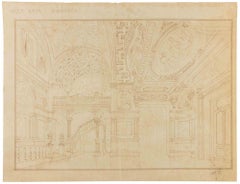
Villa Ravà, Biblioteca (Library) Architectural drawing, china ink on paper monogrammed lower right in pencil: M.P. Titled upper left: Villa Ravà – Biblioteca A finely detailed arch...
Category

1920s Modern Continental Europe - Figurative Drawings and Watercolors

Materials

Paper, Ink

France 19th century, The Bohème artist in his workshop, watercolor
Located in Paris, FR
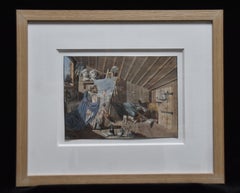
France circa 1850 The Bohème artist in his workshop Watercolor on paper 15.5 x 21.5 cm In good condition except a small tear (visible on the photographs) on the upper right border. I...
Category

1840s Romantic Continental Europe - Figurative Drawings and Watercolors

Materials

Watercolor

Boat on the Marañón River, Jungle series - Contemporary Drawing, work on paper
By Calo Carratalá
Located in Paris, FR
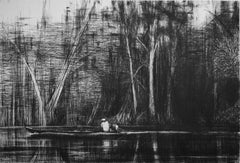
Boat on the Marañón River is a drawing by Spanish contemporary artist Calo Carratalá, from the "Jungle" series. This piece of art portrays a man boating down the river Marañón - a tr...
Category

2010s Contemporary Continental Europe - Figurative Drawings and Watercolors

Materials

Paper, Pencil

Georgian Contemporary Art by Ilia Balavadze - Untitled 3
Located in Paris, IDF
Gouache on paper Ilia Balavadze is a Georgian artist born in 1968 who lives and works in Tbilisi, Georgia. From 1987 to 1993, he studied the painting at the Tbilisi State Academy of...
Category

2010s Contemporary Continental Europe - Figurative Drawings and Watercolors

Materials

Paper, Gouache

Impressionistic Portrait of the Equestrian Artist Baptista Schreiber - Drawing
Located in Stockholm, SE
This expressive and atmospheric graphite drawing by Gösta von Hennigs (1866–1941) portrays the celebrated equestrian artist Baptista Schreiber within the charged setting of a circus ...
Category

1910s Impressionist Continental Europe - Figurative Drawings and Watercolors

Materials

Paper, Graphite

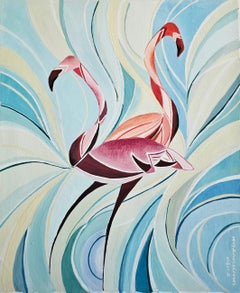
Georgian Contemporary Art by Eter Merkviladze - Flamingos
Located in Paris, IDF
Gouache on a watercolor paper Eter Merkviladze is a Georgian female artist born in 1999 who lives and works in Tbilisi, Georgia. She was graduated from Robert Schuman European Schoo...
Category

2010s Contemporary Continental Europe - Figurative Drawings and Watercolors

Materials

Paper, Watercolor, Gouache

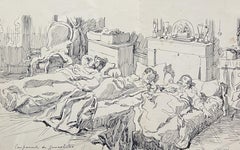
Louis Tinayre (1861-1942) An encampment of journalists, signed drawing
Located in Paris, FR
Louis Tinayre (1861-1942) An encampment of journalists in Chambéry, signed and titled lower left "Campement de journalistes à Chambéry" Ink on paper In quite good condition, a a visible vertical fold in the centre, some stains and foxings 21 x 29 cm Framed : 33.7 x 45.5 cm Louis Tinayre's background and adventurous life obviously inform this humorous and detailed scene. He demonstrates a remarkable sense of observation, capturing this scene of extraordinary life like a journalistic illustrator. A contributor, to whom I'd like to express my sincere thanks, sheds important light on the nature of this scene. It appears that this drawing is the draft for an illustration published in “Le Monde illustré” of August 4, 1888 (page 77), to accompany the article “Épilogue du voyage présidentiel” (Epilogue to the presidential trip) - president Sadi Carnot- en Savoie et en Dauphiné (p. 74), which ends with: “As a picturesque note, we enclose an improvised journalists' dormitory in Chambéry, where our colleagues deeply regretted the comfort of the special train”. As a quasi-ethnographic observer, Tinayre's interest lies in the journalists' camp, which he turns into a tender, comical scene. We understand him better when we know that he may have been similarly fascinated by the territories of Madagascar, the North Pole or the Far West that he painted and drew. Louis Tinayre was born on 14 March 1861 in Neuilly-sur-Seine. His mother, Victoire Tinayre, was a teacher and a member of the International Workers' Association. Louis was the son of a Communard couple. His father, Jean Joseph, known as Jules Tinayre (Issoire 1821 - Paris 1871) was shot during the Bloody Week. His mother, Victoire Tinayre, fled with her children. Louis was the first to be sent to Hungary, and the rest of the family (including his brother Julien) joined him there later. He studied Fine Arts at the Hungarian University of Fine Arts in Budapest. Returning to Paris in 1880 (after the amnesty), Louis Tinayre assiduously frequented Le Chat noir, where he met the positivists and Adèle Jacomet (Buenos Aires 1867-1946), whom he married in 1888. He became an animal painter and press illustrator and was sent by Le Monde Illustré to cover the second expedition to Madagascar (then under French protectorate) in 1895. He stayed there, fascinated, for six months and produced numerous drawings and photographs. Back in France, he created eight 5 x 4 meters dioramas presented at the National and Colonial Exhibition in Rouen in 1896. He returned to Madagascar in 1898 to prepare the creation of a giant panorama representing the surrender of Antananarivo in 1895. The Malagasy pavilion at the 1900 Universal Exhibition in Paris allowed him to admire the dioramas (on the ground floor) and the panorama (on the first floor). On his second trip, Tinayre took a Lumière cinematograph with him to document the daily life of the Malagasy people, no doubt to facilitate the design of the vast panorama. These short films were donated to the Cinémathèque française in 2009 by his grandson, Alain Tinayre. One of the admirers of Tinayre's drawings, watercolours, paintings and photographs at the Universal Exhibition was Prince Albert I of Monaco: from 1901 onwards, Tinayre accompanied him on his hunts, painting scenes in North Africa, Russia, the Far West (Wyoming) and the North Pole. Tinayre, the official painter of the Prince's scientific expeditions, left his name to a glacier. Together with the painter Alexandre Jean-Baptiste Brun, he painted the four murals in the large amphitheatre of the Oceanographic Institute in Paris. Louis Tinayre painted the figures while Alexandre Brun...
Category

1890s Realist Continental Europe - Figurative Drawings and Watercolors

Materials

Ink

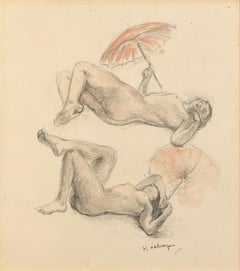
Reclining female nudes with an umbrella
By Henri Lebasque
Located in Paris, Île-de-France
HENRI LEBASQUE (Champigné 1865 - 1937 Le Cannet) Reclining female nudes with an umbrella Pencil, stumping and heightened with watercolor on paper 27 x 24 cm Stamped signature lowe...
Category

19th Century Art Nouveau Continental Europe - Figurative Drawings and Watercolors

Materials

Watercolor, Pencil, Paper

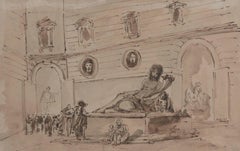
18th Century Roman School , A Palazzo with antiques, drawing
Located in Paris, FR
18th Century Roman School A Palazzo with antiques Brown ink and pen, brown ink wash on paper 12.5 x 20 cm Framed : 28,5 x 35.5 This nice drawing represents a genre scene, with a nobleman, priests, a mother and her children...
Category

Early 18th Century Old Masters Continental Europe - Figurative Drawings and Watercolors

Materials

Ink

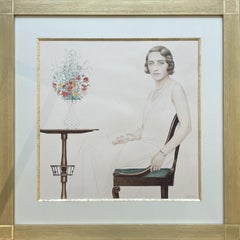
Bernard BOUTET DE MONVEL (1881 - 1949), "Portrait of Miss Lise Brissaud"
Located in Paris, FR
Bernard Boutet de Monvel was a French painter, sculptor, engraver, fashion illustrator and interior decorator. Although first known for his etchings, he earned notability for his pai...
Category

1920s Modern Continental Europe - Figurative Drawings and Watercolors

Materials

Paper, Watercolor, Pencil

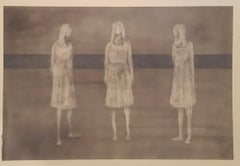
Figurative Graphite Drawing on Paper - Tres Mujeres - Pastel Colors - Framed
Located in Vilnius, Vilniaus apskr.
Work is framed. Signed on the right bottom corner of the drawing. Amilcar's drawings from the series of "Utopia by Tolina" inspired by the imagination of the artist’s five-year-old...
Category

2010s Contemporary Continental Europe - Figurative Drawings and Watercolors

Materials

Paper, Pencil, Graphite

Paul Gavarni (1804-1866) La Soubrette (The handmaid), watercolor
By Paul Gavarni (Guillaume Sulpice Chevalier)
Located in Paris, FR
Paul Gavarni (1804-1866) La Soubrette (The handmaid), pencil, watercolor and heightenings of gouache on paper Signed lower right (faded) 20 x 15 cm In quite good condition, lightly sunstroke and yellowed Framed 28.5 x 23 cm Paul Gavarni was the nom de plume of Sulpice Guillaume Chevalier (13 January 1804 – 24 November 1866), a French illustrator, born in Paris. The story is told that he took his name from Gavarnie in Luz-Saint-Sauveur where he had taken a journey into the Pyrenees. He was a very famous illustrator, friend of Felix Nadar...
Category

1850s Continental Europe - Figurative Drawings and Watercolors

Materials

Watercolor

Still Thinking About These?

All Recently Viewed