Continental US - Animal Prints

to
654
876
562
760
456
505
Overall Width
to
Overall Height
to
796
360
322
210
146
57
33
27
24
23
11
7
5
4
190
161
119
85
84
95
315
1,622
1,133
9
21
33
65
58
75
140
359
291
244
75
1,479
1,407
245
1,035
810
554
380
346
284
258
228
202
200
177
176
143
117
112
103
89
83
80
76
1,140
508
474
464
447
586
915
3,166
3,166
2,072
Item Ships From: Continental US
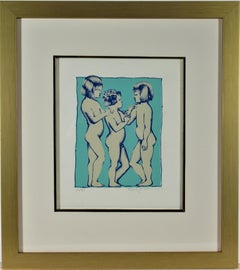
Three Children
By Beniamino Bufano
Located in San Francisco, CA
This artwork titled "Three Chidren" 1970 is an original color lithograph on B.F.K Rives paper by noted Italian/American artist Beniamino Benevenuto Bufano, 1890-1970. It is hand signed and numbered 14/50 in pencil by the artist. Published by First Impressions, San Francisco, printed by Fikrat Al-Khouri at First Impressions Graphic Society. The image size is 8.30 x 6.5 inches, framed size is 19.85 x 17.65 inches. it is beautifully custom framed in a wooden gold frame, with gold color spacer. It is in excellent condition. About the artist: Beniamino Benvenuto Bufano was born in San-Fele, Italy on Oct. 14, 1889. At age three Bufano's family brought him to NYC where he spent his childhood and was educated by private tutors. He studied at the ASL in NYC from 1913-15, the pupil of James L. Fraser, Herbert Adams, and Paul Manship. He came to San Francisco in 1915 to work on a sculpture for the PPIE. For awhile he worked in the studio of coppersmith Dirk van Erp. He then traveled extensively for four years in France, Italy, India, and China. After returning to San Francisco in 1921, he remained there the rest of his life except for visits to the Orient and Europe. Always a radical, he lost his teaching position at San Francisco Institute of Art in 1923 because he was too modern for the conservative faculty. He later taught at UC Berkeley and the CCAC (1964-65). Henry Miller wrote of him, "He will outlive our civilization and probably be better known, better understood, both as a man and artist, five thousand years hence." His work, simple in style and monumental in scale, includes smoothly rounded animals in granite and icons sheathed in stainless steel. Only five feet tall, Bufano was a controversial, free spirit until his death in San Francisco on Aug. 16, 1970. Member: SFAA; NSS; American Artists Congress. Exh: Whitney Museum (NYC), 1917; Arden Gallery...
Category

Late 20th Century American Modern Continental US - Animal Prints

Materials

Lithograph

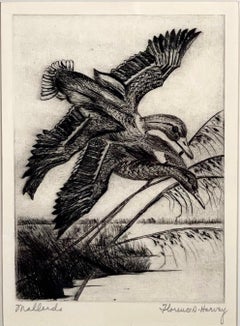
MALARDS
Located in Portland, ME
Harvey, Florence D. MALLARDS. Etching 6 3/4 x 5 in. Titled and signed in pencil.
Category

Mid-20th Century Continental US - Animal Prints

Materials

Etching

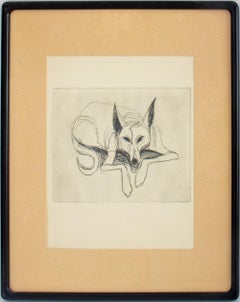
"Louie"
By Selina Trieff
Located in Astoria, NY
Selina Trieff (American, 1934-2015), "Louie", Etching on Paper, numbered edition "6/35", signed in pencil "S. Trieff" lower right, black frame. Image: 9.75" H x 8" W; frame: 21" H x ...
Category

Late 20th Century Post-War Continental US - Animal Prints

Materials

Paper, Etching

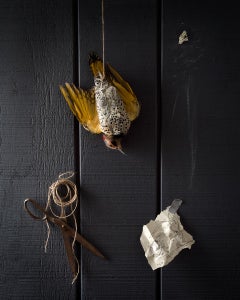
After Harnett
Located in Red Bank, NJ
After Harnett by Kimberly Witham Print, Animal, Still-Life, Bird, Gothic, Dark Colors, Textured
Category

20th Century Gothic Continental US - Animal Prints

Materials

Rag Paper, Archival Pigment

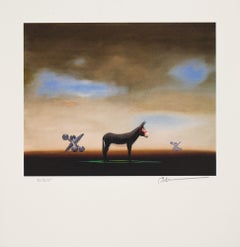
The Comedy of Oblivion
By Fred Stonehouse
Located in Lyons, CO
Color lithograph, Ed. 25. The artist describes this project: “I have a long history of exploring the possibilities of animal and naturalist imagery to fabulist ends. These works se...
Category

2010s Contemporary Continental US - Animal Prints

Materials

Lithograph

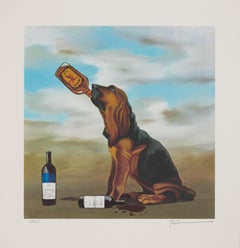
Booze Hound II
By Robert Deyber
Located in Greenwich, CT
Booze Hound II is a lithograph on paper, 9.25 x 9 inches image size. From the edition of 395, numbered 169/275 (there were also 100 Roman and 20 AP), framed in a contemporary, silver...
Category

21st Century and Contemporary Contemporary Continental US - Animal Prints

Materials

Paper, Lithograph

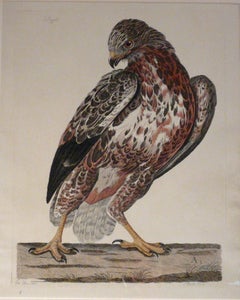
THE COMMON BUZZARD
By Peter Mazel
Located in Portland, ME
(Mazell, Peter). THE COMMON BUZZARD after Charles Collins. Engraving with hand-coloring, c. 1766. A plate from The British Zoology, London 1777. Titled in the plate, top, and with th...
Category

1760s Continental US - Animal Prints

Materials

Engraving

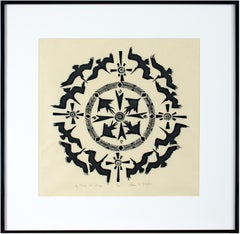
"A Round of Birds, " Original Linocut, Signed
By Mark Herrling
Located in Milwaukee, WI
"A Round of Birds" is an original linocut by Mark Herrling. It depicts a radial pattern of black birds and abstract, geometric shapes. The artist signed, titled, and wrote the editio...
Category

1990s Expressionist Continental US - Animal Prints

Materials

Linocut

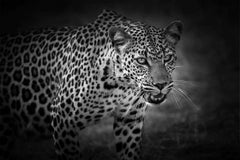
Queen of Africa
By Björn Persson
Located in New York City, NY
Available sizes: 32x47in ed.20 40x60in ed.15 47x71in ed.10 Archival Pigment Print Unframed Ask us for framing options. Björn Persson is an internationally renowned artist based i...
Category

2010s Contemporary Continental US - Animal Prints

Materials

Black and White, Inkjet, Archival Pigment

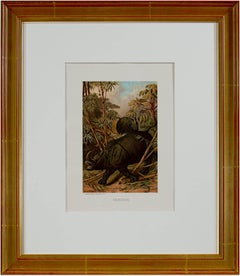
19th century color lithograph rhinoceros trees nature forest animals signed
By Louis Prang
Located in Milwaukee, WI
"Rhinoceros" is an original color chromolithograph by Louis Prang. It depicts two rhinos in a lush jungle forest. 7 1/2" x 5" art 12 1/2" x 9 1/4" paper 18 3/8" x 15 1/2" frame Lo...
Category

1880s Continental US - Animal Prints

Materials

Lithograph

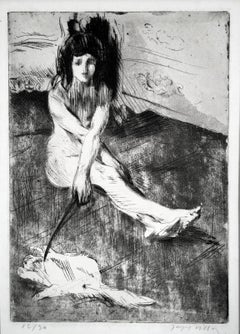
Minne Playing with a Cat (Minne Jouant avec un Chat)
By Jacques Villon
Located in New York, NY
Jacques Villon (1875-1963) etching, aquatint, and drypoint, Minne Playing with a Cat (Minne Jouant avec un Chat),1907, signed in pencil and numbered (12/30)(Ginestet and Pouillon 192...
Category

Early 1900s Impressionist Continental US - Animal Prints

Materials

Drypoint, Etching, Aquatint

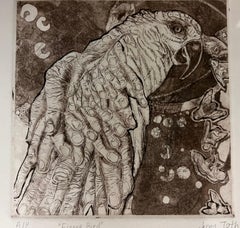
Finger Parrot, monochromatic print bold graphic, surreal bird, hands
By Jenny Toth
Located in Brooklyn, NY
This is an artist proof (one of a kind) aquatint of a parrot made up of fingers, and beautiful insects cascading to her right. She has a human ear on one side. The images is 6 x 6 ...
Category

2010s Contemporary Continental US - Animal Prints

Materials

Paper, Ink, Archival Ink, Aquatint

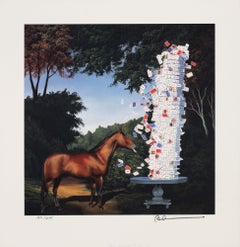
Hobby Horse
By Robert Deyber
Located in Greenwich, CT
Hobby Horse is a lithograph on paper, 9.5 x 9 inches image size, and initialed 'BD' lower right. From the edition of 395, numbered 189/275 (there were also 100 Roman and 20 AP). Fram...
Category

21st Century and Contemporary Contemporary Continental US - Animal Prints

Materials

Paper, Lithograph

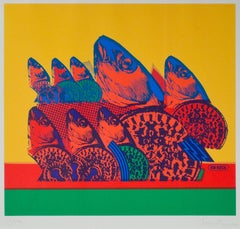
"Procession (Fish), " Original Colorful Serigraph print fish design unique
By Ronald Osiecki
Located in Milwaukee, WI
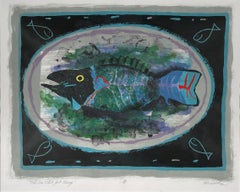
"Procession (Fish)" is an original serigraph print by Ronald Osiecki. It is signed and part of a limited edition. This print depicts fish hea...
Category

1990s Surrealist Continental US - Animal Prints

Materials

Screen

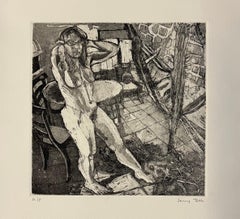
Naked with Cactus and dog in the Mexican Living Room
By Jenny Toth
Located in Brooklyn, NY
This is an artist proof aquatint of a woman stepping forward in a tiled Mexican living room with her dog and a mysterious giant cactus coming out of the floor. Image is 9.75 x 9.75 ...
Category

2010s Feminist Continental US - Animal Prints

Materials

Paper, Ink, Aquatint

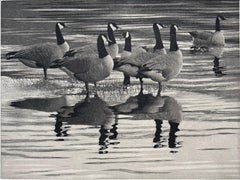
Geese, by Stephen McMillan
By Stephen McMillan
Located in Palm Springs, CA
Medium: etching and aquatint Edition of 250 Year: 2014 Image Size: 9 x 12 inches Signed, titled and numbered by the artist. Inspired by a scene of seven Canadian Geese in Lake Padde...
Category

2010s Contemporary Continental US - Animal Prints

Materials

Etching, Aquatint

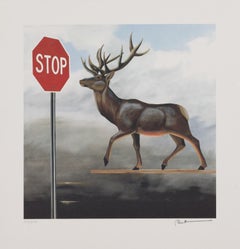
The Buck Stops Here (Deer at Stop Sign)
By Robert Deyber
Located in Greenwich, CT
The Buck Stops Here (Deer at Stop Sign) is a lithograph on paper, 9 x 9 inches image size. From the edition of 395, numbered 53/275 (there were also 100 Roman and 20 AP), framed in a...
Category

21st Century and Contemporary Contemporary Continental US - Animal Prints

Materials

Paper, Lithograph

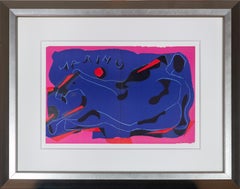
"Two Horses from Homage to Marino Marini, " an Original signed by Marino Marini
By Marino Marini
Located in Milwaukee, WI
"Two Horses from Homage to Marino Marini" is an original color lithograph signed in stone by Marino Marini. It depicts a horse and rider in abstracted contour lines and black shapes ...
Category

1970s Post-Modern Continental US - Animal Prints

Materials

Lithograph

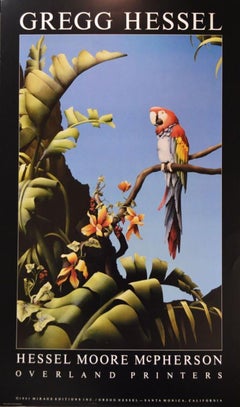
Poster-Hessel Moore McPherson, Overland Printers
Located in Chesterfield, MI
GREGG HESSEL-Hessel Moore McPherson Overland Printers. Publishing Information: Copyright Mirage Editions, Inc. 1981/Gregg Hessel, Santa Monica, Californ...
Category

1980s Continental US - Animal Prints

Materials

Lithograph

Deer John
By Robert Deyber
Located in Greenwich, CT
Deer John is a lithograph on paper, 9 x 9 inches image size, and initialed 'BD' lower right. From the edition of 395, numbered 35/275 (there were also 100 Roman and 20 AP). Framed in...
Category

21st Century and Contemporary Contemporary Continental US - Animal Prints

Materials

Paper, Lithograph

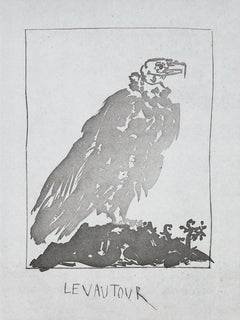
The Vulture. 1942 (Histoire Naturelle - Textes de Buffon, B.341)
By Pablo Picasso
Located in Greenwich, CT
The Vulture is an aquatint and drypoint print on chine from one of the deluxe copies of Picasso's 1942 Histoire Naturelle - Textes de Buffon series. The image size is 10.6 x 8 inches, unsigned as issued, and framed in a contemporary silver and gray moulding. One of about 36 prints that exist with Picasso's remarqued title in French, from the edition of 262 (there were 226 portfolios, some with additional sets on varying papers). Catalogue - Cramer #37 The exceptional etchings from Picasso’s Histoire Naturelle – Textes de Buffon are a masterful combination of sugar-lift aquatint and drypoint, showcasing a full range of gray tonalities. The etchings of animals, birds and insects are considered some of the most beautiful and most unusual examples of Picasso’s graphic work. Roger Lacourière, Picasso’s master printer, pulled the prints for each etching between 1939-1942. It was Lacourière who taught Picasso the sugar-lift aquatint technique which allowed him to mimic the effect of brushstrokes in these etched images. Picasso first explored the technique in his plates for the Vollard Suite, but it was in the creation of the Buffon images that he fully realized its stunning, painterly potential. For the edition, 226 portfolios were produced with the first thirty-six counting as deluxe compilations. These rare deluxe sets were on diverse papers (chine, japon or vergé ancien) and each included a complete additional suite showing Picasso’s title remarques along the bottom. As such, the remarqued versions of the prints are quite rare with just thirty-six of each produced for the edition (with the exception of The Wolf which is never remarqued – the image always fills the entire etching plate). These prints are based on the writings of French naturalist Georges-Louis Leclerc, Comte de Buffon, who extensively documented the natural world in his monumental work Histoire Naturelle. Picasso’s association with the project to illustrate parts of the Buffon came during a tumultuous time in European history – the prelude to, and early years of, World War II. As the continent was ravaged, Picasso lived through the disaster in Paris, which the Germans occupied in 1940. These prints could be seen as a political statement – Picasso channeling his artistic expression into a form of resistance art...
Category

20th Century Modern Continental US - Animal Prints

Materials

Aquatint, Drypoint

Another Cock and Bull Story
By Robert Deyber
Located in Greenwich, CT
Another Cock and Bull Story is a lithograph on paper, initialed lower right 'BD', 9.5 x 9" image size. From the edition of 395, numbered LXXXV/C (there were also 275 Arabic and 20 AP...
Category

21st Century and Contemporary Contemporary Continental US - Animal Prints

Materials

Paper, Lithograph

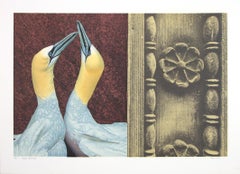
"Royal Applause, " original lithograph signed abstract bold realistic birds
By Michael Knigin
Located in Milwaukee, WI
"Royal Applause" is an original color lithograph by Michael Knigin. The artist signed the piece in the lower right and editioned/titled it lower left with graphite. This piece features two yellow-headed birds known as Gannet Seabirds. To the right of the birds is shown a rendition of an ornate wood...
Category

1980s Pop Art Continental US - Animal Prints

Materials

Lithograph, Ink

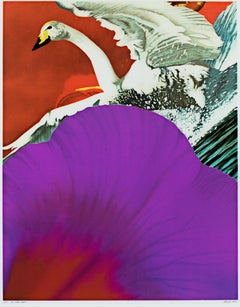
"In Real Form" signed original lithograph pop art realistic swan floral vibrant
By Michael Knigin
Located in Milwaukee, WI
"In Real Form" is an original color lithograph by Michael Knigin. The artist signed the piece in the lower right and titled/editioned "A/P" in the lower left with graphite. This piec...
Category

1980s Pop Art Continental US - Animal Prints

Materials

Lithograph

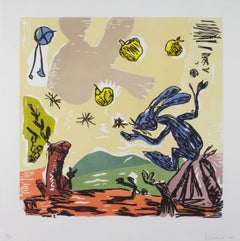
"Blue Bunny, " a Woodcut signed by Santi Moix
By Santi Moix
Located in Milwaukee, WI
"Blue Bunny" is an original woodcut print signed by the artist Santiago Moix. It depicts a blue rabbit juggling yellow apples. 26 1/2" x 25 7/8" art 29 1/8" x 29 3/4" frame Santia...
Category

1990s Continental US - Animal Prints

Materials

Woodcut

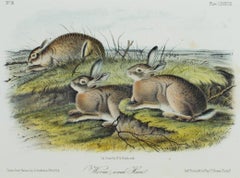
19th century color lithograph hare landscape grass animal print wildlife
By John James Audubon
Located in Milwaukee, WI
"Worm-Wood Hare" is an original color lithograph by John James Audubon. It depicts three brown rabbits in a landscape. No. 18, Plate LXXXVIII, On Stone by W.E. Hitchcock. 6" x 8" ar...
Category

1840s Other Art Style Continental US - Animal Prints

Materials

Lithograph

19th century color lithograph hares animal nature print wildlife
By John James Audubon
Located in Milwaukee, WI
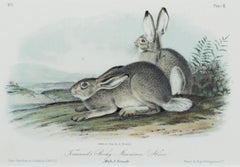
"Townsend's Rocky Mountain Hare" is an original color lithograph by John James Audubon. This artwork features two gray hares in a muted, cool-colored landscape. 5 1/2" x 8 1/4" art...
Category

Mid-19th Century Academic Continental US - Animal Prints

Materials

Lithograph

THE ONE THAT GOT AWAY
By John D. Muench
Located in Portland, ME
Muench, John (American, 1914-1993). THE ONE THAT GOT AWAY. Color Lithograph, not dated. Edition of 25. Signed, titles and numbered, all in pencil...
Category

Mid-20th Century Continental US - Animal Prints

Materials

Lithograph

"Présure Guillien, Dijon Cow, " Original Color Lithograph Poster by L. Serre
Located in Milwaukee, WI
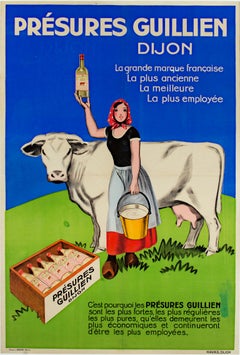
"Présure Guillien, Dijon Cow" is an original color lithograph poster. The artist's name is printed in the lower left, and the name of the printing company, Havas, is printed in the lower right. The poster advertises rennet, a product used to curdle milk and make cheese, featuring a milk maid with a red kerchief tied around her head in front of a white cow. She holds a golden bucket...
Category

1920s Modern Continental US - Animal Prints

Materials

Lithograph

Nasiterna Pygmae
By John Gould
Located in Missouri, MO
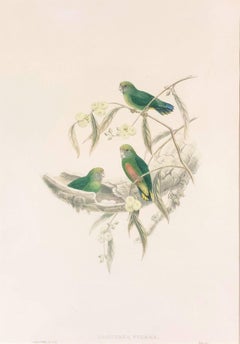
John Gould (British, 1804-1881) Nasiterna Pygmae c. 1849-1861 Hand Colored Lithograph Image Size: approx 19.5 x 13.5 inches Framed Size: 27 3/8 x 21 1/2 inches John Gould was an English ornithologist and bird artist. The Gould League in Australia was named after him. His identification of the birds now nicknamed "Darwin's finches" played a role in the inception of Darwin's theory of evolution by natural selection. Gould's work is referenced in Charles Darwin's book, On the Origin of Species. Gould was born in Lyme Regis, Dorset, the son of a gardener, and the boy probably had a scanty education. Shortly afterwards his father obtained a position on an estate near Guildford, Surrey, and then in 1818 became foreman in the Royal Gardens of Windsor. He was for some time under the care of J T Aiton, of the Royal Gardens of Windsor. The young Gould started training as a gardener, being employed under his father at Windsor from 1818 to 1824, and he was subsequently a gardener at Ripley Castle in Yorkshire. He became an expert in the art of taxidermy, and in 1824 he set himself up in business in London as a taxidermist, and his skill led to him becoming the first Curator and Preserver at the museum of the Zoological Society of London in 1827. Gould's position brought him into contact with the country's leading naturalists, and also meant that he was often the first to see new collections of birds given to the Society. In 1830 a collection of birds arrived from the Himalayas, many not previously described. Gould published these birds in A Century of Birds from the Himalaya Mountains (1830-1832). The text was by Nicholas Aylward Vigors, and the illustrations were lithographed by Gould's wife Elizabeth, daughter of Nicholas Coxen of Kent. This work was followed by four more in the next seven years including Birds of Europe in five volumes - completed in 1837, with the text written by Gould himself, edited by his clerk Edwin Prince. Some of the illustrations were made by Edward Lear as part of his Illustrations of the Family of Psittacidae in 1832. Lear however was in financial difficulty, and he sold the entire set of lithographs to Gould. The books were published in a very large size, imperial folio, with magnificent coloured plates. Eventually 41 of these volumes were published with about 3000 plates. They appeared in parts at £3 3s. a number, subscribed for in advance, and in spite of the heavy expense of preparing the plates, Gould succeeded in making his ventures pay and in realizing a fortune. In 1838 he and his wife moved to Australia to work on the Birds of Australia and shortly after his return to England, his wife died in 1841. When Charles Darwin presented his mammal and bird specimens collected during the second voyage of HMS Beagle to the Geological Society of London at their meeting on 4 January 1837, the bird specimens were given to Gould for identification. He set aside his paying work and at the next meeting on 10 January reported that birds from the Galápagos Islands, which Darwin had thought were blackbirds, "gross-bills" and finches were in fact "a series of ground Finches which are so peculiar" as to form "an entirely new group, containing 12 species." This story made the newspapers. In March, Darwin met Gould again, learning that his Galápagos "wren" was another species of finch and the mockingbirds he had labeled by island were separate species rather than just varieties, with relatives on the South American mainland. Subsequently Gould advised that the smaller southern Rhea specimen that had been rescued from a Christmas dinner...
Category

Mid-19th Century Naturalistic Continental US - Animal Prints

Materials

Lithograph

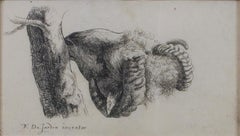
17th century etching animal print sketch ram sheep tree black and white signed
By Karel Dujardin
Located in Milwaukee, WI
"Ram Eating Bark" is an original etching by Karel DuJardin. DuJardin completed many delicate etchings of rams. 3 3/4" x 7 3/4" art 16 3/8" x 19 1/8" f...
Category

17th Century Old Masters Continental US - Animal Prints

Materials

Etching

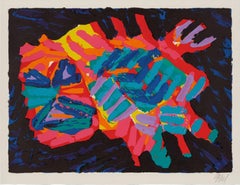
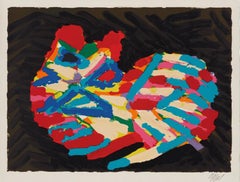
Devil Cat, CoBrA Group Modern Lithograph by Karel Appel
By Karel Appel
Located in Long Island City, NY
This signed and numbered lithograph on Japon paper is from a portfolio of 17 prints by Modern artist Karel Appel. He admired the domestic house cat for its aloof, yet instinctive, de...
Category

1970s Modern Continental US - Animal Prints

Materials

Lithograph

Innocent Cat, CoBrA Group Modern Lithograph by Karel Appel
By Karel Appel
Located in Long Island City, NY
This signed and numbered lithograph on Japon paper is from a portfolio of 17 prints by Modern artist Karel Appel. He admired the domestic house cat for its aloof, yet instinctive, de...
Category

1970s Modern Continental US - Animal Prints

Materials

Lithograph

House Cat, CoBrA Group Modern Lithograph by Karel Appel
By Karel Appel
Located in Long Island City, NY
This signed and numbered lithograph on Japon paper is from a portfolio of 17 prints by Modern artist Karel Appel. He admired the domestic house cat for its aloof, yet instinctive, de...
Category

1970s Modern Continental US - Animal Prints

Materials

Lithograph

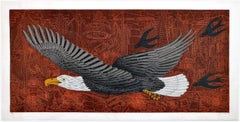
War Eagle
By John Buck
Located in Lyons, CO
Color woodcut with hand coloring, Edition 15 In War Eagle, John Buck continues to explore the conflict between our pastoral, utopian ideals and the sad rea...
Category

21st Century and Contemporary Contemporary Continental US - Animal Prints

Materials

Woodcut

Avanti, Ajman, UAE, United Arab Emirates
By Raphael Macek
Located in New York City, NY
The photographic work of Raphael Macek offers profound meditation on the timeless bond between humans and horses. With exceptional sensitivity, Macek captures the equine form as both...
Category

2010s Contemporary Continental US - Animal Prints

Materials

Plexiglass, Archival Paper

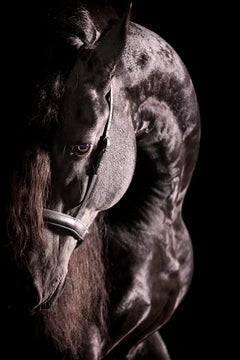
Curvarum, Horse Portrait, Equestrian Photography
By Raphael Macek
Located in New York City, NY
The photographic work of Raphael Macek offers profound meditation on the timeless bond between humans and horses. With exceptional sensitivity, Macek captures the equine form as both...
Category

2010s Contemporary Continental US - Animal Prints

Materials

Plexiglass, Archival Pigment

The Jack Ass (Jacks Game)
By Robert Deyber
Located in Greenwich, CT
The Jack Ass is a lithograph on paper, 7.75 x 9 inches image size, and initialed 'BD' lower right. From the edition of 395, numbered 70/275 (there were also 100 Roman and 20 AP). Fra...
Category

21st Century and Contemporary Contemporary Continental US - Animal Prints

Materials

Paper, Lithograph

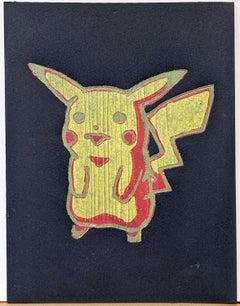
untitled ( Pikachu Pokémon )
Located in New York, NY
untitled woodcut by Kjell Otterness from the early 2000s printed in an edition of 6. Pickachu Pokémon
Category

Early 2000s Continental US - Animal Prints

Materials

Woodcut

Peregrine Falcon, Surrealist Etching, Aquatint and Intaglio by Martin Barooshian
By Martin Barooshian
Located in Long Island City, NY
Martin Barooshian, American (1929 - 2022) - Peregrine Falcon, Year: circa 1979, Medium: Etching, Aquatint and Intaglio, signed, titled and numbered in pencil, Edition: 50/60, Im...
Category

1970s Surrealist Continental US - Animal Prints

Materials

Etching, Aquatint

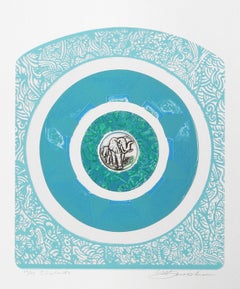
Elephants, Surrealist Etching and Aquatint by Martin Barooshian
By Martin Barooshian
Located in Long Island City, NY
Martin Barooshian, American (1929 - 2022) - Elephants, Year: circa 1979, Medium: Etching and Aquatint, signed, titled and numbered in pencil, Edition: 50/60, Image Size: 12 x 1...
Category

1970s Surrealist Continental US - Animal Prints

Materials

Etching, Aquatint

Green Sea Turtle, Surrealist Etching, Aquatint and Intaglio by Martin Barooshian
By Martin Barooshian
Located in Long Island City, NY
Martin Barooshian, American (1929 - 2022) - Green Sea Turtle, Year: circa 1979, Medium: Etching, Aquatint and Intaglio, signed, titled and numbered in pencil, Edition: 50/60, Im...
Category

1970s Surrealist Continental US - Animal Prints

Materials

Etching, Aquatint

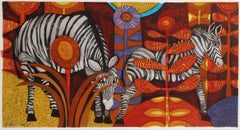
Zebras, Folk Art Lithograph and Blind Embossing by Judith Bledsoe
By Judith Bledsoe
Located in Long Island City, NY
Judith Bledsoe, American (1938 - 2013) - Zebras, Year: circa 1980, Medium: Lithograph and Blind Embossing, signed and dedicated in pencil, Edition: EA, Image Size: 9.5 x 17.5 i...
Category

1980s Folk Art Continental US - Animal Prints

Materials

Lithograph

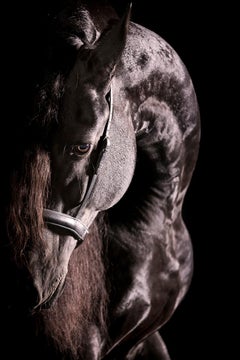
Curvarum, Horse Portrait, Equestrian Photography
By Raphael Macek
Located in New York City, NY
Large-scale photograph from the Equine Beauty series. The legendary and complex relationship between humans and horses is an enduring one. The horse’s distinctive blend of grace and...
Category

2010s Contemporary Continental US - Animal Prints

Materials

Archival Pigment, Plexiglass

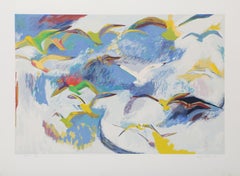
Gulls, Seascape Silkscreen by Dody Muller
By Dody Muller
Located in Long Island City, NY
Gulls by Dody Müller, American Date: 1979 Lithograph, signed, titled, numbered and dated in pencil Edition of 250 Size: 22 x 30 in. (55.88 x 76.2 cm)
Category

1970s Contemporary Continental US - Animal Prints

Materials

Screen

The Catbird Seat
By Robert Deyber
Located in Greenwich, CT
The Catbird Seat is a lithograph on paper, 9.25 x 9 inches image size, and initialed 'BD' lower right. From the edition of 395, numbered 214/275 (there were also 100 Roman and 20 AP)...
Category

21st Century and Contemporary Contemporary Continental US - Animal Prints

Materials

Paper, Lithograph

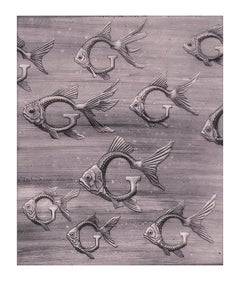
"G"
By Kelvin Mann
Located in Palm Springs, CA
The letter "G", illustrated by goldfish. All letters from the Kelvin Mann's bestiary alphabet are available, and the full set of 27 etchings in folio box is available for $3500. Anim...
Category

Early 2000s Contemporary Continental US - Animal Prints

Materials

Etching, Aquatint

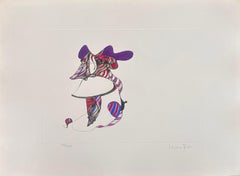
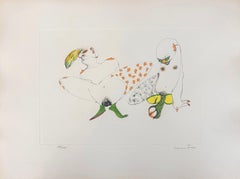
Fantastical character - Hand-signed lithograph Leonor Fini Surrealist, 1975
By Leonor Fini
Located in New York, NY
Leonor Fini Fantastical character, 1975 Colored etching on Arches paper 11 × 15 in 28 × 38 cm Limited edition of 185
Category

1970s Surrealist Continental US - Animal Prints

Materials

Lithograph

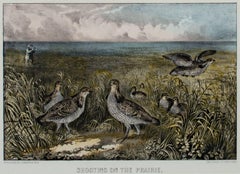
19th century color lithograph birds landscape nature grass sky water figure
By Currier Ives
Located in Milwaukee, WI
"Shooting on the Prairie" is an original hand-colored lithograph by Currier & Ives. It depicts a hunter shooting at fowl in an open field. 8 1/2" x 12 1/2" art 20 1/4" x 23 3/4" frame Nathaniel Currier was a tall introspective man with a melancholy nature. He could captivate people with his piercing stare or charm them with his sparkling blue eyes. Nathaniel was born in Roxbury, Massachusetts on March 27th, 1813, the second of four children. His parents, Nathaniel and Hannah Currier, were distant cousins who lived a humble yet spartan life. When Nathaniel was eight years old, tragedy struck. Nathaniel’s father unexpectedly passed away leaving Nathaniel and his eleven-year-old brother Lorenzo to provide for the family. In addition to their mother, Nathaniel and Lorenzo had to care for six-year-old sister Elizabeth and two-year-old brother Charles. Nathaniel worked a series of odd jobs to support the family, and at fifteen, he started what would become a life-long career when he apprenticed in the Boston lithography shop of William and John Pendleton. A Bavarian gentleman named Alois Senefelder invented lithography just 30 years prior to young Nat Currier’s apprenticeship. While under the employ of the brothers Pendleton, Nat was taught the art of lithography by the firm’s chief printer, a French national named Dubois, who brought the lithography trade to America. Lithography involves grinding a piece of limestone flat and smooth then drawing in mirror image on the stone with a special grease pencil. After the image is completed, the stone is etched with a solution of aqua fortis leaving the greased areas in slight relief. Water is then used to wet the stone and greased-ink is rolled onto the raised areas. Since grease and water do not mix, the greased-ink is repelled by the moisture on the stone and clings to the original grease pencil lines. The stone is then placed in a press and used as a printing block to impart black on white images to paper. In 1833, now twenty-years old and an accomplished lithographer, Nat Currier left Boston and moved to Philadelphia to do contract work for M.E.D. Brown, a noted engraver and printer. With the promise of good money, Currier hired on to help Brown prepare lithographic stones of scientific images for the American Journal of Sciences and Arts. When Nat completed the contract work in 1834, he traveled to New York City to work once again for his mentor John Pendleton, who was now operating his own shop located at 137 Broadway. Soon after the reunion, Pendleton expressed an interest in returning to Boston and offered to sell his print shop to Currier. Young Nat did not have the financial resources to buy the shop, but being the resourceful type he found another local printer by the name of Stodart. Together they bought Pendleton’s business. The firm ‘Currier & Stodart’ specialized in "job" printing. They produced many different types of printed items, most notably music manuscripts for local publishers. By 1835, Stodart was frustrated that the business was not making enough money and he ended the partnership, taking his investment with him. With little more than some lithographic stones, and a talent for his trade, twenty-two year old Nat Currier set up shop in a temporary office at 1 Wall Street in New York City. He named his new enterprise ‘N. Currier, Lithographer’ Nathaniel continued as a job printer and duplicated everything from music sheets to architectural plans. He experimented with portraits, disaster scenes and memorial prints, and any thing that he could sell to the public from tables in front of his shop. During 1835 he produced a disaster print Ruins of the Planter's Hotel, New Orleans, which fell at two O’clock on the Morning of the 15th of May 1835, burying 50 persons, 40 of whom Escaped with their Lives. The public had a thirst for newsworthy events, and newspapers of the day did not include pictures. By producing this print, Nat gave the public a new way to “see” the news. The print sold reasonably well, an important fact that was not lost on Currier. Nat met and married Eliza Farnsworth in 1840. He also produced a print that same year titled Awful Conflagration of the Steamboat Lexington in Long Island Sound on Monday Evening, January 18, 1840, by which melancholy occurrence over One Hundred Persons Perished. This print sold out very quickly, and Currier was approached by an enterprising publication who contracted him to print a single sheet addition of their paper, the New York Sun. This single page paper is presumed to be the first illustrated newspaper ever published. The success of the Lexington print launched his career nationally and put him in a position to finally lift his family up. In 1841, Nat and Eliza had their first child, a son they named Edward West Currier. That same year Nat hired his twenty-one year old brother Charles and taught him the lithography trade, he also hired his artistically inclined brother Lorenzo to travel out west and make sketches of the new frontier as material for future prints. Charles worked for the firm on and off over the years, and invented a new type of lithographic crayon which he patented and named the Crayola. Lorenzo continued selling sketches to Nat for the next few years. In 1843, Nat and Eliza had a daughter, Eliza West Currier, but tragedy struck in early 1847 when their young daughter died from a prolonged illness. Nat and Eliza were grief stricken, and Eliza, driven by despair, gave up on life and passed away just four months after her daughter’s death. The subject of Nat Currier’s artwork changed following the death of his wife and daughter, and he produced many memorial prints and sentimental prints during the late 1840s. The memorial prints generally depicted grief stricken families posed by gravestones (the stones were left blank so the purchasers could fill in the names of the dearly departed). The sentimental prints usually depicted idealized portraits of women and children, titled with popular Christian names of the day. Late in 1847, Nat Currier married Lura Ormsbee, a friend of the family. Lura was a self-sufficient woman, and she immediately set out to help Nat raise six-year-old Edward and get their house in order. In 1849, Lura delivered a son, Walter Black Currier, but fate dealt them a blow when young Walter died one year later. While Nat and Lura were grieving the loss of their new son, word came from San Francisco that Nat’s brother Lorenzo had also passed away from a brief illness. Nat sank deeper into his natural quiet melancholy. Friends stopped by to console the couple, and Lura began to set an extra place at their table for these unexpected guests. She continued this tradition throughout their lives. In 1852, Charles introduced a friend, James Merritt Ives, to Nat and suggested he hire him as a bookkeeper. Jim Ives was a native New Yorker born in 1824 and raised on the grounds of Bellevue Hospital where his father was employed as superintendent. Jim was a self-trained artist and professional bookkeeper. He was also a plump and jovial man, presenting the exact opposite image of his new boss. Jim Ives met Charles Currier through Caroline Clark, the object of Jim’s affection. Caroline’s sister Elizabeth was married to Charles, and Caroline was a close friend of the Currier family. Jim eventually proposed marriage to Caroline and solicited an introduction to Nat Currier, through Charles, in hopes of securing a more stable income to support his future wife. Ives quickly set out to improve and modernize his new employer’s bookkeeping methods. He reorganized the firm’s sizable inventory, and used his artistic skills to streamline the firm’s production methods. By 1857, Nathaniel had become so dependent on Jims’ skills and initiative that he offered him a full partnership in the firm and appointed him general manager. The two men chose the name ‘Currier & Ives’ for the new partnership, and became close friends. Currier & Ives produced their prints in a building at 33 Spruce Street where they occupied the third, fourth and fifth floors. The third floor was devoted to the hand operated printing presses that were built by Nat's cousin, Cyrus Currier, at his shop Cyrus Currier & Sons in Newark, NJ. The fourth floor found the artists, lithographers and the stone grinders at work. The fifth floor housed the coloring department, and was one of the earliest production lines in the country. The colorists were generally immigrant girls, mostly German, who came to America with some formal artistic training. Each colorist was responsible for adding a single color to a print. As a colorist finished applying their color, the print was passed down the line to the next colorist to add their color. The colorists worked from a master print displayed above their table, which showed where the proper colors were to be placed. At the end of the table was a touch up artist who checked the prints for quality, touching-in areas that may have been missed as it passed down the line. During the Civil War, demand for prints became so great that coloring stencils were developed to speed up production. Although most Currier & Ives prints were colored in house, some were sent out to contract artists. The rate Currier & Ives paid these artists for coloring work was one dollar per one hundred small folios (a penny a print) and one dollar per one dozen large folios. Currier & Ives also offered uncolored prints to dealers, with instructions (included on the price list) on how to 'prepare the prints for coloring.' In addition, schools could order uncolored prints from the firm’s catalogue to use in their painting classes. Nathaniel Currier and James Merritt Ives attracted a wide circle of friends during their years in business. Some of their more famous acquaintances included Horace Greeley, Phineas T. Barnum, and the outspoken abolitionists Rev. Henry Ward, and John Greenleaf Whittier (the latter being a cousin of Mr. Currier). Nat Currier and Jim Ives described their business as "Publishers of Cheap and Popular Pictures" and produced many categories of prints. These included Disaster Scenes, Sentimental Images, Sports, Humor, Hunting Scenes, Politics, Religion, City and Rural Scenes, Trains, Ships, Fire Fighters, Famous Race Horses, Historical Portraits, and just about any other topic that satisfied the general public's taste. In all, the firm produced in excess of 7500 different titles, totaling over one million prints produced from 1835 to 1907. Nat Currier retired in 1880, and signed over his share of the firm to his son Edward. Nat died eight years later at his summer home 'Lion’s Gate' in Amesbury, Massachusetts. Jim Ives remained active in the firm until his death in 1895, when his share of the firm passed to his eldest son, Chauncey. In 1902, faced will failing health from the ravages of Tuberculosis, Edward Currier sold his share of the firm to Chauncey Ives...
Category

1870s Other Art Style Continental US - Animal Prints

Materials

Lithograph

Pendant l été - Hand-signed numbered lithograph Leonor Fini Surrealist, 1975
By Leonor Fini
Located in New York, NY
Leonor Fini Pendant l'été, 1975 Colored etching on Arches paper 11 × 15 in 28 × 38 cm Limited edition of 185
Category

1970s Surrealist Continental US - Animal Prints

Materials

Lithograph

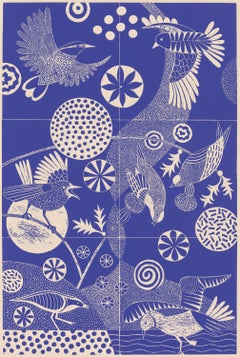
Chittering and Chattering Folk-like linoleum print of birds in blue and white
By Lisa Houck
Located in Wellesley, MA
'Chittering and Chattering,' Linoleum Block Print, Edition 10, 35 1/4 x 23 1/4 Inches, is one of a series of 8 related prints in this size in varying shades of blue. Sold individ...
Category

2010s Continental US - Animal Prints

Materials

Linocut

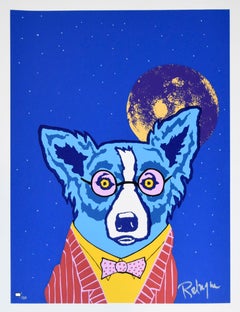
Blue Dog "Looking at Life Through Rose-Colored Glasses"- Signed Silkscreen Print
By George Rodrigue
Located in Mount Laurel, NJ
This Blue Dog work consists of a blue dog on a blue background with tiny white dots (stars) and a blue and yellow moon. The dog is dressed in a red jacket with white pinstripes, a ye...
Category

1990s Pop Art Continental US - Animal Prints

Materials

Screen

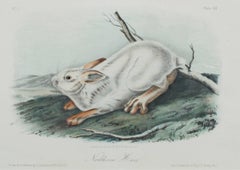
19th century color lithograph hare animal print wildlife
By John James Audubon
Located in Milwaukee, WI
"Northern Hare" is an original color lithograph by John James Audubon. This piece depicts a white rabbit in a cool green landscape. 5 3/4" x 7 3/4" art...
Category

1840s Other Art Style Continental US - Animal Prints

Materials

Lithograph

19th century color lithograph birds nature tree leaves nature scene signed
By Louis Prang
Located in Milwaukee, WI
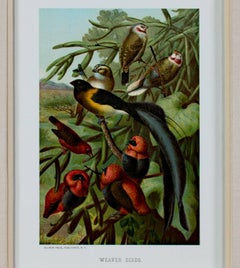
"Weaver Birds" is an original color lithograph by Louis Prang. It depicts multiple weaver birds with leaves surrounding them. 8 1/4" x 5" image 12 1/2" x...
Category

Late 19th Century American Realist Continental US - Animal Prints

Materials

Lithograph

"Pajaro (Parrot), " Black and White Lithograph signed by Arthur Secunda
By Arthur Secunda
Located in Milwaukee, WI
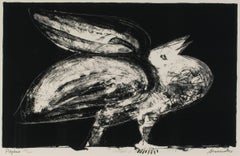
"Pajaro" is an original black and white lithograph by Arturo A. Secunda. It depicts a parrot. The artist signed the piece in the lower right and wrote the title and the edition number (27/100) in the lower left. 11 1/2" x 17 1/2" art 22 3/4" x 28 1/2" frame Arthur Secunda is an internationally renowned artist whose career has spanned five decades. His one man shows have been seen worldwide in numerous galleries and museums in France, Sweden, Belgium, Holland, Spain, Israel, and Japan. In the United States, he is represented in most major museums of the country, including the National Gallery of Art and the Smithsonian Museum in Washington D.C., the Museum of Modern Art in New York, the UCLA Museum, the Detroit Art Institute, and the Phoenix Museum. Known for his brilliant collages and striking graphics, Secunda has mastered all types of printmaking, even making his own paper in France and Japan. His impressive body of work includes painting, mixed media, polyester assemblage, ceramics and welded sculpture. His studies began at the Detroit Art Institute as a teenager, and continued in New York at the Art Students League and New York University. After a stint in the Air Force as an artist, he then studied, thanks to the GI bill, in Mexico, Paris and Italy, with many great artists and teachers, beginning a lifelong propensity for travel-- living and working in other countries. For decades, he maintained studios in Paris and LA. He considers himself a landscape artist, and has developed his own iconography in representing nature, the land and its forms, as well as corresponding inner landscapes. He is known for a specific kind of color gradation and blending of forms in many media. His work tends to oscillate between the serene--striated colors in landscapes--to the expressive, as in many of his oil paintings. After years in Paris, Secunda has maintained a studio in Scottsdale for the last decade--doing what he has done in all of the other places he has liv ed and worked in the last 50 years--creating imagery. He has worked as a jazz musician--in Paris in the early days to support himself, and as a milkman; as an art critic, lecturer, curator, writer and publisher. Periodically, he consults at NASA where he is an image visualizer, helping translate scientific data into visual images. Highly respected as a teacher, he will spend August in Lacoste, France teaching a master class in collage and the creation of handmade artists books. (Secunda has an international following of people who subscribe and collect his dada art "books".) Next year, he will have a one man exhibition at the University of Judaism in Los Angeles, presenting a never before seen series of expressive portrait monotypes of noted art personalities, after which he will exhibit early Mexican woodcuts...
Category

1950s Continental US - Animal Prints

Materials

Lithograph

Three Antique Hand Colored Engravings of Birds
By Peter Brown
Located in Palm Beach, FL
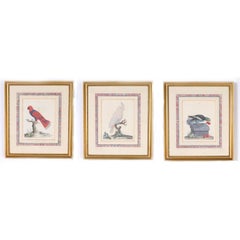
Three 18th century hand colored engravings of parrot specimens as depicted by Peter Brown, an artist and naturalist, working in London England. Originally published in 1776 in a foli...
Category

Late 18th Century Naturalistic Continental US - Animal Prints

Materials

Engraving

Fish Chips
By Robert Deyber
Located in Greenwich, CT
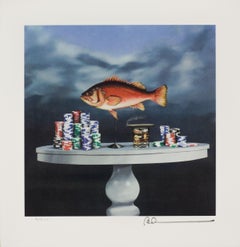
Fish & Chips is a lithograph on paper, initialed lower right 'BD', 9.5 x 9" image size. From the edition of 395, numbered XLIX/C (there were also 275 Arabic and 20 AP), framed in a c...
Category

21st Century and Contemporary Contemporary Continental US - Animal Prints

Materials

Paper, Lithograph

La jineta (The Jockey)
Located in San Francisco, CA
Arturo Rivera La jineta (The Jockey) Serigraph 33.46 x 29.52 in Edition 96 of 100 Serigraph by Mexican artist Arturo Rivera. Edition 96 of 100. Certificate of authenticity included....
Category

21st Century and Contemporary Contemporary Continental US - Animal Prints

Materials

Paper, Screen

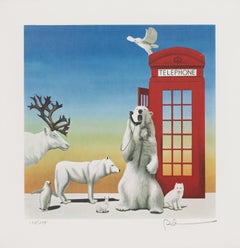
Cold Call (Arctic)
By Robert Deyber
Located in Greenwich, CT
Cold Call (Arctic) is a lithograph on paper, 9 x 9 inches image size. From the edition of 395, numbered 138/275 (there were also 100 Roman and 20 AP), framed in a contemporary, silve...
Category

21st Century and Contemporary Contemporary Continental US - Animal Prints

Materials

Paper, Lithograph

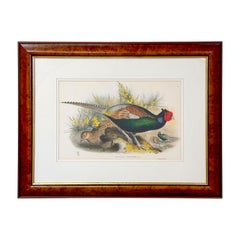
John Gould Japanese Pheasant "Phasianus Versicolo" Large Lithograph, Framed
By John Gould
Located in Plainview, NY
A large print of John Gould of Japanese Pheasant ""Phasianus Versicolo " from his published book " Birds of Asia". John Gould was influenced by James...
Category

20th Century Continental US - Animal Prints

Materials

Paper

Still Thinking About These?

All Recently Viewed