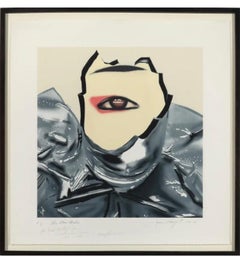
Florida - Figurative Prints
to
891
611
633
870
416
376
Overall Width
to
Overall Height
to
1,001
408
238
227
225
142
86
67
51
14
14
8
4
1
105
47
45
41
40
15
59
1,946
886
49
80
60
48
33
26
137
394
315
260
12
1,704
1,012
180
1,421
795
472
462
433
424
277
233
144
131
109
102
95
90
77
74
66
64
62
61
1,474
939
859
520
283
598
299
2,906
19,344
17,437
Item Ships From: Florida
Abel Pann Israeli Bezalel School Lithograph Judaica Biblical Print Jewish Art
By Abel Pann
Located in Surfside, FL
Abel Pann (1883–1963) was a European Jewish painter who settled in the Talpiot neighborhood of Jerusalem in the early twentieth century and taught at the Bezalel Academy of Art under...
Category
Mid-20th Century Symbolist Florida - Figurative Prints
Materials
Lithograph
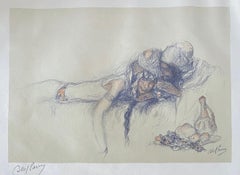
Abel Pann Israeli Bezalel School Lithograph Judaica Biblical Print Jewish Art
By Abel Pann
Located in Surfside, FL
Abel Pann (1883–1963) was a European Jewish painter who settled in the Talpiot neighborhood of Jerusalem in the early twentieth century and taught at the Bezalel Academy of Art under...
Category
Mid-20th Century Symbolist Florida - Figurative Prints
Materials
Lithograph
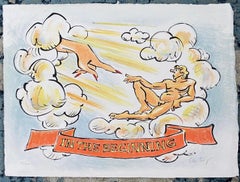
Lithograph Italian Post Modernist Figurative Pop Art - "In The Beginning"
By Sandro Chia
Located in Surfside, FL
Sandro Chia (Italian, 1946)
Children Holiday, 1984
Lithograph in colors on six sheets of Somerset soft white,
71 x 77 inches (180.3 x 195.6 cm)
Numbered A.P. 13/15 (aside from an edi...
Category
Late 20th Century Pop Art Florida - Figurative Prints
Materials
Lithograph
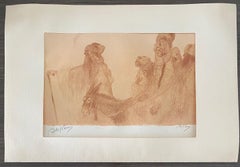
Abel Pann Israeli Bezalel School Lithograph Judaica Biblical Print Jewish Art
By Abel Pann
Located in Surfside, FL
Abel Pann (1883–1963) was a European Jewish painter who settled in the Talpiot neighborhood of Jerusalem in the early twentieth century and taught at the Bezalel Academy of Art under...
Category
Mid-20th Century Symbolist Florida - Figurative Prints
Materials
Lithograph
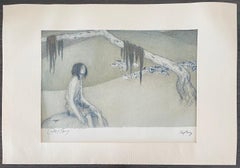
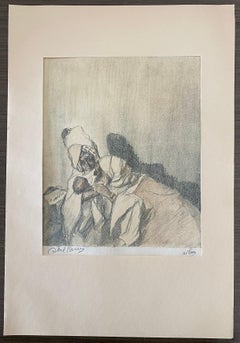
Abel Pann Israeli Bezalel School Lithograph Judaica Biblical Print Jewish Art
By Abel Pann
Located in Surfside, FL
Abel Pann (1883–1963) was a European Jewish painter who settled in the Talpiot neighborhood of Jerusalem in the early twentieth century and taught at the Bezalel Academy of Art under...
Category
Mid-20th Century Symbolist Florida - Figurative Prints
Materials
Lithograph
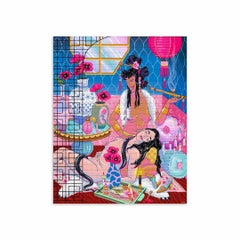
Kristen Liu Wong "We Dreamt Of Poppies" Blotter Print Art
Located in Draper, UT
Embark on a vivid journey into the whimsical world of Kristen Liu Wong with her enchanting "We Dreamt of Poppies" Blotter Print. Crafted with meticulous detail and vibrant colors, th...
Category
2010s Florida - Figurative Prints
Materials
Paper
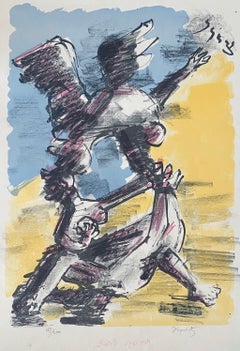
Jacques Lipchitz French Cubist Modernist Lithograph Hebrew Judaica ZIon
By Jacques Lipchitz
Located in Surfside, FL
Hand signed and numbered.
with Hebrew calligraphy "Zion"
Chaim Jacob Lipchitz, 1891-1973, was born in Lithuania and came of age in Paris during the early 20th century, where he was...
Category
1960s Modern Florida - Figurative Prints
Materials
Lithograph
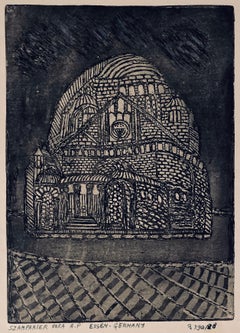
Etching of destroyed synagogue - Essen, Germany
By Dora Szampanier
Located in Surfside, FL
Cracow Poland Etching of Polish Synagogue, Jewish temple. From very rare small edition. Most are signed in Hebrew and /or English. some are marked AP some are numbered. please see ph...
Category
20th Century Folk Art Florida - Figurative Prints
Materials
Etching
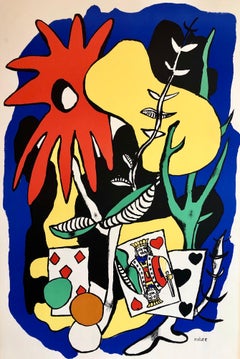
Fernand Leger School Prints Colorful Modernist King of Hearts Drawing Lithograph
By (after) Fernand Léger
Located in Surfside, FL
Bright vibrant blue, orange, red, yellow, green lithograph in color. This is signed in the plate and dated. Leger's abstract drawing lithograph was drawn by the artist direct on to p...
Category
1940s Modern Florida - Figurative Prints
Materials
Lithograph
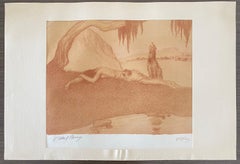
Abel Pann Israeli Bezalel School Lithograph Judaica Biblical Print Jewish Art
By Abel Pann
Located in Surfside, FL
Abel Pann (1883–1963) was a European Jewish painter who settled in the Talpiot neighborhood of Jerusalem in the early twentieth century and taught at the Bezalel Academy of Art under...
Category
Mid-20th Century Symbolist Florida - Figurative Prints
Materials
Lithograph
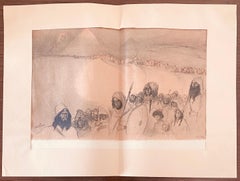
Abel Pann Israeli Bezalel School Lithograph Judaica Biblical Print Jewish Art
By Abel Pann
Located in Surfside, FL
Abel Pann (1883–1963) was a European Jewish painter who settled in the Talpiot neighborhood of Jerusalem in the early twentieth century and taught at the Bezalel Academy of Art under...
Category
Mid-20th Century Symbolist Florida - Figurative Prints
Materials
Lithograph
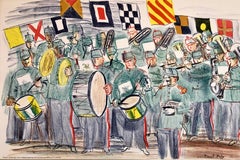
Raoul Dufy School Prints Colorful Modernist Drawing Lithograph Marching Band
By (after) Raoul Dufy
Located in Surfside, FL
Bright vibrant blue, yellow lithograph in color. This is signed in the plate and dated. Dufy's abstract drawing lithograph was drawn by the artist direct on to plastic plates newly d...
Category
1940s Modern Florida - Figurative Prints
Materials
Lithograph
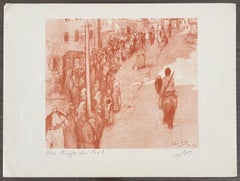
Abel Pann Israeli Bezalel School Lithograph Judaica Biblical Print Jewish Art
By Abel Pann
Located in Surfside, FL
Abel Pann (1883–1963) was a European Jewish painter who settled in the Talpiot neighborhood of Jerusalem in the early twentieth century and taught at the Bezalel Academy of Art under...
Category
Mid-20th Century Symbolist Florida - Figurative Prints
Materials
Lithograph
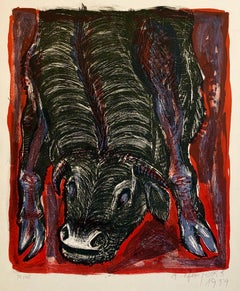
1959 Israeli Avraham Ofek Leviathan Modernist Lithograph, Bull, Bezalel School
By Avraham Ofek
Located in Surfside, FL
Bright, vibrant purple, red and black bull or ox.
1959 Lithograph "Bull".
This was from a portfolio which included works by Yosl Bergner, Menashe Kadishman, Yosef Zaritsky, Aharon Kahana, Jacob Wexler, Moshe Tamir and Michael Gross.
Avraham Ofek (August 14, 1935 – January 13, 1990 was an Israeli sculptor, muralist, painter and printmaker.
Avraham Ofek was born in Burgas, Bulgaria. He immigrated to Israel in 1949, and he lived in Ein Hamifratz, a kibbutz near Haifa. He studied at the Academy of Fine Arts in Florence, as well as in Spain and in London, and later taught art in Jerusalem before being appointed head of the Art Department at the University of Haifa. In 1975, he established the Leviathan Group school together with Michail Grobman and Shmuel Ackerman (prominent Post Soviet avant garde Russian artists), seeking to combine symbolism, metaphysics and Judaism in an all-inclusive “national style.” He represented Israel at the Venice Biennale in 1972.
Avraham Ofek's early paintings of landscape were at both lyrical and rugged; later in his career the landscape was undefined and receded into the background. Near the end of his life, the landscape of Jerusalem became an important motif, reflecting loss and despair. Many of Ofek's landscapes convey a sense of alienation and solitude, as well as nostalgia for the city of his birth, Sofia.
His mural paintings and sculpture can be seen across Israel, notably at Kfar Uria and the Central Post Office Building (Jerusalem). His sculpture "The Binding of Isaac...
Category
1950s Modern Florida - Figurative Prints
Materials
Lithograph
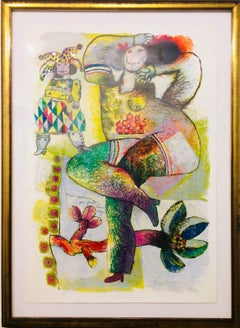
Theo Tobiasse Danse Pantomime Silkscreen
By Théo Tobiasse
Located in Lake Worth Beach, FL
Danse Pantomime 1982 pencil signed, limited edition silkscreen 112/150
Theo Tobiasse was born in Israel in 1927 to Lithuanian parents. Due to financial ...
Category
1980s Surrealist Florida - Figurative Prints
Materials
Archival Paper, Screen

$2,013 Sale Price
39% Off
Israeli Naive Folk Art Silkscreen Lithograph David Sharir - Bet Hamikdash Scene
By David Sharir
Located in Surfside, FL
David Sharir was born in 1938 in Tel Aviv, Israel and currently resides there.
David Sharir, the son of Russian immigrants, was born in Israel. Beginning his study of art in Tel Aviv...
Category
20th Century Folk Art Florida - Figurative Prints
Materials
Screen

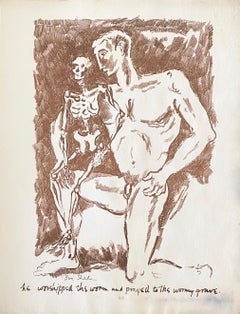
Ben Shahn Original Lithograph From Portfolio - Levana
Our Ladies Of Sorrow
By Ben Shahn
Located in Surfside, FL
SCARCE EARLY WORK. BEN SHAHN
Levana and our Lady's Sorrows.
lithograph printed in sepia on Papier Ancien, 1931. 13 1/8x9 7/8 inches (sheets), full margins, loose as issued.
One of o...
Category
Mid-20th Century American Modern Florida - Figurative Prints
Materials
Lithograph
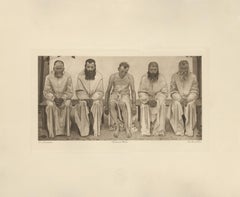
"The World Weary" Copper Plate Heliogravure
By Ferdinand Hodler
R. Piper
Co.
Located in Palm Beach, FL
2018 marks the centenary anniversary of Ferdinand Hodler’s death. In that 100 years time, the art world’s esteem of this important artist has proved fickle. It has shifted from extolling his artistic merits during his lifetime to showing something of a feigned disdain- more reflective of the world political order than a true change of heart for Hodler’s work. After years of Hodler being all but a footnote in the annals of art history and generally ignored, finally, the pendulum has righted itself once again. Recent retrospective exhibitions in Europe and the United States have indicated not only a joyful rediscovery of Hodler’s art but a firm conviction that his work and world view hold particular relevance today. DAS WERK FERDINAND HODLERS is not only a collection of printed work reflecting the best of all of his painted work created up to 1914 just before the outbreak of World War I, the portfolio itself is an encapsulation of Hodler’s ethos, Parallelisme.
Hodler developed his philosophy of Parallelisme as a unifying approach to art which strips away detail in search of harmony. By means of abstraction, symmetry and repetition, Hodler sought ways to depict Nature’s essence and her fundamental, universal order. He believed these universal laws governing the natural, observable world extend to the spiritual realm. Symbolist in nature with Romantic undertones, his works are equally portraits of these universal concepts and feelings governing all life as they are a visual portrait in the formal sense. Whether his subject is a solitary tree, a moment in battle, mortal fear, despair, the awe inspired by a vast mountain range, a tender moment or even the collective conviction in a belief, Hodler unveils this guiding principle of Parallelisme.
Several aspects of Hodler’s portfolio reinforce his tenets of Parallelisme. The Table of Contents clearly preferences a harmonious design over detail. The two columns, consisting of twenty lines each, list the images by order of appearance using their German titles. The abbreviated titles are somewhat cryptic in that they obscure the identities of the sitters. Like the image Hodler presents, they are distillations of the sitter without any extraneous details. This shortening was also done in an effort to maintain a harmonious symmetry of the Table of Contents, themselves, and keep titles to a one-line limit. The twenty-fourth title: “Bildnis des Schweizerischen Gesandten C.” was so long, even with abbreviation, that it required two lines; so, for the sake of maintaining symmetry, the fortieth title: “Bauernmadchen” was omitted from the list. This explains why the images are not numbered. Hodler’s reasoning is not purely esoteric. Symmetry and pattern reach beyond mere formal design principles. Finding sameness and imposing it over disorder goes to the root of Hodler’s identity and his art. A Swiss native, Hodler was bi-lingual and spoke German and French. Each printed image, even number forty, have titles in both of Hodler’s languages. Certainly, there was a market for Hodler’s work among francophones and this inclusion may have been a polite gesture to that end; however, this is the only place in the portfolio which includes French. With German titles at the lower left of each image, Hodler’s name at bottom center and corresponding French titles at the lower right of each image, there is a harmony and symmetry woven into all aspects of the portfolio. This holds true for the page design, as it applies to each printed image and as it describes the Swiss artist himself. Seen in this light, Hodler’s portfolio of printed work is the epitome of Hodler’s Parallelisme. DAS WERK FERDINAND HODLERS is also one of the most significant documents to best tell the story of how Hodler, from Switzerland, became caught between political cross-hairs and how the changing tides of nations directly impacted the artist during his lifetime as well as the accessibility of his art for generations to come.
The Munich-based publisher of the portfolio, R. Piper & Co., Verlag, plays a crucial role in this story. Publishing on a wide range of subjects from philosophy and world religion to music, literature and the visual arts; the publisher’s breadth of inquiry within any one genre was equal in scope. Their marketing strategy to publish multiple works on Hodler offers great insight as to what a hot commodity Hodler was at that time. R.Piper & Co.’s Almanach, which they published in 1914 in commemoration of their first ten years in business, clearly illustrates the rapid succession- strategically calculated for achieving the deepest and broadest impact - in which they released three works on Hodler to hit the market by the close of 1914. DAS WERK FERDINAND HODLERS was their premier publication. It preceded C.A. Loosli’s Die Zeichnungen Ferdinand Hodlers, a print portfolio after 50 drawings by Hodler which was released in Autumn of 1914 at the mid-level price-point of 75-150 Marks; and a third less expensive collection of prints after original works by Hodler, which had not been included in either of the first two portfolios, was released at the end of that year entitled Ferdinand Hodler by Dr. Ewald Bender.
The title and timing of DAS WERK FERDINAND HODLERS' debut leaves little doubt as to the connection it has with another avant-garde portfolio of art prints, Das Werk Gustav Klimts, released in 5 installments from 1908 -1914 by Galerie Miethke in Vienna. Hodler, himself, was involved in Klimt’s ground-breaking project. As the owner of Klimt’s 1901 painting, “Judith with the Head of Holifernes” which appears as the ninth collotype print in the second installment of Das Werk Gustav Klimts, Hodler was obliged to grant access of the painting to the art printers in Vienna for them to create the collotype sometime before 1908. Hodler had been previously invited in 1904 to take part in what would be the last exhibition of the Vienna Secession before Klimt and others associated with Galerie Miethke broke away. In an interview that same year, Hodler indicated that he respected and was impressed by Klimt. Hodler’s esteem for Klimt went beyond the art itself; he emulated Klimt’s method aimed at increasing his market reach and appeal to a wider audience by creating a print portfolio of his painted work. By 1914, Hodler and his publisher had the benefit of hindsight to learn from Klimt’s Das Werk publication.
Responding to the sluggish sales of Klimt’s expensive endeavor, Hodler’s publisher devised the same diversified 1-2-3 strategy for selling Hodler’s Das Werk portfolio as they did with regards to all three works on Hodler they published that year. For their premium tier of DAS WERKS FERDINAND HODLERS, R. Piper & Co. issued an exclusive Museum quality edition of 15 examples on which Hodler signed each page. At a cost of 600 Marks, this was generally on par with Klimt’s asking price of 600 Kronen for his Das Werk portfolio. A middle-tiered Preferred edition of 30, costing somewhat less and with Hodler’s signature only on the Title Page, was also available. The General edition, targeting the largest audience with its much more affordable price of 150 Marks, is distinguishable by its smaller size.
Rather than use the subscription format Miethke had chosen for Klimt’s portfolios which proved to have had its challenges, R. Piper & Co. employed a different strategy. In addition to instantly gratifying the buyer with all 40 of the prints comprising DAS WERK FERDINAND HODLERS and the choice among three price points, they advertised in German journals a fourth possibility of ordering single prints from them directly. These printed images are easily discernible from the three complete folio editions. The paper size of the single purchased images is of the larger format like the Museum and Preferred editions, measuring 65 h x 50 w cm; however, the paper itself is the same copper print paper used in the General edition and then mounted on poster board. The publishing house positioned itself to be a direct retailer of Hodler’s art. They astutely recognized the potential for profitability and the importance, therefore, of having proprietary control over his graphic works.
R. Piper & Co. owned the exclusive printing rights to Hodler’s best work found in their three publications dating from 1914. That same year, a competing publication out of Weimar entitled Ferdinand Hodler: Ein Deutungsversuch von Hans...
Category
1910s Symbolist Florida - Figurative Prints
Materials
Paper
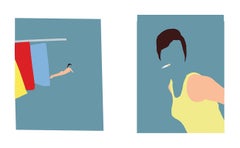
Lawn and Cig, From the Series "Why This Restlessness?" Limited edition print
By Casey Waterman
Located in Miami Beach, FL
By removing parts of the image, he explores the tension between what is present and what is omitted, focusing on the reasons behind these choices and their implications. The cutouts ...
Category
2010s Contemporary Florida - Figurative Prints
Materials
Archival Ink, Color
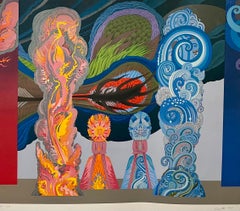
Austrian Psychedelic Abstract Fire Tower Water Tower Silkscreen Wolfgang Hutter
Located in Surfside, FL
Fire Tower Water Tower (1974) Silkscreen Lithograph by Wolfgang Hutter
Wolfgang Hutter (1928 – 2014) was a painter, draughtsman, printmaker and stage designer. Hutter's imagery is c...
Category
1970s Abstract Florida - Figurative Prints
Materials
Screen
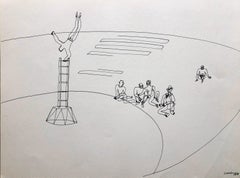
Alexander Calder Circus Reproduction Lithograph After a Drawing
By (after) Alexander Calder
Located in Surfside, FL
(after) Alexander Calder
"Calder's Circus" offset lithograph on wove paper after drawings by the artist
Published by Art in America and Perls gallery in 1964 (from drawings done in the 1930's)
these range slightly in size but they are all about 13 X 17 inches (with minor variations in size as issued.) These have never been framed. The outer folio is not included just the one lithograph.
James Sweeny from the introduction “The fame of Calder’s circus spread quickly between the years 1927 and 1930. All the Paris art world came to know it. It brought him his first great personal success. But what was more important, the circus also provided the first steps in Calder’s development as an original sculptor”
Clive Gray wrote ”A visit to the studio of Alexander Calder led to the chance discovery of some hundred masterful circus drawings completed over thirty years ago. We publish, for the first time, a choice of sixteen from that group.” With signed introduction by Miro.
These whimsical drawings, done in the style of wire sculpture, include acrobats, clowns, jugglers, trapeeze artists, an elephant, dog and lion. they are great.
Alexander Calder is widely considered to be one of the most important American sculptors of the 20th century. He is best known for his colorful, whimsical abstract public sculptures and his innovative mobiles, kinetic sculptures powered by motors or air currents, which embraced chance in their aesthetic. Born into a family of accomplished artists, Calder's work first gained attention in Paris in the 1930s and was soon championed by the Museum of Modern Art in New York, resulting in a retrospective exhibition in 1943. Major retrospectives were also held at the Solomon R. Guggenheim Museum (1964) and the Museum of Contemporary Art, Chicago (1974). Calder’s work is in many permanent collections, most notably in the Whitney Museum of American Art, but also the Guggenheim Museum; the Museum of Modern Art; the National Gallery of Art, Washington, D.C.; and the Centre Georges Pompidou. He produced many large public works, including .125 (at JFK Airport, 1957), Pittsburgh (Carnegie International prize winner 1958, Pittsburgh International Airport) Spirale (UNESCO in Paris, 1958), Flamingo and Universe (both in Chicago, 1974), and Mountains and Clouds (Hart Senate Office Building, Washington, D.C., 1976). Although primarily known for his sculpture, Calder was a prodigious artist with a restless creative spirit, whose diverse practice included painting and printmaking, miniatures (such as his famous Cirque Calder), children’s book illustrations, theater set design, jewelry design, tapestry and rug works, and political posters. Calder was honored by the US Postal Service with a set of five 32-cent stamps in 1998, and received the Presidential Medal of Freedom, posthumously in 1977, after refusing to receive it from Gerald Ford one year earlier in protest of the Vietnam War.
Calder moved to New York and enrolled at the Art Students League, studying briefly with Thomas Hart Benton, George Luks, Kenneth Hayes Miller, and John Sloan. While a student, he worked for the National Police Gazette where, in 1925, one of his assignments was sketching the Ringling Bros. and Barnum & Bailey Circus. Calder became fascinated with the action of the circus, a theme that would reappear in his later work.
In 1926, Calder moved to Paris, enrolled in the Académie de la Grande Chaumière, and established a studio at 22 rue Daguerre in the Montparnasse Quarter. In June 1929, while traveling by boat from Paris to New York, Calder met his future wife, Louisa James (1905-1996), grandniece of author Henry James and philosopher William James. They married in 1931. While in Paris, Calder met and became friends with a number of avant-garde artists, including Fernand Léger, Jean Arp, and Marcel Duchamp. Cirque Calder (on view at the Whitney Museum of American Art at present) became popular with the Parisian avant-garde. He also invented wire sculpture, or "drawing in space," and in 1929 he had his first solo show of these sculptures in Paris at Galerie Billiet. Hi! (Two Acrobats) in the collection of the Honolulu Museum of Art is an early example of the artist's wire sculpture. The painter Jules Pascin, a friend of Calder's from the cafes of Montparnasse, wrote the preface to the catalog. A visit to Piet Mondrian's studio in 1930, where he was impressed by the environment-as-installation, "shocked" him into fully embracing abstract art, toward which he had already been tending.
Dating from 1931, Calder’s sculptures of discrete movable parts powered by motors were christened “mobiles” by Marcel Duchamp, a French pun meaning both "motion" and "motive." At the same time, Calder was also experimenting with self-supporting, static, abstract sculptures, dubbed "stabiles" by Jean Arp in 1932 to differentiate them from mobiles.
Public commissions increasingly came his way in the 1960s. Notable examples are .125 for JFK Airport in 1957, Spirale for UNESCO in Paris 1958 and Trois disques, commissioned for Expo 67 in Montreal, Quebec, Canada. Calder's largest sculpture at 25.7 meters high was El Sol Rojo, constructed outside the Aztec Stadium for the 1968 Summer Olympics "Cultural Olympiad" events in Mexico City. Many of his public works were commissioned by renowned architects; I.M. Pei commissioned his La Grande Voile (1966), a 25-ton, 40-foot high stabile for the Massachusetts Institute of Technology.
Part of Calder's repertoire includes pivotal stage sets for more than a dozen theatrical productions, including Nucléa, Horizon, and most notably, Martha Graham’s Panorama (1935), a production of the Erik Satie symphonic drama Socrate (1936), and later, Works in Progress (1968).
In addition to sculptures, Calder painted throughout his career, beginning in the early 1920s. He picked up his study of printmaking in 1925, and continued to produce illustrations for books and journals.As Calder’s professional reputation expanded in the late 1940s and 1950s, so did his production of prints. Masses of lithographs based on his gouache paintings hit the market, and deluxe editions of plays, poems, and short stories illustrated with fine art prints by Calder became available for sale.
One of Calder's most celebrated and unconventional undertakings was a commission from Dallas-based Braniff International Airways to paint a full-size Douglas DC-8-62 four-engined jet as a "flying canvas."
Calder created over 2,000 pieces of jewelry over the course of his career, many of them as gifts for friends and relatives. For his lifelong friend Joan Miró, he set a shard of a broken porcelain vessel in a brass ring. Peggy Guggenheim received enormous silver mobile earrings and later commissioned a hammered silver headboard...
Category
1930s American Modern Florida - Figurative Prints
Materials
Lithograph
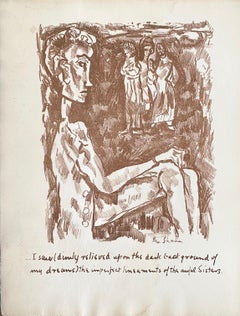
Ben Shahn Original Lithograph From Portfolio - Levana
Our Ladies Of Sorrow
By Ben Shahn
Located in Surfside, FL
SCARCE EARLY WORK. BEN SHAHN
Levana and our Lady's Sorrows.
lithograph printed in sepia on Papier Ancien, 1931. 13 1/8x9 7/8 inches (sheets), full margins, loose as issued.
One of o...
Category
Mid-20th Century American Modern Florida - Figurative Prints
Materials
Lithograph
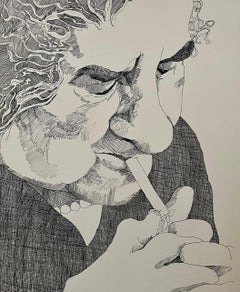
Golda Meir Israeli Woman Prime Minister Smoking Cigarette Ink Line Etching Print
Located in Surfside, FL
Golda Meir, Israeli Zionist leader, Prime Minister and feminist icon, smoking a cigarette.
Nancy Drosd is a painter working in New York City. Since 2001 s...
Category
1970s American Modern Florida - Figurative Prints
Materials
Etching
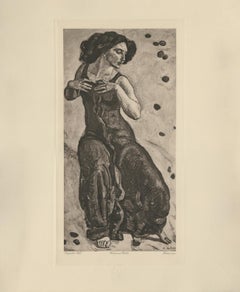
"Exuberant Woman" Copper Plate Heliogravure
By Ferdinand Hodler
R. Piper
Co.
Located in Palm Beach, FL
2018 marks the centenary anniversary of Ferdinand Hodler’s death. In that 100 years time, the art world’s esteem of this important artist has proved fickle. It has shifted from extolling his artistic merits during his lifetime to showing something of a feigned disdain- more reflective of the world political order than a true change of heart for Hodler’s work. After years of Hodler being all but a footnote in the annals of art history and generally ignored, finally, the pendulum has righted itself once again. Recent retrospective exhibitions in Europe and the United States have indicated not only a joyful rediscovery of Hodler’s art but a firm conviction that his work and world view hold particular relevance today. DAS WERK FERDINAND HODLERS is not only a collection of printed work reflecting the best of all of his painted work created up to 1914 just before the outbreak of World War I, the portfolio itself is an encapsulation of Hodler’s ethos, Parallelisme.
Hodler developed his philosophy of Parallelisme as a unifying approach to art which strips away detail in search of harmony. By means of abstraction, symmetry and repetition, Hodler sought ways to depict Nature’s essence and her fundamental, universal order. He believed these universal laws governing the natural, observable world extend to the spiritual realm. Symbolist in nature with Romantic undertones, his works are equally portraits of these universal concepts and feelings governing all life as they are a visual portrait in the formal sense. Whether his subject is a solitary tree, a moment in battle, mortal fear, despair, the awe inspired by a vast mountain range, a tender moment or even the collective conviction in a belief, Hodler unveils this guiding principle of Parallelisme.
Several aspects of Hodler’s portfolio reinforce his tenets of Parallelisme. The Table of Contents clearly preferences a harmonious design over detail. The two columns, consisting of twenty lines each, list the images by order of appearance using their German titles. The abbreviated titles are somewhat cryptic in that they obscure the identities of the sitters. Like the image Hodler presents, they are distillations of the sitter without any extraneous details. This shortening was also done in an effort to maintain a harmonious symmetry of the Table of Contents, themselves, and keep titles to a one-line limit. The twenty-fourth title: “Bildnis des Schweizerischen Gesandten C.” was so long, even with abbreviation, that it required two lines; so, for the sake of maintaining symmetry, the fortieth title: “Bauernmadchen” was omitted from the list. This explains why the images are not numbered. Hodler’s reasoning is not purely esoteric. Symmetry and pattern reach beyond mere formal design principles. Finding sameness and imposing it over disorder goes to the root of Hodler’s identity and his art. A Swiss native, Hodler was bi-lingual and spoke German and French. Each printed image, even number forty, have titles in both of Hodler’s languages. Certainly, there was a market for Hodler’s work among francophones and this inclusion may have been a polite gesture to that end; however, this is the only place in the portfolio which includes French. With German titles at the lower left of each image, Hodler’s name at bottom center and corresponding French titles at the lower right of each image, there is a harmony and symmetry woven into all aspects of the portfolio. This holds true for the page design, as it applies to each printed image and as it describes the Swiss artist himself. Seen in this light, Hodler’s portfolio of printed work is the epitome of Hodler’s Parallelisme. DAS WERK FERDINAND HODLERS is also one of the most significant documents to best tell the story of how Hodler, from Switzerland, became caught between political cross-hairs and how the changing tides of nations directly impacted the artist during his lifetime as well as the accessibility of his art for generations to come.
The Munich-based publisher of the portfolio, R. Piper & Co., Verlag, plays a crucial role in this story. Publishing on a wide range of subjects from philosophy and world religion to music, literature and the visual arts; the publisher’s breadth of inquiry within any one genre was equal in scope. Their marketing strategy to publish multiple works on Hodler offers great insight as to what a hot commodity Hodler was at that time. R.Piper & Co.’s Almanach, which they published in 1914 in commemoration of their first ten years in business, clearly illustrates the rapid succession- strategically calculated for achieving the deepest and broadest impact - in which they released three works on Hodler to hit the market by the close of 1914. DAS WERK FERDINAND HODLERS was their premier publication. It preceded C.A. Loosli’s Die Zeichnungen Ferdinand Hodlers, a print portfolio after 50 drawings by Hodler which was released in Autumn of 1914 at the mid-level price-point of 75-150 Marks; and a third less expensive collection of prints after original works by Hodler, which had not been included in either of the first two portfolios, was released at the end of that year entitled Ferdinand Hodler by Dr. Ewald Bender.
The title and timing of DAS WERK FERDINAND HODLERS' debut leaves little doubt as to the connection it has with another avant-garde portfolio of art prints, Das Werk Gustav Klimts, released in 5 installments from 1908 -1914 by Galerie Miethke in Vienna. Hodler, himself, was involved in Klimt’s ground-breaking project. As the owner of Klimt’s 1901 painting, “Judith with the Head of Holifernes” which appears as the ninth collotype print in the second installment of Das Werk Gustav Klimts, Hodler was obliged to grant access of the painting to the art printers in Vienna for them to create the collotype sometime before 1908. Hodler had been previously invited in 1904 to take part in what would be the last exhibition of the Vienna Secession before Klimt and others associated with Galerie Miethke broke away. In an interview that same year, Hodler indicated that he respected and was impressed by Klimt. Hodler’s esteem for Klimt went beyond the art itself; he emulated Klimt’s method aimed at increasing his market reach and appeal to a wider audience by creating a print portfolio of his painted work. By 1914, Hodler and his publisher had the benefit of hindsight to learn from Klimt’s Das Werk publication.
Responding to the sluggish sales of Klimt’s expensive endeavor, Hodler’s publisher devised the same diversified 1-2-3 strategy for selling Hodler’s Das Werk portfolio as they did with regards to all three works on Hodler they published that year. For their premium tier of DAS WERKS FERDINAND HODLERS, R. Piper & Co. issued an exclusive Museum quality edition of 15 examples on which Hodler signed each page. At a cost of 600 Marks, this was generally on par with Klimt’s asking price of 600 Kronen for his Das Werk portfolio. A middle-tiered Preferred edition of 30, costing somewhat less and with Hodler’s signature only on the Title Page, was also available. The General edition, targeting the largest audience with its much more affordable price of 150 Marks, is distinguishable by its smaller size.
Rather than use the subscription format Miethke had chosen for Klimt’s portfolios which proved to have had its challenges, R. Piper & Co. employed a different strategy. In addition to instantly gratifying the buyer with all 40 of the prints comprising DAS WERK FERDINAND HODLERS and the choice among three price points, they advertised in German journals a fourth possibility of ordering single prints from them directly. These printed images are easily discernible from the three complete folio editions. The paper size of the single purchased images is of the larger format like the Museum and Preferred editions, measuring 65 h x 50 w cm; however, the paper itself is the same copper print paper used in the General edition and then mounted on poster board. The publishing house positioned itself to be a direct retailer of Hodler’s art. They astutely recognized the potential for profitability and the importance, therefore, of having proprietary control over his graphic works.
R. Piper & Co. owned the exclusive printing rights to Hodler’s best work found in their three publications dating from 1914. That same year, a competing publication out of Weimar entitled Ferdinand Hodler: Ein Deutungsversuch von Hans...
Category
1910s Symbolist Florida - Figurative Prints
Materials
Paper
1922 German Expressionist Figurative Train Tunnel Etching Paul Kleinschmidt
By Paul Kleinschmidt
Located in Surfside, FL
Paul Kleinschmidt, (1883–1949)
"Tunnel" Etching
1922
Frame: 17" X 21"
Image: 10.5" X 13.5"
Rare Artist's Proof edition 1 of 4
An architectural study of a bridge and train tunnel
Prov...
Category
1920s Abstract Florida - Figurative Prints
Materials
Paper, Etching

Abel Pann Israeli Bezalel School Lithograph Judaica Biblical Print Jewish Art
By Abel Pann
Located in Surfside, FL
Abel Pann (1883–1963) was a European Jewish painter who settled in the Talpiot neighborhood of Jerusalem in the early twentieth century and taught at the Bezalel Academy of Art under...
Category
Mid-20th Century Symbolist Florida - Figurative Prints
Materials
Lithograph
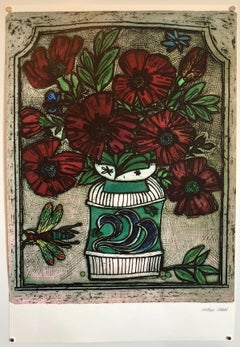
Offset Lithograph Modernist Print of Bold Vibrant Flowers, Plate Signed
Located in Surfside, FL
Alfred Cohenartist, 1920-2001
Brilliant colourist famed for portraits of the stars and landscapes
Although his professed heroes were Rembrandt and Picasso...
Category
20th Century Modern Florida - Figurative Prints
Materials
Offset
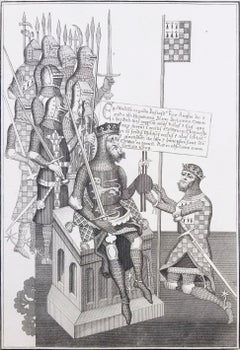
William the Conqueror Giving a Charter to his Nephew Alan Earl of Britain
Located in Saint Augustine, FL
Artist: Francis Drake (English, 1696-1771)
Title: "William the Conqueror Giving a Charter to his Nephew Alan Earl of Britain" (Plate 12)
Portfolio: Eboracum: or The History and Antiquities of the City of York
Year: 1736 (First edition)
Medium: Original Engraving on watermarked light laid paper
Limited edition: Unknown
Printer: William Bowyer...
Category
1730s Old Masters Florida - Figurative Prints
Materials
Laid Paper, Engraving
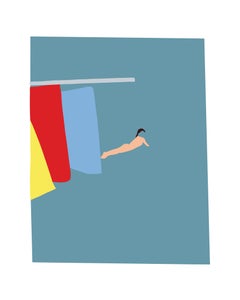
Lawn, From the Series Why This Restlessness? Limited edition print
By Casey Waterman
Located in Miami Beach, FL
By removing parts of the image, he explores the tension between what is present and what is omitted, focusing on the reasons behind these choices and their implications. The cutouts ...
Category
2010s Minimalist Florida - Figurative Prints
Materials
Archival Ink, Archival Paper, Color
Cig, From the series “Why This Restlessness?”. Limited edition print
By Casey Waterman
Located in Miami Beach, FL
By removing parts of the image, he explores the tension between what is present and what is omitted, focusing on the reasons behind these choices and their implications. The cutouts ...
Category
2010s Contemporary Florida - Figurative Prints
Materials
Archival Ink, Color, Inkjet
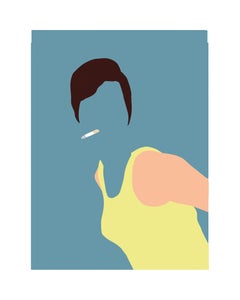
Tennis, From the Series “Why This Restlessness?” Limited edition print
By Casey Waterman
Located in Miami Beach, FL
By removing parts of the image, he explores the tension between what is present and what is omitted, focusing on the reasons behind these choices and their implications. The cutouts ...
Category
2010s Contemporary Florida - Figurative Prints
Materials
Archival Ink, Color, Inkjet
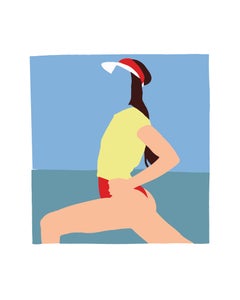
ANGER
By Charles Bragg
Located in Aventura, FL
Etching on paper. Hand signed, titled and numbered by the artist. Sheet size 12 x 15 inches. Image size 5.75 x 7.75 inches. Edition of 300. Artwork is in excellent condition. Cer...
Category
Late 20th Century Contemporary Florida - Figurative Prints
Materials
Paper, Etching
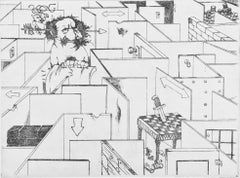
$200 Sale Price
50% Off
Large Archival Pigment Print Judaica Lithograph Mark Podwal Jewish Hebrew Art
By Mark Podwal
Located in Surfside, FL
Mark Podwal (American, New York, born 1945)
"All This Has Come Upon Us"
Archival pigment print
Dimensions: 22 X 30 inches
with Roman antique bronze or gold coins
From a 2014 portf...
Category
21st Century and Contemporary Neo-Expressionist Florida - Figurative Prints
Materials
Lithograph, Archival Pigment
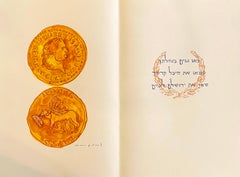
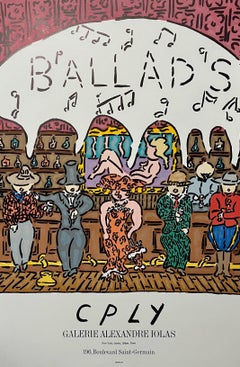
Vintage Galerie Alexandre Iolas Ballads Poster William Copley CPLY Mourlot Litho
Located in Surfside, FL
Ballads Galerie Alexandre Iolas Poster by William N. Copley (CPLY)
New-York, Geneve, Milan, Paris
196, Boulevard Saint-Germain
William Nelson Copley (January 24, 1919 – May 7, 1996) also known as CPLY, was an American painter, writer, gallerist, collector, patron, publisher and art entrepreneur. His works as an artist have been classified as late Surrealist and precursory to Pop Art.
William N. Copley was born in New York City in 1919 to parents John and Flora Lodwell; they died shortly after in the 1919 Spanish Flu epidemic. Copley was adopted in 1921 by Ira C. Copley, the owner of sixteen newspaper companies in Chicago and San Diego. Copley was ten years old whereby the family moved to Coronado Island, California.
Copley was sent to Phillips Andover and then Yale University by his adopted parents. He was drafted in the Second World War in the middle of his education at Yale, a decision negotiated by the school and the army. Copley experimented with politics upon returning home from the war, working as a reporter for his father's newspaper.
By 1946, Copley met and married Marjorie Doris Wead, the daughter of a test pilot for the Navy. Doris's sister was married to John Ployardt, a Canadian-born animator and narrator at Walt Disney Studios. Copley and Ployardt soon became friends and Ployardt began introducing Copley to painting and Surrealism. The two traveled to Mexico and New York, discovering art, meeting the artists behind the works, and grasping Surrealist ideas. It was during this time that Copley and Ployardt decided to open a gallery in Los Angeles to exhibit Surrealist works.
Copley and Ployardt tracked down Man Ray while living in Los Angeles. Ray then introduced them to Marcel Duchamp in New York City. There, Duchamp opened many doors for them, introducing the two to New York dealers in Surrealism. In 1948, Copley and Ployardt opened The Copley Galleries in Beverly Hills, displaying works by artists including René Magritte, Max Ernst, Yves Tanguy, Roberto Matta, Joseph Cornell, and Man Ray. Copley moved to Paris in 1949–50, leaving behind his wife and two children to continue to paint. During his time in Paris, he remained in Surrealist circles and continued to paint with a uniquely American style.
Copley's first exhibition took place in Los Angeles in 1951 at Royer's Book Shop. From there Copley participated in numerous solo and group exhibitions worldwide. In 1961, Copley was given an exhibition in Amsterdam by the Stedelijk Museum. The museum became the first public institution to add a Copley to their collection.
Copley's paintings throughout the 1950s and 60s dealt with ironic and humorous images of stereotypical American symbols like the Western saloon, cowboys, and pin-up girls combined with flags. His works during this period were often considered a combination of American and Mexican folk art and melded in well with the new young POP movement occurring in America when he returned to New York in the 1960s. Artists like Andy Warhol, Christo, Roy Lichtenstein and many others were frequent visitors at Copley's studio on Lower Broadway. Copley believed that pop art had always interested him, claiming American pop art had much to do with "self-disgust" and "satire."
In 1967, after a divorce with his second wife, Noma, Copley and new friend Dmitri Petrov decided to publish portfolios of 20th-century artist collaborations with the abbreviation SMS (for "Shit Must Stop"). Copley's Upper West Side loft became a meeting place for performers, artists, curators, and composers to work together on the open-ended collective. The SMS portfolio...
Category
20th Century Abstract Florida - Figurative Prints
Materials
Paper, Lithograph, Offset
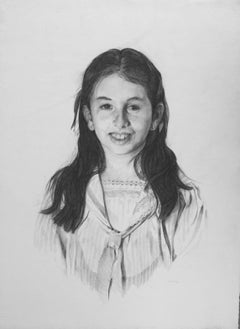
Portrait of a Girl
By Harry Sudman
Located in Surfside, FL
Harry Sudman is a realist painter and photographer who has worked out of Chicago for over twenty-five years. He grew up on the south side, and currently resides uptown. In the late 1...
Category
20th Century Realist Florida - Figurative Prints
Materials
Charcoal
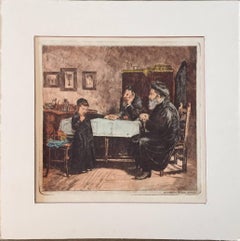
Rare Judaica Cheder Test Hand Colored Etching after Kaufmann
Located in Surfside, FL
This is an etching with hand painted watercolor applied
After Isidor Kaufmann (1853-1921) was an Austro-Hungarian painter of Jewish themes. Having devoted his career to genre painti...
Category
20th Century Florida - Figurative Prints
Materials
Etching
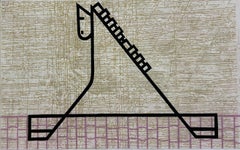
Miguel Castro Leñero, Caballo de Batalla III-3, 29.8 x 47.3 in. (75.5 x 120 cm.)
By Miguel Castro Leñero
Located in Miami, FL
Miguel Castro Leñero (Mexico, 1956)
'Caballo de Batalla III-3', 2019
engraving on paper Intaglio 300 g.
29.8 x 47.3 in. (75.5 x 120 cm.)
Edition of 30
Unframed
ID: CAM-107
Hand-signe...
Category
2010s Contemporary Florida - Figurative Prints
Materials
Paper, Engraving, Etching, Aquatint, Screen
Artists Hand Signed and Inscribed "Ballet Dancers" Holiday Greeting Card
By Moses Soyer
Located in Surfside, FL
This piece a holiday card with hand painted print by the Social Realist artist Moses Soyer. Here, the artist depicts the figure of a dancer assuming different ballet poses and works in a very intimate scale, reflecting the delicate nature of ballet. Text on the piece reads: To Rina
Moses Soyer (December 25, 1899 – September 3, 1974) was an American social realist painter. Soyer was born in Borisoglebsk, Russian Empire, in 1899. His father was a Hebrew scholar, writer and teacher. His family emigrated to the United States in 1912. Two of Soyer's brothers, Raphael (his identical twin) and Isaac were also painters. Soyer's wife, Ida, was a dancer, and dancers are a recurring subject in his paintings. Soyer studied art in New York, first at Cooper Union and later at the Ferrer Art School, where he studied under the Ashcan painters Robert Henri and George Bellows. He had his first solo exhibition in 1926 and began teaching art the following year at the Contemporary Art School and The New School. He died in the Chelsea Hotel in New York while painting dancer and choreographer Phoebe Neville.
The Brooklyn Museum, the Detroit Institute of Arts, the Hirshhorn Museum and Sculpture Garden (Washington, DC), the Honolulu Museum of Art, the Metropolitan Museum of Art, the Museum of Modern Art (New York City), the Philadelphia Museum of Art, The Phillips Collection...
Category
Mid-20th Century American Realist Florida - Figurative Prints
Materials
Screen
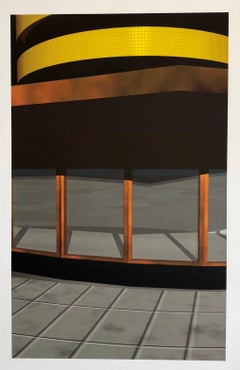
Location Proposal Iris Print Ed. 12 Hand Signed Architectural Study
By Cindy Bernard
Located in Surfside, FL
Cindy Bernard’s career spans nearly three decades and she is best known for photographs and projections that explore the relationship between cinema, memory, and landscape including the widely exhibited series Ask the Dust (1988-92), now in the collections of the Museum of Contemporary Art, Los Angeles (21 part set), the Pompidou, MOMA and the Whitney Museum of American Art. She is a recipient of grants and fellowships from the J. Paul Getty Trust Fund for the Visual Arts, California Arts Council, Creative Capital, Anonymous Was a Woman, the Harpo Foundation, California Community Foundation, the John Simon Guggenheim Memorial Foundation and the MacDowell Colony. Her work has been exhibited in museums and galleries in the US, Canada, Mexico, Europe, and Japan, and was included in the Whitney and Lyon Biennials.
In addition to her visual practice, Bernard takes an active interest in the spaces and production of social exchange. She was a director and advisor to Foundation for Art Resources from 1985 to 1990, a founding director of the Coalition for Freedom of Expression, and co-founder of MOCA Mobilization. Bernard is also the founder and director of The Society for the Activation of Social Space through Art and Sound (SASSAS), an organization she began in response to the need for a flexible and sustainable association dedicated to experimental music in Los Angeles. She has curated and produced more than 50 concerts for SASSAS including Welcome Inn Time Machine for Pacific Standard Time in 2012.
Her interest in sound has spurred several projects including a series of photographs of municipal band shells which Bernard sees as an architecture of public exchange and The Inquisitive Musician, an adaptation of a 17th century German satire, Musicus Curiosus, or Battalus, the Inquisitive Musician; the Struggle for Precedence between the Kunst Pfeifer and the Common Players. The Inquisitive Musician pits itinerant “beer fiddlers” against the city sanctioned “Kunstpfeifer” in an argument over who has the right to perform and be compensated. Presented as a staged reading incorporating video and live music, The Inquisitive Musician has been performed in New York, in Los Angeles at the LA County Museum of Art, and most recently at the Stedelijk Museum in Amsterdam in June 2013.
Current projects include Vinland, a meditation on the complex and continually shifting relationships between spaces, social and economic structures, and personal and collective histories and, more recently, an “episodic” series based on the history of social nudism: Your Personal View of (Social) Nudism.
Bernard is a Adjunct Professor of Graduate Fine Art at Art Center College of Art and Design and was appointed the inaugural Ruffin Distinguished Artist-In-Residence at the University of Virginia for the academic year 2013/2014. She was a 2016 National Endowment for the Arts Fellow at the MacDowell Colony and will be in residence at the UCross Foundation in 2017.
Muse X Editions. An (now defunct) LA based innovative publisher of limited-edition prints, Muse X has launched its first group of prints and is just beginning to make itself known to artists, curators, dealers and collectors. Among works just off the press are otherworldly landscapes by Barbara Kasten and Oliver Wasow, a sizzling sunset by Peter Alexander, abstract compositions by Pauline Stella Sanchez and Jennifer Steinkamp, text and photo combinations by Bill Barminski and Nancy Dwyer...
Category
1990s American Modern Florida - Figurative Prints
Materials
Color
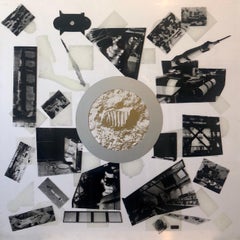
MOONWALK 1970 Color Silkscreen Screenprint Acrylic Plexiglass Mod Space Art
By Lowell Nesbitt
Located in Surfside, FL
Space Race Silkscreen on Acrylic hand signed and dated 1970, MOON WALK, color screenprint on Plexiglas depicting the moon landing, from the numbered edition of 150, size 30 x 30”
L...
Category
1970s Pop Art Florida - Figurative Prints
Materials
Plexiglass, Screen
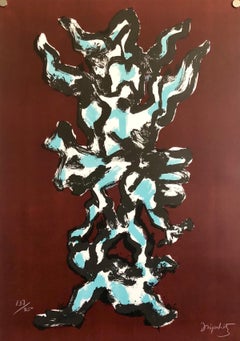
Large Color French Cubist Lithograph Tree of Life Signed Ltd Ed. Sculpture Study
By Jacques Lipchitz
Located in Surfside, FL
Chaim Jacob Lipchitz, 1891-1973, was born in Lithuania and came of age in Paris during the early 20th century, where he was active in the avante-garde community of Pablo Picasso, Ama...
Category
1970s Cubist Florida - Figurative Prints
Materials
Lithograph
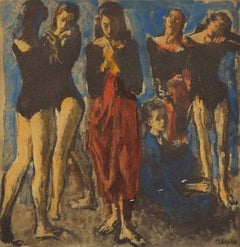
Abel Pann Israeli Bezalel School Lithograph Judaica Biblical Print Jewish Art
By Abel Pann
Located in Surfside, FL
Abel Pann (1883–1963) was a European Jewish painter who settled in the Talpiot neighborhood of Jerusalem in the early twentieth century and taught at the Bezalel Academy of Art under...
Category
Mid-20th Century Symbolist Florida - Figurative Prints
Materials
Lithograph
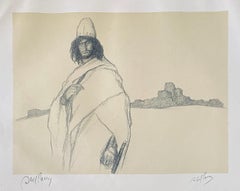
1936 Lithograph Interregnum Portfolio Windblown Man Small Edition Weimar Germany
By George Grosz
Located in Surfside, FL
Hand lithography on BFK Rives French hand moulded paper Style: German New Objectivity (Neue Sachlichkeit)
According to the frontis these were produced by Hand Lithography. According...
Category
1930s Modern Florida - Figurative Prints
Materials
Lithograph
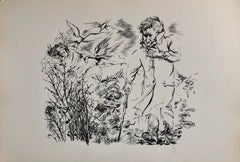
A Youth at His Devotions /// after Raphael Raffaello Sanzio Renaissance Italian
Located in Saint Augustine, FL
Artist: William Young Ottley (English, 1771-1836)
Title: "A Youth at His Devotions"
Portfolio: The Italian School of Design: Being a Series of Fac-Similes of Original Drawings, By th...
Category
1810s Victorian Florida - Figurative Prints
Materials
Etching, Intaglio
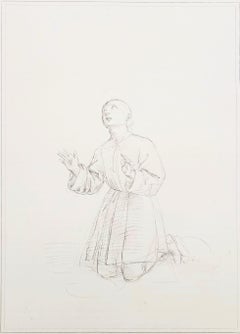
Zen Minimalist Flowers Aquatint Etching American Modernist Ed Baynard Pop Art
By Ed Baynard
Located in Surfside, FL
ED BAYNARD (American, 1940-2016)
Flowers, Flowers in a Vase, Aquatint Etching.
1979/1980,
Hand signed, dated l.r.,
Hand numbered from small edition 12/24,
Dimensions: 23 by 19 in. Framed 25 by 21 in
Born in Washington, D.C. in 1940. Raised in Washington, D.C. and newly graduated from high school, he flew to Europe living off and on in Paris and London. During this time, he designed costumes for Jimi Hendrix, worked as a graphic designer for the Beatles as well as Elizabeth Taylor and Richard Burton. Returning to New York, he dedicated his life to art after a surprise success with his first show in 1971 at the Willard Gallery in NYC. Ed's images are Zen-like in their simplicity and grace rendered in a flat, graphic style that recalls Japanese Ukiyo-e prints. His watercolors are luminous, like the rest of his representations regardless of the medium. The Japanese inspired ukiyo-e style woodblock prints and lithograph works he created at Tyler Graphics in 1980 contain a 20th century "floating world" sensibility. Ed's wish was to bring harmony, color, and a meditative stillness to this chaotic planet. He did so in a gentle and powerful way, always as an expression of his deep gratitude for the love and beauty, friendship, and concerns he held dearest. His first solo exhibition was in 1971 at New York's legendary Willard Gallery on the recommendation of Agnes Martin. Baynard went on to have exhibitions at galleries including Betty Parsons Gallery, New York (1973); Marian Goodman Gallery, New York (1977); John Berggruen Gallery, San Francisco (1980); and Barbara Gladstone Gallery, New York (1980/81).. Baynard manages to retain a simplicity of form inspired by a love of Japanese Woodblock prints. His new works reflect the same poetry of his earlier paintings, retaining his stylized compositions with their Zen like minimalism and Oriental calm, along with a new sense of rhythm and movement. Baynard uses familiar themes such as flowers, plants, pots, and vases, incorporating them into his delicate watercolor still lifes, thus creating stunning visual feasts. He was included in the 1972 Landscape exhibition at MoMA NY alone with other luminaries James Boynton...
Category
1980s American Modern Florida - Figurative Prints
Materials
Etching
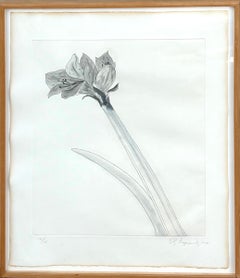
Abel Pann Israeli Bezalel School Lithograph Judaica Biblical Print Jewish Art
By Abel Pann
Located in Surfside, FL
Abel Pann (1883–1963) was a European Jewish painter who settled in the Talpiot neighborhood of Jerusalem in the early twentieth century and taught at the Bezalel Academy of Art under...
Category
Mid-20th Century Symbolist Florida - Figurative Prints
Materials
Lithograph
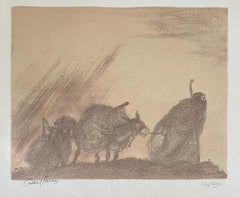
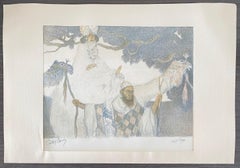
Abel Pann Israeli Bezalel School Lithograph Judaica Biblical Print Jewish Art
By Abel Pann
Located in Surfside, FL
Abel Pann (1883–1963) was a European Jewish painter who settled in the Talpiot neighborhood of Jerusalem in the early twentieth century and taught at the Bezalel Academy of Art under...
Category
Mid-20th Century Symbolist Florida - Figurative Prints
Materials
Lithograph
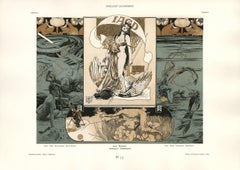
Gerlach
s Allegorien Plate #75: "Hunting, Fishing, Rowing, Cycling"
By Koloman Moser
Located in Palm Beach, FL
Koloman Moser
(1868 –1918), AUSTRIAN
Instead of applying his flair and art education solely to painting, Koloman Moser embodied the idea of Gesamt Kunstwerk (all-embracing art work) by designing architecture, furniture, jewelry, graphics, and tapestries meant to coordinate every detail of an environment. His work transcended the imitative decorative arts of earlier eras and helped to define Modernism for generations to come. Moser achieved a remarkable balance between intellectual structure (often geometric) and hedonistic luxury.
Collaborating with Gustav Klimt and Josef Hoffmann, the artist was an editor and active contributor to Ver Sacrum, (Sacred Spring), the journal of the Viennese Secession that was so prized for its aesthetics and high quality production that it was considered a work of art. The magazine featured drawings and designs in the Jugendstil style (Youth) along with literary contributions from distinguished writers from across Europe. It quickly disseminated both the spirit and the style of the Secession.
In 1903 Moser and Hoffmann founded and led the Wiener Werkstatte (Viennese Workshop) a collective of artisans that produced elegant decorative arts items, not as industrial prototypes but for the purpose of sale to the public. The plan, as idealistic then as now, was to elevate the lives of consumers by means of beautiful and useful interior surroundings.
Moser’s influence has endured throughout the century. His design sensibility is evident from the mid-century modern furniture of the 1950s and ‘60s to the psychedelic rock posters...
Category
1890s Vienna Secession Florida - Figurative Prints
Materials
Lithograph
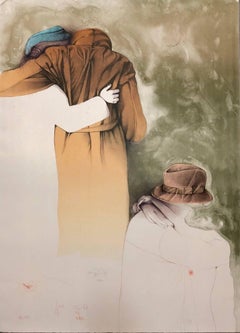
Al Quattro Large Surrealist Modernist Lithograph Embracing Couple
By Bruno Bruni
Located in Surfside, FL
Bruno Bruni senior (born 22 November 1935, in Gradara) is an Italian lithographer, graphic artist, painter and sculptor. He became commercially successful in the 1970s. In 1977, he won the International Senefeld award for Lithography. He has since become one of the most successful Italian artists in Germany and one of Germany's best known lithographers.
Born in Gradara, in the Province of Pesaro and Urbino on the Adriatic Coast in 1935, the son of a railway attendant, Bruni started painting as a young boy. He was initially a pupil of [Giuliano Vanghi] ; from 1953 to 1959 he attended the Art Institute in Pesaro. He then moved to London, where he became interested in pop art. In 1960, after an exhibit of his work at London's John Whibley Gallery, and after meeting a girl from Hamburg, he moved there to live with her and enrolled at the Hochschule für bildende Künste Hamburg. He has lived in the city ever since and visits his hometown regularly. In 1961-1966 took a course at the Hamburg College of Fine Arts, where at that time taught artists Georg Gresko, Paul Wunderlich, Horst Janssen, Arnolfo Hausner, and art critic Hans Theodor Flemming. One of his teachers called Bruni Renato Guttuso. He studied in Milan. Along with several young authors Bruni founded in Hamburg group "COOP" - against the commercialization of art. In the 1970s, Bruno Bruni made a name for himself as a draftsman, lithographer, painter and sculptor in the international art world. Bearing stylistic similarities to the surrealist work of Michael Parkes and Leonor Fini. In 1977, he won the International Senefeld Competition for Lithography. He is influenced primarily by German expressionists like Otto Dix, George Grosz etc. and the Italian old masters . In particular, he is noted as one of the few lithographic artists "who paint all work directly onto the stone". He is especially known for his erotic female forms. He has said, "I cannot paint an abstract picture. If I had gone along with the trends I'd have disappeared long ago". He resides in a converted swimming pool, more than a century old, which serves as apartment, workplace and gallery. He sells his art through his wife's gallery in Hanover and is reputedly one of Germany's top earning artists. He is also a keen cook of Italian cuisine, and is a boxing fan and a close friend of former boxing champion Dariusz Michalczewski, for whom he used to cook for before matches. He has also cooked for Gerhard Schröder and has published a cooking book...
Category
1980s Surrealist Florida - Figurative Prints
Materials
Lithograph
Abel Pann Israeli Bezalel School Lithograph Judaica Biblical Print Jewish Art
By Abel Pann
Located in Surfside, FL
Abel Pann (1883–1963) was a European Jewish painter who settled in the Talpiot neighborhood of Jerusalem in the early twentieth century and taught at the Bezalel Academy of Art under...
Category
Mid-20th Century Symbolist Florida - Figurative Prints
Materials
Lithograph
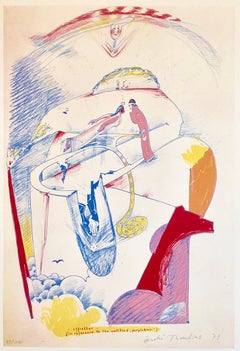
1970s Modernist Swiss Colorful Surrealism Signed Dada Lithograph Andre Thomkins
By André Thomkins
Located in Surfside, FL
This one is titled "Offsetter, in reference to the untitled, purple hair" It depicts what looks like a ski slope and a Niki de Saint Phalle type coiled snake. in pink, blue, red and yellow colors.
Published by Edition Hansjörg Mayer, Stuttgart They published concrete poetry and art books by Mark Boyle, Richard Hamilton, Dorothy Iannone, John Latham, Tom Phillips, Dieter Roth, André Thompkins and Emmett Williams, to name just a few.
André Thomkins (1930 - 1985) was a Swiss painter, illustrator, and poet. He attended art-school, taught by Max von Moos, 1947 – 1949 and the Académie de la Grande Chaumière, Paris, France, 1950. From 1952, he lived in Germany and taught at the Kunstakademie Düsseldorf between 1971 and 1973.
Thomkins painted and drew ironic and fantastic pictures influenced by surrealism and dadaism. Together with Dieter Roth and Daniel Spoerri he prepared works of Eat Art. He also was a writer of palindromes. His friends and collaborators included Daniel Spoerri, Dieter Roth, George Brecht, Richard Hamilton and Karl Gerstner, Thomkins gained a reputation as an ‘artist’s artist’, and is considered one of the most important Swiss artists of the second half of the twentieth century.He died in 1985.
His work is currently represented by Hauser & Wirth Zurich, Switzerland.
Select group exhibitions:
2018
Kunsthalle Krems, 'Pablo Picasso. Arshile Gorky, Andy Warhol. Sculptures and Works on Paper. Hubert Looser Collection', Krems, Austria
2017
Kunsthandel Wolfgang Werner, 'Martin Barré, Karl Otto Götz, Ernst Wilhelm Nay, André Thomkins',
Berlin, Germany
2013
Fabian & Claude Walter Galerie, 'Schweizer Avantgarde Kunst nach 1940', Zurich, Switzerland
2009
The Modern Institute, 'Thomas Houseago...
Category
1970s Dada Florida - Figurative Prints
Materials
Lithograph, Offset
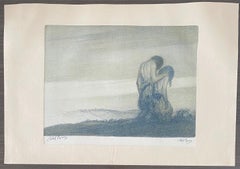
Abel Pann Israeli Bezalel School Lithograph Judaica Biblical Print Jewish Art
By Abel Pann
Located in Surfside, FL
Abel Pann (1883–1963) was a European Jewish painter who settled in the Talpiot neighborhood of Jerusalem in the early twentieth century and taught at the Bezalel Academy of Art under...
Category
Mid-20th Century Symbolist Florida - Figurative Prints
Materials
Lithograph
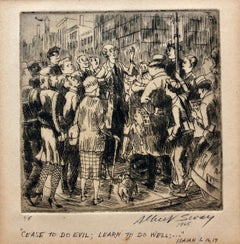
New York Social Realist Etching Cease To Do Evil Learn To Do Well WPA Artist NYC
Located in Surfside, FL
18.5x15.5, 6.25 x 5 mat cut size. edition 1/6 signed and dated.
Albert Sway (b.1913)
Painter, illustrator, etcher, lithographer, cartoonist and teacher, Albert Sway was born in Cin...
Category
1960s American Modern Florida - Figurative Prints
Materials
Etching
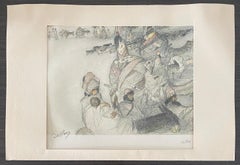
Abel Pann Israeli Bezalel School Lithograph Judaica Biblical Print Jewish Art
By Abel Pann
Located in Surfside, FL
Abel Pann (1883–1963) was a European Jewish painter who settled in the Talpiot neighborhood of Jerusalem in the early twentieth century and taught at the Bezalel Academy of Art under...
Category
Mid-20th Century Symbolist Florida - Figurative Prints
Materials
Lithograph
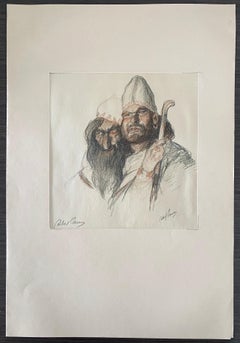
Jewish Shtetl Peddlar Americana Judaica Lithograph WPA Yiddish Social Realist
By William Gropper
Located in Surfside, FL
Hand signed in pencil and numbered with Roman numerals 8/24. A very small edition.
Old Lower East Side of New York or East European Shtetl. Jewish Shtetl Peddler Merchant. humorous ...
Category
Mid-20th Century Modern Florida - Figurative Prints
Materials
Lithograph
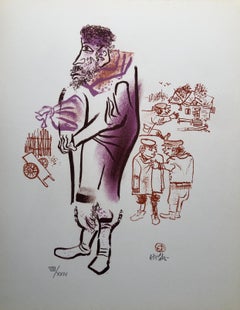
Abel Pann Israeli Bezalel School Lithograph Judaica Biblical Print Jewish Art
By Abel Pann
Located in Surfside, FL
Abel Pann (1883–1963) was a European Jewish painter who settled in the Talpiot neighborhood of Jerusalem in the early twentieth century and taught at the Bezalel Academy of Art under...
Category
Mid-20th Century Symbolist Florida - Figurative Prints
Materials
Lithograph
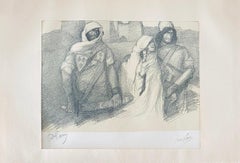
Abel Pann Israeli Bezalel School Lithograph Judaica Biblical Print Jewish Art
By Abel Pann
Located in Surfside, FL
Abel Pann (1883–1963) was a European Jewish painter who settled in the Talpiot neighborhood of Jerusalem in the early twentieth century and taught at the Bezalel Academy of Art under...
Category
Mid-20th Century Symbolist Florida - Figurative Prints
Materials
Lithograph
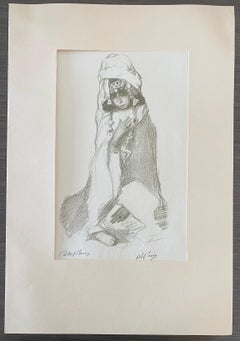
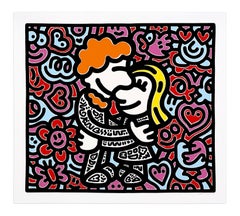
Doodle Hug (framed hand signed screen print)
By Mr Doodle
Located in Aventura, FL
6 color screen print on 4120gsm somerset paper. Hand signed and dated lower right by Mr. Doodle. Hand numbered 92/300 lower right. Artwork Size: 21.3 x 23.6 inches. Frame Size: 2...
Category
2010s Street Art Florida - Figurative Prints
Materials
Paper, Screen
$2,962 Sale Price
25% Off
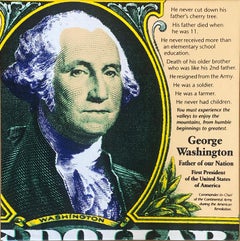
George Washington: Father of Our Nation
By Steve Kaufman
Located in Hollywood, FL
Artist: Steve Kaufman
Title: George Washington: Father of Our Nation
Medium: Screenprint on Canvas
Size: 20 x 20 Inches
Edition: 97 of 200
Year: 2000-2010
Notes: Hand Signed and ...
Category
Early 2000s Pop Art Florida - Figurative Prints
Materials
Canvas, Screen
Large American Pop Art Color Abstract Lithograph James Rosenquist Glass Wishes
By James Rosenquist
Located in Surfside, FL
James Rosenquist (1933-2017)
THE GLASS WISHES (Glenn 161)
Color lithograph, 1978-1986, on wove paper, hand signed, dated, titled, dedicated for Jack Martin...
Category
1980s Pop Art Florida - Figurative Prints
Materials
Color, Lithograph