Germany - Drawings and Watercolor Paintings

to
55
185
79
37
58
45
Overall Width
to
Overall Height
to
16
22
42
324
3
5
4
1
3
1
5
10
6
108
81
71
19
9
7
2
2
1
251
137
16
139
109
78
73
60
35
31
22
21
20
17
14
14
11
11
9
8
7
7
7
210
154
104
72
46
66
50
32
32
30
194
9
18,765
18,185
Item Ships From: Germany
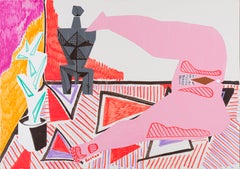
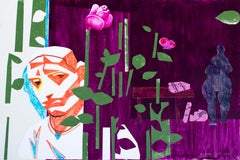
Women with Idol II - 21st Century, Nude, Pink, Cactus, Female, Male, Interior
By Alexandru Rădvan
Located in Baden-Baden, DE
Women with Idol II, 2016 Collage on cardboard 27 9/16 H x 39 3/8 W in. 70 H x 100 W cm The artist's reference on fundamental myths of humanity and their analysis from the perspectiv...
Category

2010s Contemporary Germany - Drawings and Watercolor Paintings

Materials

Paper, Acrylic, Cardboard

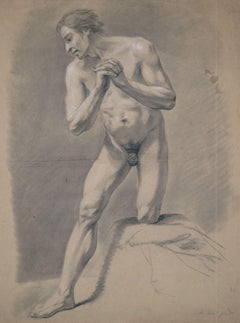
Male Nude / - The Drama of the Nude -
Located in Berlin, DE
Johann Heinrich Meil (1730 Gotha - 1820 Berlin), Male Nude, 1807. White heightened, occasionally wiped charcoal drawing on brownish paper, 51 cm x 39.5 cm, signed “J.[ohann] H.[einri...
Category

Early 19th Century Rococo Germany - Drawings and Watercolor Paintings

Materials

Paper

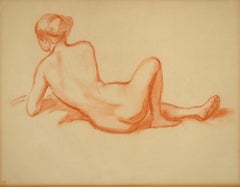
Female Nude from the Back, around 1900 / - The contour of the Art Nouveau -
By Ludwig von Hofmann
Located in Berlin, DE
Ludwig von Hofmann (1861 Darmstadt - 1945 Pillnitz), Female nude from the back, around 1900. Red chalk drawing on watermarked drawing paper, 36 cm x 44 cm (sheet size). Artist's liga...
Category

Early 1900s Art Nouveau Germany - Drawings and Watercolor Paintings

Materials

Paper

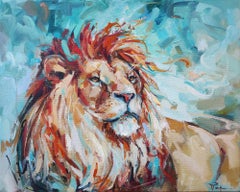
Lion
Located in Zofingen, AG
"Lion" depicts the majestic presence and serene strength of the lion, a symbol of power and dignity. An expressive palette and textural brushstrokes...
Category

2010s Expressionist Germany - Drawings and Watercolor Paintings

Materials

Canvas, Oil

Lying Boy / - Fragile childlikeness -
Located in Berlin, DE
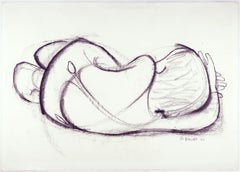
Alfred Fuchs (1925 Saarbrücken - 2003 Prague), Lying Boy. Charcoal drawing on strong paper, 30 x 41.5 cm, signed A.[lfred] Fuchs and dated [19]96. - smal...
Category

1990s Realist Germany - Drawings and Watercolor Paintings

Materials

Charcoal

The Dreamcatcher - Collage, Paper, Red, Contemporary Art
By Raluca Arnăutu
Located in Baden-Baden, DE
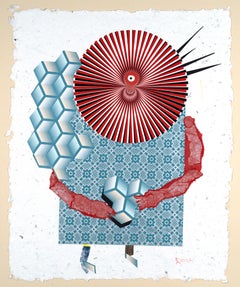
The Dreamcatcher, 2022 collage on paper 46 H x 37.5 W cm Signed on right side down Raluca Arnăutu dreams the world through collages. A collage, dreamlike and surreal, populated by thousands of pieces of paper, textiles, pieces of plastic, found or made objects, which intertwine on the paper support and as in a well-controlled and thought puzzle give birth to a new universe. The new series of...
Category

2010s Contemporary Germany - Drawings and Watercolor Paintings

Materials

Paper

Norwegian Pine Grove - The inner glow of the trees -
Located in Berlin, DE
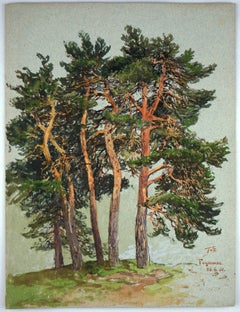
Themistokles von Eckenbrecher (1842 Athens - 1921 Goslar), Norwegian pine grove, 1901. Watercolor on blue-green paper, 30 x 22 cm. Signed, dated and inscribed in his own hand "TvE. Fagermes [i.e. Fagermes]. 26.6.[19]01." - Slight crease throughout at left margin, otherwise in good condition. About the artwork Themistokles von Eckenbrecher often traveled to Norway to study the nature that fascinated him there. On June 26, 1901, near the southern Norwegian town of Fagernes, in the summer evening sun, he saw a small pine grove, which he immediately captured in a watercolor. He exposed the trees growing on a small hill in front of the background, so that the pines completely define the picture and combine to form a tense motif. The tension comes from the contrast of form and color. The trunks, growing upward, form a vertical structure that is horizontally penetrated by the spreading branches and the pine needles, which are rendered as a plane. This structural tension is further intensified by the color contrast between the brown-reddish iridescent trunks and branches and the green-toned needlework. Themistokles von Eckenbrecher, however, does not use the observed natural scene as an inspiring model for a dance of color and form that detaches itself from the motif and thus treads the path of abstracting modernism. Its inner vitality is to be brought to light and made aesthetically accessible through the work of art. It is precisely in order to depict the inner vitality of nature that von Eckenbrecher chooses the technique of watercolor, in which the individual details, such as the needles, are not meticulously worked out, but rather a flowing movement is created that unites the contrasts. The trees seem to have formed the twisted trunks out of their own inner strength as they grew, creatingthose tense lineations that the artist has put into the picture. The inner strength continues in the branches and twigs, culminating in the upward growth of the needles. At the same time, the trunks, illuminated by the setting sun, seem to glow from within, adding an almost dramatic dimension to the growing movement. Through the artwork, nature itself is revealed as art. In order to make nature visible as art in the work, von Eckenbrecher exposes the group of trees so that they are bounded from the outside by an all-encompassing contour line and merge into an areal unity that enters into a figure-ground relationship with the blue-greenish watercolor paper. The figure-ground relationship emphasizes the ornamental quality of the natural work of art, which further enforces the artwork character of the group of trees. With the presentation of Themistokles von Eckenbrecher's artistic idea and its realization, it has become clear that the present watercolor is not a study of nature in the sense of a visual note by the artist, which might then be integrated into a larger work context, but a completely independent work of art. This is why von Eckenbrecher signed the watercolor. In addition, it is marked with a place and a date, which confirms that this work of nature presented itself to him in exactly this way at this place at this time. At the same time, the date and place make it clear that the natural work of art has been transferred into the sphere of art and thus removed from the time of the place of nature. About the artist Themistocles' parents instilled a life of travel in their son, who is said to have spoken eleven languages. His father, who was interested in ancient and oriental culture, was a doctor and had married Francesca Magdalena Danelon, an Italian, daughter of the British consul in Trieste. During a stay in Athens - Gustav von Eckenbrecher was a friend of Heinrich von Schliemann and is said to have given him crucial clues as to the location of Troy - Themistokles saw the light of day in 1842. After an interlude in Berlin, where Themistokles was educated at the English-American School, the journey began again. From 1850 to 1857 the family lived in Constantinople, after which the father opened a practice in Potsdam, where Themistokles, who wanted to become a painter, was taught by the court painter Carl Gustav Wegener. In 1861 the von Eckenbrechers left Potsdam and settled in Düsseldorf. There Themistokles received two years of private tuition from Oswald Aschenbach, who greatly admired the talented young artist. After his artistic training, he undertook extensive travels, often accompanied by Prince Peter zu Sayn-Wittgenstein, which took him to northern and eastern Europe, but above all to the Middle East and even to South America. The paintings that resulted from these journeys established his artistic reputation and led to his participation in large panoramas such as the 118 x 15 metre Entry of the Mecca Caravan into Cairo, painted for the City of Hamburg in 1882. 1882 was also the start of a total of 21 study trips to Scandinavia, most of them to Norway, and the unique Norwegian landscape with its rugged fjords became a central motif in his work. Along with Anders Askevold and Adelsteen Normann...
Category

Early 1900s Naturalistic Germany - Drawings and Watercolor Paintings

Materials

Watercolor

A girl
Located in Oslo, NO
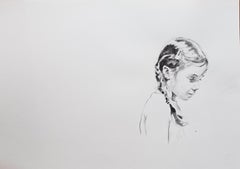
Minimalistic but masterfully executed monochrome watercolor. The work immediately attracts attention with the originality of the composition - the image is shifted to the right edge ...
Category

2010s Realist Germany - Drawings and Watercolor Paintings

Materials

Paper, Watercolor, Pencil

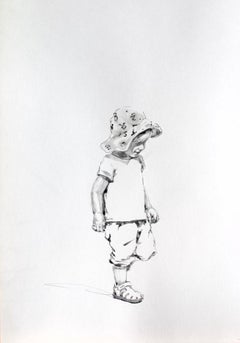
On the walk
Located in Oslo, NO
A minimalist but masterfully executed monochrome watercolor. The work is striking in its lightness - although there is nothing on it except the figure of a child, from the way he is ...
Category

2010s Realist Germany - Drawings and Watercolor Paintings

Materials

Paper, Watercolor, Pencil

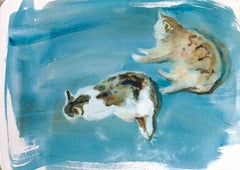
Sunny Day
Located in Oslo, NO
This bright, light watercolor is painted in one breath. Two cats are lying on a blue background, one of them is lazily squinting at the sun. The work is filled with sunlight and a fe...
Category

2010s Realist Germany - Drawings and Watercolor Paintings

Materials

Paper, Watercolor

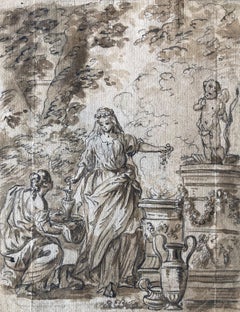
Italian School, Nicolo Grassi, 18th, Worship of Venus, The Venus Sacrifice, Amor
Located in Greven, DE
Italian School, 18th Century, Circle of Grassi, This old master drawing is drawn in the late-Baroque or Rococo style. It depicts a woman worshipping Venus/ preparing a sacrifice for ...
Category

Late 17th Century Baroque Germany - Drawings and Watercolor Paintings

Materials

Handmade Paper

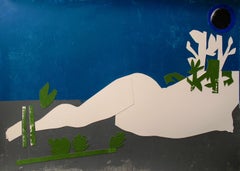
Siren - Contemporary Art, Nude, Female, Nature, White, Blue, Gray, Flowers
By Alexandru Rădvan
Located in Baden-Baden, DE
Siren, 2015 Collage on cardboard 27 9/16 H x 39 3/8 W in. 70 H x 100 W cm The artist's reference on fundamental myths of humanity and their analysis from the perspective of contempo...
Category

2010s Contemporary Germany - Drawings and Watercolor Paintings

Materials

Paper, Acrylic, Cardboard

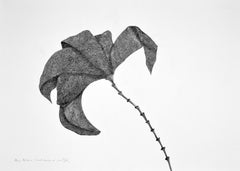
Secret Garden 18 - Contemporary, Drawing, Flower, White, Black, Figurative
By Alina Aldea
Located in Baden-Baden, DE
Secret Garden 18, 2021 black ink on paper 27 9/16 H x 39 3/8 W in. 70 H x 100 W cm The drawings signed by Alina Aldea show the meticulousness and perfection of microscopic observati...
Category

2010s Post-Modern Germany - Drawings and Watercolor Paintings

Materials

Paper, Ink

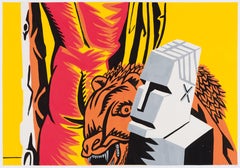
Hercules after Carracci V - Contemporary Art, Red, Yellow, Male, Lion, Nude
By Alexandru Rădvan
Located in Baden-Baden, DE
Hercules after Carracci V, 2014 Tempera on paper (Signed) 27 3/5 H × 39 2/5 W in. 70 H × 100 W cm On the subject of his new works the artist stated: “There is not enough orange, ye...
Category

2010s Contemporary Germany - Drawings and Watercolor Paintings

Materials

Paper, Egg Tempera

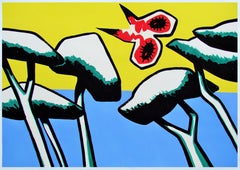
Meridional VII - Contemporary, Drawing, Yellow, Blue, Red, Landscape, Butterfly
By Alexandru Rădvan
Located in Baden-Baden, DE
Meridional VII, 2013 Tempera on Paper 27.55 H x 39.37 W in. 70 H x 100 W cm The series "Meridional" from 2014 shows colorful landscapes under some occasional exemptions. The tree...
Category

2010s Contemporary Germany - Drawings and Watercolor Paintings

Materials

Paper, Egg Tempera

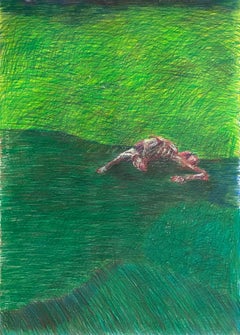
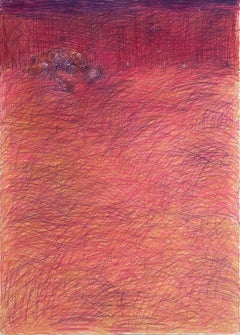
Untitled_Body on the Field #5 - Contemporary, Green, 21st Century
By Zsolt Berszán
Located in Baden-Baden, DE
Untitled_Body on the Field #5, 2022 coloured pencils on paper 39 3/8 H x 27 9/16 W inches 100 H x 70 W cm Signed on reverse Zsolt Berszán embodies in his works the dissolution of th...
Category

2010s Neo-Expressionist Germany - Drawings and Watercolor Paintings

Materials

Paper, Color Pencil

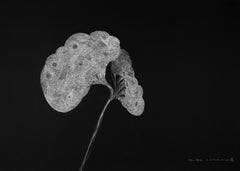
Secret Garden 13 - Contemporary Art, Flower, Black, White, Organic, 21st Century
By Alina Aldea
Located in Baden-Baden, DE
Secret Garden 13, 2020 white ink on black cardboard 27 9/16 H x 39 3/8 W in. 70 H x 100 W cm The drawings signed by Alina Aldea show the meticulousness and perfection of microscopic...
Category

2010s Contemporary Germany - Drawings and Watercolor Paintings

Materials

Ink, Cardboard

Untitled_Body Remains on the Field - Red, Contemporary, 21st Century, Landscape
By Zsolt Berszán
Located in Baden-Baden, DE
Untitled_Body Remains on the Field, 2022 coloured pencils on paper 39 3/8 H x 27 9/16 W inches 100 H x 70 W cm Signed on reverse Zsolt Berszán embodies in his works the dissolution...
Category

2010s Neo-Expressionist Germany - Drawings and Watercolor Paintings

Materials

Paper, Color Pencil

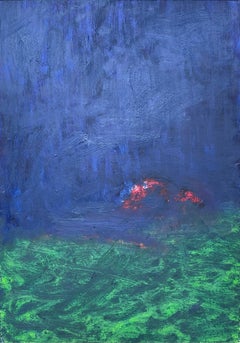
Remains (Body in the Field 21) - Contemporary, Blue, Green, 21st Century
By Zsolt Berszán
Located in Baden-Baden, DE
Remains (Body in the Field 21 ), 2022 oil on paper 16 17/32 h x 11 13/16 w in. 42 H x 30 W cm Zsolt Berszán embodies in his works the dissolution of the human body through the prism...
Category

2010s Abstract Expressionist Germany - Drawings and Watercolor Paintings

Materials

Paper, Oil

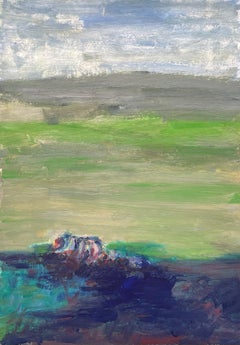
Remains (Body in the Field 7) - Contemporary, Green, Grey, Blue, 21st Century
By Zsolt Berszán
Located in Baden-Baden, DE
Remains (Body in the Field 7), 2022 oil on paper (signed on reverse) 16 17/32 H x 11 13/16 W in. 42 H x 30 W cm Zsolt Berszán embodies in his works the dissolution of the human body...
Category

2010s Abstract Expressionist Germany - Drawings and Watercolor Paintings

Materials

Paper, Oil

Island for Umberto 01 - 21st Century, Drawing, Nature, Butterfly, Summer
By Alexandru Rădvan
Located in Baden-Baden, DE
Island for Umberto 01, 2014 Pencil on paper ( Signed and dated front lower-right corner, framed) 11.6 H x 16.5 W in. 29.5 H x 42 W cm "Island for Umberto" has the literary source in...
Category

2010s Contemporary Germany - Drawings and Watercolor Paintings

Materials

Paper, Pencil

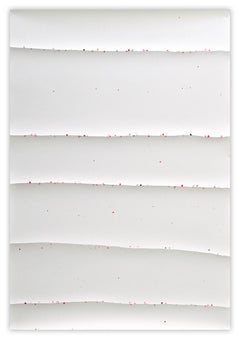
Untitled - Paper, White, Abstract, 21st Contemporary, Minimalist
By Zsolt Berszán
Located in Baden-Baden, DE
Untitled, 2016 White silicone on paper 78 × 58 3/10 in 198 × 148 cm Signed on reverse Berszán depicts in his drawings and paintings the primary turmoil where the violence of the un...
Category

2010s Abstract Expressionist Germany - Drawings and Watercolor Paintings

Materials

Silicone, Paper

The Card Player - Contemporary Art, Collage, 21st Century
By Raluca Arnăutu
Located in Baden-Baden, DE
The Card Player, 2019 collage on paper 11 13/16 H x 15 3/4 W in. 30 H x 40 W cm The artist’s collages describe a series of characters composed of different materials – cardboards, t...
Category

2010s Abstract Germany - Drawings and Watercolor Paintings

Materials

Paper

Old Master Drawing, 17th century, Netherlands, Dutch, Flemish, Mannerist
Located in Eltville am Rhein, DE
Probably Dutch Flemish master, 17th century Ink on paper / on backing Inscribed on the upper and lower margins Size: approx. 23 x 40 cm, plus passe-partout Viewing and collection...
Category

17th Century Mannerist Germany - Drawings and Watercolor Paintings

Materials

Ink

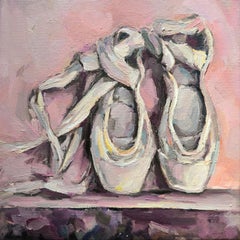
ballerina pointe shoes
Located in Zofingen, AG
In this delicate composition, the ethereal elegance of ballet is conveyed through the image of pointe shoes against a soft pink background. Pointe shoes, symbols of grace and dedica...
Category

2010s Modern Germany - Drawings and Watercolor Paintings

Materials

Canvas, Oil

Stooped Old Man with Walking Stick and Cigarette, c. 1910 / - The sum of life -
Located in Berlin, DE
Hans Thoma (1839 Bernau - 1924 Karlsruhe), Stooped Old Man with Walking Stick and Cigarette, circa 1900. Watercolor and pastel on paper, mounted on cardboard, 29.5 cm x 23.5 cm (shee...
Category

1910s Realist Germany - Drawings and Watercolor Paintings

Materials

Watercolor, Gouache

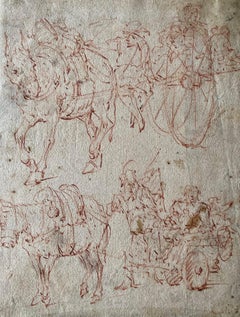
Flemish Old Master, Study of Donkey Carriage, 17th Century, Sanguine Drawing
Located in Greven, DE
This drawing shows several studies of a donkey with a carriage. Its style is close to Flemish 17th century artists. On the passepartout one reads "Mathias Scheyer/ Jacob Weyer", both...
Category

17th Century Baroque Germany - Drawings and Watercolor Paintings

Materials

Chalk, Handmade Paper

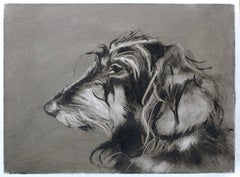
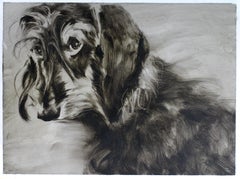
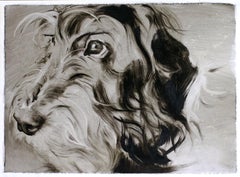
Dachshund. Dog portraits
Located in Oslo, NO
This small but elegant work is a black-and-white portrait of a dog. It is painted using the signature technique of oil on photographic paper (reverse side). Thick, plasticized photog...
Category

2010s Realist Germany - Drawings and Watercolor Paintings

Materials

Canvas, Oil

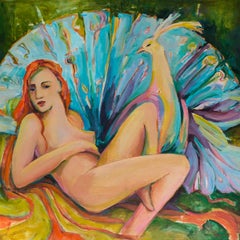
Nymph of Eden
Located in Zofingen, AG
In "Nymph of Eden" the artist continues her exploration of human sexuality and identity through mythological images. Inspired by ancient Greek mythology, where nymphs symbolized nat...
Category

2010s Modern Germany - Drawings and Watercolor Paintings

Materials

Canvas, Acrylic

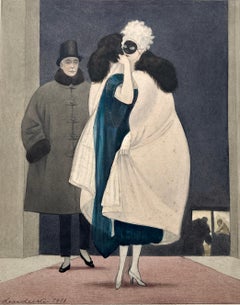
Art Deco Watercolor 1918, By Otto Lendecke Decorated Salon Helena Rubinstein
Located in Eltville am Rhein, DE
Otto Friedrich Carl Lendecke Lemberg 1886 - 1918 Vienna Ich werde beobachtet! I am being watched!, 1918 Watercolor and pencil on paper / cardboard Signed and dated lower left, tit...
Category

1910s Art Deco Germany - Drawings and Watercolor Paintings

Materials

Watercolor

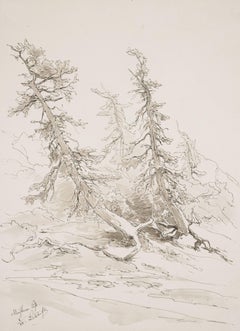
Woodland / - The Inner Drama of the Landscape -
Located in Berlin, DE
Eduard Peithner von Lichtenfels (1833 Vienna - 1913 Berlin), Woodland, 1884. Watercolor and pen and ink on drawing paper, 30.4 cm x 22.5 cm, signed, dated and inscribed by the artist...
Category

1880s Germany - Drawings and Watercolor Paintings

Materials

Paper

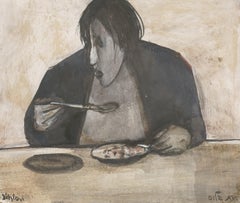
Woman eating / - Interior Pictures -
By Ruth Schloss
Located in Berlin, DE
Ruth Schloss (1922 Nuremberg - 2013 Kfar Shmaryahu), Woman eating, around 1990. Mixed media on watercolor paper, 22.2 cm x 26.5 cm, signed “Schloss” lower left and signed again in He...
Category

1990s Realist Germany - Drawings and Watercolor Paintings

Materials

Paper

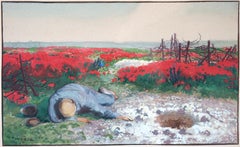
Red blooming war landscape with dead soldier - Bleeding flowers -
Located in Berlin, DE
Johannes Friedrich Heinrich Hänsch (1875-1945), Red blooming war landscape with dead soldier, 1918. Watercolor and gouache on paper, 15 x 24.5 cm (image), 27 x 37 cm (sheet size / frame), monogrammed and dated "19JH18" at lower left. - Paper slightly darkened About the artwork Despite the relatively small format, the watercolor with an internal frame depicts a panoramic view of a flat landscape stretching to the horizon. As far as the eye can see, the poppies bloom in flaming red. The flowers are not rendered individually, however, creating an almost cohesive red surface. The bright red is interspersed with vegetal green. A complementary contrast that creates an intense color effect. In this color contrast, a white area breaks through from the middle ground, widening towards the foreground and surrounding a brown hole. Next to it, in blue, is the actual protagonist of the painting, the first thing that catches the eye: a dead soldier. Next to him is his helmet, revealing the empty interior. The brown, hollow shape corresponds to the hole in the ground. A shell funnel is surrounded by bright ash, which, like the inverted helmet, becomes a sign of death. The soldier's arms point to the funnel, while the empty helmet paraphrases the calotte of the skull and, like the funnel, thematizes the empty darkness of death. The soldier's body, however, is intact and not - as in Otto Dix's triptych "The War" - a dismembered corpse. Instead, Johannes Hänsch activates the landscape, especially the color, to illustrate a blooming landscape of death that extends from the shell funnel in the foreground to the rising column of smoke on the horizon. If the soldier's body is intact, the tangle of barbed wire emblematically placed over the empty helmet also appears tattered. On the right side of the picture, the barbed wire even seems to stretch its arms to the sky in horror. Against the background of this allegory, the content of the bright red also becomes clear: the landscape is drenched in blood, literally a sea of blood, and the single unknown soldier stands pars pro toto for all those who died on the battlefield. Dying in war is not dying in community, but in solitude. In order to emphasize the isolation in death, Johannes Hänsch has set the blue of the soldier in the axis given by his body in the middle ground of the picture into the red sea. A master of landscape painting, Hänsch succeeds in creating a natural-looking landscape allegory that illustrates the horror and death of war, without depicting the brutality of war itself. This singular 'war memorial' of the unknown soldier is the opposite of heroization and yet the dignity of the deceased soldier is preserved through the integrity of his body. About the artist As the son of the sculptor Adolf Haensch, the young Johannes received his first artistic training in his father's Berlin studio. However, he eventually decided to become a painter, and in 1897 he entered the Berlin Academy of Arts. He initially studied under Paul Vorgang and Eugen Bracht, and was particularly influenced by Bracht's increasingly colourful landscape painting. In 1901 he moved to the class of Friedrich Kallmorgen, with whom he spent several weeks on excursions into nature. In 1905 he became a master pupil of Albert Hertel, who taught him watercolour painting. From 1903 to 1933 he exhibited annually at the Great Berlin Art Exhibition, the exhibitions of the Berlin Artists' Association and the Munich Glaspalast. In 1905 he was awarded the Carl Blechen...
Category

1910s Realist Germany - Drawings and Watercolor Paintings

Materials

Watercolor

Untitled / - Bleeding Picture -
Located in Berlin, DE
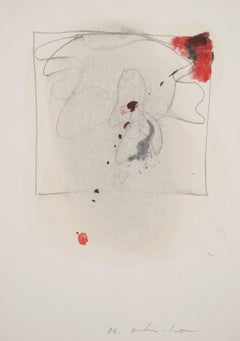
Ouhi Cha (*1945 Busan), Untitled, 1988. mixed media, 31.8 cm x 23.3 cm (sheet size), signed “Ouhi Cha” in pencil below and dated “[19]88”. - in good condition - Bleeding Picture -...
Category

1980s Abstract Germany - Drawings and Watercolor Paintings

Materials

Paper

Pygmalion - Sculptor Studio I - 21st Century, Flowers, Couple, Female Nude, Male
By Alexandru Rădvan
Located in Baden-Baden, DE
Pygmalion - Sculptor Studio I, 2015 Collage on cardboard 27 9/16 H x 39 3/8 W in. 70 H x 100 W cm The artist's reference to fundamental myths of humanity and their analysis from the...
Category

2010s Contemporary Germany - Drawings and Watercolor Paintings

Materials

Paper, Acrylic, Cardboard

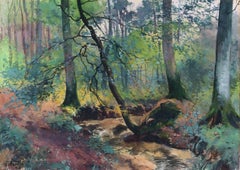
Summer Forest Landscape, 1915 / - The Forest Walk -
Located in Berlin, DE
Stanislas Warnie (1879-1958), Summer Forest Landscape, 1915. Watercolor, 31.5 cm x 45 cm (passepartout), 50.5 cm x 63.5 cm (frame), signed "S. Warnie" at lower left and dated "1915"....
Category

1910s Art Nouveau Germany - Drawings and Watercolor Paintings

Materials

Watercolor

Fenzoni, Painting AND preparatorial Drawing, John the Baptist, Italy Renaissance
By Ferrau Fenzoni
Located in Greven, DE
The painting and the preparatory drawing are offered together. Provenance Private collection, Germany, Trier, c. 1980- 2013 Saint John the Baptist Brown ink and wash over red chalk on oatmeal paper 31 x 20.5 cm Inscribed: „Ferrau Fenzonio da Faenza invt. esque … imp. da Fran. Villamena …“. bears the collector's mark of Henry Scipio Reitlinger (1882-1950; Lugt 2274a) on a tiny label glued to the verso On the reverse is a partial drawing of a Pieta, pricked for transfer. Provenance New York, Doyle, 14. October 2015, No. 6 The painting and the preparatory drawing resemble the composition of an engraving after Ferraù Fenzoni by Francesco Villamena. Drawing, engraving and painting are almost identical, except for minor differences. Even the measurements nearly correspond: painting (32 x 25,5 cm), drawing (30 x 20,5 cm), engraving (31,1 x 23,5 cm). Dr. Guiseppe Scavizzi confirmed the attribution of the present panting to Fenzoni and he dates it to c. 1590. The inscription on the drawing reads “Ferrau Fenzonio da Faenza invt. esque. . . imp. da Fran: Villamena . . .”. The engraving’s inscription also lists place and date “Ferra Fensionius inventor/F. Villamoena sculpsit Rome/Aspectu fruitur… antra puer/cum Privilegio… 1613”. Interestingly, the engraving is not mirrored as it is in most printing processes. Painting, drawing and engraving are not reversed but the same. It is remarkable to note that there are further paintings by Fenzoni which were engraved in the same order and not reverted. They also show strong parallels regarding the compositions and the measurements (see for example “Deposition of Christ” ). Ferraù Fenzoni was an Italian painter mainly active in Todi. He is also called Il Faenzone after his birthplace (Faenza). He apprenticed in Rome during the papacy of Gregory XIII and contributed to numerous fresco cycles under pope Sixtus V, such as the Loggia della Benedizioni in the Lateran Palace, the frescoes on the walls and vaults of the Scala Santa of the adjacent Basilica of San Giovanni in Laterano, and the decoration in the Sistine library. His expressive canvases straddle the styles of Mannerism and Baroque. In 1594, he moved to Todi. A “Last Judgement” by him is housed in the cathedral of Todi. He returned to Faenza in 1599, where he decorated chapels in the cathedral from 1612 to 1616. In 1622, he completed a “Deposition”, now in the local Pinacoteca. In 1640, Fenzoni was named “cavaliere dello speron d’oro” by Cardinal Colonna and, on 25th April 1634, he was nominated vicar and “castellano of Granarolo”. Fenzoni‘s style is characterized by a mixture of the Mannerism of the Northern Netherlands and the Italian Baroque. Saint John the Baptist, Old Master, 17th Century, By Fenzoni, Religious Scene, Rome Art...
Category

16th Century Mannerist Germany - Drawings and Watercolor Paintings

Materials

Canvas, Oil, Handmade Paper

The actor Karl Seydelmann as soldier / - The expressiveness of a simple pose -
Located in Berlin, DE
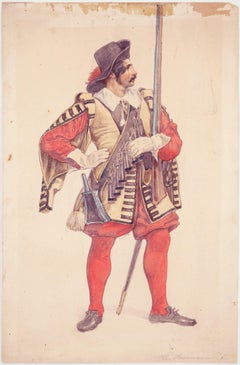
Theodor Hosemann (1807 Brandenburg - 1875 Berlin), The actor Karl Seydelmann as soldier, around 1840. Watercolor in pencil, 22 cm (height) x 14.7 cm (width), signed “Th.[eodor] Hosem...
Category

1840s Realist Germany - Drawings and Watercolor Paintings

Materials

Paper

Vigilant Fox - The psyche of the fox -
Located in Berlin, DE
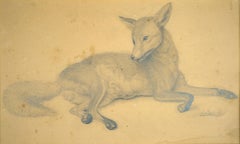
Carl Friedrich Deiker (1838 Wetzlar - 1892 Düsseldorf). Vigilant fox. Pencil drawing on brown paper, 18 × 29.5 cm (inside measurement), 31.5 x 43.5 cm (mount), signed and dated "Deiker [18]54" at lower right. - a little bit stained, with a light water stain at lower right About the artwork Carl Friedrich Deiker's consummate ability to depict animals is already evident in this early work. He brought a whole new psychological dimension to animal painting, so that one could literally speak of animal portraits. The naturalistic appearance of the fox alone makes it seem alive. Every strand of muscle, even every hair, is captured, which requires an intensive artistic study of animal anatomy and physiology. But the fox's real liveliness comes not from its natural appearance, but from its internal movement: Stretched out, it has been brought out of rest. It turns around and, with its ears pricked up, looks intently in the direction from which it has seen something. His mouth is slightly open and his pointed teeth are bared, as if he were growling. Tension gradually takes hold of his whole body. While the hind legs were still in a relaxed position, closely observed by Deiker, one front leg was already raised, ready to begin a rising movement. The fox seems so alarmed with all its senses that one gets the impression that, at any moment, its tail will move jerkily and the animal will jump up. While wild animals have traditionally been portrayed as beasts or anthropomorphised, often for caricatural purposes, Deiker explores their inherent nature by attempting to capture their psychic impulses. The wild animal is neither bestial nor human, but a creature in its own right, valued by Deiker for its own sake. In this way, he brought the dignity of the animal into representation and raised animal painting to a whole new artistic level. About the artist Carl Friedrich Deiker was the son of the drawing teacher Christian Friedrich Deiker and the younger brother of the animal painter Johannes Deiker. In addition to the family art lessons, Christian Friedrich shared a studio with his brother Johannes at Braunfels Castle, Deiker attended the drawing academy in Hanau, and from 1858 he was a student at the Karlsruhe Art Academy, where he studied under the landscape painter Johann Wilhelm Schirmer. Carl Friedrich Deiker was already in demand as an artist during his first year: Grand Duke Frederick I of Baden, Margrave Max of Baden and Grand Duke Michael of Russia bought hunting scenes by him. In 1859 he went on a study trip to the Reinhardswald. Just as the Barbizon School had rediscovered the landscape, Deiker opened up the forest for animal painting. From 1861-64 Deiker had his own studio in Karlsruhe, then moved to Düsseldorf, where his brother Johannes followed four years later. Deiker married a daughter of the landscape painter Karl Hilger and remained in Düsseldorf until his death. In 1868 he finally achieved international fame with his painting 'Pursued Noble Deer' and was regarded as a virtuoso new founder of animal painting. "Deiker brought for the first time a truly great artistic quality to animal painting [...]". - Hans Vollmer From 1870 he participated in the academic art exhibitions in Berlin, Dresden, Munich and Hanover. He was also very busy as an illustrator. He drew for the Gartenlaube, the Salon, the Universum, and produced many of the finely illustrated hunting and animal books of the period. He also worked as a printmaker, while his oil paintings circulated as reprints by Franz Dinger. From 1865 to 1892 Deiker was a member of the artists' association Malkasten. Carl Friedrich Deiker's life's work was honoured with a large posthumous memorial exhibition at the Düsseldorf Kunsthalle in 1892. His son Carl Deiker, born in 1879, also became a painter. Selection of art museums that own works by Carl Friedrich Deiker: Hamburger Kunsthalle / Kunsthalle Karlsruhe / Kunstmuseum Düsseldorf / Wallraff Richartz Cologne. Selected Bibliography H. Schmidt: Johannes and...
Category

1850s Naturalistic Germany - Drawings and Watercolor Paintings

Materials

Pencil

The Ruins of St. Clement s Church in Visby, Sweden / - Real romanticism -
Located in Berlin, DE
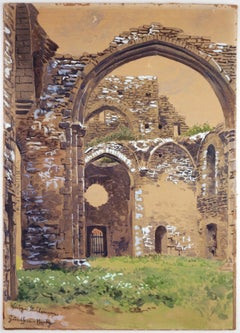
Otto Günther-Naumburg (1856-1941), The Ruins of St. Clement's Church in Visby, Sweden. Watercolor and ink, heightened with white, on sand-colored paper, mounted on cardboard, 33 x 24...
Category

Early 20th Century Realist Germany - Drawings and Watercolor Paintings

Materials

Paper

Half-length portrait of a Pharisee - In the shadow of betrayal -
Located in Berlin, DE
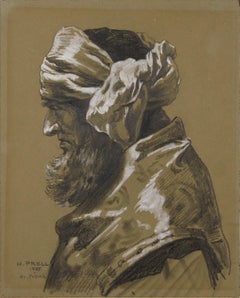
Hermann Prell (1854 Leipzig - 1922 Dresden-Loschwitz). Half-length portrait of a Pharisee, 1885. Sketch for the right-hand figure in the painting Judas Iscariot, 1886. Pencil drawing heightened with opaque white and black chalk on beige-grey wove paper (papier vélin), 34 x 27.8 cm (visible size), 52 x 45 cm (mount), signed, dated and inscribed "H. PRELL 1885 zu 'Judas'". Minor browning, collection stamp on the reverse. - In the shadow of betrayal - About the artwork This painting is the sketch for the head of the Pharisee offering the coins to Judas in one of Herrmann Prell's major works, the painting Betrayal of Judas, completed in 1886. The painting belongs to the Staatliche Kunstsammlungen Dresden and is illustrated in Adolf Rosenberg: Prell, Bielefeld and Leipzig 1901, p. 21 (Fig. 19). It is especially highlighted in Thieme-Becker (vol. 27, p. 376). Hermann Prell, Betrayal of Judas, 1886 The monumental head, which fills the picture and is distinguished by its ornamented robe, is almost a lost profile, which in the executed painting is justified by the Pharisee's turning towards Judas. Despite the fact that the sitter withdraws from the viewer by turning away, it was necessary to artistically elaborate the motivation for the purchase of one of Christ's disciples, which is why the drawing focuses on the expression of the face, while the 'accessories' are treated in a more summary manner. In characterising the face, Hermann Prell performs a balancing act: since the Pharisee, despite his destructive actions, is an actor in the history of salvation, the head must show a dignity appropriate to the event, but at the same time the physiognomy must also bear witness to the scheming attitude that led to the betrayal. To solve this dilemma, Prell draws on the traditional depictions of the heads of the apostles, shading the face to indicate the obdurate darkness of the spirit and moving the base of the nose slightly upwards while the mouth falls away, thus giving a physiognomic expression to the motivation of the action. The fatal drama of the betrayal is expressed in the monumentalisation of the head and in the thunderous white highlights that contrast with the darkness of the chalk. As a study, considered by the artist to be a work in itself, this drawing reveals the pictorial problems and brainstorming of monumental painting. About the artist In 1872 Prell, who was one of the most important exponents of monumental painting of his time, began studying painting with Theodor Grosse at the Dresden Academy of Art and continued with Carl Gussow at the Berlin Academy in 1876. Hans von Marées taught him in Rome in 1878. More influential on his work, however, were Arnold Böcklin and Max Klinger, with whom Prell had been friends since his student days and with whom he worked together on several occasions. Prell's first major work, which established his reputation as a monumental painter, were the frescoes in the banqueting hall of the Architektenhaus in Berlin in 1881/82, commissioned by the state and depicting the different periods of architecture. Prell then went to Italy for two years to study fresco painting. Other major commissions followed. These included monumental frescoes in the town halls of Worms (1884), Hildesheim (1882-92), Gdansk (1895) and Dresden, the staircase of the Silesian Museum of Fine Arts in Breslau (1893/94), the throne room of the German Embassy in Rome (1896-99) and the staircase of the Albertinum in Dresden (1900-1904). From 1886 Prell taught at the academy of arts in Berlin and in 1892 he was appointed professor at the academy of arts in Dresden. His students included Osmar Schindler and Hans Unger...
Category

1880s Realist Germany - Drawings and Watercolor Paintings

Materials

Chalk

Sketch of a head - Carved in stone -
Located in Berlin, DE
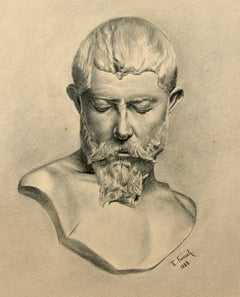
Emil Faesch (1865 Basel - 1915 Basel). Sketch of a head. Charcoal on painting cardboard, 60 x 47.5 cm (folio size), signed and dated at lower right "E. Faesch. 1888.". Minor browning. - Carved in stone - About the artwork The life-size head has an immensely present presence. This effect is due to the fact that Faesch took his cue from academic classical...
Category

1880s Realist Germany - Drawings and Watercolor Paintings

Materials

Chalk

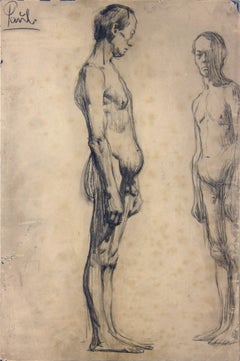
Self-portrait - Homo nudus -
Located in Berlin, DE
Bruno Paul (1874 Seifhennersdorf - 1968 Berlin). Self-portrait, c. 1895. Pencil on paper, mounted on cardboard, 53.5 x 35 cm, signed 'Paul' at upper left. - Homo nudus - About the artwork In a mirrored situation, Bruno Paul looks at himself in the picture. While his body, which is the size of the format, is shown in profile parallel to the picture, he turns his head into the picture in order to become aware of himself there, whereby the lighter use...
Category

1890s Realist Germany - Drawings and Watercolor Paintings

Materials

Pencil

untitled, Drawing, Pencil/Colored Pencil on Paper
Located in Yardley, PA
In my pictures I try to combine the visual and the conceptual. For me, drawing is a medium of knowledge which, beyond direct expression, makes visible material and immaterial forces,...
Category

2010s Expressionist Germany - Drawings and Watercolor Paintings

Materials

Pencil

Canto #22 (Abstract work on paper)
By Harald Kroner
Located in London, GB
Canto #22 (Abstract work on paper) Ink, oil on paper - unframed This artwork will be shipped rolled in a dent-resistant tube. Harald Kröner works thoroughly with paper, of which h...
Category

2010s Abstract Germany - Drawings and Watercolor Paintings

Materials

Paper, Ink, Oil

Canto #22 (Abstract work on paper)
By Harald Kroner
Located in London, GB
Canto #22 (Abstract work on paper) Ink, oil on paper - unframed This artwork will be shipped rolled in a dent-resistant tube. Harald Kröner works thoroughly with paper, of which h...
Category

2010s Abstract Germany - Drawings and Watercolor Paintings

Materials

Paper, Ink, Oil

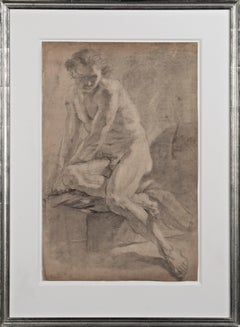
Seated Male Nude France Circa 1760 Charcoal Drawing Signed
Located in Eltville am Rhein, DE
Gabriel Briard Paris 1725 - 1777 Seated male nude Charcoal drawing Signed lower left Size 55 x 36 cm Frame 75 x 56 cm Authenticity confirmed in writing Gabriel Briard was a landsca...
Category

1750s French School Germany - Drawings and Watercolor Paintings

Materials

Charcoal

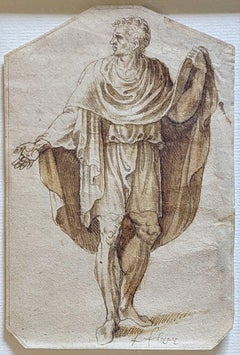
Study of a Man, Old Master Drawing, Figure, Roman Study, Lombard
Located in Greven, DE
Old Master Drawing by the Circle of Lambert Lombard. Drawing/ Study of a Man in Renaissance Style, later signed "F. Floris". Study of a Man Lombard li...
Category

16th Century Renaissance Germany - Drawings and Watercolor Paintings

Materials

Handmade Paper

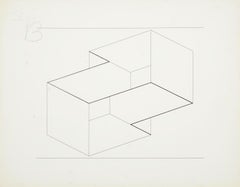
"Structural Constellation" - Abstract, Drawing, Geometric, Black, White
By Josef Albers
Located in Köln, DE
Ink drawing "Structural Costellation" by Josef Albers from 1958. Josef Albers' works “Structural Constellations” were created from 1949 onwards. They demonstrate spatial perception...
Category

1950s Abstract Geometric Germany - Drawings and Watercolor Paintings

Materials

Ink

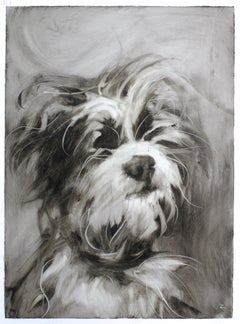
So what ? Dog portraits
Located in Oslo, NO
This small but elegant work is a black-and-white portrait of a dog. It is painted using the signature technique of oil on photographic paper (reverse side). Thick, plasticized photog...
Category

2010s Contemporary Germany - Drawings and Watercolor Paintings

Materials

Paper, Oil

French Orientalist Art, Old Master Drawing Elephants, Hunt and Soldiers, Nature
Located in Greven, DE
Guignet was born in Annecy and grew up in the city of Autun. He was a friend of Hippolyte Michaud. He was a rather popular orientalist painter in h...
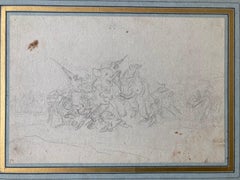
Category

Mid-19th Century Romantic Germany - Drawings and Watercolor Paintings

Materials

Handmade Paper

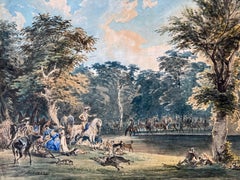
Noble Hunting Society wild Boar Deer and Dogs, Hunter s Life, 1822, Watercolour
Located in Greven, DE
This Watercolor drawing shows a noble hunting society. The duke (?) on horse and several noble ladies accompanying the soctiety. The duke (?) gestures towards a group of hunters on h...
Category

19th Century Romantic Germany - Drawings and Watercolor Paintings

Materials

Watercolor

Marx. Dog portraits
Located in Oslo, NO
This small but elegant work is a black-and-white portrait of a dog. It is painted using the signature technique of oil on photographic paper (reverse side). Thick, plasticized photog...
Category

2010s Realist Germany - Drawings and Watercolor Paintings

Materials

Paper, Oil

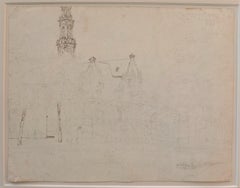
Old Master Drawing, Westerkerk Keizersgracht in Amsterdam, 17th century, Dutch
Located in Greven, DE
Jan van der Heyden (1637 Gorinchem - 1712 Amsterdam), attributed. Old Master Drawing, Westerkerk Keizersgracht in Amsterdam, 17th century, Dutch Westerkerk and Keizersgracht in Amsterdam Backside: later drawn backside with village church of the 18th century Chalk and pen on paper 23,5 x 18,5 cm Preliminary drawing for a painting from the creative period c. 1667 - 1670. This painting has been published a few years ago by Peter C. Sutton in the catalogue raisonné of the artist. Van der Heyden was initially a pupil of a glass painter, but later turned exclusively to architectural painting and went to Amsterdam, where he painted views of churches, castles, palaces, public squares, streets, canals, etc., most of which are richly decorated with staffage. In addition, van der Heyden was also active as an inventor, for example, he developed a street lighting system for Amsterdam by means of oil street lamps, which was in operation from 1669 to 1840. After a stay in London, he painted the London fire of 1666, which he either witnessed himself or had seen the consequences of. Certainly influenced by this, he did much to further the technical and organisational development of the fire brigade from 1669 onwards. His greatest invention was probably the fire hose, which enabled significant improvements in fire-fighting technology and tactics. He also improved the hand-operated fire engines of the time by making them smaller, more mobile and more powerful, and he developed the series connection of several pumps to increase the pressure in order to achieve a greater range for the water jet. In 1690, together with his son, he was the author and illustrator of the Brandspuiten-boek, the first manual for fire fighting. Johann Lingelbach, Adriaen van de Velde and Eglon van der Neer...
Category

17th Century Dutch School Germany - Drawings and Watercolor Paintings

Materials

Paper, Chalk

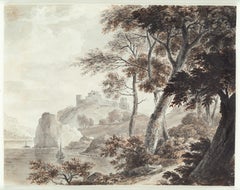
Southern Landscape, Ships, Old Master Drawing, 19th Century, by Von Stengel
Located in Greven, DE
Southern Landscape with View of a Castle and Ships passing by Pen and brush in brown and black over pencil, brown and grey wash, 17,5 x 22,7cm Plain black moulding with golden pearl ...
Category

19th Century Romantic Germany - Drawings and Watercolor Paintings

Materials

Paper, Gouache

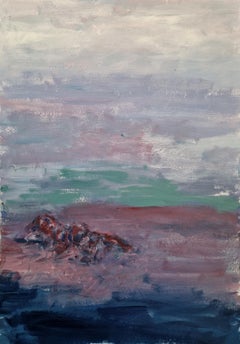
Remains (Body in the Field 2) - Contemporary, Green, Blue, Beige, Grey
By Zsolt Berszán
Located in Baden-Baden, DE
Remains (Body in the Field 2), 2022 oil on paper 16 17/32 H x 11 13/16 W in. 42 H x 30 W cm Signed on reverse Zsolt Berszán embodies in his works the dissolution of the human body...
Category

2010s Abstract Expressionist Germany - Drawings and Watercolor Paintings

Materials

Paper, Oil

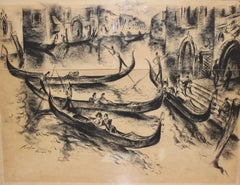
Painting, 20th century, charcoal drawing "Venice - Gondolier" by Paul Kuhfuss
By Paul Kuhfuss
Located in Berlin, DE
Painting, 20th century, charcoal drawing "Venice - Gondolier" by Paul Kuhfuss Original drawing. Signed and dated. Title "Traghetto". Framed, behind glass. Drawing unfortunately torn. Dimensions with frame 65.5cm x 51cm. Age-related condition. For magazines from the publishers Scherl, Mosse, Ullstein, youth (Munich) he worked as an illustrator. In October 1935, he was denounced to the Gestapo by a member of the artist association "Berlin North" for "expressionist impact" and "resistance to Nazi cultural propaganda" and the defense of Jewish colleagues after an exhibition opening in the castle Niederschönhausen. After that, participation in art exhibitions in Berlin was no longer possible. From 1945 he was until January 1960 lecturer at the Volkshochschule Berlin. From 1949 to 1954 he was in charge of the class "Act, Set Design and Costume Design" at the Textile and Clothing School Berlin. From 1912 to 1960 he participated in 173 exhibitions, in particular the Great Berlin Art Exhibitions...
Category

20th Century Germany - Drawings and Watercolor Paintings

Materials

Paper, Charcoal

Maltese dog. Dog portraits
Located in Oslo, NO
This small but elegant work is a black-and-white portrait of a dog. It is painted using the signature technique of oil on photographic paper (reverse side). Thick, plasticized photog...
Category

2010s Realist Germany - Drawings and Watercolor Paintings

Materials

Paper, Oil

Italian Transavantgarde Watercolor Museum of Modern Art Metropolitan New York
By Mimmo Paladino
Located in Eltville am Rhein, DE
Mimmo Paladino Paduli 1948 Untitled, 1983 Watercolor, chalk, and ink on ivory-colored Fabriano paper (watermark) Monogrammed lower right and dated (19)83 Sheet size: 48 x 65 cm Fra...
Category

1980s Italian School Germany - Drawings and Watercolor Paintings

Materials

Watercolor

Flügelschlag der Seele / Wing Beat of the Soul
Located in Greifswald, DE
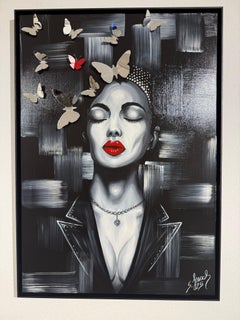
"Flügelschlag der Seele" or "Wing Beat of the Soul" is a one of a kind art piece by Steven Leesch, a young and aspiring painter from Greifswald, Germany. This work of art is primari...
Category

2010s Pop Art Germany - Drawings and Watercolor Paintings

Materials

Canvas, Mirror, Acrylic

Still Thinking About These?

All Recently Viewed