Germany - Interior Drawings and Watercolors
to
2
1
Overall Width
to
Overall Height
to
2
1
1
1
3
3
2
2
1
1
1
1
1
2
2
1
1
481
306
Item Ships From: Germany
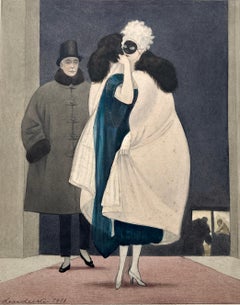
Art Deco Watercolor 1918, By Otto Lendecke Decorated Salon Helena Rubinstein
Located in Eltville am Rhein, DE
Otto Friedrich Carl Lendecke
Lemberg 1886 - 1918 Vienna
Ich werde beobachtet!
I am being watched!, 1918
Watercolor and pencil on paper / cardboard
Signed and dated lower left, tit...
Category
1910s Art Deco Germany - Interior Drawings and Watercolors
Materials
Watercolor
Self-portrait - Homo nudus -
Located in Berlin, DE
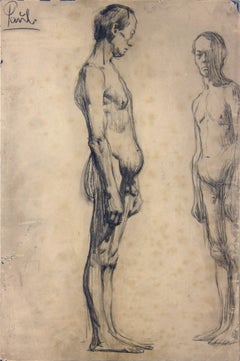
Bruno Paul (1874 Seifhennersdorf - 1968 Berlin). Self-portrait, c. 1895. Pencil on paper, mounted on cardboard, 53.5 x 35 cm, signed 'Paul' at upper left.
- Homo nudus -
About the artwork
In a mirrored situation, Bruno Paul looks at himself in the picture. While his body, which is the size of the format, is shown in profile parallel to the picture, he turns his head into the picture in order to become aware of himself there, whereby the lighter use...
Category
1890s Realist Germany - Interior Drawings and Watercolors
Materials
Pencil
Man sitting in the studio - Thinking about art -
Located in Berlin, DE
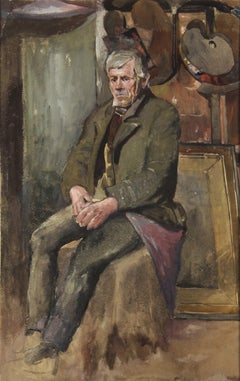
Adolph Eduard Otto von Faber du Faur (1828 Ludwigsburg - 1901 Munich). Man sitting in the studio. Watercolour painting, 43 x 27 cm (visible size), 73 x 53 cm (frame), monogrammed at lower right, estate stamp.
Upper right corner neatly repaired, small tear in the wall to the left of the sitter.
- Thinking about art -
About the artwork
The sitter, an elderly man, is seated in a studio on a pedestal reminiscent of an academy hall. The earthy, dark tones give the scene a weighty quality. The lightest tones are found in the incarnate parts of the figure, which do not stand out from the other colours of the picture, but are linked to them. As a result, the sitter's face is both part of and the highlight of the colour references in the picture. The colour of the sitter's skin is reflected in his pink coat, while his white-grey hair matches the colour of the wall next to him. This almost monochrome wall surface, in turn, is connected across the portrait to the framed picture standing on the floor, which seems to have been erased by this correspondence with the empty wall surface. Through the palette, which is positioned directly behind the sitter's head, the reference to painting, which is already given by the studio space, is explicitly linked to the sitter, who thus seems to be contemplating the question of the meaning of art.
This raises the question of whether Faber Du Faur, who had become lonely in his old age, might have painted a self-portrait here in his later years. In addition to the studio setting, the sitter's explicit reference to the palette and the fact that the picture was part of his estate, the only summary elaboration of the body suggests a self-portrait, while the representation of the face is concretised with the wide-open eyes typical of a self-portrait. This concentration on the face gives the impression of the artist's melancholy introspection, captured by the palette and related to the meaning of painting, whose dark character is reinforced by the concealment of the palette hanging on the right of the picture in the light tones so characteristic of Faber Du Faur. In the course of this resignation, Faber du Faur advises his son Hans, who has also become a painter: "Promise me one thing: never move to Munich, they'll kill you here!"
Whoever the sitter may be, the references to painting make the portrait a resigned self-contemplation by Faber Du Faur, focused on art.
About the artist
After leaving school, Otto Faber du Faur entered the service of the Württemberg army, at the same time cultivating his artistic talent. In 1851, on the recommendation of his father Christian Wilhelm, who was himself a battle painter, he spent six months in Munich as an apprentice to Alexander von Kotzebue. In 1852 he was granted a year's leave of absence from military service to study battle painting in the studio of Adolphe Yvon...
Category
1890s Realist Germany - Interior Drawings and Watercolors
Materials
Watercolor
Related Items
"Masha
s fairy tales" watercolor cm. 17 x 22 1970
By Marina Yevgenyevna Uspenskaya
Located in Torino, IT
Children, illustrations, tales
Marina Evgenevna USPENSKAYA (Moscow, 1925 – 2007)
Marina Evgenevna Uspenskaya was born in Moscow. She graduated from the 1905 Art College, where she ...
Category
1970s Realist Germany - Interior Drawings and Watercolors
Materials
Paper, Watercolor


$1,801 Sale Price
25% Off
H 14.97 in W 13 in
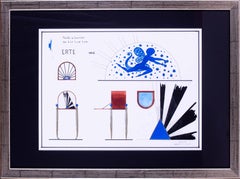
Erte original furniture art deco designs in ink, gold paint and watercolour
By Erte - Romain de Tirtoff
Located in Petworth, West Sussex
Romain de Tirtoff, called ERTE (Russian/French, 1892-1990)
Meuble a Courrier
Ink, gold paint and watercolour
Inscribed with details (upper left) and signed with studio stamp (lower right)
11.1/2 x 15.1/8 in. (29.3 x 38.5 cm.)
Provenance: The personal collection of the artist
Gifted to Serge Leeman and thence by descent
Romain de Tirtoff, commonly known as Erté, is widely recognized as the most influential artist of the Art Deco movement. His distinguished career spanned over 80 years and crossed over into several mediums including fashion illustration, stage and costume design and bronze sculpture.
Erté was born on November 23, 1892 in St. Petersburg, Russia. His father was a military man...
Category
20th Century Art Deco Germany - Interior Drawings and Watercolors
Materials
Ink, Watercolor
$2,064
H 11.5 in W 15.13 in D 1 in
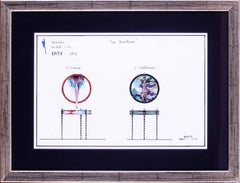
Original Erte Art Deco table watercolour and ink designs, 20th Century
By Erte - Romain de Tirtoff
Located in Petworth, West Sussex
Romain de Tirtoff called ERTE (Russian/French, 1892-1990)
Les emotions: La Tristesse et l’Indifference
Ink and watercolour
Inscribed with details and signed with studio stamp (lower...
Category
20th Century Art Deco Germany - Interior Drawings and Watercolors
Materials
Paper, Ink, Watercolor
$2,202
H 9.63 in W 14.13 in D 1 in
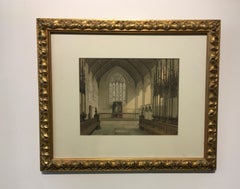
Historic English Chapel Interior,
by Unknown, Watercolor Painting
Located in Oklahoma City, OK
This framed and matted 16" x 19" watercolor painting by an Unknown artist depicts an historic English chapel interior. The interior of the church features the large stained glass window pane...
Category
19th Century Realist Germany - Interior Drawings and Watercolors
Materials
Watercolor
$400 Sale Price
20% Off
H 16 in W 19 in D 1 in
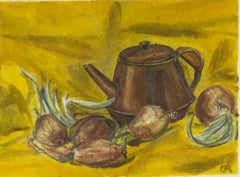
Brown teapot surrounded by red onions on Yellow background
By Glenora Richards
Located in New Orleans, LA
Glenny created beautiful miniature watercolors, mostly still life. This image of a bronze teapot with red onions is a unique work of art.
Glenora Rich...
Category
1990s Realist Germany - Interior Drawings and Watercolors
Materials
Watercolor
$71 Sale Price
25% Off
H 2 in W 2.5 in
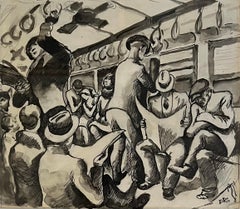
NYC Subway Mid 20th Century American Scene Social Realism WPA Modern 1930s
By Daniel Ralph Celentano
Located in New York, NY
NYC Subway Riders Mid 20th Century American Scene Social Realism WPA Modern 1930s
Daniel Celentano (1902 - 1980)
Subway Scene, 1930s
8 x 9 inches
Ink and wash on paper
Singed lower ...
Category
1930s American Realist Germany - Interior Drawings and Watercolors
Materials
Paper, Ink, Gouache
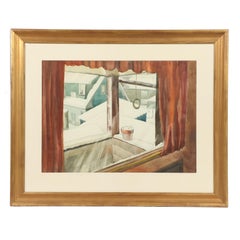
Rooftops - Cleveland
Located in Indianapolis, IN
Signed lower left. Vixseboxse Art Galleries, OH label verso.
Exhibited: Thirteenth Annual May Show, Cleveland Museum of Art, Cleveland, OH, 1931
Kae Dorn Cass was born in 1901 and ...
Category
1930s Germany - Interior Drawings and Watercolors
Materials
Watercolor, Board
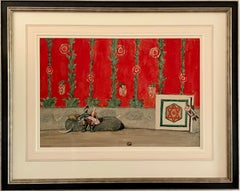
Claude Shepperson - Petrushka - Watercolour scene from the Ballets Russes
By Claude Allin Shepperson
Located in London, GB
CLAUDE ALLIN SHEPPERSON, ARA, ARWS
(1867-1921)
Petrushka – Scene from the Ballets Russes
Signed l.l.: Shepperson
Watercolour over traces of pencil on paper
Framed
30.5 by 45.5 cm., 12 by 18 in.
(frame size 52.5 by 66 cm., 20 ¾ by 26 in.)
Provenance:
Richard C Davis...
Category
1910s Realist Germany - Interior Drawings and Watercolors
Materials
Watercolor, Paper
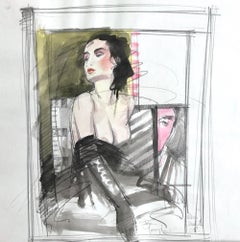
SEDUCTRESS Signed Watercolor, Erotic Fashion Portrait, Modern Boudoir Art
By Nico Vrielink
Located in Union City, NJ
SEDUCTRESS is a unique original mixed media watercolor and graphite on paper, hand drawn and painted by the Dutch artist Nico Vrielink. SEDUCTRESS portrays a dark haired young woman wearing an off-shoulder evening gown and long elegant evening gloves looking sideways over her shoulder, seductively posing on a modern settee, her warm coral pink lipstick, rose lavender eye shadow and warm rose blushed cheeks enhancing her passionate mood. SEDUCTRESS is an erotic fashion portrait of expressive, modern boudoir art...
Category
1980s Contemporary Germany - Interior Drawings and Watercolors
Materials
Watercolor, Graphite, Paper, Mixed Media
$618 Sale Price
25% Off
H 18 in W 24 in
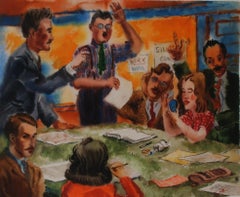
"Animated Discourse" WPA Mid-Century American Scene Modernism Realism Figurative
Located in New York, NY
"Animated Discourse" WPA Mid-Century American Scene Modernism Realism Figurative.
Chris Ritter (American, 1906 – 1976) "Animated Discourse," 19 x 24 (sight). Watercolor on paper. Si...
Category
1940s American Modern Germany - Interior Drawings and Watercolors
Materials
Paper, Watercolor
$6,500
H 30 in W 34 in D 2 in
The Open Window - 19th Century British Children
s Book illustration by Sowerby
By John George Sowerby 1
Located in London, GB
JOHN GEORGE SOWERBY
(1849-1914)
Phoebe - The Open Window
Watercolour heightened with white
Unframed, in mount only
8 by 7 cm., 3 by 2 ¼ in.
(mount size 25.5 by 20 cm., 10 by 8 in.)
Reproduced:
J G Sowerby & Thomas Crane, At Home, Marcus Ward & Co, 1881, p.42.
The current work was reproduced in Sowerby and Crane’s 1881 children’s book, At Home, where is accompanied by the following verse:
All the morning, all the morning,
Sat she till her tasks were done;
While without were birds and blossoms,
And the pleasant sun.
And the leaves in ev’ry rustle,
And the birds in ev’ry song:-
“Phoebe, Phoebe, are you coming?
Phoebe, don’t be long!”
Whispered thro’ the open window
Gentle breezes, passing by:-
“Phoebe, are you coming, Phoebe?
Come before we die!”
Till the clock, with joyful measure,
Struck the hour when work is o’er;
Crying “Ponto’” Phoebe vanished
Through the open door.
Whither sped out nimble Phoebe?
She is in the study now;
Ponto heard her with she called him, -
Answered back “Bow-wow!’
“Ponto, tho’ the birds and garden,
Called me all the morning thro’
I had first to do my lessons –
So I think should you.”
Poor old Ponto! He is longing,
Longing for his game of play,
And the garden – ah: but Phoebe
Has a word to say.
“Beg then – beg, sir – do you hear me?
No, no, Ponto, that is wrong;
Paws up! Steady! Ah, that’s better!
Good dog, come along!”
John George Sowerby was born into a prosperous Gateshead family of glass manufactures and artists. He inherited the family business, the Ellison Glass Works, one of the world’s largest producers of pressed glass, where he introduced designs inspired by the Arts and Crafts movement. Initially he combined his energies at the glass works with his work as an illustrator and painter of landscapes and floral subjects with a Pre-Raphaelite intensity, strong colours and rich detail. He exhibited many of these paintings at the Royal Academy. In the 1880s he collaborated with Newcastle artist, Henry Hetherington Emmerson, on illustrations for the children’s books Afternoon Tea (1880) and The May Blossom (1881). Although were critically very well received but the publications were attacked by Kate Greenaway who considered them too close to her own work. Sowerby then went on to produce highly aesthetic illustrated books At Home (1881) and At Home Again (1883), with decorations by Thomas Crane. Gleeson White, editor of The Studio magazine stated that in Afternoon Tea Sowerby “set a new fashion for ‘aesthetic’ little quartos’ (The Studio, 1897). Roger Dixon in Belfast Publishing (Oxford University Press, 2011, p.79) considered these At Home and At Home Again to be “among the loveliest books ever produced.” Never very wise as a business man, in the early 1880s he left Ellison Glass Works being declared bankrupt in 1884. He returned to the works again as a paid employee.
Sowerby’s daughter, Millicent Sowerby...
Category
Late 19th Century Realist Germany - Interior Drawings and Watercolors
Materials
Watercolor
The Prince
s Room
By Willy Pogany
Located in Buffalo, NY
Born in Szeged, Hungary, he became one of the better known and successful illustrators of the Golden Age of Illustration, completing over 100 books. Among them are "A Treasury of Verse for Little Children," "The Rubaiyat of Omar Khayyam," and "The Rime of the Ancient Mariner." He is probably best known for pen and ink drawings of mythology subjects geared towards children.
He studied at Budapest Technical University and attended art schools in Munich and Paris before moving to London at age 23. In 1907, he began illustrating children's books and did a series of annual gift books...
Category
1940s Realist Germany - Interior Drawings and Watercolors
Materials
Gouache, Graphite, Pen, Watercolor
Still Thinking About These?
All Recently ViewedMore Ways To Browse
Annette Ollivary
Annika Tucksmith
Anthony Alonso
Anthony Brunelli
Anthony Gibbs On Sale
Anthony Rickards On Sale
Antique Fishing Pole
Antique Orchard Painting
Antique Original Paintings Boston
Antique Peddlers Cart
Antique Pioneer Wagons
Antique Sexton
Antique Sock Stretchers
Ariane Wyss
Armand Fouquet
Arthur Maynard
Arthur Prince Spear
Artist Alan King