Indiana - More Prints
to
6
2
Overall Width
to
Overall Height
to
6
1
1
6
1
1
8
1
5
1
5
3
4
2
2
8
3,896
3,645
Item Ships From: Indiana
Tina Turner
By Andy Warhol
Located in Indianapolis, IN
Andy Warhol (1928-1987)
Tina Turner 1985
Unique gelatin silver print
Size: 8 x 10 in (20.3 x 25.4 cm)
Frame size: 16 x 17.5 in (40.6 x 44.4 cm)
Unsigned
Authenticated by the Authen...
Category
1980s Pop Art Indiana - More Prints
Materials
Silver Gelatin


$18,000
Beach Scene
By Andy Warhol
Located in Indianapolis, IN
Andy Warhol (1928-1987)
Beach Scene (1975)
Unique polaroid print
Size: 4.25 x 3.5 in (10.8 x 8.9 cm)
Frame size: 11 x 8.875 in (27.9 x 22.5 cm)
Unsigned
Authenticated by the Authen...
Category
1970s Pop Art Indiana - More Prints
Materials
Polaroid

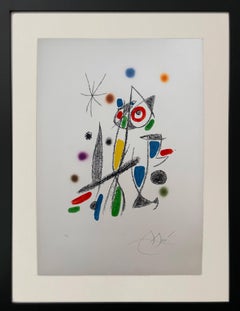
Maravillas con variaciones acrósticas En El Jardín de Miró
By Joan Miró
Located in Indianapolis, IN
Joan Miró (1893-1983)
Maravillas con variaciones acrósticas En El Jardín de Miró (1975)
Lithograph
Size: 29.5 x 23.25 in (75 x 59 cm)
Frame size: 38.5 x 30 in (97.94 x 76.05 cm)
Fr...
Category
Late 20th Century Surrealist Indiana - More Prints
Materials
Lithograph
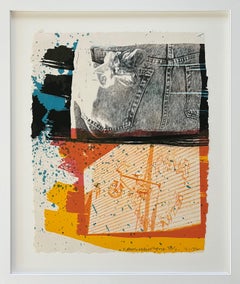
Fest
By Robert Rauschenberg
Located in Indianapolis, IN
Robert Rauschenberg (1925-2008)
Fest (1991)
Four color lithograph
Size: 26 x 21 in (66 x 53.3 cm)
Frame size: 33.5 x 28.25 (85 x 71.7 cm)
Edition of 51, this is 38/51
Hand signed an...
Category
1990s Abstract Expressionist Indiana - More Prints
Materials
Lithograph
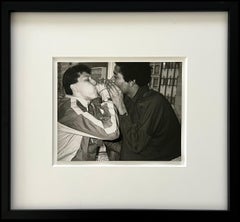
Jean-Michel Basquiat and Friend
By Andy Warhol
Located in Indianapolis, IN
Andy Warhol (1928-1987)
Jean-Michel Basquiat and Friend (1984)
Unique gelatin silver print
Size: 8 x 10 in (20.3 x 25.4 cm)
Frame size: 16 x 17.5 in (40.6 x 44.4 cm)
Unsigned
Authe...
Category
1980s Pop Art Indiana - More Prints
Materials
Silver Gelatin
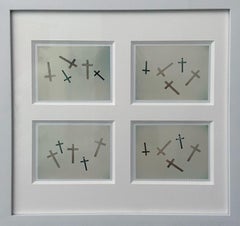
Crosses
By Andy Warhol
Located in Indianapolis, IN
Andy Warhol (1928-1987)
Crosses (1982)
Unique polaroid print
Size: 3.375 x 4.25 in (8.6 x 10.8 cm)
Frame size: 11.5 x 12 in (29.2 x 30.4 cm)
Unsigned
Authenticated by the Authentic...
Category
1980s Pop Art Indiana - More Prints
Materials
Polaroid
$25,000
David Hockney
By Andy Warhol
Located in Indianapolis, IN
Andy Warhol (1928-1987)
David Hockney (1982)
Unique gelatin silver print
Size: 10 x 8 in (25.4 x 20.3 cm)
Frame size: 17.5 x 16 in (44.4 x 40.6 cm)
Unsigned
Authenticated by the Au...
Category
1980s Pop Art Indiana - More Prints
Materials
Silver Gelatin

$12,000
David Hockney
By Andy Warhol
Located in Indianapolis, IN
Andy Warhol (1928-1987)
David Hockney (circa 1980)
Unique gelatin silver print
Size: 8 x 10 in (20.3 x 25.4 cm)
Frame size: 16 x 17.5 in (40.6 x 44.4 cm)
Unsigned
Authenticated by ...
Category
1980s Pop Art Indiana - More Prints
Materials
Silver Gelatin

Related Items
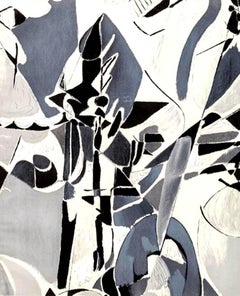
Pierre Tal Coat - Original Lithograph
By Pierre Tal-Coat
Located in Collonge Bellerive, Geneve, CH
Pierre Tal Coat - Original Lithograph
1976
Dimensions: 32 x 25 cm
Revue XXe Siècle
Edition: Cahiers d'art published under the direction of G. di San ...
Category
1970s Abstract Expressionist Indiana - More Prints
Materials
Lithograph
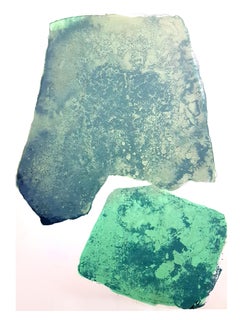
André Lanskoy - Composition - Mourlot Lithographic Poster
By André Lanskoy
Located in Collonge Bellerive, Geneve, CH
André LANSKOY (1902-1976)
Composition
Lithographic poster
Editor: Mourlot
Dimensions: 58.5 x 47.5 cm
André Lanskoy was one of the great painters o...
Category
1960s Abstract Expressionist Indiana - More Prints
Materials
Lithograph
$1,434
H 23.04 in W 18.71 in D 0.04 in
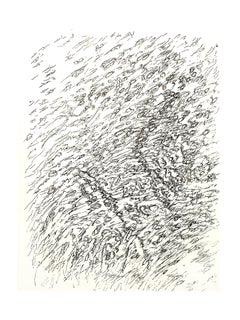
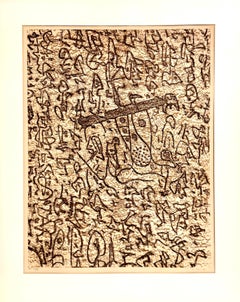
Henri Michaux - Beach - Original Lithograph
By Henri Michaux
Located in Collonge Bellerive, Geneve, CH
Henri Michaux - Beach - Original Lithograph
1956
Dimensions: 32 x 25 cm
Edition: G. di San Lazzaro.
From the art review XXème siècle
Unsigned and unumbered as issued
Category
1950s Abstract Expressionist Indiana - More Prints
Materials
Lithograph
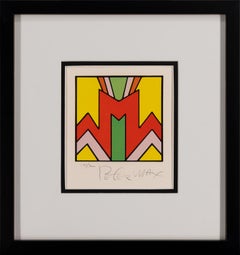
Peter Max "Geometric #2" Vibrant 1976 Signed Lithograph, Limited Edition
By Peter Max
Located in Miami, FL
PETER MAX – "GEOMETRIC #2"
⚜ Lithograph on Paper ⚜ Hand signed lower right ⚜ Framed
AN ICONIC GEOMETRIC STUDY BY PETER MAX
"Geometric #2" (1976) captures Peter Max’s signature use o...
Category
1970s Pop Art Indiana - More Prints
Materials
Lithograph
$2,300
H 14.625 in W 13.75 in D 1.125 in
Max Ernst Dada Surrealist Hand Signed Lithograph Poster for a Jewish Museum
By Max Ernst
Located in Surfside, FL
Max Ernst (German, American, 1891-1976)
Color lithograph
Titled, "Poster For The Jewish Museum"
1966
Hand signed lower right
Hand numbered HC I/XVII
Dimensions: 34.75 x 28.5 sight 25 X 19.25
Max Ernst (German 1891 – 1976) was a German-born painter, sculptor, printmaker, graphic artist, and poet. A prolific artist, Ernst was a primary pioneer of the Dada movement and surrealism in Europe. He had no formal artistic training, but his experimental attitude toward the making of art resulted in his invention of frottage—a technique that uses pencil rubbings of textured objects and relief surfaces to create images—and grattage, an analogous technique in which paint is scraped across canvas to reveal the imprints of the objects placed beneath.
Max Ernst showed for the first time in 1912 at the Galerie Feldman in Cologne. At the Sonderbund exhibition of that year in Cologne he saw the work of Paul Cezanne, Edvard Munch, Pablo Picasso, Paul Gauguin and Vincent van Gogh. In 1913 he met Guillaume Apollinaire and Robert Delaunay and traveled to Paris. Ernst participated that same year in the Erste deutsche Herbstsalon.
In 1914 he met Jean Arp in Cologne who was to become a lifelong friend. In 1921 Ernst exhibited at the Galerie au Sans Pareil in Paris. He was involved in Surrealist activities in the early 1920s with Paul Eluard and André Breton. His work was exhibited that year together with that of the Das Junge Rheinland group, at Galerie Feldman in Cologne, and then in several group exhibitions in 1913. In his paintings of this period, Ernst adopted an ironic style that juxtaposed grotesque elements alongside Cubist and Expressionist motifs.
Ernst fought in world war I. Several German Expressionist painters died in action during the war, among them August Macke and Franz Marc. In 1918, Ernst was demobilised and returned to Cologne. He soon married art history student Luise Straus, of Jewish ancestry, whom he had met in 1914. In 1919, he visited Paul Klee in Munich and studied paintings by Giorgio de Chirico. In the same year, inspired by de Chirico and mail-order catalogues, teaching-aide manuals and similar sources, he produced his first collage works (notably Fiat modes, a portfolio of lithographs), a technique which later dominated his artistic pursuits. Also in 1919, Ernst, social activist Johannes Theodor Baargeld and several colleagues founded the Cologne Dada group. In 1919–20, Ernst and Baargeld published various short-lived magazines such as Der Strom, die Schammade and organised Dada exhibitions.
Ernst and Luise's son Ulrich Jimmy Ernst was born on 24 June 1920; he later would also become a painter. In 1921, he met Paul Éluard, who became a lifelong friend. Éluard bought two of Ernst's paintings (Celebes and Oedipus Rex) and selected six collages to illustrate his poetry collection Répétitions. A year later the two collaborated on Les malheurs des immortels and then with André Breton, whom Ernst met in 1921, on the magazine Littérature.
Ernst developed a fascination with birds which was prevalent in his work. His alter ego in paintings, which he called Loplop, was a bird. He suggested that this alter-ego was an extension of himself stemming from an early confusion of birds and humans. In 1927, he married Marie-Berthe Aurenche and it is thought his relationship with her may have inspired the erotic subject matter of The Kiss and other works of that year.
He collaborated with Joan Miro on designs for Sergei Diaghilev Ballet that same year. The following year the artist collaborated with Salvador Dali and the Surrealist Luis Bunuel on the film L'Age d'or. His first American show was held at the Julien Levy Gallery, New York, in 1932. In 1936 Ernst was represented in Fantastic Art, Dada, Surrealism at the Museum of Modern Art in New York. Ernst began to sculpt in 1934 and spent time with Alberto Giacometti. In 1938, the American heiress and artistic patron Peggy Guggenheim acquired a number of Max Ernst's works, which she displayed in her new gallery in London.
Ernst and Guggenheim were married from 1942 to 1946.
In September 1939, the outbreak of World War II caused Ernst, being German, to be interned as an "undesirable foreigner" in Camp des Milles, near Aix-en-Provence, along with fellow surrealist, Hans Bellmer, who had recently emigrated to Paris. He had been living with his lover and fellow surrealist painter, Leonora Carrington who, not knowing whether he would return, saw no option but to sell their house to repay their debts and leave for Spain. Thanks to the intercession of Paul Éluard and other friends, including the journalist Varian Fry, he was released a few weeks later. Soon after the German occupation of France, he was arrested again, this time by the Gestapo, but managed to escape to America with the help of Fry and Peggy Guggenheim, a member of a wealthy American art collecting family. Ernst and Peggy Guggenheim arrived in the United States in 1941 and were married at the end of the year. Along with other artists and friends (Marcel Duchamp and Marc Chagall) who had fled from the war and lived in New York City, Ernst helped inspire the development of abstract expressionism. His marriage to Guggenheim did not last. In October 1946 he married American surrealist painter Dorothea Tanning in a double ceremony with Man Ray and Juliet P. Browner in Beverly Hills, California. The couple made their home in Sedona, Arizona from 1946 to 1953. He and Tanning hosted intellectuals and European artists such as Henri Cartier-Bresson and Yves Tanguy. Sedona proved an inspiration for the artists and for Ernst, who compiled his book Beyond Painting and completed his sculptural masterpiece Capricorn while living in Sedona. As a result of the book and its publicity, Ernst began to achieve financial success. From the 1950s he lived mainly in France. In 1954 he was awarded the Grand Prize for painting at the Venice Biennale.
In 2005, "Max Ernst: A Retrospective" opened at the Metropolitan Museum of Art. Contemporary artist tapestries have had their true believers. He produced a tapestry for Gloria Ross...
Category
1960s Surrealist Indiana - More Prints
Materials
Lithograph
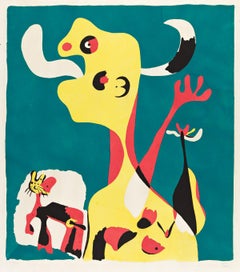
Femme et Chien devant la Lune
By Joan Miró
Located in New York, NY
A superb impression of this very scarce, early color pochoir. Signed, dated "1935" and numbered 58/60 in pencil by Miro. Published by Adlan, Barcelona. Ink stamp on the reverse indic...
Category
1930s Surrealist Indiana - More Prints
Materials
Color, Stencil
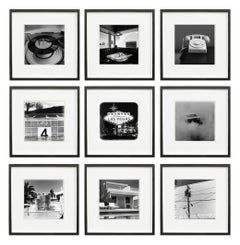
Black and White Photography Set of Nine
By Richard Heeps
Located in Cambridge, GB
A set of nine black and white photographs by Richard Heeps. They can be hung in a grid, or spaced out throughout your interior.
Richard Heeps, primarily known as a colour photographe...
Category
Early 2000s Contemporary Indiana - More Prints
Materials
Photographic Paper, C Print, Color, Silver Gelatin
$7,380
H 94.49 in W 94.49 in D 1.97 in
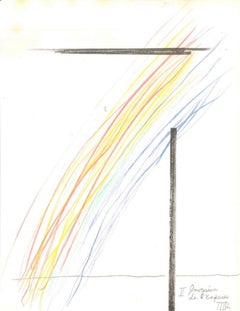
Invasion de l
Espace - Lithograph by Man Ray - 1975
By Man Ray
Located in Roma, IT
Invasion de l'espace is a color lithograph by the American artist and exponent of Dadaism and Surrealism Man Ray (Philadelphia, 1890 - Paris, 1976).
The workr was edited by the Fr...
Category
1970s Surrealist Indiana - More Prints
Materials
Lithograph
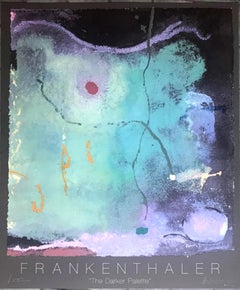
The Darker Palette print, Hand signed twice and inscribed by Helen Frankenthaler
By Helen Frankenthaler
Located in New York, NY
Helen Frankenthaler (after)
Frankenthaler: The Darker Palette (autographed and inscribed), 1998
Offset Lithograph print
42 × 35 in
hand signed "Frankenthaler" lower left; inscribed a...
Category
1990s Abstract Expressionist Indiana - More Prints
Materials
Offset, Lithograph
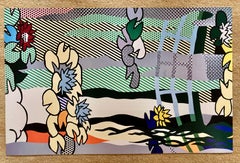
Roy II.
By Roy Lichtenstein
Located in Slovak Republic, SK
A Hahnemuehle Fine Art Print, attributed to Roy Lichtenstein. Editioned of 25.
Category
Mid-20th Century Pop Art Indiana - More Prints
Materials
Photographic Paper, Color, Digital, Archival Pigment
EARTH - Mandela, Former South African President, Signed Art, Symbol, Crescent
By Nelson Mandela
Located in Knowle Lane, Cranleigh
Nelson Mandela, Earth, Signed Limited Edition Lithograph
Many people are unaware that Nelson Mandela turned his hand to art in his 80's as a way of leaving a legacy for his family. H...
Category
2010s Contemporary Indiana - More Prints
Materials
Lithograph

$11,616
H 27.56 in W 25.6 in D 1.58 in
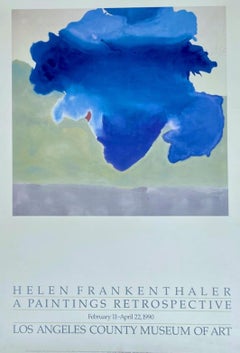
A Paintings Retrospective: vintage LACMA Museum poster depicting her 1963 work
By Helen Frankenthaler
Located in New York, NY
Helen Frankenthaler (after)
A Paintings Retrospective: vintage LACMA Museum poster, 1990
Offset lithograph museum poster
(Unsigned
Unnumbered)
37 × 25 inches
Unframed
This was printed in the artists lifetime - making it more collectible - on the occasion of the exhibition, "Helen Frankenthaler: A Paintings Retrospective from February to April, 1990 at the Los Angeles County Museum of Art (LACMA)
Print is published by Editions Limited Galleries, San Francisco for Los Angeles County Museum of Art (LACMA), LA, CA
The work depicted is Helen Frankenthaler, The Bay, 1963, acrylic on canvas, Detroit Institute of Arts, Michigan (Incidentally, this beautiful work is featured on the cover of the book Water and Art' by David Clarke.)
“What concerns me when I work is not whether a picture is a landscape… or whether somebody will see a sunset in it. What concerns me is, did I make a beautiful picture?” - - Helen Frankenthaler
This is Frankenthaler's first silkscreen, produced for the portfolio New York Ten, which includes works by other New York-based artists at the time such as Roy Lichtenstein, Jim Dine, Tom Wesselmann and Claes Oldenburg. (She created her first lithograph in 1961)
Other examples of this edition are found in the permanent collections of the Museum of Modern Art, MOCA Chicago, the Metropolitan Museum, the Philadelphia Museum, the Art Institute of Chicago, and numerous regional museums and institutions in the United States and worldwide.
Helen Frankenthaler, A Brief Biography
Helen Frankenthaler (1928-2011), whose career spanned six decades, has long been recognized as one of the great American artists of the twentieth century. She was eminent among the second generation of postwar American abstract painters and is widely credited for playing a pivotal role in the transition from Abstract Expressionism to Color Field painting. Through her invention of the soak-stain technique, she expanded the possibilities of abstract painting, while at times referencing figuration and landscape in unique ways. She produced a body of work whose impact on contemporary art has been profound and continues to grow.
Frankenthaler was born on December 12, 1928, and raised in New York City. She attended the Dalton School, where she received her earliest art instruction from Rufino Tamayo. In 1949 she graduated from Bennington College, Vermont, where she was a student of Paul Feeley. She later studied briefly with Hans Hofmann.
Frankenthaler’s professional exhibition career began in 1950, when Adolph Gottlieb selected her painting Beach (1950) for inclusion in the exhibition titled Fifteen Unknowns: Selected by Artists of the Kootz Gallery. Her first solo exhibition was presented in 1951, at New York’s Tibor de Nagy Gallery, and that year she was also included in the landmark exhibition 9th St. Exhibition of Paintings and Sculpture.
In 1952 Frankenthaler created Mountains and Sea, a breakthrough painting of American abstraction for which she poured thinned paint directly onto raw, unprimed canvas laid on the studio floor, working from all sides to create floating fields of translucent color. Mountains and Sea was immediately influential for the artists who formed the Color Field school of painting, notable among them Morris Louis and Kenneth Noland.
As early as 1959, Frankenthaler began to be a regular presence in major international exhibitions. She won first prize at the Premiere Biennale de Paris that year, and in 1966 she represented the United States in the 33rd Venice Biennale, alongside Ellsworth Kelly, Roy Lichtenstein, and Jules Olitski. She had her first major museum exhibition in 1960, at New York’s Jewish Museum, and her second, in 1969, at the Whitney Museum of American Art, followed by an international tour.
Frankenthaler experimented tirelessly throughout her long career. In addition to producing unique paintings on canvas and paper, she worked in a wide range of media, including ceramics, sculpture, tapestry, and especially printmaking. Hers was a significant voice in the mid-century “print renaissance” among American abstract painters, and she is particularly renowned for her woodcuts. She continued working productively through the opening years of this century.
Frankenthaler’s distinguished, prolific career has been the subject of numerous monographic museum exhibitions. The Jewish Museum and Whitney Museum shows were succeeded by a major retrospective initiated by the Modern Art Museum of Fort Worth that traveled to The Museum of Modern Art, New York, the Los Angeles County Museum of Art, and the Detroit Institute of Arts, MI (1989); and those devoted to works on paper and prints organized by the National Gallery of Art, Washington, D.C. (1993), among others.
Select recent important exhibitions have included Painted on 21st Street: Helen Frankenthaler from 1950 to 1959 (Gagosian, NY, 2013); Making Painting: Helen Frankenthaler and JMW Turner (Turner Contemporary, Margate, UK, 2014); Giving Up One’s Mark: Helen Frankenthaler in the 1960s and 1970s (Albright-Knox Art Gallery, Buffalo, NY, 2014–15); Pretty Raw: After and Around Helen Frankenthaler (Rose Art Museum, Brandeis University, Waltham, MA, 2015); As in Nature: Helen Frankenthaler, Paintings and No Rules: Helen Frankenthaler Woodcuts...
Category
1990s Abstract Expressionist Indiana - More Prints
Materials
Offset, Lithograph