Italy Scientific Instruments
to
14
281
953
594
281
19
3
3
1
1
1
1
1
1
21
106
154
56
84
11
2
10
6
16
4
16
6
11
136
118
58
57
51
219
101
38
30
30
281
281
281
6
4
2
2
2
Item Ships From: Italy
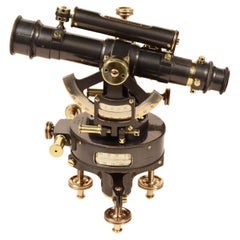
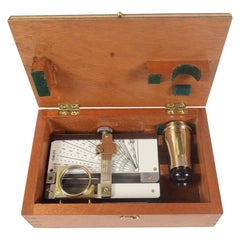
Tacheometro model Soldati late 19th c. signed La Filotecnica Milano
Located in Milan, IT
Tacheometer model Soldati from the late 19th century signed La Filotecnica Ing. A Salmoiraghi Milan serial no. 18865.
Construction site surveying and tracking tool used for calculati...
Category
Late 19th Century Antique Italy Scientific Instruments
Materials
Brass
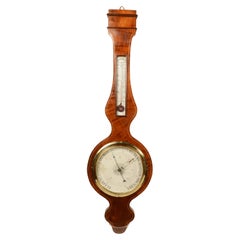
Torricellian barometer French manufacture from the second half of the 19th century
Located in Milan, IT
Torricellian mercury barometer, French manufacture from the second half of the 19th century, made of mahogany veneer wood with cedar wood edge threading complete with rare thermomet...
Category
1870s Antique Italy Scientific Instruments
Materials
Wood
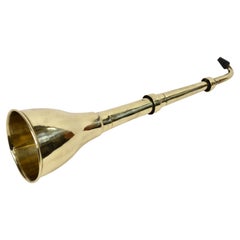
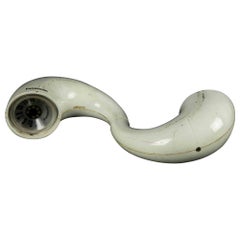
Brass and Bakelite telescopic acoustic cornet England early 1900s
Located in Milan, IT
Telescopic acoustic cornet made of brass and Bakelite , English manufacture of the early 1900s.
The principle of its operation is based on the reflection of sound on the inner walls,...
Category
Early 1900s Antique Italy Scientific Instruments
Materials
Brass
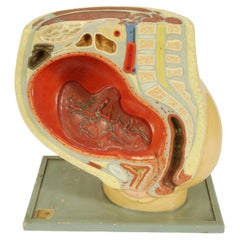
1930s Educational Model Depicting the Belly of the Woman Immediately After Birth
Located in Milan, IT
Educational model depicting the belly of the woman immediately after birth with a part of the placenta. 1930's, sold by the Hygiene Museum in Dresden...
Category
1930s Vintage Italy Scientific Instruments
Materials
Plaster
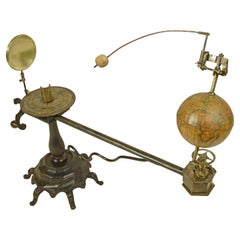
Mechanical planetarium representative of the solar system with Sun Earth and Moon
Located in Milan, IT
Mechanical planetarium, or representative model of the solar system, from the second half of the 19th century.
The cartouche of the globe reads: GlobusVydal J. Felkl at Syn Roztok ...
Category
1860s Antique Italy Scientific Instruments
Materials
Metal
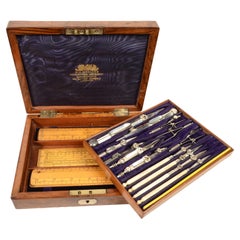
Box of mid-19th century compasses housed in their tuia burl box
Located in Milan, IT
Box of mid-19th century compasses, housed in their original tuia burl box, nickel-plated brass and ivory instruments, velvet and satin interior, lock and hinges in brass. Embossed ...
Category
Mid-19th Century Antique Italy Scientific Instruments
Materials
Wood
Vintage Wood Geloso Television GT1014, 1950s, Italy
Located in Rome, IT
This GTV1014 was one of the first 21-inch b / w televisions produced by Geloso.
It uses the intercarrier system as an audio-video medium frequency. The chassis is mounted inside th...
Category
1950s Italian Mid-Century Modern Vintage Italy Scientific Instruments
Materials
Glass, Plastic, Wood

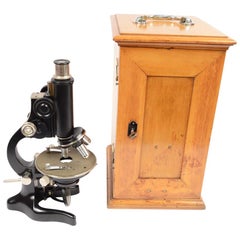
Milan 1920/30 Antique Microscope by F.lli Koristka Wooden Box with Accessories
Located in Milan, IT
Optical microscope signed F.lli Koristka Milano n. 42870 produced between 1920/30, of chromed and black painted brass, three-magnification turret, consisting of a stand and a plate w...
Category
1920s Italian Vintage Italy Scientific Instruments
Materials
Brass
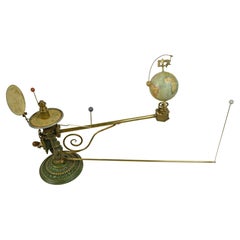
Mechanical solar system with Sun, Mercury, Venus, Earth, Moon and Mars 1870
Located in Milan, IT
Tellurium or representative and demonstrative mechanical model of the solar system composed of the Sun, Mercury, Venus, Earth, Moon and Mars, realized by the Prague geographer and ...
Category
1870s Antique Italy Scientific Instruments
Materials
Metal
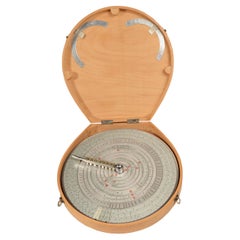
FER model logarithmic circular slide rule H 39 n. 1675 1930s
Located in Milan, IT
FER model logarithmic circular slide rule H 39 No. 1675 from the 1930s, Italian Patent No. 1680, housed in its original round-shaped wooden box like the instrument, complete with in...
Category
1930s Vintage Italy Scientific Instruments
Materials
Aluminum
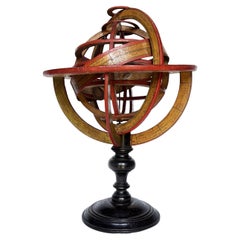
Ptolemaic Armillary Sphere, Charles-François Delamarche, Paris, ante 1798
By Charles Francois Delamarche
Located in Milano, IT
Ptolemaic armillary sphere
Charles-François Delamarche
Paris, ante 1798
Wood and papier-mâché
covered with printed and partly hand-colored paper
It measures 15.55 in in height x Ø 10...
Category
1790s French Other Antique Italy Scientific Instruments
Materials
Wood, Paper
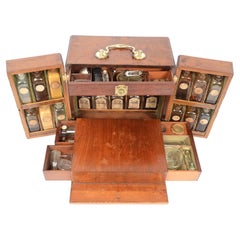
XIX Century English Mahogany Apothecary Set Cabinet Medicines J Hexam Chymist
Located in Milan, IT
English apothecary cabinet dated to the first half of the nineteenth century, mahogany box, brass handle and hinges and complete with key. The cabinet with a rectangular base is form...
Category
19th Century British Antique Italy Scientific Instruments
Materials
Mahogany
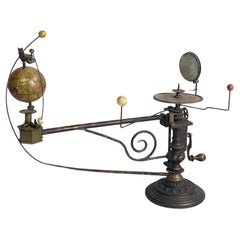
Italian antique mechanical tellurium in brass and cast iron, mid 1800s
Located in MIlano, IT
Italian antique mechanical tellurium in brass and cast iron, mid 1800s
Mechanical tellurium made of brass and cast iron. This scientific instrument ...
Category
Mid-19th Century Italian Antique Italy Scientific Instruments
Materials
Brass
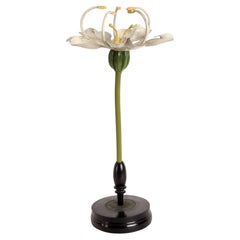
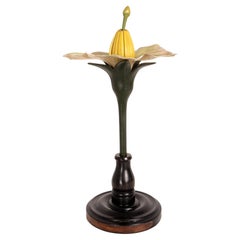
A botanic model Brendel, Germany 1900.
Located in Milan, IT
A rare botanical model of the Brendel, Conium maculatum N.60 (Umbelliferae). The round base in ebonized wood holds the botanical model which reveals the flower of the Hemlock. Brende...
Category
Early 20th Century German Italy Scientific Instruments
Materials
Wood
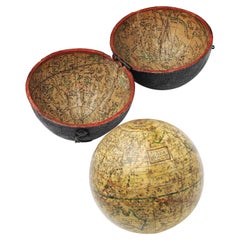
English Pocket Globe, London, Circa 1775-1798
By Herman Moll
Located in Milano, IT
Pocket globe
London, between 1775 and 1798
Re-edition of the globe of Hermann Moll (1678-1732) dated 1719
The globe is contained in its original case, which itself is covered in shark skin.
There are slight gaps in the original paint on the sphere. The case no longer closes.
The sphere measures 2.7 in (7 cm) in diameter whereas the case measures 2.9 in (7.4 cm) in diameter.
lb 0.22 (kg 0.1)
The globe is made up of twelve printed paper gores aligned and glued to the sphere.
In the North Pacific Ocean there is a cartouche with the inscription:
A Correct
Globe
with the new
Discoveries.
The celestial globe is depicted on the inside of the box and is divided into two hemispheres with the cartouche:
A correct globe
with ye new cons
relations of Dr.
Halley & c.
It shows the ecliptic divided into the days of the zodiacal calendar and the constellations represented as animals and mythological figures.
On the globe are delineated the equinoctial line, divided by degrees and hours, the ecliptic and the meridian (passing west of Greenwich). The continents are shaded and outlined in pink, green and yellow. It shows: the Cook routes; a wind rose in the Southern Indian Ocean; Antarctica without land; Africa with Negroland (Hermann Moll is considered the first geographer to name the West African region in his 1727 map. (Encyclopaedia Britannica, ed. 1902, under "States of Central Africa"); Tartary in Central Asia; the Mogul kingdom in northern India; in North America only New England, Virginia, Carolina, Florida, Mississippi are identified; California is already a peninsula; the northwest coast of America is "unknown parts" (Alaska is not described and it is only partially delineated, it was to become part of the United States in 1867); Mexico is named "Spain"; Central South America "Amazone America". Australia (which was to be so named after 1829) is called New Holland. The route of Admiral Anson is traced (1740) and the trade winds are indicated by arrows. (See Van der Krogt, P., Old Globes in the Netherlands, Utrecht 1984, p. 146 and Van der Krogt, P. - Dekker, E., Globes from the Western World, London 1993, pp. 115.)
Elly Dekker, comparing Moll’s 1719 globe and his re-edition (of which the one described above is a sample), identifies the differences between them: the two editions are quite similar to each other, but in the "anonymous" globe, compared to the previous globe of 1719, California looks like a proper peninsula - the reports of the Spanish explorers of the region had given rise to uncertainty over whether it was connected to the mainland or not. The geographical nature of California was confirmed after the explorations of Juan Bautista de Anza (1774-1776). The routes of Dampier's journey were partially erased and the route of Captain James Cook's first voyage was superimposed on them, and the geography of Australasia was adapted accordingly, including the denomination of the Cook Strait. See Dekker, Elly, Globes at Greenwich, 1999.
An important ante quem element is represented by Tasmania: it is not separated from Australia by the Bass Strait...
Category
Late 18th Century English George III Antique Italy Scientific Instruments
Materials
Shagreen, Paper
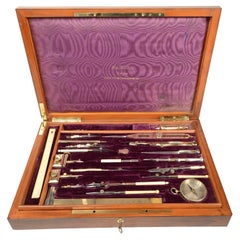
Wooden compass box with rosewood veneer circa 1870s
Located in Milan, IT
Box of compasses wood with rosewood veneer from the second mid-19th century, complete with key. In the center of the lid a rhombus-shaped brass medallion is engraved with the name...
Category
1870s Antique Italy Scientific Instruments
Materials
Brass
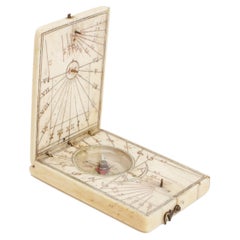
An ivory dyptich sundial, Germany, 17th century.
Located in Milan, IT
Ivory diptych sundial for latitude 48 degrees with vertical and horizontal dials, pin gnomon for Italian hours and lunar volvelle. Compass needle and glass cover. On the plain back ...
Category
Early 17th Century German Antique Italy Scientific Instruments
Materials
Ivory
Vintage Panasonic Toot-a-Loop-Radio, 1970s
Located in Roma, IT
Vintage Panasonic toot-a-loop-radio is an original decorative object realized in the 1970s by Panasonic R-72 (R72) and built by Matsushita Electric Industrial Co
This radio is the...
Category
1970s Japanese Vintage Italy Scientific Instruments
Materials
Plastic
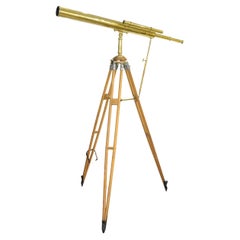
Brass floor astronomical telescope signed Edmund Wheeler London 1870
Located in Milan, IT
Astronomical round-section brass ground astronomical telescope with two-extension focusing and rack and pinion, with searcher scope, complete with wooden tripod and wooden case conta...
Category
1870s Antique Italy Scientific Instruments
Materials
Brass
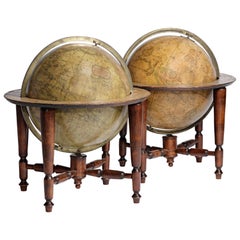
Pair of English 12-inch Globes by William Harris, London, 1832 and 1835
By William Harris
Located in Milano, IT
Pair of 12-inch table globes
William Harris
London, 1832 and 1835
Slight abrasions from use; few cracks
lb 11 each (kg 5)
The two terrestrial and celestial globes rest in their original Dutch style stands with four supporting turned wood columns.
Each one measures 12 in in height x 16.5 in in diameter with the diameter of the spheres measuring approximately 12 in; 48 cm in height x 42 cm in diameter x 31 cm diameter of the spheres.
The 12 inch measure was the most frequently used by British manufacturers of globes of this period.
Each globe is composed of two series of twelve printed paper gores, aligned and glued onto plaster spheres.
The brass circle of the meridian bears engravings...
Category
1830s English William IV Antique Italy Scientific Instruments
Materials
Paper, Wood
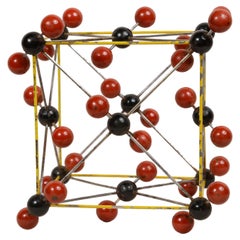
Molecular structure of metal diamond and black painted bakelite spheres
Located in Milan, IT
Molecular structure of metal diamond and black-painted Bakelite spheres. Czechoslovakian manufacture of the 1950s. Measures 23x20 x20 cm - 9x7.9x7.9 inches.
The last photo is the gif...
Category
Mid-20th Century Italy Scientific Instruments
Materials
Metal

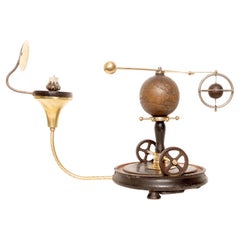
A paradoxical orrery that demonstrates the earth-moon system. Italy circa 1860.
Located in Milan, IT
A paradoxical orrery that demonstrates the earth-moon system and its movement. The base of the planetarium is made of fruit wood, circular in shape with three bell-shaped wood feet. ...
Category
Mid-19th Century Italian Antique Italy Scientific Instruments
Materials
Brass
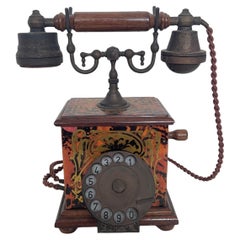
Vintage Table Phone in Boulle Style - Wood and Brass
Located in Cantù, IT
Elegant vintage Boulle-style desk telephone with fine brass details and decorative inlays on a tortoiseshell effect background. The square body made of fine wood is embellished with ...
Category
20th Century Italian Italy Scientific Instruments
Materials
Metal, Bronze
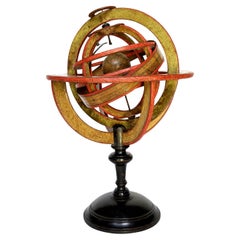
Ptolemaic Armillary Sphere, Charles-François Delamarche, Paris, ante 1798
By Charles Francois Delamarche
Located in Milano, IT
Ptolemaic armillary sphere
Charles-François Delamarche
Paris, ante 1798
Wood and papier-mâché
covered with printed and partly hand-colored paper
It measures 16.37 in in height x Ø 10.94 in (41.60 cm - Ø 27.80 cm)
It weights 2.33 lb (1,058 g)
State of conservation: consistent with its age and use, the paper shows some signs of use, stains and abrasions.
The sphere is Ptolemaic, with the Earth placed at its center, surrounded by the Moon and the Sun mounted on two metal arms.
The sphere is composed of six horizontal and two vertical rings (armillae), each bearing graduations and its own name.
The first horizontal ring is illegible. The others, in descending order are: North Pole, Tropic of Cancer, Equator, Tropic of Capricorn, South Pole.
The vertical rings consist of two double meridians.
The sphere is then connected to the large meridian by two pins, a vertical ring inserted perpendicularly into the circle of the Horizon, in turn supported by four semicircles connected to the turned and black-stained wooden base.
Each element is covered with printed paper. It contains various pieces of information: latitudes, length of days, names and zodiac symbols, calendar, wind directions, etc.
The vertical circles mention the latitudes and longitudes of different cities: Rome, Bordeaux, Madrid, Boston, Batavia (Jakarta), Acapulco, etc.
Even the small terrestrial globe is covered with printed paper: continents and oceans appear with numerous geographical markings indicating the most recent explorations.
In the Pacific Ocean, west of South America bears the following inscription:
GLOBE
TERRESTRIAL
à Paris
chez Delamarche Géog
Rue du Foin Jacques
Au Collège de
M.e Gervais
The North American coasts are well delineated and California appears correctly as a peninsula - reports from Spanish explorers in the region had given rise to confusion as to whether it was connected to the mainland or not. The geographical nature of California was confirmed after the explorations of Juan Bautista de Anza (1774-1776).
Alaska is not described and is only partially traced; it would become part of the United States in 1867.
Various Pacific islands are indicated.
Australia (the name definitely used from 1824) is called "Nouvelle Hollande."
Tasmania is still represented as a peninsula and this is an important detail for the dating of our armillary sphere.
The island is separated from Australia by Bass Strait, which was crossed by Matthew Flinders for the first time in 1798, showing that it was not a peninsula. Delamarche certainly would not have waited a long time to update such an important geographical datum: presumably he did so shortly after receiving the news.
Charles-François Delamarche (1740-1817) founded his laboratory around 1770 and, in a few years, he became the most famous French cartographer and globe maker between the 18th and 19th centuries. After having acquired the laboratory of the late Didier Robert de Vaugondy (1723-1786; himself a renowned cartographer who continued the family business founded by his grandfather Nicolas Sanson in the seventeenth century) and after having purchased, between 1788 and around 1800, the businesses of Jean-Baptiste Fortin (1750-1831) and Jean Lattré (around 1750-1800), he began to call himself "Successeur de MM. Sanson and Robert de Vaugondi, Géographes du Roi and de M. Fortin, Ingénieur-mécanicien du Roi pour les globes et les sphères."
Thus, at the end of the eighteenth century, Delamarche possessed the warehouse stocks, as well as the manufacturing skills of the globes of his main rivals in Paris.
In addition to this aggressive acquisition policy, the key to its success also lay in the combination of high-quality cartography combined with extremely attractive globes and armillary spheres; and, of course, its famous red paint finishing touch.
His laboratory was located on Rue de Foin St Jacques "au Collège Me. (or "Mtre") Gervais" in the Latin Quarter of Paris until around 1805, when he moved to rue du Jardinet No. 13.
On the death of Charles-François in 1817, the reins of the company passed to his son Félix (1779-1835), who continued to publish, often in collaboration with the engraver Charles Dien, Sr. In 1835 the company first moved to rue du Jardinet No. 12 and a little later to rue du Battoir No. 7.
Bibliography:
Dekker, Elly, et al. Globes at Greenwich...
Category
1790s French Other Antique Italy Scientific Instruments
Materials
Wood, Paper
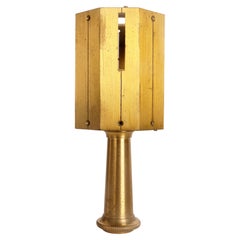
A land surveying square, France 1880.
Located in Milan, IT
Octagonal brass land surveying square. Each side has a slot, which allows to aim the distance and evaluate 90 and 45 degrees when measuring the field. ...
Category
Late 19th Century French Antique Italy Scientific Instruments
Materials
Brass
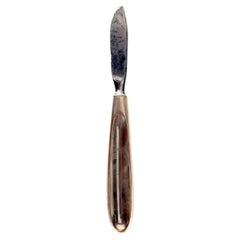
Surgical instrument: a scalpel, late 19th century, United States 1900.
Located in Milan, IT
A surgical instrument from the late 19th early 20th century. An iron scalpel. With brass handle. Tiemann & Co, American manufacturing. New York, United States circa 1900.
Category
Early 20th Century American Italy Scientific Instruments
Materials
Iron
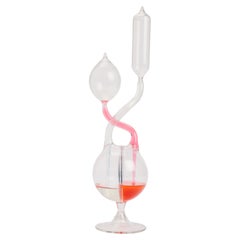
Blown glass scientific instrument, Italy 1900.
Located in Milan, IT
Blown glass scientific instrument to evaluate the expansion of the liquids with the warmth. Italy circa 1900.
Category
Early 20th Century Italian Italy Scientific Instruments
Materials
Glass
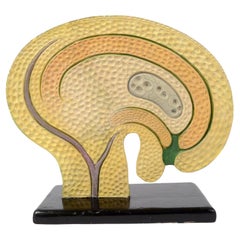
Botanical Model in Enlarged Section of a Moraceae Syconium, Italy, 1930s
Located in Milan, IT
Model in enlarged section of the Moraceae syconium (fig for example is a sicon). The model is made of painted plaster and almost certainly made by Paravia in the 1930s. Measures cm 3...
Category
1930s Italian Vintage Italy Scientific Instruments
Materials
Plaster
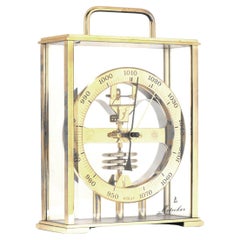
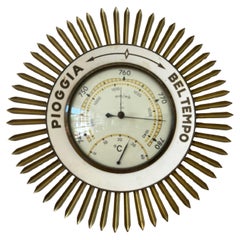
Huger West Germany Meteobar skeleton design years
60 rare real fine barometer
Located in Biella, IT
Huger West Germany meteobar design in years '60 rare and real fine skeleton barometer
the barometer is in brass and is perfect vintage and original, working condition
Category
1960s German Mid-Century Modern Vintage Italy Scientific Instruments
Materials
Brass
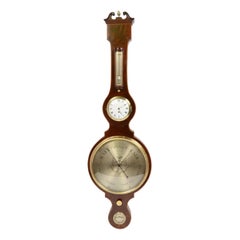
19th Century Mahogany Barometer F Somalvico Antique Weather Measuring Instrument
Located in Milan, IT
Barometer complete with clock signed F. Somalvico N ° 11 Brook Str. Holborn London datable between 1810 and 1820. Finely crafted mahogany wood case with cedar wood edges. Large silve...
Category
1810s British Antique Italy Scientific Instruments
Materials
Mahogany
Mid-Century Brass Wall Barometer, 1950s
Located in Palermo, IT
Mid-Century Brass Barometer, 1950s
Working and in good condition.
Category
1950s Italian Vintage Italy Scientific Instruments
Materials
Brass
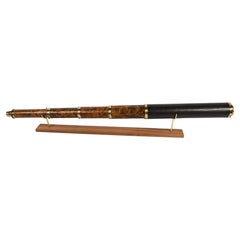
Cardboard round section telescope with four extensions and brass ferrules
Located in Milan, IT
Rare round cardboard scope with four extensions and brass ferrules, german manufacture from the early 19th century. Excellent state of conservation.
Maximum length cm 95 - 37.4 in,...
Category
Early 19th Century Antique Italy Scientific Instruments
Materials
Paper
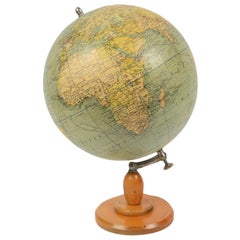
Antique Terrestrial Globe Published in 1940s by Girard Barrère et Thomas, Paris
Located in Milan, IT
Terrestrial globe published in the 1940s by Girard Barrère et Thomas 17, Rue de Buci Paris. Turned wooden base, papier mâché sphere covered with paper printed by engraving on copper ...
Category
1940s French Vintage Italy Scientific Instruments
Materials
Wood, Paper
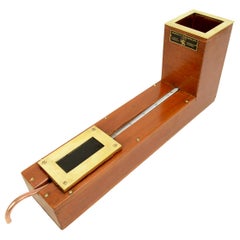
Actinometer Antique Measuring Instrument made by Griffin
Tatlock London in 30s
By Griffin
Tatlock ltd
Located in Milan, IT
Herschel actinometer, 1930s, wood and brass, signed Griffin & Tatlock ltd London. It is an instrument invented in 1825 by John Herschel and used for the measurement of the solar heat...
Category
1930s British Vintage Italy Scientific Instruments
Materials
Wood
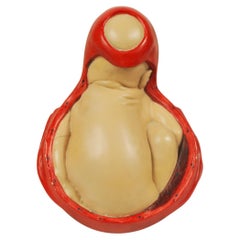
1930s Educational Model Papier Maché and Plaster Decipting a Baby Borning
Located in Milan, IT
Educational model, papier maché and plaster, decipting a baby borning. 1930s-1940s, sold by the Hygiene Museum in Dresden. Very good condition. Measu...
Category
1930s Vintage Italy Scientific Instruments
Materials
Plaster
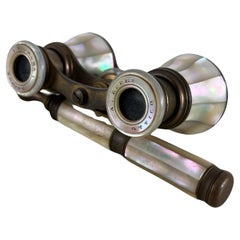
Brass Lorgnettes
Long-Handled Opera Glasses
Mid-Century Italian Design 1930s
Located in Palermo, IT
A splendid pair of 'lorgnettes' (long-handled opera, or theatre, glasses). Lorgnettes, eye glasses held in place by long handles rather than resting on the bridge of one's nose, were...
Category
1930s Italian Vintage Italy Scientific Instruments
Materials
Brass

$461 Sale Price
20% Off
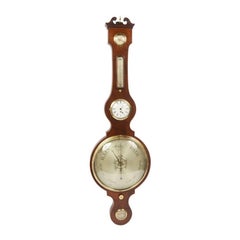
1820-35 Large Clock Barometer by Silvani Brighton Antique Forecast Instrument
Located in Milan, IT
Rare large barometer complete with clock signed Silvani Brighton, dated from 1820 and 1835. Finely crafted mahogany wood case with double thread at th...
Category
1840s British Antique Italy Scientific Instruments
Materials
Mahogany
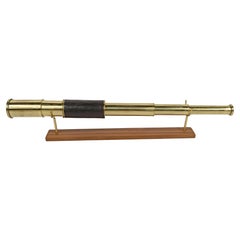
Spyglass round section brass and leather focus 3 extensions 1850
Located in Milan, IT
Round-section brass telescope with leather-covered handle and three-extension focus, complete with sunshade extension and dust cover tabs. English manufacture of the mid-19th centur...
Category
Mid-19th Century Antique Italy Scientific Instruments
Materials
Brass
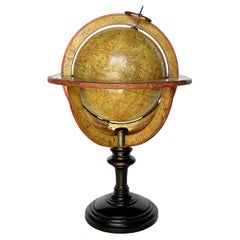
Celestial Table Globe, Charles-François Delamarche, Paris, 1791
By Charles Francois Delamarche
Located in Milano, IT
Celestial table globe
Charles-François Delamarche
Paris, 1791
It measures: 17.13 in in height, Ø max 27.7 in; the sphere Ø 7.09 in
(h 43.5 cm x Ø max 27.7 cm; the sphere Ø 18 cm).
W...
Category
1790s French Other Antique Italy Scientific Instruments
Materials
Metal
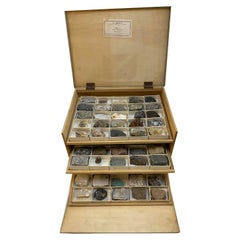
Paravia Collection 100 Rocks, Educational Material, Italy 1950s
By Paravia
Located in Naples, IT
Collection 100 Rocks, Teaching Material, Italy 1950s
Geology teaching board "Minerals and Rocks" G.B. Paravia Scientific Collection - Turin
The ...
Category
1950s Italian Mid-Century Modern Vintage Italy Scientific Instruments
Materials
Rock Crystal
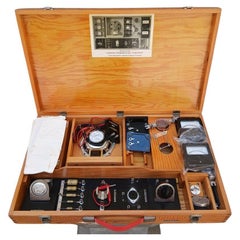
Paravia Applied Electricity Original Components Cassette - Italy - 1960s
By Paravia
Located in Milano, IT
Paravia, scientific instruments, vintage educational kit, 1960s, Norstedts, magnetism, optics, thermology, mechanics, applied electricity, top vintage lab, educational set, experimen...
Category
Mid-20th Century Italian Mid-Century Modern Italy Scientific Instruments
Materials
Magnets
$1,442 Sale Price
20% Off
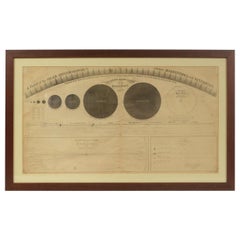
1855 Astronomical Plate of Distance of the Planets by FJ Huntington New York
Located in Milan, IT
Plate of the distance of the planets “Entered according to Act of Congress in the year 1855 by F.J. Huntington in the Clerk's Office of the District Court of the United States for th...
Category
1850s American Antique Italy Scientific Instruments
Materials
Glass, Wood, Paper
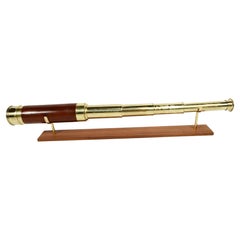
Round-section brass telescope with mahogany-lined handle 1850
Located in Milan, IT
Round-section brass telescope with mahogany-lined handle, four-extension focus. English manufacture from the mid-19th century. Good condition signs of wear and tear, fully functional...
Category
Mid-19th Century Antique Italy Scientific Instruments
Materials
Brass
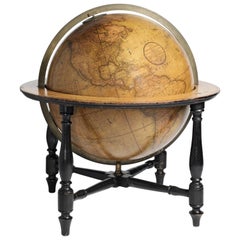
18-inch Globe, Cary
s, London, 1840
By Cary’s
Located in Milano, IT
John and William Cary
Updated by George and John Cary
Terrestrial Globe
London, 1840
lb 22 (kg 10)
Slight surface abrasions due to use. A small crack on the horizon circle.
The globe rests in its original Dutch style stand with four supporting turned wood columns.
It measures 26 in in height x 23.6 in in diameter with the diameter of the sphere measuring 18 in; 66 cm in height x 60 cm in diameter with the diameter of the sphere measuring 45.72 cm.
The 18 inch...
Category
1840s English Early Victorian Antique Italy Scientific Instruments
Materials
Paper, Wood
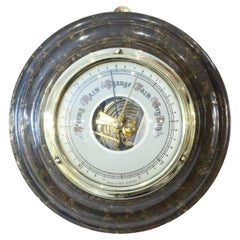
Antique German aneroid barometer from the early 1900s made of turned marble.
Located in Milan, IT
Antique German aneroid barometer from the early 1900s made of turned marble, brass, and glass.
Good state. Working order.
Diameter cm 17 - inches 6.7, thickness cm 5- inches 1.9...
Category
1910s Vintage Italy Scientific Instruments
Materials
Marble
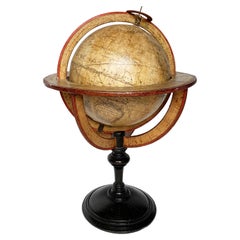
Terrestrial Table Globe by Félix Delamarche, Paris, 1821
By Félix Delamarche
Located in Milano, IT
Terrestrial table globe
Félix Delamarche
Paris, 1821
It measures 20.47 in height, Ø max 14.17 in; the sphere Ø 9.44 in (h 52 cm x Ø max 36.5 cm; the sphere Ø 24 cm)
Wood, printed...
Category
1820s French Restauration Antique Italy Scientific Instruments
Materials
Metal
Botanic Model of Solarum Tuberosum Flower, Paravia, Italy, 1940
Located in Milan, IT
A botanic didactical model, depicting a Solarum Tuberosum flower, pale pink color, made out of papier machè, plaster and wood, hand painted. Extremely detailed. Paravia, Milan, Italy...
Category
Mid-20th Century Italian Italy Scientific Instruments
Materials
Plaster, Wood
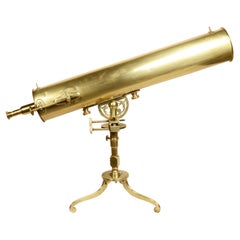
Brass Gregorian refractor telescope circa 1750 attributed to James Short
Located in Milan, IT
Antique mid-18th-century brass Gregorian refractor telescope, almost certainly made by James Short (1710-1768). Good condition, replaced eyepiece and missing lens, lathe rebuilt the ...
Category
Mid-18th Century Antique Italy Scientific Instruments
Materials
Brass
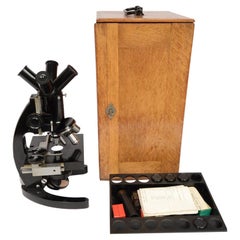
Milan 1910/20 F.lli Koristka Antique Microscope Wooden Box with Accessories
Located in Milan, IT
Tri-ocular optical microscope Euskop model, antique scientific instrument of painted brass and chromed steel, with four-magnification turret n. 40122 by Fratelli Koristka, Milano, ci...
Category
1910s Italian Vintage Italy Scientific Instruments
Materials
Brass
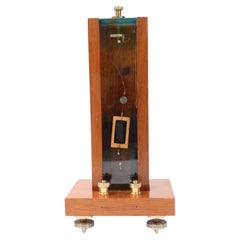
Galvanometer Antique Measuring Instrument Used for Telegraph Cables 1850 circa
Located in Milan, IT
Vertical mirror galvanometer made in 1850 circa, oak and glass, three adjustable screws at the base. Tool constituted by a magnet bar movable inside a coil and connected to a needle. In the absence of current the needle is positioned vertically while when the coil is crossed by the current it creates a magnetic field that moves the needle. This type of galvanometer was used for measurement of insulation of telegraph cables...
Category
1850s British Antique Italy Scientific Instruments
Materials
Wood
Atomic structure for educational use of carbonic acid Czechoslovakia 1950s.
Located in Milan, IT
Struttura atomica ad uso didattico dell'acido carbonico (H2CO3) in metallo, sfere in bachelite verniciate rosso e nero. Czechoslovakian manufacture of the 1950s.
Good condition sign...
Category
1950s Vintage Italy Scientific Instruments
Materials
Metal
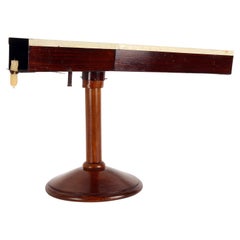
Scientific tool for demonstrating the refraction of light, Italy 1920.
Located in Milan, IT
Scientific tool for demonstrating and assessing the refraction of light. Constructed in boxed metal with a square section, it consists of a horizontal tube that bends a few grids in ...
Category
Early 20th Century Italian Italy Scientific Instruments
Materials
Metal
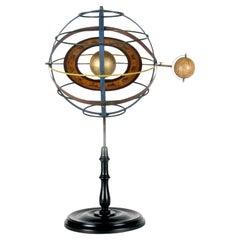
A Copernican armillary sphere, Paravia, Milan, Italy 1930
Located in Milan, IT
A Copernican armillary sphere made of iron, paper, brass and wood, with the Sun inside, and the Earth on the outside, made of wood and covered with paper. Pedestal made of turned and...
Category
Mid-20th Century Italian Italy Scientific Instruments
Materials
Brass, Iron
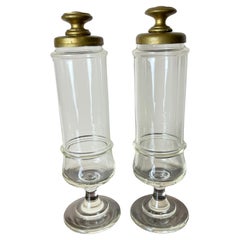
Pair of Glass Pharmacy Jars, Italy, 1930s
Located in Palermo, IT
Pair of glass pharmacy jars, Italy, 1930s
Found in an old disused pharmacy.
Good condition. One has an imperceptible chip on the edge.
Being handcra...
Category
1930s Italian Vintage Italy Scientific Instruments
Materials
Glass
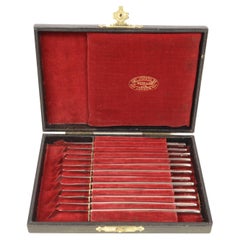
End 19th Century Ophthalmic Steel Surgery kitJ. Weiss
Son and Dixey England
Located in Milan, IT
Ophthalmic steel surgery kit, signed J. Weiss & Son Ltd London and Dixey England, made in the end of XIX century circa, placed in its original wooden box covered with leather, red ve...
Category
Late 19th Century Antique Italy Scientific Instruments
Materials
Steel
Anatomical model: a human skull model life size, Stuttgard, Germany 1930.
Located in Milan, IT
Human skull anatomical model life size 1:1 Model with cranial sutures detachable 2 parts plus three cervical vertebrae for medical educational aid. The skull and vertebrae are made o...
Category
Mid-20th Century German Italy Scientific Instruments
Materials
Iron

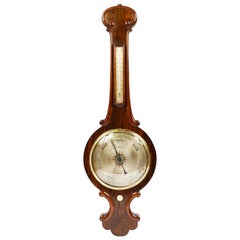
19th Century Wooden Barometer Signed Burlinson Ripon Antique Instrument Weather
Located in Milan, IT
Wooden barometer signed Burlinson Ripon made in the mid 19th century. Silver-plated brass dial engraved with weather indications and the name of the m...
Category
1850s British Antique Italy Scientific Instruments
Materials
Wood
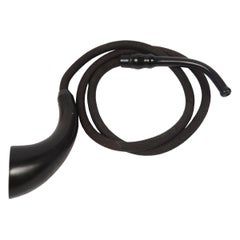
German 1900s Antique Ear Trumpet medical instrument Made of Ebonite and Rubber
Located in Milan, IT
Ear trumpet, bell and earphone of ebonite and extension of rubber, German medical instrument, manufacture of the early 1900s. Measures: Length 10 cm, 3.9 i...
Category
Early 20th Century German Italy Scientific Instruments
Materials
Rubber
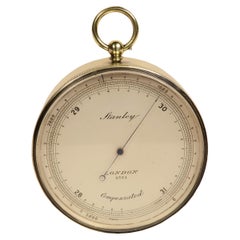
Compensated brass barometric altimeter signed Stanley London from the early 1900s
Located in Milan, IT
Brass compensated barometric altimeter signed Stanley London No. 1581 from the early 1900s.
Diameter 7.6 x 3 cm - inches 3x1.2.
An altimeter is an instrument for measuring the heig...
Category
Early 20th Century Italy Scientific Instruments
Materials
Brass
1960s Nautical Rangefinder Signed Kelvin Hughes Antique Marine Navigation Tool
Located in Milan, IT
Nautical rangefinder signed Made in Great Britan by Kelvin Hughes a divison of Smiths Industries Limited made in the 1960s, complete with original mahogany box. AP 498 Stuats Marine Distance Meter very good working condition. Box size cm 21 x 13 H 6. It is an ancient nautical instrument used to measure...
Category
1960s British Vintage Italy Scientific Instruments
Materials
Metal
Still Thinking About These?
All Recently ViewedMore Ways To Browse
Japanese Vintage Camera
Large Coffee Grinder
Paper Dispenser
Small Telescope
Stanley Tool
Theatre Binoculars
Thomas Edison Furniture
Used Furniture Fairbanks
Used Surveyor Transit
Victorian Opera Glasses
Vintage Barometer West Germany
Vintage Brass Pump
Vintage Brass Telescope
Vintage Projectors
Wwii Binoculars
Zeiss Binoculars
1900 Camera
1960s Barometer