Miami - Metalwork
to
11
1,072
574
11
1
8
2
2
2
11
10
4
4
3
11
10
6
4
1
11
11
11
1
Item Ships From: Miami
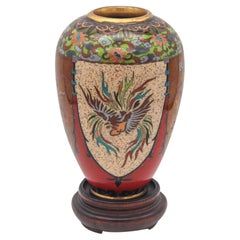
Japan 1890 Meiji Period Decorative Vase In Cloisonné Enamel With Wood Base
Located in Miami, FL
Japanese vase from the Meiji Period (1868-1912).
Beautiful antique decorative vase, created in Japan during the Meiji period (1868-1912), circa 1890s. It was carefully crafted in so...
Category
1890s Japanese Meiji Antique Miami - Metalwork
Materials
Bronze, Enamel

$488 Sale Price / set
30% Off
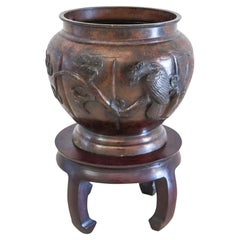
JAPAN 1900 Meiji Period Bronze Planter Vase With Carved Wood Base
Located in Miami, FL
Large Planter Vase from imperial Japan.
This a beautiful piece of Japanese decorative arts, created in Japan during the Meiji imperial period, circa 1900. The oversized vase can be ...
Category
Early 1900s Japanese Meiji Antique Miami - Metalwork
Materials
Bronze
$2,789 Sale Price / set
30% Off
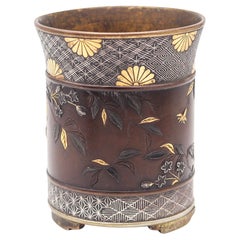
MEIJI Period Japan 1890 Imperial Shakudo Gold Mixed Metals Brush Vase-Pot
Located in Miami, FL
A brush pot from the Meiji imperial period.
This is a beautiful brush vase-pot created in the Imperial Japan during the early Meiji period (1868-1912), circa 1890. The fabulous roun...
Category
1890s Japanese Meiji Antique Miami - Metalwork
Materials
Gold, Silver, Bronze
$4,025 Sale Price
30% Off
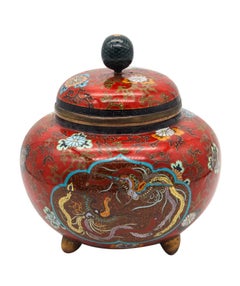
JAPAN IMPERIAL 1900 Meiji Period Tripode Koro Censer In Cloisonné Enamel With
Located in Miami, FL
Japanese tripod Koro from the Meiji Period (1868-1912).
This is a rare and beautiful antique koro censer, created in the imperial Japan during the Meiji period (1868-1912), circa 1900. It was carefully crafted in solid bronze and copper with silver wires and embellished with applications of polychromatic Cloisonné enamels and aventurine. The designs depict organics and natural motifs such mythological animals and flowers.
The Chrysanthemum Symbol
In Imperial Japan, the chrysanthemum (Kiku) was a potent symbol of the imperial family and the emperor himself, representing longevity, royalty, and divine power. The 16-petaled chrysanthemum is the Imperial Seal and crest, found on passports, coins, and the Chrysanthemum Throne. This association dates back to the Kamakura period (1185–1333), particularly with Emperor Go-Toba's fondness for the flower, establishing its link to imperial authority and lineage. The connection between the chrysanthemum and the imperial family began when Emperor Go-Toba adopted it as a personal emblem, aligning it with the strength and refinement of the emperor's rule. During the Meiji Period, the 16-petaled chrysanthemum crest, solidifying the association with the imperial family, was established during this time.
The Meiji Imperial Period
This is an era of Japanese history that extended from October 23, 1868 to July 30, 1912.The Meiji era was the first half of the Empire of Japan, when the Japanese people moved from being an isolated feudal society at risk of colonization by Western powers to the new paradigm of a modern, industrialized nation state and emergent great power, influenced by Western scientific, technological, philosophical, political, legal, and aesthetic ideas. As a result of such wholesale adoption of radically different ideas, the changes to Japan were profound, and affected its social structure, internal politics, economy, military, and foreign relations. The period corresponded to the reign of Emperor Meiji. It was preceded by the Keiō era and was succeeded by the Taishō era, upon the accession of Emperor Taishō.
Country: Imperial Japan.
Period: Meiji, 1890-1910.
Technique: Silver Wire Cloisonné over copper and bronze.
Weight: 416.80 Grams, (0.417 Kg).
Measurements:118 mm by 115 mm (4.65 x 4.52 Inches).
Koro
This term refers to a Japanese censer, incense burner, perfume burner or pastille burner is a vessel made for burning incense or perfume in some solid form. They vary greatly in size, form, and material of construction, and have been in use since ancient times throughout the world. They may consist of simple earthenware bowls or fire pots to intricately carved silver or gold vessels, small tabletop objects a few centimeters tall to as many as several meters high. Many designs use openwork to allow a flow of air. In many cultures, burning incense has spiritual and religious connotations, and this influences the design and decoration of the censer.
Cloisonné
This is an enameling technique in which the pattern is formed by wires soldered to the surface of the object to be decorated, which is usually made from copper, forming cells or cloisons, each of which holds a single colour of enamel paste which is then fired, and ground and polished. The champleve technique also uses an enameling technique, but the cells are formed by carving into the surface of the object, or in the casting. The cloisonne technique has been in use since the 12th century BC in the west, but the technique did not reach China until the 13th or 14th century. It became popular in China in the 18th century. Initially bronze or brass bodies were used, and in the 19th century copper, at which time the quality of the items produced began to decline. Chinese cloisonné is the best-known enamel cloisonné, though the Japanese produced large quantities from the mid-19th century, of very high technical quality. In the west the cloisonne technique was revived in the mid-19th century following imports from China, and its use continued in the Art Nouveau and Art Deco periods.
Condition: Basically, is in great antique condition, near mint, with insignificant and minimal usage, in great condition. All parts are secured in the settings. This Japanese Meiji Koro...
Category
Early 1900s Japanese Meiji Antique Miami - Metalwork
Materials
Silver, Bronze, Copper, Enamel
$1,398 Sale Price
30% Off
QING DYNASTY 1800 Early 19th Century Pair of Bronze Censers With Lids
Bases
Located in Miami, FL
An early 19th century dragons censer from the Qing Dynasty.
This is a beautiful antique pair of censers, heavily cast in high relief in the early of the 19th century during the Qing...
Category
Early 1800s Chinese Qing Antique Miami - Metalwork
Materials
Bronze
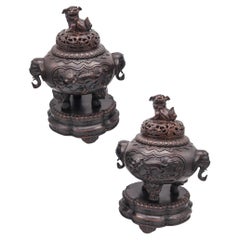
$3,325 Sale Price / set
30% Off
QING DYNASTY 1880 Seated Enthroned Mazu Quan-Yin In Solid Gilt Bronze
Located in Miami, FL
A 19th century enthroned Mazu Quan Ying from the Qing Dynasty.
This is a beautiful antique sculptural figure of an enthroned Mazu Quan Yin, cast in bronze in high relief in the late...
Category
1880s Chinese Qing Antique Miami - Metalwork
Materials
Bronze, Gold
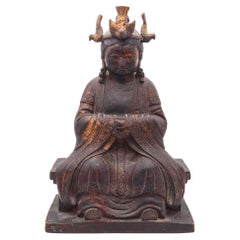
$1,048 Sale Price
30% Off
Ota Jinnoei 1890 Imperial Meiji Period Pair of Cloisonne Cabinet Vases
By Ota Jinnoei
Located in Miami, FL
Pair of cloisonne vases designed by Ota Jinnoei.
Beautiful pair of small cabinet vases, created in Japan circa 1890, during the meiji Imperial period (1868-1912). These vases has ...
Category
1890s Japanese Meiji Antique Miami - Metalwork
Materials
Silver, Bronze, Enamel
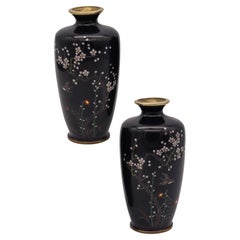
$1,746 Sale Price / set
30% Off
Philippines 19th Century Panabas Iron Sword With Carved Wood And Rattan Handle
Located in Miami, FL
Panabas short sword from the Philippines.
A rare late 18th early 19th century Panabas short sword from the Mindanao, Malabang and the Moro cultures in Lanao Del Sur, the southern p...
Category
19th Century Philippine Tribal Antique Miami - Metalwork
Materials
Iron
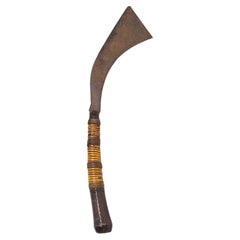
$1,575 Sale Price
30% Off
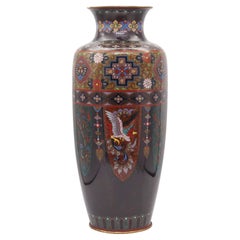
JAPAN 1890-1900 Meiji Period Decorative Six-sided Vase In Cloisonné Enamel
Located in Miami, FL
Japanese vase from the Meiji Period (1868-1912).
This is a beautiful antique decorative vase created in the imperial Japan during the Meiji period (1868-1912), circa 1890s. It was c...
Category
1890s Japanese Meiji Antique Miami - Metalwork
Materials
Gold, Bronze, Enamel
$1,048 Sale Price
30% Off
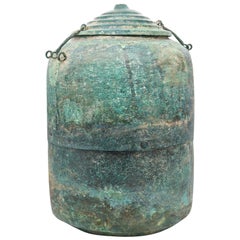
China 960 Ad Song Dynasty Very Rare Imperial Period Offering Vessel in Bronze
Located in Miami, FL
Offering vessel from the Chinese Song Dynasty (960/1279 AD ).
A beautiful "offering spiritual vessel" from the Yunnan province region in the ancient China. This rare vessel was created in red bronze during the Song Dynasty period. between 960/1279 AD.
This is one of the most unusual forms of red bronze jar. A large vessel, the sides are virtually perpendicular to the base. The stepped lid design is also among the more rare types. The predominant lid design among the Yunnan offering bronzes is the "wheel" pattern, with a few lids having the lotus design. This is also one of the few bronzes displaying clear riveting of a two-part vessel body, with the original twisted elements
Has a combined measures including the lid of 12.5 by 8.75 inches (31.75 x 22,23 Cm).
The Song Dynasty, was an imperial dynasty of China that began in 960 and lasted until 1279. The dynasty was founded by Emperor Tizu of Song following his usurpation of the throne of the later Zhou, ending the Five-Dynasties and Ten Kingdoms period. The Song often came into conflict with the contemporaneous Liao, Western Xia and Jin dynasties in northern China. After decades of armed resistance defending southern China, it was eventually conquered by the Mongol-led Yuan dynasty.
The dynasty is divided into two periods: Northern Song and Southern Song...
Category
15th Century and Earlier Chinese Medieval Antique Miami - Metalwork
Materials
Bronze
$3,465 Sale Price
30% Off
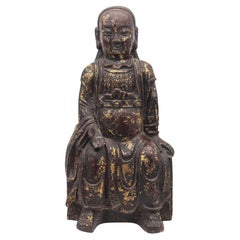
QING DYNASTY 1850 Sculptural Enthroned Mazu Quan-Yin In Solid Gilded Bronze
Located in Miami, FL
A 19th century enthroned Mazu Quan Ying from the Qing Dynasty.
This is a beautiful antique sculptural figure of an enthroned Mazu Quan Yin, cast in bronze in high relief in the late...
Category
1850s Chinese Qing Antique Miami - Metalwork
Materials
Bronze, Gold
$1,048 Sale Price
30% Off
Related Items
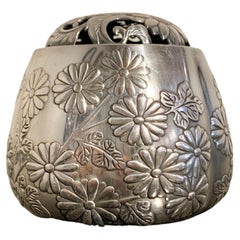
Japanese Silver Incense Burner, Akoda Koro, by Nomura, Meiji Period, Japan
Located in Austin, TX
A lovely and luxurious Japanese silver incense burner of lobed melon form, akoda koro, marked jungin and signed Nomura, Meiji Period, circa 1900, Japan.
The silver koro...
Category
1910s Japanese Meiji Vintage Miami - Metalwork
Materials
Silver, Sterling Silver
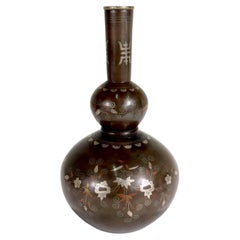
Antique Signed Japanese Meiji Period Mixed Metals Bronze Double Gourd Form Vase
Located in Philadelphia, PA
A fine antique Japanese bronze vase.
From the Meiji Period.
With copper and silver floral and vine and butterfly inlay as well a kanji symbol to the neck (possibly a stylized f...
Category
Early 20th Century Japanese Meiji Miami - Metalwork
Materials
Silver, Bronze, Copper
$895
H 6.88 in Dm 3.88 in
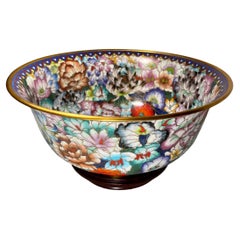
Large Chinese Cloisonne Enamel Bowl, Qing Dynasty
Located in Vero Beach, FL
Large Chinese Cloisonne enamel bowl, Qing Dynasty
Exceptional and finely decorated Chinese cloisonne punch bowl with gilt
metal foot and rim. The bowl has slightly flaring sides ...
Category
Early 20th Century Chinese Qing Miami - Metalwork
Materials
Copper, Enamel
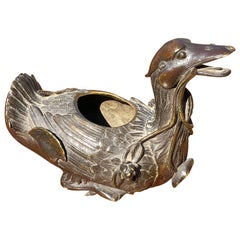
18th Century Chinese Qing Bronze Duck Incense Burner Sculpture
Located in Haddonfield, NJ
18th Century Chinese bronze duck incense burner, Qing period
Please note that one foot is missing, broken off, see detailed image.
Category
Early 18th Century Chinese Qing Antique Miami - Metalwork
Materials
Bronze
$760 Sale Price
49% Off
H 5.25 in W 7.25 in D 3.9 in
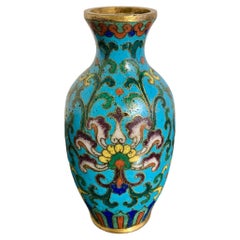
Chinese Cloisonne Incense Tool Vase, Qing Dynasty, 18th/19th Century, China
Located in Austin, TX
A small and elegant Chinese cloisonné vase for incense tools, Qing Dynasty, 18th/19th century, China.
Made for the scholar's studio, this small refined vase, was used to hold incense tools, including a small pair of tongs or chopsticks and spoon. The tools no longer present.
Of miniature baluster vase form, the vase beautify proportioned and decorated in the cloisonné enamel technique, with gilt wires forming the cloisons, or partitions. Within the cloisons, colorful enamels have been expertly laid.
The small incense tool vase...
Category
Early 1800s Chinese Qing Antique Miami - Metalwork
Materials
Copper, Enamel
$6,800
H 3.75 in Dm 1.75 in
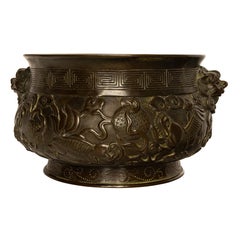
Antique 18th Century Cast Bronze Chinese Qing Dynasty Censer Xuande Mark
Located in Portland, OR
A fine antique late 18th century Chinese archaic style bronze censer with a Xuande mark.
The censer made of cast bronze is very finely modeled, the flared mouth with a key pattern, t...
Category
1780s Chinese Qing Antique Miami - Metalwork
Materials
Bronze
$1,295
H 6 in W 11 in D 10 in
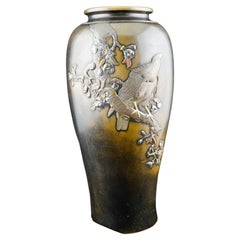
Japanese MIxed Metals and Bronze Meiji Period Vase by Nogawa
By Ando Jubei
Located in Sarasota, FL
Japanese mixed metal and bronze Meiji period finely cast and inlaid vase of an eagle in a tree. Marked for Nogawa workshop and signed by maker on the side.
Category
Late 19th Century Anglo-Japanese Antique Miami - Metalwork
Materials
Silver, Bronze
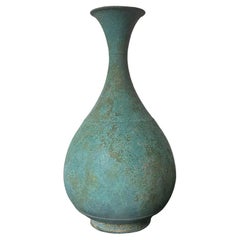
Korean Bronze Bottle Goryeo Dynasty
Located in Atlanta, GA
An antique Korean bronze bottle of bulbous pear form with a long neck and flared open mouth from Goryeo Dynasty (918 AD-1392 AD) circa 12-13th century I...
Category
15th Century and Earlier Korean Archaistic Antique Miami - Metalwork
Materials
Bronze
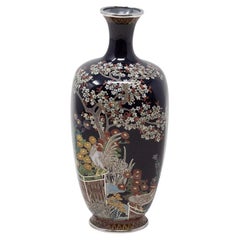
Japanese Meiji Period Cloisonne Enamel Vase by Ando Jubei
By Ando Jubei
Located in Newark, England
Free international shipping
Ando Cloisonne Company Mark
From our Japanese collection, we are delighted to introduce this Japanese Cloisonne Enamel Vase by Ando Jubei. The Cloisonn...
Category
Early 1900s Japanese Meiji Antique Miami - Metalwork
Materials
Enamel, Wire
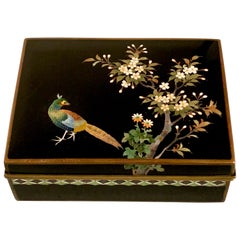
Japanese Cloisonne Box by Inaba, Meiji Period, circa 1900, Japan
By Inaba Cloisonne Co.
Located in Austin, TX
A fine Japanese cloisonne hinged box with pheasant and autumn foliage, by Inaba Nanaho and the Inaba Cloisonne Company, Meiji period, circa 1900, ...
Category
Early 1900s Japanese Meiji Antique Miami - Metalwork
Materials
Copper, Enamel, Metal
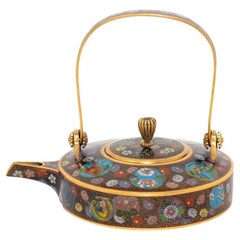
Japanese Meiji Period Cloisonne Enamel Sake Pot
Located in Newark, England
Fine Japanese Meiji period cloisonne enamel Sake pot. The Sake pot of rounded form with with clean edges profusely decorated with blossoming flowers throughout upon a black ground ba...
Category
Late 19th Century Japanese Meiji Antique Miami - Metalwork
Materials
Metal, Enamel
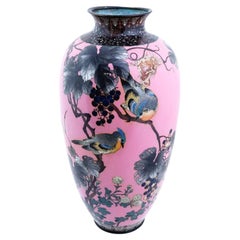
Large Antique Meiji Japanese Cloisonne Enamel Pink Vase W Birds
Located in Long Island City, NY
A large Japanese Meiji period cloisonne enameled vase with a scene of birds, butterflies, and flowers on the pink background and borders with colorful decoration. Collectible Orienta...
Category
Late 19th Century Japanese Meiji Antique Miami - Metalwork
Materials
Enamel
$2,250 Sale Price
50% Off
H 17 in Dm 8 in
Previously Available Items
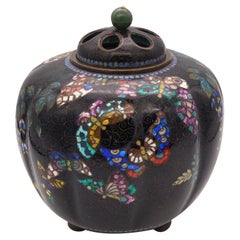
Japan 1890 Meiji Period Bronze Koro Censer in Cloisonne Enamel with Jade Lid
Located in Miami, FL
Japanese Koro from the Meiji Period (1868-1912).
Beautiful antique ten sides fluted koro censer, created in Japan during the Meiji period (1868-1912), ci...
Category
1890s Japanese Meiji Antique Miami - Metalwork
Materials
Jade, Gold, Enamel, Bronze, Silver
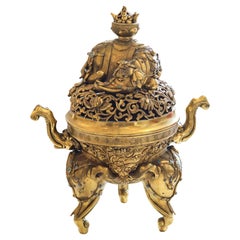
QING DYNASTY 18th Century Palatial Gilt Bronze Elephant Censer With Cover Lid
Located in Miami, FL
An 18th century elephant censer from the Qing Dynasty.
This is an extremely rare palatial censer, created in the 18th century during the Qing Dynasty, circa 1750. The fabulous censer have been designed with an ovoid body standing on three large elephant-head legs. It was crafted with exceptional highly detailed parts in solid gilt bronze and embellished with cabochons beads carved from blue turquoises, below an elaborate relief-cast lotus meander and tow elephant heads with raised and extended trunks to form handles, The domed cover lid is pierced with further latus below a recumbent elephant caparisoned with a howdah on its back in form of an urn filled with auspicious objects. An apocryphal six-character Xuande mark in relief.
About This Rare Censer
The present censer is derived from Ming dynasty prototypes of similar decoration; see one attributed to the Xuande period but with a waisted neck in the Special Exhibition of Incense Burners and Perfumers throughout the Dynasties, National Palace Museum, Taipei, 1994, cat. no.55. The form was originally inspired by ding vessels...
Category
18th Century Chinese Qing Antique Miami - Metalwork
Materials
Bronze
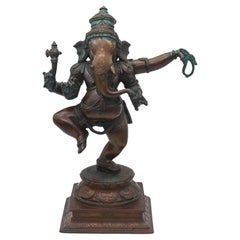
Nepalese-Tibetan 19th Century Dancing Ganesha Sculpture Patinated Solid Bronze
Located in Miami, FL
Nepalese-Tibetan sculpture of Ganesha.
A splendid Hindu religious bronze sculpture of a dancing Ganesha of Tibetan or Nepalese origin, crea...
Category
19th Century Tibetan Tibetan Antique Miami - Metalwork
Materials
Bronze
H 9.05 in W 6.75 in D 3.6 in
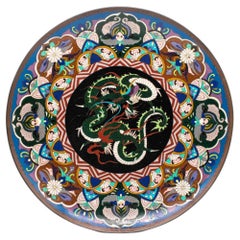
Japan 1900 Meiji Period Charger With A Dragon In Cloisonné Multicolor Enamel
Located in Miami, FL
Large charger in cloisonné from imperial Japan.
Beautiful piece of Japanese decorative arts, created during the Meiji imperial period, circa ...
Category
Early 1900s Japanese Meiji Antique Miami - Metalwork
Materials
Bronze, Copper, Enamel
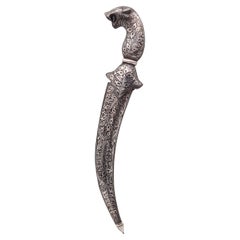
Turkish Arab 1850 Damascene Silver and Niello Waist Short Dagger with Sheath
Located in Miami, FL
Damascene silver and niello forged steel dagger with sheath.
Beautiful short dagger (Jambiya) from the Ottoman Empire, of Turkish / Arab origin, circa 1850. Created with forged Damascus steel and damascene of silver with niello technique. It is composed by three parts; the handle in the shape of a Mesopotamian lion, the slender curved steel blade and the scabbard. The blade and the pommel are also worked in niello.
Like swords and daggers in most cultures, the Islamic dagger...
Category
1850s Turkish Islamic Antique Miami - Metalwork
Materials
Silver, Sterling Silver, Steel
H 9.75 in W 2.75 in D 1.25 in
Japan 1890 Meiji Period Rectangular Bronze Box with Colorful Enamel Cloisonne
Located in Miami, FL
Japanese box from the Meiji Period (1868-1912).
Beautiful antique rectangular colorful box, created in Japan during the Meiji period (1868-1912), circa 1890's. It was carefully cr...
Category
1890s Japanese Meiji Antique Miami - Metalwork
Materials
Bronze, Enamel
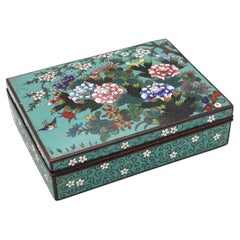
H 1.7 in W 4.1 in D 5.6 in
Japan Meiji Period 1868-1912 Jewel Box with Compartments Drawers Sterling Silver
Located in Miami, FL
Rare Japanese jewel box from the Meiji period (1868-1912).
An unique, fabulous and truly one-of-a-kind antique Japanese jewel box, made at the turn of ...
Category
1880s Japanese Meiji Antique Miami - Metalwork
Materials
Silver, Sterling Silver
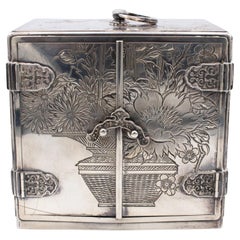
H 5.75 in W 5.15 in D 4 in
Turkish Arab 1820 Damascene Dagger with Sheath in Forged Steel and 24 Karat Gold
Located in Miami, FL
Damascene forged steel dagger with sheath.
Beautiful dagger (Jambiya) from the Ottoman empire, of Turkish / Arab origin, circa early 1800's. Created with forged Damascus wootz steel and damascene of 24 carats yellow gold. It is composed by three parts; the handle in the shape of a Mesopotamian lion, the slender curved steel blade and the scabbard. The scabbard is inscribed in gold damascene with suspension loop and the Arabic text "Allah Is Great". The blade and the pommel are also worked in damascene and inscribed with a tughra in one side. The blade is very special, made from precious black wootz steel, also known as kara taban, with great contrast and remains of the watered pattern throughout the entire blade.
Like swords and daggers in most cultures, the Islamic dagger...
Category
1820s Turkish Islamic Antique Miami - Metalwork
Materials
Gold, Steel
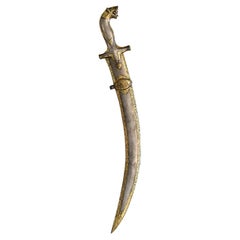
H 19.5 in W 2.95 in D 1.06 in
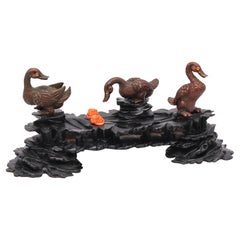
Japan Meiji 1900 Three Bronze Ducks Sculpture in Wood Stand and Coral
Located in Miami, FL
Sculptural composition of the ducks from the Japanese Meiji Period.
Beautiful and very well realized sculptural composition of three ducks, made during the japanese imperial perio...
Category
Early 1900s Japanese Meiji Antique Miami - Metalwork
Materials
Coral, Bronze
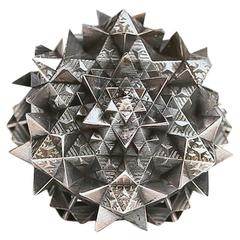
Intuition Thoscene Meditation Chamber
By John Brevard
Located in Coral Gables, FL
Using astrological and Vedic algorithms, we are able to create this unique Thoscene sculpture. Each piece is built and inspired by you and your space. Each Thoscene can also be opene...
Category
2010s Tribal Miami - Metalwork
Materials
Bronze
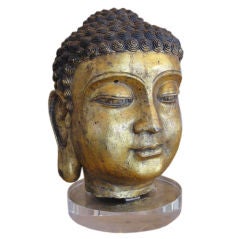
Extraordinary Gilded Bronze Buddha Head
Located in North Miami, FL
Beautiful details and patina on this over-sized heavy bronze and iron Buddha head. A museum quality piece to add to your collection. Lucite base 12" d...
Category
19th Century Chinese Antique Miami - Metalwork
Materials
Iron, Ormolu
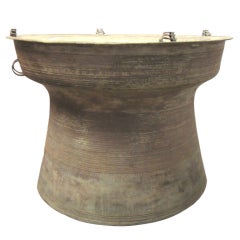
Chinese Bronze "RAIN DRUM"
Located in Miami, FL
Very interesting piece in bronze can fit in any decoration as a sculpture or side table , or sofa table,
The patina is delicate and sophisticated, the round shape very ergonomic .t...
Category
19th Century Chinese Antique Miami - Metalwork
Materials
Bronze
Still Thinking About These?
All Recently ViewedMore Ways To Browse
Asian Export Silver Set
Burmese Bronze Bell
Chinese Bronze Mirror
Chinese Cloisonne Charger
Chinese Painted Eggs
Chinese Plique A Jour
Cloisonne Teapot
Japanese Champleve Urn
Japanese Damascene
Japanese Metal Flower
Qajar Copper
19th Century Middle Eastern Arabic Coffee Pot
Antique Iron Stirrups
Brass Chinese Burners
Bronze Asian Charger
Bronze Chinese Incense Censer
Burma Karen
Chinese Censor Bronze