New York City - Turkish Rugs
to
593
Width
to
Length
to
5,983
929
110
745
372
275
84
33
30
23
19
18
17
17
8
1
46
350
5,587
1,039
1,092
3,462
220
72
70
163
115
161
1,072
791
73
19
7
7,013
6,899
417
205
205
7,022
19,696
1,628
7,022
6,977
6,983
6,436
6,338
6,186
6,165
149
491
21
15
14
14
Item Ships From: New York City
Mid-20th Century Handmade Turkish Flat-Weave Kilim Accent Carpet
Located in New York, NY
A vintage Turkish flat-weave Kilim accent carpet handmade during the mid-20th century.
Measures: 6' 10" x 9' 7"
Flat-weave rugs
carpets:
Knotted pile rugs are just one small part of a vast universe of textile techniques suitable for heavy use. If you can imagine it, some weaver has tried it out. Pieces can be roughly divided into those reversible from the start and those never, or at least not initially, reversible. Thus, kilims are considered reversible, while everything else is not.
Kilims are tapestry woven rugs with both sides the same, in either slit technique where colors change, or with various methods of avoiding slits. Slit tapestry weave goes back to ancient times and Coptic Egyptian weavers used it for ornaments on garments and larger wall hangings. Slits can be avoided by dovetailing of colors (warp sharing) or by interlocking the wefts. The Navajo weavers of the Southwest practice the first while the Fine shawl weavers of Kashmir and Kerman employed the second. Interlocking produces a one-faced fabric, with smooth and rough, ridged faces. The typical Turkish, Caucasian, or Persian rustic Kilim shows slits, but never long ones. Aubusson French carpets are also slit tapestries and the long color transitions are sewn up as part of the regular maintenance. Some kilims are very Fine. The best antique urban Sehna (Senna) kilims on wool, cotton or silk warps approximate the comparable rugs in refinement and are the most desirable of all Persian kilims. Although the various flatweave techniques are usually expressed in geometric, simple, often repeating, patterns, Sehna kilims demonstrate that even the most intricate designs can be effectively rendered in flat-stich. The term ‘Kilim’ has been extended to cover any pileless, weft-faced heavy textile. Thus, the sectioned and joined northeastern Persian horizontally striped wool rugs are called ‘kilims’. So are the plain-weave end finishes of pile rugs. All these are weft-faced, weft patterned flatweaves.
These sectioned pieces are woven not on a frame loom, but one steadied by the weaver at one end and with the warps fastened down at the other. Only relatively recent have these tribal pieces become available. They are used as floorcoverings, hangings, room dividers, furniture covers. They are mostly bitonal in shades of natural dark brown and beige. Some more recent pieces show weaver innovations with ikat and moire effects. Work proceeds quickly and a skilled weaver can complete a thirty foot strip in almost no time.
Wefts, the elements added as weaving progresses, play an essential part in what is a flatweave. The best-known example of an extra-weft, wrapping technique is on Caucasian and tribal Persian Soumaks, where a pattern weft wraps around the fixed warp, changing as weaving progresses. Soumaks can be large carpets, Kuba in the Caucasus, small bag faces (Caucasian and Persian Shah Savan saddle bags), or cover scatter rugs (Persian Afshars). The Soumak technique is fast, and a weaver can work much more quickly than tying knots. The left-over wefts are cut off on the back, so the front and back are initially different. As a Soumak on the floor gets used, these weft yarns wear away and the two sides converge although the exact texture remains distinct.
There are other ways of pattern by weft. Often on smaller tribal pieces, the pattern weft(s) is (are) part of the weft structure, moving in an out, and holding the whole thing together. These wefts can be complementary or added (supplementary), continuous across the flatweave or cut off as they travel unneeded across the verso. Supplementary weft flatweaves are often very compact and substantial. The nomadic Turkmen and Balouch tribes employ both supplementary and complementary weft techniques on their pieces. Supplementary wefts are often raised on the recto (front) while complementary wefts are flat to the surface. Tribal Kurds employ this extra-wefting technique. The Balouch of Pakistan use complementary wefts almost exclusively on their small woven paraphernalia like salt bags.
Flatweave techniques may be combined on a single piece. Afshar rugs employ plain-weave end strips, preceded by Soumak bands, with pile sections between. The large Bakhtiari saddlebags feature Soumak work, pile “islands” an areas of plain-weave. Qashqai rugs and kilims frequently displays checkerboard end strips in continuous, complementary wefting.
Another distinct flatweave type is the jajim (jijim, cecim) in which a pattern is added with colored wefts as the weaving of the plain-weave ground progresses. Here the wefts are discontinuous and the pattern stands proud from the voided ground. Often made in two pieces on narrow looms and edge-sewn together, these may have geometric patterns. The term ‘jajim’ also refers to the assembled warp-faced strip and stripe covers from the Shah Savan of northwest Persia, the pattern is defined by warps alone, usually in plain stripes, but sometimes in designs of ladders, snakes, human figures and various animals. Here the color changing warps are continuous. Most are wool, a few are silk. Better to call these something else.
Indian ‘Dhurries’ are all cotton kilims and ‘shatrangis’ employ wool wefts on cotton warps. Dhurries are slitless. The cotton texture is more appropriate to the humid and warm climate of the Indian subcontinent. Modern Dhurries...
Category
Mid-20th Century Turkish Tribal New York City - Turkish Rugs
Materials
Wool
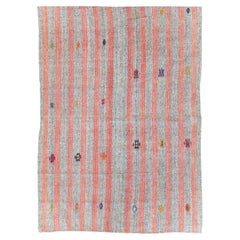
Contemporary Handmade Turkish Flat-Weave Kilim Large Geometric Room Size Carpet
Located in New York, NY
A modern Turkish flat-weave Kilim large room size carpet handmade during the 21st century with a geometric large scale diamond-shaped pattern in earth tones with an overall khaki gre...
Category
21st Century and Contemporary Turkish Modern New York City - Turkish Rugs
Materials
Wool
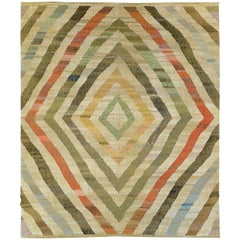
Moroccan Inspired Contemporary Handmade Turkish Large Room Size Carpet
Located in New York, NY
A contemporary Turkish large room size carpet handmade during the 21st century inspired by Moroccan carpets from the mid-20th century period.
Measures: 14' 5" x 17' 10".
Category
21st Century and Contemporary Turkish Modern New York City - Turkish Rugs
Materials
Wool
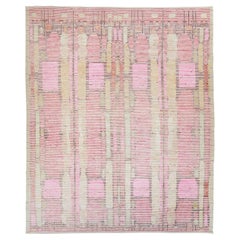
Sensational Tan-Camel Background Color With Damask Pattern Vintage Oushak Rug
Located in New York, NY
Antique Turkish Oushak rug, size: 15'4" x 18'8".
Category
1940s Turkish Oushak Vintage New York City - Turkish Rugs
Materials
Wool
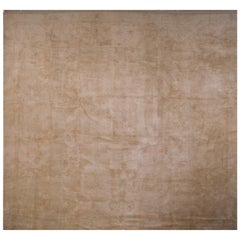
Vintage Tabriz Rug with Soft Blush Field and Ivory Floral Medallion
Located in New York, NY
This vintage Tabriz rug exudes refined elegance with its softly blushed field and delicately layered floral medallion in ivory and sand. Intricate rosettes, palmettes, and lattice vi...
Category
Late 20th Century New York City - Turkish Rugs
Materials
Wool

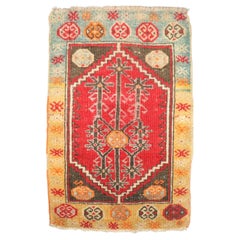
Zabihi Collection Colorful Antique Anatolian Turkish Small Tribal Rug
Located in New York, NY
A colorful early 20th-century antique Anatolian Turkish yastik rug
1'7'' x 2'4''
Category
20th Century Asian Black Forest New York City - Turkish Rugs
Materials
Wool
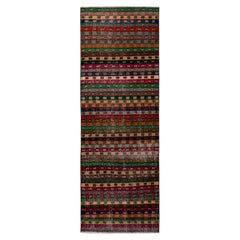
1960s Vintage Runner in Multicolor Stripes, Geometric Patterns by Rug
Kilim
Located in Long Island City, NY
Hand-knotted in wool, a 2x6 vintage runner from a bold Turkish designer, commemorated in Rug & Kilim’s Mid-Century Pasha Collection.
Featuring a repetitive geometric pattern in p...
Category
1960s Turkish Mid-Century Modern Vintage New York City - Turkish Rugs
Materials
Wool
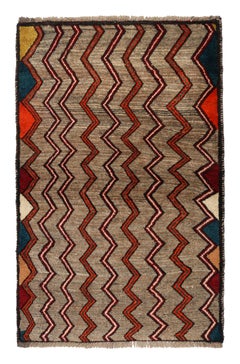
Vintage Gabbeh Tribal Rug in Beige-Brown and Red Chevron Patterns by Rug
Kilim
Located in Long Island City, NY
A vintage 3x5 Persian Gabbeh rug in the latest entries to Rug & Kilim’s curation of rare tribal pieces. Hand-knotted in wool circa 1950-1960.
On the Design:
This pattern enjoys...
Category
1950s Turkish Tribal Vintage New York City - Turkish Rugs
Materials
Wool
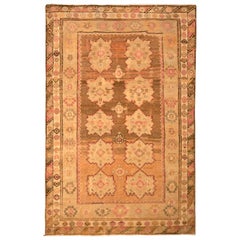
Hand Knotted Vintage Oushak Rug Beige Brown Geometric Pattern by Rug
Kilim
Located in Long Island City, NY
Hand knotted in wool from a notable sheen yarn originating from Turkey circa 1950-1960, this midcentury rug remarks a distinctive vintage Oushak rug design with a notably inviting pe...
Category
1950s Turkish Oushak Vintage New York City - Turkish Rugs
Materials
Wool
Red
Gold Antique Turkish Oushak Rug with an Allover Field, circa 1920s
Located in New York, NY
The Turkey red field of this Smyrna-style carpet displays three alternating columns of ragged palmettes and diamond-shaped Yaprak (leaf) medallions accented with botehs. The matching...
Category
1920s Turkish Oushak Vintage New York City - Turkish Rugs
Materials
Wool
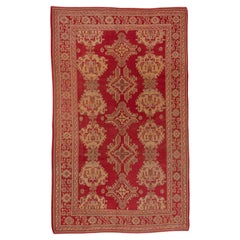
1960s Vintage Deco Rug in Red, White
Pink Geometric Patterns by Rug
Kilim
Located in Long Island City, NY
A vintage 7x10 mid-century rug from the Mid-Century Pasha Collection by Rug & Kilim—commemorating the works of a unique multi-disciplinary Turkish artist.
Hand knotted in wool, the rug enjoys softness & elegance of white, dainty pink & red tones complementing the geometric floral elements for a French County...
Category
1960s Turkish Mid-Century Modern Vintage New York City - Turkish Rugs
Materials
Wool
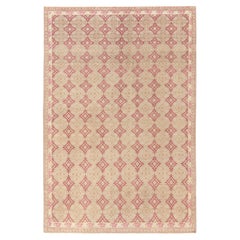
Antique Oushak with Ivory Colors and Classic Medallion, Circa Late 1800
s
Located in New York, NY
A very elegant large Oushak decorative carpet suitable for embellishing both classic and modern environments. The classic medallion design is barely hinted at in the ivory-colored pr...
Category
Late 19th Century Turkish Antique New York City - Turkish Rugs
Materials
Wool
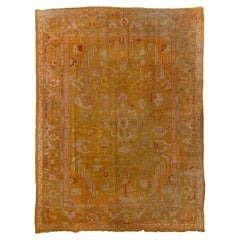
Antique Red Turkish Oushak Runner
Located in New York, NY
Four oval medallions in French floral style decorate the red field of this western Turkish runner. Small rose bunches fill in along the sdies of the field. A semi-realistic acanthus ...
Category
1930s Turkish Oushak Vintage New York City - Turkish Rugs
Materials
Wool
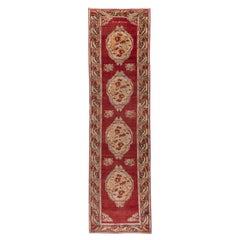
Vintage Turkish Multi Color Kilim Rug
Located in New York, NY
5'11 X 8'3. This vintage Turkish flat weave Kilim is hand-woven. The simplicity and boldness of this piece can also give a contemporary feel and is able to look at home in both a mod...
Category
20th Century Turkish Oushak New York City - Turkish Rugs
Materials
Wool
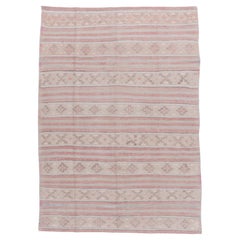
Distressed Red Oushak Rug, Red Field, Taupe Outer Field
Located in New York, NY
The distressed red field shows escutcheon pendants and sharp spikes, encloses an ivory three cartouche "medallion". The red border shows octagons and botehs in a Konya style.
Category
1950s Turkish Oushak Vintage New York City - Turkish Rugs
Materials
Wool
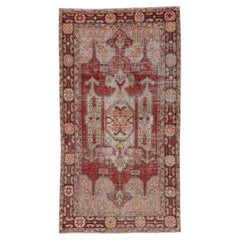
Handwoven Vintage Mid-Century Kilim Rug Geometric Pattern by Rug
Kilim
Located in Long Island City, NY
A 6 x 9 vintage Kilim rug in handwoven wool, originating from Turkey, circa 1950-1960. Enjoying warm orange and gold in the wide-spanning tribal colorway pallet throughout the all ov...
Category
1950s Turkish Tribal Vintage New York City - Turkish Rugs
Materials
Wool
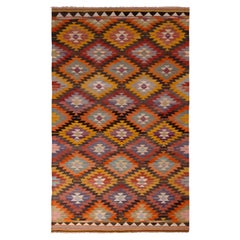
Zabihi Collection Square Vintage Shabby Chic Lion Pigeon Turkish Deco Rug
By Zeki Müren
Located in New York, NY
A Mid-20th-century Turkish deco square Anatolian rug depicting a lion and pigeon and what looks to be the name of a turkish weaver?
Details
rug no. r4806
size 2'10" x 3'
Category
20th Century Turkish Mid-Century Modern New York City - Turkish Rugs
Materials
Wool
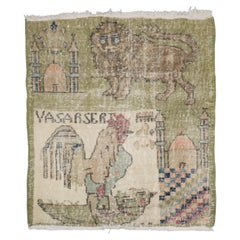
Vintage Red Turkish Oushak Runner
Located in New York, NY
2'11 x 11'7. This lovely Rug hand knotted in Turkey in the 1940's has a natural abrash (color change) common in old pieces and giving a uniqueness to the rug. All the elements one lo...
Category
20th Century Turkish Oushak New York City - Turkish Rugs
Materials
Wool
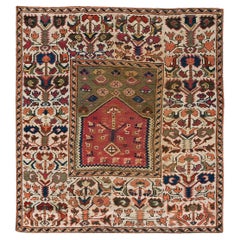
19th Century Turkish Anatolian Bergama Prayer Rug ( 3
10" x 4
3 - 117 x 130 )
Located in New York, NY
19th Century Turkish Anatolian Bergama Prayer Rug ( 3'10" x 4'3 - 117 x 130 )
Category
1910s Turkish Vintage New York City - Turkish Rugs
Materials
Wool
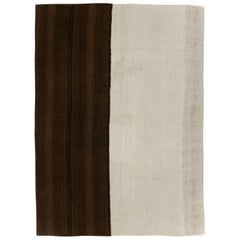
Tribal Mid-20th Century Turkish Flatweave Kilim Accent Rug in Brown
Cream
Located in New York, NY
A vintage Turkish tribal flatweave Kilim accent rug handmade during the mid-20th century in shades of brown and cream.
Measures: 6' 0" x 8' 3".
Category
Mid-20th Century Turkish Tribal New York City - Turkish Rugs
Materials
Wool
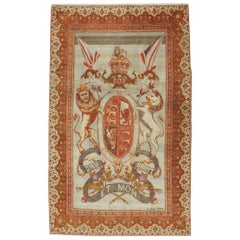
Early 20th Century
Royal Coat of Arms of the United Kingdom
Accent Rug
Located in New York, NY
An antique Turkish Sivas accent rug handmade during the early 20th century with a pictorial design of the 'Royal Coat of Arms of the United Kingdom.'
Measures: 5' 4" x 8' 6".
Category
Early 20th Century Turkish Elizabethan New York City - Turkish Rugs
Materials
Wool
Galerie Shabab Collection Mid-20th Century Turkish Anatolian Room Size Carpet
Located in New York, NY
A vintage Turkish Anatolian small room size carpet handmade during the Mid-20th Century.
Measures: 8' 4" x 10' 11".
Category
Mid-20th Century Turkish Rustic New York City - Turkish Rugs
Materials
Wool
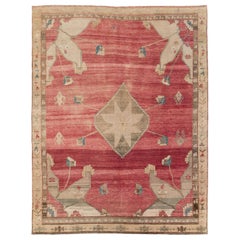
Nazmiyal Collection Antique Safavid Pictorial Turkish Tuduc Rug 6
4" x 11
By Theodor Tuduc 1
Located in New York, NY
Antique Turkish Tuduc rug, Country of Origin: Turkey, Circa date: 1900. Size: 6 ft 4 in x 11 ft (1.93 m x 3.35 m).
Category
Early 20th Century Turkish Tribal New York City - Turkish Rugs
Materials
Wool
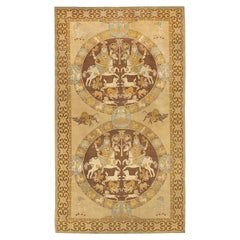
Vintage Turkish Anatolian Rug
Located in New York, NY
A vintage Turkish Anatolian carpet from the second quarter of the 20th century with a checkerboard pattern in maroon and chocolate.
Category
1940s Turkish Art Deco Vintage New York City - Turkish Rugs
Materials
Wool
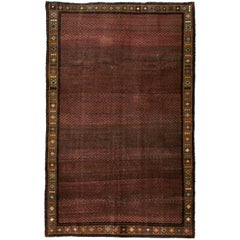
Vintage Ersari Rug in Beige with Teal Geometric Medallions, from Rug
Kilim
Located in Long Island City, NY
Hand-knotted wool and originating from Turkey circa 1950-1960, this 8x11 vintage Ersari rug is from the same provenance, a sub-tribe of the Turkmen people often known for their more ...
Category
1950s Turkish Vintage New York City - Turkish Rugs
Materials
Wool
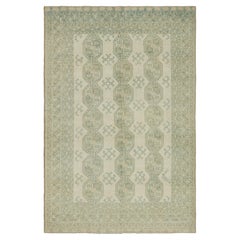
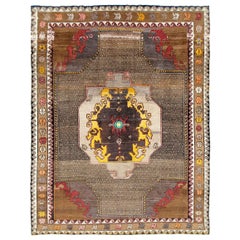
Midcentury Handmade Turkish Tribal Room Size Rug in Brown Yellow and Red
Located in New York, NY
A vintage Turkish Anatolian rug handmade during the mid-20th century with a field in several shades of light and dark brown and white dots. The ivory medallion consists of a yellow a...
Category
Mid-20th Century Turkish Rustic New York City - Turkish Rugs
Materials
Wool

$9,500 Sale Price
20% Off
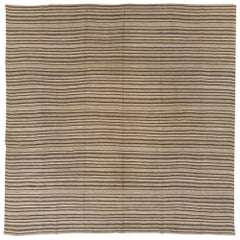
Mid-20th Century Handmade Turkish Flatweave Kilim Square Room Size Carpet
Located in New York, NY
A vintage Turkish flatweave Kilim square room size carpet handmade during the mid-20th century.
Measures: 10' 5" x 10' 7"
Category
Mid-20th Century Turkish Rustic New York City - Turkish Rugs
Materials
Wool
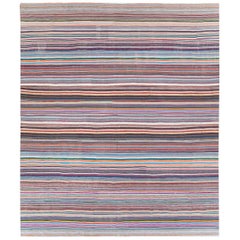
Contemporary Handmade Colorful Turkish Oversize Square Flat-Weave Rug
Located in New York, NY
A modern Turkish oversize flat-weave Kilim carpet in square rug format handmade during the 21st century.
Measures: 15' 0" x 18' 0".
Category
21st Century and Contemporary Turkish Modern New York City - Turkish Rugs
Materials
Wool
$15,100 Sale Price
20% Off
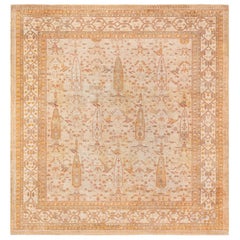
Doris Leslie Blau Antique Turkish Oushak Beige Wool Rug (Size Adjusted)
Located in New York, NY
Antique Turkish Oushak Rug
Size: 12'0" × 12'8" (366 × 386 cm)
A stunning example of early 20th-century Anatolian textile artistry, this antique Turkish Oushak rug encapsulates the el...
Category
Early 20th Century Turkish Oushak New York City - Turkish Rugs
Materials
Wool
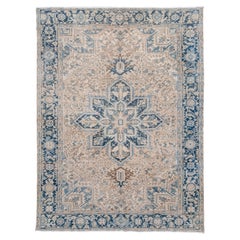
Vintage Heriz Rug with Cream Ground and Indigo Medallion
Located in New York, NY
This vintage Heriz rug features a grand, radiating central medallion in layered tones of indigo, slate, and glacier blue set atop a softly muted cream field. Delicate accents in sand...
Category
Late 20th Century New York City - Turkish Rugs
Materials
Wool
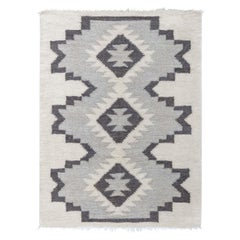
Contemporary Stamverband Rug by Doris Leslie Blau
Located in New York, NY
Contemporary Stamverband Rug by Doris Leslie Blau
Size: 5'4" × 7'1" (162 × 215 cm)
This contemporary hand-knotted rug was made using only the best available materials. It immediately...
Category
21st Century and Contemporary Turkish Modern New York City - Turkish Rugs
Materials
Wool
$3,920 Sale Price
30% Off
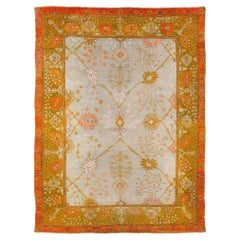
Antique 19th Century Turkish Oushak Area Rug with Seafoam Field, Orange Border
Located in New York, NY
This large antique Ouskak rug measures 13'6" (W) x 18' (L). In very good condition with silky lustrous wool and a beautiful color palette. The field features a light seafoam backgrou...
Category
Late 19th Century Turkish Oushak Antique New York City - Turkish Rugs
Materials
Wool
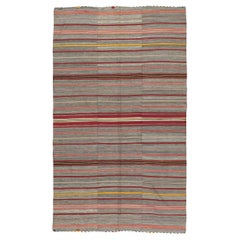
Vintage Turkish Flat-Weave Kilim Rug
Located in New York, NY
A vintage Turkish flat-woven Kilim carpet from the mid-20th century.
Category
Mid-20th Century Turkish Kilim New York City - Turkish Rugs
Materials
Wool
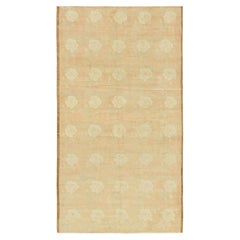
Vintage Zeki Müren Rug in Cream and Beige Floral Patterns, from Rug
Kilim
Located in Long Island City, NY
Hand-knotted in wool and originating from Turkey circa 1960 – 1970, this 5x9 vintage Zeki Müren rug is a unique addition to the Rug & Kilim Collection for its floral patterns across ...
Category
1960s Turkish Vintage New York City - Turkish Rugs
Materials
Wool
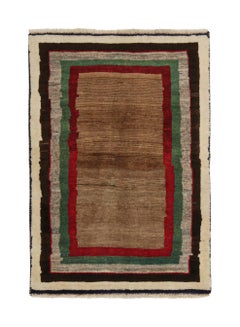
Vintage Gabbeh Tribal Rug in Brown with Red, Green
Gray Borders by Rug
Kilim
Located in Long Island City, NY
A vintage 4x5 Persian Gabbeh rug in the latest entry to Rug & Kilim’s curation of rare tribal pieces. Hand-knotted in wool circa 1950-1960.
On the Design:
This piece emanates a...
Category
1950s Turkish Tribal Vintage New York City - Turkish Rugs
Materials
Wool
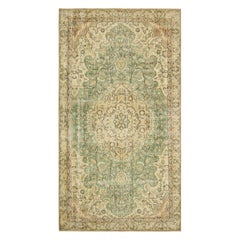
Vintage Turkish Rug in Light Green with Beige Floral Medallion Rug
Kilim
Located in Long Island City, NY
Made with hand-knotted wool in Turkey circa 1950-1960, this 5x9 vintage rug is an exciting new mid-century curation from Rug & Kilim’s collection of rare classics—full of unexpected ...
Category
1950s Turkish Vintage New York City - Turkish Rugs
Materials
Wool
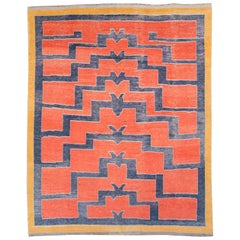
Contemporary Handmade Turkish Shag Large Room Size Rug in Rust
Located in New York, NY
A modern Turkish Tulu large room size rug with a low shaggy pile handmade during the 21st century. The geometric "Mayan Pyramid" design of stepped...
Category
21st Century and Contemporary Turkish Mid-Century Modern New York City - Turkish Rugs
Materials
Wool
Rug
Kilim
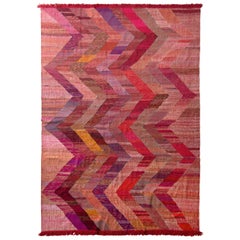
s Modern Kilim Red Pink Chevron Pattern Flat-Weave
By Rug
Kilim
Located in Long Island City, NY
This modern Kilim represents a selection of distinct new patterns joining Rug
Kilim’s titular Kilim
flat-weave collection, with this piece representing a sub collection u...
Category
2010s Turkish Kilim New York City - Turkish Rugs
Materials
Wool
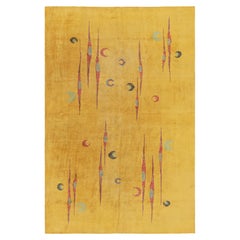
Vintage Zeki Müren Rug, Bold and Playful Geometric Pattern on Gold - Rug
Kilim
Located in Long Island City, NY
Hand-knotted in wool, this 7x11 vintage rug originating from Turkey, circa 1960-1970, is a very special piece, featuring a light and refreshing mid-...
Category
1960s Turkish Vintage New York City - Turkish Rugs
Materials
Wool
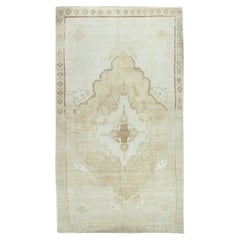
Vintage Beige Turkish Wool Hand Knotted Oushak Rug
Located in New York, NY
8'7 X 15'. Even today, Oushak rugs are still the first choice of professional interior designers. Sometimes this is because when grading Oushak carpets, carpet connoisseurs will not ...
Category
20th Century Turkish Oushak New York City - Turkish Rugs
Materials
Wool
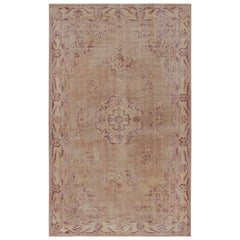
Vintage Zeki Müren Rug in Pink with Floral Medallion, from Rug
Kilim
Located in Long Island City, NY
Handknotted in wool, this 6x10 vintage rug originates from Turkey, circa 1960-1970, and is believed to be among the works of mid-century designer Zeki Múren.
On the Design:
Connoi...
Category
1960s Turkish Art Deco Vintage New York City - Turkish Rugs
Materials
Wool
Vintage Ersari Rug in Pink and Beige/Brown with Geometric Pattern by Rug
Kilim
Located in Long Island City, NY
This 7x10 vintage rug is believed to be a rare mid-century Ersari rug, hand-knotted in wool and originating in Turkey circa 1950-1960.
On the Design
The Ersari are a sub-tribe of t...
Category
1950s Turkish Tribal Vintage New York City - Turkish Rugs
Materials
Wool
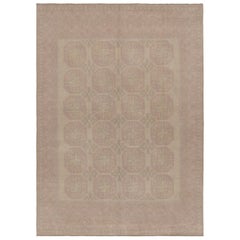
Early 20th Century Handmade Turkish Oushak Gallery Carpet
Located in New York, NY
An antique Turkish Oushak gallery carpet handmade during the early 20th century.
Measures: 7' 0" x 13' 3".
Category
Early 20th Century New York City - Turkish Rugs
Materials
Wool
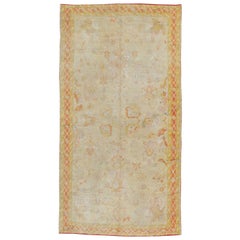
Mid-20th Century Rustic Turkish Kars Rug, Black Innter Field, Cream Outer Field
Located in New York, NY
From Eastern Turkey, this rustic room size shows a deep chocolate sub-field with a rustic attempt at an ecru scrolled edge cartouche medallion. The corners and ends of the subfield s...
Category
Mid-20th Century Turkish Rustic New York City - Turkish Rugs
Materials
Wool
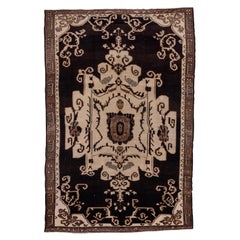
Mid-Century Modern Style Checkered Flatweave Rug
By Nasiri
Located in New York, NY
This Pelas flatweave rug is made with handspun wool and natural dyes. It is inspired by the antique kilims that are native to the Kurdish region in Iran. NASIRI continues their rich ...
Category
2010s Turkish Mid-Century Modern New York City - Turkish Rugs
Materials
Wool
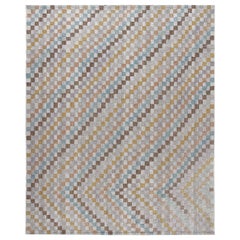
Vintage Ersari Rug in Beige-Brown with Geometric Medallions, from Rug
Kilim
Located in Long Island City, NY
Hand-knotted wool and originating from Turkey circa 1950-1960, this 8x13 vintage Ersari rug is from the same provenance, a sub-tribe of the Turkmen people often known for their more ...
Category
1950s Turkish Vintage New York City - Turkish Rugs
Materials
Wool
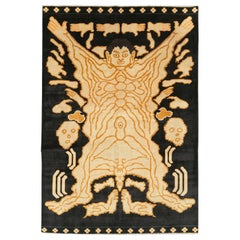
Contemporary Handmade Turkish Pictorial Flayed Man Tantra Accent Rug
Located in New York, NY
A modern Turkish tantric accent rug from the 21st century with a pictorial design of a flayed man over a black field.
Original versions were employed by ...
Category
21st Century and Contemporary Turkish Modern New York City - Turkish Rugs
Materials
Wool
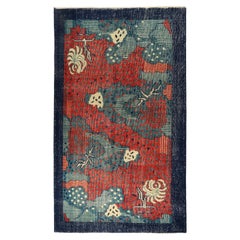
Vintage Zeki Müren Art Deco Rug in Red and Blue Pattern, by Rug
Kilim
Located in Long Island City, NY
This vintage 4x7 rug is a new addition to Rug & Kilim’s mid-century Pasha Collection. This line is a commemoration, with rare curations we believe to hail from multidisciplinary Turk...
Category
1960s Turkish Art Deco Vintage New York City - Turkish Rugs
Materials
Wool
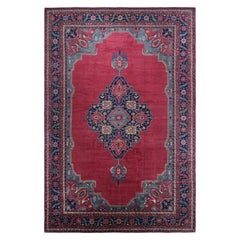
Antique Turkish Isparta Rug with Red Open Field and Medallion
Located in Long Island City, NY
Made with hand-knotted wool and originating in the early 20th century, this 15x22 antique Persian rug is a rare and exciting new curation from our Antique collection.
On the Design:
Keen eyes will appreciate the play of medallion and open field, where the rich red underscores the large-scale geometric medallion enclosed in a thick, finely-detailed border. The natural sense of depth of the medallion pattern brings out both the natural, regal character of the design in kindred hues of rich red, blue, and pink, as well as the meticulous accenting hues of a grayish blue against the prevailing colorway. The construction hosts a lustrous wool that brings out the texture and finesse of this rare regal piece. Admirers of the craft will note the design influence of Turkish Isparta rugs...
Category
1910s Turkish Vintage New York City - Turkish Rugs
Materials
Wool
Antique Oushak Rug With Beige Open Field and Floral Patterns, From Rug
Kilim
Located in Long Island City, NY
Hand-knotted in wool circa 1920-1930, this 9×12 antique Oushak rug is a rare curation from the Rug & Kilim collection. Originating from Turkey, it enjoys an open field design in beig...
Category
1910s Turkish Oushak Vintage New York City - Turkish Rugs
Materials
Wool
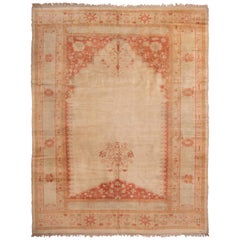
Vintage Turkish Runner Rug in Beige, with Geometric Patterns, from Rug
Kilim
Located in Long Island City, NY
This vintage 3x10 Turkish runner rug, hand-knotted in wool, circa 1960-1970, is a new addition to Rug & Kilim Collection. This design featuring field motifs in neutral tones, is likely to be inspired by Indian Mir rugs...
Category
1960s Turkish Vintage New York City - Turkish Rugs
Materials
Wool
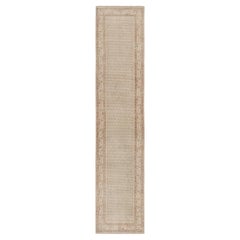
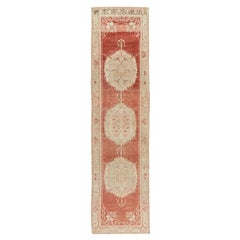
Mid-20th Century Handmade Turkish Anatolian Art Deco Style Runner
Located in New York, NY
A vintage Turkish Anatolian Art Deco style rug in runner format handmade during the mid-20th century.
Measures: 1' 11" x 8' 1"
Turkish Rugs
Carpets:
Until the Great Persian Carpet Revival in the later 19th century, the “Oriental rug” was Turkish. For nearly six centuries, Turkish rugs, both scatter, room size, and even larger, thoroughly dominated the European import market. Whereas the Persian carpet can be divided into urban, village, and tribal types, in Turkey and its predecessor the Ottoman Empire, rugs almost exclusively came from village weavers and from a small number of urban workshops. Ninety percent village, nine percent city, one percent tribal.
Turkish weavers have, with very few exceptions, always worked with the symmetric (Turkish) knot. Wool foundations are standard practice among both town and village weavers. The exceptions, very finely woven 20th century and recent Herekeh silks from near Istanbul, and early 17th century Ottoman Court rugs from Bursa, constitute only a tiny part of the total. Always pricey, they appealed and still appeal to the clients who want lots of knots and perfect execution instead of individual personality.
The urban workshops have been centered around the western Turkish city of Oushak and its attendant port town of Smyrna. Oushak weaves with the trends in fashion. When color saturated medallion carpets were needed, Oushak was ready in the 17th and 18th centuries. When coarse red and blue carpets...
Category
Mid-20th Century Turkish Art Deco New York City - Turkish Rugs
Materials
Wool
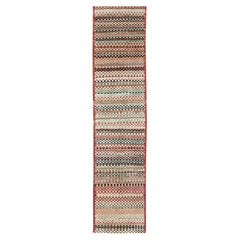
Vintage Cinnamon Turkish Kilim 3
8 X 5
7
Located in New York, NY
3'8 X 5'7. This vintage Turkish flat weave Kilim is hand-woven. The simplicity and boldness of this piece can also give a contemporary feel and is able to look at home in both a mode...
Category
20th Century Turkish Kilim New York City - Turkish Rugs
Materials
Wool
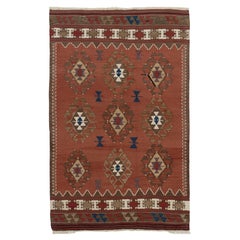
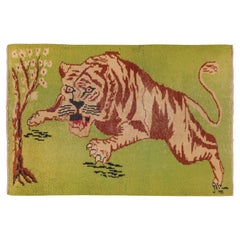
Vintage Zeki Müren Rug in Green with Beige-Brown Tiger Pictorial by Rug
Kilim
Located in Long Island City, NY
This vintage 3x5 rug is a bold new addition to Rug & Kilim’s Mid-Century Pasha Collection. This line is a commemoration, with rare curations we believ...
Category
1960s Turkish Vintage New York City - Turkish Rugs
Materials
Wool
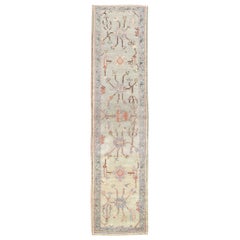
Early 20th Century Handmade Turkish Oushak Runner
Located in New York, NY
An antique Turkish Oushak rug in runner format handmade during the early 20th century.
Measures: 2' 8" x 10' 9"
Turkish rugs
carpets:
Until the Great Persian Carpet Revival in the later 19th century, the “Oriental rug” was Turkish. For nearly six centuries, Turkish rugs, both scatter, room size, and even larger, thoroughly dominated the European import market. Whereas the Persian carpet can be divided into urban, village, and tribal types, in Turkey and its predecessor the Ottoman Empire, rugs almost exclusively came from village weavers and from a small number of urban workshops. Ninety percent village, nine percent city, one percent tribal.
Turkish weavers have, with very few exceptions, always worked with the symmetric (Turkish) knot. Wool foundations are standard practice among both town and village weavers. The exceptions, very finely woven 20th century and recent Herekeh silks from near Istanbul, and early 17th century Ottoman Court rugs from Bursa, constitute only a tiny part of the total. Always pricey, they appealed and still appeal to the clients who want lots of knots and perfect execution instead of individual personality.
The urban workshops have been centered around the western Turkish city of Oushak and its attendant port town of Smyrna. Oushak weaves with the trends in fashion. When color saturated medallion carpets were needed, Oushak was ready in the 17th and 18th centuries. When coarse red and blue carpets were required, Oushak and Smyrna in the 19th century wove them by the boatload. When tastes changed again, and the European dealers in Smyrna wanted room size carpets with lighter and unusual colors, and with Persianate designs, production ramped up in nearby Oushak. Those antique, all-wool construction turn-of-the-century carpets are still in high demand with designers. Antique carpets with allover, roughly drawn patterns on grounds of shrimp, rust, straw, cream, pale blue, and pale and pea green, hitherto unavailable colors, are in such demand today that contemporary Oushaks have attempted to mimic them with soft palettes, extra-large scale drawing and coarse weaves.
Oushaks woven for the Turkish market, for palaces, houses and mosques were often oversize with large, repeating medallions, all in shades of (Turkey) red, dark blue, light blue-teal, and ivory, with lemon and green accents. Turkey, along with India, invented standard sizes. By vertically repeating the medallion, one could get one medallion, one with two end halves, two, three, etc. medallions, up to thirty or so feet in length. The process spared making new cartoons for each length and allowed a quicker turnaround time. Oushak, from the time of 15th century “Holbein” rugs onward, has always been a commercial center.
The prayer niche directional rug is primarily a Turkish development. In the towns and villages east of Oushak, in Ghiordes, Kula, Ladik, Kirsehir, Mucur and Konya, among others, arch pattern scatters with bright palettes and weaves varying from relatively fine to moderate were almost the entire production. Antique examples were particularly popular in America around 1900.
Other centers of village weaving were situated on the western coast and adjacent islands with the town of Melas and neighboring villages weaving geometric prayer rugs and scatters with a characteristic khaki green and lots of yellow.
The other large region was in the northwest of Anatolia, near ancient Troy, with the sizable town of Bergama at its center. The satellite towns of Ezine, Karakecilli, Yuntdag, and Canakkale all wove colorful scatters with moderate weaves in all wool with geometric designs and cheerful palettes. Near to Istanbul, these were among the first Turkish rugs to reach Europe in the Renaissance.
The earliest Turkish pieces depicted in Italian Old Master paintings display the so-called “Memling gul”, an allover panel pattern with hooked and stepped elements within the reserves. This pattern continues for centuries in the Konya area and in the Caucasus as well.
Turkey is a land of villages and much of the most interesting Turkish weaving comes from one undiscovered village or another. The Konya-Cappadocia region of central Turkey includes the active towns of Karapinar, Karaman, Obruk, Sizma, and Tashpinar, all weaving Konya-esque scatters and long rugs. Karapinar has been active the longest, since the 17th century. The mosques in and around Konya have preserved locally-made rugs from the fourteenth. In the 20th century, the extra-long pile, many wefted Tulu rug was devised, with limited palettes and color block patterns. These are not really antique Tulus, but they must be a product of long-standing village tradition.
There are thousands upon thousands of rural Turkish villages, almost all with easy access to local tribal wool. Rug students are discovering new names and rug types almost daily. The common denominators are bright colors, geometric designs, wool construction, moderate to coarse weaves and symmetric knots. Synthetic dyes hit the Turkish rug industry quickly and hard after 1870, and they penetrated to even the most off-the-beaten-track villages. This development was almost entirely negative. The village weavers used fugitive or overly bright dyes which ruined the color harmonies built up over centuries. Characteristic types disappeared or were negatively transmuted. The Turkish village rug of the 1870 to 1920 period is nothing to be proud of.
In the eastern provinces, the semi-nomadic Kurdish tribes, collectively called ‘Yuruks’, weave all wool, geometric pieces with medium to medium-coarse weaves, as well as kilims and other flatweaves. The rugs employ cochineal instead of madder for the reds, mustard yellows, greens, and various blues. They are under-collected like the Persian Afshars. Their rugs are in scatter and long rug formats. The far eastern Turkish town of Erzerum has a long tradition of idiosyncratic, semi-workshop rugs and further to the east is Kars with a tradition of rugs in the Caucasian Kazak manner.
One Turkish specialty is the Yastiks or cushion cover, made in pairs for the public living rooms of village houses. These are larger rugs in miniature and good ones are highly collectible. Like other Turkish rustic weavings, ones with synthetic dyes are almost totally undesirable. Only the tribal Baluch make similar cushion covers, known as pushtis or balishts, in the same small, oblong format. Yastiks always have a back, usually in plain weave, so that they can be easily stuffed.
When the Imperial Carpet Factory at Herekeh near Istanbul closed in the early 20th century, the highly proficient Armenian master weavers set up in the Kum Kapi district of Istanbul where they wove all-silk, exquisitely fine and elaborately detailed small pieces, sometimes enriched with metal thread, for the most discriminating European buyers. Today the best, signed Kum Kapi pieces, usually in the “Sultan’s head” prayer niche design, can fetch upwards of $100,000. They are strictly for the wall. An Interwar all-silk room size Kum Kapi carpet is both exceedingly rare and stratospherically priced. The workshops closed in the 1930s, but the weaving of extremely fine, all-silk small rugs in Herekeh was revived in the 1960s.
There has been a recent vogue for larger Turkish village vintage...
Category
Early 20th Century Turkish Modern New York City - Turkish Rugs
Materials
Wool
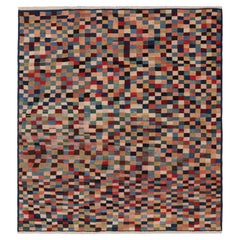
Vintage Zeki Müren Rug with Polychromatic Geometric Pattern from Rug
Kilim
Located in Long Island City, NY
Hand-knotted in wool and originating from Turkey circa 1960 – 1970, this 5x6 vintage rug is a unique addition to the Mid-Century Pasha Collection by Rug & Kilim—a curation of unique ...
Category
1960s Turkish Vintage New York City - Turkish Rugs
Materials
Wool
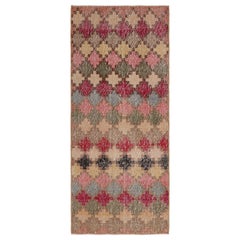
Vintage Zeki Múren Runner in Brown with Colorful Floral Pattern from Rug
Kilim
Located in Long Island City, NY
Hand-knotted in wool and originating from Turkey circa 1960 – 1970, this 2x5 vintage Zeki Müren runner is a unique addition to the Rug & Kilim Collection for its wide range of colors...
Category
1960s Turkish Vintage New York City - Turkish Rugs
Materials
Wool
Vintage Ersari Rug in Beige/Brown, Blue with Geometric Patterns by Rug
Kilim
Located in Long Island City, NY
This 7x9 vintage rug is believed to be a rare mid-century Ersari rug, hand-knotted in wool and originating in Turkey circa 1950-1960.
On the Design:...
Category
1950s Turkish Tribal Vintage New York City - Turkish Rugs
Materials
Wool
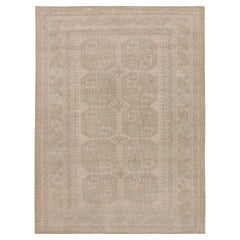
Antique Turkish Sivas Rug
Located in New York, NY
An early 20th century Turkish Sivas. Sivas is a city in North Central Turkey, which is a major production site of Turkish rugs based on Persian designs. Often finely woven, Sivas rug...
Category
20th Century Turkish Rustic New York City - Turkish Rugs
Materials
Wool
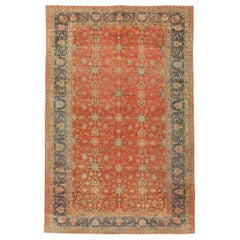
$14,500
Vintage Turkish Anatolian Rug
Located in New York, NY
A vintage Turkish Anatolian rug from the mid-20th century.
Measures: 7' 3" x 9' 2".
Category
Mid-20th Century Turkish Tribal New York City - Turkish Rugs
Materials
Wool
Still Thinking About These?
All Recently ViewedMore Ways To Browse
Botolo Chair
Boulle Pier Cabinets
Brass Foot Sculpture
Brass Lion Claw
Brass Log Box
Brass Longhorn
Brass Match Holder Antique
Brass Shell Planter
Brevete Sgdg
Brides Basket
British Classic Furniture
Bronze Art Deco Archer
Bronze Boat Sculpture
Bronze Cat Statue
Bronze Cavalier
Bronze Clown
Bronze Cossack
Bronze Crow