North Carolina - Drawings and Watercolor Paintings

to
4
3
4
Overall Width
to
Overall Height
to
4
1
2
2
1
1
6
1
2
2
2
1
1
1
1
1
1
1
1
1
1
1
1
1
1
7
7
1
1
1
1
1
5
18,765
18,184
Item Ships From: North Carolina
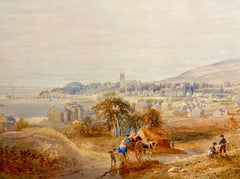
View of Dunoon on the Clyde, Scottish landscape and Figures, 19th Century
Located in Hillsborough, NC
Scottish artist Robert Carrick (1829-1904) is renowned for his landscape and figurative paintings in oil and watercolor. This painting features detailed drawings of figures in the foreground with wagon, and the town and scenery in the background, painted over in watercolor in rich raw umber and red-brown tones in the foreground and blue green tones in the background. Carrick showed promise at a young age, exhibiting his work at the Royal Academy age 16. He was a member of the Royal Institute. This two-toned watercolor work has detailed figures, wagon with hay in the forefront above a view of Dunoon town near Glasgow as it was long ago. Signed by the artist, lower left with an inscription that reads: 'View of Dunoon, Argyllshire drawn by Robert Carrick, Glasgow, for David Allan'. Verso includes a copy of the same inscription. Saltire Gallerie replaced the cracked and dirty plain glass with art glass and added an acid-free paper behind the work. While doing this work we found an art giclee, included with the painting. Presented in a patterned wooden frame with art glass. Dunoon was a thriving town on the river at the time of this work, and later became part of Glasgow. The view from above the town is a popular one, as Saltire Gallerie has another view of Dunoon from above by Scottish artist Patrick Downie...
Category

19th Century Naturalistic North Carolina - Drawings and Watercolor Paintings

Materials

Watercolor, Board, Pencil

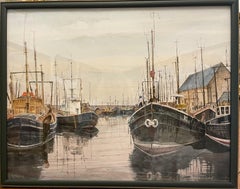
Pittenweem Harbor Scotland East Neuk Fishing Village
Located in Hillsborough, NC
'Pittenweem Harbor' is by contemporary Scottish artist Robert Stirling, signed in lower left. Pittenweem is a fishing village on the east coast of Scotland in Fife, between St Andrews and Elie, an area known for local crafts and pottery. 'Pittenweem Harbor' presents well and is in excellent condition. The frame complements the dark blue greens of the boat hulls and reflections in the water. Covered in glass for protection, the frame is new. The total measurement is 21" high by 25.5" wide including the frame. This is a well priced...
Category

Late 20th Century Contemporary North Carolina - Drawings and Watercolor Paintings

Materials

Watercolor

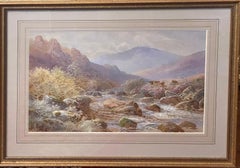
Highland Cattle Beside Stream, Heather on Hill, 19th Century, Scottish
By John Barrett
Located in Hillsborough, NC
Scottish Highland mountains, river rapids and heather on the hill with cows, this 19th century impressionist watercolor is bright and fresh. Sign...
Category

19th Century Impressionist North Carolina - Drawings and Watercolor Paintings

Materials

Watercolor

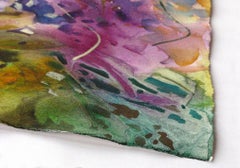
Mysteries of Purple Green, Original Painting
By Melissa Gannon
Located in San Francisco, CA

Artist Comments
Purple and green are two of my favorite colors and wisteria is the perfect subject! I squirted paint directly onto the paper to make a lovely, saturated wash. When dry I developed the piece intuitively. I finished with tinted gouache to highlight the lovely light behind the wisteria. I'm very pleased with the mood of this piece.


About the Artist
Melissa is passionate about color. She finds it to be the most significant form of inspiration to paint. Speaking on influences in her work, Melissa says, “Sometimes it’s an idea that I can’t get out of my head, or a color that I just MUST paint!” She particularly enjoys painting leaves, and the changing colors of Oregon foliage are visible in her work. In 2001, Melissa began teaching art classes, which has allowed her to view her own artwork in a new way. “The information that flows in a class is awesome,” she says. Melissa is constantly learning from the students in her classes, and is more conscious of what it means to be an artistic role model.


Words that describe this painting: wisteria,flowers,watercolor painting,watercolor floral,floral,purple,green,purple and green,nature,floral painting,, impressionism, flora, representational, watercolor painting, green, purple, purple


Mysteries of Purple & Green
Melissa Gannon...

Category

21st Century and Contemporary Abstract Impressionist North Carolina - Drawings and Watercolor Paintings

Materials

Watercolor

The Angler on River, Scottish Landscape 19th Century
By William Bradley Lamond
Located in Hillsborough, NC
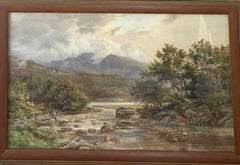
Lovely 19th century watercolor painting with an angler in a mountain stream landscape painting, this is signed William Bradley with a place and date on the lower left hand corner. Mists fall over the central mountain rising above the stream with rocks and boulders. A mountain ridge is on the left, and trees above boulders on the right. William radley Lamond was a self taught artist flourishing from mid to late 19th century. This would be a later work by this artist. The attribution is based on the period, the style the landscape subject and signature. The painting is presented in an attractive new wooden frame with fresh glass...
Category

1880s Naturalistic North Carolina - Drawings and Watercolor Paintings

Materials

Watercolor

Old Bobbin Mill on the Spey, Scotland watercolor 19th century
Located in Hillsborough, NC
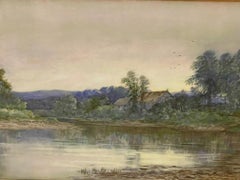
William Beattie-Brown is a 19th century Scottish artist, and a master landscape painter using tonal color in a naturalistic style. 'Old Bobbin Mill on ...
Category

1880s Naturalistic North Carolina - Drawings and Watercolor Paintings

Materials

Watercolor

Oasis
By Catherine McCargar
Located in San Francisco, CA

Artist Comments
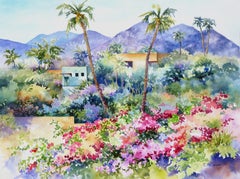
I enjoy making trips to Palm Springs to collect inspirational material for paintings. I am especially drawn to the bougainvillea blossoms that grow so well in...

Category

21st Century and Contemporary Abstract Impressionist North Carolina - Drawings and Watercolor Paintings

Materials

Watercolor

Related Items
Contemporary impressionist expressive acrylic floral bouquet vase painting
Located in VÉNISSIEUX, FR
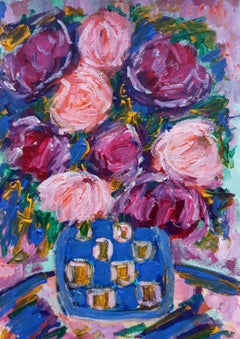
This captivating floral artwork "Summer blooming flowers in a blue vase" is an exuberant portrayal of a bouquet, radiating vibrancy and textural complexity. The piece commands attention with its vigorous brushstrokes, creating a sense of movement and depth. The bouquet is composed of blooming flowers in a rich palette of colors ranging from various shades of pinks and purples to luminous whites. Each flower is rendered with bold, gestural layers of paint, creating a tactile surface that invites the viewer to appreciate the artist’s dynamic technique. The background, with its harmonious blend of cool blues and popping greens, forms a vivid contrast against the warm tones of the flowers, enhancing their visual impact. Noteworthy is the blue-checkered vase...
Category

2010s Abstract Impressionist North Carolina - Drawings and Watercolor Paintings

Materials

Paper, Acrylic, Watercolor

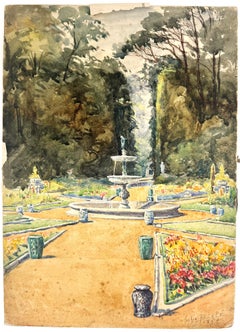
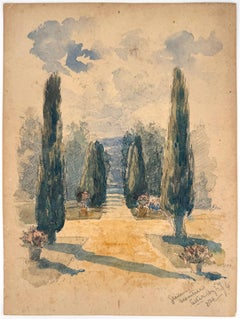
Welton House Garden
Located in Middletown, NY
An superb painting of the formal gardens from a 17th century manor house in Yorkshire. Watercolor on board, 14 3/8 x 10 3/8 inches (365 x 264 mm), the full sheet. Signed and dated i...
Category

Late 19th Century English School North Carolina - Drawings and Watercolor Paintings

Materials

Watercolor, Pencil, Board

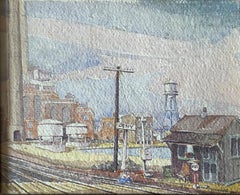
"Train Station, " Max Kuehne, Industrial City Scene, American Impressionism
By Max Kuehne
Located in New York, NY
Max Kuehne (1880 - 1968) Train Station, circa 1910 Watercolor on paper 8 1/4 x 10 1/4 inches Signed lower right Provenance: Private Collection, Illinois Max Kuehne was born in Halle, Germany on November 7, 1880. During his adolescence the family immigrated to America and settled in Flushing, New York. As a young man, Max was active in rowing events, bicycle racing, swimming and sailing. After experimenting with various occupations, Kuehne decided to study art, which led him to William Merritt Chase's famous school in New York; he was trained by Chase himself, then by Kenneth Hayes Miller. Chase was at the peak of his career, and his portraits were especially in demand. Kuehne would have profited from Chase's invaluable lessons in technique, as well as his inspirational personality. Miller, only four years older than Kuehne, was another of the many artists to benefit from Chase's teachings. Even though Miller still would have been under the spell of Chase upon Kuehne's arrival, he was already experimenting with an aestheticism that went beyond Chase's realism and virtuosity of the brush. Later Miller developed a style dependent upon volumetric figures that recall Italian Renaissance prototypes. Kuehne moved from Miller to Robert Henri in 1909. Rockwell Kent, who also studied under Chase, Miller, and Henri, expressed what he felt were their respective contributions: "As Chase had taught us to use our eyes, and Henri to enlist our hearts, Miller called on us to use our heads." (Rockwell Kent, It's Me O Lord: The Autobiography of Rockwell Kent. New York: Dodd, Mead and Co., 1955, p. 83). Henri prompted Kuehne to search out the unvarnished realities of urban living; a notable portion of Henri's stylistic formula was incorporated into his work. Having received such a thorough foundation in art, Kuehne spent a year in Europe's major art museums to study techniques of the old masters. His son Richard named Ernest Lawson as one of Max Kuehne's European traveling companions. In 1911 Kuehne moved to New York where he maintained a studio and painted everyday scenes around him, using the rather Manet-like, dark palette of Henri. A trip to Gloucester during the following summer engendered a brighter palette. In the words of Gallatin (1924, p. 60), during that summer Kuehne "executed some of his most successful pictures, paintings full of sunlight . . . revealing the fact that he was becoming a colorist of considerable distinction." Kuehne was away in England the year of the Armory Show (1913), where he worked on powerful, painterly seascapes on the rocky shores of Cornwall. Possibly inspired by Henri - who had discovered Madrid in 1900 then took classes there in 1906, 1908 and 1912 - Kuehne visited Spain in 1914; in all, he would spend three years there, maintaining a studio in Granada. He developed his own impressionism and a greater simplicity while in Spain, under the influence of the brilliant Mediterranean light. George Bellows convinced Kuehne to spend the summer of 1919 in Rockport, Maine (near Camden). The influence of Bellows was more than casual; he would have intensified Kuehne's commitment to paint life "in the raw" around him. After another brief trip to Spain in 1920, Kuehne went to the other Rockport (Cape Ann, Massachusetts) where he was accepted as a member of the vigorous art colony, spearheaded by Aldro T. Hibbard. Rockport's picturesque ambiance fulfilled the needs of an artist-sailor: as a writer in the Gloucester Daily Times explained, "Max Kuehne came to Rockport to paint, but he stayed to sail." The 1920s was a boom decade for Cape Ann, as it was for the rest of the nation. Kuehne's studio in Rockport was formerly occupied by Jonas Lie. Kuehne spent the summer of 1923 in Paris, where in July, André Breton started a brawl as the curtain went up on a play by his rival Tristan Tzara; the event signified the demise of the Dada movement. Kuehne could not relate to this avant-garde art but was apparently influenced by more traditional painters — the Fauves, Nabis, and painters such as Bonnard. Gallatin perceived a looser handling and more brilliant color in the pictures Kuehne brought back to the States in the fall. In 1926, Kuehne won the First Honorable Mention at the Carnegie Institute, and he re-exhibited there, for example, in 1937 (Before the Wind). Besides painting, Kuehne did sculpture, decorative screens, and furniture work with carved and gilded molding. In addition, he designed and carved his own frames, and John Taylor Adams encouraged Kuehne to execute etchings. Through his talents in all these media he was able to survive the Depression, and during the 1940s and 1950s these activities almost eclipsed his easel painting. In later years, Kuehne's landscapes and still-lifes show the influence of Cézanne and Bonnard, and his style changed radically. Max Kuehne died in 1968. He exhibited his work at the National Academy of Design, the Art Institute of Chicago, the Carnegie Institute in Pittsburgh, the Memorial Art Gallery of the University of Rochester, and in various New York City galleries. Kuehne's works are in the following public collections: the Detroit Institute of Arts (Marine Headland), the Whitney Museum (Diamond Hill...
Category

1910s American Impressionist North Carolina - Drawings and Watercolor Paintings

Materials

Paper, Watercolor

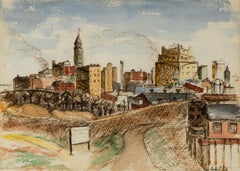
1950s Denver Skyline Painting – Graphite Watercolor Colorado Cityscape Art
Located in Denver, CO
A captivating midcentury cityscape titled "Denver Skyline", this original 1950s watercolor and graphite painting offers a rare industrial-era view of lower downtown Denver, Colorado....
Category

1950s American Impressionist North Carolina - Drawings and Watercolor Paintings

Materials

Watercolor, Graphite

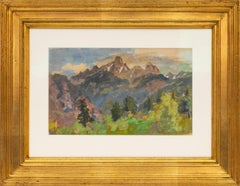
Charles Partridge Adams, Colorado Landscape Gouache, 20th-Century Plein Air Art
By Charles Partridge Adams
Located in Denver, CO
This original circa 1910s plein air field study by celebrated Colorado landscape painter Charles Partridge Adams (1858–1942) beautifully captures the tranquil majesty of the Rocky Mo...
Category

1910s American Impressionist North Carolina - Drawings and Watercolor Paintings

Materials

Gouache

Gardens, Exeter
Located in Middletown, NY
Watercolor with graphite on heavy gauge watercolor paper, 9 3/4 x 7 1/4 inches (249 x 185 mm), the full sheet. Titled and dated August 27, 1896 in pencil in the lower right margin. I...
Category

Late 19th Century English School North Carolina - Drawings and Watercolor Paintings

Materials

Watercolor, Board, Graphite

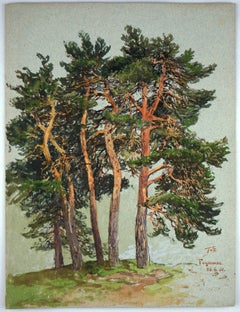
Norwegian Pine Grove - The inner glow of the trees -
Located in Berlin, DE
Themistokles von Eckenbrecher (1842 Athens - 1921 Goslar), Norwegian pine grove, 1901. Watercolor on blue-green paper, 30 x 22 cm. Signed, dated and inscribed in his own hand "TvE. Fagermes [i.e. Fagermes]. 26.6.[19]01." - Slight crease throughout at left margin, otherwise in good condition. About the artwork Themistokles von Eckenbrecher often traveled to Norway to study the nature that fascinated him there. On June 26, 1901, near the southern Norwegian town of Fagernes, in the summer evening sun, he saw a small pine grove, which he immediately captured in a watercolor. He exposed the trees growing on a small hill in front of the background, so that the pines completely define the picture and combine to form a tense motif. The tension comes from the contrast of form and color. The trunks, growing upward, form a vertical structure that is horizontally penetrated by the spreading branches and the pine needles, which are rendered as a plane. This structural tension is further intensified by the color contrast between the brown-reddish iridescent trunks and branches and the green-toned needlework. Themistokles von Eckenbrecher, however, does not use the observed natural scene as an inspiring model for a dance of color and form that detaches itself from the motif and thus treads the path of abstracting modernism. Its inner vitality is to be brought to light and made aesthetically accessible through the work of art. It is precisely in order to depict the inner vitality of nature that von Eckenbrecher chooses the technique of watercolor, in which the individual details, such as the needles, are not meticulously worked out, but rather a flowing movement is created that unites the contrasts. The trees seem to have formed the twisted trunks out of their own inner strength as they grew, creatingthose tense lineations that the artist has put into the picture. The inner strength continues in the branches and twigs, culminating in the upward growth of the needles. At the same time, the trunks, illuminated by the setting sun, seem to glow from within, adding an almost dramatic dimension to the growing movement. Through the artwork, nature itself is revealed as art. In order to make nature visible as art in the work, von Eckenbrecher exposes the group of trees so that they are bounded from the outside by an all-encompassing contour line and merge into an areal unity that enters into a figure-ground relationship with the blue-greenish watercolor paper. The figure-ground relationship emphasizes the ornamental quality of the natural work of art, which further enforces the artwork character of the group of trees. With the presentation of Themistokles von Eckenbrecher's artistic idea and its realization, it has become clear that the present watercolor is not a study of nature in the sense of a visual note by the artist, which might then be integrated into a larger work context, but a completely independent work of art. This is why von Eckenbrecher signed the watercolor. In addition, it is marked with a place and a date, which confirms that this work of nature presented itself to him in exactly this way at this place at this time. At the same time, the date and place make it clear that the natural work of art has been transferred into the sphere of art and thus removed from the time of the place of nature. About the artist Themistocles' parents instilled a life of travel in their son, who is said to have spoken eleven languages. His father, who was interested in ancient and oriental culture, was a doctor and had married Francesca Magdalena Danelon, an Italian, daughter of the British consul in Trieste. During a stay in Athens - Gustav von Eckenbrecher was a friend of Heinrich von Schliemann and is said to have given him crucial clues as to the location of Troy - Themistokles saw the light of day in 1842. After an interlude in Berlin, where Themistokles was educated at the English-American School, the journey began again. From 1850 to 1857 the family lived in Constantinople, after which the father opened a practice in Potsdam, where Themistokles, who wanted to become a painter, was taught by the court painter Carl Gustav Wegener. In 1861 the von Eckenbrechers left Potsdam and settled in Düsseldorf. There Themistokles received two years of private tuition from Oswald Aschenbach, who greatly admired the talented young artist. After his artistic training, he undertook extensive travels, often accompanied by Prince Peter zu Sayn-Wittgenstein, which took him to northern and eastern Europe, but above all to the Middle East and even to South America. The paintings that resulted from these journeys established his artistic reputation and led to his participation in large panoramas such as the 118 x 15 metre Entry of the Mecca Caravan into Cairo, painted for the City of Hamburg in 1882. 1882 was also the start of a total of 21 study trips to Scandinavia, most of them to Norway, and the unique Norwegian landscape with its rugged fjords became a central motif in his work. Along with Anders Askevold and Adelsteen Normann...
Category

Early 1900s Naturalistic North Carolina - Drawings and Watercolor Paintings

Materials

Watercolor

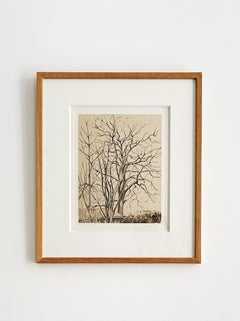
Jeanne-marie Barbey (1876-1960), Trees in Winter, Brown ink wash
Located in PARIS, FR
Jeanne-Marie BARBEY (1876-1960) Trees in winter Brown ink wash and graphite pencil on paper Signed lower right 26 x 20 cm frame 46 x 40 cm Born Louise Jeanne Marie Barbée in 1876 in...
Category

Early 20th Century North Carolina - Drawings and Watercolor Paintings

Materials

Watercolor, Graphite

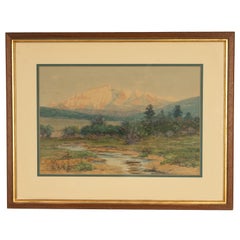
Antique Impressionist Painting "Spanish Peaks" Colorado Mountain Landscape 1900
By Charles Partridge Adams
Located in Portland, OR
A very attractive American Impressionist watercolor & gouache painting, "The Spanish Peaks" Colorado mountain landscape scene, by Charles Partridge Adams (1858-1942), circa 1900. Thi...
Category

Early 1900s American Impressionist North Carolina - Drawings and Watercolor Paintings

Materials

Watercolor, Gouache

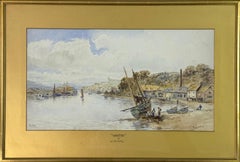
Antique Victorian Watercolour of Whitby Harbour by 19th Century British Artist
By William Langley
Located in Preston, GB
Antique Victorian Watercolour of Whitby Harbour by 19th Century British Artist William Langley (1852–1922) dating back to Circa 1891 Art measures 19 x 10.5 inches Frame measures 2...
Category

1890s Victorian North Carolina - Drawings and Watercolor Paintings

Materials

Gold

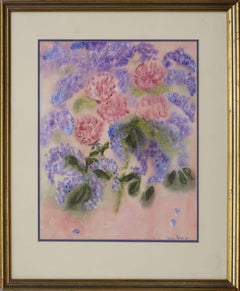
Lilacs and Peonies, Mid Century Floral Still-Life with Pink Purple
By Carolyn Tyson
Located in Soquel, CA
Lilacs and Peonies, Mid Century Floral Still-Life with Pink & Purple Vibrant mid century floral still-life featuring lilacs and peonies by Carolyn Tyson (American, b-1941). This lov...
Category

1960s Abstract Impressionist North Carolina - Drawings and Watercolor Paintings

Materials

Gouache, Paper

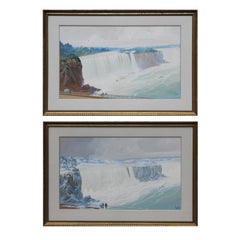
Niagra Falls Spring and Winter Watercolor Landscapes
By Maude Leach
Located in Houston, TX
Original watercolor landscape painting of Niagra falls in the winter and in the spring. The pair of paintings are signed by the artist in the bottom corne...
Category

20th Century Naturalistic North Carolina - Drawings and Watercolor Paintings

Materials

Watercolor

Previously Available Items
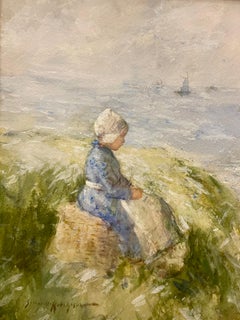
Waiting for Father, Scottish seaside circa 1900
Located in Hillsborough, NC
‘Waiting for Father’ is a charming painting depicting a 19th century child waiting by the sea for her Scottish fisherman father to return. Robert Gemmel Hutchison (1860-1936), is renowned for his delightful paintings of children. His watercolors are often in the pastel blues of beaches and the sea, set primarily in Scotland. Gemmel Hutchison was highly successful (Royal Scottish Academy, Royal Society of Watercolor, Royal Oil...
Category

Late 19th Century Impressionist North Carolina - Drawings and Watercolor Paintings

Materials

Canvas, Watercolor

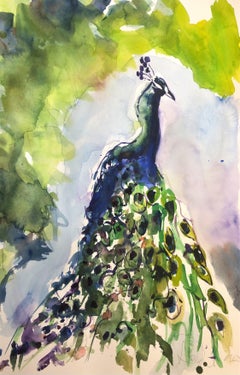
Arboretum Peacock, Painting, Watercolor on Watercolor Paper
By Daniel Clarke
Located in Yardley, PA
Peacock with your feathers so bright, So blue and beautiful, so full of might, You stand up tall, proud and bold, You have so many adventures yet to be told. Peahen youre so shy and ...
Category

2010s Impressionist North Carolina - Drawings and Watercolor Paintings

Materials

Watercolor

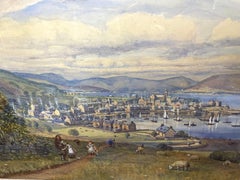
Dunoon, By Glasgow Scotland
Located in Hillsborough, NC
Fine and fresh Town view toward Dunoon, Scotland and harbor by Patrick Downie (1854-1945), a 19th century/20th century Scottish artist known for seascap...
Category

Late 19th Century Impressionist North Carolina - Drawings and Watercolor Paintings

Materials

Watercolor, Panel

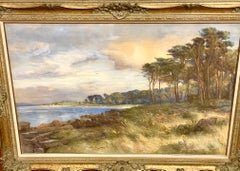
The Hounds Point, Dalmeny Shore
Located in Hillsborough, NC
Late 19th century watercolor with body color painting titled 'Hounds Point Dalmeny Shore', Edinburgh by Scottish artist James Kinnear (1846-1917). Meas...
Category

Late 19th Century Impressionist North Carolina - Drawings and Watercolor Paintings

Materials

Watercolor

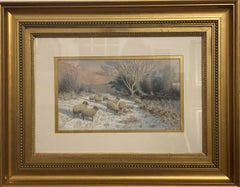
A Frosty Morning
Located in Hillsborough, NC
'A Frosty Morning' landscape with sheep in snow is by British 19th century artist John Crane. Crane signed his painting lower right and added the date '...
Category

1880s Naturalistic North Carolina - Drawings and Watercolor Paintings

Materials

Watercolor, Pencil, ABS

A Frosty Morning
A Frosty Morning
H 20 in W 25.5 in D 2 in

Still Thinking About These?

All Recently Viewed