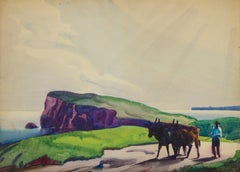
Ohio - Landscape Drawings and Watercolors
to
5
34
46
21
7
1
Overall Width
to
Overall Height
to
1
4
100
1
1
6
21
15
16
13
7
1
2
3
1
55
11
9
3
3
90
16
3
37
31
29
17
10
8
7
6
6
5
5
5
4
4
4
4
4
4
4
3
93
92
13
12
12
43
6
5
3
3
60
6
5,162
3,478
Item Ships From: Ohio
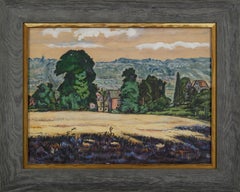
Houses in Zoar, Ohio Landscape, Early 20th Century Cleveland School
By August F. Biehle
Located in Beachwood, OH
August Frederick Biehle (1885-1979)
Houses in Zoar, c. 1921
Gouache, litho crayon, colored pencil and graphite on paper
Signed lower right
14 x 19 inches
20.25 x 25.25 inches, framed...
Category
1920s American Modern Ohio - Landscape Drawings and Watercolors
Materials
Crayon, Gouache, Color Pencil, Graphite
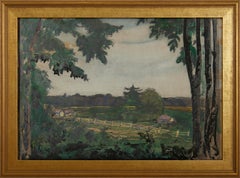
Farm Landscape, Zoar, Ohio, Early 20th Century
By August F. Biehle
Located in Beachwood, OH
August Frederick Biehle (1885-1979)
Farm Landscape, Zoar, c. 1923
Gouache, litho crayon and graphite on paper
Signed lower right
14 x 19 inches
17 x 23 inches, framed
A versatile pa...
Category
1920s American Modern Ohio - Landscape Drawings and Watercolors
Materials
Crayon, Gouache, Graphite
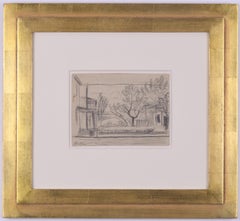
Brookdale, New Jersey
By Oscar Florianus Bluemner
Located in Fairlawn, OH
Brookdale, New Jersey
Graphite on paper, 1922
Signed with the artist's initials l.l., and dated 1922 (see photo)
Annotated "Brookdale" front and back of sheet
Condition: Excellent
Ar...
Category
1920s American Modern Ohio - Landscape Drawings and Watercolors
Materials
Graphite
untitled (Maine Landscape near Mt. Desert Island)
By Greta Allen
Located in Fairlawn, OH
untitled (Maine Landscape near Mt. Desert Island)
Watercolor on paper, c. 1945-1955
Signed by the artist lower left (see photo)
Provenance: Estate of the artist
Condition: Excellent
...
Category
1940s American Impressionist Ohio - Landscape Drawings and Watercolors
Materials
Watercolor
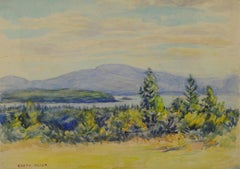
Fisherman
s Island, Boothbay, Maine, early 20th century landscape watercolor
By Frank Wilcox
Located in Beachwood, OH
Frank Nelson Wilcox (American, 1887-1964)
Fisherman's Island, Boothbay, Maine, c. 1925
Watercolor on paper
Signed lower left
15 x 20 inches
20.75 x 25.75 inches, framed
Frank Nelson Wilcox (October 3, 1887 – April 17, 1964) was a modernist American artist and a master of watercolor. Wilcox is described as the "Dean of Cleveland School painters," though some sources give this appellation to Henry Keller or Frederick Gottwald. Wilcox was born on October 3, 1887 to Frank Nelson Wilcox, Sr. and Jessie Fremont Snow Wilcox at 61 Linwood Street in Cleveland, Ohio. His father, a prominent lawyer, died at home in 1904 shortly before Wilcox' 17th birthday. His brother, lawyer and publisher Owen N. Wilcox, was president of the Gates Legal Publishing Company or The Gates Press. His sister Ruth Wilcox...
Category
1920s American Modern Ohio - Landscape Drawings and Watercolors
Materials
Watercolor
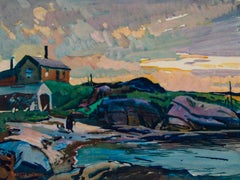
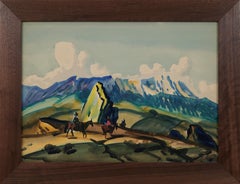
On the Top, People Crossing the Mountains, Montana Western Landscape
By Frank Wilcox
Located in Beachwood, OH
Frank Nelson Wilcox (American, 1887–1964)
On the Top, Montana, 1952
Watercolor and gouache on board
Signed and dated lower right
22 x 30 inches
25.5 x 34 inches framed
Frank Nelso...
Category
1950s American Modern Ohio - Landscape Drawings and Watercolors
Materials
Watercolor, Gouache
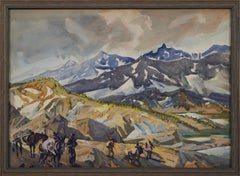
Mountainous Landscape, Mexico
Located in Fairlawn, OH
Mountainous Landscape, Mexico
Monotype in colors on heavy paper, c. 1960's
Signed in ink lower left "G Ceniceros"
Condition: Excellent
Image size: 6 x 14 1/2" (15.24 x 36.83cm)
Sheet size: 12 7/8 x 19 11/16 inches
Guillermo Ceniceros (born May 7, 1939) is a Mexican painter and muralist, best known for his mural work in Mexico City, as well as his figurative easel work. He began his mural painting career as an assistant to mural painters such as Federico Cantú, Luis Covarrubias and then David Alfaro Siqueiros who was a mentor and a key influence. Ceniceros is the most notable of Siqueiros' assistants. While he has experimented with abstract expression, his easel work mostly classifies as figurativism and is influenced by the geometrical construct of Mexican muralism. He has had over 300 individual and collective exhibitions in Mexico and the International stage. His work has been recognized by the Mexican Ministry of Culture and several of its institutions. He has painted over 20 large scale Mural Paintings with some of the most notable being the large scale work for the Legislative Palace of San Lazaro (Mexico's Legislative Building) as well as his murals in the Metro Subway System. He is a member of the Salón de la Plástica Mexicana. In 1995, the State of Durango, Ceniceros' native state, opened to the public the Guillermo Ceniceros Art Museum within the oversight of the Ministry of Culture. Ceniceros has been reviewed by notable critics such as Berta Taracena, Raquel Tibol, Alaide Foppa, Graciela Kartofel, José Angel Leyva and Eduardo Blackaller among others. There are several publications about his work including a vast review of his art life endeavors developed by the Ministries of Culture of Durango and Nuevo León. He is married to the artist Esther González and lives in his studio house in the Colonia Roma of Mexico City.
Life
Interview with the subject Ceniceros and Siqueiros
Ceniceros was born in a small village called El Salto, located in the municipality of Pueblo Nuevo in the Mexican state of Durango. His father was a woodworker who made toys and furniture in his workshop. His father's shop would become an influence in Ceniceros' life long interest in developing his own innovative working tools. When he was twelve the family moved to Monterrey to seek better economic opportunities. There he attended school and when he was fourteen he entered the Fabricación de Máquinas, S.A. (FAMA), a school/business, where he studied industrial drawing. He considers this early training important as it taught him the importance of geometry, use of space and materials. While at FAMA he met painters Gerardo Cantú and Ignacio Ortiz, and collaborated with them on sketches for publications of Alfonso Reyes, Pedro Garfias and other notable writers.
In 1955, he enrolled in the Taller de Artes Plásticas at the Universidad Autónoma de Nuevo León, graduating in 1958. At the Taller he met fellow Mexican artist Esther González, whom he married and with whom he has two children.
In 1962 he moved to Mexico City with the goal of working in the Taller of the Maestro David Alfaro Siqueiros. He became Siqueiros' first assistant working on his last murals while at the same time working at night on his easel painting work. Siqueiros supported Ceniceros decision to leave his Taller and supported him in his career until his death in 1974. By then Ceniceros was already a break thru artist having had several individual exhibitions including the prestigious Palacio De Bellas Artes as well as other recognitions. Thru the 70's and 80s Ceniceros continued his work with an emphasis on exhibits and exchanges abroad and traveling to Eastern Europe, Cuba, China, Chile, Ecuador, Italy and the United States. His Mexico City contemporaries and circle would include names that today have become reference such as Sebastian, José Luis Cuevas, Gilberto Aceves Navarro, Benjamin Dominguez, Gustavo Arias Murueta, Byron Galvez, Leonel Maciel among others. In the 70's his Row-House neighbors in the colonia Roma were Francisco Toledo and Alejandro Jodorowski.
His focus on mural painting is renewed in the mid 80's thru his large scale work in the Metro Subway System with him working on major commissions consistently and into the new century. While the Mexican school of Muralism had been challenged by the Ruptura members, the interest in Mural painting as a unique national form of expression continues.
He lives in Mexico City at a studio/home in the Colonia Roma. His home is a frequent gathering place for writers, poets, painters, singers, actors and journalists. He has a strong interest in Spanish language literature. Juan Rulfo...
Category
1960s Modern Ohio - Landscape Drawings and Watercolors
Materials
Monotype
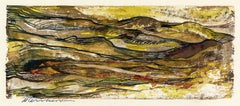
Woods Interior, Berlin Heights, Ohio, Forest Landscape, Cleveland School Artist
Located in Beachwood, OH
August Frederick Biehle (1885-1979)
Woods Interior, Berlin Heights, 1920
Gouache and colored pencil on paper
Signed and dated lower right
17 x 23 inches
23.25 x 29.25 inches, framed
...
Category
1920s American Modern Ohio - Landscape Drawings and Watercolors
Materials
Gouache, Color Pencil
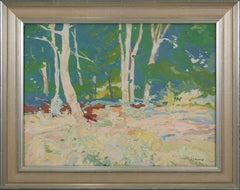
Mountain Landscape
By Hijikata Torei
Located in Fairlawn, OH
Ink and gold on paper silk mounted to hanging scroll
Brush wash scroll
Signed Torei sha, sealed Hirokuni and Torei
Painting size: 42 x 16"
Scrol...
Category
Ohio - Landscape Drawings and Watercolors
Materials
Sumi Ink
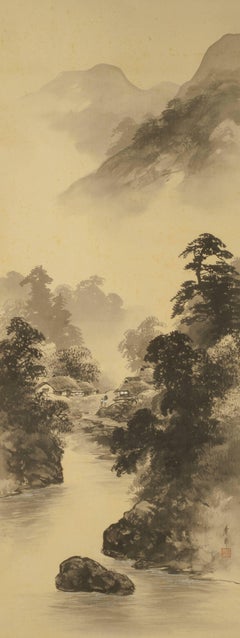
Gaspe: St. Lawrence Village
By William Grauer
Located in Fairlawn, OH
Signed by the artist in pencil, lower right
Provenance:
Estate of the Artist
With the artist's original presentation (Frame and matting)
Two similar titles were exhibited in The ...
Category
1950s American Modern Ohio - Landscape Drawings and Watercolors
Materials
Watercolor
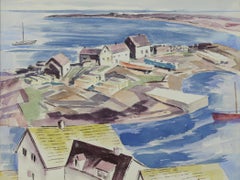
Beachside Village, Maine, 20th century landscape watercolor, Cleveland School
By George Adomeit
Located in Beachwood, OH
George Gustav Adomeit (American, 1879-1967)
Beachside Village, Maine
Watercolor on paper
Signed lower right
10 x 14 inches
17.75 x 21.75 inches, framed
A major painter of American ...
Category
Mid-20th Century American Modern Ohio - Landscape Drawings and Watercolors
Materials
Watercolor
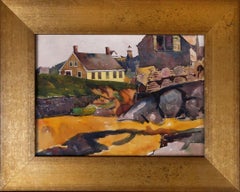
California Valley, Near Capistrano, 20th Century Western Mountainous Landscape
By Frank Wilcox
Located in Beachwood, OH
Frank Nelson Wilcox (American, 1887–1964)
California Valley, Near Capistrano, c. 1937
Watercolor on paper
Signed lower right, titled verso
15 x 20 inches
18.5 x 24 inches framed
Fr...
Category
1930s American Modern Ohio - Landscape Drawings and Watercolors
Materials
Watercolor
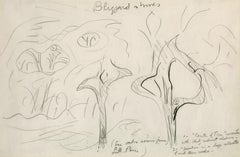
Blizzard in Woods
By Charles E. Burchfield
Located in Fairlawn, OH
Blizzard in Woods
Graphite on paper, c. 1945-1963
Unsigned
Provenance: Sid Deutsch Gallery, New York
Annotated with notes for completing the drawing. Deutsch Gallery has handled Bur...
Category
1940s American Modern Ohio - Landscape Drawings and Watercolors
Materials
Graphite
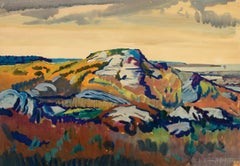
View Towards Christmas Cove, Maine, Early 20th Century East Coast Landscape
By Frank Wilcox
Located in Beachwood, OH
View Towards Christmas Cove, Maine, c. 1923
Watercolor on paper
Signed lower right
14 x 19.5 inches
Frank Nelson Wilcox (October 3, 1887 – April 17, 1...
Category
1920s American Modern Ohio - Landscape Drawings and Watercolors
Materials
Watercolor
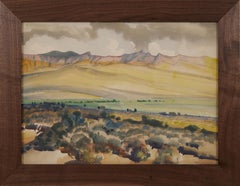
Flats Near Pueblo Isleta, New Mexico, 20th Century Western Landscape
By Frank Wilcox
Located in Beachwood, OH
Frank Nelson Wilcox (American, 1887–1964)
Flats Near Isleta, c. 1937
Watercolor on paper
Signed lower right, titled verso
14.5 x 20 inches
18.5 x 24 inches framed
Frank Nelson Wil...
Category
1930s American Modern Ohio - Landscape Drawings and Watercolors
Materials
Watercolor
Red Cliffs
Hogan, Arizona, Early 20th Century Western Mountainous Landscape
By Frank Wilcox
Located in Beachwood, OH
Frank Nelson Wilcox (American, 1887–1964)
Red Cliffs and Hogan, Arizona, 1937
Watercolor on paper
Signed and dated lower right
14.5 x 19 inches
18.5 x 24 inches framed
Frank Nelso...
Category
1930s American Modern Ohio - Landscape Drawings and Watercolors
Materials
Watercolor
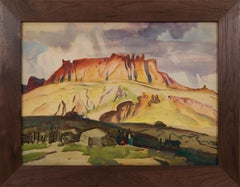
At Isleta, New Mexico Western Landscape Painting, 20th Century Cleveland School
By Frank Wilcox
Located in Beachwood, OH
Frank Nelson Wilcox (American, 1887–1964)
At Isleta, New Mexico, c. 1937
Watercolor on paper
Signed lower right, titled verso
15 x 20 inches
Frank Nelson Wilcox (October 3, 1887 – A...
Category
1930s Ohio - Landscape Drawings and Watercolors
Materials
Watercolor
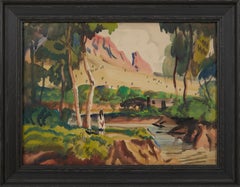
Wild Horses, Arizona, Early 20th Century Western Landscape, Cleveland School
By Frank Wilcox
Located in Beachwood, OH
Frank Nelson Wilcox (American, 1887–1964)
Wild Horses, Arizona, 1937
Watercolor on paper
Signed and dated lower right, titled verso
15 x 20 inches
18 x 24 inches framed
Frank Nelso...
Category
1930s American Modern Ohio - Landscape Drawings and Watercolors
Materials
Watercolor
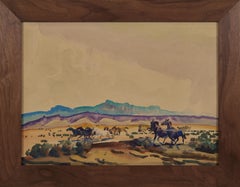
Stevedores, Ohio River, Early 20th Century Cleveland School Artist
By Frank Wilcox
Located in Beachwood, OH
Frank Nelson Wilcox (American, 1887-1964)
Stevedores, Ohio River, c. 1920
Watercolor on paper
Signed lower right
21.5 x 29. 5 inches
"The trip Otto Ege and I made from Pittsburgh to Marietta by riverboat and then by train to Mammoth Cave, was the next high spot in my artistic explorations. We saw something of the Old Southern river life on the way - the roustabouts, the showboat and river town life at Point Pleasant, and then to the sombre tonal mysteries of the Cave. These sights added much to my pictorial vocabulary..." - Frank Wilcox
Frank Nelson Wilcox (October 3, 1887 – April 17, 1964) was a modernist American artist and a master of watercolor. Wilcox is described as the "Dean of Cleveland School...
Category
1920s American Modern Ohio - Landscape Drawings and Watercolors
Materials
Watercolor
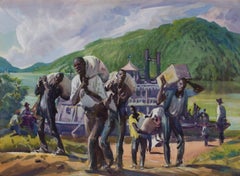
Nearing the Peaks, Early 20th Century Mountainous Western Landscape
By Frank Wilcox
Located in Beachwood, OH
Frank Nelson Wilcox (American, 1887–1964)
Nearing the Peaks, 1937
Watercolor on paper
Signed and dated lower right
15 x 20 inches
18.5 x 24 inches framed
Frank Nelson Wilcox (Octo...
Category
1930s American Modern Ohio - Landscape Drawings and Watercolors
Materials
Watercolor
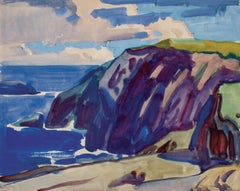
Cliffs at Paramé, France, 20th century seascape
landscape watercolor
By Frank Wilcox
Located in Beachwood, OH
Frank Nelson Wilcox (American, 1887-1964)
Cliffs at Paramé, France, c. 1926
Watercolor on paper
Signed lower right
14 x 17.5 inches
Frank Nelson Wilcox (October 3, 1887 – April 17...
Category
1920s American Modern Ohio - Landscape Drawings and Watercolors
Materials
Watercolor
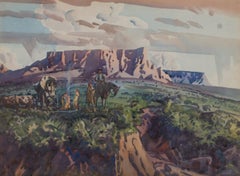
Gilbert
s Camp, Western Painting, Mid 20th Century, Cleveland School Artist
By Frank Wilcox
Located in Beachwood, OH
Frank Nelson Wilcox (American, 1887-1964)
Gilbert's Camp, c. 1941
Watercolor on Whatman board
Signed lower right
22 x 30 inches
Frank Nelson Wilcox (October 3, 1887 – April 17, 1964) was a modernist American artist and a master of watercolor. Wilcox is described as the "Dean of Cleveland School painters," though some sources give this appellation to Henry Keller or Frederick Gottwald. Wilcox was born on October 3, 1887 to Frank Nelson Wilcox, Sr. and Jessie Fremont Snow Wilcox at 61 Linwood Street in Cleveland, Ohio. His father, a prominent lawyer, died at home in 1904 shortly before Wilcox' 17th birthday. His brother, lawyer and publisher Owen N. Wilcox, was president of the Gates Legal Publishing Company or The Gates Press. His sister Ruth Wilcox was a respected librarian.
In 1906 Wilcox enrolled from the Cleveland School of Art under the tutelage of Henry Keller, Louis Rorimer...
Category
1940s American Modern Ohio - Landscape Drawings and Watercolors
Materials
Watercolor
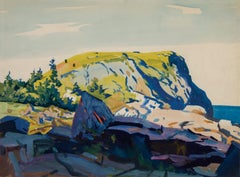
Headland
Rocks, White Island, Maine, early 20th century watercolor
By Frank Wilcox
Located in Beachwood, OH
Frank Nelson Wilcox (American, 1887-1964)
Headland & Rocks, White Island, Maine, c. 1923
Watercolor on paper
Signed lower left
15 x 19.5 inches
Frank Nelson Wilcox (October 3, 1887 – April 17, 1964) was a modernist American artist and a master of watercolor. Wilcox is described as the "Dean of Cleveland School painters," though some sources give this appellation to Henry Keller or Frederick Gottwald. Wilcox was born on October 3, 1887 to Frank Nelson Wilcox, Sr. and Jessie Fremont Snow Wilcox at 61 Linwood Street in Cleveland, Ohio. His father, a prominent lawyer, died at home in 1904 shortly before Wilcox' 17th birthday. His brother, lawyer and publisher Owen N. Wilcox, was president of the Gates Legal Publishing Company or The Gates Press. His sister Ruth Wilcox...
Category
1920s American Modern Ohio - Landscape Drawings and Watercolors
Materials
Watercolor
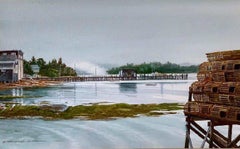
Outgoing Fog (South Bristol, Maine)
Located in Fairlawn, OH
Watercolor on paper, 1976
Painted in South Bristol, Maine
Signed by the artist lower left
Condition: Excellent
Category
1970s Realist Ohio - Landscape Drawings and Watercolors
Materials
Watercolor
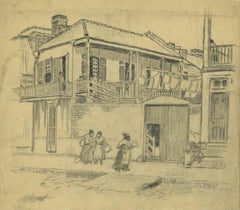
Preliminary Drawing for the color aquatint "New Orleans, Street Gossip"
By Louis Oscar Griffith
Located in Fairlawn, OH
Preliminary Drawing for the color aquatint "New Orlaens, Street Gossip"
Signed by the artist in pencil lower left
Graphite on tracing paper, 1916-1917
An impr...
Category
1910s American Impressionist Ohio - Landscape Drawings and Watercolors
Materials
Graphite
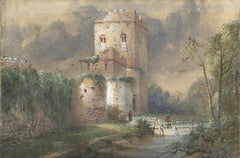
Unknown title (castle with wall, stream and footbridge)
By David Cox
Located in Fairlawn, OH
Unknown title (castle with wall, stream and footbridge)
Watercolor on laid paper, mounted to support of old Albumin photograph mount
Signed and dated lower left (see photo)
The watercolor is mounted on support that is the backing for a vintage albumin photograph of Moulin Huet, Guernsey, Channel Islands, c. 1850's
Condition: Mounted to verso of albumin photograph mount (see photo)
Glue residue outside of image/sheet on recto
Colors fresh
No other issues to note
David Cox (29 April 1783 – 7 June 1859) was an English landscape painter, one of the most important members of the Birmingham School of landscape artists and an early precursor of Impressionism.
He is considered one of the greatest English landscape painters, and a major figure of the Golden age of English watercolour.
Although most popularly known for his works in watercolour, he also painted over 300 works in oil towards the end of his career, now considered "one of the greatest, but least recognised, achievements of any British painter.
His son, known as David Cox the Younger (1809-1885), was also a successful artist.
Early life in Birmingham, 1783–1804
Cox's birthplace in Deritend, Birmingham, illustrated by Samuel Lines
Cox was born on 29 April 1783 on Heath Mill Lane in Deritend, then an industrial suburb of Birmingham. His father was a blacksmith and whitesmith about whom little is known, except that he supplied components such as bayonets and barrels to the Birmingham gun trade. Cox's mother was the daughter of a farmer and miller from Small Heath to the east of Birmingham. Early biographers record that "she had had a better education than his father, and was a woman of superior intelligence and force of character." Cox was initially expected to follow his father into the metal trade and take over his forge, but his lack of physical strength led his family to seek opportunities for him to develop his interest in art, which is said to have first become apparent when the young Cox started painting paper kites...
Category
1840s Romantic Ohio - Landscape Drawings and Watercolors
Materials
Watercolor
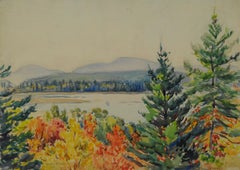
untitled (Maine Autumn Landscape across the narrows from Mt. Desert)
By Greta Allen
Located in Fairlawn, OH
untitled (Maine Autumn Landscape across the narrows from Mt. Desert)
Watercolor, 1945-1955
Signed by the artist lower left in pencil (see photo)
Provenance: Estate of the artist
Cond...
Category
1940s American Impressionist Ohio - Landscape Drawings and Watercolors
Materials
Watercolor
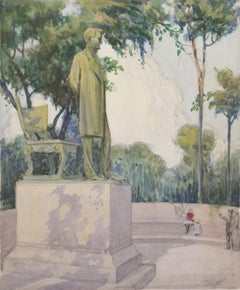
Standing Lincoln: The Man, Lincoln Park, Illinois
By Louis Oscar Griffith
Located in Fairlawn, OH
Standing Lincoln: The Man, Lincoln Park, Illinois
Watercolor and graphite on paper , c. 1895
Signed in script lower right (see photo)
The scene depicts the Augustus Saint-Gaudens bro...
Category
1890s American Impressionist Ohio - Landscape Drawings and Watercolors
Materials
Watercolor
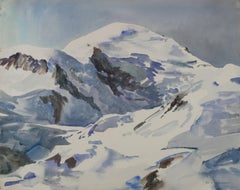
Snowy Peaks (Mont Blanc)
By Robert Hallowell
Located in Fairlawn, OH
Snowy Peaks (Mont Blanc)
Watercolor on paper, c. 1930
Signed "R. Hallowell" lower right (see photo)
The image depicts is of Mont Blanc in France.
Mont Blanc is the highest mountain i...
Category
1930s American Impressionist Ohio - Landscape Drawings and Watercolors
Materials
Watercolor
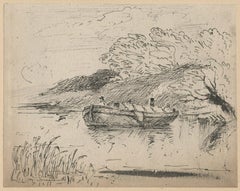
The River Barge
By David Cox
Located in Fairlawn, OH
The River Barge
Pen and ink on paper on laid paper, mounted in English drum mount , c. 1810
Unsigned
Condition: Slight sun staining to sheet and mount in the window (see photo)
Image/sheet size: 5 1/4 x 6 11/16 inches
Sight: : 5-3/4 x 7-1/4"
Frame: 13-3/8 x 14-3/8"
Provenance: Colnaghi, London (see photo of label)
David Cox (29 April 1783 – 7 June 1859) was an English landscape painter, one of the most important members of the Birmingham School of landscape artists and an early precursor of Impressionism.
He is considered one of the greatest English landscape painters, and a major figure of the Golden age of English watercolour.
Although most popularly known for his works in watercolour, he also painted over 300 works in oil towards the end of his career, now considered "one of the greatest, but least recognised, achievements of any British painter.
His son, known as David Cox the Younger (1809-1885), was also a successful artist.
Early life in Birmingham, 1783–1804
Cox's birthplace in Deritend, Birmingham, illustrated by Samuel Lines
Cox was born on 29 April 1783 on Heath Mill Lane in Deritend, then an industrial suburb of Birmingham. His father was a blacksmith and whitesmith about whom little is known, except that he supplied components such as bayonets and barrels to the Birmingham gun trade. Cox's mother was the daughter of a farmer and miller from Small Heath to the east of Birmingham. Early biographers record that "she had had a better education than his father, and was a woman of superior intelligence and force of character." Cox was initially expected to follow his father into the metal trade and take over his forge, but his lack of physical strength led his family to seek opportunities for him to develop his interest in art, which is said to have first become apparent when the young Cox started painting paper kites while recovering from a broken leg.
By the late 18th century Birmingham had developed a network of private academies teaching drawing and painting, established to support the needs of the town's manufacturers of luxury metal goods, but also encouraging education in fine art, and nurturing the distinctive tradition of landscape art of the Birmingham School. Cox initially enrolled in the academy of Joseph Barber in Great Charles Street, where fellow students included the artist Charles Barber and the engraver William Radclyffe, both of whom would become important lifelong friends.
At the age of about 15 Cox was apprenticed to the Birmingham painter Albert Fielder, who produced portrait miniatures and paintings for the tops of snuffboxes from his workshop at 10 Parade in the northwest of the town. Early biographers of Cox record that he left his apprenticeship after Fielder's suicide, with one reporting that Cox himself discovered his master's hanging body, but this is probably a myth as Fielder is recorded at his address in Parade as late as 1825. At some time during mid-1800 Cox was given work by William Macready the elder at the Birmingham Theatre, initially as an assistant grinding colours and preparing canvases for the scene painters, but from 1801 painting scenery himself and by 1802 leading his own team of assistants and being credited in plays' publicity.
London, 1804–1814
In 1804 Cox was promised work by the theatre impresario Philip Astley and moved to London, taking lodgings in 16 Bridge Row, Lambeth. Although he was unable to get employment at Astley's Amphitheatre it is likely that he had already decided to try to establish himself as a professional artist, and apart from a few private commissions for painting scenery his focus over the next few years was to be on painting and exhibiting watercolours. While living in London, Cox married his landlord's daughter, Mary Agg and the couple moved to Dulwich in 1808.
David Cox Travellers on a Path, pencil and brown wash.
In 1805 he made his first of many trips to Wales, with Charles Barber, his earliest dated watercolours are from this year. Throughout his lifetime he made numerous sketching tours to the Home Counties, North Wales, Yorkshire, Derbyshire and Devon.
Cox exhibited regularly at the Royal Academy from 1805. His paintings never reached high prices, so he earned his living mainly as a drawing master. His first pupil, Colonel the Hon.H. Windsor (the future Earl of Plymouth) engaged him in 1808, Cox went on to acquire several other aristocratic and titled pupils. He also went on to write several books, including: Ackermanns' New Drawing Book (1809); A Series of Progressive Lessons (1811); Treatise on Landscape Painting (1813); and Progressive Lessons on Landscape (1816). The ninth and last edition of his series Progressive Lessons, was published in 1845.
By 1810 he was elected President of the Associated Artists in Water Colour. In 1812, following the demise of the Associated Artists, he was elected as associate of the Society of Painters in Water Colour (the old Water Colour Society). He was elected a Member of the Society in 1813, and exhibited there every year (except 1815 and 1817) until his death.
Hereford, 1814–1827
In the summer of 1813 Cox was appointed as the drawing master of the Royal Military College in Farnham, Surrey, but he resigned shortly afterwards, finding little sympathy with the atmosphere of a military institution. Soon after that he applied to a newspaper advertisement for a position as drawing master for Miss Crouchers' School for Young Ladies in Hereford and in Autumn 1814 moved to the town with his family. Cox taught at the school in Widemarsh Street until 1819, his substantial salary of £100 per year requiring only two-day's work per week, allowing time for painting and the taking of private pupils.
Cox's reputation as both a painter and a teacher had been building over previous years, as indicated by his election as a member of the Society of Painters in Water Colours and his inclusion in John Hassell's 1813 book Aqua Pictura, which claimed to present works by "all of the most approved water coloured draftsmen". The depression that accompanied the end of the Napoleonic Wars had caused a contraction in the art market, however, and by 1814 Cox had been very short of money, requiring a loan from one of his pupils to pay even for the move to Hereford. Despite its financial advantages and its proximity to the scenery of North Wales and the Wye Valley, the move to Hereford marked a retreat in terms of his career as a painter: he sent few works to the annual exhibition of the Society of Painters in Water Colours during his first years away from London and not until 1823 would he again contribute more than 20 pictures.
Between 1823 and 1826 he had Joseph Murray Ince as a pupil.
London, 1827–1841
He made his first trip to the Continent, to Belgium and the Netherlands in 1826 and subsequently moved to London the following year.
He exhibited for the first time with the Birmingham Society of Artists in 1829, and with the Liverpool Academy in 1831. In 1839, two of Cox's watercolours were bought from the Old Water Colour Society exhibition by the Marquis of Conynha for Queen Victoria.
Birmingham, 1841–1859
Greenfield House in Harborne, Birmingham – where Cox lived from 1841 until his death in 1859 .
In May 1840 Cox wrote to one of his Birmingham friends: "I am making preparations to sketch in oil, and also to paint, and it is my intention to spend most of my time in Birmingham for the purpose of practice". Cox had been considering a return to painting in oils since 1836 and in 1839 had taken lessons in oil painting from William James Müller, to whom he had been introduced by mutual friend George Arthur Fripp. Hostility between the Society of Painters in Water Colours and the Royal Academy made it difficult for an artist to be recognised for work in both watercolour and oil in London, however, and it is likely that Cox would have preferred to explore this new medium in the more supportive environment of his home town. By the early 1840s his income from sales of his watercolours was sufficient to allow him to abandon his work as a drawing master, and in June 1841 he moved with his wife to Greenfield House in Harborne, then a village on Birmingham's south western outskirts. It was this move that would enable the higher levels of freedom and experimentation that were to characterise his later work.
The elderly Cox pictured by Samuel Bellin in 1855.
In Harborne, Cox established a steady routine – working in watercolour in the morning and oils in the afternoon. He would visit London every spring to attend the major exhibitions, followed by one or more sketching excursions, continuing the pattern that he had established in the 1830s. From 1844 these tours evolved into a yearly trip to Betws-y-Coed in North Wales to work outdoors in both oil and watercolour, gradually becoming the focus for an annual summer artists colony that continued until 1856 with Cox as its "presiding genius".
Cox's experience of trying to exhibit his oils in London was short and unsuccessful: in 1842 he made his only submission to the Society of British Artists; one oil painting was exhibited at each of the British Institution and the Royal Academy in 1843; and two oil paintings were exhibited at the Royal Academy in 1844 – the last that would be exhibited in London during his lifetime.
Cox showed regularly at the Birmingham Society of Arts and its successor, the Birmingham Society of Artists, becoming a member in 1842.
Cox suffered a stroke on 12 June 1853 that temporarily paralysed him, and permanently affected his eyesight, memory and coordination.
By 1857 however, his eyesight had deteriorated. An exhibition of his work was arranged in 1858 by the Conversazione Society Hampstead, and in 1859 a retrospective exhibition was held at the German Gallery Bond Street, London. Cox died several months later. He was buried in the churchyard of St Peters, Harborne, Birmingham, under a chestnut tree, alongside his wife Mary.
Work
Early work
In the spring of 1811 Cox made a small number of notable works in oils during a visit to Hastings with his family. It is not known why he didn't continue working in this medium at the time, but the five known surviving examples were described in 1969 as "surely some of the most brilliant examples of the genre in England".
Mature work
Cox reached artistic maturity after his move to Hereford in 1814. Although only two major watercolours can confidently be traced to the period between Cox's arrival in the town and the end of the decade, both of these – Butcher's Row, Hereford of 1815 and Lugg Meadows, near Hereford of 1817 – mark advances on his earlier work.
Later work
Cox's later work produced after his move to Birmingham in 1841 was marked by simplification, abstraction and a stripping down of detail. His art of the period combined the breadth and weight characteristic of the earlier English watercolour school, together with a boldness and freedom of expression comparable to later impressionism. His concern with capturing the fleeting nature of weather, atmosphere and light was similar to that of John Constable, but Cox stood apart from the older painter's focus on capturing material detail, instead employing a high degree of generalisation and a focus on overall effect.
The quest for character over precision in representing nature was an established characteristic of the Birmingham School of landscape artists with which Cox had been associated early in his life, and as early as 1810 Cox's work had been criticised for its "sketchiness of finish" and "cloudy confusion of objects", which were held to betray "the coarseness of scene-painting". During the 1840s and 1850s Cox took this "peculiar manner" to new extremes, incorporating the techniques of the sketch into his finished works to a far greater degree.
Cox's watercolour technique of the 1840s was sufficiently different from his earlier methods to need explanation to his son in 1842, despite the fact that his son had been helping him teach and paint since 1827. The materials used for his later works in watercolour also differed from his earlier periods: he used black chalk instead of graphite pencil as his primary drawing medium, and the rough and absorbent "Scotch" wrapping paper for which he became well-known – both of these were related to his development of a rougher and freer style.
Influence and legacy
By the 1840s Cox, alongside Peter De Wint and Copley Fielding, had become recognised as one of the leading figures of the English landscape watercolour style of the first half of the 19th century. This judgement was complicated by reaction to the rougher and bolder style of Cox's later Birmingham work, which was widely ignored or condemned. While by this time De Wint and Fielding were essentially continuing in a long-established tradition, Cox was creating a new one.
A group of young artists working in Cox's watercolour style emerged well before his death, including William Bennett, David Hall McKewan and Cox's son David Cox Jr. By 1850 Bennett in particular had become recognised as "perhaps the most distinguished among the landscape painters" for his Cox-like vigorous and decisive style. Such early followers concentrated on the example of Cox's more moderate earlier work and steered clear of what were then seen as the excesses of Cox's later years. During a period dominated by sleek and detailed picturesque landscape, however, they were still condemned by publications such as The Spectator as "the 'blottesque' school", and failed to establish themselves as a cohesive movement.
John Ruskin in 1857 condemned the work of the Society of Painters in Water-colours as "a kind of potted art, of an agreeable flavour, suppliable and taxable as a patented commodity", excluding only the late work of Cox, about which he wrote "there is not any other landscape which comes near these works of David Cox in simplicity or seriousness".
An 1881 book, A Biography of David Cox: With Remarks on His Works and Genius, was based on a manuscript by Cox's friend William Hall, edited and expanded by John Thackray Bunce, editor of the Birmingham Daily Post.
There are two Blue Plaque memorials commemorating him at 116 Greenfield Road, Harborne, Birmingham, and at 34 Foxley Road, Kennington, London, SW9, where he lived from 1827. It can also be seen at the David Cox exhibition in Birmingham.
His pupils included Birmingham architectural artist, Allen Edward...
Category
1810s Romantic Ohio - Landscape Drawings and Watercolors
Materials
Ink
Irish Sea
By Edward Dobrotka
Located in Fairlawn, OH
Irish Sea
Watercolor, 1947
Signed and dated by the artist lower right
Condition: Excellent
Image/Sheet size: 12 x 18 inches
Provenance: Estate of the Artist
...
Category
1940s American Realist Ohio - Landscape Drawings and Watercolors
Materials
Watercolor
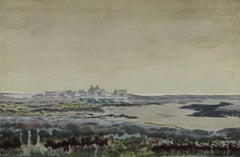
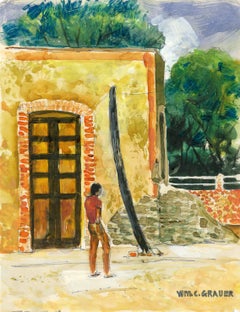
untitled (Street Scene Mexico)
By William Grauer
Located in Fairlawn, OH
Untitled Mexican Landscape (Man Walking on Street)
Ink and watercolor on paper.
Signed with the estate stamp lower right (see photo)
From the Estate of the Artist with the artist's estate stamp lower right.
C. 1960's
Condition: excellent
Image/Sheet size: 9 7/8 x 7 5/8 inches
William C. Grauer (1895-1985)
William C. Grauer (1895-1985) was born in Philadelphia to German immigrant parents. After attending the Philadelphia Museum School of Industrial Art, Grauer received a four year scholarship from the City of Philadelphia to pursue post graduate work. It was during this time that Grauer began working as a designer at the Decorative Stained Glass Co. in Philadelphia.
Following his World War I service in France, Grauer moved to Akron, Ohio where he opened a studio in 1919 with his future brother-in-law, the architect George Evans Mitchell. Soon, the Rorimer-Brooks design company, the developer Van Swerngen brothers, as well as the Sterling Welch and Halle Bros. department stores realized the extent of Grauer's talent and eagerly employed him. Grauer’s work during this time included architectural renderings for Shaker Square, Moreland Courts, and other many other projects commissioned by Cleveland architects. Grauer also remained true to his roots as a master designer of stained glass windows. With his work in such high demand, Grauer received a commission in 1921 to paint murals for the French Grill...
Category
1960s American Modern Ohio - Landscape Drawings and Watercolors
Materials
Watercolor

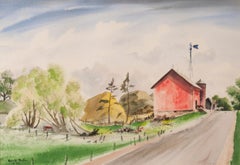
$500 Sale Price
28% Off
Horses Leaving the Barn
By Adolf Dehn
Located in Fairlawn, OH
Horses Leaving the Barn
Watercolor on paper, 1940
Signed and dated lower left corner (see photo)
Condition: Excellent
Image: 14 1/2 x 21”
Frame: 25” x 31”
Provenance; Associated American Artists, New York (see photo of label)
Mamdouha and Elmer Holmes Bobst
Displayed in an original wormy chestnut frame with OP3 Acrylic. Most probably from the AAA Dehn watercolor exhibition of 1940. Vintage original framing chosen by the artist.
Note: Elmer Holmes Bobst (1884–1978) was an American businessman and philanthropist who worked in the pharmaceutical industry. His wife, Mamdouha, was also well known philanthropist.
Bobst was born in Lititz, Pennsylvania. He aspired to become a doctor, but instead, he taught himself pharmacology. After his wife Ethel composed his interview letter, he became manager and treasurer of the Hoffman-LaRoche Chemical Works by 1920. When Bobst retired from the company in 1944, he was one of the nation's highest paid corporate executives. In 1945 he took charge of the ailing William Warner Company (later Warner–Lambert) and he remained board chairman until his retirement.
Bobst had close connections to President Dwight Eisenhower, but was also a close friend of President Richard Nixon.
Note: In 1940, the year of this watercolor, Dehn and Elizabeth Timmerman visited Waterville, MN on their way to Colorado Sprint, Colorado where Dehn was to teach lithography and watercolor. This watercolor is obviously a view of the area around Waterville.
Adolf Dehn, American Watercolorist and Printmaker, 1895-1968
Adolf Dehn was an artist who achieved extraordinary artistic heights, but in a very particular artistic sphere—not so much in oil painting as in watercolor and lithography. Long recognized as a master by serious print collectors, he is gradually gaining recognition as a notable and influential figure in the overall history of American art.
In the 19th century, with the invention of the rotary press, which made possible enormous print runs, and the development of the popular, mass-market magazines, newspaper and magazine illustration developed into an artistic realm of its own, often surprisingly divorced from the world of museums and art exhibitions, and today remains surprisingly overlooked by most art historians. Dehn in many regards was an outgrowth of this world, although in an unusual way, since as a young man he produced most of his illustrative work not for popular magazines, such as The Saturday Evening Post, but rather for radical journals, such as The Masses or The Liberator, or artistic “little magazines” such as The Dial. This background established the foundation of his outlook, and led later to his unique and distinctive contribution to American graphic art.
If there’s a distinctive quality to his work, it was his skill in introducing unusual tonal and textural effects into his work, particularly in printmaking but also in watercolor. Jackson Pollock seems to have been one of many notable artists who were influenced by his techniques.
Early Years, 1895-1922
For an artist largely remembered for scenes of Vienna and Paris, Adolf Dehn’s background was a surprising one. Born in Waterville, Minnesota, on November 22, 1895, Dehn was the descendent of farmers who had emigrated from Germany and homesteaded in the region, initially in a one-room log cabin with a dirt floor. Adolf’s father, Arthur Clark Dehn, was a hunter and trapper who took pride that he had no boss but himself, and who had little use for art. Indeed, during Adolf’s boyhood the walls of his bedroom and the space under his bed were filled with the pelts of mink, muskrats and skunks that his father had killed, skinned and stretched on drying boards. It was Adolf’s mother, Emilie Haas Dehn, a faithful member of the German Lutheran Evangelical Church, who encouraged his interest in art, which became apparent early in childhood. Both parents were ardent socialists, and supporters of Eugene Debs...
Category
1940s American Realist Ohio - Landscape Drawings and Watercolors
Materials
Watercolor
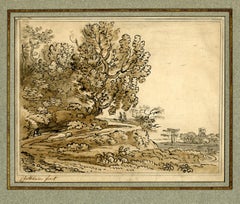
Landscape with Figures in the English Countryside
Located in Fairlawn, OH
Landscape with Figures in the English Countryside
Pen, ink and graphite with gray and brown washes on laid watermarked paper, c. 1740
Signed by the artist lower left of image: "Chate...
Category
1740s Romantic Ohio - Landscape Drawings and Watercolors
Materials
Ink
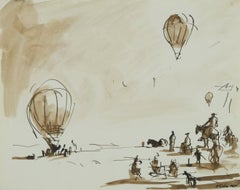
Untitled (Hot Air Baloon Ascent and Spectators)
By Joseph O
Sickey
Located in Fairlawn, OH
Untitled (Hot Air Balloon Ascent and Spectators)
Sepia wash on wove paper, 1985
Signed and dated in ink lower right corner
From the artist's 1985 sketchbook
Probably a view of Cape C...
Category
1980s American Modern Ohio - Landscape Drawings and Watercolors
Materials
Ink
Rainbow on Santa Fe Trail, New Mexico, Early 20th Century Western Landscape
By Frank Wilcox
Located in Beachwood, OH
Frank Nelson Wilcox (American, 1887–1964)
Rainbow on Santa Fe Trail, New Mexico, c. 1937
Watercolor on paper
Signed lower right, titled verso
15 x 20 inches
18.5 x 24 inches framed
...
Category
1930s American Modern Ohio - Landscape Drawings and Watercolors
Materials
Watercolor
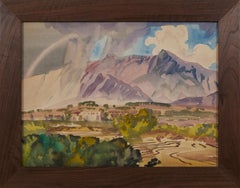
Sun Drenched Pueblo, 1950s Western Mountainous Landscape, Cleveland School
By Frank Wilcox
Located in Beachwood, OH
Frank Nelson Wilcox (American, 1887–1964)
Sun Drenched Pueblo, c. 1950
Watercolor on paper
Monogram lower right
15 x 20 inches
18.5 x 24 inches framed
"All these things are, of co...
Category
1950s American Modern Ohio - Landscape Drawings and Watercolors
Materials
Watercolor
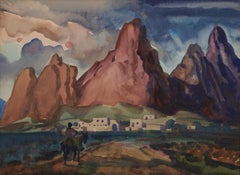
Beaver Pond, Longs Peak, Rocky Mountain National Park Colorado Western Landscape
By Frank Wilcox
Located in Beachwood, OH
Frank Nelson Wilcox (American, 1887–1964)
Beaver Pond near Longs Peak, Rocky Mountain National Park, Colorado, c. 1950
Watercolor on Paper
Unsigned
19 x 24 inches
21 x 26 inches fram...
Category
1950s Ohio - Landscape Drawings and Watercolors
Materials
Watercolor
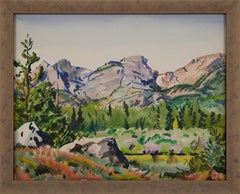
Spring Landscape with house and figure
By Louis Oscar Griffith
Located in Fairlawn, OH
Spring Landscape with house and figure
A preliminary watercolor for a color aquatint, illustrated on line, title unknown
Signed lower left in block letters (see photo)
Watercolor and...
Category
1920s American Impressionist Ohio - Landscape Drawings and Watercolors
Materials
Watercolor
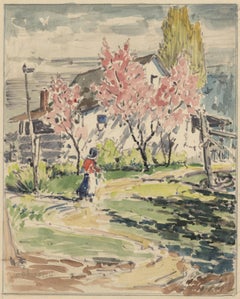
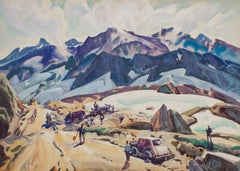
Construction on the Pass, Montana, Western Landscape, Cleveland School Artist
By Frank Wilcox
Located in Beachwood, OH
Frank Nelson Wilcox (American, 1887-1964)
Construction on the Pass, Montana, c. 1950
Unsigned
Watercolor on Whatman board
22 x 30 inches
Provenance: From the estate of Frank Nelson Wilcox
Frank Nelson Wilcox (October 3, 1887 – April 17, 1964) was a modernist American artist and a master of watercolor. Wilcox is described as the "Dean of Cleveland School painters," though some sources give this appellation to Henry Keller or Frederick Gottwald. Wilcox was born on October 3, 1887 to Frank Nelson Wilcox, Sr. and Jessie Fremont Snow Wilcox at 61 Linwood Street in Cleveland, Ohio. His father, a prominent lawyer, died at home in 1904 shortly before Wilcox' 17th birthday. His brother, lawyer and publisher Owen N. Wilcox, was president of the Gates Legal Publishing Company or The Gates Press. His sister Ruth Wilcox was a respected librarian.
In 1906 Wilcox enrolled from the Cleveland School of Art under the tutelage of Henry Keller, Louis Rorimer...
Category
1950s American Modern Ohio - Landscape Drawings and Watercolors
Materials
Watercolor
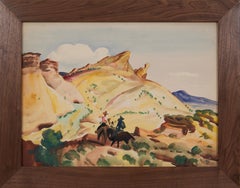
Riders Near Camel Rock Monument, Santa Fe, New Mexico Western Landscape
By Frank Wilcox
Located in Beachwood, OH
Frank Nelson Wilcox (American, 1887–1964)
Riders Near Camel Rock Monument, Santa Fe, New Mexico, c. 1937
Watercolor on paper
Monogram lower right, titled verso
14.5 x 20 inches
18....
Category
1930s American Modern Ohio - Landscape Drawings and Watercolors
Materials
Watercolor
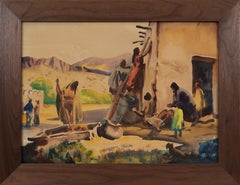
The Adobe, Early 20th Century Western Village Landscape, Cleveland School Artist
By Frank Wilcox
Located in Beachwood, OH
Frank Nelson Wilcox (American, 1887–1964)
The Adobe, c. 1940-41
Watercolor on paper
Signed lower right
14 x 20 inches
18.5 x 24 inches framed
Frank Nelson Wilcox (October 3, 1887 –...
Category
1940s American Modern Ohio - Landscape Drawings and Watercolors
Materials
Watercolor
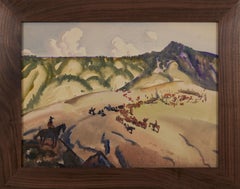
High Pastures, Cattle Round Up, Wyoming, 20th Century Western Landscape
By Frank Wilcox
Located in Beachwood, OH
Frank Nelson Wilcox (American, 1887–1964)
High Pastures, Cattle Round Up, Wyoming, 1937
Watercolor on paper
Signed and dated lower right, titled verso
15 x 20 inches
18.5 x 24 inche...
Category
1930s American Modern Ohio - Landscape Drawings and Watercolors
Materials
Watercolor
Colorado River, Needles, California, 1950s Western Landscape, Cleveland School
By Frank Wilcox
Located in Beachwood, OH
Frank Nelson Wilcox (American, 1887–1964)
The Colorado At Needles, California, c. 1950
Watercolor on paper
Monogram lower right, titled verso
14.5 x 20 inches
18.5 x 24 inches fram...
Category
1950s American Modern Ohio - Landscape Drawings and Watercolors
Materials
Watercolor
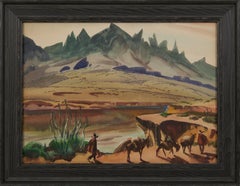
Canyon at Evening, Early 20th Century Western Landscape, Cleveland School Artist
By Frank Wilcox
Located in Beachwood, OH
Frank Nelson Wilcox (American, 1887–1964)
Canyon at Evening, 1937
Watercolor on paper
Signed and dated lower right
14 x 19 inches
18.75 x 24 inches, framed
Frank Nelson Wilcox (Oc...
Category
1930s American Modern Ohio - Landscape Drawings and Watercolors
Materials
Watercolor
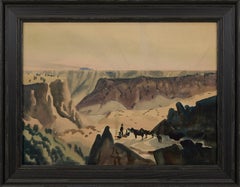
Silent Prayers at St. Malo, France, Early 20th Century European Landscape
By Frank Wilcox
Located in Beachwood, OH
Frank Nelson Wilcox (American, 1887–1964)
Silent Prayers at St. Malo, France, 1925
Watercolor and gouache on board
Signed and dated lower right
19 x 24 inches
Frank Nelson Wilcox (...
Category
1920s Ohio - Landscape Drawings and Watercolors
Materials
Watercolor, Gouache
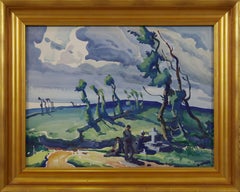
Cubist Landscape/Cityscape of Capri, Italy, Early 20th Century Woman Artist
Located in Beachwood, OH
Clara Deike (American, 1881-1965)
Capri, 1927
Watercolor on paper
Signed and dated lower right
11 x 10 inches
14.25 x 13.25 inches, framed
A graduate of the Cleveland School of Art ...
Category
1920s Cubist Ohio - Landscape Drawings and Watercolors
Materials
Watercolor
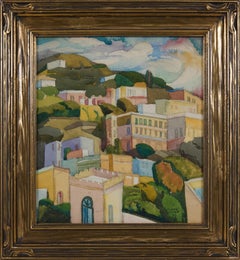
Sunset Outside of Utah, Early 20th Century Western Landscape w/ Mountain
Fire
By Frank Wilcox
Located in Beachwood, OH
Frank Nelson Wilcox (American, 1887–1964)
Sunset Outside of Zion, Utah, c. 1940
Watercolor on paper
Signed lower right
14 x 20 inches
18 x 24 inches framed
Frank Nelson Wilcox (Oct...
Category
1940s American Modern Ohio - Landscape Drawings and Watercolors
Materials
Watercolor
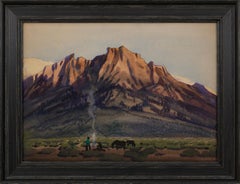
Oxen and Mule Drawn Wagon on the Trail Western Landscape
By Frank Wilcox
Located in Beachwood, OH
Frank Nelson Wilcox (American, 1887-1964)
Oxen and Mule Drawn Wagon on the Trail, 1949
Oil on board
Signed and dated lower right
22 x 30 inches
Frank Nelson Wilcox (October 3, 1887 – April 17, 1964) was a modernist American artist and a master of watercolor. Wilcox is described as the "Dean of Cleveland School painters," though some sources give this appellation to Henry Keller or Frederick Gottwald. Wilcox was born on October 3, 1887 to Frank Nelson Wilcox, Sr. and Jessie Fremont Snow Wilcox at 61 Linwood Street in Cleveland, Ohio. His father, a prominent lawyer, died at home in 1904 shortly before Wilcox' 17th birthday. His brother, lawyer and publisher Owen N. Wilcox, was president of the Gates Legal Publishing Company or The Gates Press. His sister Ruth Wilcox was a respected librarian.
In 1906 Wilcox enrolled from the Cleveland School of Art under the tutelage of Henry Keller, Louis Rorimer...
Category
1940s American Modern Ohio - Landscape Drawings and Watercolors
Materials
Oil
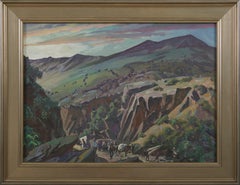
Moraine Valley
Snow Peaks, Rocky Mountain National Park, Colorado Landscape
By Frank Wilcox
Located in Beachwood, OH
Frank Nelson Wilcox (American, 1887–1964)
Moraine and Snow Peaks, Rocky Mountain National Park, Colorado, c. 1950
Watercolor on paper
Unsigned
19 x 24 inches
21 x 26 inches framed
...
Category
1950s Ohio - Landscape Drawings and Watercolors
Materials
Watercolor
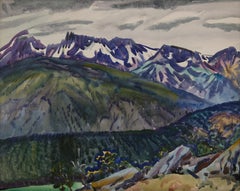
Villa Giardino, 20th Century Charcoal Italian Landscape Drawing
Located in Beachwood, OH
Clara Deike (American, 1881-1964)
Villa Giardino
Charcoal on paper
Signed and titled verso
17.75 x 12.5 inches
A graduate of the Cleveland School of Art in 1912, Clara Deike was pa...
Category
20th Century American Modern Ohio - Landscape Drawings and Watercolors
Materials
Charcoal
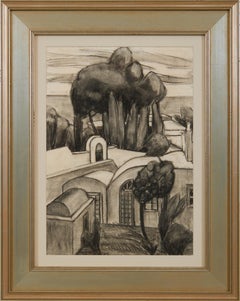
Rio Puerco, New Mexico, Early 20th Century Western Landscape, Cleveland School
By Frank Wilcox
Located in Beachwood, OH
Frank Nelson Wilcox (American, 1887–1964)
Rio Puerco, New Mexico, c. 1940-1
Watercolor on paper
Monogram lower right
15 x 20 inches
18.5 x 24 inches framed
Frank Nelson Wilcox (O...
Category
1940s American Modern Ohio - Landscape Drawings and Watercolors
Materials
Watercolor
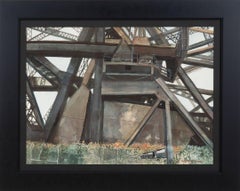
Bridge in the Cleveland Flats, Late 20th Century Architectural Painting
Located in Beachwood, OH
William Gould (American, 1930-2017)
Bridge in the Flats, 1990
Watercolor on Arches paper
Signed and dated lower right
21 x 28.5 inches
28 x 35.5 inches, framed
Cleveland Arts Prize ...
Category
1990s Ohio - Landscape Drawings and Watercolors
Materials
Watercolor
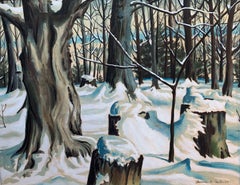
Snow in Forest, Mid-Century Winter Landscape, Cleveland School Artist
By Clarence Holbrook Carter
Located in Beachwood, OH
Clarence Holbrook Carter (American, 1904-2000)
Snow in the Forest, 1945
Watercolor on paper
Signed and dated lower right
19 x 23.75 inches
24 x 29 inches, framed
Clarence Holbrook C...
Category
1940s American Modern Ohio - Landscape Drawings and Watercolors
Materials
Watercolor
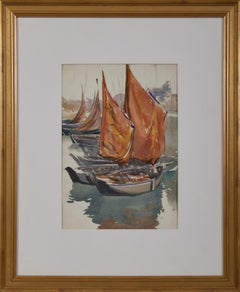
Boats off Concarneau, France, Early 20th Century Seascape, Cleveland School
By Frank Wilcox
Located in Beachwood, OH
Frank Nelson Wilcox (American, 1887–1964)
Boats off Concarneau, France, c. 1910-11
Unsigned
Watercolor on paper
12.5 in. h. x 8.5 in. w.
22 in. h. x 18 in. w., as framed
Frank Nelso...
Category
1910s Ohio - Landscape Drawings and Watercolors
Materials
Watercolor
Horses in Landscape, Late 20th Century Watercolor by Cleveland School artist
By Joseph O
Sickey
Located in Beachwood, OH
Work sold to benefit the CLEVELAND INSTITUTE OF ART
Joseph B. O’Sickey (American, 1918–2013)
Horses in Landscape
Watercolor and graphite on paper
Signed lowe...
Category
Late 20th Century Post-Impressionist Ohio - Landscape Drawings and Watercolors
Materials
Watercolor, Graphite
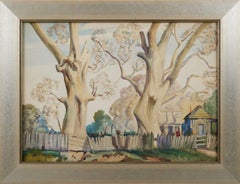
Two Old Pecan Trees, Early 20th Century Landscape, 1st Place May Show Winner
By Frank Wilcox
Located in Beachwood, OH
Frank Nelson Wilcox (American, 1887–1964)
Two Old Pecan Trees, 1932
Watercolor on paper mounted on board
Signed lower right
21 x 28.25 inches
27 x 35.25 inches, as framed
Exhibited: 1932 May Show (1st Place) Cleveland Museum of Art; Poetics of Place: Charles Burchfield and His Contemporaries, 2001 Cleveland Artist's Foundation.
Frank Nelson Wilcox (October 3, 1887 – April 17, 1964) was a modernist American artist and a master of watercolor. Wilcox is described as the "Dean of Cleveland School painters," though some sources give this appellation to Henry Keller or Frederick Gottwald. Wilcox was born on October 3, 1887 to Frank Nelson Wilcox, Sr. and Jessie Fremont Snow Wilcox at 61 Linwood Street in Cleveland, Ohio. His father, a prominent lawyer, died at home in 1904 shortly before Wilcox' 17th birthday. His brother, lawyer and publisher Owen N. Wilcox, was president of the Gates Legal Publishing Company or The Gates Press. His sister Ruth Wilcox was a respected librarian.
In 1906 Wilcox enrolled from the Cleveland School of Art under the tutelage of Henry Keller, Louis Rorimer, and Frederick Gottwald. He also attended Keller's Berlin Heights summer school from 1909. After graduating in 1910, Wilcox traveled and studied in Europe, sometimes dropping by Académie Colarossi in the evening to sketch the model or the other students at their easels, where he was influenced by French impressionism. Wilcox was influenced by Keller's innovative watercolor techniques, and from 1910 to 1916 they experimented together with impressionism and post-impressionism. Wilcox soon developed his own signature style in the American Scene or Regionalist tradition of the early 20th century. He joined the Cleveland School of Art faculty in 1913. Among his students were Lawrence Edwin Blazey, Carl Gaertner, Paul Travis, and Charles E. Burchfield. Around this time Wilcox became associated with Cowan Pottery.
In 1916 Wilcox married fellow artist Florence Bard, and they spent most of their honeymoon painting in Berlin Heights with Keller. They had one daughter, Mary. In 1918 he joined the Cleveland Society of Artists, a conservative counter to the Bohemian Kokoon Arts Club, and would later serve as its president. He also began teaching night school at the John Huntington Polytechnic Institute at this time, and taught briefly at Baldwin-Wallace College.
Wilcox wrote and illustrated Ohio Indian Trails in 1933, which was favorably reviewed by the New York Times in 1934. This book was edited and reprinted in 1970 by William A. McGill. McGill also edited and reprinted Wilcox' Canals of the Old Northwest in 1969. Wilcox also wrote, illustrated, and published Weather Wisdom in 1949, a limited edition (50 copies) of twenty-four serigraphs (silk screen prints) accompanied by commentary "based upon familiar weather observations commonly made by people living in the country."
Wilcox displayed over 250 works at Cleveland's annual May Show. He received numerous awards, including the Penton Medal for The Omnibus, Paris (1920), Fish Tug on Lake Erie (1921), Blacksmith Shop (1922), and The Gravel Pit (1922). Other paintings include The Trailing Fog (1929), Under the Big Top (1930), and Ohio Landscape...
Category
1930s Ohio - Landscape Drawings and Watercolors
Materials
Watercolor
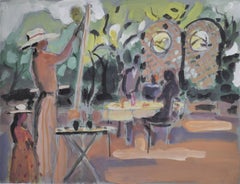
Outdoor Garden Scene of Woman Painting, Late 20th C. Cleveland Female Artist
Located in Beachwood, OH
Algesa O'Sickey (American, 1917-2006)
Woman Painting
Watercolor and ink on green paper
Unsigned
9 x 12 inches
13.75 x 16 inches, framed
Born Algesa D’Agostino on June 4, 1917, Alges...
Category
Late 20th Century Ohio - Landscape Drawings and Watercolors
Materials
Ink, Watercolor
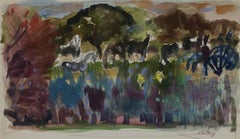
Frosty Dawn, Upstate New York, 20th century American modern watercolor
By Frank Wilcox
Located in Beachwood, OH
Frank Nelson Wilcox (American, 1887-1964)
Frosty Dawn, Upstate New York, c. 1916
Watercolor and gouache on board
Signed lower right
21 x 30 inches
Frank Nelson Wilcox (October 3, 1887 – April 17, 1964) was a modernist American artist and a master of watercolor. Wilcox is described as the "Dean of Cleveland School painters". In 1906 Wilcox enrolled from the Cleveland School of Art...
Category
1910s American Modern Ohio - Landscape Drawings and Watercolors
Materials
Watercolor, Gouache
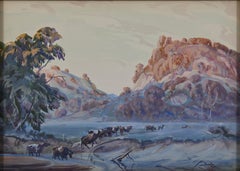
Oxen on Road, Gaspé, Canada, Early 20th Century Cleveland School
By Frank Wilcox
Located in Beachwood, OH
Frank Nelson Wilcox (American, 1887-1964)
Oxen on Road, Gaspé, Canada, 1932
Watercolor on board
Signed and dated lower right
15.25 x 21 inches
Frank Nelson Wilcox (October 3, 1887 – April 17, 1964) was a modernist American artist and a master of watercolor. Wilcox is described as the "Dean of Cleveland School painters," though some sources give this appellation to Henry Keller or Frederick Gottwald. Wilcox was born on October 3, 1887 to Frank Nelson Wilcox, Sr. and Jessie Fremont Snow Wilcox at 61 Linwood Street in Cleveland, Ohio. His father, a prominent lawyer, died at home in 1904 shortly before Wilcox' 17th birthday. His brother, lawyer and publisher Owen N. Wilcox, was president of the Gates Legal Publishing Company or The Gates Press. His sister Ruth Wilcox was a respected librarian.
In 1906 Wilcox enrolled from the Cleveland School of Art under the tutelage of Henry Keller, Louis Rorimer, and Frederick Gottwald. He also attended Keller's Berlin Heights summer school from 1909. After graduating in 1910, Wilcox traveled and studied in Europe, sometimes dropping by Académie Colarossi in the evening to sketch the model or the other students at their easels, where he was influenced by French impressionism. Wilcox was influenced by Keller's innovative watercolor techniques, and from 1910 to 1916 they experimented together with impressionism and post-impressionism. Wilcox soon developed his own signature style in the American Scene or Regionalist tradition of the early 20th century. He joined the Cleveland School of Art faculty in 1913. Among his students were Lawrence Edwin Blazey, Carl Gaertner, Paul Travis, and Charles E. Burchfield. Around this time Wilcox became associated with Cowan Pottery.
In 1916 Wilcox married fellow artist Florence Bard, and they spent most of their honeymoon painting in Berlin Heights with Keller. They had one daughter, Mary. In 1918 he joined the Cleveland Society of Artists, a conservative counter to the Bohemian Kokoon Arts Club, and would later serve as its president. He also began teaching night school at the John Huntington Polytechnic Institute at this time, and taught briefly at Baldwin-Wallace College.
Wilcox wrote and illustrated Ohio Indian Trails in 1933, which was favorably reviewed by the New York Times in 1934. This book was edited and reprinted in 1970 by William A. McGill. McGill also edited and reprinted Wilcox' Canals of the Old Northwest in 1969. Wilcox also wrote, illustrated, and published Weather Wisdom in 1949, a limited edition (50 copies) of twenty-four serigraphs (silk screen prints) accompanied by commentary "based upon familiar weather observations commonly made by people living in the country."
Wilcox displayed over 250 works at Cleveland's annual May Show. He received numerous awards, including the Penton Medal for as The Omnibus, Paris (1920), Fish Tug on Lake Erie (1921), Blacksmith Shop (1922), and The Gravel Pit (1922). Other paintings include The Trailing Fog (1929), Under the Big Top (1930), and Ohio Landscape...
Category
1930s American Modern Ohio - Landscape Drawings and Watercolors
Materials
Watercolor