Palm Beach - Prints and Multiples

to
7
143
188
156
165
237
Overall Width
to
Overall Height
to
168
135
50
36
31
27
7
2
2
2
1
1
1
46
45
34
31
26
5
57
684
143
80
92
78
52
57
34
49
65
61
51
4
610
251
28
499
273
188
155
151
151
100
95
87
79
61
59
53
51
29
28
27
26
25
23
471
218
79
55
25
249
4
51,010
36,886
Item Ships From: Palm Beach
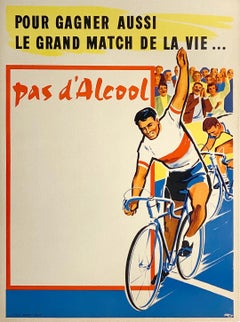
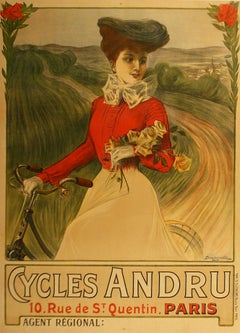
Original Vintage Cycles Andru Poster by Douzinelle c1900
Located in Boca Raton, FL
Cycling became very popular as it became more accessible to more of the public in the early 1900s. It became closely linked to the early women's rights movements as a symbol of their...
Category

Early 1900s Palm Beach - Prints and Multiples

Materials

Lithograph

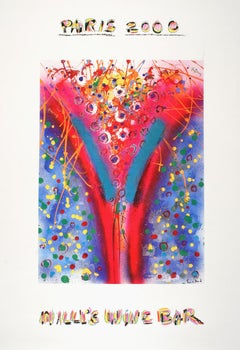
Original Vintage Willi s Wine Bar Poster by Ensrud 2000 Paris
Located in Boca Raton, FL
This is an original lithographic poster printed on heavy weight paper. It was created for the well known Wine Bar called Willi's located in the heart of Paris. Each year they commiss...
Category

Early 2000s Palm Beach - Prints and Multiples

Materials

Lithograph

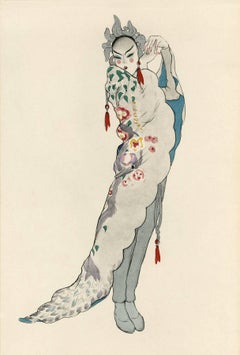
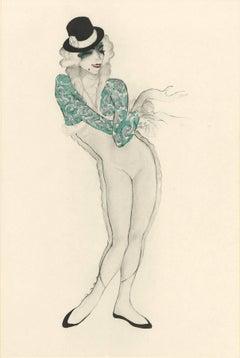
Ballet und Pantomime "Walzer", plate #21.
By Walter Schnackenberg
Located in Palm Beach, FL
Walter Schnackenberg’s style changed several times during his long and successful career. Having studied in Munich, the artist traveled often to Paris where he fell under the spell of the Henri de Toulouse-Lautrec’s colorful and sensuous posters depicting theatrical and decadent subjects. Schnackenberg became a regular contributor of similar compositions to the German magazines Jugend and Simplicissimus before devoting himself to the design of stage scenery and costumes. In the artist’s theatrical work, his mastery of form, ornamentation, and Orientalism became increasingly evident. He excelled at combining fluid Art Nouveau outlines, with spiky Expressionist passages, and the postures and patterns of the mysterious East. In his later years, Schnackenberg explored the unconscious, using surreal subject matter and paler colors that plainly portrayed dreams and visions, some imbued with political connotations. His drawings, illustrations, folio prints, and posters are highly sought today for their exceedingly imaginative qualities, enchanting subject matter, and arresting use of color. SCHNACKENBERG BALLET UND PANTOMIME...
Category

1920s Art Deco Palm Beach - Prints and Multiples

Materials

Paper

Original Cachou Lajaunie Vintage Art Nouveau Poster 1905 by Francisco Tamagno
Located in Boca Raton, FL
Cachou Lajaunie is French advertisement from 1905 by the artist, Francisco Tamangno. Cachou Lajaunie is a licorice candy whose strong flavor was designed to disguise the smoker's breath. Tamangno's composition places the Victorian woman in the center. She holds the small tin...
Category

Early 1900s Palm Beach - Prints and Multiples

Materials

Lithograph

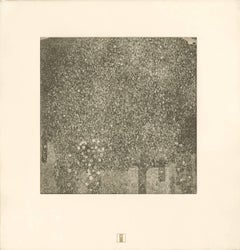
H.O. Miethke Das Werk folio "Rose" collotype print
By Gustav Klimt K.K. Hof-und Staatsdruckerei
Located in Palm Beach, FL
DAS WERK GUSTAV KLIMTS, a portfolio of 50 prints, ten of which are multicolor collotypes on chine colle paper laid down on hand-made heavy cream wove paper wi...
Category

Early 1900s Vienna Secession Palm Beach - Prints and Multiples

Materials

Paper

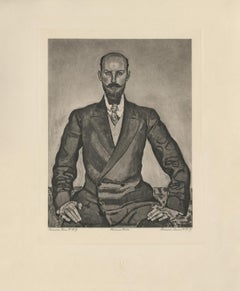
"Portrait of Herrn Willy Russ-Young" Copper Plate Heliogravure
By Ferdinand Hodler R. Piper Co.
Located in Palm Beach, FL
2018 marks the centenary anniversary of Ferdinand Hodler’s death. In that 100 years time, the art world’s esteem of this important artist has proved fickle. It has shifted from extolling his artistic merits during his lifetime to showing something of a feigned disdain- more reflective of the world political order than a true change of heart for Hodler’s work. After years of Hodler being all but a footnote in the annals of art history and generally ignored, finally, the pendulum has righted itself once again. Recent retrospective exhibitions in Europe and the United States have indicated not only a joyful rediscovery of Hodler’s art but a firm conviction that his work and world view hold particular relevance today. DAS WERK FERDINAND HODLERS is not only a collection of printed work reflecting the best of all of his painted work created up to 1914 just before the outbreak of World War I, the portfolio itself is an encapsulation of Hodler’s ethos, Parallelisme. Hodler developed his philosophy of Parallelisme as a unifying approach to art which strips away detail in search of harmony. By means of abstraction, symmetry and repetition, Hodler sought ways to depict Nature’s essence and her fundamental, universal order. He believed these universal laws governing the natural, observable world extend to the spiritual realm. Symbolist in nature with Romantic undertones, his works are equally portraits of these universal concepts and feelings governing all life as they are a visual portrait in the formal sense. Whether his subject is a solitary tree, a moment in battle, mortal fear, despair, the awe inspired by a vast mountain range, a tender moment or even the collective conviction in a belief, Hodler unveils this guiding principle of Parallelisme. Several aspects of Hodler’s portfolio reinforce his tenets of Parallelisme. The Table of Contents clearly preferences a harmonious design over detail. The two columns, consisting of twenty lines each, list the images by order of appearance using their German titles. The abbreviated titles are somewhat cryptic in that they obscure the identities of the sitters. Like the image Hodler presents, they are distillations of the sitter without any extraneous details. This shortening was also done in an effort to maintain a harmonious symmetry of the Table of Contents, themselves, and keep titles to a one-line limit. The twenty-fourth title: “Bildnis des Schweizerischen Gesandten C.” was so long, even with abbreviation, that it required two lines; so, for the sake of maintaining symmetry, the fortieth title: “Bauernmadchen” was omitted from the list. This explains why the images are not numbered. Hodler’s reasoning is not purely esoteric. Symmetry and pattern reach beyond mere formal design principles. Finding sameness and imposing it over disorder goes to the root of Hodler’s identity and his art. A Swiss native, Hodler was bi-lingual and spoke German and French. Each printed image, even number forty, have titles in both of Hodler’s languages. Certainly, there was a market for Hodler’s work among francophones and this inclusion may have been a polite gesture to that end; however, this is the only place in the portfolio which includes French. With German titles at the lower left of each image, Hodler’s name at bottom center and corresponding French titles at the lower right of each image, there is a harmony and symmetry woven into all aspects of the portfolio. This holds true for the page design, as it applies to each printed image and as it describes the Swiss artist himself. Seen in this light, Hodler’s portfolio of printed work is the epitome of Hodler’s Parallelisme. DAS WERK FERDINAND HODLERS is also one of the most significant documents to best tell the story of how Hodler, from Switzerland, became caught between political cross-hairs and how the changing tides of nations directly impacted the artist during his lifetime as well as the accessibility of his art for generations to come. The Munich-based publisher of the portfolio, R. Piper & Co., Verlag, plays a crucial role in this story. Publishing on a wide range of subjects from philosophy and world religion to music, literature and the visual arts; the publisher’s breadth of inquiry within any one genre was equal in scope. Their marketing strategy to publish multiple works on Hodler offers great insight as to what a hot commodity Hodler was at that time. R.Piper & Co.’s Almanach, which they published in 1914 in commemoration of their first ten years in business, clearly illustrates the rapid succession- strategically calculated for achieving the deepest and broadest impact - in which they released three works on Hodler to hit the market by the close of 1914. DAS WERK FERDINAND HODLERS was their premier publication. It preceded C.A. Loosli’s Die Zeichnungen Ferdinand Hodlers, a print portfolio after 50 drawings by Hodler which was released in Autumn of 1914 at the mid-level price-point of 75-150 Marks; and a third less expensive collection of prints after original works by Hodler, which had not been included in either of the first two portfolios, was released at the end of that year entitled Ferdinand Hodler by Dr. Ewald Bender. The title and timing of DAS WERK FERDINAND HODLERS' debut leaves little doubt as to the connection it has with another avant-garde portfolio of art prints, Das Werk Gustav Klimts, released in 5 installments from 1908 -1914 by Galerie Miethke in Vienna. Hodler, himself, was involved in Klimt’s ground-breaking project. As the owner of Klimt’s 1901 painting, “Judith with the Head of Holifernes” which appears as the ninth collotype print in the second installment of Das Werk Gustav Klimts, Hodler was obliged to grant access of the painting to the art printers in Vienna for them to create the collotype sometime before 1908. Hodler had been previously invited in 1904 to take part in what would be the last exhibition of the Vienna Secession before Klimt and others associated with Galerie Miethke broke away. In an interview that same year, Hodler indicated that he respected and was impressed by Klimt. Hodler’s esteem for Klimt went beyond the art itself; he emulated Klimt’s method aimed at increasing his market reach and appeal to a wider audience by creating a print portfolio of his painted work. By 1914, Hodler and his publisher had the benefit of hindsight to learn from Klimt’s Das Werk publication. Responding to the sluggish sales of Klimt’s expensive endeavor, Hodler’s publisher devised the same diversified 1-2-3 strategy for selling Hodler’s Das Werk portfolio as they did with regards to all three works on Hodler they published that year. For their premium tier of DAS WERKS FERDINAND HODLERS, R. Piper & Co. issued an exclusive Museum quality edition of 15 examples on which Hodler signed each page. At a cost of 600 Marks, this was generally on par with Klimt’s asking price of 600 Kronen for his Das Werk portfolio. A middle-tiered Preferred edition of 30, costing somewhat less and with Hodler’s signature only on the Title Page, was also available. The General edition, targeting the largest audience with its much more affordable price of 150 Marks, is distinguishable by its smaller size. Rather than use the subscription format Miethke had chosen for Klimt’s portfolios which proved to have had its challenges, R. Piper & Co. employed a different strategy. In addition to instantly gratifying the buyer with all 40 of the prints comprising DAS WERK FERDINAND HODLERS and the choice among three price points, they advertised in German journals a fourth possibility of ordering single prints from them directly. These printed images are easily discernible from the three complete folio editions. The paper size of the single purchased images is of the larger format like the Museum and Preferred editions, measuring 65 h x 50 w cm; however, the paper itself is the same copper print paper used in the General edition and then mounted on poster board. The publishing house positioned itself to be a direct retailer of Hodler’s art. They astutely recognized the potential for profitability and the importance, therefore, of having proprietary control over his graphic works. R. Piper & Co. owned the exclusive printing rights to Hodler’s best work found in their three publications dating from 1914. That same year, a competing publication out of Weimar entitled Ferdinand Hodler: Ein Deutungsversuch von Hans Muhlestein appeared. Its author, a young scholar, expressed his frustration with the limited availability of printable work by Hodler. In his Author’s Note on page 19, dated Easter, 1914, Muhlestein confirms that the publisher of Hodler’s three works from that same year owned the exclusive reproductive rights to Hodler’s printed original work. He goes further to explain that even after offering to pay to use certain of those images in his book, the publisher refused. Clearly, a lot of jockeying for position in what was perceived as a hot market was occurring in 1914. Instead, their timing couldn’t have been more ill-fated, and what began with such high hopes suddenly found a much different market amid a hostile climate. The onset of WWI directly impacted sales. Many, including Ferdinand Hodler, publicly protested the September invasion by Germany of France in which the Reims Cathedral, re-built in the 13th century, was shelled, destroying priceless stained glass and statuary and burning off the iron roof and badly damaging its wooden interior. Thomas Gaehtgens, Director of the Getty Research Institute describes how the bombing of Reims Cathedral triggered blindingly powerful and deeply-felt ultra-nationalistic responses: “The event profoundly shocked French intellectuals, who for the most part had an intense admiration for German literature, music and art. By relying on press accounts and abstracting from the visual propagandistic content, they were unable to interpret the siege of Reims without turning away from German culture in disgust. Similarly, the German intelligentsia and bourgeoisie were also shocked to find themselves described as vandals and barbarians. Ninety-three writers, scientists, university professors, and artists signed a protest, directed against the French insults, that defended the actions of the German army.” In similar fashion, a flurry of open letters published in German newspapers and journals as well as telegrams and postcards sent directly to Hodler following his outcry in support of Reims reflected the collectively critical reaction to Hodler’s position. Loosli documents that among the list of telegrams Hodler received was one from none other than his publisher in Germany, R.Piper & Co. Allegiances were questioned. The market for Hodler in Germany immediately softened. Matters worsened for the publisher beyond the German backlash to Hodler and his loss of appeal in the home market; with the war in full swing until 1918, there was little chance a German publisher would have much interest coming from outside of Germany and Austria. Following the war and Hodler’s death in 1918, the economy in Germany continued to spiral out and just 5 years later, hyper-inflation had rendered its currency worthless vis-a-vis its value in the pre-war years. Like the economy, Hodler’s reputation was slow to find currency in these difficult times. Even many French art fans had turned sour on Hodler as they considered his long-standing relationship in German and Austrian art circles. Thus, the portfolio’s rarity in Hodler’s lifetime and, consequently, the availability of these printed images from DAS WERK FERDINAND HODLERS since his death has been scarce. In many ways, Hodler and his portfolios were casualties of war. Thwarted from their intended purpose of reaching a wide audience and show-casing Parallelisme, Hodler’s unique approach to art, this important, undated work has been both elusive and shrouded in mystery. Perhaps DAS WERK FERDINAND HODLERS was left undated as a means of affirming the timelessness of Hodler’s art. Digging back into the past, Hodler’s contemporaries, like R. Piper, C.A. Loosli and Hans Muhlestein, indeed provide the keys to unequivocally clarify what has largely been mired in obscurity. Just after Hodler’s death, the May, 1918 issue of the Burlington Review ran a small column which opined hope for better access to R.Piper & Co.’s DAS WERK FERDINAND HODLERS; 100 years later, it is finally possible. Hodler’s voice rings out through these printed works. Once more, his modern approach to depicting portraits, landscapes and grand scale scenes of Swiss history speak to us of what is universal. Engaging with any one of these images is the chance to connect to Hodler’s vision and his world view- weltanschauung in German, vision du monde in French- however one expresses these concepts through language, its message embedded in his work is the same: “We differ from one another, but we are like each other even more. What unifies us is greater and more powerful than what divides us.” Today, Hodler’s art couldn’t be more timely. FERDINAND HODLER (SWISS, 1853-1918) explored Parallelisme through figurative poses evocative of music, dance and ritual. His images of sex, night, desertion and death as well as his many landscapes exploring the universal longing for harmony with Nature are unique and important works embodying a Symbolist paradigm. Truly a Modern Master, Hodler’s influence can be felt in the work of Gustav Klimt and Kolomon Moser and subsequent Expressionist artists such as Egon Schiele. He was born into an impoverished family in Bern, Switzerland in 1853. His entire family succumbed to tuberculosis, and he was orphaned by the age of 13, the only surviving child among his 13 siblings. In the absence of family, the influence and guidance which his art instructors provided Hodler was foundational and profound. Hodler began formal studies in 1872 at the Geneva School of Design. Under Barthelemy Menn, Hodler was drawn to the ordered beauty of Euclidian geometry and Durer’s fundamentals of human proportion that proved to be guiding principles informing his art throughout his life. By the 1880s, Hodler began to enjoy some recognition for his work which put him on a new path towards stability. Remaining in Geneva, he became assistant to the well-known muralist, Edouard Castres. Following his first solo show in 1885, Hodler’s work took on a Symbolist quality. He frequently associated with a group of Swiss Symbolist...
Category

1910s Symbolist Palm Beach - Prints and Multiples

Materials

Paper

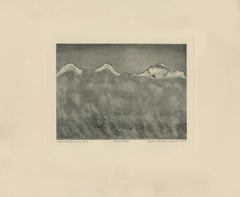
"Three Mountaintops Emerging From Fog" Copper Plate Heliogravure
By Ferdinand Hodler R. Piper Co.
Located in Palm Beach, FL
2018 marks the centenary anniversary of Ferdinand Hodler’s death. In that 100 years time, the art world’s esteem of this important artist has proved fickle. It has shifted from extolling his artistic merits during his lifetime to showing something of a feigned disdain- more reflective of the world political order than a true change of heart for Hodler’s work. After years of Hodler being all but a footnote in the annals of art history and generally ignored, finally, the pendulum has righted itself once again. Recent retrospective exhibitions in Europe and the United States have indicated not only a joyful rediscovery of Hodler’s art but a firm conviction that his work and world view hold particular relevance today. DAS WERK FERDINAND HODLERS is not only a collection of printed work reflecting the best of all of his painted work created up to 1914 just before the outbreak of World War I, the portfolio itself is an encapsulation of Hodler’s ethos, Parallelisme. Hodler developed his philosophy of Parallelisme as a unifying approach to art which strips away detail in search of harmony. By means of abstraction, symmetry and repetition, Hodler sought ways to depict Nature’s essence and her fundamental, universal order. He believed these universal laws governing the natural, observable world extend to the spiritual realm. Symbolist in nature with Romantic undertones, his works are equally portraits of these universal concepts and feelings governing all life as they are a visual portrait in the formal sense. Whether his subject is a solitary tree, a moment in battle, mortal fear, despair, the awe inspired by a vast mountain range, a tender moment or even the collective conviction in a belief, Hodler unveils this guiding principle of Parallelisme. Several aspects of Hodler’s portfolio reinforce his tenets of Parallelisme. The Table of Contents clearly preferences a harmonious design over detail. The two columns, consisting of twenty lines each, list the images by order of appearance using their German titles. The abbreviated titles are somewhat cryptic in that they obscure the identities of the sitters. Like the image Hodler presents, they are distillations of the sitter without any extraneous details. This shortening was also done in an effort to maintain a harmonious symmetry of the Table of Contents, themselves, and keep titles to a one-line limit. The twenty-fourth title: “Bildnis des Schweizerischen Gesandten C.” was so long, even with abbreviation, that it required two lines; so, for the sake of maintaining symmetry, the fortieth title: “Bauernmadchen” was omitted from the list. This explains why the images are not numbered. Hodler’s reasoning is not purely esoteric. Symmetry and pattern reach beyond mere formal design principles. Finding sameness and imposing it over disorder goes to the root of Hodler’s identity and his art. A Swiss native, Hodler was bi-lingual and spoke German and French. Each printed image, even number forty, have titles in both of Hodler’s languages. Certainly, there was a market for Hodler’s work among francophones and this inclusion may have been a polite gesture to that end; however, this is the only place in the portfolio which includes French. With German titles at the lower left of each image, Hodler’s name at bottom center and corresponding French titles at the lower right of each image, there is a harmony and symmetry woven into all aspects of the portfolio. This holds true for the page design, as it applies to each printed image and as it describes the Swiss artist himself. Seen in this light, Hodler’s portfolio of printed work is the epitome of Hodler’s Parallelisme. DAS WERK FERDINAND HODLERS is also one of the most significant documents to best tell the story of how Hodler, from Switzerland, became caught between political cross-hairs and how the changing tides of nations directly impacted the artist during his lifetime as well as the accessibility of his art for generations to come. The Munich-based publisher of the portfolio, R. Piper & Co., Verlag, plays a crucial role in this story. Publishing on a wide range of subjects from philosophy and world religion to music, literature and the visual arts; the publisher’s breadth of inquiry within any one genre was equal in scope. Their marketing strategy to publish multiple works on Hodler offers great insight as to what a hot commodity Hodler was at that time. R.Piper & Co.’s Almanach, which they published in 1914 in commemoration of their first ten years in business, clearly illustrates the rapid succession- strategically calculated for achieving the deepest and broadest impact - in which they released three works on Hodler to hit the market by the close of 1914. DAS WERK FERDINAND HODLERS was their premier publication. It preceded C.A. Loosli’s Die Zeichnungen Ferdinand Hodlers, a print portfolio after 50 drawings by Hodler which was released in Autumn of 1914 at the mid-level price-point of 75-150 Marks; and a third less expensive collection of prints after original works by Hodler, which had not been included in either of the first two portfolios, was released at the end of that year entitled Ferdinand Hodler by Dr. Ewald Bender. The title and timing of DAS WERK FERDINAND HODLERS' debut leaves little doubt as to the connection it has with another avant-garde portfolio of art prints, Das Werk Gustav Klimts, released in 5 installments from 1908 -1914 by Galerie Miethke in Vienna. Hodler, himself, was involved in Klimt’s ground-breaking project. As the owner of Klimt’s 1901 painting, “Judith with the Head of Holifernes” which appears as the ninth collotype print in the second installment of Das Werk Gustav Klimts, Hodler was obliged to grant access of the painting to the art printers in Vienna for them to create the collotype sometime before 1908. Hodler had been previously invited in 1904 to take part in what would be the last exhibition of the Vienna Secession before Klimt and others associated with Galerie Miethke broke away. In an interview that same year, Hodler indicated that he respected and was impressed by Klimt. Hodler’s esteem for Klimt went beyond the art itself; he emulated Klimt’s method aimed at increasing his market reach and appeal to a wider audience by creating a print portfolio of his painted work. By 1914, Hodler and his publisher had the benefit of hindsight to learn from Klimt’s Das Werk publication. Responding to the sluggish sales of Klimt’s expensive endeavor, Hodler’s publisher devised the same diversified 1-2-3 strategy for selling Hodler’s Das Werk portfolio as they did with regards to all three works on Hodler they published that year. For their premium tier of DAS WERKS FERDINAND HODLERS, R. Piper & Co. issued an exclusive Museum quality edition of 15 examples on which Hodler signed each page. At a cost of 600 Marks, this was generally on par with Klimt’s asking price of 600 Kronen for his Das Werk portfolio. A middle-tiered Preferred edition of 30, costing somewhat less and with Hodler’s signature only on the Title Page, was also available. The General edition, targeting the largest audience with its much more affordable price of 150 Marks, is distinguishable by its smaller size. Rather than use the subscription format Miethke had chosen for Klimt’s portfolios which proved to have had its challenges, R. Piper & Co. employed a different strategy. In addition to instantly gratifying the buyer with all 40 of the prints comprising DAS WERK FERDINAND HODLERS and the choice among three price points, they advertised in German journals a fourth possibility of ordering single prints from them directly. These printed images are easily discernible from the three complete folio editions. The paper size of the single purchased images is of the larger format like the Museum and Preferred editions, measuring 65 h x 50 w cm; however, the paper itself is the same copper print paper used in the General edition and then mounted on poster board. The publishing house positioned itself to be a direct retailer of Hodler’s art. They astutely recognized the potential for profitability and the importance, therefore, of having proprietary control over his graphic works. R. Piper & Co. owned the exclusive printing rights to Hodler’s best work found in their three publications dating from 1914. That same year, a competing publication out of Weimar entitled Ferdinand Hodler: Ein Deutungsversuch von Hans...
Category

1910s Symbolist Palm Beach - Prints and Multiples

Materials

Paper

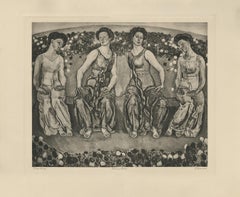
"The Holy Hour with Four Figures" Copper Plate Heliogravure
By Ferdinand Hodler R. Piper Co.
Located in Palm Beach, FL
2018 marks the centenary anniversary of Ferdinand Hodler’s death. In that 100 years time, the art world’s esteem of this important artist has proved fickle. It has shifted from extol...
Category

1910s Symbolist Palm Beach - Prints and Multiples

Materials

Paper

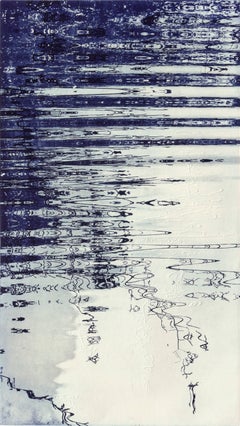
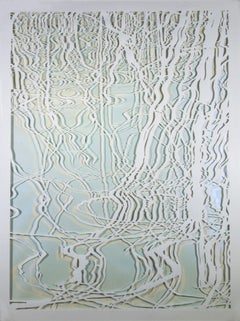
Trails of Water II - 28 X 16" Etching Limited Edition of 50
By Patricia Claro
Located in West Palm Beach, FL
Title: Trail of Water II Blue....Trails of Water I Green also shown. Edition: #28 of 50 image size: 73 x 41 cm / 28,7 x 16,1 “ Paper size: 106 x 78 cm / 41,7 x 30,7 “ Medium: Origina...
Category

2010s Abstract Palm Beach - Prints and Multiples

Materials

Etching

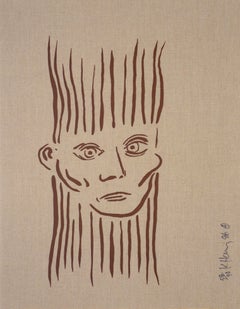
Keith Haring PORTRAIT OF JOSEPH BEUYS Screenprint
By Keith Haring
Located in Lake Worth Beach, FL
Artist/Designer; Manufacturer: Keith Haring (American, 1958-1990) Marking(s); notes: signed, dated, and numbered; numbered 58/90; 1986 Materials: screenprint on canvas Dimensions (H,...
Category

1980s Pop Art Palm Beach - Prints and Multiples

Materials

Screen

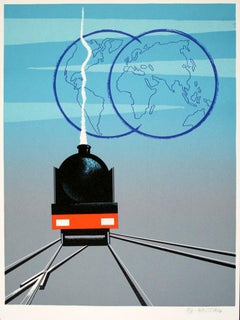
Original Vintage Trains and Globes Poster 1990 Hand Signed by Pierre Fix-Masseau
By Pierre Fix-Masseau
Located in Boca Raton, FL
Train and Globes is a 1990 print by art deco artist Pierre Fix Masseau. The artwork was a unique design commissioned for a marketing event in 1990. The event had a "global networking...
Category

1990s Palm Beach - Prints and Multiples

Materials

Lithograph

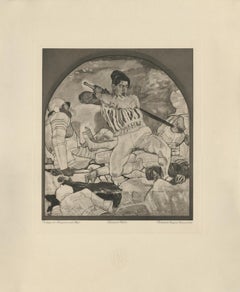
"Retreat from Marignano" set of 3 Copper Plate Prints
By Ferdinand Hodler R. Piper Co.
Located in Palm Beach, FL
The three prints included in this set are: "Retreat from Marignano", "Retreat from Marignano (left panel)", "Retreat from Marignano (right panel)". 2018 marks the centenary anniversary of Ferdinand Hodler’s death. In that 100 years time, the art world’s esteem of this important artist has proved fickle. It has shifted from extolling his artistic merits during his lifetime to showing something of a feigned disdain- more reflective of the world political order than a true change of heart for Hodler’s work. After years of Hodler being all but a footnote in the annals of art history and generally ignored, finally, the pendulum has righted itself once again. Recent retrospective exhibitions in Europe and the United States have indicated not only a joyful rediscovery of Hodler’s art but a firm conviction that his work and world view hold particular relevance today. DAS WERK FERDINAND HODLERS is not only a collection of printed work reflecting the best of all of his painted work created up to 1914 just before the outbreak of World War I, the portfolio itself is an encapsulation of Hodler’s ethos, Parallelisme. Hodler developed his philosophy of Parallelisme as a unifying approach to art which strips away detail in search of harmony. By means of abstraction, symmetry and repetition, Hodler sought ways to depict Nature’s essence and her fundamental, universal order. He believed these universal laws governing the natural, observable world extend to the spiritual realm. Symbolist in nature with Romantic undertones, his works are equally portraits of these universal concepts and feelings governing all life as they are a visual portrait in the formal sense. Whether his subject is a solitary tree, a moment in battle, mortal fear, despair, the awe inspired by a vast mountain range, a tender moment or even the collective conviction in a belief, Hodler unveils this guiding principle of Parallelisme. Several aspects of Hodler’s portfolio reinforce his tenets of Parallelisme. The Table of Contents clearly preferences a harmonious design over detail. The two columns, consisting of twenty lines each, list the images by order of appearance using their German titles. The abbreviated titles are somewhat cryptic in that they obscure the identities of the sitters. Like the image Hodler presents, they are distillations of the sitter without any extraneous details. This shortening was also done in an effort to maintain a harmonious symmetry of the Table of Contents, themselves, and keep titles to a one-line limit. The twenty-fourth title: “Bildnis des Schweizerischen Gesandten C.” was so long, even with abbreviation, that it required two lines; so, for the sake of maintaining symmetry, the fortieth title: “Bauernmadchen” was omitted from the list. This explains why the images are not numbered. Hodler’s reasoning is not purely esoteric. Symmetry and pattern reach beyond mere formal design principles. Finding sameness and imposing it over disorder goes to the root of Hodler’s identity and his art. A Swiss native, Hodler was bi-lingual and spoke German and French. Each printed image, even number forty, have titles in both of Hodler’s languages. Certainly, there was a market for Hodler’s work among francophones and this inclusion may have been a polite gesture to that end; however, this is the only place in the portfolio which includes French. With German titles at the lower left of each image, Hodler’s name at bottom center and corresponding French titles at the lower right of each image, there is a harmony and symmetry woven into all aspects of the portfolio. This holds true for the page design, as it applies to each printed image and as it describes the Swiss artist himself. Seen in this light, Hodler’s portfolio of printed work is the epitome of Hodler’s Parallelisme. DAS WERK FERDINAND HODLERS is also one of the most significant documents to best tell the story of how Hodler, from Switzerland, became caught between political cross-hairs and how the changing tides of nations directly impacted the artist during his lifetime as well as the accessibility of his art for generations to come. The Munich-based publisher of the portfolio, R. Piper & Co., Verlag, plays a crucial role in this story. Publishing on a wide range of subjects from philosophy and world religion to music, literature and the visual arts; the publisher’s breadth of inquiry within any one genre was equal in scope. Their marketing strategy to publish multiple works on Hodler offers great insight as to what a hot commodity Hodler was at that time. R.Piper & Co.’s Almanach, which they published in 1914 in commemoration of their first ten years in business, clearly illustrates the rapid succession- strategically calculated for achieving the deepest and broadest impact - in which they released three works on Hodler to hit the market by the close of 1914. DAS WERK FERDINAND HODLERS was their premier publication. It preceded C.A. Loosli’s Die Zeichnungen Ferdinand Hodlers, a print portfolio after 50 drawings by Hodler which was released in Autumn of 1914 at the mid-level price-point of 75-150 Marks; and a third less expensive collection of prints after original works by Hodler, which had not been included in either of the first two portfolios, was released at the end of that year entitled Ferdinand Hodler by Dr. Ewald Bender. The title and timing of DAS WERK FERDINAND HODLERS' debut leaves little doubt as to the connection it has with another avant-garde portfolio of art prints, Das Werk Gustav Klimts, released in 5 installments from 1908 -1914 by Galerie Miethke in Vienna. Hodler, himself, was involved in Klimt’s ground-breaking project. As the owner of Klimt’s 1901 painting, “Judith with the Head of Holifernes” which appears as the ninth collotype print in the second installment of Das Werk Gustav Klimts, Hodler was obliged to grant access of the painting to the art printers in Vienna for them to create the collotype sometime before 1908. Hodler had been previously invited in 1904 to take part in what would be the last exhibition of the Vienna Secession before Klimt and others associated with Galerie Miethke broke away. In an interview that same year, Hodler indicated that he respected and was impressed by Klimt. Hodler’s esteem for Klimt went beyond the art itself; he emulated Klimt’s method aimed at increasing his market reach and appeal to a wider audience by creating a print portfolio of his painted work. By 1914, Hodler and his publisher had the benefit of hindsight to learn from Klimt’s Das Werk publication. Responding to the sluggish sales of Klimt’s expensive endeavor, Hodler’s publisher devised the same diversified 1-2-3 strategy for selling Hodler’s Das Werk portfolio as they did with regards to all three works on Hodler they published that year. For their premium tier of DAS WERKS FERDINAND HODLERS, R. Piper & Co. issued an exclusive Museum quality edition of 15 examples on which Hodler signed each page. At a cost of 600 Marks, this was generally on par with Klimt’s asking price of 600 Kronen for his Das Werk portfolio. A middle-tiered Preferred edition of 30, costing somewhat less and with Hodler’s signature only on the Title Page, was also available. The General edition, targeting the largest audience with its much more affordable price of 150 Marks, is distinguishable by its smaller size. Rather than use the subscription format Miethke had chosen for Klimt’s portfolios which proved to have had its challenges, R. Piper & Co. employed a different strategy. In addition to instantly gratifying the buyer with all 40 of the prints comprising DAS WERK FERDINAND HODLERS and the choice among three price points, they advertised in German journals a fourth possibility of ordering single prints from them directly. These printed images are easily discernible from the three complete folio editions. The paper size of the single purchased images is of the larger format like the Museum and Preferred editions, measuring 65 h x 50 w cm; however, the paper itself is the same copper print paper used in the General edition and then mounted on poster board. The publishing house positioned itself to be a direct retailer of Hodler’s art. They astutely recognized the potential for profitability and the importance, therefore, of having proprietary control over his graphic works. R. Piper & Co. owned the exclusive printing rights to Hodler’s best work found in their three publications dating from 1914. That same year, a competing publication out of Weimar entitled Ferdinand Hodler: Ein Deutungsversuch von Hans Muhlestein appeared. Its author, a young scholar, expressed his frustration with the limited availability of printable work by Hodler. In his Author’s Note on page 19, dated Easter, 1914, Muhlestein confirms that the publisher of Hodler’s three works from that same year owned the exclusive reproductive rights to Hodler’s printed original work. He goes further to explain that even after offering to pay to use certain of those images in his book, the publisher refused. Clearly, a lot of jockeying for position in what was perceived as a hot market was occurring in 1914. Instead, their timing couldn’t have been more ill-fated, and what began with such high hopes suddenly found a much different market amid a hostile climate. The onset of WWI directly impacted sales. Many, including Ferdinand Hodler, publicly protested the September invasion by Germany of France in which the Reims Cathedral, re-built in the 13th century, was shelled, destroying priceless stained glass and statuary and burning off the iron roof and badly damaging its wooden interior. Thomas Gaehtgens, Director of the Getty Research Institute describes how the bombing of Reims Cathedral triggered blindingly powerful and deeply-felt ultra-nationalistic responses: “The event profoundly shocked French intellectuals, who for the most part had an intense admiration for German literature, music and art. By relying on press accounts and abstracting from the visual propagandistic content, they were unable to interpret the siege of Reims without turning away from German culture in disgust. Similarly, the German intelligentsia and bourgeoisie were also shocked to find themselves described as vandals and barbarians. Ninety-three writers, scientists, university professors, and artists signed a protest, directed against the French insults, that defended the actions of the German army.” In similar fashion, a flurry of open letters published in German newspapers and journals as well as telegrams and postcards sent directly to Hodler following his outcry in support of Reims reflected the collectively critical reaction to Hodler’s position. Loosli documents that among the list of telegrams Hodler received was one from none other than his publisher in Germany, R.Piper & Co. Allegiances were questioned. The market for Hodler in Germany immediately softened. Matters worsened for the publisher beyond the German backlash to Hodler and his loss of appeal in the home market; with the war in full swing until 1918, there was little chance a German publisher would have much interest coming from outside of Germany and Austria. Following the war and Hodler’s death in 1918, the economy in Germany continued to spiral out and just 5 years later, hyper-inflation had rendered its currency worthless vis-a-vis its value in the pre-war years. Like the economy, Hodler’s reputation was slow to find currency in these difficult times. Even many French art fans had turned sour on Hodler as they considered his long-standing relationship in German and Austrian art circles. Thus, the portfolio’s rarity in Hodler’s lifetime and, consequently, the availability of these printed images from DAS WERK FERDINAND HODLERS since his death has been scarce. In many ways, Hodler and his portfolios were casualties of war. Thwarted from their intended purpose of reaching a wide audience and show-casing Parallelisme, Hodler’s unique approach to art, this important, undated work has been both elusive and shrouded in mystery. Perhaps DAS WERK FERDINAND HODLERS was left undated as a means of affirming the timelessness of Hodler’s art. Digging back into the past, Hodler’s contemporaries, like R. Piper, C.A. Loosli and Hans Muhlestein, indeed provide the keys to unequivocally clarify what has largely been mired in obscurity. Just after Hodler’s death, the May, 1918 issue of the Burlington Review ran a small column which opined hope for better access to R.Piper & Co.’s DAS WERK FERDINAND HODLERS; 100 years later, it is finally possible. Hodler’s voice rings out through these printed works. Once more, his modern approach to depicting portraits, landscapes and grand scale scenes of Swiss history speak to us of what is universal. Engaging with any one of these images is the chance to connect to Hodler’s vision and his world view- weltanschauung in German, vision du monde in French- however one expresses these concepts through language, its message embedded in his work is the same: “We differ from one another, but we are like each other even more. What unifies us is greater and more powerful than what divides us.” Today, Hodler’s art couldn’t be more timely. FERDINAND HODLER (SWISS, 1853-1918) explored Parallelisme through figurative poses evocative of music, dance and ritual. His images of sex, night, desertion and death as well as his many landscapes exploring the universal longing for harmony with Nature are unique and important works embodying a Symbolist paradigm. Truly a Modern Master, Hodler’s influence can be felt in the work of Gustav Klimt and Kolomon Moser and subsequent Expressionist artists such as Egon Schiele. He was born into an impoverished family in Bern, Switzerland in 1853. His entire family succumbed to tuberculosis, and he was orphaned by the age of 13, the only surviving child among his 13 siblings. In the absence of family, the influence and guidance which his art instructors provided Hodler was foundational and profound. Hodler began formal studies in 1872 at the Geneva School of Design. Under Barthelemy Menn, Hodler was drawn to the ordered beauty of Euclidian geometry and Durer’s fundamentals of human proportion that proved to be guiding principles informing his art throughout his life. By the 1880s, Hodler began to enjoy some recognition for his work which put him on a new path towards stability. Remaining in Geneva, he became assistant to the well-known muralist, Edouard Castres. Following his first solo show in 1885, Hodler’s work took on a Symbolist quality. He frequently associated with a group of Swiss Symbolist...
Category

1910s Symbolist Palm Beach - Prints and Multiples

Materials

Paper

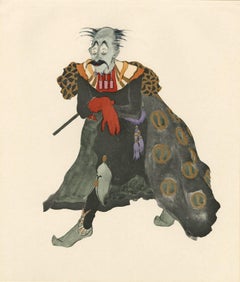
Ballet und Pantomime "Der bose Zauberer" (The Evil Wizard), plate #6.
By Walter Schnackenberg
Located in Palm Beach, FL
Walter Schnackenberg’s style changed several times during his long and successful career. Having studied in Munich, the artist traveled often to Paris where he fell under the spell o...
Category

1920s Art Deco Palm Beach - Prints and Multiples

Materials

Paper

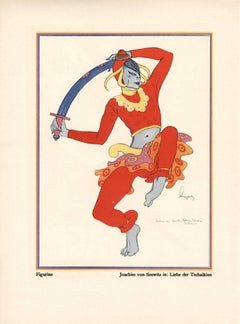
Ballet und Pantomime "Tschaikiun I", print #3.
By Walter Schnackenberg
Located in Palm Beach, FL
Walter Schnackenberg’s style changed several times during his long and successful career. Having studied in Munich, the artist traveled often to Paris where he fell under the spell o...
Category

1920s Art Deco Palm Beach - Prints and Multiples

Materials

Paper

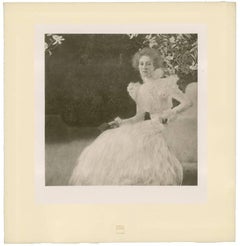
H.O. Miethke Das Werk folio "Portrait of Sonja Knips" collotype print
By Gustav Klimt K.K. Hof-und Staatsdruckerei
Located in Palm Beach, FL
DAS WERK GUSTAV KLIMTS, a portfolio of 50 prints, ten of which are multicolor collotypes on chine colle paper laid down on hand-made heavy cream wove paper with deckled edges; under ...
Category

Early 1900s Vienna Secession Palm Beach - Prints and Multiples

Materials

Paper

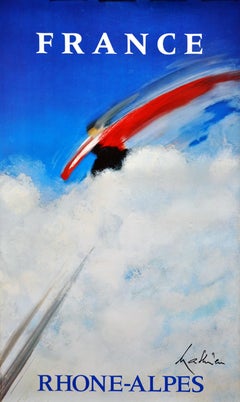
Original Vintage Travel Poster France Rhone Alpes by Mathieu
By Georges Mathieu
Located in Boca Raton, FL
This is one of a series of 4 images by Georges Mathieu commissioned by the Rhone Alpes region in France to promote its many scenic attractions. In this image, Mathieu suggests to the...
Category

1990s Palm Beach - Prints and Multiples

Materials

Lithograph

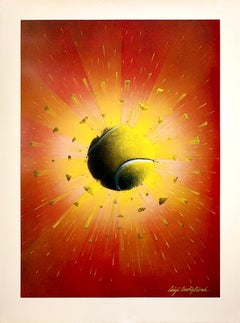
Tennis - Exploding Ball Original Vintage Print by Luigi Castiglioni c1983
Located in Boca Raton, FL
Luigi Castiglioni (1936 - 2003) once said, "There is no need to show dedication, everybody [already] knows that it is inseparable from sports". Instead, he chose to highlight the qui...
Category

1980s Palm Beach - Prints and Multiples

Materials

Lithograph

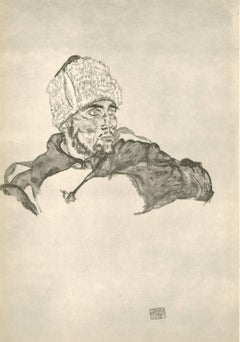
R. Layni, Zeichnungen folio, "Russian Soldier" Collotype plate VII
Located in Palm Beach, FL
Egon Schiele (1890 – 1918), AUSTRIA “ART CANNOT BE MODERN, ART IS PRIMORDIALLY ETERNAL.” -SCHIELE Defiantly iconoclastic in life and art, Egon Schiele is esteemed for his masterful draftsmanship and precocious insight into the human condition. Part of the first wave of Austrian Modernism, he was swept away by the Viennese fascination with the tension between Life and Death (known in the works of Freud and his later interpreters as Eros and Thanatos). Life, identified with attraction, love, sexuality, and reproduction, and Death, represented by distortion, disease, repulsion, and hysteria, often appeared in the same composition, thereby suggesting the frightening life cycle of the human mind and body. Young throughout his career, Schiele universalized his childhood traumas, thriving libido, insecurities, fears, and longings. His contorted line, jarring contrasts, and flat areas of color, demonstrate an early alliance with Expressionist philosophy and artists who were relentlessly frustrated by conventionality in all its forms. Schiele’s work embodied man’s disorientation and confusion in a seemingly absurd world, a world plagued by disease and war. It continues to be astonishingly relevant today, not just because it helped define Modernism but also because it revealed the dark and immutable aspects of the human condition. Zeichnungen is a fine art print portfolio published by Verlag der Buchhandlung Richard Lanyi, Vienna, 1917, printed by Max Jaffe...
Category

1910s Vienna Secession Palm Beach - Prints and Multiples

Materials

Paper

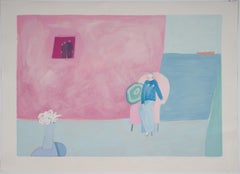
Unframed "Seated Woman on Pink Chair" signed lithograph by artist Joy Laville
By Joy Laville
Located in Boca Raton, FL
Unframed "Seated Woman on Pink Chair" lithograph by artist Joy Laville. Signed H J Laville lower right recto. Image size: 31 x 43 inches.
Category

1980s Modern Palm Beach - Prints and Multiples

Materials

Lithograph

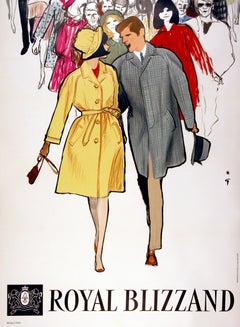
Original Vintage Royal Blizzand Poster by Rene Gruau Trenchcoat c1965
By René Gruau
Located in Boca Raton, FL
In this poster by fashion illustrator, Rene Gruau, a couple is observed walking into the forefront of the image wearing elegant and beautifully illustrated coats in the typical Gruau...
Category

1960s Palm Beach - Prints and Multiples

Materials

Lithograph

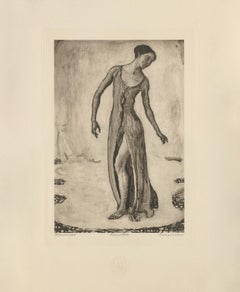
"Woman Turning Around" Copper Plate Heliogravure
By Ferdinand Hodler R. Piper Co.
Located in Palm Beach, FL
2018 marks the centenary anniversary of Ferdinand Hodler’s death. In that 100 years time, the art world’s esteem of this important artist has proved fickle. It has shifted from extolling his artistic merits during his lifetime to showing something of a feigned disdain- more reflective of the world political order than a true change of heart for Hodler’s work. After years of Hodler being all but a footnote in the annals of art history and generally ignored, finally, the pendulum has righted itself once again. Recent retrospective exhibitions in Europe and the United States have indicated not only a joyful rediscovery of Hodler’s art but a firm conviction that his work and world view hold particular relevance today. DAS WERK FERDINAND HODLERS is not only a collection of printed work reflecting the best of all of his painted work created up to 1914 just before the outbreak of World War I, the portfolio itself is an encapsulation of Hodler’s ethos, Parallelisme. Hodler developed his philosophy of Parallelisme as a unifying approach to art which strips away detail in search of harmony. By means of abstraction, symmetry and repetition, Hodler sought ways to depict Nature’s essence and her fundamental, universal order. He believed these universal laws governing the natural, observable world extend to the spiritual realm. Symbolist in nature with Romantic undertones, his works are equally portraits of these universal concepts and feelings governing all life as they are a visual portrait in the formal sense. Whether his subject is a solitary tree, a moment in battle, mortal fear, despair, the awe inspired by a vast mountain range, a tender moment or even the collective conviction in a belief, Hodler unveils this guiding principle of Parallelisme. Several aspects of Hodler’s portfolio reinforce his tenets of Parallelisme. The Table of Contents clearly preferences a harmonious design over detail. The two columns, consisting of twenty lines each, list the images by order of appearance using their German titles. The abbreviated titles are somewhat cryptic in that they obscure the identities of the sitters. Like the image Hodler presents, they are distillations of the sitter without any extraneous details. This shortening was also done in an effort to maintain a harmonious symmetry of the Table of Contents, themselves, and keep titles to a one-line limit. The twenty-fourth title: “Bildnis des Schweizerischen Gesandten C.” was so long, even with abbreviation, that it required two lines; so, for the sake of maintaining symmetry, the fortieth title: “Bauernmadchen” was omitted from the list. This explains why the images are not numbered. Hodler’s reasoning is not purely esoteric. Symmetry and pattern reach beyond mere formal design principles. Finding sameness and imposing it over disorder goes to the root of Hodler’s identity and his art. A Swiss native, Hodler was bi-lingual and spoke German and French. Each printed image, even number forty, have titles in both of Hodler’s languages. Certainly, there was a market for Hodler’s work among francophones and this inclusion may have been a polite gesture to that end; however, this is the only place in the portfolio which includes French. With German titles at the lower left of each image, Hodler’s name at bottom center and corresponding French titles at the lower right of each image, there is a harmony and symmetry woven into all aspects of the portfolio. This holds true for the page design, as it applies to each printed image and as it describes the Swiss artist himself. Seen in this light, Hodler’s portfolio of printed work is the epitome of Hodler’s Parallelisme. DAS WERK FERDINAND HODLERS is also one of the most significant documents to best tell the story of how Hodler, from Switzerland, became caught between political cross-hairs and how the changing tides of nations directly impacted the artist during his lifetime as well as the accessibility of his art for generations to come. The Munich-based publisher of the portfolio, R. Piper & Co., Verlag, plays a crucial role in this story. Publishing on a wide range of subjects from philosophy and world religion to music, literature and the visual arts; the publisher’s breadth of inquiry within any one genre was equal in scope. Their marketing strategy to publish multiple works on Hodler offers great insight as to what a hot commodity Hodler was at that time. R.Piper & Co.’s Almanach, which they published in 1914 in commemoration of their first ten years in business, clearly illustrates the rapid succession- strategically calculated for achieving the deepest and broadest impact - in which they released three works on Hodler to hit the market by the close of 1914. DAS WERK FERDINAND HODLERS was their premier publication. It preceded C.A. Loosli’s Die Zeichnungen Ferdinand Hodlers, a print portfolio after 50 drawings by Hodler which was released in Autumn of 1914 at the mid-level price-point of 75-150 Marks; and a third less expensive collection of prints after original works by Hodler, which had not been included in either of the first two portfolios, was released at the end of that year entitled Ferdinand Hodler by Dr. Ewald Bender. The title and timing of DAS WERK FERDINAND HODLERS' debut leaves little doubt as to the connection it has with another avant-garde portfolio of art prints, Das Werk Gustav Klimts, released in 5 installments from 1908 -1914 by Galerie Miethke in Vienna. Hodler, himself, was involved in Klimt’s ground-breaking project. As the owner of Klimt’s 1901 painting, “Judith with the Head of Holifernes” which appears as the ninth collotype print in the second installment of Das Werk Gustav Klimts, Hodler was obliged to grant access of the painting to the art printers in Vienna for them to create the collotype sometime before 1908. Hodler had been previously invited in 1904 to take part in what would be the last exhibition of the Vienna Secession before Klimt and others associated with Galerie Miethke broke away. In an interview that same year, Hodler indicated that he respected and was impressed by Klimt. Hodler’s esteem for Klimt went beyond the art itself; he emulated Klimt’s method aimed at increasing his market reach and appeal to a wider audience by creating a print portfolio of his painted work. By 1914, Hodler and his publisher had the benefit of hindsight to learn from Klimt’s Das Werk publication. Responding to the sluggish sales of Klimt’s expensive endeavor, Hodler’s publisher devised the same diversified 1-2-3 strategy for selling Hodler’s Das Werk portfolio as they did with regards to all three works on Hodler they published that year. For their premium tier of DAS WERKS FERDINAND HODLERS, R. Piper & Co. issued an exclusive Museum quality edition of 15 examples on which Hodler signed each page. At a cost of 600 Marks, this was generally on par with Klimt’s asking price of 600 Kronen for his Das Werk portfolio. A middle-tiered Preferred edition of 30, costing somewhat less and with Hodler’s signature only on the Title Page, was also available. The General edition, targeting the largest audience with its much more affordable price of 150 Marks, is distinguishable by its smaller size. Rather than use the subscription format Miethke had chosen for Klimt’s portfolios which proved to have had its challenges, R. Piper & Co. employed a different strategy. In addition to instantly gratifying the buyer with all 40 of the prints comprising DAS WERK FERDINAND HODLERS and the choice among three price points, they advertised in German journals a fourth possibility of ordering single prints from them directly. These printed images are easily discernible from the three complete folio editions. The paper size of the single purchased images is of the larger format like the Museum and Preferred editions, measuring 65 h x 50 w cm; however, the paper itself is the same copper print paper used in the General edition and then mounted on poster board. The publishing house positioned itself to be a direct retailer of Hodler’s art. They astutely recognized the potential for profitability and the importance, therefore, of having proprietary control over his graphic works. R. Piper & Co. owned the exclusive printing rights to Hodler’s best work found in their three publications dating from 1914. That same year, a competing publication out of Weimar entitled Ferdinand Hodler: Ein Deutungsversuch von Hans Muhlestein appeared. Its author, a young scholar, expressed his frustration with the limited availability of printable work by Hodler. In his Author’s Note on page 19, dated Easter, 1914, Muhlestein confirms that the publisher of Hodler’s three works from that same year owned the exclusive reproductive rights to Hodler’s printed original work. He goes further to explain that even after offering to pay to use certain of those images in his book, the publisher refused. Clearly, a lot of jockeying for position in what was perceived as a hot market was occurring in 1914. Instead, their timing couldn’t have been more ill-fated, and what began with such high hopes suddenly found a much different market amid a hostile climate. The onset of WWI directly impacted sales. Many, including Ferdinand Hodler, publicly protested the September invasion by Germany of France in which the Reims Cathedral, re-built in the 13th century, was shelled, destroying priceless stained glass and statuary and burning off the iron roof and badly damaging its wooden interior. Thomas Gaehtgens, Director of the Getty Research Institute describes how the bombing of Reims Cathedral triggered blindingly powerful and deeply-felt ultra-nationalistic responses: “The event profoundly shocked French intellectuals, who for the most part had an intense admiration for German literature, music and art. By relying on press accounts and abstracting from the visual propagandistic content, they were unable to interpret the siege of Reims without turning away from German culture in disgust. Similarly, the German intelligentsia and bourgeoisie were also shocked to find themselves described as vandals and barbarians. Ninety-three writers, scientists, university professors, and artists signed a protest, directed against the French insults, that defended the actions of the German army.” In similar fashion, a flurry of open letters published in German newspapers and journals as well as telegrams and postcards sent directly to Hodler following his outcry in support of Reims reflected the collectively critical reaction to Hodler’s position. Loosli documents that among the list of telegrams Hodler received was one from none other than his publisher in Germany, R.Piper & Co. Allegiances were questioned. The market for Hodler in Germany immediately softened. Matters worsened for the publisher beyond the German backlash to Hodler and his loss of appeal in the home market; with the war in full swing until 1918, there was little chance a German publisher would have much interest coming from outside of Germany and Austria. Following the war and Hodler’s death in 1918, the economy in Germany continued to spiral out and just 5 years later, hyper-inflation had rendered its currency worthless vis-a-vis its value in the pre-war years. Like the economy, Hodler’s reputation was slow to find currency in these difficult times. Even many French art fans had turned sour on Hodler as they considered his long-standing relationship in German and Austrian art circles. Thus, the portfolio’s rarity in Hodler’s lifetime and, consequently, the availability of these printed images from DAS WERK FERDINAND HODLERS since his death has been scarce. In many ways, Hodler and his portfolios were casualties of war. Thwarted from their intended purpose of reaching a wide audience and show-casing Parallelisme, Hodler’s unique approach to art, this important, undated work has been both elusive and shrouded in mystery. Perhaps DAS WERK FERDINAND HODLERS was left undated as a means of affirming the timelessness of Hodler’s art. Digging back into the past, Hodler’s contemporaries, like R. Piper, C.A. Loosli and Hans Muhlestein, indeed provide the keys to unequivocally clarify what has largely been mired in obscurity. Just after Hodler’s death, the May, 1918 issue of the Burlington Review ran a small column which opined hope for better access to R.Piper & Co.’s DAS WERK FERDINAND HODLERS; 100 years later, it is finally possible. Hodler’s voice rings out through these printed works. Once more, his modern approach to depicting portraits, landscapes and grand scale scenes of Swiss history speak to us of what is universal. Engaging with any one of these images is the chance to connect to Hodler’s vision and his world view- weltanschauung in German, vision du monde in French- however one expresses these concepts through language, its message embedded in his work is the same: “We differ from one another, but we are like each other even more. What unifies us is greater and more powerful than what divides us.” Today, Hodler’s art couldn’t be more timely. FERDINAND HODLER (SWISS, 1853-1918) explored Parallelisme through figurative poses evocative of music, dance and ritual. His images of sex, night, desertion and death as well as his many landscapes exploring the universal longing for harmony with Nature are unique and important works embodying a Symbolist paradigm. Truly a Modern Master, Hodler’s influence can be felt in the work of Gustav Klimt and Kolomon Moser and subsequent Expressionist artists such as Egon Schiele. He was born into an impoverished family in Bern, Switzerland in 1853. His entire family succumbed to tuberculosis, and he was orphaned by the age of 13, the only surviving child among his 13 siblings. In the absence of family, the influence and guidance which his art instructors provided Hodler was foundational and profound. Hodler began formal studies in 1872 at the Geneva School of Design. Under Barthelemy Menn, Hodler was drawn to the ordered beauty of Euclidian geometry and Durer’s fundamentals of human proportion that proved to be guiding principles informing his art throughout his life. By the 1880s, Hodler began to enjoy some recognition for his work which put him on a new path towards stability. Remaining in Geneva, he became assistant to the well-known muralist, Edouard Castres. Following his first solo show in 1885, Hodler’s work took on a Symbolist quality. He frequently associated with a group of Swiss Symbolist...
Category

1910s Symbolist Palm Beach - Prints and Multiples

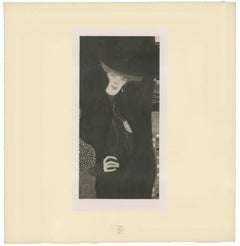
H.O. Miethke Das Werk folio "Portrait of Lady in Red and Black" collotype print
By Gustav Klimt K.K. Hof-und Staatsdruckerei
Located in Palm Beach, FL
DAS WERK GUSTAV KLIMTS, a portfolio of 50 prints, ten of which are multicolor collotypes on chine colle paper laid down on hand-made heavy cream wove paper with deckled edges; under each of the 50 prints is a gold signet intaglio...
Category

Early 1900s Vienna Secession Palm Beach - Prints and Multiples

Materials

Paper

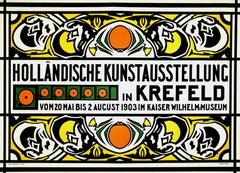
Original Hollandische Kunstausstellung Krefeld Germany Poster by Thorn Prikker
Located in Boca Raton, FL
Decorative ornamentation is on full display in this poster that promotes an exhibit of Dutch art at the Kaiser Wilhem Museum in Krefeld, Germany. This poster is done in the style of...
Category

Early 1900s Palm Beach - Prints and Multiples

Materials

Lithograph

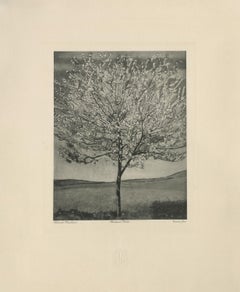
"Cherry Tree in Bloom" Copper Plate Heliogravure
By Ferdinand Hodler R. Piper Co.
Located in Palm Beach, FL
2018 marks the centenary anniversary of Ferdinand Hodler’s death. In that 100 years time, the art world’s esteem of this important artist has proved fickle. It has shifted from extolling his artistic merits during his lifetime to showing something of a feigned disdain- more reflective of the world political order than a true change of heart for Hodler’s work. After years of Hodler being all but a footnote in the annals of art history and generally ignored, finally, the pendulum has righted itself once again. Recent retrospective exhibitions in Europe and the United States have indicated not only a joyful rediscovery of Hodler’s art but a firm conviction that his work and world view hold particular relevance today. DAS WERK FERDINAND HODLERS is not only a collection of printed work reflecting the best of all of his painted work created up to 1914 just before the outbreak of World War I, the portfolio itself is an encapsulation of Hodler’s ethos, Parallelisme. Hodler developed his philosophy of Parallelisme as a unifying approach to art which strips away detail in search of harmony. By means of abstraction, symmetry and repetition, Hodler sought ways to depict Nature’s essence and her fundamental, universal order. He believed these universal laws governing the natural, observable world extend to the spiritual realm. Symbolist in nature with Romantic undertones, his works are equally portraits of these universal concepts and feelings governing all life as they are a visual portrait in the formal sense. Whether his subject is a solitary tree, a moment in battle, mortal fear, despair, the awe inspired by a vast mountain range, a tender moment or even the collective conviction in a belief, Hodler unveils this guiding principle of Parallelisme. Several aspects of Hodler’s portfolio reinforce his tenets of Parallelisme. The Table of Contents clearly preferences a harmonious design over detail. The two columns, consisting of twenty lines each, list the images by order of appearance using their German titles. The abbreviated titles are somewhat cryptic in that they obscure the identities of the sitters. Like the image Hodler presents, they are distillations of the sitter without any extraneous details. This shortening was also done in an effort to maintain a harmonious symmetry of the Table of Contents, themselves, and keep titles to a one-line limit. The twenty-fourth title: “Bildnis des Schweizerischen Gesandten C.” was so long, even with abbreviation, that it required two lines; so, for the sake of maintaining symmetry, the fortieth title: “Bauernmadchen” was omitted from the list. This explains why the images are not numbered. Hodler’s reasoning is not purely esoteric. Symmetry and pattern reach beyond mere formal design principles. Finding sameness and imposing it over disorder goes to the root of Hodler’s identity and his art. A Swiss native, Hodler was bi-lingual and spoke German and French. Each printed image, even number forty, have titles in both of Hodler’s languages. Certainly, there was a market for Hodler’s work among francophones and this inclusion may have been a polite gesture to that end; however, this is the only place in the portfolio which includes French. With German titles at the lower left of each image, Hodler’s name at bottom center and corresponding French titles at the lower right of each image, there is a harmony and symmetry woven into all aspects of the portfolio. This holds true for the page design, as it applies to each printed image and as it describes the Swiss artist himself. Seen in this light, Hodler’s portfolio of printed work is the epitome of Hodler’s Parallelisme. DAS WERK FERDINAND HODLERS is also one of the most significant documents to best tell the story of how Hodler, from Switzerland, became caught between political cross-hairs and how the changing tides of nations directly impacted the artist during his lifetime as well as the accessibility of his art for generations to come. The Munich-based publisher of the portfolio, R. Piper & Co., Verlag, plays a crucial role in this story. Publishing on a wide range of subjects from philosophy and world religion to music, literature and the visual arts; the publisher’s breadth of inquiry within any one genre was equal in scope. Their marketing strategy to publish multiple works on Hodler offers great insight as to what a hot commodity Hodler was at that time. R.Piper & Co.’s Almanach, which they published in 1914 in commemoration of their first ten years in business, clearly illustrates the rapid succession- strategically calculated for achieving the deepest and broadest impact - in which they released three works on Hodler to hit the market by the close of 1914. DAS WERK FERDINAND HODLERS was their premier publication. It preceded C.A. Loosli’s Die Zeichnungen Ferdinand Hodlers, a print portfolio after 50 drawings by Hodler which was released in Autumn of 1914 at the mid-level price-point of 75-150 Marks; and a third less expensive collection of prints after original works by Hodler, which had not been included in either of the first two portfolios, was released at the end of that year entitled Ferdinand Hodler by Dr. Ewald Bender. The title and timing of DAS WERK FERDINAND HODLERS' debut leaves little doubt as to the connection it has with another avant-garde portfolio of art prints, Das Werk Gustav Klimts, released in 5 installments from 1908 -1914 by Galerie Miethke in Vienna. Hodler, himself, was involved in Klimt’s ground-breaking project. As the owner of Klimt’s 1901 painting, “Judith with the Head of Holifernes” which appears as the ninth collotype print in the second installment of Das Werk Gustav Klimts, Hodler was obliged to grant access of the painting to the art printers in Vienna for them to create the collotype sometime before 1908. Hodler had been previously invited in 1904 to take part in what would be the last exhibition of the Vienna Secession before Klimt and others associated with Galerie Miethke broke away. In an interview that same year, Hodler indicated that he respected and was impressed by Klimt. Hodler’s esteem for Klimt went beyond the art itself; he emulated Klimt’s method aimed at increasing his market reach and appeal to a wider audience by creating a print portfolio of his painted work. By 1914, Hodler and his publisher had the benefit of hindsight to learn from Klimt’s Das Werk publication. Responding to the sluggish sales of Klimt’s expensive endeavor, Hodler’s publisher devised the same diversified 1-2-3 strategy for selling Hodler’s Das Werk portfolio as they did with regards to all three works on Hodler they published that year. For their premium tier of DAS WERKS FERDINAND HODLERS, R. Piper & Co. issued an exclusive Museum quality edition of 15 examples on which Hodler signed each page. At a cost of 600 Marks, this was generally on par with Klimt’s asking price of 600 Kronen for his Das Werk portfolio. A middle-tiered Preferred edition of 30, costing somewhat less and with Hodler’s signature only on the Title Page, was also available. The General edition, targeting the largest audience with its much more affordable price of 150 Marks, is distinguishable by its smaller size. Rather than use the subscription format Miethke had chosen for Klimt’s portfolios which proved to have had its challenges, R. Piper & Co. employed a different strategy. In addition to instantly gratifying the buyer with all 40 of the prints comprising DAS WERK FERDINAND HODLERS and the choice among three price points, they advertised in German journals a fourth possibility of ordering single prints from them directly. These printed images are easily discernible from the three complete folio editions. The paper size of the single purchased images is of the larger format like the Museum and Preferred editions, measuring 65 h x 50 w cm; however, the paper itself is the same copper print paper used in the General edition and then mounted on poster board. The publishing house positioned itself to be a direct retailer of Hodler’s art. They astutely recognized the potential for profitability and the importance, therefore, of having proprietary control over his graphic works. R. Piper & Co. owned the exclusive printing rights to Hodler’s best work found in their three publications dating from 1914. That same year, a competing publication out of Weimar entitled Ferdinand Hodler: Ein Deutungsversuch von Hans...
Category

1910s Symbolist Palm Beach - Prints and Multiples

Materials

Paper

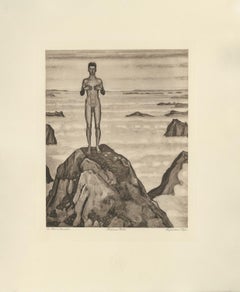
"Looking at Infinity" Copper Plate Heliogravure
By Ferdinand Hodler R. Piper Co.
Located in Palm Beach, FL
2018 marks the centenary anniversary of Ferdinand Hodler’s death. In that 100 years time, the art world’s esteem of this important artist has proved fickle. It has shifted from extolling his artistic merits during his lifetime to showing something of a feigned disdain- more reflective of the world political order than a true change of heart for Hodler’s work. After years of Hodler being all but a footnote in the annals of art history and generally ignored, finally, the pendulum has righted itself once again. Recent retrospective exhibitions in Europe and the United States have indicated not only a joyful rediscovery of Hodler’s art but a firm conviction that his work and world view hold particular relevance today. DAS WERK FERDINAND HODLERS is not only a collection of printed work reflecting the best of all of his painted work created up to 1914 just before the outbreak of World War I, the portfolio itself is an encapsulation of Hodler’s ethos, Parallelisme. Hodler developed his philosophy of Parallelisme as a unifying approach to art which strips away detail in search of harmony. By means of abstraction, symmetry and repetition, Hodler sought ways to depict Nature’s essence and her fundamental, universal order. He believed these universal laws governing the natural, observable world extend to the spiritual realm. Symbolist in nature with Romantic undertones, his works are equally portraits of these universal concepts and feelings governing all life as they are a visual portrait in the formal sense. Whether his subject is a solitary tree, a moment in battle, mortal fear, despair, the awe inspired by a vast mountain range, a tender moment or even the collective conviction in a belief, Hodler unveils this guiding principle of Parallelisme. Several aspects of Hodler’s portfolio reinforce his tenets of Parallelisme. The Table of Contents clearly preferences a harmonious design over detail. The two columns, consisting of twenty lines each, list the images by order of appearance using their German titles. The abbreviated titles are somewhat cryptic in that they obscure the identities of the sitters. Like the image Hodler presents, they are distillations of the sitter without any extraneous details. This shortening was also done in an effort to maintain a harmonious symmetry of the Table of Contents, themselves, and keep titles to a one-line limit. The twenty-fourth title: “Bildnis des Schweizerischen Gesandten C.” was so long, even with abbreviation, that it required two lines; so, for the sake of maintaining symmetry, the fortieth title: “Bauernmadchen” was omitted from the list. This explains why the images are not numbered. Hodler’s reasoning is not purely esoteric. Symmetry and pattern reach beyond mere formal design principles. Finding sameness and imposing it over disorder goes to the root of Hodler’s identity and his art. A Swiss native, Hodler was bi-lingual and spoke German and French. Each printed image, even number forty, have titles in both of Hodler’s languages. Certainly, there was a market for Hodler’s work among francophones and this inclusion may have been a polite gesture to that end; however, this is the only place in the portfolio which includes French. With German titles at the lower left of each image, Hodler’s name at bottom center and corresponding French titles at the lower right of each image, there is a harmony and symmetry woven into all aspects of the portfolio. This holds true for the page design, as it applies to each printed image and as it describes the Swiss artist himself. Seen in this light, Hodler’s portfolio of printed work is the epitome of Hodler’s Parallelisme. DAS WERK FERDINAND HODLERS is also one of the most significant documents to best tell the story of how Hodler, from Switzerland, became caught between political cross-hairs and how the changing tides of nations directly impacted the artist during his lifetime as well as the accessibility of his art for generations to come. The Munich-based publisher of the portfolio, R. Piper & Co., Verlag, plays a crucial role in this story. Publishing on a wide range of subjects from philosophy and world religion to music, literature and the visual arts; the publisher’s breadth of inquiry within any one genre was equal in scope. Their marketing strategy to publish multiple works on Hodler offers great insight as to what a hot commodity Hodler was at that time. R.Piper & Co.’s Almanach, which they published in 1914 in commemoration of their first ten years in business, clearly illustrates the rapid succession- strategically calculated for achieving the deepest and broadest impact - in which they released three works on Hodler to hit the market by the close of 1914. DAS WERK FERDINAND HODLERS was their premier publication. It preceded C.A. Loosli’s Die Zeichnungen Ferdinand Hodlers, a print portfolio after 50 drawings by Hodler which was released in Autumn of 1914 at the mid-level price-point of 75-150 Marks; and a third less expensive collection of prints after original works by Hodler, which had not been included in either of the first two portfolios, was released at the end of that year entitled Ferdinand Hodler by Dr. Ewald Bender. The title and timing of DAS WERK FERDINAND HODLERS' debut leaves little doubt as to the connection it has with another avant-garde portfolio of art prints, Das Werk Gustav Klimts, released in 5 installments from 1908 -1914 by Galerie Miethke in Vienna. Hodler, himself, was involved in Klimt’s ground-breaking project. As the owner of Klimt’s 1901 painting, “Judith with the Head of Holifernes” which appears as the ninth collotype print in the second installment of Das Werk Gustav Klimts, Hodler was obliged to grant access of the painting to the art printers in Vienna for them to create the collotype sometime before 1908. Hodler had been previously invited in 1904 to take part in what would be the last exhibition of the Vienna Secession before Klimt and others associated with Galerie Miethke broke away. In an interview that same year, Hodler indicated that he respected and was impressed by Klimt. Hodler’s esteem for Klimt went beyond the art itself; he emulated Klimt’s method aimed at increasing his market reach and appeal to a wider audience by creating a print portfolio of his painted work. By 1914, Hodler and his publisher had the benefit of hindsight to learn from Klimt’s Das Werk publication. Responding to the sluggish sales of Klimt’s expensive endeavor, Hodler’s publisher devised the same diversified 1-2-3 strategy for selling Hodler’s Das Werk portfolio as they did with regards to all three works on Hodler they published that year. For their premium tier of DAS WERKS FERDINAND HODLERS, R. Piper & Co. issued an exclusive Museum quality edition of 15 examples on which Hodler signed each page. At a cost of 600 Marks, this was generally on par with Klimt’s asking price of 600 Kronen for his Das Werk portfolio. A middle-tiered Preferred edition of 30, costing somewhat less and with Hodler’s signature only on the Title Page, was also available. The General edition, targeting the largest audience with its much more affordable price of 150 Marks, is distinguishable by its smaller size. Rather than use the subscription format Miethke had chosen for Klimt’s portfolios which proved to have had its challenges, R. Piper & Co. employed a different strategy. In addition to instantly gratifying the buyer with all 40 of the prints comprising DAS WERK FERDINAND HODLERS and the choice among three price points, they advertised in German journals a fourth possibility of ordering single prints from them directly. These printed images are easily discernible from the three complete folio editions. The paper size of the single purchased images is of the larger format like the Museum and Preferred editions, measuring 65 h x 50 w cm; however, the paper itself is the same copper print paper used in the General edition and then mounted on poster board. The publishing house positioned itself to be a direct retailer of Hodler’s art. They astutely recognized the potential for profitability and the importance, therefore, of having proprietary control over his graphic works. R. Piper & Co. owned the exclusive printing rights to Hodler’s best work found in their three publications dating from 1914. That same year, a competing publication out of Weimar entitled Ferdinand Hodler: Ein Deutungsversuch von Hans...
Category

1910s Symbolist Palm Beach - Prints and Multiples

Materials

Paper

"William Tell" Copper Plate Heliogravure
By Ferdinand Hodler R. Piper Co.
Located in Palm Beach, FL
2018 marks the centenary anniversary of Ferdinand Hodler’s death. In that 100 years time, the art world’s esteem of this important artist has proved fickle. It has shifted from extol...
Category

1910s Symbolist Palm Beach - Prints and Multiples

Materials

Paper

"The Holy Hour with Six Figures" Copper Plate Heliogravure
By Ferdinand Hodler R. Piper Co.
Located in Palm Beach, FL
2018 marks the centenary anniversary of Ferdinand Hodler’s death. In that 100 years time, the art world’s esteem of this important artist has proved fickle. It has shifted from extol...
Category

1910s Symbolist Palm Beach - Prints and Multiples

Materials

Paper

"What the Flowers Say" Copper Plate Heliogravure
By Ferdinand Hodler R. Piper Co.
Located in Palm Beach, FL
2018 marks the centenary anniversary of Ferdinand Hodler’s death. In that 100 years time, the art world’s esteem of this important artist has proved fickle. It has shifted from extolling his artistic merits during his lifetime to showing something of a feigned disdain- more reflective of the world political order than a true change of heart for Hodler’s work. After years of Hodler being all but a footnote in the annals of art history and generally ignored, finally, the pendulum has righted itself once again. Recent retrospective exhibitions in Europe and the United States have indicated not only a joyful rediscovery of Hodler’s art but a firm conviction that his work and world view hold particular relevance today. DAS WERK FERDINAND HODLERS is not only a collection of printed work reflecting the best of all of his painted work created up to 1914 just before the outbreak of World War I, the portfolio itself is an encapsulation of Hodler’s ethos, Parallelisme. Hodler developed his philosophy of Parallelisme as a unifying approach to art which strips away detail in search of harmony. By means of abstraction, symmetry and repetition, Hodler sought ways to depict Nature’s essence and her fundamental, universal order. He believed these universal laws governing the natural, observable world extend to the spiritual realm. Symbolist in nature with Romantic undertones, his works are equally portraits of these universal concepts and feelings governing all life as they are a visual portrait in the formal sense. Whether his subject is a solitary tree, a moment in battle, mortal fear, despair, the awe inspired by a vast mountain range, a tender moment or even the collective conviction in a belief, Hodler unveils this guiding principle of Parallelisme. Several aspects of Hodler’s portfolio reinforce his tenets of Parallelisme. The Table of Contents clearly preferences a harmonious design over detail. The two columns, consisting of twenty lines each, list the images by order of appearance using their German titles. The abbreviated titles are somewhat cryptic in that they obscure the identities of the sitters. Like the image Hodler presents, they are distillations of the sitter without any extraneous details. This shortening was also done in an effort to maintain a harmonious symmetry of the Table of Contents, themselves, and keep titles to a one-line limit. The twenty-fourth title: “Bildnis des Schweizerischen Gesandten C.” was so long, even with abbreviation, that it required two lines; so, for the sake of maintaining symmetry, the fortieth title: “Bauernmadchen” was omitted from the list. This explains why the images are not numbered. Hodler’s reasoning is not purely esoteric. Symmetry and pattern reach beyond mere formal design principles. Finding sameness and imposing it over disorder goes to the root of Hodler’s identity and his art. A Swiss native, Hodler was bi-lingual and spoke German and French. Each printed image, even number forty, have titles in both of Hodler’s languages. Certainly, there was a market for Hodler’s work among francophones and this inclusion may have been a polite gesture to that end; however, this is the only place in the portfolio which includes French. With German titles at the lower left of each image, Hodler’s name at bottom center and corresponding French titles at the lower right of each image, there is a harmony and symmetry woven into all aspects of the portfolio. This holds true for the page design, as it applies to each printed image and as it describes the Swiss artist himself. Seen in this light, Hodler’s portfolio of printed work is the epitome of Hodler’s Parallelisme. DAS WERK FERDINAND HODLERS is also one of the most significant documents to best tell the story of how Hodler, from Switzerland, became caught between political cross-hairs and how the changing tides of nations directly impacted the artist during his lifetime as well as the accessibility of his art for generations to come. The Munich-based publisher of the portfolio, R. Piper & Co., Verlag, plays a crucial role in this story. Publishing on a wide range of subjects from philosophy and world religion to music, literature and the visual arts; the publisher’s breadth of inquiry within any one genre was equal in scope. Their marketing strategy to publish multiple works on Hodler offers great insight as to what a hot commodity Hodler was at that time. R.Piper & Co.’s Almanach, which they published in 1914 in commemoration of their first ten years in business, clearly illustrates the rapid succession- strategically calculated for achieving the deepest and broadest impact - in which they released three works on Hodler to hit the market by the close of 1914. DAS WERK FERDINAND HODLERS was their premier publication. It preceded C.A. Loosli’s Die Zeichnungen Ferdinand Hodlers, a print portfolio after 50 drawings by Hodler which was released in Autumn of 1914 at the mid-level price-point of 75-150 Marks; and a third less expensive collection of prints after original works by Hodler, which had not been included in either of the first two portfolios, was released at the end of that year entitled Ferdinand Hodler by Dr. Ewald Bender. The title and timing of DAS WERK FERDINAND HODLERS' debut leaves little doubt as to the connection it has with another avant-garde portfolio of art prints, Das Werk Gustav Klimts, released in 5 installments from 1908 -1914 by Galerie Miethke in Vienna. Hodler, himself, was involved in Klimt’s ground-breaking project. As the owner of Klimt’s 1901 painting, “Judith with the Head of Holifernes” which appears as the ninth collotype print in the second installment of Das Werk Gustav Klimts, Hodler was obliged to grant access of the painting to the art printers in Vienna for them to create the collotype sometime before 1908. Hodler had been previously invited in 1904 to take part in what would be the last exhibition of the Vienna Secession before Klimt and others associated with Galerie Miethke broke away. In an interview that same year, Hodler indicated that he respected and was impressed by Klimt. Hodler’s esteem for Klimt went beyond the art itself; he emulated Klimt’s method aimed at increasing his market reach and appeal to a wider audience by creating a print portfolio of his painted work. By 1914, Hodler and his publisher had the benefit of hindsight to learn from Klimt’s Das Werk publication. Responding to the sluggish sales of Klimt’s expensive endeavor, Hodler’s publisher devised the same diversified 1-2-3 strategy for selling Hodler’s Das Werk portfolio as they did with regards to all three works on Hodler they published that year. For their premium tier of DAS WERKS FERDINAND HODLERS, R. Piper & Co. issued an exclusive Museum quality edition of 15 examples on which Hodler signed each page. At a cost of 600 Marks, this was generally on par with Klimt’s asking price of 600 Kronen for his Das Werk portfolio. A middle-tiered Preferred edition of 30, costing somewhat less and with Hodler’s signature only on the Title Page, was also available. The General edition, targeting the largest audience with its much more affordable price of 150 Marks, is distinguishable by its smaller size. Rather than use the subscription format Miethke had chosen for Klimt’s portfolios which proved to have had its challenges, R. Piper & Co. employed a different strategy. In addition to instantly gratifying the buyer with all 40 of the prints comprising DAS WERK FERDINAND HODLERS and the choice among three price points, they advertised in German journals a fourth possibility of ordering single prints from them directly. These printed images are easily discernible from the three complete folio editions. The paper size of the single purchased images is of the larger format like the Museum and Preferred editions, measuring 65 h x 50 w cm; however, the paper itself is the same copper print paper used in the General edition and then mounted on poster board. The publishing house positioned itself to be a direct retailer of Hodler’s art. They astutely recognized the potential for profitability and the importance, therefore, of having proprietary control over his graphic works. R. Piper & Co. owned the exclusive printing rights to Hodler’s best work found in their three publications dating from 1914. That same year, a competing publication out of Weimar entitled Ferdinand Hodler: Ein Deutungsversuch von Hans Muhlestein appeared. Its author, a young scholar, expressed his frustration with the limited availability of printable work by Hodler. In his Author’s Note on page 19, dated Easter, 1914, Muhlestein confirms that the publisher of Hodler’s three works from that same year owned the exclusive reproductive rights to Hodler’s printed original work. He goes further to explain that even after offering to pay to use certain of those images in his book, the publisher refused. Clearly, a lot of jockeying for position in what was perceived as a hot market was occurring in 1914. Instead, their timing couldn’t have been more ill-fated, and what began with such high hopes suddenly found a much different market amid a hostile climate. The onset of WWI directly impacted sales. Many, including Ferdinand Hodler, publicly protested the September invasion by Germany of France in which the Reims Cathedral, re-built in the 13th century, was shelled, destroying priceless stained glass and statuary and burning off the iron roof and badly damaging its wooden interior. Thomas Gaehtgens, Director of the Getty Research Institute describes how the bombing of Reims Cathedral triggered blindingly powerful and deeply-felt ultra-nationalistic responses: “The event profoundly shocked French intellectuals, who for the most part had an intense admiration for German literature, music and art. By relying on press accounts and abstracting from the visual propagandistic content, they were unable to interpret the siege of Reims without turning away from German culture in disgust. Similarly, the German intelligentsia and bourgeoisie were also shocked to find themselves described as vandals and barbarians. Ninety-three writers, scientists, university professors, and artists signed a protest, directed against the French insults, that defended the actions of the German army.” In similar fashion, a flurry of open letters published in German newspapers and journals as well as telegrams and postcards sent directly to Hodler following his outcry in support of Reims reflected the collectively critical reaction to Hodler’s position. Loosli documents that among the list of telegrams Hodler received was one from none other than his publisher in Germany, R.Piper & Co. Allegiances were questioned. The market for Hodler in Germany immediately softened. Matters worsened for the publisher beyond the German backlash to Hodler and his loss of appeal in the home market; with the war in full swing until 1918, there was little chance a German publisher would have much interest coming from outside of Germany and Austria. Following the war and Hodler’s death in 1918, the economy in Germany continued to spiral out and just 5 years later, hyper-inflation had rendered its currency worthless vis-a-vis its value in the pre-war years. Like the economy, Hodler’s reputation was slow to find currency in these difficult times. Even many French art fans had turned sour on Hodler as they considered his long-standing relationship in German and Austrian art circles. Thus, the portfolio’s rarity in Hodler’s lifetime and, consequently, the availability of these printed images from DAS WERK FERDINAND HODLERS since his death has been scarce. In many ways, Hodler and his portfolios were casualties of war. Thwarted from their intended purpose of reaching a wide audience and show-casing Parallelisme, Hodler’s unique approach to art, this important, undated work has been both elusive and shrouded in mystery. Perhaps DAS WERK FERDINAND HODLERS was left undated as a means of affirming the timelessness of Hodler’s art. Digging back into the past, Hodler’s contemporaries, like R. Piper, C.A. Loosli and Hans Muhlestein, indeed provide the keys to unequivocally clarify what has largely been mired in obscurity. Just after Hodler’s death, the May, 1918 issue of the Burlington Review ran a small column which opined hope for better access to R.Piper & Co.’s DAS WERK FERDINAND HODLERS; 100 years later, it is finally possible. Hodler’s voice rings out through these printed works. Once more, his modern approach to depicting portraits, landscapes and grand scale scenes of Swiss history speak to us of what is universal. Engaging with any one of these images is the chance to connect to Hodler’s vision and his world view- weltanschauung in German, vision du monde in French- however one expresses these concepts through language, its message embedded in his work is the same: “We differ from one another, but we are like each other even more. What unifies us is greater and more powerful than what divides us.” Today, Hodler’s art couldn’t be more timely. FERDINAND HODLER (SWISS, 1853-1918) explored Parallelisme through figurative poses evocative of music, dance and ritual. His images of sex, night, desertion and death as well as his many landscapes exploring the universal longing for harmony with Nature are unique and important works embodying a Symbolist paradigm. Truly a Modern Master, Hodler’s influence can be felt in the work of Gustav Klimt and Kolomon Moser and subsequent Expressionist artists such as Egon Schiele. He was born into an impoverished family in Bern, Switzerland in 1853. His entire family succumbed to tuberculosis, and he was orphaned by the age of 13, the only surviving child among his 13 siblings. In the absence of family, the influence and guidance which his art instructors provided Hodler was foundational and profound. Hodler began formal studies in 1872 at the Geneva School of Design. Under Barthelemy Menn, Hodler was drawn to the ordered beauty of Euclidian geometry and Durer’s fundamentals of human proportion that proved to be guiding principles informing his art throughout his life. By the 1880s, Hodler began to enjoy some recognition for his work which put him on a new path towards stability. Remaining in Geneva, he became assistant to the well-known muralist, Edouard Castres. Following his first solo show in 1885, Hodler’s work took on a Symbolist quality. He frequently associated with a group of Swiss Symbolist...
Category

1910s Symbolist Palm Beach - Prints and Multiples

Materials

Paper

"Battle at Nafels" Copper Plate Heliogravure
By Ferdinand Hodler R. Piper Co.
Located in Palm Beach, FL
2018 marks the centenary anniversary of Ferdinand Hodler’s death. In that 100 years time, the art world’s esteem of this important artist has proved fickle. It has shifted from extolling his artistic merits during his lifetime to showing something of a feigned disdain- more reflective of the world political order than a true change of heart for Hodler’s work. After years of Hodler being all but a footnote in the annals of art history and generally ignored, finally, the pendulum has righted itself once again. Recent retrospective exhibitions in Europe and the United States have indicated not only a joyful rediscovery of Hodler’s art but a firm conviction that his work and world view hold particular relevance today. DAS WERK FERDINAND HODLERS is not only a collection of printed work reflecting the best of all of his painted work created up to 1914 just before the outbreak of World War I, the portfolio itself is an encapsulation of Hodler’s ethos, Parallelisme. Hodler developed his philosophy of Parallelisme as a unifying approach to art which strips away detail in search of harmony. By means of abstraction, symmetry and repetition, Hodler sought ways to depict Nature’s essence and her fundamental, universal order. He believed these universal laws governing the natural, observable world extend to the spiritual realm. Symbolist in nature with Romantic undertones, his works are equally portraits of these universal concepts and feelings governing all life as they are a visual portrait in the formal sense. Whether his subject is a solitary tree, a moment in battle, mortal fear, despair, the awe inspired by a vast mountain range, a tender moment or even the collective conviction in a belief, Hodler unveils this guiding principle of Parallelisme. Several aspects of Hodler’s portfolio reinforce his tenets of Parallelisme. The Table of Contents clearly preferences a harmonious design over detail. The two columns, consisting of twenty lines each, list the images by order of appearance using their German titles. The abbreviated titles are somewhat cryptic in that they obscure the identities of the sitters. Like the image Hodler presents, they are distillations of the sitter without any extraneous details. This shortening was also done in an effort to maintain a harmonious symmetry of the Table of Contents, themselves, and keep titles to a one-line limit. The twenty-fourth title: “Bildnis des Schweizerischen Gesandten C.” was so long, even with abbreviation, that it required two lines; so, for the sake of maintaining symmetry, the fortieth title: “Bauernmadchen” was omitted from the list. This explains why the images are not numbered. Hodler’s reasoning is not purely esoteric. Symmetry and pattern reach beyond mere formal design principles. Finding sameness and imposing it over disorder goes to the root of Hodler’s identity and his art. A Swiss native, Hodler was bi-lingual and spoke German and French. Each printed image, even number forty, have titles in both of Hodler’s languages. Certainly, there was a market for Hodler’s work among francophones and this inclusion may have been a polite gesture to that end; however, this is the only place in the portfolio which includes French. With German titles at the lower left of each image, Hodler’s name at bottom center and corresponding French titles at the lower right of each image, there is a harmony and symmetry woven into all aspects of the portfolio. This holds true for the page design, as it applies to each printed image and as it describes the Swiss artist himself. Seen in this light, Hodler’s portfolio of printed work is the epitome of Hodler’s Parallelisme. DAS WERK FERDINAND HODLERS is also one of the most significant documents to best tell the story of how Hodler, from Switzerland, became caught between political cross-hairs and how the changing tides of nations directly impacted the artist during his lifetime as well as the accessibility of his art for generations to come. The Munich-based publisher of the portfolio, R. Piper & Co., Verlag, plays a crucial role in this story. Publishing on a wide range of subjects from philosophy and world religion to music, literature and the visual arts; the publisher’s breadth of inquiry within any one genre was equal in scope. Their marketing strategy to publish multiple works on Hodler offers great insight as to what a hot commodity Hodler was at that time. R.Piper & Co.’s Almanach, which they published in 1914 in commemoration of their first ten years in business, clearly illustrates the rapid succession- strategically calculated for achieving the deepest and broadest impact - in which they released three works on Hodler to hit the market by the close of 1914. DAS WERK FERDINAND HODLERS was their premier publication. It preceded C.A. Loosli’s Die Zeichnungen Ferdinand Hodlers, a print portfolio after 50 drawings by Hodler which was released in Autumn of 1914 at the mid-level price-point of 75-150 Marks; and a third less expensive collection of prints after original works by Hodler, which had not been included in either of the first two portfolios, was released at the end of that year entitled Ferdinand Hodler by Dr. Ewald Bender. The title and timing of DAS WERK FERDINAND HODLERS' debut leaves little doubt as to the connection it has with another avant-garde portfolio of art prints, Das Werk Gustav Klimts, released in 5 installments from 1908 -1914 by Galerie Miethke in Vienna. Hodler, himself, was involved in Klimt’s ground-breaking project. As the owner of Klimt’s 1901 painting, “Judith with the Head of Holifernes” which appears as the ninth collotype print in the second installment of Das Werk Gustav Klimts, Hodler was obliged to grant access of the painting to the art printers in Vienna for them to create the collotype sometime before 1908. Hodler had been previously invited in 1904 to take part in what would be the last exhibition of the Vienna Secession before Klimt and others associated with Galerie Miethke broke away. In an interview that same year, Hodler indicated that he respected and was impressed by Klimt. Hodler’s esteem for Klimt went beyond the art itself; he emulated Klimt’s method aimed at increasing his market reach and appeal to a wider audience by creating a print portfolio of his painted work. By 1914, Hodler and his publisher had the benefit of hindsight to learn from Klimt’s Das Werk publication. Responding to the sluggish sales of Klimt’s expensive endeavor, Hodler’s publisher devised the same diversified 1-2-3 strategy for selling Hodler’s Das Werk portfolio as they did with regards to all three works on Hodler they published that year. For their premium tier of DAS WERKS FERDINAND HODLERS, R. Piper & Co. issued an exclusive Museum quality edition of 15 examples on which Hodler signed each page. At a cost of 600 Marks, this was generally on par with Klimt’s asking price of 600 Kronen for his Das Werk portfolio. A middle-tiered Preferred edition of 30, costing somewhat less and with Hodler’s signature only on the Title Page, was also available. The General edition, targeting the largest audience with its much more affordable price of 150 Marks, is distinguishable by its smaller size. Rather than use the subscription format Miethke had chosen for Klimt’s portfolios which proved to have had its challenges, R. Piper & Co. employed a different strategy. In addition to instantly gratifying the buyer with all 40 of the prints comprising DAS WERK FERDINAND HODLERS and the choice among three price points, they advertised in German journals a fourth possibility of ordering single prints from them directly. These printed images are easily discernible from the three complete folio editions. The paper size of the single purchased images is of the larger format like the Museum and Preferred editions, measuring 65 h x 50 w cm; however, the paper itself is the same copper print paper used in the General edition and then mounted on poster board. The publishing house positioned itself to be a direct retailer of Hodler’s art. They astutely recognized the potential for profitability and the importance, therefore, of having proprietary control over his graphic works. R. Piper & Co. owned the exclusive printing rights to Hodler’s best work found in their three publications dating from 1914. That same year, a competing publication out of Weimar entitled Ferdinand Hodler: Ein Deutungsversuch von Hans Muhlestein appeared. Its author, a young scholar, expressed his frustration with the limited availability of printable work by Hodler. In his Author’s Note on page 19, dated Easter, 1914, Muhlestein confirms that the publisher of Hodler’s three works from that same year owned the exclusive reproductive rights to Hodler’s printed original work. He goes further to explain that even after offering to pay to use certain of those images in his book, the publisher refused. Clearly, a lot of jockeying for position in what was perceived as a hot market was occurring in 1914. Instead, their timing couldn’t have been more ill-fated, and what began with such high hopes suddenly found a much different market amid a hostile climate. The onset of WWI directly impacted sales. Many, including Ferdinand Hodler, publicly protested the September invasion by Germany of France in which the Reims Cathedral, re-built in the 13th century, was shelled, destroying priceless stained glass and statuary and burning off the iron roof and badly damaging its wooden interior. Thomas Gaehtgens, Director of the Getty Research Institute describes how the bombing of Reims Cathedral triggered blindingly powerful and deeply-felt ultra-nationalistic responses: “The event profoundly shocked French intellectuals, who for the most part had an intense admiration for German literature, music and art. By relying on press accounts and abstracting from the visual propagandistic content, they were unable to interpret the siege of Reims without turning away from German culture in disgust. Similarly, the German intelligentsia and bourgeoisie were also shocked to find themselves described as vandals and barbarians. Ninety-three writers, scientists, university professors, and artists signed a protest, directed against the French insults, that defended the actions of the German army.” In similar fashion, a flurry of open letters published in German newspapers and journals as well as telegrams and postcards sent directly to Hodler following his outcry in support of Reims reflected the collectively critical reaction to Hodler’s position. Loosli documents that among the list of telegrams Hodler received was one from none other than his publisher in Germany, R.Piper & Co. Allegiances were questioned. The market for Hodler in Germany immediately softened. Matters worsened for the publisher beyond the German backlash to Hodler and his loss of appeal in the home market; with the war in full swing until 1918, there was little chance a German publisher would have much interest coming from outside of Germany and Austria. Following the war and Hodler’s death in 1918, the economy in Germany continued to spiral out and just 5 years later, hyper-inflation had rendered its currency worthless vis-a-vis its value in the pre-war years. Like the economy, Hodler’s reputation was slow to find currency in these difficult times. Even many French art fans had turned sour on Hodler as they considered his long-standing relationship in German and Austrian art circles. Thus, the portfolio’s rarity in Hodler’s lifetime and, consequently, the availability of these printed images from DAS WERK FERDINAND HODLERS since his death has been scarce. In many ways, Hodler and his portfolios were casualties of war. Thwarted from their intended purpose of reaching a wide audience and show-casing Parallelisme, Hodler’s unique approach to art, this important, undated work has been both elusive and shrouded in mystery. Perhaps DAS WERK FERDINAND HODLERS was left undated as a means of affirming the timelessness of Hodler’s art. Digging back into the past, Hodler’s contemporaries, like R. Piper, C.A. Loosli and Hans Muhlestein, indeed provide the keys to unequivocally clarify what has largely been mired in obscurity. Just after Hodler’s death, the May, 1918 issue of the Burlington Review ran a small column which opined hope for better access to R.Piper & Co.’s DAS WERK FERDINAND HODLERS; 100 years later, it is finally possible. Hodler’s voice rings out through these printed works. Once more, his modern approach to depicting portraits, landscapes and grand scale scenes of Swiss history speak to us of what is universal. Engaging with any one of these images is the chance to connect to Hodler’s vision and his world view- weltanschauung in German, vision du monde in French- however one expresses these concepts through language, its message embedded in his work is the same: “We differ from one another, but we are like each other even more. What unifies us is greater and more powerful than what divides us.” Today, Hodler’s art couldn’t be more timely. FERDINAND HODLER (SWISS, 1853-1918) explored Parallelisme through figurative poses evocative of music, dance and ritual. His images of sex, night, desertion and death as well as his many landscapes exploring the universal longing for harmony with Nature are unique and important works embodying a Symbolist paradigm. Truly a Modern Master, Hodler’s influence can be felt in the work of Gustav Klimt and Kolomon Moser and subsequent Expressionist artists such as Egon Schiele. He was born into an impoverished family in Bern, Switzerland in 1853. His entire family succumbed to tuberculosis, and he was orphaned by the age of 13, the only surviving child among his 13 siblings. In the absence of family, the influence and guidance which his art instructors provided Hodler was foundational and profound. Hodler began formal studies in 1872 at the Geneva School of Design. Under Barthelemy Menn, Hodler was drawn to the ordered beauty of Euclidian geometry and Durer’s fundamentals of human proportion that proved to be guiding principles informing his art throughout his life. By the 1880s, Hodler began to enjoy some recognition for his work which put him on a new path towards stability. Remaining in Geneva, he became assistant to the well-known muralist, Edouard Castres. Following his first solo show in 1885, Hodler’s work took on a Symbolist quality. He frequently associated with a group of Swiss Symbolist...
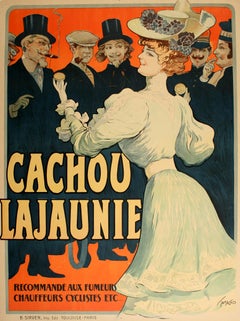
Category

1910s Symbolist Palm Beach - Prints and Multiples

Materials

Paper

"Mountain Stream" Copper Plate Heliogravure
By Ferdinand Hodler R. Piper Co.
Located in Palm Beach, FL
2018 marks the centenary anniversary of Ferdinand Hodler’s death. In that 100 years time, the art world’s esteem of this important artist has proved fickle. It has shifted from extolling his artistic merits during his lifetime to showing something of a feigned disdain- more reflective of the world political order than a true change of heart for Hodler’s work. After years of Hodler being all but a footnote in the annals of art history and generally ignored, finally, the pendulum has righted itself once again. Recent retrospective exhibitions in Europe and the United States have indicated not only a joyful rediscovery of Hodler’s art but a firm conviction that his work and world view hold particular relevance today. DAS WERK FERDINAND HODLERS is not only a collection of printed work reflecting the best of all of his painted work created up to 1914 just before the outbreak of World War I, the portfolio itself is an encapsulation of Hodler’s ethos, Parallelisme. Hodler developed his philosophy of Parallelisme as a unifying approach to art which strips away detail in search of harmony. By means of abstraction, symmetry and repetition, Hodler sought ways to depict Nature’s essence and her fundamental, universal order. He believed these universal laws governing the natural, observable world extend to the spiritual realm. Symbolist in nature with Romantic undertones, his works are equally portraits of these universal concepts and feelings governing all life as they are a visual portrait in the formal sense. Whether his subject is a solitary tree, a moment in battle, mortal fear, despair, the awe inspired by a vast mountain range, a tender moment or even the collective conviction in a belief, Hodler unveils this guiding principle of Parallelisme. Several aspects of Hodler’s portfolio reinforce his tenets of Parallelisme. The Table of Contents clearly preferences a harmonious design over detail. The two columns, consisting of twenty lines each, list the images by order of appearance using their German titles. The abbreviated titles are somewhat cryptic in that they obscure the identities of the sitters. Like the image Hodler presents, they are distillations of the sitter without any extraneous details. This shortening was also done in an effort to maintain a harmonious symmetry of the Table of Contents, themselves, and keep titles to a one-line limit. The twenty-fourth title: “Bildnis des Schweizerischen Gesandten C.” was so long, even with abbreviation, that it required two lines; so, for the sake of maintaining symmetry, the fortieth title: “Bauernmadchen” was omitted from the list. This explains why the images are not numbered. Hodler’s reasoning is not purely esoteric. Symmetry and pattern reach beyond mere formal design principles. Finding sameness and imposing it over disorder goes to the root of Hodler’s identity and his art. A Swiss native, Hodler was bi-lingual and spoke German and French. Each printed image, even number forty, have titles in both of Hodler’s languages. Certainly, there was a market for Hodler’s work among francophones and this inclusion may have been a polite gesture to that end; however, this is the only place in the portfolio which includes French. With German titles at the lower left of each image, Hodler’s name at bottom center and corresponding French titles at the lower right of each image, there is a harmony and symmetry woven into all aspects of the portfolio. This holds true for the page design, as it applies to each printed image and as it describes the Swiss artist himself. Seen in this light, Hodler’s portfolio of printed work is the epitome of Hodler’s Parallelisme. DAS WERK FERDINAND HODLERS is also one of the most significant documents to best tell the story of how Hodler, from Switzerland, became caught between political cross-hairs and how the changing tides of nations directly impacted the artist during his lifetime as well as the accessibility of his art for generations to come. The Munich-based publisher of the portfolio, R. Piper & Co., Verlag, plays a crucial role in this story. Publishing on a wide range of subjects from philosophy and world religion to music, literature and the visual arts; the publisher’s breadth of inquiry within any one genre was equal in scope. Their marketing strategy to publish multiple works on Hodler offers great insight as to what a hot commodity Hodler was at that time. R.Piper & Co.’s Almanach, which they published in 1914 in commemoration of their first ten years in business, clearly illustrates the rapid succession- strategically calculated for achieving the deepest and broadest impact - in which they released three works on Hodler to hit the market by the close of 1914. DAS WERK FERDINAND HODLERS was their premier publication. It preceded C.A. Loosli’s Die Zeichnungen Ferdinand Hodlers, a print portfolio after 50 drawings by Hodler which was released in Autumn of 1914 at the mid-level price-point of 75-150 Marks; and a third less expensive collection of prints after original works by Hodler, which had not been included in either of the first two portfolios, was released at the end of that year entitled Ferdinand Hodler by Dr. Ewald Bender. The title and timing of DAS WERK FERDINAND HODLERS' debut leaves little doubt as to the connection it has with another avant-garde portfolio of art prints, Das Werk Gustav Klimts, released in 5 installments from 1908 -1914 by Galerie Miethke in Vienna. Hodler, himself, was involved in Klimt’s ground-breaking project. As the owner of Klimt’s 1901 painting, “Judith with the Head of Holifernes” which appears as the ninth collotype print in the second installment of Das Werk Gustav Klimts, Hodler was obliged to grant access of the painting to the art printers in Vienna for them to create the collotype sometime before 1908. Hodler had been previously invited in 1904 to take part in what would be the last exhibition of the Vienna Secession before Klimt and others associated with Galerie Miethke broke away. In an interview that same year, Hodler indicated that he respected and was impressed by Klimt. Hodler’s esteem for Klimt went beyond the art itself; he emulated Klimt’s method aimed at increasing his market reach and appeal to a wider audience by creating a print portfolio of his painted work. By 1914, Hodler and his publisher had the benefit of hindsight to learn from Klimt’s Das Werk publication. Responding to the sluggish sales of Klimt’s expensive endeavor, Hodler’s publisher devised the same diversified 1-2-3 strategy for selling Hodler’s Das Werk portfolio as they did with regards to all three works on Hodler they published that year. For their premium tier of DAS WERKS FERDINAND HODLERS, R. Piper & Co. issued an exclusive Museum quality edition of 15 examples on which Hodler signed each page. At a cost of 600 Marks, this was generally on par with Klimt’s asking price of 600 Kronen for his Das Werk portfolio. A middle-tiered Preferred edition of 30, costing somewhat less and with Hodler’s signature only on the Title Page, was also available. The General edition, targeting the largest audience with its much more affordable price of 150 Marks, is distinguishable by its smaller size. Rather than use the subscription format Miethke had chosen for Klimt’s portfolios which proved to have had its challenges, R. Piper & Co. employed a different strategy. In addition to instantly gratifying the buyer with all 40 of the prints comprising DAS WERK FERDINAND HODLERS and the choice among three price points, they advertised in German journals a fourth possibility of ordering single prints from them directly. These printed images are easily discernible from the three complete folio editions. The paper size of the single purchased images is of the larger format like the Museum and Preferred editions, measuring 65 h x 50 w cm; however, the paper itself is the same copper print paper used in the General edition and then mounted on poster board. The publishing house positioned itself to be a direct retailer of Hodler’s art. They astutely recognized the potential for profitability and the importance, therefore, of having proprietary control over his graphic works. R. Piper & Co. owned the exclusive printing rights to Hodler’s best work found in their three publications dating from 1914. That same year, a competing publication out of Weimar entitled Ferdinand Hodler: Ein Deutungsversuch von Hans...
Category

1910s Symbolist Palm Beach - Prints and Multiples

Materials

Paper

"Marilyn Chanel Diamond [Queens White (B+W Bright White)]" screen print on linen
By Russell Young
Located in Boca Raton, FL
"Marilyn Chanel Diamond [Queens White (B+W Bright White)]" acrylic, oil-based ink and diamond dust hand-pulled screen print on linen by artist Russell Young. Depicts Marilyn Monroe h...
Category

2010s Contemporary Palm Beach - Prints and Multiples

Materials

Linen, Ink, Screen

Kostume, Plakate, und Dekorationen, "Shadows Light"
By Walter Schnackenberg
Located in Palm Beach, FL
Walter Schnackenberg’s style changed several times during his long and successful career. Having studied in Munich, the artist traveled often to Paris where he fell under the spell of the Henri de Toulouse-Lautrec’s colorful and sensuous posters depicting theatrical and decadent subjects. Schnackenberg became a regular contributor of similar compositions to the German magazines Jugend and Simplicissimus before devoting himself to the design of stage scenery and costumes. In the artist’s theatrical work, his mastery of form, ornamentation, and Orientalism became increasingly evident. He excelled at combining fluid Art Nouveau outlines, with spiky Expressionist passages, and the postures and patterns of the mysterious East. In his later years, Schnackenberg explored the unconscious, using surreal subject matter and paler colors that plainly portrayed dreams and visions, some imbued with political connotations. His drawings, illustrations, folio prints, and posters are highly sought today for their exceedingly imaginative qualities, enchanting subject matter, and arresting use of color. SCHNACKENBERG: KOSTUME, PLAKATE UND DEKORATIONEN, a cardboard bound art book consisting of 43 prints of work by Walter Schnackenberg, 30 of which are color lithographs that are signed and some are titled and dated in the plate, as well as black and white prints and photographs with accompanying text by Oskar Bie; lithographs printed at Kunstanstalt Oskar Consee in Munich, other images printed by Gesellschaft Pick & Co. in Munich, the text and cover with color images by Schnackenberg front and verso printed by R. Oldenbourg in Munich; published by Musarion Verlag, Munich, 1920. The majority of Walter Schnackenberg’s artistic output was destroyed by bomb attacks in Munich in 1944. The highly publicized 2013 auction in New York of the recovered pre-war poster collection once belonging to German poster aficionado, Hans Sachs has reintroduced the world to Walter Schnackenberg’s graphic genius and priceless ephemeral art from a lost era. Besides the museum world, designer Karl Lagerfeld is one of the most prodigious collectors of Schnackenberg. Flipping through the pages of Kostume, Plakate und Dekorationen, it becomes quite clear that Schnackenberg’s collection is ground zero at the crossroads of early modern fashion where the cult of celebrity meets up with dance, music, theater and cabaret, film and the graphic medium. Berlin and Munich under Germany’s Weimar Republic in the first quarter of the 20th century produced just the atmosphere to feed this burgeoning industry. Rising inflation sparked a recklessness to live large for the moment and heightened a desire for escapism. An influx of Indian and East Asian dancers and musicians added to the artsy bohemian cultural mix. A new decadence and tolerance resulted. Film boldly featured provocative subject matter. Cabarets became popular venues giving rise to the demi-monde in which people from all social stations mixed more freely in a thriving underground economy and culture where there was a blurring of boundaries and of social codes. Noted art historian and cultural doyen, Oskar Bie astutely observes in his introduction to Schnackenberg’s publication that what unites the images is fantasy and advertisement. Schnackenberg uses the eye as an instrument to brilliantly construct and convey this double message. His personages never directly confront the viewer. Their eyes gaze off in the distance like those of the screenplayer and film star Hedamaria Scholz in Schnackenberg’s “Die Rodelhexe” movie poster. Their eyes follow the path of a dance composition or become a transfixed and ogling male gaze such as the iconic 1911 Odeon Casino poster...
Category

1910s Expressionist Palm Beach - Prints and Multiples

Materials

Lithograph

Philip Guston "Studio Corner" Lithograph, Brooke Alexander Gallery
By Philip Guston
Located in Lake Worth Beach, FL
Artist/Designer; Manufacturer: Philip Guston (1913-1980) Marking(s); notes: signed, blind stamp; ed. 39/50; 1980 Country of origin; materials: Canadian-American; lithograph Dimension...
Category

1980s Modern Palm Beach - Prints and Multiples

Materials

Lithograph

Kostume, Plakate, und Dekorationen, "Joachim von Seewitz"
By Walter Schnackenberg
Located in Palm Beach, FL
Walter Schnackenberg’s style changed several times during his long and successful career. Having studied in Munich, the artist traveled often to Paris where he fell under the spell of the Henri de Toulouse-Lautrec’s colorful and sensuous posters depicting theatrical and decadent subjects. Schnackenberg became a regular contributor of similar compositions to the German magazines Jugend and Simplicissimus before devoting himself to the design of stage scenery and costumes. In the artist’s theatrical work, his mastery of form, ornamentation, and Orientalism became increasingly evident. He excelled at combining fluid Art Nouveau outlines, with spiky Expressionist passages, and the postures and patterns of the mysterious East. In his later years, Schnackenberg explored the unconscious, using surreal subject matter and paler colors that plainly portrayed dreams and visions, some imbued with political connotations. His drawings, illustrations, folio prints, and posters are highly sought today for their exceedingly imaginative qualities, enchanting subject matter, and arresting use of color. SCHNACKENBERG: KOSTUME, PLAKATE UND DEKORATIONEN, a cardboard bound art book consisting of 43 prints of work by Walter Schnackenberg, 30 of which are color lithographs that are signed and some are titled and dated in the plate, as well as black and white prints and photographs with accompanying text by Oskar Bie; lithographs printed at Kunstanstalt Oskar Consee in Munich, other images printed by Gesellschaft Pick & Co. in Munich, the text and cover with color images by Schnackenberg front and verso printed by R. Oldenbourg in Munich; published by Musarion Verlag, Munich, 1920. The majority of Walter Schnackenberg’s artistic output was destroyed by bomb attacks in Munich in 1944. The highly publicized 2013 auction in New York of the recovered pre-war poster collection once belonging to German poster aficionado, Hans Sachs has reintroduced the world to Walter Schnackenberg’s graphic genius and priceless ephemeral art from a lost era. Besides the museum world, designer Karl Lagerfeld is one of the most prodigious collectors of Schnackenberg. Flipping through the pages of Kostume, Plakate und Dekorationen, it becomes quite clear that Schnackenberg’s collection is ground zero at the crossroads of early modern fashion where the cult of celebrity meets up with dance, music, theater and cabaret, film and the graphic medium. Berlin and Munich under Germany’s Weimar Republic in the first quarter of the 20th century produced just the atmosphere to feed this burgeoning industry. Rising inflation sparked a recklessness to live large for the moment and heightened a desire for escapism. An influx of Indian and East Asian dancers and musicians added to the artsy bohemian cultural mix. A new decadence and tolerance resulted. Film boldly featured provocative subject matter. Cabarets became popular venues giving rise to the demi-monde in which people from all social stations mixed more freely in a thriving underground economy and culture where there was a blurring of boundaries and of social codes. Noted art historian and cultural doyen, Oskar Bie astutely observes in his introduction to Schnackenberg’s publication that what unites the images is fantasy and advertisement. Schnackenberg uses the eye as an instrument to brilliantly construct and convey this double message. His personages never directly confront the viewer. Their eyes gaze off in the distance like those of the screenplayer and film star Hedamaria Scholz in Schnackenberg’s “Die Rodelhexe” movie poster. Their eyes follow the path of a dance composition or become a transfixed and ogling male gaze such as the iconic 1911 Odeon Casino...
Category

1910s Expressionist Palm Beach - Prints and Multiples

Materials

Lithograph, Paper

Kostume, Plakate, und Dekorationen, "Erry Merry"
By Walter Schnackenberg
Located in Palm Beach, FL
Walter Schnackenberg’s style changed several times during his long and successful career. Having studied in Munich, the artist traveled often to Paris where he fell under the spell of the Henri de Toulouse-Lautrec’s colorful and sensuous posters depicting theatrical and decadent subjects. Schnackenberg became a regular contributor of similar compositions to the German magazines Jugend and Simplicissimus before devoting himself to the design of stage scenery and costumes. In the artist’s theatrical work, his mastery of form, ornamentation, and Orientalism became increasingly evident. He excelled at combining fluid Art Nouveau outlines, with spiky Expressionist passages, and the postures and patterns of the mysterious East. In his later years, Schnackenberg explored the unconscious, using surreal subject matter and paler colors that plainly portrayed dreams and visions, some imbued with political connotations. His drawings, illustrations, folio prints, and posters are highly sought today for their exceedingly imaginative qualities, enchanting subject matter, and arresting use of color. SCHNACKENBERG: KOSTUME, PLAKATE UND DEKORATIONEN, a cardboard bound art book consisting of 43 prints of work by Walter Schnackenberg, 30 of which are color lithographs that are signed and some are titled and dated in the plate, as well as black and white prints and photographs with accompanying text by Oskar Bie; lithographs printed at Kunstanstalt Oskar Consee in Munich, other images printed by Gesellschaft Pick & Co. in Munich, the text and cover with color images by Schnackenberg front and verso printed by R. Oldenbourg in Munich; published by Musarion Verlag, Munich, 1920. The majority of Walter Schnackenberg’s artistic output was destroyed by bomb attacks in Munich in 1944. The highly publicized 2013 auction in New York of the recovered pre-war poster collection once belonging to German poster aficionado, Hans Sachs has reintroduced the world to Walter Schnackenberg’s graphic genius and priceless ephemeral art from a lost era. Besides the museum world, designer Karl Lagerfeld is one of the most prodigious collectors of Schnackenberg. Flipping through the pages of Kostume, Plakate und Dekorationen, it becomes quite clear that Schnackenberg’s collection is ground zero at the crossroads of early modern fashion where the cult of celebrity meets up with dance, music, theater and cabaret, film and the graphic medium. Berlin and Munich under Germany’s Weimar Republic in the first quarter of the 20th century produced just the atmosphere to feed this burgeoning industry. Rising inflation sparked a recklessness to live large for the moment and heightened a desire for escapism. An influx of Indian and East Asian dancers and musicians added to the artsy bohemian cultural mix. A new decadence and tolerance resulted. Film boldly featured provocative subject matter. Cabarets became popular venues giving rise to the demi-monde in which people from all social stations mixed more freely in a thriving underground economy and culture where there was a blurring of boundaries and of social codes. Noted art historian and cultural doyen, Oskar Bie astutely observes in his introduction to Schnackenberg’s publication that what unites the images is fantasy and advertisement. Schnackenberg uses the eye as an instrument to brilliantly construct and convey this double message. His personages never directly confront the viewer. Their eyes gaze off in the distance like those of the screenplayer and film star Hedamaria Scholz in Schnackenberg’s “Die Rodelhexe” movie poster. Their eyes follow the path of a dance composition or become a transfixed and ogling male gaze such as the iconic 1911 Odeon Casino poster...
Category

1910s Expressionist Palm Beach - Prints and Multiples

Materials

Lithograph

Kostume, Plakate, und Dekorationen, "Flower of Evil"
By Walter Schnackenberg
Located in Palm Beach, FL
Walter Schnackenberg’s style changed several times during his long and successful career. Having studied in Munich, the artist traveled often to Paris where he fell under the spell of the Henri de Toulouse-Lautrec’s colorful and sensuous posters depicting theatrical and decadent subjects. Schnackenberg became a regular contributor of similar compositions to the German magazines Jugend and Simplicissimus before devoting himself to the design of stage scenery and costumes. In the artist’s theatrical work, his mastery of form, ornamentation, and Orientalism became increasingly evident. He excelled at combining fluid Art Nouveau outlines, with spiky Expressionist passages, and the postures and patterns of the mysterious East. In his later years, Schnackenberg explored the unconscious, using surreal subject matter and paler colors that plainly portrayed dreams and visions, some imbued with political connotations. His drawings, illustrations, folio prints, and posters are highly sought today for their exceedingly imaginative qualities, enchanting subject matter, and arresting use of color. SCHNACKENBERG: KOSTUME, PLAKATE UND DEKORATIONEN, a cardboard bound art book consisting of 43 prints of work by Walter Schnackenberg, 30 of which are color lithographs that are signed and some are titled and dated in the plate, as well as black and white prints and photographs with accompanying text by Oskar Bie; lithographs printed at Kunstanstalt Oskar Consee in Munich, other images printed by Gesellschaft Pick & Co. in Munich, the text and cover with color images by Schnackenberg front and verso printed by R. Oldenbourg in Munich; published by Musarion Verlag, Munich, 1920. The majority of Walter Schnackenberg’s artistic output was destroyed by bomb attacks in Munich in 1944. The highly publicized 2013 auction in New York of the recovered pre-war poster collection once belonging to German poster aficionado, Hans Sachs...
Category

1910s Expressionist Palm Beach - Prints and Multiples

Materials

Lithograph

Kostume, Plakate, und Dekorationen, "The Blue Flame"
By Walter Schnackenberg
Located in Palm Beach, FL
Walter Schnackenberg’s style changed several times during his long and successful career. Having studied in Munich, the artist traveled often to Paris where he fell under the spell of the Henri de Toulouse-Lautrec’s colorful and sensuous posters depicting theatrical and decadent subjects. Schnackenberg became a regular contributor of similar compositions to the German magazines Jugend and Simplicissimus before devoting himself to the design of stage scenery and costumes. In the artist’s theatrical work, his mastery of form, ornamentation, and Orientalism became increasingly evident. He excelled at combining fluid Art Nouveau outlines, with spiky Expressionist passages, and the postures and patterns of the mysterious East. In his later years, Schnackenberg explored the unconscious, using surreal subject matter and paler colors that plainly portrayed dreams and visions, some imbued with political connotations. His drawings, illustrations, folio prints, and posters are highly sought today for their exceedingly imaginative qualities, enchanting subject matter, and arresting use of color. SCHNACKENBERG: KOSTUME, PLAKATE UND DEKORATIONEN, a cardboard bound art book consisting of 43 prints of work by Walter Schnackenberg, 30 of which are color lithographs that are signed and some are titled and dated in the plate, as well as black and white prints and photographs with accompanying text by Oskar Bie; lithographs printed at Kunstanstalt Oskar Consee in Munich, other images printed by Gesellschaft Pick & Co. in Munich, the text and cover with color images by Schnackenberg front and verso printed by R. Oldenbourg in Munich; published by Musarion Verlag, Munich, 1920. The majority of Walter Schnackenberg’s artistic output was destroyed by bomb attacks in Munich in 1944. The highly publicized 2013 auction in New York of the recovered pre-war poster collection once belonging to German poster aficionado, Hans Sachs has reintroduced the world to Walter Schnackenberg’s graphic genius and priceless ephemeral art from a lost era. Besides the museum world, designer Karl Lagerfeld is one of the most prodigious collectors of Schnackenberg. Flipping through the pages of Kostume, Plakate und Dekorationen, it becomes quite clear that Schnackenberg’s collection is ground zero at the crossroads of early modern fashion where the cult of celebrity meets up with dance, music, theater and cabaret, film and the graphic medium. Berlin and Munich under Germany’s Weimar Republic in the first quarter of the 20th century produced just the atmosphere to feed this burgeoning industry. Rising inflation sparked a recklessness to live large for the moment and heightened a desire for escapism. An influx of Indian and East Asian dancers and musicians added to the artsy bohemian cultural mix. A new decadence and tolerance resulted. Film boldly featured provocative subject matter. Cabarets became popular venues giving rise to the demi-monde in which people from all social stations mixed more freely in a thriving underground economy and culture where there was a blurring of boundaries and of social codes. Noted art historian and cultural doyen, Oskar Bie astutely observes in his introduction to Schnackenberg’s publication that what unites the images is fantasy and advertisement. Schnackenberg uses the eye as an instrument to brilliantly construct and convey this double message. His personages never directly confront the viewer. Their eyes gaze off in the distance like those of the screenplayer and film star Hedamaria Scholz in Schnackenberg’s “Die Rodelhexe” movie poster. Their eyes follow the path of a dance composition or become a transfixed and ogling male gaze such as the iconic 1911 Odeon Casino poster...
Category

1910s Expressionist Palm Beach - Prints and Multiples

Materials

Lithograph

Black on Black
By Peter Halley
Located in Boca Raton, FL
paper size 34 x 45 inches framed size 41 x 52 inches
Category

21st Century and Contemporary Contemporary Palm Beach - Prints and Multiples

Materials

Glitter, Screen

Canto XXXVIII Dresden Night-Limited Ed. of 5 iPad drawing on Aluminum 46 X 60
By Sebastian Spreng
Located in West Palm Beach, FL
iPad Drawing on aluminum 46 X 60; No 2 of edition of 5. This drawing was part of his Dresden exhibit at the Lowe Museum of Art. Sebastian Spreng's Dresden depicts the decimation of...
Category

2010s Abstract Expressionist Palm Beach - Prints and Multiples

Materials

Metal

French Original Vintage Cycling Poster - Pas D Alcool c1950
Located in Boca Raton, FL
This promotional poster was created in France by an anonymous artist in the 1950s. It was part of a national campaign against alcohol consumption. The poster explains that if you eli...
Category

1950s Palm Beach - Prints and Multiples

Materials

Lithograph

Kinagin Original Vintage Swiss Liquor Poster by Patke 1941
Located in Boca Raton, FL
Patke created this bold Art Deco poster to advertise Kinagin around the 1930s. The beverage is a gin mixed with vermouth and quina. The bright red pops against the classic black back...
Category

1940s Palm Beach - Prints and Multiples

Materials

Lithograph

"Serena with Cap (Yellow)" archival mixed media print by Carole A. Feuerman
By Carole Feuerman
Located in Boca Raton, FL
"Serena with Cap (Yellow)" archival mixed media print from a limited edition of 30. Hand signed Carole A. Feuerman, dated 2012 and numbered 12/30. Printed on textured paper with addi...
Category

2010s Contemporary Palm Beach - Prints and Multiples

Materials

Mixed Media

Vintage Poster American Airlines Niagara Falls Edward McKnight Kauffer
By Edward McKnight Kauffer
Located in Boca Raton, FL
Vintage Poster American Airlines Niagara Falls Edward McKnight Kauffer Good condition -- see all photos and video. This listing includes the frame (which is new). If you prefer to r...
Category

21st Century and Contemporary Modern Palm Beach - Prints and Multiples

Materials

Paper, Ink

KAWS URGE 4 Screenprint
By KAWS
Located in Lake Worth Beach, FL
Artist/Designer; Manufacturer: KAWS aka Brian Donnelly (American, b. 1974) Marking(s); notes: signed; 228/250 plus 50 APs and 6 PPs; 2020 Materials: screenprint on Saunders Waterford...
Category

2010s Pop Art Palm Beach - Prints and Multiples

Materials

Paper

Untitled framed lithograph by Aristide Maillol
By Aristide Maillol
Located in Boca Raton, FL
Framed lithograph of female nude of pastel by Aristide Maillol. Initials in lower-right corner. Framed under glass in wooden frame.
Category

20th Century Modern Palm Beach - Prints and Multiples

Materials

Lithograph

"Olivia 1" signed, numbered limited edition silkscreen by artist Alex Katz
By Alex Katz
Located in Boca Raton, FL
"Olivia 1" silkscreen of a woman by artist Alex Katz. Published by Lococo Fine Art Publisher, St. Louis. Printed in colors on Saunders Waterford High White HP 425 gsm paper and frame...
Category

2010s Contemporary Palm Beach - Prints and Multiples

Materials

Screen

Untitled nude woman framed lithograph by artist Aristide Maillol
By Aristide Maillol
Located in Boca Raton, FL
Framed lithograph of a female nude pastel by artist Aristide Maillol. Image size: 12 1/2 x 9 1/2 inches. Framed under glass in wooden frame.
Category

20th Century Modern Palm Beach - Prints and Multiples

Materials

Lithograph

Pair of Antique Framed Hand Colored French Parrot Engraving
Located in Palm Beach, FL
Lofty pair of 18th Century French hand colored engravings of parrots in natural settings as discovered by noted naturalist George Louis Leclerc Comte de Buffon. Presented under glass...
Category

Late 18th Century Other Art Style Palm Beach - Prints and Multiples

Materials

Paper

"The Rabbi and the Torah" unframed lithograph hand-signed by artist Chaim Gross
By Chaim Gross
Located in Boca Raton, FL
"The Rabbi and the Torah" unframed lithograph on fine art paper by artist Chaim Gross from a limited edition of 250. Hand signed Chaim Gross and hand numbered 63/250. Image size: 21...
Category

20th Century Modern Palm Beach - Prints and Multiples

Materials

Lithograph

Water Shadows- Laser Print 47 X 31
By Patricia Claro
Located in West Palm Beach, FL
Laser cut Stonepaper, a Korean paper made from shells and stone without cellulose (Tree). The base layer is iridescent acrylic. 47 X 31.5 Framed. Companion piece Water Shadow reflect...
Category

2010s Contemporary Palm Beach - Prints and Multiples

Materials

Laser, Archival Pigment

"Marilyn Chanel Diamond (Marmont Blue)" hand-pulled screen print on linen
By Russell Young
Located in Boca Raton, FL
"Marilyn Chanel Diamond (Marmont Blue)" acrylic, oil-based ink and diamond dust hand-pulled screen print on linen by artist Russell Young. Depicts Marilyn Monroe holding a bottle of ...
Category

2010s Contemporary Palm Beach - Prints and Multiples

Materials

Linen, Ink, Screen

Season Tree II Blue
By Sebastian Spreng
Located in West Palm Beach, FL
Edition of 5, iPad drawing on metal. 15" x 15". This IPad drawing was part of Sebastian Spreng's Dresden exhibition at the Lowe Museum of Art. The 60 piece Dresden Project depicts th...
Category

2010s Abstract Palm Beach - Prints and Multiples

Materials

Metal

Original Golden Arrow Poster by Fix Masseau Hand Signed 1989
Located in Boca Raton, FL
This Fix-Masseau illustrated poster of the Golden Arrow is a not only great reminder of the artist’s practiced Art Deco niche but as well a reminder of the luxury of the Golden Arrow...
Category

1980s Art Deco Palm Beach - Prints and Multiples

Materials

Lithograph

Original Vintage Fiorucci - Safety Jeans Poster C1975
Located in Boca Raton, FL
A crisp, technical homage to workwear, this poster presents a nine-panel grid of bib-overall details—straps and bib, cargo pockets, bar-tacked stress points, double-needle seams, and...
Category

1970s Palm Beach - Prints and Multiples

Materials

Lithograph

"Astaire and Rogers" original etching by Al Hirschfeld from Deluxe Edition of 95
By Albert Al Hirschfeld
Located in Boca Raton, FL
"Astaire and Rogers" original etching by Al Hirschfeld. Caricature portraits of Fred Astaire and Ginger Rogers Edition 37 from the Delux...
Category

1980s Other Art Style Palm Beach - Prints and Multiples

Materials

Etching

Roberto Matta FOG GOG MAGOG PLANCHE 6 Lithograph
By Roberto Matta
Located in Lake Worth Beach, FL
Artist/Designer; Manufacturer: Roberto Matta (Chilean, 1911-2002) Marking(s); notes: signed, blind stamp; ed. 94/100; 1971 Materials: lithograph on Arches paper Dimensions (H, W, D):...
Category

1970s Surrealist Palm Beach - Prints and Multiples

Materials

Lithograph

Tree-Limited Edition of 10 iPad Drawing on German Etching Paper 20 X 20
By Sebastian Spreng
Located in West Palm Beach, FL
iPad drawing on German Etching Matt Fine art- paper of archival standard. This mould-made etching paper features a distinct textured surface. Printed from the original digital file....
Category

21st Century and Contemporary Abstract Palm Beach - Prints and Multiples

Materials

Archival Ink

Aux Buttes Chaumont Poster 1888 by Jules Cheret Men s Fashions Large
By Jules Chéret
Located in Boca Raton, FL
This is one of Jules Cheret's most attractive posters from his early period in the late 1880's. It is a large size image that is promoting the new fashions for Men...
Category

1880s Art Nouveau Palm Beach - Prints and Multiples

Materials

Lithograph

Canto XXXVII -Limited Edition of 5-iPad Drawing on Aluminum 46 X60
By Sebastian Spreng
Located in West Palm Beach, FL
iPad drawing on aluminum. Edition of 5. This IPad drawing was part of Sebastian Spreng's Dresden exhibition at the Lowe Museum of Art. The 60 piece Dresden Project depicts the decima...
Category

2010s Abstract Palm Beach - Prints and Multiples

Materials

Metal

"Savoy: Saturday Midnight" signed, framed print by artist Richard Yarde
By Richard Yarde
Located in Boca Raton, FL
Framed "Savoy: Saturday Midnight" limited edition giclée print on fine art paper of dancers at the Savoy by African American artist Richard Yarde. Part of Yarde's "Savoy Ballroom" se...
Category

Early 2000s Contemporary Palm Beach - Prints and Multiples

Materials

Giclée

Still Thinking About These?

All Recently Viewed