South America - Metalwork
to
2
1,072
574
6
3
4
2
3
1
1
9
3
3
3
2
5
5
3
3
2
9
6
8
3
1
Item Ships From: South America
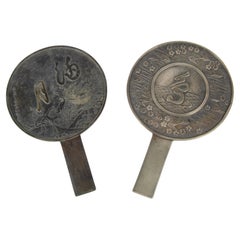
Set of 19th Century Meiji Era Ornate Etched Bronze Kagami Hand Mirrors, Japan
Located in North Miami, FL
Set of 19th century Meiji Era ornate etched bronze kagami hand mirrors, Japan
By: unknown
Material: bronze, copper, tin, metal
Technique: cast, molded, patinated, polished, metalwor...
Category
19th Century Japanese Meiji Antique South America - Metalwork
Materials
Metal, Bronze, Copper, Tin
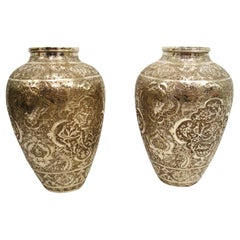
Pair of Antique Signed Islamic Ottoman or Persian Repousse Silver Vases
Located in Buenos Aires, Olivos
A fine Pair of Islamic silver vases.
Richly decorated with Ishafan (Eshafan) style repousse decoration throughout including gryphon heads, flowers & vines, birds of paradise, foliage...
Category
Late 19th Century Unknown Islamic Antique South America - Metalwork
Materials
Silver

$2,399 Sale Price / set
60% Off
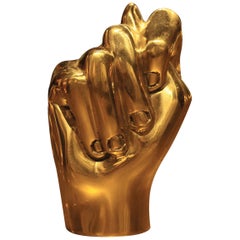
Golden "Figa" Single Door Handle in Cast Brass by Estudio Orth
By Estúdio Orth
Located in Sao Paulo, BR
Contemporary golden handle, in cast brass.
Produced in São Paulo, Brazil.
This golden handle was meticulously handmade by master artisans one delicate piece at a time. It is therefo...
Category
2010s South American Brutalist South America - Metalwork
Materials
Brass
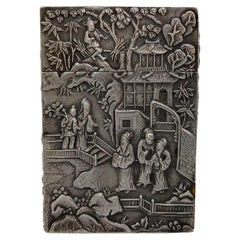
Chinese Silver Card Holder Artist Lee Ching
By Leeching
Located in Buenos Aires, Argentina
Leeching Chinese silver card holder.
Solid silver card holder.
Origin China (Canton) Circa 1840 1870.
Signed on its base (stamp).
Canton manners...
Category
1850s Chinese Chinese Export Antique South America - Metalwork
Materials
Silver
$1,200 Sale Price
20% Off
Golden "Figa" Contemporary Double Door Handle in Cast Brass by Estudio Orth
By Estúdio Orth
Located in Sao Paulo, BR
Contemporary golden handle, in cast brass.
Produced in São Paulo, Brazil.
This door handle was meticulously handmade by master artisans one delicate piece at a time. It is therefore...
Category
2010s Brazilian Brutalist South America - Metalwork
Materials
Brass
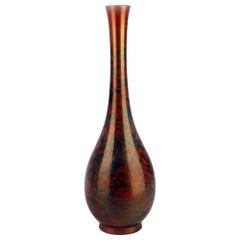
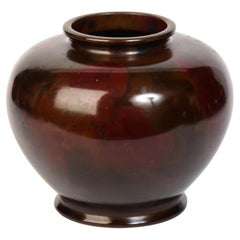
20th Century/Shōwa Period Murashido Patinated and Polished Bronze Japanese Vase
Located in North Miami, FL
20th century/Shōwa period murashido patinated and polished bronze japanese vase
By: unknown
Material: bronze, copper, metal
Technique: murashido, cast, patinated, polished, metalwor...
Category
20th Century Japanese Showa South America - Metalwork
Materials
Bronze, Metal, Copper
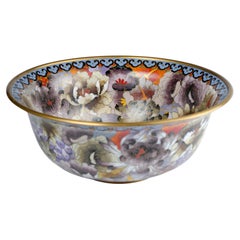
Chinese Cloisonne Bowl
Located in Buenos Aires, Argentina
Chinese Cloisonne Bowl
Bronze and enamel materials
made with Cloisonne technique
Origin China Circa 1950
Floral decoration
perfect condition
cloisone te...
Category
1950s Chinese Chinese Export Vintage South America - Metalwork
Materials
Bronze, Enamel
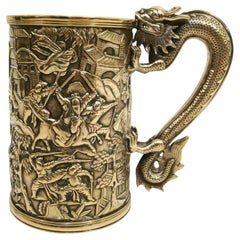
Silver 19 Century Chinese Export Dragon-Handled Mug / Tankard
Located in Buenos Aires, Olivos
19th Century Chinese Export Silver Mug / Tankard, the sides are beautifully decorated in relief with a scene of warriors in combat, very crisp and detailed, centering a shaped cartou...
Category
Mid-19th Century Chinese Chinese Export Antique South America - Metalwork
Materials
Silver
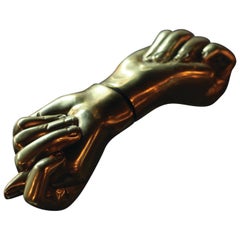
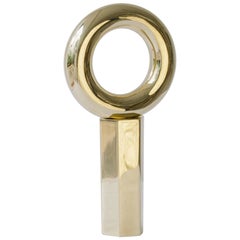
"Primeiro" Contemporary Corkscrew in Cast Brass by Estudio Orth
By Estúdio Orth
Located in Sao Paulo, BR
Produced in São Paulo, Brazil.
This contemporary corkscrew in cast brass was meticulously handmade by master artisans one piece at a time. It is therefore quite difficult, if not ...
Category
2010s Brazilian Brutalist South America - Metalwork
Materials
Brass
Related Items
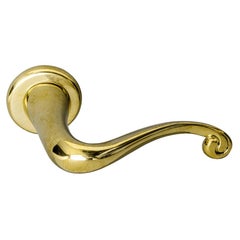
Polished Solid Brass Batlló door handle by Antoni Gaudi, 20th century design
By Antoni Gaudí
Located in Barcelona, ES
Solid cast brass with polished finish.
A company that has always attributed such great importance to the author of the designs could never forget the great figures in history. That is why the BD catalogue of contemporary creations has always included those by admired classical masters. Antoni Gaudí (1852/1926) is, without doubt, the most internationally well-known Spanish architect. But is not only his buildings and brilliant architectural solutions that have travelled the globe. His integrated conception of architecture led him to pay attention, not only to structural calculations, but also to all the decorative elements, including furniture, that would form part of the building. The admiration felt by modern designers for the furniture designed by Gaudí has not gone unnoticed by BD which was the first company to rescue them from history by embarking on their serial production using...
Category
21st Century and Contemporary Spanish Art Nouveau South America - Metalwork
Materials
Brass
$622
H 5.91 in W 3.94 in D 1.58 in
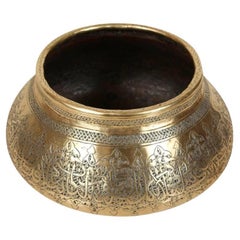
Antique Islamic Brass Bowl Fine Metalwork Hand Etched Bowl
Located in Moreno Valley, CA
Antique Middle Eastern Islamic art Moorish brass bowl engraved with Thuluth Arabic calligraphy.The polished brass bowl is profusely chased with vines and vegetal motifs and inscribed with Islamic verses of the Holly Koran.This bowl has been professionally cleaned and polished.Measures: Diameter 7.25" x 4" height Mouth opening: 5".Great Middle Eastern brass metalwork decorative Islamic art objects.Handcrafted Moorish hand-etched Islamic metal brass bowl.Engraved, incised and hammered with very fine Arabic Islamic calligraphy writing and geometric designs on brass vessel.Very Intricate fine Middle eastern Moorish Islamic Art metalwork, museum quality artwork.Late 19th Century.Date of Manufacture: Circa 1880.Condition: Wear consistent with age and use.
Islamic brass metalwork is an intricate and beautiful form of art that originated in the Islamic world. It encompasses a wide range of decorative objects made from brass or other metals such as copper, bronze, and silver. Brass trays, in particular, are highly regarded for their craftsmanship and intricate designs.
Islamic brass metalwork has a rich history that dates back to the early Islamic period, with its roots in the metalworking traditions of ancient civilizations such as the Persians, Greeks, and Romans. However, Islamic artisans developed their own unique styles and techniques, blending elements from various cultures and creating distinctive motifs that reflected Islamic aesthetics and religious beliefs.
The process of creating brass trays involves several steps, each requiring specialized skills. Here is a general overview of the traditional techniques involved:
1) Design: A skilled artist or calligrapher creates the design for the brass object. Islamic brass metalwork often incorporates intricate geometric patterns, arabesques, floral motifs, and calligraphy inspired by Quranic verses or poetry.
2) Metalworking: The object is typically made from a sheet of brass or another metal. The metal is cut into the desired shape and then hammered or pressed to create the object. Traditional techniques such as repoussé (hammering from the reverse side) or chasing (hammering on the front side) may be employed to shape the metal.
3) Engraving: The surface of the metal is often decorated with intricate engravings or etchings. Skilled artisans use chisels, gravers, or other specialized tools to create fine details and elaborate patterns.
4) Filigree and Inlay: Some brass trays feature additional decorative elements such as filigree or inlay work. Filigree involves shaping thin wires of brass into delicate patterns and soldering them onto the tray's surface. Inlay work, on the other hand, involves embedding contrasting materials such as silver or copper into the brass, creating intricate designs.
5) Surface Treatment: After the main decorative work is complete, the tray may undergo surface treatments to enhance its appearance. This can include processes like polishing, buffing, or applying various chemical patinas to create an aged or oxidized effect.
While this bowl has certainly witnessed the passage of time, it remains in remarkably good condition, with only minor signs of age that add character to its appearance. The patina on the brass enhances its antique allure, making it a truly authentic and captivating collectible.
Arabic Calligraphy: The Arabic writing on the bowl is a work of art in itself. The calligraphy showcases the mastery of the scribe's hand, with flowing curves and intricate details that form an elegant script. The script may include Quranic verses, blessings, or poetic verses, depending on the bowl's origin and purpose. The inscriptions are not only visually striking but also carry profound meaning, making this bowl a beautiful representation of Islamic heritage.
Intricate Patterns: In addition to the Arabic calligraphy, the bowl features intricate geometric patterns and motifs that further enhance its visual appeal. These patterns are a hallmark of Islamic art and reflect the mathematical precision and artistic creativity that defined Islamic craftsmanship.
This antique Islamic brass bowl...
Category
19th Century Turkish Islamic Antique South America - Metalwork
Materials
Brass
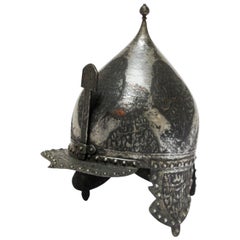
Islamic Indo Persian Kulah Khud Helmet with Arabic Inscription
Located in Moreno Valley, CA
Islamic Indo Persian kulah khud helmet with Arabic hand engravings.
Hand forged, made of heavy tinned copper metal Middle eastern influence warrior helmet ...
Category
Early 20th Century Indian Islamic South America - Metalwork
Materials
Metal, Steel
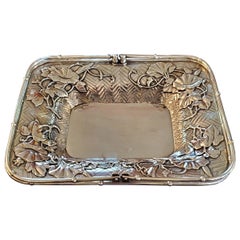
Japanese Meiji Period Sterling Silver 2 Handled Basket by Katsu Miyamoto
By Miyamoto Shoko 1
Located in Dallas, TX
PRESENTING a GORGEOUS, VERY HIGH QUALITY and EXTREMELY RARE piece of Japanese Meiji Period Sterling Silver 2 Handled Basket by Katsu Miyamoto.
EXQUISITE, EXCEPTIONAL, RARE & IMPORTANT!
This is definitely a Meiji Period piece due to the fact that it is marked with the sterling silver mark “jungin”.
The Meiji period was from 1868 to 1912 and in 1928 a law was introduced in Japan compelling the use of decimal marks for silver.
This pre-dates that decimalization law.
We are of the opinion that it is from circa 1900.
Miyamoto Shoko was founded in 1880 as the first silverware specialty shop. In 1899, Miyamoto Shoko’s silverwares were ordered by the family members of the Emperor of Japan, and to this day, they are making fine and graceful handicrafts with skillful craftsmen.
Loved by numerous customers since the Meiji era, Miyamoto Shoko’s products have also been given to Princess Mako and Princess Kako of Akishino, as well as Princess Aiko Toshinomiya, on their birthdays.
Katsu Miyamoto (宮本勝), in 1880, in order to increase the sales of tobacco and cigarettes to foreigners founded the Moyamoto Shoko company, which produced different silverwares in general and particularly silver cigarette cases. Miyamoto’s first name, Katsu (勝) in some sources is written as “Masaru”, since 勝 kanji can be pronounced in both ways.
This basket is of the HIGHEST QUALITY imaginable!
The top of the basket has the MOST GORGEOUS repousse work of flowers, probably lotus flowers, with leaves and foliage. It has an underlying chevron effect chasing, reflecting parquetry.
The 2 handles are cast in the form of bamboo handles.
The rim of the top likewise is cast as bamboo.
The base is equally stunning in a different way!
It is chased with a chevron effect, like parquetry flooring and the four feet simulate pieces of sliced bamboo with an interlinking gallery of support columns, likewise, simulating bamboo.
The QUALITY of WORKMANSHIP is OUTSTANDING!
The pieces weighs exactly 525 grams.
This piece takes my breath away!
This is one for the SERIOUS COLLECTOR of EXQUISITE AND RARE Japanese silver. You will not find another like it, for sale ANYWHERE ELSE IN THE WORLD …… I know as I have searched!
Provenance: Acquired from a Dallas Private Collector.
Dimensions: 9.6 inches wide, 7.6 inches deep and 2.75 inches tall ( 7.25 inches tall with handles up)
Condition: Very good. It looks like the base 4 legged gallery, has been repaired/re-attached to the base, but otherwise it is excellent and of Museum quality.
The Meiji period (明治時代 Meiji-jidai?), also known as the Meiji era, is a Japanese era which extended from October 23, 1868 through July 30, 1912.[1] This period represents the first half of the Empire of Japan during which Japanese society moved from being an isolated feudal society to its modern form. Fundamental changes affected its social structure, internal politics, economy, military, and foreign relations. The period corresponded with the reign of Emperor Meiji after 1868, and lasted until his death in 1912. It was succeeded by the Taishō period upon the accession of Emperor Taishō to the throne.
Solid silver pieces...
Category
Early 20th Century Japanese Meiji South America - Metalwork
Materials
Sterling Silver
$7,250
H 7.25 in W 9.6 in D 7.6 in
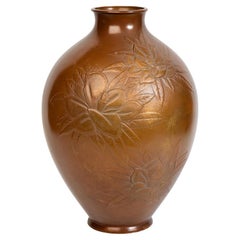
Early 20th Century, Showa, Japanese Bronze Vase
Located in Sampantawong, TH
Japanese bronze vase.
Age: Japan, Showa Period, Early 20th century
Size: Height 40.2 C.M. / Width 27.5 C.M.
Condition: Nice condition overall.
Category
Early 20th Century Japanese South America - Metalwork
Materials
Bronze
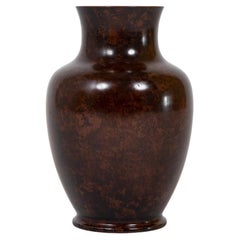
19th Century Japanese Bronze Vase
Located in Stamford, CT
19th century Japanese bronze vase of classic form with a lovely rich patina. The vase has been drilled for wiring as a lamp. It will make ...
Category
Late 18th Century Japanese Japonisme Antique South America - Metalwork
Materials
Bronze
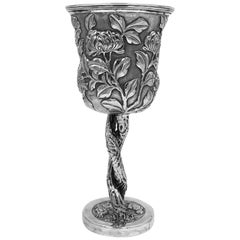
Chinese Export Silver Goblet
Located in London, GB
A Chinese silver goblet profusely decorated with chased, richly defined chrysanthemum against a matte background and is supported by two intertwi...
Category
1890s Chinese Chinese Export Antique South America - Metalwork
Materials
Silver
Early 20th Century, Showa, Japanese Bronze Vase with Artist Sign
Located in Sampantawong, TH
Japanese bronze vase with artist sign, used to decorate single flower arrangement in Japanese traditional tea ceremony.
Artist signature is on the last photo.
Age: Japan, Showa Pe...
Category
Early 20th Century Japanese South America - Metalwork
Materials
Bronze
$760 Sale Price
20% Off
H 6.62 in Dm 7.76 in
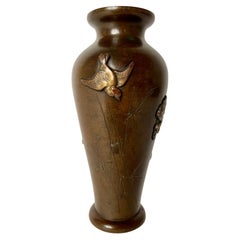
19th Century Japanese Bronze Vase With Gilt Decoration, Meiji Period
Located in Stamford, CT
19th century Meiji Period diminutive bronze vase with lovely etched and applied decoration. A raised gilt bird is shown flying above etched bamboo on one side, gilt applied lilies wi...
Category
Late 19th Century Japanese Meiji Antique South America - Metalwork
Materials
Bronze
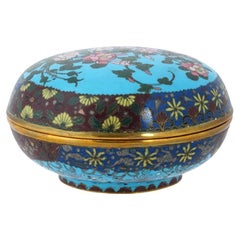
19th Century Japanese Cloisonne Enamel Meiji Floral Box
Located in Long Island City, NY
An antique Japanese, late Meiji era, covered enamel over brass jewelry or trinket box. The exterior of the ware is enameled with polychrome images of blossoming flowers surrounded by...
Category
19th Century Japanese Meiji Antique South America - Metalwork
Materials
Enamel, Brass
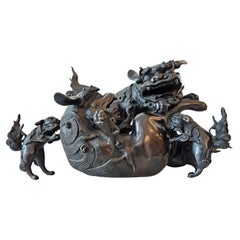
19th Century Japanese Meiji Era Patinated Bronze Foo Dog Lion Group Censer
Located in Forney, TX
A large and impressive Japanese Meiji period (1852-1912) patinated bronze guardian lion censer.
Late 19th century, Japan, exceptionally executed, the group consisting of four shishi...
Category
Late 19th Century Japanese Meiji Antique South America - Metalwork
Materials
Bronze
$3,500
H 10 in W 15.5 in D 9 in
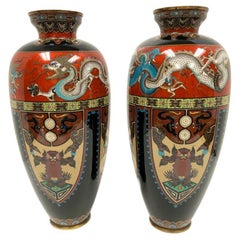
Pair Of Japanese Meiji Era Cloisonne Vases
Located in Bridgeport, CT
Pair of Japanese cloisonné vases with fine traditional form decorated with dragons and demons, geometric motifs and floral bands.
Dimensions: 5" W x 12" H
Condition: Please see detai...
Category
Late 19th Century Japanese Meiji Antique South America - Metalwork
Materials
Metal, Enamel
Still Thinking About These?
All Recently ViewedMore Ways To Browse
Qajar Copper
19th Century Middle Eastern Arabic Coffee Pot
Antique Iron Stirrups
Brass Chinese Burners
Bronze Asian Charger
Bronze Chinese Incense Censer
Burma Karen
Chinese Censor Bronze
Japanese Bronze Dog
Miyao Eisuke
Antique Chinese Silver Filigree
Antique Katar
Antique Persian Copper Tray
Chinese Brass Incense Burner
Chinese Cloisonne Teapot
Copper Persian Tray
Foo Dog Incense Burners
Japanese Copper Trays