Recognized Dealers Portrait Paintings

to
18
131
106
86
59
104
Overall Width
to
Overall Height
to
13
31
193
250
4
12
16
16
11
13
15
12
6
2
6
171
58
26
16
14
11
10
7
3
2
1
1
339
99
40
407
229
207
160
145
114
69
63
50
31
26
24
19
18
15
13
12
11
11
9
465
297
215
200
147
26
25
25
18
17
226
1
334
65
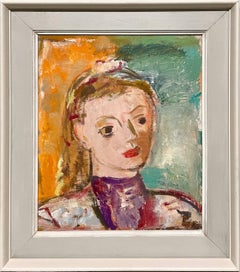
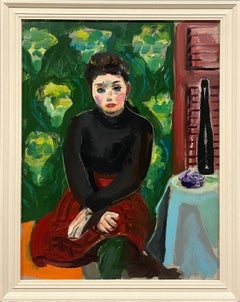
A Captivating 1930s Modern Portrait of a Seated Young Woman by Francis Chapin
By Francis Chapin
Located in Chicago, IL
A captivating, Modern 1930s portrait painting of a young woman in a black sweater by famed Chicago artist, Francis Chapin (Am. 1899-1965). A skilled and expressive portrait of a you...
Category

1930s American Modern Portrait Paintings

Materials

Oil, Board

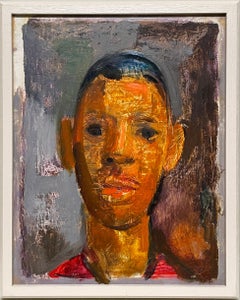
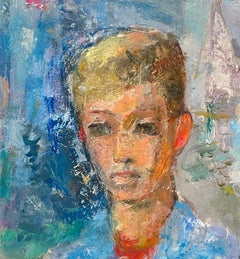
A Vibrant, 1950s Modern Portrait of a Young Black Man by Francis Chapin
By Francis Chapin
Located in Chicago, IL
A captivating, 1950s Mid-Century Modern portrait painting of a young black man by famed Chicago artist, Francis Chapin (Am. 1899-1965). A sensitive, skilled portrait of a young Afri...
Category

1930s American Modern Portrait Paintings

Materials

Oil, Board

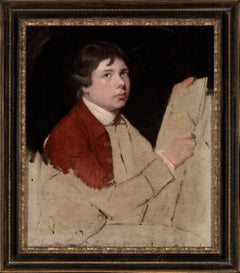
Self-Portrait
By John Hamilton Mortimer
Located in London, GB
Oil on canvas 30 x 25 ⅛ inches; 762 x 638 mm Verso: after Sir Joshua Reynolds, a self-portrait Not signed Painted c. 1758 Collections: Philip Gell (1775–1842), Hopton Hall, Derbyshire; By inheritance at Hopton Hall to his daughter, Isabella, who married William Pole Thornhill, who renounced Hopton and its contents in favour of his kinsman, Henry Chandos-Pole-Gell (1829–1902); By descent to his son, Brigadier General Harry Chandos-Pole-Gell (1872–1934), who sold Hopton Hall in 1918 and moved the family to Newnham Hall, Northamptonshire; By descent to his son, Lt Colonel John Chandos-Pole (1909–1993), Newnham Hall; Thence by descent until 2015, when acquired By descent to 2015; Lowell Libson Jonny Yarker Ltd. Literature: Algernon Graves and Walter V. Cronin, A History of the works of Sir Joshua Reynolds P.R.A., London, 1901, IV, p. 1394. David Manning...
Category

18th Century Old Masters Portrait Paintings

Materials

Canvas, Oil

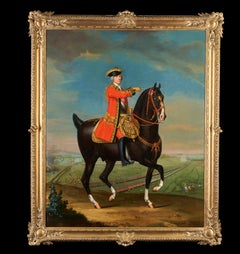
An equestrian portrait of Field Marshal Sir John Ligonier, 1st Earl of Ligonier
By David Morier
Located in Stoke, Hampshire
David Morier (c.1705–1770 London) An equestrian portrait of Field Marshal Sir John Ligonier, 1st Earl of Ligonier (1680–1770) Oil on canvas Canvas size - 40 x 50 in Framed size - 48 ...
Category

18th Century Old Masters Portrait Paintings

Materials

Oil

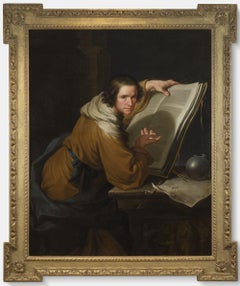
Sir Charles Frederick
Located in London, GB
Oil on canvas 50 x 40 inches; 127 x 101.6 cm Framed dimensions: 151.5 x 127 cm Inscribed on plinth: ‘VOTIS X ET XX’ Not signed Painted c.1748 Collections: Christie’s London, 23rd...
Category

18th Century Old Masters Portrait Paintings

Materials

Canvas, Oil

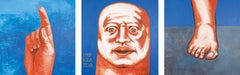
Colossal Hand - Colossal Head - Colossal Foot (Triptych) -21st Century, Blue
By Alexandru Rădvan
Located in Baden-Baden, DE
Colossal Hand - Colossal Head - Colossal Foot (Triptych), 2003 Acrylic on canvas (Signed on front) 78 7/10 H × 236 1/5 W in (78 7/10 H × 78 7/10 W in eac...
Category

Early 2000s Contemporary Figurative Paintings

Materials

Canvas, Acrylic

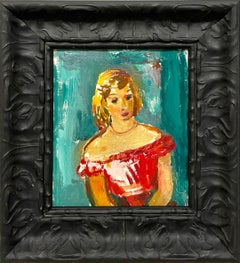
An Elegant Modernist Portrait of a Young Woman in Red Dress by Francis Chapin
By Francis Chapin
Located in Chicago, IL
An Elegant 1940s Modernist Portrait of a Young Woman a Red Dress by Noted Chicago Artist, Francis Chapin (Am. 1899-1965). A beautifully executed studio portrait, the painting is oil...
Category

Mid-20th Century American Modern Figurative Paintings

Materials

Masonite, Oil

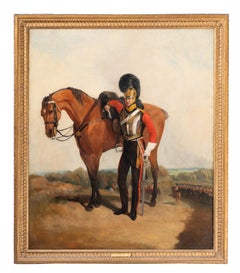
Portrait of an officer of the 2nd Life Guards, Windsor Castle beyond
By Richard Barrett Davis
Located in Stoke, Hampshire
Richard Barrett Davies (1782-1854) Portrait of an officer of the 2nd Life Guards, small full-length, with his mount, holding a paper, a troop of mounted Life Guards and Windsor Castle ...
Category

19th Century Victorian Animal Paintings

Materials

Oil

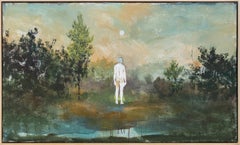
Gaze - contemporary, figurative, landscape, clay and pigment on jute
By Peter Hoffer
Located in Bloomfield, ON
This contemporary landscape painting is by Peter Hoffer. The distinctive artwork of this Canadian artist lies somewhere between realism and impressionism. Lauded internationally for his ethereal landscapes Hoffer’s artwork is reminiscent of the idyllic visions of the 19th century romanticists. This piece—a unique mix of clay and pigment on jute captures a view of the countryside…with a single human figure in the center—an almost ghost-like white image who appears to be gazing at the moon. The figure is surrounded by lush foliage painted with expressive brushstrokes in deep greens, aubergine, golden earthy browns and turquoise waters. The sky is a mix of soft blues and blush. "I love landscape painting and one of the reasons I continue to do landscape painting is that these paintings are nowhere specific.” Peter Hoffer “They are profound works from an artist with a clear vision.” Peter Simpson...
Category

2010s Contemporary Figurative Paintings

Materials

Epoxy Resin, Clay, Pigment

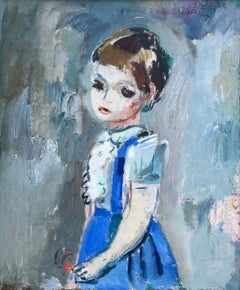
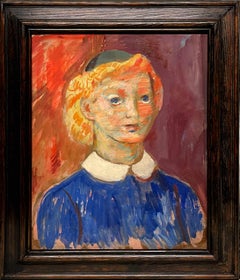
A Charming, 1950s Mid-Century Modern Portrait, "Young Girl in Blue"
By Francis Chapin
Located in Chicago, IL
A Charming, 1950s Mid-Century Modern Studio Portrait, "Young Girl in Blue" by Notable Chicago Artist, Francis Chapin (Am. 1899-1965). Artwork size: 20 x 16 inches, oil on canvas. ...
Category

Mid-20th Century American Modern Figurative Paintings

Materials

Oil, Canvas

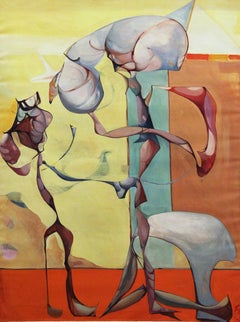
Lunar Encounter with Child, Surrealist Portrait, Oil on Canvas, 1958, Framed
By Leon Kelly
Located in Doylestown, PA
"Lunar Encounter with Child" by Philadelphia born modernist painter Leon Kelly, is a large, brightly colored surrealist portrait of two figures. The 40" x 30" oil on canvas was paint...
Category

1950s Surrealist Portrait Paintings

Materials

Canvas, Oil

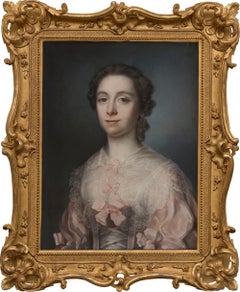
A Pair of Portraits
By Francis Cotes
Located in London, GB
Pastel on paper stretched on canvas Each 23 ¼ x 19 ¾ inches; 59 x 50 cm Framed dimensions, each: 83 x 67.5 cm Both signed ‘F. Cotes Px 1751’ Collections: Captain Penton; Christie’...
Category

18th Century Old Masters Portrait Paintings

Materials

Canvas, Paper, Pastel

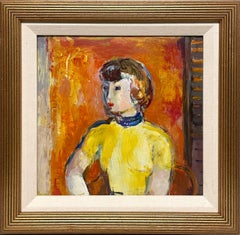
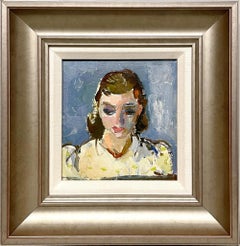
A Fashionable 1950s Mid-Century Modern Portrait, "Young Woman in Yellow Sweater"
By Francis Chapin
Located in Chicago, IL
A Fashionable, 1950s Mid-Century Modern Portrait, "Young Woman in Yellow Sweater" by Noted Chicago Artist, Francis Chapin (Am. 1899-1965). Artwork size: 11 x 11 1/4 inches (Framed...
Category

Mid-20th Century American Modern Figurative Paintings

Materials

Masonite, Oil

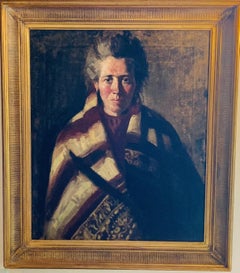
A Ballynakill Woman.
By Gerald Leslie Brockhurst
Located in Storrs, CT
A Ballynakill Woman. c. 1926. Oil on canvas. 30 x 25. Housed in an elegant gold leaf frame. Signed 'Brockhurst' in green paint, in the blanket, lower right. Provenance: Provenance...
Category

Early 20th Century Modern Portrait Paintings

Materials

Oil

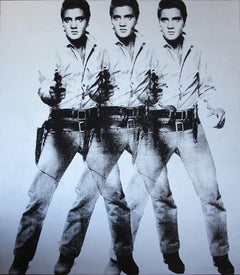
"Triple Elvis" Denied Andy Warhol Silver Black Pop Art Painting by Charles Lutz
By Charles Lutz
Located in Brooklyn, NY
"Triple Elvis" (Denied) Silkscreen Painting by Charles Lutz Silkscreen and silver enamel paint on canvas with Artist's Denied stamp of the Andy Warhol Art Authentication Board. 82 x 72" inches 2010 This important example was shown alongside works by Warhol in a two-person show "Warhol Revisited (Charles Lutz / Andy Warhol)" at UAB Abroms-Engel Institute for the Visual Arts in 2024. Lutz's 2007 ''Warhol Denied'' series gained international attention by calling into question the importance of originality or lack thereof in the work of Andy Warhol. The authentication/denial process of the [[Andy Warhol Art Authentication Board]] was used to create value by submitting recreations of Warhol works for judgment with the full intention for the works to be formally marked "DENIED". The final product of the conceptual project being "officially denied" "Warhol" paintings authored by Lutz. Based on the full-length Elvis Presley paintings by Pop Artist Andy Warhol in 1964, this is likely one of his most iconic images, next to Campbell's Soup Cans and portraits of Jackie Kennedy, Marilyn Monroe, Liz Taylor, and Marlon Brando. This is the rarest of the Elvis works from the series, as Lutz sourced a vintage roll of 1960's primed artist linen which was used for this one Elvis. The silkscreen, like Warhol's embraced imperfections, like the slight double image printing of the Elvis image. Lutz received his BFA in Painting and Art History from Pratt Institute and studied Human Dissection and Anatomy at Columbia University, New York. Lutz's work deals with perceptions and value structures, specifically the idea of the transference of values. Lutz's most recently presented an installation of new sculptures dealing with consumerism at Frank Lloyd Wright's Fallingwater House in 2022. Lutz's 2007 Warhol Denied series received international attention calling into question the importance of originality in a work of art. The valuation process (authentication or denial) of the Andy Warhol Art Authentication Board was used by the artist to create value by submitting recreations of Warhol works for judgment, with the full intention for the works to be formally marked "DENIED" of their authenticity. The final product of this conceptual project is "Officially DENIED" "Warhol" paintings authored by Lutz. Later in 2013, Lutz went on to do one of his largest public installations to date. At the 100th Anniversary of Marcel Duchamp's groundbreaking and controversial Armory Show, Lutz was asked by the curator of Armory Focus: USA and former Director of The Andy Warhol Museum, Eric Shiner to create a site-specific installation representing the US. The installation "Babel" (based on Pieter Bruegel's famous painting) consisted of 1500 cardboard replicas of Warhol's Brillo Box (Stockholm Type) stacked 20 ft tall. All 1500 boxes were then given to the public freely, debasing the Brillo Box as an art commodity by removing its value, in addition to debasing its willing consumers. Elvis was "the greatest cultural force in the Twentieth Century. He introduced the beat to everything, and he changed everything - music, language, clothes, it's a whole new social revolution." Leonard Bernstein in: Exh. Cat., Boston, The Institute of Contemporary Art and traveling, Elvis + Marilyn 2 x Immortal, 1994-97, p. 9. Andy Warhol "quite simply changed how we all see the world around us." Kynaston McShine in: Exh. Cat., New York, Museum of Modern Art (and traveling), Andy Warhol: Retrospective, 1996, p. 13. In the summer of 1963 Elvis Presley was just twenty-eight years old but already a legend of his time. During the preceding seven years - since Heartbreak Hotel became the biggest-selling record of 1956 - he had recorded seventeen number-one singles and seven number-one albums; starred in eleven films, countless national TV appearances, tours, and live performances; earned tens of millions of dollars; and was instantly recognized across the globe. The undisputed King of Rock and Roll, Elvis was the biggest star alive: a cultural phenomenon of mythic proportions apparently no longer confined to the man alone. As the eminent composer Leonard Bernstein put it, Elvis was "the greatest cultural force in the Twentieth Century. He introduced the beat to everything, and he changed everything - music, language, clothes, it's a whole new social revolution." (Exh. Cat., Boston, The Institute of Contemporary Art (and traveling), Elvis + Marilyn 2 x Immortal, 1994, p. 9). In the summer of 1963 Andy Warhol was thirty-four years old and transforming the parameters of visual culture in America. The focus of his signature silkscreen was leveled at subjects he brilliantly perceived as the most important concerns of day to day contemporary life. By appropriating the visual vernacular of consumer culture and multiplying readymade images gleaned from newspapers, magazines and advertising, he turned a mirror onto the contradictions behind quotidian existence. Above all else he was obsessed with themes of celebrity and death, executing intensely multifaceted and complex works in series that continue to resound with universal relevance. His unprecedented practice re-presented how society viewed itself, simultaneously reinforcing and radically undermining the collective psychology of popular culture. He epitomized the tide of change that swept through the 1960s and, as Kynaston McShine has concisely stated, "He quite simply changed how we all see the world around us." (Exh. Cat., New York, Museum of Modern Art (and traveling), Andy Warhol: Retrospective, 1996, p. 13). Thus in the summer of 1963 there could not have been a more perfect alignment of artist and subject than Warhol and Elvis. Perhaps the most famous depiction of the biggest superstar by the original superstar artist, Double Elvis is a historic paradigm of Pop Art from a breath-taking moment in Art History. With devastating immediacy and efficiency, Warhol's canvas seduces our view with a stunning aesthetic and confronts our experience with a sophisticated array of thematic content. Not only is there all of Elvis, man and legend, but we are also presented with the specter of death, staring at us down the barrel of a gun; and the lone cowboy, confronting the great frontier and the American dream. The spray painted silver screen denotes the glamour and glory of cinema, the artificiality of fantasy, and the idea of a mirror that reveals our own reality back to us. At the same time, Warhol's replication of Elvis' image as a double stands as metaphor for the means and effects of mass-media and its inherent potential to manipulate and condition. These thematic strata function in simultaneous concert to deliver a work of phenomenal conceptual brilliance. The portrait of a man, the portrait of a country, and the portrait of a time, Double Elvis is an indisputable icon for our age. The source image was a publicity still for the movie Flaming Star, starring Presley as the character Pacer Burton and directed by Don Siegel in 1960. The film was originally intended as a vehicle for Marlon Brando and produced by David Weisbart, who had made James Dean's Rebel Without a Cause in 1955. It was the first of two Twentieth Century Fox productions Presley was contracted to by his manager Colonel Tom Parker, determined to make the singer a movie star. For the compulsive movie-fan Warhol, the sheer power of Elvis wielding a revolver as the reluctant gunslinger presented the zenith of subject matter: ultimate celebrity invested with the ultimate power to issue death. Warhol's Elvis is physically larger than life and wears the expression that catapulted him into a million hearts: inexplicably and all at once fearful and resolute; vulnerable and predatory; innocent and explicit. It is the look of David Halberstam's observation that "Elvis Presley was an American original, the rebel as mother's boy, alternately sweet and sullen, ready on demand to be either respectable or rebellious." (Exh. Cat., Boston, Op. Cit.). Indeed, amidst Warhol's art there is only one other subject whose character so ethereally defies categorization and who so acutely conflated total fame with the inevitability of mortality. In Warhol's work, only Elvis and Marilyn harness a pictorial magnetism of mythic proportions. With Marilyn Monroe, whom Warhol depicted immediately after her premature death in August 1962, he discovered a memento mori to unite the obsessions driving his career: glamour, beauty, fame, and death. As a star of the silver screen and the definitive international sex symbol, Marilyn epitomized the unattainable essence of superstardom that Warhol craved. Just as there was no question in 1963, there remains still none today that the male equivalent to Marilyn is Elvis. However, despite his famous 1968 adage, "If you want to know all about Andy Warhol, just look at the surface of my paintings" Warhol's fascination held purpose far beyond mere idolization. As Rainer Crone explained in 1970, Warhol was interested in movie stars above all else because they were "people who could justifiably be seen as the nearest thing to representatives of mass culture." (Rainer Crone, Andy Warhol, New York, 1970, p. 22). Warhol was singularly drawn to the idols of Elvis and Marilyn, as he was to Marlon Brando and Liz Taylor, because he implicitly understood the concurrence between the projection of their image and the projection of their brand. Some years after the present work he wrote, "In the early days of film, fans used to idolize a whole star - they would take one star and love everything about that star...So you should always have a product that's not just 'you.' An actress should count up her plays and movies and a model should count up her photographs and a writer should count up his words and an artist should count up his pictures so you always know exactly what you're worth, and you don't get stuck thinking your product is you and your fame, and your aura." (Andy Warhol, The Philosophy of Andy Warhol (From A to B and Back Again), San Diego, New York and London, 1977, p. 86). The film stars of the late 1950s and early 1960s that most obsessed Warhol embodied tectonic shifts in wider cultural and societal values. In 1971 John Coplans argued that Warhol was transfixed by the subject of Elvis, and to a lesser degree by Marlon Brando and James Dean, because they were "authentically creative, and not merely products of Hollywood's fantasy or commercialism. All three had originative lives, and therefore are strong personalities; all three raised - at one level or another - important questions as to the quality of life in America and the nature of its freedoms. Implicit in their attitude is a condemnation of society and its ways; they project an image of the necessity for the individual to search for his own future, not passively, but aggressively, with commitment and passion." (John Coplans, "Andy Warhol and Elvis Presley," Studio International, vol. 181, no. 930, February 1971, pp. 51-52). However, while Warhol unquestionably adored these idols as transformative heralds, the suggestion that his paintings of Elvis...
Category

21st Century and Contemporary Pop Art Figurative Paintings

Materials

Enamel

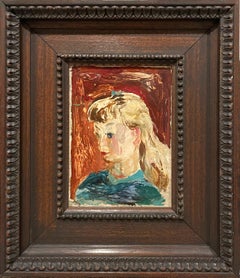
A Cheerful 1950s Modern Portrait of a Young Woman by Francis Chapin
By Francis Chapin
Located in Chicago, IL
A Cheerful, 1950s Modern Portrait of a Young Woman with Blonde Hair by Notable Chicago Artist, Francis Chapin (Am. 1899-1965). Artwork size: 7 1/2 x 5 1/4 inches, oil on Masonite (...
Category

Mid-20th Century American Modern Figurative Paintings

Materials

Masonite, Oil

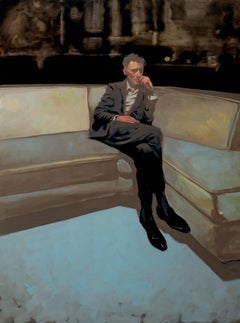
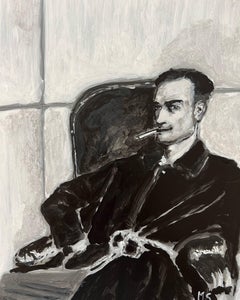
"Just Think of It"
By Michael Carson
Located in Scottsdale, AZ
"Just Think of It" is a moody, figurative oil painting that layers soft pale blues against deep grays and black, creating a quiet tension. A stylish man sits at the edge of a couch, ...
Category

2010s Contemporary Figurative Paintings

Materials

Canvas, Oil

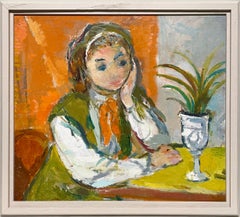
A Wonderful 1950s Mid-Century Modern Portrait of a Young Woman Seated at a Table
By Francis Chapin
Located in Chicago, IL
A wonderful 1950s Mid-Century Modern portrait of a young woman seated at a table by famed Chicago artist, Francis Chapin (Am. 1899-1965). Great color palette and expressive, contemp...
Category

Mid-20th Century American Modern Figurative Paintings

Materials

Canvas, Oil

An Introspective 1930s Modern Portrait, "Acolyte" by Noted Artist Francis Chapin
By Francis Chapin
Located in Chicago, IL
An Introspective 1930s Modern Portrait, "Acolyte" by Noted Chicago Artist, Francis Chapin (Am. 1899-1965). Dry watercolor on board. Artwork size: 15 x 12 inches (Framed size: 18 ...
Category

1930s American Modern Figurative Paintings

Materials

Watercolor, Board

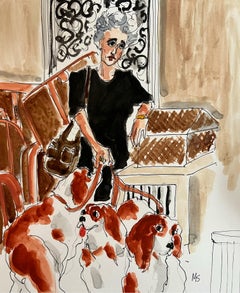
Pat Buckley leaving town. From The Art, culture society Series
By Manuel Santelices
Located in Miami Beach, FL
Movies, TV and magazines are constant source of inspiration. Fame, as fleckring and shallow it can be sometimes, is very intriguing to him. The worlds of fashion, society and pop cu...
Category

21st Century and Contemporary Contemporary Figurative Drawings and Water...

Materials

Paper, Ink, Watercolor, Gouache

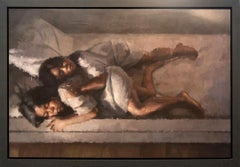
Sleeping Girls - contemporary, figurative, portrait, acrylic, oil on board
By Daniel Hughes
Located in Bloomfield, ON
This realistic painting, a portrait of children, is by internationally recognized artist Daniel Hughes. Daniel Hughes is known best perhaps for his true-to-life figurative paintings. Early in his life, Hughes was strongly influenced by the work of his artist mother and her friends, many of whom were renowned British artists. He grew up drawing…never in color books but on six-foot lengths of computer paper. Hughes was especially drawn to the figurative paintings of British artists of the 1950s. His aesthetic focuses on a realistic interpretation, composition, light, harmony, and emotion. Hughes' work, like this acrylic and charcoal painting of two little girls sleeping...
Category

2010s Realist Portrait Paintings

Materials

Oil, Board

A Charming 1950s Modern Portrait, Girl in White Dress, by Francis Chapin
By Francis Chapin
Located in Chicago, IL
A Charming, 1950s Modern Portrait of a Girl in White Dress by Noted Chicago Artist, Francis Chapin (Am. 1899-1965). Artwork size: 6 1/2 x 5 3/4 inches; oil on Masonite; Framed si...
Category

Mid-20th Century American Modern Figurative Paintings

Materials

Masonite, Oil

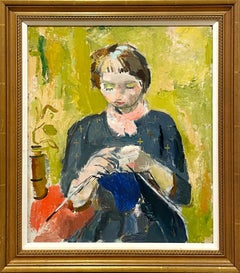
A Charming, Colorful 1930s Painting of a Young Woman Knitting by Francis Chapin
By Francis Chapin
Located in Chicago, IL
A charming, colorful 1930s painting of a young woman knitting by famed Chicago Modern artist, Francis Chapin. A harmonious palette of cheerful yellows, reds and blues, where a young...
Category

1930s American Modern Figurative Paintings

Materials

Masonite, Oil

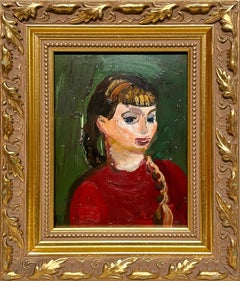
A Charming 1950s Modern Portrait of a Young Woman by Francis Chapin
By Francis Chapin
Located in Chicago, IL
A Charming, 1950s Modern Portrait of a Young Woman in a Red Sweater by Famed Chicago Artist, Francis Chapin (Am. 1899-1965). Artwork size: 8 x 6 inches, oil on Masonite (Framed siz...
Category

Mid-20th Century American Modern Figurative Paintings

Materials

Masonite, Oil

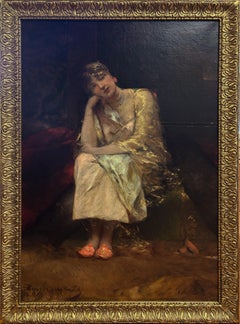
The Empress Theodora at the Coliseum
Located in New York, NY
Benjamin Constant was an important figure in the Academic painting world in Paris and one of the leading French Romantic artists of the time. He is in all the museums of France and ...
Category

Late 19th Century Academic Portrait Paintings

Materials

Canvas, Oil

Mujer con niños
Located in Miami Beach, FL
His paintings, created to the very last detail using the techniques of the Old Masters, work with classical compositions while depicting a subject of central importance to their crea...
Category

1980s Contemporary Figurative Paintings

Materials

Canvas, Oil

An Introspective, 1950s Mid-Century Modern Portrait "Head of a Young Girl"
By Francis Chapin
Located in Chicago, IL
An Introspective, 1950s Mid-Century Modern Portrait "Head of a Young Girl" by Noted Chicago Artist, Francis Chapin (Am. 1899-1965). Artwork size: 15 x 12 1/2 inches (Framed size: ...
Category

Mid-20th Century American Modern Figurative Paintings

Materials

Masonite, Oil

A Charming Mid-Century Modern Portrait of a Young Man by Francis Chapin
By Francis Chapin
Located in Chicago, IL
A Charming, 1960s Mid-Century Modern Portrait of a Young Man by Francis Chapin (Am. 1899-1965). With wonderful expressionist brushwork and a vibrant palette, the painting most like...
Category

Mid-20th Century American Modern Figurative Paintings

Materials

Masonite, Oil

Girl with Muff
By Robert Henri
Located in Palm Desert, CA
"Girl with Muff" is aa American figurative portrait oil on canvas painting by Robert Henri in 1912. The artwork is 57 1/4 x 38 1/4 inches and, with the frame, is 64 1/4 x 45 1/4 x 2 ...
Category

Early 20th Century American Realist Portrait Paintings

Materials

Canvas, Oil

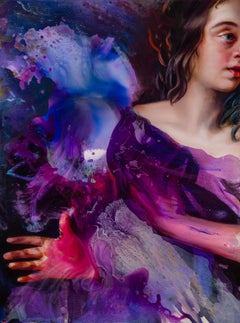
Stars Splinter, Pointed and Wild
By Angela Fraleigh
Located in New York, NY
Unsigned
Category

2010s Contemporary Portrait Paintings

Materials

Linen, Oil

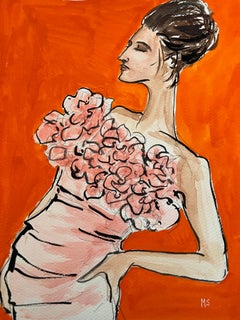
Giambattista Valli Haute couture. From The Fashion Series
By Manuel Santelices
Located in Miami Beach, FL
The artist has covered New York collections for over 16 years and has interviewed, as a journalist, several fashion designers and personalities for different publications. He loves t...
Category

21st Century and Contemporary Contemporary Figurative Drawings and Water...

Materials

Paper, Watercolor, Gouache, Ink

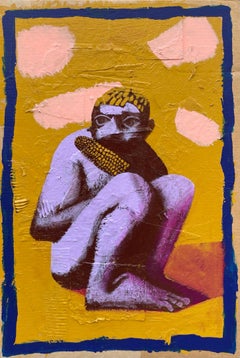
Summer Gold and Corn - Contemporary Art, Figurative, Yellow
By Alexandru Rădvan
Located in Baden-Baden, DE
Summer Gold and Corn, 2021 acrylic on cardboard 119 H x 79 W cm 46 27/32 H x 31 7/64 W cm The series of painted cardboards by Alexandru Rădvan is about our moments of 'respiro' abo...
Category

2010s Contemporary Figurative Paintings

Materials

Acrylic, Cardboard

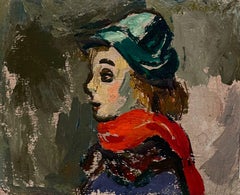
A Charming 1950s Modernist Portrait, Young Girl in Red Scarf by Francis Chapin
By Francis Chapin
Located in Chicago, IL
A Charming 1950s Modernist Portrait, "Girl in Red Scarf", by Noted Chicago Artist Francis Chapin (Am. 1899-1965). A colorful, intimate and gem-like work, the painting is accompanied...
Category

1950s Figurative Paintings

Materials

Masonite, Oil

Robert Hebert Percy. From the Art, culture society series
By Manuel Santelices
Located in Miami Beach, FL
Movies, TV and magazines are constant source of inspiration. Fame, as fleckring and shallow it can be sometimes, is very intriguing to him. The worlds of fashion, society and pop cu...
Category

21st Century and Contemporary Contemporary Portrait Paintings

Materials

Gesso, Acrylic, Panel

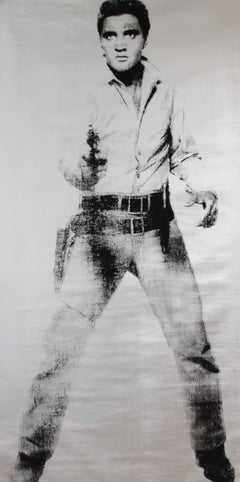
"Elvis", Denied Andy Warhol Silver Black Pop Art Painting by Charles Lutz
By Charles Lutz
Located in Brooklyn, NY
Elvis, Metallic Silver and Black Full Length Silkscreen Painting by Charles Lutz Silkscreen and silver enamel painted on vintage 1960's era linen with Artist's Denied stamp of the Andy Warhol Art Authentication Board. 82" x 40" inches 2010 Lutz's 2007 ''Warhol Denied'' series gained international attention by calling into question the importance of originality or lack thereof in the work of Andy Warhol. The authentication/denial process of the [[Andy Warhol Art Authentication Board]] was used to create value by submitting recreations of Warhol works for judgment with the full intention for the works to be formally marked "DENIED". The final product of the conceptual project being "officially denied" "Warhol" paintings authored by Lutz. Based on the full-length Elvis Presley paintings by Pop Artist Andy Warhol in 1964, this is likely one of his most iconic images, next to Campbell's Soup Cans and portraits of Jackie Kennedy, Marilyn Monroe, Liz Taylor, and Marlon Brando. This is the rarest of the Elvis works from the series, as Lutz sourced a vintage roll of 1960's primed artist linen which was used for this one Elvis. The silkscreen, like Warhol's embraced imperfections, like the slight double image printing of the Elvis image. Lutz received his BFA in Painting and Art History from Pratt Institute and studied Human Dissection and Anatomy at Columbia University, New York. Lutz's work deals with perceptions and value structures, specifically the idea of the transference of values. Lutz's most recently presented an installation of new sculptures dealing with consumerism at Frank Lloyd Wright's Fallingwater House in 2022. Lutz's 2007 Warhol Denied series received international attention calling into question the importance of originality in a work of art. The valuation process (authentication or denial) of the Andy Warhol Art Authentication Board was used by the artist to create value by submitting recreations of Warhol works for judgment, with the full intention for the works to be formally marked "DENIED" of their authenticity. The final product of this conceptual project is "Officially DENIED" "Warhol" paintings authored by Lutz. Later in 2013, Lutz went on to do one of his largest public installations to date. At the 100th Anniversary of Marcel Duchamp's groundbreaking and controversial Armory Show, Lutz was asked by the curator of Armory Focus: USA and former Director of The Andy Warhol Museum, Eric Shiner to create a site-specific installation representing the US. The installation "Babel" (based on Pieter Bruegel's famous painting) consisted of 1500 cardboard replicas of Warhol's Brillo Box (Stockholm Type) stacked 20 ft tall. All 1500 boxes were then given to the public freely, debasing the Brillo Box as an art commodity by removing its value, in addition to debasing its willing consumers. Elvis was "the greatest cultural force in the Twentieth Century. He introduced the beat to everything, and he changed everything - music, language, clothes, it's a whole new social revolution." Leonard Bernstein in: Exh. Cat., Boston, The Institute of Contemporary Art and traveling, Elvis + Marilyn 2 x Immortal, 1994-97, p. 9. Andy Warhol "quite simply changed how we all see the world around us." Kynaston McShine in: Exh. Cat., New York, Museum of Modern Art (and traveling), Andy Warhol: Retrospective, 1996, p. 13. In the summer of 1963 Elvis Presley was just twenty-eight years old but already a legend of his time. During the preceding seven years - since Heartbreak Hotel became the biggest-selling record of 1956 - he had recorded seventeen number-one singles and seven number-one albums; starred in eleven films, countless national TV appearances, tours, and live performances; earned tens of millions of dollars; and was instantly recognized across the globe. The undisputed King of Rock and Roll, Elvis was the biggest star alive: a cultural phenomenon of mythic proportions apparently no longer confined to the man alone. As the eminent composer Leonard Bernstein put it, Elvis was "the greatest cultural force in the Twentieth Century. He introduced the beat to everything, and he changed everything - music, language, clothes, it's a whole new social revolution." (Exh. Cat., Boston, The Institute of Contemporary Art (and traveling), Elvis + Marilyn 2 x Immortal, 1994, p. 9). In the summer of 1963 Andy Warhol was thirty-four years old and transforming the parameters of visual culture in America. The focus of his signature silkscreen was leveled at subjects he brilliantly perceived as the most important concerns of day to day contemporary life. By appropriating the visual vernacular of consumer culture and multiplying readymade images gleaned from newspapers, magazines and advertising, he turned a mirror onto the contradictions behind quotidian existence. Above all else he was obsessed with themes of celebrity and death, executing intensely multifaceted and complex works in series that continue to resound with universal relevance. His unprecedented practice re-presented how society viewed itself, simultaneously reinforcing and radically undermining the collective psychology of popular culture. He epitomized the tide of change that swept through the 1960s and, as Kynaston McShine has concisely stated, "He quite simply changed how we all see the world around us." (Exh. Cat., New York, Museum of Modern Art (and traveling), Andy Warhol: Retrospective, 1996, p. 13). Thus in the summer of 1963 there could not have been a more perfect alignment of artist and subject than Warhol and Elvis. Perhaps the most famous depiction of the biggest superstar by the original superstar artist, Double Elvis is a historic paradigm of Pop Art from a breath-taking moment in Art History. With devastating immediacy and efficiency, Warhol's canvas seduces our view with a stunning aesthetic and confronts our experience with a sophisticated array of thematic content. Not only is there all of Elvis, man and legend, but we are also presented with the specter of death, staring at us down the barrel of a gun; and the lone cowboy, confronting the great frontier and the American dream. The spray painted silver screen denotes the glamour and glory of cinema, the artificiality of fantasy, and the idea of a mirror that reveals our own reality back to us. At the same time, Warhol's replication of Elvis' image as a double stands as metaphor for the means and effects of mass-media and its inherent potential to manipulate and condition. These thematic strata function in simultaneous concert to deliver a work of phenomenal conceptual brilliance. The portrait of a man, the portrait of a country, and the portrait of a time, Double Elvis is an indisputable icon for our age. The source image was a publicity still for the movie Flaming Star, starring Presley as the character Pacer Burton and directed by Don Siegel in 1960. The film was originally intended as a vehicle for Marlon Brando and produced by David Weisbart, who had made James Dean's Rebel Without a Cause in 1955. It was the first of two Twentieth Century Fox productions Presley was contracted to by his manager Colonel Tom Parker, determined to make the singer a movie star. For the compulsive movie-fan Warhol, the sheer power of Elvis wielding a revolver as the reluctant gunslinger presented the zenith of subject matter: ultimate celebrity invested with the ultimate power to issue death. Warhol's Elvis is physically larger than life and wears the expression that catapulted him into a million hearts: inexplicably and all at once fearful and resolute; vulnerable and predatory; innocent and explicit. It is the look of David Halberstam's observation that "Elvis Presley was an American original, the rebel as mother's boy, alternately sweet and sullen, ready on demand to be either respectable or rebellious." (Exh. Cat., Boston, Op. Cit.). Indeed, amidst Warhol's art there is only one other subject whose character so ethereally defies categorization and who so acutely conflated total fame with the inevitability of mortality. In Warhol's work, only Elvis and Marilyn harness a pictorial magnetism of mythic proportions. With Marilyn Monroe, whom Warhol depicted immediately after her premature death in August 1962, he discovered a memento mori to unite the obsessions driving his career: glamour, beauty, fame, and death. As a star of the silver screen and the definitive international sex symbol, Marilyn epitomized the unattainable essence of superstardom that Warhol craved. Just as there was no question in 1963, there remains still none today that the male equivalent to Marilyn is Elvis. However, despite his famous 1968 adage, "If you want to know all about Andy Warhol, just look at the surface of my paintings" Warhol's fascination held purpose far beyond mere idolization. As Rainer Crone explained in 1970, Warhol was interested in movie stars above all else because they were "people who could justifiably be seen as the nearest thing to representatives of mass culture." (Rainer Crone, Andy Warhol, New York, 1970, p. 22). Warhol was singularly drawn to the idols of Elvis and Marilyn, as he was to Marlon Brando and Liz Taylor, because he implicitly understood the concurrence between the projection of their image and the projection of their brand. Some years after the present work he wrote, "In the early days of film, fans used to idolize a whole star - they would take one star and love everything about that star...So you should always have a product that's not just 'you.' An actress should count up her plays and movies and a model should count up her photographs and a writer should count up his words and an artist should count up his pictures so you always know exactly what you're worth, and you don't get stuck thinking your product is you and your fame, and your aura." (Andy Warhol, The Philosophy of Andy Warhol (From A to B and Back Again), San Diego, New York and London, 1977, p. 86). The film stars of the late 1950s and early 1960s that most obsessed Warhol embodied tectonic shifts in wider cultural and societal values. In 1971 John Coplans argued that Warhol was transfixed by the subject of Elvis, and to a lesser degree by Marlon Brando and James Dean, because they were "authentically creative, and not merely products of Hollywood's fantasy or commercialism. All three had originative lives, and therefore are strong personalities; all three raised - at one level or another - important questions as to the quality of life in America and the nature of its freedoms. Implicit in their attitude is a condemnation of society and its ways; they project an image of the necessity for the individual to search for his own future, not passively, but aggressively, with commitment and passion." (John Coplans, "Andy Warhol and Elvis Presley," Studio International, vol. 181, no. 930, February 1971, pp. 51-52). However, while Warhol unquestionably adored these idols as transformative heralds, the suggestion that his paintings of Elvis are uncritical of a generated public image issued for mass consumption fails to appreciate the acuity of his specific re-presentation of the King. As with Marilyn, Liz and Marlon, Warhol instinctively understood the Elvis brand as an industrialized construct, designed for mass consumption like a Coca-Cola bottle or Campbell's Soup Can, and radically revealed it as a precisely composed non-reality. Of course Elvis offered Warhol the biggest brand of all, and he accentuates this by choosing a manifestly contrived version of Elvis-the-film-star, rather than the raw genius of Elvis as performing Rock n' Roll pioneer. A few months prior to the present work he had silkscreened Elvis' brooding visage in a small cycle of works based on a simple headshot, including Red Elvis, but the absence of context in these works minimizes the critical potency that is so present in Double Elvis. With Double Elvis we are confronted by a figure so familiar to us, yet playing a role relating to violence and death that is entirely at odds with the associations entrenched with the singer's renowned love songs. Although we may think this version of Elvis makes sense, it is the overwhelming power of the totemic cipher of the Elvis legend that means we might not even question why he is pointing a gun rather than a guitar. Thus Warhol interrogates the limits of the popular visual vernacular, posing vital questions of collective perception and cognition in contemporary society. The notion that this self-determinedly iconic painting shows an artificial paradigm is compounded by Warhol's enlistment of a reflective metallic surface, a treatment he reserved for his most important portraits of Elvis, Marilyn, Marlon and Liz. Here the synthetic chemical silver paint becomes allegory for the manufacture of the Elvis product, and directly anticipates the artist's 1968 statement: "Everything is sort of artificial. I don't know where the artificial stops and the real starts. The artificial fascinates me, the bright and shiny..." (Artist quoted in Exh. Cat., Stockholm, Moderna Museet and traveling, Andy Warhol, 1968, n.p.). At the same time, the shiny silver paint of Double Elvis unquestionably denotes the glamour of the silver screen and the attractive fantasies of cinema. At exactly this time in the summer of 1963 Warhol bought his first movie camera and produced his first films such as Sleep, Kiss and Tarzan and Jane Regained. Although the absence of plot or narrative convention in these movies was a purposely anti-Hollywood gesture, the unattainability of classic movie stardom still held profound allure and resonance for Warhol. He remained a celebrity and film fanatic, and it was exactly this addiction that so qualifies his sensational critique of the industry machinations behind the stars he adored. Double Elvis was executed less than eighteen months after he had created 32 Campbell's Soup Cans for his immortal show at the Ferus Gallery, Los Angeles in July and August 1962, and which is famously housed in the Museum of Modern Art, New York. In the intervening period he had produced the series Dollar Bills, Coca-Cola Bottles, Suicides, Disasters, and Silver Electric Chairs, all in addition to the portrait cycles of Marilyn and Liz. This explosive outpouring of astonishing artistic invention stands as definitive testament to Warhol's aptitude to seize the most potent images of his time. He recognized that not only the product itself, but also the means of consumption - in this case society's abandoned deification of Elvis - was symptomatic of a new mode of existence. As Heiner Bastian has precisely summated: "the aura of utterly affirmative idolization already stands as a stereotype of a 'consumer-goods style' expression of an American way of life and of the mass-media culture of a nation." (Exh. Cat., Berlin, Neue Nationalgalerie (and traveling), Andy Warhol: Retrospective, 2001, p. 28). For Warhol, the act of image replication and multiplication anaesthetized the effect of the subject, and while he had undermined the potency of wealth in 200 One Dollar Bills, and cheated the terror of death by electric chair in Silver Disaster # 6, the proliferation of Elvis here emasculates a prefabricated version of character authenticity. Here the cinematic quality of variety within unity is apparent in the degrees to which Presley's arm and gun become less visible to the left of the canvas. The sense of movement is further enhanced by a sense of receding depth as the viewer is presented with the ghost like repetition of the figure in the left of the canvas, a 'jump effect' in the screening process that would be replicated in the multiple Elvis paintings. The seriality of the image heightens the sense of a moving image, displayed for us like the unwinding of a reel of film. Elvis was central to Warhol's legendary solo exhibition organized by Irving Blum at the Ferus Gallery in the Fall of 1963 - the show having been conceived around the Elvis paintings since at least May of that year. A well-known installation photograph shows the present work prominently presented among the constant reel of canvases, designed to fill the space as a filmic diorama. While the Elvis canvases...
Category

21st Century and Contemporary Pop Art Figurative Paintings

Materials

Enamel

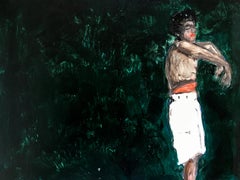
Dancer in green. Acrylic on board mounted on stretcher Painting.
By Manuel Santelices
Located in Miami Beach, FL
Movies, TV and magazines are constant source of inspiration. Fame, as fleckring and shallow it can be sometimes, is very intriguing to him. The worlds of fashion, society and pop cu...
Category

21st Century and Contemporary Contemporary Figurative Paintings

Materials

Canvas, Acrylic, Board

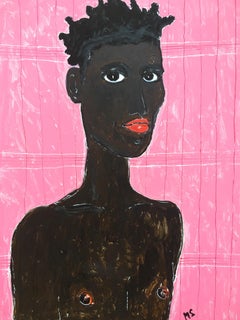
Pink Africa, Painting
By Manuel Santelices
Located in Miami Beach, FL
Movies, TV and magazines are constant source of inspiration. Fame, as fleckring and shallow it can be sometimes, is very intriguing to him. The worlds of fashion, society and pop cu...
Category

21st Century and Contemporary Contemporary Portrait Paintings

Materials

Acrylic, Wood Panel

Balthus, Portrait Painting
By Manuel Santelices
Located in Miami Beach, FL
Movies, TV and magazines are constant source of inspiration. Fame, as fleckring and shallow it can be sometimes, is very intriguing to him. The worlds of fashion, society and pop cu...
Category

21st Century and Contemporary Contemporary Figurative Paintings

Materials

Board, Acrylic, Linen

Portrait of Harriet Toby, Ballet Russe de Monte Carlo
By Donald S. Vogel
Located in Dallas, TX
Donald Vogel’s paintings reflect his interest in seeking beauty in life and in sharing pleasure with his viewers. Vogel entreats us to "rejoice and celebrate each new day, knowing it...
Category

1940s American Modern Figurative Paintings

Materials

Oil, Panel

Desire for what might have been, Figurative Painting
Located in Miami Beach, FL
Ramonn Vieitez is a self-taught Brazilian artist who primarily utilizes painting as a field of creative possibility exploring themes such as identity, memory, and nature, compulsivel...
Category

2010s Contemporary Figurative Paintings

Materials

Oil, Paper

Fred Hughes and Diana Vreeland in New York, Ink and Watercolor on paper
By Manuel Santelices
Located in Miami Beach, FL
Movies, TV and magazines are constant source of inspiration. Fame, as fleckring and shallow it can be sometimes, is very intriguing to him. The worlds of fashion, society and pop cu...
Category

21st Century and Contemporary Contemporary Figurative Drawings and Water...

Materials

Paper, Watercolor, Ink

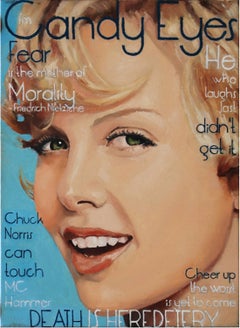
Candy Eyes issue #5 - 21st Century, Figurative Painting, Woman, Portrait, Blonde
By Mihai Florea
Located in Baden-Baden, DE
Candy Eyes issue #5, 2010 Oil on canvas (Signed front upper left corner) 13 4/5 H × 10 1/5 W in 35 H × 26 W cm Through his works, Mihai Florea equally satirizes, the one who produce...
Category

2010s Photorealist Figurative Paintings

Materials

Canvas, Oil

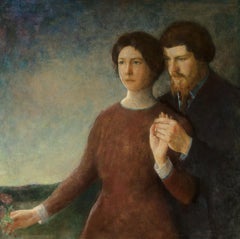
The Lovers
By Charles Webster Hawthorne
Located in Bryn Mawr, PA
The Lovers Signed lower right: C.W. Hawthorne Tempera on panel, 40 x 40 inches (101.6 x 101.6 cm) Framed dimensions: 44 1/8 x 44 1/8 inches Provenance Sotheby's, New York, March 17,...
Category

Early 20th Century American Impressionist Portrait Paintings

Materials

Tempera, Panel

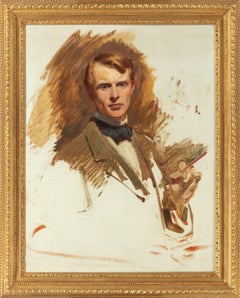
Self Portrait
Located in Stoke, Hampshire
Frank Samuel Eastman (1878-1964) Self Portrait Oil on canvas Canvas - 34 1/2 x 26 1/2 in Framed - 40 x 32 in Provenance: by descent from the artist Frank Eastman...
Category

20th Century Victorian Portrait Paintings

Materials

Oil

Self Portrait
Self Portrait
$5,455 Sale Price
20% Off
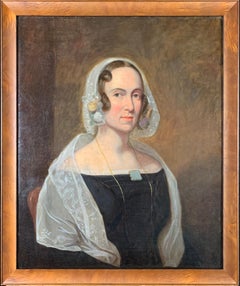
Portrait of a Lady, Oil on Canvas, 1840 s, In Style of Jacob Eichholtz
Located in Doylestown, PA
This interior portrait of a woman dressed in an elegant lace shawl is a 30" x 25" oil on canvas painting in the style of Jacob Eichholtz. The artist is unknown but the painting is believed to have been painted in the 1840's. It is not signed but framed and in good condition. Provenance: Private Collection, Old Queens Gallery...
Category

Mid-19th Century American Realist Portrait Paintings

Materials

Canvas, Oil

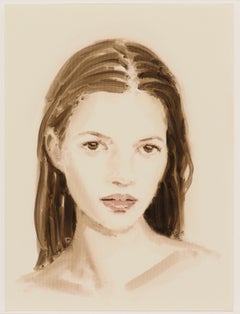
Kate Moss
By Annie Kevans
Located in New York, NY
Listing includes framing, free shipping to continental US and a 14-day return policy. Kate Moss by Annie Kevans 20 x 16 inch paper 16 x 20 inch image Archival pigment print Edition 15 of 50 Signed and edition on the front of the print Frame is in fair condition and is included for free due the condition issues. The print itself is in excellent condition. If you would like the print sent unframed the cost is the same. Please let us know if you would prefer to have us ship the print unframed. Artist Biography - Kevans’ paintings reflect her interests in power, manipulation and the role of the individual in inherited belief systems. She looks at alternative histories and how they relate to current issues and creates what she describes as ‘anti-portraits’ that may or may not be based on real documentation. She believes that, as her work is concept driven, sometimes the actual similarity to the person depicted in the work is irrelevant. This can be seen in her 'Boys' series which is not about portraying dictators as they really looked as children but rather about the notion of the ‘innocent child’ which has influenced images of children in art...
Category

2010s Contemporary Portrait Paintings

Materials

Canvas, Archival Paper, Archival Pigment

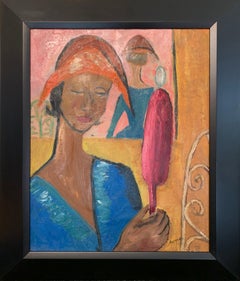
New Hat, Expressionist Portrait of Woman by Philadelphia Artist
By Bernard Harmon
Located in Doylestown, PA
"New Hat" is a figurative, interior portrait painting by Philadelphia born Expressionist painter Bernard Harmon from 195. The 20" x 16" oil on board portrait features a young African...
Category

1950s Expressionist Portrait Paintings

Materials

Oil, Cardboard

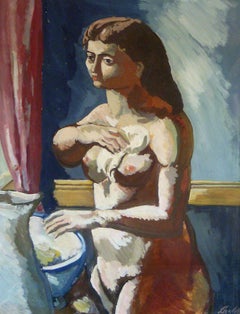
Woman at Basin, Picasso Style Portrait of a Female Nude, American Modernist
By Leon Kelly
Located in Doylestown, PA
"Woman by Basin" by Philadelphia born modernist and surrealist painter Leon Kelly, is a framed and matted portrait of a female nude. The 22.5" x 17.75" mixed media on artist board i...
Category

1920s American Modern Nude Paintings

Materials

Mixed Media

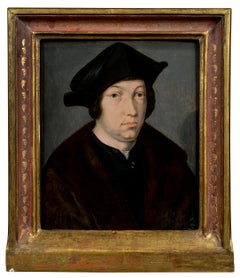
Portrait of a Man
Located in New York, NY
Provenance: with Leo Blumenreich and Julius Böhler, Munich, 1924 Dr. Frederic Goldstein Oppenheimer (1881-1963), San Antonio, Texas; by whom given to: Abraham M. Adler, New York, until 1985; thence by descent to the present owners While old inscriptions on the verso of this panel propose its author to be Hans Holbein and the sitter Sir John More—a lawyer, judge, and the father of Sir Thomas More—this fine portrait has long been recognized to be by a Flemish hand. Max Friedländer gave the painting to Bernard van Orley (1487/1491 – 1541) in 1924, but did not include it in the volume dedicated to the artist in his Early Netherlandish Paintings...
Category

16th Century Old Masters Portrait Paintings

Materials

Oil, Panel

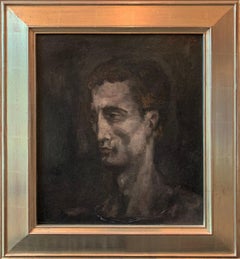
Self Portrait by American Modernist, Signed and Dated, 1925
By Leon Kelly
Located in Doylestown, PA
"Self Portrait" by Philadelphia born modernist painter Leon Kelly, is a moody and atmospheric self portrait of the artist in younger years at age 24. The 18" x 16" oil on board, fram...
Category

1920s American Modern Portrait Paintings

Materials

Oil, Board

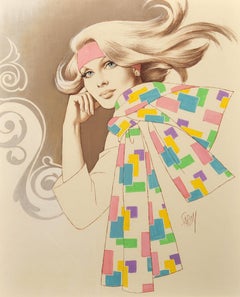
Fashionable Woman
By Arthur Sarnoff
Located in Fort Washington, PA
Medium: Acrylic on Board Signature: Signed Women with brightly colored scarf
Category

20th Century Other Art Style Portrait Paintings

Materials

Acrylic, Board

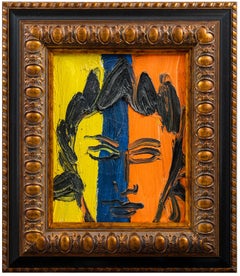
The Countess Xacha
By Hunt Slonem
Located in Denver, CO
Since 1977, Hunt Slonem has had more than 350 exhibitions at prestigious galleries and museums internationally. Globally, more than 250 museums include his work in their permanent co...
Category

1990s Contemporary Figurative Paintings

Materials

Oil, Canvas

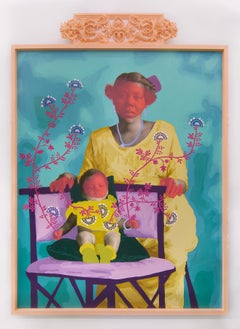
Untitled (Resibes, este pequeño recuerdo de tu nietesito Gabino Pedro...
By Daisy Patton
Located in Denver, CO
Untitled (Resibes, este pequeño recuerdo de tu nietesito Gabino Pedro Peñarber para su aguelita Maria de la Pas) This Daisy Patton work is an extension of her ongoing series called ...
Category

2010s Contemporary Portrait Paintings

Materials

Archival Ink, Oil, Wood Panel

Reine on Clay
By Casper Faassen
Located in Rye, NY
‘Reine on Clay’ is a medium size contemporary mixed media on fabric-wrapped board figurative painting created by Dutch artist Casper Faassen in 2015. Created during an extended trip ...
Category

21st Century and Contemporary Contemporary Portrait Paintings

Materials

Clay, Oil Crayon, Oil, Cardboard

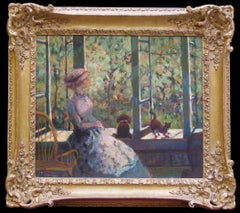
Idle Hour, Impressionist figurative Garden landscape
By Donald Roy Purdy
Located in New York, NY
Idle Hour is an intricately painted Impressionist depiction of woman with her pets on her veranda. It is exquisitely framed in a French Gold Leaf frame of quality and value. Paint...
Category

Late 20th Century Impressionist Portrait Paintings

Materials

Oil, Masonite

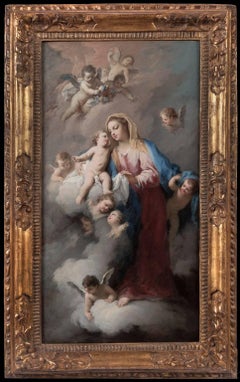
Madonna and Child with Angels in the Clouds
Located in New York, NY
Provenance: Charles H. and Virginia Baldwin, Claremont, Colorado Springs, Colorado ca. 1907-1934; thence by descent until sold in 1949 to: Charles Blevins Davis, Claremont (renamed Trianon), Colorado Springs 1949 -until gifted in 1952 to: The Poor Sisters of Saint Francis, Trianon, Colorado Springs, 1952 until acquired, 1960, by: John W. Metzger, Trianon, renamed as the Trianon School of Fine Arts, Colorado Springs, 1960-1967; when transferred to: The Metzger Family Foundation, Trianon Art Museum, Denver, 1967 - 2004; thence by descent in the Metzger Family until 2015 Exhibited: Trianon Art Museum, Denver (until 2004) The present work is a spectacular jewel-like canvas by Amigoni, rich in delicate pastel colors, most likely a modello for an altarpiece either lost or never painted. In it the Madonna stands firmly upon a cloud in the heavens, her Child resting on a delicate veil further supported by a cloud, as he gently wraps his arm around his mother’s neck. From above angels prepare to lower flowers and a wreath, while other angels and seraphim surrounding the two joyfully cavort. Dr. Annalisa Scarpa, author of the forthcoming monograph on Jacopo Amigoni...
Category

18th Century and Earlier Figurative Paintings

Materials

Canvas, Oil

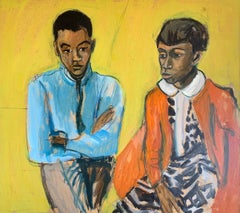
Not Speaking, Expressionist Portrait of Mother and Son by Philadelphia Artist
By Bernard Harmon
Located in Doylestown, PA
"Not Speaking" is a painting by Philadelphia born Expressionist painter Bernard Harmon. The 36" x 40" oil on board portrait of a mother and her son is painted in a vibrant color pale...
Category

1960s Expressionist Portrait Paintings

Materials

Oil, Board

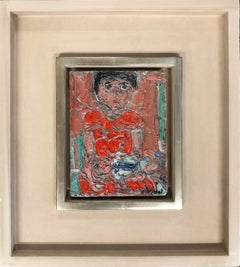
Sophie
By André Cottavoz
Located in New York, NY
Sophie is an expressive and highly individualistic Post Impressionist work reminiscent of Chaim Soutine. Cottavoz isn known and celebrated for using incredibly thick paint that is a...
Category

1960s Abstract Figurative Paintings

Materials

Canvas, Oil

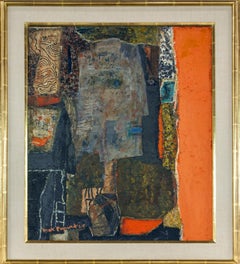
"Figure de Notier" framed, signed oil on canvas painting by artist Max Papart
By Max Papart
Located in Boca Raton, FL
"Figure de Notier" oil on canvas painting of a human figure by Max Papart. Signed Max Papart on front. Signed and titled "Max Papart Figure de Notier" on back. Additional markings o...
Category

1950s Abstract Portrait Paintings

Materials

Canvas, Oil

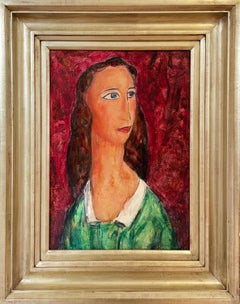
An Ideal Head of a Woman
By Alfred Henry Maurer
Located in New York, NY
In the tradition of Modigliani, Maurer's depictions of women are expressive and lively. America had very few modernists who painted in this manner but Maurer is famous for exactly t...
Category

1920s American Modern Figurative Paintings

Materials

Gesso, Oil, Board

Still Thinking About These?

All Recently Viewed