Recognized Dealers Lacquer
to
1
37
30
67
1
29
28
10
6
2
1
1
1
1
53
28
22
15
8
65
62
55
7
1
67
67
67
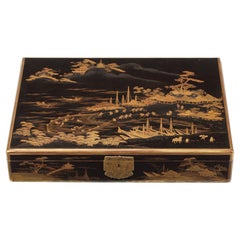
A superb Japanese export lacquer writing box
Located in Amsterdam, NL
Kyoto, circa 1680
The writing box has bevelled edges and a kabusebuta (overhanging lid), and is completely covered in black lacquer in maki-e and decorated in gold, silver and red h...
Category
Antique 17th Century Japanese Lacquer
Materials
Lacquer
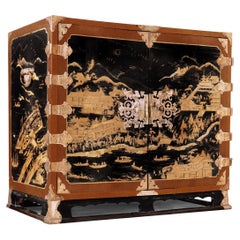
17th Century Japanese Export Lacquer Cabinet with Depiction the Dutch Tradepost
Located in Amsterdam, NL
A highly important Japanese export lacquer cabinet with depiction of the Dutch East India Company tradepost Deshima and the annual Dutch delegation on its way to the Shogun in Edo
Edo period, circa 1660-1680
H. 88 x W. 100.5 x D. 54 cm
This cabinet includes a later European japanned stand, but also a modern powder-coated steel frame.
The latter can be designed and added to your specific needs.
The sides and front of the rectangular two-door cabinet are embellished in gold and silver hiramaki-e and takamaki-e on a black roiro lacquer ground with a continuous design. The two doors depict a long procession of numerous figures travelling on foot and horseback along buildings and a pagoda into a mountainous landscape. This is the annual court journey, Hofreis, of the Dutch from Nagasaki to the Shogun’s court in Edo. Three horseback riders are dressed as Dutch merchants and a fourth figure, probably het Opperhoofd, is seen inside a palanquin, norimon. Just about to cross the bridge, two men are carrying a cabinet like the present one.
Many Japanese figures on either side of the procession are engaged in various activities; some play musical instruments on board of small boats, others are fishing; figures inside buildings are depicted playing go, and farmers are tending to their rice paddocks. The upper part of the right door shows a large mansion, probably the local daimyo’s castle, with men kneeling before a man in the central courtyard.
The court journey fits in with the foreign policy of the shogunate which accorded a role to the VOC alongside China, Korea, and the Ryukyu Islands who also had to pay tribute. However, the VOC employees were traders, having low status in Japan’s social hierarchy, and they were received with less deference than were the state embassies from Korea and the Ryukyu Islands. Nevertheless, the contacts with the Dutch were a welcome source of information to the Shogun about Europe and European science and technology.
The left side of the cabinet depicts, in mirror image, a rare view of the artificial fan-shaped Deshima Island, the trading post for the Dutch in Japan. The island, where the Dutch flag flies, is surrounded by small Japanese boats and an anchored three-masted fluyt (cargo ship), flying Dutch flags, with on the stern the VOC monogram. On the bottom right a busy street of Nagasaki is shown, bordered by shops and leading up to the stone bridge. On the island the trees are beautifully painted, two cows can be seen, and the flagpole, all in very fine detail. Dutchmen and enslaved Malay are visible outside the buildings and two Japanese figures, probably guards, sit in a small hut in the centre.
A maximum of fifteen to twenty Dutchmen lived on the island at any time and soldiers or women were not allowed. Restrictions on Deshima were tight, and the merchants were only allowed to leave the island by special permission. The Opperhoofd had to be replaced every year, and each new Opperhoofd had to make a court journey to pay tribute, present gifts, and to obtain permission to Margaret Barclay eep on trading. In the distance, many birds fly above the hills and a four-story pagoda can be seen. The right side of the cabinet is painted with other horse riders and their retinue journeying through mountains.
The pair of doors to the front open to reveal ten rectangular drawers. The drawers are decorated with scenes of birds in flight and landscapes with trees and plants. The reverse of the left door with two thatched buildings, one with a ladder, underneath a camelia tree with large blooms; the right door with a three-story pagoda nestled among trees and both doors with a flying phoenix, ho-oo bird. The cabinet, with elaborately engraved gilt copper mounts, hinges, lock plates and brass handles, is raised on an 18th-century English japanned wood stand.
A pair of large cabinets...
Category
Antique 17th Century Japanese Edo Lacquer
Materials
Copper, Gold
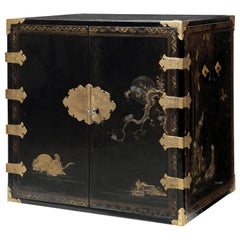
Rare Charming 17th Century Japanese Lacquer Cabinet with Gilt-Bronze Mounts
Located in Amsterdam, NL
A fine Japanese pictoral style lacquer cabinet with gilt-metal mounts
Kyoto, Edo period, 1670-1690
Decorated in Japanese relief lacquer work, black lacquer ground decorated...
Category
Antique Late 17th Century Japanese Furniture
Materials
Bronze

$44,800 Sale Price
25% Off
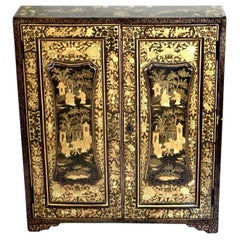
19th Century Chinese Export Table Top Black Lacquer Jewelry/Valuables Cabinet
Located in Incline Village, NV
Chinoiserie hand painted 19th century Chinese export jewelry cabinet circa 1880; is fronted by a pair of raised panel double doors; decorated in gilt with scenes of Chinese figures, ...
Category
Antique 1880s Chinese Qing Lacquer
Materials
Wood
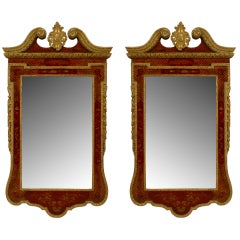
Pair of English Georgian Chinoiserie Red Lacquered Wall Mirrors
Located in Queens, NY
Pair of English Georgian (mid-18th Century) red lacquered and Chinoiserie decorated wall mirrors with gilt carved open pediment top with a centered cartouche. (PRICED AS Pair)
Lacqu...
Category
Antique 18th Century and Earlier English Georgian Wall Mirrors
Materials
Gold Leaf
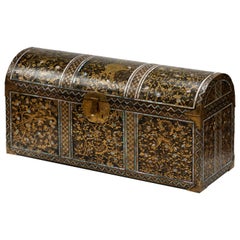
Large Japanese Namban Lacquer Coffer Arqueta, 16th Century
Located in Amsterdam, NL
A large Japanese Namban lacquer arqueta coffer for the Portuguese market
Kyoto, Momoyama-period, late 16th century
In Hinoki cypress lacquered in ...
Category
Antique 16th Century Japanese Decorative Boxes
Materials
Mother-of-Pearl, Wood
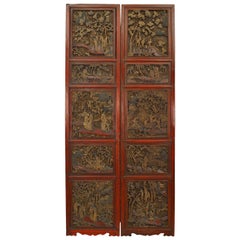
Pair of Chinese Carved and Lacquered Door Panels
Located in Queens, NY
Pair of Asian Chinese style (19th Century) red lacquered carved filigree door panels with scenes (PRICED AS Pair).
Category
Antique 19th Century Chinese Doors and Gates
Materials
Wood
$18,000 / set
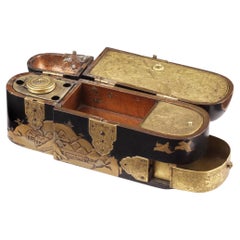
Rare 17th Century Japanese Export Lacquer Medical Instrument Box
Located in Amsterdam, NL
A rare Japanese export lacquer medical instrument box
Edo-period, 1650-1700
L. 19 x W. 6 x H. 8.5 cm
This unconventionally shaped lacquer b...
Category
Antique 17th Century Japanese Edo Lacquer
Materials
Gold
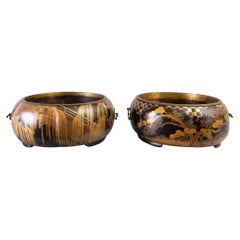
Pair of Exceptional Daimyo Hand Warmers
Located in Hudson, NY
The daimyo were the ruling class of land owners, subordinate to shogun, who formed around the 10th century and fell out of power in the 19th century. Daimyo families tended to be wealthy and could commission artwork or decorative pieces. This pair of 17th century hibachi are black and gold lacquer with designs of Uji Bridge...
Category
Antique Late 17th Century Japanese Edo Lacquer
Materials
Lacquer
$65,000 / set
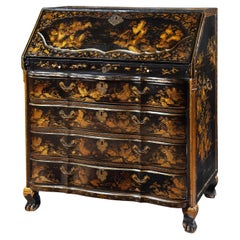
18th Century Chinese Export Lacquer Chinoiserie Bureau Desk for the Dutch Market
Located in Amsterdam, NL
An extremely rare, possibly unique, Chinese export lacquer bureau for the Dutch market
Canton, circa 1737
H. 118 x W. 102.5 x D. 63 cm
Provenance:
- Private collection, The Netherlands
- J.K. Driessen Antiques, Arnhem (Art Fair Breda, 1989)
- Noble collection, Belgium
Literature:
- C.J.A. Jörg, ’De handel van de V.O.C. in Oosters lakwerk in de 18de eeuw’ in: Nederlands Kunsthistorisch Jaarboek , Jr. 31 (1980), pp. 355-363 (ill.)
- Annigje Hofstede, Nederlandse meubelen van Barok tot Biedermeier, 1700-1830, Waanders, Zwolle 2004, pp. 35-37 (ill.)
This lacquer bureau is one of the four writing desks purchased in Canton in 1737, and as far as is known, this is the only remaining bureau of its type from the period. As the VOC believed that large pieces of import took up too much valuable space in their trading ships...
Category
Antique Mid-18th Century Chinese Chinese Export Lacquer
Materials
Wood, Cypress, Lacquer
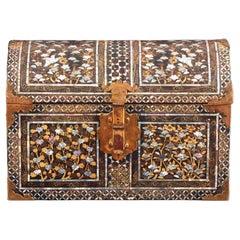
Superb Late 16th Century Signed Colonial Japanese Namban Export Lacquer Coffer
Located in Amsterdam, NL
Superb late 16th century signed colonial Japanese Namban export lacquer coffer
Momoyama period, late 16th/early 17th century, inscribed 'Arisato' on the bottom
H. 30.5 x W. 43...
Category
Antique 16th Century Japanese Lacquer
Materials
Cedar, Lacquer
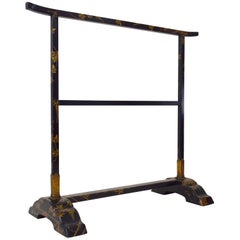
Elegant Japanese Edo Period Rack
Located in New York, NY
This refined object dates to the first half of the 19th century, and was probably used for obi, kimono sashes, which were hung over it. The gold decorations on the black-lacquered g...
Category
Antique 1830s Japanese Edo Lacquer
Materials
Lacquer
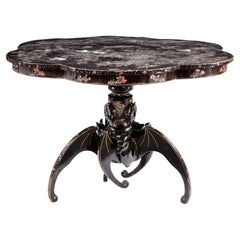
Mother-of-Pearl Black Lacquer Japanese Export Table with Feet Shaped as Bats
Located in Amsterdam, NL
A Japanese export lacquer tripod table with feet shaped as bats
Nagasaki, 1850-1860
H. 73 x diam. 108 cm
The six-lobbed top is decorated with reverse-painted mother-of-pearl in a sprawling motif of plum blossom, bamboo, and peonies, surrounded by fluttering sparrows enhanced by details in maki-e.
The table, made to appeal to a foreign audience, incorporates a curious mixture of seasonal references. In addition to the decoration of foliage from late winter and spring, the column is decorated with grapes and a rabbit pounding rice, both Japanese motifs for autumn and the month of September. The feet, shaped like bats that almost appear to wake up from hibernation, symbolise luck and happiness in Japan.
The present flamboyant Nagasaki-style table is depicted in the Asada workshop drawings of 1856. These drawings, titled Aogai makie hiinagata hikae (memorandum of designs for lacquer with inlaid pearl...
Category
Antique 19th Century Japanese Lacquer
Materials
Lacquer
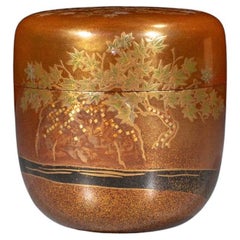
A gold-lacquer natsume with maple leaves and a stream
Located in Milano, IT
A tea caddy (natsume) in gold lacquer, decorated with a design of maple leaves and plants (momiji) extending along a flowing stream. On the lid, a branch laden with leaves stretches ...
Category
Early 20th Century Japanese Lacquer
Materials
Lacquer
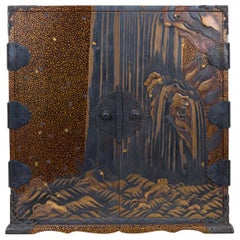
Japanese 19th Century Miniature Lacquer Chest with Waterfall
Located in Hudson, NY
Japanese 19th century miniature lacquer chest with waterfall. Late Edo to early Meiji period lacquer chest (mid to late 19th century) with two characters on the front reading Nuno an...
Category
Antique Late 19th Century Japanese Lacquer
Materials
Gold, Silver, Bronze
Japanese Edo Period Black
Gold
Nagamochi
Dowry Trunk with Family Crests
Located in London, GB
A Fine Black & Gold Lacquer
Japanese Nagamochi Trunk
With Family Crests of the Tokugawa and Minamoto Clans
Of rectangular form, the storage trunk covered on all sides with hiramak...
Category
Antique 19th Century Japanese Edo Lacquer
Materials
Lacquer
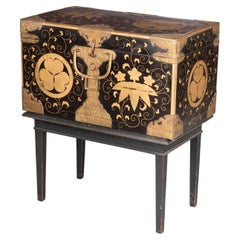
Large Royal Early 17th Century Japanese Lacquer Chest with Gilt-Bronze Mounts
Located in Amsterdam, NL
A large Japanese transitional lacquer chest with gilt-metal mounts
Edo period, early 17th century
The rectangular chest with flat hinged lid decorated in gold, silver, and red ...
Category
Antique Early 17th Century Japanese Blanket Chests
Materials
Bronze
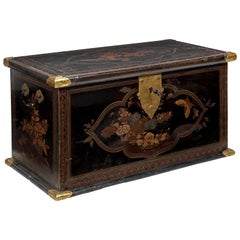
A Japanese export lacquer box with depiction of the Grand Hotel, Yokohama
Located in Amsterdam, NL
Meiji period, circa 1873-1887
The black lacquered box decorated in maki-e and hiramaki-e gold, with on the lid a European style building complex and several Japanese and European figures walking along a street in the foreground. The sides are finely decorated with several insects and the inside with several compartments and nashiji decoration.
H. 7.4 x W. 29 x D. 25.7 cm
After the Americans forced Japan to open their harbours to the outside world and take part in international treaty and trade around the mid 19th century, the formerly feudal society rapidly changed. Japan was now focussing on an industrial future. One of the major international ports was Yokohama with its foreign embassies and warehouses - which attracted a great number of visitors of all sorts. For the higher society visiting Japan for the first time a new and ‘Western’ hotel had to be realised; hence the construction of The Grand Hotel on Kaigandori.
The hotel was opened on August 16, 1873 (Meiji 6) and was soon considered the height of Western culture and elegance in Japan. The building probably depicted on this box, designed by American architect Richard P. Bridgens (リチャード・ブリジェンス, 1819 -1891), is the original hotel...
Category
Antique 19th Century Japanese Lacquer
Materials
Gold
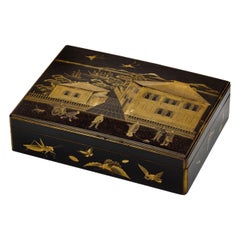
A rare Japanese Namban export lacquer coffer with Mon emblems
Located in Amsterdam, NL
Late Momoyama period, late 16th century
The coffer is decorated in black lacquer, urushi, on cedar wood, decorated with gold dust and silver, maki-e, and nashiji, mother-of-pearl, r...
Category
Antique 16th Century Japanese Lacquer
Materials
Silver, Copper
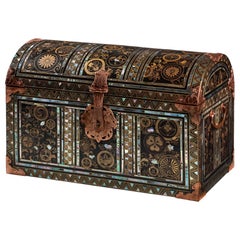
Unique 17th Century Miniature Japanese Namban Lacquer Miniature Dollhouse Chest
Located in Amsterdam, NL
A unique and exceptional Japanese miniature or dollhouse export lacquered chest
Kyoto, circa 1620-1640
The chest of rectangular shape with a domed lid, decorated in Transition-style, in gold hiramaki-e on a black background within reserved lobed cartouches decorated with landscapes animated with birds and rabbits, on a shagreen or samegawa background. The borders are decorated with geometric friezes, the box with gilt-copper mounts, the interior decorated in red lacquer.
Measures: H 9.2 x W 14.5 x D 7.2 cm
This miniature is of exceptional quality and a perfect copy of the famous large size Transition-style coffers. It was most likely ordered by a Dutch lady for her dollhouse (poppenhuis), like the famous Petronella Oortman (1656-1716) doll-house, which is now one of the highlights in the collection of the Rijksmuseum Amsterdam, or Petronella Oortmans-de la Court’s (1624-1707) dollhouse in the collection of the Centraal Museum Utrecht. Sara Rothé of Amsterdam in 1743 ordered a miniature black lacquered ivory tripod table with gold chinoiserie decoration by Jurriaan Buttner (Monika Kopplin, European Lacquer, 2010, p. 56).
Other Japanned dollhouse...
Category
Antique 17th Century Japanese Edo Lacquer
Materials
Shagreen, Cypress
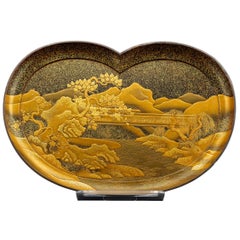
Japanese Lacquer Tray
Located in New Orleans, LA
As beautiful as it is practical, this Japanese Meiji-period lacquered tray is distinguished by its exceptional craftsmanship. It exhibits a phenomenal artistry as the entire tray is ...
Category
Early 20th Century Japanese Meiji Lacquer
Materials
Lacquer
$8,850
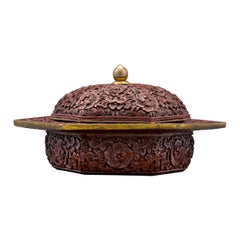
Chinese Cinnabar Lacquer Cuspidor
Located in New Orleans, LA
This intriguing Chinese zhadou is intricately carved of fine cinnabar lacquer. A work of exceptional artistry, this covered bowl is adorned with an intricately carved floral motif on all surfaces, including the cover and the wide rim. Also known as a cuspidor or spittoon, this rare container would have been used by members of the imperial family and scholar- officials at the court. Carved during the Kangxi period (1662-1722), this charming piece exhibits the high detail and charm associated with items from that period, making it a true treasure,
Early 18th century (Kangxi dynasty)
Measures: 6 ¼” wide x 3 ¼” high
Cinnabar has been revered for its color all over the world. It has been found in the royal burial chambers of the Mayas, in the rituals of India, and in the ruins of ancient Greece and Rome. In China, cinnabar and gold were the two most important elements in alchemy. Mined since the Neolithic Age, cinnabar is the ore of mercury, and as such, it can be incredibly toxic, especially when mining. In fact, during the Roman Empire, miners at Spain’s Almadén mine in Spain were frequently exposed to mercury fumes, and the subsequent, often fatal, sickness was considered an occupational hazard.
The most popular known use of cinnabar is in Chinese carved lacquer-ware, a technique that is believed to have originated in the Song Dynasty, in which cinnabar is ground to a powder and added to clear lacquer. As with mining, there was inherent danger of mercury poisoning for those who carved the lacquer, as mercury was also released into the air when artisans ground the pigments. Most antique cinnabar...
Category
Antique 18th Century Chinese Other Lacquer
Materials
Lacquer
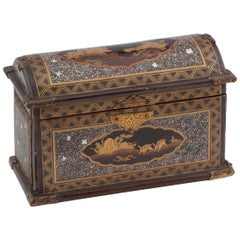
Fine Japanese Namban Lacquer Jewelry Casket, 17th Century
Located in Amsterdam, NL
Japanese Namban lacquer transition-style coffer with two drawers
Kyoto/Nagasaki, circa 1650
The cartouches with gilt and red decorations of leaves...
Category
Antique 17th Century Japanese Edo Lacquer
Materials
Cypress
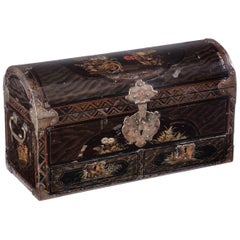
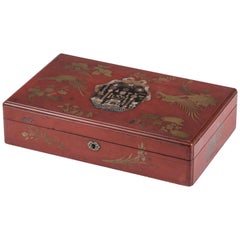
Fine Japanese Export Red Lacquer Box with Masonic Symbols, circa 1800
Located in Amsterdam, NL
A fine Japanese export red lacquer box with Masonic symbols
Kyoto/Nagasaki, 1800-1820
Red lacquer decorated with scattered flowers and flying birds with long tails in gold, wit...
Category
Antique Early 19th Century Japanese Edo Lacquer
Materials
Gold
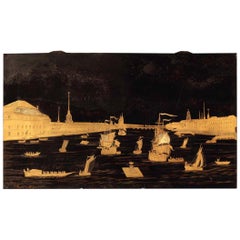
Extremely Japanese Rare Lacquer Plaque Depicting Russian St. Petersburg
Located in Amsterdam, NL
An important Japanese lacquer Maki-É Panel Depicting St. Petersburg on the River Neva, with the winter palace on the left and the academy of science on the right, 18th century.
Nagasaki, 1780-1800
In black lacquer on copper, the front decorated in maki-é, the back inscribed, Vue Perspective des Bords de la Neva en descendant la Rivière entre le Palais d'hyver de sa Majesté Impériale et les batiments de l'Académie des Sciences à St Petersburg in gold and inlaid with flowers in mother of pearl.
Measures: H 23 x W 39 cm
The present plaque is identical to one in the Museum of Japanese History in Sakura and another one in the Museum of Peter the Great in St. Petersburg. (see: Oliver Impey & Christiaan Jörg, Japanese Export Lacquer, 1580-1850, p. 52-53)
This last one was given to Catherine the Great in 1794 by the Swedish medical doctor Johan Arnold Stutzer who had served with the VOC in Deshima in 1787-1788. Apparently, such plaques were not unique and may have been made in several copies. This was certainly the case with the smaller lacquer oval portrait medallions (see for instance Uit Verre Streken, June 2017, no. 62)
The scene of St. Petersburg was copied from an optical print taken by Stutzer to Japan, as shown by Yasumasa Oka of the Kobe City Museum. Stutzer in his diary writes: “I am the first to bring them (i.e. the Japanese) original pictures such as a view of St Petersburg and of Rudolf XV on horseback and try to have them made (in lacquer). According to the Japanese, it is the first time that these two pictures will be copied. Other products that I also ordered, for example, pictures of sea battles, are also appreciated as absolute masterpieces”.
For two lacquered plaques depicting the sea battle of Dogger Bank in 1781 between the Dutch and the English navies, see Uit Verre Streken, December 2013, nr. 39 and March 2015, nr 56. Johan Strutzer at the same time also presented six beautiful Japanese glass telescopes to Catherine the Great of Russia, like the two Japanese glass telescopes illustrated in Uit Verre Streken, March 2015, item 59 and 60 and the one in the Kobe City Museum (illustrated in: Japan Envisions the West, 16th-19th Century Japanese Art...
Category
Antique Late 18th Century Japanese Decorative Art
Materials
Copper
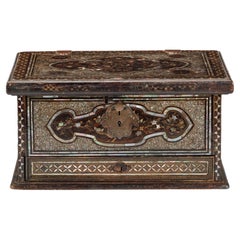
An exceptional Namban
escritório
writing-box, with a single drawer
Located in Amsterdam, NL
Kyoto, Late Momoyama to Edo period, circa 1590-1630
Decorated in pearl shell and gold with branches, leaves and flowers inside cartouches on a pearl shell mosaic background.
H. 25 ...
Category
Antique 17th Century Japanese Lacquer
Materials
Gold
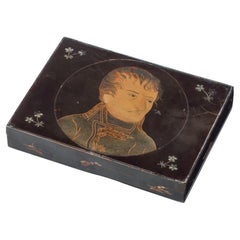
Japanese Export Nagasaki Lacquer Box with the Portrait of Napoleon Bonaparte
Located in Amsterdam, NL
A Japanese export Nagasaki lacquer tobacco box with the portrait of Napoleon Bonaparte
Edo-period, circa 1810
The box in black lacquer on copper, ...
Category
Antique 19th Century Japanese Edo Lacquer
Materials
Copper, Gold
An oval Japanese export lacquer tray
Located in Amsterdam, NL
An oval Japanese export lacquer tray decorated with the alliance of the coats of arms of the Mooyaart and Pauw families
Edo-period, circa 1798
L. 51.5 x B. 37.5 x H.3.2 cm
This tra...
Category
Antique 18th Century Japanese Lacquer
Materials
Lacquer
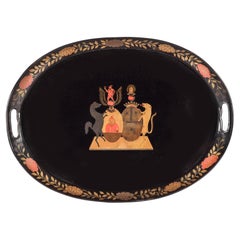
Antique Japanese Lacquer Stacking Food Box
Jubako
Located in Hudson, NY
With all-over mother of pearl inlay and mon design of chrysanthemum in gold and black lacquer on top. The chrysanthemum is a national symbol of Japan and the Imperial family.
Category
Antique 19th Century Japanese Lacquer
Materials
Gold
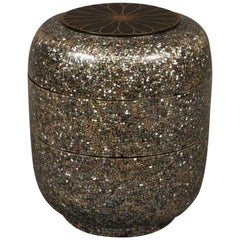
Pair of Japanese Lacquer and Mother-of-Pearl Inlaid Knife Urns, circa 1800-1815
Located in Amsterdam, NL
A rare pair of Kyoto-Nagasaki style lacquer and mother-of-pearl inlaid knife urns
Edo period, early 19th century
Measures: Height 71 x diameter 30 cm
?Formed as urns with vertically lifting covers and elongated finials, revealing fitted green velvet lined interiors for knives, decorated overall with birds, flowering stems, faux-fluting and oval panels with landscapes. The square plinth is raised on four bracket feet. Inside the lifting cover of one of the urns are Japanese characters, supposedly indications of some code by the craftsman.
A closely related knife urn, now in the collection of the Peabody Essex Museum, Salem (inv. E 73115), was acquired in Nagasaki by Captain Samuel Gardner Derby of the Margareth of Salem in 1801. Captain Gardner Derby traded in Nagasaki under charter from the VOC (Vereenigde Oostindische Compagnie), the Dutch East India Company. Between 1797 and 1814 Holland was occupied by the French and from 1811 until 1816 Java by
the English. During these periods practically no Dutch shipping was possible between Holland and Batavia (Jakarta) or between Batavia (Jakarta) and Nagasaki. To maintain a minimum amount of shipping between Batavia (Jakarta) and Nagasaki, between 1797 and 1807, the VOC chartered mainly American ships. American captains and officers ordered and bought mainly lacquered furniture in an American-English style, completely different from what the Dutch up till then had ordered. The present knife urns were possibly also ordered and acquired by Captain Gardner Derby during his stay in Deshima/Nagasaki in 1801.
Another similarly neoclassical shaped knife urn in the collection of the Ashmolean Museum Oxford (inv. 1996.17) appears to be signed by woodworker Kiyotomo koreo tsukuru (Kiyomoto made this). The same name, together with an address in the Sanjo-Teramachi District of Kyoto, has been found inside a fragmentary urn in a private collection. This is an indication that European-style furniture was not only lacquered in Japan but made there as well. This undoubtedly is not only true for knife-urns, but all European- style furniture lacquered in Japan after circa 1800 was made by Japanese furniture makers...
Category
Antique Early 19th Century Japanese Anglo-Japanese Lacquer
Materials
Brass
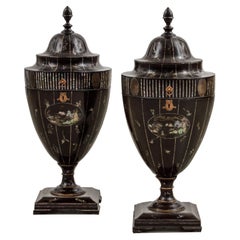
Japanese Antique Lacquer Document Box with Elaborate Hawk and Faux Oak Grain
Located in Hudson, NY
Japanese antique lacquer document box with elaborate hawk and faux oak grain, Late Meiji (1868 - 1912) / Early Taisho (1912 - 1926) period lac...
Category
Early 20th Century Japanese Lacquer
Materials
Lacquer
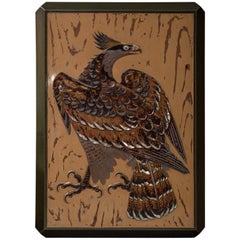
A small Japanese export lacquer circular box with a depiction of the Muiderpoort
Located in Amsterdam, NL
Nagasaki, Edo period, 1st half 19th century
Of circular form decorated in gold hiramaki-e on a black-lacquered ground, the lid depicts the Muiderpoort, a city gate of Amsterdam, aft...
Category
Antique 19th Century Japanese Lacquer
Materials
Lacquer
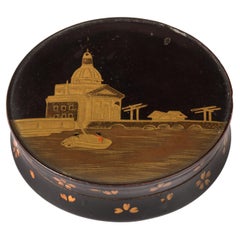
Japanese Lacquer and Gold Tray
Located in New Orleans, LA
This Meiji-period lacquer tray represents the mastery of Japanese craftsmen in the art of lacquer work. Precious materials are precisely inlaid in the lacquer base, creating a highly...
Category
Antique Late 19th Century Asian Meiji Lacquer
Materials
Gold
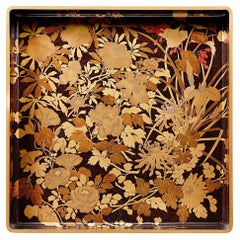
Pair of Fine Japanese Export Lacquer Cutlery Knife Boxes, 18th Century
Located in Amsterdam, NL
A pair of fine Japanese export lacquered cutlery boxes
Kyoto or Nagasaki, late 18th century
H. 33.5 x W. 24 x D. 21 cm
The bow-fronted boxes with sloping lids flat at the top are made of hinoki wood (Cypress), coated with Japanese paper and decorated in lacquer with scattered gold birds and flowers on a nashiji background. The Japanese mounts are made of copper and both boxes still have internal partitions to keep the cutlery upright.
The form of these boxes is similar to a pictorial-style knife box in the collection of the Groninger Museum (inv. 1989- 347), dated between 1730 and 1780, but the style of the decoration is more like that on a knife box in the Peabody Essex Museum in Salem (inv. E62271), which was brought to Salem by James Devereux, Captain of the Franklin, in 1799.
Provenance:
Henriette Jeane Christine van Neukirchen, called Nyvenheim (1807- 1849) and Nicolaas Johan Steengracht van Oostcapelle (1806-1866), thence by descent to the last owners, Ludolphine Emilie baronesse Schimmelpenninck van der Oye (1944) married in 1969 to Roland Daniel van Haersma Buma (1944), the last residents of castle Duivenvoorden near Voorschoten and the great-great-granddaughter of Nicolaas Johan Steengracht van Oostcapelle.
There is no evidence that Nicolaas Johan himself, or any of his or his wife’s ancestors had ever been in Japan. However, Nicolaas’ grandfather (Nicolaas Steengracht, 1754-1840) was a director of both the VOC and WIC (West Indies Company...
Category
Antique Late 18th Century Japanese Lacquer
Materials
Silver
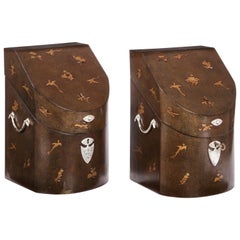
Japanese Nagasaki Export Lacquer Box with Depiction of the
Trippenhuis
Located in Amsterdam, NL
A Japanese Nagasaki export lacquer box with mother-of-pearl depiction of the Amsterdam ‘Trippenhuis’
Edo-period, circa 1830
H. 12.5 x W. 24...
Category
Antique 19th Century Japanese Edo Lacquer
Materials
Mother-of-Pearl, Lacquer
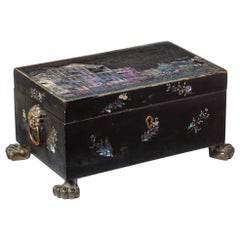
Pair of Edo Period Black and Gold Lacquer Samurai Helmet Boxes
Located in Lymington, Hampshire
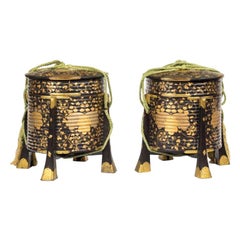
A pair of Edo period black and gold lacquer Samurai helmet boxes (Hakko Bako), each of ribbed cylindrical form with a lid, a black lacquer interior,...
Category
Antique 19th Century Japanese Edo Lacquer
Materials
Lacquer
Japanese Lacquer Box
Located in New Orleans, LA
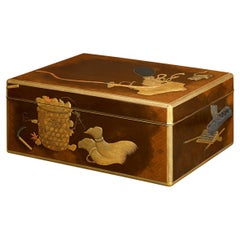
This exquisite Meiji-period lacquer document box known as a ryoshibako showcases the meticulous artistry of maki-e, a technique of raised lacquer decoration. Adorned with gold and vi...
Category
Antique 19th Century Asian Meiji Lacquer
Materials
Gold
$39,850
Chinese, 18th Century Red Lacquer Table
Located in Hudson, NY
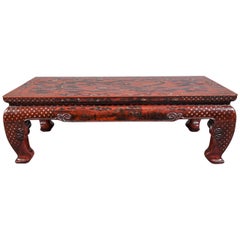
Chinese, 18th century red lacquer table with shell inlay dragon design.
Category
Antique Mid-18th Century Chinese Lacquer
Edo Maki-e Japanese Box
Located in Brescia, IT
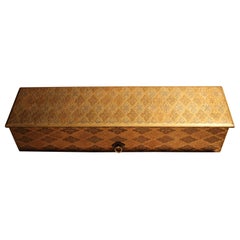
Japanese box with lacquer lid finely decorated with Maki-e, dating from the 18th century, mid-Edo period.
The box is of special size to preserve important calligraphy.
All sides of ...
Category
Antique Late 18th Century Japanese Edo Lacquer
Materials
Gold Leaf
$3,106
Pair of Antique Japanese Lacquer Trays
Located in Hudson, NY
Pair of antique Japanese Lacquer Trays, Taisho period (1912-1926) beautifully decorated with a miniature landscape of pea pods on the vine and a gold cricket set...
Category
Vintage 1920s Japanese Taisho Lacquer
Materials
Lacquer
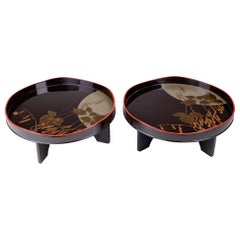
$2,500 / set
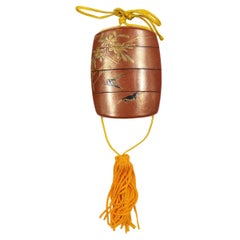
Lacquer inro, Japanese, Late 19th c.
Located in Stockholm, SE
A fourpart Japanese lacquer Inro. the lacquer is red with motives of a spider with its web in gold and two flying cranes. The lowest part of the inro has a crack on one side.
Category
Antique Late 19th Century Japanese Lacquer
Materials
Lacquer
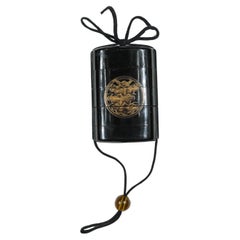
Large Japanese five part lacquer Inro, late 19th c.
Located in Stockholm, SE
A large five part lacquer inro. A family crest in gold on black background.
Category
Antique Late 19th Century Japanese Lacquer
Materials
Lacquer
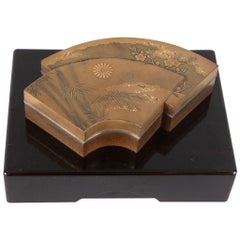
Japanese Lacquer Kogo
Incense Box
Located in Hudson, NY
Late Edo (1614 - 1868) period incense storage box in stacked, double fan design. Fans have bamboo and plum design with a chrysanthemum crest. Silve...
Category
Antique Mid-19th Century Japanese Edo Lacquer
Materials
Gold
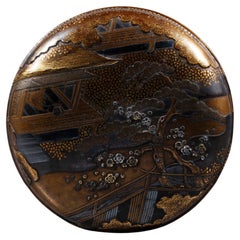
A circular gilt-lacquer box depicting a landscape scene
Located in Milano, IT
A circular lacquer box decorated with a refined landscape scene characterized by architectural elements, pine trees, and a large flowering plum tree in the foreground. The lid featur...
Category
Antique Late 18th Century Japanese Lacquer
Materials
Lacquer
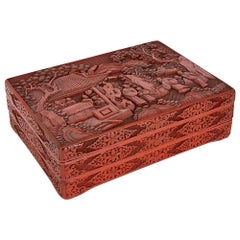
Antique Chinese Lacquer Gaming Box and Counters
Located in London, GB
Antique Chinese Lacquer Gaming Box and Counters
Chinese, late 19th century
Height 9.5cm, width 32cm, depth 23cm
This beautiful Chinese red lacquer box...
Category
Antique Late 19th Century Chinese Lacquer
Materials
Mother-of-Pearl, Lacquer
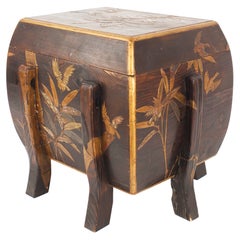
Japanese Lacquered Karabitsu Trunk
Located in Queens, NY
Japanese (19th Cent) brown lacquered karabitsu traveling trunk with carved birds and floral relief of gilt and pearl inlay resting on 6 legs.
Category
Antique 19th Century Lacquer
Materials
Lacquer
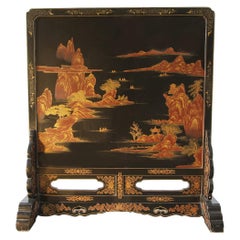
XX°Century Chinese Decorative Screen Lacquered whit Landscape and Sails
Located in Brescia, IT
Chinese screen in black lacquered wood decorated with gilded paintings, very sturdy with excellent wooden base.
Category
20th Century Chinese Chinese Export Furniture
Materials
Giltwood, Lacquer, Wood
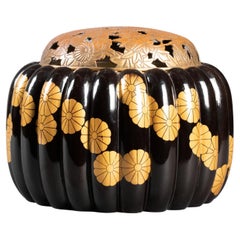
Japanese, Black Lacquer, Chrysanthemum Shaped Incense Burner
Koro
Located in Hudson, NY
With chrysanthemum motif and a gilded bronze lid. Includes unsigned collector's box. Interior measurements: 7 1/2" opening, 5 1/4" deep.
Category
Antique Late 18th Century Japanese Lacquer
Materials
Lacquer
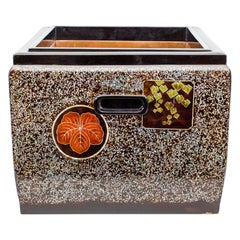
Japanese Lacquer Hibachi (Brazier)
Located in Hudson, NY
Japanese Lacquer Hibachi (Brazier), Meiji period (1868 - 1912) Box- shaped Japanese hibachi with mother of pearl inlay, handles on two sides, and a cop...
Category
Antique 1880s Japanese Meiji Lacquer
Materials
Copper
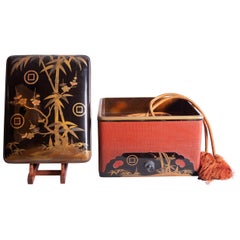
Japanese Lacquer Box with Bamboo, Plum, and Family Crest
Located in Hudson, NY
Made with heavy gold flakes and lacquered fabric on wood, with cutout heart designs. Has an interior tray, and comes with silk tasseled ties. (Does not come with presentation stand).
Category
Antique 19th Century Japanese Lacquer
Materials
Lacquer
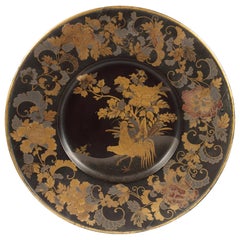
Fine 17th Century Japanese Export Black and Gold Lacquered Pictorial-Style Dish
Located in Amsterdam, NL
A fine Japanese export black and gold lacquered pictorial-style dish Nagasaki or Kyoto, 1680-1720
The dish with wide flat rim of Keaki wood (Zelkova species) in black lacquer with...
Category
Antique 17th Century Japanese Edo Lacquer
Materials
Gold
Early 17th century
Incense Burner
( Koro)
Located in Hudson, NY
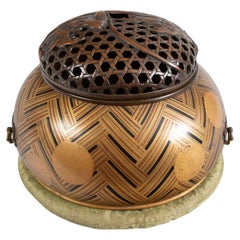
Early 17th century incense burner( Koro) in basket weave nashiji lacquer pattern with chrysanthemum mons (the national symbol of Japan). Copper grill with detailed waves pattern. Foo...
Category
Antique Early 17th Century Japanese Lacquer
Materials
Copper
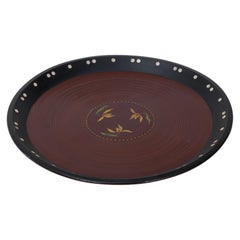
Japanese Lacquer Tray with Intricate Designs
Located in Hudson, NY
This lacquer tray uses several lacquer techniques including multi-color painting of flowers, ito-me (thread pattern) and shell inlay. The artist was Shimano Sanshu (1877 - 1965). He ...
Category
Early 20th Century Japanese Showa Lacquer
Materials
Lacquer
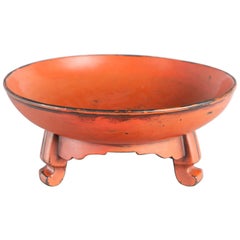
Early 17th Century Negoro Lacquer Footed Bowl
Located in Hudson, NY
Early 17th century Negoro lacquer footed bowl, Edo period (1603-1868) round bowl with tripod cabriole style legs. Negoro lacquer (monk's lacquer in red ...
Category
Antique Early 17th Century Japanese Edo Lacquer
Materials
Lacquer
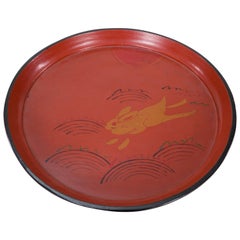
19th Century Red Lacquer Tray with Rabbit Running Over Waves Under Full Moon
Located in Hudson, NY
19th century Japanese red lacquer tray with rabbit running over waves under full moon. Mingei style painting, the imagery of this tray is bas...
Category
Antique Early 19th Century Japanese Edo Lacquer
Materials
Wood, Lacquer
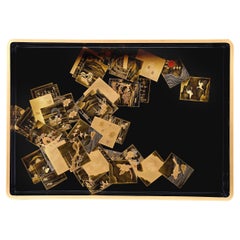
Japanese Lacquer Tray With Cards
Located in New Orleans, LA
This Meiji-period lacquer tray represents the mastery of Japanese craftsmen in the art of lacquer work. Precious materials are precisely inlaid in the lacquer base, creating a highly...
Category
Antique Late 19th Century Japanese Meiji Lacquer
Materials
Gold
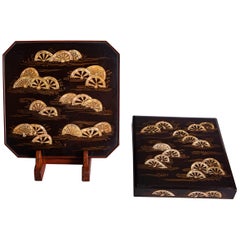
18th Century Japanese Lacquer Writing Box and Tray Set
Located in Hudson, NY
Wheels Submerged in flowing water motif, believed to be a subject popular in samurai families. Example of the same subject matter in Tokyo National Museum.
Category
Antique 18th Century Japanese Lacquer
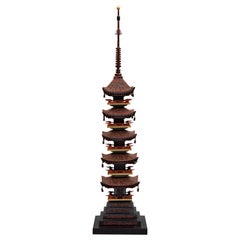
Fabulous Lacquer Pagoda Chinoiserie Sculpture with Original Wooden Box
Located in Amsterdam, NL
Wajima lacquer model of a five story-pagoda by the contemporary lacquer master Miyasaki Masahiro.
In the original signed box, including a wooden disp...
Category
Late 20th Century Japanese Showa Lacquer
Materials
Lacquer
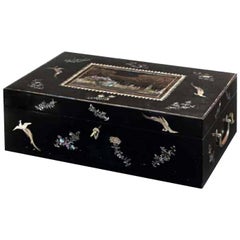
Japanese Colonial Nagsaki Lacquer Box with Depiction of Amsterdam, 1830-1840
Located in Amsterdam, NL
An important Japanese lacquer box with a view of The 'Nieuwe Stadsherberg Van Amsterdam
Nagasaki, Edo-period, 1830-1840
The black lacquered wood box, decorated in gold and inla...
Category
Antique Early 19th Century Japanese Decorative Boxes
Materials
Mother-of-Pearl, Wood
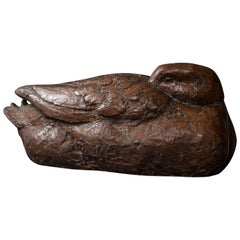
Japanese Showa Period Dry Lacquer Sculpture of a Duck
Located in Hudson, NY
Showa Period (1926 - 1989) sculpture of a duck resting with its head tucked into its wings. Dry lacquer, or kanshitsu, is a process of layering and manipulating lacquer soaked cloth ...
Category
Early 20th Century Japanese Showa Lacquer
Materials
Lacquer