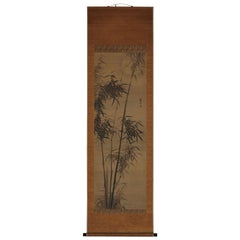
Recognized Dealers Paintings and Screens
to
2
311
88
455
13
1
13
5
4
1
1
1
70
181
204
14
131
34
7
12
1
9
7
1
1
4
2
278
223
196
186
135
433
399
366
30
19
469
456
459
22
2
2
2
2
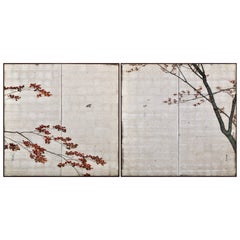
1895 Meiji Japanese Screen Pair. Cherry Blossoms
Autumn Maples on Silver Leaf
Located in Kyoto, JP
Cherry Blossoms and Autumn Maples
Isobe Hyakurin (1836–1906)
Dated Meiji 28, April: 1895
Pair of two-panel Japanese screens; ink and pigments on silver leaf
This refined pair of scr...
Category
Antique Late 19th Century Japanese Meiji Paintings and Screens
Materials
Silver Leaf
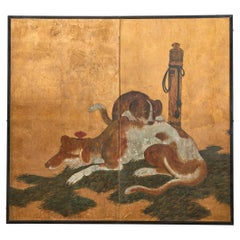
Japanese Two Panel Screen: European Hounds
Located in Hudson, NY
18th century painting of European hound and her pup. Mineral pigments on gold leaf with black lacquer trim.
Category
Antique Mid-18th Century Japanese Paintings and Screens
Materials
Gold Leaf
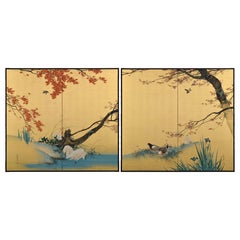
Meiji era Japanese Screen Pair, Two-panel. Spring
Autumn Birds
Flowers.
Located in Kyoto, JP
Spring and Autumn Birds & Flowers
Hasegawa Gyokujun (1863-1921)
Meiji period, circa 1900.
Ink, color and gofun on silk.
Dimensions of each screen:
H. 172 cm x W. 188 cm (68’’ x 7...
Category
Early 20th Century Japanese Meiji Paintings and Screens
Materials
Gold Leaf
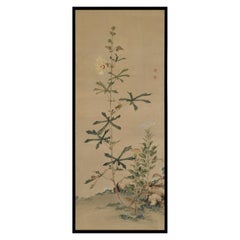
Mid 19th Century Framed Japanese Painting. Grasshopper
Hibiscus.
Located in Kyoto, JP
Obata Tosho (1812-1886)
Grasshopper & Hibiscus.
Late Edo period, mid 19th Century
Framed Japanese Painting. Ink and color on paper.
Individually framed 19th century bird and flow...
Category
Antique Mid-19th Century Japanese Edo Paintings and Screens
Materials
Paper
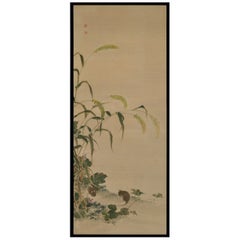
Mid 19th Century Framed Japanese Painting. Mice
Millet
Located in Kyoto, JP
Obata Tosho (1812-1886)
Mice & Millet
Late Edo period, mid 19th Century
Framed Japanese Painting. Ink and color on paper.
Individually framed 19th century bird and flower paintin...
Category
Antique Mid-19th Century Japanese Edo Paintings and Screens
Materials
Paper
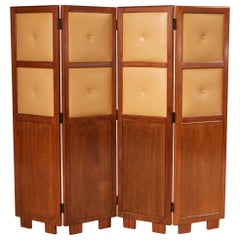
Brazilian Hardwood, Leather and Mirrored Panel Folding Screen, Brazil, c 1960s
Located in Los Angeles, CA
A beautiful four-paneled Brazilian Hardwood folding screen with leather panels on one side and mirrored paneling on the reverse. Produced in Brazil in circa 1960s, this folding scree...
Category
20th Century Brazilian Mid-Century Modern Paintings and Screens
Materials
Wood, Leather, Mirror

$3,950 Sale Price
28% Off
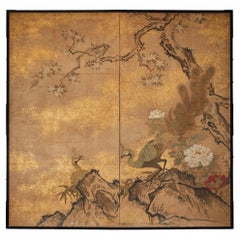
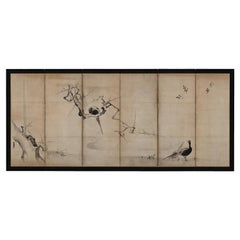
Japanese Two Panel Screen: Amorous Pea-fowl in Craggy Garden Landscape
Located in Hudson, NY
Ink and minimal pigments on mulberry paper with black lacquer trim.
Category
Antique Mid-19th Century Japanese Paintings and Screens
Materials
Lacquer, Paper
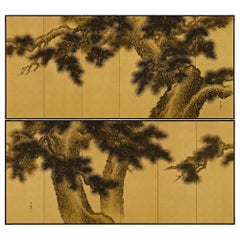
Early 20th Century Japanese Screen Pair - Ink Pine Trees on Gold
Located in Kyoto, JP
Imao Keisho (1902-1993)
Pine Trees
Early 20th Century, Circa 1930
Pair of six-panel Japanese screens. Ink on silk and gold leaf.
Dimensions: Each screen H. 67.5” x 148” (172 cm x 376 cm)
A pair of monumental six-panel Japanese pine screens by the renowned Nihonga artist Imao Keisho. Here Keisho entirely removed the background and brought the pine trees to the surface of the painting. This simplification of the elements makes the scene exceptionally direct and compelling and injects a very modern...
Category
Early 20th Century Japanese Showa Paintings and Screens
Materials
Gold Leaf
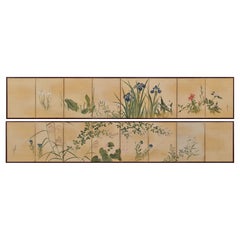
1838 Japanese Screen Pair. Flowers
Grasses of the Four Seasons.
Located in Kyoto, JP
Maruyama Oshin (1790-1838)
Flowers and grasses of the four seasons: dated 1838
Pair of eight-panel Japanese screens; ink, color and gold leaf on silk
Dimensions: each (2) H. 38.5 cm...
Category
Antique 1830s Japanese Edo Paintings and Screens
Materials
Silk
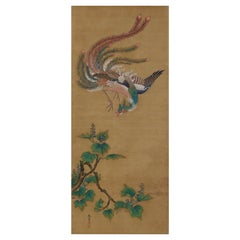
19th Century Japanese Silk Painting by Kano Chikanobu, Phoenix
Paulownia
Located in Kyoto, JP
Birds & Flowers of the seasons
Pheasants & Plum in Snow
Unframed painting. Ink, pigment and gofun on silk
Kano Chikanobu 1819-1888
Signature...
Category
Antique Mid-19th Century Asian Edo Paintings and Screens
Materials
Silk
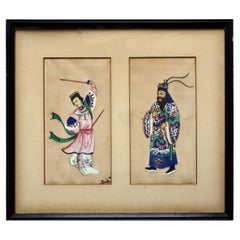
19th C Royal Couple; Pair Chinese Pith Paintings Qing Dynasty. China, Circa 1855
Located in Incline Village, NV
Lovely and authentic all original mid 19th century pair of small Chinese Pith Paintings; under glass and double matted in a single plain narrow black straight reeded trimmed wooden f...
Category
Antique 1850s Chinese Qing Paintings and Screens
Materials
Paper
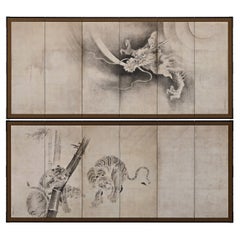
17th Century Japanese Screen Pair. Tiger
Dragon by Kaiho Yusetsu
Located in Kyoto, JP
Kaiho Yusetsu (1598-1677)
Tiger and Dragon
Early Edo Period, Circa 1650
A Pair of Six-fold Japanese Screens. Ink and slight color on paper.
Dimensions:
Each screen: H. 171 cm x W. 380 cm (67.5’’ x 149.5’’)
In this pair of early Edo period Japanese screens a group of tigers prowl in a bamboo grove whipped with fierce wind, while a dragon claws through clouds and mist. The dragon embodies elemental qualities - looming out of the mist, the coils of its body disappearing in the clouds. The dragon is calling for rain, symbolizing spring which is considered the fountain of life. On the other side, the tigers calls for the wind, symbolizing autumn which is considered the end of life. Tigers were familiar motifs within Japanese art from ancient times though the animals were imaginary to the people in the 17th century. While dragons and tigers are usually associated as sacred and ferocious, in this painting, both animals have rather amusing expressions. The tigers appear to glare at the dragon with cat-like eyes, and the look on the swirling dragon’s face appears almost affectionate - lending a playful flair to an otherwise magnificent theme.
The tiger and dragon are cosmological symbols of the balancing forces in the world. Screens such as this were originally meant to express the fluctuating nature of the world. For Japanese in the early Edo period, they likely suggested the powers of the cosmos. In Japan the tiger and dragon motif was originally absorbed into the circles of Zen monasteries before spreading into the secular world. The theme especially appealed to the military classes with the Kano school, the official painters to the Shogun and the samurai, being the leading contributors. The painter of this pair of screens, Kaiho Yusetsu (1598-1677), was closely patronized by the third Shogun Tokugawa Iemitsu. In his later years he worked with Kano school artists...
Category
Antique Mid-17th Century Japanese Edo Paintings and Screens
Materials
Silk, Wood, Paper
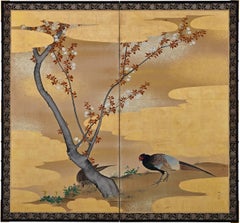
Early 19th Century Japanese Screen. Cherry Blossom
Pheasants by Mori Tetsuzan
Located in Kyoto, JP
Mori Tetsuzan (1775-1841)
Pheasants and Cherry Blossoms
Two-fold Japanese screen. Ink, color, gofun, gold and silver on paper.
A two-fold Japanese bir...
Category
Antique Early 19th Century Japanese Edo Paintings and Screens
Materials
Gold Leaf
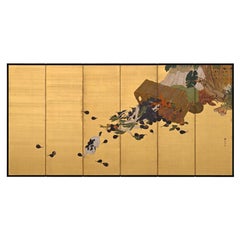
Circa 1920 Japanese Screen. Cat
Mouse Harvest Scene on Gold Silk.
Located in Kyoto, JP
The narrative playfulness of the scene depicted on this Japanese screen sets alight what is at its core a celebration of a bountiful harvest. The screen offers a visual representatio...
Category
Early 20th Century Japanese Taisho Paintings and Screens
Materials
Gold
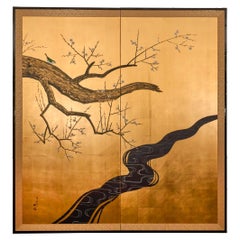
Japanese Two Panel Screen: "Autumn Day in the year 1931 (Xinwei)"
Located in Hudson, NY
Titled by the artist. This screen depicts a plum tree on rivers edge with a solitary nightingale. Mineral pigments on gold with silk brocade boarder and black lacquer trim with bron...
Category
Vintage 1930s Japanese Paintings and Screens
Materials
Brocade, Lacquer
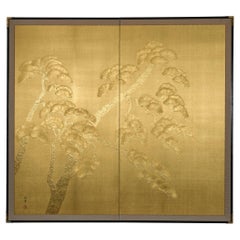
Japanese Two Panel Screen: Gilded Pine
Located in Hudson, NY
Luxurious golden pine with gold raised relief on gold silk with silk brocade border and black lacquer trim with bronze mounts. Signature and seal read: Takuyo.
Back Label Reads: ...
Category
Mid-20th Century Japanese Paintings and Screens
Materials
Brocade, Silk, Lacquer
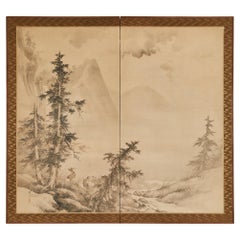
Japanese Two Panel Screen: Moonlit Forest Landscape with Deer
Located in Hudson, NY
Sumi Ink on Mulberry paper with silk brocade border and lacquer trim. Signature reads: Sobun. Seal reads: Morikawa
Notes about the Artist: Morikawa Sobun (1847-1902) was born into ...
Category
Antique Late 19th Century Japanese Paintings and Screens
Materials
Brocade, Silk, Lacquer, Paper
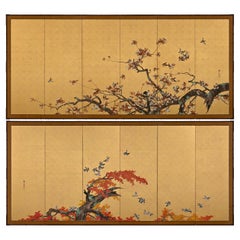
Meiji Era, Circa 1900 Japanese Screen Pair, Flowers
Birds of Spring
Autumn
Located in Kyoto, JP
Flowers & Birds of Spring and Autumn
Unknown artist.
Japan. Meiji period, circa 1900.
A pair of six-fold screens. Ink, color, gofun and gold leaf on paper.
Signed: Gaga S...
Category
Antique 1890s Japanese Meiji Paintings and Screens
Materials
Gold Leaf
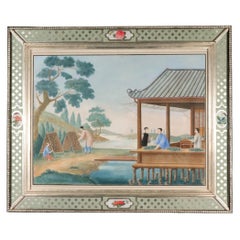
China Trade Painting on Paper depicting the Feeding of Silkworms
Located in Downingtown, PA
China Trade Painting on Paper depicting Feeding of Silkworms,
Circa 1780-1800
This painting is a superb example of the artwork created by Chinese artists for the Western market, off...
Category
Antique Late 18th Century Chinese Chinese Export Paintings and Screens
Materials
Paper
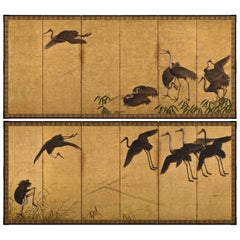
17th Century Japanese Screen Pair. Flock of Cranes. Ink and color on gold leaf.
Located in Kyoto, JP
A pair of six-fold Japanese screens from the 17th century depicting a flock of cranes arriving at their wintering grounds. The expansive scene is heavily atmospheric. The cranes are...
Category
Antique 17th Century Japanese Edo Paintings and Screens
Materials
Gold Leaf
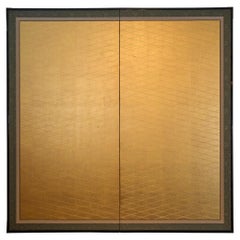
Japanese Two Panel Screen: Gold Lattice
Located in Hudson, NY
Embossed gold paper in a lattice design with silk brocade border and black lacquer trim with bronze hardware.
Category
Early 20th Century Japanese Paintings and Screens
Materials
Gold, Bronze
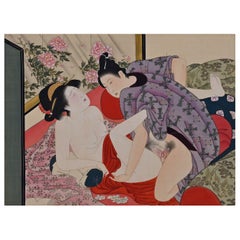
19th Century Japanese Shunga Hand-Scroll, Katsukawa School
Located in Kyoto, JP
Shunga
Unknown artist
Meiji era, circa 1880
Hand-scroll mounted with 12 paintings
Ink, pigment and gofun on silk
Dimensions:
Each image measures H. 23.2 cm x W. 34.4 cm (9.15” x 13.5”)
The hand-scroll measures H. 28 cm x W. 540 cm (11” x 212”)
A set of 12 late 19th century Japanese Shunga paintings mounted as a hand-scroll. Two of the leaves bear the signature and seal ‘Setsuzan’, although we are unable to confirm the identity of the artist using this art name. 6 of the 12 images are taken almost directly from Katsukawa Shuncho’s late 18th century woodblock series, ‘Erotic Pictures...
Category
Antique Late 19th Century Japanese Meiji Paintings and Screens
Materials
Silk
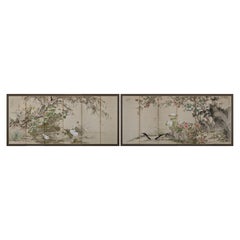
19th Century Japanese Screen Pair - Birds
Flowers of the Four Seasons
Located in Kyoto, JP
Birds & Flowers of the Four Seasons
Yamamoto Baiitsu (1783-1856)
Late Edo period, Dated 1850
A magnificent pair of six-panel Japanese folding screens by Yamamoto Baitsu, representin...
Category
Antique Mid-19th Century Japanese Edo Paintings and Screens
Materials
Wood, Paper
Chinese Horses - Japanese Folding Screen Silver Leaf
By Japanese Studio
Located in Brescia, IT
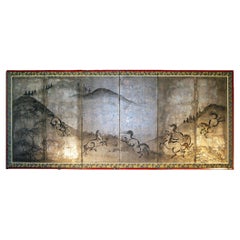
A six-panel screen, painted in ink on oxidized silver leaf, depicting galloping horses in the style of the finest Chinese paintings.
The horse is a universal symbol of freedom. Hors...
Category
Early 20th Century Japanese Taisho Paintings and Screens
Materials
Silver Leaf
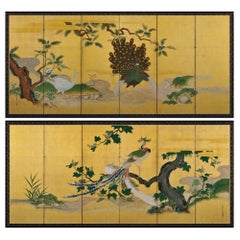
Japanese Screen Pair, circa 1730, Peacocks and Phoenix, Kano School
Located in Kyoto, JP
Phoenix and Peacocks.
A pair of six-panel Japanese folding screens by Tsunetake Yotei (n.d.)
First half of the 18th century.
The signature reads 67 year old Tsunetake.
The seals read:
-Tsunetake no in,
-Yotei,
-Seishin
Dimensions:
Each screen – H. 69” x W. 149” (176 cm x 378 cm)
A pair of Kano Grand Picture (Waga) screens depicting phoenix and peacocks rich with symbolic meaning. Dating to the first half of the 18th century, from the Kobikicho Kano school in Edo, this pair of folding...
Category
Antique Early 18th Century Asian Edo Paintings and Screens
Materials
Gold Leaf
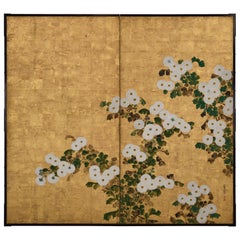
18th Century Japanese Rinpa Screen. White Chrysanthemums. School of Korin.
Located in Kyoto, JP
School of Ogata Korin
White Chrysanthemums
18th Century, Edo period.
A two-panel Japanese screen. Ink, color, gofun and gold leaf on paper.
Dimensions: H. 171 cm x W. 188 cm (67.5” x 74”)
On this two-panel Japanese screen we see blooming chrysanthemums, a flower which embodies the essence of autumn in Japan. Here the traditional floral theme has been simplified and stylized. The bright colors and asymmetrical composition against the delicate gold leaf create a luxurious and ornate work of art. Its background, a strikingly patinated grid of gold leaf, denies any sense of place or time and imbues everything with an ethereal glow. The leaves and stems of the plants are nothing more than pools of mottled color and ink without any outline whatsoever. These are typical Rinpa adaptations of traditional ink painting methods; tarashikomi, or diluted washes of color blended while very wet, and mokkotsu, or “bonelessness,” which creates forms without exterior outlines. The relief work of the rounded flower petals has been obtained by the moriage process (a mixture based on ground shells modeled on the surface of the paper).
On the lower right of the screen, the siganture “Hokyo Korin Jakumyo” and the “Hoshuku” seal can be read. Korin is Ogata Korin, famed for the Irises (Nezu Museum) and Red and White Plum Blossom (MOA Museum of Art) folding screens, both National Treasures. Korin worked in both Kyoto and Edo in the mid-Edo period. Korin was using the art name “Jakumyo” just after he received the Hokyo level, which was in 1701.
This particular screen was published in May of 1961 in the Japanese Sansai Fine Art Magazine*. An in depth article accompanies the photograph of the screen and and a photograph of the signature and seal. This article devotes much of its body to discussing the moriage technique, how it enlivens the chrysanthemum flowers and Korin’s specific skill in using the technique. The article goes on to discuss the most famous works of Korin, utilizing this technique, which were known at the time. Specifically a two-panel screen held in the Honolulu Museum which was discovered in the store-house of Takahashi Soan. A two-panel screen pair which the Nakano family own. A two-panel screen pair with chrysanthemums in moriage in fan designs owned by the Nomura family. Also a small folding screen featuring chrysanthemums held in the Yamato Bunkakan. The article goes on to say that this particular two-fold screen came from the Nijo family. Korin is known to have had a strong connection with the aristocratic Nijo family. The article explains that Korin received a lot of favors from the Nijo family and that this screen would have been gifted to them.
Since that time the Honolulu screen has been amended to ‘attributed to Ogata Korin’ and I do not know further details of the other 3 screens. Other Chrysanthemum screens...
Category
Antique 18th Century Japanese Edo Paintings and Screens
Materials
Gold Leaf
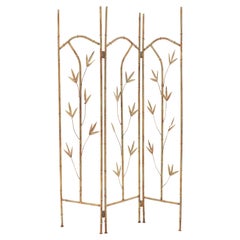
Mid-Century Faux Bamboo Metal Painted 3-Fold Screen
Located in Queens, NY
Mid-century faux bamboo metal screen with three panels have a leaf design with a faux painted patina.
Category
20th Century American Mid-Century Modern Paintings and Screens
Materials
Metal
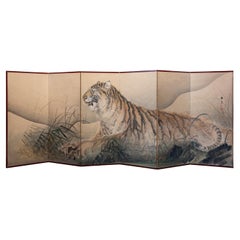
A six-panel screen depicting a majestic tiger
Located in Milano, IT
A Japanese six-panel screen painted on paper with gold powder, depicting a majestic tiger reclining in tall grass, emerging powerfully from the lightly suggested landscape in the bac...
Category
Antique Late 19th Century Japanese Paintings and Screens
Materials
Paper
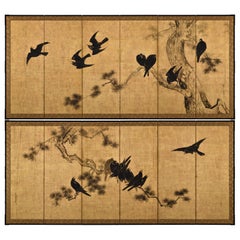
Mid 18th Century Japanese Screen Pair. Crows
Pines by Unkoku Toshuku.
Located in Kyoto, JP
Unkoku Toshuku (1722-1779)
Crows and Pines
A pair of six-panel Japanese Screens. Ink and gold leaf on paper.
Dimensions: Each Screen: H. 170.5 cm x W. 375 cm
Haha-cho or mynah birds, whose forms resemble crows in artwork, were commonly depicted in Japanese art. These types of paintings were originally modeled on paintings attributed to the 13th century Chinese painter Muqi (Mokkei), whose art was enormously influential in Japan. Crows only became a theme among Japanese artists from the later 1500s onward. They likely were inspired by these imported Chinese paintings of myna birds, which are not native to Japan, substituting the native species of crow instead.
The best known early examples of the depiction of Japanese crows are two Momoyama screen...
Category
Antique Mid-18th Century Japanese Edo Paintings and Screens
Materials
Gold Leaf
Japanese Two Panel Screen: Emu in Flowering Cactus
Located in Hudson, NY
Very unusual subject matter of emu in an arid landscape beautifully painted in mineral pigments on silk in a dark brown lacquer trim with bronze mounts. Signature and seal read: Bun...
Category
Early 20th Century Japanese Paintings and Screens
Materials
Bronze

Japanese Two Panel Screen: Pine Grove
Located in Hudson, NY
A nice example of a textile screen in the design of pine trees in mass. Japanese Dyed fabric technique with natural wood trim. Signature reads: Nagemitsu
Category
20th Century Japanese Paintings and Screens
Materials
Fabric, Wood
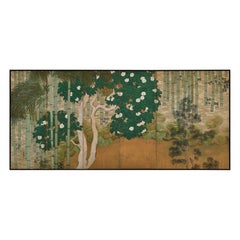
Early 20th Century Japanese Nihonga Screen. Bamboo Forest.
Located in Kyoto, JP
Anonymous
Bamboo Forest
Early Taisho era. Circa 1910-1915.
Six-panel Japanese Screen. Mineral pigment, gofun and ink on silk.
A six-panel Japanese folding screen, painted on silk in...
Category
Early 20th Century Japanese Taisho Paintings and Screens
Materials
Silk
Edo Landscape Japanese Folding Screen
By Japanese Studio
Located in Brescia, IT
Refined work by a painter from the first half of the 19th century, from the landscape of the "Rinpa" school by a painter from the end of the 18th century, the Rinpa school.
Six panels painted in ink on gold leaf and "gofun" on vegetable paper.
The flowers are made with the "gofun" technique, natural or pigmented white oyster powder.
Rinpa is one of the major historical schools of Japanese painting. The style was consolidated by the brothers Ogata Korin (1658–1716) and Ogata Kenzan (1663–1743).
This folding screen has a very clean design that leaves plenty of room for the beautiful golden landscape.
It comes flat and you can easily hang it with our hooks.
Lucio Morini...
Category
Antique 18th Century Japanese Edo Paintings and Screens
Materials
Gold Leaf
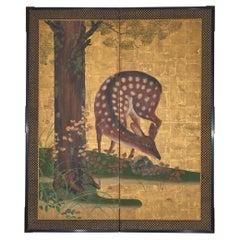
Japanese Two Panel Screen: Woodland Deer
Located in Hudson, NY
Foraging deer under hinoki tree in an autumn setting. Mineral pigments on heavy gold leaf with good veining on paper. Silk brocade border with a black lacquer trim and elaborate bron...
Category
Antique Early 19th Century Japanese Paintings and Screens
Materials
Bronze
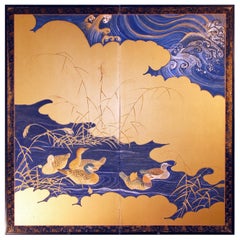
Paravento Giapponese a due pannelli
By Japanese Studio
Located in Brescia, IT
Sempre alla ricerca di cose particolari abbiamo acquistato questo paravento giapponese da una collezionista di Osaka.
Un esempio di arte del novec...
Category
20th Century Japanese Showa Paintings and Screens
Materials
Gold
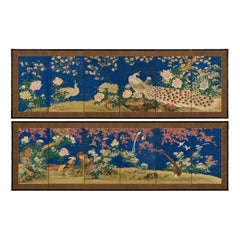
Mid 19th Century Japanese Screen Pair. Flowers
Birds of the Four Seasons.
Located in Kyoto, JP
Shioka Sorin (1781-1850)
Flowers & Birds of the Four Seasons
Pair of six-panel Japanese Screens. Ink, gofun and pigments on silk.
Dimensions (each screen): H. 91.5cm x W. 285cm (3...
Category
Antique Mid-19th Century Japanese Edo Paintings and Screens
Materials
Silk
17th Century Japanese Screen. Ink Plum Tree
Birds by Kano Naonobu.
Located in Kyoto, JP
Kano Naonobu (1607-1650)
Plum Tree and Birds
Six-fold Japanese Screen. Ink and slight color on paper.
In this evocative ink work spread over a six-panel folding screen, we see the consummation of the elegance and refinement of the Edo Kano school. This 17th century screen is a rare surviving example of a large-scale bird and flower painting by Kano Naonobu, the younger brother of Kano Tanyu...
Category
Antique 17th Century Japanese Edo Paintings and Screens
Materials
Wood, Paper
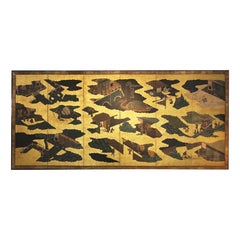
Six-panel gold leaf screen
By Japanese Studio
Located in Brescia, IT
Large Japanese six-panel screen, ink, color, gold, and gold leaf on paper, depicting three scenes from Genji monogatari (The Tale of Genji), the vignettes punctuated by raised golden...
Category
Antique Early 19th Century Japanese Edo Paintings and Screens
Materials
Gold Leaf
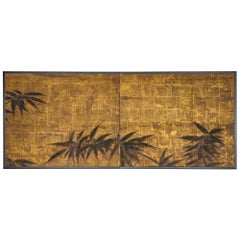
$16,719
Japanese Two Panel Screen: Bamboo on gold
Located in Hudson, NY
Fragment from an earlier screen from the Muromachi period ( 1336-1573). Appears to have been mounted in the early 20th century into a small furosaki byobu (tea ceremony screen) Miner...
Category
Antique 16th Century Japanese Paintings and Screens
Materials
Gold Leaf
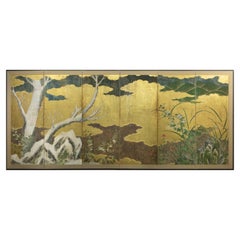
Japanese Six-Panel Screen Winter Into Spring
Located in Hudson, NY
With snow-covered willow tree, garden stone and winter berries. Right panels have spring flowers and a view of hills in the distance (likely the Higashiyama Hills painted in Kyoto by...
Category
Antique 18th Century Japanese Edo Paintings and Screens
Materials
Gold Leaf
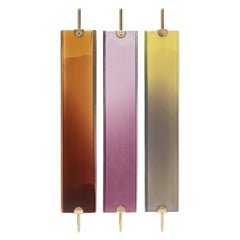
Unique Reverso Room Divider by Draga
Aurel
By Draga
Aurel
Located in Geneve, CH
Unique Reverso room divider by Draga & Aurel
Price for each piece. Please contact us
Unique piece
Dimensions: W 29 H 271
Materials: Resin, po...
Category
2010s Italian Modern Screens and Room Dividers
Materials
Brass
$7,992 / item
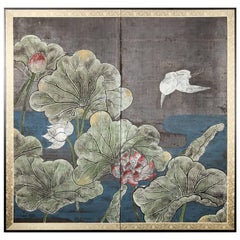
Japanese Two Panel Screen, Lotus and Heron
Located in Hudson, NY
Japanese two panel screen, lotus and heron
Colored mineral pigments on silver leaf on handmade mulberry paper.
Category
Antique Late 19th Century Japanese Paintings and Screens
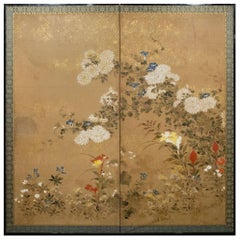
Japanese Two-Panel Screen, Flower Garden
Located in Hudson, NY
Rimpa School painting featuring cascading chrysanthemums as well as cockscombs, summer wild flowers, and a climbing morning glory vine. Beautifully executed, fine painting in mineral...
Category
Antique Mid-18th Century Japanese Edo Paintings and Screens
Materials
Gold Leaf
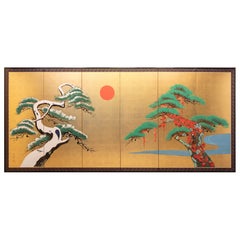
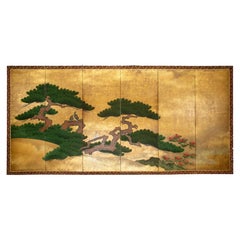
A six-panel folding screen with pine trees beneath the red sun
Located in Milano, IT
A six-panel folding screen with a gold-leaf ground, depicting two pine trees with a red sun at the center.
On the left, a snow-covered pine is shown with a sinuous, knotted trunk and...
Category
Antique Late 19th Century Japanese Paintings and Screens
Materials
Gold Leaf
Japanese Four Panel Screen: Early Spring Into Summer
Located in Hudson, NY
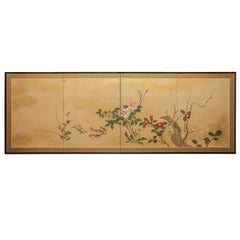
Japanese Four Panel Screen: Early Spring Into Summer, Meiji period (1868 -1912) painting of plum in bloom with red camellias on the right and peony and thistle on the left. A clutc...
Category
Antique Early 1900s Japanese Meiji Paintings and Screens
Materials
Gold Leaf
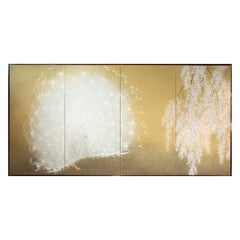
A four-panel folding screen depicting a white peacock, signed Yukihiko Kurihara
Located in Milano, IT
An unusual four-panel folding screen depicting a majestic white peacock and a flowering cherry tree, painted on paper with gold powder ground. The scene shows the peacock, rendered w...
Category
Mid-20th Century Japanese Paintings and Screens
Materials
Gold Leaf
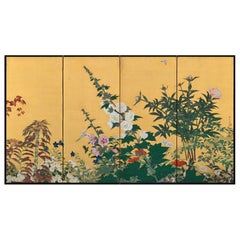
Early 20th Century Japanese Screen. Flowers of the Four Seasons.
Located in Kyoto, JP
Anonymous
Flowers of the Four Seasons
A four-panel Japanese screen. Ink, gofun and pigments on gold leaf.
This Japanese screen is a rich visual celebration of the flowers of the fo...
Category
Early 20th Century Japanese Taisho Paintings and Screens
Materials
Gold Leaf
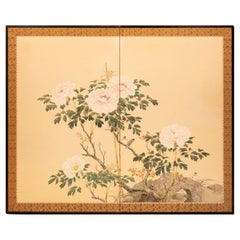
A two-panel folding screen with a naturalistic scene
Located in Milano, IT
A Japanese two-panel folding screen with floral decoration depicting blooming peonies, sparrows and rocks against a light ground. The panels are framed by two splendid silk brocade b...
Category
Early 20th Century Japanese Paintings and Screens
Materials
Paper
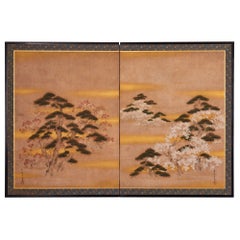
Japanese Two-Panel Screen, Pine, Cherry, and Maple
Located in Hudson, NY
Cherry blossoms and maples among ragged pines. Mineral pigments on mulberry paper with gold mist clouds. Completely remounted utilizing an antique silk brocade...
Category
Antique Mid-19th Century Japanese Paintings and Screens
Materials
Gold, Bronze
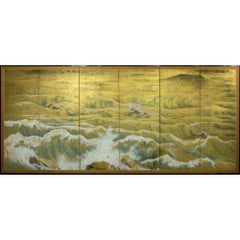
Japanese Six Panel Screen: Rocks and Waves in a Coastal Landscape
Located in Hudson, NY
Rocks and waves in a coastal landscape. Taisho (1912-1926) period painting.
Mineral pigments on silk. Artist’s signature and seal reads: Tomokazu.
Six panels measure 67 1/2 inches h...
Category
20th Century Japanese Paintings and Screens
Materials
Brocade, Silk
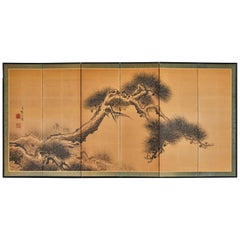
Japanese Six Panel Screen: Ink Painting of a Weathered Pine Tree
Located in Hudson, NY
Meiji period (1868 - 1912) sumi-e (or ink painting) on paper of a venerable pine tree with limbs stretching out over a bluff. Beautiful signature and seal read: Biei. Ink on paper ...
Category
Antique 19th Century Japanese Paintings and Screens
Materials
Brocade, Silk, Paper
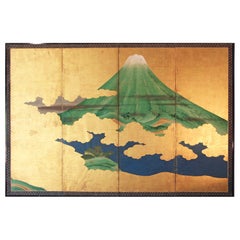
Japanese Folding Screen Gold Leaf
By Japanese Studio
Located in Brescia, IT
Byobu painted with mineral pigments on gold leaf, the quality of the painting is still excellent, with no color loss or restorations.
A classic four-panel screen depicting Mount Fuji...
Category
Antique Early 19th Century Japanese Edo Paintings and Screens
Materials
Gold Leaf
A pair of six-panel folding screens depicting two pine trees (matsu)
Located in Milano, IT
A pair of six-panel folding screens from the Kano school, painted in ink and pigments on paper.
The naturalistic composition is dominated by two lush green pine trees extending from ...
Category
Antique 19th Century Japanese Paintings and Screens
Materials
Paper
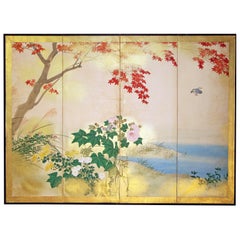
Byobu - Japanese Folding Screen
By Japanese Studio
Located in Brescia, IT
Nice four-panel Japanese screen painted on vegetal paper, depicting a landscape with a red maple, flowers and birds.
The size is very refined and easy to place in a design project.
Category
Mid-20th Century Japanese Showa Paintings and Screens
Materials
Paper
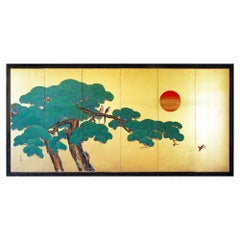
Byobu - Japanese Screen Gold Leaf Kano School Pine Sun
By Japanese Studio
Located in Brescia, IT
Japanese Screen of Kano school six panels hand painted with mineral pigments on gold leaf.
A very clean work with large pines and a red sun.
It is in good condition, with original l...
Category
Antique Late 19th Century Meiji Paintings and Screens
Materials
Gold Leaf
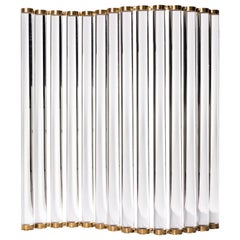
Unique Vertigo Room Divider Module by Draga
Aurel
By Draga
Aurel
Located in Geneve, CH
Unique Vertigo Room Divider by Draga & Aurel
The published price corresponds to ONE (01) bar. Please contact us for full module quotations.
Unique piece.
Dimensions: W 30 D 10 H 200,...
Category
2010s Italian Modern Screens and Room Dividers
Materials
Brass
$4,360 / item
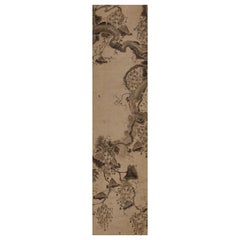
17th Century Korean Grapevine and Squirrel Scroll Painting, Mid Joseon Period
Located in Kyoto, JP
Anonymous. Korean, 17th century. Joseon period.
Hanging scroll. Ink on paper.
Seal: Shinso
Dimensions:
Scroll: H. 200 cm x W. 31 cm (79” x 12”)
Image: H. 122 cm x W. 29.5 cm (48” x 11.5”)
The grapevine came to China and then Korea from western Asia via the silk road trade routes. By the mid-Joseon period, it was one of the most popular subjects for Korean literati painters. Grapevines were painted as a singular subject or, less commonly, in combination with squirrels, which are associated with children due to their playful nature. Together, grapevines and squirrels embody wishes for abundant offspring and wealth.
For the Korean literati artist the twisting vines, curling tendrils and round, plump grapes provided ample opportunity for expressive "brush play”. In this painting the artist has abstracted the scene and is seemingly unconcerned with discontinuities and proportion. Vines spring up from nowhere, grapes hang in random clusters and the squirrel’s head appears as if twisted backwards. For the vines and leaves we can feel a sense of speed in the brushstrokes, imparting a dynamic feel which is at once intense and animated. This contrasts dramatically with the countless tiny strokes of ink which realistically capture the texture of the squirrel’s fur...
Category
Antique 17th Century Korean Other Paintings and Screens
Materials
Paper
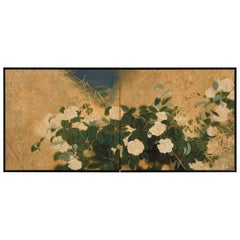
Circa 1925. Taisho era Japanese Nihonga Screen. Camellia
Bamboo.
Located in Kyoto, JP
Anonymous
Camellia & Bamboo
Taisho era
Two-panel Japanese Screen. Mineral pigment, gofun and ink on silk.
A small Japanese Nihonga screen capturing...
Category
Early 20th Century Japanese Taisho Paintings and Screens
Materials
Silk
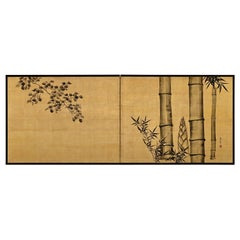
19th Century Japanese Screen for Tea-Ceremony, Ink Bamboo and Plum on Gold Leaf
Located in Kyoto, JP
Three Friends of Winter
Nakajima Raisho (1796-1871)
Late Edo period, circa 1850
Ink and gold leaf on paper.
This is a double-sided Japanese Furosaki or tea-ceremony screen from the mid 19th century; bamboo and plum on the front, young pines the back. It by Nakajima Raisho, a master painter of the Maruyama school in the late Edo and early Meiji periods. In this work Raisho combines exquisite ink brushwork with large open spaces of brilliant gold-leaf to inspire the viewers imagination. Rather than naturalism, he is searching for the phycological impression of the motifs, resulting in abstraction and stylization. His simplification of the motifs the result of looking to capture the inner nature of the objects. This art motif is known as Sho Chiku Bai, or the Three Friends of Winter. Evergreen pine connotes steadfastness, bamboo suggests both strength and flexibility, while plum blossoms unfurling on snow-laden branches imply hardiness. Combined, this trio is emblematic of Japanese new year. Chinese literati were the first to group the three plants together due to their noble characteristics. Like these resilient plants flowering so beautifully in winter, it was expected of the scholar-gentleman to cultivate a strong character with which he would be able to show the same degree of perseverance and steadfastness even during times of adverse conditions.
The screen would have been placed near the hearth of a room used for the Japanese tea ceremony, shielding the fire from draughts and also forming a stimulating and decorative backdrop behind the tea utensils. It would have been used in the Hatsugama, or first tea-ceremony of the new year.
Nakajima Raisho (1796-1871) originally studied under Watanabe Nangaku before entering the school of Maruyama Ozui. He was the highest ranking Maruyama school painter at the end of the Edo period and was known as one of the ‘Four Heian Families’ along with Kishi...
Category
Antique Mid-19th Century Japanese Edo Paintings and Screens
Materials
Gold Leaf
Japanese Painting, Hanging Scroll, 19th Century Bamboo in Moonlight
Located in Kyoto, JP
Bamboo in moonlight
Gamo Rakan (1784-1866)
Hanging scroll, ink on silk.
Dimensions:
Scroll: 201 cm x 58 cm
Image: 137 cm x 45 cm
In this early 19th century work by Gamo Rakan a light ink wash applied to the silk background silhouettes the moon and suggests the atmosphere of early evening. Even though it is a literati subject, Rakan’s bamboo is quite realistic with a strong decorative style. The painting finds its inspiration from Chinese Ming dynasty painters who often used a single-tone, jet black stroke to emphasize the calligraphic nature of bamboo.
In a different era, decorative would have been seen as somewhat unrefined. But increasingly in the Edo period, it was the hallmark of high style. The Japanese people, in particular the rising merchant class, had gradually become apathetic toward the traditional Sesshu and Kano schools of painting. Chinese professional and amateur painters living in the port of Nagasaki during the 18th century had a profound effect on Japanese painting and the freshness of their style and its decorative appeal contributed greatly to its popularity. Gamo Rakan’s teacher, Tani Buncho...
Category
Antique Early 19th Century Japanese Edo Paintings and Screens
Materials
Silk