76 results for "josé clemente orozco"
to
6
69
3
61
41
13
12
8
7
6
4
4
3
2
2
2
2
1
1
1
1
1
1
1
9
5
5
4
3
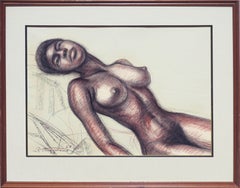
Mid Century Nude Figure Study of a Black Woman
By Raul Anguiano
Located in Soquel, CA
Compelling mid century nude figure study of a black woman reclining by Raul Anguiano (Mexican/American, 1915-2006), 1968. Signed and dated lower left hand corner "R. Anguiano." Presented in wood frame under plexiglass. Image size: 25"H x 34"W. Framed size: 35"H x 43.75"W.
Raúl Anguiano was born in Guadalajara, Jalisco, on February 26th, 1915. He started drawing cubist pictures at the age of 5, taking as his first models movie stars, as Mary Pickford, Pola Negri and Charlie Chaplin. Anguiano first artistic influence or aesthetic emotion came from the Holy Family by Rafael Sanzio.
At the age of 12, Anguiano attended Guadalajara's Free School of Painting under the tuition of Ixca Farias. From 1928 to 1933, he studied with the Master painter José Vizcarra, the disciple of Santiago Rebull and José Salomé Piña, and organised the group "Young Painters of Jalisco" with other artists. During this period, Anguiano worked with different kinds of models: workmen, employees and a few intellectuals like Pita Amor.
In 1934 Anguiano moved to Mexico City. He began teaching in primary schools and taught drawing and painting at La Esmeralda academy and the UNAM School of Art.
Anguiano was a member of the Mexican Artistic Renaissance movement which was started in the 1920's by the Mexican School of Art in which he belonged. This renaissance began with the San Carlos Academy movement -- among whose leaders were Ignacio Asúnsolo and Jose Clemente Orozco -- and which emerged out of the students' and teachers' discontent with the traditional paintings methods (academicism), and the close contact that the young artists had with the problems of Mexico and its people, explaining the marked critical realism to the painters of the time, including Anguiano himself.
The same year, Anguiano received a commission to paint his first mural, Socialist Education, a 70 meters fresco located at A. Carrillo School in Mexico City. Other works followed, including Mayan rituals (oils on canvas and wood), for the Mayan Hall in the National Museum of Anthropology, and Trilogy of Nationality (acrylic on canvas and wood), for the Attorney General's Office.
In 1936 he moved into his surrealist period, which lasted almost a decade. He painted circus performers and prostitutes. The most notable among his works of the time are: The Madame (gouche, 1936), The Clown's Daughter (oil, 1940), the Pink Circus Artist and the Grey Circus Artist (oil, 1941). Also during this period, Anguiano produced a series of drawings based on his dreams, with cold tones and silver-greys predominating.
In 1937 Anguiano joined the Revolutionary Writers and Artists League. Together, with Alfredo Zalce and Pablo O'Higgins, he was also a founding member of the Popular Graphics Workshop, where artists practised a graphic style based on Mexico's folk traditions. This was due to the powerful influence of the recently discovered Jose Guadalupe Posada and Goya.
Raúl Anguiano belonged to the so-called "Third Generation" of post-revolutionary painters, along with Juan O'Gorman, Jorge González Camarena...
Category
1960s Realist Nude Paintings
Materials
Paper, Conté, Charcoal

$4,400 Sale Price
20% Off
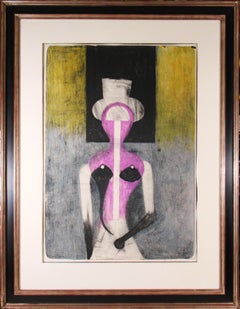
"Mujer Con Sombrero" Large lithograph
By Rufino Tamayo
Located in San Francisco, CA
This artwork titled "Mujer Con Sombrero (Woman with Hat)" 1972 is a large original colors lithograph on Arches paper by renown Mexican artist Rufino Tamayo, 1899-1991. It is hand signed and numbered 81/100. in pencil by the artist. The artwork size 36.35 x 25.85 inches, sheet size is 37.25 x 26.25 inches, framed size is 52.25 x 40.5 inches. Published by Transworld Art, New York , Printed by Bank Street Atelier, New York. Referenced and pictured in the artist's catalogue raisonne by Pereda, plate #132 page 123. Custom framed in a wooden black and silver frame, with silver bevel and fabric matting. It is in excellent condition.
About the artist:
A native of Oaxaca in Southern Mexico, Rufino Tamayo's father was a shoemaker, and his mother a seamstress. Some accounts state that he was descended from Zapotec Indians, but he was actually 'mestizo' - of mixed indigenous/European ancestry. (Santa Barbara Museum of Art). He began painting at age 11. Orphaned at the age of 12, Tamayo moved to Mexico City, where he was raised by his maternal aunt who owned a wholesale fruit business.
In 1917, he entered the San Carlos Academy of Fine Arts, but left soon after to pursue independent study. Four years later, Tamayo was appointed the head designer of the department of ethnographic drawings at the National Museum of Archaeology in Mexico City. There he was surrounded by pre-Colombian objects, an aesthetic inspiration that would play a pivotal role in his life. In his own work, Tamayo integrated the forms and tones of pre-Columbian ceramics into his early still lives and portraits of Mexican men and women.
In the early 1920s he also taught art classes in Mexico City's public schools. Despite his involvement in Mexican history, he did not subscribe to the idea of art as nationalistic propaganda. Modern Mexican art at that time was dominated by 'The Three Great Ones' : Diego Rivera, Jose Clemente Orozco, and David Alfaro Siqueros, but Tamayo began to be noted as someone 'new' and different' for his blending of the aesthetics of post Revolutionary Mexico with the vanguard artists of Europe and the United States.
After the Mexican Revolution, he focused on creating his own identity in his work, expressing what he thought was the traditional Mexico, and refusing to follow the political trends of his contemporary artists. This caused some to see him as a 'traitor' to the political cause, and he felt it difficult to freely express himself in his art. As a result, he decided to leave Mexico in 1926 and move to New York, along with his friend, the composer Carlos Chavez. The first exhibition of Tamayo's work in the United States was held at the Weyhe Gallery, New York, in that same year. The show was successful, and Tamayo was praised for his 'authentic' status as a Mexican of 'indigenous heritage', and for his internationally appealing Modernist aesthetic. (Santa Barbara Museum of Art).
Throughout the late thirties and early forties New York's Valentine Gallery gave him shows. For nine years, beginning in 1938, he taught at the Dalton School in New York.
In 1929, some health problems led him to return to Mexico for treatment. While there he took a series of teaching jobs. During this period he became romantically involved with the artist Maria Izquierdo...
Category
Mid-20th Century Modern Figurative Prints
Materials
Lithograph
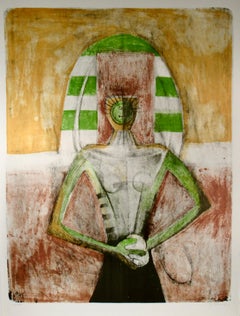
Carnavalesque
By Rufino Tamayo
Located in San Francisco, CA
This artwork titled "Carnavalesque" from the suite "The Mujeres File" 1969 is an original colors lithograph on BFK Rives paper by renown Mexican artist Rufino Tamayo, 1899-1991. It i...
Category
Mid-20th Century Modern Figurative Prints
Materials
Lithograph
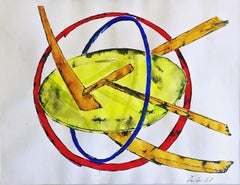
Herbert Ferber, Abstract Expressionist sculptural study signed framed Provenance
By Herbert Ferber
Located in New York, NY
Herbert Ferber
Untitled, 1968
Unique Ink and color wash on paper
Hand signed and dated by the artist on the front
Framed with original Knoedler Gallery label (under the respected dir...
Category
1960s Abstract Expressionist Abstract Drawings and Watercolors
Materials
Ink, Watercolor
Venus Noir
By Rufino Tamayo
Located in San Francisco, CA
This artwork titled "venus Noir" from the suite "The Mujeres File" 1969 is an original colors lithograph on BFK Rives paper by renown Mexican artist Rufino Tamayo, 1899-1991. It is h...
Category
Mid-20th Century Modern Figurative Prints
Materials
Lithograph
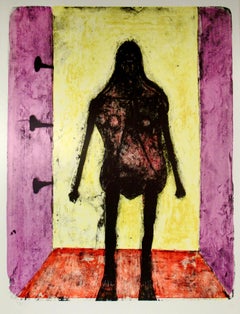
Los Carpinteros Cuban Art Photograph Tuneles Populares Silver Gelatin Photo
By Los Carpinteros
Located in Surfside, FL
Los Carpinteros (Cuban, 1992-present).
Silver gelatin print photograph, large format.
From the series "Tuneles Populares" (The People's Tunnels)
1999
Edition 1/5
Provenance: Bliss Fi...
Category
1990s Conceptual Landscape Photography
Materials
Silver Gelatin
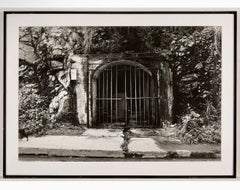
Cabeza con Pajaros
By Rufino Tamayo
Located in San Francisco, CA
This artwork titled "Cabeza con Pajaros" 1958, is an original colors lithograph on Wove paper by renown Mexican artist Rufino Tamayo, 1899-1991. It is hand signed and numbered 273/30...
Category
Mid-20th Century Modern Figurative Prints
Materials
Lithograph

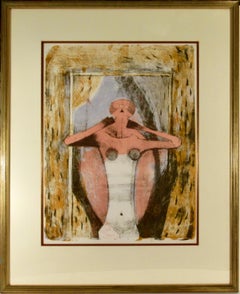
Torso de Mujer
By Rufino Tamayo
Located in San Francisco, CA
This artwork titled "Torso de Mujer (Torso de Femmee)" from the suite "The Mujeres File" 1969 is an original colors lithograph on Wove paper by renown Mexican artist Rufino Tamayo, 1899-1991. It is hand signed and inscribed H.C. (Hors Commerce) in pencil by the artist. The image size is 26.85 x 21 inches, framed size is 40.75 x 33 inches. Published by Touchtone Publisher, New York, printed by Ateliers Desjobert, Paris. Referenced and pictured in the artist's catalogue raisonne by Pereda, plate #108 page 107. Custom framed in a wooden gold frame, with gold bevel and light beige fabric matting. It is in excellent condition.
About the artist:
A native of Oaxaca in Southern Mexico, Rufino Tamayo's father was a shoemaker, and his mother a seamstress. Some accounts state that he was descended from Zapotec Indians, but he was actually 'mestizo' - of mixed indigenous/European ancestry. (Santa Barbara Museum of Art). He began painting at age 11. Orphaned at the age of 12, Tamayo moved to Mexico City, where he was raised by his maternal aunt who owned a wholesale fruit business.
In 1917, he entered the San Carlos Academy of Fine Arts, but left soon after to pursue independent study. Four years later, Tamayo was appointed the head designer of the department of ethnographic drawings at the National Museum of Archaeology in Mexico City. There he was surrounded by pre-Colombian objects, an aesthetic inspiration that would play a pivotal role in his life. In his own work, Tamayo integrated the forms and tones of pre-Columbian ceramics...
Category
Mid-20th Century Modern Figurative Prints
Materials
Lithograph
Nino Con Pajaros (Variant)
By Rufino Tamayo
Located in San Francisco, CA
This artwork titled "Nino Con Pajaros" Variant, 1976, is a color etching on Guarro paper by renown Mexican artist Rufino Tamayo, 1899-1991. It is hand signed and numbered 40/75 in black crayon by the artist. Published by Ediciones Poligrafa, Barcelona, Spain. The artwork (sheet) size is 29.5 x 22 inches, framed size is 41.25 x 33.75 inches. Referenced and pictured in the artist's catalogue raisonne by Pereda, plate #199 page 169. Custom framed in a wooden black frame, with light beige fabric matting. It is in excellent condition.
About the artist:
A native of Oaxaca in Southern Mexico, Rufino Tamayo's father was a shoemaker, and his mother a seamstress. Some accounts state that he was descended from Zapotec Indians, but he was actually 'mestizo' - of mixed indigenous/European ancestry. (Santa Barbara Museum of Art). He began painting at age 11. Orphaned at the age of 12, Tamayo moved to Mexico City, where he was raised by his maternal aunt who owned a wholesale fruit business.
In 1917, he entered the San Carlos Academy of Fine Arts, but left soon after to pursue independent study. Four years later, Tamayo was appointed the head designer of the department of ethnographic drawings at the National Museum of Archaeology in Mexico City. There he was surrounded by pre-Colombian objects, an aesthetic inspiration that would play a pivotal role in his life. In his own work, Tamayo integrated the forms and tones of pre-Columbian ceramics...
Category
Mid-20th Century Modern Figurative Prints
Materials
Etching
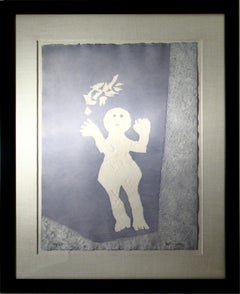
Pink Lady
Located in San Francisco, CA
THis artwork "Pink Lady" 1989, is an acrylograph on hand made paper by noted Mexican artist Byron Galves, 1941-2009. It is hand signed, dated and numbered 64/150 in white pencil by the artist.The artwork size is 28.5 x 15.5 inches, paper sheet size is 32 x 23.85 inches, framed size is 44 x 36 inches. Beautifully custom framed in a wooden silver frame, with dark purple backing and bevel. It is in excellent condition, the frame have some small minor restorations, barely visible.
About the artist:
Byron Gálvez (October 28, 1941 – October 27, 2009) was a Mexican artist who was primarily known for his painting but also created sculpture, including monumental works. He was born in rural Hidalgo state, to a father who played jazz music and read literature, a rarity in 1930s rural Mexico. However, it exposed Gálvez to culture, even though this led to an interest in visual art rather than musing or writing.
He went to Mexico City to study art at both the undergraduate and graduate level, but never completed his degrees, opting instead to begin career after his coursework. Before his first individual exhibition, his work was criticized by Justino Fernández, but all of the paintings were sold in advance to foreign buyers including American actor Vincent Price, who called Gálvez a “Mexican Picasso.” Gálvez then managed to replace the forty five paintings for the exhibition in a week. Since then he had individual and collective exhibitions in Mexico, the United States and other parts of the world. He concentrated on painting, which he is better known for, in the 1970s and 1980s, but moved on to sculpture, including monumental works later in his career. Recognitions for Gálvez's work include membership in the Salón de la Plástica Mexicana, a retrospective at the Palacio de Bellas Artes and two books published about his life.
Gálvez was born in Mixquiahuala, Hidalgo and described his childhood as happy, and would not have changed it. His father, Roberto Gálvez, was a farmer and merchant, who was a music and literature enthusiast, a rarity is 1930s rural Mexico. His father played the violin in the town's jazz band, which had almost all classical instruments, making it similar to bands in New Orleans. They even composed new pieces. The artist was named after Lord Byron, and his brothers, Eliot, Aníbal and Dante, after his father's reading preferences
This meant that Gálvez grew up in an environment that encouraged the enjoyment of the arts. However, instead of music or literature, Gálvez stated that his earliest memories related to his attraction to art and that he always wanted to be a painter. The difficulties of farm life convinced him that he needed an education and would have to move to Mexico City in order to go to school. At age sixteen he left home for the capital to study painting at the Escuela Nacional de Artes Plásticas, not knowing what the study would entail. It was far more rigorous than he expected, with thirteen-hour school days leaving only weekends to earn money to live on.[3] He did his undergraduate studies from 1958 to 1962, then continued with the graduate courses from 1962 to 1964, specializing in painting.
He did much of his studies under teachers such as Luis Nishizawa, Fernando Castro Pacheco, Francisco Moreno Capdevila, Santos Balmori, Antonio Rodríguez Luna and Antonio Ramírez. The last teacher taught him to love his studies above all else and he submitted himself to the academic rigor. This led him to become attracted to the Cubism of Picasso, and felt that the artist has opened roads which could be taken and widened. Although he specialized in painting, his interest in sculpture was also evident at this time as he was a founding member of a metal sculpture workshop at the institution along with Armando Ortega and Baltazar Martinez.[2][5] Although he completed his coursework, he did not finish the other requirements needed for the degree, instead opting to start his career.
Gálvez married once to art dealer Eva Beloglovsky.The couple first met in 1973, but did not meet again until two years later, when Beloglovsky bought one of his paintings and sold two more through her art gallery. At first it was a working relationship, and then evolved into a romantic one. During their marriage, they worked on a number of projects together such as multi-media presentations and charity benefits. The couple remained together until Galvez's death.
Although he began and developed much of his career in Mexico City, in his later life, the artist moved back to his rural hometown. Gálvez constructed a house and studio on the edge of a ravine in which flows the Moctezuma River. The structure has glass walls positioned for maximum light and a privileged view of a local landmark, a hill called El Elefante.
Gálvez's work included painting, sculpture, etching, lithography, and drawing.[4] For Galvez, art was spiritual and disconnected with physical logic, when only aesthetics mattered. Female figures are common, and often are sensual. He work has been influenced by the Cubism of Picasso and Georges Braque, by African and Oceanic folk art and by pre-Columbian sculpture. He preferred large scale works often bigger than seven by seven feet. He painted while listening to classical, jazz and occasionally, rock music.
Galvez's work experienced periods in which different artistic currents dominated including expressionism, abstract art and mixtures of the two. In his work, he tried to achieve a balance between figurative and abstract expression. The first stage of his painting was figurative expressionism, then abstract expressionism, under strong influence of Carlos Mérida, Rufino Tamaho, Santos Balmori, Kandinsky, Wifredo Lam and Picasso, along with some from classical painters such as Rembrandt and Caravaggio. Then for some time, he practiced abstract art, but then felt the need to draw human bodies again, especially female ones because he felt it allowed him better expression. Around 1980, he moved on to geometric figurativism, marked by the “Woman” exhibit at the Museum of Modern Art. This has also been describes as “pure chromatic constructivism. He considered himself primarily a sculptor and painted in that fashion. The work of Byron Galves is held in numerous corporate and private collections
Galvez died at age 67 at Inglés Observatorio Hospital from a heart attack. His ashes were deposited a year after his death to the side of one of the sculptures at his home in Mixquiahuala.
During his career, he exhibited individually and collectively in over sixty venues in Mexico, various cities in the United States, Europe and Latin America. In 1964, he had his first individual exhibition at the ENAP Gallery, after showing in collective exhibitions at the Palacio de Bellas Artes and private galleries along with more prominent painters such as José Chávez Morado, Alfredo Zalce, José Clemente Orozco, Diego Rivera, Carlos Orozco Romero and David Alfaro Siqueiros. Before the opening of this exhibit, his work was severely criticized by art historian Justino Fernández. Despite this, the paintings for the exhibit were bought in advance, most by American actor Vincent Price, who called Gálvez a “Mexican Picasso.” The paintings were taken out of the country one week before the exhibit, but Gálvez was not concerned about not having paintings for the show, rather he was satisfied about his work being recognized and supported.He managed to create forty five more paintings in the remaining time in order to have the exhibit. After this individual exhibit, Gálvez had over 55 more over he career, along with participated in other 75 collective exhibits. Important exhibits include the Solar 68 collective exhibition at the Palacio de Bellas Artes (1968), the Sterenberg Galleries, Chicago (1972), Eye Corporation in various US cities (1973), Polyforum Cultural Siqueiros (1978), Museo de Arte Moderno in Mexico City (1982), Harcourts Contemporary Gallery in San Francisco (1983, 1990), Art-Forum Gallery in Mexico City (1984), Bishop Gallery in Phoenix (1989), Merryl Chase Gallery in Washington, DC (1991, 1992), Suhan Galleries in San Diego (1992), Misrachi Gallery (1994) and San Francisco Theater in Pachuca (1995) .[4][2] After his death, the Secretaría de Relaciones Exteriores sponsored an exhibition of his work in Tainan, Taiwan in 2011. His works can be found in major collections in both Mexico and the United States. The strongest demand has been for his figurative work especially that produced later in his life. Gálvez also created murals and sculptures, both small and monumental. His first mural was sculpted done in 1968 in Los Angeles. However, most of his monumental work was produced later in his career as he concentrated on painting in the 1970s and 1980s. These include a mural at the National Conservatory of Music in Mexico City (1970), a thirty-foot high sculpture in Unidad Morelos in Mexico City (1971), a hand hammered copper triptych for a private residence in Mexico City (1984), a sculpted door for a private residence (1985), a sculpture for a private home in New York (1986), Reclined Torso at the Hotel Nikko Mexico (1998), Torso I a five-foot high sculpture for the city of Pachuca (1999), Torso II a nineteen foot high sculpture at the Altiva Building, Mexico City (1999), Millenium, a bronze sculpture/fountain at the highway entrance to Pachuca (2000), a sculpture garden for Mixquiahuala, Hidalgo (2005) and the master plan and central mosaic for the David Ben Gurion Cultural Park in Pachuca (2007). The park project, the last before his death, included not only the creation of the central mosaic, the largest pedestrian mural in the world at 345,000f, but also the design of the 65-acre park itself. His other activities included the teaching of drawing at his alma mater, the creation of a program for the radio ministry of Mexico in 1973, participation in a documentary about lithography in Mexico in 1980 and the creation of several special programs for the office Radio...
Category
Late 20th Century Modern Nude Prints
Materials
Other Medium
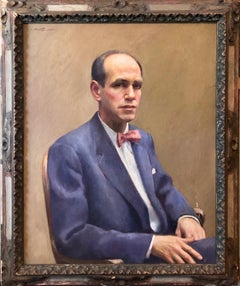
Itzhak Holtz (Judaica Master) Oil Painting Portrait John Sloan Ashcan Artist WPA
By Itshak Holtz
Located in Surfside, FL
Oil Painting Portrait of Ashcan Artist John Sloan. Signed I. Holtz.
The youngest of four children, Holtz was born and spent his early childhood in Skierniewice, Poland, a small town near Warsaw. His father was a hat maker and a furrier. In 1935, prior to World War II, when Holtz was ten years old, his family moved to Jerusalem, Israel, where they settled in the Geula neighborhood near Meah Shearim.
Itzhak Holtz's passion for art began early. When he was five years old, in Poland, his father first drew a picture of a horse and sled in the snow for him. The young Holtz looked at the drawing and studied it in wonderment. From that moment on, Holtz remembers, he constantly begged his father to draw for him. His enthusiasm for art grew and Holtz longed to study art. In 1945, he enrolled at the Bezalel Academy of Art and Design in Jerusalem, where he primarily studied lettering and poster work in a program geared toward commercial art Holtz became interested in painting, prompting him to move to New York City in 1950 to study at the Art Students League of New York under Robert Brackman and Harry Sternberg, and then at the National Academy of Design under Robert Philipp.
Holtz has stated that his artwork, which primarily but not exclusively, depict scenes of Jewish spirituality and tradition, is driven by his Orthodox Jewish beliefs: "You have to live that religious life to fully capture it on canvas." He has been classified in the school of genre painting, often depicting street scenes of ordinary people in everyday Jewish life in the back alleys and markets of Jerusalem neighborhoods such as Me'ah Shearim and Geula; and in New York neighborhoods and hamlets such as Monsey, Boro Park and Williamsburg. Along with street scenes, his work includes portraits of scribes, tailors, cobblers and fishmongers, and images such as shtetls, lighthouses, and wedding scenes. He started out painting mostly portraits in order to support his family, before expanding to include street scenes. His beloved subject matter is painting scenes of Jewish life, his childhood memories when his mother took him along shopping for the Sabbath to the markets of Meah Shearim, has left a deep impression on him and influenced many of his works. Holtz has experimented in the abstract, but then reverted to representational and figurative art to which he devoted himself exclusively. His Israeli street scenes are said to combine “an affectionate recollection of the past with the brilliance of the color of modern Israel.”
Holtz has stated that he struggled at first when he arrived to the USA because of financial reasons and because he only knew Polish, Yiddish and Hebrew, but then made good ties with his instructor who greatly influenced him Robert Philipp who helped him make friends and referred him to paint portraits.
Examples of Holtz's work throughout the years include: Yerusalem Wedding (2010), depicting a Chuppa in Jerusalem on early evening, oil on canvas; The Funeral(1966), depicting five stoic Hasidim carrying a body on a bier over to a gravesite, with the people behind them crying, in charcoal on paper and oil on canvas; Rejoicing (1974), an image of religious men dancing, in felt pen and marker on paper; and the oil painting Shamash Learning in Shul (2003), a portrait of a pious Jew studying the Talmud inside a claustrophobic synagogue scene.
Throughout the years Holtz has created hundreds of works in many art mediums, including, genre scenes, portraits, still lifes and landscape scenery, his works are sought after by art collectors worldwide, and he has been called the greatest living Jewish artist. It is said that no artist ever explored the Jewish subject like Holtz. Today some of his oil paintings have been commanding over $100,000.
Holtz creates his scenes after researching locations, and often uses locals as models. He paints slowly and with great care, but with a swift Impressionistic style. The people in his portraits and scenes are generally more cheerful and optimistic than standard portraits of Hassidic individuals. He paints oils and watercolors, and also does felt pen, pastel, marker, ink and charcoal drawings, as well as woodcuts. His oil paintings typically have a brown hue, while his work with felt pen is often in sepia tones, and on some of his works he used very bright colors, with a strong emphasis on the interplay of light and shadow. He is heavily influenced by the ancient staircases and alleyways of Jerusalem, with its modest religious population, which has made a strong impression on him in his youth, the streets of Tzfat, and the works of Rembrandt, Johannes Vermeer and Peter Bruegel, as well as Jewish artists Moritz Daniel Oppenheim...
Category
1940s Realist Portrait Paintings
Materials
Canvas, Oil
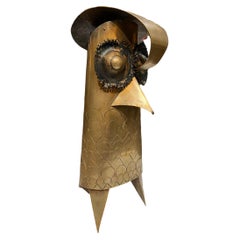
Sculpture Owl Designer : Guayasamin, Year: 1955
By Oswaldo Guayasamin
Located in Ciudad Autónoma Buenos Aires, C
We have specialized in the sale of Art Deco and Art Nouveau and Vintage styles since 1982. If you have any questions we are at your disposal.
Pushing the button that reads 'View All From Seller'. And you can see more objects to the style for sale.
Oswaldo Guayasamín (July 6, 1919 – March 10, 1999) was an Ecuadorian painter and sculptor of Kichwa and Mestizo heritage.
Biography
Early life
Guayasamín was born in Quito, Ecuador,[2] to a native father and a Mestiza mother, both of Kichwa descent.[3] His family was poor and his father worked as a carpenter for most of his life. Oswaldo Guayasamín later worked as a taxi and truck driver. He was the eldest of ten children in his family. When he was young, he enjoyed drawing caricatures of his teachers and the children that he played with. He showed an early love for art. He created a Pan-American art of human and social inequalities which achieved international recognition.
He graduated from the School of Fine Arts in Quito as a painter and sculptor. He also studied architecture there. He held his first exhibition when he was 23, in 1942. While he was attending college, his best friend died during a demonstration in Quito. This incident would later inspire one of his paintings, Los Niños Muertos (The Dead Children). This event also helped him to form his vision about the people and the society that he lived in.
Career
Guayasamín started painting from the time he was six years old. He loved to draw from that age. Starting from watercolors and transforming all the way through to his signature humanity pieces, his art career had many highlights. Although tragedy molded Guayasamín's work, it was his friend's death that inspired him to paint powerful symbols of truth in society and injustices around him. While his interest was seldom with his school work, he began selling his art before the time that he could even read. After his attendance at the School of Fine Arts in Quito, his career took off.
La Galería Caspicara, an art gallery opened by Eduardo Kingman...
Category
Vintage 1950s Ecuadorean Mid-Century Modern Animal Sculptures
Materials
Bronze
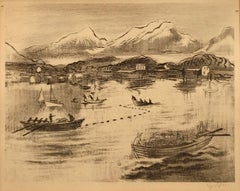
"Fishing Village" Joe Jones, Mid-Century, American Life, Small Town Scene
By Joe Jones
Located in New York, NY
Joe Jones
Fishing Village, 1949
Signed in pencil lower right margin
Lithograph on wove paper
Image 9 5/16 x 12 9/16 inches
Sheet 12 x 15 15/16 inches
From the edition of 250
The initial details of Jones' career are sparse, and this is intentional. The young artist was engaged in a process of self-reinvention, crafting a persona. When he submitted a work to the Sixteen Cities Exhibition at New York City's Museum of Modern Art in 1933, he briefly characterized himself: "Born St. Louis, 1909, self-taught. " Jones intentionally portrayed himself to the art community as an authentic working-class figure, backed by a compelling history. He was the youngest of five children in a family led by a one-armed house painter from St. Louis, a Welsh immigrant, and his German American spouse. At the age of ten, Jones found himself in a Missouri reformatory due to authorities' concerns over his graffiti activities. After completing elementary school, he traveled by freight car to California and back, even being arrested for vagrancy in Pueblo, Colorado. Returning to St. Louis, he attempted to settle down by working alongside his father. Yet, Jones felt a profound restlessness and was drawn toward a more elevated artistic pursuit in his late teenage years. He discovered a local collective of budding artists that formed St. Louis’s "Little Bohemia," sharing a studio and providing mutual support until he managed to secure his own modest workspace in a vacant garage.
Jones’s initial creations comprised still lifes, landscapes, and poignant portraits of those close to him. These subjects were not only accessible but also budget-friendly, as hiring models was beyond his means. He depicted himself, his father, mother, and eventually, his wife. In December 1930, at the age of 21, Jones wed Freda Sies, a modern dancer and political activist who was four years older than him.
By 1933, Jones had started gaining noteworthy local recognition through a solo exhibition at the Artists’ Guild of Saint Louis. Of the twenty-five paintings on display, one, titled River Front (private collection, previously with Hirschl and Adler Galleries), was selected to illustrate a feature article about his show in The Art Digest (February 15, 1933, p. 9). Shortly before this exhibition, a young surgeon named Dr. Robert Elman took an interest in Jones’s art, purchasing several pieces and forming a group of potential patrons committed to providing the emerging artist with a monthly stipend in exchange for art. This group was officially known as the "Co-operative Art Society," but it was informally dubbed the "Joe Jones Club. " Jones became an active participant in the St. Louis artistic scene, particularly within its bohemian segments. He embraced modernism and was a founding member of the "New Hat" movement in 1931, a playful rebellion against the conservative and traditional mainstream art establishment.
The summer of 1933 marked a significant shift in Jones’s journey. Sponsored by a dedicated ally, Mrs. Elizabeth Green, Jones, along with Freda and Green, embarked on an eastward road trip. In Washington, D. C., they explored the Corcoran Gallery of Art, the Freer Gallery (part of the Smithsonian Institution), the Library of Congress, and Mount Vernon. Following this whirlwind of art and American culture, they made their way to New York, where they visited various museums and galleries, including a stop at The New School for Social Research, which featured notable contemporary murals by fellow Missourian Thomas Hart Benton and the politically active Mexican artist, José Clemente Orozco. From June through August, Jones and Freda resided in the artist colony of Provincetown, Massachusetts, later returning home via Detroit to see Diego Rivera’s Detroit Industry mural housed at the Detroit Institute of Fine Arts.
While Elizabeth Green allegedly hoped that Jones would refine his artistic skills under the guidance of Charles Hawthorne or Richard Miller in Provincetown, Jones followed a different path. Rather than pursuing conservative mentors, he connected with an engaging network of leftist intellectuals, writers, and artists who dedicated their time to reading Marx and applying his theories to the American landscape. Jones's reaction to the traditional culture of New England was captured in his statement to a reporter from the St. Louis Post Dispatch: “Class consciousness . . . that’s what I got of my trip to New England. Those people [New Englanders] are like the Chinese—ancestor worshipers. They made me realize where I belong” (September 21, 1933). The stark social divisions he witnessed there prompted him to embrace his working-class identity even more fervently. Upon returning to St. Louis, he prominently identified himself as a Communist. This newfound political stance created friction with some of his local supporters. Many of his middle-class advocates withdrew their backing, likely influenced not only by Jones’s politics but also by his flamboyant and confrontational demeanor.
In December 1933, Jones initiated a complimentary art class for unemployed individuals in the Old Courthouse of St. Louis, the same location where the Dred Scott case was deliberated and where slave auctions formerly took place. Concurrently, the St. Louis Art League was offering paid courses. Emphasizing the theme of social activism, with a studio adorned with Soviet artwork, Jones’s institution operated for just over a year before being removed from the courthouse by local officials. The school’s political focus and unconventional teaching practices, along with its inclusion of a significant number of African American students during a period marked by rigid racial segregation, certainly contributed to its challenges. Under Jones’s guidance, the class created a large chalk pastel mural on board, measuring 16 by 37 feet, titled Social Unrest in St. Louis. Mural painting posed no challenge for the former housepainter, who was adept at handling large wall surfaces. His first significant commission in St. Louis in late 1931 was a mural that celebrated the city’s industrial and commercial fortitude for the local radio station, KMOX. This mural, aimed at conveying optimism amid severe economic hardship, showcased St. Louis's strengths in a modernist approach. When Jones resumed mural work in late 1933, his worldview had evolved considerably. The mural produced for the school in the courthouse, conceived by Jones, featured scenes of modern St. Louis selected to highlight political messages. Jones had observed the technique of utilizing self-contained scenes to craft visual narratives in the murals he encountered in the East. More locally, this compositional strategy was commonly employed by the renowned Missouri artist...
Category
1940s American Realist Landscape Prints
Materials
Paper, Lithograph
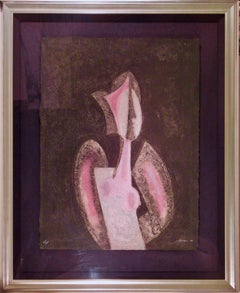
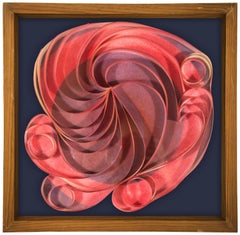
Feliciano Bejar REHILETE #2 Mixed Media Avant Garde Artwork
By Feliciano Béjar
Located in Surfside, FL
Genre: Latin American
Subject: Abstract
Medium: Mixed Media, Collage
Country: Mexico
Dimensions w/Frame: 16.75 x 16.5
Feliciano Béjar Ruíz (1920 – February 1, 2007) was a Mexican ar...
Category
1980s Modern Mixed Media
Materials
Mixed Media
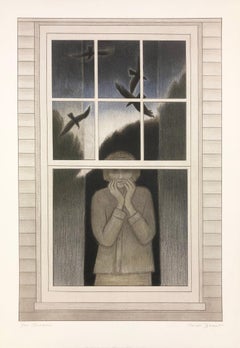
The Dream
By Will Barnet
Located in Missouri, MO
Will Barnet
"The Dream" 2002
Color Lithograph on Somerset Velvet White Paper
Signed and Titled
Ed. 250
Will Barnet, Visionary Artist, Dies at 101
By KEN JOH...
Category
Early 2000s Modern Figurative Prints
Materials
Lithograph
Price Upon Request
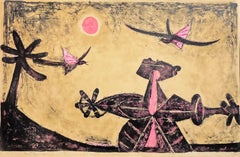
Observador de Pajaros
By Rufino Tamayo
Located in Missouri, MO
"Observador de Pajaros" 1950
By. Rufino Tamayo (Mexican, 1899-1991)
Edition 83/200 Lower Right
Signed Lower Left
Unframed: 15.5" x 22.5"
Framed: 21.75" x 28.25"
Rufino Tamayo (August 26, 1899- June 24, 1991)
A native of Oaxaca in Southern Mexico, Rufino Tamayo's father was a shoemaker, and his mother a seamstress. Some accounts state that he was descended from Zapotec Indians, but he was actually 'mestizo' - of mixed indigenous/European ancestry. (Santa Barbara Museum of Art). He began painting at age 11. Orphaned at the age of 12, Tamayo moved to Mexico City, where he was raised by his maternal aunt who owned a wholesale fruit business.
In 1917, he entered the San Carlos Academy of Fine Arts, but left soon after to pursue independent study. Four years later, Tamayo was appointed the head designer of the department of ethnographic drawings at the National Museum of Archaeology in Mexico City. There he was surrounded by pre-Colombian objects, an aesthetic inspiration that would play a pivotal role in his life. In his own work, Tamayo integrated the forms and tones of pre-Columbian ceramics into his early still lives and portraits of Mexican men and women.
In the early 1920s he also taught art classes in Mexico City's public schools. Despite his involvement in Mexican history, he did not subscribe to the idea of art as nationalistic propaganda. Modern Mexican art at that time was dominated by 'The Three Great Ones' : Diego Rivera, Jose Clemente Orozco, and David Alfaro Siqueros, but Tamayo began to be noted as someone 'new' and different' for his blending of the aesthetics of post Revolutionary Mexico with the vanguard artists of Europe and the United States.
After the Mexican Revolution, he focused on creating his own identity in his work, expressing what he thought was the traditional Mexico, and refusing to follow the political trends of his contemporary artists. This caused some to see him as a 'traitor' to the political cause, and he felt it difficult to freely express himself in his art. As a result, he decided to leave Mexico in 1926 and move to New York, along with his friend, the composer Carlos Chavez. The first exhibition of Tamayo's work in the United States was held at the Weyhe Gallery, New York, in that same year. The show was successful, and Tamayo was praised for his 'authentic' status as a Mexican of 'indigenous heritage', and for his internationally appealing Modernist aesthetic. (Santa Barbara Museum of Art).
Throughout the late thirties and early forties New York's Valentine Gallery gave him shows. For nine years, beginning in 1938, he taught at the Dalton School in New York.
In 1929, some health problems led him to return to Mexico for treatment. While there he took a series of teaching jobs. During this period he became romantically involved with the artist Maria...
Category
20th Century Abstract Abstract Prints
Materials
Lithograph
Price Upon Request