1,156 results for "motherwell"

to
368
951
175
846
411
373
309
252
222
200
164
34
33
20
17
14
1
1
1
222
181
47
44
44
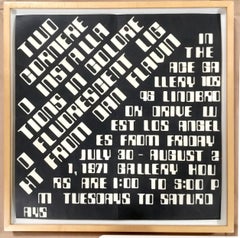
Historic invitation poster for 1970 ACE Gallery exhibition Minimalist light art
By Dan Flavin
Located in New York, NY
Dan Flavin Rare invitation poster for 1970 ACE Gallery exhibition, 1970 Letterpress and stencil on colored paper Not signed Frame included Floated in the original ACE gallery vintage wood frame. Measurements: Framed: 17.75" x 17.75" x 1.6 inches Poster: 16 inches x 16 inches Extremely uncommon letterpress and stencil poster designed by Dan Flavin on the occasion of his 1970 exhibition “Two Cornered Installations in Colored Fluorescent Light from Dan Flavin” at the legendary Ace Gallery in Los Angeles. The poster, like most exhibition invitations of that era (including those from the Leo Castelli gallery in New York) was undated, as these works were so much of the moment. This work was acquired directly from the collection of the ACE Gallery. Other than the present work, we've never seen another example of this collectors item anywhere in the world, on or off the market (If anyone is aware of others, we'd love to see!) More about the legendary ACE gallery, and the sale of some of its art collection from the bankruptcy estate, from where the present work was acquired: ACE Gallery founder Douglas Chrismas opened his own frame shop and gallery in Vancouver at the age of 17. His gallery became known as a venue where Vancouver artists could show alongside major New Yorkers, and get the feeling of belonging to a bigger scene. In the 60s and early 70s he brought artists such as Robert Rauschenberg, Carl Andre, Sol LeWitt, Bruce Nauman, and Donald Judd to Vancouver, Canada. The gallery expanded to Los Angeles in 1967 at the former Virginia Dwan Gallery space in Westwood, and then further expanded to New York in 1994. The galleries were noted for doing museum-level exhibitions by up and coming and internationally renowned artists. While in New York the gallery’s presence was amplified by doing exhibitions in conjunction with cultural institutions such as the Guggenheim Museum and the Cartier Foundation (Paris). Under Chrismas' directorship, ACE Gallery has had either offices or galleries in art centers outside of the United States, such as Mexico City, Paris, Berlin. and Beijing. In 1972, Chrismas mounted Robert Irwin’s installation Room Angle Light Volume at the first ACE/Venice, which opened at 72 Market Street in 1971. In 1977, ACE mounted exhibitions of work by Frank Stella and Robert Motherwell, along with Michael Heizer’s Displaced/Replaced Mass. Installed at ACE/Venice, the Heizer piece required that huge chunks be gouged out of the gallery floor to create recessed areas able to accommodate boulders. In April 2016, ACE Gallery emerged from a three-year bankruptcy proceeding under the leadership of Sam S. Leslie. In May 2016, founder Douglas Chrismas was terminated from all roles at the gallery. In July 2021, Douglas Chrismas was arrested by the FBI and charged with embezzlement. In May 2022, Douglas Chrismas was ordered to repay 14.2 million in ACE art sale profits, which were diverted to personal accounts. Chrismas is awaiting criminal trial in January, 2023. He faces up to 15 years in prison if convicted. Controversies In a 1983 lawsuit in Los Angeles federal court, Rauschenberg sought $500,000 from Chrismas' Flow ACE Gallery; the artist won a $140,000 judgment in the suit in 1984. Eventually the two reconciled their differences and in 1997 Robert Rauschenberg insisted that ACE Gallery New York (in conjunction with the Guggenheim Museum) host his Retrospective. In 1986, Chrismas pleaded no contest after Canadian real estate developer C. Frederick Stimpson alleged that he had improperly sold work belonging to the collector, among them pieces by Andy Warhol and Rauschenberg. Under the terms of the settlement, Chrismas agreed to pay Stimpson $650,000 over a period of five years. He continues to work with the Stimpson family in handling their art interests. In 1989, ACE Gallery wanted to borrow a work by Judd along with Carl Andre's 1968 Fall, both owned by Count Giuseppe Panza, for an exhibition devoted to minimal art called The Innovators Entering into the Sculpture. Rather than shipping the two large scale works from Italy, Panza authorized ACE Gallery to refabricate the pieces in Los Angeles. In Panza's collection archives, there is a series of signed certificates signed by Judd that granted Panza broad authority over the works by Judd in his collection. These certificates "authorized Panza and followers to reconstruct work for a variety of reasons," as long as instructions and documentation provided by Judd were followed and either he or his estate was notified. This even included the right to make "temporary exhibition copies, as long as the temporary copy was destroyed after the exhibition; and the right to recreate the work to save expense and difficulty in transportation as long as the original was then destroyed." Miwon Kwon, in her account of site specificity: "One Place After Another," presents the account of ACE Gallery recreating artworks by Donald Judd and Carl Andre without the artist's permission. Andre and Judd both publicly denounced these recreations as "a gross falsification" and a "forgery," in letters to Art in America, however, the fabrication of the pieces were permitted by Panza Collection in Italy, the owner of the works. Despite the confusion surrounding the Panza refabrications, both Carl Andre and Donald Judd maintained a professional relationship with Douglas Chrismas and ACE Gallery. Andre showcased works at ACE Gallery in 1997, 2002, 2007, 2011 and present day. In 2007, Carl Andre's show entitled "Zinc" was exhibited at ACE Gallery in Beverly Hills. Donald Judd paid a visit to The Innovators Entering into the Sculpture exhibition at ACE Gallery and agreed to keep his sculpture in the exhibition. After the exhibition was over, Chrismas planned to sell the metal used for the re-fabrication of Judd's work for scrap metal but Judd wanted to own the re-fabrication for himself. ACE Gallery then sold the re-fabrication of Donald Judd's work to Donald Judd. After having consigned more than $4 million worth of art to ACE Gallery to sell in 1997 and 1998, the sculptor Jannis Kounellis filed a lawsuit in Los Angeles Superior Court in 2006, accusing Chrismas of keeping most of the profits of artworks and refusing to return the pieces that did not sell. According to the lawsuit, the primary agreement between Kounellis and Chrismas was oral. Chrismas returned all of Kouenllis' artwork, and did a full accounting of the proceeds from Kounellis' work—minus the expense of exhibiting it. The matter was resolved between the two of them and ACE Gallery still sells and exhibits Kounellis' work today. By 2006, Chrismas had filed for Chapter 11 bankruptcy protection at least six times since 1982, barring most of his creditors from collecting the money immediately owed to them. Chrismas filed for Chapter 11 bankruptcy to protect the gallery's extensive real estate holdings from the problematic landlord. The landlord of the Wilshire Boulevard space, Wilshire Dunsmuir Company, claimed that ACE owed back rent and penalties however, the claim was disputed by Douglas Chrismas. In court papers, Chrismas Fine Art claimed that it would cure "the pre-petition" debt by Feb. 1, 2000, and was asking the court to protect its right to remain in the property. A declaration filed by Douglas Chrismas characterized this leasehold as the business' primary asset. -Courtesy Wikipedia About Dan Flavin Dan Flavin (1933–1996) was a pioneer of Minimal Art. He rose to fame in the 1960s with his work with industrially manufactured fluorescent tubes, inventing a new art form and securing his place in art history. The exhibition at the Kunstmuseum Basel focuses on his works that are dedicated to other artists or make reference to certain events. Back in 1963 Dan Flavin mounted a single, industrial fluorescent light tube at a 45-degree angle to the wall of his studio declaring it art; the act was radical, and it still is. Indeed, it was owing to this action that standard commercial products would be introduced into art: The nascent Minimal Art of the era emphasised seriality, reduction and matter-of-factness. Somewhat ironically, while the autodidact Flavin never himself sought membership to this movement in art, he would, and quite literally, go on to become one of its most illustrious exponents. Flavin began work with fluorescent light tubes from the early 1960s on; arranged in so-called ‘situations’, he would then further develop them into series and large-scale installations. The colours and dimensions of the materials he used were prescribed by industrial production. Flooded in light, viewers themselves become part of the works: The space, along with the objects within it, are set in relation to each other and thus become immersive experiences of art triggering sensual, almost spiritual experiences. Flavin liberated color from the two-dimensionality of painting. The prevalent perception of his light works has, to date, largely centred on their minimalist, industrial aspect, and thus on the inherent simplicity of their beauty. The exhibition at Kunstmuseum Basel, by contrast, places emphasis on looking at Flavin’s oeuvre in a less familiar setting: His pieces, although initially without clearly recognisable signature, frequently make reference in their titles to concrete events, such as wartime atrocities or police violence, or are dedicated to other artists—as in the work untitled (in memory of Urs Graf...
Category

1970s Minimalist Figurative Prints

Materials

Etching, Stencil

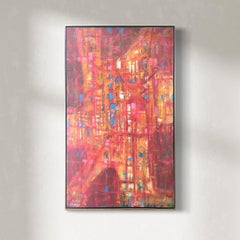
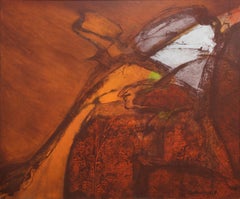
"Roman Incident, " 1960s Modern Abstract Painting
By Stanley Bate
Located in Westport, CT
This 1960s painting by Modernist artist Stanley Bate is an energetic abstract composition with a warm red and orange palette with small pops of bright blue throughout. The painting i...
Category

1960s Modern Abstract Paintings

Materials

Canvas, Oil

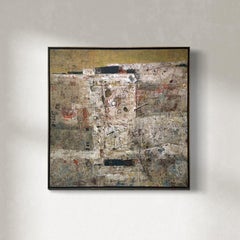
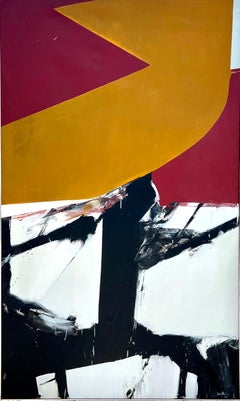
"Sagres, " 1960s Modern Abstract Painting
By Stanley Bate
Located in Westport, CT
This Modern Abstract Expressionist painting by Stanley Bate is made with oil on canvas. The top portion of the painting is an earthy gold color, while the space beneath it is a textu...
Category

1960s Modern Abstract Paintings

Materials

Canvas, Oil

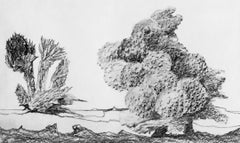
Max Ernst, The Chestnut Trees Take-Off, from Natural History, 1972 (after)
By Max Ernst
Located in Southampton, NY
This exquisite collotype after Max Ernst (1891–1976), titled Le Start du chataignier (The Chestnut Trees Take-Off), from the album Max Ernst, Histoire Naturelle (Natural History), or...
Category

1970s Surrealist Landscape Prints

Materials

Lithograph

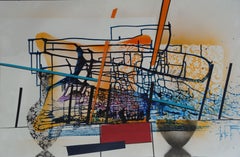
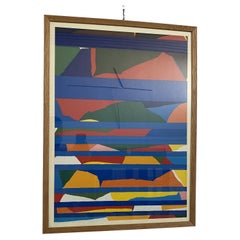
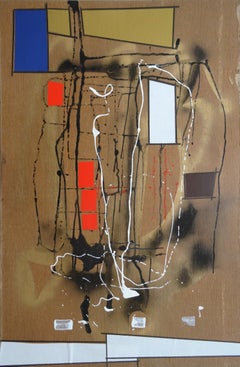
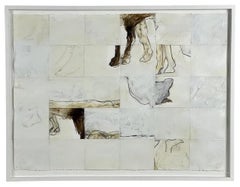
Table view. 2020. Paper, mixed media, 63x94 cm
Located in Riga, LV
The abstract series of sizable works done in a mixed-media technique pays homage to the great modernists and abstract expressionists such as Mondrian, Kandinsky, Still and Motherwell...
Category

2010s Contemporary Abstract Paintings

Materials

Paper, Acrylic, Felt Pen, Stencil

"Morat, " 1960s Modern Abstract Painting
By Stanley Bate
Located in Westport, CT
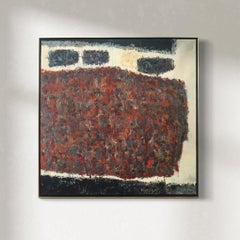
This abstract painting by Modernist artist Stanley Bate combines deep, textured red with creme and dark blue and grey. Geometric shapes throughout the painting are softened by the en...
Category

1960s Modern Abstract Paintings

Materials

Canvas, Oil

"Paphos, " 1960s Modern Abstract Painting
By Stanley Bate
Located in Westport, CT
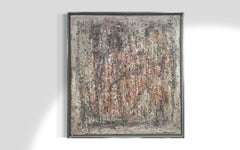
This textured, Modern Abstract Expressionist painting Stanley Bate features a neutral palette with both warm and cool undertones. Muted blues and reds seem to be incorporated into a ...
Category

1960s Modern Abstract Paintings

Materials

Canvas, Oil

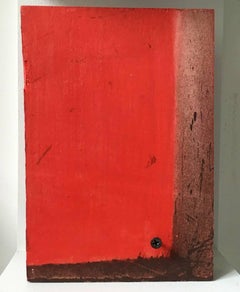
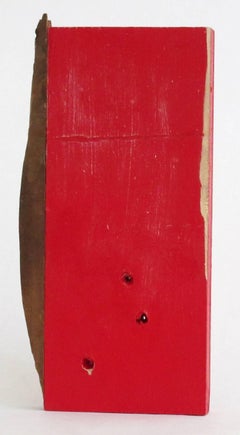
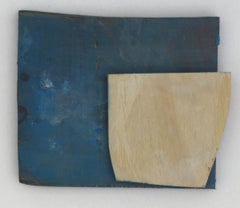
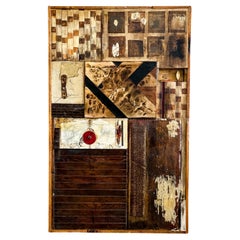
Diane Englander, Red and Wood III, Wood, Mixed Media
By Diane Englander
Located in Darien, CT
A native New Yorker, Diane had an earlier career including 17 years as a management consultant to local nonprofits concerned with poverty or disenfranchisement; work in NYC governmen...
Category

2010s Arte Povera Mixed Media

Materials

Wood, Mixed Media, Acrylic

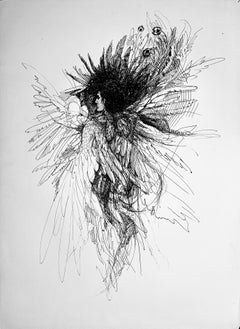
Untitled (Angel, Gabriel)
By Ian Hornak
Located in Fairfield, CT
Artist: Ian Hornak (1944-2002) Title: Untitled (Angel, Gabriel) Year: 1973 Medium: Ink on heavy archival paper Size: 22 x 30 inches Condition: Good Provenance: Estate of Ian Hornak, ...
Category

1970s Surrealist Figurative Drawings and Watercolors

Materials

Ink

Diane Englander, Red and Wood II, 2015, Mixed Media, Wood
By Diane Englander
Located in Darien, CT
A native New Yorker, Diane had an earlier career including 17 years as a management consultant to local nonprofits concerned with poverty or disenfranchisement; work in NYC governmen...
Category

2010s Arte Povera Mixed Media

Materials

Wood, Mixed Media, Acrylic

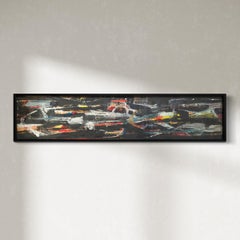
"Untitled #128, " 1960s Modern Abstract Painting
By Stanley Bate
Located in Westport, CT
This Modern Abstract Expressionist painting by Stanley Bate is made with gouache on paper. It features a dark palette, with dark charcoal black tones contrasted by yellow and red accents throughout, and large brush strokes. The painting itself is 16" x 54" and measures 17" x 56" x 2" framed. The paper is mounted on board, framed in a black frame under glass. It is not signed by the artist, but has been authenticated by his estate, and is stamped with the estate seal on the back of the painting, and on the back of the frame. It is ready to hang. Stanley Bate was born on March 26, 1903 in Nashville, Tennessee. The Bates were an established Tennessee family, in fact, Henry’s brother William Bate was the governor of Tennessee from 1883-1887 and a United States Senator from 1887-1905. Stanley studied art at the Watkins Institute in Nashville. In the 1920’s Bate moved to New York City to study at the Art Students League under Frederick Bridgman. He soon landed a job with Encyclopedia Britannica, and from 1927-1929 served as art editor. From 1929 until his death in 1972, Stanley was a self-employed artist. He taught art classes at both the Art Students League and the Albany Institute of History and Art and brought in extra income by making illustrations for magazines such as “Outdoor Life” and “Popular Science”. On January 27, 1934 Stanley married Emilie Rossel. Emilie had emigrated from Switzerland to New York in 1923. She found work as a governess to Alfred Vanderbilt and later as an executive secretary for Wall Street investment brokers Kahn, Loeb and Co. Emilie met Stanley in New York in the early 1930’s when she attended one of his art exhibitions with a friend. The couple, who had no children, lived on 34th Street in Manhattan. During this period, Bate was producing and exhibiting his art and joined several artists groups. Stanley and Emilie became part of the New York art scene, dining weekly at the Society of Illustrators Clubhouse. Stanley Bate’s time in New York was pivotal in the formation of his painting style. He lived in New York during the inception of one of the most important Modern Art movements, one that helped New York replace Paris as the center of avant-garde art. This movement, which was called the New York School of artists, was later known as Abstract Expressionism. It was comprised of a loosely associated group of vanguard artists working in New York City during the 1940s and 1950s. The New York School was not defined by a specific style, but instead reflected a fusion of European Modernism and American social relevancy that was depicted in many individual styles. Influences of Surrealism, Cubism, and Modernism can be found in their work, along with an interest in experimenting with non-traditional materials and methods. American art was in the forefront of international avant-garde for the first time. Stanley Bate was undoubtedly exposed to the varied styles and techniques that were emerging during the formative years of the New York School. Mark Rothko and Robert Motherwell were formulating their versions of color field paintings. Joseph Cornell was experimenting with assemblages, collage and the use of different types of textured paints. Jackson Pollock was adhering objects such as buttons and coins into his early works, while Louise Nevelson was using found objects. Helen Frankenthaler added sand to her early paintings. The New York School artists were undermining traditional fine art by using mixed media and non-traditional methods. Stanley Bate absorbed these varied influences and soon his early realistic landscapes and still-lifes were replaced with something entirely new. The influence of Cubism, notably the flat shallow space of the picture plane, is obvious in many of Bate’s paintings. Surrealism is evident in Bate’s use of subjects from myth, primitive art and antiquity, along with the Automatism-like line work in his more linear images. The unfettered experimentation of the New York School is everywhere in Stanley Bate’s work. We see nods to color field, collage, the mixing of textures into paint, mixed media, the inclusion of found objects and thick, luscious impasto. Bate was prolific and experimented in various media including oil, watercolor, lithography, silk screen, wood cut, drawing, collage, ceramics and sculpture. Bate is considered a true Modernist. His work is largely abstract, but sometimes figures and buildings are discernable. He frequently mixed paint, sand and glue together to achieve a textured surface, and then scraped and scratched through this layer to expose some of the underpainting below. His sculpture, which is often whimsical, also reflects the non-traditional methods of the New York School. Bate pioneered the use of enamel and copper in his work. The sculptures are not carved or modeled as was done in the past, but instead are built using mixed media and new materials. In addition to the New York School influence, many of Bate’s works exhibit a strong connection to the Spanish school, especially the work of Antonio Tapies and Modesto Cuixart. These artists were both part of an avant-garde group known as Art Informel, the Spanish equivalent of Abstract Expressionism. These artists likewise worked in mixed media and introduced objects and texture into their work. Many of Bate’s subjects and titles relate to Spanish locations and words. It is likely that Stanley spent time in Spain and found inspiration there. By the early 1940s, Stanley and Emilie had started spending weekends in a barn they purchased in Craryville, New York, a few hours north of Manhattan. The barn had no electricity or plumbing, but when the Bates eventually decided to leave New York and live full time in Craryville, they remodeled the barn, putting a gallery downstairs and a studio and living quarters upstairs. Although the Bates moved out of New York City, Stanley remained part of the New York art scene, exhibiting in New York and elsewhere throughout the 50s and 60s. During his lifetime he was represented by the New York galleries Knoedler and Company, Kennedy Galleries, Rose Fried Gallery and Key Gallery, along with Tyringham Gallery located in Tyringham, Massachusetts. Craryville was Stanley’s home until his death on August 21, 1972. Emilie died 1984...
Category

1960s Modern Abstract Paintings

Materials

Paper, Gouache

Large Budd Hopkins Modernist Hard Edged Abstract Expressionist Oil Painting 1965
Located in Surfside, FL
Budd Hopkins, American (1931-2011) Strike Red Oil on canvas, 1965, signed 'Hopkins' and dated lower right. Dimensions: 85 x81 in., 86 x 52 in. with frame. Provenance: bears partial label remnant verso from Poindexter Gallery. (a major gallery founded in 1955 in New York City by Elinor Poindexter. The gallery specialized in sculpture, abstract, and figurative art and featured the works of such artists as Richard Diebenkorn, Jules Olitski, Nell Blaine, Al Held, Willem de Kooning, Franz Kline, Earl Kerkam, Milton Resnick and Robert De Niro, among others. Budd Hopkins was one of the leading proponents of the "hard-edge" abstract minimalist school of painting in the 1950s and 1960s, Budd Hopkins (born 1931) created works that show the strong influence of Jackson Pollock and other leading painters of the Abstract Expressionism movement. Hopkins' paintings are now in numerous major collections, including the San Francisco Museum of Art, the Guggenheim Museum in New York, and the Hirshhorn Collection in Washington, DC. Recently, he has also been recognized for his research into the matter of UFOs and one of his books, "The Intruders", printed by Random House, was on the New York Times best-seller list and was the basis for a television show on CBS. Born in 1931, he is a graduate of Linsly Military Institute (now Linsly School) in 1949 and Oberlin College in 1953. He first displayed artistic abilities when, as a child recovering from a long-term illness, he began to create sculptures of ships made out of modeling clay. But it wasn't until he arrive at Oberlin that he made a serious study of art. Later, Hopkins included abstracted figures in his sculptural pieces. While moving away from Abstract Expressionism, Hopkins retained in his work the use of intense colors and hard-edged forms. His works of the 1980s, including Temples and Guardians, featured these "sentinels" who were, according to Hopkins, "participating in a frozen ritual, fixed – absolutely – within a privileged space..." Though Hopkins denied any connection, some critics viewed these ritualistic pieces as an extension of Hopkins' fascination with alien beings. Hopkins viewed his sculpted guardians not as human per se, but as magical, fierce, noble robots of the unconscious. He settled in New York after obtaining his degree and has had a residence there ever since. He and his wife, April Kingsley, and their daughter, Grace, divide their time between their home at Cape Cod, Mass., and that in New York City. In his work, he travels widely. He has exhibited in England, Finland, Italy and Switzerland. In 1963, Hopkins was selected by the Columbia Broadcasting System as one of the 15 painters featured in the network's first television special on American art. In 1958, Art News picked him as one of 12 Americans for exhibition in Spoleto, Italy, in the "Festival of Two Worlds." His brilliance has won him a number of fellowships and awards. In 1972, the West Virginia Arts and Humanities Council awarded him its Commission Prize. In 1976, he received the John Simon Guggenheim Fellowship for Painting and in '79 he received a fellowship from the National Endowment of the Arts. He also won a special project grant from the New York State Council on the Arts in 1982. He was friends with Robert Ryman and many of the other 10th street avant garde artists. He was an original member of March Gallery which showed Alice Baber, Elaine de Kooning, Mark di Suvero, Lester Johnson, Matsumi Kanemitsu. His art has been featured in the Metropolitan Museum of Art, Museum of Modern Art, Bronx Museum of Art, Brooklyn Museum, Whitney Museum, Corcoran Gallery, Guggenheim Museum, Queens Museum in New York, and the Public Library of New York. He was included in Young America 1960: Thirty American Painters Under Thirty-Six buy Lloyd Goodrich at the Whitney Museum of American Art in NYC. Artists included: Sonia Gechtoff, Edward Giobbi, Ron Gorchov, James Harvey, Budd Hopkins, Wolf Kahn, Alex Katz, Robert Natkin, Rudy Pozzatti, Dean Richardson...
Category

1960s Abstract Expressionist Abstract Paintings

Materials

Paint

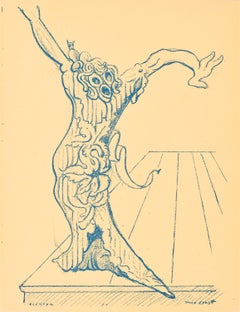
Max Ernst, Homage to San Lazzaro, from San Lazzaro et ses Amis, 1975
By Max Ernst
Located in Southampton, NY
This exquisite lithograph by Max Ernst (1891–1976), titled Hommage a San Lazzaro (Homage to San Lazzaro), from the album San Lazzaro et ses Amis, Hommage au fondateur de la revue XXe...
Category

1970s Constructivist Figurative Prints

Materials

Lithograph

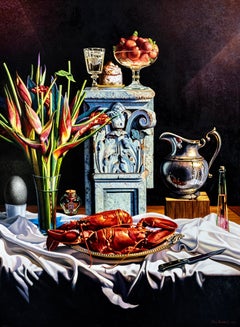
Still Life with Lobster, Helicona, Silver Pitcher
By Ian Hornak
Located in Fairfield, CT
Artist: Ian Hornak (1944-2002) Title: Still Life with Lobster, Helicona, and Silver Pitcher Year: 1998 Medium: Oil on Panel, with Artist Paint...
Category

1990s Photorealist Still-life Paintings

Materials

Oil

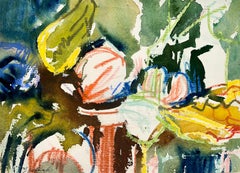
Untitled (Abstract Still Life with Flowers and Fruit)
By Ian Hornak
Located in Fairfield, CT
Artist: Ian Hornak (1944-2002) Title: Untitled (Abstract Still Life with Flowers and Fruit) Year: 1963 Medium: Watercolor on heavy archival paper Size: 11.5 x 15 inches Condition: Go...
Category

1960s Impressionist Interior Paintings

Materials

Watercolor

"Ruins of Athens, " 1960s Modern Abstract Painting
By Stanley Bate
Located in Westport, CT
This Modern Abstract Expressionist painting Stanley Bate features a deep, but colorful palette. Smaller organic shapes and layers of thick blue, black, red, and yellow paint combine ...
Category

1960s Modern Abstract Paintings

Materials

Canvas, Oil

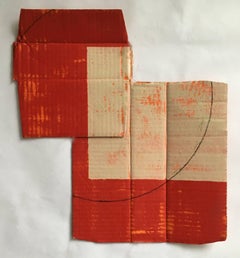
Diane Englander, Red and Buff on Orange 4, 2017, Mixed Media
By Diane Englander
Located in Darien, CT
A native New Yorker, Diane had an earlier career including 17 years as a management consultant to local nonprofits concerned with poverty or disenfranchisement; work in NYC governmen...
Category

2010s Mixed Media

Materials

Mixed Media, Acrylic, Cardboard, Graphite
de Kooning, Sans titre, In Memory of My Feelings (after)
By Willem de Kooning
Located in Southampton, NY
Lithograph on vélin Mohawk Superfine Smooth paper. Paper Size: 11.937 x 8.96 inches. Inscription: Unsigned and unnumbered, as issued. Notes: From the folio, In Memory of My Feelings,...
Category

1960s Abstract Expressionist Abstract Prints

Materials

Lithograph

"Birthday, " 1960s Modern Abstract Painting
By Stanley Bate
Located in Westport, CT
This Modern Abstract Expressionist painting by Stanley Bate is made with oil paint on canvas. It features a muted, earth-toned palette with contrasting warm yellow, orange, and red accents throughout. The painting is framed in a floater frame with gold face and black sides. It is 22" x 36" and measures 24" x 38" x 2" framed. This painting is not signed by the artist, but has been authenticated by his estate. It is stamped with the estate seal on the back of the painting, and on the back of the frame. Ready to hang. Stanley Bate was born on March 26, 1903 in Nashville, Tennessee. The Bates were an established Tennessee family, in fact, Henry’s brother William Bate was the governor of Tennessee from 1883-1887 and a United States Senator from 1887-1905. Stanley studied art at the Watkins Institute in Nashville. In the 1920’s Bate moved to New York City to study at the Art Students League under Frederick Bridgman. He soon landed a job with Encyclopedia Britannica, and from 1927-1929 served as art editor. From 1929 until his death in 1972, Stanley was a self-employed artist. He taught art classes at both the Art Students League and the Albany Institute of History and Art and brought in extra income by making illustrations for magazines such as “Outdoor Life” and “Popular Science”. On January 27, 1934 Stanley married Emilie Rossel. Emilie had emigrated from Switzerland to New York in 1923. She found work as a governess to Alfred Vanderbilt and later as an executive secretary for Wall Street investment brokers Kahn, Loeb and Co. Emilie met Stanley in New York in the early 1930’s when she attended one of his art exhibitions with a friend. The couple, who had no children, lived on 34th Street in Manhattan. During this period, Bate was producing and exhibiting his art and joined several artists groups. Stanley and Emilie became part of the New York art scene, dining weekly at the Society of Illustrators Clubhouse. Stanley Bate’s time in New York was pivotal in the formation of his painting style. He lived in New York during the inception of one of the most important Modern Art movements, one that helped New York replace Paris as the center of avant-garde art. This movement, which was called the New York School of artists, was later known as Abstract Expressionism. It was comprised of a loosely associated group of vanguard artists working in New York City during the 1940s and 1950s. The New York School was not defined by a specific style, but instead reflected a fusion of European Modernism and American social relevancy that was depicted in many individual styles. Influences of Surrealism, Cubism, and Modernism can be found in their work, along with an interest in experimenting with non-traditional materials and methods. American art was in the forefront of international avant-garde for the first time. Stanley Bate was undoubtedly exposed to the varied styles and techniques that were emerging during the formative years of the New York School. Mark Rothko and Robert Motherwell were formulating their versions of color field paintings. Joseph Cornell was experimenting with assemblages, collage and the use of different types of textured paints. Jackson Pollock was adhering objects such as buttons and coins into his early works, while Louise Nevelson was using found objects. Helen Frankenthaler added sand to her early paintings. The New York School artists were undermining traditional fine art by using mixed media and non-traditional methods. Stanley Bate absorbed these varied influences and soon his early realistic landscapes and still-lifes were replaced with something entirely new. The influence of Cubism, notably the flat shallow space of the picture plane, is obvious in many of Bate’s paintings. Surrealism is evident in Bate’s use of subjects from myth, primitive art and antiquity, along with the Automatism-like line work in his more linear images. The unfettered experimentation of the New York School is everywhere in Stanley Bate’s work. We see nods to color field, collage, the mixing of textures into paint, mixed media, the inclusion of found objects and thick, luscious impasto. Bate was prolific and experimented in various media including oil, watercolor, lithography, silk screen, wood cut, drawing, collage, ceramics and sculpture. Bate is considered a true Modernist. His work is largely abstract, but sometimes figures and buildings are discernable. He frequently mixed paint, sand and glue together to achieve a textured surface, and then scraped and scratched through this layer to expose some of the underpainting below. His sculpture, which is often whimsical, also reflects the non-traditional methods of the New York School. Bate pioneered the use of enamel and copper in his work. The sculptures are not carved or modeled as was done in the past, but instead are built using mixed media and new materials. In addition to the New York School influence, many of Bate’s works exhibit a strong connection to the Spanish school, especially the work of Antonio Tapies and Modesto Cuixart. These artists were both part of an avant-garde group known as Art Informel, the Spanish equivalent of Abstract Expressionism. These artists likewise worked in mixed media and introduced objects and texture into their work. Many of Bate’s subjects and titles relate to Spanish locations and words. It is likely that Stanley spent time in Spain and found inspiration there. By the early 1940s, Stanley and Emilie had started spending weekends in a barn they purchased in Craryville, New York, a few hours north of Manhattan. The barn had no electricity or plumbing, but when the Bates eventually decided to leave New York and live full time in Craryville, they remodeled the barn, putting a gallery downstairs and a studio and living quarters upstairs. Although the Bates moved out of New York City, Stanley remained part of the New York art scene, exhibiting in New York and elsewhere throughout the 50s and 60s. During his lifetime he was represented by the New York galleries Knoedler and Company, Kennedy Galleries, Rose Fried Gallery and Key Gallery, along with Tyringham Gallery located in Tyringham, Massachusetts. Craryville was Stanley’s home until his death on August 21, 1972. Emilie died 1984...
Category

1960s Modern Abstract Paintings

Materials

Oil, Canvas

"Survivors, " 1960s Modern Abstract Painting
By Stanley Bate
Located in Westport, CT
This Modern painting by Abstract Expressionist Stanley Bate was made with oil on canvas circa 1960. It features a cool blue and grey palette along the perimeter, with warmer muted gr...
Category

1960s Modern Abstract Paintings

Materials

Canvas, Oil

"Cathedral, " 1960s Modern Abstract Painting
By Stanley Bate
Located in Westport, CT
This Modern abstract painting by Stanley Bate has a light beige, creme, and warm sepia palette. The textured painting has darker shapes that run the length of the bottom of the compo...
Category

1960s Modern Abstract Paintings

Materials

Canvas, Oil

Diane Englander, Pale Form on Blue Wood, 2018 acrylic on scrap wood, 6 x 8 in
By Diane Englander
Located in Darien, CT
Diane Englander uses formal means to create a place between discord and tranquility, a zone with a charged harmony that energizes as it also provides refuge. That often requires tha...
Category

2010s Abstract Geometric Abstract Paintings

Materials

Acrylic, Cardboard

"Newstand, " 1960s Modern Abstract Painting
By Stanley Bate
Located in Westport, CT
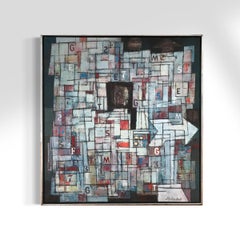
"Newstand" by Modernist painter Stanley Bate features a dark grey and brown perimeter with a white, blue and red composition that features geometric crosshatched lines with integrate...
Category

1960s Modern Abstract Paintings

Materials

Canvas, Oil

Untitled
By MORRIS, CARL
Located in Palm Desert, CA
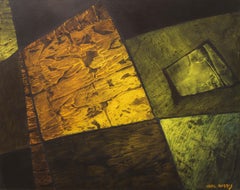
A painting by Carl Morris. “Untitled” is an abstract expressionist painting, acrylic on canvas in yellows and greens by American artist Carl Morris. The artwork is signed in the lowe...
Category

Late 20th Century Post-War Abstract Paintings

Materials

Acrylic

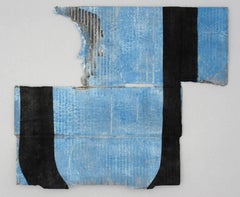
Diane Englander, Black on Blue, 2017, Mixed Media
By Diane Englander
Located in Darien, CT
A native New Yorker, Diane had an earlier career including 17 years as a management consultant to local nonprofits concerned with poverty or disenfranchisement; work in NYC governmen...
Category

2010s Arte Povera Mixed Media

Materials

Mixed Media, Acrylic, Cardboard

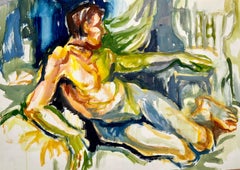
Untitled (Abstract Male Reclining Nude)
By Ian Hornak
Located in Fairfield, CT
Artist: Ian Hornak (1944-2002) Title: Untitled (Abstract Male Reclining Nude) Year: 1963 Medium: Watercolor on heavy archival paper Size: 29.5 x 21 inches Condition: Good Provenance:...
Category

1960s Impressionist Nude Paintings

Materials

Watercolor

Provincetown: Late Summer Afternoon 2
By Alex Katz
Located in Toronto, Ontario
Adored by collectors and art lovers around the globe, Alex Katz is a renowned for his elegant and distinctive version of figuration and portraiture. Born in 1927, Katz worked as an...
Category

1970s Minimalist More Prints

Materials

Screen

Day of the Dragon
By Harold Town
Located in Toronto, Ontario
Harold Town (1924-1990) is the best-known and most dynamic artist from the "Painters Eleven" group. His reputation goes beyond his association with the group as arguably one of Can...
Category

1960s Abstract Prints and Multiples

Materials

Intaglio, Monotype

Edge
Located in Austin, TX
Waterline Fine Art, Austin, TX is pleased to present the following work: Oil on board. Signed and dated lower right and verso, titled verso. 36.25 x 48 in. 40.5 x 52.25 in. (framed) Framed in contemporary silver, tiered floater frame. Dennis Eugene Norman Burton was a Canadian modernist who was born in Lethbridge, Ontario. He attended the Ontario College of Art from 1952 to 1956, and worked for the Canadian Broadcasting Corporation (CBC) as a graphic designer until 1960. Inspired by a 1955 exhibition of the “Painters Eleven” at Toronto’s Hart House, as well as American Abstract Expressionist artists such as Robert Motherwell, Jack Tworkov, and Willem de Kooning, Burton shifted his focus toward abstraction in the mid-1950s. Burton showed with the famed Isaacs Gallery in Toronto, becoming one of the youngest members on the gallery’s roster. A talented musician, he also played saxophone in the Artist’s Jazz Band in Toronto - a pioneering Canadian free-jazz group...
Category

1950s Abstract Expressionist Abstract Paintings

Materials

Masonite, Oil, Board

1970 Italy Post-Modern Multiple Abstract Multicolor Print by Piero Dorazio
By Piero Dorazio 1
Located in Brescia, IT
This is an engaging abstract multiple print od the Internationally well known Italian artist Piero Dorazio. In this artwork we can see the caracteristical way to express the art with...
Category

Vintage 1970s Italian Post-Modern Contemporary Art

Materials

Paper

Untitled
By MORRIS, CARL
Located in Palm Desert, CA
A painting by Carl Morris. “Untitled” is an abstract expressionist painting, acrylic on canvas in reds and browns by American artist Carl Morris. The artwork is signed in the lower r...
Category

Mid-20th Century Post-War Abstract Paintings

Materials

Acrylic

Window. 2021. Paper, mixed media, 94x63 cm
Located in Riga, LV
The abstract series of sizable works done in a mixed-media technique pays homage to the great modernists and abstract expressionists such as Mondrian, Kandinsky, Still and Motherwell...
Category

2010s Contemporary Abstract Paintings

Materials

Paper, Felt Pen, Stencil, Acrylic

Max Ernst, Electra, from XXe siecle, 1939
By Max Ernst
Located in Southampton, NY
This exquisite lithograph by Max Ernst (1891–1976), titled Electra, from the album XXe siecle, Chroniques du jour, 13 rue Valette (5e), Directeur G. di San Lazzaro, Sommaire du no. 5...
Category

1930s Surrealist Landscape Prints

Materials

Lithograph

Abstract B1
Located in San Juan, PR
CARLOS MERCADO ABSTRACT Inspired in the work of Franz and Ives Klein This body of work was produced during the initial months of the lock down due to the pandemic. This tragedy crea...
Category

2010s Abstract Abstract Paintings

Materials

Canvas, Acrylic

Renaissance Female Nude Figure Study, 1964, Ian Hornak — Drawing
By Ian Hornak
Located in Fairfield, CT
Artist: Ian Hornak (1944-2002) Title: Renaissance Female Nude Figure Study Year: circa 1964 Medium: Charcoal on vélin paper Size: 23 x 18 inches Condition: Good Provenance: Estate of...
Category

1960s Renaissance Figurative Drawings and Watercolors

Materials

Charcoal

"Untitled" Mary Abbott, Abstract Expressionist Collage, Ninth Street Women
By Mary Abbott
Located in New York, NY
Mary Abbott Untitled, circa 1953 Signed with initials lower right Oil and torn paper collage 17 x 14 1/2 inches Provenance: Thomas McCormick Gallery, Chicago Private Collection, New York (acquired directly from the above) Exhibited: Athens, Georgia, Georgia Museum of Art, Suitcase Paintings...
Category

1950s Abstract Expressionist Mixed Media

Materials

Paper

1980s Abstract Expressionism Color Field Silkscreen Serigraph Print Pale Yellow
By Michael Steiner
Located in Surfside, FL
Michael Steiner, American, New York City (1945 - ) this is 49 of 160 from the edition. Michael Steiner A leading member of the Bennington school, abstract artists associated with ...
Category

1970s Abstract Expressionist Abstract Prints

Materials

Screen

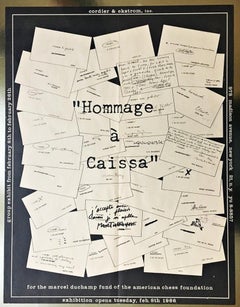
Hommage a Caissa (for the Marcel Duchamp Fund of the American Chess Foundation)
By Marcel Duchamp
Located in New York, NY
Marcel Duchamp Hommage a Caissa (for the Marcel Duchamp Fund of the American Chess Foundation), 1966 Silkscreen Poster with Gold Matting Frame included Very scarce 1960s collectors item - rarely seen! Measurements: Framed: 26.25 x 21.25 x 0.5 inch Print: 26 x 21 inches Unsigned Accompanied by Certificate of Guarantee issued by Alpha 137 Gallery This extremely rare and historic invitation/exhibition poster was designed by Duchamp on the occasion of a group exhibition at New York's Cordier & Ekstrom Gallery for the Marcel Duchamp Fund of the Americas Chess Foundation in 1966. The exhibition was called "Hommage à Caissa." Duchamp invited 36 artists to contribute. It was in this show , held at the gallery at 978 Madison Ave, as of 1962 the Daniel Cordier & Arne Ekstrom Gallery, where Dalí revealed his chess set. Duchamp used the RSVP cards he sent to various artists as a design for this invitation. Many of these RSVP cards had the artist's autographs, and a few, like the one from Alexander Calder, included personal notes to Duchamp. Some of the more famous of the 36 artists featured in print who participated by donating works to this fundraiser include: Jasper Johns, Karl Gerstner, David Hare, Salvador Dali, Enrico Donati, Roberto Matta, Isamu Noguchi, Alexander Calder, Dorothea Tanning, Jean Tinguely, Niki De St. Phalle, George Segal, Robert Rauschenberg, James Rosenquist, Meret Oppenheim, Alfonso Ossorio, Robert Motherwell, Claes Oldenburg, Man Ray, Joan Miro, Rene Magritte, Richard Lindner, Roy Lichtenstein, Arman, Enrico Baj, Hans Bellmer, Victor Brauner, Alexander Liberman, William Copley, Cleve Gray and several others. However -- did you notice one name was noticeably absent? Andy Warhol! How could that be? Well, it turns out Andy Warhol has actually expected to be invited to exhibit but for some reason was overlooked. He did, however, attend the opening and filmed Duchamp in one of his famous "Screen Tests...
Category

1960s Dada Abstract Prints

Materials

Screen

"Untitled Abstract" Oil on Board, Abstract Expressionist, Signed by the Artist
Located in Detroit, MI
SALE ONE WEEK ONLY The energy and gusto of the applied paint in "Untitled Abstract" appears close to violent except for the calming influence of the circle in the middle. The red circle tempers the movement a little and brings all the strokes and wild directions into a harmony that is bursting with life. This is an extraordinarily expressive painting by Simpson. Simpson became the first African American to receive a prestigious five-year fellowship from the Charleston Scientific and Cultural Education fund and left South Carolina in 1949 for New York City after he finished high school. He attended New York University and Cooper Union while working in the frame shop of Herbert Benevy. Many well-known artists came to the frame shop and in time critiqued Simpson's work and developed a relationship with him. At NYU Simpson became acquainted with Hale Woodruff...
Category

1980s Abstract Expressionist Abstract Paintings

Materials

Oil, Board

New York School Abstract Expressionist Drawing Watercolor Painting Carmen Cicero
By Carmen Cicero
Located in Surfside, FL
This is a stylized figurative abstract expressionist nude. This one is hand signed and dated. From the style we are estimating it to the 1970's They have abstract stylized erotic mal...
Category

1970s Abstract Expressionist Abstract Drawings and Watercolors

Materials

Ink, Watercolor

Abstract Modernist Colorful Mixed Media Painting Handmade Paper
By Sandy Kinnee
Located in Surfside, FL
Sandy Kinnee is known for paper making, printmaking and collage. This has the artists stamp verso and is signed, titled and dated verso. Sandy Kinnee lives and works in Colorado Sp...
Category

1980s Abstract Expressionist Mixed Media

Materials

Paint, Ink, Handmade Paper

Gabriel s Pavilion: Variation II, Ian Hornak - Painting
By Ian Hornak
Located in Fairfield, CT
Artist: Ian Hornak (1944-2002) Title: Gabriel's Pavilion: Variation II Year: 1979 Medium: Acrylic on canvas Size: 50 x 72 inches Condition: Excellent Inscription: Signed recto; signe...
Category

1970s Photorealist Landscape Paintings

Materials

Canvas, Acrylic

Huge Abstract Modernist "August Series" Mixed Media Monotype Colorful Painting
By Terence La Noue
Located in Surfside, FL
Terence La Noue was born in Hammond, Indiana in 1941. He received a Bachelor of Fine Arts from Ohio Wesleyan University in 1964. After going to Berlin as a Fulbright Meister Student ...
Category

1990s Abstract Expressionist Abstract Paintings

Materials

Paint, Mixed Media, Monotype

Original signed Japanese inspired Painting by David Slivka-Untitled 4
Located in Wainscott, NY
Newly Framed Mid Century abstract expressionist David Slivka who painted alongside Robert Motherwell and Willem de Kooning in the Hamptons created a large body of work during his lif...
Category

Vintage 1960s American Paintings

Materials

Paper

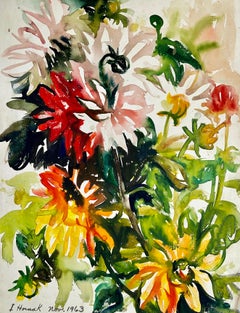
Untitled (Abstract Still Life with Flowers)
By Ian Hornak
Located in Fairfield, CT
Artist: Ian Hornak (1944-2002) Title: Untitled (Abstract Still Life with Flowers) Year: 1963 Medium: Watercolor on heavy archival paper Size: 29.5 x 21 inches Condition: Good Provena...
Category

1960s Impressionist Interior Paintings

Materials

Watercolor

Untitled (Abstract Still Life with Flowers)
By Ian Hornak
Located in Fairfield, CT
Artist: Ian Hornak (1944-2002) Title: Untitled (Abstract Still Life with Flowers) Year: 1963 Medium: Watercolor on heavy archival paper Size: 29.5 x 21 inches Condition: Good Provena...
Category

1960s Impressionist Interior Paintings

Materials

Watercolor

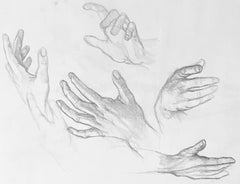
Renaissance Hand Figure Study, 1963, Ian Hornak — Drawing
By Ian Hornak
Located in Fairfield, CT
Artist: Ian Hornak (1944-2002) Title: Renaissance Hand Figure Study Year: circa 1963 Medium: Original drawing on vélin Strathmore paper Size: 18 x 23 inches Condition: Good Provenanc...
Category

1960s Renaissance Figurative Drawings and Watercolors

Materials

Graphite

Double Personage
By Wifredo Lam
Located in Fairlawn, OH
Double Personage Color lithograph, 1975 (?) Unsigned (as issued) Edition: Large Edition Limited, (estimated to be approximately 2000) Published in: XXe Siecle, No. 52, Juin 1979 Published: G. di San Lazzaro Printer: Mourlot Imprimeur, Paris, France Reference: Lam-Tonneau-Ryckelynck L7513 Condition: Excellent, fresh colors Traces of glue residue along margin edge where it was bound in the book Image/sheet size: 12 1/4 x 9 1/4 inches Wilfredo Lam (1902-1982) Biography Wifredo Lam was born in Sagua la Grande, Cuba, on December 8, 1902. He was the eighth child born to Lam-Yam―born in Canton around 1820, an immigrant to the Americas in 1860―and to Ana Serafina Catilla―born in 1862 in Cuba of mixed African and Spanish ancestry. The luxuriant nature of Sagua la Grande had a strong impact on Lam from early childhood. One night in 1907, he was startled by the strange shadows cast on the wall of his bedroom of a bat in flight. He often recounted the incident as his first magnificent awakening to another dimension to existence. In 1916, Lam and part of his family settled in Havana. He was enrolled in the Escuela Profesional de Pintura y Escultura, Academia de San Alejandro, where he remained a student until 1923. This period, with exhibitions at the Salón de Bellas artes, was determinant in his choice to become a painter. In 1923, the municipality of Sagua la Grande awarded him a grant to study in Europe and by the autumn of that year, at the age of twenty-one, he left the country for Spain. His time in Spain―initially intended as a short stay on his way to Paris―lasted 14 years. In Madrid, he was exposed to the ideas and movements of modern art. He spent long hours at the Archeological Museum and the Prado. He studied the great masters of Spanish painting, Velázquez and Goya, but felt particularly drawn to the works of Bosch and Bruegel the Elder. In 1931, his first wife, Eva (Sébastiana Piriz) and their son Wilfredo Victor died of tuberculosis. The terrible suffering he endured led to numerous paintings of mother and child. Lam found solace in the company of his Spanish friends and made contact with several political organizations. In 1936, with the help of his friend Faustino Cordón, he joined the Republican forces in their fight against Franco. He designed anti-Fascist posters and took part in the struggle by working in a munitions factory. The violence of the struggle inspired his painting La Guerra Civil. In 1938, Lam left Spain for Paris. Shortly before leaving, he met Helena Holzer, who would become his wife in 1944. His meeting Picasso in his studio on the Rue des Grands Augustins proved decisive. Picasso introduced his new “cousin” to his painter, poet and art critic friends, Braque, Matisse, Miró, Léger, Eluard, Leiris, Tzara, Kahnweiler, Zervos. Lam also met Pierre Loeb, the owner of the Galerie Pierre in Paris, which hosted Lam’s first solo exhibition in 1939. Shortly before the Germans arrived, Lam left Paris for Bordeaux and then Marseille, where many of his friends, for the most part surrealists, had gathered around André Breton in the Villa Air Bel: Pierre Mabille, René Char, Max Ernst, Victor Brauner, Oscar Domínguez, André Masson, Benjamin Péret. In the Villa Air Bel, a meeting place for creativity and experimentation, Lam worked and produced, most notably, a series of ink drawings that set the tone for what would become his signature style of hybrid figures, a vocabulary he would develop more fully during his years in Cuba from 1941 to 1947. In January and February 1941, Lam illustrated Breton’s poem Fata Morgana which was censored by the Vichy government. On March 25, Lam and Helena Holzer embarked on the “Capitaine Paul Lemerle” headed for Martinique, in the company of some 300 other artists and intellectuals―André Breton and Claude Lévi-Strauss among them. Upon arrival, the passengers were interred at Trois Îles. It was during this forced passage in Martinique and before leaving for Cuba that Lam and Aimé Césaire met for the first time to become life-long friends. Newly settled in his native land after almost twenty years, Lam delved deeper into his artistic investigations, finding nourishment for his ideas in the surroundings of his childhood and youth. His sister Eloisa, whom he was closest to, explained to him in much detail the workings of Afro-Cuban rituals and he began attending ritual ceremonies with some of his friends. This contact with Afro-Cuban culture brought new impetus to his art. He painted over one hundred canvases, most notably La Jungla, making the year 1942 his most productive of this period. Over the next few years, a number of exhibitions followed in the United States, at the Institute of Modern Art of Boston, at the MoMA of New York, at the Galerie Pierre Matisse, where La Jungla was presented and created a scandal. In 1946, Lam and Helena travel to Haiti and attend voodoo ceremonies in the company of Pierre Mabille and André Breton. Talking about his experience in Haiti, Lam said, “It is often assumed that my work took its final form in Haiti, but my stay there, like the trips I made to Venezuela, Colombia or to the Brazilian Mato Grosso only broadened its scope. I could have been a good painter from the School of Paris, but I felt like a snail out of its shell. What really broadened my painting is the presence of African poetry.” Picasso_Lam_Vallauris_1954_vignette Wifredo Lam et Pablo Picasso, Vallauris, 1954 Lam then went on to New York where he renewed contact with Marcel Duchamp and made new acquaintances: Jeanne Reynal, James Johnson Sweeney, Arshile Gorky, John Cage, Roger Wilcox, Mercedes Matter, Ian Hugo, Jesse Fernández, John Cage, Sonia Sekula and Yves Tanguy. By the end of the 1940s, Lam divided his time between Europe, Havana and New York, where they stayed with Pierre and Teeny Matisse...
Category

1970s Surrealist Abstract Prints

Materials

Lithograph

Vintage Silver Gelatin Photograph Jacques Lipchitz Bronze Sculpture Photo Signed
By Adolph Studly
Located in Surfside, FL
Adolph Studly, Swiss born American photographer. His work is kept in the Photographic Archive at The Museum of Modern Art Archives, New York. He was known for his gallery photograp...
Category

1940s Modern Abstract Photography

Materials

Photographic Paper, Silver Gelatin

Xavier Cazares Cortez Mixed Media Painting On Wood Art The Nature Of Being
By Robert Rauschenberg, Robert Motherwell, John Ridgewell, Bruce Conner 3, Tom Sachs
Located in Palm Desert, CA
Vintage Xavier Cazares Cortez Mixed Media Abstract Painting On Wood. Titled The Nature Of Being. There are 3 of them in a series. I am selling them separately. Signed: Xavier Caza...
Category

Early 2000s American Mid-Century Modern Contemporary Art

Materials

Wood

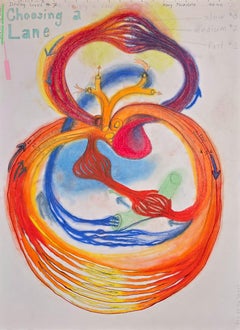
Choosing a Lane (Abstract, Biogram, Vibrant, Heart, Valve, 40% OFF LIMITED TIME)
By Kory Twaddle
Located in Kansas City, MO
Kory Twaddle Choosing a Lane California Driving Series # 7 Pastel, Pencil, Mixed Media on Paper Year: 2020 Size: 30 x 22 inches (76.2 x 55.88 cm) Signed, titled and dated in (colored...
Category

2010s Contemporary Abstract Drawings and Watercolors

Materials

Paper, Oil Pastel, Mixed Media, Color Pencil
Frank Shifreen Still Life 2
By Frank Shifreen
Located in New York, NY
Frank Shifreen Still Life 2 2021 18 x 24 inches Acrylic on Canvas Signed, titled and dated on verso These new works start from polar opposite impulses which juxtapose the purity an...
Category

2010s Contemporary Abstract Paintings

Materials

Canvas, Acrylic

50/50
By Doug Ohlson
Located in Boca Raton, FL
Doug Ohlson began his education in a number of small colleges, and a three year period in the U.S. Marines before graduating from the University of Minnesota with a B.A. in fine art....
Category

20th Century Contemporary Abstract Paintings

Materials

Canvas, Acrylic

Untitled (Abstract Still Life with Flowers and Fruit), Ian Hornak
By Ian Hornak
Located in Fairfield, CT
Artist: Ian Hornak (1944-2002) Title: Untitled (Abstract Still Life with Flowers and Fruit) Year: 1963 Medium: Watercolor on heavy archival paper Size: 29.5 x 21 inches Condition: Go...
Category

1960s Impressionist Interior Paintings

Materials

Watercolor

Judaica Bronze Sculpture "Rabbi" Figure Jewish American Boston Figural Modernist
By David Aronson
Located in Surfside, FL
Aronson, David 1923- David Aronson, son of a rabbi, was born in Lithuania in 1923 and immigrated to America at the age of five. He settled in Boston, Massachusetts where he studied at the school of the Museum of Fine Arts under Karl Zerbe, a German painter well known in the early 1900s. Aronson later taught at the school of the Museum of Fine Arts for fourteen years and founded the School of Fine Art at Boston University where he is today a professor emeritus. An internationally renowned sculptor & painter, Aronson has won acclaim for his interpretation of themes from the Hebrew Talmud and Kabala. His best known works include bronze castings, encaustic paintings, and pastels. His work is included in many important public and private collections, and has been shown in several museum retrospectives around the country. He is considered to be one of the most important 20th century American artists. At twenty-two David Aronson had his first one-man show at New York's Niveau Gallery. The next year, six of his Christological paintings were included in the Fourteen Americans exhibition at Manhattan's Museum of Modern Art where Aronson’s work was included alongside abstract expressionists Arshile Gorky, Robert Motherwell and Isamu Noguchi. In the 1950s, Aronson turned more toward his Jewish heritage for the inspiration for his art. Folklore as well as Kabalistic and other transcendental writings influenced his work greatly. The Golem (a legendary figure, brought to life by the Maharal of Prague out of clay to protect the Jewish community during times of persecution) and the Dybbuk (an evil spirit that lodges itself in the soul of a living person until exorcised) frequently appear in his work. In the sixties, Aronson turned to sculpture. His work during this period is best exemplified by a magnificent 8’ x 4’ bronze door which now stands at the entrance to Frank Lloyd Wright's Johnson Foundation Conference Center for the Arts in Racine, Wisconsin. In the seventies and eighties, Aronson continued his work in pastel drawings, paintings, and sculptures, often exploring religion and the frailties of man's nature. During this time, in addition to a traveling retrospective exhibition and many one-man shows in New York, Los Angeles, Chicago, and Boston at the Pucker-Safrai Gallery on Newbury Street, Aronson won many awards and became a member of the National Academy of Design in New York. Two years ago he retired from teaching to work full-time in his studio in Sudbury, Massachusetts. included in the catalog Contemporary Religious Imagery in American Art Catalog for an exhibition held at the Ringling Museum of Art, March 1-31, 1974. Artists represented: David Aronson, Leonard Baskin, Max Beckmann, Hyman Bloom, Fernando Botero, Paul Cadmus, Marvin Cherney, Arthur G. Dove, Philip Evergood, Adolph Gottlieb, Jonah Kinigstein, Rico Lebrun, Jack Levine, Louise Nevelson, Barnett Newman, Abraham Rattner, Ben Shahn, Mark Tobey, Max Weber, William Zorach and others. Selected Awards 1990, Certificate of Merit, National Academy of Design 1976, Purchase Prize, National Academy of Design 1976, Joseph Isidore Gold Medal, National Academy of Design 1976, Purchase Prize in Drawing, Albrecht Art Museum 1975, Isaac N. Maynard Prize for Painting, National Academy of Design 1973, Samuel F. B. Morse Gold Medal, National Academy of Design 1967, Purchase Prize, National Academy of Fine Arts 1967, Adolph and Clara Obrig Prize, National Academy of Design 1963, Gold Medal, Art Directors Club of Philadelphia 1961, 62, 63, Purchase Prize, National Institute of Arts and Letters 1960, John Siimon Guggenheim Fellowship 1958, Grant in Art, National Institute of Arts and Letters 1954, First Prize, Tupperware Annual Art Fund Award 1954, Grand Prize, Third Annual Boston Arts Festival 1953, Second Prize, Second Annual Boston Arts Festival 1952, Grand Prize, First Annual Boston Arts Festival 1946, Traveling Fellowship, School of the Museum of Fine Arts 1946, Purchase Prize, Virginia Museum of Fine Arts 1944, First Popular Prize, Institute of Contemporary Art 1944, First Judge's Prize, Institute of Contemporary Art Selected Public Collections Art Institute of Chicago Virginia Museum of Fine Arts Bryn Mawr College Brandeis University Tupperware Museum, Orlando, Florida DeCordova Museum Museum of Modern Art Print Collection, New York Atlanta University Atlanta Art...
Category

20th Century Expressionist Figurative Sculptures

Materials

Bronze

1960 s Ink on Paper in Japanese Style signed by David Slivka -Untitled 5
Located in Wainscott, NY
David Slivka's ink drawings series of the 1960s represented a melding of the organic and the abstract. "He was one of the last remaining members of The First Generation of American A...
Category

Vintage 1960s American Mid-Century Modern Contemporary Art

Materials

Paper

Abstract Contemporary Mod Deconstructed Mixed Media Painting Mosaic Lorna Marsh
Located in Surfside, FL
Lorna Marsh (South African, 2004 Horse and Rider Mixed Media on Paper Hand signed and dated Frame: 25" X 32.5" Image: 22.5" X 30.5" Experience the captivating fusion of contemporar...
Category

Early 2000s Contemporary Figurative Paintings

Materials

Paper, Mixed Media

Abstract Surrealist Double Entry on the Plane Oil Painting 1970s
Located in Surfside, FL
Sebastian Matta-Clark was born in 1943, twin of Gordon Matta-Clark. Son Of Chilean Surrealist Roberto Matta Sebastian, known as Batan died in 1976. He showed 3 exhibitions in his sho...
Category

1970s Surrealist Abstract Paintings

Materials

Canvas, Oil

The Angel Concert, Variation II
By Ian Hornak
Located in Fairfield, CT
Artist: Ian Hornak (1944-2002) Title: The Angel Concert, Variation II Year: 1979 Medium: Acrylic on Canvas Size: 36 x 48 inches Condition: Excellent Inscription: Signed, dated, and t...
Category

1970s Photorealist Landscape Paintings

Materials

Acrylic

"Erotic #1 (Cronus Sex)" David Hare, Surrealist Abstract Composition
By David Hare
Located in New York, NY
David Hare Erotic #1 (Cronus Sex), 1970 Acrylic and paper collage on linen 68 x 51 inches “Freedom is what we want,” David Hare boldly stated in 1965, but then he added the caveat, ...
Category

1970s Abstract Abstract Paintings

Materials

Linen, Paper, Acrylic