651 results for ""constantin brancusi""
to
202
171
156
452
358
199
92
76
65
41
21
20
20
19
18
15
5
4
2
281
63
22
13
13
Still Life, Flowers and Bowl, Gouache Painting by Peter Potworowski, 1950s
Located in Kingsclere, GB
Still Life, Flowers and Bowl, Gouache Painting by Peter Potworowski, 1950s
Additional information:
Medium: Gouache
33.3 x 23.6 cm
13 1/8 x 9 1/4 in
Tadeusz Piotr (Peter) Potworowsk...
Category
20th Century Abstract Paintings
Materials
Gouache
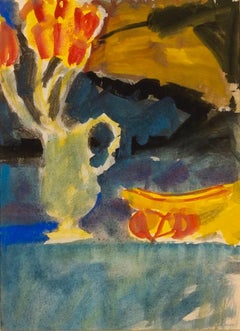
Still Life on a Table, Gouache Painting by Peter Potworowski, 1954
Located in Kingsclere, GB
Still Life on a Table, Gouache Painting by Peter Potworowski, 1954
Additional information:
Medium: Gouache
23.6 x 33.3 cm
9 1/4 x 13 1/8 in
Tadeusz Piotr (Peter) Potworowski was a Polish abstract and figurative painter who lived and exhibited in Paris, Poland, Sweden and England.
Potworowski was born in Warsaw in 1898. After serving in the First World War, Potworowski enrolled at the Warsaw University of Technology to study architecture, though his studies were halted by the Bolshevik campaign. After the end of the Polish-Soviet War in 1921, Potworowski returned to Warsaw and began to study art at the school of Konrad Krzyżanowski. By the following year, he had taken a place at the Academy of Fine Arts in Krakow, where he studied under Józef Pankiewicz. It was Pankiewicz who incorporated Potworowski into the Paris Commute, or Kapists, a group of Polish artists who travelled to the French capital in 1924.
During his seven years in Paris he became personally acquainted with Pablo Picasso, Pierre Bonnard, Jean Cocteau, Constantin Brancusi and attended for a short time Fernand Léger's studio. It was through this job that he met his first wife Magdalena Mańkowska, a student of anthropology in Paris. After marrying in France, and visiting Britain in 1928, the couple returned to Poland in 1930, where their first son John was born.
In 1931, Warsaw was the locale of the first Kapists exhibition, entitled New Generation, which took place at the Artist's Club, Hotel Polonia, and the Institute of Art Propaganda. Here, Potworowski received a prize for his painting Three Women in the Interior. The following year, he held his first solo exhibition at the Makowski Salon in Poznań. This success was sustained through 1937 when the artist received a silver medal at the International Exhibition of Art and Technology in Paris, as well as the award from the Minister of Foreign Affairs. After this strong development, Potworowski had a travelling solo exhibition arranged, held in 1938 at the Institute of Propaganda of Art in Warsaw and then in Lviv.
Following the invasion of Poland in 1939, Potworowski escaped to Sweden via Lithuania. It was from here that the artist, with his wife and two young children, made his way to Britain, arriving in 1943. After serving in Scotland, Potworowski settled in London, and in January 1946, an exhibition of 33 of his works was held at the Redfern Gallery. This was followed by regular exhibitions with the Redfern, Gimpel Fils (1948 onwards) and The London Group, to which he was elected a member in 1949. He was also the president of the Association of Polish Artists and published regularly in the monthly magazine "Nowa Polska".
Potworowski's teaching career included eight years as Professor of Painting at the Bath Academy of Art, Corsham (1949-57), where he had considerable European influence, specifically on abstraction, and was acknowledged by contemporaries including Peter Lanyon, Bryan Wynter...
Category
20th Century Abstract Paintings
Materials
Gouache
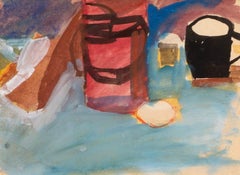
Wagons in the Field, Poland, Watercolour and Charcoal Painting, 1958
Located in Kingsclere, GB
Wagons in the Field, Poland, Watercolour and Charcoal Painting, 1958
Additional information:
Medium: Watercolour and charcoal
20.6 x 32.3 cm
8 1/8 x 12 3/4 in
Tadeusz Piotr (Peter)...
Category
20th Century Abstract Paintings
Materials
Watercolor
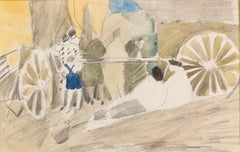
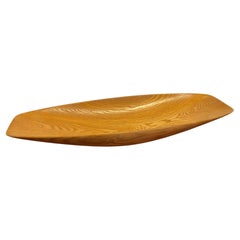
Large and Early Pine Bowl by Swedish Master Johnny Mattsson, 1944
By Johnny Mattsson
Located in Klintehamn, SE
John (Johnny) Mattsson, born 18 July 1906 in Gävle, died 9 February 1970 in the same place, was a Swedish sculptor and craftsman.
Polio had made Mattsson lame and through disabili...
Category
Vintage 1940s Swedish Scandinavian Modern Decorative Bowls
Materials
Pine

$909 Sale Price
20% Off
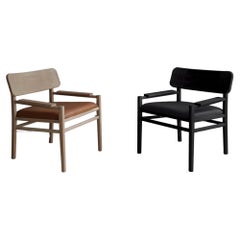
Decima Sexta - XVI Arm Chair
By Joel Escalona
Located in Ciudad de México, MX
The XVI Sixteenth Chair is part of Noviembre collection, which offers a compelling range of furniture, inviting exploration of form, function, and the serene lines that define each p...
Category
2010s Mexican Modern Chairs
Materials
Leather, Wood, Upholstery, Oak
$3,278 / item
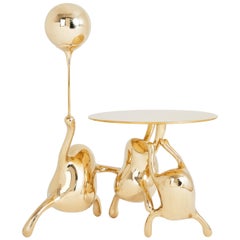
Tantan Side Table End Table Polished Brass Gold Nightstand Customizable
By Zhipeng Tan
Located in Beverly Hills, CA
The TanTan side table can also be used as a nightstand or an accent piece in the interior. It is handmade by renowned Chinese artist Zhipeng Tan and can be customized in size and col...
Category
2010s Chinese Side Tables
Materials
Brass
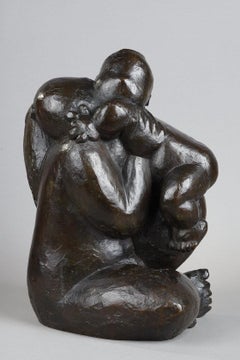
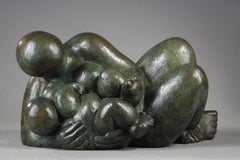
Motherhood
By Baltasar Lobo
Located in PARIS, FR
Motherhood
by Baltasar Lobo (1910-1993)
A bronze group with a nuanced greenish dark brown patina
Signed at the lower backside " Lobo "
Cast by " Susse Fondeur Paris " (with the foun...
Category
Mid-20th Century French School Figurative Sculptures
Materials
Bronze
The Cradle
By Baltasar Lobo
Located in PARIS, FR
Le Berceau (The Cradle)
by Baltasar LOBO (1910-1993)
A bronze group with a brownish green patina
Signed at the lower backside " Lobo "
Cast by " Susse Fondeur Paris " (with the foun...
Category
Mid-20th Century French School Figurative Sculptures
Materials
Bronze
Onceava-XI Dinning Chair
By Joel Escalona
Located in Ciudad de México, MX
The Eleventh Chair is part of Noviembre collection, which offers a compelling range of furniture, inviting exploration of form, function, and the serene lines that define each piece....
Category
2010s Mexican Modern Chairs
Materials
Leather, Wood, Oak
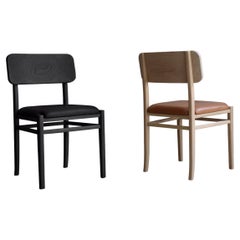
$3,052 / item
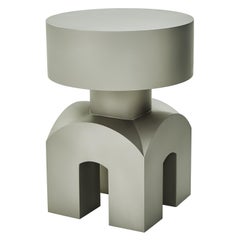
Studio Brancusi IX Sculptural Side Table Matte Steel Customizable
By Danjie Yan
Located in Beverly Hills, CA
This sculptural side table is from the Studio Brancusi Collection designed and made by China-based artist Danjie Yan. The works debutted at Sifang Art ...
Category
2010s Chinese Side Tables
Materials
Stainless Steel
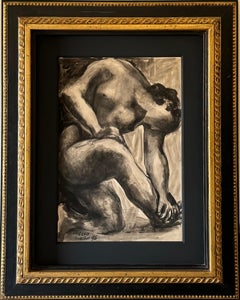
BALTASAR LOBO 1946 Seated Female Nude Abstract Figure Gouache
Ink on Paper
By Baltasar Lobo
Located in Rancho Santa Fe, CA
BALTASAR LOBO
Abstract Seated Nude Female Figure
1946
Gouache & Ink on Paper
Provenance: Ivan Boesky Collection, La Jolla, California
Signed & Dated "Lobo '46 Bruxelles"
Baltasar...
Category
1940s Abstract Figurative Paintings
Materials
Paper, Ink, Watercolor, Gouache
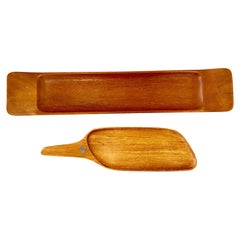
Johnny Mattsson, set of 2 teaktrays from his own workshop
By Johnny Mattsson
Located in Klintehamn, SE
Set of 2 trays by Swedish handicraft master Johnny Mattsson. Measurements for the large tray, the smaller one measures 42,5 cm (length), 11,8 cm (width), 1,7 cm (height). Large one w...
Category
Vintage 1950s Swedish Scandinavian Modern Platters and Serveware
Materials
Teak
$1,052 Sale Price
20% Off
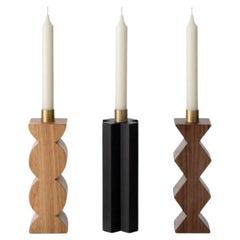
Set of 3, Constantin Candle Holders, Circles by Colé Italia
Located in Geneve, CH
Constantin Candle Holder Set Round by Colé Italia with Agustina Bottoni
Dimensions: H.30 D.7 W.7 cm
Materials: Ia- RN - Round; brushed solid oak wood and brass
IIa - RT - Cross; b...
Category
2010s Italian Modern Candlesticks
Materials
Brass
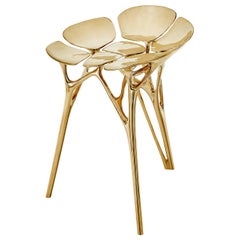
Lotus Stool Side Table Polished Brass Gold End Table Organic Form
By Zhipeng Tan
Located in Beverly Hills, CA
The Lotus stool can be used also as a side table/end table or an accent piece in the interior. It is handmade by renowned Chinese artist Zhipeng Tan and ca...
Category
2010s Chinese Stools
Materials
Brass
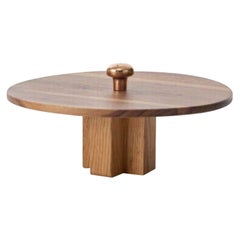
Constantin Centerpiece by Colé Italia
Located in Geneve, CH
Constantin Centerpiece by Colé Italia with Agustina Bottoni
Dimensions: H.10/13 Ø 28 cm
Materials: In solid brushed Wood: oak stained black base; natural...
Category
2010s Italian Modern Serving Pieces
Materials
Oak
$526 / item
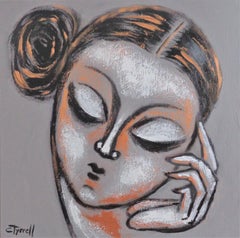
Thinking Muse - Portrait, Painting, Acrylic on Canvas
Located in Yardley, PA
Original contemporary figurative painting on canvas, painted edges and ready to hang. Made using grey, black and white with iridescent copper acrylics. I used iridescent copper as reference to the bronze sculpture. Graceful and elegant young woman portrait. Quality art materials used...
Category
21st Century and Contemporary Modern Paintings
Materials
Acrylic
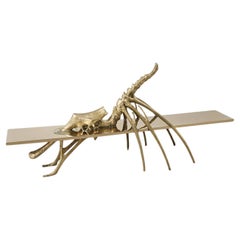
Echo Bench Polished Brass by Zhipeng Tan
By Zhipeng Tan
Located in Beverly Hills, CA
This visceral and sculptural chair is designed and made by renown artist Zhipeng Tan. Size and color is customizable upon request, lead time is 45-60 days. We ship internationally.
...
Category
2010s Chinese Benches
Materials
Brass
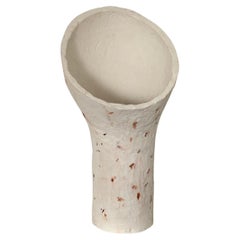
French contemporary ceramic lamp, "Cucchiao" by Renzo Maar
Located in Saint Ouen, FR
French contemporary plaster lamp by Renzo Maar. Material : ceramic (white stoneware, colors) ; signed. Reminiscent of modern sculpture like those by Jean Arp, Constantin Brancusi and...
Category
2010s Table Lamps
Materials
Ceramic
Lotus Side Table End Table Polished or Matte Brass Gold Customizable
By Zhipeng Tan
Located in Beverly Hills, CA
The Lotus side table is a great accent piece in the interior. It is handmade by renowned Chinese artist Zhipeng Tan and can be customized in size and ...
Category
2010s Chinese Side Tables
Materials
Brass

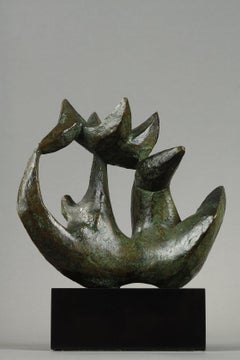
Motherhood
By Baltasar Lobo
Located in PARIS, FR
Motherhood
by Baltasar LOBO (1910-1993)
A bronze group with a brownish green patina
Signed at the lower front " Lobo "
Cast by " Susse Fondeur Paris " (with the foundry mark)
Number...
Category
Mid-20th Century French School Figurative Sculptures
Materials
Bronze
Lotus Console Table/Entry Way/Hallway Table Polished Brass by Zhipeng Tan
By Zhipeng Tan
Located in Beverly Hills, CA
Tan’s practice, since graduating from the China Academy of Art, has been focused on the ancient technique of lost-wax casting. This ancient foundry process has created an intersectio...
Category
21st Century and Contemporary Chinese Console Tables
Materials
Brass
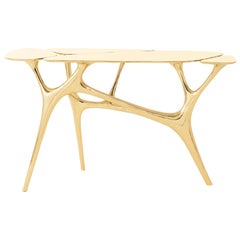
33 Step Tail Chair Polished Brass by Zhipeng Tan
By Zhipeng Tan
Located in Beverly Hills, CA
This visceral and sculptural chair is designed and made by renown artist Zhipeng Tan. Size and color is customizable upon request, lead time is 45-60 days. We ship internationally.
Since graduating with an industrial design degree from the China Academy of Art in Hangzhou, Zhipeng Tan has focused on the ancient technique of lost-wax casting. Through this foundry process, rich in heritage and tradition, Tan explores his interest in organic forms. Often inspired by his environmental surroundings, such as water and plants, he explores anthropomorphic themes, as well. Though trained as an industrial designer, he has become an accomplished self-taught sculptor, eagerly exploring the elastic and permeable boundaries between art and design and finding a harmonious fusion of sculpture and furniture, provocative objects of both beauty and utility.
Though from his early work, one may sense the influence of Joan Miró, Henry Moore and Constantin Brancusi, and in his more recent pieces there is a nod to the Post-Pop sensibilities of Jeff Koons and Takashi Murakami, the work of Zhipeng Tan is thoroughly original, an expression of his exuberance and imagination. In all of his work, one may see an exploration of our fundamental humanity and a desire to discover worlds within worlds. From the 33 Step...
Category
21st Century and Contemporary Chinese Chairs
Materials
Brass
$15,000 / item
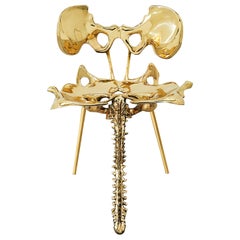
Tantan Side Table End Table Polished Brass Gold Nightstand Customizable
By Zhipeng Tan
Located in Beverly Hills, CA
The Tantan side table can also be used as a nightstand or an accent piece in the interior. It is handmade by renowned Chinese artist Zhipeng Tan and can be customized in size and col...
Category
2010s Chinese Side Tables
Materials
Brass
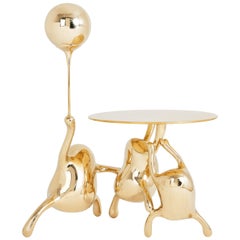
Studio Brancusi II Sculptural Side Table Matte Steel Customizable
By Danjie Yan
Located in Beverly Hills, CA
This sculptural side table is from the Studio Brancusi Collection designed and made by China-based artist Danjie Yan. The works debutted at Sifang Art ...
Category
2010s Chinese Side Tables
Materials
Stainless Steel

Studio Brancusi XI Sculptural Side Table Matte Steel Customizable
By Danjie Yan
Located in Beverly Hills, CA
This sculptural side table is from the Studio Brancusi collection designed and made by China-based artist Danjie Yan. The works debutted at Sifang Art ...
Category
2010s Chinese Side Tables
Materials
Stainless Steel
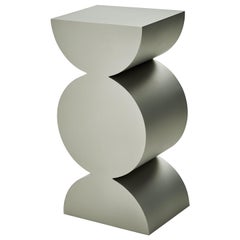
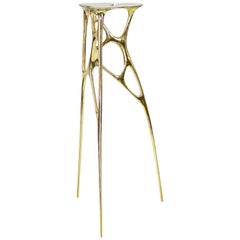
Polished Brass Gold Lotus Pedestal/Planter Stand/Accent Table by Zhipeng Tan
By Zhipeng Tan
Located in Beverly Hills, CA
The Lotus Pedestal is a great accent piece in the interior. It is handmade by renowned Chinese artist Zhipeng Tan and can be customized in size and color.
About the artist:
Since graduating with an Industrial Design degree from the China Academy of Art in Hangzhou, Zhipeng Tan has focused on the ancient technique of lost-wax casting. Through this foundry process, rich in heritage and tradition, Tan explores his interest in organic forms. Often inspired by his environmental surroundings, such as water and plants, he explores anthropomorphic themes, as well. Though trained as an Industrial designer, he has become an accomplished self-taught sculptor, eagerly exploring the elastic and permeable boundaries between art and design and finding a harmonious fusion of sculpture and furniture, provocative objects of both beauty and utility.
In spite of his rigorous training in computer modeling, Tan develops all of his concepts exclusively with hand drawing, preferring the direct connection to his work that sketching provides. As he likes to say, “Every line in the artwork is touched by me.” Most of his work is hand-sculpted in clay, and the final work is achieved through casting, hammering, welding and polishing. He has chosen brass as his preferred medium in part because of its connection to historical tradition, but most especially because of its warm color, rich luster and versatility.
Though from his early work, one may sense the influence of Joan Miró, Henry Moore and Constantin Brancusi, and in his more recent pieces there is a nod to the Post-Pop sensibilities of Jeff Koons and Takashi Murakami, the work of Zhipeng Tan is thoroughly original, an expression of his exuberance and imagination. In all of his work, one may see an exploration of our fundamental humanity and a desire to discover worlds within worlds. From the 33 Step Chair...
Category
2010s Chinese Pedestals
Materials
Brass
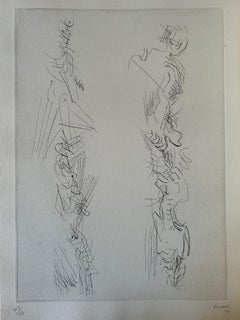
Untitled (Two Standing Figures) from Paroles Peintres IV
By Henry Moore
Located in New York, NY
This etching was executed in 1970 for Paroles Peintes IV, and is from the edition of 50 on Johannot wove paper. A limited number of signed proofs were also issued; this impression is signed and numbered 47/50.
Editions O. Lazar-Vernet, Paris 1970 Medium: original etching.
Plate size 13 1/2 x 9 1/2 inches (344 x 243 mm).
Often regarded as the father of modern British sculpture, Henry Moore’s large-scale bronze and marble sculptures can be found in public parks and plazas around the world. Working in various styles and mediums, Moore is perhaps best known for his highly abstract and interpretive renditions of the human figure, often portrayed in the reclining position. He was influenced by Classical, Pre-Columbian, and African art, and by Surrealism; his biomorphic style has been compared that of Salvador Dalí and Jean Arp. Moore was a longtime friend and colleague of fellow sculptor Barabara Hepworth, having met at the Leeds School of Art around 1919. He also admired the work of Constantin Brancusi, whose organic abstract style resonated with Moore’s belief that observation of nature is essential to artistic creation. Moore himself inspired many artists including his former studio assistants Anthony Caro and Richard Wentworth...
Category
1970s Modern Prints and Multiples
Materials
Etching
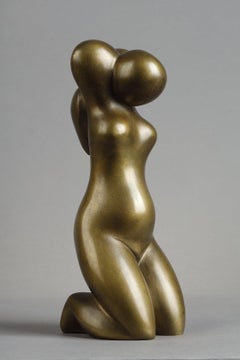
Nude kneeling
By Baltasar Lobo
Located in PARIS, FR
Nude kneeling
by Baltasar LOBO (1910-1993)
A bronze sculpture with an old gilded patina
Signed on the lower side " Lobo "
Cast by " Susse Fondeur Paris " (with the foundry mark)
Art...
Category
Mid-20th Century French School Nude Sculptures
Materials
Bronze
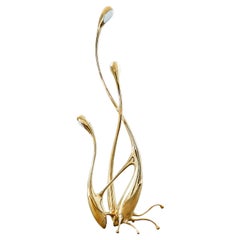
Walking Floor Lamp Polished or Matte Brass Gold Lighting Customizable
By Zhipeng Tan
Located in Beverly Hills, CA
The walking floor lamp can also be used as a sculpture or an accent piece in the interior. It is handmade by renowned Chinese artist Zhipeng Tan and can be customized in size and col...
Category
2010s Chinese Floor Lamps
Materials
Brass
Lacquer Sellette Rythme by Herve Langlais for Galerie Negropontes
Located in Paris, FR
"Rythme" sellette by Hervé Langlais for Galerie Negropontes
In Marble, lacquer or brass
Interior designer and architect Hervé Langlais creates furniture with the purest of lines. Hi...
Category
2010s French Side Tables
Materials
Marble
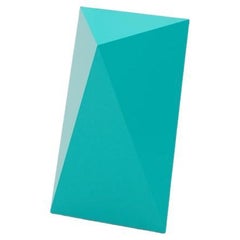
Studio Brancusi I Sculptural Side Table Matte Steel Customizable
By Danjie Yan
Located in Beverly Hills, CA
This sculptural side table is from the Studio Brancusi Collection designed and made by China-based artist Danjie Yan. The works debutted at Sifang Art ...
Category
2010s Chinese Side Tables
Materials
Stainless Steel
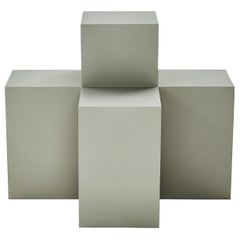
1960s Astrale Sculpture by Emile Gilioli
By Émile Gilioli
Located in Paris, FR
Emile Gilioli (1911 - 1977)
‘‘Astrale’’, 1966
White marble, base in black laquered wood
Sculpture : H. 63,5 x 29 x 39 cm / Base : H. 100 x 43 x 42,5 cm
At the height of the 20th cen...
Category
Vintage 1960s French Abstract Sculptures
Materials
Marble
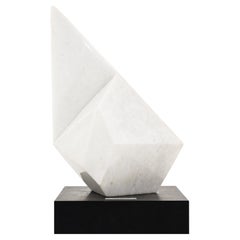
Studio Brancusi III Sculptural Side Table Matte Steel Customizable
By Danjie Yan
Located in Beverly Hills, CA
This sculptural side table is from the studio Brancusi collection designed and made by China-based artist Danjie Yan. The works debutted at Sifang Art ...
Category
2010s Chinese Side Tables
Materials
Stainless Steel
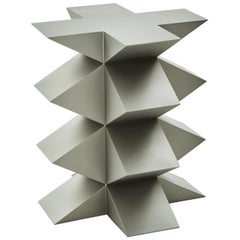
Lotus Side Table End Table Polished or Matte Brass Gold Customizable
By Zhipeng Tan
Located in Beverly Hills, CA
The lotus side table is a great accent piece in the interior. It is handmade by renowned Chinese artist Zhipeng Tan and can be customized in size and ...
Category
2010s Chinese Side Tables
Materials
Brass
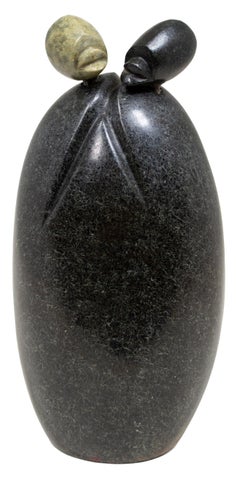
Togetherness
original stone Shona sculpture signed by Phineas Masaya
By Phineas Masaya
Located in Milwaukee, WI
'Togetherness' is an original springstone sculpture signed by the Zimbabwean artist Phineas Masaya. The sculpture presents an image of two figures in unity, their bodies together mak...
Category
Early 2000s Contemporary Figurative Sculptures
Materials
Stone
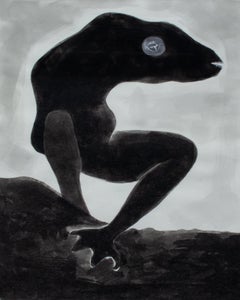
"Cronus Waiting" David Hare, Black and White Surrealist Composition
By David Hare
Located in New York, NY
David Hare
Cronus Waiting, 1990
Ink and Wash on Paper on Board
34 x 25 1/4 inches
“Freedom is what we want,” David Hare boldly stated in 1965, but then he added the caveat, “and what we are most afraid of.” No one could accuse David Hare of possessing such fear. Blithely unconcerned with the critics’ judgments, Hare flitted through most of the major art developments of the mid-twentieth century in the United States. He changed mediums several times; just when his fame as a sculptor had reached its apogee about 1960, he switched over to painting. Yet he remained attached to surrealism long after it had fallen out of official favor. “I can’t change what I do in order to fit what would make me popular,” he said. “Not because of moral reasons, but just because I can’t do it; I’m not interested in it.”
Hare was born in New York City in 1917; his family was both wealthy and familiar with the world of modern art. Meredith (1870-1932), his father, was a prominent corporate attorney. His mother, Elizabeth Sage Goodwin (1878-1948) was an art collector, a financial backer of the 1913 Armory Show, and a friend of artists such as Constantin Brancusi, Walt Kuhn, and Marcel Duchamp.
In the 1920s, the entire family moved to Santa Fe, New Mexico and later to Colorado Springs, in the hope that the change in altitude and climate would help to heal Meredith’s tuberculosis. In Colorado Springs, Elizabeth founded the Fountain Valley School where David attended high school after his father died in 1932. In the western United States, Hare developed a fascination for kachina dolls and other aspects of Native American culture that would become a recurring source of inspiration in his career.
After high school, Hare briefly attended Bard College (1936-37) in Annandale-on-Hudson. At a loss as to what to do next, he parlayed his mother’s contacts into opening a commercial photography studio and began dabbling in color photography, still a rarity at the time [Kodachrome was introduced in 1935]. At age 22, Hare had his first solo exhibition at Walker Gallery in New York City; his 30 color photographs included one of President Franklin Roosevelt.
As a photographer, Hare experimented with an automatist technique called “heatage” (or “melted negatives”) in which he heated the negative in order to distort the image. Hare described them as “antagonisms of matter.” The final products were usually abstractions tending towards surrealism and similar to processes used by Man Ray, Raoul Ubac, and Wolfgang Paalen.
In 1940, Hare moved to Roxbury, CT, where he fraternized with neighboring artists such as Alexander Calder and Arshile Gorky, as well as Yves Tanguy who was married to Hare’s cousin Kay Sage, and the art dealer Julian Levy. The same year, Hare received a commission from the American Museum of Natural History to document the Pueblo Indians. He traveled to Santa Fe and, for several months, he took portrait photographs of members of the Hopi, Navajo, and Zuni tribes that were published in book form in 1941.
World War II turned Hare’s life upside down. He became a conduit in the exchange of artistic and intellectual ideas between U.S. artists and the surrealist émigrés fleeing Europe. In 1942, Hare befriended Andre Breton, the principal theorist of surrealism. When Breton wanted to publish a magazine to promote the movement in the United States, he could not serve as an editor because he was a foreign national. Instead, Breton selected Hare to edit the journal, entitled VVV [shorth for “Victory, Victory, Victory”], which ran for four issues (the second and third issues were printed as a single volume) from June 1942 to February 1944. Each edition of VVV focused on “poetry, plastic arts, anthropology, sociology, (and) psychology,” and was extensively illustrated by surrealist artists including Giorgio de Chirico, Roberto Matta, and Yves Tanguy; Max Ernst and Marcel Duchamp served as editorial advisors.
At the suggestion of Jacqueline Lamba...
Category
1990s Abstract Mixed Media
Materials
Paper, Ink, Board
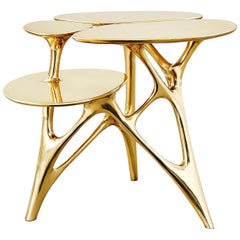
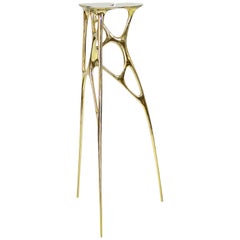
Polished Brass Gold Lotus Pedestal/Planter Stand/Accent Table by Zhipeng Tan
By Zhipeng Tan
Located in Beverly Hills, CA
The Lotus pedestal is a great accent piece in the interior. It is handmade by renowned Chinese artist Zhipeng Tan and can be customized in size and color.
About the artist:
Sin...
Category
2010s Chinese Pedestals
Materials
Brass
Italian Landscape with Pylons, Watercolour and Charcoal by Peter Potworowski
Located in Kingsclere, GB
Italian Landscape with Pylons, Watercolour and Charcoal Painting, 1950s
Additional information:
Medium: Watercolour and charcoal
23.4 x 32.3 cm
9 1/4 x 12 3/4 in
Tadeusz Piotr (Pet...
Category
20th Century Landscape Drawings and Watercolors
Materials
Watercolor, Charcoal
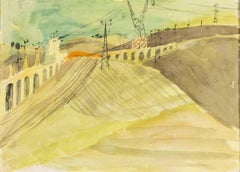
Gate, Corsham Court (Blue Sky), Gouache Painting by Peter Potworowski, 1953/55
Located in Kingsclere, GB
Gate, Corsham Court (Blue Sky), Gouache Painting by Peter Potworowski, 1953/55
Additional information:
Medium: Gouache
23.5 x 33 cm
9 1/4 x 13 in
Tadeusz Piotr (Peter) Potworowski ...
Category
20th Century Abstract Paintings
Materials
Gouache
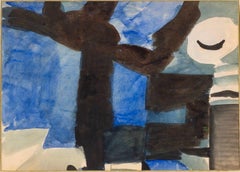
Still Life, Red
Yellow Flowers, Gouache Painting by Peter Potworowski, c 1955
Located in Kingsclere, GB
Still Life, Red & Yellow Flowers, Gouache Painting by Peter Potworowski, c 1955
Additional information:
Medium: Gouache
23.6 x 33.3 cm
9 1/4 x 13 1/8 in
Tadeusz Piotr (Peter) Potworowski was a Polish abstract and figurative painter who lived and exhibited in Paris, Poland, Sweden and England.
Potworowski was born in Warsaw in 1898. After serving in the First World War, Potworowski enrolled at the Warsaw University of Technology to study architecture, though his studies were halted by the Bolshevik campaign. After the end of the Polish-Soviet War in 1921, Potworowski returned to Warsaw and began to study art at the school of Konrad Krzyżanowski. By the following year, he had taken a place at the Academy of Fine Arts in Krakow, where he studied under Józef Pankiewicz. It was Pankiewicz who incorporated Potworowski into the Paris Commute, or Kapists, a group of Polish artists who travelled to the French capital in 1924.
During his seven years in Paris he became personally acquainted with Pablo Picasso, Pierre Bonnard, Jean Cocteau, Constantin Brancusi and attended for a short time Fernand Léger's studio. It was through this job that he met his first wife Magdalena Mańkowska, a student of anthropology in Paris. After marrying in France, and visiting Britain in 1928, the couple returned to Poland in 1930, where their first son John was born.
In 1931, Warsaw was the locale of the first Kapists exhibition, entitled New Generation, which took place at the Artist's Club, Hotel Polonia, and the Institute of Art Propaganda. Here, Potworowski received a prize for his painting Three Women in the Interior. The following year, he held his first solo exhibition at the Makowski Salon in Poznań. This success was sustained through 1937 when the artist received a silver medal at the International Exhibition of Art and Technology in Paris, as well as the award from the Minister of Foreign Affairs. After this strong development, Potworowski had a travelling solo exhibition arranged, held in 1938 at the Institute of Propaganda of Art in Warsaw and then in Lviv.
Following the invasion of Poland in 1939, Potworowski escaped to Sweden via Lithuania. It was from here that the artist, with his wife and two young children, made his way to Britain, arriving in 1943. After serving in Scotland, Potworowski settled in London, and in January 1946, an exhibition of 33 of his works was held at the Redfern Gallery. This was followed by regular exhibitions with the Redfern, Gimpel Fils (1948 onwards) and The London Group, to which he was elected a member in 1949. He was also the president of the Association of Polish Artists and published regularly in the monthly magazine "Nowa Polska".
Potworowski's teaching career included eight years as Professor of Painting at the Bath Academy of Art, Corsham (1949-57), where he had considerable European influence, specifically on abstraction, and was acknowledged by contemporaries including Peter Lanyon, Bryan Wynter...
Category
20th Century Abstract Paintings
Materials
Gouache
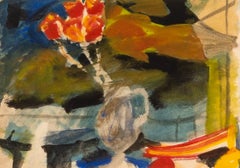
Harbour Scene, Cornwall, Black and Grey, by Peter Potworowski
Located in Kingsclere, GB
Harbour Scene, Cornwall, Black and Grey, Gouache Painting, 1953-1955
Additional information:
Medium: Gouache
22 x 26.5 cm
8 5/8 x 10 3/8 in
Tadeusz Piotr (Peter) Potworowski was a ...
Category
20th Century Abstract Paintings
Materials
Gouache
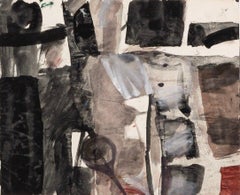
Cornish Coast, Gouache Painting by Peter Potworowski, 1952/3
Located in Kingsclere, GB
Cornish Coast, Gouache Painting by Peter Potworowski, 1952/3
Additional information:
Medium: Gouache
20.3 x 33 cm
8 x 13 in
Tadeusz Piotr (Peter) Potworowski was a Polish abstract and figurative painter who lived and exhibited in Paris, Poland, Sweden and England.
Potworowski was born in Warsaw in 1898. After serving in the First World War, Potworowski enrolled at the Warsaw University of Technology to study architecture, though his studies were halted by the Bolshevik campaign. After the end of the Polish-Soviet War in 1921, Potworowski returned to Warsaw and began to study art at the school of Konrad Krzyżanowski. By the following year, he had taken a place at the Academy of Fine Arts in Krakow, where he studied under Józef Pankiewicz. It was Pankiewicz who incorporated Potworowski into the Paris Commute, or Kapists, a group of Polish artists who travelled to the French capital in 1924.
During his seven years in Paris he became personally acquainted with Pablo Picasso, Pierre Bonnard, Jean Cocteau, Constantin Brancusi and attended for a short time Fernand Léger's studio. It was through this job that he met his first wife Magdalena Mańkowska, a student of anthropology in Paris. After marrying in France, and visiting Britain in 1928, the couple returned to Poland in 1930, where their first son John was born.
In 1931, Warsaw was the locale of the first Kapists exhibition, entitled New Generation, which took place at the Artist's Club, Hotel Polonia, and the Institute of Art Propaganda. Here, Potworowski received a prize for his painting Three Women in the Interior. The following year, he held his first solo exhibition at the Makowski Salon in Poznań. This success was sustained through 1937 when the artist received a silver medal at the International Exhibition of Art and Technology in Paris, as well as the award from the Minister of Foreign Affairs. After this strong development, Potworowski had a travelling solo exhibition arranged, held in 1938 at the Institute of Propaganda of Art in Warsaw and then in Lviv.
Following the invasion of Poland in 1939, Potworowski escaped to Sweden via Lithuania. It was from here that the artist, with his wife and two young children, made his way to Britain, arriving in 1943. After serving in Scotland, Potworowski settled in London, and in January 1946, an exhibition of 33 of his works was held at the Redfern Gallery. This was followed by regular exhibitions with the Redfern, Gimpel Fils (1948 onwards) and The London Group, to which he was elected a member in 1949. He was also the president of the Association of Polish Artists and published regularly in the monthly magazine "Nowa Polska".
Potworowski's teaching career included eight years as Professor of Painting at the Bath Academy of Art, Corsham (1949-57), where he had considerable European influence, specifically on abstraction, and was acknowledged by contemporaries including Peter Lanyon, Bryan Wynter...
Category
20th Century Abstract Paintings
Materials
Gouache

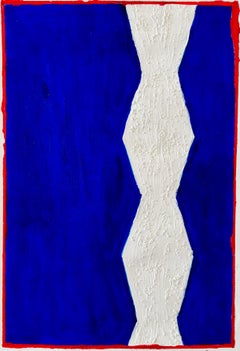
TU M’as Dit Que J’étais Beau - Textured Acrylic on Paper, Abstract Painting 2024
Located in London, GB
"Tu M'as Dit Que J’étais Beau" (2024) is a textured abstract geometric painting inspired by Constantin Brancusi’s Endless Column. As a Romanian-British artist, I created this piece a...
Category
2010s Abstract Abstract Paintings
Materials
Paper, Acrylic
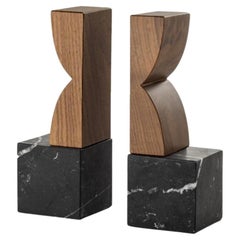
Constantin Bookends, C by Colé Italia
Located in Geneve, CH
Constantin Bookends by Colé Italia, C with Agustina Bottoni
Dimensions: H.20 D.7 W.7 cm
Materials: The body is a cube in Marquina black marble with white veins. The top is in solid...
Category
2010s Italian Modern Books
Materials
Oak, Walnut
$598 / item
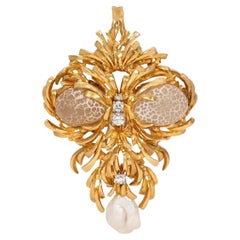
Gilbert Albert Agate, Pearl, Diamond, and 18K Gold Brooch/Pendant, c. 1965
By Gilbert Albert
Located in New York, NY
This exquisite brooch, crafted by the renowned Swiss jeweler Gilbert Albert in 1960, features diamonds, pearls, agate, and 18-karat yellow gold. Its abstract design, with textured go...
Category
Vintage 1960s Swiss Brooches
Materials
Agate, Diamond, Pearl, 18k Gold
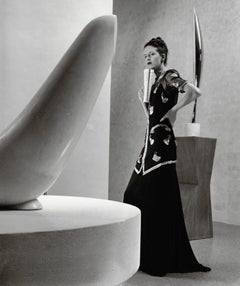
Model Shelly Napier in Schiaparelli with Brancusi Sculptures, MOMA, New York
By Louise Dahl-Wolfe
Located in New York, NY
This photograph was likely taken during the Museum of Modern Art’s 10th Anniversary Exhibition, which also celebrated the museum’s new home at 11 West 53rd Street. Pictured with the model are “Bird in Space...
Category
1930s Modern Black and White Photography
Materials
Silver Gelatin
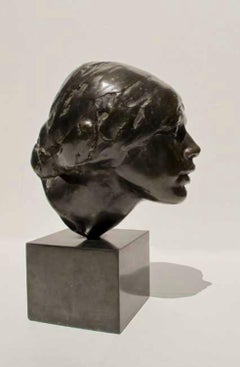
Nuska, Portrait of a Girl, unique bronze portrait by Isamu Noguchi 1924
By Isamu Noguchi
Located in Santa Fe, NM
Nuska, Portrait of a Girl, bronze portrait, 1924, unique
Isamu Noguchi (Japanese American 1904 - 1988); "Nuska, The Deaf Girl"; cire perdu cast bronze with complex dark patina on bronze base; 15 x lOx 8 inches; base 4.5 x 5.75 x 5,75 inches; signature quilled under and at back - "Isamu"; foundry stamp quilled in wax at the back - "Roman Bronze Works N.Y."
Excellent condition.
"Nuska, The Deaf Girl" is included in the Catalogue Raisonne of Noguchi's sculpture by Nancy Grove and Dianne Botnick (Garland, 1980) as Number 21. It is currently listed in the digital catalogue being assembled by the Isamu Noguchi Museum in Long Island City, New York as Number 10. This is apparently a unique casting, not part of an edition.
This is an apparently early, cire perdu bronze cast by Roman Bronze Works, probably when the foundry was located in the Louis Comfort Tiffany red...
Category
1920s Contemporary Figurative Sculptures
Materials
Bronze
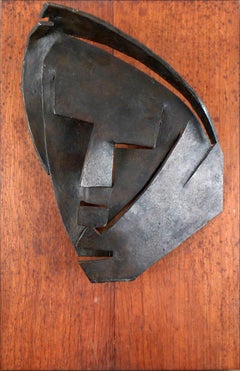
"Petit masque découpé Montserrat", 20th Century Bronze by Julio González
Located in Madrid, ES
JULIO GONZÁLEZ
Spanish, 1876 - 1942
PETIT MASQUE DÉCOUPÉ MONTSERRAT
signed "GONZALEZ"
5 of an edition of 9
Cire Perdue "C. VALSUANI" foundry seal
bronze...
Category
1930s Cubist Abstract Sculptures
Materials
Bronze
Balcomb Greene Wind Ocean Sun 1963
By Balcomb Greene
Located in Hudson, NY
Wind, Ocean, Sun by Balcomb Greene painted in 1963. Signed on the front titled and dated on the reverse.
Paintings of the Montauk coast by Balcomb Greene are few and far between. Thi...
Category
Vintage 1960s American Mid-Century Modern Paintings
Materials
Canvas, Paint
Price Upon Request
Balcomb Greene "The Cliffs", 1978
By Balcomb Greene
Located in Hudson, NY
The Cliffs by Balcomb Greene painted in 1978. Signed on the front titled and dated on the reverse.
Paintings of the Montauk coast by Balcomb Greene are few and far between. This painting likely created at his Studio in Montauk New York. Painting is in excellent original condition and retains the original gallery frame.
provenance: Estate of Gertrude B. Pascal / Gifted from the previous in 1987, The Frances Lehman Loeb Art Center, Vassar College, Poughkeepsie, NY / Christie's, New York 2012 / Private Collection, New Jersey
Public collections:
Baltimore Museum of Art, Baltimore, MD
Brooklyn Museum, Brooklyn, NY
Cleveland Museum of Art, Cleveland, OH
The Art Institute of Chicago, Chicago, IL
Corcoran Gallery of Art, Washington, D.C.
Guild Hall, East Hampton, NY
Wadsworth Atheneum, Hartford, CT
Museum of Fine Arts, Houston, TX
Indianapolis Museum of Art, Indianapolis, IN
Metropolitan Museum of Art, New York, NY
Museum of Modern Art, New York, NY
National Museum of American Art, Washington, D.C.
Joslyn Art Museum, Omaha, NE
Pennsylvania Academy of the Fine Arts, Philadelphia, PA
Norton Simon Museum, Pasadena, CA
Portland Museum of Art, Portland, OR
Neuberger Museum, Purchase, NY
Solomon R. Guggenheim Museum, New York, NY
Parrish Museum, Southampton, NY
Whitney Museum of American Art, New York, NY
Walker Art Center, Minneapolis, MN
Butler Institute of American Art, Youngstown, OH
Boca Museum of Art, Boca Raton, FL
Over a lifespan of 86 years, Balcomb Greene followed his muse wherever it led, unfettered by what had come before, unafraid of where the future might lead. Despite a series of different pathways explored, his purpose remained ever constant: to express truth as he found it and communicate it to a broader audience. In the 1930s, Greene was a young artist committed to abstraction as his expressive language. Greene’s paintings and collages of the 1930s reflect the influence of Pablo Picasso and Piet Mondrian and put him in the company of fellow Americans, including Ibram Lassaw, Josef Albers, Ilya Boltowsky and George L. K. Morris, all among the founding members, in 1936, of American Abstract Artists.
John Wesley Greene, his christened name which he never legally changed, was born in 1904 in Millville, New York, the third child and only son of Methodist minister The Reverend Bertram Stillman Greene (1864–1929) and Florence Stover Greene (1876–1911). His family on both sides were Revolutionary-era colonists, originally living in Connecticut and Vermont before joining the Yankee migration to the western frontier of New York State. In 1922, John Wesley Greene enrolled at Syracuse University aided by a scholarship for the sons of Methodist ministers and intending to fulfill the promise of his name and follow his father into the ministry. As with so many before and after him, the liberal education he absorbed at Syracuse broadened his horizons and reshaped his life plan. Studying philosophy, psychology, and literature, along the way he separated himself from organized religion. During his senior year, on a visit to The Metropolitan Museum of Art in New York City, Greene was introduced to Gertrude Glass (1904–1956), an art student and the Brooklyn-born daughter of Latvian Jewish immigrants.
Following Greene’s graduation, the two married in 1926 and went to Europe. They stopped briefly in Paris but spent most of their time in Vienna where Greene had a fellowship to study psychology. When they returned to New York in 1927, Greene enrolled in a master’s program in ‘English literature at Columbia University. When his thesis advisor rejected his essay topic on the “fallen woman” in seventeenth-century literature as inappropriate, he left without a degree. From 1928 until 1931, Greene taught English at Dartmouth College in Hanover, New Hampshire. At some point, he stopped using his given name, John, and began to call himself, more distinctively, Balcomb, the family name of his paternal grandmother.
While Greene wrote three novels (all unpublished) during his teaching years at Dartmouth, his wife was a working artist, and he eventually developed an interest of his own in painting. In 1931, Greene gave up his teaching position and he and Gertrude went to Paris, determined to immerse themselves in the modern art ferment they had briefly experienced in their earlier visit. For young Americans with no prescribed agenda, a receptiveness to innovation, and wide-open eyes and minds. Paris, in 1931, offered a rich stew of approaches to modern art. The city absorbed and transmuted an international mélange of styles—cubism, orphism, futurism, dadaism, constructivism, neoplasticism, suprematism, de Stijl, Bauhaus—France encountering Holland, Germany, Italy, and Russia with Pablo Picasso from Spain, Constantin Brancusi from Romania, and Jacques Lipchitz from Lithuania. As a sculptor, Gertrude Greene...
Category
Vintage 1970s American Mid-Century Modern Paintings
Materials
Canvas, Paint
Price Upon Request
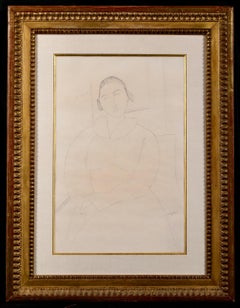
Portrait of Berthe Lipchitz - Modern Portrait Pencil Drawing - Amedeo Modigliani
By Amedeo Modigliani
Located in Marlow, Buckinghamshire
Signed pencil on paper portrait drawing by Italian artist Amedeo Clemente Modigliani. The portrait is of Berthe Lipchitz who was the wife of Modigliani's friend, the sculptor Jacques Lipchitz. This work is a study for "Portrait of Jacques & Berthe Lipchitz" which hangs in the Art Institute of Chicago.
Signature:
Signed lower right
Dimensions:
Framed: 26.75"x18.25"
Unframed: 18.75"x12.25"
Provenance:
The collection of Leopold Survage
The collection of Dimitri Snegaroff
The collection of Leopold Zborowski
Galerie Charpentier - Paris 1958
Private french collection
Galerie Pierre Levy - Paris
Private collection - United Kingdom
Exhibited:
Galerie Charpentier - Cent Tableaux de Modigliani - Paris, 1958
Les Peintres de Zborowski - ~Foundation L'Hermitage, Lausanne 1994
Amedeo Modigliani Exhibition - Museo d'Arte Moderna, Lugano 1999
Amedeo Modigliani was born into a middle-class Jewish family and was the brother of Eugenio Modigliani, who later became the leader of the Italian socialist workers’ party prior to the rise of fascism. Modigliani suffered from poor health as a child and contracted pleurisy in 1895, followed in 1898 by typhus with pulmonary complications, which culminated in tuberculosis in 1901. He moved to Livorno to study under Guglielmo Micheli, who had himself been a pupil of Giovanni Fattori, one of the Macchiaioli group of painters who worked in strong colour patches (macchie) to achieve vivid light and colour effects; their approach came as a reaction against academic art in Italy and, in much the same way as the French Impressionists, they advocated painting from nature rather than aspiring to communicate any particular message or ideology. In 1902, Modigliani enrolled at the academy of fine arts in Florence. He travelled to Rome and Venice in 1903, where he devoted the bulk of his day to visiting museums. At around this time he started to read Dante, dreaming no doubt of the Vita Nuova; he also devoured the works of Leopardi, Carducci, d’Annunzio, Spinoza and Nietzsche.
In 1906, Modigliani moved to Paris, lodging at the Rue Caulaincourt. At that juncture, nothing about him appeared to presage the brilliant career that was to follow. His arrival in the artists’ quarter, then known colloquially as the maquis - the labyrinthine tangle of narrow streets around today’s Avenue Junot in Montmartre - went virtually unnoticed by the artists already living and working there, including Picasso, Braque and Derain. Modigliani’s painting made next to no immediate impact and he was recognised primarily on account of his frail constitution, flashing eyes, innate elegance and intellectual prowess. He was accepted in the community that was Montmartre but never belonged to any particular ‘set’ or circle, and there is no record of his ever having been invited to Pablo Picasso’s studio, the famous ‘wash house’.
The literate and highly articulate Modigliani opted instead for the companionship of Maurice Utrillo, an instinctual painter of whom it could charitably have been said that his conversation was, at best, limited. Nonetheless, Modigliani and ‘Litrillo’ (as Utrillo was commonly known to the street urchins - the ‘p’tits poulbots’) began to frequent the cabarets and dance halls of the Butte de Montmartre, and the nefarious hashish dens - post-Baudelaire ‘institutions’, frequented in the main by out-of-work writers and talentless artists. Modigliani developed an addiction, which, compounded by his alcoholism, took its toll. It also transformed him from an artist of limited ability into one devoid of bourgeois scruples.
In his monograph, Modigliani: Sa Vie et Son Oeuvre, written in 1926 shortly after Modigliani’s death, André Salmon hinted at a ‘pact with the devil’. While somewhat overstating the case, this rather unpromising painter from Livorno metamorphosed virtually overnight into an artist of rare ability and sensitivity. The turning-point came in 1907, when Modigliani met Paul Alexandre, a doctor who befriended him, took him under his wing and purchased some of his work. The banal paintings he had turned out in Montmartre were suddenly superseded by exceptional works, produced first in Montmartre ( Cellist, 1909), and then in Montparnasse.
In Montparnasse, Modigliani started to move in artistic circles, meeting Chaim Soutine, Marc Chagall, Jules Pascin and others, all of whom lived and worked in the building in the Rue Vaugirard known as ‘La Ruche’ (‘the beehive’). Then, in the Cité Falguière, he met the Romanian-born sculptor Constantin Brancusi, who encouraged him to take up sculpture, which he did, between 1909 and 1913. In 1914, several dealers, including the erstwhile poet Léopold Zborowski and the collector Paul Guillaume, tried with little success to market Modigliani’s paintings. From 1914 to 1916, Modigliani was caught up in a tempestuous affair with the English poet and journalist Beatrice Hastings. In 1917, however, he met Jeanne Hébuterne at the Colarossi Academy, who became his constant companion and model, and who gave birth to their daughter Jeanne in 1918. In 1918 and 1919, Modigliani and Jeanne spent time in Nice on the Côte d’Azur but by 1920 he was suffering from tubercular meningitis. His friends, Kisling and the Chilean Ortiz de Zarate, brought him and a pregnant Jeanne back to Paris, where he died on January 20 1920 in the Hôpital de la Charité. His last words were reputed to be: ‘Cara Italia’. Modigliani’s brother, by this time a socialist member of parliament, telegrammed instructions to ‘bury him as befits a prince’. Jeanne Hébuterne, a budding twenty-year-old painter, killed herself and her unborn child on the day of Modigliani’s funeral by jumping to her death from a fifth-floor window.
Modigliani’s first paintings were undistinguished portraits in the Impressionist manner. After moving to Paris in 1907, his early work was influenced by the Swiss-born lithographer Théophile Alexandre Steinlen, Henri de Toulouse-Lautrec and Pablo Picasso, the latter then in his ‘blue’ period. From the onset, Modigliani’s principal preoccupation was the human figure. After the artistic (and literal) limbo of Montmartre, when his output was confined to a few Expressionist-like paintings of street life, the theatre and the circus, Modigliani suddenly erupted on the scene in 1909 with Cellist, a robust, well-constructed and vividly coloured canvas that utterly exceeded all prior expectations. He had not taken part in the protracted debates that took place nightly in Picasso’s studio, but he had superficially assimilated the Cubist ideas developed by Picasso and Georges Braque. Above all, Modigliani had been influenced by African art, which was a key feature of the Cubist movement. He succeeded in treading a fine line between the coolly analytical Cubist approach and the all-too-common European perception of African art as a succession of exaggerated facial grimaces.
It would appear that Modigliani had always been attracted to sculpture as a discipline. The friendly encouragement he received as of 1909 from Brancusi no doubt intensified his interest and reinforced his attempts to achieve a sustained simplicity of line and form. In 1910, he befriended the Russian artists Alexander Archipenko and Jacques Lipchitz, both of whom recorded Modigliani’s distaste for modelling in clay (which he referred to as ‘mud’), on the grounds that it degraded the art of sculpture. Like Brancusi, Modigliani believed in working directly, carving from wood in the case of two extant pieces, and from (sand)stone in others, with the exception of a few bronzes which were, presumably, modelled in clay before being cast into bronze. His sculpture was influenced by archaic and non-western cultures - early Graeco-Roman, African and Khmer - as well as heads carved on columns adorning the façades of Romanesque and Gothic cathedrals (Modigliani rarely sculpted a rear view of his figures). Up to approximately 1912, his sculptures take the form of tall cylinders, usually with elongated heads and shallow relief indentations or projections to indicate the hairline, facial features and neck. He departed from this style only infrequently, most notably in a small number of pieces believed to have been sculpted in 1913, which are characterised by a compressed, cubistic format and shallower and less distinct features. Modigliani eventually abandoned sculpture, presumably because of his general health and circumstances, and possibly due to the fact that his sculptures sold for even less than his paintings. During the years that he devoted to sculpture, Modigliani is recorded as producing only thirty canvases, although after 1913 his sculpture became reflected in his painting.
Following his Montmartre days, Modigliani’s work developed in both quantitative and qualitative terms, presumably helped by the relative stability of his relationship with Jeanne Hébuterne. The first paintings after his short-lived sculptural phase saw him revert briefly to Neo-Impressionist pointillism, followed by a episode marked by Cubism, which was mainly evident in portraits of friends and fellow artists living and working in Montparnasse: Henri Laurens; Juan Gris (1915); Jacques Lipchitz and his Wife; Chaim Soutine; Léopold Sauvage; Paul Guillaume; Max Jacob; Béatrice Hastings con Capello (all 1916); Mlle Modigliani (1917); Léon Bakst; Léopold Zborowski; Concierge’s Son; Adolescent (1918); Mademoiselle Lunia Czechowska; Madame Zborowska; Portrait of the Artist’s Wife (1919). A large number of other portraits exist among his drawings, most of which were executed impromptu in the street or cafés. These quickly drawn portraits often exhibit an urgency and surprising lucidity. Examples include Portrait of the Gypsy Painter Fabiano de Castro; André Salmon (1918); Portrait of the Artist’s Wife (1919); and Lada, Author; Mario, Composer (1920).
Whatever his shortcomings, Amedeo Modigliani ranks as one of the 20th-century’s greatest painters of the female form. The bulk of his painted nudes were produced in 1915-1916 (prior to that date they were predominantly drawings), and are taken from every walk of life, such as a regular at a Montparnasse café, or a waitress at the soup kitchen where he ate his meagre meals. In each instance, he invested his models with an almost aristocratic hauteur. This is exemplified in a number of paintings (usually based on numerous prior drawings): Flower Girl; Blonde Lady; Sleeping Nude (1917); Blonde Nude; Young Woman; Maria (1918); Pink Nude; Reclining Nude; Nude on a Divan; Woman with a Fan (1919); and Young Woman in a Chemise; Reclining Nude (1920). Modigliani painted his subjects in elongated, elliptic ovals: the swell of a breast, the pronounced curve of the pelvis, the fullness of the thigh, the symmetrically oval face and the graceful arabesque of the body. Facial features are reduced to a bare minimum, with the eyes typically empty, like those of a statue. He employed colour as a constructive material in much the same way as stone in sculpture, juxtaposing muted pinks, ochres and pale browns against discreet background tones supplied by décor and garments. The overall effect is to yield a flat image devoid of chiaroscuro but which captures the essence of a subject. It has often been remarked that his women, with their elongated heads and long, graceful necks, generally tilted to one side, possess a melancholy beauty akin to that of the Siena Madonnas (reproductions of which Modigliani kept pinned on his studio wall), which accounts for Modigliani’s soubriquet as the ‘painter of sorrows’. From 1917, the majority of his nudes, characterised by a more pronounced elongation of the female body and lighter palette, were modelled by Jeanne Hébuterne and Luna Czechowska.
Very few artists have been the subject of so many monographs and biographies as Modigliani; the selection appended to this entry indicates only some of the more important of these. Too much, perhaps, has been made of his life as an artiste maudit, of his ‘accursed’ yet colourful life rather than the quality of his work. Some critics have detected in him an artist of great and persistent intellectual curiosity; others emphasise that he was a ‘gentleman to the end’ and stress his physical frailty, ignoring the fact that this was an integral component of his creativity. More seriously, his posthumous fame amongst the public at large acts both for and against him, as if his subsequent popularity has become a yardstick of his artistic ability. The mannerism of his style ensures that a ‘Modigliani’ is instantly recognisable, but his success in adapting Cubism and African art to a language and palette that are entirely his own places him squarely at the heart of the modern movement.
Amedeo Modigliani’s work has featured in numerous group exhibitions, including: Paris in 1908, when he showed his Jewess and three other canvases; the Salon des Indépendants in 1910; and the Salon d’Automne in 1912, where he exhibited examples of his sculpture. His posthumous inclusion in the 1922 Venice Biennale was regarded in Italy as a complete fiasco, prompting the critic Giovanni Scheiwiller to paraphrase Charles Baudelaire’s remark to the effect that, ‘we know that precious few will understand us, but that shall be sufficient’. In 1917-1918, the Berthe Weill Gallery organised a one-man show at the instigation of Zborowski but, on the order of the then chief of police, some of Modigliani’s sensual nudes were withdrawn on account of alleged indecency. On 20 December 1918, the Paul Guillaume Gallery exhibited several paintings by Modigliani alongside others by Matisse, Picasso and Derain.
All other exhibitions of Modigliani’s work have been held since his death. They include those at the Bernheim-Jeune Gallery in Paris (1922); Galerie Bing (Paris, 1925 and 1927); Marcel Benhelm Gallery (Paris, 1931); Palais des Beaux-Arts (Brussels, 1933); Kunsthalle Basel (1934); American-British Art Center (New York, 1944); Galerie de France (Paris, 1945 and 1949); Gimpels Fils Gallery (London, 1947); Cleveland Museum of Art (1951); Museum of Modern Art (New York, 1951); Cantini Museum (Marseilles, 1958); Palazzo Reale (Milan, 1958); Galerie Charpentier (Paris, 1958); Chicago Arts Club (1959); Cincinnati Art Museum (1959); Galleria Nazionale d’Arte Moderna (Rome, 1959); Boston Museum of Fine Arts (1961); Perls Galleries (New York, 1963 and 1966); Kyoto National Museum of Modern Art (1968); Musée Jacquemart-André (Paris, 1970); Musée St-Georges (Liège, 1980); Tokyo Arts Centre (1980); Musée de l’Art Moderne de la Ville de Paris (1970; a comprehensive exhibition of Modigliani’s sculptures...
Category
1910s Modern Portrait Drawings and Watercolors
Materials
Paper, Pencil