224 results for "campbell s soup can"
to
33
193
28
132
92
85
40
31
27
23
21
19
10
5
2
55
34
10
6
3
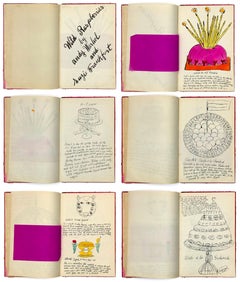
Wild Raspberries FS IV.126-143 (Andy Warhol Art Authentication Board Stamped)
By Andy Warhol
Located in Aventura, FL
Artist: Andy Warhol
Title: Wild Raspberries FS IV.126-143
The complete book, comprising 18 offset lithographs, 3 with hand-coloring, (one of which is a double plate), printed title page and two blank pages (as issued), with recipes by Suzie Frankfurt...
Category
1950s Pop Art Figurative Prints
Materials
Watercolor, Lithograph
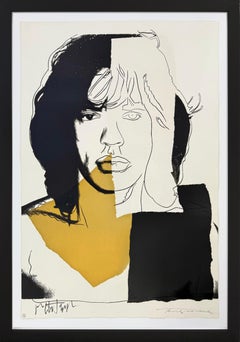
Mick Jagger FS II.146 (dual signed screen print)
By Andy Warhol
Located in Aventura, FL
Screen print on arches aquarelle (rough) paper. Hand signed lower right by Andy Warhol; hand signed lower left by Mick Jagger. Edition 35/250 (there were also 50 artist’s proofs)....
Category
1970s Pop Art Figurative Prints
Materials
Paper, Screen
1980
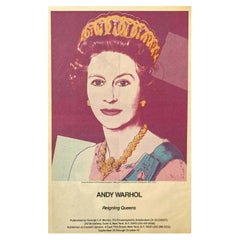
s Andy Warhol Reigning Queens Advertisement (Warhol Queen Elizabeth)
By (after) Andy Warhol
Located in Brooklyn, NY
Andy Warhol Queens advertisement circa 1985 featuring Queen Elizabeth:
Vintage original 1980s poster advertisement for Andy Warhol Reigning Queens at Leo Castelli gallery, New York....
Category
Vintage 1980s Posters
Materials
Paper
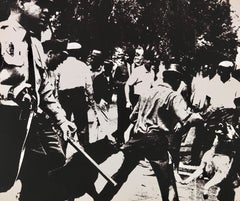
Andy Warhol, Birmingham Race Riot, from Ten Works by Ten Painters, 1964
By Andy Warhol
Located in Southampton, NY
This exquisite silkscreen by Andy Warhol (1928–1987), titled Birmingham Race Riot, originates from the landmark 1964 folio X + X (Ten Works by Ten Painters). Published by the Wadswor...
Category
1960s Pop Art Landscape Prints
Materials
Screen

$23,196 Sale Price
20% Off
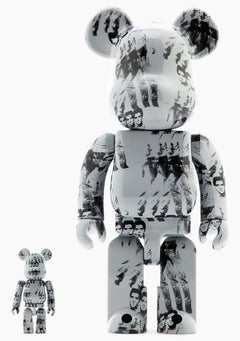
Andy Warhol Elvis Bearbrick 400%
100%
By Andy Warhol
Located in NEW YORK, NY
Be@rbrick x Andy Warhol Foundation "Elvis" Vinyl Figures: Set of two (400% & 100%):
Andy Warhol (after) Elvis collectible trademarked & licensed by the Estate of Andy Warhol. The partnered collectible reveals Warhol's iconic Triple Elvis wrapping the figure in its entirety. Housed in a standout Warhol Elvis collectors' box.
Medium: Vinyl Sculpture.
Set of two figurines. Dimensions of larger piece: 11 x 5 inches.
Condition: New in its original packaging.
Warhol foundation trademark featured on lower left of reverse.
Published by Medicom from a sold out edition of unknown.
Further Background:
BE@RBRICKs are a form of collectible toy that resemble a cross between LEGO and well, a bear. These block-style figurines boast teddy bear-style heads that have become an integral pillar of the collectible toy scene. In fact, it wouldn’t be so far-fetched to say that it almost single-handedly carved out the fad of toy collecting in modern times, treading the very fine line between toy and art. Since its inception, BE@RBRICKs have become one of the most recognizable characters in the world, and some of the most sought after.
Please note exact patterns may vary.
Andy Warhol Triple Elvis:
Standing with his trademark proud stance, Andy Warhol’s rare triple portrait of Elvis Presley dominates just as the singer dominated the cultural landscape of the 1950s and 1960s. First shown at the artist’s seminal 1963 exhibition at Irving Blum’s Ferus Gallery in Los Angeles, Warhol’s Elvis paintings...
Category
21st Century and Contemporary Pop Art More Art
Materials
Resin, Vinyl
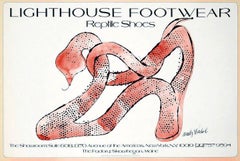
Andy Warhol Shoes poster 1979 (1970s Andy Warhol)
By Andy Warhol
Located in NEW YORK, NY
Andy Warhol illustrated advertising poster New York, 1979:
1970s Andy Warhol illustrated "Lighthouse Footwear Reptile Shoes," poster (New York, 1979). An elegant & well-sized vintage...
Category
1960s Pop Art Animal Prints
Materials
Lithograph, Offset
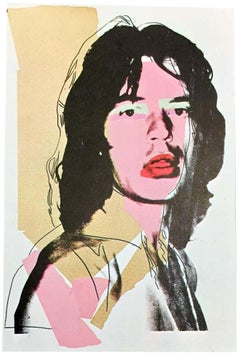
Andy Warhol Mick Jagger (portfolio of 10 Warhol Leo Castelli announcements)
By Andy Warhol
Located in NEW YORK, NY
Andy Warhol Mick Jagger, Leo Castelli gallery 1975:
A stunning set of ten announcement cards published by Castelli Graphics in 1975 to advertise the...
Category
1970s Pop Art Prints and Multiples
Materials
Offset
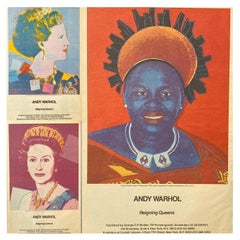
Warhol African Queens Advertisements, 1985
By Andy Warhol
Located in Brooklyn, NY
Vintage original advertisements for Warhol Queens at Leo Castelli gallery. Set of 3 circa 1985.
Offset print on newspaper stock.
Measures: 11 x 17 inches.
Minor signs of handling; o...
Category
Vintage 1980s Posters
Materials
Paper
$320 Sale Price / set
20% Off
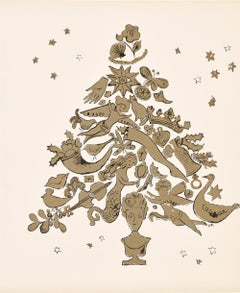
Andy Warhol Bodley Gallery announcement 1957 (1950s Andy Warhol)
By Andy Warhol
Located in NEW YORK, NY
Andy Warhol Bodley Gallery 1957:
A rare, 1950s gallery announcement offset illustrated by Andy Warhol on the occasion of: Andy Warhol Golden Pictures: December 2 - December 24, 1957: The Bodley Gallery 223 East 60th St., New York, NY. A scarce, historical Andy Warhol Pre-Pop illustration; highly collectible.
Medium: Double-sided offset lithograph in colors, on wove paper, with full margins, before folding.
Dimensions: 12 3/4 x 19 1/2 in. (32.4 x 49.5 cm)
Good overall vintage condition. Minor signs of aging & handling. Well-preserved.
Unsigned from an edition of unknown.
Warhol Foundation annotations in pencil on one side.
Provenance:
The Andy Warhol Foundation for the Visual Arts, New York.
Susan Sheehan Gallery, New York.
Private Collection, New York.
Literature:
Kornbluth: Pre-Pop Warhol, no. 66, pp. 164-165.
Further background:
Warhol’s career began as a commercial illustrator on New York’s Madison Avenue in 1949, during the massive post-war economic boom. His arrival additionally coincided with an extensive change in the motivations and strategies behind advertising, utilizing applied psychology to influence American consumers to purchase products. This stint as an ad man would further his Pop interest in cultural commercialization and start his artistic career; thus began the first chapter of Warhol’s oeuvre.
Several of Andy Warhol's earliest exhibitions in New York were at the Bodley during the 1950s, starting with two in 1956.
_
Obsessed with celebrity, consumer culture, and mechanical reproduction, Pop Art king, Andy Warhol created some of the 20th century’s most iconic images. Warhol was widely influenced by popular & consumer culture, with this being evident in some of his most famous works: 32 Campbell's soup cans, Brillo pad box sculptures, and portraits of Marilyn Monroe & Mick Jagger, for example. Rejecting the standard painting and sculpting modes of his era, Warhol embraced silk-screen printmaking to achieve his characteristic hard edges and flat areas of color. The artist mentored Keith Haring and Jean-Michel Basquiat and continues to influence contemporary art around the world: His most bold successors include Richard Prince, Takashi Murakami, and Jeff Koons. Warhol has been the subject of exhibitions at the Whitney Museum of American Art, Museum of Modern Art, Tate Modern, and Centre Pompidou, among other institutions.
Related Categories
1950s Andy Warhol. Vintage Andy Warhol. Mid century modern. Pop Art. Andy Warhol advertising...
Category
1950s Pop Art Figurative Prints
Materials
Paper, Lithograph
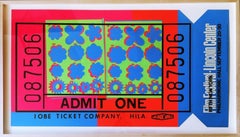
Deluxe Signed Edition of Film Festival Lincoln Center (Feldman
Schellmann, II)
By Andy Warhol
Located in New York, NY
Andy Warhol
Deluxe Signed Edition of Film Festival Lincoln Center (Feldman
Schellmann, II.19), 1967
Silkscreen, die-cut on opaque acrylic
Edition 2/200 (Signed and numbered on the back with engraving pen)
Hand-signed by artist, As this work was done on acrylic, Warhol signed and numbered it by hand on verso with an engraving needle. Printed date with copyright
Frame included: Elegantly framed in a museum quality wood frame with UV plexiglass. A die-cut window has been created in the back of the frame to reveal Warhol's incised signature and edition
Publisher: Leo Castelli, New York
Printer: Chiron Press, New York
Catalogue Raisonne: Feldman
Schellmann, II.19
This work is often hung and displayed both vertically and horizontally - see photos for inspiration
This work is one of only 200 done on opaque acrylic rather than wove paper, signed and numbered on the opaque acrylic by Andy Warhol with an engraving pen. (Separately, there was an unsigned edition of 500 on wove paper). What distinguishes this rare, extremely desirable signed edition of 200, other than that it is signed and numbered by hand by Andy Warhol, is that the black graphic text FIFTH NEW YORK is placed directly over the text Film Festival of Lincoln Center; whereas in the edition of 500, the text black text FIFTH NEW YORK is placed on top of the white text. An innovative feature that appears in this special edition is a perforated line running across the surface of the print, at its triangular cut out sides, mimicking the tear line present in real commercial movie admissions tickets. Chiron Press commissioned by Lincoln Center, devised a special process expressly to imprint the edition with this perforation using a die cut stamp. This work is quintessential early Warhol, with characteristic bright neon colors, featuring text, along with the artist's very recognizable flower motif. The Lincoln Center ticket...
Category
1960s Pop Art Abstract Prints
Materials
Plastic, Mixed Media, Screen
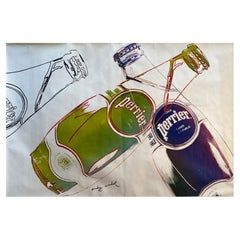
Original Vintage Advertising Poster, PERRIER by Andy Warhol c. 1983
By Andy Warhol
Located in Melbourne, Victoria
During the beginning of the 1980’s, Warhol began accepting commissions from a range of manufacturers and businesses; this screen print was an experimental design for French mineral w...
Category
Vintage 1980s American Mid-Century Modern Posters
Materials
Paper
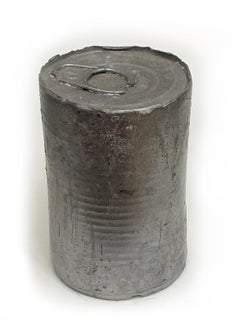
Campbell’s Pea Soup Can Sculpture, Edition of 2, 2017 by Shelter Serra
By Shelter Serra
Located in Brooklyn, NY
Campbell’s Pea Soup Can, 2017, 3.75”x2.5” inches diameter, cast aluminum, edition of 2.
Pop Artist Andy Warhol made the Campbell’s soup can an icon of Post War America.
This version, cast from an original can, in solid aluminum, is an ode to Mr. Warhol and a slight reference to Popeye, who ate spinach to increase his stamina.
Shelter Serra’s paintings, sculptures, and drawings explore mass consumption and cultural identity. He juxtaposes subject matters that are both common and recognizable: a Campbell's Soup Can, a copper plated baseball hat, and a Hermes Birkin bag...
Category
21st Century and Contemporary Pop Art Sculptures
Materials
Metal
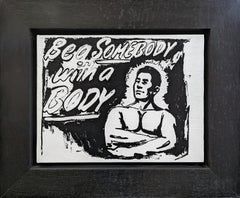
BE A SOMEBODY WITH A BODY (UNIQUE)
By Andy Warhol
Located in Aventura, FL
Unique acrylic painting and silkscreen on canvas. Hand signed and dated by Andy Warhol on verso. Authenticated on verso by Andy Warhol Authentication Board. Custom framed as pictu...
Category
1980s Pop Art Figurative Paintings
Materials
Board, Screen
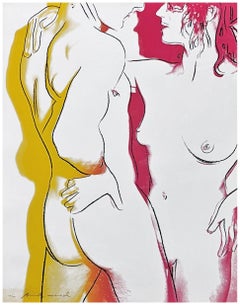
LOVE FS II.311
By Andy Warhol
Located in Aventura, FL
Screen print on Rives BFK paper. From the Love Portfolio. Hand signed and numbered lower front by Andy Warhol. Numbered 12/100 (there were also 10 AP's, 2 PP's, 5 EP's and 7 HC's). ...
Category
1980s Pop Art Figurative Prints
Materials
Board, Screen
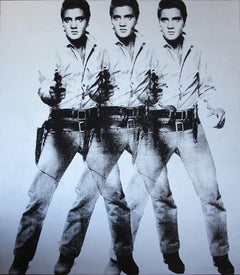
"Triple Elvis" Denied Andy Warhol Silver Black Pop Art Painting by Charles Lutz
By Charles Lutz
Located in Brooklyn, NY
"Triple Elvis" (Denied) Silkscreen Painting by Charles Lutz
Silkscreen and silver enamel paint on canvas with Artist's Denied stamp of the Andy Warhol Art Authentication Board.
82 x 72" inches
2010
This important example was shown alongside works by Warhol in a two-person show "Warhol Revisited (Charles Lutz / Andy Warhol)" at UAB Abroms-Engel Institute for the Visual Arts in 2024.
Lutz's 2007 ''Warhol Denied'' series gained international attention by calling into question the importance of originality or lack thereof in the work of Andy Warhol. The authentication/denial process of the [[Andy Warhol Art Authentication Board]] was used to create value by submitting recreations of Warhol works for judgment with the full intention for the works to be formally marked "DENIED". The final product of the conceptual project being "officially denied" "Warhol" paintings authored by Lutz.
Based on the full-length Elvis Presley paintings by Pop Artist Andy Warhol in 1964, this is likely one of his most iconic images, next to Campbell's Soup Cans and portraits of Jackie Kennedy, Marilyn Monroe, Liz Taylor, and Marlon Brando. This is the rarest of the Elvis works from the series, as Lutz sourced a vintage roll of 1960's primed artist linen which was used for this one Elvis. The silkscreen, like Warhol's embraced imperfections, like the slight double image printing of the Elvis image.
Lutz received his BFA in Painting and Art History from Pratt Institute and studied Human Dissection and Anatomy at Columbia University, New York. Lutz's work deals with perceptions and value structures, specifically the idea of the transference of values. Lutz's most recently presented an installation of new sculptures dealing with consumerism at Frank Lloyd Wright's Fallingwater House in 2022.
Lutz's 2007 Warhol Denied series received international attention calling into question the importance of originality in a work of art. The valuation process (authentication or denial) of the Andy Warhol Art Authentication Board was used by the artist to create value by submitting recreations of Warhol works for judgment, with the full intention for the works to be formally marked "DENIED" of their authenticity. The final product of this conceptual project is "Officially DENIED" "Warhol" paintings authored by Lutz.
Later in 2013, Lutz went on to do one of his largest public installations to date. At the 100th Anniversary of Marcel Duchamp's groundbreaking and controversial Armory Show, Lutz was asked by the curator of Armory Focus: USA and former Director of The Andy Warhol Museum, Eric Shiner to create a site-specific installation representing the US. The installation "Babel" (based on Pieter Bruegel's famous painting) consisted of 1500 cardboard replicas of Warhol's Brillo Box (Stockholm Type) stacked 20 ft tall. All 1500 boxes were then given to the public freely, debasing the Brillo Box as an art commodity by removing its value, in addition to debasing its willing consumers.
Elvis was "the greatest cultural force in the Twentieth Century. He introduced the beat to everything, and he changed everything - music, language, clothes, it's a whole new social revolution." Leonard Bernstein in: Exh. Cat., Boston, The Institute of Contemporary Art and traveling, Elvis + Marilyn 2 x Immortal, 1994-97, p. 9.
Andy Warhol "quite simply changed how we all see the world around us." Kynaston McShine in: Exh. Cat., New York, Museum of Modern Art (and traveling), Andy Warhol: Retrospective, 1996, p. 13.
In the summer of 1963 Elvis Presley was just twenty-eight years old but already a legend of his time. During the preceding seven years - since Heartbreak Hotel became the biggest-selling record of 1956 - he had recorded seventeen number-one singles and seven number-one albums; starred in eleven films, countless national TV appearances, tours, and live performances; earned tens of millions of dollars; and was instantly recognized across the globe. The undisputed King of Rock and Roll, Elvis was the biggest star alive: a cultural phenomenon of mythic proportions apparently no longer confined to the man alone. As the eminent composer Leonard Bernstein put it, Elvis was "the greatest cultural force in the Twentieth Century. He introduced the beat to everything, and he changed everything - music, language, clothes, it's a whole new social revolution." (Exh. Cat., Boston, The Institute of Contemporary Art (and traveling), Elvis + Marilyn 2 x Immortal, 1994, p. 9).
In the summer of 1963 Andy Warhol was thirty-four years old and transforming the parameters of visual culture in America. The focus of his signature silkscreen was leveled at subjects he brilliantly perceived as the most important concerns of day to day contemporary life. By appropriating the visual vernacular of consumer culture and multiplying readymade images gleaned from newspapers, magazines and advertising, he turned a mirror onto the contradictions behind quotidian existence. Above all else he was obsessed with themes of celebrity and death, executing intensely multifaceted and complex works in series that continue to resound with universal relevance. His unprecedented practice re-presented how society viewed itself, simultaneously reinforcing and radically undermining the collective psychology of popular culture. He epitomized the tide of change that swept through the 1960s and, as Kynaston McShine has concisely stated, "He quite simply changed how we all see the world around us." (Exh. Cat., New York, Museum of Modern Art (and traveling), Andy Warhol: Retrospective, 1996, p. 13).
Thus in the summer of 1963 there could not have been a more perfect alignment of artist and subject than Warhol and Elvis. Perhaps the most famous depiction of the biggest superstar by the original superstar artist, Double Elvis is a historic paradigm of Pop Art from a breath-taking moment in Art History. With devastating immediacy and efficiency, Warhol's canvas seduces our view with a stunning aesthetic and confronts our experience with a sophisticated array of thematic content. Not only is there all of Elvis, man and legend, but we are also presented with the specter of death, staring at us down the barrel of a gun; and the lone cowboy, confronting the great frontier and the American dream. The spray painted silver screen denotes the glamour and glory of cinema, the artificiality of fantasy, and the idea of a mirror that reveals our own reality back to us. At the same time, Warhol's replication of Elvis' image as a double stands as metaphor for the means and effects of mass-media and its inherent potential to manipulate and condition. These thematic strata function in simultaneous concert to deliver a work of phenomenal conceptual brilliance. The portrait of a man, the portrait of a country, and the portrait of a time, Double Elvis is an indisputable icon for our age.
The source image was a publicity still for the movie Flaming Star, starring Presley as the character Pacer Burton and directed by Don Siegel in 1960. The film was originally intended as a vehicle for Marlon Brando and produced by David Weisbart, who had made James Dean's Rebel Without a Cause in 1955. It was the first of two Twentieth Century Fox productions Presley was contracted to by his manager Colonel Tom Parker, determined to make the singer a movie star. For the compulsive movie-fan Warhol, the sheer power of Elvis wielding a revolver as the reluctant gunslinger presented the zenith of subject matter: ultimate celebrity invested with the ultimate power to issue death. Warhol's Elvis is physically larger than life and wears the expression that catapulted him into a million hearts: inexplicably and all at once fearful and resolute; vulnerable and predatory; innocent and explicit. It is the look of David Halberstam's observation that "Elvis Presley was an American original, the rebel as mother's boy, alternately sweet and sullen, ready on demand to be either respectable or rebellious." (Exh. Cat., Boston, Op. Cit.). Indeed, amidst Warhol's art there is only one other subject whose character so ethereally defies categorization and who so acutely conflated total fame with the inevitability of mortality. In Warhol's work, only Elvis and Marilyn harness a pictorial magnetism of mythic proportions.
With Marilyn Monroe, whom Warhol depicted immediately after her premature death in August 1962, he discovered a memento mori to unite the obsessions driving his career: glamour, beauty, fame, and death. As a star of the silver screen and the definitive international sex symbol, Marilyn epitomized the unattainable essence of superstardom that Warhol craved. Just as there was no question in 1963, there remains still none today that the male equivalent to Marilyn is Elvis. However, despite his famous 1968 adage, "If you want to know all about Andy Warhol, just look at the surface of my paintings" Warhol's fascination held purpose far beyond mere idolization. As Rainer Crone explained in 1970, Warhol was interested in movie stars above all else because they were "people who could justifiably be seen as the nearest thing to representatives of mass culture." (Rainer Crone, Andy Warhol, New York, 1970, p. 22). Warhol was singularly drawn to the idols of Elvis and Marilyn, as he was to Marlon Brando and Liz Taylor, because he implicitly understood the concurrence between the projection of their image and the projection of their brand. Some years after the present work he wrote, "In the early days of film, fans used to idolize a whole star - they would take one star and love everything about that star...So you should always have a product that's not just 'you.' An actress should count up her plays and movies and a model should count up her photographs and a writer should count up his words and an artist should count up his pictures so you always know exactly what you're worth, and you don't get stuck thinking your product is you and your fame, and your aura." (Andy Warhol, The Philosophy of Andy Warhol (From A to B and Back Again), San Diego, New York and London, 1977, p. 86).
The film stars of the late 1950s and early 1960s that most obsessed Warhol embodied tectonic shifts in wider cultural and societal values. In 1971 John Coplans argued that Warhol was transfixed by the subject of Elvis, and to a lesser degree by Marlon Brando and James Dean, because they were "authentically creative, and not merely products of Hollywood's fantasy or commercialism. All three had originative lives, and therefore are strong personalities; all three raised - at one level or another - important questions as to the quality of life in America and the nature of its freedoms. Implicit in their attitude is a condemnation of society and its ways; they project an image of the necessity for the individual to search for his own future, not passively, but aggressively, with commitment and passion." (John Coplans, "Andy Warhol and Elvis Presley," Studio International, vol. 181, no. 930, February 1971, pp. 51-52). However, while Warhol unquestionably adored these idols as transformative heralds, the suggestion that his paintings of Elvis...
Category
21st Century and Contemporary Pop Art Figurative Paintings
Materials
Enamel
Andy Warhol,
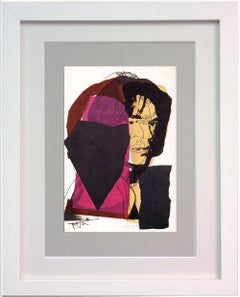
Mick Jagger FSII.139
, Framed Announcement-card, 1975
By (after) Andy Warhol
Located in Pembroke Pines, FL
Artist: Andy Warhol.
Title: 'Mick Jagger' FS II.139 Framed Announcement card.
Medium: Lithograph
Size: Image size: 6" x 4"
Framed: 10" x 8"
Year: 1975
Description: Signed and numbere...
Category
1970s Pop Art Figurative Prints
Materials
Offset
Denied Warhol Campbell
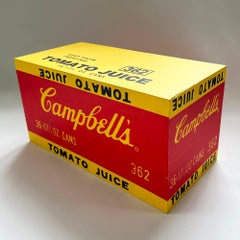
s Soup box Contemporary Pop Art Sculpture by Charles Lutz
By Charles Lutz
Located in Brooklyn, NY
Denied Warhol Campbell's Soup Box Yellow Contemporary Pop Art Sculpture by Charles Lutz.
Silkscreen and latex paint on wood, stamped with the artist's replica of the Warhol Authent...
Category
21st Century and Contemporary Contemporary Sculptures
Materials
Wood, Acrylic
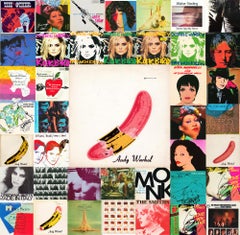
Andy Warhol Designed Record Cover Art: 1955-1987: a collection of 40 works
By Andy Warhol
Located in NEW YORK, NY
Andy Warhol Album Cover Art: a set of 40 works (1955-1987):
A rare collection of 40 individual Andy Warhol illustrated record covers accompanied by their respective vinyl records. Mo...
Category
1960s Pop Art More Art
Materials
Lithograph, Offset
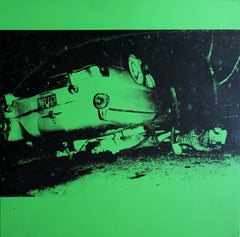
Denied Andy Warhol Green Disaster Car Crash Silkscreen Painting by Charles Lutz
By Charles Lutz
Located in Brooklyn, NY
Denied Warhol Green Disaster Painting by Charles Lutz
Silkscreen and acrylic on linen with Denied stamp of the Andy Warhol Art Authentication Board.
...
Category
Early 2000s Contemporary Figurative Paintings
Materials
Acrylic
$10,500 Sale Price
30% Off
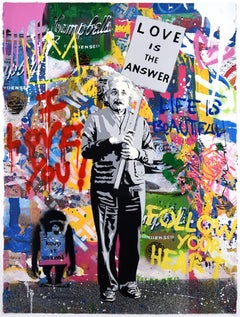
Einstein Love is the Answer
By Mr. Brainwash
Located in Palo Alto, CA
Mr. Brainwash Einstein Love is the Answer 2023, is a vibrant and stimulating work featuring Albert Einstein, a pillar of history and modern...
Category
2010s Contemporary Figurative Prints
Materials
Mixed Media, Screen
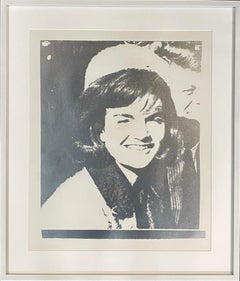
Jacqueline Kennedy (Jackie I)
By Andy Warhol
Located in Milford, NH
A fine limited edition silver screenprint of Jacqueline Kennedy (Jackie I) by well known American artist Andy Warhol (1928-1987). Warhol was born in Pittsburgh, PA, studied at the Ca...
Category
1960s Pop Art Portrait Prints
Materials
Paper, Screen
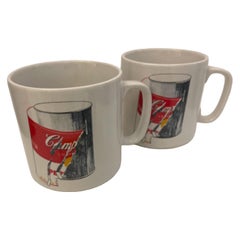
Andy Warhol American Modern Campbell
s Soup Pattern Coffee Mugs
By Andy Warhol
Located in Queens, NY
SET OF 8 Andy Warhol American Modern coffee large mugs featuring a variety of Campbell's soup cans against a white background. (3 tomato, 3 chicken noodle, 2 peeling label (PRICED AS...
Category
20th Century American Modern Tea Sets
Materials
Other
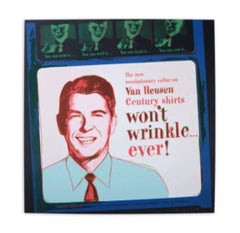
Van Heusen (Ronald Reagan), By Andy Warhol
By Andy Warhol
Located in Dubai, Dubai
Van Heusen (Ronald Reagan). F. & S. II.356.
By Andy Warhol
Andy Warhol, a leading figure in the Pop Art movement, revolutionized the art world with his iconic works that celebrated...
Category
1980s Contemporary Figurative Prints
Materials
Screen, Board
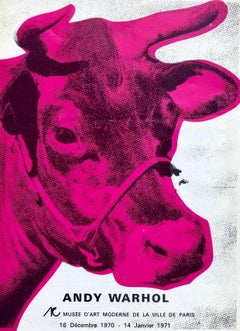
Andy Warhol Musee d’Art Moderne catalog (Warhol Cow)
By Andy Warhol
Located in NEW YORK, NY
Andy Warhol Paris, Musee d’Art Moderne de la Ville de Paris, 1970:
Rare original Andy Warhol exhibition catalog featuring a Warhol Pink Cow cover.
Published on the occasion of the Warhol solo show at the MAM, Paris, Dec. 16, 1970 - Jan. 14, 1971. A must have rare vintage Andy Warhol Cows collectible.
1st edition; 1970. Single sheet folded, twelve-page accordion style booklet. Text by Alfred Pacquement (French). Exhibition checklist found within. Reverse features a candid, black and white portrait of Warhol.
Medium: Offset printed Exhibition Catalog.
Dimensions: Folded 7.75 × 10.5 inches; Unfolded: 7.75 x 47 inches.
Condition: Very good overall vintage condition; hand written notations to interior first page.
Unsigned from edition of unknown.
Further Background:
Andy Warhol was inspired to by art dealer Ivan Karp to create his Cows in the 1960s. Warhol’s printer Gerard Malanga chose the photograph of the cow, however it was Warhol’s unique pop art style that made the final product so interested. He chose a bold color scheme of bright pink on yellow, which turned the pastoral animal into an amusing and oddly exciting subject matter. Warhol then printed the electrifying Cow image on wallpaper, introducing this process to his creative production. In Warhol’s classic mode of repetition, every inch of the walls were covered with hot pink and yellow Cows. Castelli was so moved by the show, that he had professionals install the wallpaper so that the guests could experience Andy Warhol’s vision.
_
Obsessed with celebrity, consumer culture, and mechanical reproduction, Pop Art king, Andy Warhol created some of the 20th century’s most iconic images. Warhol was widely influenced by popular & consumer culture, with this being evident in some of his most famous works: 32 Campbell's soup cans, Brillo pad box sculptures, and portraits of Marilyn Monroe & Mick Jagger, for example. Rejecting the standard painting and sculpting modes of his era, Warhol embraced silk-screen printmaking to achieve his characteristic hard edges and flat areas of color. The artist mentored Keith Haring and Jean-Michel Basquiat and continues to influence contemporary art around the world: His most bold successors include Richard Prince, Takashi Murakami, and Jeff Koons. Warhol has been the subject of exhibitions at the Whitney Museum of American Art, Museum of Modern Art, Tate Modern, and Centre Pompidou, among other institutions.
Related Categories
Warhol prints. Warhol prints. Warhol screen print...
Category
1970s Pop Art More Art
Materials
Paper, Offset
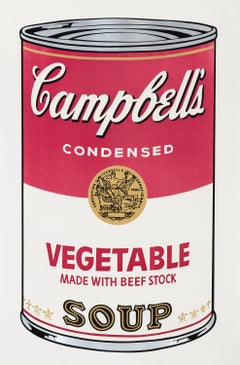
Vegetable Made With Beef Stock - Pop Art Screen Print, 1968
By Andy Warhol
Located in Palm Desert, CA
“Vegetable Made With Beef Stock” is an AP screenprint by American Pop artist, Andy Warhol. The work is AP Q/Z and is signed verso, "Andy Warhol Q"
Andy Warhol's Campbell's Soup I: Vegetable Soup (1968) is part of his first screenprint portfolio dedicated to the iconic soup cans, produced in an edition of 250 with additional artist's proofs. The speed with which the art world embraced Warhol was remarkable: in July 1962, his thirty-two Campbell's Soup Cans paintings debuted at the Ferus Gallery in Los Angeles, quickly cementing his reputation. Those early canvases, among his last hand-painted works, appeared almost mechanically produced, but Warhol soon abandoned the brush in favor of silkscreen, a commercial process that allowed for both endless repetition and striking variations of his chosen subjects. Vegetable Soup was one of the original thirty-two varieties and remains a pop culture phenomenon, continually reappearing on everything from plates and mugs to t-shirts, neckties, and even surfboards...
Category
Mid-20th Century Pop Art Still-life Prints
Materials
Screen
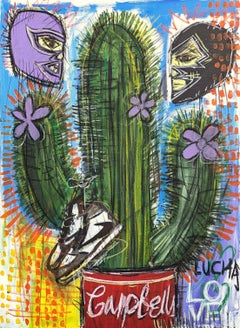
Contemporary Colorful Abstract Cactus, Campbell
s Soup, and Luchador Painting
Located in Houston, TX
Colorful contemporary abstract painting by Houston-based artist Ramon Severino. The work features a central cactus in a Campbell's soup can with a pair of sneakers hanging off of it....
Category
2010s Contemporary Abstract Paintings
Materials
Canvas, Mixed Media
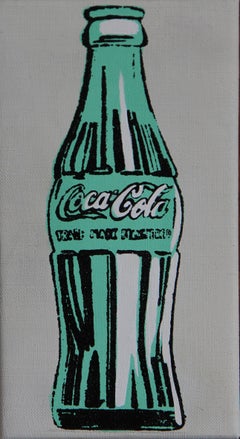
Denied Andy Warhol Coca Cola Bottle linen Painting by Charles Lutz
By Charles Lutz
Located in Brooklyn, NY
Denied Warhol Flowers, (White & Green) Silkscreen Linen Painting by Charles Lutz
Silkscreen and acrylic on linen with Denied stamp of the Andy Warhol Art Authentication Board.
11 x ...
Category
21st Century and Contemporary Contemporary Paintings
Materials
Linen, Acrylic
Denied Andy Warhol Flowers, (Red) Silkscreen linen Painting by Charles Lutz
By Charles Lutz
Located in Brooklyn, NY
Denied Warhol Flowers, (Red) Silkscreen Linen Painting by Charles Lutz
Silkscreen and acrylic on linen with Denied stamp of the Andy Warhol Art Authentication Board.
24 x 24" inches...
Category
21st Century and Contemporary Contemporary Paintings
Materials
Linen, Acrylic
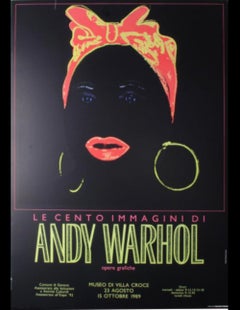
Le Cento Immagini di Andy Warhol
By Andy Warhol
Located in Dubai, Dubai
Le Cento Immagini di Andy Warhol
By Andy Warhol
Andy Warhol, a leading figure in the Pop Art movement, revolutionized the art world with his iconic works that celebrated consumer c...
Category
1980s Contemporary Figurative Prints
Materials
Lithograph
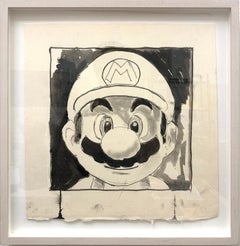
Mario (Grin), 2018, Ink and pencil on paper, black and white, by Shelter Serra
By Shelter Serra
Located in Brooklyn, NY
Mario (Grin)
2018
16”x16.5”x1.25” inches
Sumi ink and pencil on Japanese Washi Paper
Mario, the main character from the Super Mario Bros. video game is one of the most recognizable images and a true archetype of our contemporary society. This traditional hand-drawn portrait of Mario in ink on paper, renders his likeness akin to a snapshot, or cell, removing him from the digital realm and freezing him in our tangible world of reality.
Shelter Serra’s paintings, sculptures, and drawings explore mass consumption and cultural identity. He juxtaposes subject matters that are both common and recognizable: a Campbell's Soup Can, a copper plated baseball hat, and a Hermes Birkin bag...
Category
21st Century and Contemporary Contemporary Paintings
Materials
Sumi Ink, Washi Paper, Pencil
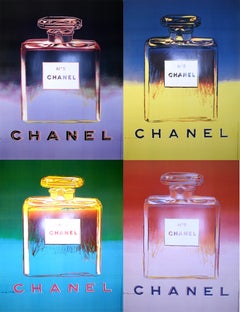
Chanel No. 5 Complete Poster Set of 4 by Andy Warhol Original 1997
By Andy Warhol
Located in Boca Raton, FL
This is a complete set of four original vintage posters created in the 1990's for Chanel No. 5 Perfume. Each poster uses an image created by the American artist, Andy Warhol (1928 -1...
Category
1990s More Prints
Materials
Lithograph
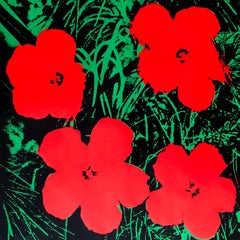
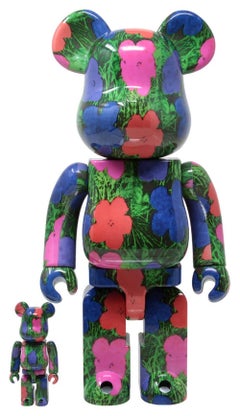
Andy Warhol Flowers Bearbrick 400% and 100% (Warhol Be@rbrick)
By Andy Warhol
Located in NEW YORK, NY
(after) Andy Warhol Flowers Bearbrick 400% & 100%:
Andy Warhol Flowers art toy trademarked & licensed by the Estate of Andy Warhol. The partnered collectible reveals Warhol's iconic Flowers imagery wrapping the figure in its entirety. Housed in a standout Warhol Flowers collectors' box.
Medium: Vinyl Figurine.
Set of two figurines. Dimensions of larger piece: 11 x 5 inches.
Condition: New in its original packaging.
Warhol foundation trademark featured on lower left of reverse.
Published by Medicom from a sold out edition of unknown.
Further Background:
BE@RBRICKs are a form of collectible toy that resemble a cross between LEGO and well, a bear. These block-style figurines boast teddy bear-style heads that have become an integral pillar of the collectible toy scene. In fact, it wouldn’t be so far-fetched to say that it almost single-handedly carved out the fad of toy collecting in modern times, treading the very fine line between toy and art. Since its inception, BE@RBRICKs have become one of the most recognizable characters in the world, and some of the most sought after.
Please note exact patterns may vary.
Further Background:
The idea to paint flowers as the subject of a major series was apparently suggested to Warhol by Henry Geldzahler, then curator at the Metropolitan Museum in New York. To some degree, the pictures belong to a long art historical tradition of still-life painting. "With the Flowers, Andy was just trying a different subject matter. In a funny way, he was kind of repeating the history of art. It was like, now we're doing my Flower period! Like Monet's water lillies, Van Gogh...
Category
21st Century and Contemporary Pop Art More Art
Materials
Resin, Vinyl
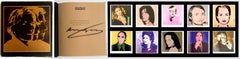
Portraits of the 1970s, Deluxe Monograph + Slipcase Hand Signed/N by Andy Warhol
By Andy Warhol
Located in New York, NY
Andy Warhol: Portraits of the 70s
First edition, limited edition hardback with slipcase and 120 Bound offset lithographs and text
Published by Random House, New York in association with the Whitney Museum of American Art, 1979
Essay by Robert Rosenblum
Edited by David Whitney
ISBN 0-394-50655-3
Signed and numbered to the title page
Edition 7/200
9 1/2 × 8 1/2 × 2 inches
Provenance
The original (uptown) Whitney Museum
An amazing and historic gift! As dazzling as the Warhol show was in 2019 at the new Whitney Museum -- only his show in the late 1970s at the old Whitney Museum, could offer this Deluxe limited edition collectors item - hand signed and numbered by Andy Warhol - because the latter was published during his lifetime. This rare 1979 First (and only) Edition hardback monograph is held in the original slipcase, and is hand signed by Andy Warhol and numbered 108 out of only 200 on the first front end page (see image). This collectors item features text, accompanied by 120 full page color offset lithograph bound, double sided plates on regular pages. (Total pages are: 145) It was published by the Whitney Museum in collaboration with Random House, in conjunction with the exhibition held at the Whitney Museum of American Art, November 20, 1979 to January 27, 1980. Text foreword is by Tom Armstrong, the Whitney's director. Total pages are: 145. The Warhol portraits included are: Giovanni Agnelli, Marella Agnelli, Corice Arman, Marian Block, Irving Blum, Truman Capote, Cristina Caramati, Leo Castelli, Carol Coleman, Norman Fisher, Kay Fortson, Tina Freeman, Diane Von Furstenberg, Henry Geldzahler, Halston, Brooke Hayward...
Category
1970s Pop Art More Art
Materials
Offset
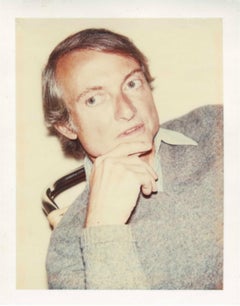
Unique portrait of Roy Lichtenstein, Authenticated by the Andy Warhol Foundation
By Andy Warhol
Located in New York, NY
Andy Warhol
Portrait of Roy Lichtenstein, 1975
Polaroid dye-diffusion print
Authenticated by the Andy Warhol Foundation for the Visual Arts, bears the Foundation stamp verso
Frame included: Framed in white wood frame with UV plexiglass; with die-cut window in the back to show official Warhol Foundation authentication stamp and text
Measurements:
9 9/16 x 8 9/16 x 9/16 inches (frame)
3 1/2 x 2 3/4 inches (window)
4.16 x 3.15 inches (Artwork)
Authenticated and stamped by the Estate of Andy Warhol/Warhol Foundation for the Visual Arts
An impressive piece of Pop Art history! A must-have for fans and collectors of both Andy Warhol and Roy Lichtenstein: This is a unique, authenticated color Polaroid taken by one Pop Art legend, Andy Warhol, of his most formidable contemporary and, in many respects, rival, Roy Lichtenstein. One of only a few portraits Andy Warhol took of Roy Lichtenstein, during one tense photo shoot. Both iconic artists, colleagues and, perhaps lesser known to the public, rivals, would be represented at the time by the renowned Leo Castelli Gallery. The truth is - they were really more rivals than friends. (the rivalry intensified when Warhol, who was working with Walt Disney, discovered that Lichtenstein painted Mickey Mouse before he did!!) Leo Castelli was committed to Roy Lichtenstein, and, it's easy to forget today, wasn't that interested in Warhol as he considered Lichtenstein the greater talent and he could relate better with Roy on a personal level. However, Ivan Karp, who worked at Castelli, was very interested in Warhol, as were some powerful European dealers, as well as many wealthy and influential American and European collectors. That was the start of Warhol's bypassing the traditional gallery model - so that dealers like Castelli could re-discover him after everybody else had.
Warhol is known to have taken hundreds of self-portrait polaroid photographs - shoe boxes full - and he took many dozens of images of celebrities like Blondie and Farrah Fawcett. But only a small number of photographic portraits of fellow Pop Art legend Roy Lichtenstein -- each unique,- are known to have appeared on the market over the past half a century - all from the same photo session. This is one of them. There is another Polaroid - from this same (and only) sitting, in the permanent collection of the Getty Museum in California.
There really weren't any other collaborations between these two titans, making the resulting portrait from this photo session extraordinary. It is fascinating to study Roy Lichtenstein's face and demeanor in this photograph, in the context of the great sense of competition, but perhaps even greater, albeit uneasy respect, these two larger than life Pop art titans had for each other: Like Leo Castelli, Roy Lichtenstein was Jewish of European descent; whereas Warhol was Catholic and quintessentially American, though also of European (Polish) descent. They were never going to be good friends, but this portrait, perhaps even arranged by Leo Castelli, represents an uneasy acknowledgement there would be room at the top for both of them.
Floated, framed with die cut back revealing authentication details, and ready to hang.
Measurements:
9 9/16 x 8 9/16 x 9/16 inches (frame)
3 1/2 x 2 3/4 inches (window)
4.16 x 3.15 inches (sheet)
Authenticated by the Estate of Andy Warhol/The Andy Warhol Foundation for the Visual Arts. Estate Stamped: Stamped with the Andy Warhol Estate, Warhol Foundation for the Visual Arts stamp, numbered "B 512536P", with the Estate of Andy Warhol stamp and inscribed UP on the reverse. Bears the Warhol Foundation unique inventory number.
Roy Lichtenstein Biography
Roy Lichtenstein was one of the most influential and innovative artists of the second half of the twentieth century. He is preeminently identified with Pop Art, a movement he helped originate, and his first fully achieved paintings were based on imagery from comic strips and advertisements and rendered in a style mimicking the crude printing processes of newspaper reproduction. These paintings reinvigorated the American art scene and altered the history of modern art. Lichtenstein’s success was matched by his focus and energy, and after his initial triumph in the early 1960s, he went on to create an oeuvre of more than 5,000 paintings, prints, drawings, sculptures, murals and other objects celebrated for their wit and invention.
Roy Fox Lichtenstein was born on October 27, 1923, in New York City, the first of two children born to Milton and Beatrice Werner Lichtenstein. Milton Lichtenstein (1893–1946) was a successful real estate broker, and Beatrice Lichtenstein (1896–1991), a homemaker, had trained as a pianist, and she exposed Roy and his sister Rénee to museums, concerts and other aspects of New York culture. Roy showed artistic and musical ability early on: he drew, painted and sculpted as a teenager, and spent many hours in the American Museum of Natural History and the Museum of Modern Art. He played piano and clarinet, and developed an enduring love of jazz, frequenting the nightspots in Midtown to hear it.
Lichtenstein attended the Franklin School for Boys, a private junior high and high school, and was graduated in 1940. That summer he studied painting and drawing from the model at the Art Students League of New York with Reginald Marsh. In September he entered Ohio State University (OSU) in Columbus in the College of Education. His early artistic idols were Rembrandt, Daumier and Picasso, and he often said that Guernica (1937; Museo Reina Sofía, Madrid), then on long-term loan to the Museum of Modern Art, was his favorite painting. Even as an undergraduate, Lichtenstein objected to the notion that one set of lines (one person’s drawings) “was considered brilliant, and somebody’s else’s, that may have looked better to you, was considered nothing by almost everyone.”i Lichtenstein’s questioning of accepted canons of taste was encouraged by Hoyt L. Sherman, a teacher whom he maintained was the person who showed him how to see and whose perception-based approach to art shaped his own.
In February 1943, Lichtenstein was drafted, and he was sent to Europe in 1945. As part of the infantry, he saw action in France, Belgium and Germany. He made sketches throughout his time in Europe and, after peace was declared there, he intended to study at the Sorbonne. Lichtenstein arrived in Paris in October 1945 and enrolled in classes in French language and civilization, but soon learned that his father was gravely ill. He returned to New York in January 1946, a few weeks before Milton Lichtenstein died. In the spring of that year, Lichtenstein went back to OSU to complete his BFA and in the fall he was invited to join the faculty as an instructor. In June 1949, he married Isabel Wilson Sarisky (1921–80), who worked in a cooperative art gallery in Cleveland where Lichtenstein had exhibited his work. While he was teaching, Lichtenstein worked on his master’s degree, which he received in 1949. During his second stint at OSU, Lichtenstein became closer to Sherman, and began teaching his method on how to organize and unify a composition. Lichtenstein remained appreciative of Sherman’s impact on him. He gave his first son the middle name of “Hoyt,” and in 1994 he donated funds to endow the Hoyt L. Sherman Studio Art Center at OSU.
In the late 1940s and early 1950s, Lichtenstein began working in series and his iconography was drawn from printed images. His first sustained theme, intimate paintings and prints in the vein of Paul Klee that poked lyrical fun at medieval knights, castles and maidens, may well have been inspired by a book about the Bayeux Tapestry. Lichtenstein then took an ironic look at nineteenth-century American genre paintings he saw in history books, creating Cubist interpretations of cowboys and Indians spiked with a faux-primitive whimsy.
As with his most celebrated Pop paintings of the 1960s, Lichtenstein gravitated toward what he would characterize as the “dumbest” or “worst” visual item he could find and then went on to alter or improve it. In the 1960s, commercial art was considered beneath contempt by the art world; in the early 1950s, with the rise of Abstract Expressionism, nineteenth-century American narrative and genre paintings were at the nadir of their reputation among critics and collectors. Paraphrasing, particularly the paraphrasing of despised images, became a paramount feature of Lichtenstein’s art. Well before finding his signature mode of expression in 1961, Lichtenstein called attention to the artifice of conventions and taste that permeated art and society. What others dismissed as trivial fascinated him as classic and idealized—in his words, “a purely American mythological subject matter.”ii
Lichtenstein’s teaching contract at OSU was not renewed for the 1951–52 academic year, and in the autumn of 1951 he and Isabel moved to Cleveland. Isabel Lichtenstein became an interior decorator specializing in modern design, with a clientele drawn from wealthy Cleveland families. Whereas her career blossomed, Lichtenstein did not continue to teach at the university level. He had a series of part-time jobs, including industrial draftsman, furniture designer, window dresser and rendering mechanical dials for an electrical instrument company. In response to these experiences, he introduced quirkily rendered motors, valves and other mechanical elements into his paintings and prints. In 1954, the Lichtensteins’ first son, David, was born; two years later, their second child, Mitchell, followed. Despite the relative lack of interest in his work in Cleveland, Lichtenstein did place his work with New York dealers, which always mattered immensely to him. He had his first solo show at the Carlebach Gallery in New York in 1951, followed by representation with the John Heller Gallery from 1952 to 1957.
To reclaim his academic career and get closer to New York, Lichtenstein accepted a position as an assistant professor at the State University of New York at Oswego, in the northern reaches of the state. He was hired to teach industrial design, beginning in September 1957. Oswego turned out to be more geographically and aesthetically isolated than Cleveland ever was, but the move was propitious, for both his art and his career. Lichtenstein broke away from representation to a fully abstract style, applying broad swaths of pigment to the canvas by dragging the paint across its surface with a rag wrapped around his arm. At the same time, Lichtenstein was embedding comic-book characters figures such as Mickey Mouse and Donald Duck in brushy, expressionistic backgrounds. None of the proto-cartoon paintings from this period survive, but several pencil and pastel studies from that time, which he kept, document his intentions. Finally, when he was in Oswego, Lichtenstein met Reginald Neal, the new head of the art department at Douglass College, the women’s college of Rutgers University, in New Brunswick, New Jersey. The school was strengthening and expanding its studio art program, and when Neal needed to add a faculty member to his department, Lichtenstein was invited to apply for the job. Lichtenstein was offered the position of assistant professor, and he began teaching at Douglass in September 1960.
At Douglass, Lichtenstein was thrown into a maelstrom of artistic ferment. With New York museums and galleries an hour away, and colleagues Geoffrey Hendricks and Robert Watts at Douglass and Allan Kaprow and George Segal at Rutgers, the environment could not help but galvanize him. In June 1961, Lichtenstein returned to the idea he had fooled around with in Oswego, which was to combine cartoon characters from comic books with abstract backgrounds. But, as Lichtenstein said, “[I]t occurred to me to do it by mimicking the cartoon style without the paint texture, calligraphic line, modulation—all the things involved in expressionism.”iii Most famously, Lichtenstein appropriated the Benday dots, the minute mechanical patterning used in commercial engraving, to convey texture and gradations of color—a stylistic language synonymous with his subject matter. The dots became a trademark device forever identified with Lichtenstein and Pop Art. Lichtenstein may not have calibrated the depth of his breakthrough immediately but he did realize that the flat affect and deadpan presentation of the comic-strip panel blown up and reorganized in the Sherman-inflected way “was just so much more compelling”iv than the gestural abstraction he had been practicing.
Among the first extant paintings in this new mode—based on comic strips and illustrations from advertisements—were Popeye and Look Mickey, which were swiftly followed by The Engagement Ring, Girl with Ball and Step-on Can with Leg. Kaprow recognized the energy and radicalism of these canvases and arranged for Lichtenstein to show them to Ivan Karp, director of the Leo Castelli Gallery. Castelli was New York’s leading dealer in contemporary art, and he had staged landmark exhibitions of Jasper Johns and Robert Rauschenberg in 1958 and Frank Stella in 1960. Karp was immediately attracted to Lichtenstein’s paintings, but Castelli was slower to make a decision, partly on account of the paintings’ plebeian roots in commercial art, but also because, unknown to Lichtenstein, two other artists had recently come to his attention—Andy Warhol and James Rosenquist—and Castelli was only ready for one of them. After some deliberation, Castelli chose to represent Lichtenstein, and the first exhibition of the comic-book paintings was held at the gallery from February 10 to March 3, 1962. The show sold out and made Lichtenstein notorious. By the time of Lichtenstein’s second solo exhibition at Castelli in September 1963, his work had been showcased in museums and galleries around the country. He was usually grouped with Johns, Rauschenberg, Warhol, Rosenquist, Segal, Jim Dine, Claes Oldenburg, Robert Indiana and Tom Wesselmann. Taken together, their work was viewed as a slap in the face to Abstract Expressionism and, indeed, the Pop artists shifted attention away from many members of the New York School.
With the advent of critical and commercial success, Lichtenstein made significant changes in his life and continued to investigate new possibilities in his art. After separating from his wife, he moved from New Jersey to Manhattan in 1963; in 1964, he resigned from his teaching position at Douglass to concentrate exclusively on his work. The artist also ventured beyond comic book subjects, essaying paintings based on oils by Cézanne, Mondrian and Picasso, as well as still lifes and landscapes.
Lichtenstein became a prolific printmaker and expanded into sculpture, which he had not attempted since the mid-1950s, and in both two- and three-dimensional pieces, he employed a host of industrial or “non-art” materials, and designed mass-produced editioned objects that were less expensive than traditional paintings and sculpture. Participating in one such project—the American Supermarket show in 1964 at the Paul Bianchini Gallery, for which he designed a shopping bag—Lichtenstein met Dorothy Herzka (b. 1939), a gallery employee, whom he married in 1968. The late 1960s also saw Lichtenstein’s first museum surveys: in 1967 the Pasadena Art Museum initiated a traveling retrospective, in 1968 the Stedelijk Musem in Amsterdam presented his first European retrospective, and in 1969 he had his first New York retrospective, at the Solomon R. Guggenheim Museum.
Wanting to grow, Lichtenstein turned away from the comic book subjects that had brought him prominence. In the late 1960s his work became less narrative and more abstract, as he continued to meditate on the nature of the art enterprise itself. He began to explore and deconstruct the notion of brushstrokes—the building blocks of Western painting. Brushstrokes are conventionally conceived as vehicles of expression, but Lichtenstein made them into a subject. Modern artists have typically maintained that the subject of a painting is painting itself. Lichtenstein took this idea one imaginative step further: a compositional element could serve as the subject matter of a work and make that bromide ring true.
The search for new forms and sources was even more emphatic after 1970, when Roy and Dorothy Lichtenstein bought property in Southampton, New York, and made it their primary residence. During the fertile decade of the 1970s, Lichtenstein probed an aspect of perception that had steadily preoccupied him: how easily the unreal is validated as the real because viewers have accepted so many visual conceptions that they don’t analyze what they see. In the Mirror series, he dealt with light and shadow upon glass, and in the Entablature series, he considered the same phenomena by abstracting such Beaux-Art architectural elements as cornices, dentils, capitals and columns. Similarly, Lichtenstein created pioneering painted bronze sculpture that subverted the medium’s conventional three-dimensionality and permanence. The bronze forms were as flat and thin as possible, more related to line than volume, and they portrayed the most fugitive sensations—curls of steam, rays of light and reflections on glass. The steam, the reflections and the shadow were signs for themselves that would immediately be recognized as such by any viewer.
Another entire panoply of works produced during the 1970s were complex encounters with Cubism, Futurism, Purism, Surrealism and Expressionism. Lichtenstein expanded his palette beyond red, blue, yellow, black, white and green, and invented and combined forms. He was not merely isolating found images, but juxtaposing, overlapping, fragmenting and recomposing them. In the words of art historian Jack Cowart, Lichtenstein’s virtuosic compositions were “a rich dialogue of forms—all intuitively modified and released from their nominal sources.”v In the early 1980s, which coincided with re-establishing a studio in New York City, Lichtenstein was also at the apex of a busy mural career. In the 1960s and 1970s, he had completed four murals; between 1983 and 1990, he created five. He also completed major commissions for public sculptures in Miami Beach, Columbus, Minneapolis, Paris, Barcelona and Singapore.
Lichtenstein created three major series in the 1990s, each emblematic of his ongoing interest in solving pictorial problems. The Interiors, mural-sized canvases inspired by a miniscule advertisement in an Italian telephone...
Category
1970s Pop Art Portrait Photography
Materials
Polaroid
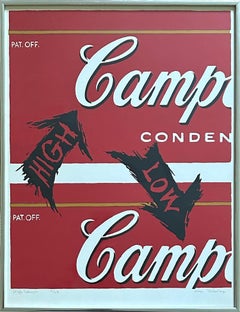
"High Camp" Screen print after Andy Warhol Campbells Soup
Located in Brooklyn, NY
Original three color silkscreen print depicting Campbell's soup can labels with arrows pointing to High and Low "Camp". This piece is hand numbered 6/25 and titled and signed by the ...
Category
20th Century Abstract Prints
Materials
Handmade Paper, Screen
$675 Sale Price
25% Off
Kerry James Marshall - May 15 2001 signed/N, iconic silkscreen Black art, Framed
By Kerry James Marshall
Located in New York, NY
Kerry James Marshall
May 15, 2001, 2003
Four color silkscreen on Arches 88 paper
Pencil signed, dated and numbered 39/60 on the front. Bears printer's blind stamp
Vintage frame incl...
Category
Early 2000s Contemporary Figurative Prints
Materials
Screen

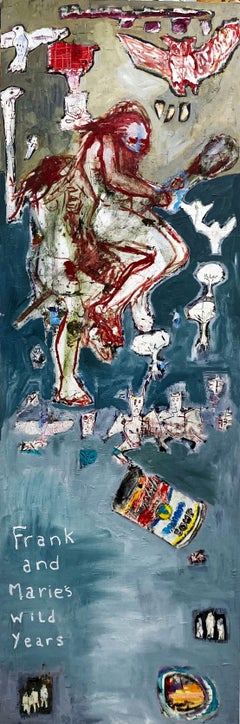
Frank
Marie
s Wild Years colorful, nudes flying broomstick w bats text
By C. Dimitri
Located in Brooklyn, NY
Portrait, figures, narrative, landscape. Inspired by Goya, Warhol. ( Campbell Soup can)
Oil paint and mixed media on panel.
Category
2010s Post-Impressionist Figurative Paintings
Materials
Mixed Media, Oil, Wood Panel
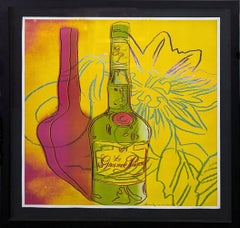
La Grande Passion FS IIIB.28 (Hand Signed)
By Andy Warhol
Located in Aventura, FL
Screen print in colors on paper. Hand signed and dated lower front by Andy Warhol. Only 100 were hand signed. Artwork size 37 x 39 inches. Frame size approx 44 x 46 inches.
This...
Category
1970s Pop Art Figurative Prints
Materials
Paper, Screen
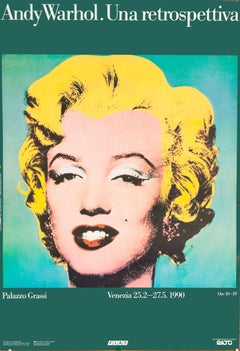
Andy Warhol Retrospective 1990 Vintage Pop Art Poster
By Andy Warhol
Located in Dubai, Dubai
Andy Warhol Retrospective 1990 Vintage Pop Art Poster
By Andy Warhol
Andy Warhol, a leading figure in the Pop Art movement, revolutionized th...
Category
1990s Contemporary Figurative Prints
Materials
Lithograph
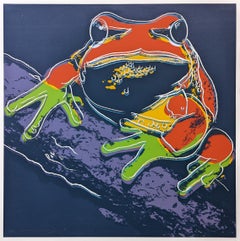
PINE BARRENS TREE FROG FS II.294
By Andy Warhol
Located in Aventura, FL
Pine Barren's Tree Frog, from Endangered Species. Screen print in colors on Lennox Museum Board. Hand signed and numbered by Andy Warhol. Edition 114/150 (there were also 30 AP's, 5 PP's, 5 EP's, 3 HC's, 10 numbered in Roman numerals, 1 BAT, and 30 TP's). Printed By Rupert Jansen Smith, Ny. Published By Ronald Feldman Fine Art Inc., NY.
Artwork is in excellent condition. All reasonable offers will be considered.
From the Endangered Species portfolio, which premiered in 1983. Warhol was commissioned by environmentalists and gallerists Ronald and Frayda Feldman to depict 10 endangered animals, bringing attention to their fragility. The US federal government had passed the Endangered Species Act (ESA) in 1973, making clear criteria for assigning the status of “endangered” to animals that had seen massive attrition of their populations. This designation has been adopted internationally and Warhol’s Endangered...
Category
1980s Pop Art Figurative Prints
Materials
Paper, Screen
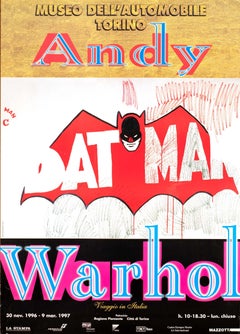
Batman – Turin Museum Retrospective
By Andy Warhol
Located in Dubai, Dubai
Batman – Turin Museum Retrospective
By Andy Warhol
Andy Warhol, a leading figure in the Pop Art movement, revolutionized the art world with his iconic works that celebrated consum...
Category
1990s Contemporary Figurative Prints
Materials
Lithograph
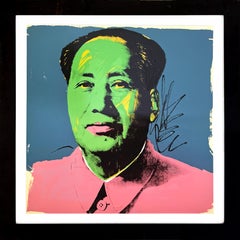
Mao FS II.93 (hand signed screen print from Mao portfolio)
By Andy Warhol
Located in Aventura, FL
Screen print on Beckett High white paper. From the Mao Portfolio. Hand signed by Andy Warhol and stamp numbered with the Andy Warhol Copyright and Styria Studio ink stamp on the rev...
Category
1970s Pop Art Figurative Prints
Materials
Screen
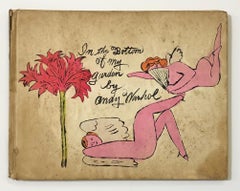
IN THE BOTTOM OF MY GARDEN FS II.86-105
By Andy Warhol
Located in Aventura, FL
Complete book comprising of 20 offset lithographs and cardboard cover, all hand-colored with watercolor. From the edition of unknown size. All 20 sheets bound (as issued). Minor ti...
Category
1970s Pop Art Figurative Prints
Materials
Paper, Watercolor, Lithograph
Basquiat Warhol Bearbrick 400%
100% art toy
By Jean-Michel Basquiat
Located in NEW YORK, NY
Andy Warhol, Jean-Michel Basquiat Bearbrick Vinyl Figures: Set of two (400% & 100%);
A unique, timeless collectible trademarked & licensed by the Estate of Jean-Michel Basquiat & And...
Category
21st Century and Contemporary Pop Art More Art
Materials
Resin, Vinyl

$340 Sale Price
20% Off
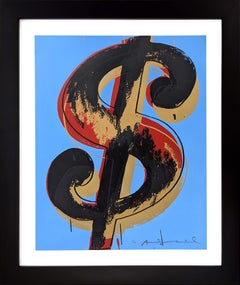
$ (1) FS II.274-279 (unique hand signed screen print)
By Andy Warhol
Located in Aventura, FL
Screen print on Lenox museum board. Hand signed lower front by Andy Warhol. Hand numbered 3/60 lower front (there were also 10 AP's, 3 PP's and 15 TP's). Each print is unique. Pu...
Category
1980s Pop Art Still-life Prints
Materials
Board, Screen
Nicola (Nicky) Weymouth, unique acetate positive of British socialite provenance
By Andy Warhol
Located in New York, NY
Andy Warhol
Nicola (Nicky) Weymouth, ca. 1976
Acetate positive, acquired directly from Chromacomp, Inc. Andy Warhol's printer in the 1970s. Accompanied by a Letter of Provenance from the representative of Chromacomp
Unique
Frame included:
Elegantly framed in a museum quality white wood frame with UV plexiglass:
Measurements:
Frame:
18 x 15.5 x 1.5 inches
Acetate:
11 x 8 inches
This is the original, unique photographic acetate positive taken by Andy Warhol as the basis for his portrait of Nicky Weymouth, that came from Andy Warhol's studio, The Factory to his printer. It was acquired directly from Chromacomp, Inc. Andy Warhol's printer in the 1970s. It is accompanied by a Letter of Provenance from the representative of Chromacomp. This is one of the images used by Andy Warhol to create his iconic portrait of the socialite Nicola Samuel Weymouth, also called Nicky Weymouth, Nicky Waymouth, Nicky Lane Weymouth or Nicky Samuel. Weymouth (nee Samuel) was a British socialite, who went on to briefly marry the jewelry designer Kenneth Lane, whom she met through Warhol. This acetate positive is unique, and was sent to Chromacomp because Warhol was considering making a silkscreen out of this portrait. As Bob Colacello, former Editor in Chief of Interview magazine (and right hand man to Andy Warhol), explained, "many hands were involved in the rather mechanical silkscreening process... but only Andy in all the years I knew him, worked on the acetates." An acetate is a photographic negative or positive transferred to a transparency, allowing an image to be magnified and projected onto a screen. As only Andy worked on the acetates, it was the last original step prior to the screenprinting of an image, and the most important element in Warhol's creative process for silkscreening. Warhol realized the value of his unique original acetates like this one, and is known to have traded the acetates for valuable services. This acetate was brought by Warhol to Eunice and Jackson Lowell, owners of Chromacomp, a fine art printing studio in NYC, and was acquired directly from the Lowell's private collection. During the 1970s and 80s, Chromacomp was the premier atelier for fine art limited edition silkscreen prints; indeed, Chromacomp was the largest studio producing fine art prints in the world for artists such as Andy Warhol, Leroy Neiman, Erte, Robert Natkin, Larry Zox, David Hockney and many more. All of the plates were done by hand and in some cases photographically. Famed printer Alexander Heinrici worked for Eunice
Jackson Lowell at Chromacomp and brought Andy Warhol in as an account. Shortly after, Warhol or his workers brought in several boxes of photographs, paper and/or acetates and asked Jackson Lowell to use his equipment to enlarge certain images or portions of images. Warhol made comments and or changes and asked the Lowells to print some editions; others were printed elsewhere. Chromacomp Inc. ended up printing Warhol's Mick Jagger Suite and the Ladies
Gentlemen Suite, as well as other works, based on the box of photographic acetates that Warhol brought to them. The Lowell's allowed the printer to be named as Alexander Heinrici rather than Chromacomp, since Heinrici was the one who brought the account in. Other images were never printed by Chromacomp- they were simply being considered by Warhol.
Warhol left the remaining acetates with Eunice and Jackson Lowell. After the Lowells closed the shop, the photographs were packed away where they remained for nearly a quarter of a century. This work is exactly as it was delivered from the factory. Unevenly cut by Warhol himself. This work is accompanied by a signed letter of provenance from the representative of Chromacomp, Andy Warhol's printer for many of his works in the 1970s.
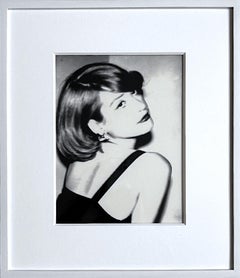
About Andy Warhol:
Isn’t life a series of images that change as they repeat themselves?
—Andy Warhol
Andy Warhol’s (1928–1987) art encapsulates the 1960s through the 1980s in New York. By imitating the familiar aesthetics of mass media, advertising, and celebrity culture, Warhol blurred the boundaries between his work and the world that inspired it, producing images that have become as pervasive as their sources.
Warhol grew up in a working-class suburb of Pittsburgh. His parents were Slovak immigrants, and he was the only member of his family to attend college. He entered the Carnegie Institute of Technology (now Carnegie Mellon University) in 1945, where he majored in pictorial design. After graduation, he moved to New York with fellow student Philip Pearlstein and found steady work as a commercial illustrator at several magazines, including Vogue, Harper’s Bazaar, and the New Yorker. Throughout the 1950s Warhol enjoyed a successful career as a commercial artist, winning several commendations from the Art Directors Club and the American Institute of Graphic Arts. He had his first solo exhibition at the Hugo Gallery in 1952, showing drawings based on the writings of Truman Capote; three years later his work was included in a group show at the Museum of Modern Art for the first time.
The year 1960 marked a turning point in Warhol’s prolific career. He painted his first works based on comics and advertisements, enlarging and transferring the source images onto canvas using a projector. In 1961 Warhol showed these hand-painted works, including Little King (1961) and Saturday’s Popeye (1961), in a window display at the department store Bonwit Teller; in 1962 he painted his famous Campbell’s Soup Cans, thirty-two separate canvases, each depicting a canned soup of a different flavor. Soon after, Warhol began to borrow not only the subject matter of printed media, but the technology as well. Incorporating the silkscreen technique, he created grids of stamps, Coca-Cola bottles, shipping and handling labels, dollar bills, coffee labels...
Category
1970s Pop Art Black and White Photography
Materials
Photographic Film
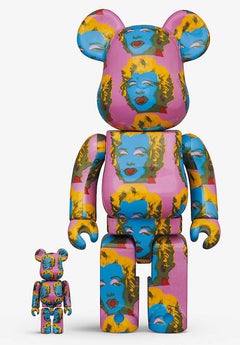
Be@rbrick x Andy Warhol Foundation Marilyn 400% and 100%%
By Andy Warhol
Located in NEW YORK, NY
Bearbrick x Andy Warhol Foundation "Marilyn" 400% Vinyl Figure (set of two: 400% + 100%):
Andy Warhol (after) Marilyn figure trademarked & licensed by the Estate of Andy Warhol. The ...
Category
21st Century and Contemporary Pop Art More Art
Materials
Resin, Vinyl
$340 Sale Price
20% Off
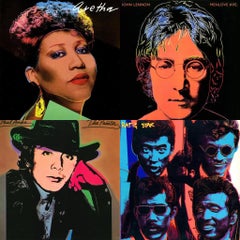
Andy Warhol Album Cover Art (Warhol record art set of 4 LPs)
By Andy Warhol
Located in NEW YORK, NY
Andy Warhol album art 1983-1986:
A collection of four 1980’w LPs with individual cover art designed by Andy Warhol.
Each piece is featured prominently in 'Andy Warhol: The Record Covers, 1949-1987- Catalog Raisonne' by Andy Warhol scholar, Paul Marechal. Featuring the following recording artists Aretha Franklin, John Lennon, Paul Anka & Rats & Star. Classic 1980's Andy Warhol imagery that makes for fantastic 1980s Pop wall-art.
Medium: Offset printed album covers accompanied by their individual vinyl record albums.
12 x 12 inches / 30.48 x 30.48 cm (applies to each individual).
Covers: Ranging from good to very good overall vintage condition.
Includes original records in good to excellent condition.
Unsigned from an edition of unknown.
Andy Warhol record art: Further Background:
In the late 1950s, as the record industry began to expand at an extraordinary rate, Warhol was hired by both Columbia and RCA Records on a freelance basis to create album covers and promotional content and, from there, carried the skill throughout his career.
When Warhol arrived in New York he met with his schoolmate George Klauber who was, at the time, working for a creative agency run by Will Burtin. Klauber did Warhol a favour and introduced him to Burtin and the opportunity to work with Columbia’s, and later RCA’s, art director Robert M. Jones.
Robert M. Jones remembered it fondly and suggested that the commissions may have been his first: “I gave him three little spots to do for the corners of the standard albums. He needed money...
Category
1980s Pop Art More Art
Materials
Offset
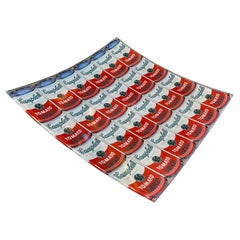
1990s Campbell Soup Square Glass Tray Designed by Andy Warhol for Rosenthal
By Rosenthal, Andy Warhol
Located in Aci Castello, IT
The glass tray designed by Andy Warhol for Rosenthal is a decorative tray that features Warhol's iconic Campbell Soup can designs. This tray was created in the 1990s by Rosenthal, a German porcelain and glassware manufacturer, as part of a limited edition series of home decor items featuring Warhol's artwork. It's in perfect condition, probably never used, and signed by Andy Warhol on the front and labeled by Rosenthal on the bottom. The tray is made of clear glass and has a square shape with rounded corners, making it a compact but eye-catching piece of decor. The tray's surface features a continuous, colorful reproduction of one of Warhol's Campbell Soup can designs, which were first created in the 1960s as part of his exploration of consumer culture and advertising.
The tray's design is simple but bold, and its use of vibrant colors and familiar imagery make it a great conversation starter and a fun addition to any room. As a limited edition item designed by a well-known artist, the tray may have some collectible value among fans of Warhol's work or collectors of vintage glassware...
Category
Late 20th Century German Modern Decorative Dishes and Vide-Poche
Materials
Glass
Denied Warhol Brillo Box Yellow, Contemporary Pop Art Sculpture by Charles Lutz
By Charles Lutz
Located in Brooklyn, NY
Denied Warhol Brillo Box Yellow Contemporary Pop Art Sculpture by Charles Lutz.
Silkscreen and latex paint on wood, stamped Denied with the Andy Warhol Art Authentication Board's ma...
Category
21st Century and Contemporary Contemporary Sculptures
Materials
Wood, Acrylic

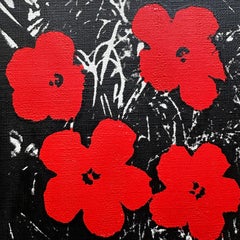
Denied Andy Warhol Flowers 5x5" on linen Red Pop Art Painting by Charles Lutz
By Charles Lutz
Located in Brooklyn, NY
Denied Warhol Flowers, (Red) Silkscreen Painting by Charles Lutz
Silkscreen and acrylic on canvas with Denied stamp of the Andy Warhol Art Authentication Board.
5 x 5" inches
2008
L...
Category
Early 2000s Pop Art Still-life Paintings
Materials
Canvas, Acrylic
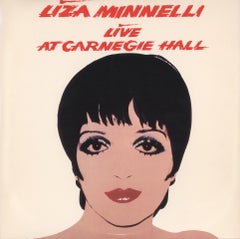
Andy Warhol Liza Minnelli record art 1981 (Warhol album art)
By Andy Warhol
Located in NEW YORK, NY
Rare sought after Andy Warhol Liza Minnelli Vinyl Record Art:
Offset illustrated by Andy Warhol in 1981:
Off-Set print on vinyl record album cover. 1981.
...
Category
1980s Pop Art More Art
Materials
Offset
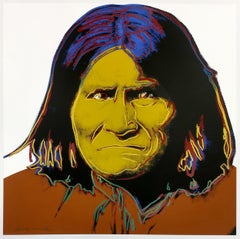
GERONIMO FS II.384
By Andy Warhol
Located in Aventura, FL
Screen print on Lenox museum board. From the Cowboys And Indians Portfolio. Hand signed and numbered lower front by Andy Warhol. Numbered 131/250 (there were also 50 AP's, 15 PP's, 15 HC's and 10 numbered in Roman numerals). Published by Gaultney, Klineman Art, Inc., New York. Printed by Rupert Jasen Smith, New York.
The artwork is in excellent condition. All reasonable offers will be considered.
In Cowboys and Indians, Warhol interspersed recognizable portraits of well-known American heroes with less familiar Native American images and motifs. It demonstrates his ironic commentary on America’s collective mythologizing of the historic West. Rather than portraying Native Americans within their historical landscape, Warhol chose to portray a romanticized version of the American West. The West that he chose to represent is familiar to everyone and can be seen in novels, films, and television series. Warhol’s Cowboys and Indians suite...
Category
1980s Pop Art Figurative Prints
Materials
Board, Screen
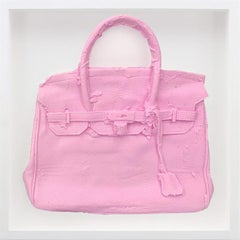
Homemade Hermes Birkin Bag ( Pink ) 2015 by Shelter Serra
By Shelter Serra
Located in Brooklyn, NY
Homemade Hermes Birkin Bag ( Kelly Green )
2015,
15”x14.5”x1.5” inches unframed, 18.75 "x 18.75 x 2.5 framed
Cast Resin, Edition of 15
Also available in Kelly Green, White, Gold and Silver. The frame is a white shadow box frame with plexiglass.
The Homemade Hermes Birkin Bag is a sculpture that celebrates the beauty, and status, that the docents of fashion have bestowed upon coveted objects and accessories as such. In a Duchampian gesture of representation, the artist has created an object that has been “elevated to uselessness”, yet reveals much about our society’s infatuation with consumption and materialism. Cast in resin the sculpture becomes an apropos trope of our time, a perfect conversation starter.
Shelter Serra’s paintings, sculptures, and drawings explore mass consumption and cultural identity. He juxtaposes subject matters that are both common and recognizable: a Campbell's Soup Can, a copper plated baseball hat, and a Hermes Birkin bag...
Category
21st Century and Contemporary Contemporary Sculptures
Materials
Enamel
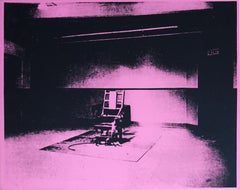
Denied Andy Warhol Pink Electric Chair Painting by Charles Lutz
By Charles Lutz
Located in Brooklyn, NY
Denied Warhol Pink Electric Chair Painting by Charles Lutz
Silkscreen and acrylic on linen with the Denied stamp of the Andy Warhol Art Authentication Board.
22 x 28" inches
2008
Lutz's 2007 ''Warhol Denied'' series gained international attention calling into question the importance of originality or lack thereof in the work of Andy Warhol. The authentication/denial process of the [[Andy Warhol Art Authentication Board]] was used to create value by submitting recreations of Warhol works for judgment with the full intention for the works to be formally marked "DENIED". The final product of the conceptual project being "officially denied" "Warhol" paintings authored by Lutz.
Based on a press photo painted by Pop Artist Andy Warhol in early 1960's, this is likely one of the most iconic images from his Death and Disaster Series. The Death and Disaster Series was a dark view of the time's media and death culture. This was a departure from Warhol's Campbell's Soup Cans and portraits of Jackie Kennedy, Marilyn Monroe, Liz Taylor, and Marlon Brando in that these were images of the deaths of everyday people- one could say their "15 minutes of fame" as Warhol coined...
Category
Early 2000s Contemporary Still-life Paintings
Materials
Acrylic, Linen
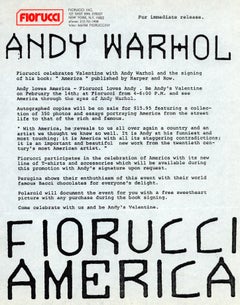
Andy Warhol Fiorucci 1986 Press Release
By Andy Warhol
Located in NEW YORK, NY
Andy Warhol "America" Fiorucci Press Release 1986:
Original press release for a 1986 Andy Warhol Valentine's Day book signing, at the legendary New York cultural institution: Fiorucci. A one day event in which Warhol signed his "America" book for 350 lucky fans.
In conjunction with this Warhol America event, Fiorucci sold Warhol inspired T-shirts, accessories and photos. A rare
much desirable piece of Andy Warhol ephemera produced just one year before the artist's death in February of 1987.
Typed letter; 1986.
8.5 x 11 inches.
Fold-lines as issued for mailing. Minor wear commensurate with age
medium; in otherwise very good overall vintage condition.
Unsigned from an edition of unknown. RARE.
More on Fiorucci:
'The New York City Fiorucci store is the stuff of cultural legend. Located in East Midtown and attracting everyone from Gloria Vanderbilt to Madonna, it was as much a place to experience culture and art during the height of the mid 70s and early 80s as it was a store – with everyone from Keith Haring to Andy Warhol hosting events at the location. Intrinsically linked to the glamorous days of disco, the brand was even name checked in Sister Sledge's “He’s The Greatest Dancer” alongside Gucci and Halston. Marc Jacobs skipped summer school to hang out there, Cher would often wonder in, Maripol designed the space. They had an advert featuring Divine. It was unquestionably cool.
As much as they became a staple of New York culture, Fiorucci’s origins were in Italy – where Elio Fiorucci, the son of a shoe shop owner, began designing wellies in primary colors before officially founding the brand in 1967. The Fiorucci store made its way to New York in 1976 (a London store opened one year prior) and soon earned a reputation for a party-like atmosphere alongside daring fashion mixed with beauty products, vintage clothing, music and home décor. Here, following the sad news...
Category
1980s Pop Art More Art
Materials
Paper, Lithograph
$300 Sale Price
40% Off
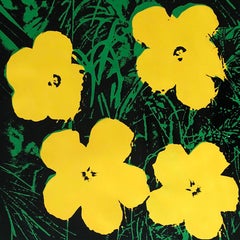
Denied Andy Warhol Flowers, (Yellow) Silkscreen linen Painting by Charles Lutz
By Charles Lutz
Located in Brooklyn, NY
Denied Warhol Flowers, (Yellow) Silkscreen Linen Painting by Charles Lutz
Silkscreen and acrylic on linen with Denied stamp of the Andy Warhol Art Authentication Board.
24 x 24" inc...
Category
21st Century and Contemporary Contemporary Paintings
Materials
Linen, Acrylic
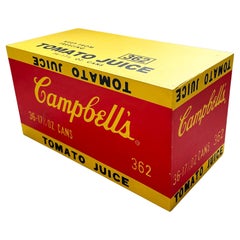
Denied Warhol Campbell
s Soup box Contemporary Pop Art Sculpture by Charles Lutz
By Charles Lutz
Located in Red Lion, PA
Denied Warhol Campbell's Soup Box Yellow Contemporary Pop Art Sculpture by Charles Lutz.
Silkscreen and latex paint on wood, stamped with the artist's replica of the Warhol Authent...
Category
20th Century American Modern Side Tables
Materials
Plywood, Paint
Denied Andy Warhol Flowers White 48 x48" on canvas Pop Art Painting Charles Lutz
By Charles Lutz
Located in Brooklyn, NY
Denied Warhol Flowers, (cream/white) Silkscreen Painting by Charles Lutz
Silkscreen and acrylic on canvas with Denied stamp of the Andy Warhol Art Authentication Board.
48 x 48" inch...
Category
Early 2000s Pop Art Still-life Paintings
Materials
Canvas, Acrylic
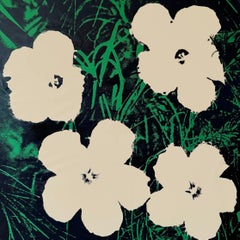
$21,900 Sale Price
40% Off
Andy Warhol American Indian Red Poste Hand Signed, Framed
Signed 1985
By Andy Warhol
Located in Plainview, NY
This original exhibition poster, created for a special Andy Warhol show at Ace Gallery, stands as a striking artifact of contemporary art history. It depicts Native American civil ri...
Category
20th Century Modern Portrait Prints
Materials
Offset