212 results for "kuniyoshi"

to
26
163
31
137
81
74
42
32
21
18
13
13
12
12
12
11
9
9
8
8
7
5
5
3
3
3
2
1
1
1
1
1
23
16
14
13
6
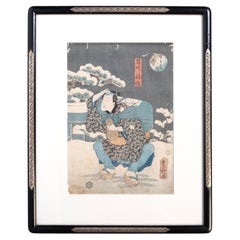
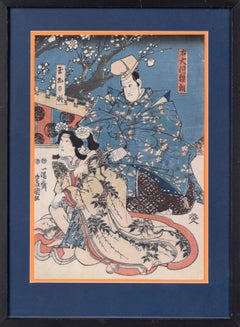
Two Actors - Japanese Woodblock by Chikanobu Yoshu
By Toyohara Chikanobu
Located in Soquel, CA
Two Actors - Japanese Woodblock by Toyohara Chikanobu (豊原周延, 1838–1912), better known to his contemporaries as Yōshū Chikanobu (楊洲周延). Colorful and expressive court scene. Two actors...
Category

1890s Edo Landscape Prints

Materials

Ink, Rice Paper, Woodcut

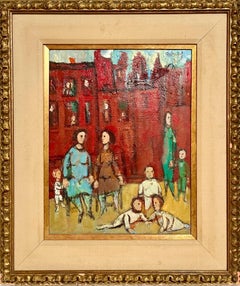
Mid Century Mothers, Children Oil Painting Frank Kleinholz WPA Era NYC Tenements
By Frank Kleinholz
Located in Surfside, FL
Frank Kleinholz (Brooklyn, 1901 - 1987) Mothers with children oil on canvas painting Frame: 27 X 23 Image: 17.75 X 13.75 Born in Brooklyn, New York, Frank Kleinholz was a painter b...
Category

20th Century Abstract Figurative Paintings

Materials

Canvas, Oil

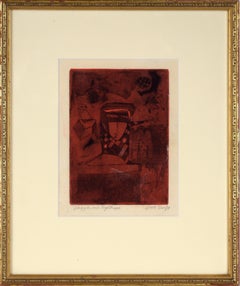
"Juggler on a Tightrope" Etching in Ink on Paper
Located in Soquel, CA
"Juggler on a Tightrope" Etching in Ink on Paper Playful etching of a performer by Dick Swift (American, 1918-2010). A juggler is show in a cubist style, w...
Category

Mid-20th Century Cubist Figurative Prints

Materials

Paper, Ink, Etching

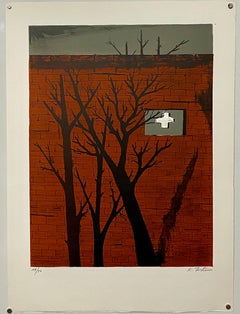
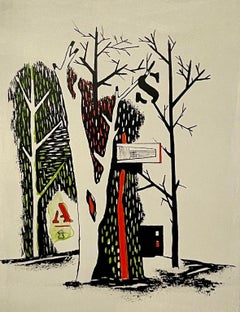
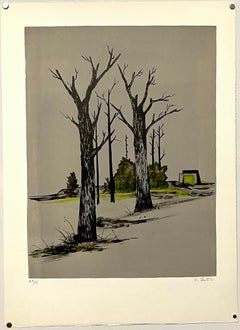
Lithograph Belgian American Surrealism WPA Modernist Karl Fortess Surrealist Art
Located in Surfside, FL
Karl Eugene Fortess (1907-1993) Original color lithographs on BFK Rives paper, 1966, Hand signed and numbered 29/36 in pencil, Sheet size 20.5 x 15 inches. Karl E. Fortess (1907-1993) was a painter, printmaker and teacher, of Boston, Massachusetts and Woodstock, N.Y. Fortess was born in Antwerp, Belgium on October 13, 1907, and became an American citizen in 1923. He studied at the Art Institute of Chicago, the Art Students League in New York, and the Woodstock School of Painting with Yasuo Kuniyoshi. In 1937 the Works Progress Administration sent him and several other artists to Alaska to document the towns, villages, and remote wilderness landscapes (Pemberton, “Alaska art museum collects WPA’s Depression works from the territory,” Columbia Daily Tribune, November 9, 2003). Trains, trucks, and industrial buildings were what Karl Fortess envisioned when the Public Works of Art Project suggested that he depict “the American Scene.” His work bears the influence of Surrealism, Russsian Constructivist art and Cubism. He was part of a circle of left leaning artists loosley involved with the WPA which included Sol Wilson, Isaac Soyer, Louis Lozowick, Abraham Harriton, Ben Shahn, William Gropper, Nahum Tschacbasov, Morris Shulman, Yasuo Kuniyoshi, Louis Slobodkin, Adolf Dehn, Le Corbusier and Louis Schanker. Karl Fortress taught at the Art Students League, Brooklyn Museum Art School, Louisiana State University, Fort Wright College, and Boston University School of Fine and Applied Arts. He was a member of the Artists Equity Association, Society of American Graphic Artists, American Association of University Professors, and the British Film Institute. He was awarded the Guggenheim Fellowship in 1946, was named an Associate of the National Academy of Design in 1960 and elected to full Academician in 1971. Fortess taught at many different schools, including Boston University School of Fine Art, where he also created an archive of interviews with more than two hundred and fifty contemporary American painters, sculptors, and graphic artists including many with with artists associated with the Woodstock, N.Y. art community. Among the interviewees are Kenneth Armitage, Will Barnet, Romare Bearden, George Biddle, James Brooks, Adolph Dehn, Jane Freilicher, Julian Levi, Alice Neel, Larry Rivers, Moses Soyer, Dorothy Varian...
Category

Mid-20th Century Surrealist Landscape Prints

Materials

Lithograph

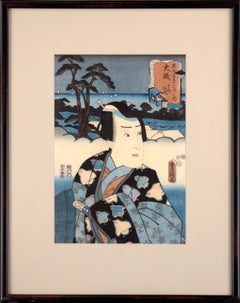
"Juro Sukenari, Station #9: Oiso", Mid 19th Century Japanese Ukiyo-e Woodblock
By Utagawa Kunisada (Toyokuni III)
Located in Soquel, CA
Beautiful mid 19th century Japanese woodblock print of a samurai by Utagawa Toyokuni III (Kunisada) (Japanese, 1786-1864/5). This piece is from a series of "The 53 Stations of the To...
Category

1860s Edo Figurative Prints

Materials

Paper, Ink

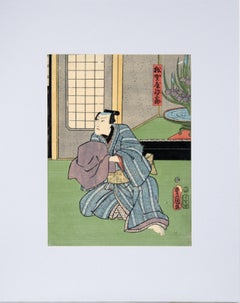
"Sun Saburo Matsugaya" - Mid 19th Century Figurative Japanese Woodblock Print
By Utagawa Kunisada (Toyokuni III)
Located in Soquel, CA
"Sun Saburo Matsugaya" - Mid 19th Century Figurative Japanese Woodblock Print Beautiful mid 19th century figural Japanese woodblock print of a seated man with lilies in the background by Utagawa Toyokuni III (Kunisada) (Japanese, 1786-1864/5). Artist's chop is in the lower right corner of the piece. The actor is Magosaburo Matsugaya from the play "Katakiuchi Rumors" Presented in a new grey-blue mat with foamcore backing. Mat size: 21"H x 16"W Paper size: 14"H x 9.75"W During his lifetime Kunisada Utagawa...
Category

1850s Edo Figurative Prints

Materials

Paper, Ink, Woodcut

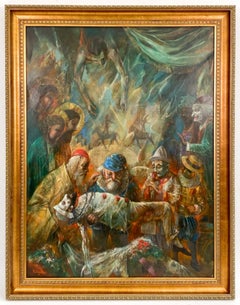
Large Oil Painting Circus Scene Clowns Rediscovered NY Artist Jonah Kinigstein
By Jonah Kinigstein
Located in Surfside, FL
Jonah Kinigstein "Death of a Clown" Large Oil on Board Painting of macabre circus scene with clowns Hand signed lower left and signed and titled verso Frame: 55 X 43 Image: 48 X 36 ...
Category

20th Century Expressionist Portrait Paintings

Materials

Oil, Board

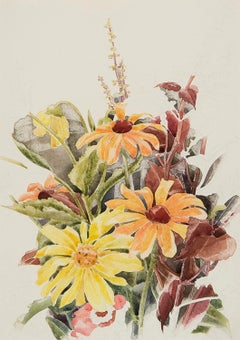
Garden Flowers
By Charles Demuth
Located in New York, NY
Charles Demuth was one of the most complex, talented, and deeply sensitive artists of the American modern period. Whether he was painting floral still lifes, industrial landscapes, or Turkish bathhouses, art was, for Demuth, fraught with personal meaning. A fixture of the vanguard art scene in New York, Demuth navigated the currents of Modernism, producing some of the most exquisite watercolors and original oil paintings in twentieth-century American art. Demuth was born in Lancaster, Pennsylvania, the only child of a well-to-do family. He had an awkward and introverted childhood shaped by a childhood illness, Perthes, a disease of the hip that not only left him permanently lame, but, as part of the “cure,” bedridden for two years in the care of his mother. This long period of incapacitation had a deep impact on Demuth, who came to see himself as an invalid, an outsider who was different from everyone else. It was perhaps during this period of indoor confinement that his keen interest in art developed. Several relatives on his father’s side had been amateur artists, and, following his convalescence, his mother encouraged his artistic pursuits by sending him to a local painter for instruction. The majority of his early pictures are of flowers, a subject for which Demuth maintained a lifelong passion. Following high school, Demuth enrolled at the Drexel Institute of Art in Philadelphia, a school renowned for its commercial arts program. He advanced through the program rapidly, and, in 1905, at the encouragement of his instructors, he began taking courses at the Pennsylvania Academy of the Fine Arts. The two leading teachers then at the Academy were William Merritt Chase and Thomas Anshutz. Anshutz, himself a former student of Thomas Eakins, was well liked by his students, and is best known as the teacher of Robert Henri, John Sloan, and several of the other artists of the Ashcan School. Demuth, too, adopted a similar idiom, working in a controlled, realistic manner while at the Academy, where he remained until 1910. In 1907, Demuth made his first trip to Europe, staying in Paris. He spent time on the periphery of the art scene composed of the numerous American artists there, including John Marin and Edward Steichen. He returned to Philadelphia five months later, and immediately resumed courses at the Academy. Despite his introduction to advanced modern styles in Europe, Demuth’s work of this period retains the academic style he practiced before the trip. It wasn’t until he had summered at New Hope, Pennsylvania, in 1908 and 1911, that his style began to evolve. New Hope was a prominent American Impressionist art colony whose members were largely affiliated with the Pennsylvania Academy. Demuth dropped the conservative tone of his style and adopted a freer and more colorful palette. Although he remained based in Philadelphia, Demuth frequently went to New York during this period. Many of the same American artists of the Parisian art scene Demuth had encountered on his earlier European trip now formed the nucleus of New York’s avant-garde, which centered around Alfred Stieglitz’s 291 gallery. It wasn’t long before Demuth began to apply modernist-inspired strategies to his work. He was particularly influenced by the watercolor work of John Marin, also a former student of Anshutz, whose bold use of color in the medium Demuth freely adapted into looser washes of color. In 1912, Demuth again left for Paris, this time studying in the Académie Moderne, Académie Colorossi, and Académie Julian. In Paris Demuth met the American modernist Marsden Hartley. Hartley, a principal figure in the expatriate art circle, acted as a mentor to Demuth, and introduced him to the wide array of modern styles currently practiced in Europe. Hartley also introduced Demuth to many of the members of the Parisian avant-garde, including Gertrude Stein. Demuth was an aspiring writer, and he spent many hours in conversation with Stein. He wrote extensively during this period, and published two works shortly after his return to America. He also developed an interest in illustrating scenes from literary texts. From 1914 to 1919, Demuth produced a series of watercolors of scenes from books such as Emile Zola’s Nana and Henry James’s The Turn of the Screw. Upon his return to America, Demuth settled in New York. In 1914, Demuth had his first one-man show at Charles Daniel’s gallery, which promoted emerging modern American artists, including Man Ray, Rockwell Kent, Yasuo Kuniyoshi, Stuart Davis, and Max Weber. Demuth drew closer to the artistic vanguard in New York, becoming friends with many in the Stieglitz and Daniel circles, including Georgia O’Keeffe, Marcel Duchamp, Carl Van Vechten, and Edward Fiske. New York’s cosmopolitan atmosphere and active nightlife appealed greatly to Demuth. In a sketchy style well suited to watercolor, he painted many vaudeville and circus themes, as well as nightclub, café, and bathhouse scenes. Often with Duchamp, Demuth took part in an urban subculture replete with nightclubs, bars, drugs, and sexual permissiveness, which, for a homosexual artist like himself, allowed room for previously unattainable personal expression. Demuth’s pictures of sailors, bathhouses, and circus performers embody a sensual and sexual undercurrent, expressing the artist’s sense of comfort and belonging in the bohemian subculture of New York. Simultaneously, Demuth deepened his interest in floral pictures, painting these almost exclusively in watercolor. His style evolved from the broad color washes of his earlier pictures to more spare, flattened, and sinuous compositions, inspired by the drawings of Aubrey Beardsley and other artists of the Aesthetic Movement. Demuth’s flower watercolors are moody and atmospheric, sensuous and elegant, introspective and yet full of expressive power. Moreover they are beautiful, and are unequivocally among the finest still lifes in American art. Despite numerous subsequent artistic undertakings that led him in a variety of directions, Demuth never stopped painting flower pictures, ultimately adding fruits and other still-life objects to his repertoire. In 1916, Demuth began to develop a style later known as Precisionism, a form of landscape painting infused with Cubism, in which space is divided into precisely drawn geometric regions of color. Demuth first began to paint the landscape in an appropriated Cubist mode while on a trip with Hartley to Bermuda. In these early landscapes, in which the curvilinear forms of trees intersect the geometrically articulated architectural forms, Demuth explored ideas that shaped the future development of modernism in America. The full realization of Demuth’s explorations came after his return to America in 1917, when he turned his attention to industrial subjects. These works derive from a “machine aesthetic,” espoused by New York artists such as Francis Picabia, Joseph Stella, Albert Gleizes, and Duchamp, by which artists viewed machines as embodying mystical, almost religious significance as symbols of the modern world. Rather than painting the skyscrapers and bridges of New York as did most of his like-minded contemporaries, Demuth returned to his home town of Lancaster, where he painted factories and warehouses in a Precisionist idiom. The titles for these pictures are often contain literary references, which serve as clues for the viewer to aid in the decoding of the artist’s meaning. In 1923, Demuth planned a series of abstract “poster portraits” of his friends and contemporaries in the New York art and literary scene. In these “portraits,” Demuth combined text and symbolic elements to evoke the essential nature of his sitters’ distinguishing characteristics. In this fashion, he painted portraits of such artists as Georgia O’Keeffe, John Marin, and Arthur Dove. His most famous poster portrait, I Saw the Figure 5 in Gold...
Category

20th Century American Modern Still-life Drawings and Watercolors

Materials

Paper, Watercolor

Lithograph Belgian American Surrealism WPA Modernist Karl Fortess Surrealist Art
Located in Surfside, FL
Karl Eugene Fortess (1907-1993) Original color lithographs on BFK Rives paper, 1966, Hand signed and numbered 29/36 in pencil, Sheet size 20.5 x 15 inches. Karl E. Fortess (1907-1993) was a painter, printmaker and teacher, of Boston, Massachusetts and Woodstock, N.Y. Fortess was born in Antwerp, Belgium on October 13, 1907, and became an American citizen in 1923. He studied at the Art Institute of Chicago, the Art Students League in New York, and the Woodstock School of Painting with Yasuo Kuniyoshi. In 1937 the Works Progress Administration sent him and several other artists to Alaska to document the towns, villages, and remote wilderness landscapes (Pemberton, “Alaska art museum collects WPA’s Depression works from the territory,” Columbia Daily Tribune, November 9, 2003). Trains, trucks, and industrial buildings were what Karl Fortess envisioned when the Public Works of Art Project suggested that he depict “the American Scene.” His work bears the influence of Surrealism, Russsian Constructivist art and Cubism. He was part of a circle of left leaning artists loosley involved with the WPA which included Sol Wilson, Isaac Soyer, Louis Lozowick, Abraham Harriton, Ben Shahn, William Gropper, Nahum Tschacbasov, Morris Shulman, Yasuo Kuniyoshi, Louis Slobodkin, Adolf Dehn, Le Corbusier and Louis Schanker. Karl Fortress taught at the Art Students League, Brooklyn Museum Art School, Louisiana State University, Fort Wright College, and Boston University School of Fine and Applied Arts. He was a member of the Artists Equity Association, Society of American Graphic Artists, American Association of University Professors, and the British Film Institute. He was awarded the Guggenheim Fellowship in 1946, was named an Associate of the National Academy of Design in 1960 and elected to full Academician in 1971. Fortess taught at many different schools, including Boston University School of Fine Art, where he also created an archive of interviews with more than two hundred and fifty contemporary American painters, sculptors, and graphic artists including many with with artists associated with the Woodstock, N.Y. art community. Among the interviewees are Kenneth Armitage, Will Barnet, Romare Bearden, George Biddle, James Brooks, Adolph Dehn, Jane Freilicher, Julian Levi, Alice Neel, Larry Rivers, Moses Soyer, Dorothy Varian...
Category

Mid-20th Century Surrealist Landscape Prints

Materials

Lithograph

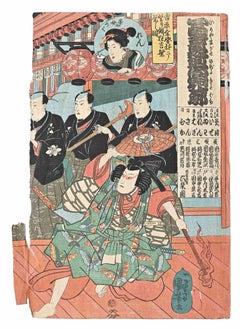
Kabuki Scene - Woodblock Print by Utagawa Kunisada - Mid-19th Century
By Utagawa Kunisada (Toyokuni III)
Located in Roma, IT
Kabuki Scene is an original Woodcut print realized in mid 19th century after Utagawa Kuniyoshi (1797-1861). Good condition and Beautiful colored woodblock print. This wonderful mo...
Category

Mid-19th Century Modern Figurative Prints

Materials

Woodcut

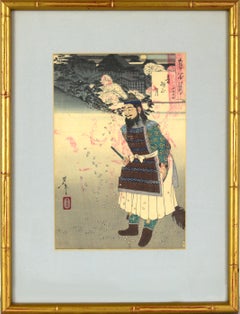
One Hundred Aspects of the Moon, Mt Otawa Moon - Bright God Tamura
By Tsukioka Yoshitoshi
Located in Soquel, CA
"Mount Otawa Moon: Bright God Tamura" - Woodblock on Paper by Tsukioka Yoshitoshi From the series "One Hundred Aspects of the Moon" This piece depicts the general Sakanoe no Tamura...
Category

1880s Edo Figurative Prints

Materials

Paper, Ink, Woodcut

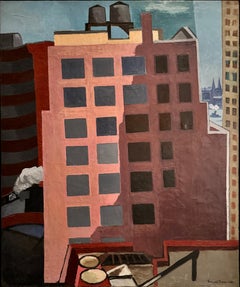
NYC Cityscape American Scene WPA Modern Realism Mid 20th Century Architectural
By Ernest Fiene
Located in New York, NY
NYC Cityscape American Scene WPA Modern Realism Mid 20th Century Architectural Ernest Fiene (1894-1965) Cityscape 36 x 30 inches Oil on canvas Signed and dated 1930. lower right Provenance Estate of the artist. ACA Galleries, New York Exhibited New York, Frank Rehn Gallery, Changing Old New York, 1931. New York, ACA Galleries, Ernest Fiene: Art of the City, 1925-1955, May 2-23, 1981, n.p., no. 5. BIO Ernest Fiene was born in Elberfeld, Germany in 1894. As a teenager, Fiene immigrated to the United States in 1912. He studied art at the National Academy of Design in New York City from 1914 to 1918, taking day classes with Thomas Maynard and evening classes with Leon Kroll. Fiene continued his studies at the Beaux-Arts Institute of Design in New York from 1916 to 1918, adding classes in printmaking at the Art Students League in 1923. Fiene began his career as an artist in 1919 with his first exhibition of watercolors at the MacDowell Club arranged by his mentor Robert Henri. In 1923 the Whitney Studio Club mounted a large exhibition of his works. The following year he had an exhibition at the New Gallery in New York, which completely sold out all fifty-two works, including paintings, watercolors, drawings, and etchings. With the proceeds of sales from the New Gallery exhibition, Ernest Fiene and his younger brother Paul, a sculptor, built studios in Woodstock, New York in 1925. In the early Twenties Ernest Fiene painted mostly landscapes of Woodstock and both the Ramapo and Hudson River Valleys. The first monograph from the Younger Artists Series was published on Fiene in 1922. Published in Woodstock, the series went on to include Alexander Brook, Peggy Bacon, and Yasuo Kuniyoshi. The book reproduced 1 illustration in color and another 27 reproductions in black and white. Around 1925 Fiene became fascinated with the intensity, excitement, and opportunities for color harmonies New York City offered as a subject. His paintings shifted to urban and industrial themes with architecture, industry, and transportation becoming his subjects. By 1926 Fiene had attracted the dealer Frank K.M. Rehn, who gave him a one-man exhibition that year, which travelled to the Boston Arts Club. C.W. Kraushaar Galleries gave Fiene a one-man exhibition of urban, landscape, portrait, and still life paintings in 1927. Julianna Force, the director of the Whitney Studio Club and first director of the Whitney Museum of American Art, included two of Fiene’s paintings in a fall exhibition in 1928. The Whitney Studio Club showed Fiene’s paintings in a two-man exhibition with Glenn O. Coleman that year and acquired three of Fiene’s paintings. Also in 1928 Fiene became affiliated with Edith Halpert’s Downtown Gallery where he had an exhibition of 20 lithographs in the spring. Fiene sold his house in Woodstock in 1928 to spend more of his time in New York City. With so many successful exhibitions, Fiene returned to Paris in 1928-29 where he rented Jules Pascin's studio and studied at the Académie de la Grande Chaumière. In France, Fiene painted both landscape and urban subjects developed from ideas influenced by Cubist geometry and the use of flat areas of broad color. Upon returning to New York in 1930, Fiene used this new approach to continue to paint New York skyscraper and waterfront subjects, as well as to begin a series of paintings on changing old New York based on the excavations for Radio City Music Hall and the construction of the Empire State Building. Frank K.M. Rehn Galleries exhibited this series, titled “Changing Old New York,” in 1931. Fiene also has solo exhibitions at Rehn Galleries in 1930 and 1932. Fiene’s oil paintings are exhibited at the Chicago Arts Club in 1930 as well. Fiene was included in the Museum of Modern Art’s exhibition Painting and Sculpture by Living Americans in December of 1931. Visiting New York, Henri Matisse saw the exhibition and called Fiene’s Razing Buildings, West 49th Street the finest painting he had seen in New York. Fiene had two mural studies from his Mechanical Progress series exhibited at the Museum of Modern Art’s exhibition Murals by American Painters and Photographers in 1932. Fiene sent View from my Window which depicts Fiene working on a lithograph stone while looking out his window to the newly completed Empire State Building to the Carnegie International in 1931. In 1932 Fiene participated in the first Biennial of American Painting at the Whitney Museum and his prints were included in exhibitions at the Downtown Gallery and the Wehye Gallery. In the same year, Fiene was awarded a Guggenheim fellowship to further study mural painting in Florence, Italy. On his return from Italy in 1933 Fiene re-engaged himself in New York City life and won several public and private mural projects. Fiene resumed his active exhibition schedule, participating in two group exhibitions at the Whitney Museum and a one-man exhibition of recent paintings at the Downtown Gallery in January 1934. In 1933 he purchased a farm in Southbury, Connecticut, which added Connecticut scenes to his landscape subjects. This was also the year Fiene began to spend summers on Monhegan Island, Maine, where he painted seascapes, harbor scenes, and still lifes. Fiene’s landscape paintings attracted numerous commissions as part of the American Scene movement. Through the fall and winter of 1935-36, Fiene took an extended sketching trip through the urban, industrial, and farming areas of Pennsylvania and West Virginia. Most of the twenty-four Pennsylvania urban and rural paintings...
Category

1930s American Modern Landscape Paintings

Materials

Canvas, Oil

Etching with Hand Watercolor Painting Jules Pascin Pencil Signed
By Jules Pascin
Located in Surfside, FL
Genre: German Expressionist Subject: Figures Medium: etching, watercolor paint Surface: Paper This is hand signed lower right.. there does not seem to be an edition size although th...
Category

Early 20th Century Expressionist Figurative Drawings and Watercolors

Materials

Paper, Watercolor, Etching

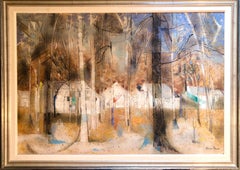
American Woman Artist Modernist Large Oil Painting Cubist Influenced Landscape
By Lena Gurr
Located in Surfside, FL
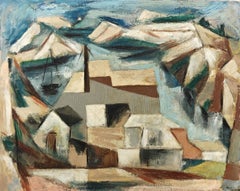
A beautiful wooded landscape scene with houses and trees. Painted on a masonite board. hand signed lower right. with framers label verso. Framed to 40 X 55 inches. 33 X 48 without the frame and mat. It is not dated. Lena Gurr (1897–1992), was an American woman artist who made paintings, prints, and drawings During the course of her career Gurr's compositions retained emotional content as they evolved from a naturalistic to a semi-abstract cubist style. Born into a Russian-Jewish Yiddish speaking immigrant family, she was the wife of Joseph Biel, also Russian-Jewish and an artist of similar genre and sensibility. Gurr used Lena Gurr as her professional name. After marrying Joseph Biel she was sometimes referred to as Lena Gurr Biel. Biel had been born in Grodno, Poland (later absorbed into Russia) and had lived in England, France, and Australia before coming to New York. An artist, he specialized in landscape paintings and silkscreen printing as well as photography. He studied art at the Russian Academy in Paris. After immigrating to the United States, he studied under George Grosz at the Arts Students League. Gurr was born in Brooklyn and, apart from brief stays in Manhattan and in Paris, lived there her whole life. This painting bears the influence of Lyonel Feininger an influential German American artist. Gurr began studying art at a young age. In 1919 she studied painting and printmaking at the Educational Alliance Art School and between 1920 and 1922 she won a scholarship to attend the Art Students League where she took classes with John Sloan and Maurice Sterne. In 1926 and 1928 Gurr participated in group shows at the Whitney Studio Club in Greenwich Village and in 1928 she also participated in the 12th annual exhibition of the Society of Independent Artists at the Waldorf Roof in New York. (Reviewing this show, Helen Appleton Read, the critic for the Brooklyn Daily Eagle, said "I made three discoveries on my first visit, Thomas Nagel, Eugenie McEvoy and Lena Gurr with two figure compositions which have something of Marie Laurencin or Helene Perdriat quality of naive sophistication.") The Waldorf Roof was a set of rooms on the top floor of the Waldorf Astoria Hotel, one of which had glass sides and a glass roof. The rooms were used for concerts, dances, benefits, and exhibitions.From 1929 to 1931 Gurr took a leave of absence from her teaching position to travel in France with Joseph Biel, an artist whom she had met while studying at the Art Students League. They spent time in Nice and Mentone but mainly in Paris. During the early months of 1931, while she was still abroad, her work appeared in group exhibitions held at the R. H. Macy department store and the Opportunity Gallery (opened by Gifford Beal). In 1932 she participated in three shows: a solo exhibition at the Brooklyn Museum, an annual exhibition of the New York Society of Women Artists, ( Its first president was Marguerite Zorach. Founding members included Agnes Weinrich, Anne Goldthwaite...
Category

Mid-20th Century American Modern Landscape Paintings

Materials

Oil, Panel

The Actor Nakamura Shikan - Woodcut by Utagawa Kunisada - Mid 19th century
By Utagawa Kunisada (Toyokuni III)
Located in Roma, IT
The actor Nakamura Shikan, color woodcut, probably from the series "9 Dances", Mid-19th Century, realized by Utagawa Kunisada (1786-1865). Dimensions. 38x26.5cm, unframed, mounted...
Category

Mid-19th Century Modern Figurative Prints

Materials

Woodcut

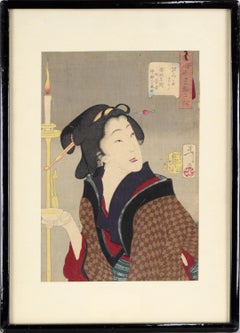
"Thirsty: the appearance of a town geisha in the Ansei era" - Woodblock on Paper
By Tsukioka Yoshitoshi
Located in Soquel, CA
"Thirsty: the appearance of a town geisha in the Ansei era" - Woodblock on Paper From the series "Thirty-two Aspects of Customs and Manners" (Fuzoku sanjuniso) Lively woodblock of a...
Category

1880s Edo Figurative Prints

Materials

Paper, Ink, Woodcut

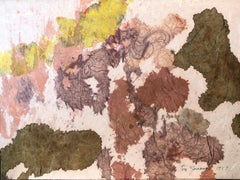
New York School Abstract Expressionist Mixed Media Painting Handmade Paper Board
By Taro Yamamoto
Located in Surfside, FL
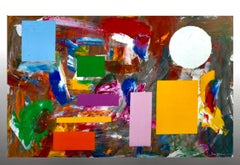
This is an interesting abstract work done with handmade Japanese Kozo or Washi type fiber paper mounted on board. Hand signed and dated in wonderful muted earth tones of fall foliage. Taro Yamamoto (1919 – 1994) belonged to the New York School Abstract Expressionist artists whose artistic innovation by the 1950s had been recognized across the Atlantic, including Paris. New York School Abstract Expressionism, represented by Jackson Pollock, Willem de Kooning, Franz Kline and others became a leading art movement of the post World War II era. He was also associated with Action painting Yamamoto was born in Hollywood, California. He lived in Japan from age six to age nineteen. In 1936 he returned to the USA and began studies in cubism at Los Angeles City College. In 1941 he joined the U.S. Army and served during WWII. After being discharged from the service he returned to California where he studied at the Santa Monica City College. 1950-1952 at The Art Students League of New York, under Yasuo Kuniyoshi, Morris Kantor, Reginald Marsh, Byron Browne and Vaclav Vytlacil; 1951-1953 at the Hans Hofmann School of Fine Arts in New York City. In 1952 he won a John Sloan Fellowship from the Art Students League. The next year he traveled to Europe under a Edward G. MacDowell Traveling Fellowship where he studies in Stuttgart, Germany with Willi Baumeister. He also exhibited at Galerie Huit in Paris. In 1954 Yamamoto was invited to a residency at the MacDowell Colony in Peterborough, New Hampshire. There he worked alongside Stuart Davis, Milton Avery, Willem de Kooning, Jackson Pollock and Mark Rothko developing his unique abstract expressionist style. Later in his life he devoted himself to a more hard-edge geometric style of painting. He married Gwyneth Cotton, a naturalized English woman, in 1955, and they lived in Wellfleet, Massachusetts. They were active at the Universalist Church of Provincetown. (He descended from a long line of Shinto priests) Yamamoto died in Provincetown in 1994. Selected Solo Exhibitions 1953: Galerie Huit, Paris; 1955: The Art Students League of New York, NYC; 1960-1962: Krasner Gallery, NYC; 1963-1964: 371 Gallery, Provincetown, MA; Selected Group Exhibitions 1951: Pennsylvania Academy of Fine Arts; 1952: NY Contemporary Gallery, NYC; 1952, 1955, 1956, 1962: Provincetown Art...
Category

1950s Abstract Expressionist Abstract Paintings

Materials

Paint, Mixed Media, Board, Handmade Paper

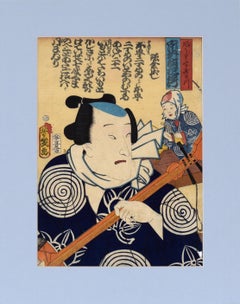
"Candy Seller" Japanese Woodblock on Rice Paper
By Utagawa Yoshiiku
Located in Soquel, CA
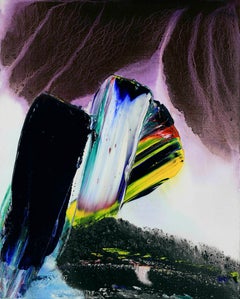
"Candy Seller" (飴売りうずまつ 市村羽左衛門) Japanese Woodblock on Rice Paper This piece depicts Ichimura Uzaemon as the Candy Peddler Uzumatsu. He is playing a stringed instrument (the shamisen) to attract people to come buy canbdy. The spiral on his clothing is the symbol of the candy seller, along with his crest of the mandarin orange. This Utagawa Yoshiiku print, titled "Umegoyomi mitate hachi shojin" (梅暦見立八笑人), depicts a scene from the Edo period. The print features a prominent male figure playing a shamisen, a traditional Japanese stringed instrument. The text on the print is in Japanese, and the overall style is characteristic of Ukiyo-e, a genre of Japanese woodblock prints. Utagawa Yoshiiku was a significant artist of the Meiji era, known for his contributions to woodblock printmaking. He was a student of Utagawa Kuniyoshi and worked alongside Tsukioka Yoshitoshi. His works often portray historical events, scenes from Kabuki plays, and contemporary life. This print, in particular, showcases the artist's skill in capturing the details of clothing, facial expressions, and the musical instrument. Presented in a new blue mat with foam core backing. Mat size: 18"H x 14"W Paper size: 16"H x 12"W Born the son of teahouse proprietor Asakusa Tamichi in 1833, Utagawa Yoshiiku (also known as Ochiai Yoshiiku) became a student of ukiyo-e artist Utagawa Kuniyoshi toward the end of the 1840s. His earliest known work dates to 1852 when he provided the backgrounds to some actor prints by his master. Yoshiiku's earliest works were portraits of actors (yakusha-e), beauties (bijin-ga), and warriors (musha-e). He later followed Kuniyoshi into making satirical and humorous pieces, and became the leading name in the field after Kuniyosh's death in 1861. He illustrated the Tokyo Nichi Nichi...
Category

1860s Edo Figurative Prints

Materials

Ink, Rice Paper, Woodcut

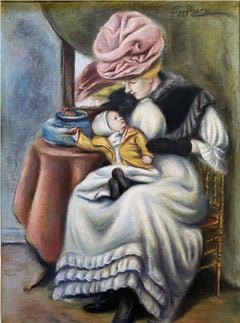
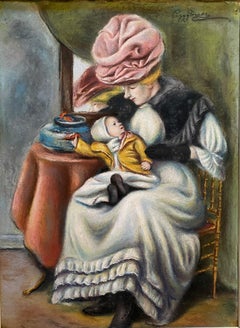
Mother and Child with Goldfish
By Peggy Dodds
Located in Los Angeles, CA
A whimsical pastel featuring a Mother with her Child on her lap that just pulled a goldfish from it's bowl. A charming large work that is exquisitely framed. Peggy Dodds Williams ...
Category

1930s Impressionist Figurative Paintings

Materials

Pastel, Archival Paper

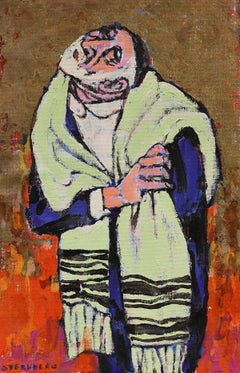
Modernist Rabbi Judaica Painting on Gold Background
By Harry Sternberg
Located in Surfside, FL
A contorted Rabbi looking upward is depicted in a naive, and almost child-like manner. Vibrant colors, and gestural brushstrokes fill the composition, enhancing the flatness of the figure. Harry Sternberg, artist, teacher, and political activist was born in New York City's lower east side in 1904. He was the youngest of eight children born to his mother, a hungarian immigrant, and his father, an immigrant from Russia, . His passion for art came early; by age 12 he had begun saturday art classes at the Brooklyn Museum of Art. Sternberg continued to advance his formal art education through 1922, studying at at New York's prestigious Arts Students League alongside Raphael Soyer, Yasuo Kuniyoshi and other notables of the day. His career as a professional artist began in 1928 when he consigned a group of his early prints with the dealer Frederick Keppel in New York. In 1933 he returned to the Art Students League of New York as an instructor, where he taught etching, lithography and composition, continuing to teach there for over 34 years. During the Great Depression he was a WPA artist, and his murals are in post offices in Chicago, Chester and Sellersville, Pennsylvania. Sternberg came to national prominence as a printmaker, painter, and muralist, in the Depression era and during World War II. Sternberg was an acclaimed member of a vital generation of American artists dedicated to exposing social injustices and offering support for an egalitarian society. His interest in the plight of American workers...
Category

20th Century Modern Figurative Paintings

Materials

Acrylic, Illustration Board

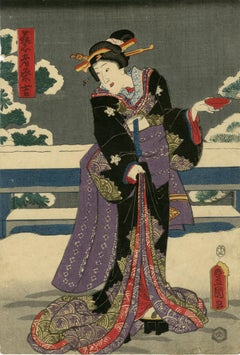
Courtesan Kumekichi
By Utagawa Kunisada (Toyokuni III)
Located in Fairlawn, OH
Courtesan Kumekichi Color woodblock, 1858 Kabuki Actor Iwai Kumesaburo III in the role of courtesan Kumekichi, who is standing in snow hold a red sake cup Publisher: Ohkuniya Kinjiro...
Category

1850s Other Art Style Figurative Prints

Materials

Woodcut

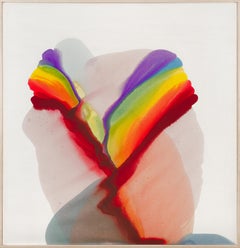
Phenomena Dervish Spell
By Paul Jenkins
Located in Austin, TX
Waterline Fine Art, Austin, TX is pleased to present the following work: Paul Jenkins Phenomena Dervish Spell, 1974 Acrylic on canvas Signed lower right 65 x 63 in. 66.5 x 64.5 in....
Category

1970s Abstract Abstract Paintings

Materials

Canvas, Acrylic

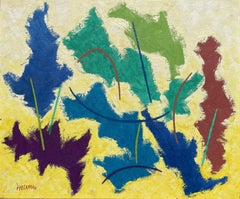
"Cubist Landscape" Albert Heckman, American Modernism, Woodstock, Earth Tones
By Albert Heckman
Located in New York, NY
Albert Heckman Cubist Landscape Oil on canvas 16 x 20 inches Albert Heckman was born in Meadville, Western Pennsylvania, 1893. He went to New York City to try his hand at the art w...
Category

1940s American Modern Figurative Paintings

Materials

Canvas, Oil

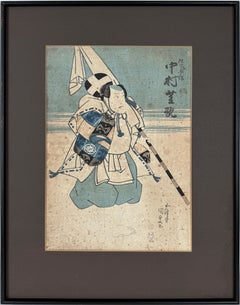
Kabuki actor Nakamura Shikan II by Utagawa Kunisada Edo Japanese Woodblock Print
By Utagawa Kunisada (Toyokuni III)
Located in Soquel, CA
Kabuki actor Nakamura Shikan II by Utagawa Kunisada Japanese Woodblock Print Wonderful portrait of Nakamura Shikan II, a prominent kabuki actor, in the role of Kisen Hoshi Toyokuni ...
Category

1820s Realist Figurative Prints

Materials

Printer s Ink, Rice Paper, Woodcut

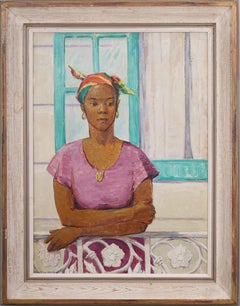
Large Antique American Bahamian Young Woman Portrait Signed Rare Oil Painting
Located in Buffalo, NY
Really rare and well painted portrait by Christine Walters Martin (1895-1982). Oil on canvas. Framed in a nice modernist molding. Signed. Artist Bio: Christine Walters Martin (1895-1982) Born and raised in Brooklyn, Christine Martin majored in art at Columbia University/Teachers College. She spent summers painting at the Woodstock Art Colony under the tutelage of artists there and continued her art studies at the Art Student's League in New York City. Over the years, her teachers included John Sloan, Yasuo Kuniyoshi, Alexander Brook and John McFee. She also studied with Eugene Speicher, who recommended her for Portraits Inc, through which some of his own commissions came. Much later in life, in her 80s, Christine studied watercolor with Zoltan Szabo. Before marrying attorney George Martin in 1923, she taught art in the New York public schools for several years. During summers in the late 1920s, after having two daughters (Cynthia, 1924-2008, and Joan, 1927-2000), she went to Woodstock with her girls in tow, staying at the Hasbrook farm. In 1930, she and her husband purchased a stone house on Ohayo Mountain Road and lived there seasonally for 25 years. Among her closest artist friends in Woodstock were Emil Ganso, Florence Hardiman, Albert Heckman, Peggy Dodds, Joe Rollo, Henry Mattson, Mary Ellen Early, and Maud and Miska Petersham, along with Juliana Force (Whitney Museum). During many summers in Woodstock, Christine's daughters Cynthia and Joan kept up their serious piano studies under the tutelage of Vladimir Padwa and Inez Carroll. Known for portraits and landscapes, she was a member of the National Association of Women Artists and the National Arts Club, Gramercy Park, NY. Her work showed at the National Arts Club, Weyhe and Preston Galleries and the National Academy of Design in New York; the Pennsylvania Academy in Philadelphia; the Woodstock Art Association and Rudolf Galleries in Woodstock, Vermont's Dawson Grist Mill Gallery, and South Hampton College, among others. Her portraits, landscapes and still lives hang in hundreds of homes around the world. Information provided by Bunny McBride...
Category

1920s Modern Portrait Paintings

Materials

Canvas, Oil

"Beach Landscape" Karl Fortess, WPA, Dramatic, Cloudy Sky, Beach, Dunes
Located in New York, NY
Karl Fortess Beach Landscape Signed lower left Oil on canvas 8 x 10 inches Karl Fortess was born in Belgium, moving United States and studying at the Art Institute of Chicago, the ...
Category

1930s American Realist Figurative Paintings

Materials

Canvas, Oil

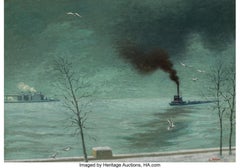
"Tugboat in New York Harbor" Ernest Fiene, Modernist, Cerulean Waterscape
By Ernest Fiene
Located in New York, NY
Ernest Fiene Tugboat in New York Harbor Signed lower right Oil on canvas 24 1/2 x 34 1/2 inches Ernest Fiene was born in Elberfeld, Germany in 1894. As a teenager, Fiene immigrated...
Category

1930s American Modern Landscape Paintings

Materials

Canvas, Oil

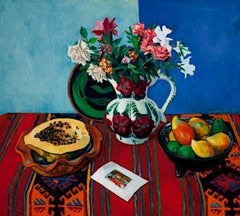
late 20th century still life oil painting with flowers and fruit signed
By Warren Brandt
Located in Milwaukee, WI
"Papaya & Mexican Pitcher" is an original signed oil painting by Warren Brandt. Brandt, an American painter originally influenced by Abstract Expressionism, became a "child of Matiss...
Category

1980s Contemporary Still-life Paintings

Materials

Canvas, Oil

Mother and Child with Goldfish
By Peggy Dodds
Located in Los Angeles, CA
A whimsical pastel featuring a Mother with her Child on her lap that just pulled a goldfish from it's bowl. A charming large work that is exquisitely framed. Peggy Dodds Williams ...
Category

1930s American Realist More Art

Materials

Pastel

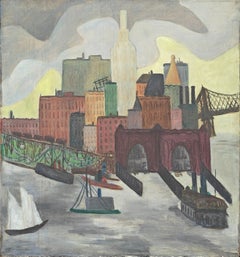
"New York Skyline" Adelaide Lawson Gaylor, Modernist Landscape, Female Artist
Located in New York, NY
Adelaide Lawson Gaylor New York Skyline, circa 1925 Oil on canvas 48 x 45 inches Modernist artist Adelaide Jaffrey Lawson Gaylor was born in New York City and studied at the Art St...
Category

1920s American Modern Figurative Paintings

Materials

Canvas, Oil

Antique 19th Century Japanese Woodblock Print By Utagawa Kunisada C.1858
Located in London, GB
Antique 19th Century Japanese Woodblock Print By Utagawa Kunisada C.1858 Edo period 1858 (Ansei 5), 3rd month Original Woodblock print of Snow (Yuki) actor Nakamura Fukusuke I as H...
Category

Antique Mid-19th Century Japanese Edo Prints

Materials

Paper

"Woodstock Landscape" Albert Heckman, American Modernist, Atmospheric Valley
By Albert Heckman
Located in New York, NY
Albert Heckman Woodstock Landscape Oil on board 10 x 8 inches Albert Heckman was born in Meadville, Western Pennsylvania, 1893. He went to New York City to try his hand at the art ...
Category

1940s American Modern Figurative Paintings

Materials

Oil, Board

Paul Jenkins - Composition - Original Lithograph
By Paul Jenkins
Located in Collonge Bellerive, Geneve, CH
Paul Jenkins - Composition - Original Lithograph 1964 Dimensions: 30 x 20 cm Edition of 200 (one of the 200 on Vélin de Rives) Mourlot Press, 1964 Paul Jenkins, American (1923 - 2012) Paul Jenkins, an artist originally associated with abstract expressionism, exhibits in his mature works a redefining of color, light and space on the canvas surface. Born in Kansas City, Missouri in 1923, Jenkins worked as a teenager in a ceramics factory, where he was first exposed to color intensity and the creation of form. From age 14 to 18, he studied drawing and painting at the city's Art Institute. Initially interested in drama, Jenkins received a fellowship to the Cleveland Playhouse, then continued his dramatic studies in Pittsburgh at the Drama School of the Carnegie Institute of Technology. Deciding to become an artist, Jenkins moved to New York City in 1948 and studied at the Art Students League. During Jenkins's three years at the League, Yasuo Kuniyoshi and Morris Kantor were his influential instructors. While Jenkins continued to live and paint in New York City, his personal explorations took a metaphysical turn, which would ultimately become dominant in his work. P.D. Ouspensky's The Search of the Miracu/ous changed the artist's thoughts on human growth and limitations, while the Chinese I Ching, through its thematic emphasis on constant change, heightened his interest in flowing paint on canvas. Painting for Jenkins became an intuitive, almost mystical process. He commented, "I paint what God is to me." In 1953, Jenkins traveled to Paris, where, a year later, he had his first one-man show. While working at the American Artists Center, he continued to experiment with flowing paints, pouring pigment in streams of various thicknesses, with white thin spills as linear overlays. Jenkins's intent was to deny stasis and create a literal and metaphysical sense of dynamism, while maintaining a sense of unity. Beginning in 1958, Jenkins titled each canvas Phenomena, with additional identifying words. He believed the work to be descriptive of the discovery process inherent in each painting. Paralleling his beliefs, the artist's paintings have undergone subtle but definite changes. Beginning in the early 1 960s, a shift of color saturation and exposure of the white areas gave Jenkins's canvases an enhanced feeling of illumination. If Jenkins's technique is unorthodox, he is in many other ways a traditional artist. He works in an acrylic medium on traditional linen canvas or fine rag paper. Often he uses an ivory knife...
Category

1960s Modern Abstract Prints

Materials

Lithograph

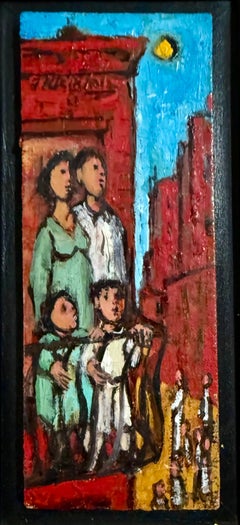
Mid Century Oil Painting Family on Fire Escape Frank Kleinholz WPA NYC Tenements
By Frank Kleinholz
Located in Surfside, FL
Frank Kleinholz (Brooklyn, 1901 - 1987) Original oil on panel painting titled "Fire Escape", a preliminary study for a mural commissioned for Marquette University. The composition de...
Category

Mid-20th Century Expressionist Figurative Paintings

Materials

Oil, Panel

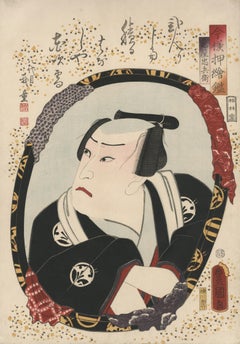
Kataoka Nizayemon(?)
By Utagawa Kunisada (Toyokuni III)
Located in Fairlawn, OH
Exceptional, brilliant impression and colors from the extremely rare 1st edition Kataoka Nizayemon(?) Color woodcut, 1860 From the series: "Contemporary Brocade Mirror Portraits" Pub...
Category

1860s Portrait Prints

Materials

Woodcut

Lithograph Belgian American Surrealism WPA Modernist Karl Fortess Surrealist Art
Located in Surfside, FL
Karl Eugene Fortess (1907-1993) Original color lithographs on BFK Rives paper, 1966, Hand signed and numbered 29/36 in pencil, Sheet size 20.5 x 15 inches. Karl E. Fortess (1907-1993) was a painter, printmaker and teacher, of Boston, Massachusetts and Woodstock, N.Y. Fortess was born in Antwerp, Belgium on October 13, 1907, and became an American citizen in 1923. He studied at the Art Institute of Chicago, the Art Students League in New York, and the Woodstock School of Painting with Yasuo Kuniyoshi. In 1937 the Works Progress Administration sent him and several other artists to Alaska to document the towns, villages, and remote wilderness landscapes (Pemberton, “Alaska art museum collects WPA’s Depression works from the territory,” Columbia Daily Tribune, November 9, 2003). Trains, trucks, and industrial buildings were what Karl Fortess envisioned when the Public Works of Art Project suggested that he depict “the American Scene.” His work bears the influence of Surrealism, Russsian Constructivist art and Cubism. He was part of a circle of left leaning artists loosley involved with the WPA which included Sol Wilson, Isaac Soyer, Louis Lozowick, Abraham Harriton, Ben Shahn, William Gropper, Nahum Tschacbasov, Morris Shulman, Yasuo Kuniyoshi, Louis Slobodkin, Adolf Dehn, Le Corbusier and Louis Schanker. Karl Fortress taught at the Art Students League, Brooklyn Museum Art School, Louisiana State University, Fort Wright College, and Boston University School of Fine and Applied Arts. He was a member of the Artists Equity Association, Society of American Graphic Artists, American Association of University Professors, and the British Film Institute. He was awarded the Guggenheim Fellowship in 1946, was named an Associate of the National Academy of Design in 1960 and elected to full Academician in 1971. Fortess taught at many different schools, including Boston University School of Fine Art, where he also created an archive of interviews with more than two hundred and fifty contemporary American painters, sculptors, and graphic artists including many with with artists associated with the Woodstock, N.Y. art community. Among the interviewees are Kenneth Armitage, Will Barnet, Romare Bearden, George Biddle, James Brooks, Adolph Dehn, Jane Freilicher, Julian Levi, Alice Neel, Larry Rivers, Moses Soyer, Dorothy Varian...
Category

Mid-20th Century Surrealist Landscape Prints

Materials

Lithograph

Large New York School Abstract Expressionist Colorful Mixed Media Painting
By Taro Yamamoto
Located in Surfside, FL
Taro Yamamoto, (American, 1919-1994) "La Gatta Miso" Oil or Acrylic/Canvas 32" x 50" Hand signed lower right, dated 1990, Titled on the stretcher verso, unframed. Taro Yamamoto (...
Category

1950s Abstract Expressionist Abstract Paintings

Materials

Canvas, Oil, Acrylic

Phenomena Celtic Fire Torc by Paul Jenkins - Abstract painting
By Paul Jenkins
Located in London, GB
Phenomena Celtic Fire Torc by Paul Jenkins (1923-2012) Acrylic on canvas 76 x 61 cm (29⁷/₈ x 24 inches) Signed lower left Paul Jenkins Signed, dated and titled on the reverse Executed in 1995 Provenance Private collection, Germany Biography Born at Kansas City in Missouri (USA), the multi-media artist, poet and playwright Paul Jenkins studied at the Kansas City Art Institute and the Art Students League in New York City. After his discharge from military service at the end of February 1946, he briefly studied playwriting with dramatist George McCalmon at the Carnegie Institute of Technology in Pittsburgh. Thereafter, Jenkins spent four years studying with Japanese American artist Yasuo Kuniyoshi in New York City. His first solo exhibitions were held at Studio Paul Facchetti in Paris in 1954 and the Martha Graham Gallery in New York City in 1956. Over the past thirty years, numerous retrospectives have been curated across the globe and Jenkins’ work can found in national collections from Europe and the United States to Israel, Australia and Japan. The diversity of his work springs from Jenkins’ wealth of eclectic influences. Some of his earliest works included what he called "interior landscapes" influenced by ancient natural forms like the caves he visited in the Ozark Mountains in his native-Missouri. Frequent student visits to the Frick Collection in New York fostered a love of the great masters: Bellini, Holbein, Vermeer, Rembrandt, de la Tour, Turner and Goya. In compliment, lingering student visits to the renowned Eastern collection of the Nelson-Atkins Museum of Art in Kansas City evoked powerful sympathy for a monumental Chinese fresco...
Category

1990s Abstract Expressionist Abstract Paintings

Materials

Canvas, Acrylic

"Untitled" Albert Heckman, Still Life, Floral Abstracted Modernist Composition
By Albert Heckman
Located in New York, NY
Albert Heckman Untitled, circa 1950 Signed lower right Oil on canvas 25 1/4 x 32 1/4 inches Albert Heckman was born in Meadville, Western Pennsylvania, 1893. He went to New York City to try his hand at the art world in 1915 after graduating from high school and landing a job at the Meadville Post Office. In 1917, at the age of 24, Heckman enrolled part-time in Teachers' College, Columbia University's Fine Arts Department to begin his formal art education. He worked as a freelance ceramic and textile designer and occasionally as a lecturer at the Metropolitan Museum of Art. In the early 1920s, at the age of almost 30, he graduated with a Bachelor of Arts degree from Columbia Teachers College. He was especially impacted by his instructor at Columbia, Arthur Wesley Dow. After graduating, he was hired by the Teachers' College as a Fine Arts instructor. He stayed with Columbia Teachers' College until 1929, when he left to attend the Leipzig Institute of Graphic Arts in Leipzig, Germany. Isami Doi (1903-1965), who was born in Hawaii, was arguably his most impressive student at Columbia. Doi is now regarded as one of the most prominent artists hailing from Hawaii. Heckman became an active member and officer of the Keramic Society and Design Guild of New York in the 1920s as part of his early commercial art career. The Society's mission was to share knowledge and showcase textile and ceramic design exhibits. In 1922, Heckman married Florence Hardman, a concert violinist. Mrs. Heckman's concert schedule during the 1920s kept Albert and Florence Heckman apart for a significant portion of the time, but they spent what little time they had together designing and building their Woodstock, New York, summer house and grounds. A small house and an acre of surrounding land on Overlook Mountain, just behind the village of Woodstock, were purchased by Albert and Florence Heckman at the time of their marriage. Their Woodstock home, with its connections, friendships, and memories, became a central part of their lives over the years, even though they had an apartment in New York City. Heckman's main artistic focus shifted to the house on Overlook Mountain and the nearby towns and villages, Kingston, Eddyville, and Glasco. After returning from the Leipzig Institute of Graphic Arts in 1930, Mr. Heckman joined Hunter College as an assistant professor of art. He worked there for almost thirty years, retiring in 1956. Throughout his tenure at Hunter, Mr. Heckman and his spouse spent the summers at their Woodstock residence and the winters in New York City. They were regular and well-known guests at the opera and art galleries in New York. Following his retirement in 1956, the Heckmans settled in Woodstock permanently, with occasional trips to Florida or Europe during the fall and winter. Mr. Heckman's close friends and artistic career were always connected to Woodstock or New York City. He joined the Woodstock art group early on and was greatly influenced by artists like Paul and Caroline Rohland, Emil Ganso, Yasuo Kuniyoshi, Andre Ruellan, and her husband, Jack Taylor. Heckman operated a summer art school in Woodstock for several years in the 1930s with support from Columbia University, where these and other Woodstock artists gave guest lectures. The Potter's Shop in New York City hosted Mr. Heckman's first art show in December 1928. The exhibit received some positive reviews from critics. The American Institute of Graphic Arts chose the plate of "Wehlen, Saxony" as one of the "Fifty Prints of the Year in 1929." There were sixteen etchings displayed. The remaining plates depicted scenes in Saxony, Germany, while five of the plates were based on scenes in Rondout, New York. Heckman started switching from etching to black and white lithography by the early 1930s. A lifelong admirer of Heckman's artwork, Mr. Gustave von Groschwitz organized a significant exhibition of Heckman etchings and lithographs at the Ferargil Gallery in New York City in 1933. The exhibition traveled to the Stendahl Galleries in Los Angeles (May 1933), the Charles Lessler Gallery in Philadelphia (May 1933), J.L. Hudson in Detroit (June 1933), and Gumps in San Francisco (July 1933). Together with his early etchings, the exhibition featured brand-new black and white lithographs depicting scenes in and around Woodstock as well as "A View from Tudor City...
Category

1950s Abstract Figurative Paintings

Materials

Canvas, Oil

Phenomenon East of the River, Acrylic on Canvas Painting by Paul Jenkins
By Paul Jenkins
Located in London, GB
*PLEASE NOTE UK BUYERS WILL ONLY PAY 5% VAT ON THIS PURCHASE. Once an order is placed we will arrange the VAT of 20% to be reduced to 5% Phenomenon East of the River by Paul Jenkins (1923 - 2012) Acrylic on canvas 97.2 x 130.2 cm (38 ¹/₄ x 51 ¹/₄ inches) Signed lower right, Paul Jenkins Signed, titled and dated 1993 on the reverse Provenance Private collection, New York, acquired directly from the artist Artist's Biography Born at Kansas City in Missouri (USA), the multi-media artist, poet and playwright Paul Jenkins studied at the Kansas City Art Institute and the Art Students League in New York City. After his discharge from military service at the end of February 1946, he briefly studied playwriting with dramatist George McCalmon at the Carnegie Institute of Technology in Pittsburgh. Thereafter, Jenkins spent four years studying with Japanese American artist Yasuo Kuniyoshi in New York City. His first solo exhibitions were held at Studio Paul Facchetti in Paris in 1954 and the Martha Graham Gallery in New York City in 1956. Over the past thirty years, numerous retrospectives have been curated across the globe and Jenkins’ work can found in national collections from Europe and the United States to Israel, Australia and Japan. The diversity of his work springs from Jenkins’ wealth of eclectic influences. Some of his earliest works included what he called "interior landscapes" influenced by ancient natural forms like the caves he visited in the Ozark Mountains in his native-Missouri. Frequent student visits to the Frick Collection in New York fostered a love of the great masters: Bellini, Holbein, Vermeer, Rembrandt, de la Tour, Turner and Goya. In compliment, lingering student visits to the renowned Eastern collection of the Nelson-Atkins Museum of Art in Kansas City evoked powerful sympathy for a monumental Chinese fresco...
Category

1990s Abstract Abstract Paintings

Materials

Canvas, Acrylic

Inari Kozo Tasaburo- Kabuki
By Utagawa Toyokuni
Located in Fairlawn, OH
Inari Kozo Tasaburo- Kabuki Color woodcut, c. 1820 Signed: ‘Toyokuni’ Publisher: ‘Yamamoto Heikichi’ Censor: Hama and Magome Very good impression and color Sheet/Image size: 15 1/2 x...
Category

1820s Other Art Style Figurative Prints

Materials

Woodcut

"Woodstock Landscape" Albert Heckman, Modernist, Rich Green Vegetation, WPA
By Albert Heckman
Located in New York, NY
Albert Heckman Woodstock Landscape Oil on board 8 x 10 inches Albert Heckman was born in Meadville, Western Pennsylvania, 1893. He went to New York City to try his hand at the art ...
Category

1940s American Modern Figurative Paintings

Materials

Oil, Board

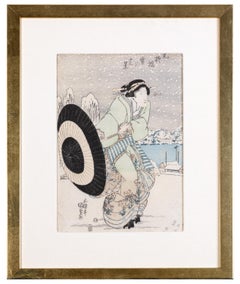
"Yanagibashi in Snow, " Color Woodcut Portrait with Umbrella
By Utagawa Kunisada (Toyokuni III)
Located in Milwaukee, WI
"Yanagibashi in Snow" is an original color woodcut by Utagawa Kunisada. This woodblock print depicts a woman walking in the snow near the Motoyanagi canal, which was located in Tokyo...
Category

1920s Figurative Prints

Materials

Woodcut

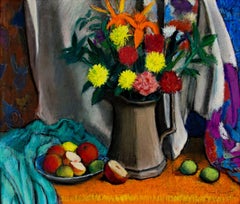
late 20th century still life oil painting with flowers and fruit signed
By Warren Brandt
Located in Milwaukee, WI
"Grey Pitcher" is a pastel still life by American artist Warren Brandt created in 1986. Warren Brandt is known for his still-life paintings being especial...
Category

1980s Contemporary Still-life Drawings and Watercolors

Materials

Pastel

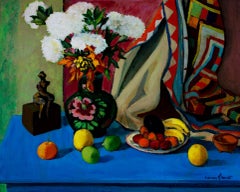
late 20th century still life oil painting with flowers and fruit on a blue table
By Warren Brandt
Located in Milwaukee, WI
Rich, colorful, expressionist still life by American artist Warren Brandt featuring a decorative vase with white flowers, an assortment of fruit, and a small wooden sculpture...
Category

1980s Contemporary Still-life Paintings

Materials

Canvas, Oil

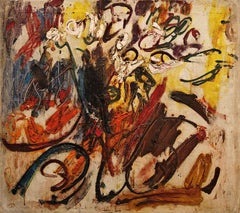
"Untitled" Taro Yamamoto, New York School, Gestural, Thick Impasto Composition
By Taro Yamamoto
Located in New York, NY
Taro Yamamoto Untitled, 1954 Signed lower right; signed and dated on the reverse Oil on canvas 25 x 30 inches Taro Yamamoto was involved in the Abstract Expressionist movement in N...
Category

1950s Abstract Expressionist Abstract Paintings

Materials

Canvas, Oil

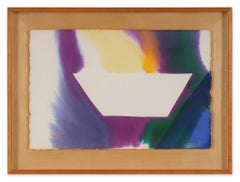
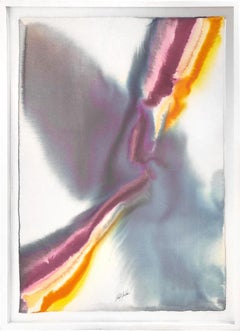
PHENOMENA Chinese Light Chalice 1989 Abstract Expressionist Watercolor, framed
By Paul Jenkins
Located in New York, NY
As a teen, Paul Jenkins worked with ceramicist James Weldon which led to a fascination with glazes; Jenkins cultivated and eventually achieved a similar effect in his paintings by mixing oil and enamel on canvas in the 50s. In 1937, Jenkins attended classes at the Kansas City Art Institute where he painted his first series of watercolors he called interior landscapes inspired by caves in the Ozarks. After serving in the US Naval Air Corps for 2 years, Jenkins moved to New York to study with Yasuo Kuniyoshi and Morris Kantor at the Art Students League from 1948 to 1952. During those years, Jenkins met Mark Rothko, Jackson Pollock and Barnett Newman. In 1953 left for Paris where he discovered and was struck by the color density and luminosity in abstract oil works termed ébauches by Gustave Moreau and pastels by Odilon Redon. He began to experiment with poured paints in various thicknesses on canvas and paper and found this technique achieved luminosity of color which in its own way was comparable to that of Moreau and Redon. The next year, Jenkins added Winsor Newton pigments and chrysochrome, a viscous enamel paint, into his poured paintings, further enriching their color density and incandescence. The next major development in technique came in 1959 when he began using an ivory knife to guide the flow of paint. That same year, he also began to title his paintings Phenomena followed by a key word or phrase. A film on Jenkins' technique titled The Ivory Knife: Paul Jenkins at Work was shown at the Museum of Modern Art and received the Golden Eagle Award at the Venice Film Festival in 1966. In 1954 Jenkins had his first solo exhibition in Paris where he met Martha Jackson, whose New York gallery included Jenkins in a group show the following year. In 1956, Martha Jackson Gallery held a solo exhibition of Jenkins’ work at which Divining Rod...
Category

1980s Abstract Expressionist Abstract Drawings and Watercolors

Materials

Watercolor, Paper

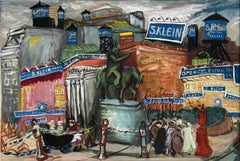
"Union Square" NYC American Scene Social Realism Modernism WPA Mid-20th Century
By Agnes Hart
Located in New York, NY
"Union Square" NYC American Scene Social Realism Modernism WPA Mid-20th Century Agnes Hart (American, 1912-1979) "Union Square, New York City" Sight: 14 1/2 x 21 1/2 inches Gouache...
Category

1940s American Modern Landscape Paintings

Materials

Gouache, Board

"Untitled" Albert Heckman, Modernist Saturated Blue and Yellow Still Life
By Albert Heckman
Located in New York, NY
Albert Heckman Untitled, circa 1950 Signed lower right Oil on canvas 18 x 24 inches Albert Heckman was born in Meadville, Western Pennsylvania, 1893. He went to New York City to try his hand at the art world in 1915 after graduating from high school and landing a job at the Meadville Post Office. In 1917, at the age of 24, Heckman enrolled part-time in Teachers' College, Columbia University's Fine Arts Department to begin his formal art education. He worked as a freelance ceramic and textile designer and occasionally as a lecturer at the Metropolitan Museum of Art. In the early 1920s, at the age of almost 30, he graduated with a Bachelor of Arts degree from Columbia Teachers College. He was especially impacted by his instructor at Columbia, Arthur Wesley Dow. After graduating, he was hired by the Teachers' College as a Fine Arts instructor. He stayed with Columbia Teachers' College until 1929, when he left to attend the Leipzig Institute of Graphic Arts in Leipzig, Germany. Isami Doi (1903-1965), who was born in Hawaii, was arguably his most impressive student at Columbia. Doi is now regarded as one of the most prominent artists hailing from Hawaii. Heckman became an active member and officer of the Keramic Society and Design Guild of New York in the 1920s as part of his early commercial art career. The Society's mission was to share knowledge and showcase textile and ceramic design exhibits. In 1922, Heckman married Florence Hardman, a concert violinist. Mrs. Heckman's concert schedule during the 1920s kept Albert and Florence Heckman apart for a significant portion of the time, but they spent what little time they had together designing and building their Woodstock, New York, summer house and grounds. A small house and an acre of surrounding land on Overlook Mountain, just behind the village of Woodstock, were purchased by Albert and Florence Heckman at the time of their marriage. Their Woodstock home, with its connections, friendships, and memories, became a central part of their lives over the years, even though they had an apartment in New York City. Heckman's main artistic focus shifted to the house on Overlook Mountain and the nearby towns and villages, Kingston, Eddyville, and Glasco. After returning from the Leipzig Institute of Graphic Arts in 1930, Mr. Heckman joined Hunter College as an assistant professor of art. He worked there for almost thirty years, retiring in 1956. Throughout his tenure at Hunter, Mr. Heckman and his spouse spent the summers at their Woodstock residence and the winters in New York City. They were regular and well-known guests at the opera and art galleries in New York. Following his retirement in 1956, the Heckmans settled in Woodstock permanently, with occasional trips to Florida or Europe during the fall and winter. Mr. Heckman's close friends and artistic career were always connected to Woodstock or New York City. He joined the Woodstock art group early on and was greatly influenced by artists like Paul and Caroline Rohland, Emil Ganso, Yasuo Kuniyoshi, Andre Ruellan, and her husband, Jack...
Category

1950s Modern Interior Paintings

Materials

Canvas, Oil

"Untitled" Albert Heckman, Mid-Century American Modernist Abstract Composition
By Albert Heckman
Located in New York, NY
Albert Heckman Untitled Signed lower left Oil on canvas 20 x 24 inches Albert Heckman was born in Meadville, Western Pennsylvania, 1893. He went to New York City to try his hand at...
Category

1950s Modern Abstract Paintings

Materials

Canvas, Oil

Phenomena Quoth by Paul Jenkins - Abstract Expressionist painting, 1963-64
By Paul Jenkins
Located in London, GB
Phenomena Quoth by Paul Jenkins (1923-2012) Acrylic on canvas 76 x 100 cm (29 ⁷/₈ x 39 ³/₈ inches) Signed lower center, Paul Jenkins Signed, titled and dated on the reverse Executed in 1963-64 Provenance Kenmore Galleries, Philadelphia Dr. Theodore A. Feinstein collection Sotheby's New York, 24th February 1995 Crozier Fine Arts, New York Private collection, New York Artist biography Born at Kansas City in Missouri (USA), the multi-media artist, poet and playwright Paul Jenkins studied at the Kansas City Art Institute and the Art Students League in New York City. After his discharge from military service at the end of February 1946, he briefly studied playwriting with dramatist George McCalmon at the Carnegie Institute of Technology in Pittsburgh. Thereafter, Jenkins spent four years studying with Japanese American artist Yasuo Kuniyoshi in New York City. His first solo exhibitions were held at Studio Paul Facchetti in Paris in 1954 and the Martha Graham Gallery in New York City in 1956. Over the past thirty years, numerous retrospectives have been curated across the globe and Jenkins’ work can found in national collections from Europe and the United States to Israel, Australia and Japan. The diversity of his work springs from Jenkins’ wealth of eclectic influences. Some of his earliest works included what he called "interior landscapes" influenced by ancient natural forms like the caves he visited in the Ozark Mountains in his native-Missouri. Frequent student visits to the Frick Collection in New York fostered a love of the great masters: Bellini, Holbein, Vermeer, Rembrandt, de la Tour, Turner and Goya. In compliment, lingering student visits to the renowned Eastern collection of the Nelson-Atkins Museum of Art in Kansas City evoked powerful sympathy for a monumental Chinese fresco of Buddha, polychrome sculptures of the enlightened Bodhisattva, the Buddhist goddess of mercy Kuan-Yin, Indian bronzes of Hindu god Shiva, and statues of meditative Buddhist lohans. Serving in the US Naval Air Corps during the Second World War, Jenkins painted watercolours of Japanese Kabuki dancers and read the ancient Chinese poetic teachings of the I Ching and Lao Tse Tung’s Tao Te Ching...
Category

1960s Abstract Expressionist Abstract Paintings

Materials

Canvas, Acrylic

Phenomena Spectrum Guardian by Paul Jenkins, Abstract Expressionist artist
By Paul Jenkins
Located in London, GB
Phenomena Spectrum Guardian by Paul Jenkins (1923 - 2012) Acrylic on canvas 76 x 101.5 cm (29 ⁷/₈ x 40 inches) Signed lower middle Paul Jenkins Executed in 1970 Provenance: Gallerie Iris Wazzau, Davos, Switzerland Private collection, Cologne, Germany Artist biography: Born at Kansas City in Missouri (USA), the multi-media artist, poet and playwright Paul Jenkins studied at the Kansas City Art Institute and the Art Students League in New York City. After his discharge from military service at the end of February 1946, he briefly studied playwriting with dramatist George McCalmon at the Carnegie Institute of Technology in Pittsburgh. Thereafter, Jenkins spent four years studying with Japanese American artist Yasuo Kuniyoshi in New York City. His first solo exhibitions were held at Studio Paul Facchetti in Paris in 1954 and the Martha Graham Gallery in New York City in 1956. Over the past thirty years, numerous retrospectives have been curated across the globe and Jenkins’ work can found in national collections from Europe and the United States to Israel, Australia and Japan. The diversity of his work springs from Jenkins’ wealth of eclectic influences. Some of his earliest works included what he called "interior landscapes" influenced by ancient natural forms like the caves he visited in the Ozark Mountains in his native-Missouri. Frequent student visits to the Frick Collection in New York fostered a love of the great masters: Bellini, Holbein, Vermeer, Rembrandt, de la Tour, Turner and Goya. In compliment, lingering student visits to the renowned Eastern collection of the Nelson-Atkins Museum of Art in Kansas City evoked powerful sympathy for a monumental Chinese fresco...
Category

1970s Abstract Expressionist Abstract Paintings

Materials

Acrylic, Canvas

Bruce Dorfman Arezzo Mixed-Media Collage Painting
By Bruce Dorfman
Located in Newfoundland, PA
Bruce Dorfman Arezzo mixed-media collage painting *Bruce Dorfman has had fifty-six solo exhibitions in New York, the United States and abroad. His most recent exhibitions include: ...
Category

1990s American Modern Contemporary Art

Materials

Acrylic

9:23 am
By Saul Chase
Located in Los Angeles, CA
9:23am, 1969, acrylic on canvas, signed and dated verso, 44 ½ x 50 inches, exhibited: 39th Midyear Show, The Butler Institute of American Art, Youngstown, Ohio, 1972 (label verso), p...
Category

1960s American Modern Landscape Paintings

Materials

Canvas, Oil

Phenomena High Born by Paul Jenkins - Abstract painting
By Paul Jenkins
Located in London, GB
*UK BUYERS WILL PAY AN ADDITIONAL 5% IMPORT DUTY ON TOP OF THE ABOVE PRICE Phenomena High Born by Paul Jenkins (1923-2012) Acrylic on canvas 91.44 x 50.8 cm (36 x 20 inches) Signed lower left Jenkins Signed, dated and titled on the reverse Executed in 1964 which makes this a very early work and so more valuable Biography Born at Kansas City in Missouri (USA), the multi-media artist, poet and playwright Paul Jenkins studied at the Kansas City Art Institute and the Art Students League in New York City. After his discharge from military service at the end of February 1946, he briefly studied playwriting with dramatist George McCalmon at the Carnegie Institute of Technology in Pittsburgh. Thereafter, Jenkins spent four years studying with Japanese American artist Yasuo Kuniyoshi in New York City. His first solo exhibitions were held at Studio Paul Facchetti in Paris in 1954 and the Martha Graham Gallery in New York City in 1956. Over the past thirty years, numerous retrospectives have been curated across the globe and Jenkins’ work can found in national collections from Europe and the United States to Israel, Australia and Japan. The diversity of his work springs from Jenkins’ wealth of eclectic influences. Some of his earliest works included what he called "interior landscapes" influenced by ancient natural forms like the caves he visited in the Ozark Mountains in his native-Missouri. Frequent student visits to the Frick Collection in New York fostered a love of the great masters: Bellini, Holbein, Vermeer, Rembrandt, de la Tour, Turner and Goya. In compliment, lingering student visits to the renowned Eastern collection of the Nelson-Atkins Museum of Art in Kansas City evoked powerful sympathy for a monumental Chinese fresco...
Category

1960s Abstract Expressionist Abstract Paintings

Materials

Canvas, Acrylic

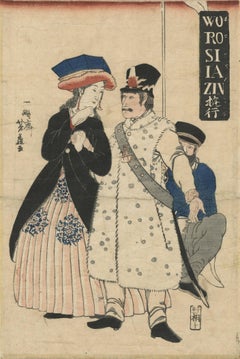
WO RO SI IA ZIN Russian Soldier with His Family
Located in Fairlawn, OH
WO RO SI IA ZIN Russian Soldier with His Family Color woodcut, 1861 2nd month Signed upper left (see photo) Titled upper right in black cartouche (see photo) Format: oban Style: Yokohama-e Publisherr: Sagamiya Tokichi (Marks #435) active 1955-1866 Metropolitan Museum of Art in New York, has an impression of this image RARE Condition: with usual aging Image size: 13 7/8 x 9 3/8 inches Rebecca Salter in her Japanese Popular Prints... on page 18 gives a different take on the situation that Yoshifuji found himself in. "A giant of the period, however, was Utagawa Kuniyoshi (1797-861). Although best known for warrior prints which reflected the militaristic undercurrents of the time, he was also responsible for some of the most light-heartend and humorous works in this book. His followers in the Utagawa school, Utagawa Yoshitsuya...
Category

1860s Other Art Style Figurative Prints

Materials

Woodcut

Abstraction
By Agnes Hart
Located in Saratoga Springs, NY
Signed lower right Agnes Hart was born in Meridan, Connecticut. She studied at the Ringling School of Art in Sarasota, Florida; at Iowa State University with Josef Presser, Paul Burlin and Lucile...
Category

1950s Abstract Abstract Paintings

Materials

Sandstone

Japanese Woodblock Print by Utagawa Yoshiika 落合芳幾 1833-1904
Located in Norton, MA
Japanese woodblock print by Utagawa Yoshiika 落合芳幾 (1833-1904), unframed. About the artist Yoshiiku was a popular ukiyo-e printmaker during the Meiji period. It is thought that he was the son of a tea house proprietor, hence his particular skill success in the portrayal of various beauties from teahouses and restaurants. Yet, he was an artist comfortable across subject matter and is recognized for his fierce portrayal of famous historical warriors. Yoshiiku was a student of Kuniyoshi and a contemporary rival of the famed Yoshitoshi. He signed his name Utagawa Yoshiiku...
Category

Antique Mid-19th Century Japanese Prints

Materials

Paper

The Courtesan Kashiwagi and the Kamuro Wakano - Japanese Woodblock Print
By Utagawa Kunisada (Toyokuni III)
Located in Soquel, CA
The Courtesan Kashiwagi and the Kamuro Wakano - Japanese Woodblock Print Original Toyokuni III/Kunisada (Japanese, 1786 - 1864) Japanese Woodblock Print "The Courtesan Kashiwagi and...
Category

1820s Realist Figurative Prints

Materials

Printer s Ink, Rice Paper, Woodcut

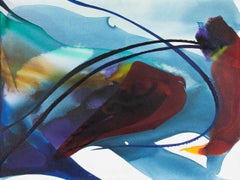
Stripes
By Paul Jenkins
Located in New York, NY
Stripes by Paul Jenkins (1923-2012) Watercolor on paper 42 x 30 ¼ inches unframed (106.68 x 76.835 cm) 47 ½ x 35 ½ inches framed (120.65 x 90.17 cm) Inscribed (Jenkins) on bottom cen...
Category

Late 20th Century Abstract Expressionist Abstract Drawings and Watercolors

Materials

Watercolor

Still Thinking About These?

All Recently Viewed