178 results for "limoges enamel"

to
29
85
81
94
62
39
36
34
12
12
10
8
7
6
6
5
4
4
4
4
4
3
3
3
3
3
2
2
1
1
1
1
1
1
1
1
1
1
43
12
7
2
2
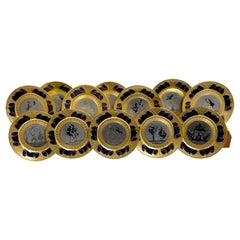
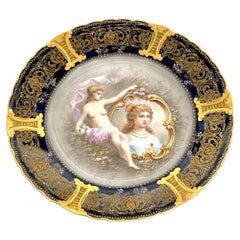
12 Magnificent Limoges Gold Platinum Encrusted Operatic Service Plates
Located in West Palm Beach, FL
12 Magnificent Limoges Gold & Platinum Encrusted Operatic Service plates France, 1920s, Pre WWII A stunning set of transitional design from Belle Epoqu...
Category

Early 20th Century French Belle Époque Dinner Plates

Materials

Porcelain

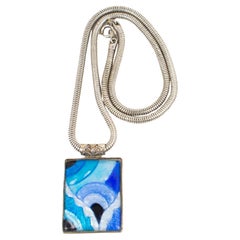
Camille Faure School Limoges Blue Enamel Art Deco Necklace
By Mauricette Pinoteau
Located in Atlanta, GA
This striking pendant necklace was hand-crafted by Limoges enamelist artist Mauricette Pinoteau. The rectangular silver plate frame is ornate with an enamel-on-copper cameo. The Art ...
Category

Early 2000s French Art Deco Pendant Necklaces

Materials

Silver Plate, Enamel

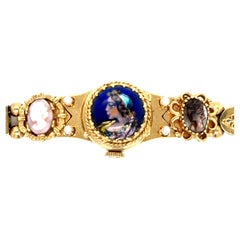
Covered Omega Slide Bracelet Watch
Located in Bradenton, FL
The covered watch bracelet has a Limoges enameled portrait covered lid and is adorned with ten slides. The slides are set with cameos and various gemstones (carnelian, coral, shell,...
Category

Vintage 1980s Unknown Modern Charm Bracelets

Materials

Multi-gemstone, 14k Gold

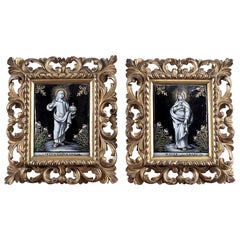
Pair of Jacques Laudin ii Enamel Plaques, circa 1665-1729
Located in Faversham, GB
A captivating pair of 17th-century Limoges enamel plaques by Jacques Laudin II of the renowned Laudin family dynasty of enamellers. Entitled ‘Jesus Amabilis’ and ‘Mater Amabilis’ fea...
Category

Antique 18th Century French Louis XIV Wall-mounted Sculptures

Materials

Enamel

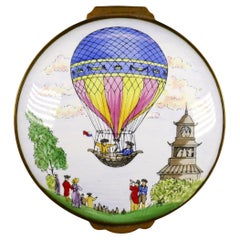
Fine Vintage Enamel Bilston Battersea Box Victorian Hot Air Balloon Scene
By Limoges
Located in San Juan Capistrano, CA
Vintage Hand Painted Enamel Trinket box by Crummles & Co. The piece features a Victorian ballooning scene.
Category

Vintage 1980s British Victorian Snuff Boxes and Tobacco Boxes

Materials

Metal, Enamel

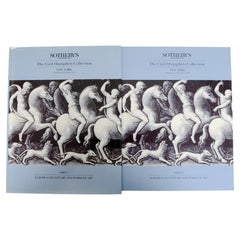
Cyril Humphris Collection of European Sculpture and Works of Art, Part I II
Located in valatie, NY
The Cyril Humphris Collection of European sculpture and Works of Art, Part I and II. Tuesday, January 10, 1995. Sotheby's New York. Sotheby's, Humphris, the London dealer...
Category

1990s American Books

Materials

Paper

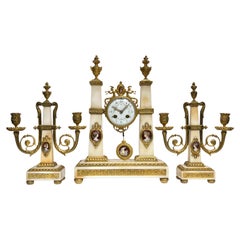
19th century French Bronze mounted Onyx Garniture Clock and Candelabra Set
Located in New York, NY
Very fine quality and unusual Antique (19th century) French Louis XVI style garniture including mantel clock and pair of two-light candelabra neoclassical style, finely crafted from ...
Category

Antique Late 19th Century French Louis XVI Mantel Clocks

Materials

Onyx, Bronze

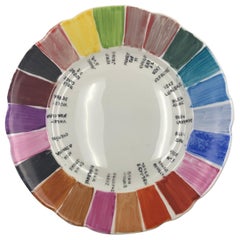
French Limoges Sample Porcelain Plate, Late 19th Century
Located in Spencertown, NY
The scallop-molded plate, painted with various hand-enameled color references and numbers over-glaze beneath tapering rectangular color tabs. Marked to underside near foot, "Havilan...
Category

Antique 1890s French Industrial Porcelain

Materials

Porcelain

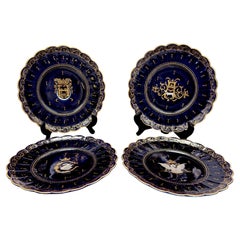
Four 19th C. French Armorial Cobalt Gilt Plates Attributed to Limoges
By Limoges
Located in West Palm Beach, FL
Set of Four 19th-Century French Armorial Porcelain Plates with Cobalt Ground and Gilt Decoration, Attributed to Limoges A striking and finely executed set of four French armorial p...
Category

Antique 19th Century French Baroque Revival Porcelain

Materials

Porcelain

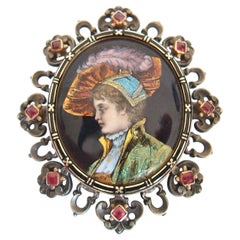
Renaissance Revival Limoges Type Enamel Brooch - Rubies, Gold Silver - C. 1892
Located in Chatham, CA
Exceptional and rare Renaissance Revival Limoges type enamel brooch - the colorful portrait miniature of a woman in Renaissance dress and hat against a midnight blue background set w...
Category

Antique Late 19th Century German Renaissance Revival Brooches

Materials

Ruby, Gold, 18k Gold, Yellow Gold, Silver, Enamel

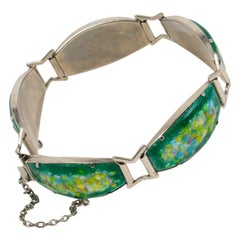
Limoges Green Enamel and Pate de Verre Link Bracelet
Located in Atlanta, GA
This link bracelet is a romantic piece featuring enamel and pâte de verre. It was made in Limoges, France, during the 1960s. The bangle boasts a chromed plated geometric framing topp...
Category

Vintage 1960s French Art Deco Link Bracelets

Materials

Copper, Enamel

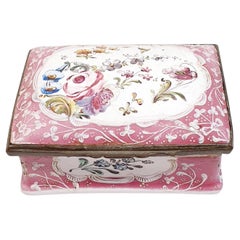
Antique Limoge 19th Enamel Box Hand Painted Pink with Flowers
By Castel Limoges
Located in Neguri, Vizcaya
Antique 19th Jewellery Antique 19th Jewellery Hand Painted pink Porcelain Box with flowers aprox 1880 Perfect gift for decoration or keeping perso...
Category

Antique Late 19th Century French Romantic Decorative Boxes

Materials

Enamel

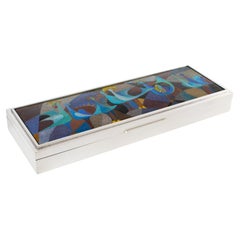
Camille Faure Limoges Modernist Enamel and Silver Plate Artwork Box, circa 1950
By Camille Fauré
Located in Atlanta, GA
A rare and exquisite creation by Camille Fauré Limoges, this enamel and silver-plated decorative box is a masterwork of French craftsmanship, dating circa 1950. Likely a bespoke comm...
Category

Vintage 1950s French Mid-Century Modern Decorative Boxes

Materials

Metal, Copper, Enamel, Silver Plate

Pair of French Porcelain and Bronze Candle Holders Napoleon III
By Manufacture Nationale de Sèvres
Located in Milano, MI
Pair of candlesticks in French Sevres style porcelain and hand-painted bronze, made in the second part of the 19th century. Two little cracks are present, as shown in the pictures. ...
Category

Antique 1870s French Napoleon III Candelabras

Materials

Bronze

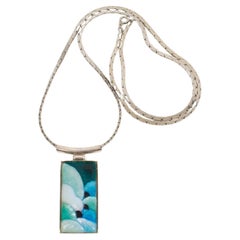
Camille Faure School Limoges Turquoise Green Enamel Geometric Pendant Necklace
By Mauricette Pinoteau
Located in Atlanta, GA
This lovely pendant necklace was hand-crafted by Limoges enamelist artist Mauricette Pinoteau. The rectangular silver plate frame is ornate with an enamel-on-copper cameo. The Art De...
Category

Early 2000s French Art Deco Pendant Necklaces

Materials

Silver Plate, Enamel

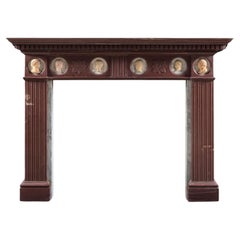
A Highly Important Empire Period Rosso Antico Chimneypiece with Portrait Reliefs
Located in London, GB
A Highly Important Empire Period Rosso Antico Chimneypiece Inset with Specimen Marble Portrait Reliefs of Roman Emperors The carved and veneered surround comprising a moulded shelf supported by a bold dentil cornice, above an inverted breakfront frieze carved with a central triglyph panel, flanked by a pair of rosettes carved in shallow relief, the frieze mounted with six carved hardstone profile portrait medallions of Roman Emperors, the stop-fluted jambs raised on moulded footblocks; in excellent condition with small restorations commensurate with age and use; the pale inclusions in the stone naturally formed. This spectacular neoclassical marble chimneypiece is carved from Rosso antico, the frieze inset with six portrait reliefs of Roman Emperors, each carved in marmo giallo on a bardiglio background, five variously incised: VESPASIANUS, TIBERIVS, OTHO, JULIUS CAESAR, TITUS. Rosso antico (marmor taenarium) is first recorded as being quarried in 1700 BC at Akra Tainaron (Cape Matapan), Greece.¹ The majority of this stone, however, was extracted throughout the Roman period, when it was one of the most coveted materials for carving due to its rich red colouring and association with highly prized Egyptian ‘Imperial’ Porphyry.² Rosso antico was chosen in antiquity for portrait busts, notably depicting Bacchic subjects such as Dionysus and satyrs due to its rich red wine colour which symbolised conviviality whilst conveying the education and cultivated taste of the owner.³ In the Renaissance, Rosso antico was also used for architectural detail on important buildings, such as the steps leading up to the choir in the medieval church of S. Prassede, and the large columns at the entrance to the Camera dell'Aurora.⁴ In 121 AD, G. Suetonius Tranquillus, secretary to Emperor Hadrian, wrote a biographical history of the first twelve emperors of Rome entitled De vita Caesarum (The Twelve Caesars). A Renaissance edition of Tranquillus’ work was published in 1470, followed by further reprints and translations into all the main European languages. Many of these were illustrated with prints of emperors taken from coins and statues, or imagined by the artist based on Tranquillus’ accounts. These interpretations were copied, in turn, by Renaissance designers for medals, Limoges enamels, and busts, as well as paintings such as the Eleven Caesars, a series of eleven half-length portraits of Roman emperors made by Titian in 1536–40 for Federico II, Duke of Mantua.⁵ These paintings were later given to King Charles I, before being passed in the Commonwealth to the Kings of Spain. Unfortunately, the series was destroyed in the catastrophic fire of 1734 at the Royal Alcazar of Madrid, and is now only known through copies and engravings.⁶ From the middle of the 17th century until the end of the 18th century, there was an insatiable demand for marble carvings, often sold as Roman or assembled from ancient fragments, thus perpetuating the reverence for antiquity that was the quintessence of the Grand Tour. Rosso antico was in extremely short supply, even after the ancient quarries at Skutari were rediscovered in 1830, and remained one of the most highly valued of all stones. Described in 1776 as ‘dark red; scarce and dear’, it was mostly used for small objects such as Grand Tour desk ornaments, inevitably using material re-cut from classical fragments, due to its rarity, as was the case with porphyry.⁷ The portrait roundels on this chimneypiece are typical of those produced in Rome and Florence in hardstones, semi-precious stones, gold, silver, bronze, and mother-of-pearl, which, being easily transportable, would be taken home from the Grand Tour to be mounted within wooden, gilded or brass frames, as fashion dictated.⁸ A group of gold portraits of Caesars, dating from around 1660, are in the Museo Nazionale del Bargello in Florence. Images of Roman emperors were not limited to Italy, England and France, however, as examples executed in Deshima for the Dutch East India Company (Verenigde Oost-Indische Compagnie) show. Medallions depicting Roman emperors, invariably made of black and gold Japanese hiramakie or takamakie lacquer on copper, were produced for the Dutch market at the end of the 18th century. Examples can be found in the Rijksmuseum, Amsterdam.⁹ There are two possible sources for the Imperial profiles on the chimneypiece: the engravings of The Twelve Caesars by Marcantonio Raimondi, or the Imperatorum Imagines by Hubert Golz.¹⁰ The portrait medallions also bear remarkable resemblance to a set of eighteen carved portrait reliefs of Roman Emperors, also of marmo giallo, almost certainly bought by David Ker (1742–1811) of Portavo, Co. Down, on his Grand Tour between 1792–4 in either Florence or Rome. Ker’s diary entry for 17th October 1793 is interesting as it reveals that he was offering his brother a choice of chimneypiece designs, which further supports a Roman origin for the offered example.¹¹ Indeed, fire surrounds incorporating antique fragments had been promoted from the late 1760s by Giovanni Battista Piranesi (1720–78), encouraged by Rome-trained architects including Robert Adam (d.1792). One such example, inset with mythological tablets carved from Rosso antico, was acquired by the 9th Earl of Exeter from Piranesi himself for Burghley House.¹² Another can be found at Islington House, Dorset.¹³ A third, inset with giallo antico and Rosso antico, follows Piranesi’s engraved design dated 1769 for a fire surround mounted with three marble portrait reliefs.¹⁴ It should be re-emphasised that Rosso antico was so precious that it was only ever used for small tablets or details rather than an entire chimneypiece, as with the offered example; likewise, while portrait reliefs are occasionally seen on the jambs of Italian surrounds, it is exceptionally rare to see the frieze mounted with a group, especially of this scale: the combination indicates an architectural commission by an extremely wealthy patron. The sophisticated lines of this chimneypiece epitomise the French Empire influence on the Italian states at the turn of the 18th century. This idiosyncratic ‘Roman’ taste is encapsulated by that of Napoleon, who identified with Rome’s Imperial past. Napoleon’s desire to establish a visual link between himself and Roman emperors is demonstrated by the portraits of his court painter, Jacques-Louis David, inspired by portraits of Emperor Augustus. This Imperial taste extended to architecture, furniture and porcelain, the latter two of which are combined in a group of magnificent ormolu-mounted guéridons commissioned in Sèvres between 1803–11, made to immortalise Napoleon’s reign.¹⁵ The second guéridon in the series, the Table des Grands Capitaines (Table of the Great Commanders of Antiquity), commissioned in 1806, is made almost entirely of hard-paste Sèvres porcelain. The top, painted in imitation of sardonyx, is centred by a portrait cameo of Alexander the Great, surrounded by twelve smaller heads of commanders and philosophers from antiquity: Pericles, Scipio Africanus, Pompey, Augustus, Septimus Severus, Constantine, Trajan, Caesar, Mithridates, Hannibal, Themistocles and Miltiades.¹⁶ Louis XVIII presented the table to the Prince Regent (later King George IV) in 1817 as a token of appreciation for Napoleon’s defeat two years earlier, and George IV treasured it so highly that it became part of the ceremonial backdrop for all his state portraits. The table remains in the Royal Collection.¹⁷ This chimneypiece remained, until recently, in the possession of a noble Dutch family, who acquired it from the owners of a bombed Knightsbridge house in the 1940s; unfortunately, its provenance prior to this has been lost. The use of Rosso antico on this scale, inset with these splendid Imperial profile medallions, appears unparalleled. 1. J. B. Grossman, 'Looking at Greek and Roman Sculpture in Stone' (Los Angeles, 2003). Grossman states that this material was ‘...quarried in three places during antiquity: on Cape Tainaron present day Matapan on the Peloponnese of Greece; on Crete; and at the site of Iasos in Asia Minor. 2. L. Lazzarini, ‘Rosso antico and other red marbles used in antiquity: a characterization study’, Marble, Art Historical and Scientific Perspectives on Ancient Sculpture’ (1990), 237–252. C. Gorgoni, L. Lazzarini, P. Pallante, ‘New archaeometric data on Rosso antico and other red marbles used in antiquity, ASMOSIA VI, Interdisciplinary Studies on Ancient Stone’ (2002), pp. 199–206. J. Deér, trans. G.A. Gilhoff, The Dynastic Porphyry Tombs of the Norman Period in Sicily (Cambridge, 1959), p. 144. R. Gnoli, Marmora Romana (Rome, 1988), pp. 187–191. 3. A notable example is a satyr from the Emperor Hadrian's villa at Tivoli, now in the Capitoline Museum, Rome. Another is the head of a satyr in the Minneapolis Institute of Arts, accession no. 2006.110. See T. Opper, Hadrian. Empire and Conflict (London, 2008), p. 165, fig. 149. 4. De Luca, Marmi antichi (Rome, 1998), p. 126. Faustino Corsi, Catalogo ragionato d’una collezione di pietre di decorazione (Rome, 1833), p. 93. 5. For related Limoges medallions, see set of ten circular Limoges enamel medallions depicting Roman emperors, en grisaille with gilding, from the workshop of Jacques I Laudin, sold Christie’s London, Fine Renaissance Bronzes and Works of Art, 19 December, 1977, lot 95. 6. See set of drawings sold Sotheby’s London, Of Royal and Noble Descent, 24 February, 2015, lot 184. 7. J. J. Ferber, Raspe’s Travels through Italy in the Years 1771–1772 (London, 1776), p. 218. 8. See Sotheby’s London, Pelham, the Public and the Private, 8 March 2016, lot 75: ‘A set of twelve mother-of-pearl cameos of Roman Emperors, Southern Italian, early 19th century’ 9. Oliver Impey, Christiaan J.A. Jörg, Cynthia Viallé, Japanese Export Lacquer 1580–1850 (Amsterdam, 2005) pp. 48–57, no. 56 & 57. 10. For a further reference, see the candlesticks by Jacques I Laudin in the Waters Art Gallery, illustrated in P. Verdier, Catalogue of the Painted Enamels of the Renaissance (Baltimore, 1967), p. 389, nos. 207 & 208. 11. John Ingamells, A Dictionary of British and Irish travellers in Italy 1701–1800 (London, 1997), pp. 572–3. 12. Oliver Impey, Four Centuries of Decorative Arts from Burghley House (Virginia, 1998), p. 53, fig. 23. 13. Country Life, 12 June, 1997, p. 162, figs. 9–11. 14. A. González-Palacios, Il Tempio del Gusto, Roma e il Regno delle due Sicilie, Vol. II (Milan, 1984), pp. 592–93, p. 260. 15. S. Grandjean, 'Napoleonic Tables...
Category

Antique Early 19th Century English Empire Fireplaces and Mantels

Materials

Marble

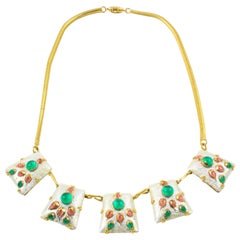
Limoges France White Enamel and Pate de Verre Link Necklace
Located in Atlanta, GA
An exquisite enamel and pate de verre link necklace designed in Limoges, France. The choker features enameled, domed, trapeze-shaped copper elements linked to a turbogas or serpentin...
Category

Vintage 1960s French Retro Choker Necklaces

Materials

Copper, Enamel, Gilt Metal

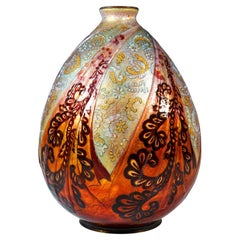
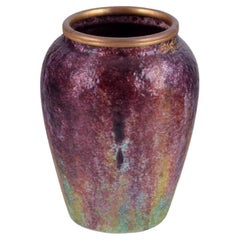
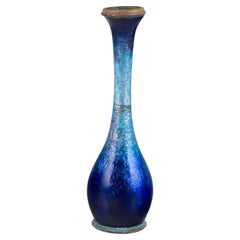
Large Art Déco Enamel Vase Volants Et Dentelles , Camille Fauré, France 1925/30
By Camille Fauré
Located in Vienna, AT
Large ovoid copper vessel on a round, grooved base with a short, narrow neck constriction and flared rim, coated in silvery pink and decorated with iridescent enamel in the form of l...
Category

Vintage 1920s French Art Deco Glass

Materials

Copper, Enamel

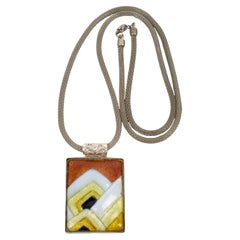
Camille Faure School Limoges Orange and Yellow Enamel Geometric Pendant Necklace
By Mauricette Pinoteau
Located in Atlanta, GA
This elegant pendant necklace was hand-crafted by Limoges enamelist artist Mauricette Pinoteau. The rectangular silver plate frame is ornate with an enamel-on-copper cameo. The Art D...
Category

Early 2000s French Art Deco Pendant Necklaces

Materials

Silver Plate, Enamel

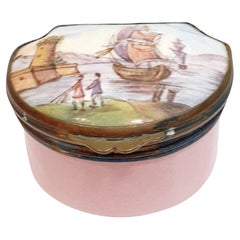
Antique Limoge Hand Painted Box in Pink enamel with Harbour Scene
By Castel Limoges
Located in Neguri, Vizcaya
Antique 19th around 1880 Hand Painted Pink Porcelain Box with harbour scene Perfect gift for decoration or keeping personal and valuable items P...
Category

Antique Late 19th Century French Romantic Decorative Boxes

Materials

Ceramic

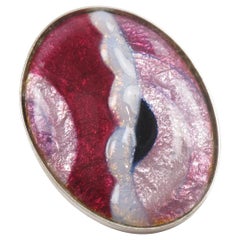
Camille Faure Limoges School Art Deco Inspired Pink Enamel Brooch
By Mauricette Pinoteau
Located in Atlanta, GA
Limoges enamelist artist Mauricette Pinoteau created this stunning romantic pin brooch. The ovoid sterling silver frame has an enamel-on-copper cameo. The Art-Deco-inspired motif boa...
Category

Early 2000s French Art Deco Brooches

Materials

Sterling Silver, Enamel

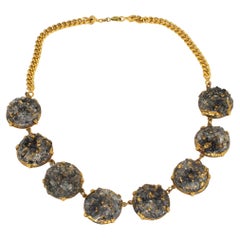
Limoges Black Gray Enamel and Pate de Verre Link Choker Necklace
Located in Atlanta, GA
This beautiful enamel and pate de verre link choker necklace was produced in Limoges, France, in the 1950s. The enameled round domed copper elements are hinged with a gilded brass ch...
Category

Vintage 1950s French Modern Choker Necklaces

Materials

Brass, Copper, Enamel

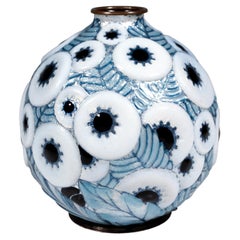
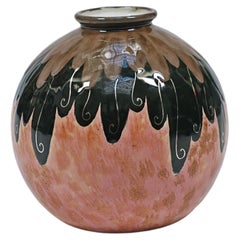
Spherical Art Déco Enamel Vase With Ornamental Decor, Camille Fauré, France 1925
By Camille Fauré
Located in Vienna, AT
Spherical vessel on a round, grooved metal stand, coated in silver and with pasty applied, polychrome and iridescent geometric-floral enamel decoration in white and blue tones, irreg...
Category

Vintage 1920s French Art Deco Glass

Materials

Metal, Enamel

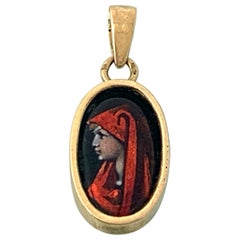
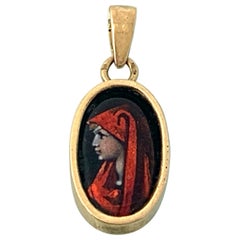
18ct Gold Enamelled Limoges Portrait Pendant
Located in London, GB
18ct Gold Enamel & Hand painted Veiled Woman portrait Pendant Set in 18ct 750 Gold By French Goldsmiths Limoges 1950s Beautiful red metallic viel wit...
Category

Vintage 1950s French Baroque Necklace Enhancers

Materials

Gold, 18k Gold, Enamel

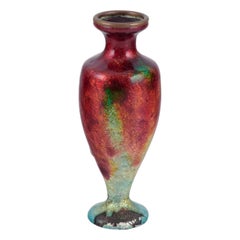
Fauré et Marty for Limoges, France. Small metalwork vase with enamel decoration
Located in København, Copenhagen
Fauré et Marty for Limoges, France. Small metalwork vase with polychrome enamel decoration. Mid-20th century. Signed. In good condition with chips in the enamel on the base. See phot...
Category

Mid-20th Century French Vases

Materials

Metal

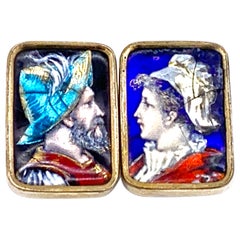
Antique Limoges Neorenaissance Enamel Soldier Beauty Buttons Cufflinks
Located in Munich, Bavaria
Rare pair of beautifully enamelled buttons - cufflinks with portaits of a couple dressed sumptuously in elegant Renaissance dress.
Category

Antique 1880s French Renaissance Revival Cufflinks

Materials

Gold Plate, Brass, Enamel

20ct Gold Antique Enameled Limoges Portrait Pendant
Located in London, GB
20ct Gold Enamel & Hand painted Veiled Woman portrait Pendant Set in 20ct Gold By French Goldsmiths Limoges 1900s possibly earlier Beautiful red metal...
Category

Early 20th Century French Baroque Necklace Enhancers

Materials

Gold, Enamel

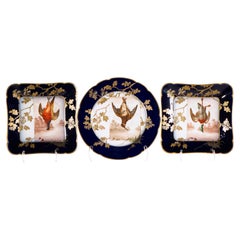
Haviland Limoges Set of 3 Porcelain Game Bird Plates, Cobalt Blue Gold 1882-91
By Haviland Co.
Located in Clifton Springs, NY
Antique set of 2 square and one round porcelain plates was created by Charles Field Haviland in late 19th century as a part of a big service; the game bird decor indicates that the p...
Category

Antique Late 19th Century French Victorian Porcelain

Materials

Gold

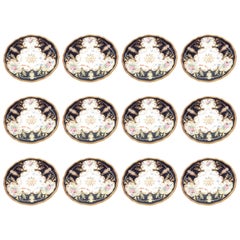
12 Antique Limoges Cobalt Blue Hand-Painted Gilt Trimmed Plates, Buffet/Dessert
By Delinieres Co. 1
Located in West Palm Beach, FL
We love the scalloped shape and nice gadroon edging to these handsomely painted set of 12 plates. There is a delightful center gilt medallion and the design features elaborate cartou...
Category

Antique Early 1900s French Dinner Plates

Materials

Gold, Enamel

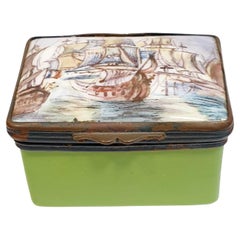
Antique Limoge Hand Painted Box in Pink enamel with with Sailing Ships scene
By Castel Limoges
Located in Neguri, Vizcaya
Antique 19th Jewellery hand painted porcelain box with hunting horse scene aprox 1880 hand painted in yellow porcelaine Perfect gift for decoration or kee...
Category

Antique Late 19th Century French Romantic Decorative Boxes

Materials

Enamel

Enameled Porcelain Vase by Camille Tharaud, Art Deco, France, 1940
By Tharaud Limoges
Located in Ciudad Autónoma Buenos Aires, C
Enamelled porcelain vase with a design of circular brushstrokes and arabesque details. Designed by THARAUD Camille (1878-1956), made by Limoges. Signed Limoges, France, C THARAUD. ...
Category

Vintage 1940s French Art Deco Vases

Materials

Porcelain

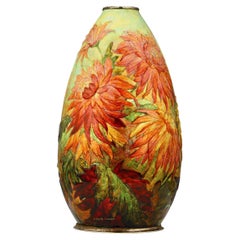
Camille Fauré Enamel Chrysanthemum Vase
By Camille Fauré
Located in New Orleans, LA
Delicate orange chrysanthemum flowers bloom in this enameled vase by Camille Fauré. Executed using his signature technique, the vase's copper form is cov...
Category

20th Century French Art Nouveau Vases

Materials

Copper, Enamel, Foil, Silver Leaf

Sarlandie for Limoges, France. Metalwork vase with enamel decoration
Located in København, Copenhagen
Sarlandie for Limoges, France. Metalwork vase with polychrome enamel decoration. Mid-20th century. Signed. In very good condition. Dimensions: H 9.0 cm x D 6.5 cm.
Category

Mid-20th Century French Vases

Materials

Metal

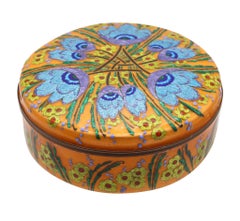
ALEXANDRE MARTY 1940 Limoges Decorative Round Box With Enamel On Copper
Located in Miami, FL
An enameled decorative round box designed by Alexandre Marty, (1876-1943). This is an amazing beautiful round box created in Limoges France by Alexandre Marty, back in the 1945-1950...
Category

Vintage 1940s French Art Deco Decorative Boxes

Materials

Gold, Copper, Enamel

A Kay Whitcomb Enamel 1966
By Kay Whitcomb
Located in St.Petersburg, FL
A great enamel by Kay Whitcomb, framed, signed and dated 1966. Titled" Where your Treasure is, there will your Heart be also" A note about the artist: " Whitcomb was born in 1921 in Arlington, Massachusetts, to a long line of New England metalsmiths, the Carr family. In a way, it was almost preordained that her life would be devoted to the crafts. While she hoped to attend the Massachusetts Institute of Technology, financial conditions prevented it. With financial assistance from relatives and friends, she began her art studies at Rhode Island School of Design (RISD) in 1939. Whitcomb recalls that in her third year, in 1941, she took an enameling class. Her instructor taught the cloisonné technique. Ruth Raemisch also used the same facilities, working on her enamels while regular courses were offered. Whitcomb recalls being intrigued by Raemisch’s techniques and wanting to emulate the distinguished German-born artist, whose style was based on the Limoges school of enamel painting. She completed her course work at RISD in 1942 while taking additional classes at the Cambridge School of Art. In 1944 she joined the United States Marine Corps Women’s Reserve at Camp Pendleton...
Category

Vintage 1960s American Mid-Century Modern Decorative Art

Materials

Enamel

French Art Deco Enameled and Wrought Iron Decorated Vase by Camille Fauré
By Camille Fauré
Located in Englewood, NJ
An extremely rare French Art Deco enameled laid on copper and wrought iron decorated vase by, Camille Fauré. The vase is decorated with an enameled geometric design in colors of blue, black, and white further set into a decorated hand forged wrought iron mount. The vase is signed "C.FAURÉ.LIMOGES". - circa 1940s' Measurements: height: 13.5 in. x width: 5 in. x diameter: 5.25 in. Biography: Camille Faurè produced designs for Limoges, long famed for its enamels Born in Perigueux in 1872, he spent a long apprenticeship before setting up his own workshop at Limoges, where he worked for over fifty years. Fauré became Limoges most famous and talented enamel artist. He exhibited in the 1925 International Exhibition in Paris that gave name to Art Deco. His early work, like his Post World War II designs, involved large floral patterns, often in rich colors keeping in line with the Art Nouveau movement. He exhibited through his Paris shop...
Category

Early 20th Century French Art Deco Vases

Materials

Enamel, Wrought Iron

A. Marty for Limoges, France. Metalwork vase with enamel decoration
Located in København, Copenhagen
A. Marty for Limoges, France. Enamelwork vase with polychrome enamel decoration. Mid-20th century. Signed. In perfect condition. Brass fitting is missing at the bottom. Dimensions: H...
Category

Mid-20th Century French Vases

Materials

Metal

Duban-Christel for Limoges, France. Large enamel bowl with gold decoration.
Located in København, Copenhagen
Duban-Christel for Limoges, France. Large enamel bowl with gold decoration. Large model. Signed. Mid-20th century. In perfect condition. Dimensions: H 7.0 cm x D 22.0 cm.
Category

Mid-20th Century French Decorative Bowls

Materials

Metal

Early 20thC Hand Painted Enamel on Copper Limoges France by Artist E. Carmona
By Etel Carmona
Located in Port Jervis, NY
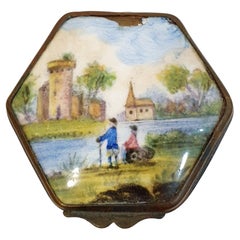
Simple & elegant hand painted enamel on copper of a French cottage by a pond with dock. Petite in size, work of art is 3.5 x 5. Totality is 10.5 x 9.5 framed. In excellent antique co...
Category

Vintage 1910s French French Provincial Paintings

Materials

Copper

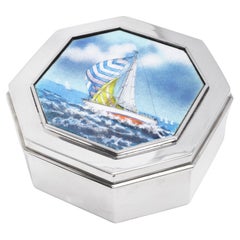
Schroth Jewelers American hand made sterling silver 925 and enamel octagonal box
Located in Braintree, GB
A handcrafted sterling silver 925 octagonal box, made in the USA circa 1950s, by renowned silversmith Wolfgang Karl Schroth and featuring enamel artwork by Daniel Sigal. The hinged l...
Category

Vintage 1950s American Sterling Silver

Materials

Silver, Enamel

Duban Christel for Limoges, Unique Bronze Bowl with Enamel Work, 1940s
Located in København, Copenhagen
Duban Christel for Limoges. Unique bronze bowl with enamel work in gold and green shades, 1940s. Measures: 15.2 x 3.3 cm. In excellent condition. Sta...
Category

Vintage 1940s French Art Deco Decorative Bowls

Materials

Bronze

Large Enameled Painted Floral Pattern Art Glass Round Dresser Box
By Limoges
Located in Rockaway, NJ
Very nice large enameled art glass jewelry dresser box center piece. Measures: 10" Diameter.
Category

20th Century American Mid-Century Modern Decorative Boxes

Materials

Glass, Milk Glass

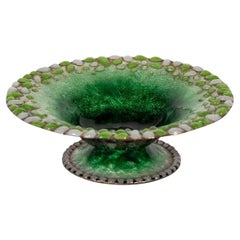
Boris Veisbrot (1903-2011) for Limoges, France. Enamel bowl in green tones.
Located in København, Copenhagen
Boris Veisbrot (1903-2011) for Limoges, France. Enamel bowl in green tones, with air bubbles. Mid-20th century. Perfect condition. Signed. Dimensions: D 14.8 cm x H 3.5 cm.
Category

Mid-20th Century French Decorative Bowls

Materials

Ceramic

Fauré et Marty for Limoges. Enamelwork vase with blue-toned decoration.
Located in København, Copenhagen
Fauré et Marty for Limoges, France. Enamelwork vase with blue-toned decoration. Mid-20th century. Signed. In excellent condition. Dimensions: H 13.0 cm x D 4.0 cm.
Category

Mid-20th Century French Vases

Materials

Metal

19th C Haviland Co Limoges Portrait Plate of Anne of Austria, Queen of France
Located in West Palm Beach, FL
19th Century Haviland & Co. Limoges Portrait Plate of Anne of Austria, Queen of France H&Co., France, 1888–1896 Signed lower right 'E. Furlaud', inscri...
Category

Antique Late 19th Century French Belle Époque Porcelain

Materials

Porcelain

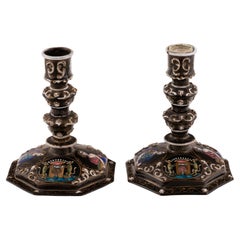
Pair of candlesticks. Metal, enamel. Limoges, France, 19th century.
Located in Madrid, ES
Pair of candlesticks. Metal, enamel. Limoges, France, 19th century. They present faults. Pair of metal candlesticks decorated with polychrome enamel on the outside, each with an oc...
Category

Antique 19th Century European Other Candlesticks

Materials

Metal, Enamel, Other

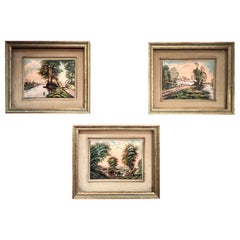
Set of 3 Antique French Limoges Framed Enameled Porcelain Plaques, Circa 1900 s.
Located in New Orleans, LA
Set of 3 Signed Antique French Limoges Framed Enameled Porcelain Plaques, Circa 1900-1920.
Category

Early 20th Century French Decorative Art

Materials

Porcelain

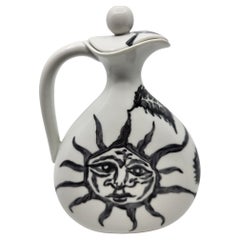
Vintage 1960s Porcelain Bottle by Jean Lurçat for Haviland Limoges
By (after) Jean Lurçat
Located in London, England
La bouteille en porcelaine blanche de Jean Lurçat, confectionnée par Haviland Limoges dans les années 1960, est bien plus qu'un simple objet décoratif; elle incarne l'élégance et la ...
Category

Vintage 1960s French Mid-Century Modern Bottles

Materials

Porcelain

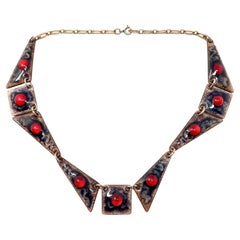
Limoges 1950s Brown Enamel and Red Glass Vintage Necklace
Located in Skelmersdale, GB
Although unsigned, this necklace is highly likely to have been created in Limoges, France, in the 1950s. Condition Report: Excellent The Details... This necklace is constructed fro...

Category

Vintage 1950s French Link Necklaces

Materials

Enamel

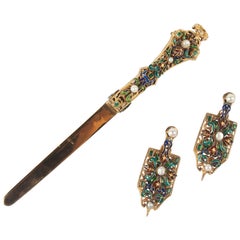
18 Carat Golden Paper Knife with Paperclips, circa 1900
Located in Esbeek, NL
18 carat golden paper knife with paperclips. Enamel de limoges, pearls and sapphire, circa 1900. French.
Category

Early 20th Century French Collectible Jewelry

Materials

Gold, Enamel

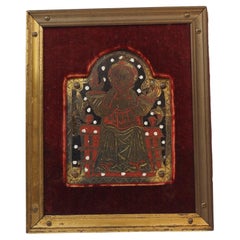
Limoges plaque Christ Salvator Mundi in enamel champlevé, Spain, Navarra, 14th c
Located in Gorssel, GE
An enamel arched Limoges plaque with Christ Salvator Mundi in enamel champlevé. Used to be placed at the rear end of a processional cross. Spain, Navarra, early 14th century. Dime...
Category

Antique 15th Century and Earlier Spanish Religious Items

Materials

Enamel

Antique Hand Painted Box in Pink enamel with Promenade Scene
By Castel Limoges
Located in Neguri, Vizcaya
Antique 19th hand painted pink porcelain box with promenade scene Perfect gift for decoration or keeping personal and valuable items PRADERA is ...
Category

Antique Late 19th Century French Romantic Decorative Boxes

Materials

Ceramic

20th Century French Enamel Bowl By Duban Et Christel, c.1950
Located in Royal Tunbridge Wells, Kent
Mid-20th French enamel bowl by Duban et Christel, Limoges. This beautiful, yet small enamelled bowl is in the shallow flared form, the centre well i...
Category

20th Century French Decorative Bowls

Materials

Enamel

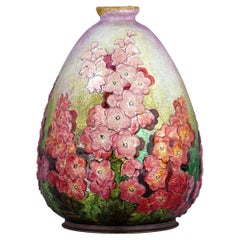
Camille Fauré Enamel Flora Vase
By Camille Fauré
Located in New Orleans, LA
A cascade of pink blooms sit against an ombre ground in this enameled vase by Camille Fauré. Executed using his signature technique, the vase's copper form...
Category

20th Century French Art Deco Vases

Materials

Copper, Silver Leaf, Enamel

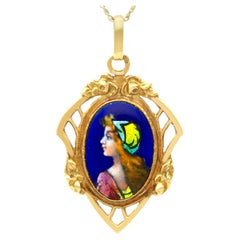
Antique French Enamel and 18k Yellow Gold Pendant
Located in Jesmond, Newcastle Upon Tyne
A fine and impressive antique French enamel and 18 karat yellow gold pendant; part of our diverse estate jewelry and Edwardian jewellery collections. This fine and impressive antique pendant has been crafted in 18k gold. The French pendant displays a central collet set oval enamel panel displaying the profile of a lady in vibrant white, yellow and pink clothing, against a royal blue background. This central enamel panel is surrounded by a pierced decorated gold frame, accented with simplified floral and foliate designs. The pendant is signed to the reverse with the maker's mark 'Le Pémen, Limoges'. This Edwardian enamel and gold pendant suspends from a contemporary 18k yellow gold 45.72cm/18' curb chain via an integrated ring loop attachment, and secures to the reverse with a conventional spring-loaded bolt ring fastening. This French pendant has been independently tested using state of the art technology (Niton XL2 Analyzer) and verified as 18k gold. Images do not always reflect the true colour of enamel decoration. The video however provides a truer representation of the actual colour and showcases the panel. Condition This antique Limoges pendant...
Category

Antique Early 1900s French Edwardian Pendant Necklaces

Materials

Yellow Gold, Enamel

17th Century Emaille de Limoges Plaquette, Depicting Maria Magdalena
Located in Esbeek, NL
Emaille de Limoges Plaquette, frame bronze with emaille. Depicting Maria Magdalena, 17th century or earlier.
Category

Antique Early 17th Century French Models and Miniatures

Materials

Bronze, Enamel

20th Century Art Deco Camille Fauré Enameled On Copper "Athènes Vase
By Camille Fauré
Located in Englewood, NJ
A French Art Deco enameled on cooper "Geometric" patterned vase by Camille Fauré (decorated with heavy geometric pattern in colors of white, grey, black and pink against an orange re...
Category

Vintage 1920s French Art Deco Vases

Materials

Brass, Copper, Enamel

Napoleon
By Manufacture Nationale de Sèvres
Located in Missouri, MO
Sevres 19th C. Original Hand Painted Porcelain Signed "G Poitevin" approx 9 x 5 inches/15 x 12 framed The vast and diverse production of the Sèvres factory in the nineteenth century resists easy characterization, and its history during this period reflects many of the changes affecting French society in the years between 1800 and 1900. Among the remarkable accomplishments of the factory was the ability to stay continuously in the forefront of European ceramic production despite the myriad changes in technology, taste, and patronage that occurred during this tumultuous century. The factory, which had been founded in the town of Vincennes in 1740 and then reestablished in larger quarters at Sèvres in 1756, became the preeminent porcelain manufacturer in Europe in the second half of the eighteenth century. Louis XV had been an early investor in the fledgling ceramic enterprise and became its sole owner in 1759. However, due to the upheavals of the French Revolution, its financial position at the beginning of the nineteenth century was extremely precarious. No longer a royal enterprise, the factory also had lost much of its clientele, and its funding reflected the ruinous state of the French economy. However, the appointment in 1800 of Alexandre Brongniart (1770–1847) as the administrator of the factory marked a profound shift in its fortunes. Trained as both an engineer and a scientist, Brongniart was both brilliant and immensely capable, and he brought all of his prodigious talents to the running of the troubled porcelain factory. He directed the Sèvres factory as administrator until his death in 1847, and during those five decades influenced every aspect of its organization and production. Much of the factory’s old, undecorated stock was immediately sold off, and new forms—largely in the fashionable, more severe Neoclassical style—were designed to replace out-of-date models. The composition for hard-paste porcelain was improved, and the production of soft paste, for which the factory had been famous in the previous century, was abandoned in 1804. New enamels colors were devised, and Brongniart oversaw the development of a new type of kiln that was both more efficient and cost-effective. Much of the factory’s output during Brongniart’s first decade reflected the prevailing Empire taste, which favored extensive gilding, rich border designs, and elaborate figural scenes (56.29.1–.8). Backgrounds simulating marble or a variety of hardstones were employed with greater frequency (1987.224); the new range of enamel colors developed under Brongniart made it easier to achieve these imitation surfaces, and it is thought that his interest in mineralogy provided the impetus for this type of decoration. For objects produced in sets, such as dinner, tea, and coffee services, and even garnitures of vases, Brongniart preferred decorative schemes that linked the objects in terms of subject matter as well as stylistically. Dinner services were given coherence by the use of an overall theme, in addition to shared border patterns and ground colors. One of the best examples of this can be found in the “Service des Départements,” which was conceived by Brongniart in 1824 (2002.57). Each of the plates in the service was decorated with a famous topographical view of the département (administrative unit) of France that it represented, and its border was painted with small cameo portraits of figures from the region, as well as symbols of the major arts, industries, and products of the area. This same type of thematic unity is found on a coffee service produced in 1836 (1986.281.1ab–4). All of the pieces of the service are decorated with scenes depicting the cultivation of cacao, from which chocolate is made, or various stages in the preparation of chocolate as a beverage. The compositions were conceived and executed by Jean Charles Develly, a painter at Sèvres who was responsible for many of the most ambitious dinner services produced at the factory during Brongniart’s tenure. The range of objects produced in the first half of the nineteenth century was enormous, as were the types of decoration that they employed. A recent exhibition catalogue devoted to Brongniart’s years at Sèvres indicates that ninety-two new designs for vases were introduced, as were eighty-nine different cup models, and the types of objects produced by the factory included every sort of form required by a dinner or dessert service, coffee and tea wares, decorative objects such as vases, and functional objects such as water jugs, basins, and toiletry articles. A new form rarely replaced an older one; the range of production simply increased. The same was true with types of decoration, as the factory was working in a wide variety of styles at any given time. From the earliest years of the Sèvres factory, its painters had copied not only contemporary compositions but also prints and paintings from earlier periods. However, under Brongniart, the factory sought to copy famous paintings with the specific intention of recording the “true” appearance of works increasingly perceived to be fragile. Works by a wide variety of artists were copied, but those by Raphael were especially popular. Raphael’s stature is reflected in a vase of 1834 in which a cameo-style portrait of the artist decorates the primary reserve, while on the back an artist’s palette is encircled by the names Titian, Poussin, and Rubens (1978.373). Just as works by earlier artists were copied, so too were decorative techniques of previous centuries. The interlace patterns of so-called Saint-Porchaire ceramic ware of the sixteenth century served as the inspiration for the decoration on a cup of 1837 (2003.153). The form of the cup itself derives from Renaissance silver forms made in Italy and France. However, the palette of vibrant reds, greens, blues, and yellows contrasts markedly with the muted browns and off whites of Saint-Porchaire wares and reflects the reinterpretation of historical styles that was characteristic of so much of nineteenth-century decorative arts. Interest in the Gothic style emerged early in Brongniart’s tenure at Sèvres and remained popular for much of the nineteenth century. Strict adherence to Gothic motifs was rarely observed, however, and the Gothic style was more evoked than faithfully copied. This tendency is reflected in a pair of vases (1992.23.1) for which the model was designated vase gothique Fragonard (named after the vase’s designer, Alexandre Evariste Fragonard [1780–1850]. The Gothic elements lie more in the painted decoration than in the form itself, and the style of the painting reflects a Renaissance technique rather than a medieval one. The palette of grays and whites on a blue ground instantly recalls the enamel-on-copper wares produced in Limoges, France, in the sixteenth century, and its use on these vases indicates the willingness to freely mix artistic styles and techniques of different periods in order to achieve new aesthetic effects. The eclecticism and historicism that characterized so much of the production during Brongniart’s tenure continued after his death in 1847. The factory’s output reflected an ongoing desire for technical innovation as well as a wide embrace of diverse decorative styles that were employed simultaneously. A tea and coffee service of 1855–61 (69.193.1–.11) embodies the selective borrowing of forms and motifs that is found so frequently in Sèvres production of the middle decades of the nineteenth century. The shapes used for the different components of the service evoke both China and the Near East, an obvious allusion to the origins of the two beverages. The openwork decoration refers directly to Chinese ceramics made in this technique, and the decoration employs a variety of Chinese emblems. However, the palette of pink and gold, entirely European in character, serves to neutralize the Asian aspects of the service. Perhaps the only thread that can be said to run through much Sèvres production of the nineteenth century is the proclivity to borrow freely from various historical styles and then to either reinterpret these styles or combine them in unprecedented ways. A standing cup of 1879 (1990.238a,b) draws upon silver cups of the Renaissance for its form, but in this instance the size of the porcelain cup dwarfs any of its metal prototypes. Its style of decoration derives from Limoges painted enamels of the sixteenth century, but the prominent use of gilding throughout reflects its wholly nineteenth-century character. This cup was presented by the French government to one of the first-prize winners at the 1878 Exposition Universelle. It was with the advent of the Art Nouveau style at the very end of the nineteenth century that historicism lost its grip at Sèvres, and indeed throughout the decorative arts, and forms inspired by nature and often characterized by asymmetry become dominant. This reliance upon natural forms is fully evident in a coffee service of 1900–1904 (1988.287.1a,b). The designer, Léon Kann...
Category

Late 19th Century Figurative Paintings

Materials

Porcelain, Oil