158 results for "rocking horses"

to
18
95
57
91
41
39
27
26
21
17
10
7
7
7
6
5
5
4
4
3
2
2
2
1
1
1
1
7
4
3
3
3
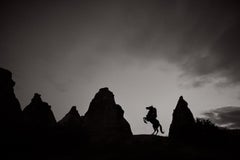
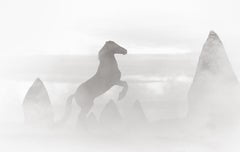
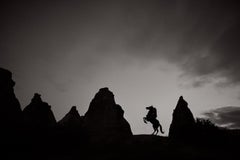
A horse rears up, silhouetted against the darkening sky and rock formations
By Drew Doggett
Located in US
"A horse rears up, silhouetted against the darkening sky and rock formations A horse rears up in the distance between two tall rock formations at dusk and i...
Category

2010s Minimalist Photography

Materials

Archival Pigment

A horse rears up, silhouetted against the darkening sky and rock formations
By Drew Doggett
Located in US
"A horse rears up, silhouetted against the darkening sky and rock formations A horse rears up in the distance between two tall rock formations at dusk and i...
Category

2010s Minimalist Photography

Materials

Archival Pigment

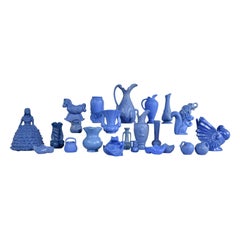
24-Piece Collection of Blue Niloak Midcentury Pottery
Located in Topeka, KS
Handsome 24-piece collection of bright blue Niloak midcentury pottery. They are all in fabulous vintage condition apart from the small glossy glazed Dutch shoe. It sounds like it is cracked but I cannot visually see a crack. The rest appear to have no chips, cracks, or chiggers, and very light crazing if any. Please see photos. We are selling this as a complete 24-piece set. Five pieces are not marked. They are noted in the list, circa 1937-1947. Holy cow! Blue, blue, my love is blue……! I had never seen this much Niloak in one place before obtaining this collection. And all in one color. It is so gorgeous! What better way for you to jump right into the blue trend in decorating. These will be incredible whether you display them all together in one place or scatter them about. Someone spent years at and put in a lot of love into gathering these beauties. Please see below for list and sizes. Niloak is a line of pottery which was produced in Benton, Arkansas by Eagle Pottery Company. Eagle was found in 1890s by Charles Dean Hyten and his brothers. By 1904 Eagle was the largest pottery-ware business in the Benton area. Then in 1909 Arthur Dovey joined Hyten, by then the sole owner, to develop an operation to produce art pottery. Thus, began Niloak. The name Niloak is the spelling of kaolin reversed. Kaolin is the main ingredient of porcelain. Niloak was and is best known for their Swirl pottery resembling marbled paper. Then in 1932 Niloak transitioned from hand thrown products to slip-cast and mold-pressed production which was spearheaded by Stoin M. Stoin. These 62 Hywood shapes were simply marked on the bottom Niloak. Beginning in 1939 new shapes were added that provided a lip and the bottoms of pieces were able to be glazed. Because of the war effort many materials were regulated which were used in the Niloak glazes and clay, so the recipes were reformulated. After the war regular production resumed and new bright glazes were used. By the end of 1947 Niloak was no more. List of pottery items with sizes: • Southern belle planter 10 H x 8 W x 8 D inches • Dutch shoe gloss glaze 2.25 H x 2.25 W x 4.5 D inches • Winged Victory swirl vase 6.5 H x 3.75 W x 3.75 D inches • 2-handled baskets 3.25 H x 3 W x 3 D inches • Rocking horse planter...
Category

Mid-20th Century American Arts and Crafts Vases

Materials

Pottery

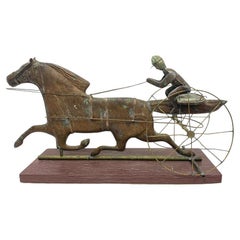
Vintage Copper Horse Sulky Weathervane
Located in Bridgeport, CT
A vintage copper Horse and Sulky Weathervane with good size and fine traditional form mounted on a faux finished wood plinth base. Dimensions: Base - 25 3/4" L x 9 1/4" W Horse - 3...
Category

20th Century Folk Art Scientific Instruments

Materials

Copper, Brass, Wire

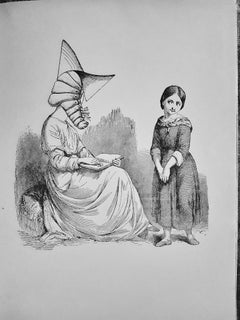
La Dame Ovale - Vintage Rare Book Illustrated by Max Ernst - 1934
By Max Ernst
Located in Roma, IT
La Dame Ovale is an original modern rare book written by Mary Leonora Carrington (Chorley, Lancashire 1917 – Mexico City, 2011) and illustrated by Max Ernst (1891 - 1976) in 1934. Original edition. Published by GLM, Paris. 535 numbered copies. Format: small 8°. Seven full page collages. Unnumbered pages. Good conditions. Max Ernst in 1934. Originally a Dada activist in Germany, Max Ernst (1891 - 1976) became one of the early adherents of the Surrealist circle. As a child living in a small community near Cologne, Ernst had considered his existence incredible and full of wonders. In autobiographical transcripts, written mostly in the third person, he said of his birth: “Max Ernst had his first contact with the world of sense on the 2nd April 1891 at 9:45 a.m., when he emerged from the egg which his mother had laid in an eagle’s nest and which the bird had incubated for seven years”. Ernst’s service in the German army during World War I swept away his early success as an Expressionist. In his own words: “Max Ernst died on 1st August 1914. He returned to life on 11th November 1918, a young man who wanted to become a magician and find the central myth of his age. From time to time he consulted the eagle which had guarded the egg of his prenatal existence. The bird’s advice can be detected in his work”. Mary Leonora Carrington (Chorley, Lancashire 1917 – Mexico City, 2011). Carrington was a British-born Mexican artist, surrealist painter, and novelist. She lived most of her adult life in Mexico City and was one of the last surviving participants in the Surrealist movement of the 1930s. Carrington was also a founding member of the women's liberation movement in Mexico during the 1970s. In 1936 Leonora saw the work of the German surrealist...
Category

1930s Surrealist More Art

Materials

Paper, Photogravure

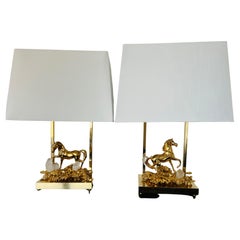
Pair of Horse Claude Victor Boeltz 1980 Gold Bronze Crystal French Table Lamps
By Claude Victor Boeltz
Located in New York, NY
A luxurious gold dore bronze and rock crystal horse table lamps. The gold bronze sculptures are on polished brass bases and they have complimentary ...
Category

Vintage 1980s French Post-Modern Table Lamps

Materials

Rock Crystal, Gold, Brass, Bronze

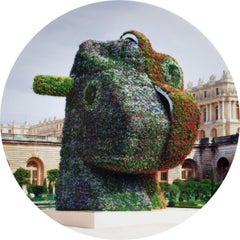
Jeff Koons Split-Rocker Decorative Plate
By After Jeff Koons
Located in Brooklyn, NY
This limited edition plate, titled Split Rocker, was designed by Jeff Koons and produced in collaboration with Bernardaud under the auspices of the Fondation. Drawing from Koons' fas...
Category

2010s Figurative Sculptures

Materials

Ceramic

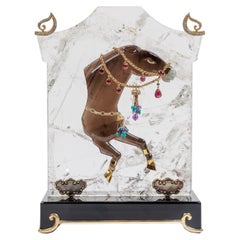
Mellerio Paris, a French Gold, Diamonds, Silver, and Smoky Quartz Carved Horse
By Mellerio dits Meller
Located in Long Island City, NY
Mellerio Paris, A French Gold, Diamonds, Silver-Gilt, Rock-Crystal, Jade, Mother-Of-Pearl and Smoky Quartz, Carved Horse Sculpture, Jeweled Mounted Object. An extremely rare and unique, one of a kind French gold, diamonds, Silver-gilt, rock-crystal, jade, obsidian, mother-of-pearl, and smoky quartz carved jeweled sculpture "CHEVAUX DE LEGENDE", "A Legendary Horse" by Mellerio, Paris, circa 1991. Sitting on black obsidian base, the solid rock-crystal slab is finely applied with a carved smoky -quartz and jade horse with a harness mounted in 18k gold, brilliant -cut diamonds, rubies, turquoise, and amethyst chains and pendants. The top columns adorned with 18k gold and brilliant cut diamond pendants, the bottom with gold and mother of pearl plaques. The obsidian base with a plaque engraved: CHEVAUX DE LEGENDE" / N° 05 / MELLERIO DITS MELLER / PARIS / 5003 D The piece is in excellent condition and comes with a custom made wood case made for transport. It's very elegant and has French hallmarks throughout. A truly magnificent piece. Measures 10.5" high x 8.5" wide x 4" deep Founded in France in 1613 by the descendants of Italian immigrants from the Vigezzo Valley in the north of Italy, Mellerio is one of the oldest jewellery houses in Europe. The family business soon attracted the attention of the Royal Court and Marie Antoinette herself reportedly purchased a precious bracelet featuring 7 cameos surrounded by rubies in 1780. Later on, in the 19th century, Mellerio became the official supplier of the French Royal family and the Court of Netherland. Mellerio creates many jewellery items, all set with rare gems such as peridots, amethysts, aquamarines, citrines and topaz, applying for a patent, the flexible stem, a very supple and light jewellery mechanism. Mellerio remains also well known for their spectacular series of Art Nouveau jewels, created at the beginning of the 20th century, as well as for the creation of trophies rewarding some of the greatest footfall and tennis players of history. In 1993, the jewellery house launched their first watch collection. Today, Mellerio has stores in Paris, Japan and Hong Kong. July 14, 1789: this date is known throughout the world as the beginning of the French Revolution. According to a ledger belonging to House of Mellerio, this was also the day that the jeweler sold a golden key to the Comte de Coutance for 10 livres. This ledger, as well as inventories dating as far back as 1768, are the jeweler’s oldest archives. These archives have continued to grow over the years, as the House, established on rue de la Paix in Paris, still lives on today, still in the hands of the same family from Craveggia, in the North of Italy. The tumultuous history of the Mellerio family in France probably goes as far back as the Italian wars of the Renaissance, but the first official document proving their commercial activity in Paris dates back to 1613. This document is the famous royal warrant awarded by Marie de Medici to a number of Italian families established along the rue des Lombards, including the Mellerios, allowing them to sell “small jewelery items”, therefore granting them a small exception to the traditional monopoly enjoyed by Parisian jewelers. At that time, powerful corporations regulated the operations and customs of Parisian business, but thanks to this exceptional warrant, the Mellerios managed to escape the confines of this framework. Today, this wax-sealed document is kept at the city hall of Craveggia. From 1613 to the Revolution, the Mellerios lived between France and Italy. The corporations tried many times to put an end to their trade privileges, but all in vain, as a dynasty of sovereigns renewed the warrant. Always marrying and often retiring in Craveggia, the Mellerios continued to maintain their jewelry business in Paris. At first, they did this without a shop. Wearing backpacks (wooden boxes divided into small compartments where jewels were kept), they would tour town fairs around Paris and royal castles. This is how Jean-Baptiste Mellerio (1765-1850) is said to have sold a bracelet set with rubies and Antique cameos to Marie-Antoinette, which still exists today. Many elements seem to prove the veracity of this anecdote. The queen was particularly fond of cameos, which cover the entire background of her famous jewelry cabinet, and ruby was her favorite stone after diamond. The famous bracelet, reacquired a few years ago by the House of Mellerio, is indeed an 18th century jewel, set with antique cameos representing the profiles of Roman emperors. Two branches of the family were operating in Paris during this time, under the reign of Louis XVI: that of Jean-François (1746-1828), the paternal ancestor of the current Mellerios, and that of Jean-Baptiste (1765-1850). The French Revolution forced them to return to Italy. However, both Jean-Baptiste and François Mellerio (1772-1843), who was the son of Jean-François, were eventually able to return to Paris after the founding of the Consulate. Jean-Baptiste opened a shop at the Iron Crown of rue Vivienne, and François opened his at the Palais des Tuileries, rue du Coq Saint-Honoré. His well-organized order books give an idea of his high-ranking clientele during the “Old Regime”, among which were the Comte and Comtesse Octave de Segur, the Marquise (later Duchess) de Tourzel, former governess of the royal children, and her daughter, the Comtesse de Bearn, the Craufurds -who organized the flight to Varennes, the Duc and Duchess de Gramont, the Comtesse de Boigne, and Madame de Souza, Talleyrand’s mistress. We also see the names of the imperial family: Empress Josephine, the Queen of Holland, Princess Elisa, Caroline and Pauline. At that time, the House of Mellerio specialized, among other things, in the trade of antique cameos, a newly fashionable genre of jewel that captured the imagination of all the princesses and noble women of the time. The years of the Restauration and July Monarchy were among the most glorious. The Bourbons were back on the throne, and the clientele of the House of Mellerio had regained its former wealth. Mellerio supplied Louis-Philippe, Duke of Orléans, as well as his mother, wife and sister, with sumptuous jewels, including a set of emeralds made piece by piece, while the Duke of Bourbon, last prince of the House of Condé, offered diamonds to his mistress, the scheming Baronne de Feucheres, and Monsieur de LaFayette also bought cameos for one of his granddaughters. For the first time, Mellerio ventured into the world of arts in 1815, when Carlotta Grisi, a famous dancer who created Giselle, as well as an actress named Rachel, bought jewels at the Mellerio store on rue de la Paix. 1848 marked a new turning point. France once again became a Republic. François Mellerio handed the company over to his son, Jean, and the latter decided to travel to Spain to build a new clientele. He later became one of the jewelers of the royal family, and met Eugénie de Montijo, who remained a faithful client when she became empress of the French people. The Imperial years were lavish. During the Second Empire, Paris was a pageant of crinoline dresses designed by Worth, while jewels by Mellerio, Worth’s neighbour on the rue de la Paix, adorned the noble women of the Tuileries court. The Empress bought pearls. Mathilde Bonaparte...
Category

20th Century French Figurines and Sculptures

Materials

Amethyst, Diamond, Jade, Quartz, Rock Crystal, Ruby, Turquoise, Gold, Si...

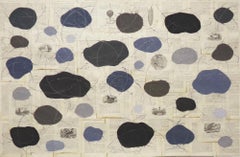
Under Scattered Clouds: Abstract Chalk Drawing of Blue Clouds on Vintage Paper)
Located in Hudson, NY
Abstract mixed media drawing of blue, black and grey clouds on vintage book pages 'Under Scattered Clouds' by Louise Laplante chalk on vintage collaged book pages. Artwork measures 26 x 40 inches unframed 30 x 43 inches in light wood frame This dreamy, whimsical drawing of fluffy light blue clouds was created by Louise Laplante in 2019. The vivid silhouette of clouds are suspended in space, drifting against a background of an early 20th century book of fables. Illustrations on the page include a hot air balloon, a rocking horse, a pheasant. In certain segments the stenciled images are delicately brushed over with a thin wisp of chalk which adds a delicate textured effect to the drawing. About the artist: Interested in blending the old world with the new, mixed media artist Louise Laplante combines her original images with ephemera of the past, enticing a conversation about it’s “relevancy to the present.” Her compositions begin with vintage book pages, personal handwritten letters, sheet music, or instruction from old guides on etiquette or science. While the text itself is weighted with reference to a particular subject, the visual of the typed or handwritten words and printed illustrations establish a unique pattern. These layered backgrounds are superimposed with opaque charcoal drawings that are inspired by the themes read between the lines. Most recently, the artist has opted for larger scale work, combining multiple sheets of vintage paper to expand her unique motifs. Laplante exhibits across the Northeast and has shown with Carrie Haddad for more than ten years. Artist Statement: My work connects the texts, and ideas, in the vintage book...
Category

2010s Contemporary Abstract Drawings and Watercolors

Materials

Paper, Chalk

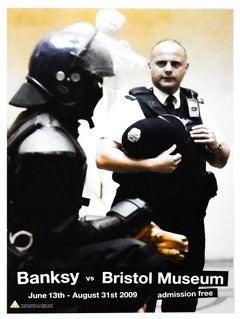
Copper Poster Banksy vs Bristol Museum (with Original POW Tube)
By Banksy
Located in Englishtown, NJ
Amusing Copper poster by Banksy created by Banksy for his solo show at the Bristol Museum and published by POW. Original mailing tube this poster was shipped in from Pictures on Wall...
Category

21st Century and Contemporary Contemporary Prints and Multiples

Materials

Offset

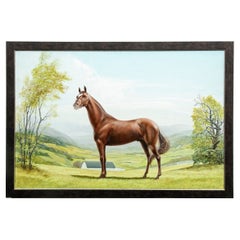
Original Oil on Board 1950, “Portrait of a Horse”, Signed Lower Right by Harold
Located in Bridgeport, CT
Original oil on board 1950, “Portrait of a Horse”. Signed lower right by Harold Mcintosh. Born in Winnipeg Canada, Mr. Mcintosh studied at Winnipeg School of Art with L.L. Fitzgerald...
Category

Vintage 1950s American Hollywood Regency Paintings

Materials

Paint

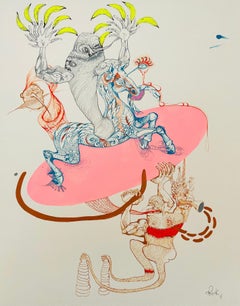
Surrealist Painting Royal College Art LGBTQ+ Female Fun Fair Pink Horse Banana
By Isabel Rock
Located in Norfolk, GB
Isabel Rock is a creator of contemporary fairy tales. A graduate of the Royal College of Art in London, her work is an explosion of strange occurrences while a surreal narrative takes the audience on a journey into the imagination. In October 2023 Isabel won the Evelyn Williams Drawing Award at the Trinity Buoy Wharf Drawing Prize. Known as the UK’s most prestigious annual open exhibition for drawing; part of the prize is a solo show at Hastings Contemporary, scheduled for 2024. Whilst Isabel always has a tale to tell for each of her images, you may or may not choose to go on the journey with her or you may indeed have a different story, one of your own that jumps off the page at you, that that you decide to follow. Artwork Details: (D), 50x40cm, acrylic ink and acrylic paint on paper, 2011 Artwork Provenance: from the Artist Studio A certificate of authentication comes from Gallery Art 1821...
Category

2010s Contemporary Figurative Paintings

Materials

Paint, Mixed Media, Acrylic, Archival Paper, Pen

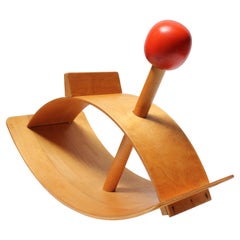
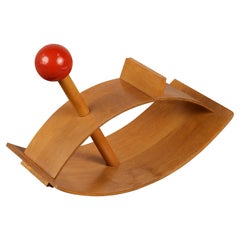
"Rocking Beauty" Hobby Horse Designed by Gloria Caranica for Creative Playthings
By Creative Playthings, Gloria Caranica
Located in Brooklyn, NY
An abstract hobby horse designed in 1964 by Gloria Caranica for Creative Playthings. Composed of two arched panels of birch plywood divided by a solid birch shaft and topped with a charming red knob...
Category

Vintage 1960s American Mid-Century Modern Children s Furniture

Materials

Birch, Plywood

Creative Playthings Seesaw
By Gloria Caranica, Creative Playthings
Located in Los Angeles, CA
Creative Playthings rocker made of a light, warm birch plywood. Designed in 1964 by Gloria Caranica, this rocking horse predecessor is a per...
Category

Vintage 1960s American Mid-Century Modern Children s Furniture

Materials

Birch, Bentwood, Plywood, Wood

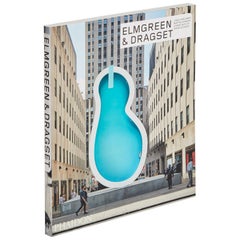
Elmgreen Dragset Phaidon Contemporary Artists Series
Located in New York, NY
Elmgreen & Dragset's constructed environments have been celebrated all over the world for their mischievous, cerebral, and accessible nature. This is the first comprehensive presentation of the duo's work, from their early performative pieces in the late 1990s to their most recent public projects Drawing from disciplines as divergent as institutional critique, social politics, performance, design, and architecture, Elmgreen & Dragset's work reconfigures the familiar with characteristic and subversive wit. Their sculptures and installations, also known as 'Powerless Structures', have redefined what it means to experience art - the cover features their work Van Gogh's Ear, a sculpture in the form of a swimming pool, which is located on Fifth Avenue in New York at the entrance to the Rockefeller Center. This book includes all of their most significant projects, from the transformation of New York's Bohen Foundation into a subway station in 2004, to the siting of a fake Prada boutique in the Texan desert...
Category

21st Century and Contemporary Books

Materials

Paper

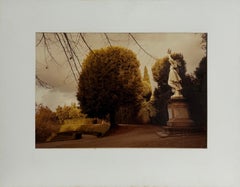
Mitchell Epstein Signed Vintage Color Photograph C Print Photo Florence Italy
By Mitch Epstein
Located in Surfside, FL
Mitch Epstein Boboli Gardens, Florence, Italy 1977 Hand signed and titled verso 11 X 16.25 image. Sheet: 13 x 19 3/16 in. frame is 19.5 X 24.75 Italian landscape with statue Mitchel...
Category

1970s American Modern Landscape Photography

Materials

C Print

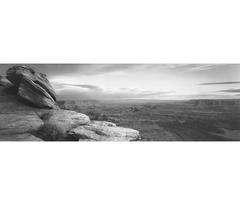
Rock Head, Dead Horse Point, Moab, Utah
By David H. Gibson
Located in Dallas, TX
"I like to go back to a place. Seasons change. Light, which is theater, changes. Nature is tumultuous, and our contact with it makes life happen.” - David H. Gibson David H. Gibso...
Category

20th Century Contemporary Landscape Photography

Materials

Silver Gelatin

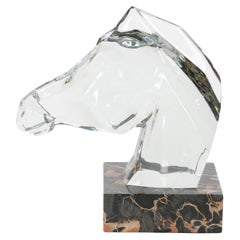
Hand-Carved Rock Crystal Equo Case Horse Head / Marble Base Sculpture
By Atlantis
Located in Tarry Town, NY
Discover elegance and sophistication in this exquisite decorative sculpture, meticulously crafted in the mid-20th century in the Art Deco style. This sculpture features a stunning horse head intricately carved from heavy cut rock crystal, known for its clarity and brilliance, set atop a square brown marble base. The contrast between the crystal and marble enhances its visual appeal, adding a touch of luxury and refinement to any space. The craftsmanship is impeccable, with intricate details that capture the essence of the horse's strength and grace. The smooth contours and sharp lines of the equine form highlight the artist's skill in sculpting such a dynamic subject. In pristine condition, this sculpture shows no signs of chips, cracks, or repairs, preserving its original beauty and integrity. It measures approximately 10 inches wide by 9 inches high, with a depth of 4 inches, while the square marble base measures about 6 inches by 6 inches. Ideal for collectors of Art Deco or Mid-Century Modern art, this piece serves as both a striking decorative accent and a testament to the era's commitment to artistic expression and craftsmanship. Display it prominently in a living room, study, or office to evoke a sense of timeless elegance and sophistication. Embrace the allure of mid-century modern design with this exceptional hand-carved rock crystal horse head sculpture...
Category

Late 20th Century Portuguese Mid-Century Modern Animal Sculptures

Materials

Crystal, Marble

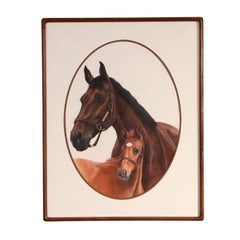
Pastel of Two Horses by Jocelyn Sandor
By Jocelyn Sandor
Located in Bridgeport, CT
Portrait of two horses in a cameo mat. Larger horse has "Sister Sarah" on the bridle. Signed and dated in lower left on smaller horse. Sight measures 18.5" wide x 25" high.
Category

Late 20th Century American Country Paintings

Materials

Wood

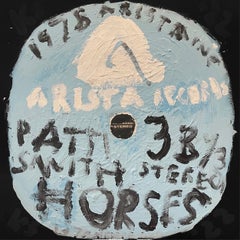
Patti Smith - Horses (Grammy, Album Art, Iconic, Rock Roll, Pop, Legend)
By Kerry Smith
Located in Kansas City, MO
Kerry Smith Patti Smith - Horses Mixed Media on Crescent board Year: 2022 Size: 21x20in Signed, dated by hand COA provided Ref.: 924802-1646 *Black frame with a mirror-gloss finish ...
Category

2010s Contemporary Figurative Paintings

Materials

Mixed Media, Acrylic, Gouache, Board

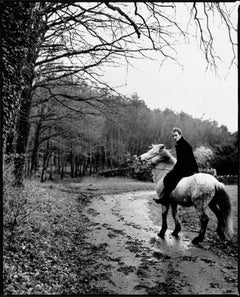
Sting - Signed Limited Edition Print (1992)
By Kevin Westenberg
Located in London, GB
Sting - Signed Limited Edition Print Album Cover Shoot December 6 1992 Wiltshire Sting on a Horse (photo Kevin Westenberg) NB All prints are signed and numbered by the artist. ...
Category

Early 2000s Modern Portrait Photography

Materials

Black and White, Archival Pigment

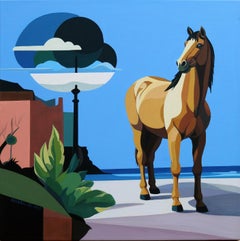
Island. Tan Horse, Original Painting
Located in San Francisco, CA

Artist Comments
This painting features a horse standing against a stylized coastal landscape. Geometric shapes define the sky, clouds, and buildings, while background elements ...

Category

21st Century and Contemporary Surrealist Animal Paintings

Materials

Acrylic

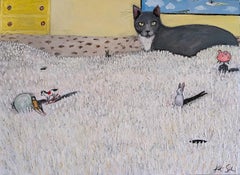
Cat Got Your Tongue, Oil Painting
By Kat Silver
Located in San Francisco, CA

Artist Comments
Bunnies peek out from a white carpet with tunnel holes for them to disappear. A tiny figurine sits passively against a stone with a rocking horse lying next to ...

Category

21st Century and Contemporary Surrealist Animal Paintings

Materials

Oil

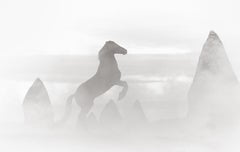
A dark horse rearing up with smoke rising and rock pinnacles in the backdrop
By Drew Doggett
Located in US
"A dark horse rearing up with smoke rising and rock pinnacles in the backdrop Black and white image of a dark horse rearing up with triangular rock formations in the background and ...
Category

2010s Minimalist Photography

Materials

Archival Pigment

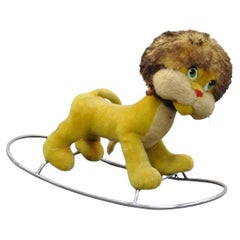
Vintage Italian Trupa Trudi Plush Stuffed Lion Rocking Childs Rocker Hobby Horse
Located in Philadelphia, PA
Vintage Italian Trupa Trudi Plush Stuffed Lion Childs Rocking Rocker Hobby Horse. Circa Mid 20th Century. Measurements: 23" H x 37.5" W x 16" D.
Category

Mid-20th Century Unknown Mid-Century Modern Toys and Dolls

Materials

Chrome

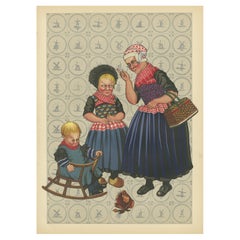
Charming Gelderland Costumes from Nunspeet and Hierden in Holland, ca. 1932
Located in Langweer, NL
Charming Dutch Peasant Costumes from Nunspeet & Hierden, Gelderland (c. 1932) This captivating original 1932 pochoir print from *The National Costumes of Holland* by Gratiane de Gar...
Category

Vintage 1930s Prints

Materials

Paper

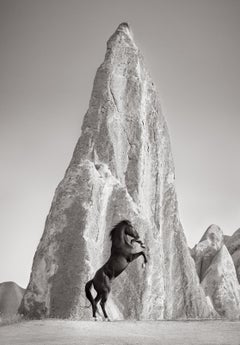
A single dark horse rearing up with a rock formation rising in the background
By Drew Doggett
Located in US
"A single dark horse rearing up with a rock formation rising in the background A dark horse rearing up with the backdrop of a towering rock formation This powerful global series ex...
Category

2010s Minimalist Photography

Materials

Archival Pigment

A dark horse rearing up with smoke rising and rock pinnacles in the backdrop
By Drew Doggett
Located in US
"A dark horse rearing up with smoke rising and rock pinnacles in the backdrop Black and white image of a dark horse rearing up with triangular rock formations in the background and ...
Category

2010s Minimalist Photography

Materials

Archival Pigment

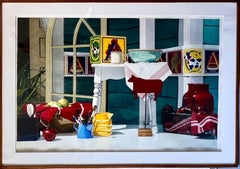
Large Photo Realist Pop Art Watercolor Painting Children s Toys Teddy Bear Block
By Michael Beck
Located in Surfside, FL
Michael Beck (American, b. 1943) Watercolor painting on paper, 1986 "First Fruits", Hand signed, dated and titled along lower margins Gallery label verso, Matted and framed under...
Category

1980s Photorealist Figurative Drawings and Watercolors

Materials

Watercolor

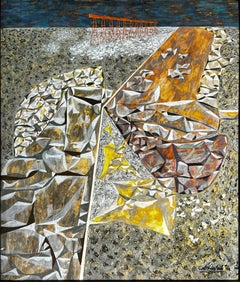
Thought Provoking Rock Quarry - Mid Century Abstract
Located in Miami, FL
This meticulously planned, designed, and executed work depicts an ultra-wide angle view of a rock quarry/mine. The viewer looks down at close-up-stylized rock formations and then out at a horizon line with rust-colored mine trestles. Atherton hints at perspective with a broken white line that is wider in the foreground and tapers to a hairline as it recedes to the background. The work was done in 1951 at the height of America's most important art movement: Abstract Expressionism. John Atherton absorbs its influences but retains elements of representation. Atherton was an in-demand commercial artist who worked for most blue-chip clients. It is possible that this was an editorial assignment for Fortune Magazine. At the same time, Atherton was also a fine artist and the work could be an expression of pure creative pursuits. The work looks better in person and one can look at it for hours and not get bored. Look carefully and you may discover a deeper meaning in this painting of precisely arranged rocks. Signed lower right. Brooklyn Museum of Art, New York, sold to benefit the acquisitions program ____________________ From Wikipedia, the free encyclopedia John Carlton Atherton (January 7, 1900 - September 16, 1952) was an American painter and magazine illustrator, writer and designer. His works form part of numerous collections, including the Museum of Modern Art,[1] Whitney Museum of American Art and the Smithsonian American Art Museum.[2][3][4] Early Years He was the son of James Chester Atherton (1868-1928) and Carrie B. Martin (1871-1909). He was born in Brainerd, Minnesota.[5] His father was Canadian born. His parents relocated from Minnesota to Washington State, with his maternal grandparents whilst he was still an infant. He attended high school in Spokane, Washington. Career During his early years he never displayed an aptitude for art; rather, his first love being nature and the activities he relished there, mainly fishing and hunting. He enlisted in 1917, serving briefly in the U.S. Navy for a year during World War I. At the end of the war, determined to get an education he worked various part-time jobs, as a sign painter and playing a banjo in a dance band to pay his enrolment fee at the College of the Pacific and The California School of Fine Arts (now the San Francisco Art Institute). Once there, he also worked in the surrounding studios developing his oil painting techniques. A first prize award of $500 at the annual exhibition of the Bohemian Club in 1929, financed his one way trip to New York City, which helped to launch his career as an artist.[6] Atherton had aspired to be a fine artist, however his first paid jobs were for commercial art firms designing advertisements for corporations such as General Motors, Shell Oil, Container Corporation of America, and Dole. However, by 1936, encouraged primarily by friends, such as Alexander Brook, an acclaimed New York realist painter, he returned to the fine arts. Atherton continued to accept numerous commissions for magazine illustrations; such as Fortune magazine, and over the years he would paint more than forty covers for The Saturday Evening Post starting with his December 1942 design, “Patient Dog.” This picture is reminiscent of his friend Norman Rockwell ‘Americana style’ and captures a poignant moment of nostalgia, where a loyal dog looks toward a wall of hunting equipment and a framed picture of his owner in military uniform. Selected One person Exhibitions Atherton accomplished his first one-man show in Manhattan in 1936. His Painting, “The Black Horse” won the $3000 fourth prize from among a pool of 14,000 entries. This painting forms part of the Metropolitan Museum of Art collection in New York.[7] Atherton achieved recognition in New York City and elsewhere during the 1930s. Having exhibited at the Julien Levy Gallery in New York,[8] his paintings began to be collected by museums; including the Museum of Modern Art[9] and the Metropolitan Museum of Art. His reputation increased with his art deco stone lithograph poster for the 1939 New York World's Fair. In 1941, his design won first place in the Museum of Modern Arts “National Defense Poster Competition”. Selected Public Collections Fleming Museum of Art, Burlington, Vermont Albright-Knox Art Gallery,[10] Buffalo, NY Art Institute of Chicago,[11] Chicago Wadsworth Atheneum,[12] Hartford, CT Brooklyn Museum of Art, New York Metropolitan Museum of Art, New York The Museum of Modern Art,[13] New York Whitney Museum of American Art,[14] New York Pennsylvania Academy of the Fine Arts,[15] Philadelphia De Young Museum,[16] San Francisco Smithsonian American Art Museum,[17] Washington DC Butler Institute of American Art[18] Youngstown, OH The Famous Artists School Founded in 1948 in Westport, Connecticut, U.S.A. The idea was conceived by members of the New York Society of Illustrators (SOI), but due to the Society's legal status, could not be operated by it. SOI member Albert Dorne led the initiative to set up a separate entity, and recruited the support of Norman Rockwell, who was also an SOI member. For the founding faculty, Dorne recruited Atherton, as well as accomplished artists such as Austin Briggs, Stevan Dohanos, Robert Fawcett, Peter Helck, Fred Ludekens, Al Parker, Norman Rockwell, Ben Stahl, Harold von Schmidt and Jon Whitcomb.[19] He collaborated with Jon Whitcomb with the book “How I Make a Picture: Lesson 1-9, Parts 1”.[20][21] Society of Illustrators Atherton as an active member from his arrival in New York. The society have owned many of his works. Ex-collection includes: Rocking Horse (ca. 1949) [22] Atherton, as his peers had many of his works framed by Henry Heydenryk Jr.[23] Personal On November 2, 1926, he married Polly “Maxine” Breese (1903-1997).[24][25] They had one daughter, Mary Atherton, born in 1932. Atherton's often chose industrial landscapes, however found himself spending considerable time in Westport, Connecticut, with an active artistic community, and it became home for him, and his family. He then moved to Arlington, Vermont.[26] Norman Rockwell enlisted Atherton in what was to be the only collaborative painting in his career.[27] He was part of a group of artists including a Norman Rockwell, Mead Schaeffer and George Hughes who established residences in Arlington.[28] Atherton and Mead Schaeffer were avid fly fishermen and they carefully chose the location for the group,[29] conveniently located near the legendary Battenkill River. In his free time, Atherton continued to enjoy fly-fishing.[30] He brought his artistic talent into the field of fishing,[31] when he wrote and illustrated the fishing classic, “The Fly and The Fish”.[32] He died in New Brunswick, Canada in 1952,[33] at the age of 52 in a drowning accident while fly-fishing.[34] Legacy The Western Connecticut State University holds an extensive archive on this artist.[35] His wife, Maxine also published a memoir “The Fly Fisher and the River” [36] She married Watson Wyckoff in 1960. Ancestry He is a direct descendant of James Atherton,[37][38] one of the First Settlers of New England; who arrived in Dorchester, Massachusetts in the 1630s. His direct ancestor, Benjamin Atherton was from Colonial Massachusetts...
Category

1950s Abstract Expressionist Abstract Paintings

Materials

Mixed Media, Gouache, Board

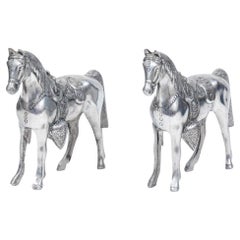
Pair Of Mid Century Cast Aluminum Decorative Horse Figures
Located in Bridgeport, CT
Pair of Mid Century well cast aluminum horse figures with detailed mane, tail and decorative saddle. Dimensions: 3 1/8" W x 11 3/8" Lx 9 1/2" H Condition: Please see detail photos....
Category

Mid-20th Century Country Animal Sculptures

Materials

Aluminum

"Black Triangle, " Black Pop Art Etching signed by James Rosenquist
By James Rosenquist
Located in Milwaukee, WI
"Black Triangle" is an original black etching by Pop artist James Rosenquist. The artist signed the piece lower right, wrote the title and edition number (72/78) lower left, and "2nd State" lower center. This piece is part of Rosenquist's "Tripartite" series, where he divides the composition into three juxtaposed images. This piece features a rocking chair and rocking horse, an irregular circle with a flower within, and a folded American flag...
Category

1970s Pop Art Abstract Prints

Materials

Etching

Vintage White Horse Whisky Statue Scotch Pub Advertising Bar
Located in Potters Bar, GB
Rare Vintage White Horse Scotch Whisky Advertising Statue (c. 1960s) - Pub & Home Bar Collectible, Excellent Condition Description: Scotch Mascot: Vintage White Horse Statue...
Category

Vintage 1950s Statues

Materials

Rock Crystal

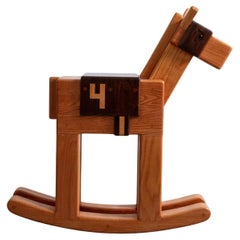
Rocking Race Horse by Pamela Weir-Quiton
By Pamela Weir-Quiton
Located in New York, NY
Race Horse #44 Berkus. Rocking Race horse in oak, shedua, and rosewood. Designed and made in Pamela Weir-Quiton, USA, 1971.
Category

Vintage 1970s American Rocking Chairs

Materials

Wood

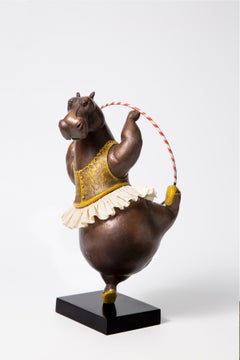
Hippo Hula Hoop Dancer II, maquette
By Bjørn Okholm Skaarup
Located in Greenwich, CT
Edition of 9 Bjorn Skaarup Biography Danish, b. 1973 Bjorn Skaarup holds a MA in History and Art History from the University of Copenhagen, and a PHD in History from the European U...
Category

2010s Contemporary Figurative Sculptures

Materials

Bronze

Hippo Ballerina, en pointe
By Bjørn Okholm Skaarup
Located in Greenwich, CT
Bjorn Skaarup Biography Danish, b. 1973 Bjorn Skaarup holds a MA in History and Art History from the University of Copenhagen, and a PHD in History from the European University Inst...
Category

2010s Contemporary Figurative Sculptures

Materials

Bronze

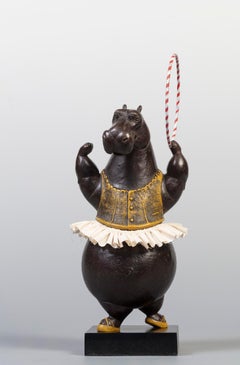
Hippo Hula Hoop Dancer, maquette
By Bjørn Okholm Skaarup
Located in Greenwich, CT
Danish, b. 1973 Bjorn Skaarup holds a MA in History and Art History from the University of Copenhagen, and a PHD in History from the European University Institute in Florence, Italy. Skaarup has also furthered his education with post-doctoral studies at the Warburg Institute, London and Columbia University, New York In addition to his career as a self-taught sculptor, Skaarup has written and illustrated numerous books on historical, archaeological, and anatomical subjects. "My animal sculptures represent a number of characters that have been given man-made and cultural tools and attributes that underline their particular traits – the dignity and supremacy of the majestic lion, the chivalrous nature of the ermine, the speed of the cheetah, the height of the giraffe, and the heavenly aspirations of the ostrich... The sculptures are a celebration of life and nature and its many intriguing shapes and creatures, all placed in peculiar and surreal encounters between nature and culture. The result is a group of bronze sculptures that combines the gracious and exclusive with the communicative, distorted and humorous." Okholm Skaarup has created a contemporary bestiary, or classical book of animals, in bronze. Each sculpture presents a whimsical story or allegory to decipher, with sources ranging from ancient fables and art history to music and modern animation. The Majestic Lion, traditional king of the animals, wears the crown and armor of a great monarch in the style of Medici court sculptor Giambologna, yet he sits astride a rocking horse, a reference to his fleeting and jovial power. Frogs reenact Homeric battles in the Batrachomyomachia and Micenaean Horse, while mice peer through spectacles and listen at telephones as The Five Senses. A cheetah rides a scooter to move faster, a giraffe stands on stilts to reach higher, and a kangaroo bounces on a pogo stick—a “kængurustylte” in Okholm Skaarup’s native Danish. From 1994 to 2004, Okholm Skaarup was an artist at the Danish National Museum, Copenhagen, before moving to Florence and receiving a PhD from the European University Institute in 2009. While in Florence, he studied the work of Renaissance sculptors Donatello, Michelangelo, and Giambologna, learning the vanishing art of large-scale bronze casting. “I am constantly trying to improve my skills in modeling, and see how far the medium can go,” Skaarup explains. “How many fun details you can add, how many forms you can create—ideally large, heavy forms that rest on light foundations, so the work appears as vibrant as possible. With bronze, you can make the most dynamic shapes imaginable.” In Okholm Skaarup’s intricately polychrome work, he explores the voluminous form of a tutu and leotard-clad hippo, which at once references Degas’s Little Dancer of Fourteen Years and Disney’s Fantasia...
Category

2010s Contemporary Figurative Sculptures

Materials

Bronze

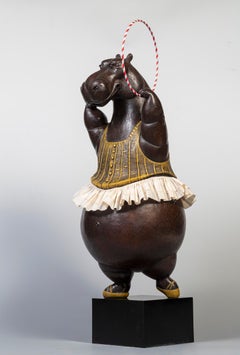
Hippo Hula Hoop Dancer
By Bjørn Okholm Skaarup
Located in Greenwich, CT
Danish, b. 1973 Bjorn Skaarup holds a MA in History and Art History from the University of Copenhagen, and a PHD in History from the European University Institute in Florence, Italy. Skaarup has also furthered his education with post-doctoral studies at the Warburg Institute, London and Columbia University, New York In addition to his career as a self-taught sculptor, Skaarup has written and illustrated numerous books on historical, archaeological, and anatomical subjects. "My animal sculptures represent a number of characters that have been given man-made and cultural tools and attributes that underline their particular traits – the dignity and supremacy of the majestic lion, the chivalrous nature of the ermine, the speed of the cheetah, the height of the giraffe, and the heavenly aspirations of the ostrich... The sculptures are a celebration of life and nature and its many intriguing shapes and creatures, all placed in peculiar and surreal encounters between nature and culture. The result is a group of bronze sculptures that combines the gracious and exclusive with the communicative, distorted and humorous." Okholm Skaarup has created a contemporary bestiary, or classical book of animals, in bronze. Each sculpture presents a whimsical story or allegory to decipher, with sources ranging from ancient fables and art history to music and modern animation. The Majestic Lion, traditional king of the animals, wears the crown and armor of a great monarch in the style of Medici court sculptor Giambologna, yet he sits astride a rocking horse, a reference to his fleeting and jovial power. Frogs reenact Homeric battles in the Batrachomyomachia and Micenaean Horse, while mice peer through spectacles and listen at telephones as The Five Senses. A cheetah rides a scooter to move faster, a giraffe stands on stilts to reach higher, and a kangaroo bounces on a pogo stick—a “kængurustylte” in Okholm Skaarup’s native Danish. From 1994 to 2004, Okholm Skaarup was an artist at the Danish National Museum, Copenhagen, before moving to Florence and receiving a PhD from the European University Institute in 2009. While in Florence, he studied the work of Renaissance sculptors Donatello, Michelangelo, and Giambologna, learning the vanishing art of large-scale bronze casting. “I am constantly trying to improve my skills in modeling, and see how far the medium can go,” Skaarup explains. “How many fun details you can add, how many forms you can create—ideally large, heavy forms that rest on light foundations, so the work appears as vibrant as possible. With bronze, you can make the most dynamic shapes imaginable.” In Okholm Skaarup’s intricately polychrome work, he explores the voluminous form of a tutu and leotard-clad hippo, which at once references Degas’s Little Dancer of Fourteen Years and Disney’s Fantasia...
Category

2010s Contemporary Figurative Sculptures

Materials

Bronze

Still Thinking About These?

All Recently Viewed