1,107 results for "judaica"
to
61
997
83
902
328
161
133
87
80
51
47
39
38
36
28
28
26
25
25
23
23
21
11
11
11
9
7
6
6
5
3
3
3
3
2
2
2
2
2
1
1
1
1
1
1
1
1
1
1
1
1
38
33
16
14
13
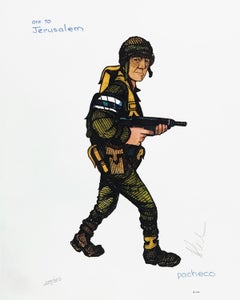
OFF TO JERUSALEM (JUDAICA ART)
Located in Aventura, FL
Offset lithograph in colors on paper. Hand signed and numbered by the artist. From the edition of 500.
Artwork is in excellent condition. Certificate of authenticity included. Al...
Category
Late 20th Century Contemporary Figurative Prints
Materials
Paper, Lithograph
$100 Sale Price
50% Off
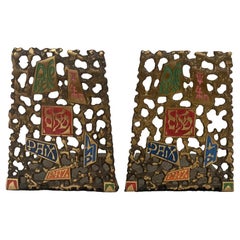
Brass Judaica Shalom Peace Tree of Life Bookends
Located in Brooklyn, NY
Beautiful pair of Midcentury modern brass Shalom Judaica bookends. Brass with lovely patina with color enameled accents. Felt under the stands for use on multiple surfaces, signed “T...
Category
Mid-20th Century Unknown Mid-Century Modern Bookends
Materials
Brass
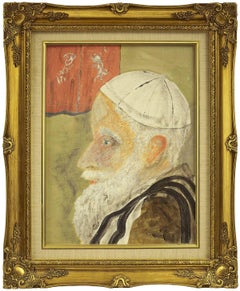
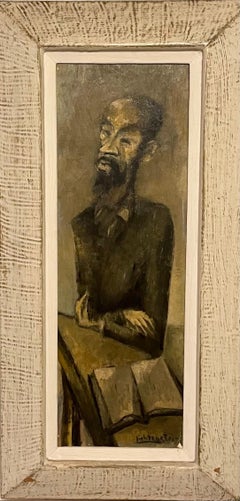
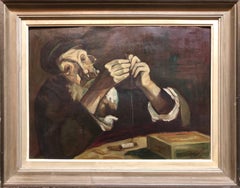
Elderly Rabbi 20th Century Judaica Portrait
Located in Surfside, FL
The artist depicts the portrait of an older Rabbi from a profile view in the manner of Samuel Rothbort. The artist's brush work is expressive, while the subject matter has a high deg...
Category
20th Century Expressionist Portrait Paintings
Materials
Canvas, Oil
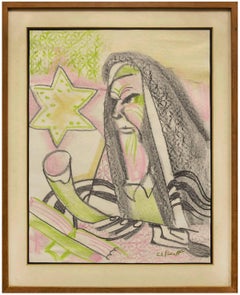
1950s Judaica Rabbi with Shofar Drawing
Located in Surfside, FL
UNTITLED (GREEN RABBI HOLDING A SHOFAR)
Signed S. I. Rusoff
Genre: Judaica
Subject: Religious
Medium: Pastel, Chalk
Surface: Paper
Country: United States
Dimensions: 16 1/2" x 12 3/...
Category
1950s Figurative Drawings and Watercolors
Materials
Chalk, Pastel
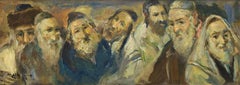
Scholars and Rabbis, Judaica Oil Painting
Located in Surfside, FL
Beautiful Mid 20th century oil painting in the manner of Judaic masters Huvi, Tully Filmus and Isaac Holtz, signed in hebrew l.r. artist unidentified.
Category
Mid-20th Century Impressionist Figurative Paintings
Materials
Oil, Board
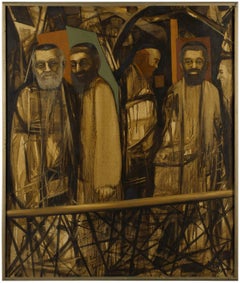
Sanctuary, Modernist Judaica Scene Oil Painting
By David Rosen (b.1912)
Located in Surfside, FL
Painter David Rosen emerged onto the art scene while the country was wrought with unimaginable economic turmoil. Like most other Americans, the Great Depression pummeled artists fina...
Category
Mid-20th Century Modern Figurative Paintings
Materials
Canvas, Oil
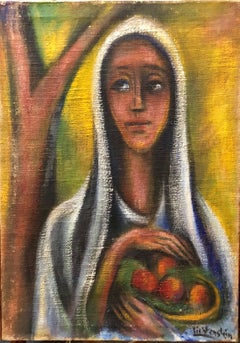
Rare Oil Painting Woman with Fruit Bezalel School Jerusalem Israeli Judaica
By Isaac Lichtenstein 1
Located in Surfside, FL
YITSKHOK LIKHTENSHTEYN (ISAAC LICHTENSTEIN) (1888-1981) (Icchok, Izrael) was born in Lodz, Poland. Initially he was studying at Yehuda Pen school in Witebsk. In the same school ...
Category
Early 20th Century Post-Impressionist Figurative Paintings
Materials
Jute, Oil
Bezalel School Jerusalem Israeli Judaica Etching
By Isaac Lichtenstein 1
Located in Surfside, FL
YITSKHOK LIKHTENSHTEYN (ISAAC LICHTENSTEIN) (1888-1981) (Icchok, Izrael) was born in Lodz, Poland. Initially he was studying at Yehuda Pen school in Witebsk. In the same school wh...
Category
Early 20th Century Post-Impressionist Drawings and Watercolor Paintings
Materials
Etching
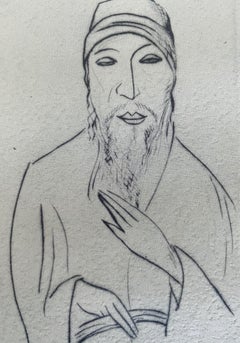
Judaica "The Rebbe
" European Hasidic Rabbi Oil Painting
Located in Surfside, FL
Realistic portrait of an older rabbi visiting and blessing a child in a European marketplace. Here the artist conveys a sense of quiet grandeur th...
Category
20th Century Realist Portrait Paintings
Materials
Canvas, Oil
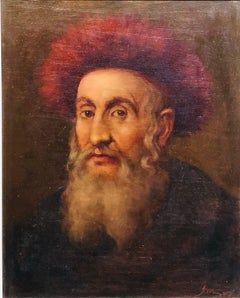
Bezalel School Jerusalem Israeli Judaica Etching
By Isaac Lichtenstein 1
Located in Surfside, FL
YITSKHOK LIKHTENSHTEYN (ISAAC LICHTENSTEIN) (1888-1981) (Icchok, Izrael) was born in Lodz, Poland. Initially he was studying at Yehuda Pen school in Witebsk. In the same school wh...
Category
Early 20th Century Post-Impressionist Drawings and Watercolor Paintings
Materials
Etching
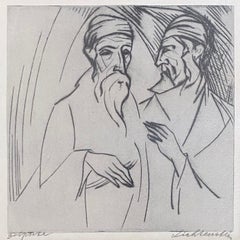
The Cantor, Vintage Judaica European Oil Painting
Located in Surfside, FL
Vintage Judaica oil painting, Poland, signed illegibly by artist l.r.
Category
20th Century Portrait Paintings
Materials
Canvas, Oil
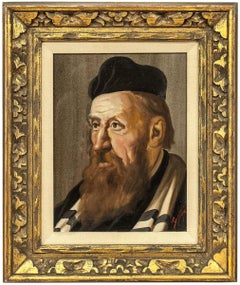
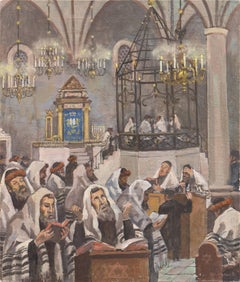
Interior of Synagogue with Rabbi
, Polish Orthodox Judaica, Israel, Pentateuch
By Mieczyslaw Watorski
Located in Santa Cruz, CA
Signed lower right, 'M. Watorski' for Mieczyslaw Watorski (Polish, 1903 - 1979) and painted circa 1950.
This Polish history and landscape painter is particularly revered for his doc...
Category
1940s Interior Paintings
Materials
Canvas, Oil
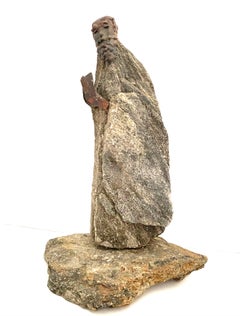
Polish Sculpture Granite Stone, Metal Judaica Jewish Holocaust Memorial Art
By Lubomir Tomaszewski
Located in Surfside, FL
Born in 1923, alumnus of the Warsaw Academy of Fine Arts. Student of the Warsaw University of Technology, is an extraordinary artist, searching for his own artistic way. Ambitious,...
Category
20th Century Modern Figurative Sculptures
Materials
Stone, Iron
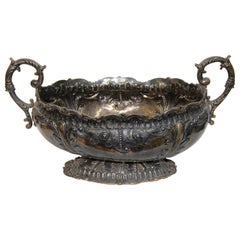
Big and Heavy Sterling Silver Fruit, Flower Bowl, Basket, Hazorfim, Judaica
Located in Berlin, DE
Big and very heavy sterling silver fruit bowl, basket. Hazorfim.
Beautiful decoration object.
Category
20th Century Centerpieces and Tazzas
Materials
Silver, Sterling Silver

$7,595 Sale Price
20% Off
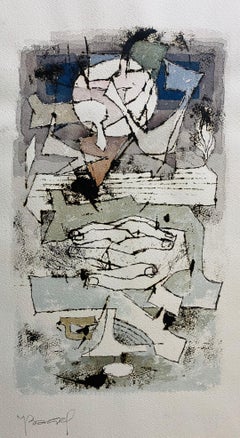
Polish French Judaica Watercolor Gouache Painting Original Bauhaus Yiddish Art
By Moses Bagel Bahelfer
Located in Surfside, FL
Moses Bahelfer BAGEL (1908-1995)
Moses Bagel (born Moshe Bahelfer) was a Polish-born Jewish artist and graphic designer associated with the original Bauhaus and then the School of Pa...
Category
20th Century Modern Figurative Drawings and Watercolors
Materials
Ink, Watercolor, ABS
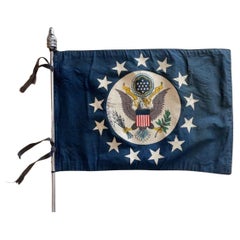
American Diplomatic Mission Flag, Judaica- Liberation of Concentration Camp 1945
Located in Doha, QA
This American Diplomatic Mission Flag is one of its kind, a true museum’s piece, and it’s from the time which should never happen again in human history.
This Flag was taken from th...
Category
20th Century American Historical Memorabilia
Materials
Cotton
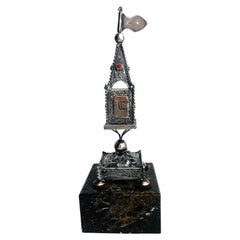
Antique Rare Judaica Silver Spice Tower 18th century Germany
Located in Doha, QA
This is an extremely rare and absolutely magnificent filigrane made 18th century silver spice tower. It has been crafted in Germany and hallmarked in two places with number 12. The German and Austrian hallmark in the 18th century, which was called Lot/ Loth and was used to indicate proportion of precious metal content in any metal object.
The base of the tower is square and has an intricate ornamented leaf design, the silver ball connects the base and the main part of the tower. In the middle there is a
small movable door which opens to the outside and has an engraved Hebrew letter Tav in an old font. It’s the last letter of the Hebrew Alphabet and translates as “truth”.
It symbolises truth, perfection, and completion. The tower has six gemstones on it, four red and two dark green. The design remains filigrane and fragile from the bottom to the top on all sides and at the tip of the tower there is a flag in an arrow shape.
This rare spice tower is impressive and very finely crafted. The condition for its age is excellent. The tower comes together with a beautiful original art deco wooden leather box...
Category
Antique Late 18th Century German Religious Items
Materials
Silver
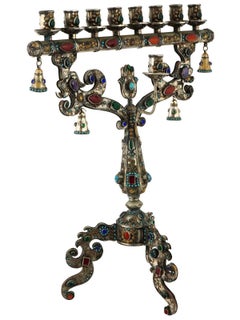
Unusual And Large Judaica Silver and Silverplate Menorah With Gemstones
Located in Long Island City, NY
A vintage Turkmen manner silver and silverplated copper menorah decorated with gemstones and filigree. The menorah includes nine candle holders arranged...
Category
Antique 19th Century French Religious Items
Materials
Silver, Copper
$4,500 Sale Price
40% Off
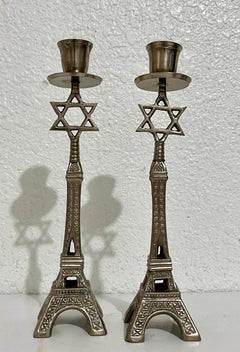
Mid Century Mod Judaica Chrome Eiffel Tower Star of David Candle Holders France
Located in Surfside, FL
20th Century Charming Metal Eiffel Tower Star of David Judaica Candle Holders
9.5" X 2.5" X 2.5"
These are unmarked. Not sure of the country of origin. ...
Category
20th Century Contemporary More Art
Materials
Metal
Magen Ruach, Large Scale Judaica Digital Print
By Ken Goldman
Located in Surfside, FL
Contemporary Jewish artist Ken Goldman, born: 1960, Memphis Tenn.
Education: Pratt Institute, Masters of industrial Design, 1985
Brooklyn College, B.A Fine Arts, 1981
Made aliyah: 1985-member Kibbutz Shluchot
Art in the collection of Mishkan LeOmanut Ein Harod Israel - Wolfson Museum Jerusalem Israel - Rodeph Shalom - Philadelphia Museum of Jewish Art
Shows
2017 - Here Is Your Ketubbah Museum Of Art Ein Harod Israel
2016 - Ima Ilya – Hebrew University Gallery – Jerusalem Israel
2016 - It Was Evening it was Morning – Rishon Le Zion Community gallery Israel
2016 - Jerusalem Biennial select works Leichtag Foundation – San Diego
2015 - Some Body Jewish - solo show - Jewish Museum Of Philadelphia Congregation Rodeph Shalom - Philadelphia
2015 - Rooted in Time - Rishon LeZion City Gallery
2015 - Black and White - Neve Schechter Tel Aviv
2015 - Rooted - Manny Cantor Center - New York
2015 - To Forgive and Remember - Reshaping American Consciousness - Derfner Judaica Museum - New York
2015 - Magenim Jewish Cuts - En Harod Museum of Art Israel
2015 - Fields of Dreams - Living Shmita in the modern world - Yeshiva University Museum New York
2015 - The Second Jerusalem Biennial - The Fine Line- Achim Hasid Gallery - Jerusalem Israel
2015 - The Second Jerusalem Biennial - Ima Iyla'a- Hechal Shlomo Museum -Jerusalem Israel
2015 - Vashti The Untold Story -Neve Schechter Gallery Tel Aviv
2015 - Active Hands - Crafts by Soldiers - Craft in America Museum - California
2014 - Through the Others Eyes - Wolfson Museum - Jerusalem Israel
2014 - Off Label - The Laurie Tisch Gallery - New york - curated by Tobi Kahn
2013 - The first Biennial of Jewish art Jerusalem Israel
2013 - Golden Ghetto of Venice - competition- second prize
2013 - First Prize in Museum of Imajewnation Four Cups of Freedom competition
2012 - First Prize-Cover thy Head - Morris and Sally Justein Heritage Museum - Toronto, Canada
2012 - Portraits of Cain - Ben Gurion University gallery Chaim Maor curator
2010 - Zimmun - Mishkan Le Omanut Ein Harod Israel
2010 - Seduced by the Sacred - Charter Oak Foundation Hartford Ct
2007 - “Kabbalah dolls” chosen and marketed by F.A.O. Schwarz at annual toy auditions.
2006 - City of Jerusalem – competition- original succah model designs - “best in concept”
2003 - Temple Judea Museum - Judith Altman Memorial Judaica Competition - “It Holds Light”- finalist
2001 - “FromWithin” – solo exhibition Mishkan Le Omanut, Museum of Art, Ein Harod, Israel.
1999 – The Philip and Sylvia Spertus Judaica Prize – The Havdalah spice...
Category
21st Century and Contemporary Contemporary Photography
Materials
Digital
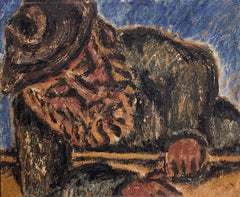
Modernist Rabbi at Study Judaica Oil Painting
By Ben-Zion
Located in Surfside, FL
Genre: Judaica
Subject: Religious
Medium: Oil
Surface: Board
Country: United States
Dimensions: 17.5" x 21.75"
Dimensions w/Frame: 24" x 28"
Born in 1897, Ben-Zion Weinman celebrated his European Jewish heritage in his visual works as a sculptor, painter, and printmaker. Influenced by Spinoza, Knut Hamsun, and Wladyslaw Reymont, as well as Hebrew literature, Ben-Zion wrote poetry and essays that, like his visual work, attempt to reveal the deep “connection between man and the divine, and between man and earth.”
An emigrant from the Ukraine, he came to the US in 1920. He wrote fairy tales and Judaic poems in Hebrew under the name Benzion Weinman, but when he began painting he dropped his last name and hyphenated his first, saying an artist needed only one name.
Ben-Zion was a founding member of “The Ten: An Independent Group” The Ten” a 1930’s avant...
Category
Mid-20th Century Modern Figurative Paintings
Materials
Oil, Board
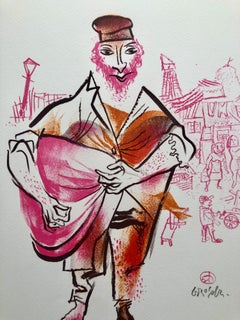
Jewish Shtetl Peddlar Americana Judaica Lithograph WPA Yiddish Social Realist
By William Gropper
Located in Surfside, FL
Hand signed in pencil and numbered with Roman numerals 8/24. A very small edition.
Old Lower East Side of New York or East European Shtetl. Jewish Shtetl Peddler Merchant. humorous ...
Category
Mid-20th Century Modern Figurative Prints
Materials
Lithograph
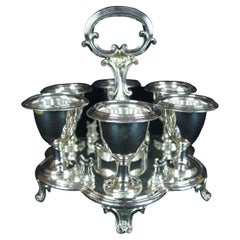
6 Baroque Silver Plated Kiddush Cup Goblets
Caddy Judaica Barware Shot Glasses
Located in Dayton, OH
Vintage silver plated kiddish cups and caddy. Features baroque design with scalloped footed form and fitted glasses for ease of use.
Measures: 8" x 8" x...
Category
Late 20th Century Baroque Barware
Materials
Silver Plate
$164 Sale Price / set
30% Off
Modernist Rabbi Oil Painting Judaica Jewish Synagogue Scene Paris. Lichtenstein.
By Isaac Lichtenstein 1
Located in Surfside, FL
Framed 26 x 13 image 20 x 6.5 inches.
YITSKHOK LIKHTENSHTEYN (ISAAC LICHTENSTEIN) (1888-1981) (Icchok, Izrael) was born in Lodz, Poland. Initially he was studying at Yehuda Pen s...
Category
Early 20th Century Post-Impressionist Figurative Paintings
Materials
Oil, Board
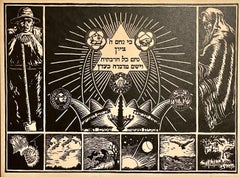
Rare 1922 German Jewish Judaica Zion Woodcut Woodblock Print Hermann Fechenbach
By Hermann Israel Fechenbach
Located in Surfside, FL
Title: Zion
Subject: Various biblical images depicting Creation and prayer
1922
Medium: woodcut
Frame: 14" x 18"
Image: 12.5" x 16.75"
Provenance: owned and signed verso by Peter Keil.
Central panel shows the Jewish star over a crown, with inscription in Hebrew: "When God comforts Zion, He will comfort all its ruins and make its deserts look like Eden," and "You have sanctified the seventh day, the goal of creation of Heaven and Earth." This is flanked by a Palestinian farmer pioneer on the left and a Jew praying on the right. The lower tier shows six vignettes of the days of creation from Genesis.
Hermann Fechenbach was born in 1897 in Württemberg, Germany. He grew up in Bad Mergentheim where his parents had an inn, which served as a meeting place for the local Jewish community.
He left school early and through family connections with clothing retailers received training in window dressing. His skill with brush writing was quickly recognised by a big firm in Dortmund where he was responsible for the displays in 10 large windows. He received his conscription papers in 1916 and recalls “being as patriotic as any other fool”. In August 1917 he was involved in a grenade attack in which he was the sole survivor. With serious injuries to both legs he struggled to safety and was eventually transported to a front line “slaughterhouse” where the first of a series of amputations was performed which led to the loss of his left leg.
As a result of his injuries his father dropped his opposition to him becoming an artist. His formal art education started in 1918 with training at a Stuttgart handcraft school for invalids. He attended the Academies in Stuttgart and Munich to learn painting and restoration for 3 years. He was influenced at this time by Max Liebermann. He has been compared to Kathe Kollwitz and was a contemporary of Jakob Steinhardt and hermann Struck. In 1923 he went to Florence for a year. While in Florence he started to produce a series of miniature wood engravings to illustrate the stories of Genesis. This was followed by periods in Pisa, Venice, Vienna and Amsterdam. In 1924 he returned to Stuttgart to paint in the contemporary style “Die Neue Sachlichkeit”. (The New Objectivity was a movement in German art that arose during the 1920s Weimar republic as a reaction against expressionism. The term was coined by Gustav Friedrich Hartlaub, the director of the Kunsthalle in Mannheim, who used it as the title of an art exhibition staged in 1925 to showcase artists who were working in a post-expressionist spirit. These artists—who included Max Beckmann, Otto Dix, George Grosz, Christian Schad, Rudolf Schlichter and Jeanne Mammen) Every spring and autumn he exhibited at the “Kunstgebit” which served as the showcase for all serious artists of the period.
His professional status “Kunstmaler und Grafiker” was recognised by Berlin in 1926. Practically all his work from this period was sold following exhibition.
In 1926 he collaborated with an architect friend to build a bungalow in Hohenheim, a non-Jewish area and a suburb of Stuttgart. Hermann alternately lived in his country bungalow and his town studio, producing portraits for sale or barter and wood engravings for his own pleasure.
In 1930 he married a non-Jewish professional photographer – Greta Batze. They had a studio in Stuttgart, which was used to teach art to a group of 12 students.
In 1933 the Nazi influence removed his name from the official state register together with the right to exhibit. By spending most of his time in his bungalow out of the Jewish quarter the Fechenbachs escaped being registered by the Nazis for some years. They were ostracised and abused by their non-Jewish neighbours. Hermann made weekly visits to friends in town to teach them the practical skills they would need assuming they were to escape from Germany. His energies were directed towards protection and survival.
Ultimately the Nazi persecution forced the Fechenbachs to flee their homeland. They moved to Palestine for 3 months in 1938, but found the political and physical environment unsustainable.
Greta arrived in England penniless in January 1939 to work as a domestic servant and to find a guarantor for her husband. Hermann arrived in May 1939. They moved to Blackheath a few months later. Hermann resumed his painting and engraving as a means of earning a living. He raised enough money to get his parents out of Germany to join his brothers in Argentina but was unable to save his twin sister Rosa who died in a Nazi concentration camp. In 1940 Hermann was interned in Bury as a suspect alien. He protested about his treatment by starting a hunger strike. Because of his persistence he was moved to a prison in Liverpool. From Liverpool he was moved to the Hutchinson Camp in the Isle of Man with fellow artist Kurt Schwitters. Arrangements were made for Greta to be accommodated near by. While interned he commenced work on “Refugee Impressions”, a series of linocut prints (no wood was available).
In 1941 when released from internment the Fechenbachs came under the sponsorship of Dr. Bela Horovitz, the Austrian art publisher who in turn made an introduction to Professor Tancred Borenius.
They were offered lodgings with a family in Oxford. Hermann had his first public exhibition for many years in a small gallery in Oxford in 1942. A second exhibition of oils, pencil drawings, coloured linocut and woodblock prints held later in the year was opened by the mayor of Oxford and critically acclaimed.
In 1944 the first London exhibition took place at the Anglo-Palestinian club in Piccadilly. There were two exhibitions at the Ben Uri Art gallery during this period.
In 1948 a second exhibition at the Anglo Palestinian club was inaugurated by a member of the Rothschild family and several members of Parliament. This was a great success.
In 1944 the Fechenbachs moved to a top floor studio flat in Colet Gardens. Open exhibitions were held each Spring at the Embankment from 1946 to 1951. Movietone News produced a short feature on the artist, which was shown in cinemas in England and Germany.
In 1969 he published the Genesis story in a hard back volume containing 137 prints. He started to research the fate of the entire Jewish community of Bad Mergentheim during the period of the second world war, liaising with historian Dr. Paul Sauer and Professor Max Miller, historian and theologian. In 1972 Kohlhammer published his partly autobiographical book “The last Jews of Mergentheim”. He exhibited at the Anglo-Palestinian Club & the Ben Uri Gallery in the 1940s. His works only came to prominence during the last year of his life when he exhibited at Blond Fine Art.
Peter Keil part of the Junge Wilde. In 1978, the Junge Wilde painting style arose in the German-speaking world in opposition to established avant garde, minimal art and conceptual art. It was linked to the similar Transavanguardia movement in Italy, USA (neo-expressionism) and France (Figuration Libre). They were also known as the Neue Wilde. Artists included; Austria: Siegfried Anzinger, Erwin Bohatsch, Herbert Brandl, Gunter Damisch, Hubert Scheibl, Hubert Schmalix...
Category
1980s Impressionist Figurative Prints
Materials
Woodcut
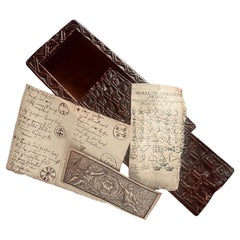
Antique Gothic Judaica Box with Kabbalistic Seals and Sacred Texts
Located in Doha, QA
This rare and evocative Medieval Gothic box contains a powerful combination of Salomon’s Kabbalistic seals, a sacred ex libris dedicated to God, and a Star of David inscribed with He...
Category
Antique 15th Century and Earlier German Renaissance Religious Items
Materials
Wood, Paper
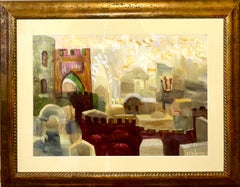
Jewish Mystical Kabbalah Oil Painting Jerusalem Cityscape Hebrew Letters Judaica
By David Rakia
Located in Surfside, FL
"Tzadik"
A Surrealist oil painting of old mystical Jerusalem with Hebrew calligraphy
Sight 13.25" x 19.5" ; frame: 21" x 27.25"
David Rakia (1928-2012) was born in Vienna, Austria...
Category
1960s Surrealist Abstract Paintings
Materials
Paper, Oil
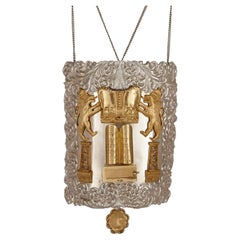
Silver Gilt Judaica Torah Breast Plate by Jacob Langleben, 1896
Located in London, GB
Silver gilt Judaica Torah breast plate by Jacob Langleben, 1896
English, late 19th century
Measures: Height 62cm, width 25cm, depth 9cm
This superb antique piece is a large, Jewish Torah...
Category
Antique Late 19th Century English Late Victorian Religious Items
Materials
Silver
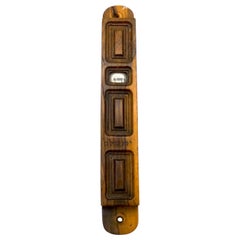
A Large Olivewood Mezuzah Case, Jerusalem Circa 1890. Judaica
Located in New York, NY
A Very Rare Large Olivewood Mezuzah Case Made in Jerusalem Circa 1890.
Olive wood can be found in many areas of the world today but it is native to the Mediterranean region and con...
Category
Antique Early 1900s Israeli Religious Items
Materials
Wood, Olive
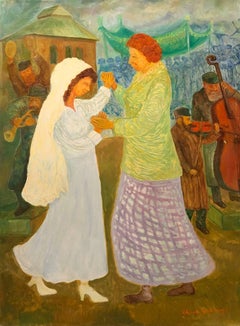
Mother Daughter Wedding Dance, Large Judaica Oil Painting, Shtetl Life
By Chaïm Goldberg
Located in Surfside, FL
Genre: Judaica
Subject: People
Medium: Oil
Surface: Canvas
Country: United States
Dimensions: 40" x 30 1/4"
Chaim Goldberg -- born in the Polish shtetl of Kazimierz Dolny
Chaim Gol...
Category
20th Century Impressionist Figurative Paintings
Materials
Canvas, Oil
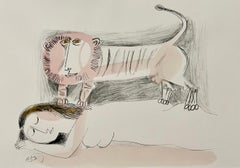
Rare Israeli Modernist Judaica Watercolor Painting Lion Lithograph Naftali Bezem
By Naftali Bezem
Located in Surfside, FL
Naftali Bezem (Hebrew: נפתלי בזם; born November 27, 1924) is an Israeli painter, muralist, and sculptor. Lion on nude figure of wo,man.
Bezem was born in Essen, Germany, in 1924. H...
Category
20th Century Modern Figurative Drawings and Watercolors
Materials
Watercolor, Lithograph
Polish Judaica Portrait of Hasidic Rabbi Shtetl Tailor Oil Painting
Located in Surfside, FL
Older, realistic portrait of an older Jewish shtetl tailor by Polish artist. Here the artist conveys a sense of quiet grandeur through the eyes of his subject and the way it's rendered. Part of a distinguished European lineage of Jewish genre...
Category
20th Century Realist Portrait Paintings
Materials
Canvas, Oil, Board
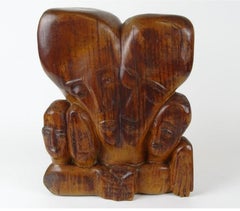
Carved Wood German Expressionist Sculpture Jewish Woman Refugee Artist Judaica
By Miriam Sommerburg
Located in Surfside, FL
Miriam Sommerburg (American female artist, born Germany, Hamburg, 1900–1980 New York)
Modernist Wood Carved Sculpture, Carving depictin...
Category
Mid-20th Century Expressionist Figurative Sculptures
Materials
Wood
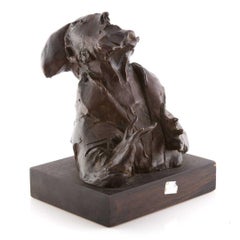
Judaica Bronze Sculpture "Rabbi" Figure Jewish American Boston Figural Modernist
By David Aronson
Located in Surfside, FL
Aronson, David 1923-
David Aronson, son of a rabbi, was born in Lithuania in 1923 and immigrated to America at the age of five. He settled in Boston, Massachusetts where he studied at the school of the Museum of Fine Arts under Karl Zerbe, a German painter well known in the early 1900s. Aronson later taught at the school of the Museum of Fine Arts for fourteen years and founded the School of Fine Art at Boston University where he is today a professor emeritus. An internationally renowned sculptor & painter, Aronson has won acclaim for his interpretation of themes from the Hebrew Talmud and Kabala. His best known works include bronze castings, encaustic paintings, and pastels. His work is included in many important public and private collections, and has been shown in several museum retrospectives around the country. He is considered to be one of the most important 20th century American artists.
At twenty-two David Aronson had his first one-man show at New York's Niveau Gallery. The next year, six of his Christological paintings were included in the Fourteen Americans exhibition at Manhattan's Museum of Modern Art where Aronson’s work was included alongside abstract expressionists Arshile Gorky, Robert Motherwell and Isamu Noguchi. In the 1950s, Aronson turned more toward his Jewish heritage for the inspiration for his art. Folklore as well as Kabalistic and other transcendental writings influenced his work greatly. The Golem (a legendary figure, brought to life by the Maharal of Prague out of clay to protect the Jewish community during times of persecution) and the Dybbuk (an evil spirit that lodges itself in the soul of a living person until exorcised) frequently appear in his work.
In the sixties, Aronson turned to sculpture. His work during this period is best exemplified by a magnificent 8’ x 4’ bronze door which now stands at the entrance to Frank Lloyd Wright's Johnson Foundation Conference Center for the Arts in Racine, Wisconsin. In the seventies and eighties, Aronson continued his work in pastel drawings, paintings, and sculptures, often exploring religion and the frailties of man's nature. During this time, in addition to a traveling retrospective exhibition and many one-man shows in New York, Los Angeles, Chicago, and Boston at the Pucker-Safrai Gallery on Newbury Street, Aronson won many awards and became a member of the National Academy of Design in New York. Two years ago he retired from teaching to work full-time in his studio in Sudbury, Massachusetts.
included in the catalog
Contemporary Religious Imagery in American Art
Catalog for an exhibition held at the Ringling Museum of Art, March 1-31, 1974.
Artists represented: David Aronson, Leonard Baskin, Max Beckmann, Hyman Bloom, Fernando Botero, Paul Cadmus, Marvin Cherney, Arthur G. Dove, Philip Evergood, Adolph Gottlieb, Jonah Kinigstein, Rico Lebrun, Jack Levine, Louise Nevelson, Barnett Newman, Abraham Rattner, Ben Shahn, Mark Tobey, Max Weber, William Zorach and others.
Selected Awards
1990, Certificate of Merit, National Academy of Design
1976, Purchase Prize, National Academy of Design
1976, Joseph Isidore Gold Medal, National Academy of Design
1976, Purchase Prize in Drawing, Albrecht Art Museum
1975, Isaac N. Maynard Prize for Painting, National Academy of Design
1973, Samuel F. B. Morse Gold Medal, National Academy of Design
1967, Purchase Prize, National Academy of Fine Arts
1967, Adolph and Clara Obrig Prize, National Academy of Design
1963, Gold Medal, Art Directors Club of Philadelphia
1961, 62, 63, Purchase Prize, National Institute of Arts and Letters
1960, John Siimon Guggenheim Fellowship
1958, Grant in Art, National Institute of Arts and Letters
1954, First Prize, Tupperware Annual Art Fund Award
1954, Grand Prize, Third Annual Boston Arts Festival
1953, Second Prize, Second Annual Boston Arts Festival
1952, Grand Prize, First Annual Boston Arts Festival
1946, Traveling Fellowship, School of the Museum of Fine Arts
1946, Purchase Prize, Virginia Museum of Fine Arts
1944, First Popular Prize, Institute of Contemporary Art
1944, First Judge's Prize, Institute of Contemporary Art
Selected Public Collections
Art Institute of Chicago
Virginia Museum of Fine Arts
Bryn Mawr College
Brandeis University
Tupperware Museum, Orlando, Florida
DeCordova Museum
Museum of Modern Art Print Collection, New York
Atlanta University
Atlanta Art...
Category
20th Century Expressionist Figurative Sculptures
Materials
Bronze
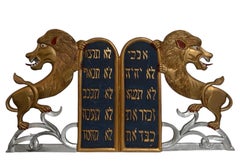
Rare Folk Art Hebrew Judaica Carved Gilded Wood Lions Torah Synagogue Sculpture
Located in Surfside, FL
Paint and gold paint on wood
Circa early to mid 20th century.
This is not signed
A treasure from a proud congregation. It is a hand-carved wooden sculpture showing the Tablets of the Law flanked by two Lions of Judah. Their paws held the tablets. Their roaring mouths faced outward, protecting the commandments from threats. In a foliage design with gold and silver paint.
Circa 1920-1940's. This Neoclassical, Judaic, Art Deco, Egyptian revival, Shul, Aron Kodesh hand carving, wood with gilding, Hebrew lettering ten commandments sign sculpture, was produced probably in New York.
There was a show at the Folk Art Museum titled “Gilded Lions and Jeweled Horses: The Synagogue to the Carousel” That featured these antique magnificent pieces. From gilded lions to high-stepping horses, the sacred to the secular, and the Old World to the New, “Gilded Lions and Jeweled Horses: The Synagogue to the Carousel” traces the journey of Jewish woodcarvers and other artisans from Eastern and Central Europe to America and the unsung role they played in establishing a distinct Jewish culture in communities throughout the United States. The exuberant artworks stand as a testament to a history of survival and transformation and provide a surprising revelation of the link that was forged between the synagogue and the carousel as immigrant Jewish artists transferred symbolic visual elements into this vernacular American idiom. The first major study of this important aspect of the Jewish contribution to American folk art, the exhibition features approximately one hundred artworks and objects, including rare documentary photographs of Eastern European synagogue arks and carved gravestones, sacred carvings, papercuts, and carousel animals. Some of these same Jewish European carvers worked on Coney Island amusement park rides and carousel horses and other carnival and circus carvings.
Category
Early 20th Century Folk Art More Art
Materials
Metal
Latin American Judaica Conceptual Chassidic Art Modern Woodcut Luis Camnitzer
By Luis Camnitzer
Located in Surfside, FL
Luis Camnitzer and Martin Buber (1878-1965),
New York: JMB Publishers Ltd, 1970.
Printed at The New York Graphic Workshop.
Hand signed on Arches paper. (Edition 24/100, numbered on Justification page)
Woodblock prints based on folktales from the Hasidic Jewish tradition in Eastern Europe, selected by Camnitzer from the early masters section of Buber’s Die chassidischen Bücher as translated by Olga Marx. German Expressionist style Jewish woodcuts...
Category
1970s Expressionist Figurative Prints
Materials
Woodcut
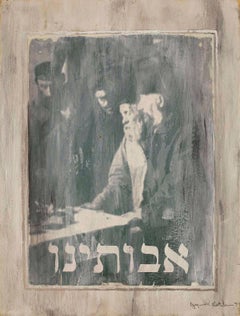
Judaica Imagery on Wood Contemporary Pop Art Manner
Located in Surfside, FL
A silkscreen mixed-media work that exhibits the word "Forefathers" in Hebrew across the bottom of the piece.
Category
Late 20th Century Contemporary Mixed Media
Materials
Wood, Mixed Media, Acrylic, Black and White
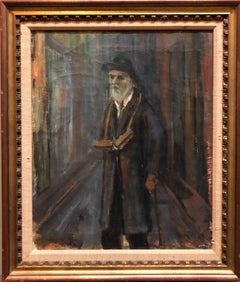
Judaica Oil Painting 1945 Palestine Old Jewish Man Polish Israeli Artist
By Ozer Shabat
Located in Surfside, FL
Ozer Shabat 1978-1901
Ozer Shabbat was an Israeli painter, a resident of Haifa. Belonged to the Palestine Expressionist group of the late 1920s and early 1930s.
Shabbat was born in Wolbrom, Poland. At the end of the First World War he went to Holland for agricultural training in the framework of the HeChalutz movement, prior to his immigration to Palestine. In 1920 he immigrated to Eretz Israel and joined the Hulda group. Later he joined the Merhavia group and there he began painting. Because of his desire to study drawing, he left the group and moved to Jerusalem. In 1921, he wrote articles in the newspaper "HaSadeh" on the subject of agriculture and Dutch cheese.
Ozer Shabath won the first prize in a competition for the design of the Dutch Consulate's Garden in Jerusalem, enabling him to travel to Paris in 1923 to study painting. Until 1925 he studied painting at the Grande Chaumiere Academy in Paris. This year he returned to Eretz Israel and settled in Haifa, where he lived until his death.
In 1928 he participated for the first time in an exhibition of Eretz Israel artists at the Tower of David. Since then he has participated in all the general exhibitions of Israeli artists. In 1934, together with painters Menachem Shemi, Avraham Mohar, Zvi Meirovitch and others, he founded the Haifa Artists' Group. In 1935-36 he toured Europe and visited Italy, France and England. During his visit, he maintained contacts with artists from the Jewish school of Paris.
He has exhibited in several solo exhibitions, represented Israel in exhibitions in Europe and participated in international exhibitions in New York, Johannesburg and Zurich. In 1958 he represented Israel in the Venice Biennale. In 1960, Shabat, together with Elchanan Halpern he represented the Israeli Painters Association at the International Congress of Plastic Arts held in Vienna, Austria . In the 40s and 50s he focused on landscape pictures. However, despite the focus on the Israeli landscape, the approach is universal in the framework of the post-Impressionist painting school. In the 1960s, his approach changed and he turned more to abstraction. The abstract direction gradually evolved. The point of departure of the abstract approach is the architectural landscape, but this view loses its real character and becomes only imaginary: the buildings lose their real character and turn into exclusive geometric areas that are usually set against a dark background. Over time, architecture captured the lion's share of his paintings. Cities like Safed, Jaffa and Jerusalem are the subject of many pictures.
He taught painting and art at the schools of the kibbutzim in Ramat Yochanan and Kfar Yehoshua, in high schools in Haifa and in the IDF and Gordon seminars.
His paintings were purchased and are in the permanent collection of the Bezalel National Museum (now the Israel Museum), Haifa Museum of Art, Haifa Maritime Museum, Acre Municipal Museum.
Select Solo exhibitions
1936 - Nadler Gallery, Haifa.
1943 - The Tel Aviv Museum of Art.
1952 - Artists House, Haifa.
1953 - Bezalel House, Jerusalem.
1955 - Gallery in Geneva, Switzerland.
1955 - The Writers' Club, Haifa.
1959 - Artists House, Haifa.
1960 - Museum of Modern Art, Haifa.
1962 - Museum of Modern Art, Haifa.
1963 - Gallery 220, Tel Aviv.
1968 - The Municipal Museum of Beit Emanuel, Ramat Gan.
1979 - Memorial exhibition marking the first anniversary...
Category
1940s Post-Impressionist Figurative Paintings
Materials
Canvas, Oil
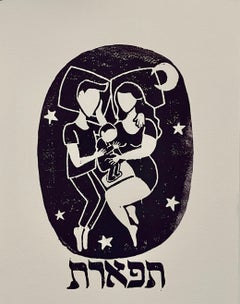
Feminist Judaica Linocut Relief Print Basya Wuensch Kabbalah Sefirot Hebrew Art
Located in Surfside, FL
Basya Wuensch
Sefirot, Tiferet (beauty in harmony)
Family,
2023
Hand printed color linocut on cold pressed watercolor paper
Hand signed and numbered
12 ...
Category
21st Century and Contemporary Contemporary Figurative Prints
Materials
Linocut
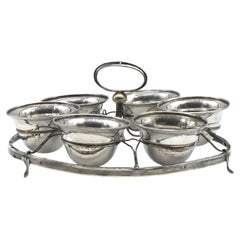
A Rare Silver Passover Seder Plate, Austria 1844 Judaica
Located in New York, NY
A Rare Silver Passover Seder Plate, Austria 1844
Circular outer rim supports wirework stems connected to a central knop and oblong shaped handle. Six bowls sit on round hanging suppo...
Category
Antique 1840s Sterling Silver
Materials
Silver
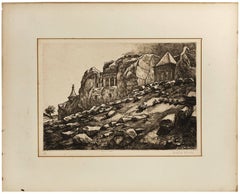
Outside Jerusalem, Tomb of Ashalom, Judaica Print
Located in Surfside, FL
Picturesque depiction of Jerusalem mountainside landscape with Tomb of Ashalom.
Category
20th Century Landscape Prints
Materials
Paper
An Art And Crafts Mezuzah Case, Israel 1948. Judaica
Located in New York, NY
An Art and crafts Mezuzah Case made in Israel in 1948.
Early Israeli Mezuzah case on a shaped piece of wood covered in green velvet with a scroll encased...
Category
Vintage 1940s Israeli Mid-Century Modern Religious Items
Materials
Brass

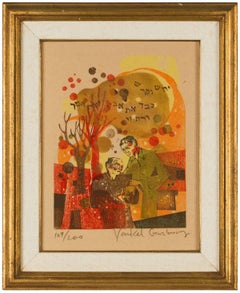
Lithograph "Honor Thy parents" Judaica Hebrew Print
By Yankel Ginzburg
Located in Surfside, FL
Yankel Ginzburg, Kazakastani/American (1945 - )
Genre: Modern
Subject: People
Medium: Lithograph
Surface: Paper
Dimensions w/Frame: 19 1/2" x 16"
Yankel Ginzburg
Yankel Ginzburg was born Yuri Zhukov in 1945 in Alma-Ata, capital of the Kazakhstan Republic near the Chinese border. His parents were both Russian Army...
Category
20th Century Contemporary Figurative Prints
Materials
Lithograph
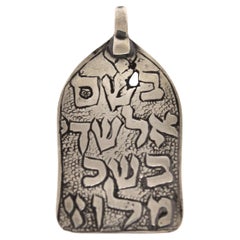
A North African Silver Amulet, Antique Judaica from North Africa
Located in New York, NY
This exquisite antique silver amulet from North Africa is a fine example of regional Judaica, rich in spiritual significance and traditional craftsmanship. Small and tablet-shaped, t...
Category
Early 20th Century African Sterling Silver
Materials
Silver
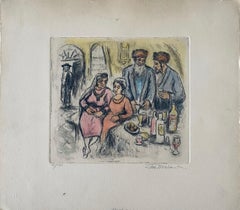
Judaica interior scene etching with hand coloring
By Ira Moskowitz
Located in Surfside, FL
I believe the scene is of a wedding engagement. etching with extensive hand coloring (making it a unique original work of art)
Ira Moskowitz (1912-2001), descendant of a long rabbin...
Category
20th Century Post-Impressionist Interior Prints
Materials
Lithograph
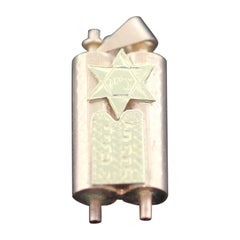
Estate Gold Jewish Mezuzah Pendant Judaica Charm Necklace
Located in Hicksville, NY
Estate Golden Jewish Mezuzah pendant Judaica Charm necklace
Yellow Gold
1.7 Grams
19.6mm x 8.8mm x 4.9 mm
Category
20th Century Unknown Modern Pendant Necklaces
Materials
Gold
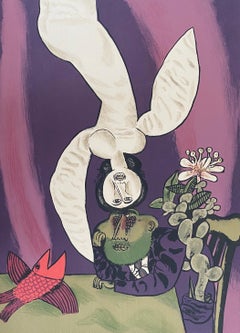
Israeli Surrealist Judaica Abstract Lithograph Naftali Bezem
By Naftali Bezem
Located in Surfside, FL
Naftali Bezem (Hebrew: נפתלי בזם; born November 27, 1924) is an Israeli painter, muralist, and sculptor.
Bezem was born in Essen, Germany, in 1924. His early adolescence was spent...
Category
20th Century Modern Prints and Multiples
Materials
Lithograph
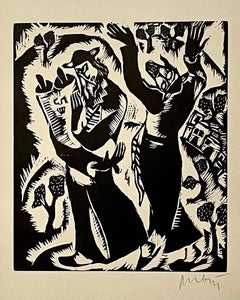
Rare 1923 Cubist Reuven Rubin Woodcut Woodblock Print Israeli Hasidic Judaica
By Reuven Rubin
Located in Surfside, FL
This is from the original first edition 1923 printing. there was a much later edition done after these originals.
These are individually hand signed in pencil by artist as issued.
This listing is for the one print. the other documentation is included here for provenance and is not included in this listing.
The various images inspired by the Jewish Mysticism and rabbis and mystics of jerusalem and Kabbalah is holy, dramatic and optimistic Rubin succeeded to evoke the spirit of life in Israel in those early days.
They are done in a modern art style influenced by German Expressionism, particularly, Ernst Barlach, Ernst Ludwig Kirchner, and Franz Marc, as introduced to Israel by Jakob Steinhardt, Hermann Struck and Joseph Budko.
Reuven Rubin 1893 -1974 was a Romanian-born Israeli painter and Israel's first ambassador to Romania.
Rubin Zelicovich (later Reuven Rubin) was born in Galati to a poor Romanian Jewish Hasidic family. He was the eighth of 13 children. In 1912, he left for Ottoman-ruled Palestine to study art at Bezalel Academy of Art and Design in Jerusalem. Finding himself at odds with the artistic views of the Academy's teachers, he left for Paris, France, in 1913 to pursue his studies at the École Nationale Supérieure des Beaux-Arts. He was of the well known Jewish artists in Paris along with Marc Chagall and Chaim Soutine,
At the outbreak of World War I, he was returned to Romania, where he spent the war years.
In 1921, he traveled to the United States with his friend and fellow artist, Arthur Kolnik. In New York City, the two met artist Alfred Stieglitz, who was instrumental in organizing their first American show at the Anderson Gallery. Following the exhibition, in 1922, they both returned to Europe. In 1923, Rubin emigrated to Mandate Palestine.
Rubin met his wife, Esther, in 1928, aboard a passenger ship to Palestine on his return from a show in New York. She was a Bronx girl who had won a trip to Palestine in a Young Judaea competition. He died in 1974.
Part of the early generation of artists in Israel, Joseph Zaritsky, Arieh Lubin, Reuven Rubin, Sionah Tagger, Pinchas Litvinovsky, Mordecai Ardon, Yitzhak Katz, and Baruch Agadati; These painters depicted the country’s landscapes in the 1920s rebelled against the Bezalel school of Boris Schatz. They sought current styles in Europe that would help portray their own country’s landscape, in keeping with the spirit of the time. Rubin’s Cezannesque landscapes from the 1920s were defined by both a modern and a naive style, portraying the landscape and inhabitants of Israel in a sensitive fashion. His landscape paintings in particular paid special detail to a spiritual, translucent light. His early work bore the influences of Futurism, Vorticism, Cubism and Surrealism.
In Palestine, he became one of the founders of the new Eretz-Yisrael style. Recurring themes in his work were the bible, the prophet, the biblical landscape, folklore and folk art, people, including Yemenite, Hasidic Jews and Arabs. Many of his paintings are sun-bathed depictions of Jerusalem and the Galilee. Rubin might have been influenced by the work of Henri Rousseau whose naice style combined with Eastern nuances, as well as with the neo-Byzantine art to which Rubin had been exposed in his native Romania. In accordance with his integrative style, he signed his works with his first name in Hebrew and his surname in Roman letters.
In 1924, he was the first artist to hold a solo exhibition at the Tower of David, in Jerusalem (later exhibited in Tel Aviv at Gymnasia Herzliya). That year he was elected chairman of the Association of Painters and Sculptors of Palestine. From the 1930s onwards, Rubin designed backdrops for Habima Theater, the Ohel Theater and other theaters.
His biography, published in 1969, is titled My Life - My Art. He died in Tel Aviv in October 1974, after having bequeathed his home on 14 Bialik Street and a core collection of his paintings to the city of Tel Aviv. The Rubin Museum opened in 1983. The director and curator of the museum is his daughter-in-law, Carmela Rubin. Rubin's paintings are now increasingly sought after. At a Sotheby's auction in New York in 2007, his work accounted for six of the ten top lots. Along with Yaacov Agam and Menashe Kadishman he is among Israel's best known artists internationally. Education
1912 Bezalel Academy of Arts and Design, Jerusalem
1913-14 École des Beaux Arts, Paris and Académie Colarossi, Paris
Select Group Exhibitions
Eged - Palestine Painters Group Eged - Palestine Painters Group, Allenby Street, Tel Aviv 1929
Artists: Chana Orloff, Abraham Melnikoff, Rubin, Reuven Nahum Gutman, Sionah Tagger,Arieh Allweil,
Jewish Artists Association, Levant Fair, Tel Aviv, 1929
Artists: Ludwig Blum,Eliyahu Sigad, Shmuel Ovadyahu, Itzhak Frenel Frenkel,Ozer Shabat, Menahem Shemi...
Category
1920s Abstract Figurative Prints
Materials
Woodcut
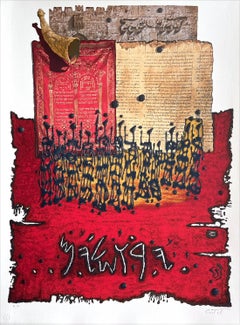
SHOFAR AT LIONS GATE Signed Lithograph, Jerusalem, Judaica, Red, Gold, Black
By Moshe Castel
Located in Union City, NJ
SHOFAR AT LIONS GATE by the Israeli artist Moshe Castel (1909-1991) is a limited edition lithograph printed in 13 colors using traditional lithographic tech...
Category
1980s Contemporary Portrait Prints
Materials
Lithograph
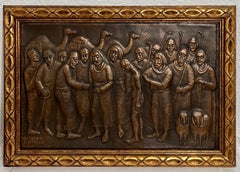
Large Judaica Copper Repousse Sculpture Relief Plaque Arie Merzer Bezalel Era
By Arieh Merzer
Located in Surfside, FL
Arieh Merzer (Israeli, 1905-1966)
Copper relief sculpture panel in gilt frame
Framed dimensions 18 X 26.25, copper 14.5 X 22.5
Arieh Merzer ...
Category
Mid-20th Century Figurative Sculptures
Materials
Metal, Copper
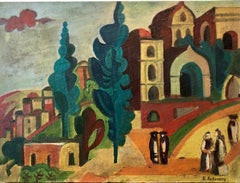
Outside the Synagogue Russian Judaica Oil Painting
By Emmanuel Snitkovsky
Located in Surfside, FL
This piece came from the collection of the Bezalel Art Gallery on the Lower East Side of New York City.
Emmanuil Snitkovsky is an internationally known artist, sculpture and poet.
Emmanuil Snitkovsky was born into a family of artists and scholars from the Odessa Art College in Russia. Immersed in the traditions of Russia art, he approaches form, line, space and color with relentless vision and impeccable technique.
Two highly successful artists, the husband and wife team of Emmanuil and Janet Snitkovsky have exhibited a selection of eight large Judaic paintings at the Chabad Chassidic Art Institute (Chai Gallery) in Crown Heights. Three of those paintings are truly singular visions of Jewish Art that cause us to stop and reassess our preconceptions about the meaning and importance of their subjects. Emmanuil and Janet Snitkovsky were both born in the Ukraine in the 1930′s. Emmanuil was trained in Odessa in public monument art, and Janet majored in fashion at the Lvov Decorative Art Institute. After both narrowly survived the devastation of the Second World War in Stalin’s Russia, they began to collaborate on state sponsored art works in 1962. For ten years, they worked on grandiose public sculptural projects to commemorate the fallen Russian heroes of the Second World War in Moscow, Kiev, Tula and Kazan. They were
exemplary Soviet Realists working for the Soviet regime. Eventually, this career became untenable for them, both as artists and as Jews, when they clashed with Soviet officialdom over a commission to commemorate the Babi-Yar massacre. The Soviets refused to acknowledge this massacre of 100,000 Jews and eventually suppressed the memorial. In 1978, Emmanuil and Janet arrived in New York and began to recreate their artistic lives. In the ensuing 25 years, they have been quite successful, exhibiting widely in the United States and Europe. They have nurtured a hybrid style of painting and sculpture called “Renaissance Revival” combining contemporary and classical subjects in a stylized realism that evokes both the American regionalist Thomas Hart
Benton and the Italian Renaissance master Sandro Botticelli. The works are highly proficient, polished, and commercial productions in a quirky decorative style. They have continued to accept sculptural projects that have not shied away from kitschy realistic sculptures of Charlie Chaplin as “The Kid,” The Little Tramp” and Buster Keaton as “Cameramen.” In some ways, they have appropriated American culture just as they once accepted Soviet culture.
Janet, a graduate of the Lvov College, was invited- by virtue of the high honors she
achieved there- to matriculate at the Lvov University of Art. Such an opportunity is extremely rare for anyone, particularly for someone of Jewish descent. Their works of art are included in collections of the Japanese Imperial Family...
Category
1980s Modern Landscape Paintings
Materials
Canvas, Oil, Illustration Board
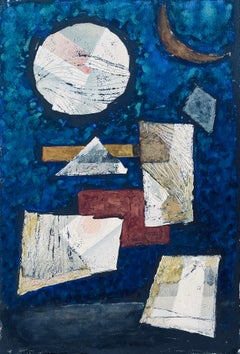
Polish French Judaica Watercolor Gouache Painting Original Bauhaus Yiddish Art
By Moses Bagel Bahelfer
Located in Surfside, FL
Moses Bahelfer BAGEL (1908-1995)
Moses Bagel (born Moshe Bahelfer) was a Polish-born Jewish artist and graphic designer associated with the original Bauhaus and then the School of Pa...
Category
20th Century Modern Figurative Drawings and Watercolors
Materials
Ink, Watercolor, ABS
Rare 1923 Cubist Reuven Rubin Woodcut Woodblock Kabbalah Print Israeli Judaica
By Reuven Rubin
Located in Surfside, FL
This is from the original first edition 1923 printing. there was a much later edition done after these originals.
These are individually hand signed in pencil by artist as issued.
This listing is for the one print. the other documentation is included here for provenance and is not included in this listing.
The various images inspired by the Jewish Mysticism and rabbis and mystics of jerusalem and Kabbalah is holy, dramatic and optimistic Rubin succeeded to evoke the spirit of life in Israel in those early days.
They are done in a modern art style influenced by German Expressionism, particularly, Ernst Barlach, Ernst Ludwig Kirchner, and Franz Marc, as introduced to Israel by Jakob Steinhardt, Hermann Struck and Joseph Budko.
Reuven Rubin 1893 -1974 was a Romanian-born Israeli painter and Israel's first ambassador to Romania.
Rubin Zelicovich (later Reuven Rubin) was born in Galati to a poor Romanian Jewish Hasidic family. He was the eighth of 13 children. In 1912, he left for Ottoman-ruled Palestine to study art at Bezalel Academy of Art and Design in Jerusalem. Finding himself at odds with the artistic views of the Academy's teachers, he left for Paris, France, in 1913 to pursue his studies at the École Nationale Supérieure des Beaux-Arts. He was of the well known Jewish artists in Paris along with Marc Chagall and Chaim Soutine,
At the outbreak of World War I, he was returned to Romania, where he spent the war years.
In 1921, he traveled to the United States with his friend and fellow artist, Arthur Kolnik. In New York City, the two met artist Alfred Stieglitz, who was instrumental in organizing their first American show at the Anderson Gallery. Following the exhibition, in 1922, they both returned to Europe. In 1923, Rubin emigrated to Mandate Palestine.
Rubin met his wife, Esther, in 1928, aboard a passenger ship to Palestine on his return from a show in New York. She was a Bronx girl who had won a trip to Palestine in a Young Judaea competition. He died in 1974.
Part of the early generation of artists in Israel, Joseph Zaritsky, Arieh Lubin, Reuven Rubin, Sionah Tagger, Pinchas Litvinovsky, Mordecai Ardon, Yitzhak Katz, and Baruch Agadati; These painters depicted the country’s landscapes in the 1920s rebelled against the Bezalel school of Boris Schatz. They sought current styles in Europe that would help portray their own country’s landscape, in keeping with the spirit of the time. Rubin’s Cezannesque landscapes from the 1920s were defined by both a modern and a naive style, portraying the landscape and inhabitants of Israel in a sensitive fashion. His landscape paintings in particular paid special detail to a spiritual, translucent light. His early work bore the influences of Futurism, Vorticism, Cubism and Surrealism.
In Palestine, he became one of the founders of the new Eretz-Yisrael style. Recurring themes in his work were the bible, the prophet, the biblical landscape, folklore and folk art, people, including Yemenite, Hasidic Jews and Arabs. Many of his paintings are sun-bathed depictions of Jerusalem and the Galilee. Rubin might have been influenced by the work of Henri Rousseau whose naice style combined with Eastern nuances, as well as with the neo-Byzantine art to which Rubin had been exposed in his native Romania. In accordance with his integrative style, he signed his works with his first name in Hebrew and his surname in Roman letters.
In 1924, he was the first artist to hold a solo exhibition at the Tower of David, in Jerusalem (later exhibited in Tel Aviv at Gymnasia Herzliya). That year he was elected chairman of the Association of Painters and Sculptors of Palestine. From the 1930s onwards, Rubin designed backdrops for Habima Theater, the Ohel Theater and other theaters.
His biography, published in 1969, is titled My Life - My Art. He died in Tel Aviv in October 1974, after having bequeathed his home on 14 Bialik Street and a core collection of his paintings to the city of Tel Aviv. The Rubin Museum opened in 1983. The director and curator of the museum is his daughter-in-law, Carmela Rubin. Rubin's paintings are now increasingly sought after. At a Sotheby's auction in New York in 2007, his work accounted for six of the ten top lots. Along with Yaacov Agam and Menashe Kadishman he is among Israel's best known artists internationally. Education
1912 Bezalel Academy of Arts and Design, Jerusalem
1913-14 École des Beaux Arts, Paris and Académie Colarossi, Paris
Select Group Exhibitions
Eged - Palestine Painters Group Eged - Palestine Painters Group, Allenby Street, Tel Aviv 1929
Artists: Chana Orloff, Abraham Melnikoff, Rubin, Reuven Nahum Gutman, Sionah Tagger,Arieh Allweil,
Jewish Artists Association, Levant Fair, Tel Aviv, 1929
Artists: Ludwig Blum,Eliyahu Sigad, Shmuel Ovadyahu, Itzhak Frenel Frenkel,Ozer Shabat, Menahem Shemi...
Category
1920s Abstract Figurative Prints
Materials
Woodcut
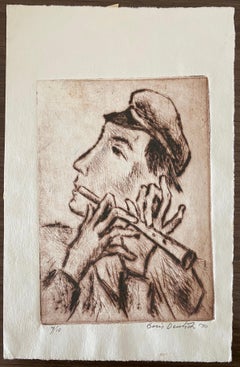
Shtetl Village Doodka Player Judaica Jewish California Modernist Artist Etching
By Boris Deutsch
Located in Surfside, FL
Boris deutsch was born in krasnagorka lithuania june 4 1892 died in los angeles 1978.Entered the polytechnic school in riga 1905.School of applied arts berlin 1912. Settled in l.A. 1...
Category
20th Century Modern Figurative Prints
Materials
Mixed Media, Watercolor
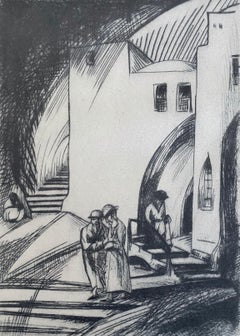
Bezalel School Jerusalem Israeli Judaica Etching - Street
By Isaac Lichtenstein 1
Located in Surfside, FL
YITSKHOK LIKHTENSHTEYN (ISAAC LICHTENSTEIN) (1888-1981) (Icchok, Izrael) was born in Lodz, Poland. Initially he was studying at Yehuda Pen school in Witebsk. In the same school wh...
Category
Early 20th Century Post-Impressionist Drawings and Watercolor Paintings
Materials
Etching
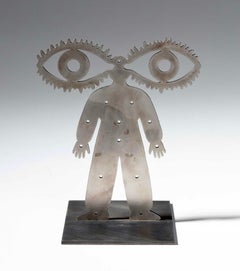
Russian Judaica "Vision" Abstract Kabbalah Figure Steel Sculpture Grisha Bruskin
By Grisha Bruskin
Located in Surfside, FL
Grisha Bruskin
(Russian, b. 1945)
Vision, 1992
steel
Hand signed and inscribed Grisha Bruskin in Cyrillic
numbered 117/300
Genre: Contemporary
Subject: Religious
Medium: Steel
Gri...
Category
1990s Contemporary Figurative Sculptures
Materials
Steel
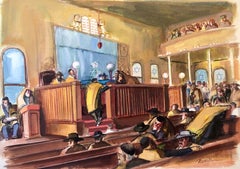
Modernist American Judaica Painting Synagogue Interior Ladies Section WPA Era
By Ervin B. Nussbaum
Located in Surfside, FL
Titled Torah Service, hand signed on Arches archival paper.
In this painting, Nussbaum portrays a joyful holiday celebration of the Torah reading in the synagogue in a sketch-like m...
Category
20th Century Modern Figurative Paintings
Materials
Gouache
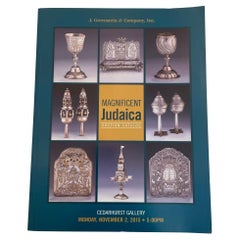
Magnificent Judaica Auction Catalog, Cedarhurst Gallery May 2016
Located in Moreno Valley, CA
Magnificent Judaica Auction Catalog, Cedarhurst Gallery, May 2016.
Great reference catalog for antique collectible Judaica.
Among the Sales Items Are Silver Work: Spice Towers, Torah...
Category
21st Century and Contemporary American Folk Art Books
Materials
Paper
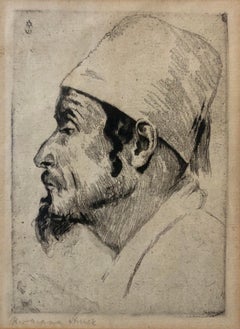
German Artist Impressionist Etching Judaica Jewish Sephardic Jewish Bezalel Era
By Hermann Struck
Located in Surfside, FL
Yemenite or Moroccan Sefardic rabbi portrait.
Framed 11 X 9 sight 6 X 4.5
Hermann Struck (6 March 1876 – 11 January 1944) was a German Jewish artist known for his etchings.
Hermann...
Category
Early 20th Century Impressionist Figurative Prints
Materials
Etching
Rare European 19C Judaica Havdalah Hebrew Plate
Located in Surfside, FL
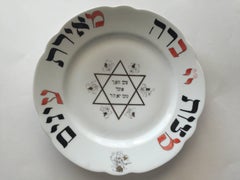
Here is a rare late 19th Century-early 20th Century painted and stenciled Jewish plate with a Yiddish greeting. A rare piece of Jewish Porcelain from the Pre War era. In a bold black...
Category
Late 19th Century Folk Art More Art
Materials
Porcelain