373 results for "leo castelli"

to
59
308
59
69
52
198
153
17
134
50
88
66
34
Overall Height
to
Overall Width
to
125
62
54
42
19
14
1
1
70
28
27
27
23
19
19
19
12
11
9
8
8
8
8
7
6
6
5
5
1
330
42
1
7
64
83
97
37
42
23
21
12
10
109
100
87
54
49
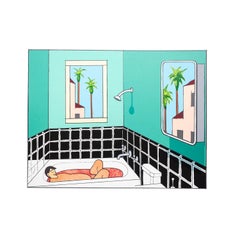
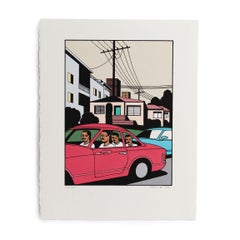
UNTITLED (INV# NP2232) by Ken Price
By Ken Price
Located in Morton Grove, IL
UNTITLED (INV# NP2232) Ken Price silkscreen on Arches 88 paper 14.875 x 12.375” 1981 edition of 150 stamped by Ken Price, SOMA Fine Art Press and Arabesque Books Ken Price (1935 - ...
Category

1980s Contemporary Interior Prints

Materials

Screen

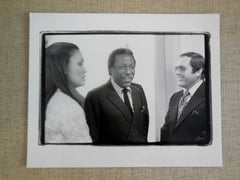
Gordon Parks, Alan King and Genevieve Young Vintage Silver Gelatin photo
By Fred McDarrah
Located in Surfside, FL
At a media party with Gordon Parks, Alan King and Genevieve Young. Veteran Village Voice photographer Fred W. McDarrah Over a 50-year span, McDarrah documented the rise of the Beat ...
Category

1970s Black and White Photography

Materials

Silver Gelatin

East-West/West-East in Brouq Nature Reserve Qatar (Hand Signed by Richard Serra)
By Richard Serra
Located in New York, NY
Richard Serra East-West/West-East: A Permanent in the Brouq Nature Reserve, Qatar (Hand Signed by Richard Serra), ca. 2014 Superb provenance: donated by the artist to a major contemporary art organization Very rare offset lithograph (Hand Signed by Richard Serra) Boldly signed on the front in black marker by Richard Serra 24 × 36 inches Unframed Sscarce when hand signed by Richard Serra. This work depicts Serra's iconic permanent installation in the desert of Brouq Qatar: East-West/West-East, which has become a famous landmark in Qatar since its installation in 2014. According to the Jewish-born Richard Serra, he had been visiting Qatar for about 12 years, during which he was introduced to the Chairperson of the Qatari Museums Authority and the sister of the new Emir, Sheikha Mayassa, by the architect of the Museum of Islamic Art, IM Pei. It was Sheikh Mayassathat who urged Serra to build a sculpture in the desert. The artist once said it was the most important thing he had ever done. In 2020 the Serra sculpture was famously vandalized. This hand signed print has superb provenance as it was donated directly by the artist to a major charitable foundation and is accompanied by a documentation from a Foundation as well as a COA from the gallery. Richard Serra biography: Obsession is what it comes down to. It is difficult to think without obsession, and it is impossible to create something without a foundation that is rigorous, incontrovertible, and, in fact, to some degree repetitive. Repetition is the ritual of obsession. Repetition is a way to jumpstart the indecision of beginning. To persevere and to begin over and over again is to continue the obsession with work. Work comes out of work. In order to work you must already be working. —Richard Serra One of the most significant artists of his generation, he has produced large-scale, site-specific sculptures for architectural, urban, and landscape settings spanning the globe, from Iceland to New Zealand. Born in 1938 in San Francisco, Richard Serra lives and works in New York and on the North Fork of Long Island. Serra attended the University of California, Berkeley before transferring to the University of California, Santa Barbara graduating with a BA in English literature; he then studied painting at Yale University, New Haven, Connecticut completing both a BFA and MFA. He began showing with Leo Castelli in 1968, and his first solo exhibition in New York was held at the Leo Castelli Warehouse the following year. His first solo museum exhibition was held at the Pasadena Art Museum, California, in 1970. Serra’s sculptures and drawings have been celebrated with two retrospectives at the Museum of Modern Art, New York, twenty years apart: Richard Serra/Sculpture (1986) and Richard Serra Sculpture: Forty Years (2007). He has had solo exhibitions at the Stedelijk Museum, Amsterdam (1977–78); Kunsthalle Tübingen, Germany (1978); Staatliche Kunsthalle Baden-Baden, Germany (1978); Museum Boijmans Van Beuningen, Rotterdam, Netherlands (1980, 2014, and 2017); Centre Pompidou, Paris (1983–84); Museum Haus Lange, Krefeld, Germany (1985); Louisiana Museum, Humlebæk, Denmark (1986); Westfälisches Landesmuseum für Kunst und Kulturgeschichte, Münster, Germany (1987); Städtische Galerie im Lenbachhaus, Munich (1987); Stedelijk Van Abbemuseum, Eindhoven, Netherlands (1988); Bonnefantenmuseum, Maastricht, Netherlands (1990); Kunsthaus Zürich (1990); CAPC Musée d’Art Contemporain, Bordeaux, France (1990); Museo Nacional Centro de Arte Reina Sofía, Madrid (1992); Kunstsammlung Nordrhein-Westfalen, Düsseldorf, Germany (1992); Dia Center for the Arts, New York (1997); Centro de Arte Hélio Oiticica, Rio de Janeiro (1997–98); Trajan’s Market, Rome (1999–2000); Pulitzer Arts Foundation, St. Louis (2003); and Museo Archeologico Nazionale di Napoli, Naples, Italy (2004). In 2005 The Matter of Time (1994–2005), a series of eight large-scale works, was installed permanently at the Guggenheim Museum Bilbao, Spain. For Monumenta 2008, the major site-specific installation Promenade was shown at the Grand Palais, Paris. Three years later the large-scale, site-specific sculpture 7 was permanently installed opposite the Museum of Islamic Art in Doha, Qatar. A major traveling retrospective dedicated to Serra’s drawings was presented at the Metropolitan Museum of Art, New York, San Francisco Museum of Modern Art, and the Menil Collection, Houston (the organizing venue), from 2011 to 2012. In 2014 the Qatar Museums Authority presented a two-venue retrospective survey of Serra’s work, and East-West/West-East (2014) was permanently installed in the Brouq Nature Reserve, Zekreet, Qatar. In 2017 the Museum Wiesbaden, Germany, presented Richard Serra: Props, Films, Early Works; an overview of Serra’s work in film and video was shown at the Kunstmuseum Basel; and recent drawings were featured at the Museum Boijmans Van Beuningen. Serra has participated in numerous major international exhibitions, including Documenta (1972, 1977, 1982, and 1987), and the Biennale di Venezia (1980, 1984, 2001, and 2013), and his work has been included in many Whitney Annuals and Biennials (1968, 1970, 1973, 1977, 1979, 1981, 1995, and 2006). He is the recipient of the Leone d’Oro for lifetime achievement, Biennale di Venezia, Venice (2001); Orden Pour le Mérite...
Category

2010s Minimalist Landscape Prints

Materials

Lithograph, Offset

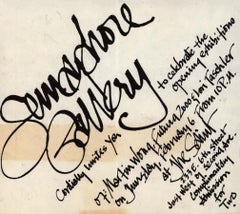
Martin Wong, Futura 2000 Semaphore Gallery New York, 1986
By Martin Wong
Located in NEW YORK, NY
Martin Wong, Futura 2000 Semaphore Gallery New York, 1986: Rare original, highly collectible 1980s graffiti announcement published on on the occasion of: ‘Semaphore Gallery Cordiall...
Category

1980s Pop Art More Art

Materials

Offset

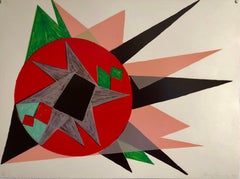
Lithograph w Gloss Overprinting Stacked Signs Post Modern 80s Memphis Milano Era
Located in Surfside, FL
Untitled, 1981 (Stacked Signs Series) lithograph with Glosscote overprinting. Published by Holly Solomon Editions. (original gallery label photo is included for reference and not included in sale) Hand signed and numbered from limited edition of 40. This is a beautiful piece perfect for the Memphis Milano early 1980's Post Modern Era. It also bears influence from Pop Art (Particularly Allan D'Arcangelo) Gary Burnley...
Category

1980s Post-Modern Abstract Prints

Materials

Lithograph

Large Color California Abstract Expressionist Copolymer Vinyl Painting Ron Davis
By Ronald Davis
Located in Surfside, FL
Ronald Davis (American, b. 1937) Pitch, 1983 cel-vinyl copolymer on canvas Hand signed verso and further inscribed with title, date, size and PTG 751 67 x 110 1/2in. Framed 69 x 112in. Bears remnants of old gallery label to reverse. Ronald Ron Davis (born 1937) is an American painter whose work is associated with geometric abstraction, abstract illusionism, lyrical abstraction, hard-edge painting, shaped canvas painting, color field painting, and 3D computer graphics. He is a veteran of nearly seventy solo exhibitions and hundreds of group exhibitions. Born in Santa Monica, California, he was raised in Cheyenne, Wyoming. In 1955–56 he attended the University of Wyoming. In 1959 at the age of 22 he became interested in painting. In 1960–64 he attended the San Francisco Art Institute. Abstract expressionism, the prevailing artistic movement of the time, would have an influence on many of his future works. In 1962 he was a Yale-Norfolk Summer School Grantee. In 1963 his paintings became hard-edged, geometric and optical in style, and by 1964 his works were shown in important museums and galleries. He lived and worked in Los Angeles, 1965–71, and in Malibu, California, 1972–90. Since 1991 he has lived and worked in Arroyo Hondo on the outskirts of Taos, New Mexico. Ronald Davis from the earliest days of his career had a significant impact on contemporary abstract painting of the mid-1960s. According to art critic Michael Fried: Ron Davis is a young California artist whose new paintings, recently shown at the Tibor de Nagy Gallery in New York, are among the most significant produced anywhere during the past few years, and place him, along with Frank Stella and Walter Darby Bannard, at the forefront of his generation. He had his first one-person exhibition at the Nicholas Wilder Gallery in Los Angeles in 1965. Barbara Rose wrote an in depth essay about Davis' paintings of the 1960s in the catalogue accompanying an exhibition of his Dodecagon Series in 1989 in Los Angeles. Among other observations she wrote: Davis saw a way to use Marcel Duchamp's perspective studies and transparent plane in The Large Glass for pictorial purposes. Instead of glass, he used fiberglass to create a surface that was equally transparent and detached from any illusion of reality. Because his colored pigments are mixed into a fluid resin and harden quickly, multiple layers of color may be applied without becoming muddy. his is essentially an inversion of Old Master layering and glazing except that color is applied behind rather than on top of the surface. Alone among his contemporaries, Davis was equally concerned with traditional problems of painting: space, scale, detail, color relationships and illusions as he was with the California emphasis on hi-tech craft and industrial materials. His work has some connection to the Light and Space art movement related to op art and minimalism. He was a contemporary of Peter Alexander, Larry Bell, Robert Irwin, Ron Cooper...
Category

1980s Abstract Expressionist Abstract Paintings

Materials

Canvas, Acrylic Polymer

CONRAD MARCA-RELLI Limited ed. Etching Aquatint American Modern, Contemporary
By Conrad Marca-Relli 1
Located in Madrid, Madrid
Conrad Marca Relli - Composition VI Date of creation: 1977 Medium: Etching and aquatint on Gvarro paper Edition: 75 + AP + HC Size: 56 x 76 cm Condition: In very good conditions and ...
Category

1970s Modern Abstract Prints

Materials

Etching, Aquatint

1970 s Large Silkscreen Abstract Geometric Day Glo Serigraph Pop Art Print Neon
By Chryssa Vardea-Mavromichali
Located in Surfside, FL
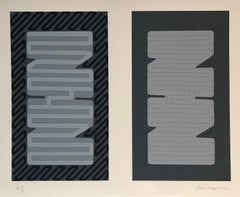
Silkscreen on Arches paper, Hand signed and Numbered in Pencil. Serigraph in black, gray (silver). Chryssa Vardea-Mavromichali (Greek: Χρύσα Βαρδέα-Μαυρομιχάλη; December 31, 1933 – December 23, 2013) was a Greek American artist who worked in a wide variety of media. An American art pioneer in light art and luminist sculpture widely known for her neon, steel, aluminum and acrylic glass installations, she has always used the mononym Chryssa professionally. She worked from the mid-1950s in New York City studios and worked since 1992 in the studio she established in Neos Kosmos, Athens, Greece. Chryssa was born in Athens into the famous Mavromichalis family from the Mani Peninsula. one of her sisters, who studied medicine, was a friend of the poet and novelist Nikos Kazantzakis. Chryssa began painting during her teenage years and also studied to be a social worker.In 1953, on the advice of a Greek art critic, her family sent her to Paris to study at the Académie de la Grande Chaumiere where Andre Breton, Edgard Varese, and Max Ernst were among her associates and Alberto Giacometti was a visiting professor. In 1954, at age twenty-one, Chryssa sailed for the United States, arrived in New York and went to San Francisco, California to study at the California School of Fine Arts. Returning to New York in 1955, she became a United States citizen and established a studio in the city. Chryssa's first major work was The Cycladic Books preceded American minimalism by seventeen years. 1961, Chryssa's first solo exhibition was mounted at The Guggenheim. 1963, Chryssa's work was shown at the Museum of Modern Art in curator Dorothy Canning Miller's Americans 1963 exhibition. The artists represented in the show also included Richard Anuszkiewicz, Lee Bontecou, Robert Indiana, Richard Lindner, Marisol, Claes Oldenburg, Ad Reinhardt, James Rosenquist and others. 1966, The Gates to Times Square, regarded as "one of the most important American sculptures of all time" and "a thrilling homage to the living American culture of advertising and mass communications." The work is a 10 ft cube installation of two huge letter 'A's through which visitors may walk into "a gleaming block of stainless steel and Plexiglas that seems to quiver in the play of pale blue neon light" which is controlled by programmed timers. First shown in Manhattan's Pace Gallery, it was given to the Albright-Knox Art Gallery in Buffalo, New York in 1972. 1972, The Whitney Museum of American Art mounted a solo exhibition of works by Chryssa. That's All (early 1970s), the central panel of a triptych related to The Gates of Times Square, was acquired by the Museum of Modern Art between 1975 and 1979. 1973, Chryssa's solo exhibition at the Gallerie Denise René was reviewed for TIME magazine by art critic Robert Hughes before it went on to the Galleries Denise René in Düsseldorf and Paris. Other works by Chryssa in composite honeycomb aluminum and neon in the 1980s and 1990s include Chinatown, Siren, Urban Traffic, and Flapping Birds. Chryssa 60/90 retrospective exhibition in Athens in the Mihalarias Art Center. After her long absence from Greece, a major exhibition including large aluminum sculptures - cityscapes, "neon boxes" from the Gates to the Times Square, paintings, drawings etc. was held in Athens. In 1992, after closing her SoHo studio, which art dealer Leo Castelli had described as "one of the loveliest in the world," Chryssa returned to Greece. She found a derelict cinema which had become a storeroom stacked with abandoned school desks and chairs, behind the old Fix Brewery near the city center in Neos Kosmos, Athens. Using the desks to construct enormous benches, she converted the space into a studio for working on designs and aluminum composite honeycomb sculptures...
Category

1980s Pop Art Abstract Prints

Materials

Screen

Why You Can Tell #2
By Robert Rauschenberg
Located in San Francisco, CA
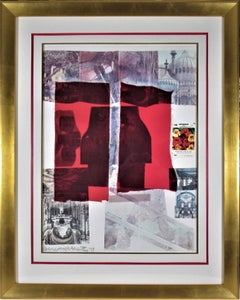
This artwork titled "Why You Can Tell #2" from the suite "Nine Prints" is an original serigraph with offset lithograph and collage on Wove paper by American artist Robert Rauschenberg, 1925-2008. It is hand signed and numbered 36/100 in pencil by the artist. Published by Multiples, New York and Printed by Styria Studio, New York. With the blind stamp of the printer at lower left corner. The sheet size is 22.75 x 30 inches, framed is 43 x 34.25 inches. This particular artwork is held in several museums, including the Museum of Modern Art, New York. It is beautifully framed in a wooden gold frame, with fabric matting and color bevel. About the artist. Born in Port Arthur, Texas in 1925, Robert Rauschenberg imagined himself first as a minister and later as a pharmacist. It wasn't until 1947, while in the U.S. Marines, that he discovered his aptitude for drawing and his interest in the artistic representation of everyday objects and people. After leaving the Marines, he studied art in Paris on the G.I. Bill, but quickly became disenchanted with the European art scene. Rauschenberg's enthusiasm for popular culture and his rejection of the angst and seriousness of the Abstract Expressionists led him to search for a new way of painting. He found his signature mode by embracing materials traditionally outside of the artist's reach. He would cover a canvas with house paint, or ink the wheel of a car and run it over paper to create a drawing, while demonstrating rigor and concern for formal painting. By 1958, at the time of his first solo exhibition at the Leo Castelli Gallery, his work had moved from abstract painting to drawings like "Erased De Kooning" (1953) (which was exactly as it sounds) to what he termed "combines." These combines (meant to express both the finding and forming of combinations in three-dimensional collage) cemented his place in art history. As Pop Art emerged in the 1960s, Rauschenberg turned away from three-dimensional combines and began to work in two dimensions, using magazine...
Category

Late 20th Century Pop Art Abstract Prints

Materials

Mixed Media

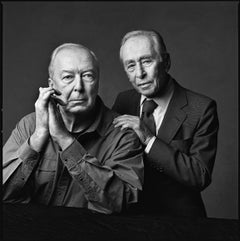
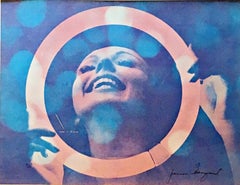
Leo Castelli and Jasper Johns, New York, 1993
By Patrick Demarchelier
Located in New York, NY
Signed by the photographer
Category

21st Century and Contemporary Photography

Materials

Silver Gelatin

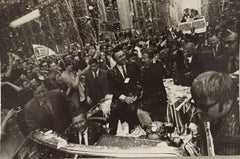
World Champions Mets Parade - October 1969
By Fred McDarrah
Located in Surfside, FL
Veteran Village Voice photographer Fred W. McDarrah Over a 50-year span, McDarrah documented the rise of the Beat Generation, the city’s postmodern art movement, its off-off-Broadwa...
Category

20th Century Black and White Photography

Materials

Silver Gelatin

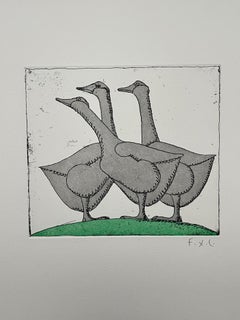
Francois-Xavier Lalanne (1927-2008) The Geese (in french : les oies), 2004
By François-Xavier Lalanne
Located in Saint Ouen, FR
Francois-Xavier Lalanne (1927-2008) The Geese (in french : les oies), 2004 This extremely rare print by François Xavier Lalanne depicts three geese. It is an edition of only 10 copi...
Category

Early 2000s Surrealist Animal Prints

Materials

Paper

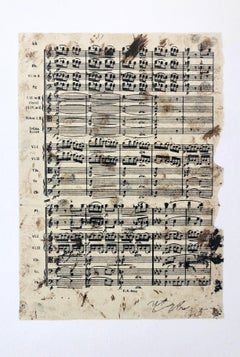
Elettra, Music Score Lithograph Jannis Kounellis Arte Povera Italian Avant Garde
By Jannis Kounellis
Located in Surfside, FL
It depicts a musical score or music notes. Offset Lithography on rag paper hand signed lower right in pencil: Kounellis numbered 37/90. Provenance: The Collection of Ileana Sonnabend...
Category

1960s Arte Povera Abstract Prints

Materials

Lithograph

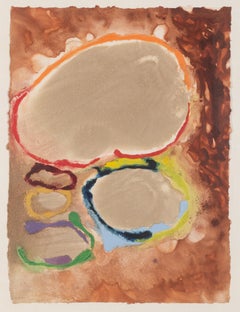
"Untitled" Friedel Dzubas, Hand-painted, Color Field, Earth and Primary Colors
By Friedel Dzubas
Located in New York, NY
Friedel Dzubas Untitled, 1987 Hand-painted monotype on paper 29 3/4 x 21 3/4 inches A noted figure in the New York School, Friedel Dzubas was associated with the Color Field painti...
Category

1980s Color-Field Abstract Prints

Materials

Paper, Acrylic, Monotype

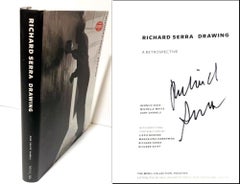
Richard Serra Drawing: A Retrospective (hand signed by Richard Serra)
By Richard Serra
Located in New York, NY
Richard Serra Richard Serra Drawing: A Retrospective (hand signed by Richard Serra), 2011 Hardback monograph with dust jacket (hand signed by Richard Serra) Hand signed by Richard Serra on the title page 12 × 10 × 1 1/2 inches Provenance Strand bookshop New York, official signed copy (see cover) This is the official signed copy from Strand bookshop, NY. bearing the "Signed Copy" stamp on the cover. Makes a superb gift! Published on the occasion of these exhibitions: The Metropolitan Museum of Art(04/11/11-08/28/11) San Francisco Museum of Modern Art (10/15/11-01/16/12) The Menil Collection (03/02/12–06/10/12) Book information: Published by Yale University Press, CO, and The Menil Collection, Houston. English; Hardback; 232 pages with 160 quadratone illustrations Publisher's blurb: As the focal point of numerous high-profile exhibitions, the sculpture of Richard Serra (b. 1939) has drawn international acclaim. Yet even those who have marveled at Serra's intellectually rigorous and large works of sculpture may not be familiar with his equally intriguing drawings. This handsome book brings together for the first time Serra's drawn work, considering the artist's investigation of medium as an activity both independent from and linked to his pioneering sculptural practice. First working in ink, charcoal, and lithographic crayon on paper, Serra originally used drawing as a means to explore form and perceptual relations between his sculpture and the viewer. Over time, his drawings underwent significant shifts in concept, materials, and scale and became fully realized and autonomous works of art. The grand, bold forms he created with black paintstick in his monumental Installation Drawings were designed to disrupt and complement existent spaces and eventually began to occupy entire rooms. In the late 1980s, Serra explored the tension of weight and gravity through layering, and his most recent work experiments with surface effects, using mesh screens as intermediaries between the gesture and the transfer of pigment to paper. More about Richard Serra: Obsession is what it comes down to. It is difficult to think without obsession, and it is impossible to create something without a foundation that is rigorous, incontrovertible, and, in fact, to some degree repetitive. Repetition is the ritual of obsession. Repetition is a way to jumpstart the indecision of beginning. To persevere and to begin over and over again is to continue the obsession with work. Work comes out of work. In order to work you must already be working. —Richard Serra One of the most significant artists of his generation, he has produced large-scale, site-specific sculptures for architectural, urban, and landscape settings spanning the globe, from Iceland to New Zealand. Born in 1938 in San Francisco, Richard Serra lives and works in New York and on the North Fork of Long Island. Serra attended the University of California, Berkeley before transferring to the University of California, Santa Barbara graduating with a BA in English literature; he then studied painting at Yale University, New Haven, Connecticut completing both a BFA and MFA. He began showing with Leo Castelli in 1968, and his first solo exhibition in New York was held at the Leo Castelli Warehouse the following year. His first solo museum exhibition was held at the Pasadena Art Museum, California, in 1970. Serra’s sculptures and drawings have been celebrated with two retrospectives at the Museum of Modern Art, New York, twenty years apart: Richard Serra/Sculpture (1986) and Richard Serra Sculpture: Forty Years (2007). He has had solo exhibitions at the Stedelijk Museum, Amsterdam (1977–78); Kunsthalle Tübingen, Germany (1978); Staatliche Kunsthalle Baden-Baden, Germany (1978); Museum Boijmans Van Beuningen, Rotterdam, Netherlands (1980, 2014, and 2017); Centre Pompidou, Paris (1983–84); Museum Haus Lange, Krefeld, Germany (1985); Louisiana Museum, Humlebæk, Denmark (1986); Westfälisches Landesmuseum für Kunst und Kulturgeschichte, Münster, Germany (1987); Städtische Galerie im Lenbachhaus, Munich (1987); Stedelijk Van Abbemuseum, Eindhoven, Netherlands (1988); Bonnefantenmuseum, Maastricht, Netherlands (1990); Kunsthaus Zürich (1990); CAPC Musée d’Art Contemporain, Bordeaux, France (1990); Museo Nacional Centro de Arte Reina Sofía, Madrid (1992); Kunstsammlung Nordrhein-Westfalen, Düsseldorf, Germany (1992); Dia Center for the Arts, New York (1997); Centro de Arte Hélio Oiticica, Rio de Janeiro (1997–98); Trajan’s Market, Rome (1999–2000); Pulitzer Arts Foundation, St. Louis (2003); and Museo Archeologico Nazionale di Napoli, Naples, Italy (2004). In 2005 The Matter of Time (1994–2005), a series of eight large-scale works, was installed permanently at the Guggenheim Museum Bilbao, Spain. For Monumenta 2008, the major site-specific installation Promenade was shown at the Grand Palais, Paris. Three years later the large-scale, site-specific sculpture 7 was permanently installed opposite the Museum of Islamic Art in Doha, Qatar. A major traveling retrospective dedicated to Serra’s drawings was presented at the Metropolitan Museum of Art, New York, San Francisco Museum of Modern Art, and the Menil Collection, Houston (the organizing venue), from 2011 to 2012. In 2014 the Qatar Museums Authority presented a two-venue retrospective survey of Serra’s work, and East-West/West-East (2014) was permanently installed in the Brouq Nature Reserve, Zekreet, Qatar. In 2017 the Museum Wiesbaden, Germany, presented Richard Serra: Props, Films, Early Works; an overview of Serra’s work in film and video was shown at the Kunstmuseum Basel; and recent drawings were featured at the Museum Boijmans Van Beuningen. Serra has participated in numerous major international exhibitions, including Documenta (1972, 1977, 1982, and 1987), and the Biennale di Venezia (1980, 1984, 2001, and 2013), and his work has been included in many Whitney Annuals and Biennials (1968, 1970, 1973, 1977, 1979, 1981, 1995, and 2006). He is the recipient of the Leone d’Oro for lifetime achievement, Biennale di Venezia, Venice (2001); Orden Pour le Mérite...
Category

2010s Minimalist Abstract Prints

Materials

Paper, Mixed Media, Permanent Marker, Lithograph, Offset
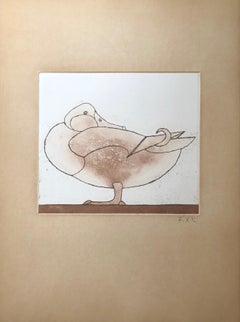
Francois-Xavier Lalanne (1927-2008) Le Canard, 2004
By François-Xavier Lalanne
Located in Saint Ouen, FR
Francois-Xavier Lalanne (1927-2008) Le Canard, 2004 Original print (aquatint and soft varnish) hand signed in pencil by François Xavier Lalanne and untitle...
Category

Early 2000s Surrealist Animal Prints

Materials

Paper

Vintage Silver Gelatin Photograph Tibor de Nagy Portrait Photo NYC Gallery
By Fred McDarrah
Located in Surfside, FL
Tibor De Nagy - October 11 1960 Photographer is Fred McDarrah Over a 50-year span, McDarrah documented the rise of the Beat Generation, the city’s postmodern art movement, its off-off-Broadway actors, troubadours, politicians, agitators and social protests. Fred captured Jack Kerouac frolicking with women at a New Year’s bash in 1958, Andy Warhol adjusting a movie-camera lens in his silver-covered factory, and Bob Dylan offering a salute of recognition outside Sheridan Square near the Voice’s old office. Not just a social chronicler, McDarrah was a great photo-journalist. For years, McDarrah was the Voice's only photographer and, for decades, he ran the Voice’s photo department, where he helped train dozens of young photographers, including James Hamilton, Sylvia Plachy, Robin Holland...
Category

1960s American Modern Black and White Photography

Materials

Silver Gelatin

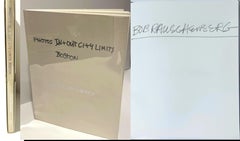
Photos In+Out City Limits: Boston (hand signed by Robert Rauschenberg) Boxed Set
By Robert Rauschenberg
Located in New York, NY
Robert Rauschenberg Photos In+Out City Limits: Boston (hand signed by Robert Rauschenberg), 1981 Monograph held in slipcase (Hand signed in graphite pencil) Hand signed by Robert Rau...
Category

1980s Pop Art More Art

Materials

Paper, Ink, Mixed Media, Lithograph, Offset, Board
Untitled (INV# NP5768) by Ken Price
By Ken Price
Located in Morton Grove, IL
Ken Price (1935-2012) screenprints in colors on Arches France paper 14 x 11” signed and dated in pencil stamped by Ken Price and Black Sparrow Graphic Arts edition of 170, # 45/170 ...
Category

1990s Contemporary Nude Prints

Materials

Screen

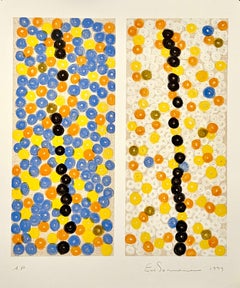
Large Diptych "Deep runners" Photograph Signed Surrealist Photo Lithograph
By Eve Sonneman
Located in Surfside, FL
Abstract geometric color composition Artist: Eve Sonneman Lithograph, 1999 Image Size 25 x 22" Hand signed, dated,and numbered from limited edition. This is from a show at Sidney J...
Category

1990s Contemporary Abstract Prints

Materials

Paper, Color, Lithograph

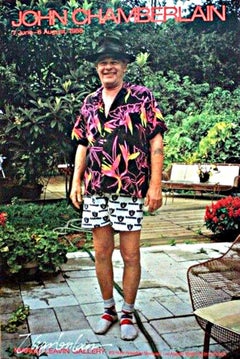
Print of Abstract Expressionist sculptor John Chamberlain, Hand Signed by artist
By John Chamberlain
Located in New York, NY
John Chamberlain (Hand Signed), 1988 Offset Lithograph Poster (Hand Signed by John Chamberlain) 30 × 20 inches Boldly signed on the recto in white grease marker by the artist in his ...
Category

1980s Abstract Expressionist Portrait Prints

Materials

Permanent Marker, Lithograph, Offset

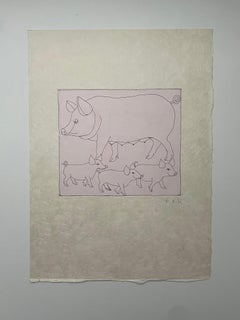
Francois-Xavier Lalanne PIG
By François-Xavier Lalanne
Located in Saint Ouen, FR
Francois-Xavier Lalanne (1927-2008) The pig (in french : le cochon), 2004 This extremely rare print by François Xavier Lalanne depicts a pig, more precisely a sow and her babies. It...
Category

Early 2000s Surrealist Animal Prints

Materials

Paper

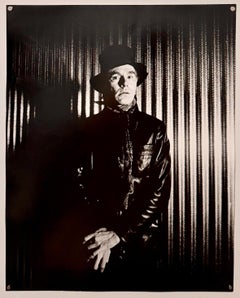
Gianfranco Gorgoni Vintage Photograph Andy Warhol in Leather Factory Photo Print
Located in Surfside, FL
Large photograph, Andy Warhol at the factory unsigned Dimensions: 20" by 16" Bears a pencil inscription Gianfranco Gorgoni verso Gianfranco Gorgoni (1941 – 2019) was an Italian ph...
Category

20th Century Pop Art Black and White Photography

Materials

Photographic Paper

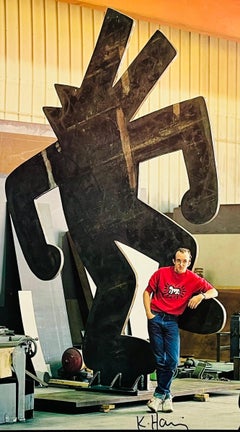
Signed Keith Haring exhibition poster 1985 (signed Keith Haring poster 1985)
By Keith Haring
Located in NEW YORK, NY
Signed Keith Haring poster 1985: A highly collectible hand-signed 1985 Keith Haring exhibition poster published on the occasion of: Keith Haring Painting...
Category

1980s Pop Art Animal Prints

Materials

Lithograph, Offset

Vintage Silver Gelatin Photograph Manhattan Parade Mets Championship 1969 Photo
By Fred McDarrah
Located in Surfside, FL
Veteran Village Voice photographer Fred W. McDarrah Over a 50-year span, McDarrah documented the rise of the Beat Generation, the city’s postmodern art movement, its off-off-Broadwa...
Category

1960s Black and White Photography

Materials

Silver Gelatin

Original Fred Mcdarrah Press Photograph 1960 s Woodstock Music Festival Photo
By (after) Fred Mcdarrah
Located in Surfside, FL
People walking alongside puddle at Woodstock in Bethel NY 1969 Photographer is Fred McDarrah Over a 50-year span, McDarrah documented the rise of the Beat Generation, the city’s postmodern art movement, its off-off-Broadway actors, troubadours, politicians, agitators and social protests. Fred captured Jack Kerouac frolicking with women at a New Year’s bash in 1958, Andy Warhol adjusting a movie-camera lens in his silver-covered factory, and Bob Dylan offering a salute of recognition outside Sheridan Square near the Voice’s old office. Not just a social chronicler, McDarrah was a great photo-journalist. For years, McDarrah was the Voice's only photographer and, for decades, he ran the Voice’s photo department, where he helped train dozens of young photographers, including James Hamilton, Sylvia Plachy, Robin Holland...
Category

1960s American Modern Black and White Photography

Materials

Photographic Paper

Supporters of George McGovern for President
By Fred McDarrah
Located in Surfside, FL
George Stanley McGovern (July 19, 1922 – October 21, 2012) was an American historian, author, U.S. Representative, U.S. Senator, and the Democratic Party presidential nominee in the ...
Category

20th Century Black and White Photography

Materials

Black and White, Silver Gelatin

John Cage, 1977, Vintage Silver Gelatin Signed Photograph
By Fred McDarrah
Located in Surfside, FL
Genre: Photographic Subject: Music Medium: Photograph, Gelatin Silver Print Surface: Photographic Paper Country: United States Dimensions: 10" x 8" Dimensions w/Frame: 14.75" x 11.75" Fred W. McDarrah, 1926-2007 Veteran Village Voice photographer Fred W. McDarrah Over a 50-year span, McDarrah documented the rise of the Beat Generation, the city’s postmodern art movement, its off-off-Broadway actors, troubadours, politicians, agitators and social protests. Fred captured Jack Kerouac frolicking with women at a New Year’s bash in 1958, Andy Warhol adjusting a movie-camera lens in his silver-covered factory, and Bob Dylan offering a salute of recognition outside Sheridan Square near the Voice’s old office. Not just a social chronicler, McDarrah was a great photo-journalist. For years, McDarrah was the Voice's only photographer and, for decades, he ran the Voice’s photo department, where he helped train dozens of young photographers, including James Hamilton, Sylvia Plachy, Robin Holland and Marc Asnin. His mailbox was simply marked "McPhoto." An exhibit of McDarrah’s photos of artists presented by the Steven Kasher Gallery in Chelsea was hailed by The New York Times as “a visual encyclopedia of the era’s cultural scene.” artists in their studios, (Alice Neel, Philip Guston, Stuart Davis, Robert Smithson...
Category

1970s American Realist Black and White Photography

Materials

Silver Gelatin

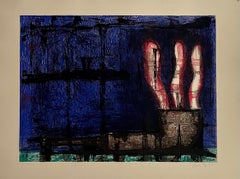
Boston Modernist Color Etching Smoking Pipe Aaron Fink Pop Art Print Americana
By Aaron Fink
Located in Surfside, FL
Aaron Fink (American, b. 1955) Etching on paper titled "Untitled (Colored Pipe)," Depicting an abstracted pipe with bright pink smoke floating from the bowl. Hand signed in pencil...
Category

1980s Contemporary Figurative Prints

Materials

Etching

Untitled (INV# NP5780) by Ken Price
By Ken Price
Located in Morton Grove, IL
Ken Price (1935-2012) screenprints in colors on Arches France paper 14 x 11” signed and dated in pencil stamped by Ken Price and Black Sparrow Graphic Arts edition of 170, # 45/170 ...
Category

1990s Contemporary Nude Prints

Materials

Screen

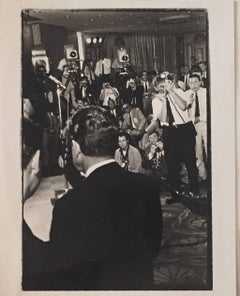
Nixon Meets the Press, Republican Convention Vintage Silver Gelatin Photograph
By Fred McDarrah
Located in Surfside, FL
Richard Milhous Nixon was the 37th President of the United States, serving from 1969 to 1974 when he became the only U.S. president to resign the office, as a result of the Watergate...
Category

20th Century Black and White Photography

Materials

Silver Gelatin

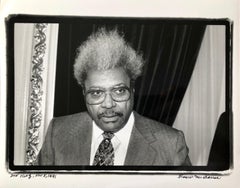
Vintage Print Silver Gelatin Signed Photograph Don King Boxing Promoter
By Fred McDarrah
Located in Surfside, FL
Signed in ink and with photographer stamp verso and hand written title. Donald King (born August 20, 1931) is an American boxing promoter known for his involvement in historic boxing matchups. He has been a controversial figure, partly due to a manslaughter conviction (King was pardoned in 1983 by Ohio Governor Jim Rhodes, with letters from Jesse Jackson, Coretta Scott King, George Voinovich, Art Modell, and Gabe Paul, among others, being written in support of King.), and civil cases against him. King's career highlights include, among multiple other enterprises, promoting "The Rumble in the Jungle...
Category

1990s American Modern Black and White Photography

Materials

Black and White, Silver Gelatin

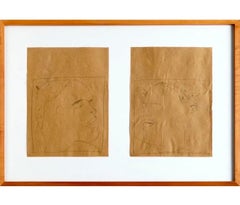
Nuba 1981 Graphite Drawing on Brown Paper James Brown Galerie Bernd Kluser
By James Brown
Located in Surfside, FL
James Brown (American, 1951-2020) "Study on the Nuba" (African men drawings) 1981 Graphite on brown paper, two works framed together Bears gallery labels verso Dimensions: approx. 16"h x 12"w (each sheet), 24.5"h x 35.25"w (frame) Provenance: Galerie Bernd Klüser, Bears label verso They represented internationally renowned artists such as Joseph Beuys, Tony Cragg, Enzo Cucchi, Jannis Kounellis, Mimmo Paladino and Andy Warhol. Their first exhibitions were with Andy Warhol, Tony Cragg, Julião Sarmento...
Category

1980s American Modern Figurative Drawings and Watercolors

Materials

Paper, Graphite

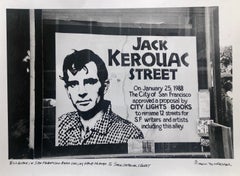
Vintage Print Silver Gelatin Signed Photograph Jack Kerouac Street Sign Photo
By Fred McDarrah
Located in Surfside, FL
signed in ink and with photographer stamp verso and hand written title.. Jack Kerouac, He called himself Jean-Louis Lebris de Kérouac); 1922 – 1969 was an American novelist and poet ...
Category

Mid-20th Century American Modern Black and White Photography

Materials

Black and White, Silver Gelatin

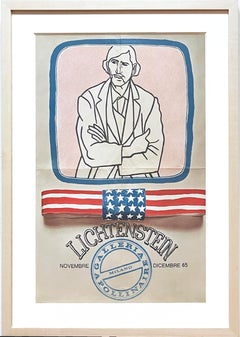
Rare historic 1960s exhibition invitation for Galleria Apollinaire Milan Framed
By Roy Lichtenstein
Located in New York, NY
Roy Lichtenstein (after) 1960s exhibition invitation for Galleria Apollinaire, 1965 Offset lithograph poster Unsigned Frame included This poster/invitation was published for Lichtens...
Category

1960s Pop Art More Art

Materials

Offset

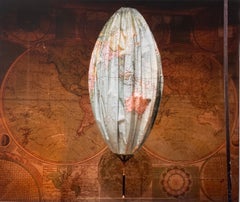
Vintage Signed Surrealist Color Photograph Eve Sonneman Cibachrome Art Photo AP
By Eve Sonneman
Located in Surfside, FL
The Deflated World, 1981 Cibachrome, this is the rare AP (Artists Proof) outside the edition of 10 Hand signed by artist and dated 20 × 24 in 50.8 × 61 cm Eve Sonneman (born in Chic...
Category

1980s Contemporary Color Photography

Materials

Color, Polaroid

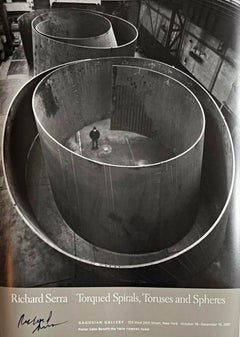
Torqued Spirals, Toruses and Spheres poster 2001, Hand Signed by Richard Serra
By Richard Serra
Located in New York, NY
Richard Serra Torqued Spirals, Toruses and Spheres, 2001 Offset lithograph poster (Hand signed by Richard Serra) Boldly signed in black marker on the front 28 × 20 inches Unframed This poster was published on the occasion of Serra's October 2001 exhibition at the Gagosian Gallery - one month after 9/11; The posters were sold for the benefit of the Twin Towers Fund and a certain quantity were hand signed by the artist. Richard Serra Biography Richard Serra was born in 1938 in San Francisco and lives and works in New York and the North Fork of Long Island. His first significant solo exhibition was held at the Leo Castelli Warehouse, New York, in 1969. His first solo museum exhibition took place at the Pasadena Art Museum in 1970. Serra has since participated in numerous international exhibitions, including documenta (1972, 1977, 1982, and 1987) in Kassel, Germany; the Venice Biennales of 1980, 1984, 2001, and 2013; and the Whitney Museum of American Art’s Annual and Biennial exhibitions of 1968, 1970, 1973, 1977, 1979, 1981, 1995, and 2006. Solo exhibitions of Serra’s sculptural work have been held at numerous public institutions worldwide, including, among others, the Museum Boijmans Van Beuningen, Rotterdam, 1980; Musée National d’Art Moderne, Paris, 1984; Museum Haus Lange, Krefeld, 1985; The Museum of Modern Art, New York, 1986; Westfälisches Landesmuseum für Kunst und Kulturgeschichte, Münster, 1987; Städtische Galerie im Lenbachhaus, Munich, 1987; Stedelijk Van Abbemuseum, Eindhoven, 1988; Kunsthaus Zürich, 1990; CAPC Musée d’Art Contemporain, Bordeaux, 1990; Museo Nacional Centro de Arte Reina Sofía, Madrid, 1992; Kunstsammlung Nordrhein-Westfalen, Düsseldorf, 1992; Dia Center for the Arts, New York, 1997; Centro de Arte Hélio Oiticica, Rio de Janeiro, 1997–1998; Trajan’s Market, Rome, 2000; Pulitzer Foundation for the Arts, St. Louis, 2003; and Museo Archeologico Nazionale di Napoli, Naples, 2004. In 2005, The Matter of Time, a series of eight large-scale works by Serra from 1994 to 2005, was installed permanently at the Guggenheim Museum Bilbao, and in 2007, The Museum of Modern Art, New York, presented the retrospective Richard Serra Sculpture...
Category

Early 2000s Minimalist Abstract Prints

Materials

Permanent Marker, Lithograph, Offset

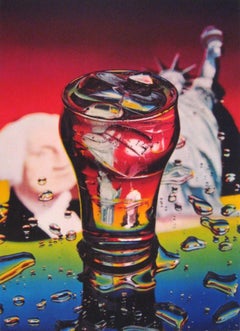
Yankee Flame Pop Art photorealist Lt Ed Signed/N. Statue of Liberty US President
By Ben Schonzeit
Located in New York, NY
Ben Schonzeit Yankee Flame, from the portfolio: America: the Third Century, 1975 Collotype on wove paper Pencil signed and numbered 50/200 on the front Publisher: APC Editions, Chermayeff Geismar Associates, Inc Printer: Triton Press 27 × 19 3/10 inches Unframed Note: this is the original hand signed and numbered collotype; not to be confused with the separate (unsigned) poster edition. This hand-signed, numbered and dated collotype in colors by photorealist pioneer artist Ben Schonzeit was created in 1975 for the portfolio America: the Third Century, commissioned by Mobil Oil Corporation in which 13 American artists, including Roy Lichtenstein, Ed Ruscha, Robert Rauschenberg, James Rosenquist and others created works celebrating America's bicentennial. Yankee Flame combines the iconic images of George Washington, Coca-Cola and the Statue of Liberty into a collaged interpretation of contemporary American life and the meaning of freedom. "Yankee Flame" is in excellent condition and never framed. It was acquired as part of the America: The Third Century full portfolio. Ben Schonzeit (b. 1942, Brooklyn, New York) is one of the original Photorealist painters and is considered to have pioneered the airbrush technique. His works often depict still life arrangements that are intentionally out of focus. He received his B.F.A. from The Cooper Union in 1964 and has since had over 50 solo exhibitions both in the United States and abroad. His paintings are held in numerous museum collections including the Solomon R. Guggenheim Museum in New York, Virginia Museum of Fine Arts in Richmond, Virginia, and the Metropolitan Museum of Art in New York. In 1973 Nancy Hoffman introduced me to Ben Schonzeit in the backroom of her gallery on West Broadway. She had been open less than a year, and Ben was one of the artists in her original stable. His large Crab Blue It had arrived from his studio a few days earlier and was leaning against the wall. I thought at the time it was one of the most impressive, virtuosic Photorealist works I had seen. That first encounter was more than a quarter of a century ago and I have always considered it to be one of the quintessential, tour de force paintings of American Photorealism. In the early seventies one could stand on West Broadway on any pleasant, sunny weekday and see less than a dozen people on the street between the Nancy Hoffman Gallery and OK Harris Works of Art. Almost all of the SoHo galleries, such as Leo Castelli, Paula Cooper, Ward-Nasse, and Ivan Karp’s Hundred Acres, could be visited in an afternoon. At night the streets were almost deserted. With the exception of Andy Warhol, there were no art world superstars. More importantly, none of the artists expected to achieve celebrity status. That was a phenomenon of the eighties and nineties. There were a only a handful of restaurants and watering holes, such Elephant and Castle, Fanelli’s, the Spring Street Bar and Prince Street Bar. Fanelli’s closed on weekends, which was a holdover from their sweatshop clientele during lunch and ragtag group of artists in the evenings. In those early days of SoHo, the drafty, raw sweatshop spaces with their large windows, rough floors, and service elevators provided large, inexpensive living quarters and studios for many artists. Unlike today, there were no boutiques. The area was not chic and with the exception of Lowell Nesbett’s showplace, the lofts were not glamorous. Schonzeit was in the same living and working space the he now occupies when I first visited him, but SoHo was a very different time and place. When the National Endowment of the Arts recommended me to curate America 1976, which turned into one of the major visual arts projects for the Bicentennial, Ben Schonzeit was on the first list of participants I made up for the U.S. Department of the Interior. His large diptych, Continental Divide, was one of the most memorable works produced for the exhibit. I stopped by his studio four or five times while it was in progress and have visited him many times over the years. We have maintained a very cordial working relationship and friendship over the past three decades. I saw The Music Room exhibit in 1978 and realized at the time that the vigorously rendered mural sized canvases and mirror and related works represented a major catharsis in his painting. In many ways, it and the other paintings and drawings based on the same image represented a sharp, decisive break with the tenets of Photorealism, or at least the photo-replicative aspects that had been so widely heralded in America and abroad in the mid-seventies. Over the years we have continued to work together. He has been in almost all of the major exhibitions I have curated here and abroad and in almost all of the books I have written. I am familiar with his studio habits, his quiet, internalized restlessness that manifests itself in the hundreds of small, unknown drawings and watercolors, doodles on napkins during lunch, and imaginary landscapes. I also know that he would rather do a painting than think or talk about it. Over the years I have followed the shifts in his studio procedure from the monumental airbrushed fruit and vegetable paintings to the most recent bouquets of flowers and decorative paintings. Our discussions of these matters tends to lapse into a verbal shorthand at this point. The following essay is based on both my longstanding familiarity and admiration for his work and involvement with contemporary realism and figurative painting. A booklet of color xeroxes with notes made up by Schonzeit was extremely helpful. In addition to several interviews, much of the information unfolded through a lengthy series of Emails. Due to our different working habits these were composed and sent out very late at night and answered by Ben the following morning. They dealt with the specifics of many of the paintings, generalities, his background and childhood in Brooklyn, and occasional bits of art world gossip. And there were odd discoveries. Prior to discussing his witty, tongue in cheek painting of Buffalo Bill, I did not know or had long forgotten that William Cody...
Category

1970s Pop Art Abstract Prints

Materials

Other Medium, Lithograph, Pencil

Etude (abstract expressionist painting)
By Fredric Karoly
Located in Wilton Manors, FL
Fredric Karoly (1898-1987). Etude, 1950. Oil on masonite panel measures 18 x 24 inches. Unframed. Signed, titled, dated on reverse. Good condition with minor paint loss at edges. Biography: An abstract painter, Karoly was born in Hungary and studied painting in Paris, architectural eingineering in Berlin, and emigrated to the U.S. in 1926. He began a successful career as a fashion and fabric designer. In 1948 he was working as a fashion director for Simplicity Patters, when he had a solo exhibition of of his oil paintings, wire montages, dry-pen drawings and abstract photography. Solo Exhibitions: Hugo Gallery (Alexandre Iolas) New York 1948; Gallery Mai. Paris 1949; New Gallery (Eugene Thaw) New York 1950; Museu de Arte, Sao Paulo, Brazil 1951; Miami Museum of Modern Art, Miami, Florida 1959; Loft Gallery, New York City, 1966.Group Exhibitions: Hugo Gallery, New York 1947; Salon des Realities Nouvelles, Paris 1949-1953; Whitney Museum of American Art, New York (Annual) 1951-1953, 1963; Biennale of Sao Paulo, Brazil, 1951; International Independent Exhibition, Tokyo, 1951; Martha Jackson Gallery, New York, 1959; The Butler Institute of Art, Youngstown, Ohio, 1960; Stuttman Gallery, New York, 1960; The Art Institute of Chicago (Annual), 1960; International Watercolor Exhibition, Brookyln Museum, 1961; Westchester Art Museum, White Plains, NY, 1963; Whitney Museum, Annual, NY 1963; Cleveland Art Festival, Park Synagogue, Cleveland, 1963; Whitney Museum, Sculpture Annual, NY, 1964.Works in Institutional Collections: Museu de Arte, San Paulo, Brazil; Museu de Bellas Artes, Buenos Aires, Argentina; New York University, New York; Washington University, St. Louis, Missouri; Finch College, NY; Barnard College, NY; Metropolitan Museum, Whitney Museum and Guggenheim Museum, New York; Museum of Fine Arts, St. Petersburg, FL. Awards: National Council Arts Awards, 1968. Frederic Karoly died on December 15, 1987 at the Inter-Continental Hotel in Manhattan, where he had made his home for many years. Fredric Karoly was born in Budapest in 1893. According to Karoly’s own vitae, his exhibition history began in New York in 1947, when at the age of 54 he took part in a four-person group show at Hugo Gallery. His involvement with visual art however was apparently life long. In a brief introduction to his solo show at Galerie Mai in Paris in June of 1949, Jen Luc de Rudder, reports that Karoly began painting at the age of 12 in Budapest. After several years of studying, then working in London, Paris and Berlin, Karoly emigrated to the United States in 1925 or 1926 (he probably first came to the US on a work visa in 1925). In New York, Karoly worked in women’s fashion as a designer. In 1948 Karoly worked in a manner than was clearly influenced by the work of such European surrealists as Max Ernst, creating spiked automatic bi-chromatic paintings. His style progressed into a progressively more biomorphic vein, similar to explorations by Theodore Stamos, Daphnis, Milton Avery and Mark Rothko around the same period. He was supported with patronage during this period by Mrs. Mimi Baliff, who apparently supported the “Industrial Design Workshop” that she helped open to feature Karoly’s designs in 1948. By the early 1950’s (1951) Karoly started experimenting with the drip and splatter process as well. Drip paintings dominated his process until the late 50’s-early 60’s, when linear compositional elements began to reemerge. By the late 50’s multi-layered drip grid motifs asserted a masque of spatial organization over looser washed fields and splatters of paint that Karoly worked off of. This development was consistent with concurrent explorations into the grid by artist Agnes Martin and others. By the mid-50’s Karoly’s style began another transition into a more surface concerned “Color Field” style of painting. There are elements still reminding one of Abstract Expressionist concerns as such painters as Clifford Still. But the works that began to emerge from Karoly’s studio in 1958 presaged the Morris Lewis fan motifs and Friedl Dzubas’s epic and romantic color spewing expanses of canvas. In 1959 Karoly began experiments using washes of turpentine diluted oil paint directly onto raw linen, and all of these subsequently suffered the consequences of oil oxidation and acidity upon the surfaces. However, many of Karoly’s washes in color field happily occurred on lightly prepared primed canvas surfaces as well. By 1960 Karoly began reintroducing imagistic references to his visual content. There were also various references to Japanese and Zen influences. He experimented with a variety of processes that included mixed media and marbleized surfaces achieved by the intermixture of oil and water mediums. A calligraphic element also enter Karoly’s work in the early 60’s. Then in 1961 glued and assembled objects begin to show up in Karoly’s work in earnest. The influence of early POP artists, particularly Jasper Johns, and Robert Rauschenberg, become apparent. From 1961-63, a series of the assemblage works transition from canvas to the sculptural to pieces obviously intended for full scale installation. Many of these pieces were among the most fragile of his works primarily due to their reliance upon the of gluing of objects such as plastic or paper cups on flexible surfaces of stretched linen or canvas. In the mid-60’s Karoly apparently produced a number of photo-silk screened series of Picasso, De Kooning and other significant artists of his generation. These were executed in a style somewhere between Rauschenberg’s and Roy Lichtenstein’s, primarily because of their reliance upon half tones and Ben-Day dot effects. Then Karoly began a series of paintings conflating his drip and grid styles with super imposed and painted over string. In the late 60’s Karoly embarked upon a series of multi-paneled stretched linen constructions often with slits and fiber optic back-lit elements that were prescient of the work of Dan Flavin and others. It was this body of work that was shown at Hofstra University’s Emily Lowe Gallery, and it was these works that suffered perhaps the most irreparable damage from a steam/water infiltration in a space where they were being stored. The late professional start that Karoly had into the art world was balanced by his long life span and early immersion into the design issues of modernism as it emerged in turn of the century Europe and later evolved in America. He was clearly an artist who subscribed to the ethos of the new in abstraction and was obviously impressionable and in some instances prescient with regard to various trends in abstraction. Several noteworthy and influential collectors and institutions during his 40 years of professional engagement acquired his work. The Whitney Museum of American Art had and may still own a large Karoly canvas from 1960, but this is doubtful as the artist failed to list it on the vitae he filed with MoMA in 1965. His work was recognized and honored by the Whitney with its inclusion in four of their annual survey shows (1951,1953, 1963 and 1964). The artist’s surrealist influenced paintings from 1948-1950 were the focus of a solo exhibition held of his work by the Museo de Art in Sao Paulo and eight years later a ten year survey of his work was the focus of a solo show at the Miami Museum of Modern art. The Sao Paulo Museum in Brazil, and the Museo de Bellas Artes in Buenos Aires, Argentina each acquired Karoly paintings for their collections in the 1950’s. One of Karoly’s surrealist pieces was apparently purchased by Christian Zervos, Picasso’s designated chronicler, who apparently also wrote a piece on Karoly in Cahiers D’Art in 1949. A 60’s piece of Karoly art that is in the New York University’s permanent collection is included in the MoMA Library’s catalog...
Category

Mid-20th Century Abstract Expressionist Abstract Paintings

Materials

Masonite, Oil

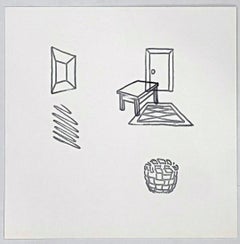
Interior #2 (from Rubber Stamp Portfolio), 1976 with original envelope 917/1000
By ARTSCHWAGER, RICHARD
Located in New York, NY
Held in the original hand numbered envelope, which is uncommon as the envelope is usually lacking or removed. Door, window, table, basket, mirror, rug. These six simple elements—foun...
Category

1970s Conceptual Interior Prints

Materials

Lithograph

Vintage Print Silver Gelatin Signed Photograph Robert Smithson Land Art Artist
By Fred McDarrah
Located in Surfside, FL
Robert Smithson (January 2, 1938 – July 20, 1973) was an American artist who used photography in relation to sculpture and land art. signed in ink and with photographer stamp verso and hand written title. Over a 50-year span, McDarrah documented the rise of the Beat Generation, the city’s postmodern art movement, its off-off-Broadway actors, troubadours, politicians, agitators and social protests. Fred captured Jack Kerouac frolicking with women at a New Year’s bash in 1958, Andy Warhol adjusting a movie-camera lens in his silver-covered factory, and Bob Dylan offering a salute of recognition outside Sheridan Square near the Village Voice Greenwich Village old office. Not just a social chronicler, McDarrah was a great photo-journalist. For years, McDarrah was the Voice's only photographer and, for decades, he ran the Voice’s photo department, where he helped train dozens of young photographers, including James Hamilton, Sylvia Plachy, Robin Holland and Marc Asnin. His mailbox was simply marked "McPhoto." An exhibit of McDarrah’s photos of artists presented by the Steven Kasher Gallery in Chelsea was hailed by The New York Times as “a visual encyclopedia of the era’s cultural scene.” artists in their studios, (Alice Neel, Philip Guston, Stuart Davis, Robert Smithson, Jasper Johns, Franz Kline), actors (Dustin Hoffman, Robert De Niro on the set of “Taxi Driver”), musicians (Janis Joplin, Alice Cooper, Bob Dylan) and documentary images of early happenings and performances (Yayoi Kusama, Charlotte Moorman, Al Hansen, Jim Dine, Nam June Paik). The many images of Andy Warhol include the well-known one with his Brillo boxes at the Stable Gallery in 1964. Woody Allen, Diane Arbus, W. H. Auden, Francis Bacon, Joan Baez, Louise Bourgeois, David Bowie, Jimmy Breslin, William Burroughs, John Cage, Leo Castelli, Christo, Leonard Cohen, Merce Cunningham, William de Kooning, Jim Dine, Mark di Suvero, Marcel Duchamp, Bob Dylan, Federico Fellini, Allen Ginsberg, Robert Indiana, Mick Jagger, Jasper Johns, Kusama, John Lennon, Sol Lewitt, Roy Lichtenstein, Nam June Paik, Elvis Presley, Claes Oldenburg, Yoko Ono, Robert Rauschenberg, Lou Reed, James Rosenquist, Mark Rothko, Ed Ruscha, Robert Smithson, Susan Sontag, Andy Warhol, and others have all been shot by him. McDarrah’s prints have been collected in depth by the J. Paul Getty Museum and the National Portrait Gallery, Washington. His work is in numerous public and private collections. Smithson was born in Passaic, New Jersey. He studied painting and drawing in New York City at the Art Students League of New York from 1955 to 1956 and then briefly at the Brooklyn Museum School. His early exhibited artworks were collage works influenced by "homoerotic drawings and clippings from beefcake magazines", science fiction, and early Pop Art. He primarily identified himself as a painter during this time, but after a three-year rest from the art world, Smithson emerged in 1964 as a proponent of the emerging minimalist movement. His new work abandoned the preoccupation with the body that had been common in his earlier work. Instead he began to use glass sheet...
Category

1960s American Modern Black and White Photography

Materials

Black and White, Silver Gelatin

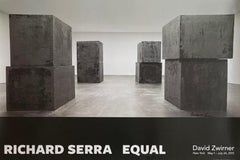
Equal, Hand Signed Richard Serra poster, published by David Zwirner Gallery
By Richard Serra
Located in New York, NY
Richard Serra, Equal, 2015 (Hand Signed) Offset lithograph poster (hand signed by Richard Serra) Boldly signed in black marker on the front Published by David Zwirner; Designed by McCall Associates 24 × 36 inches Unframed Acquired from David Zwirner Gallery Richard Serra Biography: Richard Serra was born in 1938 in San Francisco and lives and works in New York and the North Fork of Long Island. His first significant solo exhibition was held at the Leo Castelli Warehouse, New York, in 1969. His first solo museum exhibition took place at the Pasadena Art Museum in 1970. Serra has since participated in numerous international exhibitions, including documenta (1972, 1977, 1982, and 1987) in Kassel, Germany; the Venice Biennales of 1980, 1984, 2001, and 2013; and the Whitney Museum of American Art’s Annual and Biennial exhibitions of 1968, 1970, 1973, 1977, 1979, 1981, 1995, and 2006. Solo exhibitions of Serra’s sculptural work have been held at numerous public institutions worldwide, including, among others, the Museum Boijmans Van Beuningen, Rotterdam, 1980; Musée National d’Art Moderne, Paris, 1984; Museum Haus Lange, Krefeld, 1985; The Museum of Modern Art, New York, 1986; Westfälisches Landesmuseum für Kunst und Kulturgeschichte, Münster, 1987; Städtische Galerie im Lenbachhaus, Munich, 1987; Stedelijk Van Abbemuseum, Eindhoven, 1988; Kunsthaus Zürich, 1990; CAPC Musée d’Art Contemporain, Bordeaux, 1990; Museo Nacional Centro de Arte Reina Sofía, Madrid, 1992; Kunstsammlung Nordrhein-Westfalen, Düsseldorf, 1992; Dia Center for the Arts, New York, 1997; Centro de Arte Hélio Oiticica, Rio de Janeiro, 1997–1998; Trajan’s Market, Rome, 2000; Pulitzer Foundation for the Arts, St. Louis, 2003; and Museo Archeologico Nazionale di Napoli, Naples, 2004. In 2005, The Matter of Time, a series of eight large-scale works by Serra from 1994 to 2005, was installed permanently at the Guggenheim Museum Bilbao, and in 2007, The Museum of Modern Art, New York, presented the retrospective Richard Serra Sculpture: Forty Years. Promenade, a major site-specific installation, was shown at the Grand Palais, Paris, for MONUMENTA 2008. In 2011, the artist’s large-scale, site-specific sculpture 7 was permanently installed opposite the Museum of Islamic Art in Doha, Qatar. In 2014, the Qatar Museum Authority presented a two-venue retrospective survey of Serra’s work at the QMA Gallery and the Al Riwaq exhibition space, Doha, and East-West/West-East, 2014, was permanently installed in the Brouq Nature Reserve in the Zekreet Desert, Qatar. In June 2020, a new major sculpture by Serra was installed on the West Quad of Kenyon College, in Gambier, Ohio. In June 2022, the Glenstone Museum in Potomac, Maryland, will inaugurate a new building specially conceived to house a recent large-scale forged steel sculpture by Serra. Museum exhibitions that have focused on the artist’s drawings include Richard Serra: Tekeningen/Drawings 1971–1977, Stedelijk Museum, Amsterdam, The Netherlands, 1977; Richard Serra: Zeichnungen 1971–1977, Kunsthalle Tübingen, Germany, 1978; Richard Serra: Drawings, Louisiana Museum, Humlebaek, Denmark, 1986; Richard Serra: Tekeningen/Drawings, Bonnefantemuseum, Maastricht, The Netherlands, 1990; Richard Serra: Drawings, Serpentine Gallery, London, 1992; Richard Serra: Drawings and Prints, The National Museum of Art, Osaka, Japan, 1994; Richard Serra: Rio Rounds, Centro de Arte Hélio Oiticica, Rio de Janeiro, 1997–1998; and Richard Serra: Drawings: Work Comes Out of Work, Kunsthaus Bregenz, Austria, 2008. A major traveling retrospective dedicated to the artist’s drawings was presented at The Metropolitan Museum of Art, New York; the San Francisco Museum of Modern Art; and The Menil Collection, Houston (which was the organizing venue), in 2011–2012. The Courtauld Gallery, London, presented Richard Serra: Drawings for The Courtauld in 2013, and Richard Serra: desenhos na casa da Gávea was on view at Instituto Moreira Salles, Rio de Janeiro, in 2014. Richard Serra: Drawings 2015–2017, a significant overview of the artist’s recent works on paper, was on view at the Museum Boijmans Van Beuningen, Rotterdam, in 2017. Serra/Seurat. Drawings, an exhibition pairing a selection of Serra’s recent drawings alongside those by Georges Seurat, was presented at the Guggenheim Bilbao in 2022. Four Rounds: Equal Weight, Unequal Measure, Serra’s monumental sculpture which debuted at David Zwirner in 2017, is now on long-term view at Glenstone Museum, Potomac, Maryland, in a new building that was designed by Thomas Phifer in collaboration with the artist. Serra has been the recipient of many notable prizes and awards, including a J. Paul Getty Medal (2018) awarded in honor of extraordinary contributions to the practice, understanding, and support of the arts; the Chevalier de l’Ordre national de la Légion d’honneur, Republic of France (2015); Orden de las Artes y las Letras de España, Spain (2008); Orden pour le Mérite...
Category

2010s Minimalist Abstract Prints

Materials

Lithograph, Offset

Signed Silver Gelatin Photograph Washington Square Park Architecture Photo NYC
By Fred McDarrah
Located in Surfside, FL
New York Architect Robert Nichols 11/30/1959 Photographer is Fred McDarrah Over a 50-year span, McDarrah documented the rise of the Beat Generation, the city’s postmodern art move...
Category

1950s American Modern Black and White Photography

Materials

Silver Gelatin

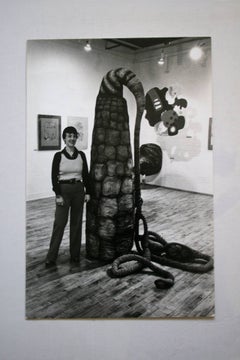
Gillian Bradshaw Smith in Studio
By Fred W. McDarrah
Located in Surfside, FL
Gillian was born in India in 1933. Her British parents were part of the twilight of the British Raj. Gillian completed her secondary education and entered The University of Reading, England to study Fine art and painting, a five year study. She worked in Dallas, Texas making paintings, creating embroidered wall hangings and teaching special classes. Her work was shown at the Contemporary Gallery. The art gallery that gave her her most important one man shows was Cordier & Ekstrom on Madison Avenue in New York. Headed by Arne Ekstrom a well known art dealer who showed many noted artists in his gallery including, Isamu Noguchi, Romare Bearden, Richard Lindner, Marcel Duchamp and Man Ray he also fostered the talents of younger artists such as Marvin Israel, Anton Van Dalen and Nancy Grossman...
Category

1970s Street Art Portrait Photography

Materials

Photographic Paper, Silver Gelatin

Vintage Signed Silver Gelatin Photograph Paul Georges Studio Painting Photo
By Fred McDarrah
Located in Surfside, FL
Paul Georges with Painting Jan 6, 1967 Photographer is Fred McDarrah Over a 50-year span, McDarrah documented the rise of the Beat Generation, the city’s postmodern art movement, its off-off-Broadway actors, troubadours, politicians, agitators and social protests. Fred captured Jack Kerouac frolicking with women at a New Year’s bash in 1958, Andy Warhol adjusting a movie-camera lens in his silver-covered factory, and Bob Dylan offering a salute of recognition outside Sheridan Square near the Voice’s old office. Not just a social chronicler, McDarrah was a great photo-journalist. For years, McDarrah was the Voice's only photographer and, for decades, he ran the Voice’s photo department, where he helped train dozens of young photographers, including James Hamilton, Sylvia Plachy, Robin Holland...
Category

1960s American Modern Black and White Photography

Materials

Silver Gelatin

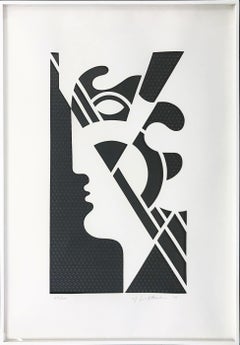
MODERN HEAD #5
By Roy Lichtenstein
Located in Aventura, FL
Modern Head #5, from Modern Head Series (C. 95). Hand signed, numbered and dated by the artist. Embossed graphite with die-cut paper overlay. Image size 20 x 11.5 inches. Sheet size ...
Category

1970s Pop Art Figurative Prints

Materials

Paper, Graphite

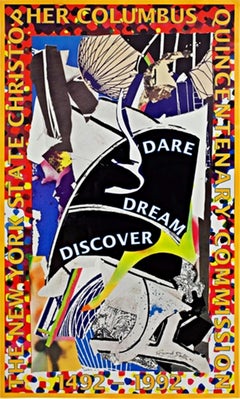
Frank Stella - NY State Columbus Centenary, Lithograph, Hand Signed, Ed. of 100
By Frank Stella
Located in New York, NY
Frank Stella The New York State Christopher Columbus Quincentenary Commission, 1991 Offset Lithograph Printed in Colors Signed and dated by the artist in ink on the lower right fron...
Category

1990s Abstract Expressionist Abstract Prints

Materials

Ink, Lithograph, Offset

Frank Stella, Sharpesville from Multicolored Squares I (Axsom 79) Lithograph S/N
By Frank Stella
Located in New York, NY
Frank Stella Sharpesville, from Multicolored Squares I (Axsom 79), 1972 Lithograph on J. Green mould-made paper Signed in graphite pencil, dated and numbered 31/100 (there were also ...
Category

1970s Abstract Geometric Abstract Prints

Materials

Lithograph

Leonor Fini - Pregnant - Original Handsigned Lithograph
By Leonor Fini
Located in Collonge Bellerive, Geneve, CH
Leonor Fini - Pregnant - Original Handsigned Lithograph Circa 1982 On colored paper Handsigned and Numbered Edition: 275 Dimensions: 69 x 52.5 cm Leonor Fini is considered one of the most important women artists of the mid-twentieth century, along with Leonora Carrington, Frida Kahlo, Meret Oppenheim, Remedios Varo, and Dorothea Tanning – most of whom Fini knew well. Her career, which spanned some six decades, included painting, graphic design, book illustration, product design (the renowned torso-shaped perfume bottle for Schiaparelli’s Shocking), and set and costume design for theatre, ballet, opera, and film. In this compellingly readable, exhaustively researched account, author Peter Webb brings Fini’s provocative art and unconventional personal life, as well as the vibrant avant-garde world in which she revolved, vividly in life. Born in Buenos Aires in 1907 (August 30 – January 18, 1996, Paris) to Italian and Argentine parents, Leonor grew up in Trieste, Italy, raised by her strong-willed, independent mother, Malvina. She was a virtually self-taught artist, learing anatomy directly from studying cadavers in the local morgue and absorbing composition and technique from the Old Masters through books and visits to museums. Fini’s fledging attempts at painting in Trieste let her to Milan, where she participated in her first group exhibition in 1929, and then to Paris in 1931. Her vivacious personality and flamboyant attire instantly garnered her a spotlight in the Parisian art world and she soon developed close relationships with the leading surrealist writers and painters, including Paul Eluard, Salvador Dali, Man Ray, and Max Ernst, who became her lover for a time. The only surrealist she could not abide because of his misogyny was André Breton. Although she repeatedly exhibited with them, she never considered herself a surrealist. The American dealer Julien Levy, very much impressed by Fini’s painting and smitten by her eccentric charms, invited her to New York in 1936, where she took part in a joint gallery exhibition with Max Ernst and met many American surrealists, including Joseph Cornell and Pavel Tchelitchew. Her work was included in MoMA’s pivotal Fantastic Art, Dada and Surrealism exhibition, along with De Chirico, Dali, Ernst, and Yves Tanguy. In 1939 in Paris she curated an exhibition of surrealist furniture for her childhood friend Leo Castelli for the opening of his first gallery. Introductions to her exhibition catalogues were written by De Chirico, Ernst, and Jean Cocteau. A predominant theme of Fini’s art is the complex relationship between the sexes, primarily the interplay between the dominant female and the passive, androgynous male. In many of her most powerful works, the female takes the form of a sphinx, often with the face of the artist. Fini was also an accomplished portraitist; among her subjects were Stanislao Lepri...
Category

1980s Modern Nude Prints

Materials

Lithograph

CONRAD MARCA-RELLI Limited ed. Etching Aquatint American Modern, Contemporary
By Conrad Marca-Relli 1
Located in Madrid, Madrid
Conrad Marca Relli - Composition X Date of creation: 1977 Medium: Etching and aquatint on Gvarro paper Edition: 75 + AP + HC Size: 56 x 76 cm Condition: In very good conditions and n...
Category

1970s Modern Abstract Prints

Materials

Etching, Aquatint

CONRAD MARCA-RELLI Limited ed. Etching Aquatint American Modern, Contemporary
By Conrad Marca-Relli 1
Located in Madrid, Madrid
Conrad Marca Relli - Composition XIII Date of creation: 1977 Medium: Etching and aquatint on Gvarro paper Edition: 75 + AP + HC Size: 56 x 76 cm Condition: In very good conditions an...
Category

1970s Modern Abstract Prints

Materials

Etching, Aquatint

CONRAD MARCA-RELLI Limited ed. Etching Aquatint American Modern, Contemporary
By Conrad Marca-Relli 1
Located in Madrid, Madrid
Conrad Marca Relli - Composition XV Date of creation: 1977 Medium: Etching and aquatint on Gvarro paper Edition number: 47/75 Size: 56 x 76 cm Condition: In very good conditions and ...
Category

1970s Modern Abstract Prints

Materials

Paper, Etching, Aquatint

CONRAD MARCA-RELLI Limited ed. Etching Aquatint American Modern, Contemporary
By Conrad Marca-Relli 1
Located in Madrid, Madrid
Conrad Marca-Relli - Composition II Date of creation: 1977 Medium: Etching and aquatint on Gvarro paper Edition number: 59/75 Size: 56 x 76 cm Condition: In very good conditions and ...
Category

1970s Modern Abstract Prints

Materials

Etching, Aquatint

CONRAD MARCA-RELLI Limited ed. Etching Aquatint American Modern, Contemporary
By Conrad Marca-Relli 1
Located in Madrid, Madrid
Conrad Marca Relli - Composition III Date of creation: 1977 Medium: Etching and aquatint on Gvarro paper Edition number: 51/75 Size: 56 x 76 cm Condition: In very good conditions and...
Category

1970s Modern Abstract Prints

Materials

Etching, Aquatint

CONRAD MARCA-RELLI Limited ed. Etching Aquatint American Modern, Contemporary
By Conrad Marca-Relli 1
Located in Madrid, Madrid
Conrad Marca Relli - Composition VIII Date of creation: 1977 Medium: Etching and aquatint on Gvarro paper Edition: 75 + AP + HC Size: 56 x 76 cm Condition: In very good conditions an...
Category

1970s Abstract Abstract Prints

Materials

Paper, Etching, Aquatint

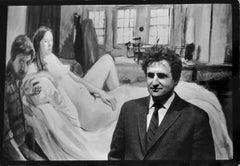
Vintage Signed Silver Gelatin Photograph Paul Georges Studio Painting Photo
By Fred McDarrah
Located in Surfside, FL
Paul Georges poses with self portrait with wife - January 6th 1967 Photographer is Fred McDarrah Paul Georges with Painting Jan 6, 1967 Photographer is Fred McDarrah Over a 50-year span, McDarrah documented the rise of the Beat Generation, the city’s postmodern art movement, its off-off-Broadway actors, troubadours, politicians, agitators and social protests. Fred captured Jack Kerouac frolicking with women at a New Year’s bash in 1958, Andy Warhol adjusting a movie-camera lens in his silver-covered factory, and Bob Dylan offering a salute of recognition outside Sheridan Square near the Voice’s old office. Not just a social chronicler, McDarrah was a great photo-journalist. For years, McDarrah was the Voice's only photographer and, for decades, he ran the Voice’s photo department, where he helped train dozens of young photographers, including James Hamilton, Sylvia Plachy, Robin Holland...
Category

1960s American Modern Black and White Photography

Materials

Silver Gelatin

Somewhere to Light Waco Texas iconic 1960s Pop Art silkscreen Signed/N, 16 Glenn
By James Rosenquist
Located in New York, NY
James Rosenquist Somewhere to Light, WACO, Texas 1966, from the New York International Portfolio Lithograph on wove paper Pencil signed and numbered 112/225 on the front Catalogue Ra...
Category

1960s Pop Art Abstract Prints

Materials

Screen

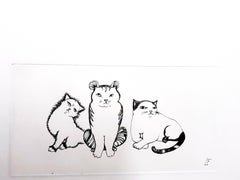
Leonor Fini - Cats Trio - Original Hand-Signed Etching
By Leonor Fini
Located in Collonge Bellerive, Geneve, CH
Leonor Fini - Cats - Original Engraving Mme.Helvetius' Cats Original etching created in 1985 Hand-Signed Conditions: excellent Edition: 71/100 Support: Arches paper. Dimensions: Pape...
Category

1980s Modern Animal Prints

Materials

Etching

Red Composition by TOSHIMITSU ÏMAI - Contemporary, Abstract, Oil on canvas
By Toshimitsu Imai
Located in London, GB
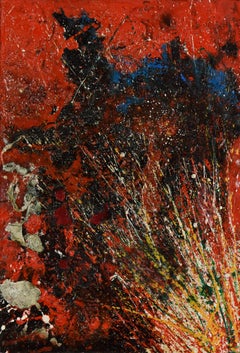
*PLEASE NOTE UK BUYERS WILL ONLY PAY 5% VAT ON THIS PURCHASE. Red Composition by TOSHIMITSU ÏMAI (1928-2002) Oil on canvas 80.2 x 55.3 (31 ⅝ x 21 ¾ inches) Signed, TOSHIMITSU IMAÏ, ...
Category

1960s Abstract Expressionist Abstract Paintings

Materials

Canvas, Oil

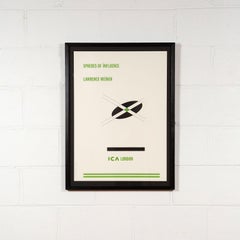
Spheres of Influence
By Lawrence Weiner
Located in Toronto, Ontario
Lawrence Weiner (b. 1942) is one of the most-distinctive American conceptual artists. His philosophy and aesthetic developed concurrently to Sol LeWitt yet Weiner has focused far more on (text-based) installation - typically in public spaces. Exhibited at Leo Castelli during the 1970's, Weiner has been an institutional darling with major exhibitions at most of the world's top museums. As a significant portion of his output is temporary installation, his multiples (which are few and far between) are sought-after and cherished by collectors. This rare silkscreen was published in conjunction with Weiner's solo exhibition "SPHERES OF INFLUENCE...
Category

1990s Conceptual Prints and Multiples

Materials

Screen

Still Thinking About These?

All Recently Viewed