317 results for "georgia o’keeffe"
to
50
292
25
88
33
128
115
63
108
91
31
53
34
Overall Height
to
Overall Width
to
91
81
72
9
6
5
3
2
1
53
31
29
25
24
19
17
16
14
13
10
10
9
7
5
5
5
4
4
3
5
129
183
5
2
5
19
5
4
6
9
20
19
46
31
27
10
9
156
125
111
75
73
Abstract Expressionist Color Field Painting Indian Artist Sangeeta Reddy
Located in Surfside, FL
Born in 1955, Hyderabad, India, painter and writer Sangeeta Reddy migrated to the United States in 1978 and continued her studies in art. Currently she maintains a studio on Santa Fe Dr. in Denver, Colorado and Hyderabad, India, dividing her time between the two. She has been represented by various galleries in Aspen, Denver, New York, New Delhi, Chennai and now, Hyderabad since the beginning of her 26 year career.
Sangeeta has lived and breathed the arts from a very young age – her maternal grandmother was a contemporary of the classical vocalist Kesarbai Kerkar, her grandfather a connoisseur of the arts. Steeped in music, her mother was one of the first disciples of the late Pandit Ravi Shankar. Her late father was a pictorial photographer who co-founded the Hyderabad Photographic Society. Sangeeta chose to follow her own path into the visual and literary arts.
With seven years of undergraduate work in fine art in India and the US, and a bachelor’s from Bombay University in English literature and Philosophy, in 1985, Sangeeta’s work has developed into a highly individual style of mixed media abstract expressionistic paintings and monotypes on both canvas and paper. The deconstructed calligraphy and vibrant and nuanced color ever present in her work gives the work the flavor of India in concert with a western restraint.
Known primarily for her mixed media collages on paper and canvas, her abstract work was conceived from a challenge to visually parallel Sankara’s idea of Brahman in Advait philosophy and has now evolved into a formal language of deconstructed Devanagari calligraphy. Her artistic influences range widely from Indian weaving and textiles to Vincent Van Gogh, Paul Cezanne and Pablo Picasso (who were introduced to her at a very young age by her father’s interest in Western art), to her discovery (while studying in the US) of the Taos School of landscape painters as well as the Abstract expressionist painters, painters, in particular, Mark Rothko and Willem De Kooning, Robert Motherwell, Antoni Tapies and Richard Diebenkorn.
After having worked for 28 years in an abstract expressionist manner, her latest series of paintings are based on the rock formations of the Colorado Plateau. She was first Inspired By Abstract Expressionists like Barnett Newman, Mark Rothko, Clyfford Still, Ray Parker, her style evolved into abstract expressionism and color field painting, Since moving to the US she has become familiar with some of the artistic giants – Georgia O’keeffe, Maynard Dixon, Ernest Blumenschein, Victor Higgins and John Marin, much later of the Group of Seven and of Regionalism. The mountains and plains, canyons and stretches of sky, pinion, sage and cottonwoods. Mostly they were in the form of small plein air works in pastel, charcoal or water color, or drawings from memory or photographs that were more reductive and expressionistic. She has also worked in monotype techniques and in collage.
SELECTED EXHIBITIONS
Recent Shows:
2016 Fractured Landscapes of the West, BMOCA, Boulder, CO
2014 Erasing Borders 11th Annual Exhibition of Contemporary Indian Art, Queens Museum, NYC
2014 LA Artcore, Los Angeles
2013 Shrishti Art Gallery, Hyderabad, India
2013 Erasing Borders 10th Annual Exhibition of Contemporary Indian Art, 2012 Erasing Borders 9th Annual Exhibition of Contemporary Indian Art, Art Crossings, Queens, the Bronx school for the Arts, New York and Art6, Richmond, Virginia.
2011 “IAAC Erasing Borders: 8th Annual Exhibition of Contemporary Indian Art”, Queens Museum of Art, Queens, New York, Aicon Gallery, NYC, Charles B. Wang Center, Stony Brook and Jorgenson Center,
2011 The William Havu gallery, Denver, Colorado
2009 15th Street Gallery, Boulder
2009 Retrospective, Rocky Mountain Women...
Category
1980s Abstract Expressionist Abstract Paintings
Materials
Paper, Paint, Mixed Media
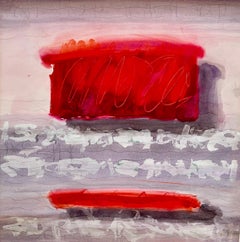
Deborah Bigeleisen - Rapture, Painting 2019
By Deborah Bigeleisen
Located in Stamford, CT
Having started my career by painting Rembrandt-like portraits of luminous white roses, I credit my discovery of fractals for transforming my artistic vision, and changing the directi...
Category
21st Century and Contemporary Contemporary Abstract Paintings
Materials
Paint, Oil

Deborah Bigeleisen - Mardi Gras, Painting 2019
By Deborah Bigeleisen
Located in Stamford, CT
Having started my career by painting Rembrandt-like portraits of luminous white roses, I credit my discovery of fractals for transforming my artistic vision, and changing the directi...
Category
21st Century and Contemporary Contemporary Abstract Paintings
Materials
Canvas, Paint, Acrylic
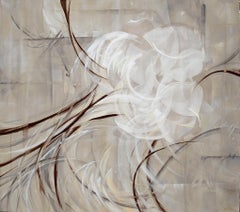
Deborah Bigeleisen - Over the Rainbow, Painting 2019
By Deborah Bigeleisen
Located in Stamford, CT
Having started my career by painting Rembrandt-like portraits of luminous white roses, I credit my discovery of fractals for transforming my artistic vision, and changing the directi...
Category
21st Century and Contemporary Contemporary Still-life Paintings
Materials
Canvas, Paint, Acrylic
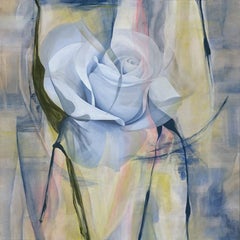
Deborah Bigeleisen - Illuminata 12, Painting 2015
By Deborah Bigeleisen
Located in Stamford, CT
Having started my career by painting Rembrandt-like portraits of luminous white roses, I credit my discovery of fractals for transforming my artistic vision, and changing the directi...
Category
21st Century and Contemporary Contemporary Abstract Paintings
Materials
Canvas, Paint, Oil

American Vivid Abstract Expressionist Art Oil Painting Norman Carton, WPA Artist
By Norman Carton
Located in Surfside, FL
Norman Carton (1908 – 1980) was an American artist and educator known for abstract expressionist art. He was born in the Ukraine region of Imperial Russia and moved to the United States in 1922 where he spent most of his adult life.
A classically trained portrait and landscape artist, Carton also worked as a drafter, newspaper illustrator, muralist, theater set designer, photographer, and fabric designer and spent most of his mature life as an art educator. Carton showed in and continues to be shown in many solo and group exhibitions. His work is included in numerous museums and private collections throughout the world.
Norman Carton was born in the Dnieper Ukraine territory of the Russian Empire in 1908. Escaping the turbulence of civil war massacres, he settled in Philadelphia in 1922 after years of constant flight. While attending the Pennsylvania Museum School of Industrial Art, Carton worked as a newspaper artist for the Philadelphia Record from 1928 to 1930 in the company of other illustrator/artists who had founded the Ashcan School, the beginnings of modern American art. From 1930 to 1935, he studied at the Pennsylvania Academy of Fine Arts under Henry McCarter, who was a pupil of Toulouse-Lautrec, Puvis de Chavanne, and Thomas Eakins. Arthur Carles, especially with his sense of color, and the architect John Harbison also provided tutelage and inspiration. Following his time at the Pennsylvania Academy of Fine Arts, Carton studied at the Barnes Foundation from 1935 to 1936 where he was influenced by an intellectual climate led by visiting lecturers John Dewey and Bertrand Russell as well as daily access to Albert C. Barnes and his art collection.
Carton was awarded the Cresson Traveling Scholarship in 1934 which allowed him to travel through Europe and study in Paris. There he expanded his artistic horizons with influences stemming from Henri Matisse, Pablo Picasso, Chaim Soutine, and Wassily Kandinsky. While at the Pennsylvania Academy of Fine Arts, Carton was also awarded the Toppan Prize for figure painting as well as the Thouron Composition Prize. He received numerous commissions as a portrait artist, social realist, sculptor, and theatrical stage designer as well as academic scholarships. During this time, Carton worked as a scenery designer at Sparks Scenic Studios, a drafter at the Philadelphia Enameling Works, and a fine art lithographer.
From 1939 to 1942, the Works Progress Administration (WPA) Federal Art Project employed Carton as a muralist and easel artist. He collaborated with architect George Howe. The WPA commissioned Carton to paint major murals at the Helen Fleischer Vocational School for Girls in Philadelphia, the Officers’ Club at Camp Meade Army Base in Maryland, and in the city of Hidalgo, Mexico. Throughout the 1940s, Carton exhibited and won prizes for his semi-abstract Expressionist and Surrealist paintings. He socialized with and was inspired by Émile Gauguin and Fernand Leger. During World War II, Carton was a naval structural designer and draftsman at the Cramps...
Category
Mid-20th Century Abstract Expressionist Landscape Paintings
Materials
Canvas, Oil
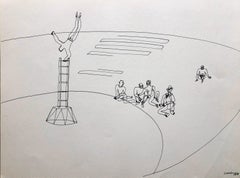
Alexander Calder Circus Reproduction Lithograph After a Drawing
By (after) Alexander Calder
Located in Surfside, FL
(after) Alexander Calder
"Calder's Circus" offset lithograph on wove paper after drawings by the artist
Published by Art in America and Perls gallery in 1964 (from drawings done in the 1930's)
these range slightly in size but they are all about 13 X 17 inches (with minor variations in size as issued.) These have never been framed. The outer folio is not included just the one lithograph.
James Sweeny from the introduction “The fame of Calder’s circus spread quickly between the years 1927 and 1930. All the Paris art world came to know it. It brought him his first great personal success. But what was more important, the circus also provided the first steps in Calder’s development as an original sculptor”
Clive Gray wrote ”A visit to the studio of Alexander Calder led to the chance discovery of some hundred masterful circus drawings completed over thirty years ago. We publish, for the first time, a choice of sixteen from that group.” With signed introduction by Miro.
These whimsical drawings, done in the style of wire sculpture, include acrobats, clowns, jugglers, trapeeze artists, an elephant, dog and lion. they are great.
Alexander Calder is widely considered to be one of the most important American sculptors of the 20th century. He is best known for his colorful, whimsical abstract public sculptures and his innovative mobiles, kinetic sculptures powered by motors or air currents, which embraced chance in their aesthetic. Born into a family of accomplished artists, Calder's work first gained attention in Paris in the 1930s and was soon championed by the Museum of Modern Art in New York, resulting in a retrospective exhibition in 1943. Major retrospectives were also held at the Solomon R. Guggenheim Museum (1964) and the Museum of Contemporary Art, Chicago (1974). Calder’s work is in many permanent collections, most notably in the Whitney Museum of American Art, but also the Guggenheim Museum; the Museum of Modern Art; the National Gallery of Art, Washington, D.C.; and the Centre Georges Pompidou. He produced many large public works, including .125 (at JFK Airport, 1957), Pittsburgh (Carnegie International prize winner 1958, Pittsburgh International Airport) Spirale (UNESCO in Paris, 1958), Flamingo and Universe (both in Chicago, 1974), and Mountains and Clouds (Hart Senate Office Building, Washington, D.C., 1976). Although primarily known for his sculpture, Calder was a prodigious artist with a restless creative spirit, whose diverse practice included painting and printmaking, miniatures (such as his famous Cirque Calder), children’s book illustrations, theater set design, jewelry design, tapestry and rug works, and political posters. Calder was honored by the US Postal Service with a set of five 32-cent stamps in 1998, and received the Presidential Medal of Freedom, posthumously in 1977, after refusing to receive it from Gerald Ford one year earlier in protest of the Vietnam War.
Calder moved to New York and enrolled at the Art Students League, studying briefly with Thomas Hart Benton, George Luks, Kenneth Hayes Miller, and John Sloan. While a student, he worked for the National Police Gazette where, in 1925, one of his assignments was sketching the Ringling Bros. and Barnum & Bailey Circus. Calder became fascinated with the action of the circus, a theme that would reappear in his later work.
In 1926, Calder moved to Paris, enrolled in the Académie de la Grande Chaumière, and established a studio at 22 rue Daguerre in the Montparnasse Quarter. In June 1929, while traveling by boat from Paris to New York, Calder met his future wife, Louisa James (1905-1996), grandniece of author Henry James and philosopher William James. They married in 1931. While in Paris, Calder met and became friends with a number of avant-garde artists, including Fernand Léger, Jean Arp, and Marcel Duchamp. Cirque Calder (on view at the Whitney Museum of American Art at present) became popular with the Parisian avant-garde. He also invented wire sculpture, or "drawing in space," and in 1929 he had his first solo show of these sculptures in Paris at Galerie Billiet. Hi! (Two Acrobats) in the collection of the Honolulu Museum of Art is an early example of the artist's wire sculpture. The painter Jules Pascin, a friend of Calder's from the cafes of Montparnasse, wrote the preface to the catalog. A visit to Piet Mondrian's studio in 1930, where he was impressed by the environment-as-installation, "shocked" him into fully embracing abstract art, toward which he had already been tending.
Dating from 1931, Calder’s sculptures of discrete movable parts powered by motors were christened “mobiles” by Marcel Duchamp, a French pun meaning both "motion" and "motive." At the same time, Calder was also experimenting with self-supporting, static, abstract sculptures, dubbed "stabiles" by Jean Arp in 1932 to differentiate them from mobiles.
Public commissions increasingly came his way in the 1960s. Notable examples are .125 for JFK Airport in 1957, Spirale for UNESCO in Paris 1958 and Trois disques, commissioned for Expo 67 in Montreal, Quebec, Canada. Calder's largest sculpture at 25.7 meters high was El Sol Rojo, constructed outside the Aztec Stadium for the 1968 Summer Olympics "Cultural Olympiad" events in Mexico City. Many of his public works were commissioned by renowned architects; I.M. Pei commissioned his La Grande Voile (1966), a 25-ton, 40-foot high stabile for the Massachusetts Institute of Technology.
Part of Calder's repertoire includes pivotal stage sets for more than a dozen theatrical productions, including Nucléa, Horizon, and most notably, Martha Graham’s Panorama (1935), a production of the Erik Satie symphonic drama Socrate (1936), and later, Works in Progress (1968).
In addition to sculptures, Calder painted throughout his career, beginning in the early 1920s. He picked up his study of printmaking in 1925, and continued to produce illustrations for books and journals.As Calder’s professional reputation expanded in the late 1940s and 1950s, so did his production of prints. Masses of lithographs based on his gouache paintings hit the market, and deluxe editions of plays, poems, and short stories illustrated with fine art prints by Calder became available for sale.
One of Calder's most celebrated and unconventional undertakings was a commission from Dallas-based Braniff International Airways to paint a full-size Douglas DC-8-62 four-engined jet as a "flying canvas."
Calder created over 2,000 pieces of jewelry over the course of his career, many of them as gifts for friends and relatives. For his lifelong friend Joan Miró, he set a shard of a broken porcelain vessel in a brass ring. Peggy Guggenheim received enormous silver mobile earrings and later commissioned a hammered silver headboard...
Category
1930s American Modern Animal Prints
Materials
Lithograph
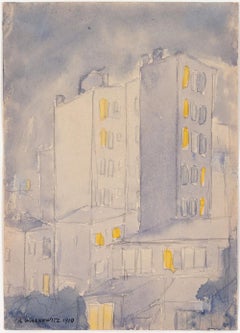
Improvisations of New York
By Abraham Walkowitz
Located in Miami, FL
Abraham Walkowitz (1878–1965)
Improvisations of New York, 1910
Watercolor and pencil on paper
Signed lower right 'A. Walkowitz 1910'
Dimensions: 7 x 5 inches (paper)
Titled on Berna...
Category
Early 1900s Post-Impressionist Landscape Drawings and Watercolors
Materials
Watercolor
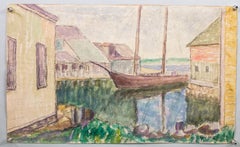
A Sailing Ship at the Port
By Abraham Walkowitz
Located in Miami, FL
Abraham Walkowitz (1878–1965)
A Sailing Ship at the Port, 1909
Watercolor on cardboard
Signed lower right 'A. Walkowitz', in pencil '1909'
Dimensions: 33.5 x 56 cm
Born: Tyumen, Ru...
Category
Early 1900s Post-Impressionist Landscape Drawings and Watercolors
Materials
Watercolor
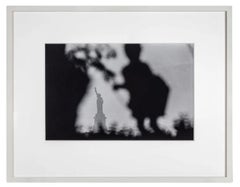
Cuban American Julio Mitchel Statue of Liberty Photograph Silver Gelatin Photo
Located in Surfside, FL
Julio Mitchell (Cuban, b. 1942) 'Statue of Liberty'
'Statue of Liberty from Brooklyn
Dated 1998
Dedicated to Chara Schreyer and Natalie for her Bat Mitzvah
Fine Print
16in. x 10 1/2i...
Category
20th Century Black and White Photography
Materials
Silver Gelatin
Veiled Series XXX, Abstract Expressionist Organic Drawing Watercolor Painting
By Dorothy Gillespie
Located in Surfside, FL
Dorothy Gillespie (June 29, 1920 – September 30, 2012) was an American artist and sculptor who became known for her large and colorful abstract metal sculptures. Gillespie became best known for the aluminum sculptures she started to produce at the end of the 1970s. She would paint sheets of the metal, cut them into strips and connect the strips together to resemble cascades or starbursts of bright colored ribbon. The New York Times once summarized her work as “topsy-turvy, merrymaking fantasy,” and in another review declared, “The artist’s exuberant sculptures of colorful aluminum strips have earned her an international reputation.Her works are featured at her alma mater (Radford University) in Virginia, where she later returned to teach, as well as in New York (where she was artist in residence for the feminist Women's Interart Center), Wilmington, North Carolina and Florida.
She enrolled both at Radford University near her hometown, and the Maryland Institute College of Art in Baltimore, Maryland. The director of the Maryland Institute, Hans Schuler, helped foster her career in fine art.
On June 5, 1943, aged 23, Gillespie moved to New York City. There she took a job at the B. Altman department store as assistant art director. She also joined the Art Students League where she was exposed to new ideas about techniques, materials, and marketing. She also created works at Atelier 17 printmaking studio, where Stanley William Hayter encouraged to experiment with her own ideas.
She and her husband, Bernard Israel, opened a restaurant and night club in Greenwich Village to support their family. She returned to making art in 1957, and worked at art full-time after they sold the nightclub in the 1970.
In 1977 Gillespie gave her first lecture series at the New School for Social Research, and she would give others there until 1982. She taught at her alma mater as a Visiting Artist (1981-1983) and gave Radford University some of her work to begin its permanent art collection. Gillespie then served as Woodrow Wilson visiting Fellow (1985-1994), visiting many small private colleges to give public lectures and teach young artists. She returned to Radnor University to teach as Distinguished Professor of Art (1997–99).[8] She also hosted a radio program, the Dorothy Gillespie Show on Radio Station WHBI in New York from 1967-1973.
Gillespie began moving away from realism and into the abstraction that marked her career. Gillespie returned to New York City in 1963 to continue her career. She maintained a studio through the 70s and advocate worked towards feminist goals in the art industry, picketing the Whitney Museum, helping to organize the Women's Interart Center, curating exhibitions of women's art, and writing articles raising awareness of her cause. Gillespie numbered among her acquaintances such art-world luminaries as Jackson Pollock, Lee Krasner, Alice Neel, Louise Nevelson and Georgia O’Keeffe. “She had amazing stories that unfortunately are gone,” her son said.
During the 1960s, she built multimedia art installations that made political statements, such as 1965’s “Made in the USA,” that used blinking colored lights, mirrors, shadow boxes, rotating figures and tape recordings to convey a chaotic look at American commercial fads. The floor was strewn with real dollar bills, which visitors assumed were fake.
By the 1980s, Gillespie's work had come to be known internationally. She completed many commissions for sculptures in public places, including Lincoln Center, Rockefeller Center and Walt Disney World Epcot Center in Orlando, Florida. Her work is in many collections across the United States, including the Delaware Museum, the Solomon R. Guggenheim Museum, and the National Museum of Women in the Arts. Her sculptures can also be found in the Frankfurt Museum in Germany and the Tel Aviv Museum in Israel.
Group Shows Conceived and Curated by Dorothy Gillespie
Women's Interart Center, New York, NY 1974 included: Betty Parsons, Elsie Asher, Alice Baber, Minna Citron, Nancy Spero, Seena Donneson, Alice Neel, Natalie Edgar, Dorothy Gillespie, and Anita Steckel...
Category
Early 2000s Abstract Expressionist Abstract Drawings and Watercolors
Materials
Paper, Ink, Watercolor, Permanent Marker
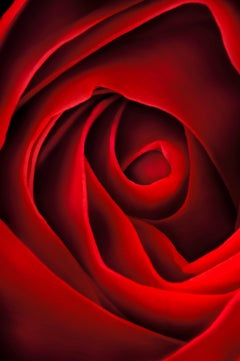
Kiss from a Rose
By Harold Davis
Located in Boston, MA
Artist Commentary:
This romantic photograph of mine of a red, red rose has often been mistaken for a reproduction of a painting by the great artist Georgia O'Keeffe.
Words that des...
Category
21st Century and Contemporary Impressionist Still-life Photography
Materials
Photographic Paper
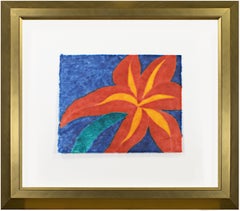
Narcissus Braziliana
original woodcut
monotype signed by Carol Summers
By Carol Summers
Located in Milwaukee, WI
The present artwork is a vibrant and colorful example of the woodcut prints of Carol Summers. The image is dominated by the form of a red tropical flower, closely cropped around the petals like in the photographs of Imogen Cunningham and the paintings of Georgia O'Keeffe. The playfulness of the image is enhanced by Summers' signature printmaking technique, which allows the ink from the woodblock to seep through the paper, blurring the edges of each form.
9.63 x 11.63 inches, artwork
21 x 23 inches, frame
Edition 16/50 in pencil, lower right
Titled in pencil, lower right
Signed in pencil, lower center
Framed to conservation standards using archival materials including 100 percent rag matting, Museum Glass to inhibit fading, and housed in a modern profile gold gilded wood moulding.
Carol Summers (1925-2016) has worked as an artist throughout the second half of the 20th century and into the first years of the next, outliving most of his mid-century modernist peers. Initially trained as a painter, Summers was drawn to color woodcuts around 1950 and it became his specialty thereafter. Over the years he has developed a process and style that is both innovative and readily recognizable. His art is known for it’s large scale, saturated fields of bold color, semi-abstract treatment of landscapes from around the world and a luminescent quality achieved through a printmaking process he invented.
In a career that has extended over half a century, Summers has hand-pulled approximately 245 woodcuts in editions that have typically run from 25 to 100 in number. His talent was both inherited and learned. Born in 1925 in Kingston, a small town in upstate New York, Summers was raised in nearby Woodstock with his older sister, Mary. His parents were both artists who had met in art school in St. Louis. During the Great Depression, when Carol was growing up, his father supported the family as a medical illustrator until he could return to painting. His mother was a watercolorist and also quite knowledgeable about the different kinds of papers used for various kinds of painting. Many years later, Summers would paint or print on thinly textured paper originally collected by his mother.
From 1948 to 1951, Carol Summers trained in the classical fine and studio arts at Bard College and at the Art Students League of New York. He studied painting with Steven Hirsh and printmaking with Louis Schanker. He admired the shapes and colors favored by early modernists Paul Klee (Sw: 1879-1940) and Matt Phillips (Am: b.1927- ). After graduating, Summers quit working as a part-time carpenter and cabinetmaker (which had supported his schooling and living expenses) to focus fulltime on art. That same year, an early abstract, Bridge No. 1 was selected for a Purchase Prize in a competition sponsored by the Brooklyn Museum.
In 1952, his work (Cathedral, Construction and Icarus) was shown the first time at the Museum of Modern Art in New York City in an exhibition of American woodcuts. In 1954, Summers received a grant from the Italian government to study for a year in Italy. Woodcuts completed soon after his arrival there were almost all editions of only 8 to 25 prints, small in size, architectural in content and black and white in color. The most well-known are Siennese Landscape and Little Landscape, which depicted the area near where he resided. Summers extended this trip three more years, a decision which would have significant impact on choices of subject matter and color in the coming decade.
After returning from Europe, Summers’ images continued to feature historical landmarks and events from Italy as well as from France, Spain and Greece. However, as evidenced in Aetna’s Dream, Worldwind and Arch of Triumph, a new look prevailed. These woodcuts were larger in size and in color. Some incorporated metal leaf in the creation of a collage and Summers even experimented with silkscreening. Editions were now between 20 and 50 prints in number. Most importantly, Summers employed his rubbing technique for the first time in the creation of Fantastic Garden in late 1957.
Dark Vision of Xerxes, a benchmark for Summers, was the first woodcut where Summers experimented using mineral spirits as part of his printmaking process. A Fulbright Grant as well as Fellowships from the Louis Comfort Tiffany Foundation and the Guggenheim Foundation followed soon thereafter, as did faculty positions at colleges and universities primarily in New York and Pennsylvania. During this period he married a dancer named Elaine Smithers with whom he had one son, Kyle. Around this same time, along with fellow artist Leonard Baskin, Summers pioneered what is now referred to as the “monumental” woodcut. This term was coined in the early 1960s to denote woodcuts that were dramatically bigger than those previously created in earlier years, ones that were limited in size mostly by the size of small hand-presses. While Baskin chose figurative subject matter, serious in nature and rendered with thick, striated lines, Summers rendered much less somber images preferring to emphasize shape and color; his subject matter approached abstraction but was always firmly rooted in the landscape.
In addition to working in this new, larger scale, Summers simultaneously refined a printmaking process which would eventually be called the “Carol Summers Method” or the “ Carol Summers Technique”. Summers produces his woodcuts by hand, usually from one or more blocks of quarter-inch pine, using oil-based printing inks and porous mulberry papers. His woodcuts reveal a sensitivity to wood especially its absorptive qualities and the subtleties of the grain. In several of his woodcuts throughout his career he has used the undulating, grainy patterns of a large wood plank to portray a flowing river or tumbling waterfall. The best examples of this are Dream, done in 1965 and the later Flash Flood Escalante, in 2003. In the majority of his woodcuts, Summers makes the blocks slightly larger than the paper so the image and color will bleed off the edge.
Before printing, he centers a dry sheet of paper over the top of the cut wood block or blocks, securing it with giant clips. Then he rolls the ink directly on the front of the sheet of paper and pressing down onto the dry wood block or reassembled group of blocks. Summers is technically very proficient; the inks are thoroughly saturated onto the surface of the paper but they do not run into each other. The precision of the color inking in Constantine’s Dream in 1969 and Rainbow Glacier in 1970 has been referred to in various studio handbooks. Summers refers to his own printing technique as “rubbing”. In traditional woodcut printing, including the Japanese method, the ink is applied directly onto the block. However, by following his own method, Summers has avoided the mirror-reversed image of a conventional print and it has given him the control over the precise amount of ink that he wants on the paper. After the ink is applied to the front of the paper, Summers sprays it with mineral spirits, which act as a thinning agent. The absorptive fibers of the paper draw the thinned ink away from the surface softening the shapes and diffusing and muting the colors. This produces a unique glow that is a hallmark of the Summers printmaking technique. Unlike the works of other color field artists or modernists of the time, this new technique made Summers’ extreme simplification and flat color areas anything but hard-edged or coldly impersonal.
By the 1960s, Summers had developed a personal way of coloring and printing and was not afraid of hard work, doing the cutting, inking and pulling himself. In 1964, at the age of 38, Summers’ work was exhibited for a second time at the Museum of Modern Art. This time his work was featured in a one-man show and then as one of MoMA’s two-year traveling exhibitions which toured throughout the United States. In subsequent years, Summers’ works would be exhibited and acquired for the permanent collections of multiple museums throughout the United States, Europe and Asia. Summers’ familiarity with landscapes throughout the world is firsthand. As a navigator-bombardier in the Marines in World War II, he toured the South Pacific and Asia.
Following college, travel in Europe and subsequent teaching positions, in 1972, after 47 years on the East Coast, Carol Summers moved permanently to Bonny Doon in the Santa Cruz Mountains in Northern California. There met his second wife, Joan Ward Toth, a textile artist who died in 1998; and it was here his second son, Ethan was born. During the years that followed this relocation, Summers’ choice of subject matter became more diverse although it retained the positive, mostly life-affirming quality that had existed from the beginning. Images now included moons, comets, both sunny and starry skies, hearts and flowers, all of which, in one way or another, remained tied to the landscape.
In the 1980s, from his home and studio in the Santa Cruz mountains, Summers continued to work as an artist supplementing his income by conducting classes and workshops at universities in California and Oregon as well as throughout the Mid and Southwest. He also traveled extensively during this period hiking and camping, often for weeks at a time, throughout the western United States and Canada. Throughout the decade it was not unusual for Summers to backpack alone or with a fellow artist into mountains or back country for six weeks or more at a time. Not surprisingly, the artwork created during this period rarely departed from images of the land, sea and sky. Summers rendered these landscapes in a more representational style than before, however he always kept them somewhat abstract by mixing geometric shapes with organic shapes, irregular in outline. Some of his most critically acknowledged work was created during this period including First Rain, 1985 and The Rolling Sea, 1989. Summers received an honorary doctorate from his alma mater, Bard College in 1979 and was selected by the United States Information Agency to spend a year conducting painting and printmaking workshops at universities throughout India. Since that original sabbatical, he has returned every year, spending four to eight weeks traveling throughout that country.
In the 1990s, interspersed with these journeys to India have been additional treks to the back roads and high country areas of Mexico, Central America, Nepal, China and Japan. Travel to these exotic and faraway places had a profound influence on Summers’ art. Subject matter became more worldly and non-western as with From Humla to Dolpo, 1991 or A Former Life of Budha, 1996, for example. Architectural images, such as The Pillars of Hercules, 1990 or The Raja’s Aviary, 1992 became more common. Still life images made a reappearance with Jungle Bouquet in 1997. This was also a period when Summers began using odd-sized paper to further the impact of an image.
The 1996 Night, a view of the earth and horizon as it might be seen by an astronaut, is over six feet long and only slightly more than a foot-and-a-half high. From 1999, Revuelta A Vida (Spanish for “Return to Life”) is pie-shaped and covers nearly 18 cubic feet. It was also at this juncture that Summers began to experiment with a somewhat different palette although he retained his love of saturated colors. The 2003 Far Side of Time is a superb example of the new direction taken by this colorist.
At the turn of the millennium in 1999, “Carol Summers Woodcuts...
Category
Early 2000s Contemporary Landscape Prints
Materials
Monotype, Woodcut
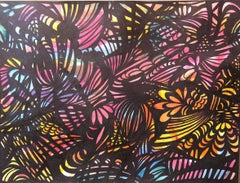
Abstract Expressionist Color Field Painting Indian Artist Sangeeta Reddy
Located in Surfside, FL
image is 21 X 21 inches; frame: 30 X 30 inches
Born in 1955, Hyderabad, India, painter and writer Sangeeta Reddy migrated to the United States in 1978 and continued her studies in art. Currently she maintains a studio on Santa Fe Dr. in Denver, Colorado and Hyderabad, India, dividing her time between the two. She has been represented by various galleries in Aspen, Denver, New York, New Delhi, Chennai and now, Hyderabad since the beginning of her 26 year career.
Sangeeta has lived and breathed the arts from a very young age – her maternal grandmother was a contemporary of the classical vocalist Kesarbai Kerkar, her grandfather a connoisseur of the arts. Steeped in music, her mother was one of the first disciples of the late Pandit Ravi Shankar. Her late father was a pictorial photographer who co-founded the Hyderabad Photographic Society. Sangeeta chose to follow her own path into the visual and literary arts.
With seven years of undergraduate work in fine art in India and the US, and a bachelor’s from Bombay University in English literature and Philosophy, in 1985, Sangeeta’s work has developed into a highly individual style of mixed media abstract expressionistic paintings and monotypes on both canvas and paper. The deconstructed calligraphy and vibrant and nuanced color ever present in her work gives the work the flavor of India in concert with a western restraint.
Known primarily for her mixed media collages on paper and canvas, her abstract work was conceived from a challenge to visually parallel Sankara’s idea of Brahman in Advait philosophy and has now evolved into a formal language of deconstructed Devanagari calligraphy. Her artistic influences range widely from Indian weaving and textiles to Vincent Van Gogh, Paul Cezanne and Pablo Picasso (who were introduced to her at a very young age by her father’s interest in Western art), to her discovery (while studying in the US) of the Taos School of landscape painters as well as the Abstract expressionist painters, painters, in particular, Mark Rothko and Willem De Kooning, Robert Motherwell, Antoni Tapies and Richard Diebenkorn.
After having worked for 28 years in an abstract expressionist manner, her latest series of paintings are based on the rock formations of the Colorado Plateau. She was first Inspired By Abstract Expressionists like Barnett Newman, Mark Rothko, Clyfford Still, Ray Parker, her style evolved into abstract expressionism and color field painting, Since moving to the US she has become familiar with some of the artistic giants – Georgia O’keeffe, Maynard Dixon, Ernest Blumenschein, Victor Higgins and John Marin, much later of the Group of Seven and of Regionalism. The mountains and plains, canyons and stretches of sky, pinion, sage and cottonwoods. Mostly they were in the form of small plein air works in pastel, charcoal or water color, or drawings from memory or photographs that were more reductive and expressionistic. She has also worked in monotype techniques and in collage.
SELECTED EXHIBITIONS
Recent Shows:
2016 Fractured Landscapes of the West, BMOCA, Boulder, CO
2014 Erasing Borders 11th Annual Exhibition of Contemporary Indian Art, Queens Museum, NYC
2014 LA Artcore, Los Angeles
2013 Shrishti Art Gallery, Hyderabad, India
2013 Erasing Borders 10th Annual Exhibition of Contemporary Indian Art, 2012 Erasing Borders 9th Annual Exhibition of Contemporary Indian Art, Art Crossings, Queens, the Bronx school for the Arts, New York and Art6, Richmond, Virginia.
2011 “IAAC Erasing Borders: 8th Annual Exhibition of Contemporary Indian Art”, Queens Museum of Art, Queens, New York, Aicon Gallery, NYC, Charles B. Wang Center, Stony Brook and Jorgenson Center,
2011 The William Havu gallery, Denver, Colorado
2009 15th Street Gallery, Boulder
2009 Retrospective, Rocky Mountain Women...
Category
1980s Abstract Expressionist Abstract Paintings
Materials
Paint, Paper, Mixed Media
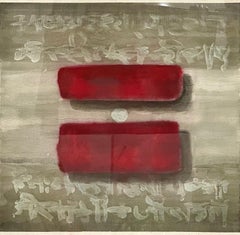
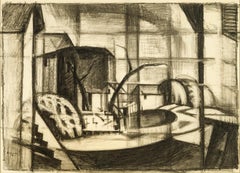
Study for Old Canal, Red and Blue (Rockaway, Morris Canal)
By Oscar Florianus Bluemner
Located in New York, NY
Oscar Bluemner was a German and an American, a trained architect who read voraciously in art theory, color theory, and philosophy, a writer of art criticism both in German and English, and, above all, a practicing artist. Bluemner was an intense man, who sought to express and share, through drawing and painting, universal emotional experience. Undergirded by theory, Bluemner chose color and line for his vehicles; but color especially became the focus of his passion. He was neither abstract artist nor realist, but employed the “expressional use of real phenomena” to pursue his ends. (Oscar Bluemner, from unpublished typescript on “Modern Art” for Camera Work, in Bluemner papers, Archives of American Art, Smithsonian Institution, as cited and quoted in Jeffrey R. Hayes, Oscar Bluemner [1991], p. 60. The Bluemner papers in the Archives [hereafter abbreviated as AAA] are the primary source for Bluemner scholars. Jeffrey Hayes read them thoroughly and translated key passages for his doctoral dissertation, Oscar Bluemner: Life, Art, and Theory [University of Maryland, 1982; UMI reprint, 1982], which remains the most comprehensive source on Bluemner. In 1991, Hayes published a monographic study of Bluemner digested from his dissertation and, in 2005, contributed a brief essay to the gallery show at Barbara Mathes, op. cit.. The most recent, accessible, and comprehensive view of Bluemner is the richly illustrated, Barbara Haskell, Oscar Bluemner: A Passion for Color, exhib. cat. [New York: Whitney Museum of American Art, 2005.])
Bluemner was born in the industrial city of Prenzlau, Prussia, the son and grandson of builders and artisans. He followed the family predilection and studied architecture, receiving a traditional and thorough German training. He was a prize-winning student and appeared to be on his way to a successful career when he decided, in 1892, to emigrate to America, drawn perhaps by the prospect of immediate architectural opportunities at the Chicago World’s Fair, but, more importantly, seeking a freedom of expression and an expansiveness that he believed he would find in the New World.
The course of Bluemner’s American career proved uneven. He did indeed work as an architect in Chicago, but left there distressed at the formulaic quality of what he was paid to do. Plagued by periods of unemployment, he lived variously in Chicago, New York, and Boston. At one especially low point, he pawned his coat and drafting tools and lived in a Bowery flophouse, selling calendars on the streets of New York and begging for stale bread. In Boston, he almost decided to return home to Germany, but was deterred partly because he could not afford the fare for passage. He changed plans and direction again, heading for Chicago, where he married Lina Schumm, a second-generation German-American from Wisconsin. Their first child, Paul Robert, was born in 1897. In 1899, Bluemner became an American citizen. They moved to New York City where, until 1912, Bluemner worked as an architect and draftsman to support his family, which also included a daughter, Ella Vera, born in 1903.
All the while, Oscar Bluemner was attracted to the freer possibilities of art. He spent weekends roaming Manhattan’s rural margins, visiting the Bronx, Brooklyn, Queens, and New Jersey, sketching landscapes in hundreds of small conté crayon drawings. Unlike so many city-based artists, Bluemner did not venture out in search of pristine countryside or unspoiled nature. As he wrote in 1932, in an unsuccessful application for a Guggenheim Fellowship, “I prefer the intimate landscape of our common surroundings, where town and country mingle. For we are in the habit to carry into them our feelings of pain and pleasure, our moods” (as quoted by Joyce E. Brodsky in “Oscar Bluemner in Black and White,” p. 4, in Bulletin 1977, I, no. 5, The William Benton Museum of Art, Storrs, Connecticut). By 1911, Bluemner had found a powerful muse in a series of old industrial towns, mostly in New Jersey, strung along the route of the Morris Canal.
While he educated himself at museums and art galleries, Bluemner entered numerous architectural competitions. In 1903, in partnership with Michael Garven, he designed a new courthouse for Bronx County. Garven, who had ties to Tammany Hall, attempted to exclude Bluemner from financial or artistic credit, but Bluemner promptly sued, and, finally, in 1911, after numerous appeals, won a $7,000 judgment.
Barbara Haskell’s recent catalogue reveals more details of Bluemner’s architectural career than have previously been known. Bluemner the architect was also married with a wife and two children. He took what work he could get and had little pride in what he produced, a galling situation for a passionate idealist, and the undoubted explanation for why he later destroyed the bulk of his records for these years. Beginning in 1907, Bluemner maintained a diary, his “Own Principles of Painting,” where he refined his ideas and incorporated insights from his extensive reading in philosophy and criticism both in English and German to create a theoretical basis for his art. Sometime between 1908 and 1910, Bluemner’s life as an artist was transformed by his encounter with the German-educated Alfred Stieglitz, proprietor of the Little Galleries of the Photo-Secession at 291 Fifth Avenue. The two men were kindred Teutonic souls. Bluemner met Stieglitz at about the time that Stieglitz was shifting his serious attention away from photography and toward contemporary art in a modernist idiom. Stieglitz encouraged and presided over Bluemner’s transition from architect to painter. During the same period elements of Bluemner’s study of art began to coalesce into a personal vision. A Van Gogh show in 1908 convinced Bluemner that color could be liberated from the constraints of naturalism. In 1911, Bluemner visited a Cézanne watercolor show at Stieglitz’s gallery and saw, in Cézanne’s formal experiments, a path for uniting Van Gogh’s expressionist use of color with a reality-based but non-objective language of form.
A definitive change of course in Bluemner’s professional life came in 1912. Ironically, it was the proceeds from his successful suit to gain credit for his architectural work that enabled Bluemner to commit to painting as a profession. Dividing the judgment money to provide for the adequate support of his wife and two children, he took what remained and financed a trip to Europe. Bluemner traveled across the Continent and England, seeing as much art as possible along the way, and always working at a feverish pace. He took some of his already-completed work with him on his European trip, and arranged his first-ever solo exhibitions in Berlin, Leipzig, and Elberfeld, Germany. After Bluemner returned from his study trip, he was a painter, and would henceforth return to drafting only as a last-ditch expedient to support his family when his art failed to generate sufficient income.
Bluemner became part of the circle of Stieglitz artists at “291,” a group which included Marsden Hartley, John Marin, and Arthur Dove. He returned to New York in time to show five paintings at the 1913 Armory Show and began, as well, to publish critical and theoretical essays in Stieglitz’s journal, Camera Work. In its pages he cogently defended the Armory Show against the onslaught of conservative attacks. In 1915, under Stieglitz’s auspices, Bluemner had his first American one-man show at “291.” Bluemner’s work offers an interesting contrast with that of another Stieglitz architect-turned-artist, John Marin, who also had New Jersey connections.
The years after 1914 were increasingly uncomfortable. Bluemner remained, all of his life, proud of his German cultural legacy, contributing regularly to German language journals and newspapers in this country. The anti-German sentiment, indeed mania, before and during World War I, made life difficult for the artist and his family. It is impossible to escape the political agenda in Charles Caffin’s critique of Bluemner’s 1915 show. Caffin found in Bluemner’s precise and earnest explorations of form, “drilled, regimented, coerced . . . formations . . . utterly alien to the American idea of democracy” (New York American, reprinted in Camera Work, no. 48 [Oct. 1916], as quoted in Hayes, 1991, p. 71).
In 1916, seeking a change of scene, more freedom to paint, and lower expenses, Bluemner moved his family to New Jersey, familiar terrain from his earlier sketching and painting. During the ten years they lived in New Jersey, the Bluemner family moved around the state, usually, but not always, one step ahead of the rent collector. In 1917, Stieglitz closed “291” and did not reestablish a Manhattan gallery until 1925. In the interim, Bluemner developed relationships with other dealers and with patrons. Throughout his career he drew support and encouragement from art cognoscenti who recognized his talent and the high quality of his work. Unfortunately, that did not pay the bills. Chronic shortfalls were aggravated by Bluemner’s inability to sustain supportive relationships. He was a difficult man, eternally bitter at the gap between the ideal and the real. Hard on himself and hard on those around him, he ultimately always found a reason to bite the hand that fed him.
Bluemner never achieved financial stability. He left New Jersey in 1926, after the death of his beloved wife, and settled in South Braintree, Massachusetts, outside of Boston, where he continued to paint until his own death in 1938. As late as 1934 and again in 1936, he worked for New Deal art programs designed to support struggling artists. Bluemner held popular taste and mass culture in contempt, and there was certainly no room in his quasi-religious approach to art for accommodation to any perceived commercial advantage. His German background was also problematic, not only for its political disadvantages, but because, in a world where art is understood in terms of national styles, Bluemner was sui generis, and, to this day, lacks a comfortable context.
In 1933, Bluemner adopted Florianus (definitively revising his birth names, Friedrich Julius Oskar) as his middle name and incorporated it into his signature, to present “a Latin version of his own surname that he believed reinforced his career-long effort to translate ordinary perceptions into the more timeless and universal languages of art” (Hayes 1982, p. 189 n. 1). In 1939, critic Paul Rosenfeld, a friend and member of the Stieglitz circle, responding to the difficulty in categorizing Bluemner, perceptively located him among “the ranks of the pre-Nazi German moderns” (Hayes 1991, p. 41). Bluemner was powerfully influenced in his career by the intellectual heritage of two towering figures of nineteenth-century German culture, Johann Wolfgang von Goethe and Georg Wilhelm Friedrich Hegel. A keen student of color theory, Bluemner gave pride of place to the formulations of Goethe, who equated specific colors with emotional properties. In a November 19, 1915, interview in the German-language newspaper, New Yorker Staats-Zeitung (Abendblatt), he stated:
I comprehend the visible world . . . abstract the primary-artistic . . . and after these elements of realty are extracted and analyzed, I reconstruct a new free creation that still resembles the original, but also . . . becomes an objectification of the abstract idea of beauty.
The first—and most conspicuous mark of this creation is . . . colors which accord with the character of things, the locality . . . [and which] like the colors of Cranach, van der Weyden, or Durer, are of absolute purity, breadth, and luminosity. . . . I proceed from the psychological use of color by the Old Masters . . . [in which] we immediately recognize colors as carriers of “sorrow and joy” in Goethe’s sense, or as signs of human relationship. . . . Upon this color symbolism rests the beauty as well as the expressiveness, of earlier sacred paintings. Above all, I recognize myself as a contributor to the new German theory of light and color, which expands Goethe’s law of color through modern scientific means (as quoted in Hayes 1991, p. 71).
Hayes has traced the global extent of Bluemner’s intellectual indebtedness to Hegel (1991, pp. 36–37). More specifically, Bluemner made visual, in his art, the Hegelian world view, in the thesis and antithesis of the straight line and the curve, the red and the green, the vertical and the horizontal, the agitation and the calm. Bluemner respected all of these elements equally, painting and drawing the tension and dynamic of the dialectic and seeking ultimate reconciliation in a final visual synthesis. Bluemner was a keen student of art, past and present, looking, dissecting, and digesting all that he saw. He found precedents for his non-naturalist use of brilliant-hued color not only in the work Van Gogh and Cezanne, but also in Gauguin, the Nabis, and the Symbolists, as well as among his contemporaries, the young Germans of Der Blaue Reiter.
Bluemner was accustomed to working to the absolute standard of precision required of the architectural draftsman, who adjusts a design many times until its reality incorporates both practical imperatives and aesthetic intentions. Hayes describes Bluemner’s working method, explaining how the artist produced multiple images playing on the same theme—in sketch form, in charcoal, and in watercolor, leading to the oil works that express the ultimate completion of his process (Hayes, 1982, pp. 156–61, including relevant footnotes). Because of Bluemner’s working method, driven not only by visual considerations but also by theoretical constructs, his watercolor and charcoal studies have a unique integrity. They are not, as is sometimes the case with other artists, rough preparatory sketches. They stand on their own, unfinished only in the sense of not finally achieving Bluemner’s carefully considered purpose.
The present charcoal drawing is one of a series of images that take as their starting point the Morris Canal as it passed through Rockaway, New Jersey. The Morris Canal industrial towns that Bluemner chose as the points of departure for his early artistic explorations in oil included Paterson with its silk mills (which recalled the mills in the artist’s childhood home in Elberfeld), the port city of Hoboken, Newark, and, more curiously, a series of iron ore mining and refining towns, in the north central part of the state that pre-dated the Canal, harkening back to the era of the Revolutionary War. The Rockaway theme was among the original group of oil paintings that Bluemner painted in six productive months from July through December 1911 and took with him to Europe in 1912. In his painting journal, Bluemner called this work Morris Canal at Rockaway N.J. (AAA, reel 339, frames 150 and 667, Hayes, 1982, pp. 116–17), and exhibited it at the Galerie Fritz Gurlitt in Berlin in 1912 as Rockaway N. J. Alter Kanal. After his return, Bluemner scraped down and reworked these canvases. The Rockaway picture survives today, revised between 1914 and 1922, as Old Canal, Red and Blue (Rockaway River) in the collection of the Hirshhorn Museum and Sculpture Garden, Smithsonian Institution, Washington D. C. (color illus. in Haskell, fig. 48, p. 65).
For Bluemner, the charcoal expression of his artistic vision was a critical step in composition. It represented his own adaptation of Arthur Wesley’s Dow’s (1857–1922) description of a Japanese...
Category
20th Century American Modern Abstract Drawings and Watercolors
Materials
Paper, Charcoal
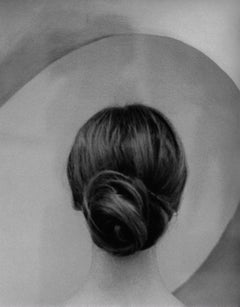
Rosebud Conway, Georgia O’Keefe, Chicago
Located in New York, NY
Frajndlich, well-known for his photographs of artists, met the aspiring actress and performer Rosebud Conway in 1970 in Cleveland, Ohio. They beca...
Category
1970s Modern Portrait Photography
Materials
Silver Gelatin
Price Upon Request
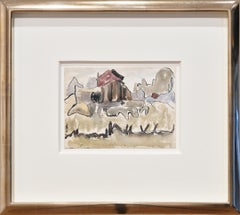
The Other Farm
By Arthur Dove
Located in London, GB
This quaint and reflective work features delicate and inky lines depicting a farmhouse nestled within a cool-toned watercolour landscape. Muted red brick, almost silver bluish greys,...
Category
Mid-20th Century American Modern Landscape Drawings and Watercolors
Materials
Ink, Watercolor

Price Upon Request