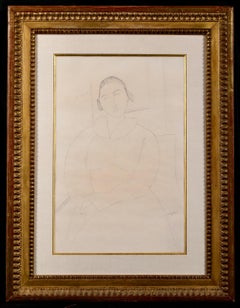
417 results for "diego rivera"

to
76
378
31
139
50
261
131
11
130
110
82
36
58
Overall Height
to
Overall Width
to
167
85
50
14
13
4
2
2
1
1
1
179
93
91
62
42
34
32
27
25
22
20
7
7
6
6
6
6
6
5
4
1
3
331
82
4
21
68
34
20
17
25
11
35
1
34
30
25
22
14
139
109
70
68
63
Antonio Segui - Distraido - Oil on Canvas
By Antonio Seguí
Located in Collonge Bellerive, Geneve, CH
Antonio Segui 38 x 46 cm Distraido Oil on Canvas Signed and Dated on the back Antonio Segui Biography Born in Córdoba, Argentina in 1934, Antonio Seguí currently lives and works in Paris. He studied at the San Fernando Academy in Madrid, Spain as well as the Ecole des Beaux-Arts in Paris, France. His first solo exhibition was in Argentina at age 23. Antonio Seguí is one of the most internationally renowned Argentinian artists. He began his artistic endeavors at a young age after leaving Argentina to travel the world and study art. His journeys through Latin America, Europe and Africa exposed him to new ideas and encouraged his culturally diverse approach to art. Influenced by artists like Fernand Leger and Diego Rivera, Seguí’s work is generally satirical, critiquing society and human nature. In a pre-computer age, the artist created a vocabulary that is now being explored by a new generation of artists through comics and Manga, yet his visual language and social commentaries remain poignant, both symbolically and literally. Throughout his career, Seguí has developed a fascination for urban life, creating in his work the idea of the “everyman.” The city movement, the fast pace at which life happens and the people who live in these urban spaces are some of the elements that constitute the world depicted in his paintings. It is a prototypical realm inhabited by speedy automatons that take immutable routes leading nowhere. Up close, each figure is an individual, walking down dark alleys, pointing, waving and emerging from potholes. But from a distance, the individuals morph into complex patterns swallowed up in a labyrinth of buildings and cookie-cutter trees. Utilizing cubist techniques, Seguí’s repeated elements give shape to the cities causing planes to vibrate between line and color. Numerous perspectives unfold with each vibration and reflect the many angles of life of the urban man. Always in action, the little figures trample, tip-toe, dodge and advance through Seguí’s imaginary metropolis of life. His work is representated on a series of narratives and criticisms reflected on paintings that show many little men, dressed in 20's style clothes. He uses his own recourse based on comic strip characters, texts, arrows and various signs, juxtaposed onto the figures that resemble comic strip style language. Seguí’s work is collected and exhibited worldwide in places such as the MoMA, New York; Art Museum of the Americas, Washington, D.C.; Frissiras Museum, Athens, Greece; Museo de Arte Moderno de Buenos Aires, Argentina; Museum der Moderne Salzburg, Austria; Museum of Modern Art Dubrovnik, Croatia; and Museo Tamayo, Mexico City, Mexico. The Musée National d´Art Moderne, Paris organized a retrospective of his works on paper in 2005. A monograph on the artist by Daniel Abadie was published in 2010 by Hazan. Antonio Segui Resumé 1995 Art Miami '95, USA. S. Zannettacci, Geneva, Switzerland Marwan Hoss, Paris, France Gallerie du Cirque Divers, Belgium Le Moulin du Roc, France Fundacao C. Gulbenkaian, Portugal Gallerie J. Rubeiz, Beirut, Liban 1994 F. Santos, Portugal E. Franck Gallery, Belgium 1993 Galleria San Carlo, Milan, Italy Galería I. Vega, Puerto Rico Winance-Sabbe, Belgium FIAC, Paris, France 1992 Casa Rosada, Buenos Aires, Argentina Espace Julio Gonzales...
Category

2010s Modern Figurative Paintings

Materials

Oil

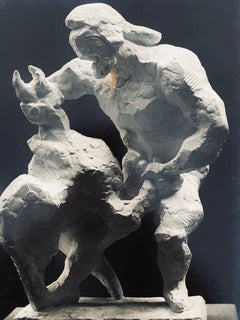
Vintage Silver Gelatin Photograph Jacques Lipchitz Sculpture Photo Signed
By Marc Vaux
Located in Surfside, FL
Marc Vaux, a figure of Montparnasse, pro­duced a trove of pho­tographs which are cur­rently held in the col­lec­tion of the Centre Pompidou in Paris, France. Marc Vaux was com­mitted equally to sup­porting artists, notably by cre­ating the Foyer des Artistes (1946-70) and, in 1951, the first Musée du Montparnasse at 10, rue de l’Arrivée. Marc Vaux was born on February 19, 1895 in Crulai, Normandy Thanks to the color mer­chant from whom he bought his plates and his pho­to­graphic equip­ment, he met the sculptor Charles Desvergnes winner of Prix the Rome and author of var­ious memo­rials who was looking for someone to pho­tographs his works. Two of Marc Vaux’s first clients were his neigh­bors of 21 Avenue du Maine- Marie Vassilieff and Maria Blanchard...
Category

1930s Modern Abstract Photography

Materials

Photographic Paper, Silver Gelatin

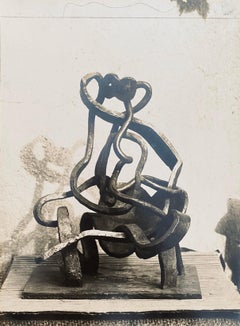
Vintage Silver Gelatin Photograph Jacques Lipchitz Bronze Sculpture Photo Signed
By Marc Vaux
Located in Surfside, FL
Marc Vaux, a figure of Montparnasse, pro­duced a trove of pho­tographs which are cur­rently held in the col­lec­tion of the Centre Pompidou in Paris, France. Marc Vaux was com­mitted equally to sup­porting artists, notably by cre­ating the Foyer des Artistes (1946-70) and, in 1951, the first Musée du Montparnasse at 10, rue de l’Arrivée. Marc Vaux was born on February 19, 1895 in Crulai, Normandy Thanks to the color mer­chant from whom he bought his plates and his pho­to­graphic equip­ment, he met the sculptor Charles Desvergnes winner of Prix the Rome and author of var­ious memo­rials who was looking for someone to pho­tographs his works. Two of Marc Vaux’s first clients were his neigh­bors of 21 Avenue du Maine- Marie Vassilieff and Maria Blanchard...
Category

1930s Modern Abstract Photography

Materials

Photographic Paper, Silver Gelatin

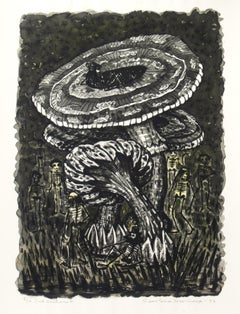
Sub Culture
By Caroline Durieux
Located in San Francisco, CA
This artwork titled "Sub Culture" c1972 is an original color lithograph on wove paper by noted New Orleans artist Caroline Spellman Wogan Durieux, 1896-1989. It is hand signed, titled, dated and numbered 5/10 in pencil by the artist. The image size is 17.75 x 13 inches, sheet size is 19.85 x 15 inches. It is in excellent condition, some hanging tape from previous framing remaining on the back. About the artist: As a Southern female satirist, Caroline Spellman Wogan Durieux was a rare phenomenon in the early twentieth century. Today, she is highly regarded for her stinging lithographs that touch on human foibles as well as some of the important issues of her day. Born to a family of Creole descent in New Orleans, young Caroline was precocious; she began drawing at age four and completed a portfolio of watercolors depicting her city by the time she was twelve. She took lessons from Mary Butler, a member of the art faculty at Sophie Newcomb College, and, beginning in 1912, matriculated at the school full-time, where her instructors included Ellsworth Woodward, chair of the art department. She graduated with a bachelor’s degree in design in 1916 and one in education in 1917. Awarded a scholarship by the New Orleans Art Association, Durieux pursued further coursework at the Pennsylvania Academy of the Fine Arts from 1918 to 1920. Years later, she was encouraged to try lithography by Carl Zigrosser, an expert curator of prints at the Philadelphia Museum of Art, who became her mentor. With her husband Pierre Durieux—an importer of Latin American goods and later the chief representative of General Motors for South America—Caroline Durieux spent time in Cuba during the early 1920s. The couple moved in 1926 to Mexico City, where she met the great muralist Diego Rivera and became involved in the local art community. Following a short interval in New York City, Durieux went back to Mexico in 1931 and enrolled at the Academy of San Carlos (now the National University of Mexico) to study lithography. She returned to New Orleans seven years later and was hired to teach at her alma mater, Newcomb College, from 1938 to 1943. Starting in 1939, Durieux served as the director of Louisiana’s Works Progress Administration program, and her division was the only one in the state not to practice racial discrimination. This was a matter she felt strongly about, stating: “I had a feeling that an artist is an artist and it doesn’t make any difference what color he or she is.” From 1943 until her retirement in 1964, Durieux was a member of the faculty at Louisiana State University in Baton Rouge. Durieux’s forte was lithography, a technique popular in the mid-nineteenth century and long associated with social commentary, and her prints proved no exception. Her work in the 1930s and 1940s coincided with a rise in art that dealt with poverty, racism, and totalitarianism. She often presented stereotyped social climbers...
Category

Late 20th Century American Modern Figurative Prints

Materials

Lithograph

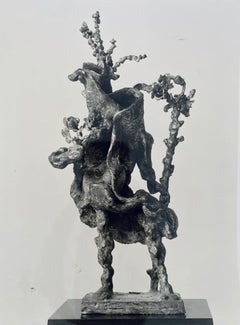
Vintage Silver Gelatin Photograph Jacques Lipchitz Bronze Sculpture Photo Signed
By Adolph Studly
Located in Surfside, FL
Adolph Studly, Swiss born American photographer. His work is kept in the Photographic Archive at The Museum of Modern Art Archives, New York. He was known for his gallery photograp...
Category

1950s Modern Abstract Photography

Materials

Photographic Paper, Silver Gelatin

Vintage Silver Gelatin Photograph Jacques Lipchitz Bronze Sculpture Photo Signed
By Adolph Studly
Located in Surfside, FL
Adolph Studly, Swiss born American photographer. His work is kept in the Photographic Archive at The Museum of Modern Art Archives, New York. He was known for his gallery photograp...
Category

1950s Modern Abstract Photography

Materials

Photographic Paper, Silver Gelatin

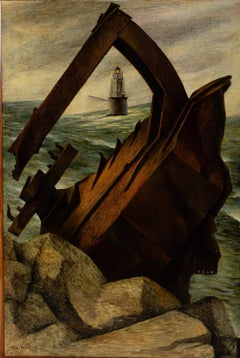
"Motion, " Victor Arnautoff, San Francisco Lighthouse, World s Fair WPA Painting
By Victor Michail Arnautoff
Located in New York, NY
Victor Mikhail Arnautoff (1896 - 1979) Motion (Mile Rocks Lighthouse), San Francisco, 1939 Oil and tempera on board 60 x 40 inches Signed lower left Provenance: The artist California School of Fine Arts (CFSA) John & Lynne Bolen Fine Arts, Huntington Beach, California Exhibited: New York, World's Fair, Exhibition of Contemporary American Art, 1939. San Francisco Museum of Art, 1962. Literature: American Art from the New York World's Fair 1939, Poughkeepsie, 1987, no. 11, p. 41, illustrated. Robert W. Cherny, Victor Arnautoff and the Politics of Art, Urbana, Illinois, 2017. The lighthouse in the distance is the Mile Rocks Lighthouse in San Francisco Bay, built in 1906 after many shipwrecks made the lighthouse necessary. In 1962 the lighthouse was reduced in size to make room for a helipad. Arnautoff was the son of a Russian Orthodox priest. He showed a talent for art from an early age and hoped to study art after graduating from the gymnasium in Mariupol. With the outbreak of World War I, he enrolled in the Yelizavetgrad Cavalry School. He went on to hold military leadership positions in the army of Nicholas II and the White Siberian army. With the defeat of the Whites in Siberia, he crossed into northeastern China and surrendered his weapons. Arnautoff remained in China for five years. He again tried to pursue art, but was impoverished and took a position training the cavalry of the warlord Zhang Zuolin. He met and married Lydia Blonsky and they had two sons, Michael and Vasily. In November 1925 Arnautoff went to San Francisco on a student visa to study at the California School of Fine Arts. There he studied sculpture with Edgar Walter and painting with several instructors. His wife and children joined him, and they all continued to Mexico in 1929, where, on Ralph Stackpole...
Category

1930s American Realist Landscape Paintings

Materials

Canvas, Oil, Tempera

"El Fud" (FRAMED) Painting 14.5" x 20" inch by Antonio Pelayo
By Antonio Pelayo
Located in Culver City, CA
"El Fud" (FRAMED) Painting 14.5" x 20" inch by Antonio Pelayo Medium: Pencil on Paper, Acrylic Ink Paint on Animation Acetate Size: 12" x 17" inch Size framed: 14.5" x 20" in...
Category

21st Century and Contemporary Contemporary Figurative Paintings

Materials

Paper, Ink, Acrylic, Pencil

Wifredo Lam - Original Handsigned Lithograph -El ultimo viaje del buque fantasma
By Wifredo Lam
Located in Collonge Bellerive, Geneve, CH
Original lithograph, hand-signed and hand-numbered in pencil by the artist. Edition: 56/99 Excellent Conditions Dimensions: 76 x 56 cm Reference : Catalogue raisonné Tonneau-Ryckely...
Category

1970s Post-Modern Figurative Prints

Materials

Lithograph

California Abstract Expressionist Linocut Lithograph Ronald Reagan Political Art
By Hans Burkhardt
Located in Surfside, FL
Untitled, 1983, lithograph printed in sepia ink, Hand signed and dated lower right, with the artist's chop mark lower left, inscribed by artist. From a series of experimental abst...
Category

1980s Abstract Expressionist Abstract Prints

Materials

Lithograph, Linocut

Israeli Round Tondo Hard Edged Geometric Abstract Color Painting Reuven Berman
Located in Surfside, FL
Reuven Kadim (Mark Berman) Kadim, Israeli, born Philadelphia, Pennsylvania,USA, 1929-2014. Identified with geometric abstract art. Since 1985 worked with classical ancient Mediterranean imagery, and Since 1995 worked exclusively with computer on new versions of Islamic and fractal patterns. 1983 Curator of the 17th International Biennale of Sao Paulo, Brazil. 1961-72 Art Critic for "Jerusalem Post"; 1966-73 Art Critic for "Yedioth Ahronoth" newspaper. Lived and worked in Rehovot. Education 1948-49 Los Angeles City College, California, USA, Anthropology and Architectural Design 1954-56 New Bezalel School of Art, Jerusalem Teaching 1977-84 The Technion, Israel Institute of Technology, Haifa, Architecture, and Town Planning since 1979 Bezalel Academy of Art & Design, Jerusalem 1984 Sadna Workshop for Architecture and Design, Tel Aviv. Reuven Berman...
Category

1970s Hard-Edge Abstract Paintings

Materials

Wood, Plywood, Paint, Acrylic

Large Mid Century Modern Texas Artist Abstract Geometric Minimalist Oil Painting
By Duanye Hatchett
Located in Buffalo, NY
An abstract expressionist painting by Duayne Hatchett . Oil on canvas, circa 1990. Signed verso. Framed. Image size, 60"H x 50"L. Duayne Hatchett was a visual artist whose work included prints, paintings, sculpture, and found objects. He was born on May 12, 1925 in Shawnee, Oklahoma. He enlisted in the Air Force where he trained to become a fighter pilot. After leaving the militrary he studied design at the University of Oklahoma. His highly technical military training combined a mathematical intelligence with a love for physics and a daring embrace of new experience, all of which would soon be the tools for his evolution through art. Two major influences interacted on his early development at OU. Emelio Omero, a colleague and close friend of Diego Rivera, introduced him to the revolutionary art ideas of Mexico City, while teaching him a wide range of printing techniques that would culminate in a Masters Degree in Painting in 1952. During this time he met Bruce Goff, a renowned Wright disciple, who was teaching architecture at OU and befriended Hatchett, introducing him to the most avant-garde architecture of that time. He spent his summers while at OU designing for a small sign shop, which introduced him to new materials used for building neon, plastic, and metal signs. The use of new materials and a keen sense for design would soon become invaluable building blocks for future sculpture. During this time he met and married Mary Ellen Jeffries. They would spend their lives together and raise three children, David (me), my brother Dana, and my sister Jeffri. As children, they were immersed in art from childhood and benefited greatly from this loving art and domestic environment. Hatchett was always interested in the techniques of construction, often watching different tradesmen working, understanding how materials are put together to create the manmade environment that surrounded him. While teaching printmaking at Oklahoma City University from 1951 through ‘54, he began to build sculpture employing some of the materials and techniques that he saw workers using. He was beginning to draw the attention of architects and he became interested in their work-trade processes, moving from blue prints to construction. He accepted an invitation from Alexander Hogue...
Category

1990s Abstract Abstract Paintings

Materials

Canvas, Oil, Acrylic

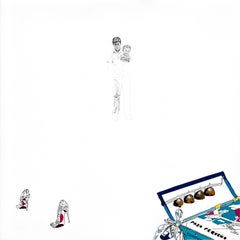
"Las Metas Pequeńas" (FRAMED) Painting 21" x 20.5" inch by Antonio Pelayo
By Antonio Pelayo
Located in Culver City, CA
"Las Metas Pequeńas" (FRAMED) Painting 21" x 20.5" inch by Antonio Pelayo Medium: Pencil on Paper. Acrylic Ink & Paint on Animation Acetate Image size: 15" x 15" inch Size framed...
Category

21st Century and Contemporary Contemporary Figurative Drawings and Water...

Materials

Ink, Acrylic

"Igualdad" (FRAMED) Painting 14.5" x 20" inch by Antonio Pelayo
By Antonio Pelayo
Located in Culver City, CA
"Igualdad" (FRAMED) Painting 14.5" x 20" inch by Antonio Pelayo Medium: Pencil on Paper, Acrylic Ink Paint on Animation Acetate Size: 12" x 17" inch Size framed: 14.5" x 20" ...
Category

21st Century and Contemporary Contemporary Figurative Paintings

Materials

Paper, Ink, Acrylic, Pencil

"Untitled 27" (FRAMED) Pencil Drawing 21" x 18" inch by Antonio Pelayo
By Antonio Pelayo
Located in Culver City, CA
"Untitled 27" (FRAMED) Pencil Drawing 21" x 18" inch by Antonio Pelayo Medium: Pencil on Paper Artist Antonio Pelayo, born in Glendale, California, and yet raised for most of his c...
Category

21st Century and Contemporary Contemporary Figurative Drawings and Water...

Materials

Paper, Pencil

"Memorias" (FRAMED) Painting 34" x 28" inch by Antonio Pelayo
By Antonio Pelayo
Located in Culver City, CA
"Memorias" Painting 34" x 28" inch by Antonio Pelayo Medium: Acrylic Ink Paint on Animation Acetate Image size: 25" x 19" inch Size framed: 34" ...
Category

21st Century and Contemporary Contemporary Figurative Paintings

Materials

Ink, Acrylic

Huge Mid Century Modern Texas Artist Abstract Expressionist Original Painting
By Duanye Hatchett
Located in Buffalo, NY
An abstract expressionist painting by Duayne Hatchett . Oil on canvas, circa 1990. Signed verso. Framed. Image size, 60"H x 56"L. Duayne Hatchett was a visual artist whose work...
Category

1990s Abstract Abstract Paintings

Materials

Canvas, Acrylic

Los Carpinteros Cuban Art Photograph Tuneles Populares Silver Gelatin Photo
By Los Carpinteros
Located in Surfside, FL
Los Carpinteros (Cuban, 1992-present). Silver gelatin print photograph, large format. From the series "Tuneles Populares" (The People's Tunnels) 1999 Edition 1/5 Provenance: Bliss Fi...
Category

1990s Conceptual Landscape Photography

Materials

Silver Gelatin

Itzhak Holtz (Judaica Master) Oil Painting Portrait John Sloan Ashcan Artist WPA
By Itshak Holtz
Located in Surfside, FL
Oil Painting Portrait of Ashcan Artist John Sloan. Signed I. Holtz. The youngest of four children, Holtz was born and spent his early childhood in Skierniewice, Poland, a small town near Warsaw. His father was a hat maker and a furrier. In 1935, prior to World War II, when Holtz was ten years old, his family moved to Jerusalem, Israel, where they settled in the Geula neighborhood near Meah Shearim. Itzhak Holtz's passion for art began early. When he was five years old, in Poland, his father first drew a picture of a horse and sled in the snow for him. The young Holtz looked at the drawing and studied it in wonderment. From that moment on, Holtz remembers, he constantly begged his father to draw for him. His enthusiasm for art grew and Holtz longed to study art. In 1945, he enrolled at the Bezalel Academy of Art and Design in Jerusalem, where he primarily studied lettering and poster work in a program geared toward commercial art Holtz became interested in painting, prompting him to move to New York City in 1950 to study at the Art Students League of New York under Robert Brackman and Harry Sternberg, and then at the National Academy of Design under Robert Philipp. Holtz has stated that his artwork, which primarily but not exclusively, depict scenes of Jewish spirituality and tradition, is driven by his Orthodox Jewish beliefs: "You have to live that religious life to fully capture it on canvas." He has been classified in the school of genre painting, often depicting street scenes of ordinary people in everyday Jewish life in the back alleys and markets of Jerusalem neighborhoods such as Me'ah Shearim and Geula; and in New York neighborhoods and hamlets such as Monsey, Boro Park and Williamsburg. Along with street scenes, his work includes portraits of scribes, tailors, cobblers and fishmongers, and images such as shtetls, lighthouses, and wedding scenes. He started out painting mostly portraits in order to support his family, before expanding to include street scenes. His beloved subject matter is painting scenes of Jewish life, his childhood memories when his mother took him along shopping for the Sabbath to the markets of Meah Shearim, has left a deep impression on him and influenced many of his works. Holtz has experimented in the abstract, but then reverted to representational and figurative art to which he devoted himself exclusively. His Israeli street scenes are said to combine “an affectionate recollection of the past with the brilliance of the color of modern Israel.” Holtz has stated that he struggled at first when he arrived to the USA because of financial reasons and because he only knew Polish, Yiddish and Hebrew, but then made good ties with his instructor who greatly influenced him Robert Philipp who helped him make friends and referred him to paint portraits. Examples of Holtz's work throughout the years include: Yerusalem Wedding (2010), depicting a Chuppa in Jerusalem on early evening, oil on canvas; The Funeral(1966), depicting five stoic Hasidim carrying a body on a bier over to a gravesite, with the people behind them crying, in charcoal on paper and oil on canvas; Rejoicing (1974), an image of religious men dancing, in felt pen and marker on paper; and the oil painting Shamash Learning in Shul (2003), a portrait of a pious Jew studying the Talmud inside a claustrophobic synagogue scene. Throughout the years Holtz has created hundreds of works in many art mediums, including, genre scenes, portraits, still lifes and landscape scenery, his works are sought after by art collectors worldwide, and he has been called the greatest living Jewish artist. It is said that no artist ever explored the Jewish subject like Holtz. Today some of his oil paintings have been commanding over $100,000. Holtz creates his scenes after researching locations, and often uses locals as models. He paints slowly and with great care, but with a swift Impressionistic style. The people in his portraits and scenes are generally more cheerful and optimistic than standard portraits of Hassidic individuals. He paints oils and watercolors, and also does felt pen, pastel, marker, ink and charcoal drawings, as well as woodcuts. His oil paintings typically have a brown hue, while his work with felt pen is often in sepia tones, and on some of his works he used very bright colors, with a strong emphasis on the interplay of light and shadow. He is heavily influenced by the ancient staircases and alleyways of Jerusalem, with its modest religious population, which has made a strong impression on him in his youth, the streets of Tzfat, and the works of Rembrandt, Johannes Vermeer and Peter Bruegel, as well as Jewish artists Moritz Daniel Oppenheim...
Category

1940s Realist Portrait Paintings

Materials

Canvas, Oil

"Ladrillo" (FRAMED) Painting 20.5" x 21" inch by Antonio Pelayo
By Antonio Pelayo
Located in Culver City, CA
"Ladrillo" (FRAMED) Painting 20.5" x 21" inch by Antonio Pelayo Medium: Pencil on Paper. Acrylic Ink & Paint on Animation Acetate Image size: 15" x 1...
Category

21st Century and Contemporary Contemporary Figurative Drawings and Water...

Materials

Ink, Acrylic

"El Purerco" (FRAMED) Painting 14.5" x 20" inch by Antonio Pelayo
By Antonio Pelayo
Located in Culver City, CA
"El Purerco" (FRAMED) Painting 14.5" x 20" inch by Antonio Pelayo Medium: Pencil on Paper, Acrylic Ink & Paint on Animation Acetate Size: 12" x 17" inch Size framed: 14.5" x 20" in...
Category

21st Century and Contemporary Contemporary Figurative Paintings

Materials

Paper, Ink, Acrylic, Pencil

Huge Mid Century Modern Texas Artist Abstract Expressionist Minimalist Painting
By Duanye Hatchett
Located in Buffalo, NY
An abstract expressionist painting by Duayne Hatchett . Oil on canvas, circa 1990. Signed verso. Framed. Image size, 60"H x 55"L. Duayne Hatchett was a visual artist whose work...
Category

1990s Abstract Abstract Paintings

Materials

Canvas, Acrylic

Monumental Mid Century Modern Abstract Minimalist Sleek Design Oil Painting
By Duanye Hatchett
Located in Buffalo, NY
An abstract mid century painting by Duayne Hatchett . Oil on canvas, circa 1973. Signed verso. Framed. Duayne Hatchett was a visual artist whose work included prints, painting...
Category

1970s Abstract Abstract Paintings

Materials

Canvas, Oil, Acrylic

Mid Century Modern Texas Artist Abstract Expressionist Thick Impasto Painting
By Duanye Hatchett
Located in Buffalo, NY
An abstract expressionist painting by Duayne Hatchett . Oil on canvas, circa 1990. Signed verso. Framed. Image size, 60"H x 56"L. Duayne Hatchett was a visual artist whose work...
Category

1990s Abstract Abstract Paintings

Materials

Canvas, Acrylic

Monumental Mid Century Modern Abstract Minimalist Sleek Design Oil Painting
By Duanye Hatchett
Located in Buffalo, NY
An abstract mid century painting by Duayne Hatchett . Oil on canvas, circa 1973. Signed verso. Framed. Duayne Hatchett was a visual artist whose work included prints, painting...
Category

1970s Abstract Abstract Paintings

Materials

Canvas, Oil, Acrylic

Geometric Abstract Oil Painting Textured Black Grey Duanye Hatchett Original
By Duanye Hatchett
Located in Buffalo, NY
An abstract painting by Duayne Hatchett from his Trowel Painting Series. Oil on canvas, circa 1994. Signed. Unframed. Duayne Hatchett was a visual artist whose work included pr...
Category

1990s Abstract Abstract Paintings

Materials

Canvas, Acrylic

"Reflection " (FRAMED) Print 15" x 15" in by Antonio Pelayo x Isaac Pelayo
By Antonio Pelayo
Located in Culver City, CA
"Reflection " (FRAMED) Print 15" x 15" in by Antonio Pelayo x Isaac Pelayo Artist Antonio Pelayo, born in Glendale, California, and yet raised for most of his childhood in the Mexic...
Category

21st Century and Contemporary Contemporary Figurative Prints

Materials

Spray Paint, Digital

"Lavate Los Dientes" (FRAMED) Painting 21" x 20.5" inch by Antonio Pelayo
By Antonio Pelayo
Located in Culver City, CA
"Lavate Los Dientes" (FRAMED) Painting 21" x 20.5" inch by Antonio Pelayo Medium: Pencil on Paper. Acrylic Ink Paint on Animation Acetate Image...
Category

21st Century and Contemporary Contemporary Figurative Drawings and Water...

Materials

Ink, Acrylic

"El Hombre" (FRAMED) Painting 14.5" x 20" inch by Antonio Pelayo
By Antonio Pelayo
Located in Culver City, CA
"El Hombre" (FRAMED) Painting 14.5" x 20" inch by Antonio Pelayo Medium: Pencil on Paper, Acrylic Ink & Paint on Animation Acetate Size: 12" x 17" inch Size framed: 14.5" x 20" inc...
Category

21st Century and Contemporary Contemporary Figurative Paintings

Materials

Paper, Ink, Acrylic, Pencil

"I DO IT MYSELF" (FRAMED) Portrait Painting 30" x 24" inch by Antonio Pelayo
By Antonio Pelayo
Located in Culver City, CA
"I DO IT MYSELF" (FRAMED) Portrait Painting 30" x 24" inch by Antonio Pelayo Medium: Marker on paper Size: 30" x 24" inch Size framed: 34" x 27.5" inch From Pelayo VS Pelayo exhib...
Category

21st Century and Contemporary Contemporary Figurative Paintings

Materials

Paper, Ink, Acrylic, Pencil

Monumental Mid Century Modern Abstract Minimalist Sleek Design Oil Painting
By Duanye Hatchett
Located in Buffalo, NY
An abstract mid century painting by Duayne Hatchett . Oil on canvas, circa 1973. Signed verso. Framed. Duayne Hatchett was a visual artist whose work included prints, painting...
Category

1990s Abstract Abstract Paintings

Materials

Canvas, Oil, Acrylic

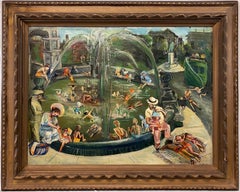
“Washington Square Park, 1938” NYC Social Realism Female American Artist Oil
By Dorothy Eisner
Located in Yardley, PA
An exceptional, large, early work by American artist Dorothy Eisner (1906-1984). This painting was recently exhibited at Gracie Mansion in 2019 as part of “She Persists” - a show de...
Category

1930s American Modern Figurative Paintings

Materials

Canvas, Oil

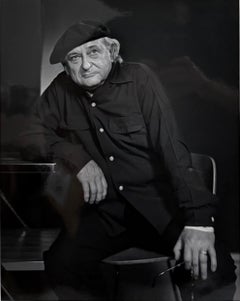
Sculptor Jacques Lipchitz Photograph Portrait Yousuf Karsh Photo Vintage Print
By Yousuf Karsh
Located in Surfside, FL
YOUSUF KARSH Vintage Photograph of Sculptor Jacques Lipchitz, Dimensions: sight 13 x 10-1/2 overall size is 16.5 X 14 inches mat This bears a studio stamp verso inscribed Copyright...
Category

20th Century Modern Black and White Photography

Materials

Photographic Paper

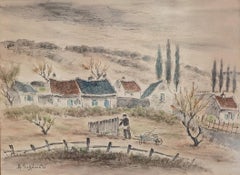
"Suburb of Gif-sur-Yvette, France" Henry Yuzuru Sugimoto, Modernist Landscape
Located in New York, NY
Henry Yuzuru Sugimoto Suburb of Gif-sur-Yvette, France, circa 1928-32 Signed lower left Watercolor on paper 11 x 14 inches Henry Sugimoto was born in Wakayama, Japan, on March 12, 1900. His father left for the United States shortly after he was born, and his mother joined him some years later, with the result that the young Henry was raised largely by his grandparents. Following the end of World War I, Henry Sugimoto arrived in the United States as a "yobiyose" (child brought over) and settled with his parents in Hanford, California. After attending Hanford High School, he enrolled at the University of California, Berkeley. He soon grew absorbed in art and his parents agreed to let him enroll at the California School of Arts and Crafts. After studying there for four years with a concentration in oil painting, he graduated with honors in 1928. He then moved to the California School for Fine Arts, but after a year there he decided to travel to France, the international artistic capital, for further study. Once arrived in Paris, Sugimoto became close to the circle of Japanese...
Category

1930s Modern Figurative Drawings and Watercolors

Materials

Paper, Watercolor

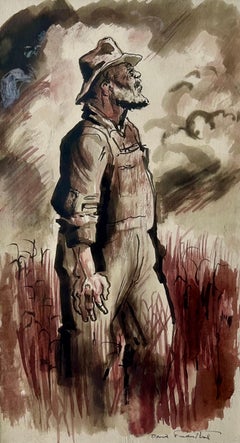
TOBACCO ROAD Mid 20th Century Realism 1940 Drawing from the Novel WPA Literary 3
By David Fredenthal
Located in New York, NY
TOBACCO ROAD Mid 20th Century Realism 1940 Drawing from the Novel WPA Literary 3 10 1/2 x 6 (sight), Signed David Fredenthal lower right. Framed by Lowy. Offered here is one of several original drawings by WPA artist David Fredenthal that were first published in the 1940 illustrated edition of the novel TOBACCO ROAD by Erskine Caldwell. Background on the Drawing Erskine Caldwell remarked, on seeing the work of David Fredenthal, 26-year-old painter: "That boy could draw my Tobacco Road people." A casual comment, it was enormously productive. The young painter was just finishing a two-year Guggenhcim Fellowship, preceded by a year's study in Paris, two one-man shows at New York's Downtown Gallery, and a fellowship at the Cranbrook Academy near Detroit. He was out in Colorado Springs when he heard what Caldwell had said about him. Fredenthal hadn't read Tobacco Road. He had not even seen the play - now breaking all records in its seventh year on Broadway. But he swapped a portrait for a second-hand Ford and headed East. In New York he learned that Dnell, Sloan & Pearce were bringing out a deluxe edition of Tobacco Road. But he had no entrée to the publishers, and Caldwell, to his disappointment, was out of town. So he drove on to Georgia to have a look at the Tobacco Road people. He found Dr. I. C. Caldwell, the author's father, in Wrens, Ga., going on his ministerial rounds among people like the Lesters. Fredenthal got a room from a couple who ran a 1-pump filling station...
Category

1930s American Realist Figurative Drawings and Watercolors

Materials

Paper, Ink, Watercolor

"I M NOT TIRED" (FRAMED) Painting 30" x 24" inch by Antonio Pelayo
By Antonio Pelayo
Located in Culver City, CA
"I'M NOT TIRED" (FRAMED) Painting 30" x 24" inch by Antonio Pelayo Medium: Marker on paper Size: 30" x 24" inch Size framed: 34" x 27.5" inch From Pelayo VS Pelayo exhibition: The...
Category

21st Century and Contemporary Contemporary Figurative Paintings

Materials

Paper, Ink, Acrylic, Pencil

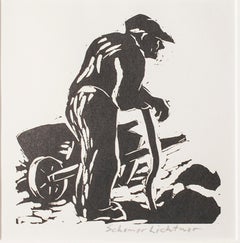
"Rest, " Farmer leaning on Work Tool Linoleum Cut signed by Schomer Lichtner
By Schomer Lichtner
Located in Milwaukee, WI
"Rest" is an original linoleum print by Schomer Lichtner, signed in the lower right hand corner. It features a man in the act of resting on a stick in the middle of work. Image: 5.6...
Category

1930s American Modern Figurative Prints

Materials

Linocut

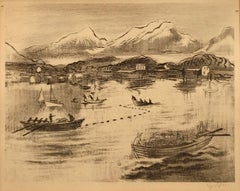
"Fishing Village" Joe Jones, Mid-Century, American Life, Small Town Scene
By Joe Jones
Located in New York, NY
Joe Jones Fishing Village, 1949 Signed in pencil lower right margin Lithograph on wove paper Image 9 5/16 x 12 9/16 inches Sheet 12 x 15 15/16 inches From the edition of 250 The initial details of Jones' career are sparse, and this is intentional. The young artist was engaged in a process of self-reinvention, crafting a persona. When he submitted a work to the Sixteen Cities Exhibition at New York City's Museum of Modern Art in 1933, he briefly characterized himself: "Born St. Louis, 1909, self-taught. " Jones intentionally portrayed himself to the art community as an authentic working-class figure, backed by a compelling history. He was the youngest of five children in a family led by a one-armed house painter from St. Louis, a Welsh immigrant, and his German American spouse. At the age of ten, Jones found himself in a Missouri reformatory due to authorities' concerns over his graffiti activities. After completing elementary school, he traveled by freight car to California and back, even being arrested for vagrancy in Pueblo, Colorado. Returning to St. Louis, he attempted to settle down by working alongside his father. Yet, Jones felt a profound restlessness and was drawn toward a more elevated artistic pursuit in his late teenage years. He discovered a local collective of budding artists that formed St. Louis’s "Little Bohemia," sharing a studio and providing mutual support until he managed to secure his own modest workspace in a vacant garage. Jones’s initial creations comprised still lifes, landscapes, and poignant portraits of those close to him. These subjects were not only accessible but also budget-friendly, as hiring models was beyond his means. He depicted himself, his father, mother, and eventually, his wife. In December 1930, at the age of 21, Jones wed Freda Sies, a modern dancer and political activist who was four years older than him. By 1933, Jones had started gaining noteworthy local recognition through a solo exhibition at the Artists’ Guild of Saint Louis. Of the twenty-five paintings on display, one, titled River Front (private collection, previously with Hirschl and Adler Galleries), was selected to illustrate a feature article about his show in The Art Digest (February 15, 1933, p. 9). Shortly before this exhibition, a young surgeon named Dr. Robert Elman took an interest in Jones’s art, purchasing several pieces and forming a group of potential patrons committed to providing the emerging artist with a monthly stipend in exchange for art. This group was officially known as the "Co-operative Art Society," but it was informally dubbed the "Joe Jones Club. " Jones became an active participant in the St. Louis artistic scene, particularly within its bohemian segments. He embraced modernism and was a founding member of the "New Hat" movement in 1931, a playful rebellion against the conservative and traditional mainstream art establishment. The summer of 1933 marked a significant shift in Jones’s journey. Sponsored by a dedicated ally, Mrs. Elizabeth Green, Jones, along with Freda and Green, embarked on an eastward road trip. In Washington, D. C., they explored the Corcoran Gallery of Art, the Freer Gallery (part of the Smithsonian Institution), the Library of Congress, and Mount Vernon. Following this whirlwind of art and American culture, they made their way to New York, where they visited various museums and galleries, including a stop at The New School for Social Research, which featured notable contemporary murals by fellow Missourian Thomas Hart Benton and the politically active Mexican artist, José Clemente Orozco. From June through August, Jones and Freda resided in the artist colony of Provincetown, Massachusetts, later returning home via Detroit to see Diego Rivera’s Detroit Industry mural housed at the Detroit Institute of Fine Arts. While Elizabeth Green allegedly hoped that Jones would refine his artistic skills under the guidance of Charles Hawthorne or Richard Miller in Provincetown, Jones followed a different path. Rather than pursuing conservative mentors, he connected with an engaging network of leftist intellectuals, writers, and artists who dedicated their time to reading Marx and applying his theories to the American landscape. Jones's reaction to the traditional culture of New England was captured in his statement to a reporter from the St. Louis Post Dispatch: “Class consciousness . . . that’s what I got of my trip to New England. Those people [New Englanders] are like the Chinese—ancestor worshipers. They made me realize where I belong” (September 21, 1933). The stark social divisions he witnessed there prompted him to embrace his working-class identity even more fervently. Upon returning to St. Louis, he prominently identified himself as a Communist. This newfound political stance created friction with some of his local supporters. Many of his middle-class advocates withdrew their backing, likely influenced not only by Jones’s politics but also by his flamboyant and confrontational demeanor. In December 1933, Jones initiated a complimentary art class for unemployed individuals in the Old Courthouse of St. Louis, the same location where the Dred Scott case was deliberated and where slave auctions formerly took place. Concurrently, the St. Louis Art League was offering paid courses. Emphasizing the theme of social activism, with a studio adorned with Soviet artwork, Jones’s institution operated for just over a year before being removed from the courthouse by local officials. The school’s political focus and unconventional teaching practices, along with its inclusion of a significant number of African American students during a period marked by rigid racial segregation, certainly contributed to its challenges. Under Jones’s guidance, the class created a large chalk pastel mural on board, measuring 16 by 37 feet, titled Social Unrest in St. Louis. Mural painting posed no challenge for the former housepainter, who was adept at handling large wall surfaces. His first significant commission in St. Louis in late 1931 was a mural that celebrated the city’s industrial and commercial fortitude for the local radio station, KMOX. This mural, aimed at conveying optimism amid severe economic hardship, showcased St. Louis's strengths in a modernist approach. When Jones resumed mural work in late 1933, his worldview had evolved considerably. The mural produced for the school in the courthouse, conceived by Jones, featured scenes of modern St. Louis selected to highlight political messages. Jones had observed the technique of utilizing self-contained scenes to craft visual narratives in the murals he encountered in the East. More locally, this compositional strategy was commonly employed by the renowned Missouri artist...
Category

1940s American Realist Landscape Prints

Materials

Paper, Lithograph

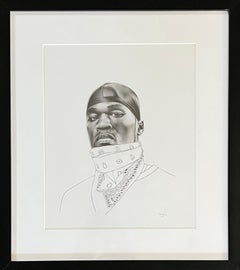
"50" (FRAMED) 50 Cent Portrait Pencil Drawing 17" x 15" inch by Antonio Pelayo
By Antonio Pelayo
Located in Culver City, CA
"50" (FRAMED) 50 Cent Portrait Pencil Drawing 17" x 15" inch by Antonio Pelayo Medium: Pencil on Paper Artist Antonio Pelayo, born in Glendale, California, and yet raised for most ...
Category

21st Century and Contemporary Contemporary Figurative Drawings and Water...

Materials

Paper, Pencil

"El Bańo" (FRAMED) Painting 20.5" x 21" inch by Antonio Pelayo
By Antonio Pelayo
Located in Culver City, CA
"El Bańo" (FRAMED) Painting 20.5" x 21" inch by Antonio Pelayo Medium: Pencil on Paper, Acrylic Ink Paint on Animation Acetate Artist Antonio Pelayo, born in Glendale, Calif...
Category

21st Century and Contemporary Contemporary Figurative Paintings

Materials

Paper, Ink, Acrylic, Pencil

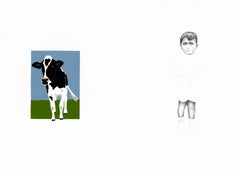
"La Vaca" (FRAMED) Painting 14.5" x 20" inch by Antonio Pelayo
By Antonio Pelayo
Located in Culver City, CA
"La Vaca" (FRAMED) Painting 14.5" x 20" inch by Antonio Pelayo Medium: Pencil on Paper, Acrylic Ink Paint on Animation Acetate Size: 12" x 17" inch Size framed: 14.5" x 20" i...
Category

21st Century and Contemporary Contemporary Figurative Paintings

Materials

Paper, Ink, Acrylic, Pencil

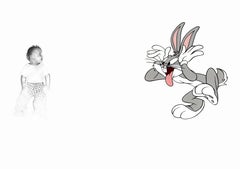
"Conejo" (FRAMED) Painting 14.5" x 20" inch by Antonio Pelayo
By Antonio Pelayo
Located in Culver City, CA
"Conejo" (FRAMED) Painting 14.5" x 20" inch by Antonio Pelayo Medium: Pencil on Paper, Acrylic Ink Paint on Animation Acetate Size: 12" x 17" inch Size framed: 14.5" x 20" in...
Category

21st Century and Contemporary Contemporary Figurative Paintings

Materials

Paper, Ink, Acrylic, Pencil

"Sueńos Chicos" (FRAMED) Painting 21" x 20.5" inch by Antonio Pelayo
By Antonio Pelayo
Located in Culver City, CA
"Sueńos Chicos" (FRAMED) Painting 21" x 20.5" inch by Antonio Pelayo Medium: Pencil on Paper. Acrylic Ink & Paint on Animation Acetate Image size: 15...
Category

21st Century and Contemporary Contemporary Figurative Drawings and Water...

Materials

Ink, Acrylic

"Calica" (FRAMED) Painting 14.5" x 20" inch by Antonio Pelayo
By Antonio Pelayo
Located in Culver City, CA
"Calica" (FRAMED) Painting 14.5" x 20" inch by Antonio Pelayo Medium: Pencil on Paper, Acrylic Ink & Paint on Animation Acetate Size: 12" x 17" inch Size framed: 14.5" x 20" inch ...
Category

21st Century and Contemporary Contemporary Figurative Paintings

Materials

Paper, Pencil, Ink, Acrylic

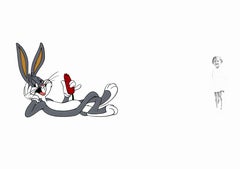
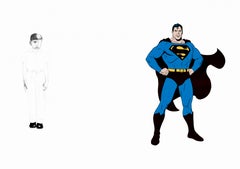
"Super Artist" (FRAMED) Painting 14.5" x 20" inch by Antonio Pelayo
By Antonio Pelayo
Located in Culver City, CA
"Super Artist" (FRAMED) Painting 14.5" x 20" inch by Antonio Pelayo Medium: Pencil on Paper, Acrylic Ink & Paint on Animation Acetate Size: 12" x 17" inch Size framed: 14.5" x 20" ...
Category

21st Century and Contemporary Contemporary Figurative Paintings

Materials

Paper, Ink, Acrylic, Pencil

"Della" (FRAMED) Painting 19" x 22" inch by Antonio Pelayo
By Antonio Pelayo
Located in Culver City, CA
"Della" (FRAMED) Painting 19" x 22" inch by Antonio Pelayo Medium: Acrylic Ink & Paint on Animation Acetate Size: 13" x 15" inch Size framed: 19" x 22" inch Artist Antonio Pelayo,...
Category

21st Century and Contemporary Contemporary Figurative Paintings

Materials

Paper, Ink, Acrylic, Pencil

"Untitled 28" (FRAMED) Pencil Drawing 21" x 18" inch by Antonio Pelayo
By Antonio Pelayo
Located in Culver City, CA
"Untitled 28" (FRAMED) Pencil Drawing 21" x 18" inch by Antonio Pelayo Size unframed: 15.5" x 13.5 inch Medium: Pencil on Paper Artist Antonio Pelayo, born in Glendale, California...
Category

21st Century and Contemporary Contemporary Figurative Drawings and Water...

Materials

Paper, Pencil

"Untitled 29" (FRAMED) Pencil Drawing 21" x 18" inch by Antonio Pelayo
By Antonio Pelayo
Located in Culver City, CA
"Untitled 29" (FRAMED) Pencil Drawing 21" x 18" inch by Antonio Pelayo Size unframed: 15.5" x 13.5" inch Medium: Pencil on Paper Artist Antonio Pelayo, born in Glendale, California...
Category

21st Century and Contemporary Contemporary Figurative Drawings and Water...

Materials

Paper, Pencil

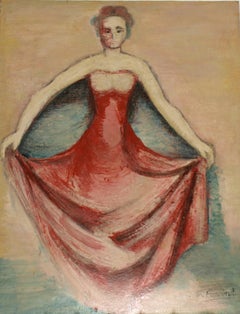
Modern Dance Female Dancer in Red Dress Jazz - oil paint on board circa 1950s
By Raimondo Puccinelli
Located in Rancho Santa Fe, CA
Signed lower right Raimondo (Raymond) Puccinelli (American, 1904-1986). Puccinelli began art training at age 15 at the California School of Fine Art (now the San Francisco Art Institute) and the Schaeffer School of Design. While in Italy in 1927, he studied ancient Italian sculpture (Romanesque, Gothic, and late Renaissance) which affected his future work. After a year of studying in France and Italy with various craftsmen, he returned to San Francisco to assist in the studio of J. Vieira and study under Benny Bufano...
Category

Mid-20th Century American Modern Figurative Paintings

Materials

Oil, Board

"HOW DO YOU KNOW MY NAME?" (FRAMED) Painting 24" x 30" inch by Antonio Pelayo
By Antonio Pelayo
Located in Culver City, CA
"HOW DO YOU KNOW MY NAME?" (FRAMED) Painting 24" x 30" inch by Antonio Pelayo Medium: Marker on paper Size: 24" x 30" inch Size framed: 27.5" x 34" inch From Pelayo VS Pelayo exhi...
Category

21st Century and Contemporary Contemporary Figurative Paintings

Materials

Paper, Permanent Marker, Pencil

"KITTY" (FRAMED) Painting 24" x 30" inch by Antonio Pelayo
By Antonio Pelayo
Located in Culver City, CA
"KITTY" (FRAMED) Painting 24" x 30" inch by Antonio Pelayo Medium: Marker on paper Size: 24" x 30" inch Size framed: 27.5" x 34" inch From Pelayo VS Pelayo exhibition: The exhibit...
Category

21st Century and Contemporary Contemporary Figurative Paintings

Materials

Paper, Permanent Marker, Pencil

"Dont Belong Here" (FRAMED) Painting 18" x 24" inch by Antonio Pelayo
By Antonio Pelayo
Located in Culver City, CA
"Dont Belong Here" (FRAMED) Painting 18" x 24" inch by Antonio Pelayo Medium: Pencil on Paper, Acrylic Ink Paint on Animation Acetate Size: 18" x 24" inch Size framed: 20" x ...
Category

21st Century and Contemporary Contemporary Figurative Paintings

Materials

Paper, Ink, Acrylic, Pencil

"NO WAY JOSE!" (FRAMED) Painting 24" x 30" inch by Antonio Pelayo
By Antonio Pelayo
Located in Culver City, CA
"NO WAY JOSE!" (FRAMED) Painting 24" x 30" inch by Antonio Pelayo Medium: Marker on paper Size: 24" x 30" inch Size framed: 27.5" x 34" inch From Pelayo VS Pelayo exhibition: The ...
Category

21st Century and Contemporary Contemporary Figurative Paintings

Materials

Paper, Permanent Marker, Pencil

"WHY IS THE SKY BLUE?" (FRAMED) Painting 24" x 30" inch by Antonio Pelayo
By Antonio Pelayo
Located in Culver City, CA
"WHY IS THE SKY BLUE?" (FRAMED) Painting 24" x 30" inch by Antonio Pelayo Medium: Marker on paper Size: 24" x 30" inch Size framed: 27.5" x 34" inch From Pelayo VS Pelayo exhibiti...
Category

21st Century and Contemporary Contemporary Figurative Paintings

Materials

Paper, Permanent Marker, Pencil

Fruta Prohibida
By Manuel Alvarez Bravo
Located in Santa Monica, CA
Signed in pencil on recto Manuel Alvarez Bravo was a pioneer of artistic Latin American Photography in the 20th Century and produced a proliferate body ...
Category

Late 20th Century Photography

Materials

Platinum

Observador de Pajaros
By Rufino Tamayo
Located in Missouri, MO
"Observador de Pajaros" 1950 By. Rufino Tamayo (Mexican, 1899-1991) Edition 83/200 Lower Right Signed Lower Left Unframed: 15.5" x 22.5" Framed: 21.75" x 28.25" Rufino Tamayo (August 26, 1899- June 24, 1991) A native of Oaxaca in Southern Mexico, Rufino Tamayo's father was a shoemaker, and his mother a seamstress. Some accounts state that he was descended from Zapotec Indians, but he was actually 'mestizo' - of mixed indigenous/European ancestry. (Santa Barbara Museum of Art). He began painting at age 11. Orphaned at the age of 12, Tamayo moved to Mexico City, where he was raised by his maternal aunt who owned a wholesale fruit business. In 1917, he entered the San Carlos Academy of Fine Arts, but left soon after to pursue independent study. Four years later, Tamayo was appointed the head designer of the department of ethnographic drawings at the National Museum of Archaeology in Mexico City. There he was surrounded by pre-Colombian objects, an aesthetic inspiration that would play a pivotal role in his life. In his own work, Tamayo integrated the forms and tones of pre-Columbian ceramics into his early still lives and portraits of Mexican men and women. In the early 1920s he also taught art classes in Mexico City's public schools. Despite his involvement in Mexican history, he did not subscribe to the idea of art as nationalistic propaganda. Modern Mexican art at that time was dominated by 'The Three Great Ones' : Diego Rivera, Jose Clemente Orozco, and David Alfaro Siqueros, but Tamayo began to be noted as someone 'new' and different' for his blending of the aesthetics of post Revolutionary Mexico with the vanguard artists of Europe and the United States. After the Mexican Revolution, he focused on creating his own identity in his work, expressing what he thought was the traditional Mexico, and refusing to follow the political trends of his contemporary artists. This caused some to see him as a 'traitor' to the political cause, and he felt it difficult to freely express himself in his art. As a result, he decided to leave Mexico in 1926 and move to New York, along with his friend, the composer Carlos Chavez. The first exhibition of Tamayo's work in the United States was held at the Weyhe Gallery, New York, in that same year. The show was successful, and Tamayo was praised for his 'authentic' status as a Mexican of 'indigenous heritage', and for his internationally appealing Modernist aesthetic. (Santa Barbara Museum of Art). Throughout the late thirties and early forties New York's Valentine Gallery gave him shows. For nine years, beginning in 1938, he taught at the Dalton School in New York. In 1929, some health problems led him to return to Mexico for treatment. While there he took a series of teaching jobs. During this period he became romantically involved with the artist Maria...
Category

20th Century Abstract Abstract Prints

Materials

Lithograph

Portrait of Berthe Lipchitz - Modern Portrait Pencil Drawing - Amedeo Modigliani
By Amedeo Modigliani
Located in Marlow, Buckinghamshire
Signed pencil on paper portrait drawing by Italian artist Amedeo Clemente Modigliani. The portrait is of Berthe Lipchitz who was the wife of Modigliani's friend, the sculptor Jacques Lipchitz. This work is a study for "Portrait of Jacques & Berthe Lipchitz" which hangs in the Art Institute of Chicago. Signature: Signed lower right Dimensions: Framed: 26.75"x18.25" Unframed: 18.75"x12.25" Provenance: The collection of Leopold Survage The collection of Dimitri Snegaroff The collection of Leopold Zborowski Galerie Charpentier - Paris 1958 Private french collection Galerie Pierre Levy - Paris Private collection - United Kingdom Exhibited: Galerie Charpentier - Cent Tableaux de Modigliani - Paris, 1958 Les Peintres de Zborowski - ~Foundation L'Hermitage, Lausanne 1994 Amedeo Modigliani Exhibition - Museo d'Arte Moderna, Lugano 1999 Amedeo Modigliani was born into a middle-class Jewish family and was the brother of Eugenio Modigliani, who later became the leader of the Italian socialist workers’ party prior to the rise of fascism. Modigliani suffered from poor health as a child and contracted pleurisy in 1895, followed in 1898 by typhus with pulmonary complications, which culminated in tuberculosis in 1901. He moved to Livorno to study under Guglielmo Micheli, who had himself been a pupil of Giovanni Fattori, one of the Macchiaioli group of painters who worked in strong colour patches (macchie) to achieve vivid light and colour effects; their approach came as a reaction against academic art in Italy and, in much the same way as the French Impressionists, they advocated painting from nature rather than aspiring to communicate any particular message or ideology. In 1902, Modigliani enrolled at the academy of fine arts in Florence. He travelled to Rome and Venice in 1903, where he devoted the bulk of his day to visiting museums. At around this time he started to read Dante, dreaming no doubt of the Vita Nuova; he also devoured the works of Leopardi, Carducci, d’Annunzio, Spinoza and Nietzsche. In 1906, Modigliani moved to Paris, lodging at the Rue Caulaincourt. At that juncture, nothing about him appeared to presage the brilliant career that was to follow. His arrival in the artists’ quarter, then known colloquially as the maquis - the labyrinthine tangle of narrow streets around today’s Avenue Junot in Montmartre - went virtually unnoticed by the artists already living and working there, including Picasso, Braque and Derain. Modigliani’s painting made next to no immediate impact and he was recognised primarily on account of his frail constitution, flashing eyes, innate elegance and intellectual prowess. He was accepted in the community that was Montmartre but never belonged to any particular ‘set’ or circle, and there is no record of his ever having been invited to Pablo Picasso’s studio, the famous ‘wash house’. The literate and highly articulate Modigliani opted instead for the companionship of Maurice Utrillo, an instinctual painter of whom it could charitably have been said that his conversation was, at best, limited. Nonetheless, Modigliani and ‘Litrillo’ (as Utrillo was commonly known to the street urchins - the ‘p’tits poulbots’) began to frequent the cabarets and dance halls of the Butte de Montmartre, and the nefarious hashish dens - post-Baudelaire ‘institutions’, frequented in the main by out-of-work writers and talentless artists. Modigliani developed an addiction, which, compounded by his alcoholism, took its toll. It also transformed him from an artist of limited ability into one devoid of bourgeois scruples. In his monograph, Modigliani: Sa Vie et Son Oeuvre, written in 1926 shortly after Modigliani’s death, André Salmon hinted at a ‘pact with the devil’. While somewhat overstating the case, this rather unpromising painter from Livorno metamorphosed virtually overnight into an artist of rare ability and sensitivity. The turning-point came in 1907, when Modigliani met Paul Alexandre, a doctor who befriended him, took him under his wing and purchased some of his work. The banal paintings he had turned out in Montmartre were suddenly superseded by exceptional works, produced first in Montmartre ( Cellist, 1909), and then in Montparnasse. In Montparnasse, Modigliani started to move in artistic circles, meeting Chaim Soutine, Marc Chagall, Jules Pascin and others, all of whom lived and worked in the building in the Rue Vaugirard known as ‘La Ruche’ (‘the beehive’). Then, in the Cité Falguière, he met the Romanian-born sculptor Constantin Brancusi, who encouraged him to take up sculpture, which he did, between 1909 and 1913. In 1914, several dealers, including the erstwhile poet Léopold Zborowski and the collector Paul Guillaume, tried with little success to market Modigliani’s paintings. From 1914 to 1916, Modigliani was caught up in a tempestuous affair with the English poet and journalist Beatrice Hastings. In 1917, however, he met Jeanne Hébuterne at the Colarossi Academy, who became his constant companion and model, and who gave birth to their daughter Jeanne in 1918. In 1918 and 1919, Modigliani and Jeanne spent time in Nice on the Côte d’Azur but by 1920 he was suffering from tubercular meningitis. His friends, Kisling and the Chilean Ortiz de Zarate, brought him and a pregnant Jeanne back to Paris, where he died on January 20 1920 in the Hôpital de la Charité. His last words were reputed to be: ‘Cara Italia’. Modigliani’s brother, by this time a socialist member of parliament, telegrammed instructions to ‘bury him as befits a prince’. Jeanne Hébuterne, a budding twenty-year-old painter, killed herself and her unborn child on the day of Modigliani’s funeral by jumping to her death from a fifth-floor window. Modigliani’s first paintings were undistinguished portraits in the Impressionist manner. After moving to Paris in 1907, his early work was influenced by the Swiss-born lithographer Théophile Alexandre Steinlen, Henri de Toulouse-Lautrec and Pablo Picasso, the latter then in his ‘blue’ period. From the onset, Modigliani’s principal preoccupation was the human figure. After the artistic (and literal) limbo of Montmartre, when his output was confined to a few Expressionist-like paintings of street life, the theatre and the circus, Modigliani suddenly erupted on the scene in 1909 with Cellist, a robust, well-constructed and vividly coloured canvas that utterly exceeded all prior expectations. He had not taken part in the protracted debates that took place nightly in Picasso’s studio, but he had superficially assimilated the Cubist ideas developed by Picasso and Georges Braque. Above all, Modigliani had been influenced by African art, which was a key feature of the Cubist movement. He succeeded in treading a fine line between the coolly analytical Cubist approach and the all-too-common European perception of African art as a succession of exaggerated facial grimaces. It would appear that Modigliani had always been attracted to sculpture as a discipline. The friendly encouragement he received as of 1909 from Brancusi no doubt intensified his interest and reinforced his attempts to achieve a sustained simplicity of line and form. In 1910, he befriended the Russian artists Alexander Archipenko and Jacques Lipchitz, both of whom recorded Modigliani’s distaste for modelling in clay (which he referred to as ‘mud’), on the grounds that it degraded the art of sculpture. Like Brancusi, Modigliani believed in working directly, carving from wood in the case of two extant pieces, and from (sand)stone in others, with the exception of a few bronzes which were, presumably, modelled in clay before being cast into bronze. His sculpture was influenced by archaic and non-western cultures - early Graeco-Roman, African and Khmer - as well as heads carved on columns adorning the façades of Romanesque and Gothic cathedrals (Modigliani rarely sculpted a rear view of his figures). Up to approximately 1912, his sculptures take the form of tall cylinders, usually with elongated heads and shallow relief indentations or projections to indicate the hairline, facial features and neck. He departed from this style only infrequently, most notably in a small number of pieces believed to have been sculpted in 1913, which are characterised by a compressed, cubistic format and shallower and less distinct features. Modigliani eventually abandoned sculpture, presumably because of his general health and circumstances, and possibly due to the fact that his sculptures sold for even less than his paintings. During the years that he devoted to sculpture, Modigliani is recorded as producing only thirty canvases, although after 1913 his sculpture became reflected in his painting. Following his Montmartre days, Modigliani’s work developed in both quantitative and qualitative terms, presumably helped by the relative stability of his relationship with Jeanne Hébuterne. The first paintings after his short-lived sculptural phase saw him revert briefly to Neo-Impressionist pointillism, followed by a episode marked by Cubism, which was mainly evident in portraits of friends and fellow artists living and working in Montparnasse: Henri Laurens; Juan Gris (1915); Jacques Lipchitz and his Wife; Chaim Soutine; Léopold Sauvage; Paul Guillaume; Max Jacob; Béatrice Hastings con Capello (all 1916); Mlle Modigliani (1917); Léon Bakst; Léopold Zborowski; Concierge’s Son; Adolescent (1918); Mademoiselle Lunia Czechowska; Madame Zborowska; Portrait of the Artist’s Wife (1919). A large number of other portraits exist among his drawings, most of which were executed impromptu in the street or cafés. These quickly drawn portraits often exhibit an urgency and surprising lucidity. Examples include Portrait of the Gypsy Painter Fabiano de Castro; André Salmon (1918); Portrait of the Artist’s Wife (1919); and Lada, Author; Mario, Composer (1920). Whatever his shortcomings, Amedeo Modigliani ranks as one of the 20th-century’s greatest painters of the female form. The bulk of his painted nudes were produced in 1915-1916 (prior to that date they were predominantly drawings), and are taken from every walk of life, such as a regular at a Montparnasse café, or a waitress at the soup kitchen where he ate his meagre meals. In each instance, he invested his models with an almost aristocratic hauteur. This is exemplified in a number of paintings (usually based on numerous prior drawings): Flower Girl; Blonde Lady; Sleeping Nude (1917); Blonde Nude; Young Woman; Maria (1918); Pink Nude; Reclining Nude; Nude on a Divan; Woman with a Fan (1919); and Young Woman in a Chemise; Reclining Nude (1920). Modigliani painted his subjects in elongated, elliptic ovals: the swell of a breast, the pronounced curve of the pelvis, the fullness of the thigh, the symmetrically oval face and the graceful arabesque of the body. Facial features are reduced to a bare minimum, with the eyes typically empty, like those of a statue. He employed colour as a constructive material in much the same way as stone in sculpture, juxtaposing muted pinks, ochres and pale browns against discreet background tones supplied by décor and garments. The overall effect is to yield a flat image devoid of chiaroscuro but which captures the essence of a subject. It has often been remarked that his women, with their elongated heads and long, graceful necks, generally tilted to one side, possess a melancholy beauty akin to that of the Siena Madonnas (reproductions of which Modigliani kept pinned on his studio wall), which accounts for Modigliani’s soubriquet as the ‘painter of sorrows’. From 1917, the majority of his nudes, characterised by a more pronounced elongation of the female body and lighter palette, were modelled by Jeanne Hébuterne and Luna Czechowska. Very few artists have been the subject of so many monographs and biographies as Modigliani; the selection appended to this entry indicates only some of the more important of these. Too much, perhaps, has been made of his life as an artiste maudit, of his ‘accursed’ yet colourful life rather than the quality of his work. Some critics have detected in him an artist of great and persistent intellectual curiosity; others emphasise that he was a ‘gentleman to the end’ and stress his physical frailty, ignoring the fact that this was an integral component of his creativity. More seriously, his posthumous fame amongst the public at large acts both for and against him, as if his subsequent popularity has become a yardstick of his artistic ability. The mannerism of his style ensures that a ‘Modigliani’ is instantly recognisable, but his success in adapting Cubism and African art to a language and palette that are entirely his own places him squarely at the heart of the modern movement. Amedeo Modigliani’s work has featured in numerous group exhibitions, including: Paris in 1908, when he showed his Jewess and three other canvases; the Salon des Indépendants in 1910; and the Salon d’Automne in 1912, where he exhibited examples of his sculpture. His posthumous inclusion in the 1922 Venice Biennale was regarded in Italy as a complete fiasco, prompting the critic Giovanni Scheiwiller to paraphrase Charles Baudelaire’s remark to the effect that, ‘we know that precious few will understand us, but that shall be sufficient’. In 1917-1918, the Berthe Weill Gallery organised a one-man show at the instigation of Zborowski but, on the order of the then chief of police, some of Modigliani’s sensual nudes were withdrawn on account of alleged indecency. On 20 December 1918, the Paul Guillaume Gallery exhibited several paintings by Modigliani alongside others by Matisse, Picasso and Derain. All other exhibitions of Modigliani’s work have been held since his death. They include those at the Bernheim-Jeune Gallery in Paris (1922); Galerie Bing (Paris, 1925 and 1927); Marcel Benhelm Gallery (Paris, 1931); Palais des Beaux-Arts (Brussels, 1933); Kunsthalle Basel (1934); American-British Art Center (New York, 1944); Galerie de France (Paris, 1945 and 1949); Gimpels Fils Gallery (London, 1947); Cleveland Museum of Art (1951); Museum of Modern Art (New York, 1951); Cantini Museum (Marseilles, 1958); Palazzo Reale (Milan, 1958); Galerie Charpentier (Paris, 1958); Chicago Arts Club (1959); Cincinnati Art Museum (1959); Galleria Nazionale d’Arte Moderna (Rome, 1959); Boston Museum of Fine Arts (1961); Perls Galleries (New York, 1963 and 1966); Kyoto National Museum of Modern Art (1968); Musée Jacquemart-André (Paris, 1970); Musée St-Georges (Liège, 1980); Tokyo Arts Centre (1980); Musée de l’Art Moderne de la Ville de Paris (1970; a comprehensive exhibition of Modigliani’s sculptures...
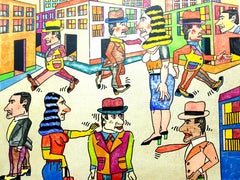
Category

1910s Modern Portrait Drawings and Watercolors

Materials

Paper, Pencil

Still Thinking About These?

All Recently Viewed