444 results for "richard prince"

to
90
260
172
299
221
143
121
65
50
34
21
20
13
7
2
2
2
1
1
1
49
15
9
9
7
Engelholm Nobu Grey 93 Rug by HENZEL STUDIO
Located in Geneve, CH
Engelholm Nobu Grey 93 Rug by HENZEL STUDIO Dimensions: W 139.7 x L 220.98 cm. Materials: Silk, Wool. Calle Henzel stands as a trailblazer in the realm of organic, free-form shaped ...
Category

2010s Swedish Post-Modern Rugs

Materials

Wool, Silk

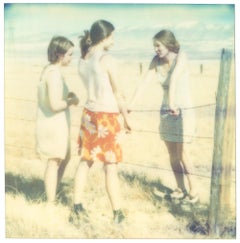
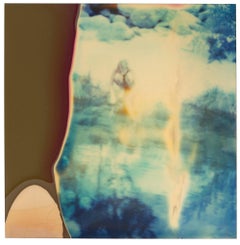
Three Girls VII (The Last Picture Show)
By Stefanie Schneider
Located in Morongo Valley, CA
Three Girls VII (The Last Picture Show) - 2006, 20x20cm, Edition of 10 plus 2 Artist Proofs. Archival C-Print, based on the original Polaroid. Certificate and Signature label. ...
Category

Early 2000s Contemporary Landscape Photography

Materials

Archival Paper, Photographic Paper, C Print, Color, Polaroid

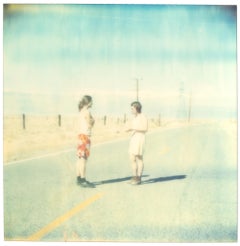
Three Girls VI (The Last Picture Show)
By Stefanie Schneider
Located in Morongo Valley, CA
Three Girls VI (The Last Picture Show) - 2006, 20x20cm, Edition of 10 plus 2 Artist Proofs. Archival C-Print, based on the original Polaroid. Certificate and Signature label. A...
Category

Early 2000s Contemporary Landscape Photography

Materials

Photographic Paper, C Print, Color, Polaroid, Archival Paper

My own private Travel Diary - Bishop, CA - Walking Lulu
By Stefanie Schneider
Located in Morongo Valley, CA
My own private Travel Diary - Bishop, CA - Walking Lulu - 2001, 20x83cm, Edition of 10, plus 2 Artist Proofs. Archival C-Print, based on the Polaroid Slide. Signature label and...
Category

1990s Contemporary Landscape Photography

Materials

Archival Paper, Photographic Paper, Black and White, C Print, Polaroid

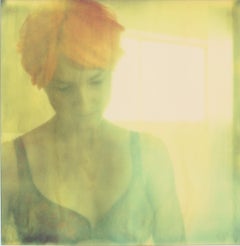
Mayfair Lane, #03 (The last Picture Show) - Polaroid, Contemporary, Women, Color
By Stefanie Schneider
Located in Morongo Valley, CA
Mayfair Lane, #03 (The last Picture Show) - 2004 58x56cm, Edition of 5, analog C-Print, hand-printed by the artist on Fuji Crystal Archive Paper, based on the Polaroid, Signatu...
Category

Early 2000s Contemporary Color Photography

Materials

Archival Paper, Photographic Paper, C Print, Color, Polaroid

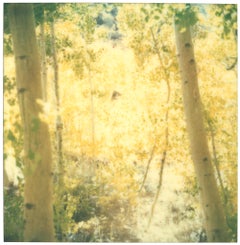
My own private Travel Diary - Bishop, CA - Autumn
By Stefanie Schneider
Located in Morongo Valley, CA
My own private Travel Diary - Bishop, CA - Autumn - 2001, 20x29cm, Edition of 10, plus 2 Artist Proofs. Archival C-Print, based on a Polaroid Slide. Signature label and Certificate. Not mounted. LIFE’S A DREAM (The Personal World of Stefanie Schneider) by Mark Gisbourne Projection is a form of apparition that is characteristic of our human nature, for what we imagine almost invariably transcends the reality of what we live. And, an apparition, as the word suggests, is quite literally ‘an appearing’, for what we appear to imagine is largely shaped by the imagination of its appearance. If this sounds tautological then so be it. But the work of Stefanie Schneider is almost invariably about chance and apparition. And, it is through the means of photography, the most apparitional of image-based media, that her pictorial narratives or photo-novels are generated. Indeed, traditional photography (as distinct from new digital technology) is literally an ‘awaiting’ for an appearance to take place, in line with the imagined image as executed in the camera and later developed in the dark room. The fact that Schneider uses out-of-date Polaroid film stock to take her pictures only intensifies the sense of their apparitional contents when they are realised. The stability comes only at such time when the images are re-shot and developed in the studio, and thereby fixed or arrested temporarily in space and time. The unpredictable and at times unstable film she adopts for her works also creates a sense of chance within the outcome that can be imagined or potentially envisaged by the artist Schneider. But this chance manifestation is a loosely controlled, or, better called existential sense of chance, which becomes pre-disposed by the immediate circumstances of her life and the project she is undertaking at the time. Hence the choices she makes are largely open-ended choices, driven by a personal nature and disposition allowing for a second appearing of things whose eventual outcome remains undefined. And, it is the alliance of the chance-directed material apparition of Polaroid film, in turn explicitly allied to the experiences of her personal life circumstances, that provokes the potential to create Stefanie Schneider’s open-ended narratives. Therefore they are stories based on a degenerate set of conditions that are both material and human, with an inherent pessimism and a feeling for the sense of sublime ridicule being seemingly exposed. This in turn echoes and doubles the meaning of the verb ‘to expose’. To expose being embedded in the technical photographic process, just as much as it is in the narrative contents of Schneider’s photo-novel exposés. The former being the unstable point of departure, and the latter being the uncertain ends or meanings that are generated through the photographs doubled exposure. The large number of speculative theories of apparition, literally read as that which appears, and/or creative visions in filmmaking and photography are self-evident, and need not detain us here. But from the earliest inception of photography artists have been concerned with manipulated and/or chance effects, be they directed towards deceiving the viewer, or the alchemical investigations pursued by someone like Sigmar Polke. None of these are the real concern of the artist-photographer Stefanie Schneider, however, but rather she is more interested with what the chance-directed appearances in her photographs portend. For Schneider’s works are concerned with the opaque and porous contents of human relations and events, the material means are largely the mechanism to achieving and exposing the ‘ridiculous sublime’ that has come increasingly to dominate the contemporary affect(s) of our world. The uncertain conditions of today’s struggles as people attempt to relate to each other - and to themselves - are made manifest throughout her work. And, that she does this against the backdrop of the so-called ‘American Dream’, of a purportedly advanced culture that is Modern America, makes them all the more incisive and critical as acts of photographic exposure. From her earliest works of the late nineties one might be inclined to see her photographs as if they were a concerted attempt at an investigative or analytic serialisation, or, better still, a psychoanalytic dissection of the different and particular genres of American subculture. But this is to miss the point for the series though they have dates and subsequent publications remain in a certain sense unfinished. Schneider’s work has little or nothing to do with reportage as such, but with recording human culture in a state of fragmentation and slippage. And, if a photographer like Diane Arbus dealt specifically with the anomalous and peculiar that made up American suburban life, the work of Schneider touches upon the alienation of the commonplace. That is to say how the banal stereotypes of Western Americana have been emptied out, and claims as to any inherent meaning they formerly possessed has become strangely displaced. Her photographs constantly fathom the familiar, often closely connected to traditional American film genre, and make it completely unfamiliar. Of course Freud would have called this simply the unheimlich or uncanny. But here again Schneider almost never plays the role of the psychologist, or, for that matter, seeks to impart any specific meanings to the photographic contents of her images. The works possess an edited behavioural narrative (she has made choices), but there is never a sense of there being a clearly defined story. Indeed, the uncertainty of my reading here presented, acts as a caveat to the very condition that Schneider’s photographs provoke. Invariably the settings of her pictorial narratives are the South West of the United States, most often the desert and its periphery in Southern California. The desert is a not easily identifiable space, with the suburban boundaries where habitation meets the desert even more so. There are certain sub-themes common to Schneider’s work, not least that of journeying, on the road, a feeling of wandering and itinerancy, or simply aimlessness. Alongside this subsidiary structural characters continually appear, the gas station, the automobile, the motel, the highway, the revolver, logos and signage, the wasteland, the isolated train track and the trailer. If these form a loosely defined structure into which human characters and events are cast, then Schneider always remains the fulcrum and mechanism of their exposure. Sometimes using actresses, friends, her sister, colleagues or lovers, Schneider stands by to watch the chance events as they unfold. And, this is even the case when she is a participant in front of camera of her photo-novels. It is the ability to wait and throw things open to chance and to unpredictable circumstances, that marks the development of her work over the last eight years. It is the means by which random occurrences take on such a telling sense of pregnancy in her work. However, in terms of analogy the closest proximity to Schneider’s photographic work is that of film. For many of her titles derive directly from film, in photographic series like OK Corral (1999), Vegas (1999), Westworld (1999), Memorial Day (2001), Primary Colours (2001), Suburbia (2004), The Last Picture Show (2005), and in other examples. Her works also include particular images that are titled Zabriskie Point, a photograph of her sister in an orange wig. Indeed the tentative title for the present publication Stranger Than Paradise is taken from Jim Jarmusch’s film of the same title in 1984. Yet it would be dangerous to take this comparison too far, since her series 29 Palms (1999) presages the later title of a film that appeared only in 2002. What I am trying to say here is that film forms the nexus of American culture, and it is not so much that Schneider’s photographs make specific references to these films (though in some instances they do), but that in referencing them she accesses the same American culture that is being emptied out and scrutinised by her photo-novels. In short her pictorial narratives might be said to strip films of the stereotypical Hollywood tropes that many of them possess. Indeed, the films that have most inspired her are those that similarly deconstruct the same sentimental and increasingly tawdry ‘American Dream’ peddled by Hollywood. These include films like David Lynch’s Blue Velvet (1986), Wild at Heart (1990) The Lost Highway (1997), John Dahl’s The Last Seduction (1994) or films like Ridley Scott’s Thelma and Louise with all its girl-power Bonny and Clyde-type clichés. But they serve no more than as a backdrop, a type of generic tableau from which Schneider might take human and abstracted elements, for as commercial films they are not the product of mere chance and random occurrence. Notwithstanding this observation, it is also clear that the gender deconstructions that the characters in these films so often portray, namely the active role of women possessed of a free and autonomous sexuality (even victim turned vamp), frequently find resonances within the behavioural events taking place in Schneider’s photographs and DVD sequences; the same sense of sexual autonomy that Stefanie Schneider possesses and is personally committed to. In the series 29 Palms (first begun in 1999) the two women characters Radha and Max act out a scenario that is both infantile and adolescent. Wearing brightly coloured fake wigs of yellow and orange, a parody of the blonde and the redhead, they are seemingly trailer park white trash possessing a sentimental and kitsch taste in clothes totally inappropriate to the locality. The fact that Schneider makes no judgment about this is an interesting adjunct. Indeed, the photographic projection of the images is such that the girls incline themselves to believe that they are both beautiful and desirous. However, unlike the predatory role of women in say Richard Prince’s photographs, which are simply a projection of a male fantasy onto women, Radha and Max are self-contained in their vacuous if empty trailer and motel world of the swimming pool, nail polish, and childish water pistols. Within the photographic sequence Schneider includes herself, and acts as a punctum of disruption. Why is she standing in front of an Officers’ Wives Club? Why is Schneider not similarly attired? Is there a proximity to an army camp, are these would-be Lolita(s) Rahda and Max wives or American marine groupies, and where is the centre and focus of their identity? It is the ambiguity of personal involvement that is set up by Schneider which deliberately makes problematic any clear sense of narrative construction. The strangely virulent colours of the bleached-out girls stand in marked contrast to Schneider’s own anodyne sense of self-image. Is she identifying with the contents or directing the scenario? With this series, perhaps, more than any other, Schneider creates a feeling of a world that has some degree of symbolic order. For example the girls stand or squat by a dirt road, posing the question as to their sexual and personal status. Following the 29 Palms series, Schneider will trust herself increasingly by diminishing the sense of a staged environment. The events to come will tell you both everything and nothing, reveal and obfuscate, point towards and simultaneously away from any clearly definable meaning. If for example we compare 29 Palms to say Hitchhiker (2005), and where the sexual contents are made overtly explicit, we do not find the same sense of simulated identity. It is the itinerant coming together of two characters Daisy and Austen, who meet on the road and subsequently share a trailer together. Presented in a sequential DVD and still format, we become party to a would-be relationship of sorts. No information is given as to the background or social origins, or even any reasons as to why these two women should be attracted to each other. Is it acted out? Are they real life experiences? They are women who are sexually free in expressing themselves. But while the initial engagement with the subject is orchestrated by Schneider, and the edited outcome determined by the artist, beyond that we have little information with which to construct a story. The events are commonplace, edgy and uncertain, but the viewer is left to decide as to what they might mean as a narrative. The disaggregated emotions of the work are made evident, the game or role playing, the transitory fantasies palpable, and yet at the same time everything is insubstantial and might fall apart at any moment. The characters relate but they do not present a relationship in any meaningful sense. Or, if they do, it is one driven the coincidental juxtaposition of random emotions. Should there be an intended syntax it is one that has been stripped of the power to grammatically structure what is being experienced. And, this seems to be the central point of the work, the emptying out not only of a particular American way of life, but the suggestion that the grounds upon which it was once predicated are no longer possible. The photo-novel Hitchhiker is porous and the culture of the seventies which it might be said to homage is no longer sustainable. Not without coincidence, perhaps, the decade that was the last ubiquitous age of Polaroid film. In the numerous photographic series, some twenty or so, that occur between 29 Palms and Hitchhiker, Schneider has immersed herself and scrutinised many aspects of suburban, peripheral, and scrubland America. Her characters, including herself, are never at the centre of cultural affairs. Such eccentricities as they might possess are all derived from what could be called their adjacent status to the dominant culture of America. In fact her works are often sated with references to the sentimental sub-strata that underpin so much of American daily life. It is the same whether it is flower gardens and household accoutrements of her photo-series Suburbia (2004), or the transitional and environmental conditions depicted in The Last Picture Show (2005). The artist’s use of sentimental song titles, often adapted to accompany individual images within a series by Schneider, show her awareness of America’s close relationship between popular film and music. For example the song ‘Leaving on a Jet Plane’, becomes Leaving in a Jet Plane as part of The Last Picture Show series, while the literalism of the plane in the sky is shown in one element of this diptych, but juxtaposed to a blonde-wigged figure first seen in 29 Palms. This indicates that every potential narrative element is open to continual reallocation in what amounts to a story without end. And, the interchangeable nature of the images, like a dream, is the state of both a pictorial and affective flux that is the underlying theme pervading Schneider’s photo-narratives. For dream is a site of yearning or longing, either to be with or without, a human pursuit of a restless but uncertain alternative to our daily reality. The scenarios that Schneider sets up nonetheless have to be initiated by the artist. And, this might be best understood by looking at her three recent DVD sequenced photo-novels, Reneé’s Dream and Sidewinder (2005). We have already considered the other called Hitchhiker. In the case of Sidewinder the scenario was created by internet where she met J.D. Rudometkin, an ex-theologian, who agreed to her idea to live with her for five weeks in the scrubland dessert environment of Southern California. The dynamics and unfolding of their relationship, both sexually and emotionally, became the primary subject matter of this series of photographs. The relative isolation and their close proximity, the interactive tensions, conflicts and submissions, are thus recorded to reveal the day-to-day evolution of their relationship. That a time limit was set on this relation-based experiment was not the least important aspect of the project. The text and music accompanying the DVD were written by the American Rudometkin, who speaks poetically of “Torn Stevie. Scars from the weapon to her toes an accidental act of God her father said. On Vaness at California.” The mix of hip reverie and fantasy-based language of his text, echoes the chaotic unfolding of their daily life in this period, and is evident in the almost sun-bleached Polaroid images like Whisky Dance, where the two abandon themselves to the frenetic circumstances of the moment. Thus Sidewinder, a euphemism for both a missile and a rattlesnake, hints at the libidinal and emotional dangers that were risked by Schneider and Rudometkin. Perhaps, more than any other of her photo-novels it was the most spontaneous and immediate, since Schneider’s direct participation mitigated against and narrowed down the space between her life and the art work. The explicit and open character of their relationship at this time (though they have remained friends), opens up the question as the biographical role Schneider plays in all her work. She both makes and directs the work while simultaneously dwelling within the artistic processes as they unfold. Hence she is both author and character, conceiving the frame within which things will take place, and yet subject to the same unpredictable outcomes that emerge in the process. In Reneé’s Dream, issues of role reversal take place as the cowgirl on her horse undermines the male stereotype of Richard Prince’s ‘Marlboro Country’. This photo-work along with several others by Schneider, continue to undermine the focus of the male gaze, for her women are increasingly autonomous and subversive. They challenge the male role of sexual predator, often taking the lead and undermining masculine role play, trading on male fears that their desires can be so easily attained. That she does this by working through archetypal male conventions of American culture, is not the least of the accomplishments in her work. What we are confronted with frequently is of an idyll turned sour, the filmic clichés that Hollywood and American television dramas have promoted for fifty years. The citing of this in the Romantic West, where so many of the male clichés were generated, only adds to the diminishing sense of substance once attributed to these iconic American fabrications. And, that she is able to do this through photographic images rather than film, undercuts the dominance espoused by time-based film. Film feigns to be seamless though we know it is not. Film operates with a story board and setting in which scenes are elaborately arranged and pre-planned. Schneider has thus been able to generate a genre of fragmentary events, the assemblage of a story without a storyboard. But these post-narratological stories require another component, and that component is the viewer who must bring their own interpretation as to what is taking place. If this can be considered the upside of her work, the downside is that she never positions herself by giving a personal opinion as to the events that are taking place in her photographs. But, perhaps, this is nothing more than her use of the operation of chance dictates. I began this essay by speaking about the apparitional contents of Stefanie Schneider’s pictorial narratives, and meant at that time the literal and chance-directed ‘appearing’ qualities of her photographs. Perhaps, at this moment we should also think of the metaphoric contents of the word apparition. There is certainly a spectre-like quality also, a ghostly uncertainty about many of the human experiences found in her subject matter. Is it that the subculture of the American Dream, or the way of life Schneider has chosen to record, has in turn become also the phantom of it former self? Are these empty and fragmented scenarios a mirror of what has become of contemporary America? There is certainly some affection for their contents on the part of the artist, but it is somehow tainted with pessimism and the impossibility of sustainable human relations, with the dissolute and commercial distractions of America today. Whether this is the way it is, or, at least, the way it is perceived by Schneider is hard to assess. There is a bleak lassitude about so many of her characters. But then again the artist has so inured herself into this context over a long protracted period that the boundaries between the events and happenings photographed, and the personal life of Stefanie Schneider, have become similarly opaque. Is it the diagnosis of a condition, or just a recording of a phenomenon? Only the viewer can decide this question. For the status of Schneider’s certain sense of uncertainty is, perhaps, the only truth we may ever know.

1 Kerry Brougher (ed.), Art and Film Since 1945: Hall of Mirrors, ex. cat., The Museum of Contemporary Art (New York, 1996) 2 Im Reich der Phantome: Fotographie des Unsichtbaren, ex. cat., Städtisches Museum Abteiberg Mönchengladbach/Kunsthalle Krems/FotomuseumWinterthur, (Ostfildern-Ruit, 1997) 3 Photoworks: When Pictures Vanish – Sigmar Polke, Museum of Contemporary Art (Zürich-Berlin-New York, 1995) 4 Slavoj Žižek, The Art of the Ridiculous Sublime: On David Lynch’s Lost Highway, Walter Chapin Simpson Center for the Humanities, University of Washington, Seattle, Occasional Papers, no. 1, 2000. 5 Diane Arbus, eds. Doon Arbus, and Marvin Israel...
Category

1990s Contemporary Landscape Photography

Materials

Archival Paper, Photographic Paper, C Print, Color, Polaroid

My own private Travel Diary - Bishop, CA - Winter
By Stefanie Schneider
Located in Morongo Valley, CA
My own private Travel Diary - Bishop, CA - Winter - 2001, 20x29cm, Edition of 10, plus 2 Artist Proofs. Archival C-Print, based on the Polaroid Slide. Signature label and Certificate. Not mounted. LIFE’S A DREAM (The Personal World of Stefanie Schneider) by Mark Gisbourne Projection is a form of apparition that is characteristic of our human nature, for what we imagine almost invariably transcends the reality of what we live. And, an apparition, as the word suggests, is quite literally ‘an appearing’, for what we appear to imagine is largely shaped by the imagination of its appearance. If this sounds tautological then so be it. But the work of Stefanie Schneider is almost invariably about chance and apparition. And, it is through the means of photography, the most apparitional of image-based media, that her pictorial narratives or photo-novels are generated. Indeed, traditional photography (as distinct from new digital technology) is literally an ‘awaiting’ for an appearance to take place, in line with the imagined image as executed in the camera and later developed in the dark room. The fact that Schneider uses out-of-date Polaroid film stock to take her pictures only intensifies the sense of their apparitional contents when they are realised. The stability comes only at such time when the images are re-shot and developed in the studio, and thereby fixed or arrested temporarily in space and time. The unpredictable and at times unstable film she adopts for her works also creates a sense of chance within the outcome that can be imagined or potentially envisaged by the artist Schneider. But this chance manifestation is a loosely controlled, or, better called existential sense of chance, which becomes pre-disposed by the immediate circumstances of her life and the project she is undertaking at the time. Hence the choices she makes are largely open-ended choices, driven by a personal nature and disposition allowing for a second appearing of things whose eventual outcome remains undefined. And, it is the alliance of the chance-directed material apparition of Polaroid film, in turn explicitly allied to the experiences of her personal life circumstances, that provokes the potential to create Stefanie Schneider’s open-ended narratives. Therefore they are stories based on a degenerate set of conditions that are both material and human, with an inherent pessimism and a feeling for the sense of sublime ridicule being seemingly exposed. This in turn echoes and doubles the meaning of the verb ‘to expose’. To expose being embedded in the technical photographic process, just as much as it is in the narrative contents of Schneider’s photo-novel exposés. The former being the unstable point of departure, and the latter being the uncertain ends or meanings that are generated through the photographs doubled exposure. The large number of speculative theories of apparition, literally read as that which appears, and/or creative visions in filmmaking and photography are self-evident, and need not detain us here. But from the earliest inception of photography artists have been concerned with manipulated and/or chance effects, be they directed towards deceiving the viewer, or the alchemical investigations pursued by someone like Sigmar Polke. None of these are the real concern of the artist-photographer Stefanie Schneider, however, but rather she is more interested with what the chance-directed appearances in her photographs portend. For Schneider’s works are concerned with the opaque and porous contents of human relations and events, the material means are largely the mechanism to achieving and exposing the ‘ridiculous sublime’ that has come increasingly to dominate the contemporary affect(s) of our world. The uncertain conditions of today’s struggles as people attempt to relate to each other - and to themselves - are made manifest throughout her work. And, that she does this against the backdrop of the so-called ‘American Dream’, of a purportedly advanced culture that is Modern America, makes them all the more incisive and critical as acts of photographic exposure. From her earliest works of the late nineties one might be inclined to see her photographs as if they were a concerted attempt at an investigative or analytic serialisation, or, better still, a psychoanalytic dissection of the different and particular genres of American subculture. But this is to miss the point for the series though they have dates and subsequent publications remain in a certain sense unfinished. Schneider’s work has little or nothing to do with reportage as such, but with recording human culture in a state of fragmentation and slippage. And, if a photographer like Diane Arbus dealt specifically with the anomalous and peculiar that made up American suburban life, the work of Schneider touches upon the alienation of the commonplace. That is to say how the banal stereotypes of Western Americana have been emptied out, and claims as to any inherent meaning they formerly possessed has become strangely displaced. Her photographs constantly fathom the familiar, often closely connected to traditional American film genre, and make it completely unfamiliar. Of course Freud would have called this simply the unheimlich or uncanny. But here again Schneider almost never plays the role of the psychologist, or, for that matter, seeks to impart any specific meanings to the photographic contents of her images. The works possess an edited behavioural narrative (she has made choices), but there is never a sense of there being a clearly defined story. Indeed, the uncertainty of my reading here presented, acts as a caveat to the very condition that Schneider’s photographs provoke. Invariably the settings of her pictorial narratives are the South West of the United States, most often the desert and its periphery in Southern California. The desert is a not easily identifiable space, with the suburban boundaries where habitation meets the desert even more so. There are certain sub-themes common to Schneider’s work, not least that of journeying, on the road, a feeling of wandering and itinerancy, or simply aimlessness. Alongside this subsidiary structural characters continually appear, the gas station, the automobile, the motel, the highway, the revolver, logos and signage, the wasteland, the isolated train track and the trailer. If these form a loosely defined structure into which human characters and events are cast, then Schneider always remains the fulcrum and mechanism of their exposure. Sometimes using actresses, friends, her sister, colleagues or lovers, Schneider stands by to watch the chance events as they unfold. And, this is even the case when she is a participant in front of camera of her photo-novels. It is the ability to wait and throw things open to chance and to unpredictable circumstances, that marks the development of her work over the last eight years. It is the means by which random occurrences take on such a telling sense of pregnancy in her work. However, in terms of analogy the closest proximity to Schneider’s photographic work is that of film. For many of her titles derive directly from film, in photographic series like OK Corral (1999), Vegas (1999), Westworld (1999), Memorial Day (2001), Primary Colours (2001), Suburbia (2004), The Last Picture Show (2005), and in other examples. Her works also include particular images that are titled Zabriskie Point, a photograph of her sister in an orange wig. Indeed the tentative title for the present publication Stranger Than Paradise is taken from Jim Jarmusch’s film of the same title in 1984. Yet it would be dangerous to take this comparison too far, since her series 29 Palms (1999) presages the later title of a film that appeared only in 2002. What I am trying to say here is that film forms the nexus of American culture, and it is not so much that Schneider’s photographs make specific references to these films (though in some instances they do), but that in referencing them she accesses the same American culture that is being emptied out and scrutinised by her photo-novels. In short her pictorial narratives might be said to strip films of the stereotypical Hollywood tropes that many of them possess. Indeed, the films that have most inspired her are those that similarly deconstruct the same sentimental and increasingly tawdry ‘American Dream’ peddled by Hollywood. These include films like David Lynch’s Blue Velvet (1986), Wild at Heart (1990) The Lost Highway (1997), John Dahl’s The Last Seduction (1994) or films like Ridley Scott’s Thelma and Louise with all its girl-power Bonny and Clyde-type clichés. But they serve no more than as a backdrop, a type of generic tableau from which Schneider might take human and abstracted elements, for as commercial films they are not the product of mere chance and random occurrence. Notwithstanding this observation, it is also clear that the gender deconstructions that the characters in these films so often portray, namely the active role of women possessed of a free and autonomous sexuality (even victim turned vamp), frequently find resonances within the behavioural events taking place in Schneider’s photographs and DVD sequences; the same sense of sexual autonomy that Stefanie Schneider possesses and is personally committed to. In the series 29 Palms (first begun in 1999) the two women characters Radha and Max act out a scenario that is both infantile and adolescent. Wearing brightly coloured fake wigs of yellow and orange, a parody of the blonde and the redhead, they are seemingly trailer park white trash possessing a sentimental and kitsch taste in clothes totally inappropriate to the locality. The fact that Schneider makes no judgment about this is an interesting adjunct. Indeed, the photographic projection of the images is such that the girls incline themselves to believe that they are both beautiful and desirous. However, unlike the predatory role of women in say Richard Prince’s photographs, which are simply a projection of a male fantasy onto women, Radha and Max are self-contained in their vacuous if empty trailer and motel world of the swimming pool, nail polish, and childish water pistols. Within the photographic sequence Schneider includes herself, and acts as a punctum of disruption. Why is she standing in front of an Officers’ Wives Club? Why is Schneider not similarly attired? Is there a proximity to an army camp, are these would-be Lolita(s) Rahda and Max wives or American marine groupies, and where is the centre and focus of their identity? It is the ambiguity of personal involvement that is set up by Schneider which deliberately makes problematic any clear sense of narrative construction. The strangely virulent colours of the bleached-out girls stand in marked contrast to Schneider’s own anodyne sense of self-image. Is she identifying with the contents or directing the scenario? With this series, perhaps, more than any other, Schneider creates a feeling of a world that has some degree of symbolic order. For example the girls stand or squat by a dirt road, posing the question as to their sexual and personal status. Following the 29 Palms series, Schneider will trust herself increasingly by diminishing the sense of a staged environment. The events to come will tell you both everything and nothing, reveal and obfuscate, point towards and simultaneously away from any clearly definable meaning. If for example we compare 29 Palms to say Hitchhiker (2005), and where the sexual contents are made overtly explicit, we do not find the same sense of simulated identity. It is the itinerant coming together of two characters Daisy and Austen, who meet on the road and subsequently share a trailer together. Presented in a sequential DVD and still format, we become party to a would-be relationship of sorts. No information is given as to the background or social origins, or even any reasons as to why these two women should be attracted to each other. Is it acted out? Are they real life experiences? They are women who are sexually free in expressing themselves. But while the initial engagement with the subject is orchestrated by Schneider, and the edited outcome determined by the artist, beyond that we have little information with which to construct a story. The events are commonplace, edgy and uncertain, but the viewer is left to decide as to what they might mean as a narrative. The disaggregated emotions of the work are made evident, the game or role playing, the transitory fantasies palpable, and yet at the same time everything is insubstantial and might fall apart at any moment. The characters relate but they do not present a relationship in any meaningful sense. Or, if they do, it is one driven the coincidental juxtaposition of random emotions. Should there be an intended syntax it is one that has been stripped of the power to grammatically structure what is being experienced. And, this seems to be the central point of the work, the emptying out not only of a particular American way of life, but the suggestion that the grounds upon which it was once predicated are no longer possible. The photo-novel Hitchhiker is porous and the culture of the seventies which it might be said to homage is no longer sustainable. Not without coincidence, perhaps, the decade that was the last ubiquitous age of Polaroid film. In the numerous photographic series, some twenty or so, that occur between 29 Palms and Hitchhiker, Schneider has immersed herself and scrutinised many aspects of suburban, peripheral, and scrubland America. Her characters, including herself, are never at the centre of cultural affairs. Such eccentricities as they might possess are all derived from what could be called their adjacent status to the dominant culture of America. In fact her works are often sated with references to the sentimental sub-strata that underpin so much of American daily life. It is the same whether it is flower gardens and household accoutrements of her photo-series Suburbia (2004), or the transitional and environmental conditions depicted in The Last Picture Show (2005). The artist’s use of sentimental song titles, often adapted to accompany individual images within a series by Schneider, show her awareness of America’s close relationship between popular film and music. For example the song ‘Leaving on a Jet Plane’, becomes Leaving in a Jet Plane as part of The Last Picture Show series, while the literalism of the plane in the sky is shown in one element of this diptych, but juxtaposed to a blonde-wigged figure first seen in 29 Palms. This indicates that every potential narrative element is open to continual reallocation in what amounts to a story without end. And, the interchangeable nature of the images, like a dream, is the state of both a pictorial and affective flux that is the underlying theme pervading Schneider’s photo-narratives. For dream is a site of yearning or longing, either to be with or without, a human pursuit of a restless but uncertain alternative to our daily reality. The scenarios that Schneider sets up nonetheless have to be initiated by the artist. And, this might be best understood by looking at her three recent DVD sequenced photo-novels, Reneé’s Dream and Sidewinder (2005). We have already considered the other called Hitchhiker. In the case of Sidewinder the scenario was created by internet where she met J.D. Rudometkin, an ex-theologian, who agreed to her idea to live with her for five weeks in the scrubland dessert environment of Southern California. The dynamics and unfolding of their relationship, both sexually and emotionally, became the primary subject matter of this series of photographs. The relative isolation and their close proximity, the interactive tensions, conflicts and submissions, are thus recorded to reveal the day-to-day evolution of their relationship. That a time limit was set on this relation-based experiment was not the least important aspect of the project. The text and music accompanying the DVD were written by the American Rudometkin, who speaks poetically of “Torn Stevie. Scars from the weapon to her toes an accidental act of God her father said. On Vaness at California.” The mix of hip reverie and fantasy-based language of his text, echoes the chaotic unfolding of their daily life in this period, and is evident in the almost sun-bleached Polaroid images like Whisky Dance, where the two abandon themselves to the frenetic circumstances of the moment. Thus Sidewinder, a euphemism for both a missile and a rattlesnake, hints at the libidinal and emotional dangers that were risked by Schneider and Rudometkin. Perhaps, more than any other of her photo-novels it was the most spontaneous and immediate, since Schneider’s direct participation mitigated against and narrowed down the space between her life and the art work. The explicit and open character of their relationship at this time (though they have remained friends), opens up the question as the biographical role Schneider plays in all her work. She both makes and directs the work while simultaneously dwelling within the artistic processes as they unfold. Hence she is both author and character, conceiving the frame within which things will take place, and yet subject to the same unpredictable outcomes that emerge in the process. In Reneé’s Dream, issues of role reversal take place as the cowgirl on her horse undermines the male stereotype of Richard Prince’s ‘Marlboro Country’. This photo-work along with several others by Schneider, continue to undermine the focus of the male gaze, for her women are increasingly autonomous and subversive. They challenge the male role of sexual predator, often taking the lead and undermining masculine role play, trading on male fears that their desires can be so easily attained. That she does this by working through archetypal male conventions of American culture, is not the least of the accomplishments in her work. What we are confronted with frequently is of an idyll turned sour, the filmic clichés that Hollywood and American television dramas have promoted for fifty years. The citing of this in the Romantic West, where so many of the male clichés were generated, only adds to the diminishing sense of substance once attributed to these iconic American fabrications. And, that she is able to do this through photographic images rather than film, undercuts the dominance espoused by time-based film. Film feigns to be seamless though we know it is not. Film operates with a story board and setting in which scenes are elaborately arranged and pre-planned. Schneider has thus been able to generate a genre of fragmentary events, the assemblage of a story without a storyboard. But these post-narratological stories require another component, and that component is the viewer who must bring their own interpretation as to what is taking place. If this can be considered the upside of her work, the downside is that she never positions herself by giving a personal opinion as to the events that are taking place in her photographs. But, perhaps, this is nothing more than her use of the operation of chance dictates. I began this essay by speaking about the apparitional contents of Stefanie Schneider’s pictorial narratives, and meant at that time the literal and chance-directed ‘appearing’ qualities of her photographs. Perhaps, at this moment we should also think of the metaphoric contents of the word apparition. There is certainly a spectre-like quality also, a ghostly uncertainty about many of the human experiences found in her subject matter. Is it that the subculture of the American Dream, or the way of life Schneider has chosen to record, has in turn become also the phantom of it former self? Are these empty and fragmented scenarios a mirror of what has become of contemporary America? There is certainly some affection for their contents on the part of the artist, but it is somehow tainted with pessimism and the impossibility of sustainable human relations, with the dissolute and commercial distractions of America today. Whether this is the way it is, or, at least, the way it is perceived by Schneider is hard to assess. There is a bleak lassitude about so many of her characters. But then again the artist has so inured herself into this context over a long protracted period that the boundaries between the events and happenings photographed, and the personal life of Stefanie Schneider, have become similarly opaque. Is it the diagnosis of a condition, or just a recording of a phenomenon? Only the viewer can decide this question. For the status of Schneider’s certain sense of uncertainty is, perhaps, the only truth we may ever know.

1 Kerry Brougher (ed.), Art and Film Since 1945: Hall of Mirrors, ex. cat., The Museum of Contemporary Art (New York, 1996) 2 Im Reich der Phantome: Fotographie des Unsichtbaren, ex. cat., Städtisches Museum Abteiberg Mönchengladbach/Kunsthalle Krems/FotomuseumWinterthur, (Ostfildern-Ruit, 1997) 3 Photoworks: When Pictures Vanish – Sigmar Polke, Museum of Contemporary Art (Zürich-Berlin-New York, 1995) 4 Slavoj Žižek, The Art of the Ridiculous Sublime: On David Lynch’s Lost Highway, Walter Chapin Simpson Center for the Humanities, University of Washington, Seattle, Occasional Papers, no. 1, 2000. 5 Diane Arbus, eds. Doon Arbus, and Marvin Israel...
Category

1990s Contemporary Landscape Photography

Materials

Archival Paper, Photographic Paper, C Print, Color, Polaroid

Untitled (Paradise) - Contemporary, Nude, Men, Polaroid
By Stefanie Schneider
Located in Morongo Valley, CA
Untitled (Paradise) - 1999 50x50cm. Edition of 10, plus 2 Artist Proofs. Archival C-Print, based on a Polaroid. Signature label and Certificate. Artist Inventory No. 20456. Not...
Category

Early 2000s Contemporary Abstract Photography

Materials

Archival Paper, Photographic Paper, C Print, Color, Polaroid

My own private Travel Diary - Bishop, CA - Autumn
By Stefanie Schneider
Located in Morongo Valley, CA
My own private Travel Diary - Bishop, CA - Autumn - 2001, 20x29cm, Edition of 10, plus 2 Artist Proofs. Archival C-Print, based on a Polaroid Slide. Signature label and Certifi...
Category

1990s Contemporary Landscape Photography

Materials

Archival Paper, Photographic Paper, C Print, Color, Polaroid

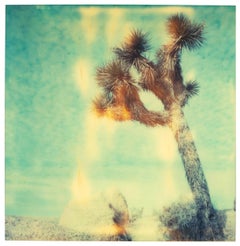
Untitled - Stage of Consciousness, Polaroid, Analog
By Stefanie Schneider
Located in Morongo Valley, CA
'Untitled' (Stage of Consciousness) - 2007 20x24cm, sold out Edition of 5, this is Artist Proof 1/2. Archival C-Print, based on the original Polaroid. Certificate and Signature ...
Category

Early 2000s Contemporary Color Photography

Materials

Photographic Paper, C Print, Polaroid, Archival Paper, Color

Untitled (Paradise) - Contemporary, Nude, Polaroid
By Stefanie Schneider
Located in Morongo Valley, CA
Untitled (Paradise) - 1999, 50x50cm. Edition of 10, plus 2 Artist Proofs. Archival C-Print, based on a Polaroid. Signature label and Certificate. Artist Inventory No. 20461. No...
Category

Early 2000s Contemporary Nude Photography

Materials

Archival Paper, Photographic Paper, C Print, Color, Polaroid

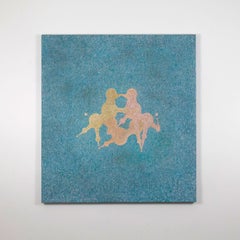
Monet Cane
By General Idea
Located in Toronto, Ontario
General Idea was founded in 1967 in Toronto by AA Bronson (b. 1946), Felix Partz (1945-1994), and Jorge Zontal (1944-1994). Over the course of 25 years, they made a significant contribution to postmodern and conceptual art in Canada and beyond. The trio was both prolific and multi-disciplinary long before it became de rigueur. They worked across a wide range of media including photography, sculpture, painting, mail art, video, installations, multiples, and performance. With their subversive approach and interest in parody and appropriation, General Idea addressed a broad range of social (and art-world) issues such as the cult of the artist, mass media, queer identity, and consumerism. Thematic continuity was a key element for General Idea, who utilized longevity as an avenue to delve deeper into, build upon, and evolve with the complex and nuanced subject matter they took on. “Monet Cane” is an extraordinary example of General Idea’s use of iconography, appropriation, (and mischief) from this era. Beginning in the early 1980s, General Idea began using the poodle as an emblem for the trio, quickly elevating it to one of the most dominant motifs in their practice. Both single poodles, and trios (which would be a sort of group self-portrait) appeared frequently in a variety of artwork during their last decade of production. The 80's was a decade that saw appropriation flourish in the visual arts. General Idea made a significant contribution to this trend. While many of their contemporaries used mass-market images or objects (think Barbara Kruger, Jeff Koons, and Richard Prince) General Idea did not restrict themselves to accessible imagery but also claimed canonical images and blue-chip references. General Idea created two major series of paintings featuring the trio of poodles; in pastels (which were often bleached in a commercial washing machine) and in neon colors. This painting is exceptionally rare as it is one of four paintings made with this distinct flecked surface. This unique texture is a significant (and beautiful) anomaly at odds with their predominantly flat and graphic aesthetic. The surface of the canvas is enveloped in tiny, weighted flecks of paint that have been layered to create an incredible texture. This application of paint, which appears to be chenille-like, recalls both the atmospheric pastel palette and impressionistic effects made famous by Claude Monet. "Monet Cane" can not only be contextualized with other poodle paintings...
Category

1980s Pop Art Figurative Paintings

Materials

Mixed Media

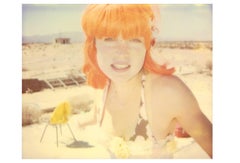
Radha Mind Screen - part 3 (Starnger than Paradise)
By Stefanie Schneider
Located in Morongo Valley, CA
Radha Mind Screen II (Stranger than Paradise), 1999, 20x20cm, Artist Proof 1/2, sold out Edition of 10, digital C-Print, based on a Polaroid Certificate and Signature label, artist...
Category

1990s Contemporary Color Photography

Materials

Archival Paper, Photographic Paper, C Print, Color, Polaroid

Indian Summer IV (The Last Picture Show)
By Stefanie Schneider
Located in Morongo Valley, CA
Indian Summer III (The Last Picture Show) - 2005 20x20cm, Edition of 10, plus 2 Artist Proofs. Archival C-Print print, based on the Polaroid, Certificate and Signature label Artist Inventory No 18549. Not mounted. Stefanie Schneider's scintillating situations take place in the American West. Situated on the verge of an elusive super-reality, her photographic sequences provide the ambience for loosely woven story lines and a cast of phantasmic characters. Schneider works with the chemical mutations of expired Polaroid film stock. Chemical explosions of color spreading across the surfaces undermine the photograph's commitment to reality and induce her characters into trance-like dream scapes. Like flickering sequences of old road movies Schneider's images seem to evaporate before conclusions can be made - their ephemeral reality manifesting in subtle gestures and mysterious motives. Schneider's images refuse to succumb to reality, they keep alive the confusions of dream, desire, fact, and fiction. Stefanie Schneider received her MFA in Communication Design at the Folkwang Schule Essen, Germany. Her work has been shown at the Museum for Photography, Braunschweig, Museum für Kommunikation, Berlin, the Institut für Neue Medien, Frankfurt, the Nassauischer Kunstverein, Wiesbaden, Kunstverein Bielefeld, Museum für Moderne Kunst Passau, Les Rencontres d'Arles, Foto -Triennale Esslingen., Bombay Beach Biennale 2018 / 2019. “It was Stefanie Schneider, who inspired me to start the company THE IMPOSSIBLE PROJECT after seeing her work, which seems to achieve the possible from the impossible, creating the finest of art out of the most basic of mediums and materials. Indeed, after that one day, I was so impressed with her photography that I realized Polaroid film could not be allowed to disappear. Being at the precise moment in time where the world was about to lose Polaroid, I seized the moment and have put all my efforts and passion into saving Polaroid film. For that, I thank Stefanie Schneider almost exclusively, who played a bigger role than anyone in saving this American symbol of photography.” –Florian Kaps, March 8th 2010 (“Doc” Dr. Florian Kaps, founder of “The Impossible Project”) What makes Stefanie Schneider’s work so unique is that it’s immediately recognizable. Perfect ‘wabi-sabi’ in appearance and content. Dream like, colorful with depth and vision. From start to finish, a truly self made artist with a distinctively female perspective. Exhibitions Selected (selected) 2018 Participation Bombay Beach Biennale, Bombay Beach, USA (G) March Available to All, Rough Play Projects - Site Specific, Joshou Tree, USA (G) curated by Deborah Martin with Adam Berg, Doron Gazit, Kellan Barnebey, Chris Sanchez, Aili Schmelzt 2017 BLICKFELD Analoge Fotografie, Kommunale Galerie Steglitz-Zehlendorf (G) (catalog), (upcoming)
 Rosegallery, Bergamot Station, Santa Monica (G) Magie des Moments, Kunstverein Bad Homburg Artlantis, Bad Homburg (G) 2016 
Instantdreams, Instantdreams Gallery, Berlin 

(S) 2015
 Desert Voices, De Re Gallery, Los Angeles (G) with Pamela Littky The Ballery in Heat, The Ballery, Berlin (G) 
Blue Nudes, De Re Gallery, Los Angeles (G) 

 2014

 Summer Show, Galerie Catherine et André Hug, Paris, France (G) 6 Finalists, Saatchi Gallery London (G) 
Instantdreams, De Re Gallery, Los Angeles (S)
Grand Opening, De Re Gallery, Los Angeles (G) with Banksy, Andy Warhol, Alison Bignon, Sophie Dickens, Victor Gingembre and others
 2013 
Heather's Dream, Short, nominated for the German Short Film Award 2013 (Deutscher Kurzfilmpreis)
Images For Images (Artists fir Tichy), GASK - Gallery of the Central Bohemian Region,  Kutná Hora, Czech Republic, (G) with Richard Prince, Nan Golding, Shirana Shahbazi, Sophie Calle, Martin Kippenberger, Arnulf Rainer, Thomas Ruff, Katharina Grosse, Jonathan Meese & others (catalog) 
The Girl behind the White Picket Fence, Galerie Catherine et André Hug, Paris, France (S)
 Heather's Dream, Short, German Competition Short Film Festival Oberhausen 
Multimedia Presentation with Artist Stefanie Schneider, Palms Springs Art Museum, Annenberg Theater
 The Polaroid Years: Instant Photography and Experimentation, The Frances Lehman Loeb Art Center, Poughkeepsie, NY, (G) with Ansel Adams, Bruce Charlesworth...
Category

Early 2000s Contemporary Color Photography

Materials

Archival Paper, Photographic Paper, C Print, Color, Polaroid

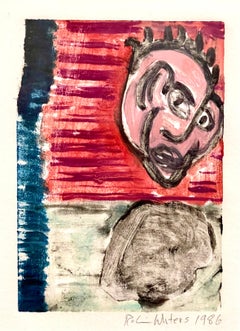
Conceptual Pop Art Color Oil Monotype Painting Abstract Figure Robin Winters
By Robin Winters
Located in Surfside, FL
Robin Winters (American, born 1950), Untitled (Red Face) from "Cherry Block Series" 1986, monotype, pencil signed and dated lower right, plate: 6"h x 8.5"w, overall (with frame): 22.25"h x 18.25"w. Provenance: Property from a Private Collection, San Francisco. Winters was invited to make monotypes at Experimental Workshop in San Francisco, (they printed Richard Bosman, Sam Francis, Claire Falkenstein, Deborah Oropallo and Kenneth Noland and many more greats). Winters chose to paint on wood blocks rather than the more usual metal plates in order to capture the organic quality of the natural material. He exploited a salient characteristic of the monoprint in Ghost Story by adding new painted elements onto the increasingly faint ghost images that result from successive impressions from a single block. In so doing he achieved the effect of transparent layers of color and shadow imagery. Winters's brightly-colored monotypes portray an array of figures and landscapes (and an occasional still-life) that, although can be seen in the context of a general trend away from abstraction that has marked the 1980s, defy strict stylistic categorization. They are neither realistic nor abstract, psychological self-examinations nor narrative fictions, but they contain elements of all of these approaches. Like Jonathan Borofsky, Winters derives much of his subject matter from dreams, believing that through his private fears and obsessions he can touch similar emotions in others. Although at first glance Winters's images look as if they could have been made by a child, closer attention reveals sly art historical references to Jackson Pollock and Pattern Painting (the drip and splatter backgrounds), Mark Rothko (the three-part horizontal compositions) and Minimalism (the gridded Cherry Block Series: Bread Beat). Robin Winters (born 1950 in Benicia, California) is an American conceptual, multi-disciplinary, artist and teacher based in New York. Winters is known for creating solo exhibitions containing an interactive durational performance component to his installations, sometimes lasting up to two months. Winters first emerged in the burgeoning Soho NYC art scene of the 1970s. An early practitioner of the Relational Aesthetics (social interaction as an art medium) Winters also created in works through sculpture, installation, performance, painting, drawing and prints. His art maintains a whimsical spirit, and he often returns to ongoing themes involving faces, boats, cars, bottles, hats and jesters or fools. Winters has incorporated such devices as blind dates, double dates, dinners, fortune telling, and free consultation in his performances. Throughout his career he has engaged in a wide variety of media, such as performance art, film, video, writing prose and poetry, photography, installation art, printmaking, drawing, painting, ceramic sculpture, bronze sculpture, and glassblowing. Winters was born in Benicia, California in 1950 to lawyer parents. As a child his hobby was collecting glass bottles found on the beach and under old buildings, which would later influence him as an artist. In 1968, Winters had his first durational performance, entitled Norman Thomas Travelling Museum. The artist drove a Volkswagen bus decorated in collage, many of the images relating to current events and politics. Inside was what the artist described as a “reliquary” containing many objects, including a bottle collection. Winters took the van to shopping centers and even as far as Mexico. That same year, Winters opted not to register for the military draft. Although he was deemed fit to serve, Winters refused. In 1975 the resulting legal proceedings finally came to a close after it was proven that the artist had been harassed by the local draft board. In his teens and early twenties, Winters became acquainted with several local artists who helped shape his aesthetic, most notably Manuel Neri and Robert Arneson. By the early 1970s, Winters was studying at the San Francisco Art Institute (SFAI) and had relocated to San Francisco. At this time Winters became friends with the Bay Area conceptual artists Terry Fox and Howard Fried, and participated in several of Fried's performance works. In 1972 Winters was accepted into the Whitney Independent Study Program in New York City. After coming to New York City, Winters helped support himself by working for various artists, among them the performance artist Joan...
Category

1980s Pop Art Figurative Paintings

Materials

Monoprint, Monotype

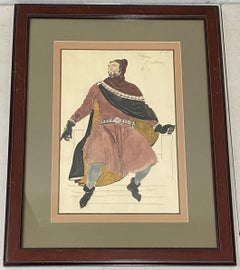
Roger Furse "Waldemar Fitzurse - Ivanhoe" Original Costume Illustration C.1940
Located in San Francisco, CA
Roger Furse "Waldemar Fitzurse - Ivanhoe" Original Costume Illustration C.1940 Dimensions 12" wide x 17.5" high The distressed frame measures 22...
Category

Early 20th Century Figurative Drawings and Watercolors

Materials

Watercolor

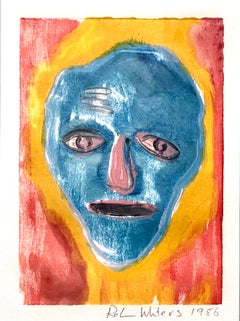
Conceptual Pop Art Color Oil Monotype Painting Abstract Figure Robin Winters
By Robin Winters
Located in Surfside, FL
Robin Winters (American, born 1950), Untitled (Red Face) from "Cherry Block Series" 1986, monotype, pencil signed and dated lower right, plate: 6"h x 8.5"w, overall (with frame): 22.25"h x 18.25"w. Provenance: Property from a Private Collection, San Francisco. Winters was invited to make monotypes at Experimental Workshop in San Francisco, (they printed Richard Bosman, Sam Francis, Claire Falkenstein, Deborah Oropallo and Kenneth Noland and many more greats). Winters chose to paint on wood blocks rather than the more usual metal plates in order to capture the organic quality of the natural material. He exploited a salient characteristic of the monoprint in Ghost Story by adding new painted elements onto the increasingly faint ghost images that result from successive impressions from a single block. In so doing he achieved the effect of transparent layers of color and shadow imagery. Winters's brightly-colored monotypes portray an array of figures and landscapes (and an occasional still-life) that, although can be seen in the context of a general trend away from abstraction that has marked the 1980s, defy strict stylistic categorization. They are neither realistic nor abstract, psychological self-examinations nor narrative fictions, but they contain elements of all of these approaches. Like Jonathan Borofsky, Winters derives much of his subject matter from dreams, believing that through his private fears and obsessions he can touch similar emotions in others. Although at first glance Winters's images look as if they could have been made by a child, closer attention reveals sly art historical references to Jackson Pollock and Pattern Painting (the drip and splatter backgrounds), Mark Rothko (the three-part horizontal compositions) and Minimalism (the gridded Cherry Block Series: Bread Beat). Robin Winters (born 1950 in Benicia, California) is an American conceptual, multi-disciplinary, artist and teacher based in New York. Winters is known for creating solo exhibitions containing an interactive durational performance component to his installations, sometimes lasting up to two months. Winters first emerged in the burgeoning Soho NYC art scene of the 1970s. An early practitioner of the Relational Aesthetics (social interaction as an art medium) Winters also created in works through sculpture, installation, performance, painting, drawing and prints. His art maintains a whimsical spirit, and he often returns to ongoing themes involving faces, boats, cars, bottles, hats and jesters or fools. Winters has incorporated such devices as blind dates, double dates, dinners, fortune telling, and free consultation in his performances. Throughout his career he has engaged in a wide variety of media, such as performance art, film, video, writing prose and poetry, photography, installation art, printmaking, drawing, painting, ceramic sculpture, bronze sculpture, and glassblowing. Winters was born in Benicia, California in 1950 to lawyer parents. As a child his hobby was collecting glass bottles found on the beach and under old buildings, which would later influence him as an artist. In 1968, Winters had his first durational performance, entitled Norman Thomas Travelling Museum. The artist drove a Volkswagen bus decorated in collage, many of the images relating to current events and politics. Inside was what the artist described as a “reliquary” containing many objects, including a bottle collection. Winters took the van to shopping centers and even as far as Mexico. That same year, Winters opted not to register for the military draft. Although he was deemed fit to serve, Winters refused. In 1975 the resulting legal proceedings finally came to a close after it was proven that the artist had been harassed by the local draft board. In his teens and early twenties, Winters became acquainted with several local artists who helped shape his aesthetic, most notably Manuel Neri and Robert Arneson. By the early 1970s, Winters was studying at the San Francisco Art Institute (SFAI) and had relocated to San Francisco. At this time Winters became friends with the Bay Area conceptual artists Terry Fox and Howard Fried, and participated in several of Fried's performance works. In 1972 Winters was accepted into the Whitney Independent Study Program in New York City. After coming to New York City, Winters helped support himself by working for various artists, among them the performance artist Joan...
Category

1980s Pop Art Figurative Paintings

Materials

Monoprint, Monotype

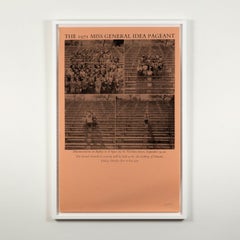
The 1971 Miss General Idea Pageant
By General Idea
Located in Toronto, Ontario
In 1967, General Idea was founded in Toronto by AA Bronson (b. 1946), Felix Partz (1945-1994), and Jorge Zontal (1944-1994). Over the course of four decades, they made a significant ...
Category

1970s Post-Modern Prints and Multiples

Materials

Screen

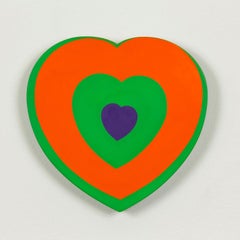
Coeur Volant
By General Idea
Located in Toronto, Ontario
In 1967, General Idea was founded in Toronto by AA Bronson (b. 1946), Felix Partz (1945-1994), and Jorge Zontal (1944-1994). Over the course of 25 years, they made a significant cont...
Category

1990s Post-Modern Figurative Sculptures

Materials

Wax, Acrylic, Fiberboard

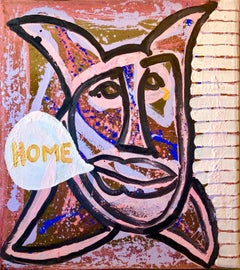
Conceptual Pop Art Color Mixed Media Painting "Home" Brooke Alexander Gallery
By Robin Winters
Located in Surfside, FL
Robin Winters (b. 1950) hand signed; 1986. Acrylic, rhoplex and powdered pigment on screenprint Dimensions: 36”h, 32”w Title: "Home" Provenance: Brooke Alexander Gallery, New York, New York. Gallery label verso. Robin Winters is known for his conceptual works in a wide variety of two- and three-dimensional media and performance/durational art. The reliquary and other recurring themes that appear in his works can be seen in the collection of sculptures and paintings offered in this sale (lots 170, 171, 173, 393, 396). Gallery label to reverse: Brooke Alexander Gallery, New York, New York. Provenance: Brooke Alexander Gallery, New York, New York. Robin Winters (born 1950 in Benicia, California) is an American conceptual, multi-disciplinary, artist and teacher based in New York. Winters is known for creating solo exhibitions containing an interactive durational performance component to his installations, sometimes lasting up to two months. Winters first emerged in the burgeoning Soho NYC art scene of the 1970s. An early practitioner of the Relational Aesthetics (social interaction as an art medium) Winters also created in works through sculpture, installation, performance, painting, drawing and prints. His art maintains a whimsical spirit, and he often returns to ongoing themes involving faces, boats, cars, bottles, hats and jesters or fools. Winters has incorporated such devices as blind dates, double dates, dinners, fortune telling, and free consultation in his performances. Throughout his career he has engaged in a wide variety of media, such as performance art, film, video, writing prose and poetry, photography, installation art, printmaking, drawing, painting, ceramic sculpture, bronze sculpture, and glassblowing. Winters was born in Benicia, California in 1950 to lawyer parents. As a child his hobby was collecting glass bottles found on the beach and under old buildings, which would later influence him as an artist. In 1968, Winters had his first durational performance, entitled Norman Thomas Travelling Museum. The artist drove a Volkswagen bus decorated in collage, many of the images relating to current events and politics. Inside was what the artist described as a “reliquary” containing many objects, including a bottle collection. Winters took the van to shopping centers and even as far as Mexico. That same year, Winters opted not to register for the military draft. Although he was deemed fit to serve, Winters refused. In 1975 the resulting legal proceedings finally came to a close after it was proven that the artist had been harassed by the local draft board. In his teens and early twenties, Winters became acquainted with several local artists who helped shape his aesthetic, most notably Manuel Neri and Robert Arneson. By the early 1970s, Winters was studying at the San Francisco Art Institute (SFAI) and had relocated to San Francisco. At this time Winters became friends with the Bay Area conceptual artists Terry Fox and Howard Fried, and participated in several of Fried's performance works. In 1972 Winters was accepted into the Whitney Independent Study Program in New York City. After coming to New York City, Winters helped support himself by working for various artists, among them the performance artist Joan Jonas and sculptor Donald Judd. In 1974, Winters performed The Secret Life of Bob-E or Bob-E Behind the Veil eight hours a day, five days a week for a month in his studio apartment. Behind a one-way mirror the audience could watch Winters play the character of Bob-E, whose goal was to make a monument for everyone in the world in the form of blue and yellow rubber top hats. By the end of the month the artist had constructed 262 hats. The following year, Winters was invited to take part in the Whitney Museum's 1975 Biennial Exhibition. Entitled W.B. Bearman Bags a Job or Diary of a Dreamer. These meetings led to the formation of the Group Collaborative Projects, or Colab, of which Winters is a founding member. Also in 1976, Winters formed the partnership “X&Y” with fellow artist Coleen Fitzgibbon that would last two years. Together they performed a series of shows in the Netherlands, most notably a show entitled Take the Money and Run. Performed at De Appel in Amsterdam, the show involved the artists robbing their audience. The following day the audience was given an apology, as well as the opportunity to retrieve any valuables and participate in a lottery to win the artists’ services. They also made a Super 8 film in NY called Rich-Poor, in which they asked people on the streets their thoughts on the rich and poor. In 1980 Winters participated in The Real Estate Show and in Absurdities at ABC No Rio. That same year he and artists Peter Fend, Coleen Fitzgibbon, Peter Nadin, Jenny Holzer, and Richard Prince also formed The Offices of Fend, Fitzgibbon, Holzer, Nadin, Prince & Winters. This short-lived collective was based out of an office on lower Broadway and offered “Practical Esthetic Services Adaptable to Client Situation”, as stated on their business card. Their goal was to offer their art as “socially helpful work for hire”. In June of that year Winters participated in The Times Square Show, Colab's most well-known exhibition. The month-long show took place in a four floor building on West 41st Street and was densely packed with art. To cap off a busy year, Winters also became one of the first artists to join the Mary Boone Gallery, showing a successful solo exhibition in 1981. His work was shown in the New York/New Wave show in 1981 at MoMA PS1 along with Jean-Michel Basquiat, Roberta Bayley, William S. Burroughs, David Byrne, Sarah Charlesworth, Larry Clark, Crash (John Matos), Ronnie Cutrone, Brian Eno, Peter Fend, Nan Goldin, Keith Haring, Ray Johnson, Joseph Kosuth, Marcus Leatherdale, Christopher Makos, Robert Mapplethorpe, Elaine Mayes, Frank Moore, Kenny Scharf and others. In 1982, Winters had his first solo exhibition in Los Angeles at the Richard Kuhlenschmidt Gallery. At the Mo David Gallery in 1984, Winters created an installation piece that consisted of a floor of plaster tiles. Underneath each tile, hidden from view, was a drawing. He designed the stage sets for the musician Nico, and assisted French artist Orlan, American artist Stuart Sherman, and American poet Gregory Corso. Two years later Winters was invited to take part in Chambres d’Amis (In Ghent there is Always a Free Room for Albrecht Durer) in Ghent, Belgium. In it, 51 artists created installations in 50 different sites, mostly private homes. Winters chose the home of a local art historian. The artist made 90 drawings based on images found in the large collection of art books in the home's library. He made two copies of each drawing and placed the originals in the books themselves. One set of copies was exhibited in the sponsoring museum, Museum van Hedendaagse, as "The Ghent Drawings". The drawings were also on display at Winters’ solo exhibition at Luhring Augustine & Hodes Gallery in New York City in 1987. In 1986, Winters had a solo exhibition at Maurice Keitelman Gallery in Brussels, Belgium, and the following year a solo exhibition at the Centre Régional d'Art Contemporain Midi-Pyrénées in Toulouse, France. Also in 1986, Winters' Playroom was held at the Institute for Contemporary Art in Boston, Massachusetts. The exhibition was part of Think Tank, a retrospective of Winters' work which traveled to the Stedelijk Museum in the Netherlands, the Centre Regional d’Art Contemporain in France, and the Contemporary Arts Center in Ohio. Winters spent a month in 1989 working with students at the San Francisco Art Institute. Never having worked with ceramics, he spent the month making numerous ceramic pieces, which were then shown in the aptly named One Month in San Francisco. Other components of the piece included Winters’ childhood bottle collection and a video showing each piece in the show filmed briefly next to a ruler.[ Also that year, Robin served as a visiting artist at the Pilchuck Glass School, where he met artist John Drury, who was then working as the school's artist liaison. In the summer of 1990, Winters interviewed fellow artist Kiki Smith for her eponymous book, which was published later that year. That same year (1990), Winters was invited by the Val Saint Lambert glass factory in Belgium to create glassworks in their facility. Winters, artists John Drury and Tracy Glover traveled to Liege from the US, and the three in combination with two of the factories master glassblowers, realized Mr. Winters' work over six weeks time. A portion of the works, a group of glass heads and hats that the artist had produced at the factory, were exhibited in 1990 at the Centre d’Art Contemporain Geneve in Geneva, Switzerland. Later in the year they were included in his solo exhibition at Brooke Alexander Gallery in New York City. They were also shown at Facts and Rumours, an exhibition at the Witte de With Center for Contemporary Art in Rotterdam, the Netherlands in 1991. Winters had a solo exhibition at Van Esch Galerie in Eindhoven, the Netherlands called I am not Indifferent in 1991. The show consisted of paintings, glass heads, and bronze sculpture. Two years later he had another solo exhibition at the Renaissance Society at the University of Chicago, entitled Human Nature. Several hundred heads, made of glass and ceramic, lined the walls and were arranged in rings on the floor. Also on display were various paintings and bronzes. In 1994 Winters had a show at the Michael Klein Gallery in New York City entitled Notes from the Finishing Room, a solo exhibition of paintings. The artist also collaborated with fellow Benicia natives and glass artists Leroy Champagne and Michael Nourot...
Category

1980s Pop Art Figurative Paintings

Materials

Mixed Media, Acrylic, Pigment, Screen

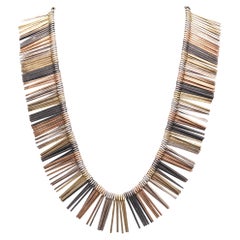
Eigil Jensen For Anton Michelsen 1960 Denmark Fringe Necklace In .925 Sterling
Located in Miami, FL
Fringe necklace designed by Eigil Jensen for Anton Michelsen. Beautiful fringe necklace, created in Copenhagen Denmark, by the silversmith Eigil Jensen for Anton Michelsen, back in the 1960. Crafted as a flexible cascade of multiples tines, made up in Sterling Silver, Silver, Plated Yellow Gold, Plated Rose Gold, and Plated Oxidized Silver. Fitted with an integrated toggle lock with a ring. Very comfortable and gorgeous look. Weight: 77.95 Grams, (49.97 Dwt). Size: Fit a neck up to 16 Inches, (40 Cm). Measurements: The fringes lengths are 27 mm (1.06 Inches). Hallmarks: Stamped with Danish crown marks the maker's mark, the mark for the assay of the silver and signed, "AM STERLING DENMARK". Anton Michelsen Company He was born 1809 in Copenhagen Denmark, he completed a goldsmith's apprenticeship in Odense in 1839 before moving back to Copenhagen where he continued his training in Dyrkoph's and court goldsmith J.B. Dalhoff's workshops. He also attended the Royal Danish Academy of Arts where he was influenced by Gustav Friedrich Hersch. In 1836, he went on a long journey abroad, working in some of the leading goldsmiths in Germany and Paris. He established his own goldsmith in Gothersgade, Copenhagen when he returned to Denmark in 1841. He immediately won the attention of the royal family and the king Christian VIII charged him with executing all Danish orders with title of royal court and order jeweler. Michelsen was the only Danish goldsmith who was represented at the Exposition Universelle in Paris in 1855. The company of A. Michelsen, was a leading Danish jeweler founded in 1841 by Anton Michelsen in Copenhagen. It was responsible for executing all Danish royal orders and was absorbed by the Georg Jensen company in 1985. Eigil Jensen Eigil Jensen was born in the Danish town of Aalborg in 1917. He liked drawing and was originally drawn towards graphic design, but was unable to find an apprenticeship. Instead, a goldsmith in Aalborg was looking for an apprentice who could draw. He soon showed an aptitude for his work and finished his apprenticeship in 1938. Jensen then sought new challenges and was employed by Hans Hansen in Kolding, Hans Hansen silversmith had an international reputation by this time. After five years at Hans Hansen Jensen sent his CV to A. Michelsen in Copenhagen, where he worked for the next forty years until his retirement in 1985. After just four years he became the foreman for the goldsmith workshop, he simultaneously studied and became a qualified gemologist and diamond expert. At Michelsen Eigil Jensen fulfilled many different design assignments, including jewelry, Christmas spoons, and hollowware. He also executed many commission orders; mayoral chains, church silver and silverware for Crown Prince Margrethe and Prince Henrik's as well as Princess Benedikte and Prince Richard...
Category

Vintage 1960s Danish Modernist Pendant Necklaces

Materials

Gold, Gold Plate, Yellow Gold, Silver, Sterling Silver

Modern Head #4
By Roy Lichtenstein
Located in Laguna Beach, CA
When American Pop artist Roy Lichtenstein painted Look Mickey in 1961, it set the tone for his career. This primary-color portrait of the cartoon mouse introduced Lichtenstein’s deta...
Category

1970s Contemporary Abstract Prints

Materials

Screen

Warhol Basquiat Collaborations exhibition catalog (London)
By Jean-Michel Basquiat
Located in NEW YORK, NY
Warhol Basquiat Collaborations: Vintage original catalogue published on the occasion of: Collaborations: Andy Warhol, Jean-Michel Basquiat: November 1988 - January 1989: The Mayor Ga...
Category

1980s Pop Art More Art

Materials

Paper

Paper Plate Screenprint Sculpture, 1969
By Roy Lichtenstein
Located in New York, NY
This collaborative was done at the studio called "On First Studios" (meant First Avenue downtown, N.Y.C.); but the collaboration was dissolved after a small run was produced. Origina...
Category

1960s Pop Art Abstract Sculptures

Materials

Paper, Acrylic

Still Thinking About These?

All Recently Viewed